






Abstract
Introduction
This study aims to measure frequency and correlates of initial idiopathic psychiatric diagnosis in a cohort of 147 patients with Frontotemporal Dementia (FTD)-spectrum disorders.
Methods
Participants were evaluated at the National Institutes of Health in Bethesda, Maryland. Initial participant diagnoses were determined by chart review and patient and informant interviews. Logistic regression was used to assess the relationships between diagnosis and age of symptom onset, gender, education, family history of psychiatric illness, and family history of dementia. Additional exploratory analyses investigated patients’ first symptom type.
Results
25% (n=43) of all the patients reviewed were initially misdiagnosed with an idiopathic psychiatric illness, which is less than half the commonly cited 50% rate.3 Depression was the most common misdiagnosis (46.5%). Family history of dementia, family history of mental illness and an exploratory analysis of behavioral first symptoms suggested significant association with a greater likelihood of initial idiopathic psychiatric diagnosis in FTD patients.
Discussion
This data confirms patterns of initial idiopathic psychiatric diagnosis in FTD and elucidates potential factors underlying misdiagnosis. Potential implications for patient outcomes, caregiver burden and healthcare costs are discussed.
Introduction
Dementia poses a unique burden to the aging population and their families, due in large part to neuropsychiatric symptomatology. In frontotemporal dementia (FTD) spectrum disorders, such symptoms can be especially debilitating. 1 These disorders characteristically affect the frontal and anterior temporal lobes, and are associated with significant changes in behavior, personality, social-cognition, and language. 2
Given the marked social and behavioral changes that are common in FTD spectrum disorders, alongside the relatively young median age of onset, early clinical presentations of this neurodegenerative disease may be mistaken for psychiatric illness.2-6 Indeed, FTD patients experience initial psychiatric diagnoses significantly more frequently than patients with other dementias, with an estimated 50% of FTD patients receiving initial psychiatric misdiagnoses, compared to 23.1% in Alzheimer’s disease dementia (AD).3,7 Major Depressive Disorder (MDD) is an especially common early diagnosis in patients with FTD,3-5 possibly related to symptom overlap between anhedonia observed in MDD and apathy observed in bvFTD. Bipolar Affective Disorder (BAD) diagnoses have been reported, as well.3,5,8-10 Schizophrenia has been a documented misdiagnosis as well, 3 likely driven by the substantial overlap between schizophrenia and bvFTD in negative symptoms (e.g., apathy), and occasional overlap in positive symptoms (e.g., hallucinations), which are reported in a minority of bvFTD patients.11-13 Notably, when considering initial psychiatric diagnosis of FTD, it is important to acknowledge that the reverse can and does happen as well. Specifically, FTD phenocopy (“phFTD”) cases, where patients present with symptoms of bvFTD but do not exhibit functional decline or supportive neuroimaging, have been documented. While the etiology of phFTD is yet unclear, it may represent a late-onset psychiatric disorder. 2 For the purpose of this paper, which will include only patients with probable FTD as distinguished by imaging and cognitive findings, we will not focus further on this topic.
Misdiagnoses in FTD have recently been identified as a top source of burden by caregivers. 14 Initial psychiatric misdiagnoses are associated with significantly delayed time to an accurate FTD diagnosis, by anywhere from 3-6 years.3,7 Risks during this delay period include inadequate or incorrect prognosis and medication management, ineffective symptom management, increased clinical visits, and increased caregiver burden. In a study of initially misdiagnosed patients with vascular dementia (VD) and Parkinson’s disease (PD), the financial burden associated with excess use of medical services was reported to “immediately dissipate after a correct non-AD diagnosis.” 15 Based on the existing literature and individual patient experiences, it seems likely that a similar relationship between misdiagnosis and negative financial, medical and caregiver outcomes also exists for FTD patients.
In the current study, we build upon the existing literature by investigating initial idiopathic psychiatric diagnosis in FTD. This terminology has been selected to account for the complexity of such initial diagnoses, which may capture true psychiatric diagnoses as well as psychiatric prodromes congruent with FTD neurodegeneration. In either case, such initial identification is significant, as it neglects to account for the complete etiology of the disorder and can be associated with the aforementioned adverse outcomes. This study explores the frequency with which FTD is initially diagnosed as a psychiatric disorder in a sample of patients who would ultimately develop FTD, whether and which specific psychiatric misdiagnoses are most common, and whether obtaining initial idiopathic psychiatric diagnosis an initial FTD diagnosis is associated with other factors. The variables selected for investigation, including age, gender, education, and family history of psychiatric illness or neurodegenerative illness, were selected primarily based on prior findings. Specifically, past research has suggested that female gender, younger age, greater education and family history of psychiatric illness are associated with initial psychiatric diagnosis in FTD populations. 3 We added an additional factor, family history of neurodegenerative illness, to assess whether a family history of such processes may promote earlier accurate identification given the highly familial and genetic nature of many FTD cases. 7 The current study has the advantage of utilizing a specific dedicated prospective interview with the caregiver and patient to determine previous diagnoses, in addition to formal chart review, rather than relying on retrospective chart review alone. Two exploratory analyses are also included, which observe associations between roughly categorized initial symptom-type and initial diagnosis. Due to the open-ended and overlapping nature of the symptoms captured, these findings must be considered preliminary and are included to perhaps inform future research.
Methods
Procedure
All subjects were research participants over a 1-week research visit in the Cognitive Neuroscience Section of the National Institute of Neurological Disorders and Stroke (NINDS) of the National Institute of Health (NIH) in Bethesda, Maryland. This broader research study sought to establish general characterization of frontotemporal dementia and related disorders. Neuroimaging, neuropsychological testing, and behavioral observation were central components of the study design. During this period, patients and their family members, including a study partner with Durable Power of Attorney, participated voluntarily in clinical and neurological examinations. The study obtained ethical approval from the NIH Institutional Review Board and all participants provided assent individually and through the consent of their Legal Representatives.
Subjects
Patient Demographics And Clinical Characteristics of the FTD Group.
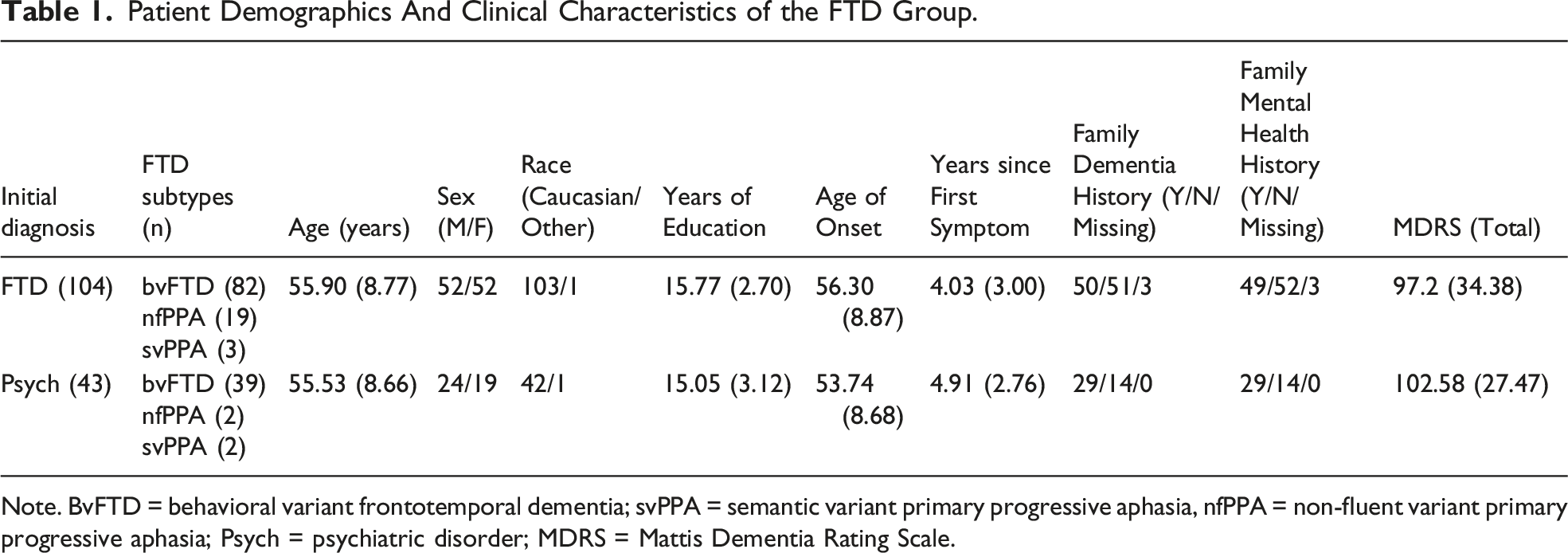
Note. BvFTD = behavioral variant frontotemporal dementia; svPPA = semantic variant primary progressive aphasia, nfPPA = non-fluent variant primary progressive aphasia; Psych = psychiatric disorder; MDRS = Mattis Dementia Rating Scale.
A third group of participants who received initial diagnoses that were neither psychiatric nor FTD (n = 31) was included in descriptive analyses for complete capture of all initial diagnosis types and frequencies. This third group included, for example, Alzheimer’s Disease, seizures, and chemotherapy, and was not included in the comparative analyses between FTD and psychiatric initial diagnoses. This group, which was quite diverse in terms of initial diagnosis, was not further assessed in the comparative analyses as it did not directly relate to the central research question of distinguishing psychiatric from neurodegenerative processes for accurate identification of FTD populations. 1 participant was excluded from all analyses due to a missing “Age of Onset.”
Variables
Frequencies of initial idiopathic psychiatric diagnosis and misdiagnosis type were assessed based on chart review and open-ended responses of patients and informants collected at the time of the visit by a research assistant. Analyzed participants were thus categorized as initial FTD diagnosis (‘FTD Group’) or initial idiopathic psychiatric diagnosis (‘Initial Idiopathic Psychiatric Diagnosis Group').
The following variables of interest collected directly at the time of the visit were also assessed based on the existing literature describing FTD misdiagnosis3-5,11,18: gender (man vs. woman), education (years), age of onset (years), family history of psychiatric illness (history vs. no history), and family history of neurodegenerative illness (history vs. no history). Exploratorily, time to accurate diagnosis was assessed in both the FTD and the Initial Idiopathic Psychiatric Diagnosis Group based on participants’ self-reported “Months since Symptom Onset” and “Months since Diagnosis.” On average, these analyses suggested an average delay of 4 years from symptom onset to FTD diagnosis in those with an initial psychiatric diagnosis (M = 50.1 mos, R = 8 – 121 mos), compared to a 3-year delay in the FTD group that was initially accurately diagnosed (M = 36.2 mos, R = 2 – 213 mos). These analyses are considered exploratory due to the high proportions of missing data (12% in Initial Idiopathic Psychiatric Diagnosis group, 41% in FTD group) as well as several outlier values in the FTD group.
An additional variable — ‘First Symptom Type’ — was assessed based on information collected at the time of the visit. Specifically, ‘First Symptom Type’ was categorized by a geriatric psychiatrist based on the open-ended range of ‘First Symptom’ responses collected by the research team at the time of the visit. Based on the raw data, two systems of categorization were created. The first was a coarse binary model of ‘Behavioral and Social/Emotional’ vs. ‘Cognitive and Language.’ The second was a more fine-grained model which allowed for ‘Behavioral’ vs. ‘Social/Emotional’ vs. ‘Cognitive’ vs. ‘Language’ comparison. Broadly, ‘Behavioral’ symptoms were action-based, such as picking or other repetitive activities. ‘Social/Emotional’ symptoms involved changes in interpersonal interest and activities (eg, violating social rules) or changes in affect and emotion, including emotional blunting and changes in mood and anxiety. ‘Language’ symptoms represented those that involved changes in verbal functioning. ‘Cognitive’ symptoms captured general changes in thinking skills, excluding social cognition.
Data Analysis
A logistic regression analysis was conducted with group (FTD Group vs. Initial Idiopathic Psychiatric Diagnosis Group) as the outcome variable and Gender, Education, Age of Onset, Family History of Psychiatric Illness and Family History of Dementia as predictors in the model. The regression analysis was conducted using SPSS v26, and the analytic approach and results verified by a statistical expert using R.
Two additional, separate, logistic regression analyses were conducted to investigate the relationship between ‘First Symptom Type’ and initial psychiatric diagnosis: the first model was conducted with the coarsely-defined, two-level categorization of first symptoms as predictors (Behavioral and Social/Emotional vs. Cognitive and Language), while the second model was conducted with the more refined, four-level categorization of the first symptoms (for Behavioral vs. Social/Emotional vs. Cognitive vs. Language). Analyses conducted on ‘First Symptom Type’ were considered exploratory because these variables were interpreted following completion of the original study, and because they were based on post-hoc clinician judgment and thus likely more subjective than the other variables in the analyses.
For all analyses, statistical significance was defined at the
Results
Initial Psychiatric Diagnosis Frequency
Of the 178 total patients reviewed, 104 (58%) were initially accurately diagnosed with an FTD spectrum illness, 43 (25%) initially received an initial idiopathic psychiatric diagnosis, and 31 (17%) were initially misdiagnosed with other conditions, including other neurodegenerative disorders. Of the 43 who initially received a full or partial psychiatric diagnosis, 20 (46.5%) reported a first diagnosis of Major Depressive Disorder or related (ie “depression”). This was followed by 3 (6.98%) who reported Bipolar Affective Disorder, Schizophrenia or a combination of the 2 as the first diagnosis. An additional 2 (4.65%) reported anxiety as a first diagnosis. The remaining 18 were categorized as other initial idiopathic psychiatric diagnosis, and included such initial diagnoses as “Adjustment Disorder,” “PTSD,” and “Stress.”
Correlates of Initial Idiopathic Psychiatric Diagnosis
Initial Idiopathic Psychiatric Diagnosis Correlates.


Associations with initial idiopathic psychiatric diagnosis.
Years of education (B = −.135, P = .056) did not reach the level of statistical significance. Inspection of the estimates suggests that additional years of education may be meaningfully associated with a lower likelihood of initial idiopathic psychiatric diagnosis, as the FTD group had a mean education of approximately 16 years while the Initial Idiopathic Psychiatric Diagnosis group had a mean education of approximately 15 years (Figure 2). Initial idiopathic psych diagnosis by symptom type.
The remaining variables in the model (‘Age of Onset’, ‘Gender’) were not statistically significantly related to initial idiopathic psychiatric diagnosis (B = −.023, P = .316; B = .212, P = .592).
Exploratory Analyses of First Symptoms
Coarse First Symptoms.

Fine-grained First Symptoms.

Discussion
The goal of this study was to characterize initial idiopathic psychiatric diagnosis within an FTD population, and to determine whether and how such initial diagnoses are related to demographic and family history factors. We found that psychiatric initial diagnoses were indeed frequent, impacting 25% of the participants in this sample. However, in our sample, initial psychiatric diagnoses were less frequent than the 50% rate found in a comparable population. 3 Within the current sample, MDD was the most frequent misdiagnosis, which aligns with prior findings.3,18 An exploratory analysis of first symptom types suggested that early social and emotional symptoms may be especially linked to initial idiopathic psychiatric diagnosis in FTD populations, though the possibility of real, simultaneous psychiatric processes must also be noted. Nonetheless, these differences in initial diagnoses were linked with demonstrable implications, even in this population. A crude assessment of delay from symptom onset to accurate diagnosis suggested that those encountering an initial psychiatric diagnosis experienced delays of 4 years on average to accurate FTD identification compared to 3 years in those initially accurately classified, in line with prior research.(3,7) Overall, these descriptive findings support the existing literature to indicate that initial idiopathic psychiatric diagnosis is indeed an important issue confronting FTD patients and their caregivers.
Correlates of Idiopathic Psychiatric Misdiagnosis
We found that a family history of psychiatric illness was associated with an initial idiopathic psychiatric diagnosis, which aligns with the existing literature.(3,18) However, two other findings — the positive association between family history of dementia and initial idiopathic psychiatric diagnosis and the potential association between fewer years of education and initial idiopathic psychiatric diagnosis — are unique to the current study. Thus far, no similar relationship has been reported between family history of dementia and initial idiopathic psychiatric diagnosis, and, contrary to our findings, years of education has previously been found to positively correlate with initial idiopathic psychiatric diagnosis.(3)
We posit a speculative explanation for the family history of dementia finding: Non-FTD dementias are likely to be overrepresented in the reporting of familial dementia history, given the rarity of FTD in the general population 19 and the relative dearth of FTD genetic mutations in this particular cohort (<10%). As FTD onset is quite distinct from the initial presentation of most other dementias, 20 family members may not be attuned to the relevant symptom development. Even, and perhaps especially, if family members are familiar with other neurodegenerative disorders, they may be on the lookout for characteristic memory decline or cognitive symptoms later in life and miss early behavioral, social and emotional signs of FTD arising in mid-life. Notably, the above analyses were replicated controlling for the presence of a familial FTD genetic mutation covariate, and the findings remained essentially the same.
The negative association between age of onset and initial idiopathic psychiatric diagnosis in FTD, though statistically non-significant in our sample, was consistent with existing findings.(3) Individuals in our sample who were psychiatrically misdiagnosed were, on average, roughly 3 years younger than those who initially received an accurate FTD diagnosis; previous literature has found a difference of 5.5 years.(3) In aggregate, these findings suggest that age of onset may be an important variable to consider in patient diagnosis. In our sample, there did not appear to be a relationship between gender and initial idiopathic psychiatric diagnosis, which contradicts a previously described association between being female and obtaining an initial idiopathic psychiatric diagnosis.(3) This also highlights the need for additional investigation into this area.
Exploratory Analyses
The exploratory analyses provide a starting point for future investigation, as the post-hoc symptomatologic categorizations were, by necessity, coarse. The significant association between broadly-conceived behavioral initial symptoms and initial idiopathic psychiatric diagnosis is relevant considering that behavioral symptoms are known to be central presenting features of FTD.2,5,6,20,21 As behavioral symptoms are also core to psychiatric illness, it is perhaps unsurprising that these would be linked. Nonetheless, the association may offer a point of reference which could be helpful for clinicians.
The fine-grained breakdown of behavioral symptoms demonstrated that jointly categorized social and emotional changes are most strongly associated with initial idiopathic psychiatric diagnosis. Such changes are highly associated with psychiatric illnesses, which are more common in the general population than FTD. 12 However, FTD, a much rarer diagnosis, is also highly associated with initial changes to social and emotional functioning, often perceived as personality changes. 2 Depression, among the most common and debilitating disorders globally, 12 and also the most common misdiagnosis in this group, could be a particularly illustrating example of this effect.
These exploratory findings are primarily useful in validating the expectation that behavioral symptoms are more likely to lead to assumptions of psychiatric processes when underlying neurodegeneration may be at play. Nonetheless, research into this area could promote increasing awareness among clinicians about the overlap between FTD and primary psychiatric disorders, as well as more readily available tools to discriminate these pathologies by symptoms. There is already some evidence that novel and nontraditional tests of social, emotional and cognitive functioning can differentiate FTD from MDD with high specificity and sensitivity. 22 Furthermore, a relatively straightforward clinical tool, the “FTD vs. Primary Psychiatric Disorder (PPD) Checklist,” has shown promising results in the differentiation of such disorders. 23 This tool makes a particular effort to query for features that would make an FTD diagnosis both more likely (e.g., changes in food preferences) and less likely (e.g., dysphoria, guilt, self-blame). We suggest that a careful and comprehensive evaluation of all presenting features could be useful in differential diagnosis.
Limitations and Future Directions
One major limitation of this study is that the data are over 10 years old. In the years since, diagnostic capacity has increased through advances in genetic, imaging, pathologic and neuropsychological assessment, 23 which were not applied in this study sample. However, there is no strong evidence to suggest that early identification of the disorder has improved and thus we posit that these findings remain relevant. It is likely that cases in younger cohorts continue to be overlooked, as FTD is estimated to account for 10.2% of dementia occurrences in individuals under 65. 21 A second potential limitation is the possibility of recall bias as participants had to recollect their diagnostic experiences. Though chart review was incorporated, that can involve its own limitations, such as missing entries or incomplete notes, such as cases where practitioners may have withheld initial judgement on the possibility of neurodegenerative processes. Furthermore, the longer-term outcomes of initial ‘misdiagnostic’ work-up were not investigated. It is possible that in certain cases, early treatment of depression, for example, may have been an efficacious approach for symptom management. This is an important area of investigation for future research. Likewise, exploratory analyses of first symptom type could benefit from replication using established and validated scales to capture first symptoms, in comparison with the open-ended reporting and subsequent categorization used here. Similarly, future studies evaluating the proportion of patients with FTD who actually meet DSM criteria for psychiatric diagnoses would add meaningfully to the literature. Lastly, and very importantly, by nature of the week-long, in-person study design, this cohort of FTD patients was self-selected and quite homogenous in terms of race/ethnicity and education. Specifically, the patients reviewed were mostly white (98.6%) and highly educated (∼15 years). It seems reasonable to assume that patients in the general healthcare system may not encounter equivalent care, which could have significant implications for misdiagnosis and time to diagnosis for many legitimate FTD cases. The questions in this paper and current understanding of this disorder will significantly benefit from increasing the diversity of research participants.
Implications and Conclusion
The findings from this study build upon existing literature to affirm that initial idiopathic psychiatric diagnosis is a concern in the timely identification and appropriate management of FTD. Inaccurate or incomplete initial diagnoses can be highly burdensome to the patient, caregiver, and healthcare system. More accurate initial diagnosis, and thus reduced burden in these areas, may be informed by understanding the factors associated with misdiagnosis. Several such factors have been analyzed and reviewed in this paper toward the aim of supporting clinicians faced with this complex diagnosis.
Footnotes
Acknowledgments
We thank Karen Detucci and Alyson Cavanagh for patient testing. We thank Amelia Boehme, PhD, MSPH, for her support with database review. We thank the patients and caregivers who participated in this study, without whom this work would not be possible.
Author Contributions
EDH and JG oversaw the design and data acquisition of this study. CAS and JD performed statistical and imaging analyses. CAS and EDH drafted the manuscript, and all other authors were involved in data interpretation, review and contribution to the manuscript, and have approved the final version.
Declaration of Conflicting Interests
The author(s) declared no potential conflicts of interest with respect to the research, authorship, and/or publication of this article.
Funding
The author(s) disclosed receipt of the following financial support for the research, authorship, and/or publication of this article: This work was supported by the Intramural Research Program of The National Institutes of Health / The National Institute of Neurological Disorders and Stroke, by a grant from the Division of Extramural Research of The National Institutes of Health / The National Institute of Neurological Disorders and Stroke to EDH [R00 NS060766].
