






Abstract
Purpose
Delirium is a common yet preventable complication of hospitalization, surgery and illness that is associated with poor outcomes. Older adults with Alzheimer’s Disease and Related Dementias (ADRD) are especially vulnerable to delirium and experience greater delirium severity, yet no existing assessment tool is specifically designed to evaluate this vulnerable population. This study will validate two new delirium severity instruments, the Delirium Severity (DEL-S) rating for all older adults and the Delirium Severity Rating in ADRD (DEL-S-AD) for patients with dementia.
Design/Setting and Participants
The Better ASsessment of ILlness II (BASIL II) study is an innovative prospective cohort study that measures cognitive function, delirium, delirium severity, demographics, clinical and functional variables and clinical outcomes. Participants include older adults from 3 unique yet complementary clinical sites: medical inpatients, elective surgery inpatients, or skilled nursing facility residents.
Methods
Performance of DEL-S and DEL-S-AD items in older adults with cognition ranging from no impairment to moderate impairment will be determined. Analyses will include psychometric characteristics of DEL-S and DEL-S-AD items, harmonization of the two scales and validation against reference standard diagnoses.
Conclusions and Implications
Results from this study will help accurately measure delirium severity, a critically important, graded outcome. The DEL-S-AD instrument holds broad applications in persons with and without ADRD to monitor delirium severity in clinical settings, and as an outcome measure in future clinical treatment trials and pathophysiologic studies. Ultimately, the DEL-S and DEL-S-AD have the potential to improve health care for the vulnerable, growing population of older adults with cognitive impairment worldwide.
Introduction
An estimated 12 million older Americans experience delirium each year, 1 with excess annual health care costs of over $164 billion attributable to delirium. 2 The significance of delirium is heightened in Alzheimer’s Disease and Alzheimer’s Disease Related Dementias (ADRD), where it occurs with increased frequency (4-5-fold risk) and severity compared to those without ADRD. 3 Persons with ADRD who experience delirium have worse long-term outcomes, including accelerated cognitive decline, rehospitalization, institutionalization, and death.4-7 For these reasons delirium prevention and treatment strategies are a priority, and intervention trials are greatly needed.
Delirium severity, defined as the intensity or degree of delirium symptoms, provides a graded, continuous measure which holds great potential for advancing our understanding of delirium. Most delirium severity instruments use additive scoring of presence and severity of symptoms and behaviors. 8 In clinical practice, monitoring delirium severity has been used in tracking patients’ clinical recovery and prognosis, and estimating patient case-mix, potential staffing needs and costs. 9 In research, delirium severity can be used for risk stratification of patients for intervention studies, and as a responsive, graded outcome for clinical trials or biomarker studies of delirium.
In our previous systematic review of 228 articles, we identified 42 delirium severity instruments, of which 6 met prespecified criteria as high-quality measurement instruments for delirium severity (ie, frequency of use, methodologic quality, construct or predictive validity, broad domain coverage). The most commonly used instrument was the Confusion Assessment Method (CAM) including the CAM-S, followed by the Delirium Rating Scale, and the Memorial Delirium Assessment Scale. Each instrument has unique strengths and limitations dependent on the intended clinical or research use and setting. 8 For example, the most widely used delirium severity measure, the CAM-S, is limited in that it does not include a cognitive assessment, patient self-report, or psychometrically derived items. Another common problem is that many instruments tend to emphasize hyperactive delirium symptoms (such as agitation). Furthermore, an important weakness of the CAM-S, as well as the other existing delirium severity instruments, is that none were specifically developed or validated for use in persons with ADRD. The lack of systematic development and validation of a delirium severity instrument specifically for use in persons with ADRD or underlying cognitive impairment therefore remains an important gap in the field. 11
Despite the obvious importance of measuring delirium severity in persons with ADRD, this population does present unique challenges. ADRD and delirium share cognitive impairment, including inattention and memory impairment, as a key diagnostic criterion, 10 so it can be difficult to accurately detect delirium and quantify symptoms of delirium vs coexisting dementia, 11 and to date, the field has been lacking systematic development and validation of delirium severity instruments specifically for use in persons with ADRD or underlying cognitive impairment. 12
In our prior work, we described the development and validation of the DEL-S for delirium severity measurement in all older adults. By using state-of-the art psychometric approaches and including cognitive test items, patient self-report, and observer-rated items, the DEL-S addresses limitations of prior delirium severity instruments.12-14 We now extend this work to a new measure for delirium severity in persons with ADRD, where distinguishing delirium and dementia features may be quite challenging. In previous studies, we organized three interdisciplinary expert panels to review the literature and identify key domains and items for inclusion in the new instrument for delirium severity in ADRD.13,14 We utilized a modified Delphi process, multiple iterative discussion rounds, qualitative assessments and factor analysis to develop an instrument (across 7 content domains and 21 subdomains) to test across multiple sites.13,15
The objective of the present study is to describe the novel study design and rigorous methods for this complex multi-site field study designed to test and validate the DEL-S and DEL-S-AD items for measurement of delirium severity in persons with and without ADRD.
Methods
Study Overview
The Better ASsessment of ILlness (BASIL) II study is a three-site prospective cohort study with a planned sample size of 500 older adults to evaluate the validity of items for two new delirium severity instruments, the Delirium Severity (DEL-S) rating for all older adults and the Delirium Severity Rating in Alzheimer’s and other Dementias (DEL-S-AD) specifically for persons with mild to moderate ADRD. Patients with and without ADRD are enrolled across 3 sites: acute medical inpatients (Site 1), scheduled surgical inpatients (Site 2), and long-term and post-acute care residents (Site 3). At all sites paired delirium severity assessments are conducted, where clinical assessors (CA) administer standardized assessments and research associates (RA) administer the items for the DEL-S and DEL-S-AD. Sites 2 and 3 include separate baseline assessments of cognitive and physical function, whereas this information is obtained concurrently with the paired assessment at Site 1 (described below). All clinical assessments are adjudicated by an expert panel for a final consensus reference standard diagnosis. Study enrollment occurred between April 13, 2021-April 25, 2024; and follow-up for clinical outcomes on all participants is ongoing.
Analyses will evaluate: (1) psychometric characteristics of the DEL-S and DEL-S-AD items and harmonization of the two scales on a unified metric; and (2) validity of the new instruments relative to the reference standard diagnoses. The conceptual framework of the BASIL II Study is illustrated in Figure 1, demonstrating the steps of instrument development and validation. The present study describes the design and methods for the ‘Field Study’ step. Conceptual diagram for BASIL II Study. Legend. The figure illustrates two epicycles of measurement development, one focused around construct definition and the other around measurement testing and evaluation. Our completed stages are shown in gray arrows, current stage in green, and future stages in white. Similar frameworks have been described previously (De Vet et al, 2011).
39
The construct definition cycle is primarily qualitative and relies upon expert and clinical input. The activities in this cycle include domain identification and definition, a process that is informed by systematic literature review and expert consensus processes, and pilot testing of items (to assess the face validity of developed items). In the testing and evaluation cycle, a formal field test of new instruments is fielded, followed by a set of validation studies that involve psychometric data analyses and predictive and clinical validation. Finally, new instruments must be disseminated and continually revised.
Study Sites and Participants
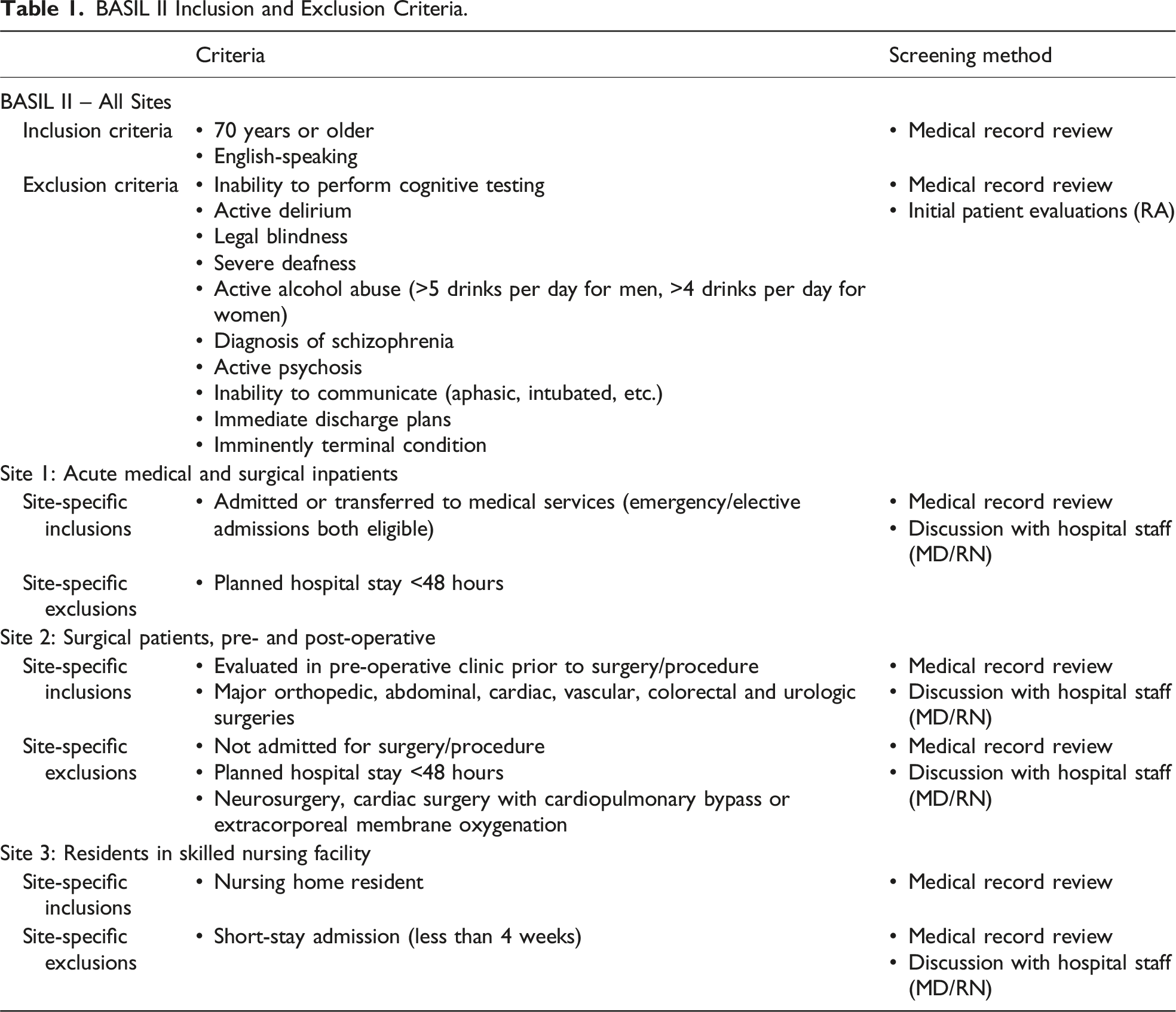
We chose three study sites to capture diverse settings in which older patients are commonly at risk for delirium, thereby allowing optimal testing of internal validity and maximizing external validity. A total of 500 participants are planned to be recruited from: Site 1- acute medical inpatients at Beth Israel Deaconess Medical Center (BIDMC) in Boston, MA (target n = 200); Site 2 - elective surgical inpatients at University of Florida (UF) Hospital in Gainesville, FL (target n = 150); and Site 3 - long-term and post-acute care residents at The New Jewish Home (TNJH) in New York, NY (target n = 150). BIDMC is a large academic tertiary medical center with 673 beds and over 40,000 admissions/year. UF is a large academic medical center in Gainesville, FL, with 1162 beds, 40,000 admissions and 15,000 surgeries/year. TNJH is an academic nursing facility in New York City affiliated with New York University and Mount Sinai Health Centers, with 514 beds total (164 beds for post-acute care) and 127 new long-term admissions/year.
BASIL II Inclusion and Exclusion Criteria.
Study Recruitment
Potentially eligible participants are identified initially by electronic health record reports and/or manual review. Once identified, potential participants are approached by research staff to obtain verbal consent for study participation. Participants who fail a standard capacity assessment are considered unable to provide consent. If these participants assent to participate, verbal consent is obtained from their legally authorized representative. 16 All study procedures including informed consent are approved by the BIDMC (Site (1) Institutional Review Board with ceded review from UF (Site (2) and TNJH (Site 3). Hebrew SeniorLife in Boston, MA, is the study coordinating center.
Enrollment Flow and Timing of Assessments
The enrollment flow and timing of assessments at each site are detailed in Figure 2. At Site 1, the paired CA/RA assessment occurs at the time of enrollment, during the hospital admission (acute timepoint). For Site 1 participants there is no pre-admission baseline assessment. At Sites 2 and 3, enrollment occurs prior to surgery or an acute illness episode and a baseline assessment is completed at the time of enrollment. At Site 2 the paired CA/RA assessment is conducted on postoperative day 1 or 2. Because an acute illness episode is unpredictable, Site 3 planned to recruit and collect baseline assessments in excess of the enrollment goal in order to achieve n = 150 paired assessments. After enrollment, Site 3 participants are monitored daily by the RA using reports from the site’s electronic medical records to identify acute illness episodes,
17
suggested by fever and falls; new antibiotics or vaccinations; new intravenous fluids or other intravenous medications; and new return from hospitalization.
18
When an acute illness episode occurs at Site 3, a paired CA/RA assessment is conducted on Day 1 or 2 of the acute illness (acute timepoint). At Site 3, baseline interviews were repeated annually to account for cognitive changes over time. Paired assessments could be repeated once (per resident) if a second acute illness episode occurs at least 30 days after the first acute illness. At all sites, CA and RA assessors are strictly blinded to each other's acute illness/timepoint assessment ratings at all times. The paired CA-RA assessments are expected to occur within 2 hours of each other and the order of assessments will be alternated as much as possible. At all three sites, follow-up assessment for clinical outcomes will be conducted one month after the paired CA-RA acute assessment by the RA through patient or proxy interview and medical record review. One year clinical outcomes will be obtained from administrative data and medical record review. Enrollment flow and sequence of assessments. Legend. The figure describes the enrollment flow and sequence of assessments at the 3 individual sites for baseline, acute and 1-month follow-up time points. It also shows who performs the assessments, Research Associates or Clinical Assessors.
On average, CA enrollment assessments took 30-35 minutes per participant and 15 minutes per caregiver then an additional 10-15 minutes for the paired rating. The RA assessments took 10-15 minutes for the paired rating. Since the study involved only 2 hospital interviews, the study burden for the patient is relatively low.
Study Variables
Measures and Timepoints for Key Study Variables.
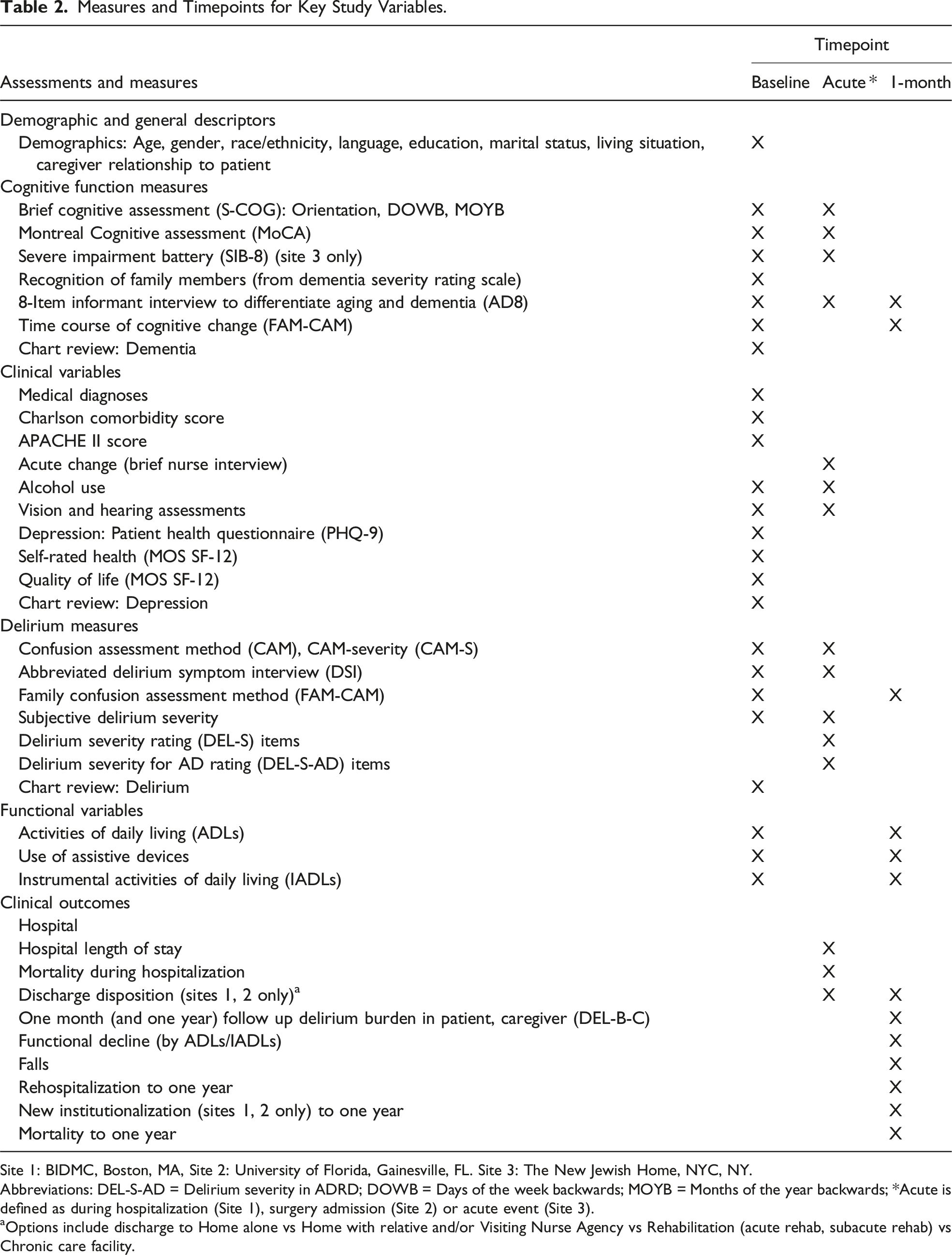
Site 1: BIDMC, Boston, MA, Site 2: University of Florida, Gainesville, FL. Site 3: The New Jewish Home, NYC, NY.
Abbreviations: DEL-S-AD = Delirium severity in ADRD; DOWB = Days of the week backwards; MOYB = Months of the year backwards; *Acute is defined as during hospitalization (Site 1), surgery admission (Site 2) or acute event (Site 3).
aOptions include discharge to Home alone vs Home with relative and/or Visiting Nurse Agency vs Rehabilitation (acute rehab, subacute rehab) vs Chronic care facility.
DEL-S and DEL-S-AD
The DEL-S 19 is a brief assessment tool designed to rate the severity of delirium symptoms; it was previously developed and validated in the BASIL I derivation sample.19,20 In prior work, the DEL-S demonstrated high reliability and construct validity for prediction of relevant clinical outcomes. 17 The DEL-S includes a brief cognitive assessment (orientation, days of the week backward, and months of the year backward), and is administered by the RAs.
The DEL-S-AD assessment tool has been under development over several years prior to the launch of the current study. To create the panel of potential items to be included in the DEL-S-AD, an external expert panel met to identify key domains and subdomains. 21 This was followed by a local expert panel that identified potential items and raters for these items. 22 In the present study, we are testing 27 potential items identified through this process for inclusion in the DEL-S-AD. The potential DEL-S-AD items will be administered by RAs to multiple raters, including patient, family member, nurse or nursing aide; some items will be rated by the RAs directly (See Appendix Table 2 for potential items). Subsequently, psychometric analysis will be used to select the best items and raters for each item, and the final DEL-S-AD instrument will be created.
Clinical Assessment
Delirium Assessment Measures: Delirium is assessed at baseline, and a paired blinded delirium assessment is conducted at the acute time point. The CAs interview care partners, usually family members, for the presence of baseline symptoms of delirium or cognitive impairment along with timing of onset using the Family Confusion Assessment Method (FAM-CAM) 23 and look for previous delirium or cognitive diagnoses in the medical record. CAs complete a nurse interview at baseline and acute timepoints to evaluate for acute change in mental status, and to assess for any newly started medications (antipsychotic, benzodiazepine, ramelteon) or use of a sitter. At baseline and during hospitalization/acute timepoints, CAs obtain the Abbreviated Delirium Symptom Interview (DSI) 24 from patients. CAs determine delirium presence using the Confusion Assessment Method (CAM), 25 a standardized 10-question delirium assessment with 94% sensitivity, 89% specificity, and inter-rater reliability of 0.70-1.00. 26 The CAM is scored based on observations made during a structured interview including brief cognitive testing (described below); acute change and reduced or fluctuating consciousness are rated based on proxy-report or interviewer observations. Delirium severity is measured with the CAM-Severity (CAM-S) 9 with a score scale of 0-19, 19 = most severe delirium.
Cognitive Function Measures: CAs assess cognition using the Montreal Cognitive Assessment (MoCA), 27 the 8-item informant interview to differentiate aging and dementia (AD8), 28 and the family or proxy-rated Dementia Severity Rating Scale (DSRS). 29 The medical record is reviewed for baseline dementia status. Because cognitive impairment is often more severe among nursing home residents, the Severe Impairment Battery (SIB-8) 30 is administered at baseline at Site 3. The MoCA and SiB-8 were the cognitive tests used to rate the CAM. 31
Other Study Variables: Demographic data are gathered at baseline through patient and informant interviews conducted by CAs and from medical record review. Clinical data including medical diagnoses, Charlson Comorbidity Index score, 32 Acute Physiology and Chronic Health Evaluation II (APACHE II), 33 intercurrent medical illnesses and previous diagnosis of depression are obtained from the medical record. CAs administer the Patient Health Questionnaire (PHQ-9) 34 depression scale at baseline. RAs assess the patient’s baseline vision, hearing, and alcohol use at the time of hospitalization.
Functional variables are obtained from patients and informants at baseline by CAs and at 1-month by RAs. CAs also obtain the Medical Outcomes Study Short Form 12 (MOS SF-12) 35 Self-rated Health and Quality of Life scales at baseline from patients. At 1-month follow-up, medical records are reviewed for hospital length of stay and mortality. Medical records for participants at Sites 1 and 2 are also reviewed for new institutionalization. RAs interview caregivers (both informal and formal) to obtain the Delirium Burden in Caregiver rating (DEL-B-C).
Clinical Assessor and Research Assistant Training and Standardization
CAs are expert clinicians and advanced clinical fellows who undergo training and standardization for reliability in administering and scoring of all instruments, along with observed interviews by each Site PI. At twice-monthly meetings, cases are reviewed for purposes of CA standardization. RAs are experienced bachelor and master level interviewers who undergo comprehensive training and standardization. Case presentations and coding questions are addressed in bi-weekly meetings to achieve and maintain standardization.
Interdisciplinary Expert Panel Adjudication Procedures
Diagnoses of delirium, mild cognitive impairment (MCI) and dementia are determined by a standardized adjudication process. A panel of clinical experts independently review data collected during the CA assessments and assign a diagnosis for the presence and severity of delirium and dementia. Adjudicators are blinded and consensus is defined as agreement on diagnosis by 4 or more of the 5 adjudicators. Cases not meeting consensus are brought to a meeting where all adjudicators review and discuss the case, followed by a modified Delphi approach until consensus is achieved.
For the consensus panel diagnosis, the presence or absence of delirium is determined following DSM-5 criteria. 10 Delirium severity is rated using a single item score that represents the rater’s subjective impression of delirium severity. Scores ranged from 0 to 10 (most severe), categorized into 4 major categories: 0, no delirium; 1-3, mild delirium (subsyndromal); 4-6, moderate delirium; 7-10, severe delirium. For patients with scores in the no-mild delirium severity categories, the team is instructed to adjudicate first to confirm the presence of subsyndromal symptoms and then to confirm the level of delirium severity. 36 The presence of Minor (MCI) or Major (Dementia) Neurocognitive Disorder is determined using all available data, following DSM-5 criteria 10 and clinical judgment. Dementia severity of “very mild” was assigned to cases determined to have Minor Neurocognitive Disorder whereas Major Neurocognitive Disorder was rated as “mild,” “moderate,” or “severe” using the Clinical Dementia Rating Scale descriptions for CDR 1-3 as a guideline.
Data Management and Planned Analysis
Rigorous data quality procedures are instituted for careful monitoring and minimization of missing data, as previously used for other studies by our group. There are regular staff trainings, meetings addressing coding questions, inter-rater reliability assessments, database programming and cross-check, and data quality report reviews. The data capture system is programmed with automated data quality and error checking algorithms.
In our planned analyses, our study will first evaluate the validity of the DEL-S delirium severity measure. We will confirm the unidimensional structure of the DEL-S described in the derivation study, 37 and examine DEL-S internal consistency, convergent validity with other delirium severity instruments, and predictive validity. Second, we will select optimal candidate items to include in the DEL-S-AD. Along with an expert panel, we will identify items with clinical relevance and sufficient prevalence to include in the final instrument. We will apply item response theory (IRT) methods to further evaluate items for their correlation with delirium severity to assist in the final variable selection for inclusion in the new DEL-S-AD instrument. Calibration analyses will be performed to harmonize the DEL-S and DEL-S-AD instruments. Lastly, we will use the complete prospective cohort to evaluate performance of the DEL-S and DEL-S-AD across different levels of cognitive function, ranging from normal cognition to moderate ADRD.
Discussion
The BASIL II study holds the potential to yield substantial advances for the delirium field, with novel validation of new delirium severity measures, the DEL-S and DEL-S-AD, for patients with and without dementia following rigorous psychometric approaches. This is a difficult area to study, given that delirium and dementia may have overlapping features. The complexity of the study design and approach warrant detailed description. While complex, this unique study design and approach allows for validation across three diverse study samples, enhancing both internal and external validity. Due to overlapping symptom presentation in delirium and dementia, delirium is often unrecognized or misdiagnosed in people with dementia, resulting in lack of appropriate management and treatment, which may be life-threatening. The DEL-S-AD directly targets this longstanding and intractable problem, and will provide an accurate and graded outcome measure for treatment trials.
Several clinically novel features distinguish our current study. Our sample includes patients from three demographically diverse sites, allowing recruitment from a broad range of baseline cognitive functioning. The paired ratings allow for real-time concurrent validity assessments. The variability of settings, clinical conditions and cognitive abilities in our sample will strengthen the generalizability of our results. The rigorous methodology in BASIL II is also a unique strength. Robust training procedures with ongoing standardization of CAs and RAs have been implemented; rigorous data quality measures are also in place.
Extensive assessments are conducted on study participants, which will improve the certainty of distinguishing between delirium and dementia during the acute phase evaluation. Participants are assessed for delirium by a pair of CA and RA assessors applying standardized criteria. This paired assessment, to be completed within 2 hours of each other and in alternating order, will allow us to collect and validate data on how well the DEL-S and DEL-S-AD items perform. Finally, to enhance validity of the results, CA ratings will be adjudicated by an expert consensus panel to rigorously establish a final reference standard diagnosis.
Some limitations should be noted. For the acute medical site (Site 1), we do not have baseline cognitive function for participants prior to hospitalization as they are recruited for enrollment after admission. This may cause difficulty in differentiating delirium from dementia in some cases. However, extensive structured interviews are conducted with caregivers to characterize the participants at baseline. ICU and palliative care patients were not included in this study, high risk populations for delirium who will be important to include in future studies. We excluded people with advanced dementia due to their inability to engage with interviews and provide reliable self-reports. Future work will be needed to test the DEL-S-AD in persons with severe dementia.
Conclusions and Implications
The BASIL II study aims to develop and validate the first delirium severity assessment tool designed to evaluate delirium severity in persons with ADRD. This study describes the field study intended to refine the DEL-S-AD items for measuring delirium severity in ADRD, test the DEL-S and DEL-S-AD instruments against reference standard ratings, and test concurrent and predictive validity of both instruments in patients with and without ADRD. Importantly, once fully validated, the DEL-S and the DEL-S-AD will be made freely available for use, which will be a major advance for the field and provide a critical tool for all settings caring for older adults, particularly Age-Friendly Health Systems. 38 Ultimately, the DEL-S-AD instrument holds broad applications for monitoring delirium severity in clinical settings in persons with and without ADRD. It will provide a dynamic, continuous outcome measure for all future delirium studies, including clinical trials, pathophysiology, and biomarker studies. It will allow for stratification of high-risk patients both clinically and in research studies for persons with and without ADRD. These measures hold great promise to improve health care and clinical research broadly for the vulnerable, growing population of older adults with cognitive impairment worldwide.
Supplemental Material
Supplemental Material - Better Assessment of Illness Study (BASIL) II for Delirium Severity: Study Design, Variables, and Methods
Supplemental Material for Better Assessment of Illness Study (BASIL) II for Delirium Severity: Study Design, Variables, and Methods by Tammy Hshieh, Ben Chapin, Wingyun Mak, Guoquan Xu, Eva Schmitt, Edward R. Marcantonio, Hannah Shanes, Cole Heine, Jordan Helfand, Catherine Price, Kenneth S. Boockvar, Eran D. Metzger, Tamara G. Fong, Richard N. Jones, Sharon K. Inouye, for the BASIL II Study Group in Journal of Geriatric Psychiatry and Neurology.
Footnotes
Acknowledgements
BASIL II Study Group [Presented in alphabetical order; individuals listed may be part of multiple groups, but are listed only once under major activity, listed in parentheses.]. Overall Principal Investigators (Multi-PIs): Sharon K. Inouye, MD, MPH (Overall PI, HSL, BIDMC, HMS); Richard N. Jones, ScD (MPI, Brown University). Co-Investigators: Ken Boockvar, MD, MS (TNJH, UA, BVA); Tamara Fong, MD, PhD (HSL, BIDMC, HMS); Wingyun Mak, PhD (TNJH, ISM); Edward R. Marcantonio, MD, SM (BIDMC, HMS); Catherine Price, PhD, ABPP-CN (UF); Eva Schmitt, PhD (HSL). Gold Standard Panel: Eran Metzger, MD (HSL, BIDMC, HMS). Clinical Assessors: Rebecca Avila-Rieger, PhD (TNJH); Juliana Burt, MS (UF); Benjamin Chapin, MD (UF); Rejoice Dhliwayo, BS (BIDMC); Kristin Hamlet, PhD (UF); Yael Koren, PhD (BIDMC, HSL); Anna MacKay-Brandt, PhD (TNJH, NKI); Mariam Mufti, MD (UF); Kerry Palihnich, BA (BIDMC); Estefania Perera, BA (UF). Research Associates: Amina Atef Abdelalim (BIDMC); Sabaina Ahmed (UF); Liliane Fanburg (BIDMC); Erin Formanski (UF); Cole Heine (HSL); Margret Howard (TNJH); Faith Kimmet (UF); Julianna Liu (HSL); Gina Michael (BIDMC); Kathryn Pendleton (UF): Abena Prempeh (TNJH); Emily Quig (HSL); Louis Shaevel (BIDMC); Meghan Shanahan (HSL); Hannah Shanes (HSL); Mackenzie Topper (HSL); Peter Wang (BIDMC); Michelle Ward (BIDMC). Data Management and Statistical Analysis Team: Douglas Tommet, MPH (Brown University); Thomas Travison, PhD (HSL, HMS); Guoquan Xu, MD, PhD (HSL). Abbreviations: BIDMC, Beth Israel Deaconess Medical Center; BVA, Birmingham VA Health Care System, Birmingham, Alabama; BWH, Brigham and Women’s Hospital; FOI, Florida Orthopedic Institute; HMS, Harvard Medical School; HSL, Hebrew SeniorLife; ISM, Icahn School of Medicine at Mount Sinai; NKI, Nathan Kline Institute for Psychiatric Research, Orangeburg, NY; PI, principal investigator; TNJH, The New Jewish Home; UA, University of Alabama, Birmingham, Alabama; UF, University of Florida; USF, University of South Florida
Declaration of Conflicting Interests
The author(s) declared no potential conflicts of interest with respect to the research, authorship, and/or publication of this article.
Funding
The author(s) disclosed receipt of the following financial support for the research, authorship, and/or publication of this article: This work was funded in part by the National Institute on Aging grant no. R01AG044518 (SKI/RNJ), R33AG071744 (SKI/RNJ), P01AG031720 (SKI), R01AG030618 (ERM). Dr Price is supported by the PECAN network (K07AG066813). Dr Inouye holds the Milton and Shirley F. Levy Family Chair at Hebrew SeniorLife/Harvard Medical School.
Ethical Statement

Supplemental Material
Supplemental material for this article is available online.
References
Supplementary Material
Please find the following supplemental material available below.
For Open Access articles published under a Creative Commons License, all supplemental material carries the same license as the article it is associated with.
For non-Open Access articles published, all supplemental material carries a non-exclusive license, and permission requests for re-use of supplemental material or any part of supplemental material shall be sent directly to the copyright owner as specified in the copyright notice associated with the article.
