







Abstract
This article critically analyses the current Maltese educational reform process, which aimed to transform educational governance in Malta from a centralized system to a more decentralized one. This longitudinal study adopted a multi-site inquiry of a sample of the colleges involving different stakeholders, including key policy-makers, college principals, heads of primary and secondary schools, and a sample of teachers. It explores the reform by reviewing the relevant literature, studying statutory documents and policies, and researching governance processes at the grassroots level where the reform policies have been and continue to be implemented. It analyses the experience of ‘governing stakeholders’, including those who work in schools, as they engage and work with the reforms. Preliminary findings indicate that what has been created is just another ‘notch’ in the hierarchical structure of the system with the introduction of a new post, that of College Principal, and the setting-up of the Council of Heads, which has managerial and organizational responsibilities, and the non-statutory Council for Educational Leaders (ELC). A top-down approach to change management continues to be adopted, leaving limited space for the development of governance networks and distributed forms of governance. This study sheds light on the significance of governance networks, distributed governance and the effects of overly strong governing relationships between government and the schools at the periphery. We argue that the opportunity to establish and develop a governance network has been missed.
Introduction
Changes to the Maltese Education system in the last 15 years have underpinned notably successful economic and social change. Educational reform and innovation are essential elements in the social and economic development of nations. Malta is no exception. In particular, the Amended Education Act of 2006 required groups of state-maintained schools to collaborate as ‘colleges’, which is a substantial change. The Act speaks of a ‘devolution agenda’, with schools being networked into ten regional colleges, and two education directorates being responsible for supporting and regulating the implementation of reforms rather having top-down bureaucratic management control. Despite that espoused intent, we argue in this article that the reforms and the way they have been implemented represent a missed opportunity to realize the benefits that accrue from a governance system with distributed properties as opposed to one that is more readily characterized as being hierarchical in nature. The empirical basis for the article is a longitudinal study of educational reforms undertaken by Cutajar (2012), and other research into the reforms undertaken by Bezzina (2006) and Cutajar and Bezzina (2012).
We begin the article with an account of the history and background of the reforms. We then summarize the reforms being undertaken. The nature of governance, governance interactions, the nature of a distributed perspective and the benefits that a distributed organizational form can bring are then explored. In the subsequent section, we describe aspects of the reforms where we feel an opportunity has been missed to create a form of governance that has strong distributed characteristics. A discussion section follows and we end with some concluding thoughts.
History and background
In 1964, the Maltese Islands gained independence from the UK and a number of educational reforms were implemented. The main educational landmarks in the history of Maltese Education since Independence are:
secondary education for all in 1970 reviewing the school leaving age in 1974 – the compulsory school leaving age was raised from 14 to 16 in 1988 a new Education Act established the onus of the State to provide compulsory education to all Maltese citizens so as to meet the needs of society, and recognized the professional status of teachers and set up School Councils (Laws of Malta, 1988) 1989 saw the creation of the first National Minimum Curriculum, which attempted to describe what compulsory education was meant to be doing the 1994 new organizational structure of the Education Division saw the creation of the Department of Curriculum Development, Implementation and Review in 2000 there was the publication of the second National Minimum Curriculum.
This reform process has continued and in the last 12 years in particular several major reforms have been introduced, such as the amendment to the Education Act in 2006 and the introduction of the National Curriculum Framework in 2012. Despite these reforms, the Maltese Education System, from kindergarten to university, together with its system of assessment, still tends to follow the British model, arguably because of Malta’s colonial past (Sultana, 1997; Zammit Mangion, 1992). There is a tripartite system of state, church and independent schools. All kindergarten and primary state schools follow a co-educational model, while all secondary state schools are single-sex schools.
The educational system has a large measure of central government control. The Maltese Government has the right to establish the National Curriculum of study for the schools − for example, the design and development of subject areas (Ministry of Education, 1999). Various studies, e.g. Zammit Mangion (1992), provide evidence of the highly centralized and bureaucratic characteristics of the Maltese state educational system. Human resources (e.g. the deployment of staff), assessment (e.g. benchmarking and standards) and quality assurance (e.g. external review) are all controlled centrally. The Education Authority is responsible by law for the provision of an efficient and effective system of schools and ensuring education and training in areas relevant to the needs of Maltese society.
Before the 1990s, the operation of state-maintained schools in Malta was largely dependent on central government policies. In 1989/1990 the Minister of Education initiated the devolution of responsibilities to schools, which began to enhance school autonomy and empowerment. In 2005 the Ministry of Education, Youth and Employment (MEYE) launched an innovative reform with the publication of the seminal policy document entitled, For All Children to Succeed: A New Network Organisation for Quality Education in Malta (MEYE, 2005). This seminal document proposed the radical overhaul of the Maltese Education system through the formation of a network of schools, where state-maintained schools would be grouped into ‘colleges’. The individual schools would collaborate and school practitioners would be able to share good practice and learn from each other. The intention was to bring about fundamental changes in the way schools and teachers relate to each other, collaborate and add value to each other’s endeavours. The document also advocated a radical reform of governance.
The Education (Amendment) Act of 2006, in which the MEYE’s proposals (MEYE, 2005) were formalized in statute, established and specified the functions of a Permanent Committee for Education, presided over by the Minister. It was given the power to make decisions on educational policies. The Act also made provisions for the constitution of two directorates as follows:
The Directorate for Educational Services (DES), which was to provide services to the Colleges and State schools and allow space for decentralization and autonomy. The Directorate for Quality and Standards in Education (DQSE) which was responsible for regulating, monitoring and assuring standards and quality programmes for Maltese Education. (Laws of Malta, 2006)
The Act also required schools to collaborate as colleges as proposed in the ministry’s publication (MEYE, 2005). The reform advocated a change in educational governance, from a ‘top-down’ bureaucracy to ‘communities’ where parents and practitioners who work within them come together for the benefit of the students. By October 2007, all state-maintained Maltese schools were arranged into 10 ‘autonomous’ regional colleges. The location of the 10 colleges is presented in Figure 1.
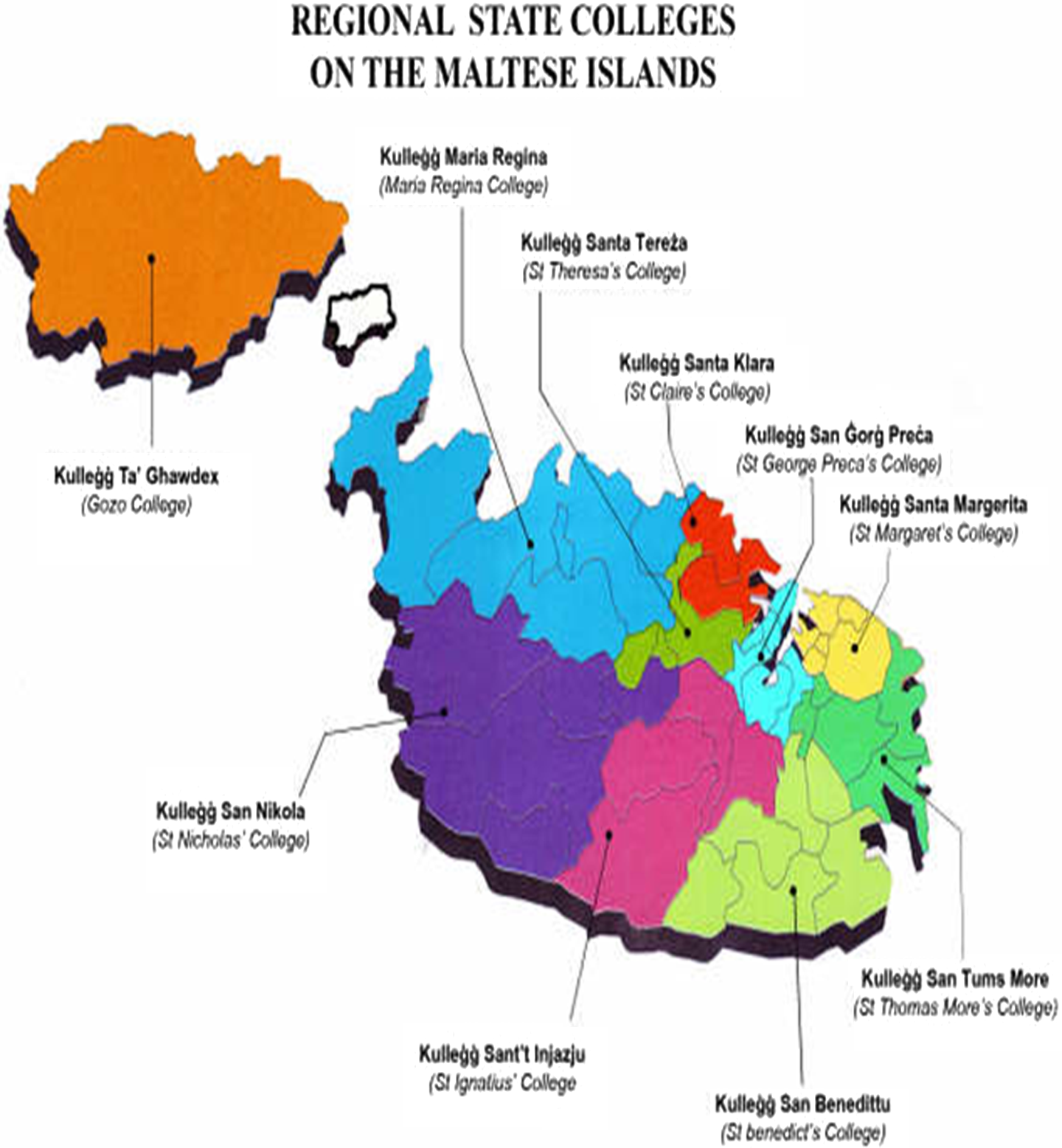
The location of the 10 colleges formed by The Education (Amendment) Act, 2006.
The 2006 Act also established the governance arrangements and accountability structures of each college. It sanctions the provisions for:
a consultative college board a college principal, as the chief executive officer of the college, who is accountable to the college board a council of heads, formed by the heads of all the primary and secondary schools within the college, who is accountable to the college principal a school council composed of educators and parents, chaired by a person nominated by the Minister for Education, with the head of the school acting as its secretary a students’ council, which will be chaired by the head of school or an educator nominated by the head.
Perspectives on governance
In this section, we explore the nature of governance, the significance of governance interactions, the nature of a distributed perspective on organizing, and the benefits that a distributed organizational form can bring.
Governance
Governance – including educational governance – is the outcome of formal and informal institutional influencing relationships between governmental and other actors, which are structured around shared interests in public policy-making and implementation (Kooiman, 2003). The governance of national systems in many settings is thus more than government and includes a range of bodies including non-state actors, some of which have a degree of autonomy from the state (Rhodes, 1997). These actors are interdependent and they continually interact and mutually influence on the basis of agreed rules and trust. The influencing inter-relationships between the various actors, which are typically complex and of central importance (Kooiman, 2003), are usually construed as a network in which the state is only one of many other actors. Governance networks are in a continual state of flux because of the inter-connected nature of governance networks, the continual and dynamic interactions of network actors, the various and varying mutual influences, and the shifts in the rules and bases of trust that regulate network actor interactions (Kjaer, 2004).
The governance of the school system in many national settings includes a large number of network actors such as: teachers, politicians, unions, government departments, religious institutions, government agencies, head teachers, local authorities, public companies, voluntary organizations, members of the wider community and school governors (James et al., 2011). Governance interactions in such settings are complex and can take a range of forms. Formal hierarchical modes of interaction with tightly specified roles and responsibilities and linear accountability relationships are but one form of many interactions in governance networks. Because of this complexity, in settings where governance can be viewed as a network, a distributed perspective (Spillane et al., 2001) on governance is more appropriate.
Distributed governance
A distributed perspective on organizing processes, including a governance network, is founded on a view that activity is ‘stretched over’ various actors and the tools they employ (Spillane et al., 2001). In essence, a distributed analysis of leadership processes sees leadership less as a property of individuals but more the property of interactions or ‘concertive action’ (Gronn, 2003: 35) among various actors. The interactions become the unit of analysis, and the detailed aspects of these influencing interactions − social and material circumstances, objects, instruments, communication and many other factors − are important (Mayrowetz, 2008). As the emphasis is on interaction, the applicability of a distributed perspective to understanding complex leadership interactions in many organizations, including educational organizations, is immediately apparent. Indeed, in the analysis of educational organizations, the perspective is often associated with distributed leadership.
Organizational forms and modes of functioning for which a distributed mode of analysis, typically of leadership interactions, is deemed appropriate has led a number of authors to advocate a distributed leadership mode of working (Mayrowetz, 2008), where influencing authority is widely distributed and a range of players are included. Distributed leadership is an attractive notion, and advocates cite a range of benefits. Mayrowetz (2008) identifies three kinds of benefit:
Distributed leadership enhances the democratic nature of the organization, which can in turn bring considerable benefits through wider engagement and involvement. It improves efficiency and effectiveness on the basis that the leadership empowerment of knowledgeable individuals contributes to the total sum of expertise and collective endeavour in the organization. Distributed leadership builds human capacity, which is a benefit linked to point 2 above. Individuals who are empowered and engaged to contribute and influence others will in the process learn about their own practice and the challenges the organization faces. This learning contributes to the organization’s collective human capacity. In turn this growth of capacity enables the organization to be more autonomous and ultimately to become self-improving.
Whether the benefits of distributed leadership are realized in practice remains open to question, as Mayrowetz (2008) himself points out. But none the less, there is a strong case for arguing that a wide distribution of productive influence can bring a range of benefits to the organization and its members: by enhancing democratic participation; expanding the pool of expertise brought to the organization’s tasks, which improves organizational functioning; and by developing the capabilities of those involved. On that basis, forms of governance that are networked can be beneficial to the organization of governance and to those participating.
The missed opportunity
In this part, we describe aspects of the reforms where we feel an opportunity has been missed in the implementation of the educational reforms in Malta to create a form of governance that has distributed characteristics. The data we report were collected from a series of semi-structured in-depth interviews with policy-makers, college principals, heads of school, and teachers (Bezzina, 2006; Cutajar, 2012; Cutajar and Bezzina, 2012).
During interviews, policy-makers maintained that surrendering decision-making power would entail the central government relinquishing its responsibility and would be a dangerous path to take. They argued that they could not allow that to happen because having an education system without central control is not possible. All the policy-makers interviewed agreed that the Maltese education system in fact needed a stronger ‘centre’ to monitor schools and to make the schools more aware of the environment they were part of. One policy-maker put the issue very clearly:
I have to admit that we had a centralized system and that schools had limited autonomy but now we have moved beyond the individual school to a school within a college. As a result we have created a new level, that is, the college principal. We have created an environment where the head is no longer on his/her own but part of a larger group of primary and secondary schools that form the Council of Heads under the leadership of the principal.
The policy-makers thus espouse the view that delegation of responsibility to colleges and to college principals whilst retaining central control are important aspects of the reforms.
At the time of writing, decentralization and autonomy has only been partially achieved. The colleges and their schools have been given only a degree of latitude in managing financial and technological resources. Very importantly, college governing boards have not been implemented, with the consequence that the colleges are still subject to direct hierarchical management from the Ministry of Education. Whilst there are moves towards increased accountability at college/school level, decision-making has yet to be decentralized and to be passed down to the school level. The important decisions seem to be taking place at the Education Leaders Council (ELC), which is where college leaders meet and the college principals are transferring and implementing policies within the college structure. There is thus a clear hierarchical management relationship between central government and the colleges via the directorates.
Some college principals use well-developed leadership/interpersonal skills and encourage ‘culture building’ tasks to develop collegial collaborating working. However, there is evidence of principals using their authority in their role to unilaterally manage and direct the schools in their colleges. Many heads of schools acknowledge the high quality of their college principal’s leadership but a number express dissatisfaction. They feel that decentralization of leadership responsibility is at best artificial. These dissatisfied heads consider that the policy-makers, in creating the new post of college principal, have simply ‘crafted another notch’ in the administrative hierarchy. They consider that in many instances principals act on the directive of central government and that as school heads they are given very little autonomy to run their schools appropriately. The school heads claim that they have limited authority because they have to refer all decisions to the college principal for confirmation and approval. The disgruntled heads feel that they are not being authorized by their superiors to act autonomously but are being too tightly controlled by the college principals, who in turn simply follow the directives of the central government. One head, who was very displeased, described the situation with a feeling of immense dissatisfaction:
I and some of my peers feel threatened by what we perceive as impositions by the college principals. There should be a more defined definition of roles. The college principals must work towards achieving desirable relationships.
A consequence of this mode of direction and management control is that the heads of schools are experiencing an increased workload. They are subject to demands, not only from the education authorities but also from other quarters such as parents, government agencies and the community. The heads are concerned about the expansion of their responsibilities and that they cannot accomplish all that is expected of them, especially in relation to school improvement issues. In a sense, there is a return to the bureaucratic-rational conception of the role of the head of school, as being first and foremost an administrator, who ensures that mandates, policies and procedures decided at a higher level are implemented.
Although the heads did acknowledge that the monthly council of heads meetings did have a range of positive aspects − for example, helping to build understanding and momentum to jointly develop the work of the college − sometimes the particular issues facing the individual school within the college were not discussed. As one head put it:
They (the college principals) need to involve the heads when drawing up the council of heads agenda and not come to the meeting with a prescriptive schedule which would probably have been based on decisions taken during the monthly meetings that the principals have with the director generals and directors.
It is as if, with the implementation of the colleges, another layer has been introduced into the management hierarchy rather than the schools within a college being empowered through the college structure to act collaboratively and with a high degree of autonomy. The current way of working goes against the spirit of the 2006 Act, which proposed a mode of leadership directed at capacity building.
Many of those interviewed, particularly the heads of school, felt that although Maltese education was undergoing innovative reforms, decentralization seems to be limited. One head of school claimed:
The running of the education system is still controlled by the central authorities, because the centre still has the statutory right to establish the National Curriculum, a detailed policy outlining the subjects that are taught in schools, class sizes, the aims of the educational system and how these should be achieved. It also has full control over recruitment, deploying, discipline and promoting members of staff.
The heads felt that certain areas, such as recruitment of personnel, should be passed on to the colleges and schools, which would lead to improvements because those directly involved in the running of the organization would be in a better position to address the needs of their institution. They held that such a mode of governance would add value to the institution and the overall performance of schools.
The interviewed teachers complained that the system of governance is still top-down and felt that it did not reinforce the practice of collegiality and shared governance, which would help to sustain the collaborative working proposed for the colleges. They thought that the top-down approach still tends to reign, and that the head of school is of great and undue influence on the school. The hierarchical approach generally does not involve and include teachers in the way that a mode of organizing better characterized as ‘distributed’ would enable. As one teacher pointed out:
We teachers do not seem to have a voice in policies or plans that are proposed for our college, because the head of school rarely consults the teachers before the monthly council of heads meeting. The agenda of those meetings does not include any of our suggestions, which we feel are needed for the school and our students. Who else can offer better ideas than the teachers who are the grassroots and the pulse of Maltese schools and colleges?
There is one further major shortfall in the implementation of collaborative processes at school level. The focus is on a team approach, but the push for joint working and collaboration is taking place in a context where teachers, in the main, have little time to work together and develop collaborative work practices.
Discussion
In this section, we analyse some of the outcomes of the research into the educational reforms being implemented in the Malta and explore some of the implications. In summary, the findings presented the researchers with mixed views on the matter of governance. Policy-makers and college principals concurred with and indeed appeared to support the current form of top-down bureaucratic management control, while heads of school and teachers felt that the system needed to be more participative and empowering in nature. The reforms that have been implemented following the 2006 Act have had excellent intents but they have been undermined by a reluctance on the part of the central government to delegate responsibility for decision-making to the colleges. As a result, a very clear hierarchical managerial relationship between the central government and the colleges has been established. The lack of autonomy accorded to colleges has been exacerbated by the fact that the college governing bodies, which could take responsibility for the colleges’ conduct, have not been implemented. The centre–college relationship is manifested in the college–school relationship where many college principals appear to see their main responsibility as passing on directives from central government to the school heads. Matters of concern for heads and their schools are not being fully addressed at the college level and the heads themselves do not have sufficient decision-making autonomy to resolve them. Governing at the school level is weak, with school governing councils having an under-developed role. The heads are ‘under pressure’ because they are subject to a wide range of accountabilities, including directives from central government that are unmediated by the college principals. The high level of hierarchical managerial control is being experienced within schools where teachers feel that they have very little influence or say in matters that relate to their work.
Arguably, in the way the college structure has been implemented, the opportunities for wider engagement in the education system have been lost. The researchers did not interview parents and students at this stage of the study and recognize that it would be interesting to get their views on the reforms and the extent to which it has enabled them to feel engaged with the education system. Perhaps understandably, the central government in Malta wishes to retain tight control, but such an approach to governance excludes other potential valuable players – members of civil society, for example – in ensuring the appropriate conduct of the schools and the colleges. While this wider engagement would reduce direct central control, it could ensure that there were sufficient checks and balances in the system. It would also mean that influence in the system was more widely dispersed, that a wider range of players were involved, and that the benefits from such a more distributed mode of governance could be realized, in the way that many advocates of distributed leadership have argued (Mayrowetz, 2008).
Finally, we argue that in such a context exemplified by the system implemented in Malta, centralized and decentralized policies and practices need to be at the forefront of the debate as they both will impact on the quality of education being provided. This study has shown that governance in a policy context that requires a collaborative way of working between the centre and the schools needs itself to have collaborative aspects to it. The direction that the current reforms are taking is seeing a move from a highly centralized system characterized by isolationist institutional practices (Bezzina, 2006) to one which calls for greater responsibilities and accountability at the college level. Striking the balance between centralized and decentralized practices demands a new approach of co-operation and sharing of good practices which have been identified as essential ingredients that have to be addressed in a strategic manner and sustained over time.
Conclusion
In this article, we have discussed the educational reforms in Maltese state schools, particularly the nature of governance interactions, and their implications on the new ways of working together, as fostered by the Act and the way those reforms have been implemented. The article highlights that the central government, whilst acknowledging the importance of devolving greater responsibilities to the school site as evidenced by the provisions in the 2006 Act, is in fact finding it hard to do so. The effects of this reluctance to devolve decision-making authority and to thereby enhance autonomy have widespread implications which are experienced negatively by stakeholders in the schools.
At the top of the hierarchical structure of the college, the Act decreed the setting up of a consultative college board of governors for every college. Regrettably, at the time of writing this article, the college governing boards had not been instituted, subsequently making the colleges still subject to hierarchical governance from the central authorities. We found the absence of the college board of governors perplexing because the policy-makers interviewed had acknowledged the efficacy of having such college boards. They had argued that as some of its members would be from the outside community of the college they would be an asset in nurturing the collaborative culture that was central to the 2006 Act.
Furthermore, the nature of governing schools and the implications on the new way of collaboration, mainly among heads of school who attend monthly council of heads’ meetings chaired by the college principal, emerged as making headway. However, we also argued that if colleges and schools establish a wider engagement in governance so that a dispersed network of individuals, groups and organizations was involved, the benefits of this more distributed form of governance would be gained. To this effect, we argued that a different collaborative approach, which engaged a wider range of participants in the overall control of the system to ensure its proper conduct, would be an appropriate alternative. It would offset some of the risks inherent in the devolution of responsibility.
That being said, manifesting a distributed governance mind-set among colleges and school leaders and transforming the current partially centralized model into a more egalitarian and distributed one requires effort, hard work, patience, dedication, commitment and perseverance from all stakeholders, including the education directorates. It also has to be appreciated that moving from a highly centralized system to a more decentralized one requires time as people working at the different levels learn to develop new working patterns and relationships that would materialize into a more distributed governance model. This approach towards governance would assist college and school leaders and educators in overcoming the challenges that emerge, and transform the new colleges into professional learning communities.
References
Supplementary Material
Please find the following supplemental material available below.
For Open Access articles published under a Creative Commons License, all supplemental material carries the same license as the article it is associated with.
For non-Open Access articles published, all supplemental material carries a non-exclusive license, and permission requests for re-use of supplemental material or any part of supplemental material shall be sent directly to the copyright owner as specified in the copyright notice associated with the article.
