







Abstract
The article is a summary of a small-scale research project which considers the formation of Co-operative Trust Schools. This was carried out in 2013 at a time when the number of schools becoming Academies and Trust Schools through the Co-operative College was burgeoning. Through questionnaire, interview, documentary analysis and exploration of websites, the research has sought to build up a picture of this Movement. A number of emergent issues are identified. These include the nature of new spaces for schools to form networks which provide a half-way house between the much tighter academy chains and the individual stand-alone academies and trust schools and the ‘places’ within the governance landscape within which they can do this. Perhaps the most challenging is the sometimes tenuous link between the value-centric Co-operative Movement and the values declared by these academies. It is suggested that the development of these academies with a connection with Co-operativism is more an association than a movement.
Introduction
In 2006, under the then Labour Government, The Education & Inspections Act enabled the development of trust schools, which were independent of the local authority (LA). This Act has facilitated much of the work of the Co-operative College (CC) in the setting up of its associated Schools and Academies. Subsequent legislation, such as the Academies Act (2010) and the Education Act (2011), dramatically increased the speed of change in relation to the establishment and governance of such schools.
The role of LAs has been eroded over a number of years, excluding them from direct control of the increasing numbers of autonomous schools. Substantial numbers of schools have been moving, either as volunteers or conscripts, to a position of autonomous governance. At the time of writing, just over 50 percent of secondary schools and 9 percent of primary schools are academies. The Department for Education (2013) states that there are also 181 free schools intended to open by September 2013 with a further 100 planned for opening in the following year. When the CEO of the CC was interviewed in August 2013 there were some 400 affiliated schools, making it a substantial player in the new educational order.
The overall structure that has emerged is a mixture of autonomous schools/academies and aggregated groupings. Pragmatically, without the ‘go-between’ LAs, the Department for Education is unlikely to manage the 25,000 state funded schools. One solution is to group schools into federations or chains. The CC has emerged as a significant player in providing both a process for achieving trust status and as having an intention to develop a network of schools and academies. The initial process of the school or academy attaining trust status is supported by the CC; subsequently the school or academy joins the Schools Co-operative Society (SCS), which serves to encourage and direct networking. The Co-operative Movement, of which the CC and SCS are constituents, is values-based. These values are historically rooted and expressed as follows: self-help encouraging all within the organization to help each other, by working together to gain mutual benefits; helping people to help themselves self-responsibility to take responsibility for, and answer to, our actions democracy to give our stakeholders a say in the way we run our school equality equal rights and benefits according to their contribution equity being fair and unbiased solidarity supporting each other and those in other co-operatives. (SCS, 2014)
The CEO of the SCS commented: Just as Co-operatives in other enterprise areas are showing that there is a valid alternative to the ‘PLC’ approach, Co-operative Schools are developing an alternative way of educating our children. Education is rapidly changing in our country and there are many new models available for schools to use. One of the many advantages Co-operative Schools have over many of the other models is that they have to take into account the views of the local stakeholders of a school. If we want our schools to be good schools that truly work with their local community then it is important that we actively involve the people like parents, members of the community staff and of course the learners. Co-operative Schools have that as part of their DNA. (Boston, 2014)
The conceptual framework
As our educational landscape is changing, one suggested response to its evolution is network governance. The expression of network governance can be varied. Triantafilou (2004: 489) suggested that ‘Network governance is a specific form of rule that governs at a distance through norms of efficiency, agency and accountability’. Rittel and Weber suggested that network governance is a response to ‘wicked social problems that defy efforts to delineate their boundaries and to identify their causes’ (Rittel and Weber, 1973: 167 in Williams, 2002). This view holds that solutions will develop through collaboration and networking. This is resonant with values of the Co-operative Movement, which has collaboration as a central focus, where a declared value is ‘Supporting each other and those in other co-operatives’ (Brown, 2013b).
The research explores in what way and to what extent the CC is providing a new framework of ‘knots and threads’ (Clerkin, 2007) for schools and academies. The purpose of the study is to examine what happens when a school moves to achieving autonomous status through the Co-operative Trust School route, and what is the configuration of its new web of relationships.
Methodology
The research is a small-scale study conducted between January and November 2013. A significant challenge for the study was the rapid development of the CC during this period, and so the findings can only be viewed as a ‘snapshot’.
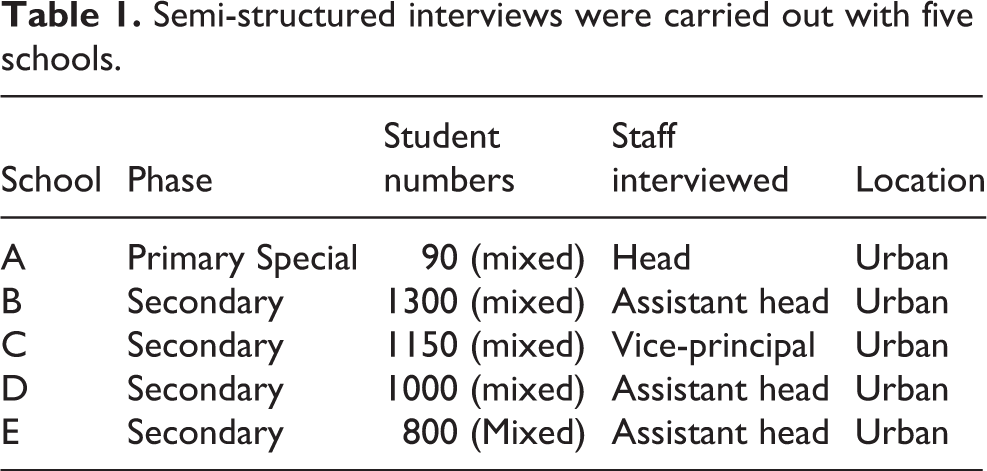
There were four instruments used in the research: questionnaire all extant Co-operative Trust Schools; interviews with senior staff of Co-operative Trust Schools: one principal of a special school and a vice-principal of a secondary academy were interviewed, and the remainder were assistant head teachers (see Table 1); documentary analysis of memoranda of agreements supplied by the CC, prospectuses from the schools where interviews were carried out, and the publications of the CC which are guides to the process of becoming a Trust School – these are referenced below; website analysis of Co-operative Trust Schools.
Semi-structured interviews were carried out with five schools.
Data and findings
Questionnaires to existing Co-operative Trust Schools
The questionnaire was constructed to establish some basic contextual information. At the core were questions about the identification, or indeed lack of identification, with the values stated by the CC. The questionnaire was designed to find out whether schools were affiliating on the basis of a values-based preference or out of a need to find new avenues of support.
The CC kindly distributed electronic copies of the questionnaires to all of their schools. This was distributed to some 200 schools. This was the numbers who had formally completed trust status. Thirty-four (17%) questionnaires were returned. The phase distribution represented by the schools returning the questionnaires was as follows:
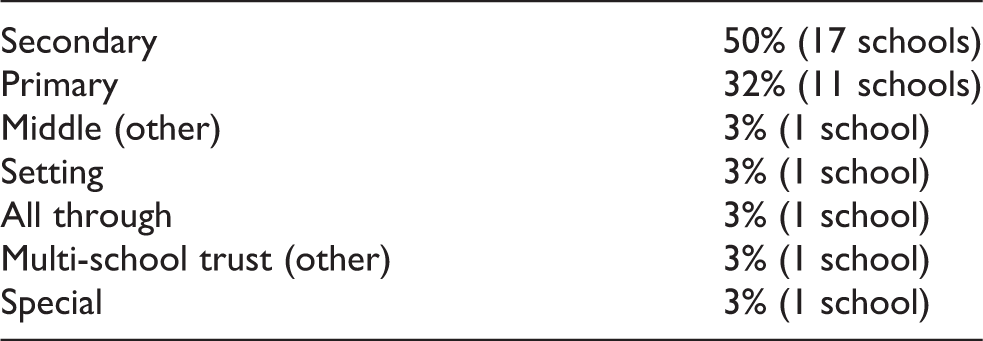
(the figures are rounded up and so do not correspond to 100%).
Association with other schools, i.e. where the school stand-alone institutions, federations or multi-academy trusts:
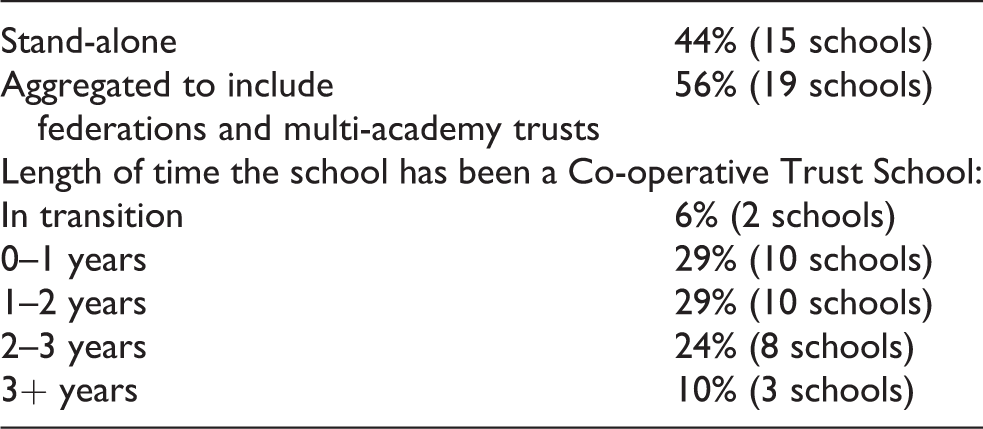
Overall, the responses came from schools judged as good by Ofsted; only a small number of respondents came from schools that were judged outstanding (9% of respondents). There was one secondary school designated as being in special measures and one primary school held to exhibit serious weaknesses. The majority of the respondent schools populate the middle ground of the current Ofsted designation. There is nothing to prevent a school judged outstanding becoming a Co-operative Trust School; however, schools designated as having weaknesses or being in special measures were less likely to be permitted to move to trust status. This is consistent with the regulations for seeking trust status.
Governance was seen as central to the schools’ strategic planning and accountability. A good structure of governance was seen as important. The questionnaire sought to determine whether or not the articles of governance were seen as being somewhat incidental when contrasted with the larger goal of autonomy.
The move towards seeking to become Co-operative Trust Schools was largely initiated by the schools’ head teachers (50%), by governors (18%) and by local head teacher groups (12%).
All the respondents expressed satisfaction with the service that they had received. A useful reflection of this was the extent that they subsequently became advocates for services and processes of the CC. Ninety-seven per cent of respondents were advocates of the CC, and of these 68 percent recommended the route frequently. Only one respondent indicated that they did not provide information or encourage others’ heads and governors to explore working with the CC.
The experience of affiliation did not change the responses. The percentages remained the same. Their initial experience was positive, and gaining trust status did not cause any change in the way that they responded.
Interviews
The interviews were split into two groups; firstly, the interview with Mervyn Wilson, the Chief Executive and Principal of the CC; and secondly, with five senior staff involved in the leading of Co-operative Trust Academies.
A regret is that a wider range of interviews was not possible. Requests were made to some of the established network groups but no replies were received. Under pressure of time, four of the interviews were conducted with stand-alone academies and one with a small federation. Gaining access to a Multi-academy Trust would have added depth to the research.
The interview with Mervyn Wilson illuminated the structure of the CC and the process they have developed for becoming a Co-operative Trust School. In essence, the overarching organization is the CC. The SCS is a development that subsequently seeks to support networking and facilitate development within linked schools. The SCS is an independent Co-operative registered as an Industrial & Provident Society and with membership open to all Co-operative Schools. The CC and the Co-operative Group were founder members, as were a group of the first Co-operative Schools. Its current affiliation fee stands at a recommended minimum of £1.00.
Interestingly, the Chief Executive did not see the oversight of the conversion process as his main area of work, and indicated that the Rochdale Pioneers Museum was also a significant part of his work and personal commitment. In August 2013, the staffing of the CC linked to supporting conversion was 2.5 FTE.
The CC, in effect, provides a consultancy service for converter schools. Much of this support is undertaken by a named associate in conjunction with a recommended law firm. The basis of the relationship between the CC and a school, academy, free school or federation is through a memorandum of agreement which makes explicit the intended direction of association. These memoranda now have a clause requiring all affiliating schools to engage with a network of SCS-affiliated schools. Previously it had only made this a requirement of Academies.
Documentary analysis
A variety of documents were accessible for the research. These included three publications from the CC: Trustee Handbook (Brown, 2013a), Company Secretary Handbook for Co-operative School Trusts (Brown, 2013b) and Your Co-operative Trust: Making it Work (Gardner et al., 2013). Additionally, and generously, the CC made available a variety of internal documents and documents such as memoranda of agreements.
Website analysis
Nearly all UK schools now have a website. They are a mix of message and marketing blended with varying degrees of subtlety. They invariably provide details of phase, number and admission criteria. Many use such a portal to record their values. Ten websites of schools linked to the CC were analysed. These were selected from those where interviews had been conducted and from schools that were featured on the CC website.
Analysis and discussion
In the initial framing of the research the interest was on the quality of the ‘governance package’ that schools/academies could secure through affiliation. It soon became clear from the questionnaire respondents that what was being offered by the CC was a properly conceived product that would meet the requirements of the Department for Education for the schools incorporation. Certainly this was the evidence offered in interview by Mervyn Wilson. He contrasted the consistent success of gaining incorporation as opposed to stated failures by schools that had sought their own pathway. It also became clear that the main provision of such a package was through recommended law firms who had been properly briefed by the CC. The analysis of the questionnaires was akin to a customer satisfaction survey showing that the CC was providing its clients with a very creditable service. With the next stage of the research – exploration of the interviews and websites – a less secure picture began to emerge. The values were espoused in a superficial manner and the intended structures of representation by stakeholders were inconsistent across a number of the schools.
The sites were scrutinized for evidence of linkage to the CC and SCS, e.g. logos, relevant hypertext links and explicit statements linking the schools with the stated values by the CC and SCS. The websites of the latter two organizations have very clear value statements which have historic routes and which are central to the memoranda of agreements (see Table 2).
Website analysis (accessed 17 August 2013).
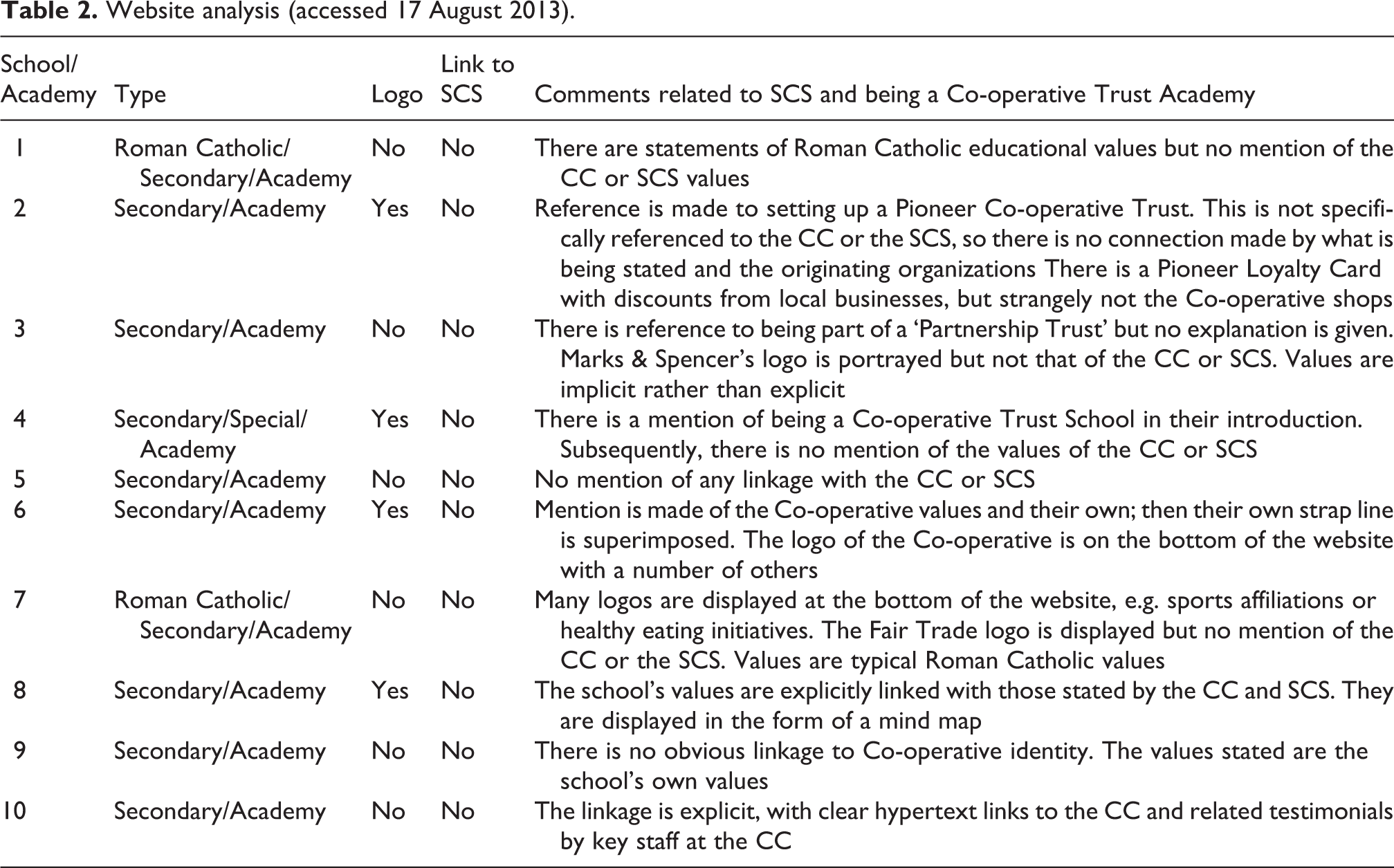
With one exception the interviews supported the website analysis in suggesting an apparent detachment from the underpinning principles advocated by the CC and also by the SCS. A senior manager interviewed at School B was asked what difference it would make to be a Co-operative Trust Academy. They replied ‘Absolutely nothing’. In an interview at School E, I was offered an explanation as to how the idea of being a ‘Co-operative Academy’ was communicated to parents: ‘We explain that we are a co-operative just like Waitrose’. In the interview at School A, the head teacher repeatedly moved away from the SCS linkage to an exposition of his or the school’s own stance on values. The latter is also evidenced by the website where the existing school values were overlaid on those promulgated by the CC. In a number of websites it was challenging to find a link to either co-operative values or even identification of the Co-operative Movement.
This stands in marked contrast to the interview and website of School C. The identification with the CC and the SCS was evident in their literature, displays in the entrance and, of course, their website. The vice-principal was explicit about the co-operative values and explained in detail how these had been worked through in detail in many aspects of the life of the school.
Three of the schools (A, B and D) noted that becoming a Co-operative Trust School had been birthed through the vision and drive of an individual. Several years on, that person was moving to another post or retiring. In all three of these interviews concern was expressed about the Co-operative concept being sustained. At School B the engagement with the CC had been driven by a vice-principal who had left a year ago. The interviewee noted that since they had left there was very little mention of the new status of the school, the co-operative values or the engagement with the wider network of SCS schools. The view was expressed that ‘It was business as usual’.
A feature of all the interviews was a concern that the LA was less able to provide the support that had previously been available. This emerged as regret rather than rancour. School A was working hard to retain a partnership with its LA and included a representative from the LA in the governance of the academy. Four of the respondents expressed a view about the academy chains such as Ark, Oasis etc. Three of those interviewed stated that joining such chains was not a route that they wanted to go down. They saw their school as a local provision of education and wanted to secure governance specific to their school and locality. The Co-operative route appeared resonant with this. One respondent noted that: The school does not have a business sponsor and is free from LA control. We have chosen to become a co-operative because the staff, parents and governors believe that the best way to build on a very strong legacy is for all members to be part of governing the college through co-operatives. It makes us part of a family of schools, nationally and internationally, that are co-operatives, sharing a set of values that we believe really matter to the future of our young people.
Schools all stated a desire to work collaboratively and that many of their existing structures were diminishing as the role of LAs became reduced. There was a perception that the Co-operative Trust route offered another space which was distinctive from that being developed by the academy chains.
A particularly interesting area relates to the espousal of values by the schools working with the CC and subsequently the SCS. The questionnaire explored this, and the responses suggested that having a clear statement of values was a matter of considerable importance to head teachers.
Initially this seemed to be a situation of a consensual partnership between the CC/SCS and the schools around the Co-operative values. The website analysis appears to challenge this. The schools where the websites were explored seemed to have clear statements of their own values, whilst those of the Co-operative Movement were omitted or given minimal prominence. This was the case in nine out of ten of the websites analysed and in all but one of the school-based interviews.
Conclusions
Mention has been made earlier of the burgeoning numbers of schools achieving autonomous status through becoming Co-operative Trust Schools and Academies. It is only in 2013 that the memorandum required all the schools connecting with them to engage in their network. Previously this was only required of academies, there was no requirement for the extended memorandum of agreement that identifies being part of a network of schools to have any further linkage with the Co-operative Movement. This network is encouraged and administered by the SCS.
The original intention of the research was to focus on what was specific about the governance model required by the CC. It has been concluded that the CC is guiding schools along a ‘tried and tested’ pragmatic route to becoming academies. The ‘template’ offered would not be significantly different from that adopted by an academy or trust school that was ploughing its own furrow. The distinctiveness of the process appears to lie more with the assent, in principle at least, to the Co-operative values, rather than to the specifics of the governance model.
It is suggested that what has emerged from this research are five emergent issues germane to Co-operative Trust Academies:
Space: The route generated by the CC allows academies a pathway into a different space than might be offered by a more structured academy chain. This is a space not populated by academy chains or fading LAs but one which offers opportunities to develop differently and one in which collaboration becomes a possibility. Becoming a Co-operative Trust School often seems to be motivated less by an identification with the Movement itself than a desire to make use of the guidance and recommended services offered by the CC.
Place: Maintained schools have traditionally belonged within LAs that offered an identity. The affiliation with the SCS and through the development of local networks has reduced the sense of isolation and provided routes and access to resources to negotiate this new educational landscape.
Detached democracy: The emergent governance of Co-operative Trust Schools is clearly wedded to local representation. The interviews confirmed that parents and local groups were represented. Interestingly, in many cases an organization was represented on a governing body rather than an individual from that organization. Such a structure of governance does place accountability and responsibility with special interest groups rather than retaining the school within an overall framework of local and national democracy. Put another way, unless an individual is a stakeholder with the Trust School they have no easy route to making an input into its existence or function. The ordinary voter has become potentially detached from having a democratic voice in the local provision of state education at all but the most general levels.
Governance: At the time of writing, there is a lack of consistency in the operation of governance. It would appear that most academies surveyed took this area seriously. What was less secure was the role of membership. There was a lack of clarity as to how representation and stakeholder voice operated.
Values: This is a significant area, which has emerged from the research. It is certainly one that would warrant further exploration. The CC and the SCS stand within the modern Co-operative Movement, which has its roots with the Rochdale Society of Equitable Pioneers, which in the mid-1800s established a variety of ventures. Over the years the Movement has generated a number of initiatives, ranging from banking and retail sales to funeral provision and insurance. Historically the various initiatives achieved coherence around the Movement’s stated values. The values have been the brand identity of the Movement. There are indications of a lack of prominence of these values within the affiliated academies. Many surveyed seem to eclipse the Co-operative values with their own.
As new models of school organization emerge, there are significant questions to be asked about the detachment of schools from existing democratic processes. Many of the academy chains have centralized governance, and for the stakeholders engagement is more akin to contacting the board of directors of a commercial organization. This is not the model developed by the CC and intended for its affiliated schools. Clear patterns of stakeholder participation and involvement are explicitly specified, which have dimensions of local engagement, collaboration and accountability at their core. There is a sense that democracy has moved back a step and that education has passed from an electorate to interest groups.
It would be disingenuous to critique a sapling for not bearing fruit. In the same way it would be inappropriate to judge the CC and their linked Trust Academies for being embryonic. Both require considerable husbandry to fulfil their potential yield. Enshrined in their updated memorandum of agreement for use with all institutions becoming Co-operative Trust Academies is the requirement to be involved in their local networks. This certainly begins to align with the aspirations of network governance.
A major question must be to ask if the SCS, as the networking dimension, has sufficient capacity or coherency to undertake the husbandry of its affiliated schools and to facilitate the development of their regional and area networks of schools and academies without such clusters becoming increasingly dissonant with the original template.
Footnotes
Acknowledgment
The research on which this article is based was part-funded by the British Educational Leadership Management and Administration Society.