







Abstract
Education human resources (HR) professionals have often been neglected in education research. This study seeks to better understand their role in the American school industry, by first examining how districts conceptualize the position of HR professionals and then exploring how the professionals themselves understand their role in school business. Emphasis is placed on identifying the dominant employee management philosophy (i.e. personnel vs. strategic HR management) that is promoted for and practiced by the professionals. Data was collected by document analysis and focus group interviews. The document analysis was conducted with data from a recruitment/job advertising system that most school employers use in the state of California, USA. The focus group was conducted with HR professionals in primary and secondary education institutions across Northern California (n = 14). Findings suggest that personnel management is emphasized for HR professionals in public school districts more often than strategic HR management. Results are discussed.
Keywords
Introduction
By the end of the 19th century, employee management functions in organizations began evolving from what was then known as personnel to what is now known as human resources (HR) (Bogardus, 2007). The field grew from primarily clerical work to a robust profession, with associations, standards and globally recognized certifications (HR Certification Institute, nd). Whereas in the past those in HR were seen as personnel administrators operating in personnel department silos, the new philosophy views HR professionals as strategic partners among organizational leaders (Armstrong, 2006). In fact, HR’s strategic role has been increasingly embraced on a global scale. For instance, Schuler (1994) studied 12 countries and noted an increasing prevalence of strategic HR management.
While the transition to strategic HR is encouraging for the discipline of HR, some have noted that public education practices seem to be lagging behind (Hanushek, 2007; Teo and Rodwell, 2007). The purpose of this study is to better understand the role HR practitioners occupy in American school business. This is accomplished by first examining how that position is conceptualized by school districts via in-depth document analyses of their HR job advertisements and then exploring how that role is understood by the professionals themselves through focus group interviews. Emphasis is placed on identifying the dominant employee management philosophy (i.e. personnel vs. strategic HR management) that is promoted for and practiced by the professionals. Data are from California (USA) school districts and their employees.
The two management approaches represent different philosophies for dealing with employment issues. For example, with recruitment, a personnel philosophy may be focused on reactively replacing vacancies and meeting compliance rules and regulations (e.g. emphasizing the hiring of a credentialed teacher). On the other hand, an HR philosophy would be focused on proactively selecting the most potentially effective applicant (e.g. the applicant most likely able to help the district reach its goals, such as closing the achievement gap).
Results of this study suggest that education HR practice has not kept pace with the field of HR overall. Specifically, education appears to still espouse and institutionalize personnel rather than strategic HR management. While a lack of strategic processes has been a common criticism of education systems, most criticisms target specific practices. This study examines HR practices, but focuses on the underlying philosophy that drives the practice rather than any individual practice itself. Furthermore, unique insight is added from education HR practitioners, whose voices are often ignored in research. By framing the study through HR management theory, we gain a better understanding of the dominant philosophy present in school systems.
Unlike the majority of school improvement recommendations, which focus on educators as change agents, this study is novel in that it proposes that education HR practitioners can also play a role in positive school reform. Its contribution is significant because not only do we know little about HR’s role in the public sector (Teo and Rodwell, 2007), but we know even less concerning their roles in public education. This study was designed to help fill that void in the literature.
Strategic HR management
Strategic HR management has been linked to outcome improvements (McMahan et al., 1998). For example, Wright et al. (1998) discovered that HR’s involvement in strategic planning was a strong predictor of subsequent evaluations of the effectiveness of HR functions. Likewise, Darwish et al. (2013) found that strategic HR management was positively associated with organizational performance in Jordan. Although strategic HR management has been increasingly popular, not all HR professionals operate under this approach. For instance, in a study of Oman HR professionals, Mamman and Al Kulaiby (2014) found that the strategic role is the least performed role and that public sector practitioners operate with a less strategic focus than those in the private sector. Although there has been much speculation that this trend may also exist in American public education, education research has not focused much attention on HR professionals.
Strategic HR management in education
The importance of HR is especially critical in a labor-intensive field like education. In a time when policy changes have resulted in increased accountability for public funds usage (Forrester, 2011) and student achievement (Showunmi, 2013), HR functions must be strategically linked to organizational outcomes. It is for this reason that education HR must become more strategic, like its counterparts in other sectors.
While many education reform agendas have called for updating specific HR practices (e.g. teacher pay) as a means of improving student outcomes (Hanushek, 2007), the focus of education research, district priorities and policy debates have almost exclusively been on educators. Even research that includes data from HR administrator interviews has focused on educators (Ramirez et al., 2014). Broadening the focus to HR support staff can be beneficial as they have been found to be pivotal to organizational success. For instance, Huselid et al. (1997) found that organizational effectiveness was related to the effectiveness of their HR managers across a variety of markets. By extension, HR professionals in the field of education may be able to make similar impacts on school district performance.
Purpose and theoretical framework
This study builds on the foundation provided by Monks (1992), who described personnel administrators as falling into one of four types of practitioners: (a) traditional/administrative; (b) traditional/industrial relations; (c) innovative/professionals and (d) innovative/sophisticated. Practitioners that were categorized as traditional (a and b) focused on administrative concerns, such as ensuring compliance to regulations, while practitioners that were categorized as innovative (c and d) focused on strategically integrating HR activities with other functions to reach organizational goals. These dual categories align with the philosophical distinctions between personnel and strategic HR management and will serve as the lens through which this study is framed.
The purpose of this study is to examine the professional philosophy that drives education HR. In addressing this goal, the following questions are posited:
What is the role of education HR professionals (as espoused by the district and understood by the professionals)? Do these roles reflect the philosophy of personnel or HR management (or are they equally balanced)?
Method and design
This study uses document analysis and focus group interviews. Document analyses were conducted with data from a recruitment/job advertising system known as Ed-join (Edjoin.org, nd) used by most school employers in California. The focus group was conducted with HR professionals from public K-12 institutions across Northern California.
Document analysis
Document analysis is a method used to rigorously analyze written material. It enables readers to understand the social reality that is commonly accepted by a community (Altheide, 1996). The document analysis performed in this study was based on job advertisement data and was intended to ascertain how districts conceptualize and communicate expectations for the role of their HR professionals. Specifically, the terms “human resources” and “personnel” were inputted into the search engine, retrieving a total of 57 job advertisements (41 and 16 respectively). All relevant job advertisements from September 21 to September 28, 2014 were compiled for the document analysis, excluding five positions without an HR focus (e.g. high school guidance counselor), leaving a sample of 52.
Focus group
Focus groups are one of the most common methods of qualitative research for generating data on common perspectives of a community (Gill et al., 2008). Freitas et al. (1998: 2) recommend the use of focus groups for “generating ideas for investigation or action in new fields.” Because the profession of education HR is an area that is rarely researched, focus groups provide the opportunity to examine common understandings in the field. Specifically, a focus group was conducted with 14 education HR practitioners throughout northern California. Their positions varied from eight technicians and analysts to six management employees, including an HR director and an assistant superintendent of HR. There was only one male in the group. All of the participants were invited to the focus group through a professional education association to discuss the role of education HR professionals and identify training needs.
Results
Document analysis results: categorizing document analysis data
The job advertisements were analyzed for common themes related to personnel and strategic HR philosophies. To maintain consistency of information obtained across different job descriptions, the focus of the analysis was on essential job functions. According to the US Equal Employment Opportunity Commission (EEOC), “Essential job functions are the basic job duties that an employee must be able to perform… [and that are] essential to performance” (U.S. EEOC, 2008).
Essential job functions that represented the personnel emphasis included responsibilities that primarily focused on administrative, clerical and compliance areas. Essential job functions that represented the strategic HR emphasis included responsibilities that primarily focused on proactive strategic planning, linking actions to organizational outcomes and strategic partnerships between HR and other stakeholders. Some examples from both emphases are listed in Table 1.
Examples of essential job functions for personnel, strategic HR and neutral management.
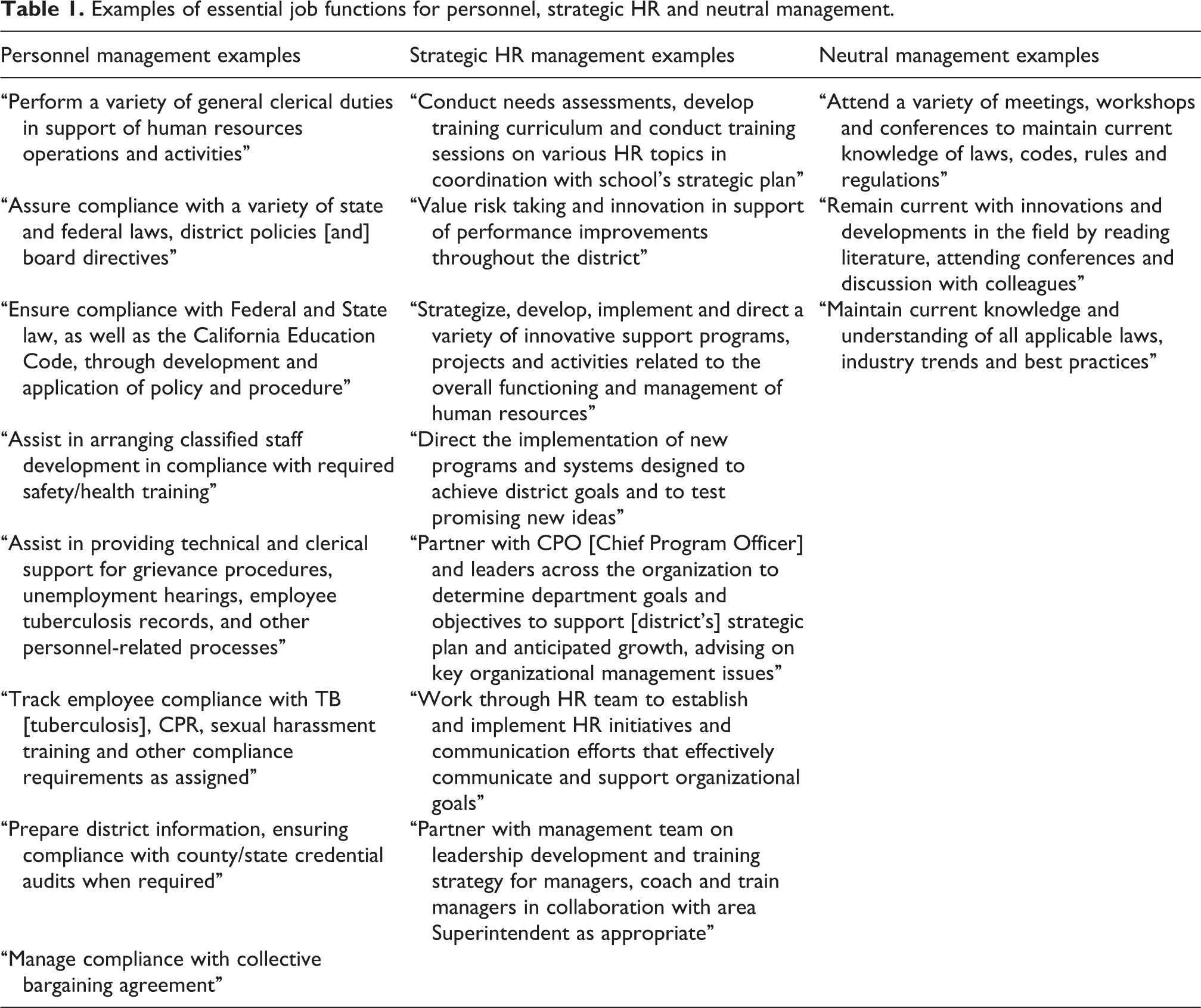
Because emerging themes were allowed to present themselves without restrictions, essential job functions that did not clearly fall under either a strategic HR or personnel philosophy were identified as neutral. For example, “Participating in training programs inside the district and with outside agencies” could be considered personnel management if its purpose is to help the organization fulfill regulatory obligations, or it could be considered strategic HR if the training leads to innovative action aligned with organizational goal achievement. Other examples of a neutral management emphasis from the data are listed in Table 1.
To compare the three categories of employee management philosophies (i.e. personnel, strategic HR and neutral), the number of instances the essential functions fell under each of them was converted into percentages. Specifically, 94.5% of all the essential job functions obtained from job advertisements were categorized as personnel, whereas only 2.7% and 3.2% were categorized as strategic HR and neutral respectively. Cohen’s D (Cohen, 1992) was used to determine the effect size of the difference between the average number of essential job functions that were identified as either personnel (M = 14.19, SD = 6.75) or strategic HR (M = .38, SD = .93). Results suggest a large difference, amounting to almost three standard deviations (d = 2.87). This lack of balance suggests that districts overwhelmingly espouse that the role of HR professionals is to operate under a personnel rather than an HR management approach.
Because organizational leaders such as assistant superintendents are more likely to perform strategic activities than their subordinates, the results were re-examined by restricting the sample to only management positions (n = 16). Ed-join allows employers to self-identify the category of the position being advertised, and those categorized as management positions were selected for this sub-analysis. While the restriction to only management employees lowered the percentage of responsibilities identified as personnel to 89%, like before, it represented the majority of essential job functions. Strategic HR and neutral were identified at the rate of 4.94% and 6% respectively. Cohen’s D (Cohen, 1992) effect size (d = 3.15) once again suggests a large difference between the essential job functions identified as personnel (M = 15.75, SD = 6.52) as compared to strategic HR (M = .88, SD = 1.45).
Reliability
To assess inter-rater reliability regarding coding consistency, a research assistant was asked to re-categorize the data into coding themes (Billingsley et al., 1980). These themes were compared to those categorized by the principal investigator and agreement correlations were computed (r = .83, p < .05). This verification demonstrated acceptable reliability (Cooper et al., 2007). Based on criteria set by Morse et al. (2002), the verification strategy used in this study is sufficient for coding reliability.
Focus group results: themes
Focus group participants were mostly allowed to direct the conversation because the goal was to learn about their perceptions (Morgan, 1997). This allowed for a natural emergence of themes from the participants and data was openly coded (Strauss, 1987). Based on the idea that participants’ beliefs and perceptions are a reflection of the organizational norms that shape daily action (Berger and Luckmann, 1966), several themes concerning the profession of education HR were identified.
When asked about the role of education HR professionals, participants suggested that they occupy a “watchdog position,” protecting the district from penalties and lawsuits. One participant noted, “Our job is to make sure we don’t cross the legal line, that we have all of our ducks in a row.” A management respondent indicated that “My job consists of me being in meetings all day…I spend most of my time listening to and resolving complaints, trying to figure out what people want.” This suggests a “putting out fires” approach.
Another participant mentioned that “We are employee advocates and help them navigate the logistical parts of employment.” However, this assistance is not always appreciated, as another respondent exemplified “We keep the district out of trouble. But you know what gets me? Managers will tell their employees to work around us to get things done, when we are trying to protect them.” Indeed, the perceived lack of appreciation for HR’s contributions was shared by others, as another noted, “Employees don’t know what we do. To them, we are just part of the DO [district office], the obstacle, and they [the school sites] are where things get done.” Consequently, it seems HR’s contributions are less than fully appreciated.
Education as a whole also does not seem to put much weight on HR specific training/credentials for HR positions. For instance, most of the participants in the focus group were unaware of the Professional in Human Resources (PHR)/Senior Professional in Human Resources (SPHR) certification, although it is a globally recognized certification in the field of HR (HR Certification Institute, nd). Instead, as one respondent mentioned: I don’t know anything about a PHR or SPHR, but in order to get hired for most HR management jobs, you need to have an administrative credential. And in order to get this, you need to have at least have five years of teaching experience. The Credential Commission is committed to requiring teaching experience before obtainment of the administrative credential.
While it was explained that “you need the credential because you are evaluating certificated employees,” with the rationale being that one should not be evaluating teachers if they have not had experience teaching, functionally what results is many districts are not likely to hire an HR assistant superintendent without their administrative credentials because the industry norm is that “most HR managers are expected to evaluate certificated staff.” Consequently, individuals with HR experience and training may not be hired when compared to candidates who have performed work at the school site (e.g. a teacher or principal) but lack that same HR knowledge. This type of scenario privileges classroom experience over HR experience, even for an HR position.
When asked about professional development needs for HR administrators, the Affordable Care Act (ACA) and maintenance of personnel records were the modal topics mentioned (i.e. 29% of all participants for both). As it relates to the ACA, one HR administrator noted that “The law keeps changing and so what is true today might not be tomorrow. We might be penalized if we are not compliant but we don’t know how to be!”
Other less frequent areas that were mentioned included contracts/agreements, and the education code. One HR professional noted: A lot of us, when we got the promotion to become an HR manager, we came from other departments and have [sic] no training in HR before that. All of a sudden your decision could cost the district lots of money so you need to make sure you know what you are doing. Know when people need to be evaluated, work status notification, all these things can get very complicated and so we definitely need more training on Ed-code.
After engaging in axial coding of the data to refine themes through several iterative reviews of the identified categories, themes that were related to personnel or strategic HR approaches were linked to those core areas through selective coding (Strauss, 1987). For instance, it can be seen that themes like ACA training and Ed-code are based on participants’ concern with learning the rules to remain compliant with regulations, which relates specifically to a personnel management philosophy. Similarly, HR practitioners’ own view of their role as compliance monitors further illustrates that focus. Whereas strategic HR management encourages partnering up with other departments, school employees’ lack of knowledge regarding the HR departments’ functions suggests a personnel management approach, as the departments seem to operate in silos as opposed to in tandem with others.
If strategic HR management were the focus in education HR, then by definition HR functions would be strategically performed to align with the larger goals of the organization. For instance, the focus would be on hiring the most effective employee that can contribute to the achievement of the district’s mission. However, in many instances this is not reality. In fact, it is often the case that the recruitment and selection process is performed in a perfunctory manner, as evident by the example provided by one respondent: “Sometimes we post for jobs when the hire has already been decided. But we post for a certain amount of days anyways because we have to, according to Ed-code.” Another participant noted that “according to our collective bargaining agreement, we have to give first preference internally, so if someone within the district meets the bare minimum requirements, we have to hire them,” as opposed to hiring the most potentially effective applicant. These types of behavior speak to the personnel philosophy of compliance as opposed to a strategic HR emphasis in public school districts.
Conclusion
The results of this study suggest that school employers overwhelmingly see the role of HR professionals as one that adheres to the philosophy of personnel management, and this was evident in their job advertisements for HR positions. The HR professionals themselves seem to have institutionalized that same philosophy, as evident in their stated views of their roles and desire for compliance-based over strategic HR management training. This finding makes sense when interpreted via institutional theory, because the theory suggests that an organization’s practices and actions are directly influenced by the rules and structures that professionals operate within (Powell, 1998). It is for this reason that it has been suggested that HR professionals in public sector organizations, such as schools, are more likely to be engaged in administrative rather than strategic roles (Mamman and Al Kulaiby, 2014).
In order to evolve education HR, the present personnel management paradigm must be allowed to transition into a more strategic focus. While past researchers have recommended reforming various education HR practices to improve school outcomes, such as redesigning employee evaluations so that they are meaningful rather than ritualistic (Ramirez et al., 2014), the recommendation of this study differs in that it calls for systemic change in not only HR structures but HR’s role in school business. Policy makers and districts must embrace a broader understanding of HR’s function and, in turn, HR professionals should think of their own roles as connected to advancing the organization’s goals and missions. Institutional structures must be modified to accommodate this new understanding of HR’s purpose and, by doing so, HR’s role can make the necessary evolution that has been found to positively impact organizational outcomes (Darwish et al., 2013; Wright et al., 1998). Although how HR professionals see and perform their roles may vary across the world, the recommendation to modify structures to accommodate different types of roles is not restricted to any particular country. For instance, Gooderham and Nordhaug (1997) found that differences in type of institutional structures across Europe help explain variations in the role of HR.
HR activities can be strategically linked to improve organizational outcomes, such as the teacher supply problem evident in the USA and UK (Smethem, 2007). Because supervisor interpersonal communication has been found to be positively related to teachers’ job growth satisfaction and negatively related to their job burn-out (Rajesh and Suganthi, 2014), one recommendation to address this problem is through ongoing interpersonal communication training for supervisors. Education HR professionals are well positioned to facilitate this because it can be tracked by HR systems for all supervisors. HR professionals themselves can be trained to provide communication workshops and evaluate turnover data to determine program effectiveness. However, such an initiative would not be rooted in the personnel approach of “business as usual.” Rather, it must be rooted in a strategic management approach that strategically links training with desired outcomes.
To be clear, having concerns about understanding employment law and regulations is not a negative attribute for HR professionals. In fact, an effective HR professional must understand how to navigate the complex world of labor laws to protect their employers. However, the emphasis on compliance should not be at the expense of improving effectiveness through strategic HR management. Rather, HR professionals must balance the dual roles of the day-to-day administrative personnel expert and HR workforce strategist (Wright et al., 1998), and failing to do so may not only put the organization in danger from external threats (e.g. sanctions) but HR professionals may lose credibility internally if they are unable to provide necessary administrative support (Teo and Rodwell, 2007).
Indeed, both HR and personnel issues warrant attention in school organizations. Unfortunately, evidence from this study suggests that personnel issues drive the organization at the expense of HR strategies. The paradigm shift from the status quo to balancing proactive talent management and administrative duties will allow organizations to re-conceptualize the role of HR, which will be reflected in their communications, such as job advertisements. The organization’s deliberate expansion of HR’s role will likely allow HR professionals themselves to adopt a similar philosophy regarding how they understand their roles and practices. Making this change in approach would represent a “significant step towards the modernization of the public services” (Forrester, 2011: 6).
Finally, education HR as its own discipline must be appreciated for its critical role in the school districts. This recommendation is aligned with findings by Bowen et al. (2002), who reported positive relationships between HR departments with higher status and their organization’s capabilities across numerous countries including Australia and Japan. Data from this study suggests that the status of HR in education warrants improvement, as evident by examples provided regarding the lack of knowledge concerning HR’s purpose by teachers, and managers’ attempts to “work around” HR because of the perception that HR represents an obstacle for school operations. One critical step towards accomplishing this is by increasing the visibility of HR’s function to the school community.
While this study focused on HR professionals in school industries, it is recognized that many school districts do not have HR professionals and instead the HR responsibilities are divvied up among the district employees. The recommendations and findings of this study are largely still relevant because the same duties (e.g. effective recruitment) need to be performed, whether by an HR specialist or a principal, and the same need for strategic HR planning still exists.
Although teachers make the greatest impact on student outcomes (Nye et al., 2004), HR activities are often the actions that make that learning possible. For instance, through HR, effective teachers can be hired, appropriately compensated, retained, and developed to further increase student learning. It is evident that effective schools do not become outstanding on their own, but instead evolve as a product of clearly planned processes in the form of strategic management (Morton, 2011). HR’s role as a strategic and integral partner to other departments, including the school site, must be acknowledged in order for the district to be able to work cohesively as a unit as opposed to operating as disparate entities. Unlike the stories shared in this study, teachers should have a better idea of what the HR department does and how it can help teachers achieve their professional objectives. HR should not be seen as merely performing tangential duties outside of the core mission of the district, but rather what HR does should support the core mission. By keeping pace with the HR profession and emphasizing a strategic HR management model, public school districts will likely spend less time “putting out fires” and more time building towards the future.
Footnotes
Funding
This research received no specific grant from any funding agency in the public, commercial, or not-for-profit sectors.