







Abstract
The emerging concept of generative dialogue is accompanied by strong claims for its benefit. A literature review identified six dominant models of generative dialogue across the range of disciplines of education, business studies, counselling and psychology. Through the analysis, commonalities and differences between the different models are identified, with an ultimate goal of providing an overarching description of those crucial attributes that make generative dialogue and its implementation beneficial as a management tool in education.
Introduction
Unlike most other professions, the very nature of teaching would seem to be grounded upon communication or dialogue, and so too school leadership. The term dialogue stems from the Greek dialogos (dia – through/via, and logos – speech, reason, meaning). In Western culture, this meaning mostly derives from Plato, whose Dialogues present his teacher Socrates and the Socratic method – a process of discussion/dialogue that promotes critical thinking. When one turns to contemporary schooling in our increasingly diverse world, and with more access to information, there is a context for rich productive dialogue. Surprisingly, then, a number of research studies assert that quality and sustained conversations among teachers and school leaders about teaching and learning matters are, in fact, uncommon (Little and Horn, 2007; McLaughlin and Talbert, 2001; Timperley, 2015). Philip Caposey (2017: 23) reported that initially school leaders and teachers tend to avoid meaningful conversations, owing to a lack of courage to engage in difficult conversations. They ‘simply needed to gain the fortitude to have the really difficult conversations when they saw practice in the classroom that needed to be fixed’. In her comprehensive review for the Australian Institute for Teaching and School Leadership (AITSL), Helen Timperley (2015: 6) defined the term ‘professional conversations’ as the formal and informal dialogue that occurs between education professionals. As conversations or dialogues allow people with common and diverse points of view to discuss topics of common interest, the rarity of quality conversations in education would seem a particular gap – and one which may impede appropriate and effective management and leadership in education.
Rather than examining the causes of such lack of dialogue, our purpose here is to analyse the concept of generative dialogue and investigate its implementation in various contexts. In Dialogue is Not Just Talk: A New Ground for Educational Leadership, Carolyn Shields and Mark Edwards (2005) maintained that scholarship about dialogue is not new, and that dialogue is complex and important. They specifically examined the role of dialogue in educational leadership and highlighted the potential for the creation of meaningful and positive professional relationships. Their view is both more constrained and more rigorous than Timperley’s ‘professional conversations’.
Shields and Edwards (2005) suggested that the ultimate goal of any attempt for engagement into a professional practice of conversation is to move beyond a simple conventional discussion, or even a debate, and to reach a higher level of ‘reflective dialogue’, and ideally to a ‘generative dialogue’ (Gunnlaugson, 2006). A generative dialogue is thus a more comprehensive, purposeful and integrated practice of conversation. Writing from the perspective of the counselling profession, generative dialogue is explained as the type of discussion that opens for participants a collective new learning space, new knowledge and ground for action (Moir-Bussy, 2010). Canadian education consultants, Townsend and Adams (2010), argued that it is a dynamic interpersonal communication that promotes trust, commitment and mutual respect among professional educators. Their forward-looking claim is that generative dialogue ‘has the potential to create and sustain organizational learning while providing increased opportunities for collaboration, recognition and celebration’ (Townsend and Adams, 2009: 138).
In this context, the purpose of this article, then, is to analyse the concept of generative dialogue. Although the literature about the concept is still emerging, this literature arises from varied disciplines. Generative dialogue has been used and reported on by scholars and practitioners from education, business, counselling and psychology who each have found the concept to be useful for their discipline. As will be detailed later in this article, each of these scholars has considered generative dialogue’s characteristics and the beneficial consequences of its implementation.
The ultimate goal of this article is to clarify the concept and to provide an overarching description of those crucial attributes that make its implementation potentially beneficial in a range of disciplines, but particularly for education. A literature review using the term ‘generative dialogue’ (EBSCO host Academic Search Premier) identified six dominant models of the concept in a range of disciplines. By way of an early meta-analysis, the order in which the six models will be presented here is based on each model’s comprehensive and inclusive description of the concept. At the next level of analysis, commonalities and differences between the different models will be identified.
The discussion about models starts with the education discipline, as the Townsend-Adams model of school leadership growth and Gunnlaugson’s model in the adult and higher education fields have clear commonalities. Then the discussion extends to consideration of generative dialogue as it is found in the literature of business, psychology and counselling. The final model to be discussed is from the blended discipline of vocational education and counselling.
School leadership growth
During successful workshops and educational leadership projects, the Canadian academics Townsend and Adams (2009, 2010) introduced the use of generative dialogue. They came to claim it as an essential component of their leadership growth initiatives, which have now extended to more than 400 schools in Alberta, Canada, and also in New South Wales, Australia (Chaseling et al., 2016, 2017). Over more than two decades, Townsend and Adams (and now their colleague, Carmen Mombourquette) have developed and implemented a collaborative inquiry approach that has been shown to lead to measurable growth in school improvement (Adams, 2014; Chaseling et al., 2017; Townsend, 2015; Townsend and Adams, 2008). They consider generative dialogue to be in the centre of the process of collaborative inquiry.
In their writings, they offer an extensive description of its main characteristics, linked to its empowering role in school leadership growth. They claim to identify ‘some patterns of behaviour that can affirm mutual respect, build trust, stimulate reflection and strengthen professional partnerships’ (Townsend and Adams, 2010: 2). Their overarching view is that the generative dialogue process empowers educators and school leaders to be committed to work with each other, regardless of positional authority, and to do so in a spirit of mutual respect and trust. Based on this assumption across their various writings, Townsend and Adams (Adams, 2014; Townsend and Adams, 2008, 2010) described the main characteristics of generative dialogue as where all participants: respect one another and develop an internal ownership of both the process and its results; mutual respect and trust allow participants to enter into such kinds of collaborations that are most likely to enhance their professional practice; are encouraged to be engaged and stay committed; their competence and responsibility is taken for granted; are encouraged to provide their opinions and share their ideas; are committed to active and effective listening by suspending any kind of judgment and criticism, but also no gratuitous praise or blame is used; are focused on reflection through asking questions. Reflective questioning can help participants to refine aspects of their own practice and become aware of false assumptions, contradictions, origins and consequences of their thinking.
As a consequence, the implementation of generative dialogue has the potential to create and sustain organizational learning, as it generates new knowledge and empowers participants’ future professional actions. Moreover, the process provides opportunities for collaboration, recognition, and some degree of celebration. The transparency and accessibility of the process keeps all participants focused and committed. In other words, its powerful feature is that it opens a collective space for multiple ways of knowing and, at the same time, guarantees the timely and ethical use of new knowledge created through the process (Townsend and Adams, 2009).
Recently, Adams (2016) summarized the principles of generative dialogue as: modeling positive regard; encouraging autonomy; describing rather than judging; listening.
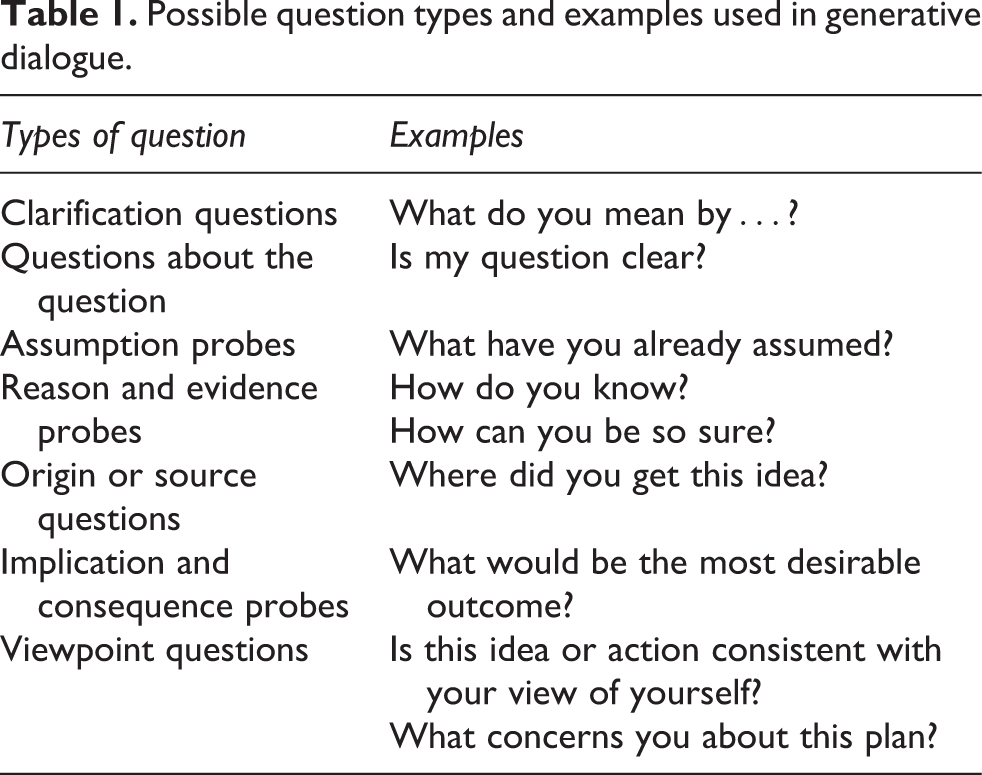
In order to demonstrate how the process is enacted, Table 1 presents a list of indicative question types and examples that can be used during the generative dialogue (from Townsend and Adams, 2010: 10–11).
Possible question types and examples used in generative dialogue.
Their same introduction goes on to give some suggestions for providing helpful and non-threating feedback during the session.
While this model of generative dialogue has been developed within the professional practice of school leaders, there have been scholars in the education disciplines who have addressed the concept from broader bases, such as Gunnlaugson’s model in adult and higher education.
Adult and higher education
Olen Gunnlaugson (2006) suggested that generative dialogue offered a useful theoretical framework for enhancing the transformative learning process within adult and higher education settings. He presented it ‘as a more comprehensive and integrated practice of conversation that cultivates ways of knowing and ways of being that serve the development of new knowledge and transformation of adult learners’ (Gunnlaugson, 2006: 2).
Usefully Gunnlaugson (2006: 9) identified four points that distinguish generative dialogue from conventional types of dialogue. These four characteristics are presented in terms of their value in supporting transformative learning. Gunnlaugson maintained that generative dialogue: is a discipline of lifelong learning and practice; is informed by three sources of learning (past, present and future); takes into account conversation as a developmental process; and relies on the primacy of meta-awareness vs thought or feeling.
Core here is that, through practice, generative dialogue ‘develops [in individuals] the ability to witness their processes of knowing through forms of meta-awareness’ (Gunnlaugson, 2006: 14). In particular, he suggested that, by facilitating the practices of generative dialogue, individuals move beyond just a conversation about ideas, or even a reflection on their ideas, to change the ways they hold their personal perspectives – and thereby they become more open to difference and to acceptance of diversity in all ways. ‘Through meta-awareness of our knowing, which is distinct from being merely self-conscious, the learner is subtly changed by this process’ (Gunnlaugson, 2006: 14). In other words, during the process, meta-awareness possibly includes those ‘light-bulb moments’ when the participant’s awareness moves to a stage beyond their current personal ideas or schemata to the formation/construction of a new body of knowledge.
Drawing upon the earlier work of Scharmer, an underlying theory of generative dialogue is presented by Gunnlaugson (2006: 8) as a model across two axes: whole vs parts, and the past vs the future. It is suggested that group conversations commence in the lower left quadrant (see Figure 1) ‘talking nice’, and then the process may develop, following an anti-clockwise direction, ending in ‘generative dialogue’.
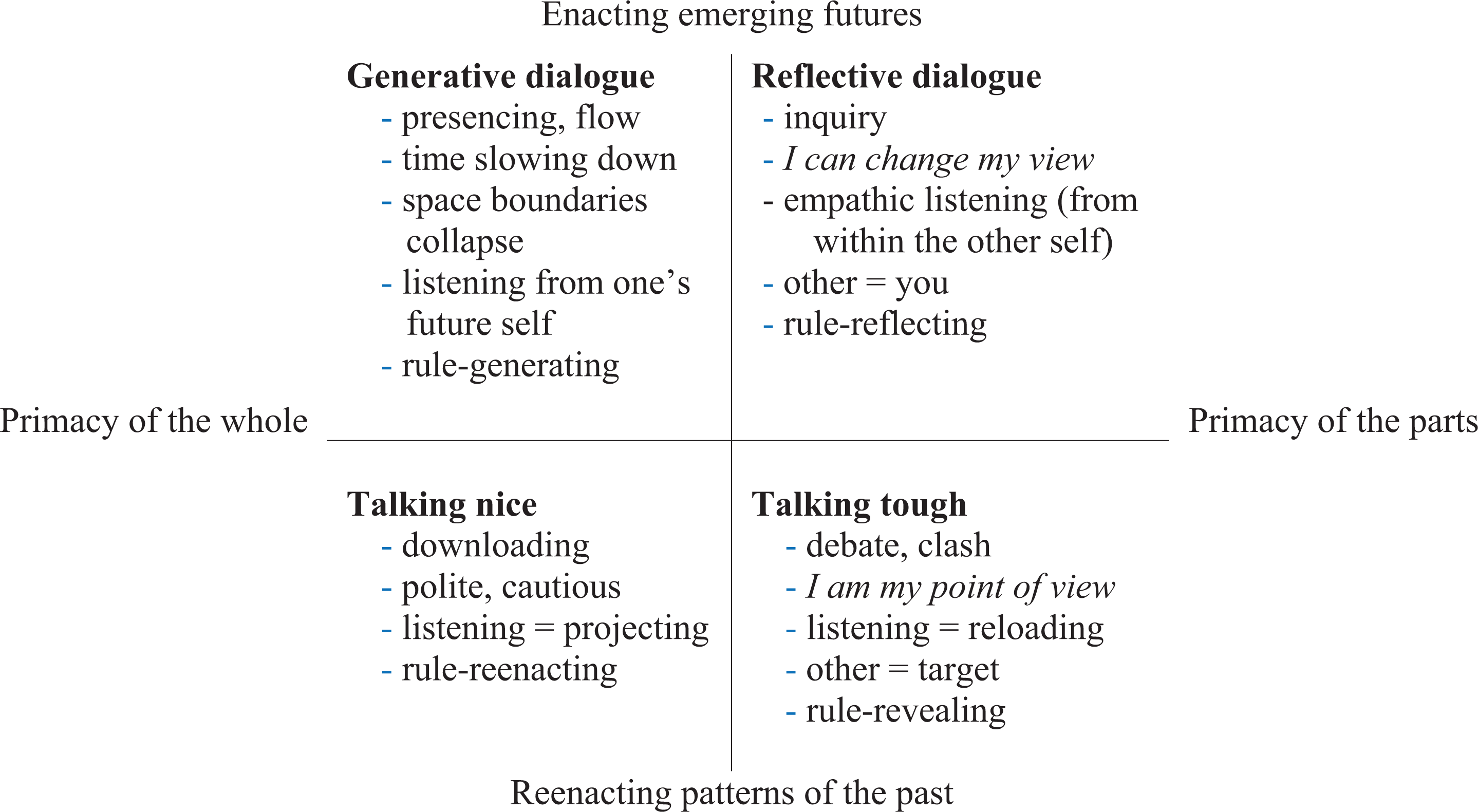
Four fields of generative dialogue, adapted from Gunnlaugson (2006: 8; 2007: 140).
In sum, Gunnlaugson’s ultimate goal was to identify a method for facilitating coherence between young adult and adult learners’ perspectives, conversations, actions and their capacity to co-create new ways of knowing, being and learning. He proposed that generative dialogue can be helpful within adult and higher education settings for new ways of being together in conversation as well as a method for unfolding new knowledge.
Counselling education
Ann Moir-Bussy (2010) investigated the role of generative dialogue within a transformative counselling program. She presented a description of the development of the concept, arguing that it grew out of the theory of dialogic self. She pointed out that Scharmer (2000) had developed the concept of generative dialogue in the leadership field and that Gunnlaugson (2007) had then extended and further discussed its characteristics ‘as a practice of conversation that draws on a broader spectrum of ways of knowing mediated by “meta-awareness” rather than discursive reasoning’ (Moir-Bussy, 2010: 161).
Moir-Bussy also argued that dialogue in general is a process that engages all parties to stay engaged and to interact towards both ‘the known and the un-known’. A special emphasis is given to the reflective dialogue and its ‘meta-awareness’ attributes. From her viewpoint, generative dialogue goes beyond the reflective by providing a collective learning space – ‘a holding space that meets the needs of all the participants in the dialogue’ (Moir-Bussy, 2010: 163). Moir-Bussy also maintained that the process leads to a higher-level awareness of those beliefs, habits, schemata and emotions that dominate ways of thinking and potentially do not allow us to really connect, listen and mutually accept the other participants’ thoughts, ideas or opinions.
Furthermore, she proposed that the process allows the development of stronger bonds/relationships between the participants, and potentially they all become more open to a shared exploration of new ideas and practices. Moir-Bussy also highlighted another special attribute of generative dialogue as its ‘presencing’. Scharmer (2000) introduced this term in order to describe the practice of slowing down the process of dialogue to enable participants to explore/discover new ways of knowing. Learning from attention is described as almost visceral – ‘The stillness within the dialogue [which] makes possible the sensing within one’s body of what might be possible or might become’ (Moir-Bussy, 2010: 163). Thoughtful and reflective silences within the dialogue provide the collective space for the reformulation of experiences and ideas but also for exploration of new possibilities. Indeed, there is an indication that too much talking destroys the process of generative dialogue.
Within this framework of ‘presencing’, Moir-Bussy introduced a model of dialogic teaching in counselling education where dialogue then plays a central role in the interaction between all: teachers, students, teaching content as well as teaching context. Moir-Bussy (2010) stressed that this process requires non-hierarchical relationship between teacher and students and students themselves, and is based on trust, appreciation, suspension of assumptions, and respect (Figure 2).
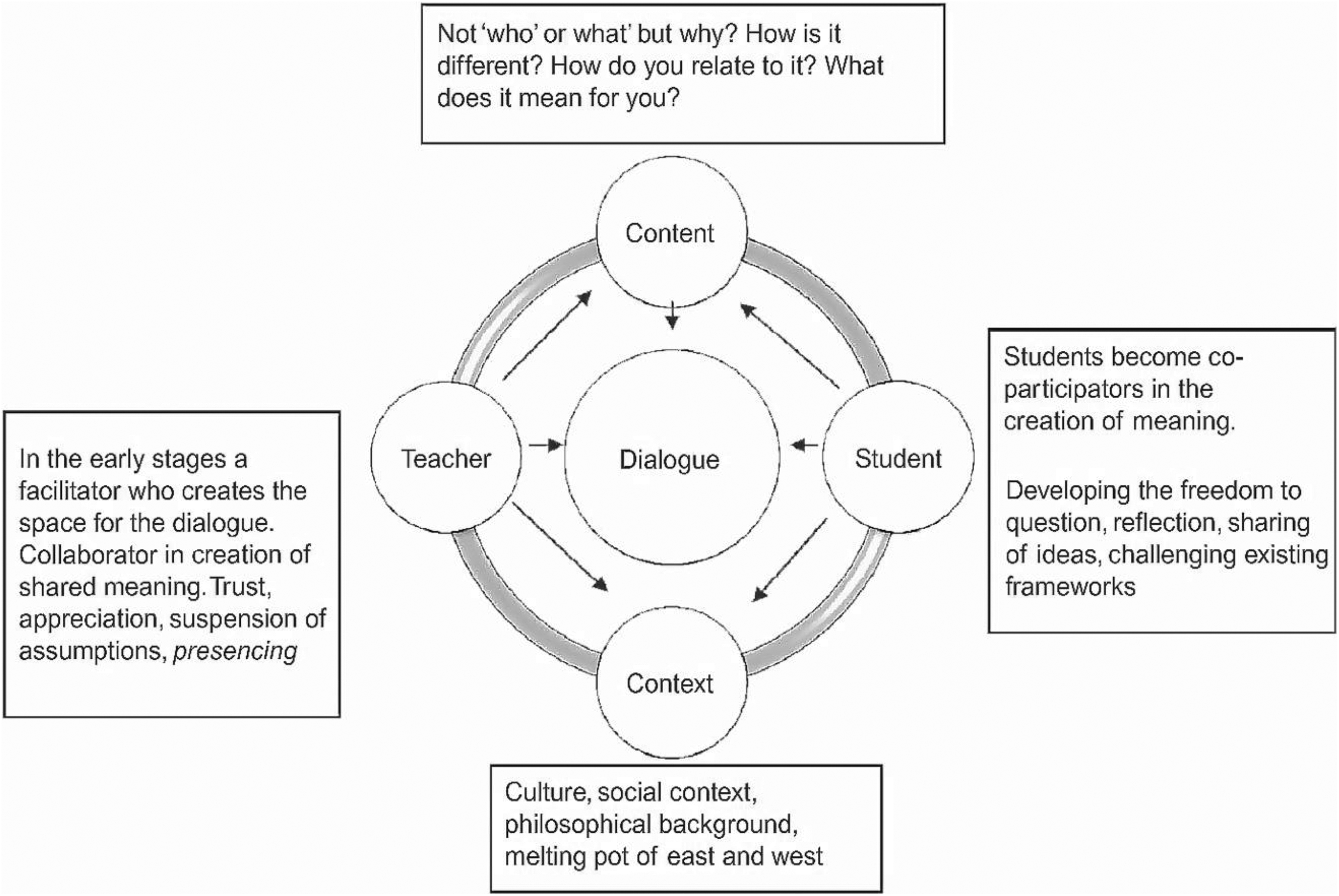
A model for dialogic teaching (Moir-Bussy, 2010: 167).
Counselling psychology
More recently, Tom Strong, Karen Ross and Monica Sesma-Vazquez (2015), in their work in counselling psychology, suggested ways of moving beyond medicalized discourse via reflective and generative conversations. They argued that ‘generative dialogues refer to a collaborative mobilization of resourcefulness’ (Strong et al., 2015: 600). It opens possibilities where prior thoughts and actions had been unsuccessful. The process is described as having energizing and hopeful attributes, and is characterized by deconstruction of things that clients may be taking for granted. In this way, the process provides a space for exploration and experimentation beyond assumed meanings, preferred ideas and actions. Strong’s group explained also that generative dialogues pre-suppose careful listening and acknowledgement of participants’ concerns.
These authors also take a comparatively judgemental view, suggesting that the facilitators must be careful not to allow the participants to feel inadequate or unintelligent. In order to achieve this, they do recommend that the hierarchy must be flattened, while participants must be considered ‘as editors-in-chief of the meaning for their lives’ (Strong et al., 2015: 606). For these counsellors, the process is considered as the means of producing new, actionable meanings.
All of the above are from the so-called ‘soft sciences’ of education and counselling. Another theoretical perspective about the characteristics of generative dialogue is available within the distinctly different discipline of business studies.
Business studies
Ian Palmer and his colleagues presented a generative dialogue approach where researchers would be engaged into a conversation about the different uses of the term ‘new organisational forms’ (Palmer et al., 2007). They made a call to business studies’ researchers to participate in a generative dialogue in order to investigate the diverse assumptions of this term that can be found in the literature.
Their study was based on the suggestion that the process is appropriate for successful interaction because it allows for diversity of perspectives and interests. In order to support this, they outlined the following characteristics which they proposed for a successful application of generative dialogue (Palmer et al., 2007): The acknowledgement of others’ positions and perspectives is needed to create generative dialogue. Paying attention, curiosity and asking questions are forms of affirmation.
Productive difference: It is based on the existence and acknowledgment of different perspectives and ideas in order to generate new meaning.
Coherence – repetitive sequences: Its effectiveness relies upon repetitions of key concepts, actions and relationships. Repetitive sequences lead to the creation of coherence.
Integration: For example, this provides a historical depth when temporarily ideas or perspectives are presented in a narrative form. Taking into account past minutes of the meetings can be used to enlighten, validate and extend present perspectives.
Reflection: By reflecting periodically on the process, participants are allowed to access what has been achieved. Any ambiguous statements or ideas can be clarified.
Bonds and boundaries: Relies upon the boundary shifting from the singular ‘I’ to the inclusive ‘we’. The collective characteristic of the process helps in the creation of a community of practice and consequently a bonding among the participants.
In sum, the group provided a comprehensive description of the characteristics of generative dialogue. From the perspective of business, in a tentative way, they proposed this dialogue as a base for productive interaction between scholars in business studies.
Leadership in vocational education and training (VET)
Returning to education, but in a broader context, the sixth and final model to be discussed in this article is a research study in vocational education and training (VET). Aini-Kristiina Jappinen and Anneli Sarja (2012) investigated distributed pedagogical leadership practices and generative dialogues as aids to supporting students in VET in particular, but also in education more generally. This research data came from two learning environments within the Finnish VET system – an upper secondary education institute and a rural comprehensive school. The authors argued that generative dialogue is an effective communicative tool for administration and teaching staff better to operate in the demanding world of education.
Jappinen and Sarja (2012: 65) argued that ‘generative dialogue is rule-generating, that it is applied to generate a common frame of thinking, shared meaning and a collective worldview in a group/system’. They maintained that, in order to get to that point, the process is very supportive and understanding as a practice in helping students to cope with their learning pathways. ‘Generative dialogue is an innovative tool for the changing institutional socio-cultural circumstances of leadership activities and educational practices.’ As a result of distributed pedagogical leadership, the two educational institutes that participated in this study then introduced the idea of effective student counselling.
Summary of findings
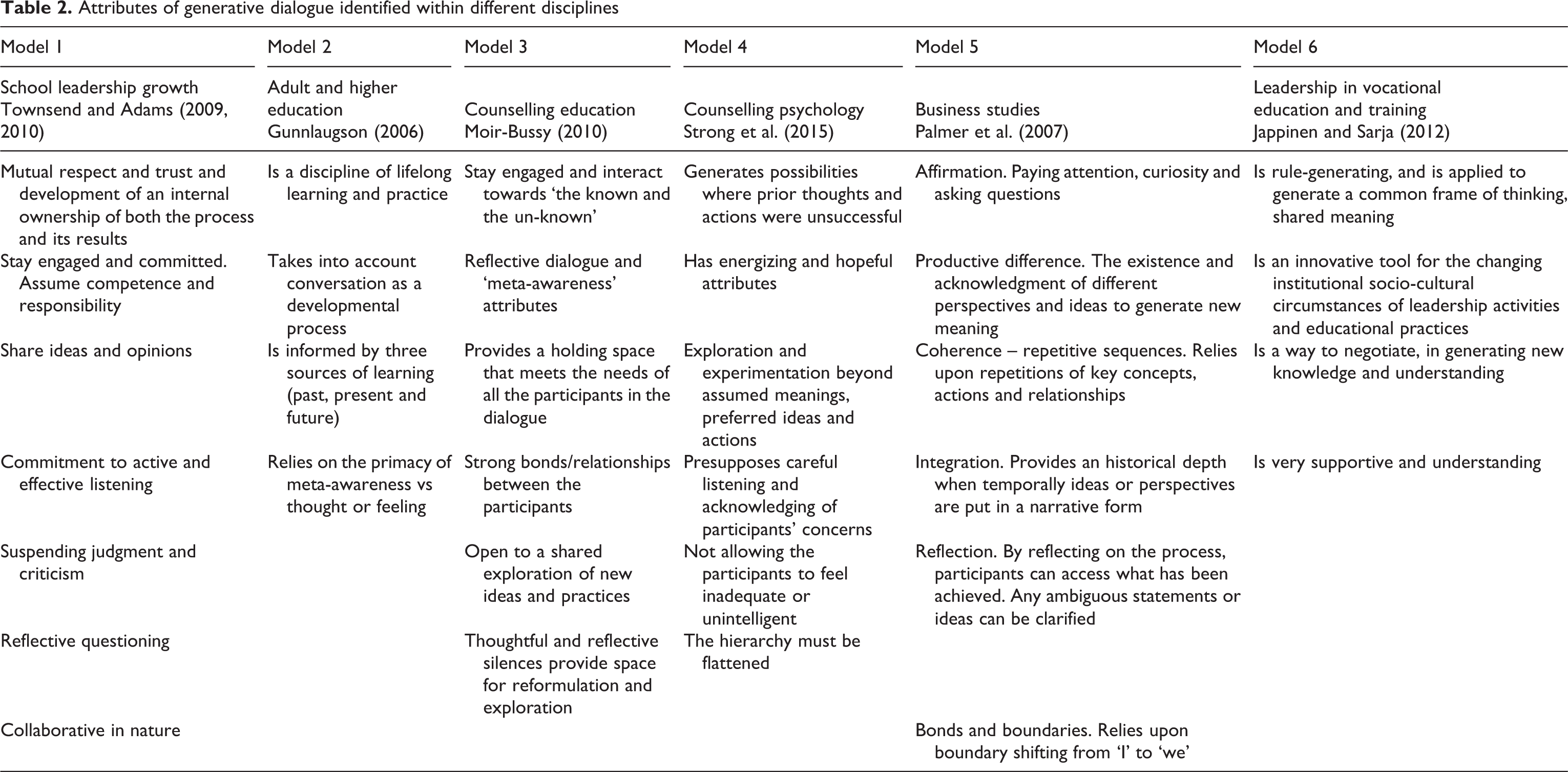
A literature review on the concept of generative dialogue revealed a limited number of studies which come from different disciplines. Most of those sources are relatively recent, emerging around 2000, and growing steadily since. From an analysis of this literature, six main models emerged. Although the use and benefit of the process is explored from different perspectives and contexts, all models share common characteristics. Table 2 presents those six different models within those disciplines.
Attributes of generative dialogue identified within different disciplines
While there is a common thread of education in these examples, clearly, across a range of contexts, generative dialogue is a powerful type of meaningful collegial interaction that empowers participants to stay engaged, sharing trust and mutual respect, while working towards a common goal. The lack of any judgmental criticism, combined with the mutual purposeful interaction through the process, empowers participants to share responsibilities in developing new knowledge and in setting common goals. According to Townsend and Adams (2010), generative dialogue is one of the core elements of the collaborative inquiry approach, and consequently this early analysis of the concept will contribute to our better understanding of its role in that approach.
Comparing Gunnlaugson’s with the Townsend-Adams model of generative dialogue, some clear points of agreement can be identified. Both models point out the developmental role of the process and the opportunity it provides for the creation of new knowledge. Gunnlaugson highlighted the meta-awareness characteristic, whereas Townsend and Adams focused on the mutual respect and trust as well as the development of an internal ownership and locus of control that allows participants to enter into such kinds of collaborations that are most likely to enhance professional practice.
Given its similarities to Carl Rogers’ ‘unconditional positive regard’ (1953) and to classical Adlerian psychotherapy, it is not surprising that the concept of generative dialogue has been used in the counselling discipline. It is obvious that Moir-Bussy’s work in generative dialogue, within the context of counselling education, is highly influenced by Gunnlaugson’s model, and that there are close similarities with the Townsend-Adams model.
Whereas Townsend and Adams assert that all participants’ competence and responsibility must be taken as a basic professional assumption, from the perspective of counselling psychology, Strong et al. (2015) highlight the important role of the facilitator of the generative dialogue. This links with the Townsend-Adams emphasis in practice for the commitment of busy academic facilitators to regularly be present for the sessions, and accords with the counsellors’ ‘flattened’ hierarchy. More generally, the models are in agreement that all participants in a generative dialogue are committed to the development of new professional knowledge through a respectful engagement.
Similarly, Palmer et al.’s (2007) model is closely related to the Townsend-Adams model. Both models highlight the importance of affirmation of participants’ different perspectives and ideas. Both pay attention to the reflective characteristics of generative dialogue. Although only the Palmer et al. (2007) model refers to the shifting from ‘I’ to ‘we’ (and the emerging group solidarity inherent in this), both models present generative dialogue as a collective space of sharing ideas and practices.
Finally, Jappinen and Sarja (2012) highlighted the role of generative dialogue as a way to produce new knowledge. This perspective aligns with the Townsend-Adams practice in that it highlights the important role that it can play in school professional growth.
In all, there is evident potential for generative dialogue to lead to new knowledge, to collaborative work towards significant outcomes. This goes well beyond reflection, whether individual or group, to point to ways for the management of engaged and effective professional groups.
Conclusions
Educational leaders can be in positions of considerable awkwardness, required to implement ever-changing policy and higher-level demands, to supervise teachers, as well as to inspire all in teaching and learning. As this new concept of generative dialogue is emerging across disciplines, it is noted that the majority of interest comes from the field of education. Although all organizational structures have some form of hierarchy, perhaps it is in education where leaders, with their dual identity of manager/teacher, struggle most against the privileges in their position, and so this collegial process is attractive and promises much benefit.
For the individual leader, the generative dialogue process respects and supports the professional experience and judgement which the individual can bring to bear. In short, it respects their professionalism. Yet it goes further by offering a meta-awareness which is transformational in that it enables problems to be framed in a more realistic manner and with a sustained sense of purpose.
Where the process includes leadership teams (or also an external supervisor, as reported in Townsend and Adams, 2008: 60), then the effectiveness of generative dialogue has the potential to be far-reaching. The openness of professional power, and even its vulnerability, can lead to a sense of shared responsibility – a distributed leadership which is not contrived.
As educational leaders face many problems which are both complex and varying, they are also offered solutions by many. This newly emerging approach shows sufficient promise in order to prompt further exploration of the precise benefits which it can bring to a range of school contexts.
Footnotes
Declaration of Conflicting Interests
The authors declared no potential conflicts of interest with respect to the research, authorship and/or publication of this article.
Funding
The authors received no financial support for the research, authorship and/or publication of this article.
