






Abstract
Teacher effectiveness is the indispensable catalyst in transforming educational curricula into tangible, high-quality learning outcomes. Nevertheless, the concurrent struggle with school leadership and work-life balance issues presents substantial barriers that diminish teachers’ operational capability. Grounded by the stimulus-organism-response (SOR), high-reliability organisation (HRO), and job demand-resources (JD-R) theories, this study examined how teacher job satisfaction mediates the influence of principal mindful leadership and teachers’ work-life balance and effectiveness. Employing a quantitative cross-sectional design, data were collected from 384 teachers across 153 sary schools in the Malaysian state of Terengganu. Partial Least Squares Structural Equation Modeling analysis for model evaluation and hypothesis testing demonstrated that mindful leadership and work-life balance significantly enhance teacher effectiveness, with job satisfaction partially mediating these relationships. The findings offer distinct contributions to the literature on mindful leadership in Eastern, collectivist settings and provide an empirical basis for school leadership training and policy intervention to optimise teacher performance.
Keywords
Introduction
Teacher effectiveness is the foundation of quality education aligned with the UNESCO SDG4 goals. It is a critical factor influencing international student outcomes and educational success (Darling-Hammond, 2011; Muijs and Reynolds, 2011; Ronfeldt et al., 2018; Stronge, 2018a, 2018b). Although significant action has been taken globally to expand educational access, challenges remain in consistently ensuring high-quality teaching. In Malaysia, concerns regarding teacher effectiveness have intensified, particularly amid the largest decrease in the PISA and TIMSS international assessments (Azahar and Cheng, 2024; OECD, 2023). Despite Malaysia's robust economic growth, the World Bank (2024) has indicated persistent shortcomings in educational quality, highlighting an urgent need for improving teacher competencies and effectiveness as central to educational reform.
High-quality teaching, however, is not solely dependent on individual teacher competence, but it is profoundly shaped by external organisational factors, particularly the support provided by school leadership (Bush, 2013; Hallinger, 2011; Harris and Jones, 2019). Effective school leadership is vital for nurturing supportive environments that enhance teacher performance (Adams et al., 2021; Bush, 2021; Thien and Adams, 2021). During the current social, economic, and environmental turbulence, traditional hierarchical leadership models are insufficient for tackling the educational landscape's inherent volatility, uncertainty, and complexity (Subrahmanyam, 2025). Consequently, a shift is required toward leadership prioritising resilience and systemic awareness. Mindful leadership emerges as a modern alternative to the traditional paradigm for nurturing teacher effectiveness in the complex school structure. This approach is theoretically underpinned by High-Reliability Organisation (HRO) theory, characterising mindful school principal by heightened awareness, sensitivity to operations, commitment to resilience, emphasising proactive responses to educational challenges, supporting both individual and organisational effectiveness (Weick and Sutcliffe, 2001; Higgs and Rowland, 2024; Hoy, 2003; Kearney et al., 2013).
Nonetheless, mindful leadership alone may not entirely resolve issues related to teacher effectiveness without considering teachers’ well-being. Work-life balance (WLB) is a critical determinant of operational capability, yet Malaysia continues to grapple with pervasive challenges, including excessive workloads, blurred professional boundaries, and increasing burnout (Adolph, 2024; Ertürk, 2022). Furthermore, in Eastern collectivist cultures such as Southeast Asia, WLB is uniquely shaped by values prioritising familial and group harmony over individualistic personal growth prevalent in Western contexts (Yang et al., 2000). Consequently, teacher job satisfaction emerges as the pivotal psychological mechanism through which supportive leadership and well-managed WLB translate into sustained teacher effectiveness (Abdul Halim et al., 2021; Sayadi, 2016).
While substantial international research explores mindful leadership, work-life balance, and job satisfaction individually, a significant gap exists regarding their interdependent relationship within an Asian collectivist setting. Specifically, there is limited empirical evidence examining how job satisfaction mediates the influence of principal mindful leadership and teacher work-life balance on effectiveness within Malaysia's distinctive educational context. Addressing this loophole, the present study is grounded in the stimulus-organism-response (S-O-R) framework, reinforced by HRO and job demand-resources (JD-R) models, to explain these complex relationships. The research focuses on secondary schools in Terengganu, as the state was selected for its distinctive, strong collectivist culture and high-power distance, traits which are expected to heavily influence leadership styles and workplace interactions (Brewer and Venaik, 2011; Hassan et al., 2010). By investigating these complex relationships within a culturally distinctive, collectivist Malaysian context, bridging local realities with broader global educational leadership literature, this study aims to contribute novel insights in this area. This study attempts to address the following research questions:
Is there any significant relationship between principal mindful leadership and teacher effectiveness in Terengganu secondary schools? Is there any significant relationship between teacher work-life balance and teacher effectiveness in Terengganu secondary schools? Does job satisfaction significantly mediate the relationship between principal mindful leadership and teacher effectiveness in Terengganu secondary schools? Does job satisfaction significantly mediate the relationship between teacher work-life balance and teacher effectiveness in Terengganu secondary schools?
Conceptual framework and hypothesis development
Mindful leadership and teacher effectiveness
In recent years, empirical evidence has emerged to support the link between mindful leadership and teacher effectiveness (Agastya et al., 2023; Mahfouz, 2018). The introduction of mindful leadership in the organisation has been said to promote effective decision-making, teamwork, organisational resilience, reduced stress, enhanced eco-centric leadership, and increased individual and organisational performance, especially in the school context (Higgs and Rowland, 2024; Nübold et al., 2020). Another critical role of mindful leadership in enhancing teacher effectiveness is promoting a positive work environment through effective communication and mutual trust (Hoy et al., 2006; Stedham and Skaar, 2019). This work environment allows teachers to feel comfortable sharing their expertise and raising concerns, leading to a more collaborative approach. Studies have shown that effective teachers have positive relationships with their students by building trust and mutual respect, engaging and motivating them, creating a positive classroom culture and environment, supporting students’ learning styles and abilities, facilitating effective learning, and adapting their teaching style (Hattie, 2013; Stronge, 2018a, 2018b) Given teachers’ crucial role in student success, the development of mindful leadership among school principals and other educational leaders is an important consideration.
Work-life balance and teacher effectiveness
The existing literature consistently highlights the crucial relationship between work-life balance and teacher effectiveness, emphasising its impact on educators’ professional and personal domains. Work-life balance directly enhances teachers’ classroom productivity, job performance, and overall effectiveness (Punia and Kamboj, 2013; Wan and Salahudin, 2023). Effective work-life balance also reduces work-related stress and burnout, positively affecting teachers’ emotional health and sustained professional engagement (Ertürk, 2022; Hlaďo et al., 2020). Additionally, organisational support, including flexible scheduling and supportive school environments, is identified as instrumental in fostering balanced lifestyles among educators, thereby enhancing their commitment and effectiveness (Butarbutar et al., 2022). These findings align closely with the JDR model (Bakker et al., 2014), accentuating work-life balance as a critical resource in moderating teacher job demands, reducing burnout, and promoting effective teaching practices. While considerable international research highlights these dynamics, localised investigations within Malaysian secondary schools remain limited, signalling a critical contextual gap that this research aims to address.
Job satisfaction as a mediator
Recent literature highlights job satisfaction's critical role in linking mindful leadership and work-life balance to enhanced teacher effectiveness. Studies argue that job satisfaction is essential for translating supportive leadership and balanced workloads into improved professional outcomes (Crede et al., 2007; Robbins and Judge, 2018). Empirical evidence consistently demonstrates that mindful leadership practices characterised by attentiveness, emotional regulation, and consideration enhance teacher job satisfaction, consequently enhancing teacher commitment and effectiveness (Hülsheger et al., 2013; Reb et al., 2014; Tekel and Karadag, 2020). Similarly, flexible organisational policies promoting work-life balance directly elevate job satisfaction, improving teachers’ performance, reducing burnout, and fostering greater organisational commitment (Karatepe and Tekinkus, 2006; Ordu, 2021; Liu et al., 2021). Within Malaysia, research aligns with international findings, confirming job satisfaction as a crucial mediator between transformational leadership, a style closely aligned with mindful leadership, and teacher effectiveness (Halim et al., 2021; Mokhtar et al., 2023). Due to the consistently significant relationship between the exogenous and endogenous variables, the researcher introduced job satisfaction as a mediator using a segmentation approach instead of transmittal (Rungtusanatham et al., 2014). Regardless of international recognition of the importance of job satisfaction as a mediator, there remains limited evidence between the variables involved in this study thus far, especially in the Malaysian context. Hence, this study aims to fill this gap by empirically examining how job satisfaction mediates mindful leadership and work-life balance effects on teacher effectiveness in Terengganu secondary schools. Figure 1 presents the research model used in this study.
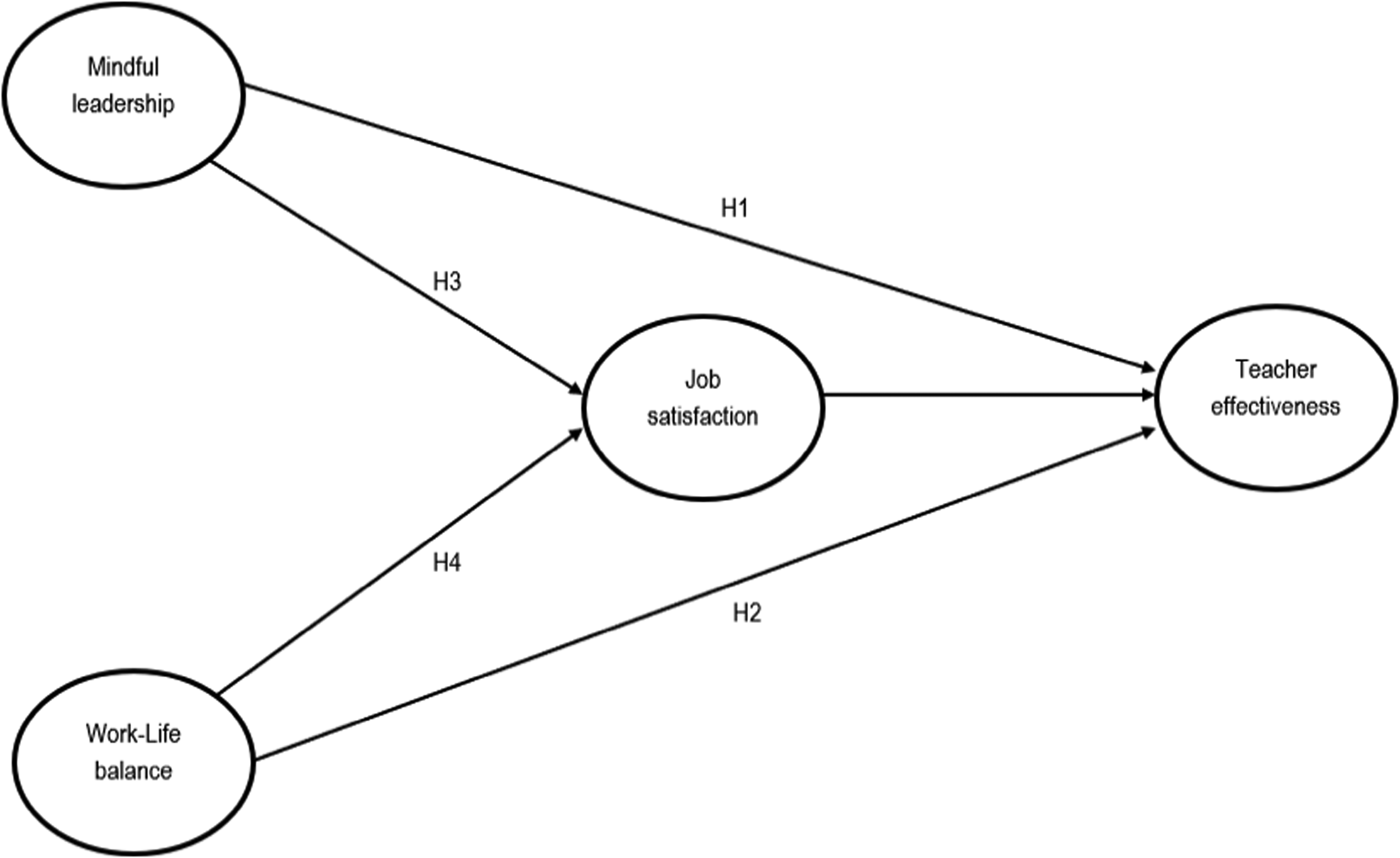
Research framework.
Research methodology
This study employed a cross-sectional, face-to-face survey using a structured questionnaire to collect data from a representative sample of 384 secondary school teachers. A cross-sectional data collection allows for efficient data collection from a large sample (Uma Sekaran and Bougie, 2016). However, this method is susceptible to common method variance (CMV), which may inflate or bias results (Podsakoff et al., 2024). To mitigate the CMV issue, the procedural and statistical remedies were implemented, including assuring respondent anonymity, varying response formats, counterbalancing item orders to reduce response biases and inclusion of a marker variable in the instruments (Lindell and Whitney, 2001). Additionally, seven underlying statistical test assumptions were run before the multiple regression analysis to ensure the data's robustness (Figures 1–7). We also employed the Gaussian Copula test to identify possible paths with endogeneity issues and the FIMIX-PLS test for heterogeneity (Table A4 and Table A5).Acknowledging the limitations of a cross-sectional approach, this design was selected due to practical considerations, including time constraints, budget limitations, the wide geographical distribution of schools, and the mobility of teachers due to transfer policies within Malaysia's education system.
Population and sampling
This study focused on secondary schools across eight districts in Terengganu, Malaysia, drawing from a population of 10,325 government teachers. Determining an appropriate sample size was critical to reduce sampling error and ensure representativeness, thereby enhancing the reliability of findings (Lakens, 2022; Memon et al., 2020). A proportional cluster sampling approach was employed, grouping schools geographically and selecting clusters based on the teacher population size within each district. To ensure representativeness, the sample size adhered to the Central Limit Theorem (McEwan, 2020) and followed Krejcie and Morgan's (1970) guidelines. At a 95% confidence level and 5% margin of error, a minimum sample of 384 respondents was required. To mitigate potential non-response and missing data, slightly more questionnaires were distributed, consistent with Salkind's (2013) recommendation of not exceeding a 20% surplus. Data were collected using the drop-off and collect method. This self-administered approach was employed specifically to minimise the tendency of social desirability bias (Larson, 2019), allowing respondents greater privacy and time, thereby eliciting more honest and authentic responses.
Instrumentation
A closed-ended adapted questionnaire was utilised to gather quantitative data from a specific group of teachers. The instruments used in this study adopted the principal mindful leadership scale (Hoy, 2003), the work-life balance scale (Hayman, 2005), the job satisfaction scale (Spector, 2020), and the teacher effectiveness scale (Prakash et al., 2020). Additionally, the cognitive rigidity items were added as the variable marker to address common method bias issues in the study. Considering the emic perspectives of Western individualist cultures while using existing instruments, these validated and improvised instruments have been adapted to suit the emic perspective of Malaysia's cross-cultural local context (Hofstede, 1980). The established instruments have undergone rigorous testing, including a decentring process such as expert reviews, back-to-back translation, cognitive interviews, and a pilot study. The adaptation preserved the instruments’ intended meaning while achieving linguistic and conceptual equivalence across languages (Sechrest et al., 1972). Negative worded items were included to minimise acquiescence bias (Lavrakas, 2013). The questionnaire comprised six sections: Section A (demographics), Section B (7 items on mindful leadership), Section C (15 items on work-life balance), Section D (3 marker variable items on cognitive rigidity), Section E (32 items on job satisfaction), and Section F (25 items on teacher effectiveness). A five-point Likert scale (1 = Strongly Disagree to 5 = Strongly Agree) was used throughout, selected for its simplicity, cross-cultural suitability, and reliability in capturing response variability. Research indicates that five-point scales offer sufficient sensitivity for statistical analysis while minimising response burden.
Results
Data analysis
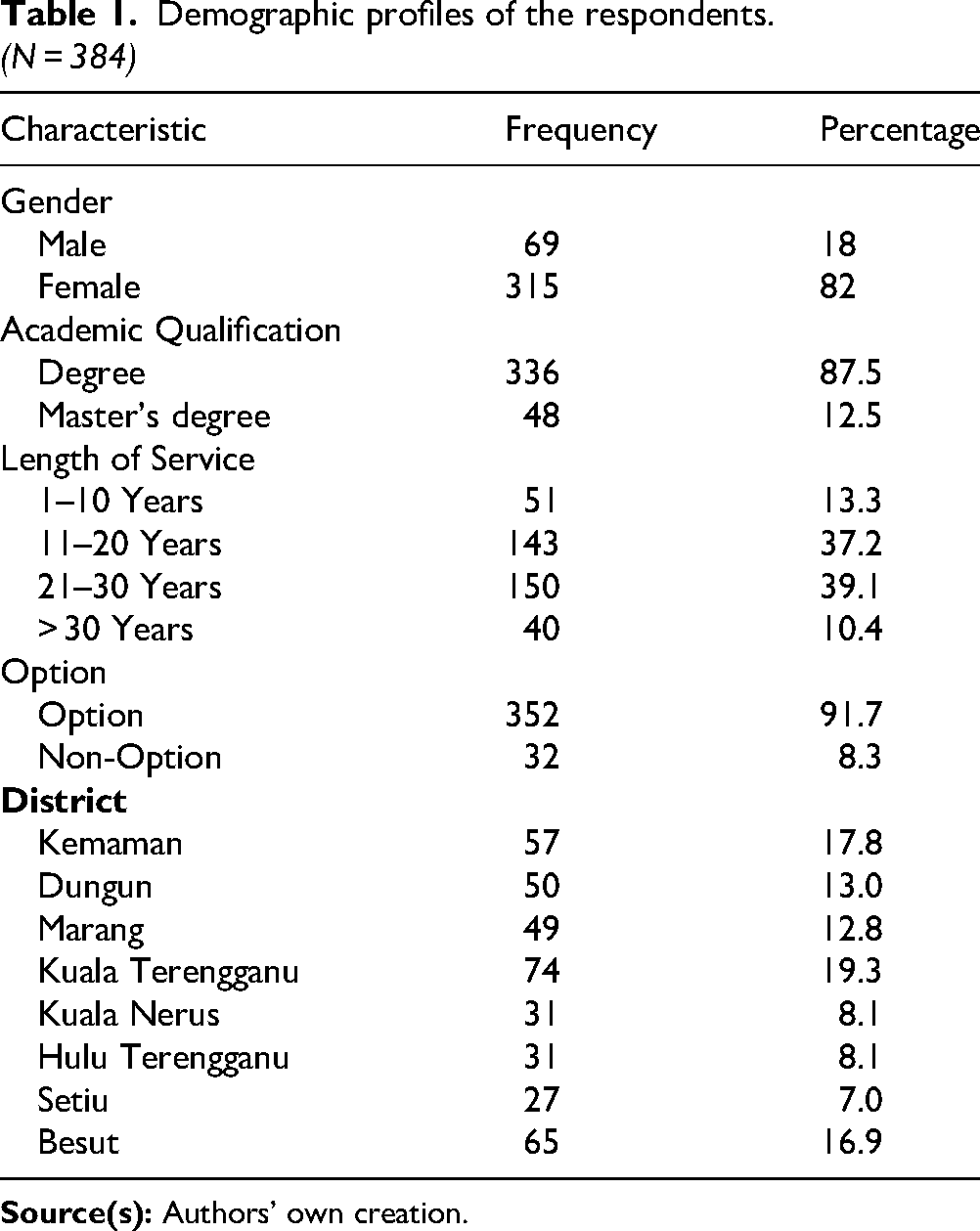
See (Table 1).
Demographic profiles of the respondents.
(N = 384)
Measurement model
The measurement model was evaluated for reliability and validity of the measured constructs using recommended PLS-SEM criteria (Hair et al., 2017). Internal consistency reliability was primarily assessed using the Composite Reliability index (ρc), which is considered a more robust measurement than Cronbach's Alpha (α) in PLS-SEM due to its tendency to avoid underestimation (Hair et al., 2021). As shown in Table 2, the ρc value for the reflective construct of mindful leadership (LM), job satisfaction (JS) and teacher effectiveness (TE) ranged from 0.797 to 0.967, exceeding the reliable threshold of 0.70 (Hair et al., 2017). This step confirms the internal consistency of the latent variables. (Note: ρc does not apply to the formative second-order work-life balance (WLB) construct).
Measurement model.
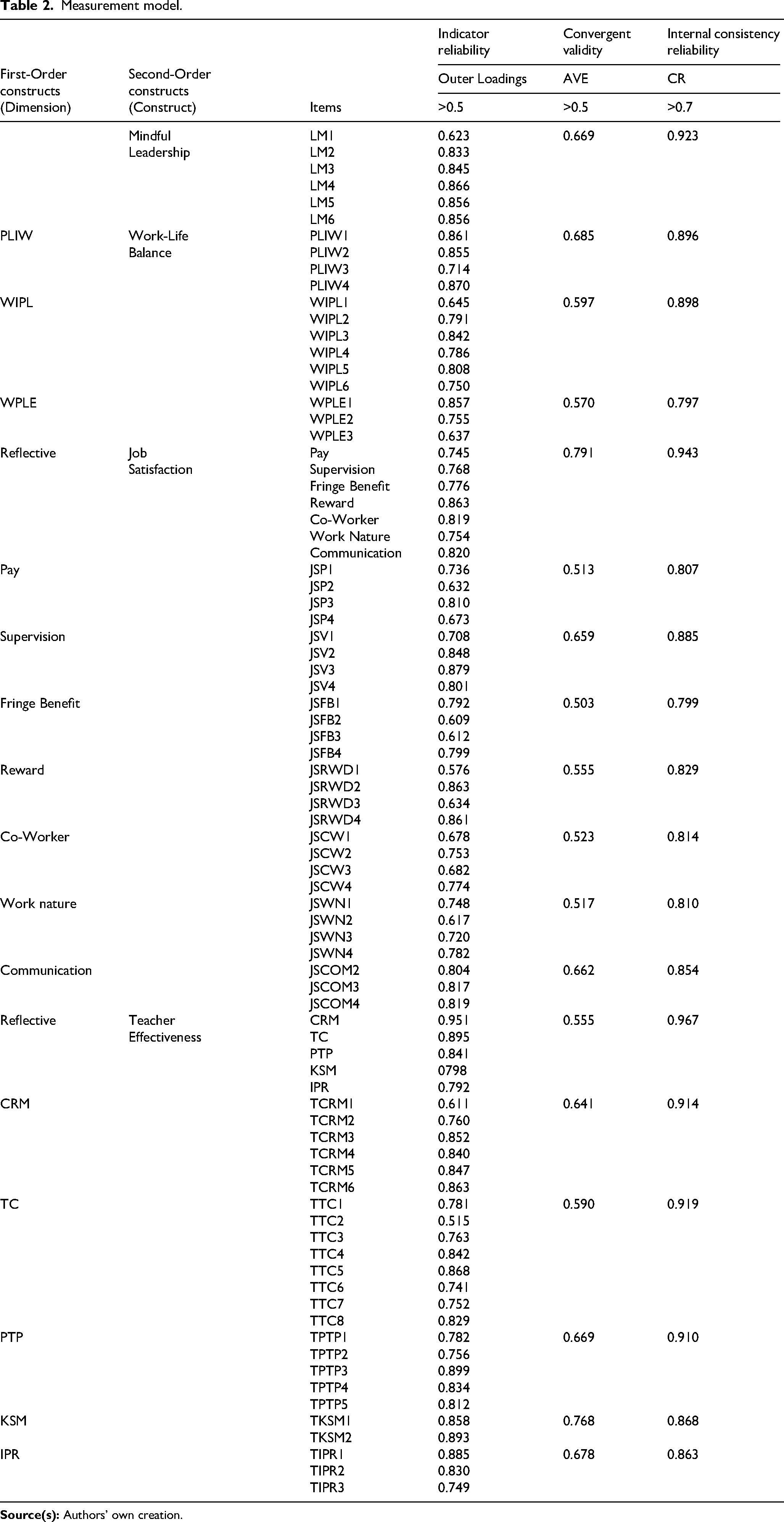
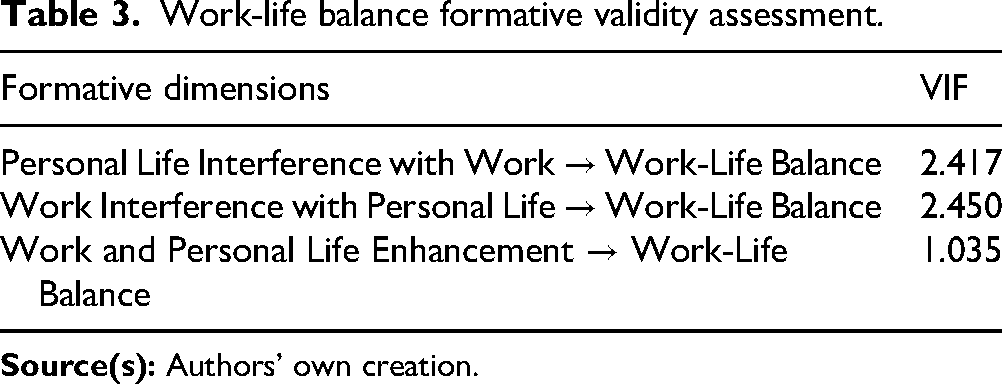
Indicator reliability was confirmed by examining the outer loadings. All indicators across the LM, WLB, JS, and TE constructs exceeded the minimum threshold, with loadings ranging from a minimum of 0.515 to a maximum of 0.899. Crucially, most indicators have loadings greater than 0.708, demonstrating that the respective construct explains more than 50% of the indicator's variance (Hair et al., 2021). Furthermore, the formative dimensions of the WLB construct demonstrated an acceptable inner VIF value (<3.3), thereby confirming the absence of a multicollinearity issue (Kock, 2015) (see Table 3).
Work-life balance formative validity assessment.
Convergent validity was established using the Average Variance Extracted (AVE). The AVE values for all reflective constructs (LM, JS, and TE) and their respective dimensions, surpassed the minimum requirements of 0.50. This result confirms that the constructs explain more than half the variance of their indicators and that all items effectively measure their intended latent variable.
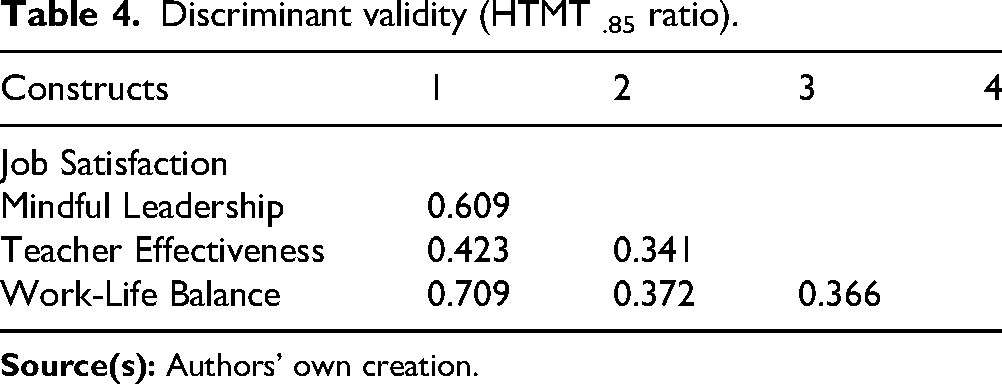
Discriminant validity was rigorously assessed using Heterotrait-Monotrait Ratio of Correlations (HTMT), which is recognised as a superior criterion compared to the traditional Fornell-Larcker test (Henseler et al., 2015). We employed a two-step approach. First, we adhered to Kline's (2011) criteria, which indicated that HTMT values below 0.85 indicate adequate discriminant validity for the constructs. Second, the bootstrapping procedures confirmed that the 95% confidence interval upper bound for every HTMT ratio did not include ‘0’. Collectively, the results presented in Table 4 substantiate the establishment of discriminant validity, indicating that each construct in the model is statistically distinct and measures a unique, coherent latent variable.
Discriminant validity (HTMT .85 ratio).
Structural model
The structural model was first assessed for lateral collinearity to examine the inner model's variance Inflation Factor (VIF). All the independent variable VIF values were below the threshold of 3.3, confirming that collinearity is not a concern in this study (See Table 3). Subsequently, a bootstrapping procedure with 10,000 subsamples and a two-tailed test at α = 0.05 was employed to test the hypothesis. Given the significant deviation from Mardia's multivariate normality (skewness β = 3.281, kurtosis β = 27.067), we adhered to the recommendation to report confidence intervals and effect sizes alongside ρ-values (Hahn & Ang, 2017; Sarstedt et al., 2022). The analysis reveals that both direct relationships with Teacher Effectiveness (TE) were statistically significant: Mindful leadership (LM) (β = 0.275, t = 5.571, p < 0.05) and Work-Life Balance (WLB) (β = 0.240, t = 4.928, p < 0.05). The bias-corrected intervals for all the hypotheses (H1 to H4) did not include zero, providing full support for the proposed model relationship (See Figure 2 and Table 5).
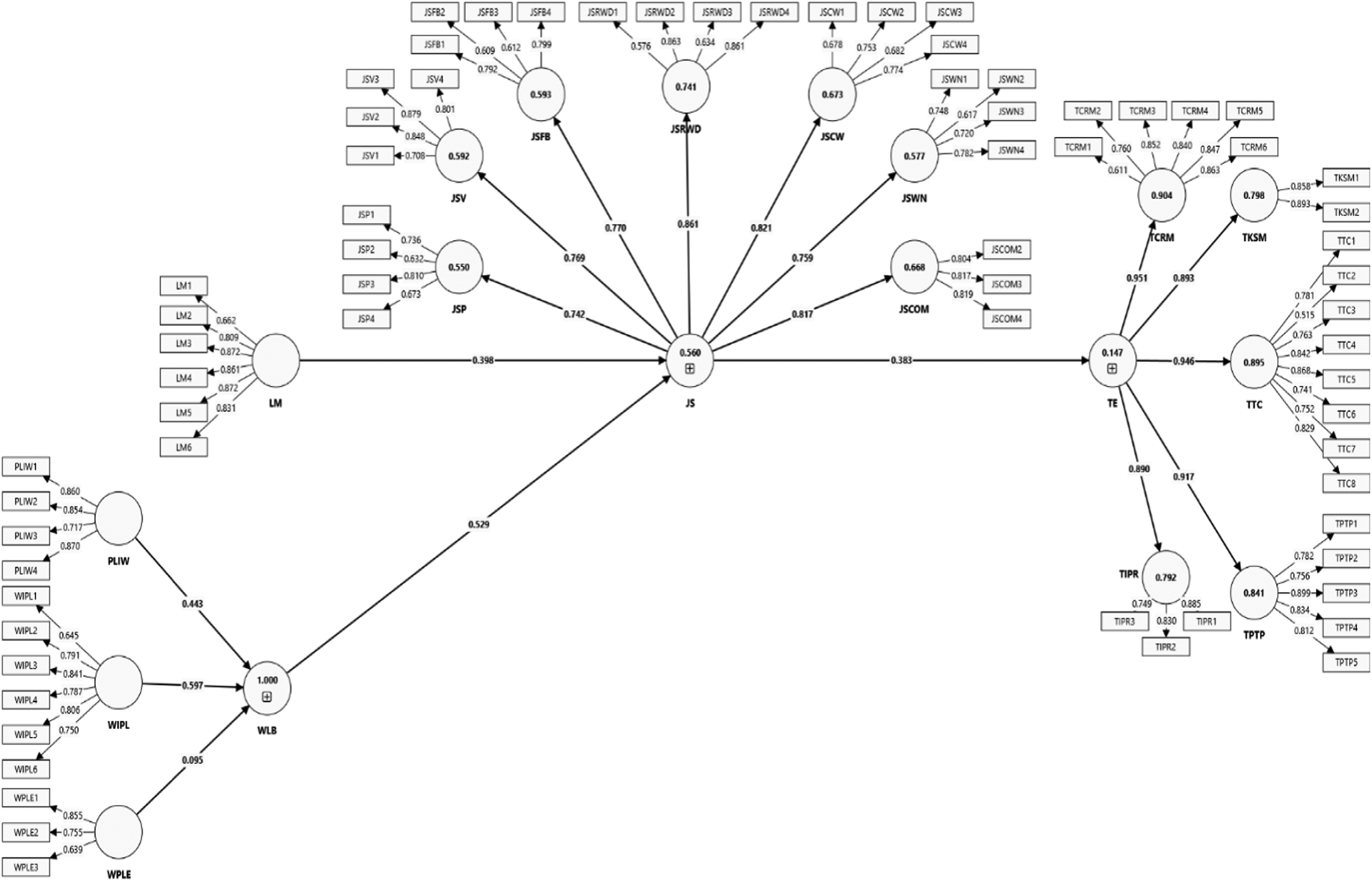
Structural model graphical output.
Hypothesis testing of direct effect.

Note: LM = mindful leadership, JS = job satisfaction, TE = teacher effectiveness, WLB = work-life balance; 95% confidence interval with a bootstrapping of 10,000.
The model exhibits a substantial explanatory power for Job Satisfaction (JS), with an R2value of 0.560. This indicates that LM and WLB collectively explain 56% of the variance in JS. In contrast, the R2 for Teacher Effectiveness (TE) is 0.170. While this value suggests a small to moderate fit, it is deemed acceptable and meaningful within the social science research (Cohen, 1988). In quantifying the magnitude of these effects, we followed the guidelines of Cohen (1988) and Lachowicz et al. (2018). LM (f2 = 0.084) and WLB (f2 = 0.064) exhibited small direct effects on the R2 of TE. However, the indirect effects via the mediator show a more detailed picture. LM (f2 = 0.330) and WLB (f2 = 0.583) demonstrated moderate and large effects, respectively, and the R2 of JS, which in turn had a moderate effect (f2 = 0.172) on the R2 of TE.
Indirect effect mediation analysis
The bootstrapping analysis for the mediation effect of job satisfaction between mindful leadership and teacher effectiveness (LM → JS → TE) revealed a significant indirect effect β = 0.152 (0.398*0.383) with a t-value of 5.628. According to Preacher and Hayes (2008), an indirect effect of 0.152, with a 95% bias-corrected confidence interval (LL = 0.101, UL = 0.206) that does not include zero, confirms the mediation in the model. Similarly, the mediation analysis for job satisfaction between work-life balance and teacher effectiveness (WLB → JS → TE) showed a significant indirect effect β = 0.203 (0.529*0.383), with a t-value of 6.171. The 95% bias-corrected interval indicated that (LL = 0.137, UL = 0.265) also did not show any intervals straddling a ‘0’, thus confirming our findings as indicated in Table 6. Therefore, this study concludes that the mediation effect is statistically significant, supporting hypotheses H3 and H4.
Indirect effect of mediation analysis.

Note: LM = mindful leadership, JS = job satisfaction, TE = teacher effectiveness, WLB = work-life balance; 95% confidence interval with a bootstrapping of 10,000.
Source(s): Authors’ own creation.
Discussion and conclusion
The findings provide several salient theoretical and practical contributions, particularly by validating Western-centric management theories in an Asian collectivist setting. The finding that principal mindful leadership significantly predicts teacher effectiveness reinforces the growing body of literature asserting that mindfulness-based leadership fosters greater organisational responsiveness, resilience, and alignment with instructional goals (Hoy et al., 2006; Kearney et al., 2013; Reb et al., 2014), a conclusion that resonated in Western contexts (Lange and Rowold, 2019). Importantly, the findings reinforce the relevance of the High-Reliability Organisation (HRO) theory, which positions mindfulness as central to leaders’ capacity to respond to complexity with sensitivity, resilience, and deference to expertise (Kearney et al., 2013). Within the Malaysian context, this study affirms that mindful leadership is a culturally adaptive and contextually appropriate approach, even within hierarchical and collectivist school systems (Shafiee et al., 2019).
The relationship between work-life balance and teacher effectiveness indicates a statistically significant positive relationship between work-life balance and teacher effectiveness. While the effect size may be moderate, the influence is practically meaningful in the education sector, where even incremental improvements in well-being can yield substantial gains in engagement, productivity, and teacher retention (Bloom and Van Reenen, 2006; Johari et al., 2018). These findings strongly validate the assumptions of the job demand-resources (JD-R) model (Bakker et al., 2014), confirming that when school management ensures sufficient resources and protects WLB boundaries, teachers become more focused, emotionally resilient, and pedagogically effective.
The primary findings of this study are statistically significant partial mediation of job satisfaction in both tested paths, confirming hypotheses H3 and H4. Consistent with psychological literature, our results demonstrate that mindful leadership has consistently emerged as a key factor in fostering work environments that promote satisfaction and improve organisational performance (Chong et al., 2015; Halim et al., 2021) and indirectly improve teacher effectiveness (Hendrawijaya et al., 2020; Liu et al., 2021; Tohal and Mali, 2023). In the Malaysian context, this mechanism is likely linked to self-efficacy, where enhanced job satisfaction translates leadership support into improved teacher performance (Mokhtar et al., 2023).
Consistent with correlational studies (Borreba and Potane, 2024; Haider et al., 2018; Pavani and Prasad, 2023; Udin, 2023), this study confirms that WLB significantly enhances job satisfaction, which then amplifies teacher performance. However, the finding of partial mediation indicates that while JS is a critical mechanism, other factors independently influence teacher effectiveness. This complexity is likely attributable to contextual variables such as economic instability (Pavani and Prasad, 2023; Udin, 2023) and the unique demands of collectivist societies (Liu et al., 2021), where the blurred line between personal and professional life may limit the perceived potency of WLB initiatives on pure job satisfaction (Idris et al., 2011). This study successfully established that mindful leadership and work-life balance are significant, positive predictors of teacher effectiveness in Malaysian secondary schools, with job satisfaction serving as a critical partial mediator in both relationships.
While robust, this study is limited by its cross-sectional design, which precludes definitive causal inferences. Future research should employ longitudinal designs to trace mindful leadership development's dynamic, time-lagged effects on teacher well-being and instructional outcomes. Furthermore, qualitative studies are needed to explore the cultural nuances of how deference to expertise in the HRO principle is mediated by high power distance in the Malaysian school context.
Supplemental Material
sj-docx-1-mie-10.1177_08920206261456484 - Supplemental material for Examining the relationship between principal mindful leadership, work-life balance, and teacher effectiveness in Malaysian secondary schools: The mediating role of job satisfaction
Supplemental material, sj-docx-1-mie-10.1177_08920206261456484 for Examining the relationship between principal mindful leadership, work-life balance, and teacher effectiveness in Malaysian secondary schools: The mediating role of job satisfaction by Wan Nurfarahiyah W. Liah, Husaina Banu Kenayathulla, Hutkemri Zulnaidi and Ariff Zakwan in Management in Education
Footnotes

Ethical considerations and Informed Consent Statements
This study received ethical clearance from the University of Malaya Research Ethics Committee [UM.TNC2/UMREC_3314], Ministry of Education Malaysia [KPM.600-3/2/3-eras19197] and the Terengganu State Education Department [JPNT.SPS.500-8/3/2 Jld.8 (46)].
Funding
The authors disclosed receipt of the following financial support for the research, authorship, and/or publication of this article: This work was supported by the Ministry of Education Malaysia (KPM.BT.700 30/21/3(6)) under the Federal Training Award Program for Education Service Officers.
Declaration of conflicting interests
The authors declared no potential conflicts of interest with respect to the research, authorship, and/or publication of this article.
Supplemental material
Supplemental material for this article is available online.
Authors biographies
APPENDIX A
References
Supplementary Material
Please find the following supplemental material available below.
For Open Access articles published under a Creative Commons License, all supplemental material carries the same license as the article it is associated with.
For non-Open Access articles published, all supplemental material carries a non-exclusive license, and permission requests for re-use of supplemental material or any part of supplemental material shall be sent directly to the copyright owner as specified in the copyright notice associated with the article.
