






Abstract
Limited theoretical attention has been paid to understanding school principals as policy entrepreneurs through frameworks drawn from public policy. Using Kingdon's Multiple Streams Framework, we conceptualize policy entrepreneurship as a form of policy enactment in which principals move beyond interpreting and adapting policies to using their discretion to initiate and influence policy processes. We demonstrate that, while school principals may initiate changes using entrepreneurial strategies, realizing these changes requires collaboration with other actors in the educational field. Thus, principals work with parent committees, senior bureaucrats in local governments, and other stakeholders to identify problems, develop solutions, and promote change, while exercising their discretion and navigating political contexts. More specifically, we demonstrate that stream coupling is not confined to senior decision-makers but operates at the micro-level of the school through interactions among principals, parents, and municipal actors. This perspective positions school principals as policy actors who move beyond policy enactment to actively initiating and shaping policy processes through entrepreneurial practices. It also enables scholars to examine how policy enactment may take an entrepreneurial form in practice in centralized yet negotiated governance systems, extending theory beyond extensively studied contexts within educational settings.
Keywords
Introduction
Policy entrepreneurs are individuals operating under the auspices of the state or within non-governmental organizations who seek to shape public policy outcomes by identifying a problem, mobilizing resources, and seizing a window of opportunity to promote innovations or influence the policyprocess (Cohen, 2021; Mintrom and Norman, 2009; Petridou and Mintrom, 2021). These actors may include elected officials at the local or national level, public servants in senior positions, mid-level managers, interest groups, and even citizens seeking to promote personal or broader social interests (Frisch-Aviram et al., 2020; Lavee and Cohen, 2019). The literature typically describes them as active, ambitious individuals who want to exert influence by changing policies (Arnold et al., 2023).
Recent research has underscored the importance of understanding policy entrepreneurship by examining it through the perspective of street-level bureaucrats (public sector professionals such as teachers, physicians, and university lecturers) (Cohen, 2021; Frisch-Aviram et al., 2020). This growing scholarship explores the distinctiveness of policy entrepreneurship emerging from frontline workers (Arnold, 2021), as opposed to governmental actors in formal decision-making positions. Building on this perspective, and in line with recent scholarship in educational administration, this study treats school principals as street-level bureaucrats (see e.g., Davidovitz and Schechter, 2024, 2026; Sanfuentes et al., 2026) and examines their role as policy entrepreneurs within the Israeli public education system.
This perspective is relevant for school principals in the Israeli public education system examined in this study. Although the Israeli Ministry of Education is very centralized, there is a trend toward giving local authorities more power over administrative regulations and negotiated arrangements in education (Gibton and Goldring, 2001; Gibton et al., 2000). These arrangements have produced a kind of hybrid governance configuration characterized by blurred boundaries of responsibility and overlapping authority between the Ministry, local educational authorities, and individual schools (Addi-Raccah and Gavish, 2010).
In this context, school principals operate within centralized and hybrid governance structures and are often understood to occupy a dual position. On one hand, they are closely connected to the populations they serve, so they can identify local needs through their direct interactions with students, families, and teachers. On the other hand, they operate under the regulatory authority of the Ministry of Education and local municipalities (Davidovitz and Cohen, 2026), to whom they are formally accountable. This distinctive hierarchical position may enable principals to recognize needs that may warrant policy changes and to promote such changes. However, they are also limited in their ability to make changes to set policies (Gassner and Gofen, 2018). Within these boundaries, they may leverage their proximity to decision-makers to mobilize resources, build networks, and recruit stakeholders to influence educational policy (Addi-Raccah, 2015; Yemini et al., 2015).
This institutional configuration makes Israel an analytically valuable case for examining whether principals’ policy entrepreneurship emerges within systems characterized by ambiguity and negotiated authority. Such an examination allows us to situate the analysis in a governance context that differs from the extensively studied English case (Ball et al., 2011; Maguire et al., 2011). Importantly, the Israeli case is analytically valuable for theory development rather than for broad generalization, allowing us to examine how policy entrepreneurship emerges under specific conditions of ambiguity and negotiated authority.
While educational research has documented the entrepreneurial roles of principals (Yemini et al., 2015), existing conceptualizations have focused primarily on enactment roles. For instance, Ball et al. (2011) identify the ‘Entrepreneur’ as a policy actor who translates and promotes policy within the school context. Our conceptualization extends beyond this, positioning principals as policy entrepreneurs in the public policy sense, meaning actors who move upstream to actively drive change in the policy process itself. Limited theoretical attention has been paid to understanding this role through frameworks drawn from public policy. To fill this gap, we propose examining principals through the two theoretical lenses of street-level bureaucracy and policy entrepreneurship, drawn from the fields of public administration and public policy. This approach can illuminate the distinctive entrepreneurial behaviors that principals exhibit in influencing policymaking processes by framing their entrepreneurial actions within Kingdon's three streams: the problem stream, the policy stream, and the politics stream. Such an analytical perspective can help position principals as significant policy actors who can function as policy entrepreneurs. Doing so provides researchers with an approach for investigating the normative dimensions of this phenomenon and its implications for understanding the allocation of social and educational values, such as enhancing safety, social well-being, and equality. This perspective also highlights the motivations and strategies that principals adopt when collaborating with key stakeholders in the educational arena, including politicians and senior bureaucrats in local authorities, parents, and actors from the private and third sectors.
We build on the policy enactment perspective, conceptualizing principals’ everyday work as involving the interpretation and translation of policy. However, we argue that in contexts characterized by decentralization, ambiguity, and negotiated authority, there is a need to move beyond enactment practices. Drawing on the street-level bureaucracy perspective, we explain how increased discretion enables principals not only to enact policy but also to engage in influencing policy processes. Under such conditions, principals may adopt entrepreneurial forms of action, as they actively initiate and shape policy processes rather than merely respond to them. Thus, we conceptualize policy entrepreneurship as activities in which actors move beyond the interpretation and adaptation of policy to actively initiating and influencing policy processes in contexts of ambiguity and negotiated authority.
Our theoretical contribution to the field of educational administration and policy is threefold. First, we build on the policy enactment perspective as a point of departure and integrate insights from street-level bureaucracy and policy entrepreneurship. This approach allows us to conceptualize principals as educational policy entrepreneurs who use their expanded discretion to initiate and shape policy processes rather than merely enact them. In doing so, we conceptualize policy entrepreneurship as an entrepreneurial form of policy enactment that emerges in contexts characterized by ambiguity and negotiated authority. Second, we extend and reconceptualize Kingdon's Multiple Streams Framework by demonstrating that stream coupling is not confined to senior decision-makers but also operates at the micro-level of the school through ongoing interactions among principals, parents, and municipal actors, where bureaucratic discretion functions as a structural resource for policy change.
Third, we propose a framework for understanding how entrepreneurial forms of policy enactment emerge within hybrid governance systems. In doing so, we extend and reconceptualize theory beyond extensively studied Anglo contexts by showing how policy entrepreneurship may emerge in centralized yet negotiated systems, inviting researchers to examine how school-level actors mobilize relational and political resources across diverse governance contexts and raising normative questions about the desirability and boundaries of such entrepreneurial behavior in educational settings.
The theoretical lens of policy entrepreneurship
Policy entrepreneurship gained significant scholarly momentum following John Kingdon's (1984) book Agendas, Alternatives, and Public Policies, in which he emphasized the central role of policy entrepreneurs in disrupting governmental equilibrium in order to influence the shaping of public policy (Petridou and Mintrom, 2021). Kingdon (1984/1995) defines policy entrepreneurs as advocates who are willing to invest resources such as their time, energy, reputation, or money in order to advance a specific position and reap future returns in the form of material or purposive benefits.
Since Kingdon's work, researchers have tried to distinguish policy entrepreneurs from other policy actors and identify the attributes, skills, and strategies associated with these entrepreneurs (Mintrom, 2019). For example, attributes that can be nurtured include qualities such as sociability, credibility, and ambition. Skills that are learned include networking, strategic thinking, and team building. Finally, strategies derived from the first two factors involve problem framing, leading by example, or collaborating with advocacy coalitions (Mintrom, 2019). For example, policy entrepreneurs can identify policy problems or gaps where existing policy fails to provide an adequate response (Brouwer and Huitema, 2018), mobilize stakeholders, and build the networks needed to enlist additional actors in pursuing these initiatives or changes (Mintrom and Vergari, 1996). Through coalition building, seizing windows of opportunity, and engaging in persistent action, they can resolve policy deadlocks and embed change within the policymaking process itself (Petridou and Mintrom, 2021). They may seek solutions by shopping for venues, planning processes, taking risks, leveraging media coverage, stimulating potential beneficiaries, engaging in political activism, participating in policy evaluation, seeking legitimacy (Frisch-Aviram et al., 2020), learning from others, and maintaining long-term consistency (Edri-Peer et al., 2023).
Kingdon’s (1984/1995) multiple streams model distinguishes among three main streams in which policy entrepreneurs operate to achieve their goals. The first is the problem stream: identifying a problem or a gap in the existing policy that warrants the entrepreneurs’ attention. The second is the policy stream: developing potential solutions in the form of ideas, consulting with relevant experts, and brainstorming with various actors to formulate a response to the identified gap. The third is the politics stream: operating within a complex contextual reality shaped by political, bureaucratic, and broader environmental factors. They must also understand the dynamics of different stakeholders and their needs, the prevailing political ideology, opportunities to influence public opinion, and ways to mobilize external actors to advance change. When the three streams converge, a window of opportunity opens through which entrepreneurs can promote policy change. Before using this model as an analytical framework to examine how principals influence policy change, we must consider the phenomenon of policy entrepreneurship within the context of educational policy.
Policy entrepreneurs at the street-level and education policy
The discretion available to teachers and principals in their decision-making is considered an inherent element of their work (Pfaff et al., 2021). Consequently, researchers have focused on understanding how teachers interpret and translate policy in the process of enacting it (see e.g., Ball et al., 2011; Braun et al., 2011; Davidovitz, 2025), even when their actions diverge from the policymakers’ original intentions (Davidovitz and Schechter, 2024). Recently, researchers have also proposed examining the role of teachers and principals as street-level bureaucrats in order to conceptualize their function through an administrative lens that recognizes the unique role these actors play as public sector professionals (Møller and Grøn, 2024).
This distinction is important, as a growing body of research on policy entrepreneurship has focused on policy entrepreneurs who operate at the street-level or on the frontlines of public service (Arnold, 2021; Cohen, 2021; Cohen and Aviram, 2021; Lavee and Cohen, 2019). These studies investigate how efforts to promote and influence innovative initiatives and introduce change into the policymaking process occur from the bottom up. They are driven by frontline professionals whose direct interactions with citizens enable them, perhaps more than any other policy actor, to identify societal needs and interests (Arnold, 2021; Cohen et al., 2023; Edri-Peer et al., 2023).
Despite their hierarchical location on the frontlines, educators are uniquely positioned to identify the specific needs of the educational community. The fact that they operate under pressure from multiple stakeholders, are required to translate ambiguous policies into responses tailored to local needs, and to do so with limited resources (Davidovitz, 2023; Nisar and Maroulis, 2017) may prompt them to seek changes (Lavee and Cohen, 2019). They may do so even if it means jeopardizing their employment, underscoring the boldness of their decisions when guided by considerations of the public good (Lavee, 2021; Maynard-Moody and Musheno, 2003).
Empirical research has examined the characteristics of educational entrepreneurs, the methods they use to advance educational initiatives or identify opportunities to influence policy, the political and regulatory contexts in which they operate, and the implications of their entrepreneurial efforts (see, e.g., Chand and Misra, 2009; Edri-Peer et al., 2023; Hughes, 2020). Studies also highlight the normative expectations for educators to engage in entrepreneurial behavior and innovation, viewing such actions as drivers of positive change (Papendieck and Hughes, 2022; Sadan and Alkaher, 2021). At the same time, these studies underscore the potential threat that such behavior poses to regulators and governmental actors, who may regard educators’ entrepreneurial initiatives as undermining their ability to maintain full control over policy design (Eyal and Yosef-Hassidim, 2012; Papendieck and Hughes, 2022). These dynamics often unfold within policy networks, where actors mobilize relationships, resources, and cross-sectoral alliances to advance preferred solutions (Ball and Junemann, 2012).
Existing research on educational entrepreneurship has primarily focused on local initiatives and pedagogical innovation, and less on the role of educators, including school principals, as policy actors within governmental systems (Wraae et al., 2021). Chand and Misra (2009), for example, conceptualize educational entrepreneurship primarily through the lens of social entrepreneurship, emphasizing how teachers developed innovative practices tailored to local constraints. However, this perspective remains focused on localized actions rather than engagement with policy processes.
Based on street-level bureaucracy and policy entrepreneurship approaches, Sadan and Alkaher (2021) demonstrate that teachers and bureaucrats in local governments are driven by social, environmental, and rebranding-related motives in determining budgetary allocations for initiate environmental and sustainability educational program. They also note the various ways through which administrators support the implementation of these initiatives. Similarly, Hughes (2020) highlights the emergence of entrepreneurial leadership roles in the educational system in England. Drawing on Kingdon's multiple streams framework and the street-level bureaucracy literature, the article emphasizes the need to reconceptualize the role of the headteacher by distinguishing the practices of the Chief Executive Officer, particularly in light of the adoption of entrepreneurial activities, the construction of professional and business networks, and engagement in market-oriented collaborations. While this work draws attention to network-building and market-oriented practices, it offers more limited insight into school leaders as policy entrepreneurs operating within broader policy processes.
Overall, these studies point to a growing recognition of educational entrepreneurship among educators. However, a theoretical gap remains regarding the examination of school principals as policy entrepreneurs operating within complex governance arrangements. To help resolve this issue, we use the theoretical lenses of street-level bureaucracy and policy entrepreneurship to illuminate the policy entrepreneurship of school principals from public policy and administration, as they interact with various actors in the educational field to try to influence change in the policy process.
School principals as policy entrepreneurs or policy enactors: empirical observations
School principals can mobilize stakeholders such as parents or senior bureaucrats in the local government to seize windows of opportunity to promote initiatives that advance their own agendas or those of their schools (Frisch-Aviram et al., 2020). Given the important position they hold in terms of the authority and power they exercise, principals play a critical role in defining the goals they set for the organizations they lead and in shaping their organizations’ outcomes (Pashiardis and Brauckmann, 2018). Accordingly, the literature also highlights the role of principals in promoting educational innovation as educational entrepreneurs (Arar et al., 2019).
Our study situates principals’ entrepreneurial actions within the broader framework of policy enactment (Ball et al., 2011; Maguire et al., 2011). While policy enactment generally focuses on how actors interpret, negotiate, and translate policy into practice, policy entrepreneurship draws attention to the strategic and proactive dimensions of agency through which actors mobilize resources, build coalitions, and exploit institutional opportunities to shape policy processes and outcomes.
This distinction engages with ongoing debates in educational policy concerning the relative influence of hierarchical direction versus local agency (Odden, 1991), while emphasizing the formative role of actors operating from the bottom up in shaping policy in practice (Lundqvist and Westerlund, 2024). These actors are at the heart of a web of relationships that manage and negotiate school policy as a co-constructed process among multiple actors (Lipsky, 2010).
Previous literature has presented biographical and interpretive accounts of how principals see their roles and define the boundaries of their actions within the spectrum between policy implementation and policy influence. Drawing on verbatim interviews, Ribbins (1997) shows how principals portray themselves as mediators between external policy demands and internal professional values, navigating tensions between compliance and influence. Similarly, Grace (1995) situates school leadership within political and moral contexts that influence the scope and meaning of the principals’ actions. There is a debate about the extent to which principals can be understood as active shapers of policy. Ball (1994), building on Bowe et al. (2017), conceptualizes policy as involving interpretation and enactment, emphasizing discretionary space at the local level, whereas Hatcher and Troyna (1994) stress the structural and legal constraints that limit such freedom. Building on this debate, we move one step further by examining how principals’ actions, in the form of policy entrepreneurship, unfold in practice. Rather than focusing only on self-understandings or abstract claims about discretion, we empirically analyze how hierarchical position and bureaucratic discretion are translated into concrete policy-shaping practices at the school level, while operating within broader political and bureaucratic constraints.
Through these processes, principals bridge the gap between policymakers’ directives and the actual needs of the school, determining how policy will be enacted (Davidovitz and Schechter, 2024). This finding underscores the fact that contextual factors cannot be separated from the processes through which policy is interpreted and translated (McKay, 2018). For example, research shows that school principals manage parental involvement through flexible boundary-setting that preserves their professional discretion, thereby maintaining the traditional division of roles. Principals also adapt their approach to parental involvement according to the school's socio-economic context, empowering less-involved parents in lowsocio-economic status schools and constraining the influence of very active parents in higher-socio-economic status settings (Addi-Raccah and Sandak, 2021). Similarly, principals are active agents who mediate between formal policy and everyday school practices rather than being passive implementers of decentralization reforms. They actively enact and interpret policy through ongoing negotiation with local educational authorities and by translating formal autonomy into practices shaped by resource dependencies (Addi-Raccah and Gavish, 2010).
Furthermore, policy actors do not operate in a vacuum but within an ecosystem that defines which governance processes are considered legitimate and who has the authority to enact them. This ecosystem is the product of tacit understandings, informal negotiations, and shared dispositions that determine the possibility of using policy entrepreneurship (Gunter, 2012, 2023). Most studies about policy enactment and school principals have been conducted in England, where decentralization was formalized through legislative reform and expanded statutory school autonomy (Ball, 1994; Ball et al., 2011; Bowe et al., 2017). These studies demonstrate how principals interpret and enact policy within decentralized governance arrangements, emphasizing the discretionary and interpretive dimensions of enactment (see e.g., Maguire et al., 2011).
However, less attention has been paid to how entrepreneurial action unfolds in formally centralized systems where authority is negotiated rather than legislatively redefined. Examining principals’ entrepreneurship in Israel's hybrid governance context allows us to probe whether such actions can emerge under negotiated authority and institutional ambiguity (Addi-Raccah and Gavish, 2010; Gibton and Goldring, 2001). Thus, we contribute to international debates on school principalship and policy by showing that school-level policy entrepreneurship does not require formally legislated decentralization. Our findings demonstrate that it can also emerge in formally centralized systems characterized by negotiated authority and institutional ambiguity.
Methodology
We collected our data in six public elementary schools (Grades 1–6) located in central Israel. Three schools had socio-economically advantaged populations, and three served low socio-economic communities. The schools were selected based on recommendations from school supervisors, who identified schools likely to collaborate with the research. We conducted 23 in-depth interviews with 6 school principals, 6 parent leadership chairs, and 11 parent leadership members (6 from advantaged schools and 5 from less advantaged schools). In addition, we observed 14 parent leadership meetings: 8 in high socio-economic status schools and 6 in low socio-economic status schools. In Israel, parental leadership practices are largely informal and not governed by detailed formal regulations. Therefore, we chose interviews and observations as the primary data sources to capture actual entrepreneurial processes.
Epistemologically, we adopted an interpretive approach grounded in the subjective ways in which principals and parent representatives interpret and translate actions that constitute entrepreneurship within the educational context from their own perspectives. Ontologically, the study is positioned within a constructivist-interpretive framework. It is based on the assumption that policy entrepreneurship is the product of interactions among diverse stakeholders within the educational field, and that contextual factors help determine its feasibility and construction. Within this interpretivist-constructivist research tradition, we can examine how school principals and parents make sense of policy and influence it through situated practices and interactions (e.g., Ball et al., 2011; Clarke and Braun, 2017). From this perspective, policy is understood as a socially constructed and negotiated process embedded in everyday practices. In addition, our methodological approach is closely aligned with the policy enactment perspective (Ball et al., 2011), which emphasizes the interpretive, relational, and context-dependent dimensions of policy processes. By adopting this perspective, we are able to capture how policy is translated, negotiated, and shaped by principals operating within conditions of ambiguity and discretion. Thus, policy entrepreneurship is understood as an emergent and context-dependent process that unfolds through interactions among various actors within the educational field.
We analyzed the data inductively using ATLAS.ti software, following the principles of thematic analysis (Clarke and Braun, 2017), including systematic coding and the identification of main themes and patterns of meaning. This approach enabled us to identify patterns of meaning that capture processes rather than merely categories. It revealed how policy entrepreneurship unfolds as a structured yet evolving process of interactions with stakeholders, involving the identification of action patterns, recognition of opportunities, network building, problem framing, and the development of policy solutions. Therefore, we could engage with the data through the theoretical lens of policy entrepreneurship while preserving the participants’ perspectives as expressed in their narratives.
All interview and observation transcripts were initially read, word-by-word, with minimal prior assumptions. The analysis revealed recurring patterns of policy entrepreneurship behavior within the interactions between the principals and parent committees. Examples included collaboration to identify windows of opportunity, mobilize resources, engage stakeholders, and leverage formal and informal networks, such as personal and political connections within the local governments. The findings also highlighted how principals, together with various actors, embedded these changes. We also considered both the short-term and long-term implications for the school and the broader educational community.
Findings
Our analysis reveals that policy entrepreneurship in schools emerges through structured, cross-stream collaborations between school principals and parents’ committees to identify policy problems and jointly develop solutions. The principals also rely on parents’ committees for obtaining resources and putting external pressure on bureaucratic and political authorities in the local municipality to shape policy changes. Table 1 illustrates the role of principals in advancing policy entrepreneurship in terms of Kingdon's Multiple Streams Framework.
Educational policy entrepreneurship in practice based on Kingdon's Multiple Streams Framework.
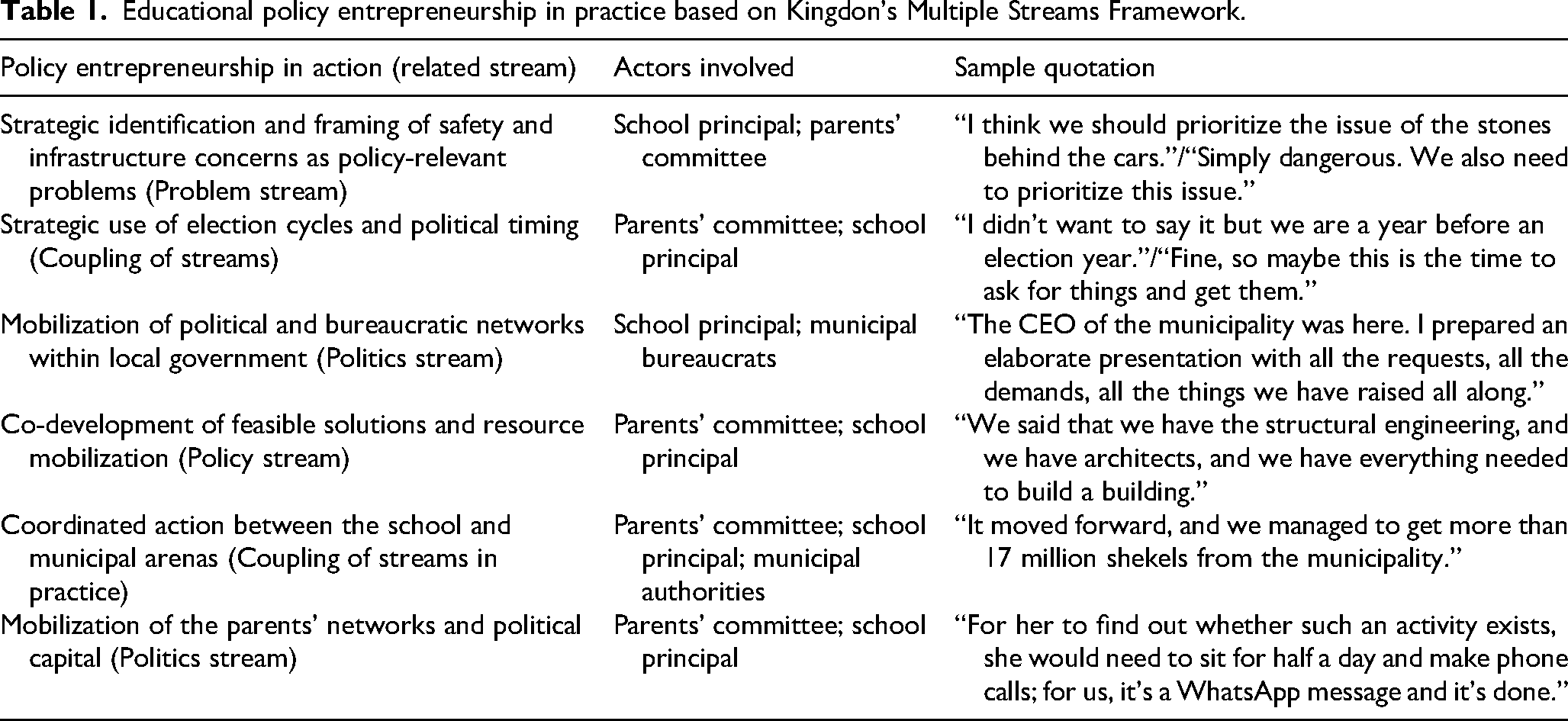
In one of the observations, the dynamic between the principal and the parents’ committee illustrates how their shared dialogue helped identify a problem, formulate a solution, mobilize stakeholders, and leverage a window of opportunity. Together, they raised issues related to the school's physical infrastructure and safety deficiencies, and proposed solutions. We observed what appears to be a negotiation process, a kind of dialogical “ping pong” that led to the identification of problems and solutions.
During the conversation, the vice chair of the parents’ committee highlighted an urgent safety concern related to curb stones that endangered drivers near the school and required immediate attention. They also emphasized that, because this was an election year, there was a window of opportunity to propose a solution to these problems. In this discussion, the parent leadership explicitly identified the local authority election as a strategic window of opportunity for promoting their cause. The chair of the committee said: “I didn’t want to say it but we are a year before an election year.” The vice chair reinforced this point by adding: “Fine, so maybe this is the time to ask for things and get them.” The chair echoed this sentiment: “So everyone is stressed about what to ask for … so they will not say we are in an election year and close all the taps.” The principal responded by explaining that she had indeed raised these issues at this strategic moment with the municipality's CEO: “The CEO of the municipality was here. I prepared an elaborate presentation with all the requests, all the demands, all the things we have raised all along.”
This dynamic reveals the political stream in action. Entrepreneurship emerges through the coupling of the problem stream with the political stream, marked by the identification of the election period as a critical window of opportunity. This coupling was not accidental. It was the principal who proposed it. The principal acted as a policy entrepreneur by mobilizing political support to promote the school's needs by linking the identification of the problem and the development of a solution with the recognition of a political opportunity for change.
In this example, the parents not only took the lead but also were very proactive in driving and enacting the initiative. They built coalitions of professionals, worked simultaneously to obtain municipal approval, and, together with the principal, moved the project forward. A member of the parents’ committee described this process in her interview. She explained how they discovered an opportunity related to the statutory expiration and aging of one of the school buildings, which served as the basis for arguing to the municipality about the need for renovating the structure and constructing a sports facility. She described how the principal approached her with concerns about a safety incident that had occurred on the old school roof, and how this moment created the opportunity to present the proposed change to the municipality. As she recounted: …I said, well, we can demolish the tower [the old one]. In short, we came and asked the construction committee, and they agreed…. We said that we have the structural engineering, and we have architects, and we have everything needed to build a building. We checked and made drawings and did all of that. When the final product was ready, before we went to Ela [the principal, a pseudonym], we went to the former head of the Scout troop [located in the same building], and we sort of ambushed her with her husband, who was also involved [knowledgeable about the issue]…. In the end, Ela was enthusiastic…. It moved forward, and we managed to get more than 17 million shekels from the municipality. Not only did we secure 17 million shekels, we planned it in several phases, so now we are entitled to another approximately 6 million shekels. We are also renovating the old hall inside the school. Meaning, it turned out great for us. It is reasonable to assume that perhaps Ela might have succeeded in doing this on her own, but I doubt it, and even if she had, she would have been there, and they would have been there, and it would have become a mess…. This is how it turned into a kind of insane win-win.
This quotation demonstrates how cross-arena coalition building connecting parents, engineers, architects, youth organizations, and municipal actors enabled the mobilization of substantial financial resources. By strategically identifying a window of opportunity and presenting a ready-made solution, the actors effectively coupled the problem, policy, and political streams to promote a policy change.
This same participant described how the principal often proposed initiatives intended to address emerging problems because the latter understood the parents’ power in formulating responses and driving rapid solutions. The principal relied on the parents’ political power and their communication channels with influential municipal actors, which helped her advance initiatives more easily. As the participant explained: “Ela takes care of things, and we help her find things….” The participant elaborated on this process: “She initiates all of this, and we support her in the sense that … she was looking for conversation classes, and I went and arranged those [classes] for them at the country club….” The participant concluded by saying: “We are a group of parents with many connections and a great deal of motivation to help, and we tell her—use it. For her to find out whether such an activity exists, she would need to sit for half a day and make phone calls; for us, it's a WhatsApp message and it's done.”
This dynamic illustrates how policy entrepreneurship unfolds within the policy stream. The parent leadership mobilizes informal networks to transform a policy problem into a viable solution. The principal leverages her bureaucratic authority to connect actors across multiple arenas and accelerate the enactment of the solution by strategically mobilizing community resources.
Discussion
This study sought to shed light on the phenomenon of entrepreneurship in education by building on the policy enactment perspective and integrating insights from research on street-level bureaucracy and policy entrepreneurship. Drawing on empirical examples from interviews and observations with principals and parent committee members, we show how school principals move beyond routine forms of policy enactment to assume entrepreneurial roles through dialogical interactions with multiple stakeholders, including parents, local authorities, and other actors in the educational field.
Our study makes three contributions to the literature on educational management, leadership, and policy. First, building on prior studies (Balasi et al., 2023; Brauckmann-Sajkiewicz and Pashiardis, 2022), as well as scholarship that has explicitly connected Kingdon's policy entrepreneurship framework with the field of educational administration (Hughes, 2020), we show that principals move beyond formal role boundaries by coupling Kingdon's problem, policy, and political streams and building cross-arena coalitions that enable policy change. In this study, coupling is achieved through the recognition and strategic mobilization of the political capital embedded in parent leadership bodies to advance policy initiatives. Thus, our findings extend Kingdon's Multiple Streams Framework by demonstrating that stream coupling is not confined to senior decision-makers but is enacted at the micro-level of the school through principals’ entrepreneurial practices. At this level, bureaucratic discretion operates as a structural resource embedded in ongoing interactions among principals, parents, and municipal actors. Rather than enacting policy in a more routine manner, principals use their discretion to combine the streams and shape policy change.
Our findings also extend Gunter's (2012, 2023) argument that policy actors operate within school-level regimes of practice and provide empirical grounding for the theoretical claims that policy actors act within structured yet negotiable governance environments. Most importantly, our findings support our argument that policy entrepreneurship can be conceptualized as a form of policy enactment under conditions of increased discretion.
Second, our study proposes a conceptual framework for understanding how policy enactment may take an entrepreneurial form in hybrid governance systems. The Israeli case demonstrates how policy entrepreneurship may emerge in centralized yet negotiated systems, extending theory beyond the contexts examined in existing research. This perspective invites researchers to examine how school-level actors mobilize relational and political resources across diverse governance contexts.
Finally, as with prior studies (see, e.g., Davidovitz and Schechter, 2024), our research highlights the significance of the principals’ discretion as street-level public administrators in allowing them to engage in policy entrepreneurship. At the normative level, our findings raise questions regarding the desirability and boundaries of policy entrepreneurship in the educational arena. While prior studies have tended to view policy entrepreneurship as a normative phenomenon that can promote values and improve the educational infrastructure, our findings also point to the limits of such activity. For example, how might policymakers seek to enable or constrain such entrepreneurial behavior within the educational environment? Do principals have the appropriate training for engaging in entrepreneurial initiatives that move beyond the formal scope of their role?
These questions not only provide fertile ground for future empirical research but are also significant in contexts marked by instability and recurring crises (Bar-On and Schechter, 2026). Principals are required not only to enact policy under complex conditions, but also to operate strategically beyond formal role boundaries. Although context-specific, our case highlights policy-oriented and strategic capacities, including problem framing, resource mobilization, and stakeholder engagement, that might also be relevant to educational systems facing similar conditions.
Footnotes

Funding
The authors disclosed receipt of the following financial support for the research, authorship, and/or publication of this article: This work was supported by the Israel Science Foundation (grant number 258/16).
Declaration of conflicting interests
The authors declared no potential conflicts of interest with respect to the research, authorship, and/or publication of this article.
Author biographies