






Abstract
The integration of Generative Artificial Intelligence (GenAI) in higher education has sparked interest in its potential to improve instructional leadership and academic management. This study explores the factors influencing instructional leaders’ adoption of GenAI by extending the diffusion of innovation (DOI) theory to include trust in AI as an additional explanatory factor. Data collected from 102 instructional leaders were analyzed using Pearson correlation and multiple regression. The results show that relative advantage, trialability, observability, and trust positively predict the adoption of GenAI, with trust being the strongest predictor. However, compatibility and complexity did not significantly affect adoption when other factors were considered. The findings suggest that adoption decisions are influenced by perceived benefits, opportunities for experimentation, visibility of outcomes, and confidence in AI's reliability and ethical use, rather than by alignment with existing practices. The study highlights key areas of application, including curriculum design, faculty feedback, student engagement, and professional development.
Keywords
Introduction
The rapid expansion of Generative Artificial Intelligence (GenAI) has introduced a profound shift in the ways higher education institutions design curricula, evaluate instruction, support faculty, and make academic decisions (Jin et al., 2025). GenAI, defined as artificial intelligence capable of generating text, solutions, insights, and other outputs autonomously, has moved quickly from experimental use to an essential tool for educational innovation. Tools such as ChatGPT, Claude, Gemini, and other domain-specific AI systems now assist with curriculum review, assessment analysis, instructional material production, and strategic planning (Sposato, 2025; Xia et al., 2024). These developments place instructional leaders, including deans, department heads, and program directors, at the centre of AI-related decision-making. Instructional leaders’ perspectives shape not only whether GenAI is adopted institutionally but also how it is implemented responsibly and effectively (Berkovich, 2025).
Understanding what drives GenAI adoption among instructional leaders is therefore a critical question for higher education. Instructional leaders oversee teaching quality, assessment practices, and faculty development (He et al., 2024). Instructional leaders’ decisions influence academic standards and institutional reputation, requiring careful evaluation of both GenAI's benefits and its risks (Renta-Davids et al., 2025). Although GenAI promises enhanced efficiency, faster analysis of assessment data, and more consistent feedback to faculty, it also introduces concerns about accuracy, transparency, bias, and ethical integrity. These concerns make GenAI different from earlier educational technologies and require a systematic framework that can explain how leaders judge new innovations and why they choose to adopt or reject them (Renta-Davids et al., 2025; Sposato, 2025).
The diffusion of innovation (DOI) theory provides such a framework. As one of the most established models in technology adoption research, DOI explains how individuals make decisions about new technologies by evaluating five attributes: relative advantage, compatibility, complexity, trialability, and observability (Singh and Strzelecki, 2025). These attributes have been widely validated across educational technology research. DOI is particularly appropriate for this study because instructional leaders regularly adopt new digital tools, and their decisions are strongly shaped by perceptions of usefulness, alignment with institutional values, ease of integration, opportunities for experimentation, and evidence of successful results (Mukred et al., 2025). Applying DOI therefore helps capture how leaders interpret GenAI as an innovation within their professional context and which characteristics influence their decision to adopt it.
However, DOI alone may be insufficient for explaining the adoption of Generative AI, which produces autonomous outputs and relies on complex internal processes that users cannot fully observe or verify (Afroogh et al., 2024). These unique characteristics introduce the need for Trust in AI, defined as the user's confidence that AI recommendations are accurate, fair, unbiased, transparent, and ethically sound (Đerić et al., 2025). Trust becomes essential in leadership contexts because instructional leaders use GenAI to make high-stakes decisions that influence curricula, faculty performance, and academic quality. A leader may perceive GenAI as highly advantageous and compatible yet still refuse to use it if they do not trust its accuracy or integrity (Razzouki et al., 2025). Existing research on algorithmic decision-making similarly highlights that trust is often the strongest determinant of AI adoption, especially when decisions have ethical consequences (Nazaretsky et al., 2025). Despite its relevance, trust has rarely been empirically examined alongside DOI in studies involving instructional leadership.
Despite the growing interest in GenAI, little is known about how instructional leaders adopt and use these tools in their daily responsibilities, especially in the higher education context. Existing research continues to focus mainly on teachers or students rather than leaders and tends to examine intention instead of real practice (Elstad and Eriksen, 2024; Kim, 2025). Only one recent empirical study has investigated the actual use of GenAI by instructional leaders, showing early adoption patterns across curriculum design, instructional support, and teacher development tasks in school (Berkovich, 2025). Yet no research has examined how DOI attributes and trust in AI jointly influence leaders’ real use of GenAI for curriculum development, assessment analysis, or faculty support. Reviews of AI in educational leadership further highlight that leadership-level decisions involve substantial ethical, governance, and institutional risks, making trust and innovation perceptions crucial to adoption (Sposato, 2025).
This gap underscores the need to examine GenAI adoption specifically among instructional leaders, whose decisions directly shape academic quality, policy directions, and institutional innovation. Responding to this need, the present study extends the DOI framework by integrating trust in AI and examines how these factors predict instructional leaders’ actual use of GenAI across curriculum, assessment, and faculty development tasks. The study addresses the following research questions:
Literature review
Instructional leadership and AI adoption in higher education
AI has increasingly been positioned as a transformative force in higher education, not only for teaching and learning but also for instructional leadership within broader management structures (Jin et al., 2025). Recent research highlights that AI supports instructional leaders and academic managers by enhancing data-informed decision-making, curriculum planning, and the monitoring of teaching quality through learning analytics and predictive systems (Sposato, 2025). Leaders are expected to move beyond managerial adoption of AI tools toward shaping pedagogical visions that align AI use with institutional teaching goals, governance frameworks, and academic values (Afrooght et al., 2024). Studies emphasize that instructional leadership in the AI era involves guiding faculty on ethical, effective, and pedagogically sound integration of generative AI into courses, while simultaneously managing organizational change associated with technological innovation. In this sense, AI is reframing instructional leadership as a strategic, pedagogical, and managerial practice rather than a purely administrative function (Berkovich, 2025; Xia et al., 2024).
Empirical and review-based studies suggest that AI can indirectly strengthen instructional leadership by supporting instructional improvement and faculty development, while also serving as a managerial innovation that must be diffused across institutions (Singh and Strzelecki, 2025). AI-driven systems enable leaders to identify learning gaps, evaluate instructional effectiveness, and promote evidence-based teaching practices at scale (Boncillo, 2025). However, scholars argue that successful diffusion of AI innovations depends on leadership actions that foster trust, perceived usefulness, and compatibility with existing instructional practices key elements emphasized in innovation diffusion theory (Berkovich, 2025). Research further shows that without clear leadership and management strategies, AI adoption risks becoming fragmented, tool-driven, and disconnected from instructional improvement (Adewale and Ndwandwe, 2025). Consequently, instructional leaders play a critical role in mediating between technological innovation, managerial coordination, and pedagogical coherence in higher education.
The literature highlights significant challenges for instructional leadership and management related to AI governance, ethics, and capacity building (Xia et al., 2024). Concerns around academic integrity, algorithmic bias, data privacy, and overreliance on automation require leaders to establish institutional policies, build trust in AI systems, and develop shared norms that support responsible adoption (Berkovich, 2025; Singh and Strzelecki, 2025). Researchers stress the importance of AI literacy among instructional leaders themselves, as limited understanding can weaken both managerial decision-making and faculty trust in AI-supported instructional practices (Renta-Davids et al., 2025). Leadership-focused research increasingly calls for professional development models that integrate AI knowledge with instructional leadership and management competencies, facilitating informed adoption rather than resistance or superficial use (Warrier et al., 2025). Overall, the literature suggests that effective instructional leadership, embedded within sound management practices, is crucial for facilitating the diffusion of AI innovations and ensuring that AI enhances, rather than undermines, teaching quality and learning in higher education.
Diffusion of innovations: application to GenAI and instructional leadership in higher education
DOIs theory offers a framework for understanding how innovations spread within societies and organizations (Rogers, 2003). This framework includes several key dimensions that explain the factors influencing the adoption of new technologies, ideas, or practices. In the context of higher education, the adoption of GenAI by instructional leadership and management teams can be examined through these dimensions to understand how such technologies are integrated into educational practices (Berkovich, 2025). The dimensions of relative advantage, compatibility, complexity, trialability, and observability are particularly relevant when analyzing how higher education institutions approach GenAI and how instructional leaders facilitate its implementation. These dimensions help explain why some institutions rapidly adopt GenAI, while others proceed more cautiously (Singh and Strzelecki, 2025).
The relative advantage of an innovation refers to the perceived benefits it offers over existing practices. In higher education, the relative advantage of GenAI lies in its ability to enhance teaching effectiveness, streamline administration, and personalize learning experiences (Granić, 2025). Instructional leaders and managers are more likely to adopt GenAI when it improves efficiency, supports data-driven decision-making, and boosts student outcomes (Jin et al., 2025; Singh and Strzelecki, 2025). GenAI tools, such as automated grading, instructional material generation, and personalized feedback, align with instructional leadership goals to improve teaching and learning. Clear communication of these advantages strengthens institutional support for adoption (He et al., 2024).
Compatibility plays a critical role in the adoption of GenAI in higher education, as successful integration depends on alignment with existing pedagogical practices, academic norms, and institutional values (Wu and Carroll, 2025). Instructional leaders who emphasize innovation and technology-enhanced learning are more likely to perceive GenAI as compatible with instructional goals, whereas resistance may arise when it challenges traditional teaching or assessment practices. At the same time, perceived complexity can hinder adoption, particularly when GenAI appears technically difficult or unfamiliar to educators and administrators (Jin et al., 2025; Singh and Strzelecki, 2025). Instructional leadership is therefore essential in reducing complexity through training, guidance, and support, enabling faculty to view GenAI as a manageable tool. Framing GenAI as a complement to human instruction further supports acceptance and sustainable integration (Reyes et al., 2025).
Trialability and observability play important roles in the adoption of GenAI in higher education (Rogers, 2003). Institutions often introduce GenAI through pilot projects in selected courses or departments, allowing instructional leaders and managers to evaluate effectiveness, identify challenges, and refine implementation strategies before wider adoption (Albishri et al., 2025). These trial phases help assess impacts on teaching workload, student engagement, and learning outcomes while managing institutional risk and resource constraints (Jin et al., 2025; Singh and Strzelecki, 2025). Observability further supports adoption when positive outcomes such as improved instructional efficiency or enhanced learning experiences are visible across the institution. Demonstrating successful use cases through internal sharing and teaching showcases reduces uncertainty, builds trust, and encourages broader diffusion of GenAI within higher education (Almaiah et al., 2022).
Trust in AI and instructional leadership in higher education
Trust is a critical element in the successful adoption and integration of GenAI in higher education, and instructional leadership plays a pivotal role in fostering that trust (Mustofa et al., 2025). For faculty and administrators to embrace GenAI, they must first believe that the technology is reliable, transparent, and aligned with ethical standards (Đerić et al., 2025). This trust is often cultivated through clear communication, transparency in AI processes, and visible, positive outcomes from pilot programs or small-scale implementations. Research highlights that trust in AI is significantly influenced by perceived competence, transparency, and the reliability of AI systems (Boncillo, 2025) which can be shaped by instructional leaders who prioritize these values in their integration strategies. Instructional leaders are often tasked with guiding the introduction of AI technologies, ensuring that they align with institutional goals, and offering the necessary support to reduce perceived complexity (Fu and Weng, 2024). When these leaders advocate for AI tools that are trialable and can be observed in action, they provide faculty members and students with opportunities to evaluate and understand their effectiveness. This trialability reduces uncertainty and builds trust as educators experience firsthand the benefits AI can offer, such as personalized learning, automated grading, and enhanced feedback mechanisms (Nazaretsky et al., 2025). Moreover, instructional leadership is crucial in framing AI as a complementary tool to human instruction, emphasizing its role in augmenting, not replacing, traditional pedagogical approaches. By demonstrating successful use cases through internal sharing and showcasing how AI tools improve instructional practices, instructional leaders can strengthen trust across their institutions (Lelescu et al., 2025). Such efforts help reduce resistance, mitigate fears about the technology's potential risks, and create a culture of trust, which is essential for broader and more sustainable AI adoption in educational settings (Lei and Cultrera, 2024).
Grounded in the DOIs theory, this study conceptualizes instructional leaders’ adoption of GenAI as a function of perceived innovation characteristics and trust (Figure 1). DOI attributes relative advantage, compatibility, complexity, trialability, and observability are proposed to influence leaders’ actual use of GenAI in teaching, curriculum development, assessment analysis, and faculty support. However, because GenAI produces autonomous and often opaque outputs, DOI alone may not capture risk-based evaluations in leadership decisions. Consistent with research showing that trust mediates the relationship between innovation attributes and adoption (Kim et al., 2025), and that trust can increase adoption while distrust reduces it (Afroogh et al., 2024), trust in AI is included as a complementary construct reflecting confidence in accuracy, transparency, fairness, and ethical integrity. The framework posits that while favorable innovation attributes facilitate adoption, trust is essential for explaining why leaders may accept or reject GenAI in high-stakes educational contexts. Together, DOI attributes and trust jointly explain variation in instructional leaders’ real-world use of GenAI in higher education.

Conceptual model of the adoption and use of GenAI by instructional leaders based on the diffusion of innovations (DOI) theory.
Methodology
This study aims to examine the factors influencing instructional leaders’ adoption and use of GenAI. The research is guided by the following hypotheses: H1: Relative advantage positively influences instructional leaders’ adoption of GenAI. H2: Compatibility positively influences instructional leaders’ adoption of GenAI. H3: Complexity negatively influences instructional leaders’ adoption of GenAI. H4: Trialability positively influences instructional leaders’ adoption of GenAI. H5: Observability positively influences instructional leaders’ adoption of GenAI. H6: Trust positively influences instructional leaders’ adoption of GenAI. These hypotheses are grounded in the theoretical framework designed to investigate the adoption of new technologies by instructional leaders. The participants in this study include instructional leaders from various educational institutions who have experience with GenAI and play a role in decision-making regarding its use. The study will involve a total of (n = 102) participants, all of whom will be surveyed to understand their perceptions and experiences with GenAI. Data will be collected through a structured survey instrument that measures constructs related to the adoption of GenAI. The survey will include questions designed to capture responses regarding Relative Advantage
The constructs in this study are measured using scales that have been adapted from established models in the literature. Specifically, the scales for Relative Advantage
Result
This study analyzed data from 102 instructional leaders working in higher education institutions. Descriptive statistics were used to summarize the participants’ demographic characteristics, including gender, age, years in leadership role, and institution type (Table 1). The sample comprised 55 female participants (53.92%) and 47 male participants (46.08%). Regarding age, the majority of respondents were between 30 and 39 years (42.16%), followed by those aged 40–49 years (30.39%), while 27.45% were 50 years or older. In terms of leadership experience, 44.12% of the participants reported 0–5 years in a leadership role, 29.41% reported 6–10 years, 14.71% had 11–15 years, and 11.76% had 15–20 years of leadership experience. With respect to institutional affiliation, participants were from private and public institutions.
Demographics.
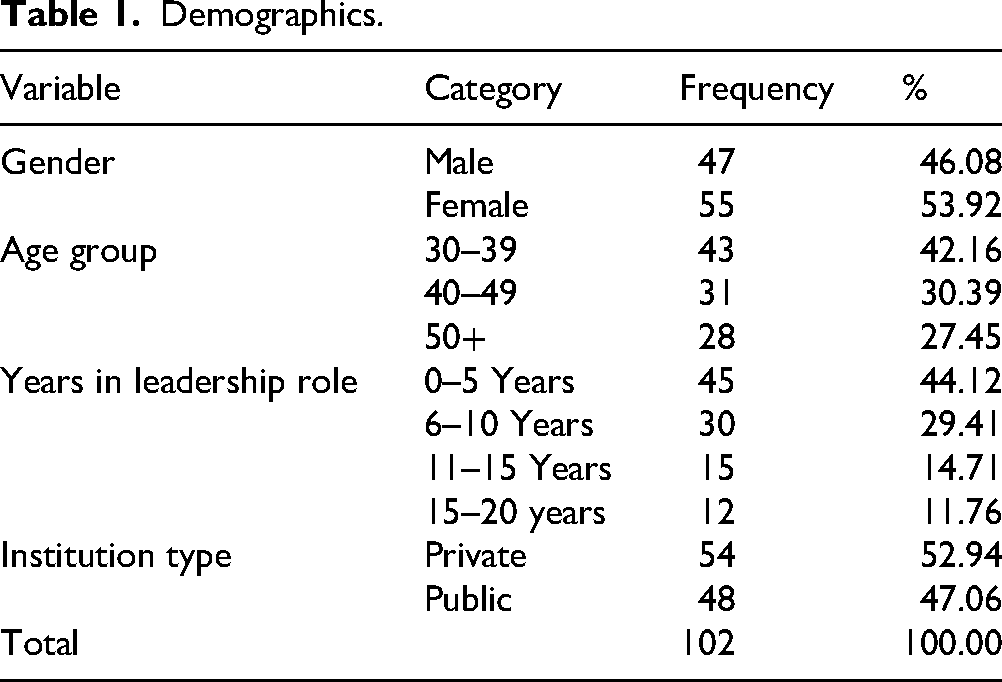
Table 2 shows that Heads of Department constituted the largest proportion of the sample (28.43%), followed by Program Managers and Administrative leaders. The bar chart illustrates the distribution of instructional leaders’ self-rated digital literacy levels. The results show that the majority of participants reported a moderate level of digital literacy (n = 63), indicating that most instructional leaders perceive themselves as reasonably competent in using digital technologies but not at an advanced level. A substantial proportion of respondents rated their digital literacy as high (n = 33), suggesting that nearly one-third of the sample feels confident and proficient in engaging with digital tools and technologies. In contrast, only a small number of participants reported a low level of digital literacy (n = 6), indicating that limited digital competence is relatively uncommon among the instructional leaders surveyed (Figure 2).
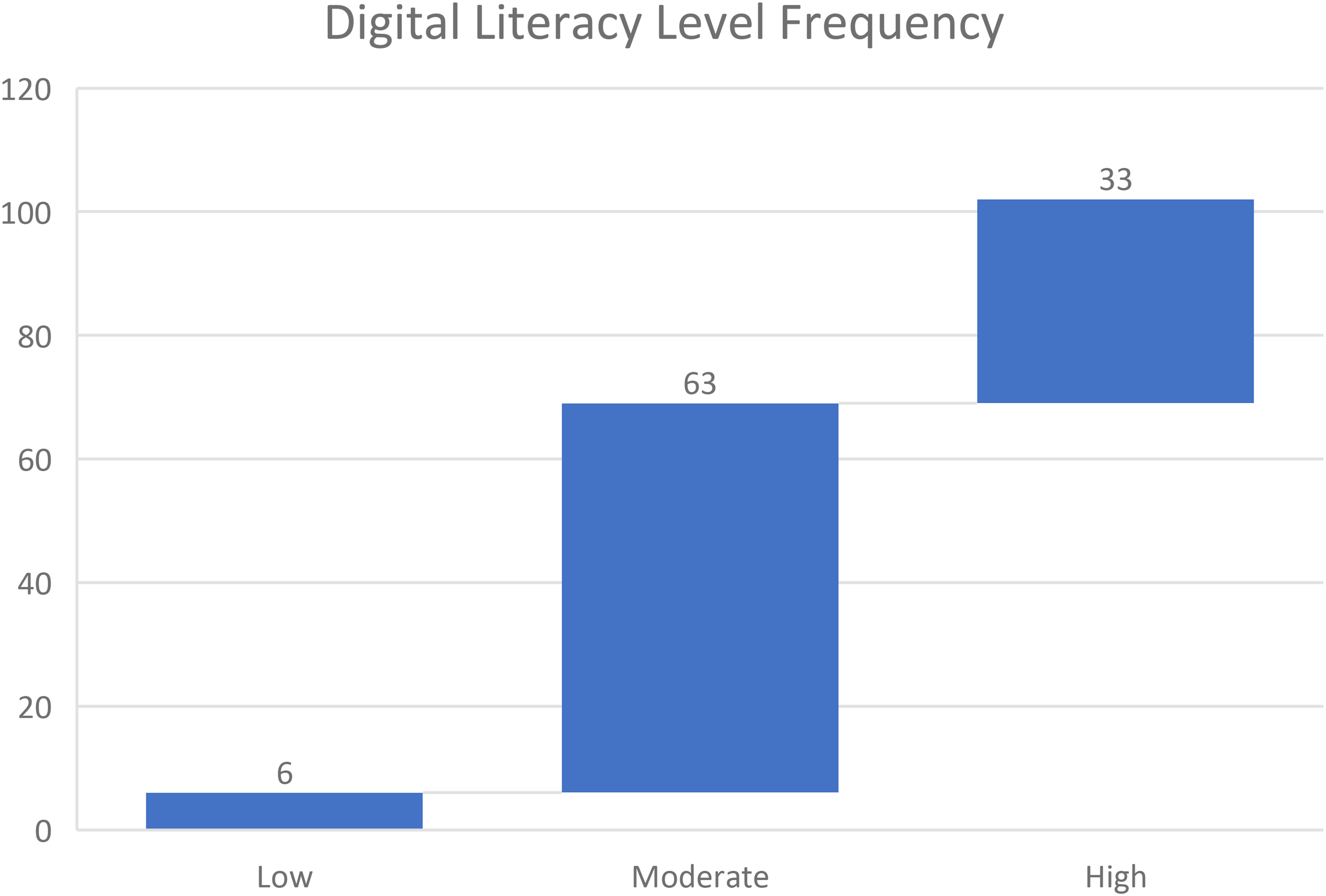
Digital literacy level frequency.
Instructional leaders’ role.
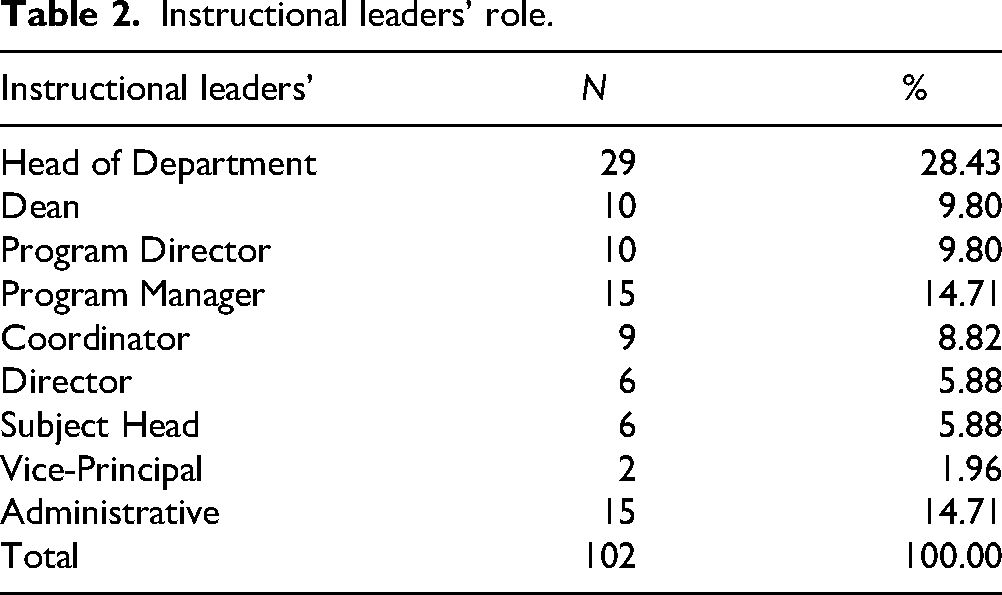
Figure 3 presents instructional leaders’ awareness and adoption stages of Generative AI based on the DOIs framework. The largest proportion of respondents was classified as Early Adopters (32.35%), followed by Innovators (26.47%), indicating a substantial presence of leadership willing to experiment with and promote GenAI. A further 17.65% of participants fell within the early majority, suggesting cautious but positive adoption once peer use becomes visible. Smaller proportions were classified as Late Majority (13.73%) and Laggards (9.80%), reflecting a minority of instructional leaders who adopt GenAI only after widespread use or remain hesitant toward its adoption.

Adoption stages.
Before examining relationships among the variables, the internal consistency of each construct was assessed using Cronbach's alpha. The results indicated acceptable to excellent reliability for all measures: relative advantage (α = 0.836), compatibility (α = 0.863), complexity (α = 0.840), trialability (α = 0.776), observability (α = 0.773), trust (α = 0.740), and adoption of GenAI (α = 0.880). These results confirm that the survey items consistently measured the intended constructs, providing confidence in the accuracy of subsequent analyses.
Table 3 presents the Pearson correlation coefficients for seven study variables based on data from 102 participants. The results reveal significant correlations between several variables, providing insights into the relationships that influence the adoption of GenAI. Specifically, Relative Advantage is positively correlated with Trust (r = .48, p < .01), Trialability (r = .44, p < .01), and Adoption of GenAI (r = .53, p < .001). This suggests that as participants perceive GenAI as having more relative advantages, their trust in the technology, the ability to try it out, and ultimately the likelihood of adopting it increase. The correlation between Compatibility and Complexity (r = .42, p < .01) shows that higher compatibility with existing practices or technologies tends to be associated with greater perceived complexity, which implies that technologies perceived as more compatible may be viewed as more complicated to integrate. Additionally, Trialability has positive correlations with Relative Advantage (r = .44, p < .01) and Adoption of GenAI (r = .54, p < .01), emphasizing that the opportunity to experiment with a technology or product leads to higher perceptions of its relative advantages and enhances the likelihood of adoption.
Pearson correlation matrix of study variables (N = 102).
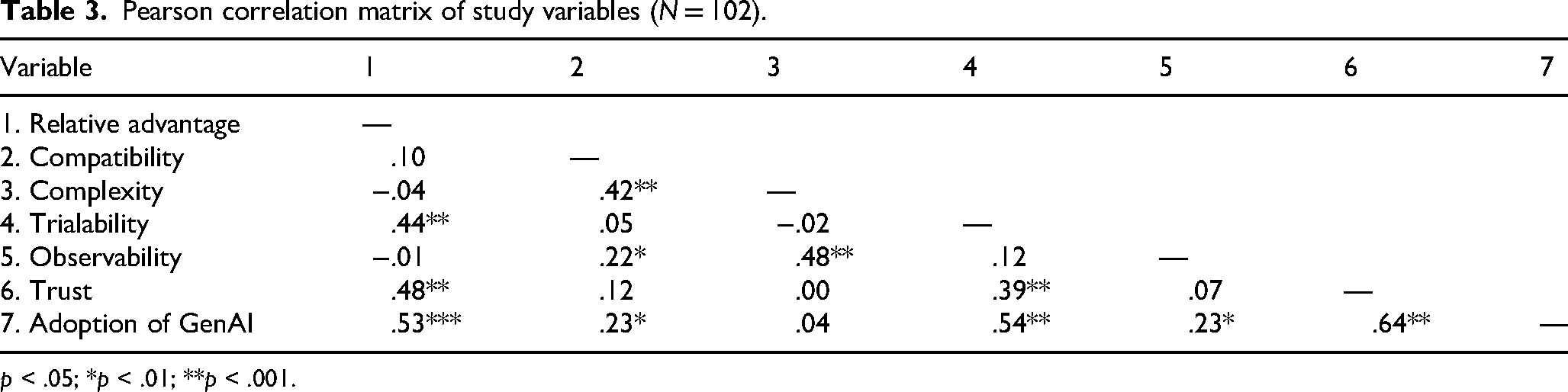
p < .05; *p < .01; **p < .001.
Observability, while still significant, shows weaker correlations, with a positive but relatively modest relationship to Compatibility (r = .22, p < .05) and Adoption of GenAI (r = .23, p < .05). This suggests that the visibility of a technology can influence perceptions of its compatibility and its adoption, though these effects are not as strong as those of Trust or Relative Advantage. Trust itself emerges as a crucial factor, with a strong positive correlation to the adoption of GenAI (r = .64, p < .01), highlighting that the degree of trust users have in the technology is a key driver of its adoption. The results suggest that Relative Advantage, Trust, and Trialability are critical determinants of Adoption of GenAI, with Trust being the most influential factor. Observability and Compatibility, while still relevant, have weaker associations with adoption and do not appear to be as influential as the other variables.
The multiple linear regression analysis was conducted to examine the extent to which Relative Advantage, Compatibility, Complexity, Trialability, Observability, and Trust predict the Adoption of GenAI, based on a sample of 102 participants. The overall regression model demonstrated a strong fit to the data, with a multiple correlation coefficient of r = .77 and an R2 of 0.59, indicating that approximately 59.2% of the variance in GenAI adoption is explained by the combined set of predictors. This suggests that the model has substantial explanatory power and that the selected predictors collectively play an important role in explaining adoption behavior (Table 4).
Multiple regression analysis.
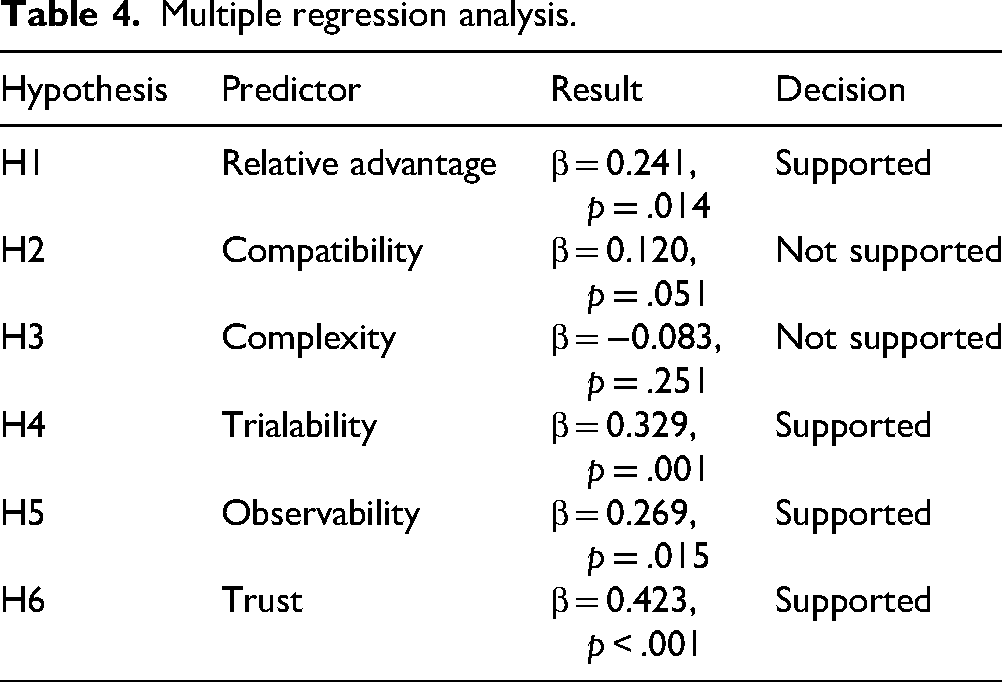
Examination of the individual regression coefficients revealed that Relative Advantage was a significant positive predictor of GenAI adoption (β = .24, t = 2.50, p = .014), indicating that individuals who perceive greater benefits and advantages of GenAI are more likely to adopt it. Trialability also emerged as a significant positive predictor (β = .33, t = 3.35, p = .001), suggesting that opportunities to experiment with GenAI significantly enhance adoption likelihood. Similarly, Observability showed a significant positive effect on adoption (β = .27, t = 2.48, p = .015), implying that seeing the outcomes and benefits of GenAI use encourages individuals to adopt it.
Most notably, Trust was the strongest predictor of GenAI adoption (β = .42, t = 5.45, p < .001), highlighting trust as a critical determinant in adoption decisions. This finding suggests that confidence in the reliability, safety, and ethical use of GenAI plays a central role in shaping users’ willingness to adopt the technology. In contrast, Compatibility showed a marginal and non-significant effect (β = .12, t = 1.97, p = .051), while Complexity did not significantly predict adoption (β = −.08, t = −1.15, p = .251), indicating that perceived difficulty or alignment with existing practices does not independently influence adoption when other factors are considered. Overall, these results suggest that GenAI adoption is primarily driven by perceived relative advantage, trialability, observability, and especially trust, whereas compatibility and complexity play a limited role once these factors are accounted for. The findings align well with innovation diffusion theory, emphasizing the importance of perceived benefits, experiential access, visibility of outcomes, and trust in promoting the adoption of emerging technologies such as GenAI.
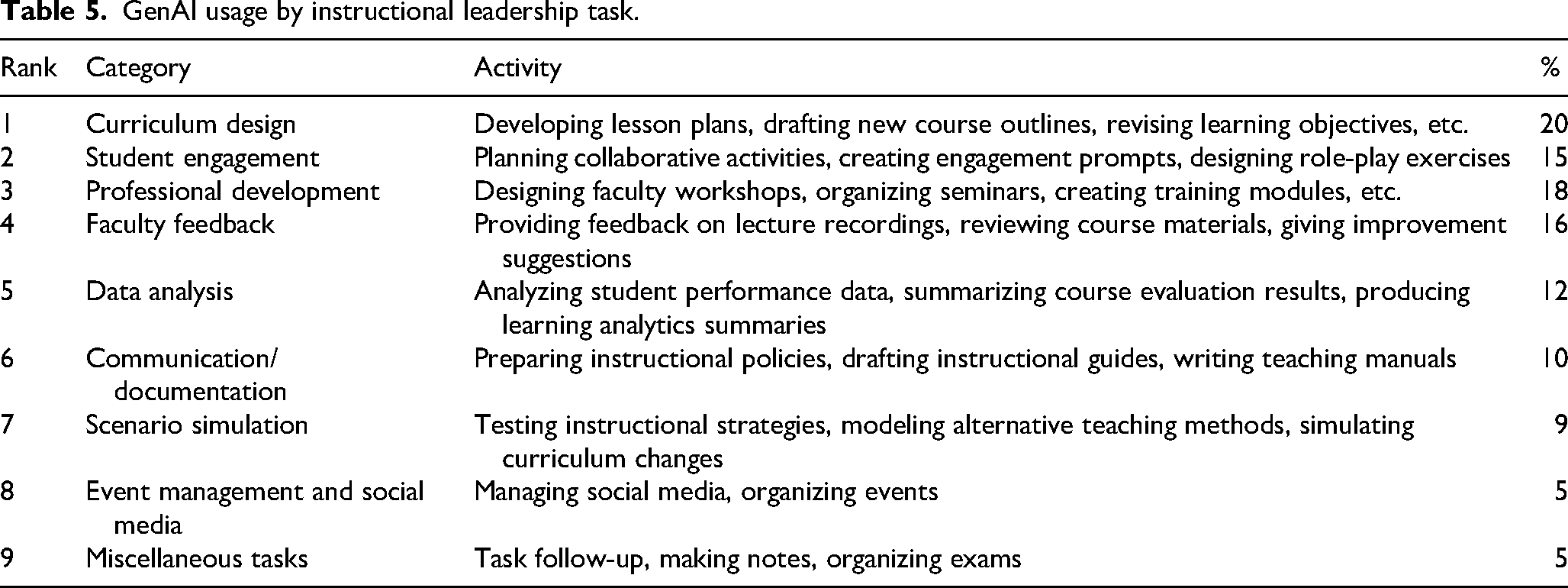
The results of the survey show that instructional leadership tasks involving Curriculum Design (e.g., developing lesson plans, drafting new course outlines, and revising learning objectives) were the most frequently mentioned, with 20% of respondents indicating their involvement in these activities (Table 5). Student Engagement tasks, such as planning collaborative activities and designing role-play exercises, followed closely with 15% of mentions. Professional Development, including organizing workshops and creating training modules, was also a significant category, representing 18% of the responses. Other important areas included Faculty Feedback (16%), focused on reviewing materials and providing feedback, and Data Analysis (12%), which involved tasks like analyzing student performance data. Activities related to Communication and Documentation and Scenario Simulation were mentioned by 10% and 9% of participants, respectively, while Event Management and social media and miscellaneous tasks (such as task follow-up and making notes) accounted for smaller percentages (5% each). These results highlight the diverse roles that instructional leaders play, with a strong emphasis on curriculum development, student engagement, and professional development activities.
GenAI usage by instructional leadership task.
Discussion
The findings of this study contribute to the growing but still limited body of research on the adoption of GenAI in higher education leadership. While a rapidly increasing number of studies have examined GenAI adoption among students using models such as TAM and UTAUT, far fewer investigations have focused on academic staff or leadership-level users. Even more limited are studies applying the DOIs framework to understand GenAI adoption. To date, only two studies have employed the DOI model in the context of AI-supported academic work, and both were conducted at the student level (Abdalla et al., 2024; Raman et al., 2024). Research applying DOI to academics’ adoption of ChatGPT remains scarce, with Singh and Strzelecki (2025) being one of the very few studies examining researchers’ use of ChatGPT through a DOI lens. However, no prior study has investigated how DOI attributes explain GenAI adoption among instructional leaders, whose decisions involve institutional, pedagogical, and ethical responsibility. In this sense, the present study extends existing literature by applying the DOI framework to a leadership sample and by integrating Trust in AI to explain actual use of GenAI in instructional leadership contexts.
Consistent with H1, relative advantage was found to have a significant positive effect on the adoption of GenAI. This finding indicates that instructional leaders are more likely to adopt GenAI when they perceive it as offering clear advantages over existing practices, such as improving efficiency in curriculum planning, enhancing assessment analysis, and supporting evidence-based decision-making. This result aligns closely with DOI theory, which identifies relative advantage as a central driver of innovation adoption (Rogers, 2003). It also corroborates findings from Singh and Strzelecki (2025), who reported that perceived usefulness significantly predicted researchers’ adoption of ChatGPT. In leadership contexts characterized by time constraints and strategic responsibilities, perceived performance and efficiency gains from GenAI appear to play a decisive role in adoption decisions.
In contrast, H2 was not supported, as compatibility did not significantly predict the adoption of GenAI. Although the effect was marginal, the result suggests that alignment between GenAI and existing institutional practices or values is not sufficient, on its own, to drive adoption among instructional leaders. One possible explanation is that leadership roles often require continuous engagement with innovation, causing compatibility to be perceived as a baseline expectation rather than a motivating factor. While this finding diverges from some DOI-based studies in educational technology adoption that report significant compatibility effects (Almaiah et al., 2022), it is consistent with Singh and Strzelecki (2025), who also found compatibility to be a weaker predictor in the context of ChatGPT adoption. The result implies that, for emerging and rapidly evolving technologies such as GenAI, perceived benefits and experiential factors may outweigh concerns about institutional alignment.
Contrary to H3, perceived complexity did not have a significant negative effect on the adoption of GenAI. This finding suggests that perceived difficulty in understanding or using GenAI does not independently deter instructional leaders from adoption when other factors are considered. Although DOI theory and prior research often identify complexity as a barrier to AI adoption (Almaiah et al., 2022; Afroogh et al., 2024), the non-significant effect observed in this study may reflect the relatively high digital literacy and professional experience of instructional leaders. Similar to Singh and Strzelecki (2025), who reported a diminished role of complexity in predicting ChatGPT adoption among researchers, this result suggests that professional users may tolerate complexity if the technology delivers clear value and is supported by opportunities for experimentation and trust.
Support was found for H4, as trialability significantly and positively influenced the adoption of GenAI. This finding highlights the importance of allowing instructional leaders to experiment with GenAI in low-risk or pilot contexts prior to full-scale implementation. Consistent with DOI theory, trialability reduces uncertainty and facilitates learning through hands-on experience (Rogers, 2003). Recent studies have similarly demonstrated that opportunities for trial use increase confidence, reduce perceived risk, and encourage the adoption of AI technologies in higher education and organizational settings (Albishri et al., 2025; Mukred et al., 2025). For instructional leaders, trialability may also provide a critical space to evaluate ethical considerations, reliability, and decision quality before integrating GenAI into high-stakes leadership functions.
The results also support H5, showing that observability has a significant positive effect on the adoption of GenAI. This finding indicates that when the outcomes and benefits of GenAI use are visible such as improved efficiency, enhanced analytical capacity, or demonstrable leadership support instructional leaders are more likely to adopt the technology. Although observability has been reported as a weaker or non-significant predictor in some professional contexts (Singh and Strzelecki, 2025), its significance in this study suggests that visible success stories and tangible outcomes remain influential in leadership-level decision-making. Observability may enhance confidence in GenAI by providing concrete evidence of its value, thereby reinforcing adoption.
The most theoretically significant finding concerns the role of Trust in AI in predicting instructional leaders’ actual use of GenAI. This finding underscores the central role of trust in shaping instructional leaders’ willingness to adopt GenAI. Confidence in the reliability, ethical use, transparency, and safety of GenAI systems appears to outweigh all other DOI attributes. This result aligns with broader technology adoption research emphasizing trust as a critical determinant, particularly for complex and opaque technologies such as AI (Venkatesh et al., 2012; Kim, 2025). For instructional leaders, trust is especially salient given their responsibility for accountability, institutional integrity, and ethical decision-making. The strong effect of trust confirms that successful GenAI adoption in leadership contexts depends not only on technological capabilities but also on institutional confidence and governance structures. As a result, leaders may recognize the advantages of GenAI and express intention to use it, yet still refrain from relying on it in practice if trust is lacking. Statistical evidence supports this effect, with trust strongly predicting actual use reflecting the idea that confidence in accuracy, fairness, and transparency is essential for sustained adoption. This finding is consistent with recent research emphasizing trust as a key determinant of AI use in high-stakes educational and organizational settings (Lei and Cultrera, 2024; Đerić et al., 2025).
The analysis of GenAI usage in instructional leadership tasks illustrates how generative AI tools are being integrated across a broad spectrum of academic management and leadership functions. The prominent use of GenAI for curriculum design and lesson planning aligns with research showing that AI can assist educators and instructional leaders in developing instructional materials and enhancing curriculum design practices (Berkovich,2025). Moreover, GenAI's role in supporting professional development and faculty feedback reflects evidence that AI technologies help reduce administrative burden and provide pedagogical support, allowing instructional leaders to manage faculty training and development more efficiently (Almisad, 2025). Engagement-related applications are consistent with systematic reviews indicating generative AI's potential to support student engagement and diverse instructional activities within academic management contexts (Elnaffar, 2025). The use of GenAI for data-related tasks and documentation further resonates with research highlighting AI's capacity to enhance decision-making, learning analytics, and operational efficiency, supporting the managerial responsibilities of instructional leaders (Sposato, 2025). Although less frequent, applications such as scenario simulation and communication tasks suggest an expanding scope for AI in strategic planning and operational support, emphasizing GenAI's versatility beyond core pedagogical tasks. Collectively, these patterns align with emerging empirical evidence that generative AI supports both instructional and academic management functions, reinforcing its transformative potential in modern educational leadership practice.
Practical implications and limitations
Instructional leaders should be knowledgeable about how GenAI tools generate content, provide recommendations, and support decision-making in curriculum design, student engagement, and faculty development. They should also be aware of institutional policies, ethical guidelines, and governance frameworks that regulate the use of these tools. As the availability of AI-powered educational tools continues to expand, leaders need to stay informed about the capabilities, limitations, and risks of GenAI to make effective and responsible decisions. Understanding both the advantages, such as efficiency and enhanced instructional support, and the potential drawbacks, including bias or over-reliance, will help leaders integrate these technologies safely and effectively into their academic management practices.This study has several limitations. The sample size (102 leaders, mainly from private institutions) may limit generalizability to public universities. Reliance on self-reported data introduces potential bias, and individual-level factors were studied without systematically considering organizational or contextual influences. The trust measure, though adapted from validated scales, may not capture all facets relevant to GenAI in educational leadership. Rapid technological evolution means the findings may not fully generalize to future GenAI systems. Despite these limitations, the study provides valuable insights into how trust and DOI attributes jointly influence the adoption of GenAI in higher education leadership.
Ethics approval and consent to participate
The study protocol was reviewed and approved by the Institutional Ethics Review Board (IERB), University of the Punjab, operating under the Office of Research Innovation & Commercialization (ORIC). All procedures involving human participants were conducted in accordance with the ethical standards of the Institutional Ethics Review Board and the institutional Ethics Policy of the University of the Punjab, as well as relevant national guidelines and regulations. Find our guidelines in the link: https://pu.edu.pk/oric/.
Informed consent was obtained from all participants before their inclusion in the study.
Footnotes

Funding
The authors received no financial support for the research, authorship, and/or publication of this article.
Declaration of conflicting interests
The authors declared no potential conflicts of interest with respect to the research, authorship, and/or publication of this article.
Data availability statement
Data can be provided based on request.
Generative AI disclosure statement
The authors confirm the use of specific generative AI tools in the preparation of this manuscript. Generative AI technologies such as Paperpal and ChatGPT 4o were used for the sole purposes of editing, language refinement, and clarity nourishment. It is worth noting that these tools were exclusively used to improve readability while maintaining academic integrity. Therefore, all content remains under the authors’ final oversight and responsibility.
Author biographies