






Abstract
Introduction:
Transgender and gender-diverse (TGD) individuals represent a growing yet underrepresented group in medical literature. Estrogen and antiandrogens are essential in feminizing gender-affirming hormone therapy (f-GAHT) for individuals assigned male at birth (AMAB). This study examines f-GAHT effects on de novo nephrolithiasis risk in TGD individuals AMAB.
Methods:
This big data study utilizes medical records from the National Institutes of Health’s All of Us database. The cohort includes patients AMAB who self-identified as non-binary, female, transgender women or had a relevant gender diagnosis. The cohort was divided into f-GAHT and non-f-GAHT groups. Cumulative incidence was calculated for each group. Participants were subdivided into estrogen-only f-GAHT (e-f-GAHT) and combined estrogen and antiandrogen f-GAHT (c-f-GAHT) groups. Univariate, unweighted multivariate, and weighted propensity score multivariate analyses were used to explore the association between nephrolithiasis and GAHT.
Results:
A total of 777 patients AMAB met our inclusion and exclusion criteria. The cumulative incidences of kidney stones were 10.3% and 4.8% in the f-GAHT and non-f-GAHT groups, respectively (p = 0.01). Kidney stone odds were 2.53 and 2.76 times greater in the unweighted and weighted regressions for f-GAHT compared with non-f-GAHT patients (p = 0.044 and p < 0.001, respectively). C-f-GAHT was associated with kidney stones in a weighted model (odds ratio [OR]: 2.63, 95% confidence interval [CI]: 1.44, 4.97, p = 0.002), whereas e-f-GAHT was not (OR = 1.88, 95% CI: 0.85, 4.32, p = 0.13).
Conclusions:
We observed a greater de novo incidence of nephrolithiasis among patients on f-GAHT. Antiandrogen therapy may work synergistically with estrogen to increase nephrolithiasis risk. Patients AMAB should be counseled about increased risk when starting f-GAHT, particularly if antiandrogens are included.
Introduction
Transgender and gender-diverse (TGD) individuals make up approximately 1.4% of the U.S. population, a share that has continued to grow within the last few years. 1 The term “TGD” refers to individuals whose gender identity does not align with the sex they were assigned at birth. It also includes those who do not strictly conform to the traditional gender binary and may express their gender along a spectrum, from more masculine to more feminine presentations. 2 For the purposes of this article, individuals who are assigned male at birth (AMAB) but whose gender identity is not “man/male” are inclusive of transgender women and gender-diverse people. 3 As the population of underserved gender and sexual minority patients seeking care in urology expands, many continue to face significant barriers to care, emphasizing the need for more informed, accessible, and patient-centered gender-affirming care. For those within the TGD community, gender-affirming hormone therapy (GAHT) represents a critical and routine component of gender-affirming medical treatment.
The hormonal approach in feminizing gender-affirming regimens is primarily estrogen based and is a key element for individuals who wish to achieve and maintain feminine secondary sex characteristics. 4 Patients seeking feminizing effects can be on just estrogen therapy or a combination of both estrogen and antiandrogens. 5 Individuals may choose not to initiate or discontinue antiandrogens if they feel they have effectively achieved feminizing secondary sexual characteristics solely through estrogen therapy or if they have undergone an orchiectomy. 5 Current guidelines for feminizing GAHT (f-GAHT) administration have been outlined by the World Professional Association for Transgender Health, which developed the Standards of Care Version 8. 4 Recommended regimens for estrogen-based therapy include 2.0 to 6.0 mg/day of oral or sublingual estradiol, 0.025 to 0.2 mg/day of transdermal estradiol, or 20 to 50 mg every 2 weeks of 2 to 10 mg intramuscular estradiol valerate or cypionate administered weekly. 4 Guidelines for f-GAHT recommend similar estrogen regimens prescribed to cisgender postmenopausal women, albeit at doses that are approximately 1 to 10 times greater. 6,7 Antiandrogen therapy can include spironolactone, cyproterone acetate, or a gonadotropin-releasing hormone (GnRH) agonist.
The risks associated with estrogen therapy discussed with patients are based on adverse effects found in cisgender postmenopausal women on estrogen therapy, including cardiovascular disease and venous thromboembolism. 4,8 Kidney stone disease is not currently listed as a risk associated with estrogen. Several studies have examined the potential relationship between estrogen hormone therapy and kidney stone disease in cisgender postmenopausal women, with contradictory results. 9 –12 However, there is scant evidence in the literature analyzing the effects of antiandrogen therapy on nephrolithiasis risk. 13,14 A known risk factor for stone disease is male sex, 15 but to our knowledge, there are no studies in the literature reporting nephrolithiasis risk among patients AMAB treated with f-GAHT, and we aim to examine the effects of f-GAHT on kidney stone formation in this population.
Patients and Methods
This study is a nationwide population-based cohort study using data from the National Institutes of Health All of Us database. 16 The All of Us database collects survey and electronic health record data from over a million participants living in the United States with a commitment to diversity that hosts one of the largest biomedical datasets. Data acquisition occurred in November 2024 from the All of Us database. Medical record data were identified using Systemized Nomenclature of Medicine (SNOMED) Clinical Terms codes in the Cohort Builder. All patients included were individuals who were AMAB and self-identified as transgender women, non-binary, or female. Patients who were also AMAB and with a diagnosis of gender reassignment patient (SNOMED concept ID 4087030), gender identity disorder (SNOMED concept ID 4338512), male-to-female transsexual (SNOMED concept ID 4248372), or gender identity finding (SNOMED concept ID 4110772) in their electronic medical record were included in the cohort. Intersex individuals were excluded.
After establishing the study population, we categorized the cohort into f-GAHT and non-f-GAHT groups. f-GAHT was identified by drug history in the electronic medical record using SNOMED concept IDs 21602514, 21602515, 21603814, 1549080, 19049228, 21602529, 1586808, 21602524, and 1586808. Estrogen regimens differed within the cohort. The cohort’s three most common estrogen regimens were estradiol 2 mg oral tablet, estradiol 1 mg oral tablet, and 0.00417 mg/hour transdermal patch. The top three antiandrogen regimens included spironolactone 100 mg, 50 mg, and 25 mg, respectively.
The primary outcome of this study was the cumulative incidence of kidney stone disease risk. The diagnosis of kidney stone disease was identified by SNOMED concept ID 201620 in the electronic medical record, and cumulative incidence was calculated using the first kidney stone event recorded in the electronic medical record across the entire time frame of data collection. Participants who had their first kidney stone event before the initiation of estrogen therapy were excluded from this study. Covariates included age, body mass index (BMI), race, and comorbidities such as type 2 diabetes, obesity, hyperlipidemia, essential hypertension, coronary atherosclerosis, and gout. Relevant laboratory values included serum calcium levels. Categorical variables were described as frequencies and percentages and compared using chi-square test. Continuous variables were expressed as mean and standard deviation and compared using an independent t test. Odds ratios (ORs) and 95% confidence interval (CI) were used to estimate the association between f-GAHT and kidney stone disease incidence in univariate, unweighted multivariate, and propensity score weighted multivariate logistic regression models. The propensity score weights were calculated based on patient age and BMI. In a hormone-type subanalysis, the f-GAHT group was divided into estrogen only f-GAHT (e-f-GAHT) and combined estrogen and antiandrogen f-GAHT (c-f-GAHT). All statistical analyses were two-sided with significance as p < 0.05. Statistics were conducted on the All of Us Researcher Workbench platform with RStudio Cloud, Version 4.0 (R Core Team, Vienna, Austria) with significance as p < 0.05.
Results
A total of 869 individuals AMAB were identified from the All of Us database between June 5, 2017 and July 1, 2022. According to the exclusion criteria, 91 intersex patients and 1 individual who had their first kidney stone before the initiation of f-GAHT were excluded from the study, leaving 777 for analysis (Fig. 1). Four hundred and seventy-two patients were in the f-GAHT group, and 114 patients were in the non-f-GAHT group at the time of the regression analysis (Table 1). The mean age of the cohort was 40 years old (±15.5) in the f-GAHT group and 42.6 years old (±15.4) in the non-f-GAHT group. The mean BMI was 28.5 (±7.3) in the f-GAHT group and 28.9 (±9.2) in the non-f-GAHT group. Table 1 shows the demographic characteristics of both f-GAHT and non-f-GAHT groups. No significant differences were observed in age, race, BMI, and other comorbidities. However, a statistically significant difference in serum calcium levels was observed between the groups (9.4 vs 9.1, p = 0.026).
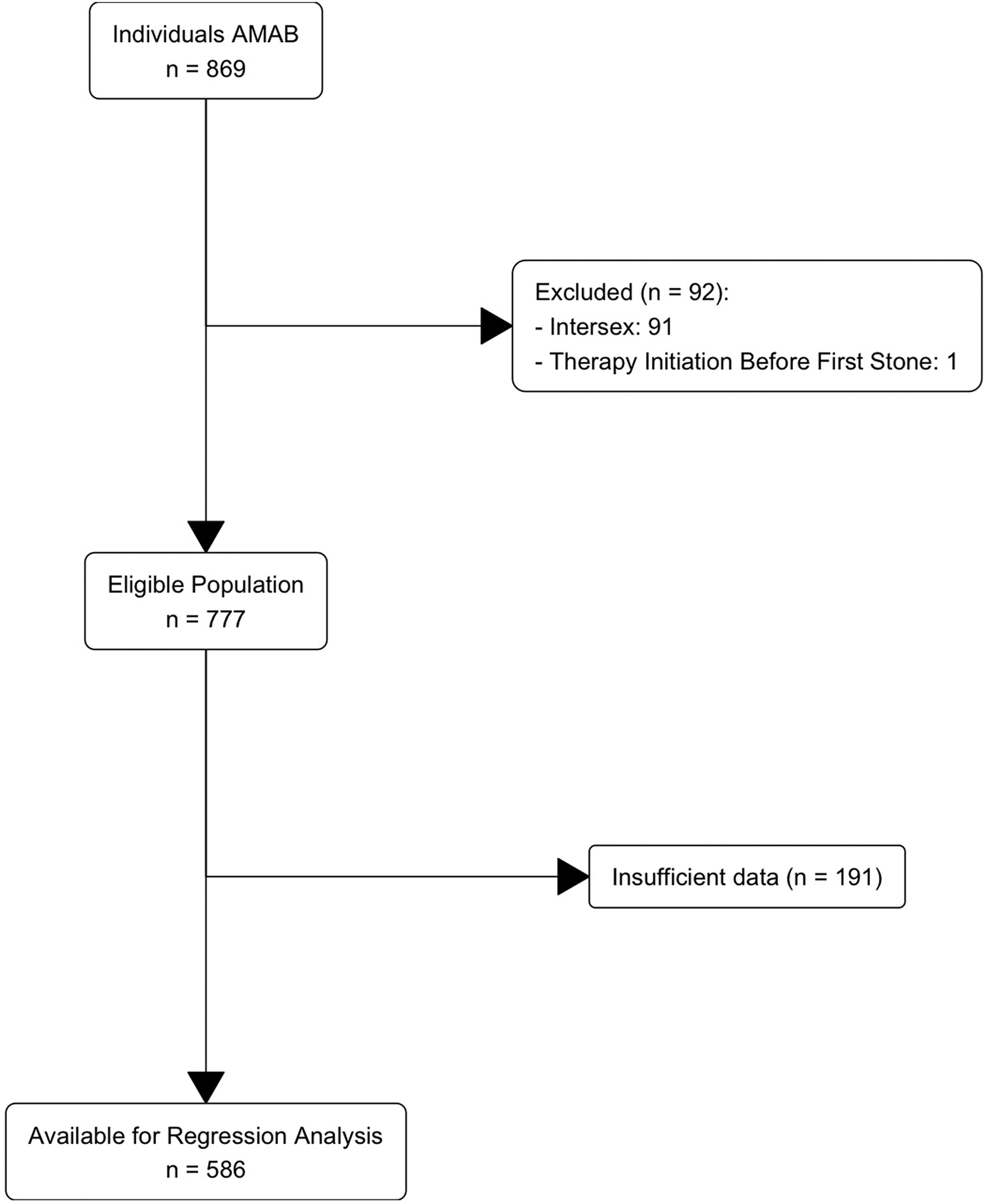
Study flowchart. AMAB = assigned male at birth.
Patient Demographics and Medical Comorbidities of Transgender and Gender-Diverse Depending on Feminizing Gender-Affirming Hormone Therapy Use
Mean (SD); n (%).
Type 2 diabetes, hyperlipidemia, coronary atherosclerosis, gout, and all races except White are removed to comply with the All of Us Research Program Data and Statistics Dissemination Policy. There are <20 participants in at least one of the two intervention groups.
BMI = body mass index; f-GAHT = feminizing gender-affirming hormone therapy; SD = standard deviation.
The cumulative incidence of kidney stone disease after initiation of f-GAHT was 10.3% compared with 4.8% for the non-f-GAHT patients (p = 0.01). In the univariate analysis, f-GAHT was significantly associated with newly diagnosed kidney stones (OR = 2.26, 95% CI: 1.23, 4.09, p = 0.008). After adjusting for covariates in an unweighted multivariate analysis, f-GAHT remained associated with kidney stone incidence (OR = 2.53, 95% CI: 1.0, 6.20, p = 0.044) (Table 2). Age and hyperlipidemia were also associated with an increased risk of kidney stones (OR = 1.03, 95% CI: 1.0, 1.07, p = 0.027 for age; OR = 3.39, 95% CI: 1.24, 9.44, p = 0.018 for hyperlipidemia). Ultimately, f-GAHT was found to independently predict the formation of kidney stones in a propensity score weighted regression (OR = 2.76, 95% CI: 1.56, 5.06, p < 0.001) (Fig. 2).
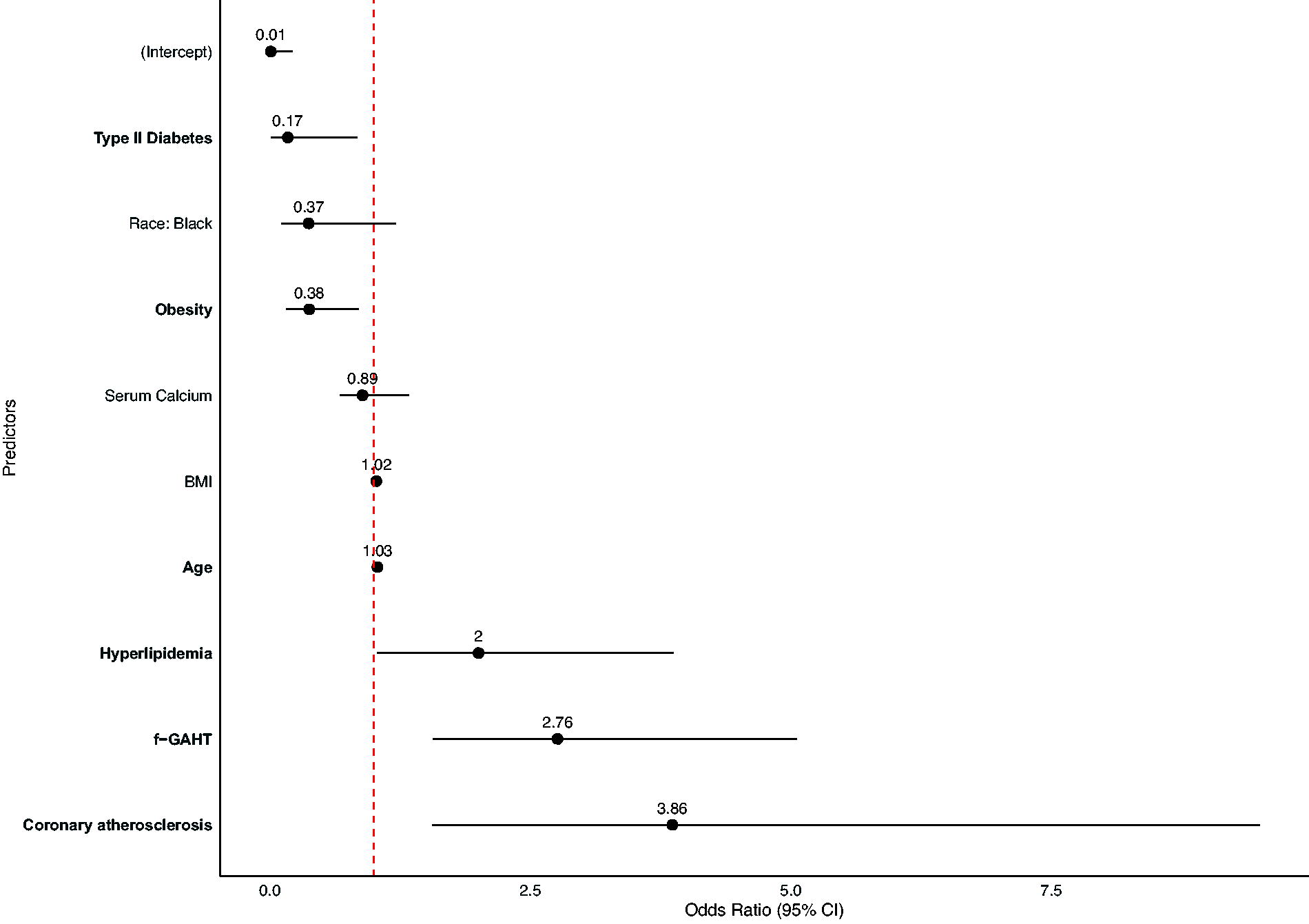
Forest plot of the weighted propensity score multivariate regression for TGD patients on f-GAHT. f-GAHT= feminizing gender-affirming hormone therapy; TGD = transgender and gender-diverse.
Univariate, Unweighted Multivariate, and Weighted Propensity Score Multivariate Regressions for Transgender and Gender-Diverse Patients on Feminizing Gender-Affirming Hormone Therapy
There were <20 participants who identified as Asian, Middle Eastern, Hispanic, and Mixed Race. They were removed from display to comply with the All of Us Research Program Data and Statistics Dissemination Policy.
CI = confidence interval; OR = odds ratio; f-GAHT = feminizing gender-affirming hormone therapy.
In a hormone-type subanalysis, c-f-GAHT patients (n = 556) were younger (38.2 vs 42.6, p = 0.01), had a greater serum calcium (9.5 vs 9.1, p = 0.005), were more obese (25% vs 15%, p = 0.024), and had a greater percentage of White patients compared with those not being treated with c-f-GAHT (68% vs 49%, p = 0.025) (Supplementary Table S1). In a weighted propensity score analysis, c-f-GAHT was found to be associated with kidney stone formation (OR 2.63, 95% CI: 1.44, 4.97, p = 0.002) (Supplementary Table S2). Patients on e-f-GAHT (n = 485) had no significant differences in age, BMI, or serum calcium compared with non-f-GAHT patients (Supplementary Table S3). E-f-GAHT was not associated with kidney stone disease in the weighted propensity score analysis (OR = 1.88, 95% CI: 0.85, 4.32, p = 0.13) (Supplementary Table S4).
Discussion
Access to GAHT can be life-changing and lifesaving for TGD individuals who can obtain it, as hormone therapy reduces gender dysphoria and improves overall quality of life. 17,18 Systemic barriers for TGD people seeking GAHT continue to exist, including economic marginalization, provider discrimination, clinical mistreatment, and provider competency for prescribing hormone therapy. 18 However, despite these barriers to care, the number of individuals found to have gender dysphoria seeking GAHT has continued to increase over the past 25 years. 19 This increasing trend underscores the urgent need for further investigation into the relationships and urologic effects of f-GAHT, contributing to more equitable and informed health care practices in this field.
According to our study, f-GAHT was found to be an independent risk factor (OR = 2.76) for kidney stones among patients AMAB, significantly increasing the incidence from 4.8% to 10.3% (p = 0.01). This association was pronounced in all our analyses, including the propensity score weighted regression. Hormone-type subanalysis found that although estrogen therapy alone was not significantly associated with nephrolithiasis, the combination of estrogen and antiandrogen therapy significantly increased the risk of kidney stone disease. This suggests that it may be the combination regimen or antiandrogen therapy that is driving stone disease in patients AMAB rather than estrogen therapy alone.
Major risk factors for stone formation include metabolic syndrome, age, and male sex. Cisgender men over the age of 40 to 50 have been shown to have the greatest prevalence of nephrolithiasis. 20 Interestingly, our cohort exhibited an elevated risk of kidney stone disease despite their young age, which may provide more weight to the hypothesis that an external factor like f-GAHT is driving the risk of stone disease in this group. The prevalence of kidney stone disease in cisgender women has been increasing and is approaching that of cisgender men. 21 Despite this recognized association, the degree to which and exact mechanism by which sex hormones influence the formation of kidney stones remain under investigation. Understanding the role of GAHT in kidney stone disease is clinically valuable for preventing future stone events in TGD patients, which has remained largely unstudied. 22
Some studies have suggested that estrogen promotes stone formation by increasing urinary excretion of calcium. 23 Conversely, estrogen has been shown to be protective of stone formation because of the inhibition of oxalate excretion and increasing urinary citrate. 24,25 A prospective study on serum uric acid levels in male-to-female transgender patients found that although baseline serum uric acid levels were high, serum uric acid significantly decreased one year after starting estrogen therapy and increased uric acid excretion. 26 Estrogen has previously been shown to cause greater excretion of uric acid, which can provide a favorable environment for the formation of calcium oxalate stones. 26 Some studies in postmenopausal women have also concluded that a menopausal state was associated with kidney stone disease, 27,28 but that there was no association between estrogen hormone therapy and kidney stone disease in this population. 10,27,29 These findings are consistent with our study, demonstrating an absence of association of stone disease for TGD patients only taking estrogen therapy.
Like estrogen, the relationship between testosterone and kidney stone disease remains unclear and inconclusive because of conflicting results. Low testosterone levels in cisgender men have been shown to be linked to a higher risk of stones. 30 Díaz Convalía and colleagues reported that the incidence of nephrolithiasis in prostate cancer patients on luteinizing hormone-releasing hormone (LHRH) analogs for androgen deprivation therapy (ADT) was over 8 times greater than those who were not. 13 However, in cisgender men undergoing ADT for prostate cancer, Lin and coworkers found that ADT therapy was associated with a significantly lower risk of nephrolithiasis compared with patients who were not on ADT. 14 The effects of spironolactone—a medication with antiandrogenic properties primarily used for its inhibition of the mineralocorticoid pathway—on calcium homeostasis and the risk of nephrolithiasis remain unclear. 31
Distinctly, we present in this big data, large-scale study that there is an association between feminization hormone therapy and kidney stones among patients AMAB, which represents a distinct population with a specific hormone profile. The findings of the subanalysis suggest that although estrogen therapy alone does not significantly increase the risk of stones, the combination of estrogen and antiandrogens or antiandrogens alone may be driving this relationship. Therefore, future prospective studies are needed to assess the risk of kidney stones associated with f-GAHT, specifically among different regimens taken by patients AMAB. Other possible explanations for stone disease in this population may be dehydration because of subsequent gender-affirming procedures or as a sequela of surgical manipulation of the urinary anatomy from the procedures themselves. 22 However, no such studies exploring these hypotheses currently exist in the literature.
This study is the first database cohort study using All of Us data examining the relationship between f-GAHT and kidney stone disease in patients AMAB. Our study provides novel evidence for this population’s potential relationship between f-GAHT and kidney stones. Possible biases in this study include an absence of ability to account for confounders like diet and hydration status, which were unavailable. Likewise, patients were not eliminated if they had a history of gender-affirming operation. Transitioning is a highly personal and nonlinear process; feminization goals differ from person to person. Although the timing of hormone initiation relative to an individual’s transition may influence their choice of hormone regimen, these nuances are complex to capture in clinical data and may contribute to potential confounding. In addition, insufficient individuals in the population had indicated a family history of nephrolithiasis, 24-hour urine test results, urinary calcium, urine pH, or uric acid results to be reliably included in the multivariate analyses. We also could not account for stone recurrence as we did not have reliable information regarding subsequent follow-up appointments for unique kidney stone events and did not have access to patients’ imaging. Although the findings have limited generalizability, this study provides unique insights into nephrolithiasis risk in patients AMAB on f-GAHT and emphasizes the need for more thoughtful focused research on this often-overlooked community to better address their kidney stone risk.
Conclusions
The results of this nationwide cohort database study capturing TGD patients demonstrated a 2.76 times greater risk and significantly greater incidence of kidney stones in patients AMAB on f-GAHT. The combination of estrogen and antiandrogen therapy appeared to provide additional risk compared with estrogen therapy alone. As our understanding of gender-affirming treatments improves, it is vital to enhance our ability to counsel patients receiving GAHT effectively. Patients AMAB on f-GAHT may benefit from awareness, early evaluation for modifiable risk factors of nephrolithiasis, and counseling regarding basic dietary (low salt, low animal protein diet) and behavioral (hydration) recommendations. This finding provides useful information and may aid prescribers with more information regarding the effects of f-GAHT in TGD populations.
Footnotes
Acknowledgments
The authors express their deepest gratitude to the All of Us participants for their invaluable contributions; this research would not have been possible without them. The authors also thank the National Institutes of Health’s All of Us Research Program for providing the data to this underrepresented and marginalized group of patients within medicine.
Authors’ Contributions
Conceptualization and design: E.F., Z.S., and M.G. Acquisition of data: E.F. Statistical Analysis: E.F. Data interpretation: E.F., K.G., V.D., and M.G. Drafting of the article: E.F. Critical article revision: Z.S., W.M.A., and M.G. Supervision: M.G. Resources: B.G.
Data Availability
This study uses data from the Controlled Tier of the All of Us Research Database version 7, which is available to users of that tier on the Research Workbench. The data are not publicly available due to ethical issues and the participants’ privacy.
Ethical Approval
No ethical approval to report this study was needed from our institutional review board.
Author Disclosure Statement
The authors have nothing to disclose.
Funding Information
The authors received no financial support for this article’s research, authorship, and/or publication. The National Institutes of Health supports the All of Us Research Program.
Supplementary Material
Supplementary Table S1
Supplementary Table S2
Supplementary Table S3
Supplementary Table S4
Abbreviations Used
References
Supplementary Material
Please find the following supplemental material available below.
For Open Access articles published under a Creative Commons License, all supplemental material carries the same license as the article it is associated with.
For non-Open Access articles published, all supplemental material carries a non-exclusive license, and permission requests for re-use of supplemental material or any part of supplemental material shall be sent directly to the copyright owner as specified in the copyright notice associated with the article.
