






Abstract
For a quarter of a century, Management Communication Quarterly (MCQ) has published research about communication in the context of work. This article charts the intellectual history of MCQ to trace its epistemic, theoretical, and identity changes. The authors consider how the journal’s published research has changed, why it has changed, and what its future direction should be. The article also considers MCQ as a place for a community of scholars and the journal’s identity as a member of that community. In providing this empirical study of MCQ’s history, it is hoped that organizational communication scholars can consider further questions about their research, their journals, and their communities within the research tradition.
Introduction
In 2007, Management Communication Quarterly (MCQ) commissioned a special forum to celebrate the journal’s 20th anniversary. Developed by then forum editor, Kathy Krone, the essays featured past MCQ editors reflecting on their time as editor, on the journal’s editorial policies of the time, the research published during their editorship, and the contributions that MCQ has made to knowledge and practice in organizations. Now that the journal has reached its 25th year, MCQ has commissioned another retrospective, but this time, the focus is somewhat different. We (two current editorial board members and the current editor) sought to deepen the personal reflections from the former editors by augmenting their views with a systematic analysis of the research trends found in MCQ over the time of its publication. Our purpose is primarily to add a new data set to the editorial reflections that will help us better understand the role that MCQ has played in shaping organizational communication scholarship, essentially investigating the following questions: Are we actually publishing what we claim to be publishing and what are the trends that we can see in the journal’s history of ideas? As with any organizational study, we aim to better our practice by reflexively increasing our knowledge. Thus, we have set out to increase our knowledge of MCQ’s history and place it in its scholarly environment. We also use this research to inform discussions about the directions that the journal could move in the future.
MCQ’s 20th Anniversary Forum
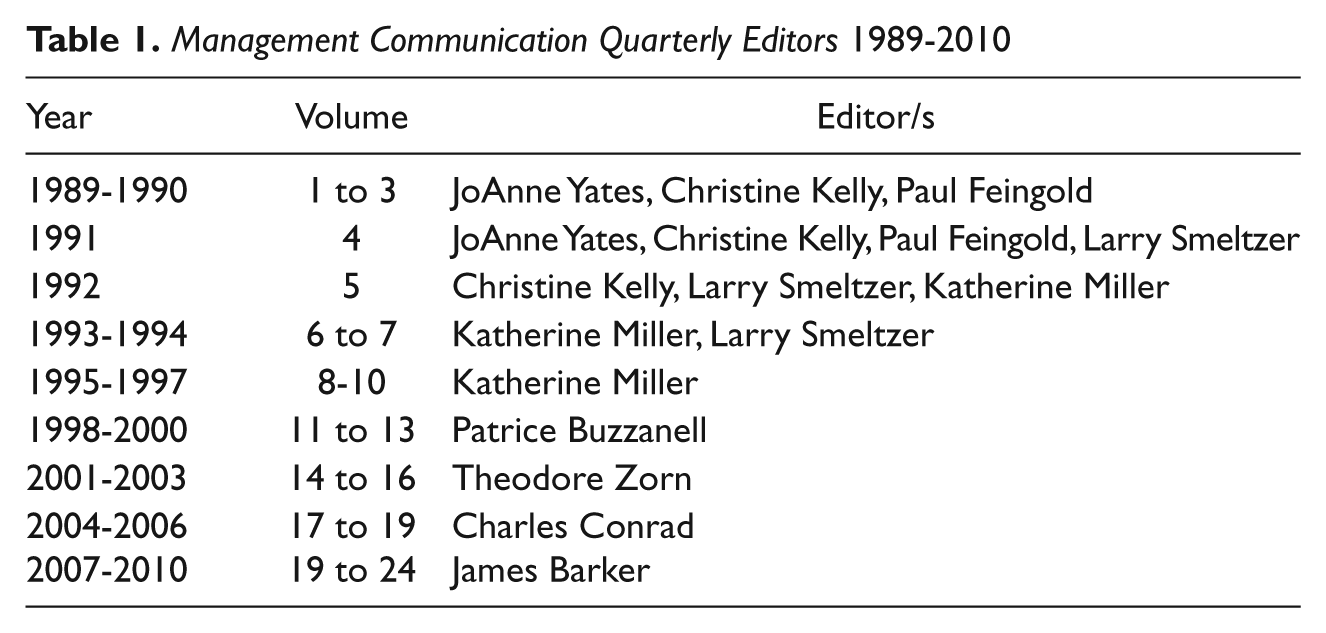
After an opening forum introduction, Krone (2007) presented the past editors’ essays in historical order to track the journal’s development. JoAnne Yates and Christine Kelly (2007), editors for Volumes 1 to 6 (along with Paul Feingold and Larry Smeltzer for part of this time) chronicled MCQ’s origins as a scholarly journal for business school communication researchers. Katherine Miller (2007), editor for Volumes 5 to 10 (along with Larry Smeltzer for part of this time), wrote of her experiences as the journal shifted more toward being a professional outlet for the field of organizational communication. Patrice Buzzanell, editor for Volumes 11 to 13, oversaw a period when MCQ’s reach expanded within the communication field as well as the journal confirming its place as an essential outlet for organizational communication scholarship. Theodore Zorn, editor for Volumes 14 to 16, as the first editor from outside the United States, described a set of tensions that the journal faced as it sought to mature as a truly international journal. Charles Conrad, editor for Volumes 17 to 19, used his essay to reflect on MCQ’s first 20 years, identifying its successes and struggles to represent itself as an international and interdisciplinary journal of organization and communication. The period covered by the essays stopped with MCQ’s 20th anniversary year and the beginning of James Barker’s editorship (Volume 20). Barker continues as the editor today as the journal moves into its 25th year. The full list of editors is provided in Table 1.
Management Communication Quarterly Editors 1989-2010
Several significant issues that emerge from these essays shaped our approach to assessing the journal’s history to its 25th year. In particular, we were struck by the consistent desire for the journal to be interdisciplinary, although, as is natural for living, evolving fields of academic study, the editors and we, ourselves, had much difficulty in pinning down exactly what being “interdisciplinary” meant for MCQ. We believed that a systematic assessment of MCQ’s published articles would help us understand this meaning and its effects. A second and related issue concerns MCQ’s identity as the central journal for organizational communication scholars. What exactly does this identity look like? What are the vital scholarly ideas that form MCQ’s identity as an organizational communication journal and how have these ideas evolved over time to mark MCQ’s identity today? Third, given MCQ’s identity as an organizational communication journal, how does a systematic analysis of the journal’s publications inform the evolution of this identity and the directions it needs to take in the future? These questions framed our historical study of MCQ’s research trends.
Charting a Journal’s “History of Ideas”
Questions about the crucial ideas framing how scholars organize their research have been addressed quite thoroughly on a number of occasions when well-known researchers have been commissioned to write review articles that survey the development and future of research in a particular area such as change management and organizational development (Weick & Quinn, 1999) and aspects of communication (Knapp & Comaden, 1979). We readily find several such review essays in organizational communication (Deetz, 2001; Krone, Jablin, & Putnam, 1987; McPhee & Tompkins, 1985; Monge & Poole, 2008; Mumby & Stohl, 1996; Putnam & Krone, 2006).
Systematic reviews of empirical research to establish the state of knowledge related to specific issues are also common (Edwards et al., 2000). However, scholars much less frequently use a formal empirical approach to track the epistemological and ontological development of a field’s representative journal. Formal analysis is usually confined to scrutiny of impact factors. Such analyses have been done for behavioral science and management journals (Extejt & Smith, 1990), information systems management (Culnan, 1987), and supply chain management (Charvet, Cooper, & Gardner, 2008). The numerous criticisms of bibliometric analysis include whether impact factors are reliable measures of quality (Hecht, Hecht, & Sandberg, 1998), that they do not measure impact on practitioners (Saha, 2003), and that citation analysis is based on simplistic ideas about knowledge production that do not account for the social construction of knowledge (MacRoberts & MacRoberts, 1996). This latter issue is our greatest concern. Citation or cocitation analysis, we argue, does little to map the intellectual structure of a journal or field. One needs to be able to map ideas or concepts within a field rather than just researchers. With such criticism in mind, it is important that recent approaches to evaluation of journals and research generally have adopted a more sociological and cognitive orientation. Raw citation figures, quality measures, and impact factors are giving way to assessments of “intellectual structure” (Charvet et al., 2008; Culnan, 1987) and ways of visualizing or mapping important historical patterns in a particular literature (Cretchley, Rooney, & Gallois, 2010; White & McCain, 1998).
The intellectual structure approach to journal analysis has attempted to build ideas or concepts into its graphs and maps (Bourret, Mogoutov, Julian-Reynier, & Cambrosio, 2006). This movement coincides with recent technological advancements in computer-assisted text analysis (CATA) that now allows concept and cognitive mapping. Interesting applications of this kind of analysis have been done in relation to organizational change (Kuhn & Corman, 2003; Rooney, McKenna, & Liesch, 2010), medical research (Bourret et al., 2006), government media responses to terrorist acts (McKenna & Waddell, 2007), public policy discourse (Rooney, 2005), and semantic analysis of journals (Cretchley et al., 2010). The importance of CATA is that it allows us to map more easily the history or evolution of ideas in a journal or field (Bourret et al., 2006).
This article, then, answers the following questions:
Are we publishing what we think we are publishing?
What intellectual trends can be empirically demonstrated in MCQ’s history?
Subquestions are as follows:
How has MCQ’s identity been constructed and changed?
What is MCQ’s (and organizational communication’s) future?
Method
Gathering data for this analysis could have replicated other studies. For example, citation and cocitation analysts traditionally collect citation data rather than the text of articles. They tend to collect “core articles” from “representative” journals (Charvet et al., 2008). Another method used by Bourret et al. (2006) is to collect data in the form of journal article titles in order to merge citation data with the ideas contained within the corpus of titles in which they were interested. For this study, we used the abstracts for each article published in MCQ since Issue 1, Number 1 through Issue 23, Number 4 as the data. Abstracts are lexically dense because they summarize the core issues presented in the article itself. To facilitate analysis that would show how ideas and concepts in MCQ have developed from 1987 to 2009, we divided the data into four 5-year period subsets (1987 to 1991, 1992 to 1996, 1997 to 2001, 2002 to 2006) and one subset covering 2007 to 2009. This periodization responds to the need to run our analysis over a sufficient number of time spans to balance having a sufficiently large sample for each period’s analysis to be meaningful while being small enough to follow some of the subtle changes in the journal. Using five periods gives this balance and is also useful because, to a significant extent, it tracks the tenures of past editors. However, given the gestation time of articles, it would be inaccurate, particularly in the later years when submission levels are higher, to attribute clear trends to different editorial policies. Therefore, we used Leximancer concept mapping software to produce a set of concept maps showing semantic structures in MCQ through its history.
Leximancer uses word frequency and co-occurrence data and an automated, machine-learning technique to learn what the main concepts and themes in a corpus are and how they are related to each other (Smith & Humphreys, 2006). In this respect, Leximancer is a data mining and visualization technology for analysis of unstructured relational data. The mapping facility in Leximancer provides a “bird’s eye” view of the conceptual structure of a data set from which the researcher can begin interpreting meaning. Using this concept map in conjunction with rank-ordered concept lists, the researcher can explore particular themes and concepts at sentence and paragraph levels. When putative patterns or themes emerge, the researcher can mine the data by looking at the specific textual instances where the concept occurs for more detailed qualitative analysis.
In creating concept maps, Leximancer analyses the relational characteristics (semantic associations) of concepts by using a word frequency count to identify the most statistically significant words, which are then treated as concepts. Using this data, the co-occurrence of concepts is measured to determine the strength of relationships between concepts. Thus, the more often a concept occurs directly with another, the stronger the relationship. In short, Leximancer rank-orders concepts and then maps both the strengths of association between concepts and semantic similarity and dissimilarly between concepts.
For this study, we used Leximancer to analyze both the entire data set and each historical block individually. As Leximancer can simultaneously examine multiple subsets of texts as a single data set, we were able to ask Leximancer, using a discriminant analysis design, to identify where each historical period is situated relative to the overall semantic landscape of MCQ’s history (Figure 1). Doing so characterizes the semantic focus of each period, thus identifying change over time. Concept maps were also created for each period or data subset in our study. These maps provide added detail about the conceptual character of each period without the relational “forcing” imposed during discriminant analysis.
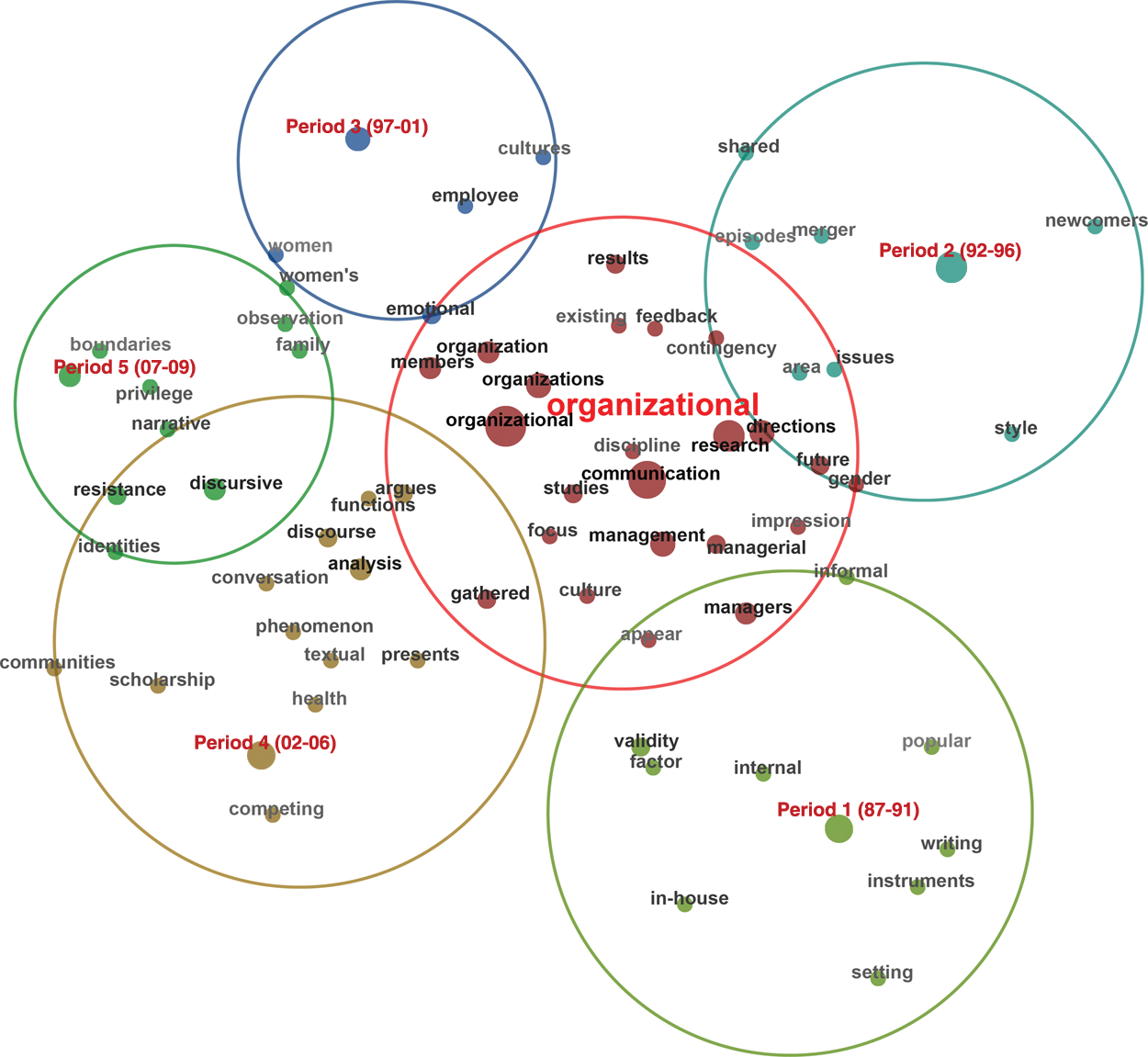
Discriminant analysis of concepts in Management Communication Quarterly, 1987 to 2009
A feature of Leximancer’s analysis is its reliability. Leximancer’s reliability is assessable in two ways: stability and reproducibility. In Leximancer, stability is equivalent to intercoder reliability (see Smith & Humphreys, 2006, for a detailed discussion). Leximancer is highly consistent in the way it automatically codes and recodes concepts in a data set. No matter how many times a data set is coded and recoded by Leximancer, it is able to consistently reproduce the same result. Leximancer, therefore, has a high level of coding stability. Reproducibility in Leximancer is characterized by its consistency in classifying text and identifying the relationships between concepts in a data set, given the same coding scheme. Consistent classifying is seen when Leximancer produces and reproduces consistently constructed stochastic concept maps representing the same data. Leximancer produced stable maps for this study.
Importantly, we compare the Leximancer analysis with the narrative data provided by the former editors’ essays published in MCQ’s 20th anniversary forum (2007) as well as use the analysis as a systematic method for charting the evolution of ideas in MCQ. Consequently, we now have access to a richer assessment of how MCQ’s identity has evolved over time and a stronger foundation from which to assess the journal’s ambitions to be interdisciplinary as well as a primary journal for organizational communication.
MCQ’s History of Ideas
We begin discussing our results by focusing on the discriminant analysis concept map of the entire corpus of abstracts that we assessed, which charts MCQ’s history since 1987 (Figure 1). The map presents five semantic regions, one for each period of the study. Those periods are each defined by a circle. Each of those circles is identified by a label denoting the years they cover, that is, 87-91, 92-96, and so on. An important feature of this map is its centre, which shows a residual of concepts within the central circle, that is, concepts that could not be assigned to a particular time block because they are recurrent and quite evenly distributed across all periods of MCQ’s history. This is the conceptual core of the journal, which clearly supports MCQ’s central identity as a journal of organizational communication. Research, results, studies, organization/s/al, and communication as well as management, managers, managerial, and members are important items of this common intellectual concern and heritage. However, also significant is that the siblings of organizational communication (business communication, corporate communication) are not readily apparent in this common core (although management communication is).
Concepts related to procedural methods (e.g., sample, reliability, validity) do not feature in the core, and neither do research design concepts (e.g., ethnography, survey), but as already reported, more generic research concepts like results and studies do occur. Based on this information, we can say that MCQ is an empirical organizational communication journal, a finding that certainly supports the common view of MCQ’s identity. Barker 1 , as current editor, states that the journal is primarily a source for emergent empirical scholarship and that he seeks to continue the journal’s identity in this direction. This sense of identity is clear in his initial editorial essay: “Thus MCQ publishes conceptually rigorous, empirically driven, and practice-relevant research from across the interdisciplinary and international management communication realm” (Barker, 2006, p. 3; emphasis in the original).
Although we can observe a clear identity as an empirically driven journal, MCQ has not consistently favored particular research methods throughout its history. For example, in the 1987-1991 period, quantitative analysis was favored (factor, validity, instruments), whereas in recent years, there is a shift to terms such as text and discourse. This implied shift toward discourse/linguistic analysis is consistent with the former editors’ narrative accounts. The clearest differences across periods are in the phenomena put under scrutiny, such as writing (1987-1991), mergers and style (1992-1996), and women, culture, and emotional (1997-2001). The final two periods (2002-2006 and 2007-2009) are the least dissimilar with identities, textual, discursive, boundaries, and resistance appearing to have common connections. Again, the data here support and, as we will show, complement the former editors’ narrative accounts and confirm MCQ’s move from a more business communication and practice journal in its early years to the more social-scientific and conceptual identity of today.
To better understand the significance of the differences and similarities between each period in MCQ’s evolution toward this identity, we now focus on analyses of each individual period. In this part of our analysis, we use individual concept maps of each period to enhance the depth and richness of our discriminant analysis. These individual period maps enable us to better trace conceptual continuities and discontinuities across different periods and to track subtle changes.
Creation: 1987 to 1991
According to the discriminant analysis (Figure 1), the most characteristic concepts of this initial period are interpersonal and communication, issues related to writing and messages, and the instrument and validity concepts that suggest a quantitative emphasis. The individual concept map for this period (Figure 2) reveals an emphasis in this period on managerial communication and decision, process, and strategy as well as messages and information. Interpersonal and individual communication processes and strategies of managerial skills were important in this period.
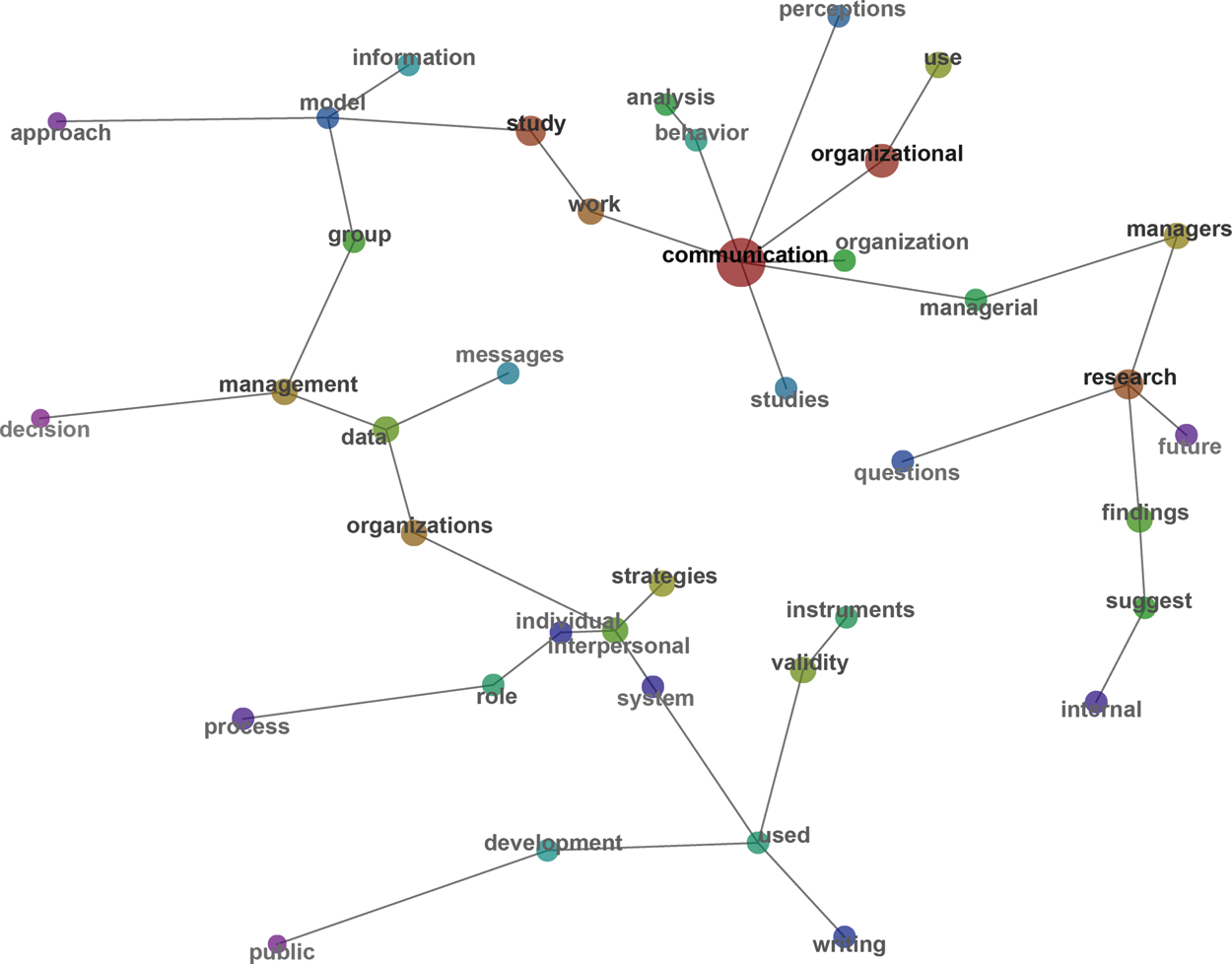
Concept map of the period, 1987 to 1991
The discriminant analysis depicts a restricted range of research methods and a rather functional view of the role of communication in organizations. The following quotations from abstracts of the time not only demonstrate the early view of which subfields of communication were included but also emphasize the focus on creating knowledge about functional skills for managers:
These instruments are very different and, therefore, will serve different purposes in communication research. Currently, several of the instruments report that considerable research needs to be done to test the validity and reliability of the instruments in different contexts. Illustrating the facilitation of communication among group participants, we describe focus group investigations across three different organizations. Our discussion concludes by reconsidering the facilitation of communication in focus groups and the accessing of data pertinent to management decision making. While this article reflects an organizational communication perspective, the editors of MCQ intend for the Research Instrument Section to become a forum for discussion of instruments related to managerial writing, managerial presentations, interpersonal communication in organizations, organizational communication, or external communication.
Our conclusion about the functional and managerial focus is quite consistent with the views of the editors of the time. Indeed, Yates and Kelly (and Feingold), who taught at U.S. business schools, noted that “the goal of management communication instruction in business schools [at the time] was very practical: making MBA students more successful at communicating in the workplace” (2007, p. 432).
Yet Yates, Kelly, and Feingold (1987) also recognized that MCQ needed to inhabit a different scholarly place from the one available to communication scholars in U.S. business schools at the time. Their commentary from their initial editorial, also reprinted in Yates and Kelly’s 2007 forum essay (p. 433), clearly marks out a new identity for the new journal:
MCQ grew out of and reflects the accelerating convergence of traditionally distinct fields of communication. Within the management school curriculum, at least five different communication areas—management writing and speaking, and interpersonal, organizational, and corporate communication—have a common focus on managerial and organizational effectiveness. This managerial focus creates the need for a journal that will foster research, discussion, and criticism among the many academicians and practitioners involved in communication research. MCQ was founded for sharing research and for shaping an interdisciplinary approach to management communication. (Yates, Kelly, & Feingold, 1987, p. 4)
Here we see an early signal as to MCQ’s unique position and identity within that place: a research-oriented journal that, as with journals that have a management and organizational focus, was concerned with enhancing organizational effectiveness. MCQ would, however, be a journal that could separate itself from strictly managerialist perspectives, a journal that could offer something different, but still constructive. We can find such a view clearly expressed in Yates and Kelly’s reflections when they told of their desire to “extend the range of methodologies, including qualitative methods and critical theory as well as quantitative methods” (Yates & Kelly, 2007, p. 433).
The data analysis also confirms the conclusion drawn by Tompkins and Wanca-Thibault (2001) that the scholarship of this time was beginning to turn from transmission to reception theories, from rationalistic and positivistic epistemologies to constructivism, and that interpretivism was spawning the dual directions of naturalistic and critical studies. In light of these commentaries, the contents of MCQ in its early years are as much as a reflection of editorial policy as they are a reflection of communication and social science scholarship more generally. It is clear, though, that Yates and Kelly primarily wanted more methodological diversity (rather than theoretical or ontological diversity, or interdisciplinary research designs) and were aligned with larger movements in scholarship (e.g., interpretivism) that Tompkins and Wanca-Thibault (2001) identified. An important seed had been planted that would subsequently shape MCQ’s evolution and the ideas it published.
Demarcation: 1992-1996
In the second period, which coincides with Katherine Miller’s individual and collective (with Larry Smeltzer) editorship, the discriminant analysis (Figure 1) suggests a strong focus on style, merger, and shared. As these are very different concepts from those in the first period, this map marks a sizable shift in the intellectual concerns of MCQ. Part of this may be due to the migration of field-specific areas such as written and spoken communication to journals such as the Journal of Business Communication, as Yates and Kelly suggest. Still, this shift is profoundly important for MCQ.
Miller’s editorship marks a turning point for the journal because the journal begins to demarcate what its identity is, a journal of and for organizational communication scholars. In her review essay, Miller engages this shift and details her difficult decision to take on Smeltzer’s offer of an editorship so early in her academic career, a fascinating discussion given the course that MCQ took with her term. Whether Miller happened to be the right person at the right time or Smeltzer saw the right person at the right time no longer matters; the fact is that Miller set MCQ on a path as an empirical, organizational communication journal.
The data strongly support Miller’s reflection as we see links in Figure 3 to the core concepts of organization/al/s and communication. We also find clear evidence here that the concepts in this period show that researchers were responding to major changes in the organizational world. The interest in mergers was a response to the problems associated with the sudden growth in mergers and acquisitions linked to globalization (facilitated in part by rapid technological change, including the Internet). That the concept, gender, emerges is also significant because it foreshadows the very great interest shown in subsequent periods in broader social issues, particularly women, power, and conflict. We can see such examples in the following abstract excerpt from this period:
Effects of layoffs on employees—both stayers and leavers—have been studied extensively, but very little research has been conducted on layoff effects on ethnically diverse employee populations nor on discrimination during layoffs. This case study begins with a set of interviews to uncover employee perceptions of ethnic discrimination during a “voluntary” downsizing process.
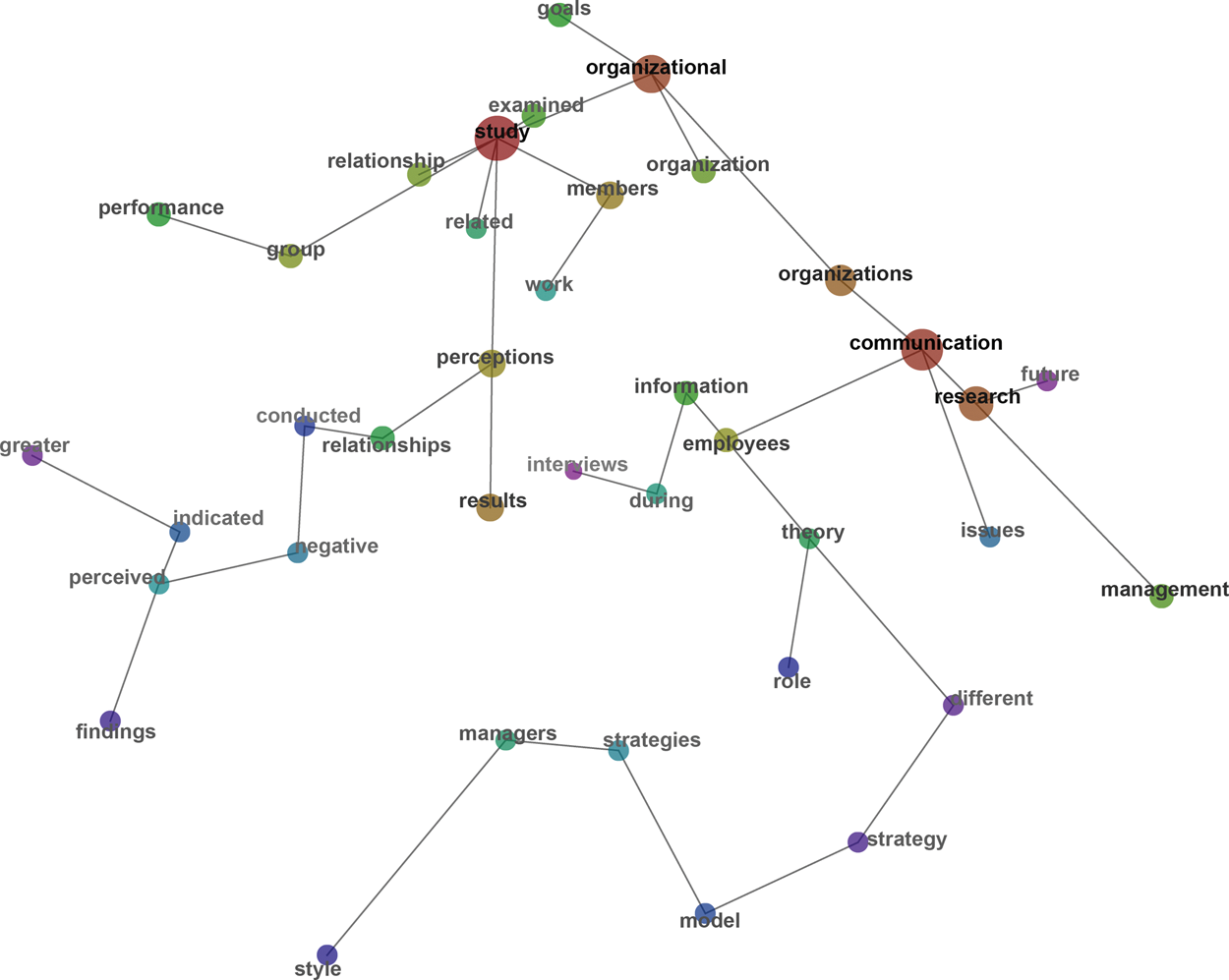
Concept map of the period, 1992-1996
The data also suggest an important ontological shift. The individual map (Figure 3) displays concerns about relationships, perceptions, employees, and future as well as concepts from the previous period such as group, management, and style. Researchers were moving away from a hierarchical top-down view of organizations structure and appear more ready to study members and relationships. They also acknowledged the need for research to provide more guidance about how to deal with the growing ambiguities in organizational life as social and technological change and the ever-increasing scale of organizational activity took effect. The following excerpts demonstrate academic questioning of the naturalized and unconsciously reproduced hierarchy and constructedness and symbolic nature of organizational life.
Even when organizational members were aware of contradictory and ambiguous communication practices by management, they were largely unaware of the extent to which their responses to this situation naturalized, reproduced, and strengthened a painfully experienced organizational system of control. The investigation demonstrates how a symbolic analysis can provide a better understanding of, and make a contribution to, existing research on organizational concepts such as organizational change, leadership, and organizational metaphors. In addition, it provides a fruitful research method for analyzing the functions of symbolic discourse and proposes some areas for future research.
The presence of perceptions as a concept is important because it acknowledges the intersubjectivity and interpretive character of organizational life. Little preference is shown for particular research designs, suggesting a clear shift away from, in relative terms, the methodological homogeneity in the previous period.
Although Miller correctly notes an increase in issues dealing with feminism, diversity, ethics, and crisis, there is greater evidence of these as significant concepts in subsequent periods. More importantly, Miller (2007, p. 440)refers positively to critical ethnography (which can easily accommodate interdisciplinary designs). This prefigures later changes to topics that lend themselves to critical approaches (e.g., critical discourse analysis) and the emergence of critical management studies in the organization studies literature, the growing popularity and legitimacy of qualitative methods, and the focus on discourse that is associated with the so-called linguistic turn in the social sciences.
One fundamental issue called into question by the data, and by organizational communication scholars of the time, is the journal’s name emphasizing management. Miller addresses this issue in her forum essay (2007, p. 441) acknowledging the discontent that organizational communication scholars had with the concept management, which further signals the demarcation of the journal during this time as a journal for organizational communication. Miller (2007) notes that a name change, while desirable, was unworkable and notes, “But the name has not hampered the progress of the journal in becoming a valued and respected outlet for organizational communication scholarship” (p. 441). Buzzanell (2007, pp. 449-450), the editor subsequent to Miller, also discussed tensions around the journal’s name and details her reasons for resisting a name change. As Barker experiences the same title concerns today from the organizational communication community, he has had several discussions with SAGE Publications about a name change. Echoing Buzzanell’s rationale, SAGE adamantly opposes any name change on substantial (and persuasive) financial and administrative grounds—any name change is too costly and too problematic. Names aside, both Miller’s reflections and the data indicate that MCQ had now demarcated itself as a journal for organizational communication scholars. What, then, became of the core ideas of that new identity?
Invitation: 1997 to 2001
The 1997 to 2001 period is most characteristic for its focus on the concepts women, emotional, cultures, and employee (Figure 1). These terms are indicative of the journal’s evolution of a conceptual foundation for its identity as an organizational communication journal. Certainly, the aim of greater plurality expressed by previous editors begins to bear fruit in this period, albeit primarily within the field of organizational communication. No doubt, this is at least partly because organizational communication scholarship was now deeply affected by the linguistic turn (Alvesson & Karreman, 2000), interpretivist studies were taking hold in the social sciences, and a more democratic political economy had also taken hold in the social sciences. The individual map (Figure 4) supports this interpretation by indicating that concepts like power, group, and role are prominent concepts, and with women suggests that the critical orientation had arrived in a meaningful way. Significant here is the emergence of women (linked to power and workplace) in the concept map, signaling that gender was now an important topic. An egalitarian framework is suggested in concepts like understanding and context. Typical of this is an abstract saying,
This study explored effects of differential quality of leader-member exchange on cooperative communication among members of work groups. Findings suggest that the nature of an individual’s own exchange with his or her leader and his or her leader’s upward leader-member exchange have significant impact on perceived use of cooperative communication among coworkers.
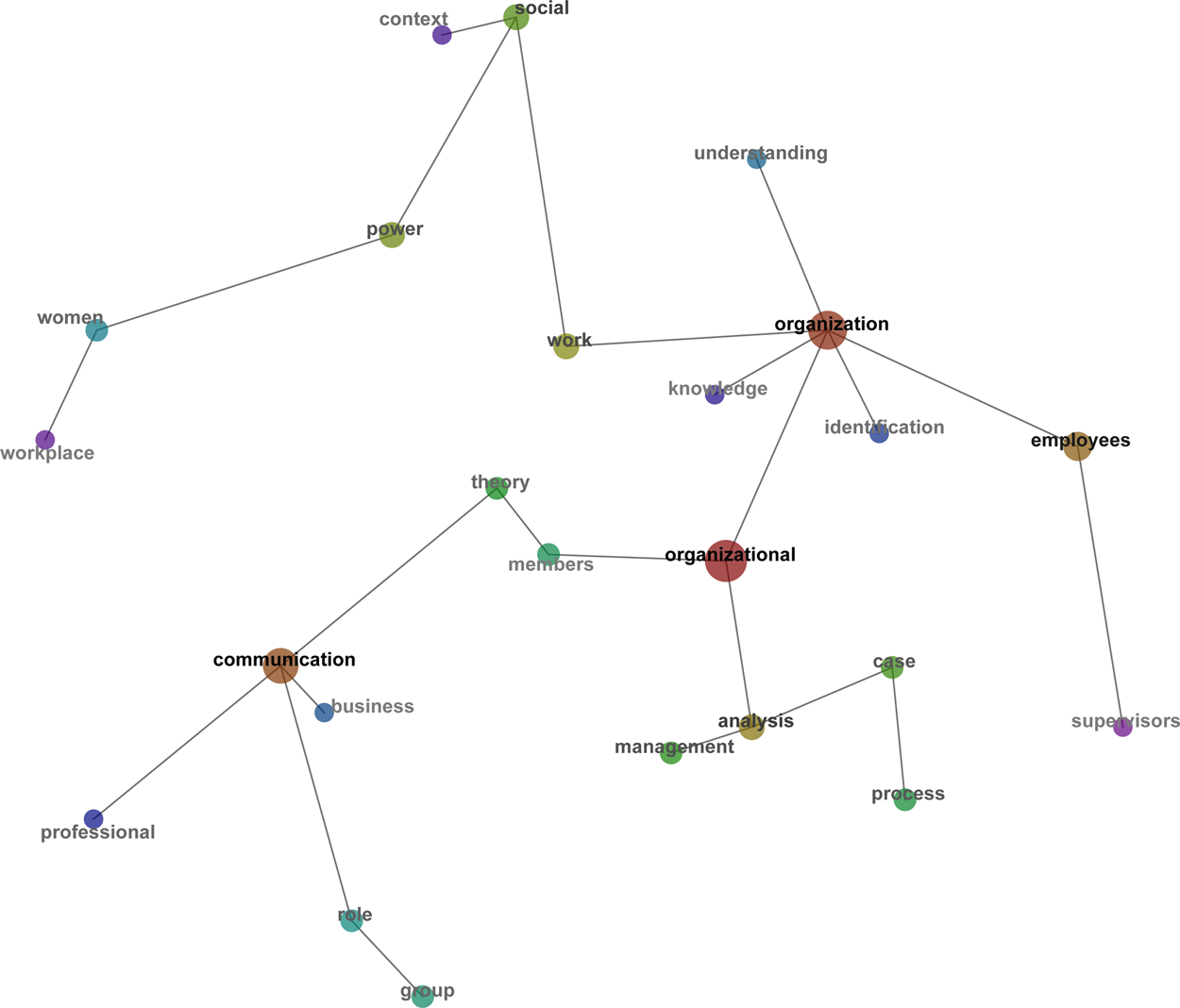
Concept map of the period, 1997 to 2001
The concept, member, is now replacing references to employer–employee ordinate relationships. The subjectivity and disposition of workers is now of more interest. The presence of knowledge nearby understanding and organization indicates the impact of organizational knowledge and intersubjectivity theory.
In methodological terms, it is noteworthy that theory and analysis linked to organizational and members are important concepts because they suggest a more thoroughgoing consideration of the links between theory, research, and the implications for practice. Debates about the relevance and applicability of research and how to make it more relevant and applicable were very topical in the social sciences at this time and MCQ’s authors were clearly engaged in this important activity. We also see the suggestion of an ontological shift in which basic concepts around communication and organizational phenomena are being understood in more theoretically nuanced ways that call into question narrowly construed research designs and the restricted ontological and epistemological perspectives suggested in the 1987 to 1991 period. This push to interdisciplinarity, mixed methods, and a growing confidence in the value of qualitative methods, as we will show, only becomes stronger in future periods.
The diversity of conceptual and empirical terms supports Buzzanell’s (2007) description of her editorial period. She described her desire to set an invitational tone for MCQ as the journal sought to recognize and “honor” (to use Buzzanell’s term, 2007, p. 445) different institutional, ontological, and epistemological streams within organizational communication by giving them a published voice. One way she did this was by soliciting “eclectic” manuscripts that engaged the tensions between internal and external, micro and macro, managerial voice and multiple stakeholders. Researchers’ awareness of such tensions was amplified, she says, by the general ontological and epistemological turns being taken in organizational communication at the time. Her editorial board was replete with members from communication schools, English departments, business schools, psychology, information systems, leadership centers, and speech communication (Buzzanell, 2007, p. 447). Articles included quantitative studies (43%) and qualitative studies (35%), rhetorical analyses (10%), multimethodological approaches (8%), and conversation analyses (5%; Buzzanell, 2007, p. 448). Thirteen percent of published articles in the 1997 to 2000 issues could be characterized as eclectic (Buzzanell, 2007, p. 450). At this point, we conjecture that MCQ’s identity has been shaped by larger epistemic, ontological, and political trends in the social sciences, which naturally would influence organizational communication research and that MCQ’s editors, as keen students of research trends, were similarly influenced. However, using Buzzanell’s figures and the data from our study, we still see support for MCQ as a journal that publishes qualitative and quantitative research rather than as a journal that publishes multimethod or eclectic research.
That point aside, and corresponding with Buzzanell’s account, MCQ was in an invitational period, seeking to attract and construct a marketplace of ideas that would reshape the conceptual and methodological foundation of the journal. Of course, that period also reflects ambient conceptual and methodological issues in general social science, and MCQ’s concerns reflect that broader trend. A good example is the above noted tension toward the publication and subsequent broad acceptance of qualitative studies. From a historical standpoint, MCQ was now positioned as a solid empirical journal poised to engage at an international level.
When Theodore Zorn succeeded Buzzanell as editor in 2000, his editorship steered the invitational tone of MCQ in significant new directions. As a U.S. academic based in New Zealand, Zorn held a unique perspective on the global potential of organizational communication. In his forum essay, Zorn carefully recounts the different tensions he faced, beginning with the issue of internationalization. He correctly noted that MCQ’s “full name is Management Communication Quarterly: An International Journal” (2007, p. 451) and extended the invitational tone more toward international connectedness. Zorn’s forum essay further reflects how MCQ began to navigate its way through the diversity of social science thought toward a coherent identity. His discussion of being international reflects the growing tensions toward the globalization of scholarship and clearly indicated that MCQ’s identity could no longer rest within its U.S. roots. However, Zorn’s account of tensions between the familiar and unfamiliar, between practice and critique, and between fads and enduring knowledge also signals a journal seeking to come to terms with its original charge as a journal that held “a common focus on managerial and organizational effectiveness” (Yates & Kelly, 2007, p. 433).
Cultivation: 2002 to 2006
This period, overlapping both the editorship of Zorn and Charles Conrad, is marked by the emergence of a clearer and more readily identifiable domain for MCQ. The discriminant analysis map (Figure 1) shows that the period 2002 to 2006 is distinctive for its focus on identities, discourse, analysis and textual, and for action, communities, conversation, and for scholarship. The ontological and epistemic evolutionary path that became evident in the 1997 to 2001 period, namely, interpretive, discursive, and critical scholarship, takes firmer root in the 2002 to 2006 period. Characteristic of research in this intellectual terrain is the following abstract excerpt:
Results reveal three distinct discursive strategies—comparison, logic, and support—that members use to manage identity tensions, and eight corresponding communicative tactics used to enact those strategies. This focus on communicative strategies and tactics is important because identities are expressed through language, and discourse is the means available to organization members for negotiating various identity structures.
The individual map for this period (Figure 5) displays an interest in social, change, resistance, and labor. Of equal importance, though, is the axiological and politicoeconomic shift that had been occurring alongside the ontological and epistemic shift. Having successfully made the shift to deal with gender issues (women) in the previous period, MCQ authors engage with identities, discursive, employees, and workers, suggesting continuation of a more democratic view in which workers, rather than merely managers, deserve attention. In particular, though, minority group members are given considerable research focus:
This article used the concept of discursive positioning to explore the narrative construction of professional identities among women engineers. The analysis of interviews with 15 women in a variety of engineering specialties suggested that they adopt a variety of distinct and sometimes contradictory positionings to present themselves as qualified professionals.
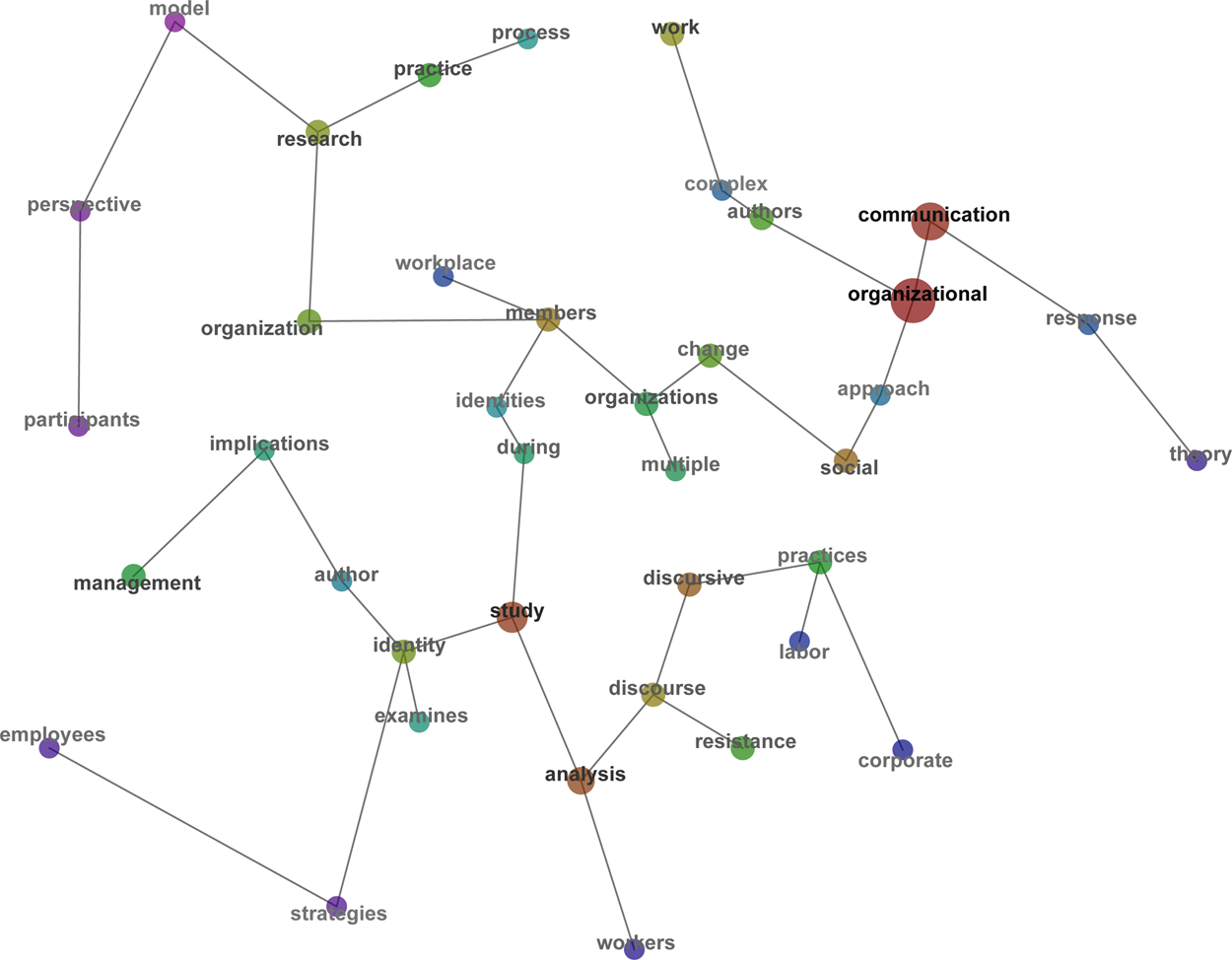
Concept map of the period, 2002 to 2006
Discourse analysis and identity research feature strongly, suggesting intergroup dialogue is a major interest. There is also a continuing concern for practice/s and process.
One might wonder at this stage whether the semantic maps for other management and organization studies journal would be greatly different from the map for MCQ that occurs here and in the following period. Parallel to this question, Zorn, editor from 2000 to 2002, also linked research in MCQ to broader trends in management research, mainly critical management studies (Zorn, 2007). In particular, and as noted above, he identified a concern with faddish management trends. Many of the concepts for this time could be related to management and organization studies rather than communication (e.g., employees, management, strategies, organizational, change, practice, corporate).
The natural question here is whether this similarity with management and organization studies precludes distinctiveness for MCQ or if it represents a point at which MCQ becomes just another organizational journal. Our sense from the forum essays, the data, and our own experiences is that we are witnessing another stage in MCQ’s development: its ability to cultivate a body of knowledge relevant for contemporary organizational scholars whether they be organizational communication scholars or not.
Zorn was particularly concerned about the relevance and accessibility of research to practice (and other audiences) and the ability of the journal to offer “positive alternatives” (Zorn, 2007, p. 455) to practitioners. Similarly, Conrad (2007) was committed to making sure that MCQ articles answered the “so what” question. The suggestion here is that the research community was becoming prisoner to a new intellectual orthodoxy and, despite its references to practical implications of its research, was somewhat self-absorbed and politically motivated. We return to these suggestions below.
Like Zorn, Conrad (Editor, 2003-2005) was also committed to further internationalizing the journal. Conrad claimed that institutional barriers to interdisciplinary research included U.S.-centric assumptions among certain scholars. Nonetheless, he noticed that the focus in MCQ had shifted somewhat from the United States to Europe and the British Commonwealth countries, South and Central America, Africa, and Asia. Another aspect of this internationalization was the constitution of MCQ’s editorial board which had moved to the point at which 40% of its members were from outside the United States. Additionally, about a third of submissions also came from outside the United States.
However, Conrad also identified a second institutional inhibiter, the compartmentalization of knowledge. This narrowed the number and range of what journals “count” in bibliometric terms and journals’ role in taming of the unruly, the adventurous, and the marginal, which, he says, impoverishes knowledge production through university research. An orthodoxy is suggested here that inhibits novelty and risk taking as research is published to be counted rather than read. Academic managers’ influence have been placing pressure on researchers to demonstrate numerically their productivity and value, rather than their insight or relevance, and this may have been an unwelcome influence on MCQ despite its invitational aspirations. Buzzanell also noted this concern in an email exchange with the authors:
Whereas editorial policies can be open and invitational, it may not be as much that the policy sets the tone but that what is published in the editorial policy cultivates particular values and expectations. Despite editors’ desires to be broad in their editorial policies, the submitters determine how they feel about editorial policies and their chances to have a successful submission. (personal communication, September 2010)
Conformity to particular politics, ontologies, and epistemologies have reduced the risk of not getting published for many researchers who invest in learning which journals publish what kinds of research. MCQ is certainly subject to these same pressures.
Consolidation: 2007 to 2009
The discriminant analysis for the final period in Figure 1 also identifies a discursive and critical orientation (resistance and discursive) and concern for identity (identities and boundaries). The semantic similarities between the individual maps for 2002-2006 and 2007-2009 suggest that MCQ has settled into a particular, even predictable, pattern.
Figure 6 indicates through concepts such as power, resistance, discursive, and practices that the ontological and political themes in the previous period remained. However, the concepts, rhetoric and meaning, emerged. An expression of political themes is seen in the following excerpt:
The author argues that an ironic approach to collusion can help shift the focus of resistance away from the relatively rare events surrounding implacable opposition or total unanimity to the quotidian aspects of workplace politics. The author argues this resistance is too often a decaf resistance. This is a resistance without the cost of radically changing the economy of enjoyment, which ties us to our master.
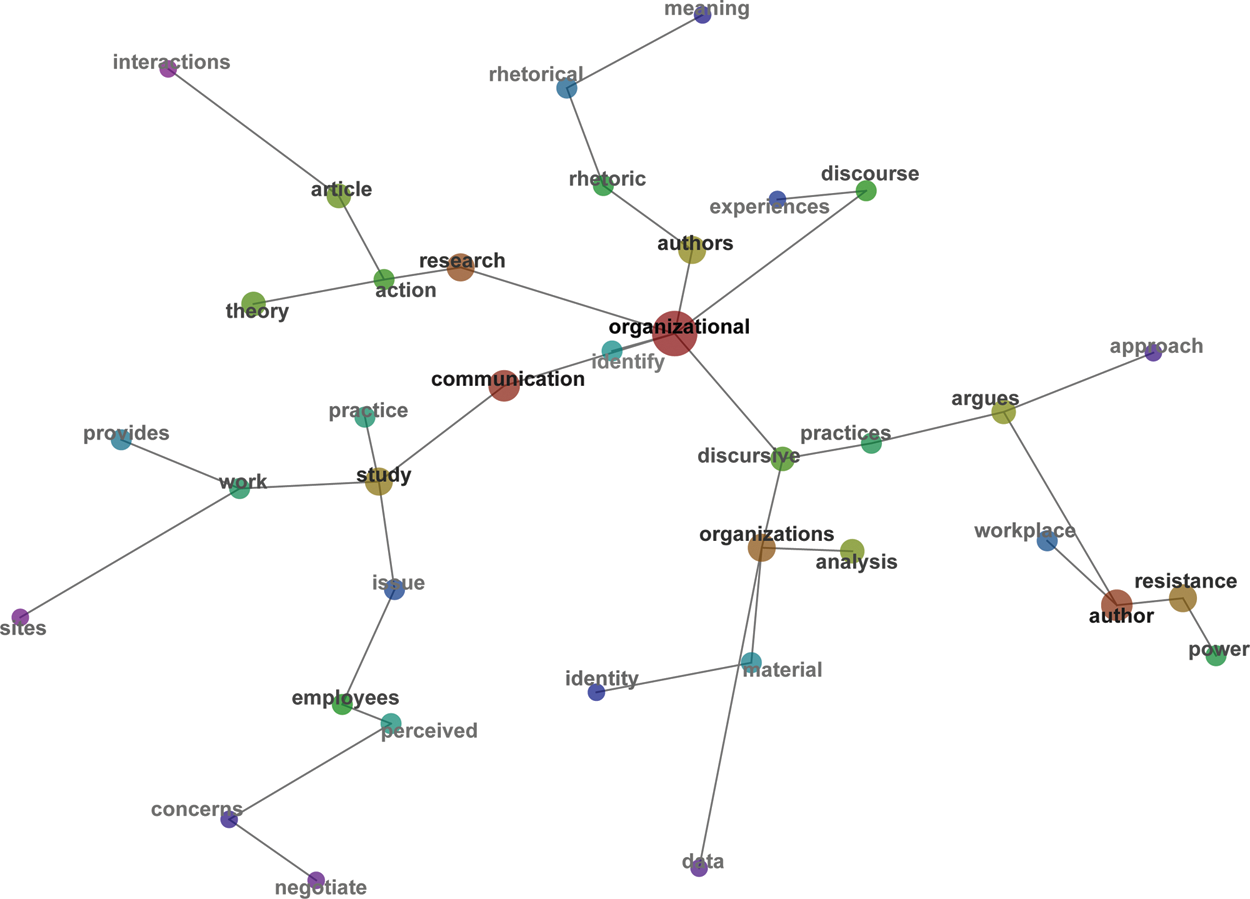
Concept map of the period, 2007 to 2009
In these excerpts, there is the suggestion of emancipator and radical political tones. The concept of (personal, privacy) boundaries is a concept typical of this period: “Although little boundary turbulence appeared, employees articulated boundaries that companies should not cross.” Thus, this final period appears to continue the evolutionary path already detected with no great departure from the ontological and epistemic development in the previous period.
It is significant that the semantic overlap in Figure 1 between this final period and the previous period is the greatest of any two periods and that the density and compactness of the final two periods is greater than other periods. The following abstract excerpt would be equally at home in the previous period:
This collaboratively multiauthored essay presents diverse tales of organizing and communicative practices in our global context. Authors from India, Nepal, Aotearoa New Zealand, Australia, Brazil, the United States, and Nigeria present individual contributions that coalesce around three clear thematic concerns regarding issues of organizing and communicating: (1) silence and voice, (2) the limits and consequences of linguistic and theoretical translations, and (3) the communal considerations of research politics . . .
While an advocacy role for research on behalf of minority groups remains strong with the journal, we could interpret the above as indicating the sort of orthodoxy about which Conrad has expressed concern. However, we still found evidence of a willingness of authors to challenge often taken-for-granted positions. For example, the following abstract resists the easy argument that sexualization of Black women is a process of commodification. The idea of a paradoxical dialectic is put forward:
Drawing on interviews and written narratives from nine Black women, the author argues that organizational discourse sexualizes Black women through commodification, experiences of invisibility, and tensions of ownership and consumption of their bodies, which consequently elicits a paradoxical dialectic of accommodation and resistance: commodification.
The above contrast does indicate that MCQ has maintained its avowed desire to avoid strictly managerialist perspectives and to adopt a more democratic research agenda. Furthermore, the similarities between the core concepts in this final time period and the previous period also indicate that MCQ has consolidated for itself a particular conceptual space oriented on the theorizing of discursive practice in organizations. We are cautious not to overinterpret our data because the 2007-2009 period draws on a smaller sample than for other periods and the maps could change significantly if 2 more years of data were added.
Discussion
Essentially, we have answered the two questions we set out to answer in our 25th Anniversary History of Ideas in MCQ. Yes, MCQ is actually publishing what “we” think it is publishing and, yes, the trends “we” think we see are actually trends in the journal’s history of ideas. Our historical mapping reveals to us an evolution of ideas in MCQ that is consistent with the reflections of the past editors. We can see the origins of clear intellectual concerns, such as Yates, Kelly, and Feingold’s desire that MCQ retain its concern for improving organizational practice and that the journal’s core concern remain as enhancing managerial and organizational effectiveness, but with a more socially aware and democratic orientation. We can see how, both politically from the editor’s reflections and practically from the concepts marking its published ideas, MCQ claimed a role as the primary source for empirical research on organizational communication. We can also see from both the reflections and the data how particular tensions ambient in social science also came to shape MCQ’s publications, and we can see how the journal worked with these tensions to cultivate and consolidate its own identity.
That sense of a demarcated and consolidated identity for MCQ is a significant accomplishment in the journal’s development. In today’s world of impact factor ratings and rankings, a journal needs a clear identity and market presence. Said colloquially, a journal needs a place all its own, and MCQ has developed such a place as a journal for organizational communication scholars to publish (primarily) empirical research that advances theory while still maintaining both an ability to move with changing research trends and an invitational quality for new ideas. Certainly, considerable political, ontological, and epistemic change has occurred in the research published throughout the history of MCQ. For example, we began with the historic characterization of MCQ by the noun communication with management as an adjectival qualifier. Our findings suggest that management and even organization may have become nouns in their own right as domain descriptors for the journal, helping to create that sense of place. Clearly, the communication “fields” of professional and technical writing, as well as spoken and interpersonal communication, have been jettisoned, allowing the journal to shape its identity more toward an organizational studies centre focused on communication and discourse.
With the importance of establishing a sense of place in mind, we now address several important questions arising from the analysis that hold significant implications for the future of the journal and of organizational research.
The first question concerns editorial policy. We have seen and noted in the data a strong consistency between what editors said they were publishing and what actually did get published; the textual analysis capability of Leximancer helps us avoid the bias of looking backward with the desire to confirm what editors think they did. Barker, the current editor, finds this issue quite fascinating. If asked at the start of his editorship, Barker, being new and idealistic, would have agreed that editors could have shaped the direction of a journal. If asked about 2 years into his editorship, Barker, feeling then a prisoner of a regular publishing schedule and the need to have enough articles accepted to meet that schedule, would have felt that the journal’s direction was more at the whim of reviewers than anything else. However, the benefit of 3 more years of experience has now moved Barker back to believing that editorial policy can influence a journal. In particular, Barker believes that editors can articulate strategic trajectories for journals that help to shape submissions. For example, Barker, noting the importance of impact factors and MCQ’s inclusion in the all-important Thompson Reuters Scientific impact factor rating scheme, has tried to ensure that MCQ remains inclusive and has worked to ensure that the journal publishes a mix of quantitative and qualitative articles and still appeals to related fields such as corporate communication.
A second question concerns internationalization of the journal beyond its traditional U.S. base. MCQ is, as Zorn duly noted, an international journal, and Barker, like Zorn was, during his editorial tenure, a U.S.-trained scholar placed outside the United States. Barker has maintained a strong global presence on MCQ’s editorial board and has developed three special issues that featured a number of articles from authors outside the United States. Certainly, Barker clearly sees a strong desire from SAGE Publications for the journal to have a substantial global readership. However, assessing the international effect on MCQ’s history of ideas is beyond the scope of our present data analysis—we did not single out those abstracts from non-U.S. scholars. Yet, in many ways, the issue of internationalization of MCQ is a nonissue. The field of organizational communication, although a predominantly U.S. field, is still an open system. More global scholars are being drawn to MCQ not only because MCQ has a history of being invitational but also because MCQ is now included in the Thompson Reuters journal impact factor system. Global scholars are experiencing pressures to publish in what were once U.S.-dominated journals, and because, in Barker’s words, organizational communication is appealing to any scholar interested in what happens to humans in organizations as a significant part of contemporary human existence.
A connected question is that of interdisciplinarity because the journal was originally intended to represent interdisciplinary groups of scholars interested in communication in organizations. “Being interdisciplinary” has always occurred in editorial commentary and the espoused direction for the journal. However, our analysis indicates that the interdisciplinarity of MCQ is contestable and arguably irrelevant. The invitational era of MCQ concerned itself more within communication scholarship and served to “invite in” a diverse set of scholars who still identified themselves as organizational communication researchers. MCQ has grown in diversity by internationalizing, but is that automatically followed by interdisciplinarity? In their essays, both Miller (2007, p. 442) and Conrad (2007, p. 461) directly acknowledged MCQ’s failure to be more interdisciplinary.
However, perhaps, this apparent failure to become more interdisciplinary is a strength rather than a failure. This is because our data indicate that MCQ has been able to appeal to a broad group of scholars interested in communication in organizations, enabling the journal to consolidate itself as the key empirical and conceptual outlet for many different organizational communication researchers. Our sense is that the more important issue here, much more important than a strict reading of being interdisciplinary, is that our analysis shows that MCQ has created a place for itself and the plurality that its scholars and readers bring with them, a place that has enabled MCQ’s identity as an organizational communication journal to unfold and continue to evolve. The diversity of scholars attracted to the journal should go some way toward gaining a sufficiently broad spectrum of ideas from which will emerge the novelty that sets new directions if they survive the review process. Future research can look carefully at the peer review process from this perspective; in the interim, though, we argue that the future of MCQ and organizational communication depend more on diversity than on interdisciplinarity.
This last point leaves us in a bit of a quandary. When we began this analysis, we expected to end with the traditional and common argument detailing the new research trends and conceptual directions that MCQ should take in the future. However, our analysis problematizes such a standard ending point. Essentially, our analysis shows that MCQ has, as we would expect of a broadly invitational journal, moved and evolved with the changing currents. MCQ’s evolution to publish more mixed-method and critically focused articles is a function of both invitation and environment. Rather than pointing toward specific and emergent research domains and issues, our analysis pushes us back to considering the importance of MCQ’s sense of place.
Thus, the vital issue now is for MCQ, as it moves beyond its 25th year, to continue to be that place where a variety of organizational communication scholars come to publish their best research. We use the term, place, deliberately because place has been linked to identity (Rooney et al., 2010). A sense of place contributes to psychological resources that build identity and self-efficacy. We find it reasonable to consider journals as places for members of intellectual communities to gather to build, maintain, and repair identities. Journal editors, reviewers, and authors could be considered stewards and curators (rather than gatekeepers) of these places. Others are invited in, and they may very well enjoy and learn from coming in, but the place remains a site for organizational communication scholars. Our conclusion is that MCQ must maintain its sense of place. If MCQ can maintain itself as a place for the best organizational communication scholarship and can ensure that its invitational quality remains (that it can continue to attract scholars from closely related domains, such as corporate communication), then the intellectual concerns of the journal will continue to evolve as scholars evolve them.
However, if MCQ has settled into a stable and predictable ontological, epistemological, and politicoeconomic place, is that OK? Does this mean MCQ has lost its distinctiveness? Our analysis indicates that some sense of stability and predictability is OK as it demarcates the journal’s place. The most important feature, as just noted, is to maintain a distinctive and open place. Our concluding point here is that MCQ and its supporters must continue to reimagine and recapture that sense of invitation: to invite others in to join in that “common focus on managerial and organizational effectiveness” with a social conscience. However, MCQ needs to do that while still being that place where organizational communication academic leadership is cultivated, consolidated, and articulated. Maintaining that sense of place is the primary challenge the journal faces as it moves forward from its 25th year.
Footnotes
Acknowledgements
The authors would like to thank Charles Conrad, Patrice Buzzanell, and Vernon Miller for their insightful comments on earlier version of this article.
The author(s) declared no potential conflicts of interest with respect to the research, authorship, and/or publication of this article.
The author(s) received no financial support for the research, authorship, and/or publication of this article.