






Abstract
Many scholars have studied the role of organizational apologies in crisis communication, but they have defined and operationalized apologies inconsistently. This study uses a grounded theory approach to explore what constitutes an effective organizational apology from the perspective of organizational stakeholders. One hundred participants were asked to imagine being the victims of a data breach at an online retailer and to write the kind of apology they would like to receive from the organization. One hundred more participants were asked to write suggestion lists for how the organization could make its apology effective. These data were analyzed using a constant comparative method. Fifteen apology elements were identified and organized along two dimensions: (a) whether the element involved primarily words or behavior and (b) whether the element focused on fixing the problem or rebuilding relationships. Based on the data, these elements must be combined to make an apology effective with stakeholders.
Organizational crises are costly. Target spent more than US$100 million to settle lawsuits after a 2013 data breach compromised millions of credit card accounts (Garcia, 2015). Samsung recalled and eventually discontinued its Galaxy Note 7 smartphone in 2016 because the devices were catching fire (Choe, 2016). Around the same time, Wells Fargo fired 5,300 employees for tampering with customer accounts and paid a US$185 million fine (Foroohar, 2016).
Costs like these are easy to recognize, but crises also carry hidden costs. Crises can damage an organization’s reputation (Coombs, 2007) and threaten its social legitimacy (Allen & Caillouet, 1994). If managed improperly, crises can destroy the relationship between an organization and the stakeholders upon whom it depends for survival.
An organizational crisis is “a major occurrence with a potentially negative outcome affecting an organization as well as its publics, services, products, and/or good name” (Fearn-Banks, 2001, p. 480). Managing such a crisis requires strategic action and effective communication. Crisis communication involves managing information (e.g., analyzing damage reports, coordinating responses, providing safety instructions) as well as managing meaning. Meaning management is the effort “to shape how people perceive the crisis situation” (Coombs, 2010, p. 478). This includes trying to protect the organization’s reputation and social legitimacy through a crisis.
One important line of crisis communication research examines the role of apologies in restoring an organization’s public image (Benoit & Brinson, 1994; Coombs & Holladay, 2008; Hearit, 2006; Lee & Chung, 2012; Pace, Fediuk, & Botero, 2010). Apologies cannot necessarily undo the damage caused by a crisis, but they can help victims find closure (Lazare, 2004) and they can repair an organization’s reputation (Benoit, 2015). Despite the potential power of apologies, many organizations resist apologizing (Hearit, 2006). Perhaps this is because genuine apologies, which traditionally involve admissions of guilt, create legal problems for organizations (Fitzpatrick & Rubin, 1995; Myers, 2016). It may also be due to the fact that apologies are embarrassing (Benoit, 2015). Or, perhaps crisis managers are not sure how to craft an appropriate apology—that is, they do not know what their stakeholders need to hear.
Indeed, other authors have noted that crisis communication research is inconsistent in how it defines and operationalizes apologies (Coombs, Frandsen, Holladay, & Johansen, 2010; Fediuk, Pace, & Botero, 2010). Most of this research uses definitions of apologies derived from rhetorical or ethical theory, but there is disagreement over what elements an apology should contain. There is also very little research on apologies from the stakeholder perspective (Pace et al., 2010). This makes it hard for managers to know how an organization ought to apologize and increases the risk that bad apologies will be offered, further offending stakeholders.
This study explores what constitutes an appropriate and effective organizational apology from the perspective of an organization’s stakeholders. Apologies are social constructs, which means the way they are performed and perceived can change over time. It also means stakeholders play a vital role in determining what is (or is not) an acceptable organizational apology. Stakeholders are the recipients of apologies, and an appropriate apology is one that stakeholders are willing to accept.
Organizations that understand what stakeholders look for in apologies may be able to communicate in ways that promote reconciliation with injured or offended stakeholders and that are more effective at repairing the organization’s public image and reestablishing its social legitimacy. Toward that end, this study analyzes apologies written by stakeholders in a hypothetical crisis scenario as well as suggestion lists generated by stakeholders of what would constitute an acceptable organizational apology. The results indicate that a combination of appropriate words and behaviors is required to put an organization back in its stakeholders’ good graces.
Literature Review
This literature review begins by discussing the concept of social legitimacy and an organization’s dependence on its stakeholders. Next, it considers what apologies are, how they work to restore legitimacy, and what elements they must include. Finally, it poses three research questions addressed in this study.
Social Legitimacy
As corporations have become more powerful in society (Coleman, 1974), they have also come under more public scrutiny. Organizational legitimacy is the public’s belief that an organization has a “right to exist and conduct operations” (Metzler, 2001, p. 322). To be perceived as legitimate, organizations must demonstrate that their values are congruent with the values of society (Dowling & Pfeffer, 1975). Without legitimacy, organizations will struggle to gain support (e.g., from customers, investors, donors) and may not be able to function at all.
Hearit (1995) explained that although corporations must stay financially viable and operate within the law, these criteria are insufficient to establish social legitimacy. Legitimacy also depends upon “how a corporation’s policy affects the larger social system in which it operates” (pp. 2-3). Corporations must serve the interests of all stakeholders, not just stockholders, to achieve social legitimacy. Unfortunately, what is beneficial for some stakeholders is not necessarily beneficial for stockholders, and so corporate actions can create social legitimacy crises.
According to Hearit (1995), when an organization’s actions spark public criticism or anger, this is a sign that stakeholders are questioning the organization’s social legitimacy. Organizations derive their social legitimacy from key publics or stakeholders, which makes “the organization dependent on them in this respect” (Metzler, 2001, p. 322). Organizations cannot afford to ignore the needs and values of these stakeholders.
Stakeholder Theory
Freeman (1984) popularized the concept of organizational stakeholders in the management literature. As he explained, owners, customers, suppliers, government agencies, competitors, special interest groups, the media, and other people all play “a vital role in the success of the business enterprise” and have “a stake in the modern corporation” (p. 25). Stakeholders are “the groups that can affect or be affected by the achievement of a business’s core purpose” (Freeman, Harrison, & Wicks, 2007, p. 48). Therefore, successful businesses are those that manage relationships with each of these stakeholder groups, not just stockholders.
Donaldson and Preston (1995) argued that stakeholder theory is descriptive, instrumental, and normative. Not only is it empirically true that most businesses consider the interests of different groups of people, it is also extremely useful to do so. For example, satisfying customers tends to increase sales, which increases profits for stockholders. More importantly, however, an ethical approach to business requires that managers consider how their actions will affect people inside and outside the organization. When companies sell unsafe products, pollute the environment, or mistreat workers, other stakeholders may question their legitimacy.
Ferrell (2004) noted that customers are one of the most important stakeholder groups to any business. They “provide financial resources, loyalty, and enhanced reputation that can help create positive firm images” (p. 128). Businesses need to realize that customers “evaluate the ethical practices of companies” (p. 127) and may disassociate themselves from companies they perceive to be irresponsible.
Although the best way to avoid problems is for an organization to act ethically and maintain good relationships with all stakeholders, this is not always possible. Therefore, when stakeholder interests or expectations are violated, an organization must reevaluate its actions and communicate clearly with those affected to protect its reputation and resolve any questions of legitimacy. One way to do this is through apologizing.
What Is an Apology?
Apologies have been described as public rituals (Hearit, 2006) and speech acts (Tavuchis, 1991). Their purpose is to help offenders reconcile with those who have been offended by repudiating offenders’ misdeeds and reaffirming their support for social norms. Goffman (1971) described an apology as “a gesture through which an individual splits himself into two parts, the part that is guilty of an offense and the part that dissociates itself from the delict and affirms a belief in the offended rule” (p. 113). As Hearit (2006) wrote, “the apologist admits guilt, often couples it with a statement of regret, and asks for forgiveness” (p. 31).
It is, perhaps, remarkable how often apologies succeed. After all, “an apology, no matter how sincere or effective, does not and cannot undo what has been done” (Tavuchis, 1991, p. 5). Still, research suggests that public apologies by people like President Bill Clinton, Senator David Vitter, Olympic swimmer Michael Phelps, and actor Hugh Grant have enabled them to move beyond their misdeeds (Benoit, 2015). The key to a successful apology lies in the way recipients perceive the apology. When offenders appear to understand what they have done wrong and genuinely regret it, the public is usually willing to let the matter drop. However, apologies that seem insincere or self-serving tend to be ineffective (Benoit, 2015) and do not bring closure to the situation (Hearit, 2006).
It makes sense that when organizations violate social norms, they should apologize to their stakeholders. However, organizational apologies can be more complicated than individual apologies because guilt is often difficult to assign (Hearit, 2006). Unlike individuals, organizations may not have one person who is clearly to blame. There may be systemic problems or patterns of poor behavior that turn into a crisis. There may be members of the organization who did not cause the problem but who must bear responsibility for it. And, of course, there may be managers who are so focused on the interests of stockholders that they do not fully appreciate the damage done to other stakeholder relationships.
As mentioned previously, organizational apologies are also complicated by liability concerns. Fitzpatrick and Rubin (1995) observed that most organizations respond to crises with legal strategies (e.g., say as little as possible, deny guilt, shift blame) rather than public relations strategies (e.g., be open with the media, investigate and address allegations of wrongdoing). Tyler (1997) argued that too much openness can lead to lawsuits that may cripple a company, and she suggested that in some crises, it is wiser to use equivocation and strategic ambiguity when communicating with stakeholders. Myers (2016) reiterated the fact that admissions of guilt are usually admissible in U.S. courts as evidence of wrongdoing.
Despite these difficulties, there is evidence that organizational apologies can be effective at repairing a company’s image and rebuilding stakeholder relationships. Scholars have found that companies like AT&T (Benoit & Brinson, 1994), Amazon (Coombs & Holladay, 2012), and Toyota (Choi & Chung, 2013) generated positive public responses when they took responsibility for problems they had caused. By contrast, when companies try to avoid responsibility for crises they have caused, those crises often take longer to resolve (Hearit, 2006). To understand why, we must consider how apologies work.
How Do Apologies Work?
Understanding how apologies work is important to understanding how apologies ought to be constructed. In the diverse literature on apologies, there are at least three different ways in which apologies are thought to function. First, apologies promote healing by meeting psychological needs within victims. Second, apologies influence the attributions other people make about the offender’s character. Third, apologies invite victims to empathize with the offender and move toward forgiveness.
Meeting psychological needs
As a trained psychiatrist, Lazare (2004) emphasized the clinical and psychological benefits of apologies. He identified seven needs victims have that can be addressed through apologies:
Restoration of self-respect and dignity, assurance that both parties have shared values, assurance that the offenses were not their fault, assurance of safety in their relationships, seeing the offender suffer, reparation for the harm caused by the offense, [and] having meaningful dialogues with the offenders. (p. 44)
Apologies can be therapeutic for victims. In fact, victims of medical malpractice who receive apologies tend to feel less anger toward their healthcare provider, more trust, and less need to file lawsuits (Robbennolt, 2009).
Changing attribution
Attribution theory (Weiner, 1985, 2006) holds that people make assumptions about why other people do things and form judgments based on those assumptions. The cause of an action may appear internal or external to the actor, it may be perceived as stable (i.e., permanent) or unstable, and it may seem to be under the actor’s control or not. In a series of experimental studies, Weiner, Graham, Peter, and Zmuidinas (1991) found that apologies changed the way people perceived the moral character of an offender. Offenders who admitted their guilt were generally evaluated more positively than those who tried to deny it.
Weiner (2006) explained that apologies “break the link between the act and the attribution to enduring characteristics of the person” (p. 120). According to this theory, apologies work by changing perceptions of the stability dimension of responsibility. The offender is no longer a permanently bad person, but a person who did a bad thing at a particular moment in time.
Producing empathy
The psychologist McCullough and his colleagues have focused on the role of empathy in producing forgiveness (McCullough, Root, Tabak, & Witvliet, 2009; McCullough, Worthington, & Rachal, 1997). They define forgiveness as choosing not to seek revenge or avoid someone who has committed an offense. Empathy involves taking another person’s perspective and feeling sympathy or concern for that person. Victims who can take the perspective of their offenders are more likely to forgive, less likely to seek revenge, and less likely to avoid their offenders. An apology can help a victim understand the regret an offender feels for committing an offense. McCullough et al. (1997) demonstrated that feelings of empathy mediate the relationship between apologies and forgiveness in interpersonal relationships.
These theories of how apologies operate were developed primarily to explain interpersonal apologies. As Hallahan (2000) warned, “theorists confound reality when they suggest that communications involving a large unnatural organization operates in the same way as communication among natural persons” (p. 509). For instance, people may not feel empathy for an organization like they do for another person, and organizations may not appreciate the psychological needs of injured or offended stakeholders. Nevertheless, when individuals have been negatively affected by crisis, it is reasonable to imagine that they have the same psychological needs and tendencies as individuals harmed by other individuals. Thus, it makes sense that stakeholders would want organizational apologies to do things like affirm stakeholders’ dignity and values, take responsibility for harms done, explain the causes of a crisis, and help stakeholders see the situation from the organization’s perspective. Certainly, if the organization can communicate these things, stakeholders are more likely to view the organization as legitimate.
Elements of an Apology
Apologies have been studied across various academic disciplines, leading to multiple typologies of apology elements. Much of the crisis communication literature comes out of the field of public relations, and these scholars tend to have a fairly narrow definition of apologies. As cited earlier, Hearit (2006) argued that an admission of guilt, a statement of regret, and a request for forgiveness were the core of an apology (although he noted that most organizations do not follow this formula).
In the first edition of Ongoing Crisis Communication, Coombs (1999) described an apology as taking full responsibility for a crisis and seeking forgiveness, along with the possibility of offering some compensation to victims. By the fourth edition, Coombs (2015) argued that full apologies “must acknowledge the crisis, accept responsibility, include a promise not to repeat the crisis, and express concern and regret” (p. 148). When companies issue statements of sympathy or regret without accepting responsibility, these are non-apologies, although stakeholders “often accept these non-apologies as true apologies” (p. 148).
Benoit (1995) originally used Kenneth Burke’s concept of mortification to describe apologies as admitting responsibility and asking for forgiveness. However, in the second edition of his book, he acknowledged, “No universally agreed conception of ‘apology’ stipulates exactly what an apology must include” (Benoit, 2015, p. 26).
Outside of the public relations literature are other conceptualizations of apologies. The sociologist Tavuchis (1991) felt that apologies must contain an acknowledgment of one’s offense and an expression of regret. He also suggested that apologies normally include a pledge to “abide by the rules” in the future (p. 8). Davis (2002), a philosopher, also called for these three elements, arguing that a “Consummate Apology” has “doxastic, affective, and dispositional elements” (p. 170). The doxastic (i.e., belief) element is the acknowledgment of the offense, the affective element is the feeling of self-reproach, and the dispositional element is the intention not to repeat the offense. Lazare (2004) agreed that apologies require acknowledgment of the offense and an expression of remorse, but he identified two additional elements: offering an explanation and making reparations.
Speech act researchers Blum-Kulka and Olshtain (1984) proposed five necessary elements in apologies: (a) an expression of remorse such as “I’m sorry,” “I apologize,” or “Pardon me” to identify the act as an apology; (b) an explanation of why the offense occurred; (c) an acknowledgment of responsibility; (d) an offer of repair; and (e) a promise of forbearance (i.e., an assurance that the offense will not happen again). Psychologists Scher and Darley (1997) agreed with four of Blum-Kulka and Olshtain’s elements, but argued that explanations are a way of making excuses instead of apologizing. Scher and Darley conducted an experiment using a hypothetical interpersonal offense and found that (a) the expression of remorse, (b) the acknowledgment of responsibility, (c) the promise of forbearance, and (d) the offer of repair each contributed significantly to the perceived appropriateness of the apology. More recently, Bisel and Messersmith (2012) demonstrated that the combination of these four elements was just as effective in organizational apologies as it was in interpersonal apologies. However, they did not test each element separately, nor did they consider any additional elements.
Empirical Research on Apologies
Several studies have tested stakeholder reactions to apologies and found divergent results. An experiment conducted by Benoit and Drew (1997) found that people viewed apologizing as the most appropriate and effective strategy for addressing an interpersonal offense. Sheldon and Sallot (2009) reported that apologies were more effective than bolstering (i.e., highlighting one’s good points) or corrective action (i.e., repairing damage) in restoring a politician’s reputation after a faux pas. By contrast, Coombs and Schmidt (2000) found no significant differences between apologies, corrective action, bolstering, or shifting blame when they tested college students’ reactions to an organization’s crisis communication. Lyon and Cameron (2004) found apologizing to be more effective than denial at producing positive attitudes toward an organization. Turk, Jin, Stewart, Kim, and Hipple (2012) also reported that apologies produced more positive attitudes toward an organization than denial, although not in every situation.
Coombs and Holladay (2008) argued that very few real life situations give organizations a choice between apology and denial. Denial is only feasible when stakeholders do not place much blame on the organization, and apologies are only necessary when stakeholders do blame the organization. Therefore, Coombs and Holladay tested apologies against the more similar strategies of expressing sympathy and offering compensation. They found no significant differences between the sympathy, compensation, and apology conditions in participants’ attitudes or intentions toward the organization. However, the apology in this study was operationalized with only an acknowledgment of responsibility and a request for forgiveness. Given the many different perspectives on what constitutes an apology, participants in the study may have considered the sympathy condition (which included an expression of remorse and an attempt to identify with stakeholders) or the compensation condition (which contained both compensation and an offer of reparations) to be just as apologetic as the apology condition.
Pace et al. (2010) reported that both an acceptance of responsibility and an expression of remorse improved stakeholders’ reactions to an organizational apology. A similar experiment by Lee and Chung (2012) found that active responsibility taking was more effective than passive responsibility taking. Stronger expressions of sympathy, however, were no more effective than weaker expressions of sympathy.
Experiments like these are important because they measure stakeholder reactions to apologies. However, because experimental research requires variables to be operationalized consistently, these experiments must limit the concept of an apology to the scholars’ predetermined definitions. Thus, participants are never allowed to define apologies for themselves. If participants in these studies happen to define apologies differently from the researchers, the experiments may have validity problems. Therefore, the next step in this line of research is to take more of a grounded theory approach to explore the way stakeholders themselves would construct apologies.
Research Questions
Because apologies are social constructs, apologies may look different to people in different roles or situations. The concept of social legitimacy implies that stakeholders want organizations to hold the same basic values they hold. It seems likely that stakeholders will look for indications in an organizational apology that the organization adheres to these common values.
From an organization’s perspective, an effective apology is one that allows the organization to move on from a crisis and regain the support of key stakeholders. However, legal and financial concerns may limit what an organization is willing to say in its apology. Furthermore, if organizations do not recognize the value of all stakeholders, they may overlook certain stakeholder concerns when apologizing.
For their part, scholars seem to focus on apologies as acknowledgments of responsibility and, thus, liability problems. Beyond that, there is no consensus. Elements like the promise of forbearance or offer of repair are considered part of an apology by scholars in some disciplines (Bisel & Messersmith, 2012; Scher & Darley, 1997), but not usually in crisis communication (Benoit, 2015; Coombs & Holladay, 2008). Furthermore, some researchers have raised the possibility that elements like offering an explanation or identifying with victims ought to be included in an apology (Blum-Kulka & Olshtain, 1984; Lazare, 2004). Perhaps there are even more elements that scholars have yet to consider.
The key for an organization in crisis is not to satisfy some idealized, scholarly definition of an apology. When an organization’s reputation or social legitimacy is threatened and its relationship with key stakeholders is in jeopardy, the priority must be to communicate in ways that satisfy stakeholders’ needs. For example, Hearit (2006) suggested that when organizations pay compensation without admitting guilt, stakeholders may interpret the payment as a form of apologizing. Nevertheless, the existing literature has not adequately explored the possibility that stakeholders’ have their own ways of construing organizational apologies. Therefore, this study examined the following research questions:
Organizations in crisis often try to avoid apologizing to stakeholders, in part because apologies are perceived as costly (Coombs, 2015). However, not all apology elements create liability problems or significant costs. Thus, the third research question addressed here is as follows:
Method
The goal of this study was to understand what constitutes an effective organizational apology in the minds of an organization’s stakeholders and to explore the various elements that stakeholders expect to see in an apology. Two types of qualitative data were collected: (a) hypothetical apologies written by organizational stakeholders and (b) suggestions for making effective apologies. This section describes the procedures used in participant recruitment, data collection, and data analysis.
Participant Recruitment
Participants for this study were recruited online using Amazon.com’s Mechanical Turk (MTurk) website (www.mturk.com). MTurk is a crowdsourcing site that allows users to post human intelligence tasks (HITs) and offer micropayments to other users who volunteer to complete the tasks (Mason & Suri, 2012). Although MTurk does not provide a random sample, it does provide a more diverse sample than traditional online samples or student samples. It is considered a reliable recruitment tool in social scientific research (Buhrmester, Kwang, & Gosling, 2011).
Two HITs were posted to MTurk, each one offering U.S. volunteers US$1.51 to complete a short writing assignment. This amount was selected because it was higher than the average rate on MTurk and so that it would appear before HITs paying US$1.50 or less if users searched for HITs by price. Users who chose to participate in one of the HITs were given a link to a SurveyMonkey.com page where they read an informed consent form and completed their writing assignment. Once participants finished writing, they received a code to enter in MTurk for payment. One hundred participants were recruited for each HIT.
HIT 1 respondent profile
More males (55%, n = 55) than females (45%, n = 45) completed the first HIT. Most participants were White (75%, n = 75) and were between 18 and 39 years (76%, n = 76). The sample was generally middle class. Thirty-eight (38%) participants reported an annual household income between US$30,000 and US$60,000. Another 38 (38%) earned more than US$60,000 per year, and 29 (29%) earned less than US$30,000 per year. More than half of the participants (64%, n = 64) had at least some college education. Nearly half of the participants (44%, n = 44) were employed full-time, and 25% (n = 25) were employed part-time. Just 9% (n = 9) were students, and 11% (n = 11) were currently seeking employment. There were also seven (7%) participants who were unemployed but not looking for work.
HIT 2 respondent profile
Like the first HIT, there were more males (53%, n = 53) than females (47%, n = 47) in the second HIT. Seventy-three participants (73%) were White, and most were below 40 years (68%, n = 68). A majority of the sample had at least some college (76%, n = 76), and 75% (n = 75) reported household incomes of US$30,000 per year or more. Participants were mostly employed, either full-time (41%, n = 41) or part-time (29%, n = 29). Eleven (11%) participants were students, and eight (8%) were unemployed but looking for work.
Data Collection
After consenting to be in the study, participants were presented with the following instructions:
Please think of a company with whom you have done business online. This company may be an online-only retailer (e.g., Newegg.com) or a company that does business online AND through brick and mortar stores (e.g., Wal-Mart). The only requirement is that you have made an online purchase from this company at some point in the past. Once you have thought of the company, please imagine that you received the following e-mail from this company: Dear friend, Our computer administrators recently discovered that hackers have illegally accessed a database containing the personal account information of our customers. Your account is one that may be affected.
Participants in HIT 1 read instructions to write an apology:
Your task is to write the rest of this e-mail. Please write an effective apology from the company—the kind of apology that you would be willing to accept if this situation really happened to you. Please make the apology long enough to be realistic. Simply typing one or two words will not be accepted. Just make sure you write an apology that would satisfy you as a customer, considering that your personal information had apparently been stolen.
Participants in HIT 2 read instructions to write a list of suggestions for the company:
Now imagine that the rest of the email contains an apology from the company for what happened. Your task is to create a list of tips or suggestions for how the company can make its apology effective. An effective apology is one that you, as a customer, would be willing to accept. Please write at least five tips below. You are free to write more than five if you wish.
This hypothetical scenario was chosen for several reasons. First, this scenario has external validity. Data breaches and online identity theft are growing problems that have affected private companies like Sony and Target, as well as government agencies (Steinhauer, 2015). Banks, health insurers, universities, and retail stores have all issued public apologies over data breaches in recent years. Second, this scenario was assumed to be relevant to MTurk users because these were people who completed transactions online. In a hypothetical scenario, especially one that asks participants to imagine themselves as victims of a crisis, it is important to create a situation with which people can identify. Third, this scenario leaves room for a wide range of stakeholder interpretations. Data breaches are somewhat ambiguous crises. In one sense, the organization is a victim of the hackers. In another sense, the organization has failed in its responsibility to safeguard customer information. One goal of this study was to identify as many different apology elements as possible, and allowing different participants to assign different levels of responsibility to the organization was considered advantageous.
After reading the scenario, participants in HIT 1 wrote apology messages from the company that they would accept if the situation actually happened to them. Participants in HIT 2 wrote tips to help the company make an apology that they, the customer, would accept. HIT 2 was included for triangulation and out of concern that people might struggle to write actual apologies, but find it easier to create suggestion lists.
Data Analysis
One hundred written apologies were collected, ranging in length from 27 to 336 words (M = 108). One hundred suggestion lists were also collected. These ranged from 17 to 450 words (M = 105). Both the apologies and the suggestion lists were analyzed according to a grounded theory approach (Strauss & Corbin, 1990). This approach, often called the “constant comparative method” (p. 62), involves three main steps: open coding, axial coding, and selective coding.
During open coding, the data were analyzed line-by-line, using induction to generate a list of all the different types of apology elements. In the axial coding step, the different types of apology elements were analyzed for common themes so that they could be combined into categories. Finally, in the selective coding step, two core categories were identified to show how all the other categories related to each other. Once the data were coded, the categories were compared with existing literature on apologies, and the literature provided a guide for naming the categories.
Findings
To explore what elements stakeholders want to see in an effective organizational apology, this study analyzed 100 stakeholder-generated organizational apologies and 100 stakeholder-generated suggestion lists. Initially, open coding of the data suggested 15 types of apology elements. The axial coding process reduced these to nine categories. Finally, through selective coding, two dimensions of organizational apologies were identified. The first dimension was words versus behaviors. Of course, all responses were in the form of words, but some words stood on their own (e.g., sharing information, expressing emotions) and some words described or promised behaviors (e.g., taking steps to fix the problem, offering compensation). Similarly, some of the stakeholder suggestions could be carried out with words alone, but others required a company to engage in additional behaviors.
The second dimension was fixing the problem versus rebuilding the relationship. Some apology elements were aimed at preventing, minimizing, or repairing damage caused by the crisis. Other apology elements and suggestions did not fix the immediate problem, but sought to show concern for stakeholders and reestablish trust. Thus, apology elements can be classified as either (1a) words to fix the problem, (1b) behaviors to fix the problem, (2a) words to rebuild the relationship, or (2b) behaviors to rebuild the relationship (see Figure 1).
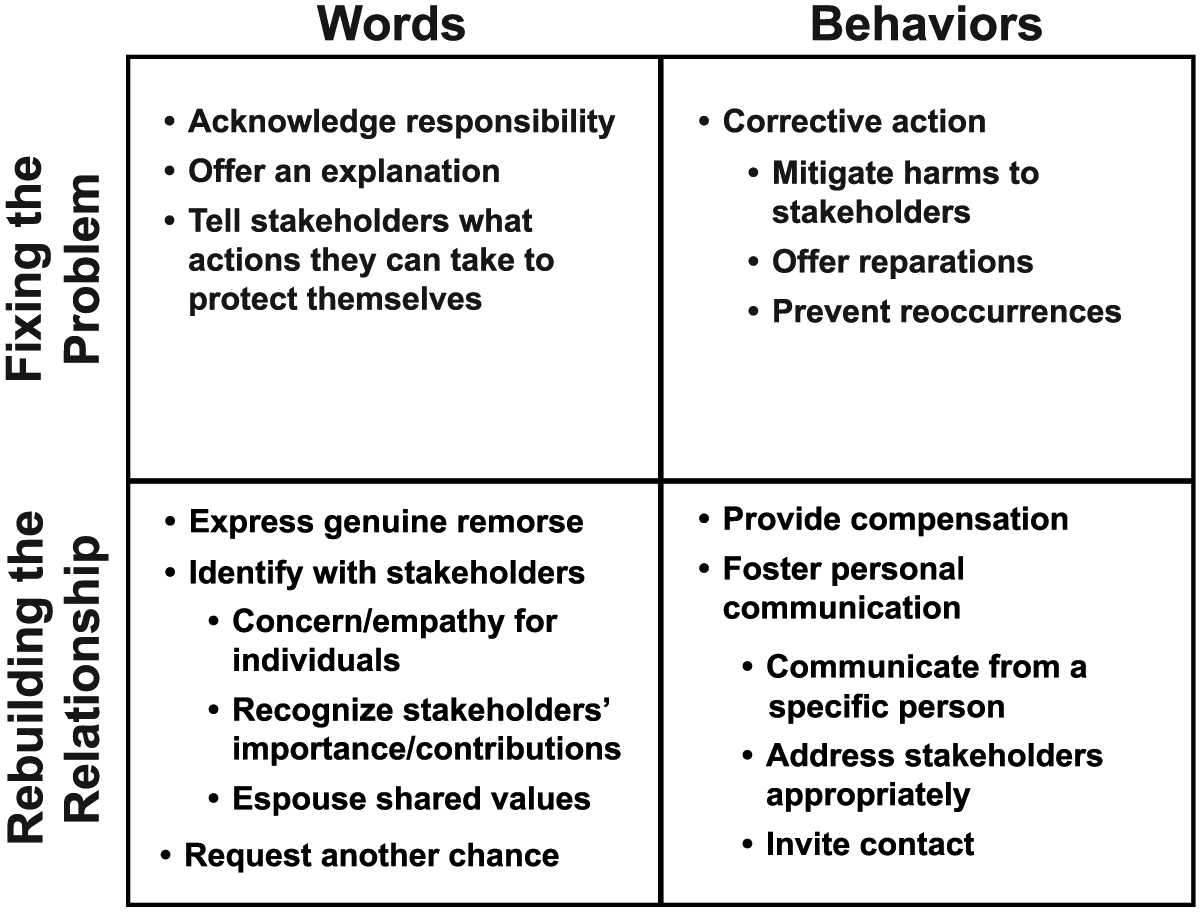
Types of apology elements generated by stakeholders.
Words to Fix the Problem
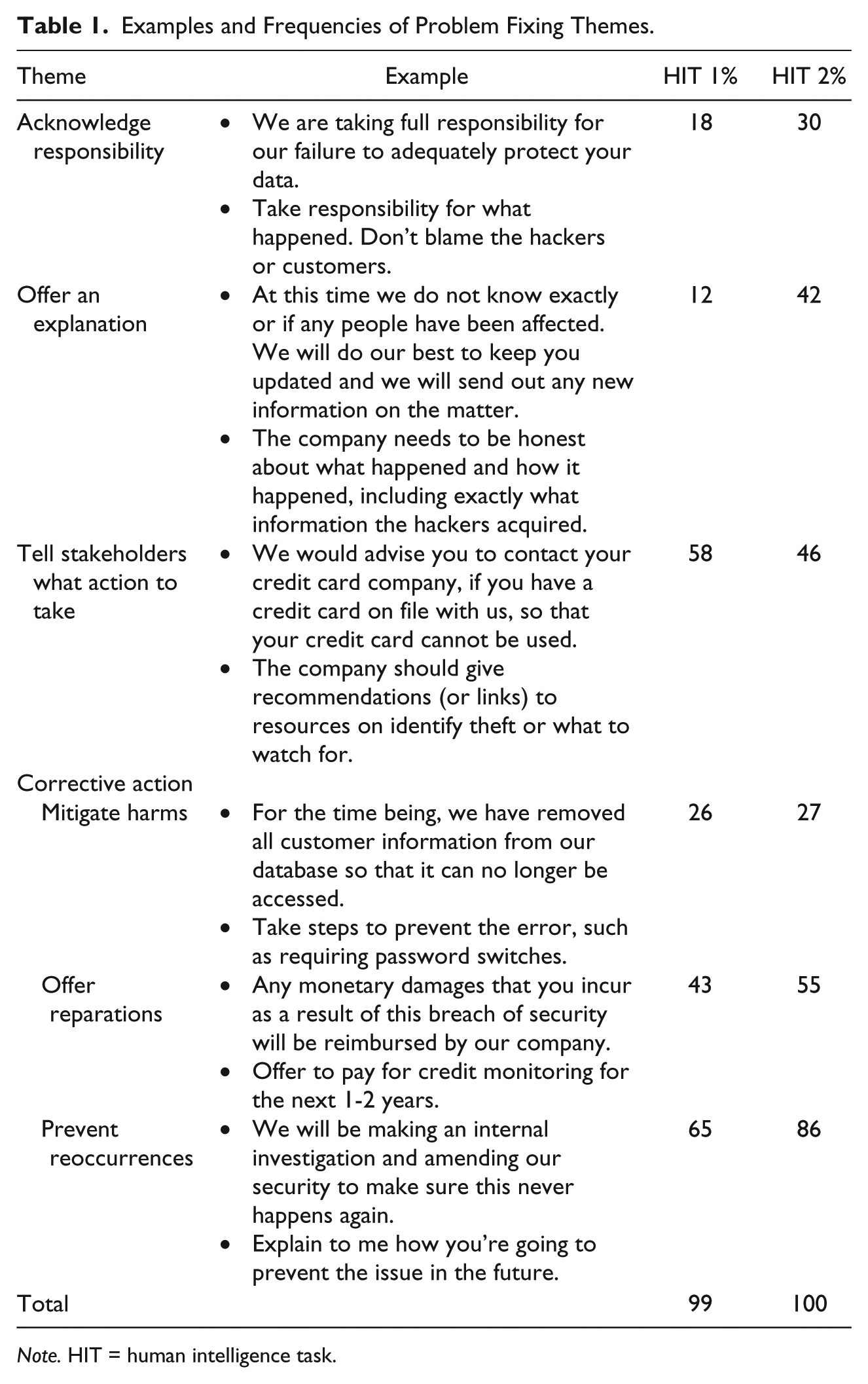
When an organization apologizes for a crisis, stakeholders expect the organization to fix the problem. This process involves words and behaviors. Most of the written apologies (77%) and suggestion lists (72%) included at least one example of words being used to fix the problem. The data revealed that organizations could use words to fix problems by acknowledging responsibility, offering an explanation, and telling stakeholders what actions to take.
Acknowledging responsibility
Some participants indicated a desire for companies to acknowledge responsibility directly. Participants often contrasted the acknowledgment of responsibility with excuse making. For instance, one apology written for HIT 1 contained this statement: “Although this can happen to any business, and even government, we are not taking that attitude.” One HIT 2 participant wrote, “Right or wrong, I would need to hear first and foremost a no excuses sincere ‘we made a mistake’ apology.” Interestingly, only 18% of HIT 1 participants and 30% of HIT 2 participants included this element in what they wrote.
Explanations
Just 12% of the participants from HIT 1 expressed a desire for the organizations to explain how the crisis occurred. However, 42% of the lists from HIT 2 recommended explanations. Explanations appeared to reinforce acknowledgments of responsibility, lend credibility to a promise of forbearance, and help stakeholders understand how a crisis affected them. One participant from HIT 2 wrote, “Explain how hackers got into the system in plain English. Make it clear whether the system was particularly weak or the hackers were very stealthy.” Another suggested, “Explain briefly how the breach happened and what steps you are taking to ensure this doesn’t happen in the future.” Only if an organization understands how a problem occurred can it credibly promise to prevent a reoccurrence.
Telling stakeholders what actions to take
Telling stakeholders what they can do to protect themselves is another way of using words to fix the problem. This element appeared in 58% of HIT 1 responses and 46% of HIT 2 responses. In the case of a data breach, stakeholders want information about how to reduce their risk of identity theft. One apology urged customers, “For your own protection we advise you to contact the issuers of any credit cards you have used in transactions with us and inform them of this event.” Another stated, “We strongly encourage you to change your current username and password as well as security questions.”
Behaviors to Fix the Problem
Part of the job of an organizational apology is to communicate what behaviors the organization is engaged in to fix the problem. These behaviors are described in promises of forbearance, offers of repair, and efforts to mitigate harm.
Promises of forbearance
Consistently, stakeholders wrote about preventing a reoccurrence of the problem. In fact, 65% of the apologies and 86% of the suggestion lists contained promises of forbearance. One suggestion read, “Explain to me how you’re going to prevent the issue in the future. Just saying sorry isn’t enough. I want to know what is being done to ensure it doesn’t happen again.”
Offers of repair
Approximately half of participants in HIT 1 (43%) and HIT 2 (55%) also mentioned offers of repair. An apology from HIT 1 stated, “We will make sure to compensate you for any time and money you have spent fixing this problem.”
Mitigating harm
Another type of corrective action is the mitigation of harm. This element was evident in 26% of the responses to HIT 1 and 27% of the responses to HIT 2. For example, one apology said, “We have removed all customer information from our database so that it can no longer be accessed.” Several suggestions from HIT 2 involved working with law enforcement to catch the hackers. These behaviors do not constitute reparations, nor do they ensure the problem will never reoccur. However, they do help to reduce the damage caused in the immediate future, and apparently, they contribute to the effectiveness of an apology.
Overall, 94% of apologies and 98% of suggestion lists made some reference to a behavior aimed at fixing the problem.
Words to Rebuild the Relationship
Just because an organization fixes a problem does not mean it automatically regains legitimacy in the eyes of its stakeholders. Stakeholders in HIT 1 and HIT 2 identified three ways organizational apologies can use words to rebuild stakeholder relationships. Apologies can express genuine remorse, identify with stakeholders, and ask victims for a second chance.
Express genuine remorse
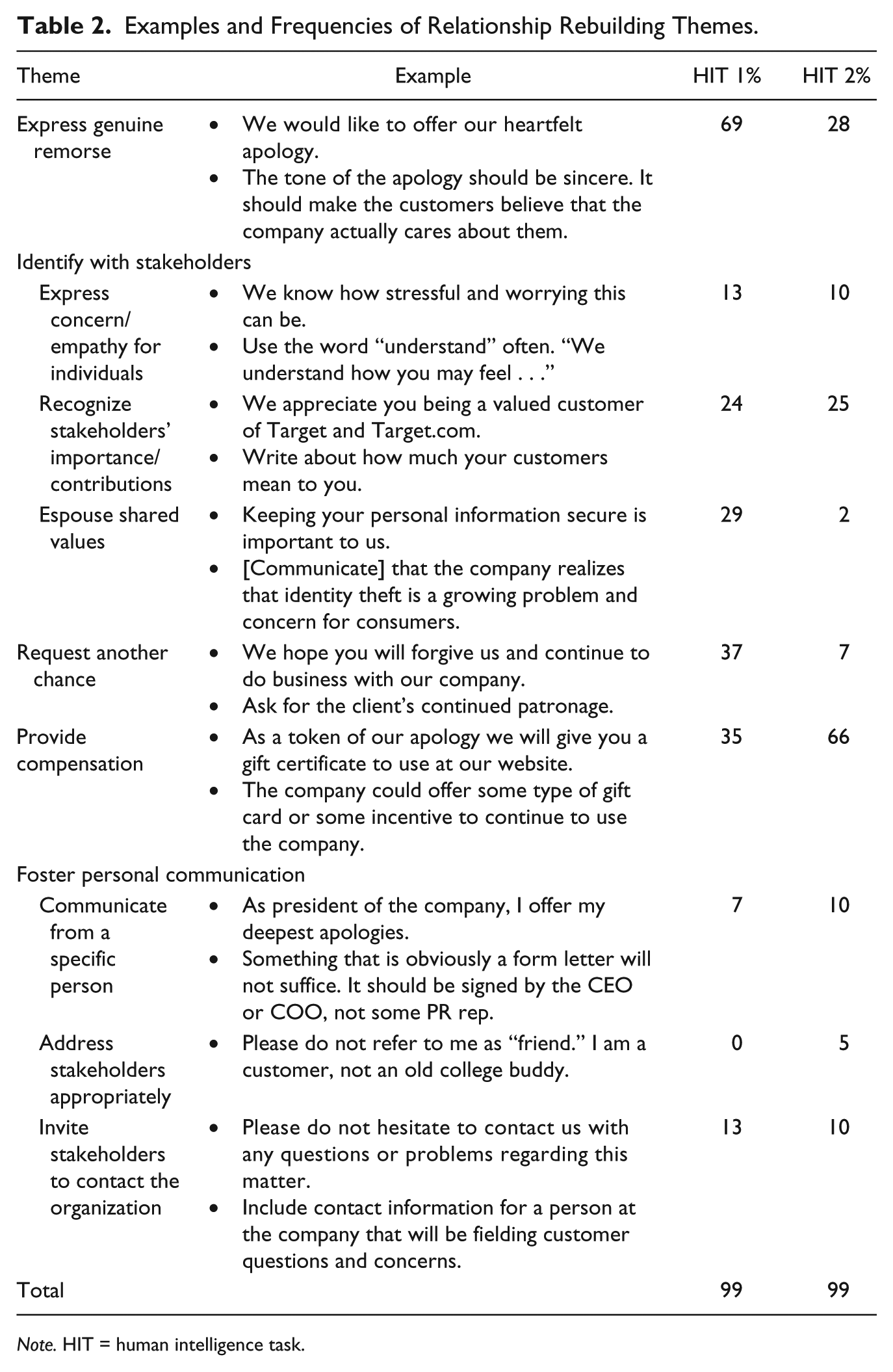
Almost all apologies written for HIT 1 contained either the word “apologize” or the word “sorry.” According to speech act theory (Scher & Darley, 1997; Searle, 1969), these words serve as illocutionary force indicating devices that tell the audience when a statement is intended to be an apology. Therefore, the fact that most study participants used these words is not surprising. More interesting is the number of participants (69% in HIT 1) who used adverbs such as “sincerely,” “deeply,” or “truly” to modify “apologize” or “sorry.” Many stakeholders apparently want an apology to reflect genuine emotion. This sincerity was also seen in 28% of the HIT 2 suggestion lists. One HIT 2 participant wrote, “The tone of the apology should be sincere. It should make the customers believe that the company actually cares about them.”
Identification with stakeholders
Identification occurs when the goals, values, or interests of two parties align (Burke, 1969). As Cheney (1983) explained, organizations often use communication to make members feel that the organization shares their interests. Common techniques for fostering identification between organizations and members include “Expression of concern for the individual” (p. 150), “Recognition of individual contributions” (p. 150), and “Espousal of shared values” (p. 151). The present data set suggests that similar techniques may be appropriate in organizational apologies. For example, concern for individuals was expressed in empathetic statements like, “We know how stressful and worrying this can be.” Concern/empathy appeared in 13% of HIT 1 and 10% of HIT 2 responses.
The contribution of individual customers was recognized in statements such as “Know that your patronage is important to us . . . ” and “We know that our customers are the only reason we are able to stay in business.” For customers who are loyal to a company, it may be gratifying to know that a company recognizes their contribution to its success. This element was found in 24% of HIT 1 responses and 25% of HIT 2 responses.
Espousal of shared values was evident in statements like “We here at Newegg pride ourselves on the security of our customers, and know that this kind of violation is completely intolerable.” Another example stated, “We at Amazon pride ourselves in protecting the personal data of our customers. We understand how important that is to you regarding your online activities . . . ” Although 29% of HIT 1 participants made some reference to shared values, only 2% of HIT 2 participants included this in their suggestion list.
Requesting another chance
The final means of rebuilding relationships with words is requesting a second chance. Requesting another chance seems to function as the organizational equivalent of an individual seeking forgiveness. This element was found in 37% of HIT 1 apologies and 7% of HIT 2 suggestion lists. One apology read, “We hope you will forgive us and continue to do business with our company.” Another apology stated, “We deeply apologize and hope that you will give us a second chance in the near future.” A participant in HIT 2 wrote that the organization should “ask for the client’s continued patronage.” Every written apology used words in some way to rebuild the relationship, as did 67% of the suggestion lists.
Behaviors to Rebuild Relationships
Organizations can also use apologies to describe certain behaviors that may help rebuild relationships with stakeholders. The data from HIT 1 and HIT 2 indicate that, as part of an apology, organizations should consider providing compensation and fostering personal communication with stakeholders. A majority of written apologies (88%) and suggestions lists (75%) contained at least one item from this category.
Providing compensation
Providing compensation to crisis victims is not the same as an offer of repair. As Benoit (1995) explained, an offer of repair, or corrective action, “addresses the actual source of injury” while compensation is “a gift designed to counterbalance, rather than to correct, the injury” (p. 79). Indeed, participants in HIT 1 and HIT 2 clearly distinguished between the two concepts. Many apologies and suggestion lists included both corrective action and compensation.
Compensation was offered in 35% of HIT 1 responses and was suggested in 66% of HIT 2 responses. Compensation seems to symbolize how much the organization values its stakeholders and how apologetic it is. The following example from an apology illustrates this point:
We also want to make you feel good about using our store again. To that degree, we have attached to this e-mail a coupon code personally tied to your user account that will grant you a 25% off discount on any one item. It’s our way of saying how sorry we are for losing your data, and hopefully helping to make things up to you.
For some people at least, compensation is symbolic of an apology. One HIT 1 participant wrote, “Please accept this $100 Gift Card as our apology.” Another wrote, “As our apology to you, we will be sending out a $25 gift card as our way for saying sorry, and hope that you will accept it as a showing of our goodwill.” Between both HITs, 27 participants mentioned specific dollar amounts, which ranged from US$5 to US$1,000. The most common amount was US$50 (n = 9) followed by US$25 (n = 5).
Fostering personal communication
Along with compensating victims, other behaviors can help rebuild relationships between organizations and stakeholders. These behaviors are related to fostering personal communication. Data suggest that some stakeholders want apologies to come from specific people (HIT 1 = 7%; HIT 2 = 10%), address stakeholders by name (HIT 1 = 0%; HIT 2 = 5%), and invite stakeholders to contact the organization (HIT 1 = 13%; HIT 2 = 10%).
Examples and frequencies for each category discussed above are provided in Tables 1 and 2.
Examples and Frequencies of Problem Fixing Themes.
Note. HIT = human intelligence task.
Examples and Frequencies of Relationship Rebuilding Themes.
Note. HIT = human intelligence task.
Research Question 1
Research Question 1 asked what elements of an organizational apology are important in reestablishing social legitimacy with stakeholders. Stakeholders consistently wanted sincere expressions of remorse (HIT 1 = 69%; HIT 2 = 28%) and promises the crisis would not reoccur (HIT 1 = 65%; HIT 2 = 86%). Overall, stakeholders wanted a combination of words and behaviors that focused on fixing the problem as well as rebuilding the relationship. Half of the apologies in HIT 1 and 36% of the suggestion lists in HIT 2 contained at least one item from each of the four categories in Figure 1. Only one of the written apologies did not mention any behaviors at all, another one did not mention anything related to rebuilding the relationship, and one more did not discuss any form of fixing the problem. For the suggestion lists, 14 mentioned behaviors only, and four focused exclusively on fixing the problem.
Research Question 2
Research Question 2 asked how stakeholders’ expectations for organizational apologies differed from idealized/scholarly conceptions of apologies. Although there is not unanimity among scholars about what constitutes an ideal apology, Hearit’s (2006) description of an apology as (a) an admission of guilt, (b) a statement of regret, and (c) a request for forgiveness is fairly representative. Virtually all scholars have agreed that apologies must include an acknowledgment of guilt or responsibility (e.g., Benoit, 1995; Coombs, 2015; Scher & Darley, 1997). Notably, however, participants in this study did not always require an apology to contain this element. In fact, only 18% of stakeholders in HIT 1 and 30% of stakeholders in HIT 2 included any acknowledgment of responsibility.
Most participants considered a statement of sincere remorse or regret to be important (see Table 2), but only 37% in HIT 1 and 7% in HIT 2 wrote about requesting a second chance (i.e., seeking forgiveness). Interestingly, participants were also quite willing to lump behaviors in with words. Scholars, at least within crisis communication literature (Benoit, 2015; Coombs & Holladay, 2008), usually treat behaviors as separate from an apology, but stakeholders seem to consider the behaviors to be part of apologies. In fact, 14% of the responses in HIT 2 mentioned only behaviors when prompted to imagine an acceptable organizational apology.
Research Question 3
Research Question 3 asked to what extent stakeholders expect apologies to contain elements that create significant financial costs for an organization. Two elements identified in this study could increase an organization’s risk of lawsuits. First, an acknowledgment of responsibility would involve some admission of fault and thus might be used in court as evidence of wrongdoing. However, this element appeared in relatively few responses (HIT 1 = 18%; HIT 2 = 13%). Second, some stakeholders indicated a desire to hear an explanation from the organization. If an explanation involves a description of wrongdoing by the organization or its members, there might be a liability issue. Overall, explanations were more common than acknowledgments of responsibility (HIT 1 = 12%; HIT 2 = 42%). However, many apologies did not contain either of these elements, indicating that organizational apologies do not always have to create liability problems to satisfy stakeholders.
Other apology elements could be costly for organizations. Preventing reoccurrences of the problem was referenced often (HIT 1 = 65%; HIT 2 = 86%), and might require expenses like hiring new staff or adopting new technology. Offering reparations could also be expensive (HIT 1 = 43%; HIT 2 = 55%). Some participants imagined a company compensating customers for any credit card losses (although most credit card companies do not hold customers liable for fraudulent charges), and others imagined (perhaps more realistically) that the company would pay for free credit monitoring for its customers. Compensation was another element that would involve costs. A third of HIT 1 participants and two thirds of HIT 2 participants indicated a desire for coupons or gift cards, which represent direct costs to a company.
Discussion
This study moved beyond idealized definitions of apologies and explored the elements that constitute an effective organizational apology from the stakeholders’ perspective. The data suggest that stakeholders want apologies that use a combination of words and behaviors to fix the problem and rebuild the relationship. Neither words nor behaviors alone constitute an effective apology. Apologies can offer information, remorse, and empathy with words alone, but they also must describe or promise things the organization will do in the face of the crisis. In a data breach crisis, it seems to be critical for a company to show genuine remorse over what its customers are facing while assuring customers that it will not allow the problem to reoccur.
This study also provides evidence that stakeholders do not parse crisis communication elements the way scholars do. It is understandable that academic experts on a subject would have their own taxonomies and terminology, but it is worth remembering that such distinctions are not always important to stakeholders. Stakeholders seems concerned that organizations see a crisis the way they do—as a serious problem affecting people who matter, which the organization is obliged to address. Organizations can use words to express this idea, but behaviors prove the authenticity of those words, perhaps because they cost the organization something.
Because stakeholders do not analyze apologies the way scholars do, there may be times when stakeholders are willing to accept apologies that do not create liability problems for an organization. To maintain social legitimacy, organizations need to communicate that they care about their stakeholders and are willing to invest resources to aid their stakeholders, but at least in a data breach crisis where blame is somewhat ambiguous, the company does not need to admit fault. This finding could very well change with different crisis situations, but it still indicates that when stakeholders think of apologies, they do not always think of acknowledgments of responsibility or guilt.
These findings have important implications for crisis communication theory and practice.
Theoretical Implications
This study advances crisis communication theory by allowing stakeholders to define what constitutes an acceptable organizational apology. Although the apology elements generated in this study can be found in existing crisis management literature, many of these elements have not been classified as part of an apology. For example, most publications—with the notable exception of Hearit (2006)—do not treat explanations, identification with stakeholders, or compensation as elements of an apology. However, those elements were common in this study.
The findings suggest that behaviors can be part of an apology. Some stakeholders in this study actually referred to gift cards and coupons as apologies, supporting Hearit’s (2006) suggestion that in our litigious society, “compensation has become the new apology” (p. 209). This should not be too surprising, as behavior is a form of nonverbal communication. Perhaps stakeholders understand the legal restraints organizations are under and are willing to read between the lines, as it were, and accept less-than-ideal apologies as long as organizations will pay.
Expanding how researchers define and operationalize apologies may produce new and interesting findings. For example, Coombs and Holladay (2008) reported that apologies were no more effective than sympathy or compensation at influencing stakeholders’ reactions to an organizational crisis. Given the present findings, however, it could be that participants felt like they were receiving an apology, even though the researchers did not define their stimulus as such. In the future, giving research participants the opportunity to define what is or is not an apology (or at least measuring their perception of whether they received an apology) may show apologies to be a more powerful type of crisis communication.
As mentioned earlier, some scholars define apologies as speech acts (Blum-Kulka & Olshtain, 1984; Scher & Darley, 1997; Searle, 1969; Tavuchis, 1991). This study indicates that if organizational apologies are going to be effective speech acts (i.e., establish legitimacy with stakeholders), they should be comprised of words and behaviors instead of words alone. From the stakeholder perspective, effective organizational apologies use a combination of words and behaviors to fix the problem and repair the relationship. Again, behaviors like taking corrective action or providing compensation may represent apologies in the minds of some stakeholders.
As seen in Tables 1 and 2, some apology elements were more prevalent in HIT 1, and some were more prevalent in HIT 2. This study collected written apologies and suggestion lists due to a concern that people might struggle to write apologies. The data from HIT 2 were more abstract than the data from HIT 1, and some apology elements were easier for participants to identify in the abstract. For instance, 42% of participants in HIT 2 suggested the organization ought to explain the situation, but only 18% of participants in HIT 1 actually attempted to write an explanation. Because the scenario in this study was hypothetical, writing an actual explanation required far more imagination on the part of the participants than simply suggesting an explanation be given.
By contrast, some apology elements were more prevalent in HIT 1 than in HIT 2. Most participants in HIT 1 (69%) included an expression of genuine remorse (e.g., “sincerely apologize” or “very sorry”), but only 28% of participants in HIT 2 suggested that the apology needed to be genuine. Some expressions are familiar to stakeholders from everyday life, but stakeholders either do not have labels for these expressions or they take them for granted.
Social constructs are developed consciously and unconsciously, so it is not surprising that stakeholders have an easier time labeling some apology elements and an easier time enacting others. Researchers should consider the possibility that stakeholders look for some apology elements consciously and take other elements for granted until they are missing.
Practical Implications
This study has practical implications for managerial communication. Although the methodology of this study limits it generalizability, it does suggest that stakeholders look for a combination of words and behaviors in organizational apologies. It also suggests that apologies should focus on both fixing problems and rebuilding relationships.
This study identifies a number of different elements that can be included in an effective apology. Some of these elements are free to the organization, such as expressing concern and empathy for individuals or making sure communication comes from a specific person. Managers who are used to thinking only about stockholders may need help in taking the perspective of other stakeholders. Organizations can consult this list when crafting apologies to make sure they do not overlook something stakeholders might expect. Future research could test these elements and categories experimentally. In the meantime, a good guideline for crisis managers might be that apologies ought to include at least one element from each quadrant in Figure 1.
While no magic combination of words can make stakeholders forgive an organization in a crisis, this study indicates that stakeholders will accept many different crisis responses as organizational apologies. In terms of repairing an organization’s image, rebuilding relationships with stakeholders, and reasserting social legitimacy, it is crucial for organizations to show that their values and goals align with those of society, generally, and their stakeholders, specifically. In data breaches, at least, this does not necessarily require an admission of guilt, but practical steps to repair the damage must be communicated.
In a crisis situation, decision makers often get conflicting advice from the communication department and the legal department (Coombs, 2015). Communication specialists tend to argue for openness and for acting quickly to repair the organization’s reputation, while attorneys generally advocate for limiting disclosure and minimizing liability. The present findings suggest that a full acknowledgment of responsibility is not always required. In some situations, expressing remorse, taking corrective action, and offering compensation may have the same positive effect on the organization’s image and relationship with its stakeholders. These strategies have real costs but do not open up the organization to lawsuits.
One caveat is in order here. Organizations that have caused harm to stakeholders will likely need to accept the blame if they want to salvage their social legitimacy. Full or ideal apologies become more important when crises are more severe and when more responsibility is attributed to the organization (Coombs & Holladay, 2008). Data breach crises involve somewhat ambiguous responsibility, so participants in the present study may have been less concerned about a direct acknowledgment of responsibility than they would be in other situations.
Limitations and Future Research
This study used a novel approach to collecting data on what stakeholders look for in organizational apologies. However, this was an exploratory study using a convenience sample and a single crisis type. The themes and categories identified here provide a wide range of possible elements for organizational apologies but may not generalize to other populations or crisis types. Stakeholders might expect an apology to be constructed differently in another situation. For example, if a company knowingly sold a defective product, it might need to go further in admitting its guilt and showing how it was changing its practices. Furthermore, stakeholders may expect different responses depending on the context of a crisis. The present study used a single data breach in isolation, but if there is a rash of data breaches in the news, organizations might have to adapt their response accordingly. It is also possible that because this study used a hypothetical scenario, participants were not as emotionally involved as they would be in real life. Genuine feelings of anger or fear might change the way stakeholders view an apology.
Readers should note that the present findings were based on analyzing and interpreting texts created by the participants, not by communicating with the participants directly. Thus, the researcher may not have understood all of the data in these studies the way the participants intended. Future research might give stakeholders the opportunity to craft organizational apologies or suggestion lists for different types of crises to see whether the same categories emerge. For instance, Coombs (2007) describes three general crisis types: victim crises, accidental crises, and intentional crises. While it would be impossible to test every crisis, it would be feasible to replicate this study with a crisis from each of those categories. Theoretically, stakeholders should expect similar responses in similar types of crises.
The categories identified here (words to fix problems, behaviors to fix problems, words to rebuild relationships, and behaviors to rebuild relationships) could also be tested experimentally. By designing stimuli that reflect each category (perhaps following examples in Tables 1 and 2), researchers could measure people’s reactions to different crisis messages.
Conclusion
Crises are costly, but they are even more costly if they are managed improperly. When organizational crises arise, managers must be ready to respond appropriately. Managers cannot unilaterally dictate what is an appropriate response. Rather, they must consider their stakeholders’ needs and expectations, which may not always conform to idealized conceptions of apologies. Ensuring apologies are acceptable to stakeholders is vital to repairing an organization’s image and protecting its social legitimacy. This study suggests that when organizations use a combination of words and behaviors to fix problems and rebuild relationships in their apologies, they can expect their apologies to be more effective and more satisfying for stakeholders.
Footnotes
Acknowledgements
The author acknowledges the help of his dissertation advisor, Dr. Maureen Taylor, as well as Sarah Merwin, who assisted in checking the data.
Author’s Note
This research was conducted as part of the author’s doctoral dissertation.
Declaration of Conflicting Interests
The author(s) declared no potential conflicts of interest with respect to the research, authorship, and/or publication of this article.
Funding
The author(s) received no financial support for the research, authorship, and/or publication of this article.