







Abstract
While meetings are a frequently used management tool, they also tend to be costly and less effective than desired. Multicommunication in meetings (Meeting MC)—being simultaneously engaged both in an organizational meeting and in one or more technology-mediated secondary conversations—has become increasingly prevalent and can affect meeting outcomes. Based on Goffman’s dramaturgical lens, media synchronicity, and compartmentalization, the present study examines how the outcomes of engaging in Meeting MC are affected by three key factors: Locus (the location of the people with whom one engages in a second conversation), Meeting Medium (the technology used to conduct a meeting), and Topic Relatedness (whether the topics being discussed in a meeting are related to the second conversation). Analyses of survey data suggest that how these three factors and their interactions affect meetings when Meeting MC occurs vary depending on whether a meeting is face-to-face (FTF) or technology-mediated.
When I’m sitting in those [virtual] meetings I’m paying attention 20% of the time and working 80%. I’m in my email, writing, deleting and responding to emails . . . I’m trying to get caught up: clear them out, delete all the ones that are information, respond to the ones that I need to take action on. So I use it as a way to keep people away from me basically so I can do my work. Sometimes [when I’m instant messaging someone else in the meeting] it’s a gut check thing, like “is this what they’re talking about? I don’t get it.” If I’m being asked questions [in the meeting] about something, I can always [message] one of my team leads or someone else ‘what’s going on in this project?’ I can get a response right there on the spot from somebody who’s not in the meeting.
Multicommunicating refers to a person engaging in multiple overlapping and synchronous conversations (Reinsch, Turner, & Tinsley, 2008), and has been receiving increasing research attention (Cameron & Webster, 2011, 2013; Cameron, Webster, Barki, & Ortiz de Guinea, 2016; Kushlev & Heintzelman, 2017; Turner & Reinsch, 2007, 2010, 2011). The present article examines one specific category of this behavior that the above quotations help to illustrate: multicommunicating during meetings (Meeting MC), defined as being simultaneously engaged both in an organizational meeting and in one or more technology-mediated secondary conversation(s). According to Schwartzman (1989), an organizational meeting is a
communicative event involving three or more people who agree to assemble for a purpose ostensibly related to the functioning of an organization or group, for example, to exchange ideas or opinions, to solve a problem, to make a decision or negotiate an agreement, to develop policy and procedures, to formulate recommendations, and so forth. (p. 7)
Meetings are a commonly used management tool, and some estimates suggest that senior managers spend almost 23 hr per week in meetings (Rogelberg, Leach, Warr, & Burnfield, 2006), and organizations spend up to 15% of their personnel budgets on meetings (Rogelberg, Shanock, & Scott, 2012). Furthermore, meetings can negatively impact employees’ job satisfaction, as well as their physical and/or emotional health (Rogelberg, Allen, Shanock, Scott, & Shuffler, 2010). In addition to being costly, meetings can also be unproductive or ineffective in achieving their objectives (Rogelberg et al., 2012).
Given the prevalence and importance of organizational meetings, it is useful to understand increasingly prevalent meeting phenomena such as Meeting MC. Meeting MC behaviors have grown due to increases in both the number and length of meetings, as well as increases in virtual work, the availability of communication technologies that support parallel activities, and expectations of constant connectivity (Dennis, Fuller, & Valacich, 2008; Dewing, Washburn, Belanger, & Lisserman, 2013; Keitt, Brown, & Martyn, 2012; Mazmanian, Orlikowski, & Yates, 2013). The present study complements existing research by integrating the different behaviors that have been examined in past research via the construct of Meeting MC, and to examine its effects on meeting outcomes.
Several gaps exist in the current Meeting MC literature. While some studies have theorized the effects of MC, they have focused on general MC without specifying whether or not the behaviors they investigated occurred during group meetings (Reinsch et al., 2008). Other studies have empirically examined MC that occurs during dyadic conversations (i.e., one-on-one; Cameron & Webster, 2011, 2013). However, meeting MC is different from dyadic MC because turn-taking rules during one-on-one conversations require almost constant attention to the other person. As the need for such attention is less critical in group environments (Leach, Rogelberg, Warr, & Burnfield, 2009), the outcomes of Meeting MC may be different than those of dyadic MC. In addition, while theories of cognitive attention (e.g., Gillie & Broadbent, 1989; Pashler, 1994; Rogers & Monsell, 1995; Sweller, 1988) can explain why Meeting MC might negatively affect performance (compared with no MC), they cannot explain the influence of different forms of Meeting MC.
Several forms of Meeting MC are illustrated by the interview quotes provided at the beginning. For example, Meeting MC can occur between different individuals (those who are in the meeting vs. those who are not), through different media (face-to-face vs. virtual meetings), and about different topics (meeting-related vs. meeting-unrelated). The present study examined the influence of these elements on Meeting MC outcomes by integrating theories on Goffman’s (1959) dramaturgical lens as well as the concepts of media synchronicity (Dennis et al., 2008) and compartmentalization (Reinsch et al., 2008). 1 Goffman’s dramaturgical lens was developed for face-to-face (FTF) interactions where the boundaries between the three stages are clear and restrict the movement of meeting participants between stages. The present study extends Goffman’s theory to Meeting MC by taking into account how the use of communication technology during meetings enables individuals to continually cross these stages and navigate between them. As such, the present study also responds to calls for expanding Goffman’s work (Rettie, 2009), as well as providing a first large-scale empirical investigation of the effects of Meeting MC.
Literature Review
Past Meeting MC research has used different terms to describe behaviors that share similar characteristics, such as invisible whispering (Dennis, Rennecker, & Hansen, 2010), digital backchannels (Cogdill, Fanderclai, Kilborn, & Williams, 2001), out-of-band communication (Yankelovich et al., 2005), technology use in FTF meetings (Kleinman, 2007), MC during meetings (Stephens & Davis, 2009), multitasking during virtual meetings (Wasson, 2004), and mobile phone use during meetings (Cardon & Dai, 2014; Washington, Okoro, & Cardon, 2014). All such behaviors involve situations where one is simultaneously engaged both in an organizational meeting and in one or more technology-mediated secondary conversation(s)—the conceptual definition of Meeting MC that guides the present study.
Meeting MC-related research involves a broad range of communication technologies and meeting formats, including secondary conversations that occur through portable technologies (Camacho, Hassanein, & Head, 2015; Kleinman, 2007), mobile phones (Cardon & Dai, 2014; Washington et al., 2014), instant messaging (Dennis et al., 2010), and texting functions built into computer-based meeting software (Yankelovich et al., 2005). Research has also investigated MC that occurs during both informal and formal meetings (Washington et al., 2014), and team-based collaborative decision-making meetings (Dennis et al., 2010). Various meeting media have also been investigated, including FTF (Dennis et al., 2010; Kleinman, 2007), audio conferencing (Dennis et al., 2010; Yankelovich et al., 2005), and virtual meetings in general (Wasson, 2004).
Meeting MC research has essentially described different categories, genres, or purposes of this behavior, with early works suggesting that Meeting MC can be oriented toward the meeting’s process, content, participant-enabling nature, or activities that are tangential to, or independent of, the meeting (Cogdill et al., 2001). Meeting MC can be used to direct a meeting, provide task support, seek clarification, provide social support, participate in a subgroup meeting, or manage extra-meeting activities (Dennis et al., 2010). An empirical examination of Meeting MC (Stephens, 2012) identified five objectives of Meeting MC: influencing a meeting, supporting others, participating in parallel meetings, being available, and individual multitasking.
Meeting MC-related research has also identified several factors that can influence a person’s decision to engage in Meeting MC, such as organizational norms, team rules, technology availability, the hierarchical status of meeting attendees (Kleinman, 2007), social norms, prior MC experience (Stephens & Davis, 2009), meeting topic relevance, and meeting medium (Wasson, 2004). Exploratory research suggested that Meeting MC can influence several outcomes, including the effectiveness of collaborative decision making, meeting participation, satisfaction, team member relations (Dennis et al., 2010), secondhand technostress (Camacho et al., 2015), timely access to information, and individual multitasking (Kleinman, 2007). The few studies that have examined Meeting MC outcomes focused on social outcomes and found that age, gender, and national culture were important moderators of perceived incivility of engaging in Meeting MC (Cardon & Dai, 2014; Washington et al., 2014). Thus, other than perceived incivility, no research has yet empirically examined other possible outcomes of Meeting MC.
Taken together, the above studies suggest that Meeting MC is not a single, uniform behavior, but a behavior whose purpose, antecedents, and outcomes can vary depending on different contextual factors. Next, we identify and propose three contextual factors—locus, meeting medium, and topic relatedness—as key to Meeting MC contexts.
Theory Development
Organizational meetings are social events during which participants are simultaneously engaged in the construction and interpretation of speech events, including verbal, facial, and behavioral displays that are subject to social analysis by other meeting participants (Schwartzman & Berman, 1994). Because Goffman’s (1959) dramaturgical lens focuses on stages and audiences, it is useful for better understanding how individuals behave during meetings.
Goffman’s Dramaturgical Lens
According to Goffman (1959), all social interactions are theatrical performances, and each person in a conversation can be viewed as an actor who plays to an audience. As an actor, each individual adopts a mask with which she or he conveys a particular impression to her or his audience and wants to “stay in character” by maintaining a coherent mask for a particular audience. A mask can be created with words, mannerisms, gestures, nonverbal cues, and other signals that form “the expression that he gives and the expression that he gives off” (Goffman, 1959, p. 2). These two expressions sometimes convey conflicting information, and each person in a social interaction is simultaneously an actor and part of someone else’s audience.
According to Goffman, an interaction’s setting has three regions: front stage, backstage, and offstage. In a front-stage interaction, an actor knows she or he is being observed and acts accordingly (e.g., a waiter talking to patrons in a restaurant). Backstage is where the performers are present, but not the intended audience, so the performers can more easily let their mask fall (e.g., a waiter speaking with the cook in the restaurant’s kitchen). Offstage interactions occur with individuals who are not part of the performance (e.g., a waiter speaking to a person in the subway while returning home from work). It is important to note that what is considered to be offstage for one social interaction is actually front stage for another (e.g., a waiter speaking to a fellow commuter would be offstage when examining the restaurant interaction, but front stage when examining the subway interaction). The stages also have boundaries that restrict the movement of individuals between stages, and actors manage these boundaries to control or influence who has access to which performance.
Goffman’s work was developed for one-at-a-time FTF interactions with clear boundaries that exist between the three stages, which restrict the movement of individuals between stages (Boden & Molotch, 1994; Meyrowitz, 1985). While his work has been applied to mediated interactions (e.g., DeAndrea & Walther, 2011) and MC research (Dennis et al., 2010; Turner & Reinsch, 2010), the latter has not examined how to adapt Goffman’s work to technology-mediated interactions that involve multiple conversations. The present article applies and extends Goffman’s work to better understand how three contextual factors, that is, Locus, Meeting Medium, and Topic Relatedness can affect Meeting MC outcomes.
Factor 1: Locus
Locus has recently emerged as a relevant factor due to the availability of new communication technologies and, in Meeting MC contexts, refers to the location of the people with whom one has a second conversation when in a meeting. Locus can be either intra or extra, that is, when the second conversation involves people who are attending the same meeting or not. For example, texting another person who is in the meeting would be Intra-Meeting MC, while sending emails to one’s boss who is not at the meeting would be Extra-Meeting MC. As such, Locus refers to whether or not the people involved in the second conversation are attending the meeting, and not to any physical, social, or role distances.
It is important to note that Locus is specific to Meeting MC and does not apply to dyadic MC. Because research on multitasking has not examined situations in which individuals multitask in the context of group meetings (Spink, Cole, & Waller, 2008), its findings are not helpful for better understanding the impacts of Intra- versus Extra-Meeting MC. Technology has also played a major role in making the intra/extra distinction important. In traditional meetings, verbal side conversations with other meeting attendees and note passing are natural and have long been considered as elements that are integral to meetings (Larsson, Västfjäll, & Kleiner, 2002; Schwartzman & Berman, 1994). In contrast, mobile communication technology that enables secondary conversations with those who are outside a meeting is a relatively new phenomenon. As such, the need to better understand how Locus can influence the outcomes of Meeting MC has become very salient.
Cognitive theories in psychology that examine task interruption (Gillie & Broadbent, 1989), cognitive load (Sweller, 1988), dual-task interference (Pashler, 1994), and task switching (Rogers & Monsell, 1995) help explain why MC in group meetings can negatively affect performance compared with no MC, but they cannot explain the effects of Intra- and Extra-Meeting MC. However, applying the three stages of Goffman’s dramaturgical lens to Meeting MC can be useful for understanding the influence of Locus. As previously theorized by Dennis et al. (2010), a meeting represents the front stage, and secondary conversations with others in the meeting (intra) represent the backstage. The present study expands this analogy by viewing secondary conversations with people who are not in the meeting (extra) as being offstage. Furthermore, given the different stages involved, we suggest that Intra-Meeting MC outcomes are likely to differ from those of Extra-Meeting MC.
Outcome: Process losses
Multitasking research indicates that being engaged in two activities simultaneously can negatively affect task performance (Pashler, 1994; Rogers & Monsell, 1995), and is labeled process losses, that is, “. . . the series of actions, behaviors, or states experienced during the MC episode that inhibit the focal individual from accomplishing his or her communication tasks” (Cameron & Webster, 2013, p. 357). Like multitasking, juggling multiple conversations simultaneously can lead to mistakes, to ask others to repeat what was said, to slower or delayed replies, and to being confused. Thus, engaging in MC generally results in more process losses than having a single conversation at a time (Cameron & Webster, 2013).
For Meeting MC, Goffman’s dramaturgical lens suggests the presence of two audiences: those in the meeting and those in the second conversation, and the person who engages in Meeting MC must maintain a different mask for each audience. When a second conversation is with people not in the meeting (extra), one would be simultaneously involved in both a front stage and offstage interaction, but with different people. While difficult, the boundary between these two stages is usually quite rigid—for example, people in the meeting would normally not see what one might be typing in one’s instant message, and the people receiving the instant message would typically not see or hear what is going on in the meeting. Thus, such compartmentalization would be likely to facilitate performance (Reinsch et al., 2008).
When Meeting MC involves others who are in the meeting (intra), one would be engaged in both front and backstage performances with the same audience. That is, the audience of one’s second conversation would be a subset of the meeting audience, making the boundary between the two stages permeable. While actors attempt to control and limit access to backstage information (Meyrowitz, 1985), both audiences may be exposed to whatever mask an actor might don, even if the mask is worn for only one of the audiences. Because audiences rely on verbal and nonverbal cues to understand an actor’s performance, and they likewise interpret and give meaning to unintended cues, Intra-Meeting MC can lead to “inopportune intrusions” (Goffman, 1959, p. 209) or a back stage performance that is interpreted by someone who is not meant to see it. The “integrity of a performance is threatened” (Aoki, 2007, p. 8) when the multiple stages intersect, and there are opportunities for inconsistent performances or for performances that work at “cross-purposes” (Aoki, 2007, p. 8). Thus, when boundaries between stages and performances are crossed, extensive social work may be needed to fix the stage (Goffman, 1959), for example, a restaurant patron walking by the kitchen and overhearing a waiter complain to the cook about how annoying a particular customer is.
Furthermore, Intra-Meeting MC occurs with others who are in the meeting, and as such, maintaining multiple masks and managing the permeable stage-audience boundary is likely to be taxing. For example, consider a meeting attendee who sends an instant message to another meeting attendee that criticizes the meeting’s speaker: The message sender would watch the receiver to see when she or he picks up her or his smartphone and reads the message, how she or he reacts to it, and any nonverbal cues she or he might convey, which can be intentional, such as eye-rolling or shoulder shrugging, or unintentional, such as a sigh or slight frown. In reading and responding, both the sender and the receiver must maintain expressive control (Goffman, 1959) so that other meeting participants cannot see the actions and/or reactions to such private messages of the two attendees who are engaged in Intra-Meeting MC. All such additional analyses and considerations are likely to require cognitive effort during Intra-Meeting MC, and, thus, may negatively affect one’s performance (Sweller, 1988). Given the additional efforts needed to manage the permeable boundaries between front and backstage performances, engaging in Meeting MC with others in a meeting would be likely to increase the process losses one experiences in the meeting. Hence,
The above logic also likely applies to process losses of secondary conversations. Moreover, findings of multitasking research suggest that individual process losses are likely to be experienced in the secondary tasks as well. Even when individuals were told that one task was more important than the other, both primary and secondary task performances were observed as being worse than the performance of a single task (Bourke, 1996). Likewise, multitasking while driving negatively affects both the driving and side task performances (Horrey & Wickens, 2004), and managing multiple communications can increase process losses, both for the primary and secondary task (Cameron & Webster, 2013). Hence,
Outcome: Meeting effectiveness
Applying Goffman’s dramaturgical lens to Meeting MC contexts also suggests that certain forms of Meeting MC may negatively impact overall meeting effectiveness. Meeting MC with people who are in the meeting (intra) represent backstage interactions that are often characterized as being secretive (otherwise, the interaction would likely happen in the front stage where all meeting attendees could participate). Also, backstage interactions are often used for controlling who has access to what information and to include/exclude certain participants (Meyrowitz, 1985). As such, they can involve facts that contradict the front stage performance, or are suppressed in it, and their common goal is often to prevent the front stage audience from getting a complete picture. Thus, conflicts and opinion differences might be given greater voice by those participating in backstage interactions, which can then lead to divisions (Dennis et al., 2010), separating participants into those who are privy to backstage conversations and those who are not. Everything else being equal, Meeting MC with others in a meeting (intra) would be likely to more negatively affect the effectiveness of a meeting than Extra-Meeting MC:
Outcome: Stress
Stress is “a particular relationship between a person and the environment that he or she appraises as taxing or exceeding one’s resources and endangering one’s well-being” (Lazarus & Folkman, 1984, p. 19). Workplace stress has been linked to individual outcomes, such as decreased mental and physical health, as well as to organizational outcomes, such as absenteeism and employee turnover (Barling, Kelloway, & Frone, 2004), in addition to several stressors, such as factors unique to one’s job, interpersonal work relationships, interpersonal communication, and organizational climate (Colligan & Higgins, 2006). Technology is another source of stress. For example, some employees cannot adapt to, or cope with technology in a healthy manner because they may feel pressured to continually be online and respond in real time (Tarafdar, Tu, Ragu-Nathan, & Ragu-Nathan, 2011).
Research in office contexts indicates that multitasking can significantly increase mental and physiological strain (Paridon & Kaufmann, 2010). Applying Goffman’s dramaturgical lens suggests that individuals who engage in Meeting MC with people who are in the meeting would likely feel more stress than individuals who engage in Meeting MC with people who are not in the meeting. The two conversations in Meeting MC mean that participants are not only engaged in multiple performances, but also in multiple roles. For Extra-Meeting MC, the two roles involve two different audiences, are more distinct, and have rigid boundaries between them. For example, one could be playing the role of being both a meeting attendee and a boss who is seeking up-to-date information from an employee not in the meeting. In contrast, in Intra-Meeting MC, these roles would be simultaneously enacted for the same audience, and the boundaries would be less clear, making it more difficult to carefully delineate between the different roles, and easier to create role conflicts (Geser, 2004; Meyrowitz, 1985). For example, one could be enacting the roles of both being a simple meeting attendee and that of a behind-the-scenes puppet master of the meeting. Research in organizational behavior has found that role ambiguity and conflict, that is, deficient, uncertain, or conflicting information in the environment regarding the work behaviors expected of a person at a specific time, can be significant workplace stressors (Beehr, 1995). Intra-Meeting MC could increase stress because of the blurred and ambiguous boundaries between the multiple roles involved when one is engaged in multiple conversations; however, as Extra-Meeting MC is done with people who are not in the meeting, less stress would be likely to result due to its clearer role boundaries. Thus,
Factor 2: Meeting Medium
The above hypotheses are based on Goffman’s dramaturgical lens, which explicitly focuses on FTF communications based on the physical co-presence of two or more individuals (Meyrowitz, 1985), and on FTF concepts such as “hear,” “see,” “watch,” and “interpretation of body language.” However, newer and mediated forms of communication have “rearranged many social forums so that most people now find themselves in contact with others in new ways” (Meyrowitz, 1985, p. 5) that “restructure a broad range of situations and require new sets of social performances” (p. 39). Goffman’s work does not address mediated encounters, that is, non-FTF meetings such as teleconferencing, and does not specify how such encounters might modify the dramaturgical analysis. To better understand Meeting MC outcomes, the present study extended Goffman’s dramaturgical lens by considering two additional factors: a meeting’s media synchronicity and compartmentalization. According to media synchronicity theory, high synchronicity media, for example, FTF meetings, enable meeting participants to communicate in real time, immediately observe other participants’ reactions and responses, and easily determine whether others are fully engaged in the conversation (Dennis et al., 2008). Furthermore, high synchronicity media also tend to have low compartmentalization, that is, “the extent to which a medium restricts the concurrent availability of communicative cues from an interaction to only those participating in the interaction” (Reinsch et al., 2008, p. 396). Compartmentalization limits the cross-conversation availability of cues and allows individuals to unobtrusively divide their attention between multiple conversations (Reinsch et al., 2008). While it is possible to categorize different technology-mediated meetings along a continuum in terms of their synchronicity and compartmentalization, FTF meetings are highest in synchronicity and lowest in compartmentalization. Because the present study is a first attempt at examining the influence of Meeting Medium on outcomes of Meeting MC, it treats all technology-mediated meetings as a single category and compares it with FTF meetings.
Interaction Between Locus and Meeting Medium
Meeting MC can occur during various meeting types, such as FTF, video conferencing, teleconferencing, or text-based meetings. Research examining the effects of Meeting Medium on meeting quality and task performance provides mixed results, sometimes finding that technology-mediated meetings did both slightly worse (Doherty-Sneddon et al., 1997; Petralia, 2011) than, and also as well as, FTF meetings (Cohen, Rogelberg, Allen, & Luong, 2011; Storck & Sproull, 1995). A meeting’s medium also likely influences other outcomes that researchers have examined, such as technology-mediated meetings having a negative effect on the attendees’ favorable impressions (Storck & Sproull, 1995) and engagement (Hollingshead, 1996), increasing negative attitudes toward the meeting (Arnfalk & Kogg, 2003), and allowing powerful group members to dominate discussions (Anderson, McEwan, Bal, & Carletta, 2007).
Past research suggests that choice of communication media can influence the outcomes of general or dyadic MC (Cameron & Webster, 2013; Turner & Reinsch, 2010). For example, newer media such as smartphones enable communicators to better compartmentalize their MC interactions (Reinsch et al., 2008), meeting participants tend to choose the least rich medium possible to engage in other tasks during meetings (Chudoba, Watson-Manheim, Crowston, & Lee, 2011), and instant messaging is being used during FTF, teleconferencing, and computer-mediated meetings (Dennis et al., 2010). However, no study has yet empirically assessed the effects of Meeting Medium on Meeting MC outcomes.
Outcome: Process losses
As noted above, a dramaturgical lens suggests that it is important to provide a consistent performance to a given audience by trying to be “situationally consistent” (Meyrowitz, 1985, p. 45) because the audience relies on the person’s consistency to assess trust, sincerity, deception, and collaborative potential (Boden & Molotch, 1994). It is easier to be consistent when there are clear boundaries between the different stages, such as in Extra-Meeting MC. However, when one audience is a subset of the other, such as in Intra-Meeting MC, maintaining consistency becomes more difficult.
Because consistency between one’s speech, facial expressions, and body language are simultaneously interpreted by one’s audience (Boden & Molotch, 1994), consistency can be a critical element in Meeting MC contexts. High synchronicity meeting media convey a large variety of cues in a fast-paced environment without much opportunity for practice, and one’s audience interprets all such cues. While many people might be capable of managing these cues when engaged in a single FTF conversation, they might also find it more difficult to manage conversations where one audience is a subset of the other audience, for example, in Intra-Meeting MC. In such cases, little compartmentalization exists between the two conversations, and one “risks presenting too much” information (Boden & Molotch, 1994, p. 260) to the wrong audience. While FTF is “thick with information” and “delivers far more context than any other form of human exchange” (Boden & Molotch, 1994, p. 259), low synchronicity media allow one to monitor a narrower range of communication elements and to better compartmentalize multiple conversations. The burden of managing all elements of FTF for two different, but embedded, audiences requires greater cognitive effort, and is likely to lead to greater process losses.
In Intra-Meeting MC, meetings with high synchronicity make it difficult to compartmentalize the secondary conversations that occur in the meeting (Reinsch et al., 2008). Because it is challenging to coordinate all communication elements needed to maintain a consistent performance to multiple embedded audiences, high synchronicity meeting media are likely to exacerbate potential problems. In meetings with low synchronicity media, a person who engages in MC will have less communication cues to coordinate rapidly and will, thus, be likely to have fewer problems in managing multiple conversations with multiple embedded audiences. Thus,
Factor 3: Topic Relatedness
As indicated by the three quotations noted at the beginning, a second conversation’s topic can be about the work being done in the meeting or about a very different task. The present study uses the term “relatedness” to refer to this factor, which has also been described as quantitative (related topics) versus qualitative (unrelated topics) MC (Turner & Reinsch, 2010). Discussing current, past, or future events in a meeting via a second conversation (e.g., “What did he mean when he made that last comment?” “I think he is going to ask us about last month’s sales numbers, so let’s have them ready,” or to ask in a meeting where a particular project is being discussed, “What’s going on in this project?”) are examples of MC about work that is being done in the meeting; answering questions about project B through instant messaging while in a meeting about project A or sending instant messages to organize lunch plans with a family member are examples of topics that are not related to the meeting’s work. The topic(s) of Meeting MC are likely to influence Meeting MC outcomes. While past research has identified multiple topic categories and their potential impacts on Meeting MC (Cogdill et al., 2001; Dennis et al., 2010; Stephens, 2012) and empirically examined the effects of topic relatedness on MC during dyadic conversations (e.g., Cameron & Webster, 2013), scholars have yet to examine the influence of Topic Relatedness on Meeting MC outcomes.
Outcome: Process losses
Past research on dyadic MC (Cameron & Webster, 2013) and general multitasking (Arrington, Altmann, & Carr, 2003; Gillie & Broadbent, 1989) suggests that MC or multitasking on related topics is likely to result in lower process losses. Research on task set reconfiguration provides a theoretical rationale for this relationship (Rogers & Monsell, 1995): when the second conversation’s topic is different from the meeting’s topic, two sets of task-related information must be retained in one’s working memory to effectively complete a task; however, when the second conversation’s topic is related to the meeting topic, only one set of task-related information is needed. The limited storage capacity of working memory and the cognitive effort that must be made to maintain each task set, and switching back and forth between them, can lead to task performance problems and errors (Walter, Dunsmuir, & Westbrook, 2015). Hence, the following hypotheses are included to replicate these findings in the context of Meeting MC:
Outcome: Meeting effectiveness
The Meeting MC topic is also likely to affect meeting effectiveness by influencing decision-making and information sharing processes. A key benefit of a group meeting (compared with a series of one-on-one communications) is having real-time access to more information (Stasser, Vaughan, & Stewart, 2000). When engaged in group decision making or problem solving, the effects of recency and availability heuristics (Kahneman, 2003) suggest that readily available information tends to be heavily used in information processing. Second conversation topics that are related to a meeting’s topic may be discussed to obtain information for the meeting (Cameron & Webster, 2013), such as a meeting attendee messaging a subordinate to search for up-to-date information on a topic that is being discussed in the meeting. Thus, such meeting-related second conversations can provide timely access to relevant key information, as well as enhance the decision-making process, problem solving, or information sharing in the meeting, thereby increasing its effectiveness.
Second conversation topics that are not related to the meeting can involve various activities, such as one working through her or his accumulated emails during the meeting (akin to the traditional managerial notion of multitasking), helping someone else in the organization in a timely manner on an unrelated issue, or dealing with a personal or family issue. While some of these Meeting MC behaviors may help the organization as a whole, for example, a manager who is in a meeting might be providing timely email or text advice to an employee who is dealing with an urgent customer issue, they are unlikely to increase the meeting’s effectiveness, because they do not improve information sharing, decision making, or problem solving that typically occurs in collaborative group meetings. Thus,
Interaction Between Locus and Topic Relatedness
Recent research and observations of Meeting MC reveal an interesting behavior that is not possible in dyadic MC: engaging in a second conversation with others in the meeting about the meeting, also labeled “meta-conversations” (Yankelovich et al., 2005). These can be about the meeting process (e.g., “I can’t find the document he is talking about. Do you know where it is?”), directing the meeting (“Maybe you should now bring up the point we discussed earlier?”), discussing content or seeking clarification (“Is that point true?”), or providing task support (“Can you send a copy of the sales numbers being discussed?”; Cogdill et al., 2001; Dennis et al., 2010; Yankelovich et al., 2005). These meta-conversations can occur when locus is intra and the topics are related, however, the effects of this interaction on meeting outcomes have not been examined.
Outcome: Process losses
In terms of an individual’s process losses, both for the meeting and the second conversation, the present study did not hypothesize any effects beyond the direct effects of Locus and Topic Relatedness already hypothesized above: while Intra-Meeting MC will be likely to increase an individual’s process losses, engaging in meeting-related Meeting MC will be likely to decrease them. Thus, no special interaction or moderation effects were hypothesized for the outcome of individual process losses.
Outcome: Meeting effectiveness
Meta-conversations can positively influence Meeting Effectiveness. The positive effects of related topics predicted in H3c are likely to be even stronger when the second conversations occur with others in the meeting because of “communication grounding.” Successful communication—whether in a dyad or a group—requires developing common ground or common understanding (Clark & Brennan, 1991) that often occurs via a grounding process in which communicators continually try to establish what was said and what was understood. While communication grounding has costs associated with formulation and understanding, it also entails repair costs for correcting, clarifying, or expanding an utterance that was not understood by the audience (Clark & Brennan, 1991). In a group meeting, an utterance may be understood by everyone, by no one, or only by some. Stopping a meeting’s progress to make repairs, especially when the utterance was misunderstood by only a portion of the attendees, can be costly and disruptive. Such costly disruptions can be avoided or minimized by advance practicing of message delivery and formulation (Larsson et al., 2002) or by engaging in side conversations to clarify points without interrupting meeting flow, both of which can be accomplished via meta-conversations that seek clarification (Dennis et al., 2010) and by pre-testing one’s message content, for example, “This is what I’m about to say . . . do you think it’s ok?” Thus, Meeting MC with others in the meeting and about meeting-related topics would be likely to improve the grounding process and the meeting’s flow, with fewer interruptions being needed for clarification purposes and fewer broaching of new, untested ideas. Hence,
Method
To obtain information from a wide variety of employees in organizational settings, an online survey was conducted by using both open- and closed-ended questions. The survey first asked respondents questions about the number and types of meetings they had attended during the last week (FTF, audio, video, or text). They were then provided with a definition of Meeting MC and asked which types of Meeting MC (based on differences in Topic Relatedness and Locus) they engaged in during recent meetings. Then, each respondent was asked to think of the most recent time in the last week when (a) she or he was in a group meeting, and (b) she or he engaged in Meeting MC during that meeting. To check that the respondent had a correct understanding of Meeting MC, she or he was also asked to provide a textual description of the episode. Then, she or he responded to questions about the episode, its outcomes, and demographics.
Measures
All constructs were assessed by adapting existing scales to the context of meetings. Unless otherwise specified, participants were asked to respond to all items on 7-point Likert-type scales (strongly disagree to strongly agree), and the complete list can be found in Table 1.
Construct Items.
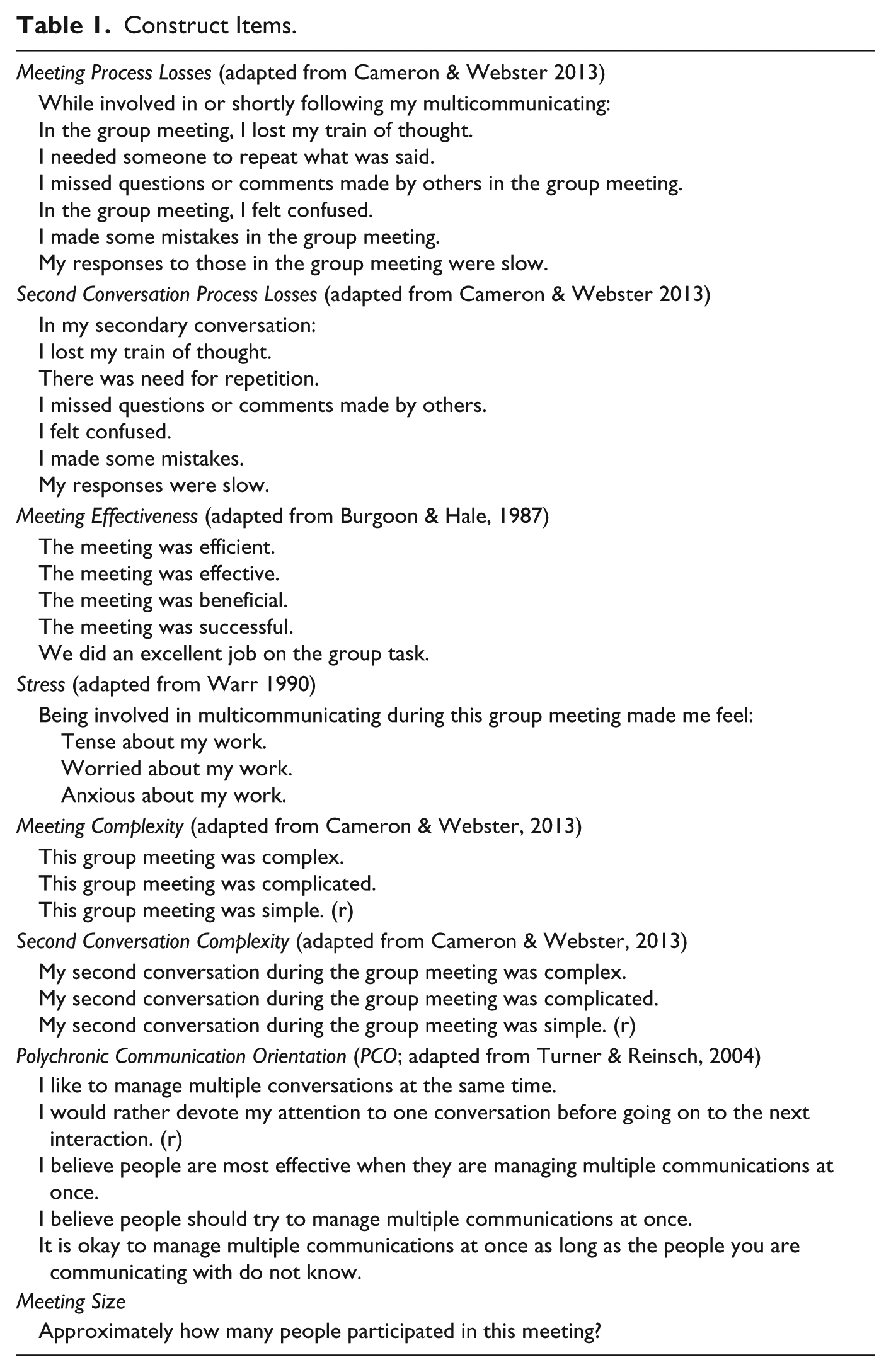
Meeting Process Losses and Second Conversation Process Losses were assessed with six items each, adapted from Cameron and Webster’s (2013) process losses scale and by modifying the question stem to clearly differentiate the two constructs. Meeting Effectiveness captures the degree to which the meeting produced desirable results and was adapted from Burgoon and Hale’s (1987) communication effectiveness scale. The respondent’s appraisal of her or his level of Stress during the meeting was measured by adapting Warr’s (1990) stress scale.
Because complexity and process losses have been found to be related in the case of dyadic MC (Cameron & Webster, 2013), Meeting Complexity and Second Conversation Complexity were both assessed as control variables by using three items adapted from Cameron and Webster (2013) to assess the cognitive demands the respondent faced in the meeting and in the second conversation, respectively. Polychronic Communication Orientation (PCO) captures a respondent’s preference for simultaneously engaging in multiple conversations and was also measured as a control variable by using a five-item version of Turner and Reinsch’s (2004) PCO scale. Because Meeting Size can influence meeting outcomes, such as its effectiveness (Cohen et al., 2011), the number of meeting participants was also assessed with a single item as a fourth control variable.
Sample
The questionnaire was administered to a broad sample of full-time office workers from different organizations and industries via Qualtrics, a data collection firm that is often used by organizational researchers (e.g., Dumas, Phillips, & Rothbard, 2013) for conducting large-scale online surveys of employees (http://qualtrics.com/). The survey targeted full-time, white-collar employees in North America and a random selection of Qualtrics volunteers were each sent an email asking them to participate in the study along with a link to the online questionnaire. A total of 5,559 individuals received and opened the study invitation, and 857 completed the survey (15%). After the first author reviewed the textual descriptions provided by each respondent (of Meeting MC, the meeting, and general comments), 247 respondents whose descriptions suggested that they had not understood the definition of Meeting MC were removed from the sample. For example, one respondent described his Meeting MC as “one of meeting attendees was on speakerphone,” and was removed. Furthermore, 92 respondents who took less than 5 min to complete the survey (the estimated minimum time that would be needed to complete it), 52 respondents who had not engaged in Meeting MC (despite earlier instructions not to continue the survey if they did not have an episode to report), and 15 respondents whose responses showed little or no variation, for example, answering the first few questions with various responses and then selecting the same number to respond to all remaining questions, were eliminated, resulting in a final sample of 451 usable responses. In all, 52% of the participants were female, 93% had postsecondary education, 90% had at least 5 years of work experience, their average age was 42 years, and they reported attending an average of 4.75 meetings per week (56% FTF, 27% audio conferencing, 9% video conferencing, and 8% via instant messaging).
Respondents were asked to recall one episode of Meeting MC that occurred in the week before they responded to the survey. The episodes they reported occurred within the last 24 hr (18%), in the last 2 to 3 days (44%), in the last 4 to 5 days (27%), in the last 6 to 7 days (10%), and unknown (1%), suggesting most of the reported episodes were recent, and, hence, minimizing the accuracy problems that can be caused by recall or retrospective bias. Furthermore, the recency of the recalled Meeting MC episode was not significantly related to the study variables.
Data Analysis and Results
Validity and reliability of all multi-item scales were examined via confirmatory factor analysis (CFA) using AMOS (version 24.0). The initial model exhibited good fit (χ2/degrees of freedom [df] = 2.3, Comparative Fit Index [CFI] = .95, Root Mean Square Error Approximation [RMSEA] = .054), with the items of all model constructs (Meeting Process Losses, Second Conversation Process Losses, Meeting Effectiveness) loading above 0.70 onto their respective constructs. The items of multi-item control variables (Meeting Complexity, Second Conversation Complexity, and PCO) loaded above 0.5 onto their respective constructs, except for the reverse-coded PCO item, which was removed from subsequent analyses. The CFA was again run, and yielded improved fit statistics: χ2/df = 2.16, CFI = .96, RMSEA = .051.
Because the present study was a self-report survey, several procedural remedies were used during survey design to minimize Common Method Bias (CMB), including an extensive questionnaire pretest, multi-item measures, and ensuring respondent anonymity (Podsakoff, MacKenzie, Lee, & Podsakoff, 2003). The extent of CMB was examined via an unmeasured latent factor approach (Podsakoff et al., 2003; Podsakoff, MacKenzie, & Podsakoff, 2012). The same CFA was rerun with all multi-item study variables plus a common variance factor linking all 30 indicators. The model with the common variance factor exhibited only a slightly better fit (χ2/df = 2.08, CFI = .97, RMSEA = .049). Furthermore, while item loadings were different from those that were obtained in the CFA without the common factor, the median amount of method variance in the 30 indicators was 9%, which suggests that while present, CMB was unlikely to have significantly influenced the present study’s results. Hence, multi-item scales were created for each construct: construct means (M), standard deviations (SD), and correlations are shown in Table 2, and Table 3 provides construct Ms, SDs, and Ns grouped by each examined factor.
Construct Means, Standard Deviations, and Correlations.
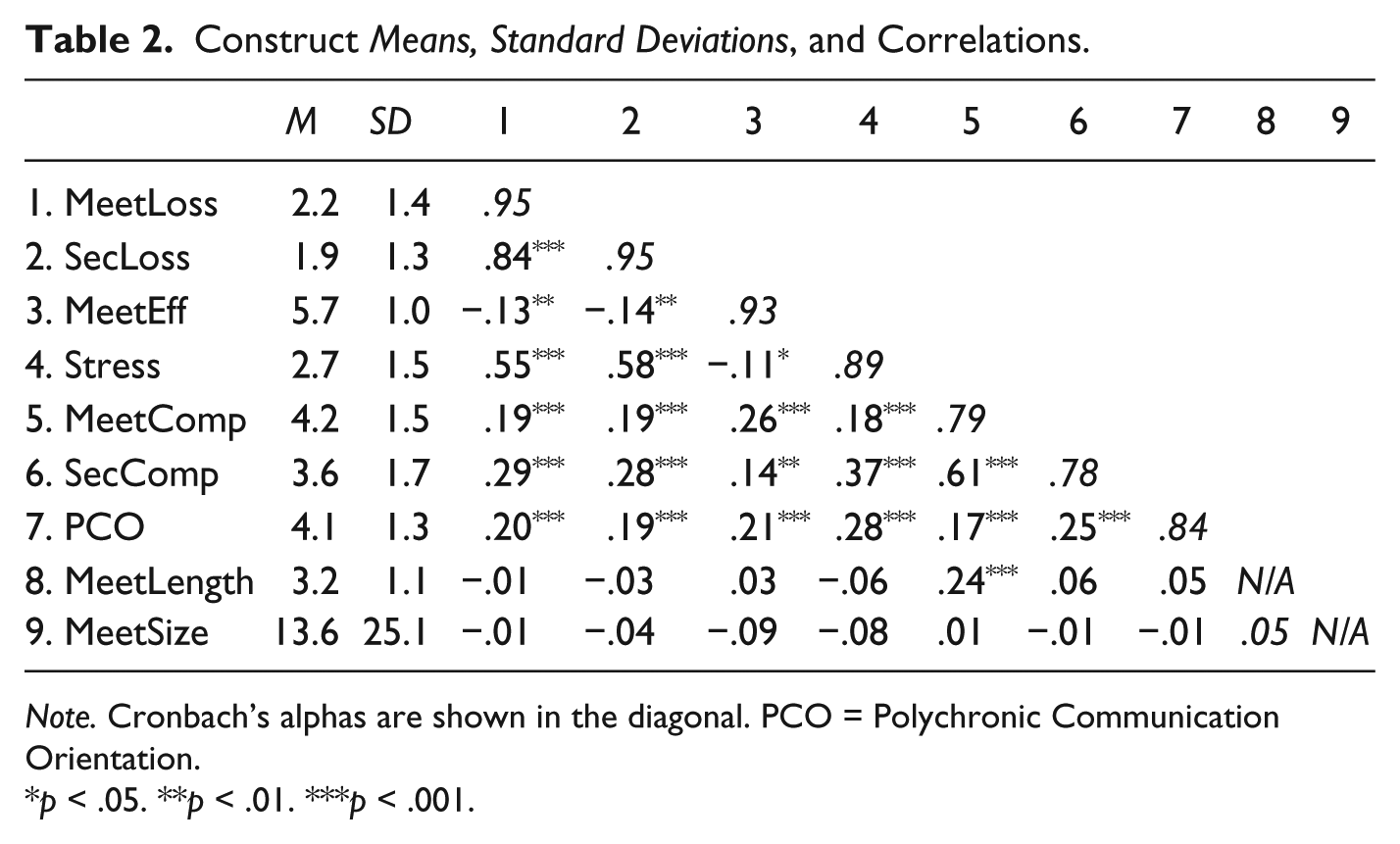
Note. Cronbach’s alphas are shown in the diagonal. PCO = Polychronic Communication Orientation.
p < .05. **p < .01. ***p < .001.
Construct Means, Standard Deviations, and Ns by Locus, Medium, and Topic Relatedness.
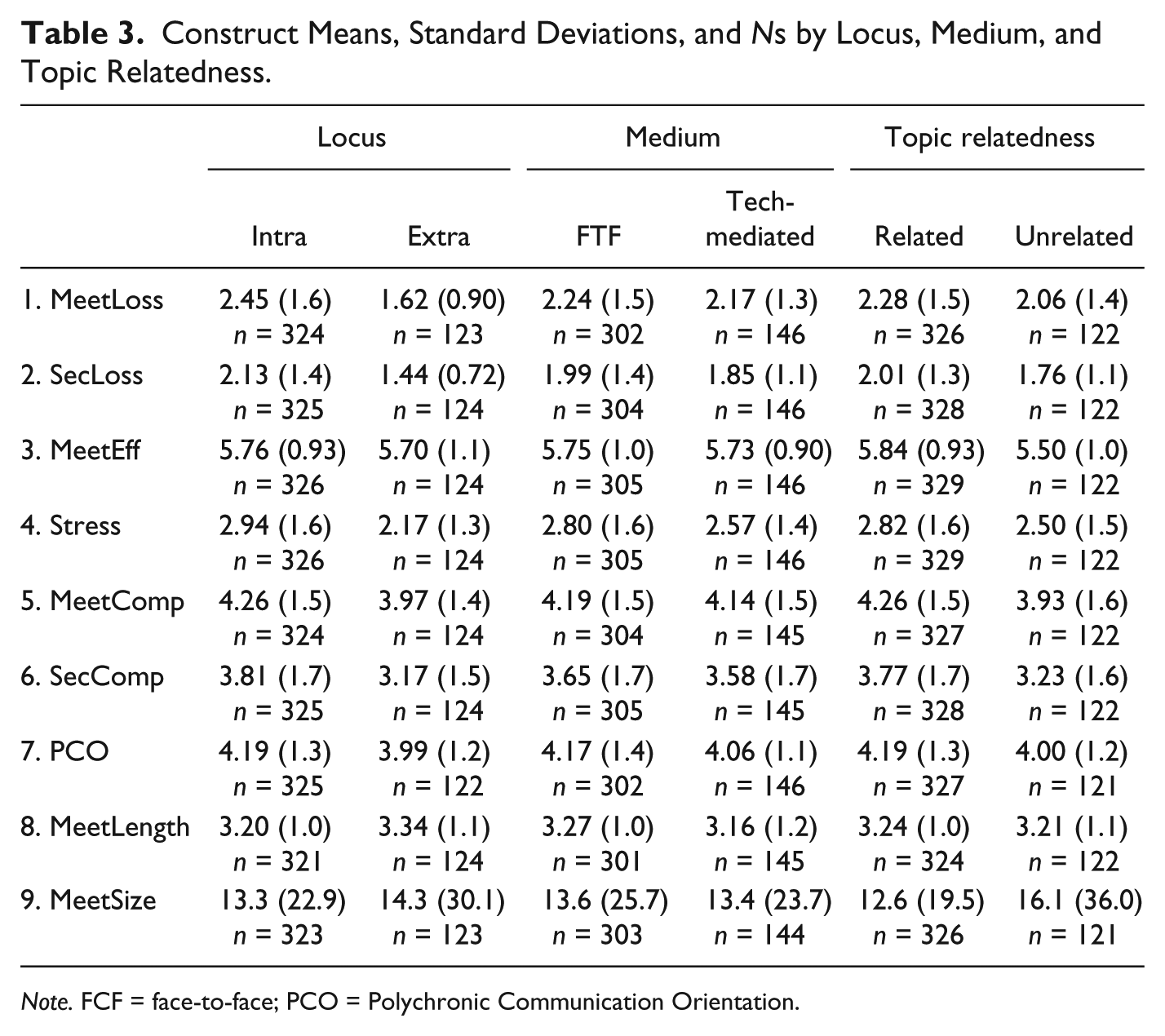
Note. FCF = face-to-face; PCO = Polychronic Communication Orientation.
While MANOVA is appropriate for testing the effects of categorical factors on multiple dependent variables when the dependent variables represent one underlying construct (Huberty & Morris, 1989; Warne, 2014), a series of ANOVA is recommended for examining how independent categorical variables affect each outcome variable separately (as in the study hypotheses). Hence, to test the hypotheses, a separate ANOVA was run for each dependent variable and its applicable factors, as well as the interaction effects. All four ANOVAs included four control variables (Meeting Complexity, Second Conversation Complexity, PCO, Meeting Size), as well as all two-way interactions.
As shown in Table 4, results supported the hypothesized effects of Locus on Meeting Process Losses (H1a), Second Conversation Process Losses (H1b), and Stress (H1d), but not on Meeting Effectiveness (H1c).
ANOVA Results (by Hypothesized Relationship).
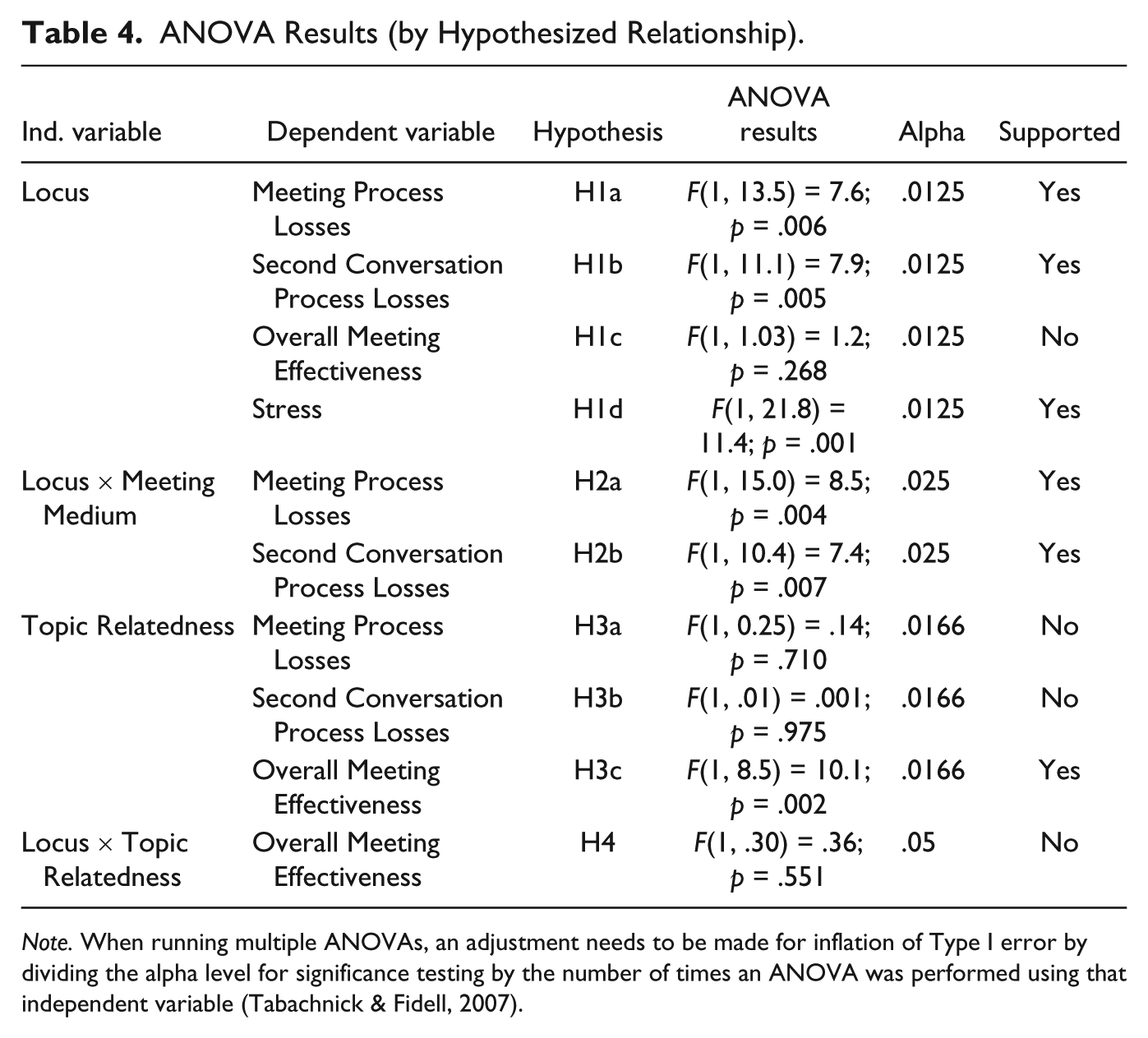
Note. When running multiple ANOVAs, an adjustment needs to be made for inflation of Type I error by dividing the alpha level for significance testing by the number of times an ANOVA was performed using that independent variable (Tabachnick & Fidell, 2007).
The Locus × Meeting Medium interaction was significantly related both to Meeting Process Losses (H2a) and Second Conversation Process Losses (H2b). Topic Relatedness influenced Meeting Effectiveness (H3c), but not Meeting Process Losses (H3a), or Second Conversation Process Losses (H3b). The hypothesized relationship between the Locus × Topic Relatedness interaction and Meeting Effectiveness (H4a) was not supported. The significant interaction effects hypothesized in H2a and H2b and observed in the results are depicted in Figure 1, suggesting that both Meeting Process Losses and Second Conversation Process Losses were affected by the Locus × Meeting Medium interaction.
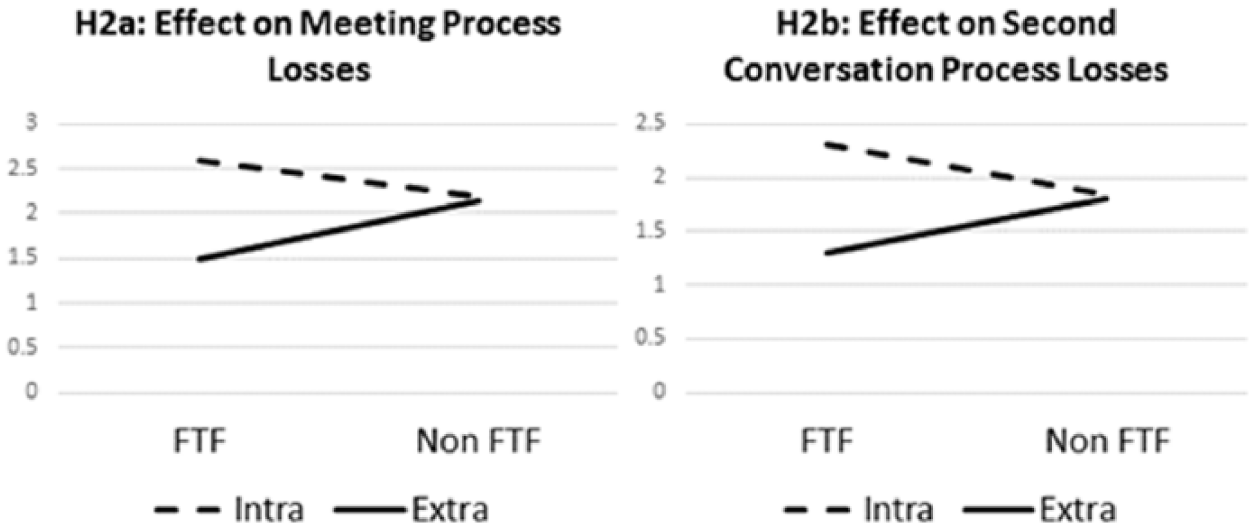
Interaction effects of Locus and Meeting Medium on Meeting Process Losses (H2a) and Second Conversation Process Losses (H2b).
Discussion
This study examined the influence of three contextual factors (Locus, Topic Relatedness, and Meeting Medium) and their interactions on Meeting MC outcomes, finding that, while Intra-Meeting MC led to greater Meeting Process Losses both in the meeting and in second conversations, as well as to greater Stress than Extra-Meeting MC in the case of FTF meetings, these effects did not seem to apply to technology-mediated, that is, Non-FTF, meetings. These results lend further support to the Goffman view that Meeting MC is a complex series of interwoven front, back, and offstage interactions, and suggest that when the boundaries between such stages are permeable, such as in Intra-Meeting MC, “inopportune intrusions” can occur and cause additional cognitive strain for those who engage in Meeting MC in FTF contexts.
Locus was not significantly associated with Meeting Effectiveness, suggesting that other factors, such as Topic Relatedness, may be more important to Meeting Effectiveness. In cases where meeting and second conversation topics were related, Meeting Effectiveness was greater, regardless of Locus. This may be because when meeting and second conversation topics are unrelated, Meeting MC is likely to be one where an individual is not using the second conversation to help or support the meeting, but rather to accomplish other tasks during the meeting (an outcome not examined in this study). Contrary to findings of dyadic MC research (Cameron & Webster, 2013), Topic Relatedness did not affect the process losses of the meeting or the second conversation. It is possible that the pressure to constantly pay attention might be stronger in a one-on-one interaction than in a meeting, so engaging in MC on different topics during a meeting may not lead to large process losses because it may not require as many cognitive resources as those needed by one-on-one interactions.
Surprisingly, the Locus × Topic Relatedness interaction was not related to meeting effectiveness, a result that appears to be contrary to existing qualitative research that suggests “meta-conversations” or second conversations with others in the meeting about the meeting can enhance meeting effectiveness (Dennis et al., 2010; Yankelovich et al., 2005). This nonsignificant result may be because these meta-conversations sometimes are negative in nature, for example, venting or complaining about the meeting or other attendees, which may have negatively affected meeting productivity, hence, their perceptions of Meeting Effectiveness. There may also be a reinforcing effect where problematic meetings led to increased side conversations and “[i]f the meeting really disintegrates, then people will stop talking about the task” (Chudoba et al., 2011, p. 25). Because the content or emotional tone of the second conversations could not be captured in the survey, it would be important to examine their potential effects in future research.
Extending the Goffman view with an understanding of media synchronicity and compartmentalization, the present study found that Intra-Meeting MC was particularly problematic during FTF meetings in which it was difficult to maintain a consistent performance across multiple embedded audiences. In non-FTF meetings, fewer communicative cues need to be coordinated when one is performing for multiple embedded audiences, making it easier to engage in Intra-Meeting MC in audio- or video-conference meetings. Thus, while high synchronicity media such as FTF may be better for communications that involve convergence (Dennis et al., 2008), lower synchronicity media that enable compartmentalization are likely to be more suitable for Intra-Meeting MC.
It is also interesting to note that, while significant differences were observed between Intra-Meeting MC and Extra-Meeting MC, both in terms of Meeting Process Losses and Second Conversation Process Losses (thus supporting both H1a and H1b), these significant differences were essentially due to those that existed in FTF meetings, as the average Intra-Meeting MC and Extra-Meeting MC scores of Non-FTF meetings were very similar (see Figure 1). Thus, while engaging in Extra-Meeting MC resulted in less process losses than engaging in Intra-Meeting MC, this difference only applied to FTF meetings and suggests that the intra/extra distinction may not be too critical in Non-FTF meetings. The results also suggest that engaging in Intra-Meeting MC in Non-FTF meetings resulted in less process losses than doing so in FTF meetings. In contrast, engaging in Extra-Meeting MC in FTF meetings resulted in less process losses than doing so in Non-FTF meetings.
The results of the present study contribute to existing theory in two ways. First, they extend current theorizing on Meeting MC by integrating and applying multiple theoretical perspectives, in particular, Goffman’s dramaturgical lens and the concepts of media synchronicity and compartmentalization, thereby providing a better understanding of how the context of a meeting can influence its outcomes. More specifically, the present study’s integration of different theoretical perspectives suggests how Goffman’s dramaturgical lens, which was developed for FTF communication and before the advent of many modern mobile communication technologies, can be extended with the concepts of media synchronicity and compartmentalization that are useful for taking into account some important contextual differences that recent technologies have brought to meetings. The present study’s results also identify a key role played by Locus, a construct that does not apply to dyadic MC, and its interactions with Meeting Medium and Topic Relatedness. As such, the present study extends Goffman’s work with findings that support the usefulness of adapting Goffman’s work to today’s mediated social encounters via media synchronicity and compartmentalization.
Implications for Practice
The present study has several practical implications for those who use, or are considering the use of, communication technologies during meetings. Employees should be careful when using communication technologies to converse with others in the same meeting, especially when the meeting is FTF. While this behavior has been thought to positively influence meeting effectiveness (Dennis et al., 2010), the present study’s results indicate that, compared with second conversations with people outside the meeting, it was also associated with increased mistakes, delayed replies, and confusion in both the meeting and the second conversation. While such problems were less apparent in non-FTF meetings, no positive influence was observed on Meeting Effectiveness. These findings may also be interesting for developers of distributed meeting and web conferencing software, for example, Adobe Connect, Microsoft Live Meeting, and Skype: the technology allows participants to send private text messages to others in the meeting, and errors of Meeting MC in non-FTF meetings were less pronounced in such platforms.
Future Research
While the present study contributes to the growing body of literature on Meeting MC (Dennis et al., 2010; Kleinman, 2007; Stephens, 2012; Stephens & Davis, 2009) and provides initial steps toward building a theory of Meeting MC, several opportunities exist for future research. Notably, several potentially relevant meeting characteristics were not examined in the current study that may influence Meeting MC outcomes. For example, the relevance of the meeting to the individual engaged in Meeting MC may influence her or his behavior and engaging in MC during an irrelevant meeting may minimize the potential negative effects of Meeting MC. An individual’s role in a meeting, as well as the role of those she or he communicates with during Intra-Meeting MC, may also influence different outcomes, for example, secondary conversations with the meeting chair may be more likely to help direct the meeting (Dennis et al., 2010), while secondary conversations with other participants may detract from the meeting objectives.
The present study focused on MC that occurred during meetings. Future research could study MC that occurs among group or team members who work together on interdependent tasks for an extended period of time. Antecedents of Meeting MC and their effects might be different when the complex and nuanced nature of today’s organizational teams are taken into account. For example, in organizations that utilize multiple team membership (O’Leary, Mortensen, & Woolley, 2011), a specific meeting may be about only one of the four projects on which an employee may be working. During the meeting, the employee may have to remain available for extra nonrelated Meeting MC should an emergency arise in one of her or his other projects. Thus, while not ideal for meeting effectiveness, such Meeting MC behaviors may be especially crucial for organizational purposes in multiple team membership environments.
Because the present study focused on task outcomes, an interesting avenue for future research might be to investigate the potential effects of changing communication norms on the social outcomes of Meeting MC (Ortiz de Guinea, 2011). While both dyadic (Cameron & Webster, 2011) and Meeting MC (Washington et al., 2014) seem to increase perceptions that those who engage in MC lack civility, the extent to which such perceptions might change as communication norms evolve is an important topic for future research.
Limitations
Several limitations of the present study need to be acknowledged. Because it used a single self-report method to measure all study variables via a survey, one potential limitation is the presence of CMB. It is important to note that procedural remedies were used in the survey design to minimize CMB, and tests using the unmeasured latent factor approach (Podsakoff et al., 2003) suggested that mono-method bias was unlikely to have significantly influenced the results.
The cross-sectional survey method prevents claims of causality. For example, H4a hypothesized that meta-conversations would increase Meeting Effectiveness. However, it is possible that ineffectively run meetings might have encouraged participants to engage in more meta-conversations, such as attempts to obtain clarifications and increased venting about the meeting, which could have led to a negative correlation between Meeting Effectiveness and Meta-conversations. Future research is needed to provide empirical insights into the causal nature of the relationships identified here.
The study focused on meeting outcomes only from the perspective of the individual engaging in Meeting MC. Future research should examine the perceptions of others in the meeting and aggregate them to investigate the group-level effects of Meeting MC. For example, future research could examine if the relationship the present study observed between Locus and Meeting Process Losses can also be observed at the group level.
Another potential limitation is related to the present study’s use of perceptual measures of Meeting MC outcomes. Past research has measured meeting effectiveness via either self-report surveys of meeting attendees or reports from trained observers who were present at the meeting (Cohen et al., 2011; Rogelberg et al., 2012). As such, the present study’s approach of measuring Meeting MC outcomes is consistent with past research on organizational meetings. However, it would be important for future research to examine the above three issues by collecting data on meeting and second conversation outcomes, and by using a variety of methods, such as experiments, quantitative data based on detailed observations of actual meetings, and measuring the perspectives of multiple meeting participants at multiple points in time.
Conclusion
With the wide availability and use of mobile technology, such as smartphones, tablets, and laptops, Meeting MC has become increasingly prevalent in organizations. Reflecting this development, and to provide informed guidelines for practice, researchers have begun to study Meeting MC. The present study provided an initial step for building a theory of Meeting MC outcomes by integrating Goffman’s dramaturgical lens and the notions of media synchronicity and compartmentalization. Results provide empirical support for the relevance and applicability of the proposed extension to Goffman’s dramaturgical lens, as well as providing some counterintuitive results that challenge some of the current assumptions regarding Meeting MC. In particular, the effects of Intra-Meeting MC during FTF meetings were less beneficial than identified in previous research (Dennis et al., 2010; Yankelovich et al., 2005), with the proposed extension of Goffman’s theory providing a plausible explanation of this and the other findings of the study.
Footnotes
Declaration of Conflicting Interests
The author(s) declared no potential conflicts of interest with respect to the research, authorship, and/or publication of this article.
Funding
The author(s) disclosed receipt of the following financial support for the research, authorship, and/or publication of this article: This research was supported by the Social Sciences and Humanities Research Council of Canada.
