







Abstract
Digital ubiquity and penetration across spatio-temporal boundaries have exacerbated the need for a clearer understanding of where the boundaries of personal, professional, and public communication begin and end. Indeed, boundary specifications have become an iconic problematic for organizational control and employee communication in the age of social media. In response, corporations increasingly issue policies that aim to regulate when, where, how, and what employees communicate in online environments. We argue that these policies are forms of organizational boundary regulation. Drawing on a content analysis of 112 social media policies from the world’s largest corporations, we examine the boundary logics articulated in these policies to delineate corporate spheres of influence. Next, we show how boundary logics relate to directives for employee speech, self-expression, and relational engagement. We discuss how the boundary logic framework contributes to our understanding of the expansion of corporate control across multiple life domains in the digital age.
Keywords
These guidelines apply to your personal and professional social media activities, whether during work-hours or at home. Regardless of your location, you never stop being a UPS employee.
Introduction
Boundaries refer to “physical, temporal, emotional, cognitive, and/or relational limits that define entities as separate from one another” (Ashforth, Kreiner, & Fugate, 2000, p. 474). As a means of simplifying and ordering the environment, individuals communicatively construct, manage, and navigate boundaries around different domains of life experience. In choosing how and what to communicate with others, people invoke boundaries between private/personal, work/professional, and public/political spheres—separating and integrating them more or less deliberately (Goodnight, 1983; Nippert-Eng, 1996). Digital ubiquity and penetration across temporal and spatial boundaries have exacerbated the need for a clearer understanding of where the boundaries of personal, professional, and public communication begin and end. Indeed, boundary specifications have become an iconic problematic for organizational control and employee communication in the age of social media.
Creating and maintaining boundaries have been a longstanding and persistent challenge for organizations and their members (Zerubavel, 1979). Even before the advent of the Internet and social media, managers voiced their concerns over employee use of work time for personal communication and nonwork tasks, and employee groups emphasized the relative importance of leaving professional matters at the workplace and treating home as a space for family interactions and personal activities (Rothbard & Ollier-Malaterre, 2016). Basic communication questions such as whether talking about your children at work limits career advancement have been asked by organizational researchers and managerial practitioners since the 1960s (Rapoport & Rapoport, 1965), and these questions continue to be relevant (Goodrich, 2016).
Today, there is general agreement that the postindustrial era effectively shattered the myth of separate worlds (Kanter, 1977), and the idea that work and nonwork domains are mutually exclusive. Globalization dynamics and changes in the nature of contemporary work (e.g., boundaryless careers, telework, etc.; Hylmö, 2006) have radically challenged traditional assumptions about employer–employee relations; where, when, and how work takes place; and the reach of corporate control (Fleming & Spicer, 2004; Perlow, 1998; Stanko & Beckman, 2015). Scholars have pointed out that by actively blurring boundaries between work and nonwork domains, employers expand their spheres of influence, and “colonize” employees’ private lives (Deetz, 1992) and identities (Alvesson & Willmott, 2002).
Perhaps more than any other factor, the advent of new communication technologies has made these issues more salient and problematic as digitization shifts the nature of work itself (Olson-Buchanan, Boswell, & Morgan, 2016). As Gregg (2011) argues, technology devices (e.g., mobile phones, laptops) and platforms (e.g., e-mail, social media) enable one’s presence to bleed across domains, thereby allowing corporate interests to seep into spaces and times that were once immune to their influence. For example, many of today’s employees use communication technologies to stay connected to work beyond traditional business hours and from home (Wright et al., 2014). Under these conditions, distinctions between personal and professional identities often become irrelevant.
Moreover, people often use social media platforms as vehicles for professional development, corporate branding, and knowledge transfer (Treem & Leonardi, 2013), and simultaneously, as personal channels for connecting with friends and family (Lampinen, Tamminen, & Oulasvirta, 2009). Thus, individual and organizational activities, information, opinions, and conversations are increasingly visible to personal and professional audiences and a variety of publics (Berkelaar, 2014). The reputational, legal, relational, and economic consequences of such boundary permeability have made organizations and individuals aware of the dangers as well as opportunities embodied in the new media environment (Kaplan & Haenlein, 2010; Treem & Leonardi, 2013). Employees are consciously developing personal strategies to manage their demands of constant connectedness and blurring spatio-temporal boundaries (Allen, Walker, Coopman, & Hart, 2007; Ollier-Malaterre, Rothbard, & Berg, 2013), while employers are developing policies and procedures to regulate employee communication across multiple contexts. A recent industry survey found that nearly 71% of today’s companies have taken disciplinary action against an employee for misusing social media within the workplace, and 67% have taken steps to protect their businesses against inappropriate social media use by employees outside of the office (Proskauer, 2014; Treem & Leonardi, 2013).
Given these developments, it is not surprising that recent years have witnessed an influx of formal social media policies (SMPs), which aim to regulate employee communication and behavior on public platforms such as Facebook, Twitter, and YouTube (Protiviti, 2013). Previous research has explored the rationales behind the development of corporate SMPs, the types of regulations they contain, and the communicative ethics and values embedded in these guidelines (Fuduric & Mandelli, 2014; Stohl, Etter, Banghart, & Woo, 2017; Thornthwaite, 2016; Vaast & Kaganer, 2013). However, despite the implicit recognition that boundary concerns are at the core of these policies and the basis for international rulings regarding social media and employment law (Morgan & Davis, 2013), there has been little exploration of these guidelines in terms of their underlying boundary logics.
Boundary logics embody the implicit and explicit organizational assumptions about the permeability or rigidity of boundaries between personal and organizational domains. Boundary logics find expression in the ways communication policies are explained and designed; they are the building blocks upon which organizations define and operationalize their spheres of influence. Pragmatically, these logics not only influence day-to-day employee and employer relations but also become embedded in legal frameworks that help determine an organization’s locus of control (e.g., Littler Mendelson P.C., 2014). Theoretically, a clearer understanding of the boundary logics corporations apply in particular sociocultural contexts provides an important framework for conceptualizing the mechanisms through which corporations enact and possibly expand their spheres of influence in the digital age.
Accordingly, in this two-part study, we investigate the organizational boundary logics applied in corporate SMPs and discuss their implications for the expansion of corporate control across multiple life domains in digital communication environments. In general, SMPs prescribe when, where, and how employees should engage with and communicate through social media (Vaast & Kaganer, 2013). We conceptualize these policies as communicative forms of organizational boundary regulation because they attempt to influence and manage employee communication to some degree within and across private, professional, and public spheres. Boundary logics are typically explicated in the rationale of SMPs and frame the focus of different types of directives. In turn, the specific directives of SMPs aim at explicit control regarding employee conduct, and what they may or may not communicate within and across these spheres of influence. Drawing from a sample of 112 SMPs from the world’s largest corporations, we present sequential and interrelated content analyses. In the first part of the study, we explore the boundary logics SMPs elucidate, establishing the relevant contexts for regulation and articulating the organizational sphere of influence. Based on the results, a second set of analyses examine how different boundary logics relate to specific types of directives in SMPs. Taken together, this study provides a more nuanced framework for understanding organizational boundary regulation. We discuss how the boundary logic framework contributes to contemporary boundary issues in the digital communication environment as well as employee–employer boundary negotiations more generally.
Background
By applying boundary logics to informal and formal regulations, organizations define their spheres of influence. For example, the American National Football League’s collective bargaining agreement includes “a boilerplate contract that requires not only a player’s best efforts on the field,” but also “loyalty to the Club, and to conduct himself on and off the field with appropriate recognition of the fact that the success of professional football depends largely on public respect for and approval of those associated with the game.” In this formal document, the NFL has articulated a boundary logic that says boundaries between private, professional, and public domains are permeable. The NFL is granted the “right” to punish “inappropriate” behavior that takes place outside the work realm, even if that behavior is not illegal (Golen, 2017). Within SMPs, boundary logics also embody the implicit and explicit assumptions regarding the permeability or rigidity of boundaries between personal and professional spheres, and between what is considered public communication and what is considered private communication that lies beyond the purview of the organization in a particular context.
Boundary logics are derived from the concept of institutional logics, although the former carry less normative weight than the latter. Institutional logics are broadly defined as social prescriptions that enable actors to make sense of their situations by providing “assumptions, values, usually implicit, about how to interpret organizational reality, what constitutes appropriate behavior and how to succeed” (Thornton, 2004, p. 700), and as “ways of ordering reality, and thereby rendering experience of time and space meaningful” (Friedland & Alford, 1991, p. 243). The literature on institutional logics argues that organizational forms, managerial practices, and policies are manifestations of and legitimated by institutional logics as “the formal and informal rules of action, interaction, and interpretation that guide and constrain” behavior (Thornton & Ocasio, 1999, p. 804), and that logics dominate and permeate organizations and even entire organizational fields (Greenwood, Díaz, Li, & Lorente, 2010; Thornton, 2004). In contrast, we understand boundary logics as specified assumptions about boundaries, which may differ within organizational fields or even within the same organization. This means that an organization may apply one boundary logic to its SMP but exert a different boundary logic with respect to other aspects of employee behavior such as conducting work-from-home offices or driving company cars. In the case of social media use, boundary logics are manifested in policies that are written with the aim to persuade and stimulate action “by committees and editors . . . who occupy official positions and whose role is to ensure that the interests of a macro-collective entity, an institution, are protected” (Suddaby, 2011, p. 185). By applying boundary logics to SMPs or other forms of regulations, organizations delineate their spheres of influence, or the parameters within which management can control and issue rules for particular types of employee communications and behaviors.
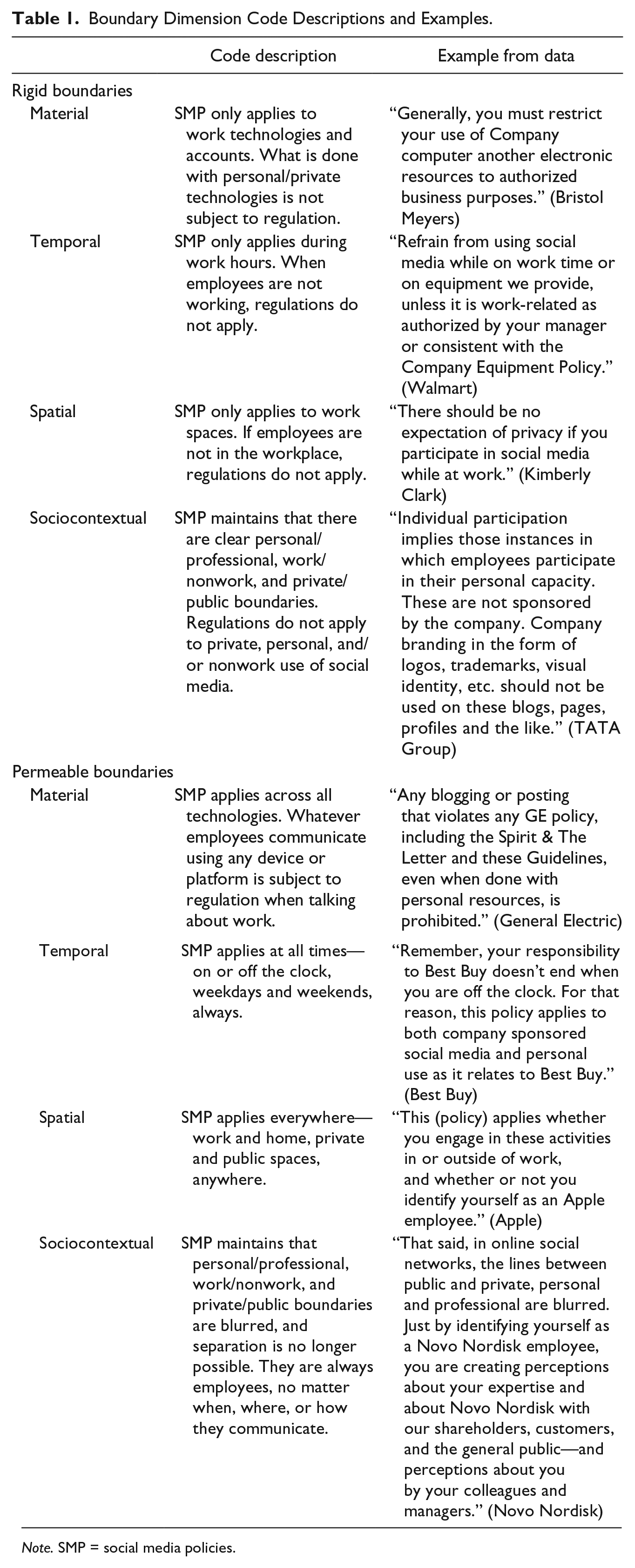
The definition of boundaries with regard to their permeability or rigidity is typically employed across one or several interrelated boundary dimensions, including sociocontextual, material, spatial, and temporal boundary dimensions (e.g., Ashforth et al., 2000; Nippert-Eng, 1996; Olson-Buchanan et al., 2016). The sociocontextual dimension is constructed around broad domains (e.g., private vs. public spheres, work vs. nonwork roles, personal vs. professional relations, etc.) and enacted in relation to those generalized spheres of life experience. Online environments are typically recognized for facilitating more permeable sociocontextual boundaries in comparison with the offline world, as they combine multiple contexts and audiences into unified digital spaces, destabilize the enactment of domain-specific roles in time and space, and allow what employees may intend to be private messages to become more public (Marwick & boyd, 2011). Still, when companies such as Zurich state that “it is not [the company’s] intention to tell [employees] how [they] should engage in the personal use of Social Media” in their SMPs, they invoke rigid sociocontextual boundaries and imply a clear distinction between what constitutes “personal” and what constitutes “professional” media use by employees.
Boundary specifications issued around material, spatial, and temporal dimensions in SMPs build upon the broader sociocontextual distinctions, providing more precise reference points for defining boundaries and corporate spheres of influence. For example, when companies such as Walmart note the applicability of their SMPs to all platforms, including “professional networking sites, social networking sites, micro-blogging sites, personal websites and blogs, forums and discussion boards,” they define material boundaries as permeable, and place all personal and professional resource use under their purview. Similarly, Apple’s SMP applies across spatial and temporal dimensions: “Whether [employees] engage in [social media] activities in or outside of work and whether or not [they] identify . . . as Apple employees,” suggesting that no matter when or where employees use social media, they must adhere to company guidelines.
In sum, SMPs may include statements that center on one or more of these boundary dimensions. Boundary logics in turn become evident in the way and degree to which these different boundary dimensions are presented as permeable or rigid, specifically defined or ambiguous and evasive. These logics have important implications for not only how employees interpret these guidelines and corporate spheres of influence (Do policy directives apply, for example, to personal social media accounts as well as professional ones?) but also for the employment consequences, boundary negotiations, and legal repercussions that follow instances of noncompliance. For example, in the United States the National Labor Relations Board (NLRB) recently ruled against a company’s SMP that prohibited “gossip about the company, an employee, or customer,” because it was “overly broad” and “ambiguous,” and had “not sufficiently narrowed, clarified, or defined the scope of its broad no gossip rule” (Littler Mendelson P.C., 2014). Hence, before examining the explicit guidelines for employee communication in SMPs, our first task is to identify the underlying boundary logics that organizations apply in their SMPs.
Analysis 1
Method
To answer the first research question, we studied how major corporations defined boundaries as permeable and/or rigid along one or several boundary dimensions in their SMPs. Based on these findings, we conceptualized and identified the underlying boundary logics of SMPs.
Sample
The content analyses presented in this article are part of a larger project on global trends in corporate SMPs. Our initial population sample included 348 companies that appeared on the “Global 500” (2015) and/or the Fortune 500 (2015) Global 500 lists. Web searches using keywords such as “social media guidelines,” “social media policies,” and “corporate code of ethics” for each company yielded a final sample of 112 SMPs, representing 32% of the population sample (for a breakdown of regions, industry, and size of sampled companies, see Appendix A). Notably, while this percentage is within the range reported by industry surveys (Protiviti, 2013), it is likely that other top global corporations have SMPs but do not make them publically available online. The SMPs in our sample varied from 18- to 5,089-word policies, with an average length of 745 words. The number of employees regulated through SMPs in each company ranges from 5,000 to 2.2 million. Collectively, these 112 SMPs regulate the communication of more than 15 million employees worldwide.
Coding procedures
Coding categories were developed through a mixed inductive–deductive procedure grounded in the literature on organizational boundaries and new technologies as well as insights derived from repeated readings and discussions of a random sample of 20 SMPs. For Analysis 1, we examined messages that directly or indirectly defined boundaries by explicitly referencing the material, spatial, and temporal, or sociocontextual parameters within which the organization exerted influence. 1 Codes were developed for each boundary dimension to capture instances in which organizations articulated boundaries as either rigid or permeable in the application of their SMPs and/or for specific subsets of directives (see Table 1 for code descriptions and examples). Boundary rigidity was operationalized as statements that established a clear separation between different social spheres, whereas boundary permeability was operationalized as statements that explicitly acknowledged blurred boundaries or established a lack of separation between multiple social domains.
Boundary Dimension Code Descriptions and Examples.
Note. SMP = social media policies.
Given the diversity of SMP formats, the unit of analysis for initial coding was a self-contained section (i.e., a paragraph or bullet point). The SMPs in our sample had an average of 13.75 sections, ranging from 1 to 70. Typically, boundary specifications are presented in the initial sections of an organization’s SMP and set the framework for employee interpretation. However, we also found boundary specifications in other sections of SMPs, often when specific regulations were introduced.
The initial coding process involved marking each section for the presence or absence of boundary specifications. A section could contain multiple codes, but each individual code was only marked once per section. Coding was refined across several meetings until the procedures were considered robust. In a first meeting, four coders were trained using a detailed 19-page coding manual. After the training, coders independently coded five randomly selected guidelines. The first coding round yielded unreliable; percentage of agreement ranged only from 40% to 80%. Thus, three more coding rounds were conducted. Each coding round included coding five policies, and subsequent meetings for the discussion and analysis of disagreements as well as refinement of the categories. In the final training session, each analyst coded 10 guidelines, and intercoder reliability of .89 was achieved (Hayes & Krippendorff, 2007). This was acceptable, and each coder then proceeded independently to code a subset of the policies.
Data analysis procedures
Our analysis proceeded in multiple stages: First, section-level coding data were aggregated into variables reflecting the total frequency of each type of boundary code within a company’s SMP. This allowed us to examine our data using companies as the units of analysis. Given our interest in identifying different boundary logics based on boundary rigidity versus permeability, we then grouped the initial boundary dimension variables into two composite variables. Code variables associated with rigid material, spatial, temporal, and sociocontextual boundaries were collapsed into one composite variable, and those that represented permeable boundary dimensions were combined into a second composite variable. The resulting composite variables were recoded as binaries to provide a straightforward measure for determining whether each company’s SMP did or did not (i.e., no = 0, yes = 1) contain rigid and/or permeable boundary specifications. However, because the initial boundary dimension codes were not mutually exclusive (i.e., SMPs could include both rigid and permeable boundary specifications), it was necessary to account for the potential overlap between the two binary variables. Thus, we created a third variable wherein SMPs were classified based on whether they acknowledged rigid, permeable, or both types of boundaries. When SMPs did not contain boundary specifications, they were coded 0; SMPs that exclusively conceptualized boundaries as rigid were coded 1; SMPs that only addressed permeable boundaries were coded 2; and SMPs that acknowledged both rigid and permeable boundaries were coded 3. Next, we ran descriptive statistics and frequency reports to assess the number of SMPs that addressed these boundaries and identified the specific organizations within each category. No significant differences were found among boundary logics related to an organization’s industry, home country, or size. Finally, we supplemented our statistical analyses by going back to the policies themselves to identify examples and gain a deeper contextual understanding of the ways in which organizations within each category conceptualized and articulated boundaries.
Results
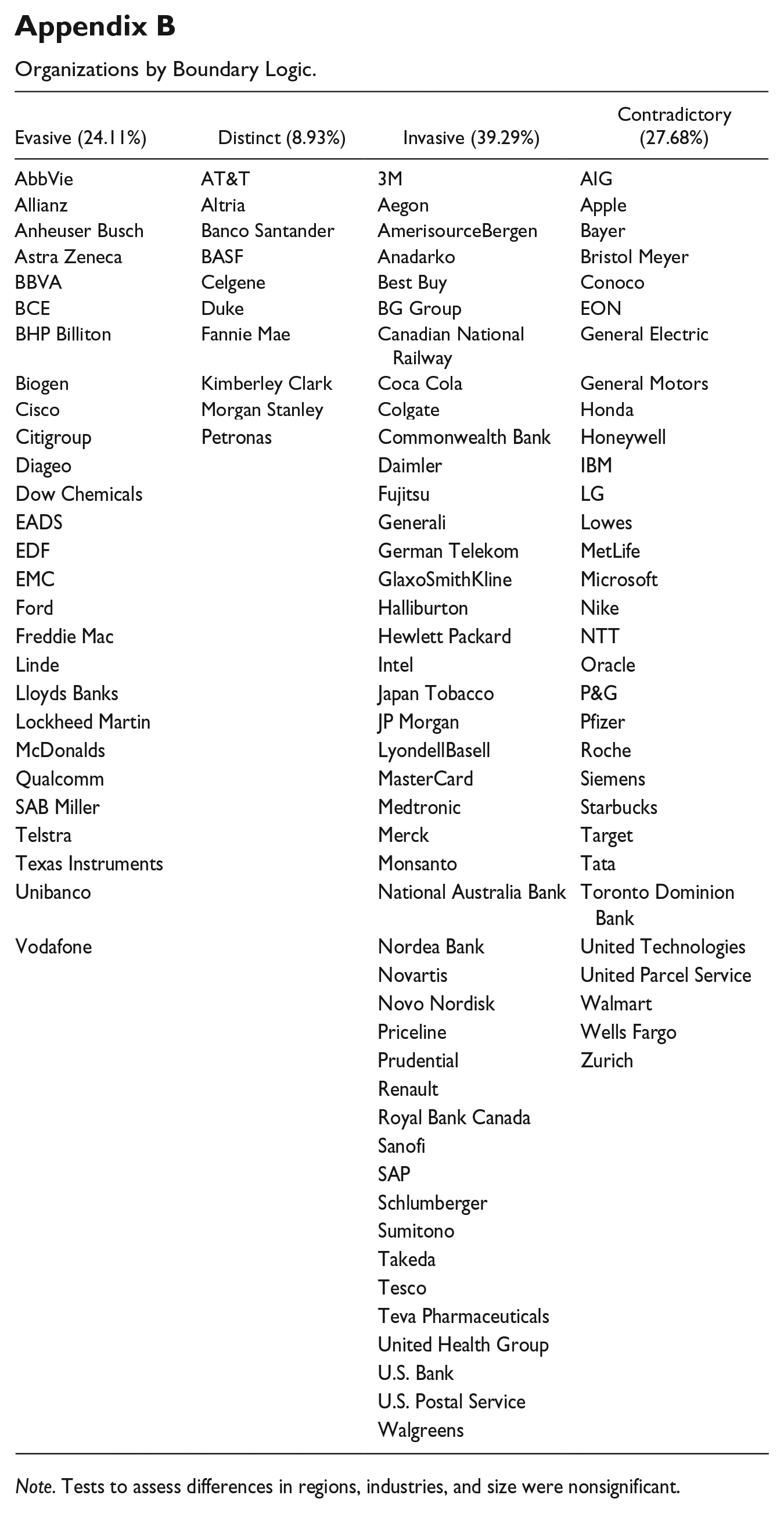
The content analysis revealed that corporate SMPs apply four different boundary logics, two of which go beyond treating boundaries as either rigid or permeable. Whereas some SMPs presented a clear view of boundaries and the scope of organizational influence, others maintained more ambiguous understandings of organizational jurisdiction and boundaries between professional, public, and personal spheres (see Appendix B for a categorization of all SMPs according to boundary logics). Surprisingly, we found that 24.12% of the organizations in our sample (n = 27) did not address boundaries at all in their SMPs, reflecting an evasive boundary logic. Companies with this evasive logic neither defined the scope of their policies in terms of material, spatial, temporal, or sociocontextual boundary dimensions nor distinguished employee social media use across work/nonwork contexts or personal/professional roles in any official capacity. Although these companies still regulated employee communication by providing directives for specific issues, explicit articulations of where, when, and under what material or sociocontextual circumstances the organization had jurisdiction to control behavior were absent from these SMPs. This ambiguity surrounding boundaries provides room for a wide range of interpretations (Eisenberg, 1984; Weick, 1995), ranging from employees thinking the rules apply only at work, the rules always apply, or the organization is providing space to explore and experiment with how to navigate boundaries in social media environments.
In contrast, 8.93% of companies (n = 10) exhibited a distinct boundary logic in their SMPs. Organizations with this logic made explicit distinctions between employee social media use occurring inside versus outside of the workplace, during the workday as opposed to off hours, and/or on company-owned platforms and technologies versus employees’ personal accounts and devices. Across each boundary dimension, the locus of SMP regulations was the work/professional sphere. Companies noted that nonwork activities and personal/private communication were not within the purview of organizational control, and SMPs only pertained to what the organization defined as work owned and/or sanctioned. In this way, companies with a distinct logic embraced a traditional, modernist ontology in treating work/nonwork spheres as discrete and ordered entities with rigid boundaries (Taylor, 2005) and employees’ personal/professional identities as separable. Accordingly, they adopted and advocated a “segmentation” approach to boundary regulation (Nippert-Eng, 1996), emphasizing that work/professional and nonwork/personal social media use should not overlap in any way. For example, Celgene warned its employees: “When you engage in personal Social Media communications, you may not represent Celgene or create the impression that you are communicating on behalf of Celgene.”
A third of the companies in our sample (32.29%, n = 44) applied an invasive boundary logic to their SMPs. Organizations operating from this logic acknowledged that employee social media use transcends work/nonwork places, times, and materials, and recognized that it is no longer a viable option for employees to separate personal/professional roles or private/public matters on these platforms. Thus, these corporations adopted an “integration” approach to boundary regulation (Nippert-Eng, 1996), and explicitly constructed SMPs that pertained to employee social media use across any boundary dimension. Companies with an invasive logic embrace a more postmodern conception of organizational life in treating work/nonwork boundaries as permeable and employees’ personal/professional identities as multifaceted, blurred, and ever-shifting (Taylor, 2005). For example, these organizations noted that anything employees communicate through social media could reflect back on the company because even messages on so-called private or personal accounts can be saved, forwarded, or shared with potentially global audiences. From a more critical standpoint (Deetz, 1992), this boundary logic can, indeed, be interpreted as invasive and colonizing, as regulations about communication and behavior in social media not only apply to the work sphere but also to private and public sphere of employees. For example, the pharmaceutical company Sanofi applied an invasive logic, and rationalized the scope of its SMP along the sociocontextual boundary by stating that “any use of social media by any employees, including any private use, could be attributed to our company and negatively impact its image and reputation.”
Finally, we found that 27.68% of organizations (n = 31) incorporated a contradictory boundary logic into their SMPs. Companies applying this boundary logic defined boundaries in SMPs as permeable and at the same time as rigid. This contradictory specification of boundaries may either apply between different boundary dimensions or even within the same boundary dimension. SMPs with a contradictory boundary logic, thus, combined the ontological tenets of distinct and invasive logics to form an approach characterized by inconsistency and contradiction. These organizations articulated competing and incongruous assumptions about boundaries in their SMPs, and vacillated between segmentation- and integration-centered approaches to boundary regulation (Nippert-Eng, 1996). However, companies recognized that—at least to some degree—work/nonwork contexts are discrete, and employees have distinct personal/professional identities. They noted that their SMPs only pertained to work-situated and/or professionally relevant social media activities. At the same time, these companies acknowledged that work/nonwork, personal/professional, and public/private boundaries are blurred in the online environment, and therefore included boundary specifications that applied across all spheres of life experience. For example, Pfizer drew a distinct line between personal/professional social media use on material boundary dimension in stating that its policy “does not apply to one’s personal use of Social Media if Pfizer Information Systems are not used.” Yet, it also blurred sociocontextual boundaries by specifying that its SMP covers any employee communication that “makes reference to Pfizer or Pfizer’s business, products, people, colleagues and former colleagues, work, policies, research, relationships and competitors […] including personal use of Social Media that references Pfizer’s Interests.”
Similar to the evasive boundary logic, boundary regulation here is ambiguous as well as potentially confusing. Policies that apply the contradictory logic explicitly address boundaries, yet articulate inconsistent assumptions and incompatible specifications for how employees should navigate boundaries in their use of social media. Thus, instead of giving room for interpretation and facilitating exploration, ambiguity about boundaries in the contradictory boundary logic is and likely to constrain and complicate interpretation and action (Alvesson & Sveningsson, 2003; Denis, Langley, & Cazale, 1996).
Taken together, the four discrete boundary logics represent differences in how organizations define their spheres of influence over employees’ social media use. They range from an evasive boundary logic that ambiguates what the organization believes is its sphere of influence, to a distinct boundary logic that acknowledges the distinct separation of social spheres along one or several boundary dimensions. An invasive boundary logic articulates an extension of an organizational sphere of influence into multiple contexts outside what has traditionally been considered the organization. When organizations express a contradictory boundary logic, they issue inconsistent and incommensurate boundary specifications along one or several dimensions, creating confusion about the limits of the corporate sphere of influence.
In the next section, we examine whether the scope of directives for particular types of employee social media communications and behaviors differs depending on the underlying boundary logic articulated in SMPs.
Analysis 2
Background and Hypothesis Development
In Analysis 1, we identified four discrete boundary logics that underlie corporate SMPs, and defined the articulated sphere of influence associated with varying degrees and forms of ambiguity. Analysis 2 explores how these boundary logics relate to the explicit directives for employee communication and behavior in SMPs. Prior research on SMPs suggests that organizations develop guidelines around what employees can and cannot talk about on social media, how they should and should not present and express themselves in the online environment, and who employees are permitted (or not) to connect and engage with on these platforms (Stohl et al., 2017; Thornthwaite, 2016; Vaast & Kaganer, 2013). Thus, companies may set forth enabling and/or constraining directives for employee speech, self-expression, and relational engagement in their SMPs. For example, Tata’s SMP enables speech in social media by stating that “the Tata group supports open dialogue and the exchange of ideas,” while Starbucks constrains it by reminding employees that “. . . complaints or concerns about Starbucks are best resolved by speaking directly with someone, rather than distributed on social media.” The pharmaceutical company Novo Nordisk enables self-expression by telling employees to express themselves: “Don’t be afraid to bring in your own personality and say what’s on your mind.” In contrast, the firm Alpina demands from its employees to “be careful not to discuss topics in a way that is inconsistent with our companies’ positions and actions.” An example of enabling relational directive can be found in 3M’s SMP which states, “[social media] communications are used to create relationships and promote interaction online.” In contrast, Nike reminds its employees that they “should only use internal, Nike supported tools for collaboration and networking with other employees.”
Whether there is a relationship between boundary logics and different types of directives (i.e., constraining or enabling) contained in a SMP is an empirical question that has not been previously addressed in the literature. The analysis of these different types of directives becomes particularly relevant when we consider the different boundary logics that frame these directives. For example, a high frequency of constraining directives has different consequences when they apply merely within the corporate domain or when communicating about work-related matters (i.e., when SMPs apply a distinct logic), when they apply across all spheres, or when they apply in unclear and/or inconsistently defined domains. Moreover, the question arises as to whether different boundary logics are associated with the different types of directives (i.e., for employee speech, self-expression, and relational engagement). Thus, our second research question addresses possible variations in the types and frequencies of regulations in SMPs that apply different boundary logics.
With regard to the nature of these differences, we draw on management and communication literature about ambiguity and control (e.g., Alvesson & Sveningsson, 2003; Eisenberg, 1984; Weick, 1995). As mentioned above, on one hand ambiguity can be seen to create space for fruitful exploration, whereby organizational members can negotiate and enact interpretations that may comply with overarching organizational goals as well as local agendas and personal goals (e.g., Jarzabkowski, Sillince, & Shaw, 2010; Weick, 1995). For example, Weick (1995) defines ambiguity as “an ongoing stream that supports several different interpretations at the same time” (p. 92). Given that the evasive boundary logic entails this form of enabling ambiguity, it seems likely that the evasive logic would be associated with fewer constraints, giving employees room to interpret and explore the limits of personal/professional and private/public social media use. Accordingly, we expect SMPs that apply an evasive boundary logic to similarly regulate employee communication and behavior to a lesser extent, and thus contain fewer constraining directives in comparison with SMPs that apply other logics.
On the contrary, ambiguity can also be seen to create “confusion and fragmentation” (Alvesson & Sveningsson, 2003, p. 965; Denis et al., 1996), particularly when managerial instructions and visions are contradictory and incompatible rather than simply absent or unclear. This literature further suggests that ambiguity in organizational contexts is linked to increased “micro-management,” as managers attempt to compensate for confusing and fragmented instructions with heightened monitoring and formal regulation efforts (Alvesson & Sveningsson, 2003, p. 962). Translated to the context of SMPs, we might expect policies that apply a contradictory boundary logic to demonstrate greater measures of control over employee social media communication and behavior, and hence have the highest frequencies of constraining directives.
Finally, research has shown that communicative directives regarding social media activities may be general or highly specific (Stohl et al., 2017). General and unspecified directives include statements such as “use common sense” and “act appropriately,” and are not tied to specific behaviors or contexts. The degree to which SMPs include unspecified and general directives is particularly important in light of the fact that overbroad SMP directives have often been the basis of legal cases against organizations (see Connelly, 2016; Morgan & Davis, 2013). When organizations are ambiguous in terms of the parameters within which their policies apply (i.e., by applying evasive or contradictory boundary logics), we might expect them to mirror and/or extend such ambiguity by issuing directives that could be interpreted as applicable across domains. Thus, we anticipate that general and unspecified directives will be more prevalent in SMPs that apply both of types of ambiguous boundary logics.
Method
Unit of analysis and variables
Using the general methods described above (i.e., the same sample and initial coding procedures), Analysis 2 focused on the relationship between boundary logics and specific types of directives for employee communication and behavior in SMPs. Companies served as the units of analysis, and boundary logic was employed as an independent measure to assess group differences in all statistical analyses. Specifically, we used the initial classification measures from Analysis 1 to create a single categorical variable in which companies were coded based on their respective boundary logic (0 = evasive, 1 = distinct, 2 = invasive, and 3 = contradictory).
Dependent variables measured the relative frequencies with which the policies contained specific types of directives for employee communication and behavior. We first coded directives based on the specific subject matter and/or behavior they addressed (see Table 2 for directive code descriptions and examples). Next, we used those initial codes to create separate composite variables, and capture the frequencies of enabling and constraining employee speech, self-expression, and relational engagement directives (respectively) in each policy. We operationalized employee speech directives as explicit statements that addressed work-related communicative activities and company information that employees could or could not disclose on social media platforms. Statements that encouraged employees to use social media to conduct or talk about work (e.g., “Social media involvement can provide support in the early identification of new trends, responding to criticism or advancing one’s own topics,” Dalmier) were coded as enabling speech, and directives that prohibited employees from using social media to communicate for or about company and work-related issues (e.g., “You must not disclose confidential information about customers or employees or other information that compromises internal controls and safety requirements,” U.S. Bank) were designated as constraining speech.
Regulation Code Descriptions and Examples.

Self-expression directives were operationalized as explicit statements that focused on how employees should and should not present or express their individual identities online. Directives that encouraged individual identity enactment and self-expression (e.g., “Be who you are. We believe in transparency and honesty,” IBM) were identified as enabling self-expression, and those that restricted individual identity enactment and self-expression (e.g., “Be aware that taking public positions online that are counter to the Company’s interests may cause conflict and can have disciplinary repercussions,” Priceline) were coded as constraining self-expression.
Likewise, relational engagement directives were operationalized as explicit statements that delineated who employees were permitted (or not) to engage and connect with in their use of social media. Statements that encouraged relational engagement (e.g., “Your engagement in online conversations may help inform and positively influence the public’s perception of the company,” Honda) were coded as enabling relations, and those that prohibited certain types of connections and relational behaviors (e.g., “Don’t invite colleagues to discuss issues in the workplace on public forums,” EON) were coded as constraining relations. Finally, we operationalized general directives as statements that were explicitly directive in terms of employee conduct but were not tied to specific topics or types of behaviors and communicative actions (e.g., “Use good judgment, P&G; “Be responsible,” Novartis).
Data analysis procedures
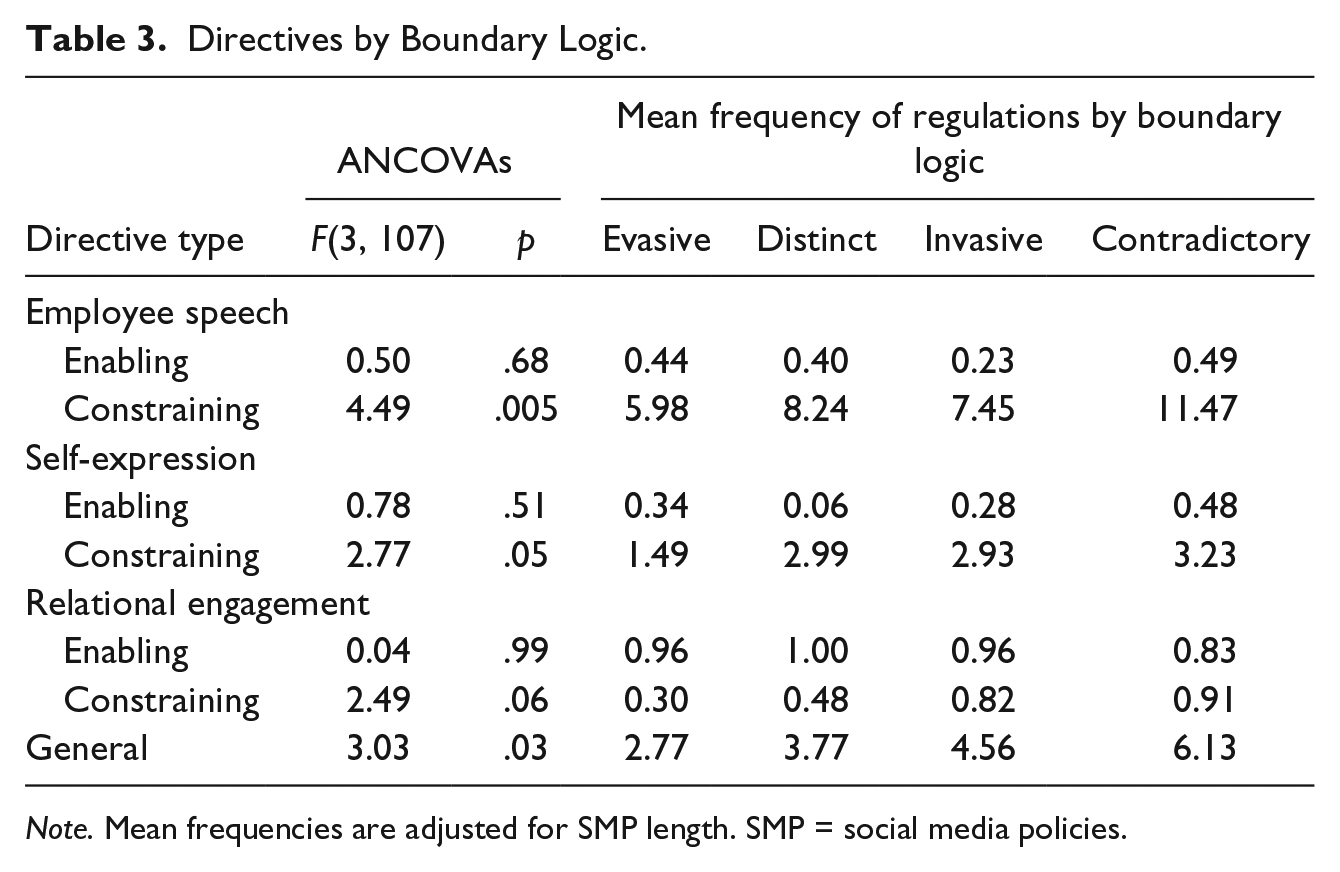
We explored our second research question and tested H1 to H3 through statistical analyses that examined group differences. Given that our dependent variables were frequency measures, we controlled for policy length in the analyses, operationalized as the total number of words a SMP contained. We conducted a MANCOVA to determine whether there were variations in terms of the frequencies of different types of directives for SMPs that applied different boundary logics, while controlling for policy length. This test was considered appropriate, given the intercorrelations between the dependent variables and the need to control for the Type 1 error rate in multiple univariate ANCOVAs (Cramer & Bock, 1966). Based on the omnibus test, we proceeded by examining the frequencies of directive types (enabling, constraining, general), and focal issues (employee speech, self-expression, and relational engagement) were assessed through post hoc analyses (Fisher’s LSD) of the one-way ANCOVA tests. Results of the univariate ANCOVAs and respective mean frequencies for each type of SMP directive by boundary logic (controlling for length) are reported in Table 3.
Directives by Boundary Logic.
Note. Mean frequencies are adjusted for SMP length. SMP = social media policies.
Results
The omnibus test for the MANCOVA indicated a statistically significant multivariate effect for the different boundary logics on the combined dependent variables, controlling for policy length, F(21, 309) = 1.592, p = .05; Pillai’s Trace = .293. Hence, there were significant differences in the frequencies of particular types of regulations in SMPs based on boundary logics. The ANCOVA results indicated that the significance of the multivariate effect for boundary logic was based primarily on variance in the frequencies of constraining directives for employee speech, F(3, 107) = 4.49, p = .005, and self-expression, F(3, 107) = 2.77, p = .05. However, there were no differences in the frequencies of constraining relational directives, F(3, 107) = 2.49, p = .06, or any of the three enabling directive subtypes based on boundary logic. Thus, in answer to Research Question 2, there were significant differences in the degrees to which SMPs applying different boundary logics constrained employee communication. The one exception was in the frequencies of constraining relational directives, which did not vary significantly across boundary logics.
H1 and H2 centered on the frequencies of constraining regulations, and predicted that SMPs applying an evasive boundary logic would have significantly lower frequencies of directives (H1), and those applying the contradictory boundary logic would have significantly higher frequencies of these directives (H2) relative to other logics. Results revealed that the means of constraining directives for SMPs with the evasive boundary logic were indeed the lowest, and those for SMPs with the contradictory logic were the highest (see Table 3). However, as noted above, the differences in frequencies were only significant for directives constraining employee speech and self-expression, and not for those regarding relational engagement.
Post hoc analyses assessing the differences between the logics for each regulation variable indicated that the frequency of directives constraining employee speech was significantly higher for SMPs applying the contradictory logic relative to the evasive (mean difference = 5.49; 95% CI = [2.37, 8.61]; p = .001) and invasive (mean difference = 4.02; 95% CI = [1.35, 6.69]; p = .004) boundary logics, but not when compared with those applying the distinct boundary logic (mean difference = 3.22; 95% CI = [−0.80, 7.24]; p = .12). All other pairwise comparisons were nonsignificant for the evasive and contradictory logics. With regard to directives constraining self-expression, the mean frequency was again significantly higher in SMPs with the contradictory logic compared with the evasive boundary logic (mean difference = 1.735; 95% CI = [0.29, 2.58]; p = .01), although all other pairwise comparisons were nonsignificant. Overall, the post hoc examinations provided partial support for H1 and H2. The evasive logic (H1) constrained employee speech and self-expression through significantly fewer directives compared with the contradictory logic but not in relation to the distinct or invasive logics. The contradictory logic (H2) constrained employee speech and self-expression with significantly higher directives in comparison with the evasive logic, and in the case of speech the invasive logic, but did not differ significantly from the distinct logic in either case.
H3 predicted that the frequency of general and unspecified regulations for employee conduct would be higher in SMPs that are ambiguous with regard to boundary specifications compared with those with clear boundary specifications. Univariate ANCOVAs (see Table 3) demonstrated that the frequency of general directives significantly varied based on boundary logic, F(3, 107) = 3.025, p = .033, while controlling for policy length, and thus contributed to the significant omnibus effect of the MANCOVA. However, contrary to our hypotheses, the frequencies of these directives for SMPs applying the evasive logic were not significantly higher than those that applied any of the other three logics. Rather, the frequency score for the evasive logic was significantly lower in comparison with the contradictory logic (mean difference = 3.367; 95% CI = [1.116, 5.618]; p = .004), and all other pairwise comparisons were nonsignificant. Thus, H3 was only partially confirmed. General directives were only significantly more prevalent when comparing SMPs that applied the contradictory logic to those that applied the evasive logic.
Discussion
The boundary logics identified and developed in this article provide a novel theoretical framework for examining the varying degrees to which organizations delineate their spheres of influence in relation to the people who work for them. Our analyses extended existing understandings of boundary management in the social media environment by shifting attention from individual coping mechanisms (Lampinen et al., 2009; Ollier-Malaterre et al., 2013) to the discursive manifestation of organizational boundary regulation in corporate SMPs. Our primary theoretical contribution, then, lies in the conceptualization of four discrete boundary logics that can help us to better study and understand organizational discourse that helps shape corporate spheres of influence and control, whether that occurs through formal written regulatory policies or other managerial initiatives.
A clearer understanding of boundary logics has important implications for academic work on organizational boundary regulation and individual boundary management in the digital age. Previous case studies have shown that managers in specific organizational contexts attempt to exert influence over how employees divide their time (Perlow, 1998), space (Fleming & Spicer, 2004), and attention (Stanko & Beckman, 2015) between work/nonwork domains. However, this study is the first to provide insight into the prevalence of these practices and the variations among them across a broad sample of global corporations. Our content analysis revealed that while nearly a quarter of our sample neither acknowledged boundaries nor specified the material, spatial, temporal, or sociocontextual parameters of their SMPs (reflecting an evasive boundary logic), the vast majority (75.89%) included explicit boundary specifications in their policies. Notably, only a minority of companies—less than 10% of our sample—adopted a simplistic conception of boundaries (a distinct logic), and developed SMPs that applied exclusively to employees’ work-situated and professionally relevant social media use. In contrast, more than two thirds acknowledged boundary permeability in the online environment (with invasive or contradictory logics), and therewith constructed SMPs that applied across multiple social roles and contexts.
Broadly, these findings support the general idea that organizational boundary regulation is becoming more prevalent and problematic within the emerging digital environment. Indeed, the predominance of invasive and contradictory boundary logics (and infrequency of the distinct logic) in our sample indicates that today’s organizations may not only be increasingly aware of contemporary boundary complexities but also contribute to those complexities by issuing policies with ambiguous and potentially all-encompassing boundary specifications. Under an invasive boundary logic, constraining regulations for employee speech, self-expression, and relational engagement apply whenever, wherever, and however employees use social media. Thus, while the frequencies of these regulations are similar to those of the distinct logic, the scope of control in the invasive logic reaches beyond the professional realm into employees’ private/personal lives. In other words, these organizations are not simply regulating boundaries but colonizing personal and public spheres by treating the entire online environment as an extension of the corporate sphere. Organizations with a contradictory logic also extend their spheres of influence to some degree but additional ambiguity through contradictory boundary specifications. These companies maintain that employees’ private/personal lives are generally not within their purview, yet simultaneously include the highest frequencies of constraining regulations that may apply across domains. In effect, the scope of control under this logic is contingent upon the nature of the communicative act, such that any form of employee communication or behavior that might interfere with corporate interests is subject to regulation. Complicating matters further, these SMPs also contain the highest frequencies of general and unspecified directives for employee social media use.
The fact that general and unspecified directives are correlated with a high frequency of constraining directives (particularly for employee speech) for SMPs with a contradictory boundary logic suggests a rather pessimistic interpretation around the role of ambiguity in these policies. Namely, general and unspecified regulations alongside constraining directives establish influence over a broader range of communicative activities that are not explicitly referenced in their SMPs while maintaining deniability and encouraging employee interpretations that privilege corporate interests over individual ones. This explanation seems consistent with the strategic ambiguity literature (Eisenberg, 1984), which suggests that vague communication amplifies existing source attributions and enables powerful actors to emphasize interpretations that serve their own agendas. Hence, general and unspecified directives might provide companies that apply a contradictory boundary logic—which is already potentially confusing due to its ambiguous boundary specifications—additional insurance against potentially problematic employee social media use.
At least to some degree, this potential for ambiguous boundary specifications and general directives to amplify existing attributions and favor organization-centric interpretations also extends to the evasive logic. Without a doubt, there is some degree of irony in a company that creates a SMP without acknowledging well-known boundary issues, or specifying the contexts or domains to which it applies. Yet, our results regarding the frequencies of regulations in these SMPs suggest that the role of ambiguity in these policies is not as bleak. Our findings show that the evasive and contradictory logics operate on opposite sides of the same coin in several ways. Namely, SMPs with the evasive logic are not only ambiguous about boundaries, but they also contain significantly fewer constraining and general regulations for employee communication relative to the contradictory logic. These findings support a more hopeful interpretation of ambiguity as fundamentally more enabling in the evasive logic. In particular, the absence of distorted communication (e.g., incompatible boundary specifications in the contradictory logic) and presence of multiple forms of ambiguity in SMPs with the evasive logic facilitate “discursive opening” rather than promoting “discursive closure” (Deetz, 1992).
Nonetheless, we suggest that ambiguity operates as a double-edged sword under both of the ambiguous boundary logics, as it inherently holds the potential to both open up and close off space for interpretation and negotiation simultaneously. On one hand, ambiguity as a strategy can be highly beneficial for organizations when it serves to shape consensus in a particular context (e.g., employee interpretations about SMPs that serve corporate interests; Deetz, 1992). On the other hand, ambiguity necessarily introduces complexity, and can generate struggles over meaning when it serves to shape multiple and divergent interpretations of the same policy. In those cases, ambiguity in corporate SMPs may not only thwart boundary regulation efforts but also require substantial efforts to (re)establish shared policy interpretations in organizations.
With regard to these interpretations of our results, we acknowledge that our analysis does not address whether boundary logics and particular directives are deliberately chosen or issued with the explicit aim to extend control into employees’ personal and private communication. Nonetheless, it is fair to assume that the development of SMPs in top global corporations with multimillion dollar market values involved at least some form of conscious decision-making process from which particular interests, agendas, and intentions found expression in the boundary logics and directives identified in this article. How and to what extent and effects boundary logics and SMP regulations play out in employment relationships, particularly the degree to which employees actually take directives into account in their social media use, can only be explored through further research. However, considering our findings in light of the existing literature and the emerging body of legal cases surrounding corporate SMPs enables some speculation around the types of issues that may arise from the application of particular logics.
Perhaps, the most obvious source of potential conflict is the expansion of corporate influence and control over employees’ private/personal communication through invasive and contradictory—and potentially even evasive—boundary logics. A recent survey suggests that despite recognizing the boundary-blurring capacities of social media, a majority of employees still believe that “work life is completely separate from personal life, and what you do in one should not affect the other” (Sanchez Abril, Levin, & Del Riego, 2012, p. 103). Moreover, a Harris poll of U.S.-registered voters conducted in September 2017 indicates that seven in 10 supported extending the first amendment to protect workers’ speech. Yet, our study indicates that the vast majority of employers adopt boundary logics that establish these spheres as blurred or conflated, and provide little room for employees to maintain any sort of clearly bounded personal space.
This apparent lack of recourse for employees who wish to maintain some degree of work/nonwork separation has potentially far-reaching consequences. For example, longstanding research suggests that the inability to separate oneself from work engenders high levels of stress and burnout as well as lower job performance (Ray, 1983). Recent scholarship has also linked the involvement of technologies across multiple roles to “technostress,” which is known to decrease job satisfaction and organizational commitment, and increase turnover intentions (Olson-Buchanan et al., 2016). These negative effects may be compounded when it is not just the job or the technology that is difficult for employees to disentangle from emotionally or cognitively, but the company policy that operates with a logic that does not allow for separate life domains. When SMPs assert, “You are always an employee” (e.g., as Apple, MasterCard, Coca-Cola, and many others do), an employee’s entire corpus of social identities and communicative activities is appropriated by organizational regulations. Yet, even when SMPs apply a distinct logic that allows for separation, the very mandate to comply with regulations in all instances of work-related or professionally relevant social media use may have negative effects, as it implicitly requires employees to maintain awareness of their organizational roles beyond the corporate domain. Of course, such conflicts and negative effects depend on whether (and if so, to what degree) employees account for SMPs in their social media use and online boundary work as well as the extent to which corporate actors monitor the environment for compliance and/or actively enforce these policies.
Moreover, it is important to consider that the prevalence of general and unspecified directives is not only likely to generate confusion but also to infringe upon employee rights. Five of the six social media cases brought to the U.S. NLRB in 2014, for example, resulted in rulings against employers because their SMPs were unlawfully overbroad, made no distinction between protected speech and information employees were prohibited from posting, and “failed to provide examples of social media content the employer would consider ‘appropriate’, ‘professional’, ‘respectful’, or ‘unfavorable’” (Gordon & Woon, 2014, p. 2). Yet to date, recommendations from the NLRB have focused primarily on the specificity of the regulations themselves, with minimal attention to the general parameters within which SMPs apply. Although specificity is clearly an important factor in protecting employee rights, our analysis suggests that specificity is not enough if explicit regulations remain coupled with unspecified directives and/or ambiguous boundary specifications that demand employee compliance beyond their organizational roles. Ironically, however, the European Court of Human Rights (ECHR) recently ruled that it is legal for employers to read employees’ private messages sent through WhatsApp, Facebook, and other social media platforms so long as their policies state that no private messages should be sent while at work (Connelly, 2016). In other words, the ECHR provides greater latitude for companies with a distinct logic to permeate employees’ private lives. Important to note is that this ruling was based on a case wherein private messages were sent through a company-owned device (material dimension), and the court did not elaborate on whether the ruling would also apply to personal devices.
Pragmatically then, the boundary logic framework offers a language and conceptual baseline for opening up critical reflection, dialogue, and fruitful negotiation among lawmakers, corporate policymakers, and employed social media users who may experience routine struggles over meaning with respect to defining personal/professional and private/public boundaries in the online environment. For lawmakers, identifying an organization’s boundary logic not only offers a way to move past the current focus on greater specificity in guidelines but may also aid in uncovering fundamental inconsistencies, ambiguities, and contradictions in SMPs that can move public discussions in the direction of balanced guidelines that protect and respect employee rights. The boundary logic framework can also inform the creation, evaluation, and revision of SMPs in organizations. In particular, it may behoove managers and corporate policymakers to identify the boundary logics embodied in their SMPs, and assess the intersections among boundary specifications and behavioral directives to ensure that guidelines are not only specific but also comprehensible, realistic, and consistent enough for employees to follow in practice. Such activities may be especially useful in organizations that apply contradictory and evasive logics, as critical analysis and reflection might prompt modifications to unspecified, incompatible, and/or potentially unlawful SMP directives that expand the corporate sphere of influence into employees’ private lives.
Finally, given the potential for ambiguous and contradictory boundary specifications to simultaneously close off and open up opportunities for interpretation, the boundary logic framework may also have utility for employees as they attempt to negotiate the limits of corporate spheres of influence in the digital age. Ironically, employees who find themselves subject to the most comprehensive and far-reaching SMPs (i.e., those that apply invasive and contradictory logics) might be in the best positions to defend themselves against potential employment and legal consequences of noncompliance, if they simply attend to their organizations’ boundary logic and explicate the inconsistencies and ambiguities that thwart compliance in the first place. At the same time, employees in companies that apply evasive logics might draw on this framework to engage in dialogue with managers and policymakers to clarify the scope of SMP guidelines, and to further define the limits and meanings their companies associate with private, corporate, and public domains.
As limitations, we acknowledge that our study is restricted to the formal codification of organizational boundary regulation in publicly available SMPs. Thus, future ethnographic work could help identify whether and how informal boundary norms operate alongside corporate SMPs in situ. Such studies might also provide insight into how employees under different boundary logics interpret and respond to SMP regulations, and whether their responses are adaptive across hierarchical levels, functional roles, and organizational contexts. Moreover, while we leveraged the four boundary dimensions (sociocontextual, material, spatial, and temporal) in Analysis 1 to uncover corporate boundary logics at the company level, our aggregated data prevented a more fine-grained analysis of each boundary dimension. Future content analyses of SMPs could address this limitation by revisiting the four boundary dimensions and examining their respective functions, interdependence, and impacts in greater depth.
Overall, it is clear that the collapse of private/public contexts, the fluidity of personal/professional roles, and the heightened visibility of work/nonwork (inter)actions and information facilitated by social media have placed communication itself at the center of contemporary boundary concerns. We anticipate that the boundary logic framework will have both theoretical and practical utility for organizational scholars, managerial practitioners, and lawmakers as they continue to grapple with complex boundary-related questions in the digital communication environment.
Footnotes
Appendix
Organizations by Boundary Logic.
| Evasive (24.11%) | Distinct (8.93%) | Invasive (39.29%) | Contradictory (27.68%) |
|---|---|---|---|
| AbbVie | AT&T | 3M | AIG |
| Allianz | Altria | Aegon | Apple |
| Anheuser Busch | Banco Santander | AmerisourceBergen | Bayer |
| Astra Zeneca | BASF | Anadarko | Bristol Meyer |
| BBVA | Celgene | Best Buy | Conoco |
| BCE | Duke | BG Group | EON |
| BHP Billiton | Fannie Mae | Canadian National Railway | General Electric |
| Biogen | Kimberley Clark | Coca Cola | General Motors |
| Cisco | Morgan Stanley | Colgate | Honda |
| Citigroup | Petronas | Commonwealth Bank | Honeywell |
| Diageo | Daimler | IBM | |
| Dow Chemicals | Fujitsu | LG | |
| EADS | Generali | Lowes | |
| EDF | German Telekom | MetLife | |
| EMC | GlaxoSmithKline | Microsoft | |
| Ford | Halliburton | Nike | |
| Freddie Mac | Hewlett Packard | NTT | |
| Linde | Intel | Oracle | |
| Lloyds Banks | Japan Tobacco | P&G | |
| Lockheed Martin | JP Morgan | Pfizer | |
| McDonalds | LyondellBasell | Roche | |
| Qualcomm | MasterCard | Siemens | |
| SAB Miller | Medtronic | Starbucks | |
| Telstra | Merck | Target | |
| Texas Instruments | Monsanto | Tata | |
| Unibanco | National Australia Bank | Toronto Dominion Bank | |
| Vodafone | Nordea Bank | United Technologies | |
| Novartis | United Parcel Service | ||
| Novo Nordisk | Walmart | ||
| Priceline | Wells Fargo | ||
| Prudential | Zurich | ||
| Renault | |||
| Royal Bank Canada | |||
| Sanofi | |||
| SAP | |||
| Schlumberger | |||
| Sumitono | |||
| Takeda | |||
| Tesco | |||
| Teva Pharmaceuticals | |||
| United Health Group | |||
| U.S. Bank | |||
| U.S. Postal Service | |||
| Walgreens |
Note. Tests to assess differences in regions, industries, and size were nonsignificant.
Acknowledgements
The authors thank Editor Patty Sias and the three anonymous reviewers for their invaluable feedback and guidance. They also thank the European Commission (EC Marie Skłodowska-Curie Actions European Fellowship scheme) and the Research Council of Norway (Project ‘‘Fair Labor in the Digitized Economy’’) for research funding.
Declaration of Conflicting Interests
The author(s) declared no potential conflicts of interest with respect to the research, authorship, and/or publication of this article.
Funding
The author(s) disclosed receipt of the following financial support for the research, authorship, and/or publication of this article: The authors disclosed receipt of the following financial support for the research, authorship, and/or publication of this article: This work was supported by the European Commission (EC Marie Skłodowska-Curie Actions European Fellowship scheme) and the Research Council of Norway (Project ‘‘Fair Labor in the Digitized Economy’’).
