







Abstract
Supervisors are confronted with the challenge to support the employability of rapidly aging teams. Drawing on structuration theory, two studies construct and test a conceptual model of how structures (rules and resources) constraining supervisors’ communication with older workers impede older workers’ job performance and access to promotion. A set of constraining structures was qualitatively identified through in-depth interviews and subsequently quantified in a survey. The results reveal a set of constraining structures that obstruct supervisors’ conversations with older workers and consequently hinder employability outcomes. If older workers are to take advantage of national and organizational policies and resources aimed at improving their employability, these constraining structures should be targeted.
European organizations and governments are restructuring labor policies and measures to deal with the issue of the aging workforce. For example, most European governments are postponing the retirement age, while organizations are implementing policies and measures aimed at job mobility and lifelong learning to reach the goal of sustainable employability (SE) among their aging staffs (Organisation for Economic Co-Operation and Development [OECD], 2014b). Older workers, however, do not always reap the benefits of existing SE policies. To a large extent, supervisors are responsible for communicating the importance of these policies to older workers. Several scholars point to the pivotal role that supervisors fulfill in supporting older workers’ SE—concerning their health, professional development, and work situation (e.g., Schoppers, 2014). Yet, the literature suggests that supervisors largely fail to address older workers’ SE needs (such as encouraging older workers to take part in training programs) during conversations with older workers, with adverse consequences such as impaired performance, reinforcement of age stereotypes, and exclusion of older workers (Armstrong-Stassen, 2008).
In both Europe and the United States, older workers’ SE is hampered by reduced access to employment, training, and development opportunities and job mobility (OECD, 2014b, 2018). These problems further highlight the importance of supervisors’ communication with older workers regarding the SE. Supervisors need to actively address goals and resources regarding employability issues during conversations with older workers to break through the negative spiral of unequal access to training, promotion, and hiring opportunities that too often taint older workers’ careers. Yet, communication supporting the long-term goal of sustaining older workers employability likely conflicts with the short-term goal of organizational efficacy and productivity, as well as supervisors’ belief systems regarding older workers’ skills and capacities (see Schoppers, 2014; Ybema, van Vuuren, & van Dam, 2017). As a consequence, supervisors will likely experience impediments to conversations with older workers regarding SE.
In support of this assumption, previous research shows that supervisors generally do not actively address SE needs in conversations with the older workers they supervise (see Armstrong-Stassen, 2008). As a result, older workers are frequently left in the dark regarding the importance and practical possibility of improving and sustaining their employability at later stages of their career.
The current study’s goal is to identify impediments to conversations between supervisors and their older subordinates regarding SE. Structuration theory (Giddens, 1979, 1984) offers a valuable starting point for examining what factors hinder supervisors in supporting the SE needs of their aging teams. Seen through the lens of structuration theory, supervisors’ actions regarding older workers are bound by enabling and constraining structures (i.e., rules and resources; Poole, Seibold, & McPhee, 1985). As the goal of sustaining older workers’ employability may be incompatible with organizational rules and resources, existing structures may impede conversations between supervisors and older workers regarding SE.
Drawing on two studies, the current article constructs and tests a conceptual model of how structures constraining supervisors’ communication with older workers regarding SE impede older workers’ job performance and access to promotion. The findings allow us to provide recommendations on how to design an intervention that may help organizations dismantle structures that constrain supervisors’ communication with older workers regarding SE. The study’s focus is on the perspective of supervisors—rather than that of older workers—given their crucial role in translating national and organizational policies regarding SE to their senior staff members (Armstrong-Stassen, 2008). The study relies on a set of structures that are theoretically grounded and qualitatively identified through in-depth interviews (n = 19) and subsequently quantified in a survey (n = 206) among Dutch supervisors to test the hypothesized relationships. The data are collected in the Netherlands, a country that is representative of European countries in terms of population aging and associated labor market challenges (OECD, 2014a).
Older Workers’ SE
SE is defined as the extent to which workers can, and are willing to, perform their current and future work. SE implies “that employees . . . continue functioning in current and future work while maintaining health and well-being” (van der Klink et al., 2010, p. 8). To reap the benefits from regulations and policies regarding older workers’ SE, it is argued that supervisors should actively accommodate older workers with regard to the following three key supportive domains: professional development, health, and job rotation (Schoppers, 2014). In the current study, older workers’ conversational needs are defined in relation to these three domains.
First, supervisors should propagate opportunities for professional development and encourage workers to acquire skills and provide resources to do so (Longenecker, 2010). Second, supervisors should proactively address health-related issues in conversations with workers and actively encourage healthy behavior. Last, communication between supervisors and older workers about the work situation, which is related to job rotation (i.e., variation in tasks and job positions), is needed to avoid constraints in task variety, known as experience concentration (Bal, Kooij, & Rousseau, 2015). Considered key domains of older workers’ SE, the focus of the current investigation is on the extent to which supervisors address older workers professional development, health-related issues, and job rotation during conversations with older workers. Managerial support is defined as supervisors’ communication about objectives and resources regarding these domains in interactions with older workers. Making explicit the encouragement to take part in training programs, addressing unhealthy behaviors, or making older workers aware of options for job rotation are all considered forms of managerial support.
Structuration Theory
Structuration theory offers a valuable framework for understanding the impediments to conversations between supervisors and older employees. Structuration refers to the process of reproducing and creating social systems through interactions (Giddens, 1979, 1984). Giddens conceptualized structures as consisting of rules and resources that both constrain and enable agency (1978, 1984). Rules refer to any principle or routine lodged in agents’ minds that can guide activity (Poole & McPhee, 2005). Rules (e.g., schema, norms) can be seen as guidelines for agency; they can be learned from experience or from official organizational documents and serve as principles for human action (Hoffman & Cowan, 2010). Resources refer to material and nonmaterial facilitators of activities (McPhee, Poole, & Iverson, 2014). For instance, material resources could refer to budget or tools, while examples of nonmaterial resources are knowledge, tradition, or skills (McPhee et al., 2014; Poole & McPhee, 2005).
Indicated by the term “duality of structure,” Giddens described structure as both the medium but also the outcome of social action (1978, 1984). Structures can serve as the organizing process or medium when members build on previous structures to take action. Yet, as structures exist by virtue of their use to produce or reproduce them, structures are also the outcome of members’ actions (Poole, 1999). The social system may change when participants introduce new rules and resources. Hence, while structures shape group members’ behaviors, individuals and groups may change existing structures by introducing new rules and resources (Kirby & Krone, 2002; Putman, Philips, & Chapman, 1996).
The current study posits that supervisors’ communication with older workers regarding SE is constrained and enabled by structures. In the Netherlands and beyond, supervisors are responsible for motivating employees to sustain their employability throughout their careers in keeping with organizational policies and governmental regulations. The goal of sustaining older workers’ employability, however, has to compete with a wide range of managerial responsibilities. Supervisors are tasked to prioritize resources, manage budgets, and maintain productivity on a daily level. As a consequence, supervisors are likely to experience tensions between SE goals and conflicting daily responsibilities. This, in turn, may impede conversations between supervisors and older workers regarding SE.
When structures are incompatible or in conflict with the goal of SE, this will likely constrain conversations between supervisors and older workers. Inconsistent or narrow communication regarding SE can have far-reaching implications, as not only consistent but also discrepant communicative practices, such as inconsistent narratives, can have organizing properties (Christensen, Morsing, & Thyssen, 2015; Haack, Schoeneborn, & Wickert, 2012). Constraining structures may have tangible outcomes for older workers, as “the organization is grounded in discourse through the ways that language imports organizational rules and resources and then simultaneously produces organizations by shaping structures and technological forms” (Fairhurst & Putnam, 2004, p. 7). In this way, impediments to communication may obstruct the extent to which organizational objectives regarding SE are reproduced in conversations between supervisors and older workers.
Impediments to Conversations Between Supervisors and Older Workers
The focus of this study is on structures—more specifically, rules and resources—that constrain conversations between supervisors and older workers regarding SE. Gerontological-focused organizational studies reveal several rules and resources that are in conflict with the goal of SE. These studies are discussed next.
To start, the literature points to at least two rules (i.e., principles and routines) that may constrain supervisors’ communication regarding the issue. First, the widespread nature of negative stereotypes about older workers has been frequently documented (Posthuma & Campion, 2009). Among other negative beliefs, older workers are generally stereotyped as neither willing nor able to learn and develop (Maurer, Barbeite, Weiss, & Lippstreu, 2008). Such group-based stereotypes can become activated in intergroup interactions and may cause individuals to neglect individualizing information and arrive at incorrect conclusions regarding what a target knows and wants (Gasiorek, 2016). As a consequence, supervisors may accommodate to their stereotypes of older workers, rather than older workers’ individuated SE needs. As workers’ participation in training programs is largely dependent on supervisors’ encouragements, the consequences hereof are troublesome. Indeed, there is evidence that older workers’ willingness to take part in training decreases if supervisors fail to provide developmental support (Van Vianen, Dalhoeven, & De Pater, 2011).
Second, previous research shows that certain issues related to SE are perceived as sensitive and, therefore, are not talked about in a workplace context. When workers experience problems with, for example, the work pace, technological changes, or their health, they may not tell their supervisor, fearing that such information will harm his or her performance appraisals (Schoppers, 2014). This choice, in turn, makes it difficult for supervisors to adequately respond and accommodate.
Next, extant literature indicates that both nonmaterial and material resources considerably affect supervisors’ communication regarding SE. A first important (nonmaterial) resource relates to what Giddens (1979, 1984) refers to as discourse knowledgeability; the extent to which supervisors possess insight, skills, and knowledge regarding the best approach to bring issues regarding older workers’ SE to the table. Managerial support regarding the issue partly hinges on supervisors’ ability to accommodate older workers’ SE needs (Leisink & Knies, 2011). Yet, the task to do so is challenging as the issue is highly complex and support is not always appreciated. Especially longer tenured workers may respond negatively to supervisors’ suggestions to participate in training (Longenecker, 2010). Such negative responses may impede supervisors’ sense of ability to motivate these workers to invest in their professional development. This study refers to these constraints as a lack of knowledge and self-efficacy to adequately deal with the issue.
In addition, previous research indicates that financial resources as well as support from human resources specialists enable supervisors to adequately support their older subordinates (Furunes, Mykletun, & Solem, 2011; Leisink & Knies, 2011), which demonstrates that “organizations have much leeway in setting the conditions that enable line supervisors to manage people” (Leisink & Knies, 2011, p. 1913).
Based on these insights, the study posits that communicative actions of supervisors regarding older workers are enabled and constrained by structures, that is, rules and resources. The following research question is formulated:
The Consequences of Constraining Structures Regarding Older Workers’ SE
The study’s second aim is to unravel the consequences of constraining structures for the extent to which older workers can fulfill their task requirements, as well as the opportunities that older workers receive in an organizational context that may foster their SE. If supervisors fail to address SE issues in conversations with older workers, they implicitly convey the message that older workers are not competent enough to be trained, take part in job rotation programs, or join health promotional programs. The feeling of being part of an underperforming stereotyped group will induce processes of stereotype threat among older workers, which is associated with decrements in performance (Lamont, Swift, & Abrams, 2015). This process points to a self-fulfilling prophecy, where impediments to conversations trigger the circumstances that contribute to the realization of the stereotype that older workers perform less.
Previous research offers empirical support for the assumption that older workers’ SE needs should be supported to maintain performance levels. Only under the condition of high managerial support, older workers’ work engagement and career success will be positively affected by organizational programs that provide employees with the opportunity to customize career trajectories (Bal, van Kleef, & Jansen, 2015). The promotion of health in the workplace seems furthermore crucial for effective personal functioning. Last, previous research has convincingly documented the positive influence of managerial support on outcome variables closely related to job performance, such as older workers’ career satisfaction, perceptions of organizational support, job satisfaction, and retention intention (Mountford, 2013). As communication with subordinates is a primary way for supervisors to express and fulfill their responsibilities, it is expected that structures constraining communication of supervisors with older workers regarding SE will negatively influence the extent to which older workers perform well in their job. It is expected that
Impaired job performance of older workers may negatively affect the promotion opportunities that individual older workers receive. If older team members are not performing well, this may harm supervisors’ overall evaluation of older workers’ competence, and feed back into negative stereotypes that they hold of this group. Such reinforced stereotypes may have negative consequences for the appraisal of individual older workers, such as the decision to select an older worker for an internal job promotion. Negative stereotypes about older workers’ competence and performance are seen as a driver of biased decisions regarding HR policies, such as access to training and promotion (Maurer et al., 2008). Hence, general assumptions about older workers’ performance influence decisions may harm both the actual and perceived employability of individual older workers. It is expected that
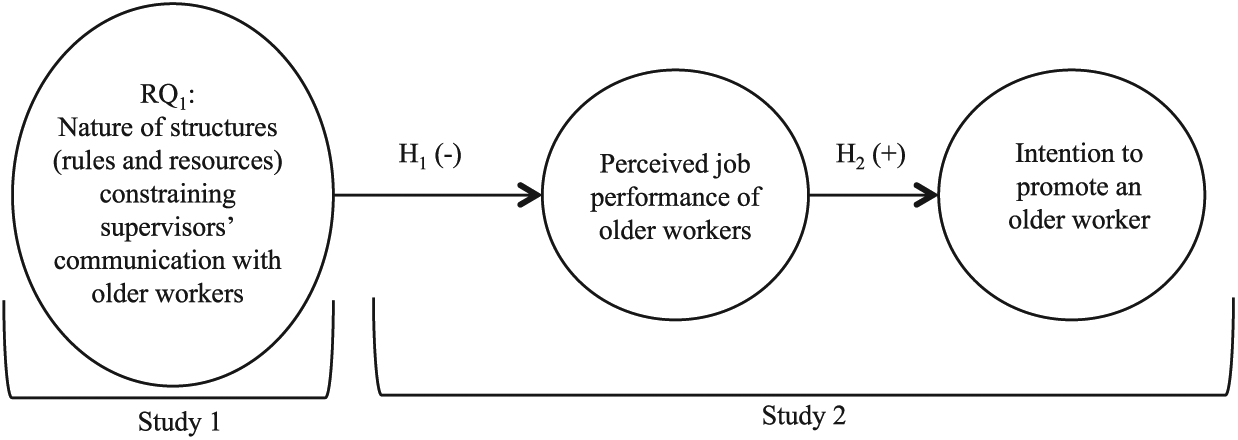
Conceptual model and study overview.
Study 1
The first study aims to investigate what structures (rules and resources) constrain supervisors’ communication with older workers regarding SE (RQ1). Following previous research (e.g., McCann & Giles, 2006; McCann & Keaton, 2013), older workers are defined as those above 50 years of age. In the Netherlands and beyond, workers above this age range are less likely to be retained and retrained (OECD, 2006; Sonnet, Olsen, & Manfredi, 2014).
Method
The author conducted interviews using a semistructured interview schedule, providing the structure to inquire about theoretical preconceptions while allowing for open questions and follow-up queries. The questions were structured at the level of rules (principles and routines) and resources (material and nonmaterial resources) and focused on the key supportive domains of older workers’ SE (professional development, health, and job rotation). To identify influential rules constraining supervisors’ communication, I structured the questions around supervisors’ perceptions of workers’ behaviors and competencies with regard to SE and the extent to which supervisors felt it was appropriate to address SE issues in conversations with older workers. Second, to identify influential resources, inquiries focused on the extent to which supervisors felt that they had the knowledge to address key domains of SE and the extent to which organizational context and features helped or hindered supervisors in addressing older workers’ SE.
Sample
The author recruited supervisors in several steps, using purposive sampling with a maximum variation strategy. In a first step, six supervisors were recruited from organizations that are considered pioneers in the Netherlands with regard to SE (Cuelenaere, Deckers, Siegert, & Bruin, 2009). In a second step, this sample was complemented with supervisors from organizations in diverse sectors and of diverse sizes. Data collection and analyses were alternated in iterative steps. The recruiting of supervisors continued until collecting additional new data no longer resulted in the emergence of new dimensions or explanations (Strauss & Corbin, 1990). The final sample consists of 19 supervisors, who oversaw at least one subordinate above the age of 50. Due to time constraints of the interviewees, the author interviewed in three occasions supervisors in pairs of two. 1 Supervisors were between 30 and 59 years of age, with four supervisors being younger than 50 years of age (M = 48.14, SD = 8.90). 2 Of all supervisors, seven were female. Participants indicated that they supervised between 10 and 80 employees.
Procedure and data analysis
The author interviewed all supervisors at their workplace in a quiet office space, where the interviews could take place without being disturbed. In addition, the author documented relevant observations made at the workplace. All interviews were fully recorded and transcribed and analyzed using the analysis program ATLAS.ti. The data were analyzed using a thematic theoretical approach to unravel constraining structures (i.e., rules and resources; Braun & Clarke, 2006). As the analysis was guided by analytical preconceptions about constraining rules and resources, the study’s approach was not purely inductive. The author engaged with the literature in an early phase of the analysis and used this engagement as a means to sensitize the analysis for data features that may contribute to answering the research question. The focus was on rules and resources that constrained supervisors in addressing and supporting SE during both formal and informal conversations with workers of diverse age groups generally and older workers specifically and how such impediments were amplified, shifted, or overcome across different circumstances. More specifically, the author tried to identify the impact of norms, schema (i.e., rules), knowledge, financial means, and time (i.e., resources) on communication of supervisors with older workers regarding SE. During repetitive steps, the transcripts were reread and initial codes generated. The author, then, collated these codes into themes and reviewed them in the ongoing analysis (see the appendix). Finally, themes were refined and renamed to generate theoretical maps on the identified levels. The final themes presented below were chosen based on explanatory power or commonality of response.
Results
In response to RQ1, structures (rules and resources) constraining supervisors’ communication with older workers regarding SE will be described below.
Rules
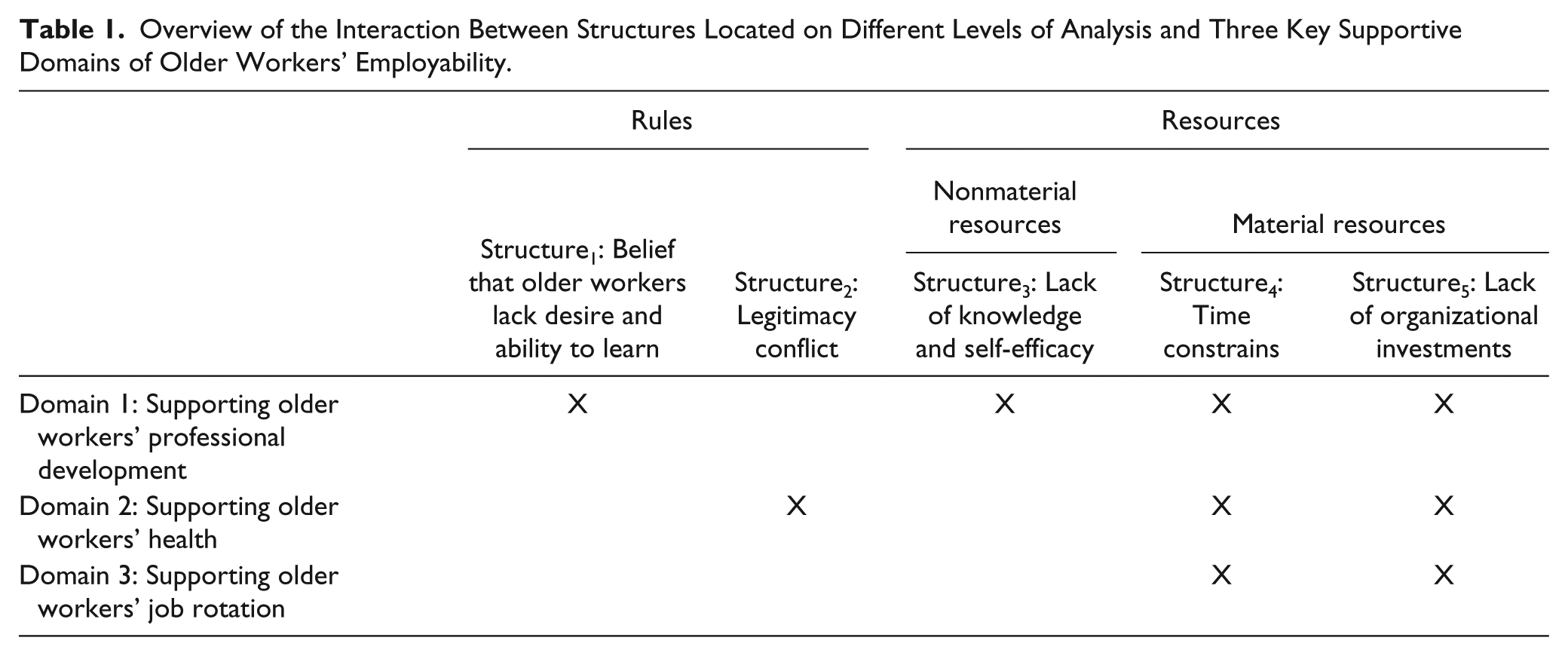
Structure1: Belief that older workers lack desire and ability to learn
The first subtheme resolved around negative perceptions of supervisors about attitudes and abilities of older workers. Most supervisors indicated that as workers age, their interests in professional development declined, as it becomes harder to motivate them to participate in training. Supervisor 1 expressed that s/he felt older workers “just don’t feel like learning anymore.” This negative perception about older workers’ desire to learn was often intertwined with a pessimistic perception of the extent to which the training of older workers could actually be beneficial. In fact, some interviewees doubted whether older workers are capable of improving certain skills: “It is more difficult for them [older workers] to remember all that stuff and to keep up to date” (Supervisor 10).
Supervisors did recognize the need for training among their elderly subordinates. For example, Supervisor 10 indicated that he or she recognized that one of his or her older subordinates needed retraining of technology skills but because “he had been in this job for such a long time” he or she assumed the employee was not interested and decided not to discuss the matter. In contrast, he or she decided to alter the employee’s duties to allow the performance of alternative and more simplistic tasks. By avoiding the conversation about training altogether, the older employee missed out on an opportunity to improve his SE, which further reinforced the idea of his incompetence and indolence. The operating mechanism seemed to further reinforce unfavorable beliefs about older employees’ competencies, so that a lack of interaction leads to actual decreased ability. The lack of interaction between supervisors and older workers about training and education in turn bolsters the idea that older workers are neither capable nor motivated to invest in their professional development. Overall, this structure functioned as both the medium that hindered supervisor–subordinate interactions and the outcome of actual decreased opportunities, which in turn reproduces this constraining structure.
Structure2: Legitimacy conflict
A different theme that emerged relates to the legitimacy boundaries that supervisors experienced in addressing issues related to the well-being and health of older workers. This legitimacy conflict structure suggests the extent to which supervisors felt it was appropriate to discuss health-related issues with older workers.
3
Supervisors expressed that issues related to older workers’ health and personal lifestyle are difficult to openly discuss. They felt these issues belong to the personal domain of workers and that it is not up to them to interfere. Supervisor 11 would only address health issues with her subordinates when daily work tasks were affected by it: Not everything needs to be shared within the context of the organization. I think it is too difficult to discuss this [health issues] because you have respect towards the other [. . . .] But when it starts affecting daily work tasks . . . That’s the boundary line. Once that line is crossed, we will talk about it. Even though that is very difficult. (Supervisor 11)
Only at the point that employees started to malfunction or drop out due to health-related issues, supervisors felt they could legitimately address health issues. As a consequence, supervisor–subordinate interactions about health-related issues seemed to be often reactive rather than proactive in nature. The experience of legitimacy constraints thus hindered preemptive discussions about physical and mental burdens of daily tasks, with actual consequences for the extent to which older employees are supported and facilitated in their jobs. This mechanism, in turn, might reinforce experienced tensions in discussing health-related issues at the workplace.
Resources
Structure3: Lack of knowledge and self-efficacy
Relatedly, the data revealed that supervisors at times feel incapable of convincing older workers of the importance of participating in professional training. Supervisors reported feeling disturbed by the lack of urgency to improve their SE experienced by older workers. Interviewees explained that older workers often mistakenly feel secure in their jobs, due to change fatigue or generous employment protection, which makes them ignorant of potential (external) threats to their employment position. According to the interviewees, this sense of security prevents older workers from adopting a proactive attitude with respect to their employability, which paradoxically decreases their current work ability and therefore future job security. Supervisors felt that this practice hindered them from getting their message across: “It is quite difficult to really get through to them and make them aware of reality. While for some, time is really running out, and they should act now” (Supervisor 7).
Supervisors felt incapable of changing older workers’ attitude toward professional development due to a lack of know-how. Some interviewees admitted that they struggled with how to adequately respond to the dejuvenation of their team, as they lacked the needed knowledge to do so (“We are just figuring things out,” Supervisor 5). This was, in particular, the case for supervisors of private-sector organizations who reported feeling caught between productivity pressures and employability concerns about their aging team. Nevertheless, the analysis indicated that a number of supervisors did not doubt their own capability to effectively address the issue and attached great importance to spending time addressing their workers’ current and future careers during formal and informal talks. These supervisors emphasized that they highly valued their connection with their subordinates and that they invested a “disproportionate amount of time” in conversations with them (Supervisor 13). Yet, these supervisors reported that other supervisors do fail in this respect: “There should be more awareness among other managers. Currently, managers deal with it [SE] in completely different ways” (Supervisor 9). The consequences of such a lack of awareness among supervisors about the importance of the issue were conceived as detrimental to individual older workers’ careers: “People are entirely dependent on whether a manager takes the trouble to actually see their subordinates for what they are worth. If they don’t, this has a severely detrimental effect” (Supervisor 13).
The lack of knowledge and insight functioned as a constraining structure through which interactions about SE issues were avoided, which in turn reinforced this very structure. By not engaging in interactions about the issue, supervisors did not acquire the needed knowledge to accurately deal with the issue, herewith further strengthening this constraint.
Structure4: Time constraints
Moving to the level of material resources, supervisors expressed that even though they were willing to invest in their subordinates’ future, the daily pressures of productivity overruled the opportunity to really make a difference. Supervisors indicated that they are held accountable for the results of today and tomorrow. The pressure to live up to these expectations jeopardizes the achievement of the long-term target of sustaining workers’ employability, because “short-term goals are always more important than long-term goals” (Supervisor 3). Investments in older workers’ employability, for example, as participation in training and education, may “increase the workload for other staff members” (Supervisor 2) to keep the organization running.
Structure5: Lack of organizational investments
In addition, supervisors expressed that they do not succeed in improving older workers’ SE due to a lack of organizational investments. This structure relates to the availability of financial and tangible resources for SE, such as budgets for training or the availability of job-rotation centers. Supervisors indicated that training programs offered by their organizations are generally not differentiated per age group, while knowledge and training needs vary across workers’ life spans. In addition, supervisors voiced experiencing difficulties in helping their workers find alternative job positions when they were no longer employable in their current position, as such positions were often simply not available within or outside their organization: We all believe it [SE] is important, but there is not a concrete plan in place to deal with it [. . . .] How we act upon SE differs a lot across situations, and I do not feel that [organizationX] has a clear policy or vision in this respect. Or at least, I haven’t seen it. (Supervisor 11)
In sum, the results of Study 1 reveal a set of rules and resources that constrain supervisors’ communication with older workers regarding SE (RQ1). An overview of these identified structures is provided in Table 1.
Overview of the Interaction Between Structures Located on Different Levels of Analysis and Three Key Supportive Domains of Older Workers’ Employability.
Discussion
Relying on qualitative interview data with supervisors, the study reveals five constraining structures that inform and emerge from supervisors’ avoidance to discuss SE issues with older workers. First, the results show that avoidance of communication about professional development originates from, and concurrently reinforces, stereotypes about older workers’ desire and ability to learn. Second, supervisors at times felt conflicted about their legitimacy to address health issues in conversations with older workers. Although the field of health communication has documented that certain health-related topics are perceived as sensitive and potentially embarrassing, previous work has not yet identified such topics in the workplace (Bachman et al., 2018). Hampered communication consecutively reproduced this constraining structure, as a lack of health support at the workplace seemed to actually increase the need for it. Third, a lack of knowledge and self-efficacy was identified as an influential structure. Supervisors felt at times conflicted regarding their ability to address SE issues appropriately and adequately, which limited the capacity for negotiation. In turn, avoidance of communication about the issue further reproduced the lack of knowledge and self-efficacy regarding the issue. Last, both time constraints and a lack of organizational investments in SE were identified as influential structures. These findings illustrate that the ability of supervisors to accommodate older workers depends on the support they receive in their organizational context. In sum, the reproduced practices of avoiding interactions with older workers regarding their SE is informed by, and reproduces, constraining structures regarding older workers’ SE.
The first study answered the question of what structures inform and emerge from supervisors’ avoidance of conversations with older workers regarding their SE needs. To fully appreciate its consequences, the identified constraining structures are quantified and tested among a larger sample of supervisors in Study 2.
Study 2
The goal of Study 2 was to trace the consequences of structures constraining supervisors’ communicative actions regarding older workers, as identified in Study 1, for employability-related outcomes.
Method
Based on the results of Study 1, a questionnaire was drawn up in Dutch and distributed among a sample of Dutch supervisors recruited by a Dutch research company (n = 380). Supervisors above 22 years of age were allowed to participate if they supervised at least one older worker and carried managerial responsibility for at least five workers—to test the hypotheses among people who spend a substantial portion of their time managing human resources. Participants were informed about the meaning of older workers (i.e., workers aged 50 years and above). Two attention check questions were included—one at the beginning and one at the end of the survey—as it was deemed vital that respondents read the instructions seriously and thoroughly. A total of 174 participants were removed from the sample because they did not finish the survey, failed at one or more of the attention checks, or were identified as an outliner, making the sample size 206. 4 The average age of respondents was 47.74 years old (SD = 10.99); 34.5% were female. Almost all respondents (94.2%) worked at least 30 hr during a general week; 50.5% worked at a private-sector organization, and 13.59% worked at a public–private partnership organization. Most of the supervisors completed higher professional education (52.4%) and supervised older workers with secondary vocational education (34.9%) or higher professional education (31.1%). Most respondents indicated having contact with older workers at least 4 days per week (76.7%).
Constraining supervisor structures
To quantify the identified structures, multiple indicators were drawn up. All indicators measuring the structures were pilot-tested (n = 33) and subjected to internal consistency tests. Based on these results, items were removed, altered, or reformulated for the final sample. 5 All structures were measured on a 7-point scale (1 = disagree very strongly, 7 = agree very strongly). 6
Structure1: Belief that older workers lack desire and ability to learn
The items used to measure the extent to which supervisors believe older workers lack desire and ability to learn were partly based on Maurer et al. (2008). Respondents were asked to answer five questions measuring both subdimensions. A second-order confirmatory factor analysis (CFA) model was constructed by assigning the items to the two subdimensions (beliefs of older workers’ a. desire and b. ability to learn), which were then assigned to the second-order factor “belief that older workers lack desire and ability to learn.” Higher scores indicate stronger negative beliefs. The subdimension “belief that older workers lack desire to learn” was measured using two items (M = 3.34,SD = .09, α = .83, example item: “The older workers that I supervise respond enthusiastically on my encouragements to take part in a course, workshop or seminar” [reverse scored]). The subdimension “belief that older workers are not able to learn” was measured with three items (M = 3.62,SD = 0.09, α = .84, example item: “Older workers have a hard time learning new skills”). The CFA-model with a second-order factor representing beliefs of older workers’ (a) desire and (b) ability to learn fits the data better, Akaike information criterion (AIC)second-order factor solution = 9,504.24, AICtwo-factor solution = 9,510.74.
Structure2: Legitimacy conflicts
Two items were included as indicators of the latent construct “legitimacy conflict,” which measures the extent to which supervisors experience legitimacy conflicts when talking to older workers about health-related issues. Higher scores indicate less perceived legitimacy to address health-related issues (M = 3.52, SD = .09, α = .81, items: “I experience talking about health-related issues with the older workers that I supervise as a breach of their private life”; “It is inappropriate to talk to older workers about their health”).
Structure3: Lack of knowledge and self-efficacy
Two items were used as indicators of the latent construct “lack of self-efficacy” to encourage older workers to participate in training and professional development. Higher scores indicate a lower perception of their ability to accommodate older workers (M = 2.71, SD = .08, α = .78, items: “I do not know how to make the older workers I supervise aware of the importance to continue learning and developing”; “I struggle with the question how I can best motivate the older workers I supervise to participate in work-related workshops or seminars outside working hours”).
Structure4: Time constraints
To measure the extent to which time constraints impede supervisors’ accommodation of older workers’ SE, respondents were asked to respond to three statements regarding their available time for addressing older workers’ (a) professional development, (b) health, and (c) work situation. The item measuring lack of time to deal with older workers’ professional development was removed due to problematic convergent validity. The two remaining items were assigned to the latent construct “Time constraints.” Higher scores indicate less time to communicatively accommodate these domains of older workers’ employability (M = 2.79, SD = .10,α = .95, example item: “I have insufficient time to talk with the older workers that I supervise about job mobility”).
Structure5: Lack of organizational investments
Respondents were asked to respond to three statements regarding the extent to which their organizations invest sufficiently in older workers’ (a) professional development, (b) health, and (c) work situation to measure the latent construct “lack of organizational investments in sustainable employability.” Higher scores indicate low levels of organizational investments (M = 3.29, SD = .09, α = .87, example item: “My organization invests sufficiently in the job mobility of older workers” [reverse scored]).
Mediator and dependent variable
Perceived job performance of older workers
Four items 7 adopted and adjusted from Williams and Anderson (1991) were used to measure the latent construct “perceived job performance of older workers.” Supervisors responded to statements regarding the performance of their older subordinates on a 5-point scale (1 = disagree completely, 5 = agree completely), such as “The average older worker that I supervise adequately completes his or her assigned duties.” Higher scores indicate more positive judgments about older workers’ performance (M = 4.01, SD = .04, α = .93).
Intention to promote an older worker
Last, supervisors’ intention to offer an older worker a promotion was measured using a simulation and decision task. Respondents were asked to imagine that, due to the vacancy of a position, they could offer one of their subordinates a promotion. Respondents were informed that there were two candidates and asked to carefully read two short biographies about them. The two candidates had the same profiles, except for age: One candidate was born in 1961, while the other was born in 1988. The following was done to assure that the two candidates were equally suitable for the promotion and that only age affected respondents’ decision; both candidates were male, worked an equal number of years within the organization, and had a comparable level of education. A pilot test showed that both candidates were seen as equally suitable for the job when the candidate’s age was omitted from the biographies. The year of birth of the candidates was randomly reversed across biographies so that half of the respondents were exposed to the scenario in which Candidate A was old and Candidate B was young, while the other half was exposed to the scenario in which Candidate A was young and Candidate B was old. After reading the biographies, respondents were asked whom they would promote. The output of the first scenario was rescored, so that the choice for a younger applicant (0) could be compared with the choice for an older applicant (1) (M = .62, SE = .49).
Data analysis
To test the hypothesized relations, structural equation modeling (SEM) was used. The analysis was performed using R using the lavaan (latent variable analysis) library (Version 0.5-20; (Rosseel, 2012), as this package allows for probit modeling of the binary outcome while testing for fit indexes and indirect effects. Coefficients were calculated using the diagonally weighted least squares (DWLS) estimator with robust standard errors (B. Muthén, 1984). To assess model fit, the following fit incremental indices were inspected: Comparative fit index (CFI) and the Tucker–Lewis index (TLI). Values above .95 indicate good fit (Hu & Bentler, 1999). In addition, the root mean square of approximation (RMSEA) was inspected. Here, values below ≤0.05 indicate good fit (Kline, 2011). Last, to evaluate the fit of the hypothesized model, the weighted root mean square residual (WRMR) was inspected, with the cut off value of <1.0, which is especially appropriate for models with dichotomous outcome variables (L. K. Muthén & Muthén, 1998-2010; Yu, 2002).
The a priori specified CFA model was examined to inspect the discriminant and convergent validity. The CFA model fits the data well: χ2(114) = 169.91, p = .001; CFI = .98; TLI = .97; RMSEA = .05 (90% confidence interval [CI]: [.03, .064]). The results are consistent with discriminant validity as factor intercorrelations are well below the threshold value of .85 (Kline, 2011). In addition, Figure 2 shows that convergent validity was generally satisfactory, as most standardized factor loadings were above .70 (Kline, 2011). These results justify the further examination of the structural model.
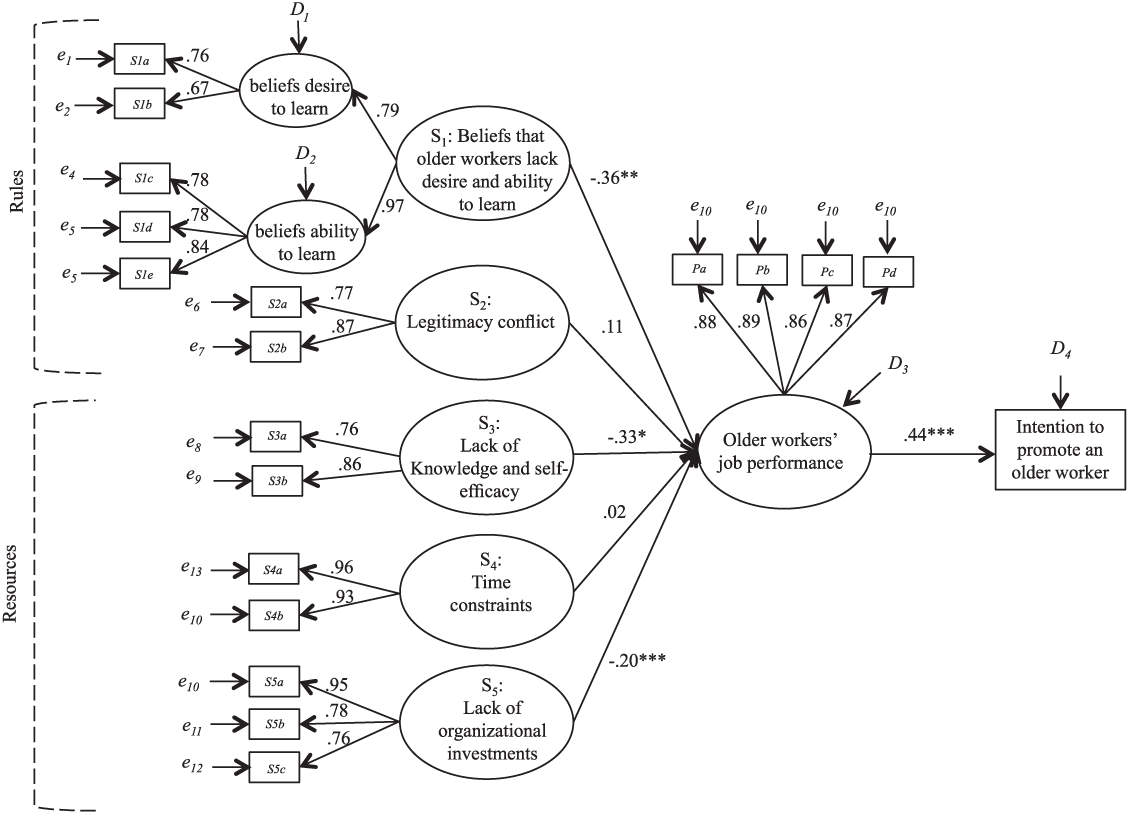
Predicting Intentions to Promote an Older Worker With Supervisor Structures (Standardized Parameter Estimates).
Results
Descriptive Statistics
Next, some descriptive findings are discussed. Supervisors indicated that they talked with older workers about professional development and health at a median rate of every 6 months, and about job mobility at a median rate of once a year. Respondents indicated that they discussed professional development, t(205) = 3.61, p < .001, and job mobility, t(205) = 2.96, p < .01, more frequently with younger workers (M =3.68, SD =.06; M = 3.50, SD =.07, respectively) compared with older workers (M = 3.43, SD =.06; M = 3.29, SD =.07, respectively). No significant differences were found regarding communication about health-related issues with older (M = 3.36, SD =.09) and younger workers (M = 3.21, SD =.10). Additional analyses, shown in Table 2, reveal furthermore that young supervisors and those who supervise low-educated older workers experience higher structure strength.
Differences in the Strength of Structures as Experienced by Younger and Older Supervisors, and Those Who Supervise Low Educated and Highly Educated Older Workers.
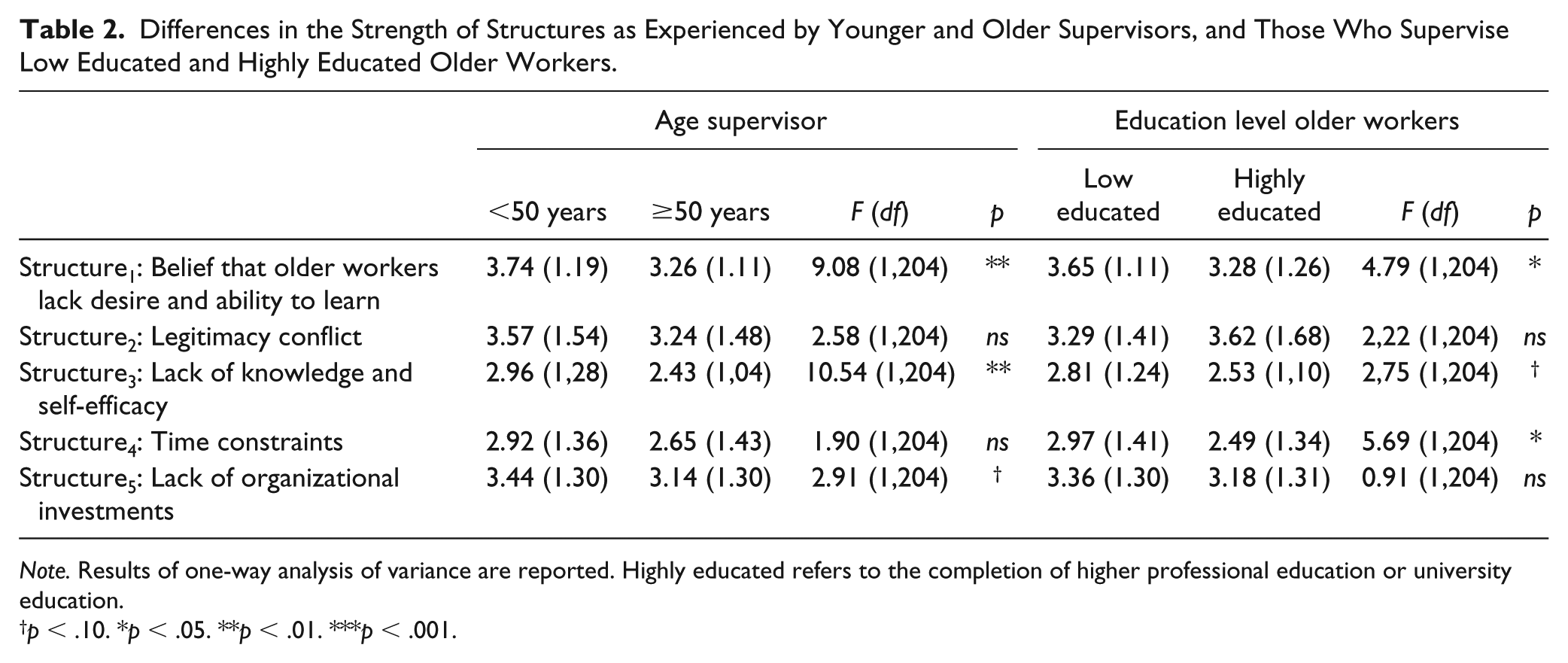
Note. Results of one-way analysis of variance are reported. Highly educated refers to the completion of higher professional education or university education.
p < .10. *p < .05. **p < .01. ***p < .001.
Hypothesis Testing
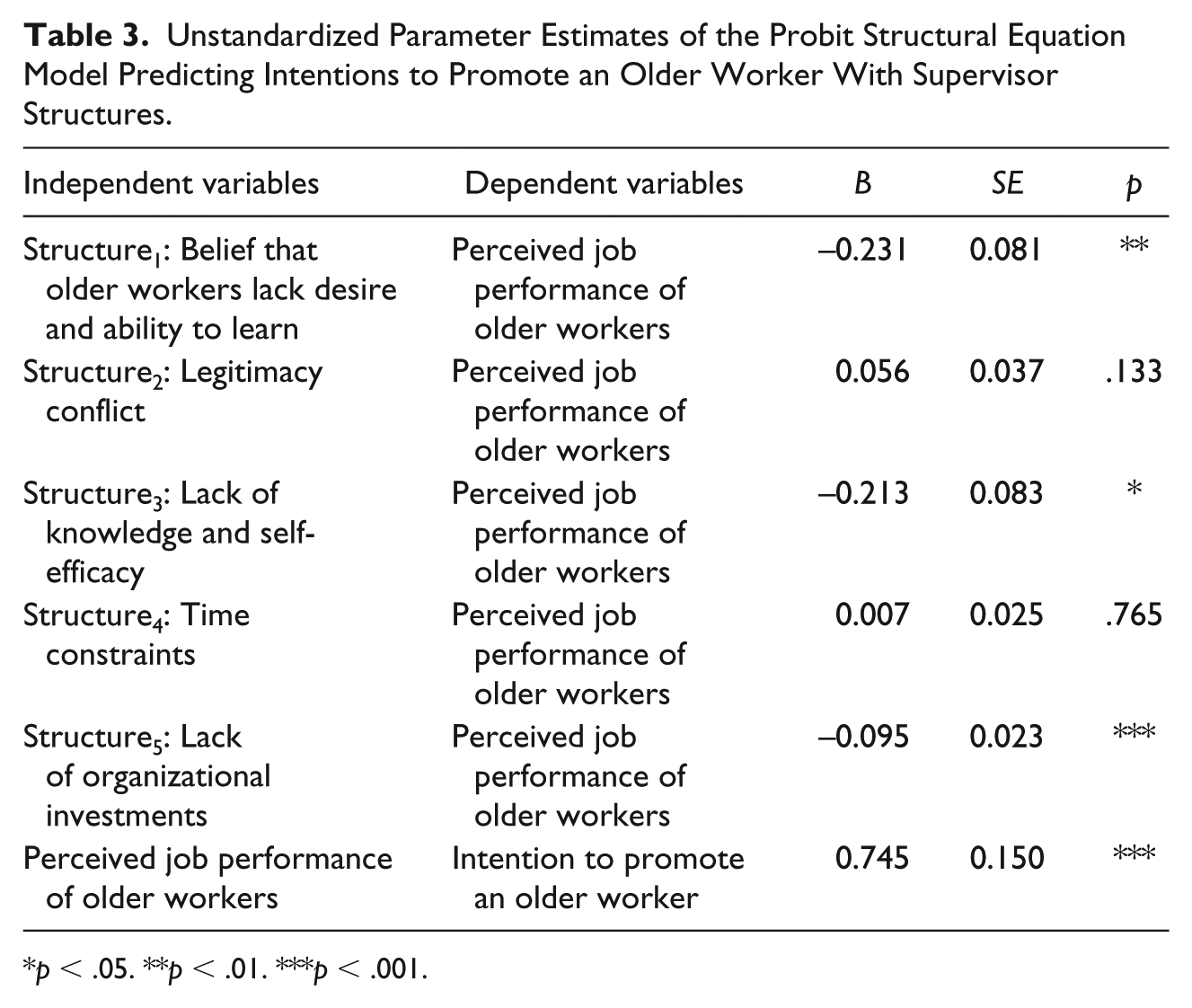
The results of the hypothesized model are discussed. The model fits the data reasonably well: χ2(134) = 153.99; CFI = 0.94; TLI = 0.92; RMSEA = 0.04 (90% CI: [.025, .056]); WRMR = 0.56. Table 3 displays the unstandardized parameter estimates of the model, and Figure 2 shows the standardized parameter estimates. The results show that three structures are negatively associated with supervisors’ perception of older workers’ job performance; negative paths are found from structure1 (the belief that older workers lack desire and ability to learn), structure3 (lack of knowledge and self-efficacy), and structure5 (lack of organizational investments). Substantially this means that if the strength of structure1, structure3, or structure5 increases by 1, perceived job performance decreases by .23, .21, and .10, respectively. Structure2 (legitimacy conflicts) and structure4 (time constraints) were not significantly associated with the perceived job performance of older workers. These findings offer partial support for H1.
Unstandardized Parameter Estimates of the Probit Structural Equation Model Predicting Intentions to Promote an Older Worker With Supervisor Structures.
p < .05. **p < .01. ***p < .001.
Next, significant indirect effects from constraining supervisor structures on the likelihood to promote an individual older worker (via perceived job performance of older workers) were expected (H2). As could be expected, a positive association between the perceived job performance of older workers and the intention to promote an older worker is found; when perceived job performance of older workers goes up by 1, the expected change in log odds is .75 (odds ratio = 3.46, SE = .94). It is verified if structure1, structure3, and structure5 contribute to the intention to promote an older worker via reduced levels of perceived job performance. The indirect (mediated) path from structure1 (beliefs about older workers desire and motivation to learn) to intention to promote an older worker via perceived job performance of older workers was significant: B = –.17, SE = .07, p < .05. Next, the indirect path from structure3 (lack of knowledge and self-efficacy) to the intention to promote an older worker is significant: B = –.16, SE = .07, p < .05. Also the indirect path from structure5 (organizational investment) to intention to promote an older worker is significant: B = –.07, SE = .02, p < .01. It is concluded that structure1, structure3, and structure5 contribute to lower probabilities to promote an older worker via reduced levels of the perception of older workers’ job performance. Robustness checks reveal that the results hold when adding covariates (e.g., supervisors’ age, education level respondent, education level subordinate older workers, the intensity level of contact with older workers).
Discussion
In Study 2, the supervisor structures identified in Study 1 were quantified, and their consequences for perceptions of supervisors regarding older workers’ job performance as well as their intention to promote an older worker were traced. The results show that negative beliefs about older workers’ desire and ability to learn, a lack of knowledge and self-efficacy, and low levels of organizational investments in older workers’ employability were related to lower levels of perceived job performance of older workers and a lower intention to promote an individual older worker. These findings demonstrate that structures constraining supervisors’ communication with older workers regarding SE are associated with the extent to which older workers are able to perform well in their job, as well as the opportunities they receive to enhance their careers. The degree to which supervisors experienced legitimacy conflicts when talking about health-related issues, as well as the time constraints they experience in talking to older workers, was not associated with the perceived job performance of older workers. A potential explanation for this result is that, compared with the other supportive domains of employability (i.e., development and work situation), supervisors have limited influence on how workers’ health affects their perceived performance (as this may be shaped by workers’ health history and habits). In addition, as maintaining productivity levels receives high managerial priority, supervisors experience less hindrance of time constraints in case the perception of workers’ job performance decreases, as they, whether or not under time pressure, have to deal with the issue.
General Discussion
In response to the issue of workforce aging, European governments and organizations have adopted extensive regulations and policies to sustain older workers’ employability. Yet, even in the presence of strong national and organizational support, older workers often lack the agency to reap the benefits of such structures. Supervisors have been held accountable for this. Through communication, supervisors can help older workers reach retirement age successfully, while sustaining their health and performance. The current study investigated impediments to conversations between supervisors and older workers regarding SE issues through the lens of structuration theory. In a sequence of two studies, structures (i.e., rules, nonmaterial and material resources) that constrain supervisors to address older workers’ SE needs were identified and quantified. In addition, the study demonstrated that these structures negatively impact supervisors’ perception of older workers’ job performance, and in turn impede the likelihood that an individual older worker gets promoted.
A limitation of the current study is that older workers’ perspectives on supervisors’ communication and data on daily interactions were not included. As a consequence, it has not been possible to analyze how structures constrained and enabled supervisors’ actions in practice. Yet, given the important role that supervisors fulfill in supporting older workers’ SE, the perspective of supervisors was deliberately chosen as the focus of inquiry. Future research may benefit from including observations, shadowing, and fieldwork methods to investigate whether the perceived structures mirror the actual structures that constrain everyday life interactions. In addition, the cross-sectional design prohibits us to make strong claims about causality as both independent and dependent variables were measured at the same point in time; In fact, it is possible that lower perceived job performance of older workers further reinforced structures that constrain communicative actions of supervisors. Although this possibility should be acknowledged and further investigated, the here-tested hypothesized relationships were based on both theoretical and qualitative insights. Future studies are encouraged to unravel the causal relation between supervisor structures and employability outcomes across time. Future research may further investigate how supervisors who fall into the category “older workers” feel about this term.
Theoretically, the findings add to the study of intergenerational communication in the workplace and structuration theory in the following ways. It was shown that structuration theory offers a useful approach to study employability-related conversations in organizational contexts. The study has investigated how reproduced practices of avoiding interactions between supervisors and older workers’ regarding SE are informed by and reproduce structures by distinguishing between rules and resources. Herewith, the findings contribute to the emerging work on why and how dysfunctional processes of contradiction arise in several domains of social life, and with what domain-specific consequences (see also Hoeven, Miller, Peper, & den Dulk, 2017).
As proposed by structuration theory, social structures are both the medium and outcome of social action (Giddens, 1979, 1984). By extrapolating this notion of the duality of structure to the data under investigation, relevant insights emerged regarding how reproduced practices of avoiding SE conversations were informed by, and in turn reproduced, constraining structures. Extant literature finds that older workers’ SE is hindered by stereotypes about their ability and motivation to learn (e.g., Posthuma & Campion, 2009). The current study adds to this work by showing that these stereotypes are talked into being in conversations between supervisors and older workers. It was found that stereotypes constrained communication with older subordinates, and due to this lack of communication, stereotypes where conserved, in turn impeding the actual employability of older workers. Supervisors indicated that they believed older workers are not motivated to participate in training to begin with, so they decided not to talk about organizational resources regarding training opportunities with senior staff. This decision can make older workers believe that they are not worthy of investment in their professional development. In other words, stereotypes impede the capacity for negotiation, which materializes through lowered (perceived) job performance and reduced access, and in turn may strengthen negative stereotypes (see Ashcraft, Kuhn, & Cooren, 2009). This practice uncovers a reproduction process; by drawing on constraining structures, supervisors sustain and maintain the principle that older workers are not worthy or capable of training (McPhee et al., 2014). Hence, if governments and organizations aim to advance, rather than marginalize, older workers’ SE, supervisors’ stereotypical beliefs should be targeted. In sum, a lack of interaction regarding SE is informed by, and in turn produces, constraining structures.
Finally, the ability to quantify the structures that constrain supervisors’ communication with older workers and trace their effects on employability outcomes is a key contribution of the current study. It was found that the employability opportunities that individual older workers receive in the workplace (i.e., the chance to be promoted) decreased as a consequence of hampered productivity perceptions due to structures constraining supervisors’ actions. This finding indicates that constraining supervisor structures impede conversations with older workers, and consequently obstruct actual employability outcomes. These communication outcomes are at odds with national and organizational policies and objectives that have been put in place to improve the employability of senior workers in the Netherlands and beyond. The study demonstrates that, if older workers are to take advantage of such policies and resources, the identified constraining structures should be targeted.
The presented findings also have considerable practical potential. Practitioners and employers may use the here-proposed measurement instrument for the assessment of the influence of structures in the form of rules and resources on supervisors’ communicative behavior. In addition, the results serve as a key tool in developing guidelines for designing an intervention that may enable supervisors to increase interactions with older workers on the issue. The results suggest that organizations should make sure that essential nonmaterial and material resources are in place and that constraining rules are targeted.
More specifically, it was found that supervisors’ actions regarding older workers are enabled by specialized knowledge about SE. Offering training to supervisors about how older workers’ SE should be supported could serve this aim. During this training, supervisors should be provided with the opportunity to practice discussing SE-related issues, such as how to address health-related issues during conversations. The training can also serve as a means by which the commonly held beliefs about older workers’ ability and desire to learn can be openly discussed and called into question. To effectively target stereotypical beliefs, supervisors should be made aware of their biases and informed about the consequences of prejudice. In addition, measures should be taken on the organizational level. The results suggest that organizations should invest in SE, by providing supervisors with sufficient time to address the issue and by offering HR-policies that target workers’ job mobility, development, and health.
Footnotes
Appendix
Acknowledgements
I would like to thank Dr. Claartje ter Hoeven, Prof. Dr. Martine van Selm, and Prof. Dr. Rens Vliegenthart for their helpful feedback and support. I also want to thank the anonymous reviewers for their valuable suggestions.
Declaration of Conflicting Interests
The author(s) declared no potential conflicts of interest with respect to the research, authorship, and/or publication of this article.
Funding
The author(s) received no financial support for the research, authorship, and/or publication of this article.
