







Abstract
On December 4, 2017, Patagonia launched its “The President Stole Your Land” initiative on Twitter, Facebook, and Instagram. In so doing, the longtime corporate social responsibility (CSR) leader entered social media in a deliberately inflammatory and political manner. This initiative defies the principles of CSR often touted in the literature and provides for an intriguing case study. We engage in a close textual reading of initiative materials and identify discursive traces to gain insight into the paradoxical workings of CSR in the context of a hypermediated environment. Through analysis of how Patagonia harnesses wide-ranging and contradictory public input, we identify a strategy of communicating CSR to stakeholders with disparate interests. By exploring the intersection of organizational communication, rhetorical studies, and media theory, this article examines the discursive strategies afforded and precluded by wild public networks. We offer three wild public provocations as new discursive tactics for CSR practitioners.
On Monday, December 4, 2017, Patagonia turned its home page into a simple black and white message that read “The President Stole Your Land.” Identical messages were posted to the company’s Instagram account, Facebook, and on Twitter. Underneath this text was an explanation, “In an illegal move, the president just reduced the size of Bears Ears and Grand Staircase-Escalante National Monuments. This is the largest elimination of public lands in American history.” This simple message was created in response to President Trump’s decision that day to shrink Bears Ears National Monument and Grand Staircase-Escalante National Park, thereby provoking intense reactions from audiences across social media as well as mass media, including The New York Times, Washington Post, The Guardian, Fortune, CNN, USA Today, and Fox News.
Many applauded Patagonia’s effort as a sign of the company’s corporate social responsibility (CSR) efforts to promote outdoor recreation alongside environmental advocacy. Others labeled the move as a stunt and pointed out the dissonance between a company that profits from consumption and its efforts toward environmental protection. Such disparate responses pose the following concern for Patagonia: Can a successful corporation that depends upon consumption to thrive also be an environmentalist? This is an important question for traditional stakeholders and nontraditional stakeholders alike. Critics, supporters, consumers, politicians, and peripheral actors are all able to interact with Patagonia on numerous social media platforms, creating an exploded stakeholder pool. The diverse array of users ignited a wildfire of responses that swept across social media networks. This case study explores how Patagonia, relying on a strong mission and sense of identity, utilizes the paradox of being lauded as both a CSR hero and a money-making corporation to launch an issue into the greater public discourse. More specifically, we use the “The President Stole Your Land” initiative to examine CSR in the context of what Brunner (2017) termed wild public networks. Our research is driven by this question: How does Patagonia’s deployment of CSR in a densely mediated environment forego the goal of inciting productive interactions and instead embrace the movement afforded by an exploded stakeholder pool, politically energized discourses, and fragmented conversations that travel wildly across platforms to raise awareness? Through this exploration, we identify the discursive strategies facilitated in the contemporary media environment that leverage an existential organizational paradox into a tool.
This study contributes to two distinct areas of communication research: corporate social responsibility, wherein a CSR paradox becomes a tool to create movement and connections, and media theory, which explores CSR outside of a company’s own controlled website and into the cacophonous realm of social media. We contribute to the practice of CSR by identifying the discursive strategies Patagonia used in the context of a controversial social media campaign and suggest that these strategies may be particularly well-suited for organizations seeking to engage with politically charged topics.
Patagonia: Corporate Global Citizen
Many have touted Patagonia as an ideal corporate citizen and pioneer of CSR (MacKinnon, 2015; Sirtori-Cortina, 2017; Watson, 2015). According to Patagonia’s mission statement, finances, and public statements, giving back to society and the planet is bound with the company’s identity. Patagonia’s website reflects its diverse mission and is equal parts environmental advocacy, retail shop, and educational ambassador. In 2015, the Sustainability Leaders Report ranked Patagonia second on a list of companies that “best integrated sustainability into its business strategy” (Watson, 2015, para. 2). Patagonia achieved this standing as a result of various initiatives, including offering to fix worn goods, recycle old clothes, use organic and sustainable materials when possible, and sell used clothing. Patagonia promoted these initiatives via a variety of marketing efforts, including an ad in The New York Times on Black Friday in 2012 that read “Don’t Buy This Jacket” and outlined the environmental costs of producing the featured jacket (Cave, 2016). The ad, which received a great deal of media attention, was paradoxically credited with significantly increasing sales that year (MacKinnon, 2015). Between 2010 and 2015, the brand saw double-digit growth in profit, tripling profits between 2008 and 2014. These economic gains, which made Patagonia a target of critique for profiting off of consumption while promoting conservation, are indicative of what business ethicists Pava and Krausz (1996) called the “paradox of social cost.”
Patagonia has a long history of environmental activism that arguably does far more than what Christensen, Morsing, and Thyssen (2013) described as “aspirational talk” (communication that announces ideals and intentions, but does not reflect action). Yvon Chouinard founded the company as Chouinard Equipment in 1973 and made a living selling climbing hardware out of the back of his car during his outdoor adventuring. As business grew, Chouinard developed the company’s first catalogue, which opened with an essay “exhorting climbers to open their eyes to the environmental impact of their sport,” thereby critiquing the very people to whom his products were aimed (Sirtori-Cortina, 2017, para. 8). Later, Chouinard changed the company name to Patagonia and, keeping in line with his dedication to environmental preservation, donated office space, a mailbox, and money to a group of students trying to save the wildlife of a local river. He also pledged 10% of pretax profits to environmental groups and began leading environmental campaigns (Sirtori-Cortina, 2017). Patagonia’s first national environmental campaign launched in 1988. We point out these successes not to praise Patagonia but to establish the company as a leader in CSR efforts.
Wild Public Networks
Patagonia’s more recent environmentalist efforts demonstrate a sophisticated media plan that taps into every existing medium, including social media and mass media, thereby making it an ideal case study for exploring CSR as it unfolds over wild public networks (Brunner, 2017). Wild public networks respond to and update Habermas’s concept of the public sphere, which emphasizes the importance of public deliberation via rational discourse, by taking into consideration the changes precipitated by our contemporary media environment and an exploded stakeholder pool. Today’s public sphere is not a sphere at all, but a dense shifting assemblage of overlapping wild public networks (WPN) in which myriad unique users are interacting in real time across vast distances. If we reconceptualize the public sphere as WPN, we witness people arguing using not rational debate, but largely affective pleas in the form of GIFs, images, and impassioned responses. By affect, we mean the pre-personal intensity that moves people to act (Massumi, 1995). For Kuhn, Ashcraft, and Cooren (2017), affect is important to organizational communication because it partially defines today’s organizing in terms of how people are moved to act: “To say that affect is an energetic stream is to insist on a force in motion . . . To be affected, in this sense, is to be moved . . . we might abridge affect as the moving flow or sensory force that animates worlds” (p. 60, italics in original). Twitter, like many of its social media counterparts, plays on heightened emotions rather than rational debate, drawing users into interactions with strangers from vastly different contexts in a way that can exacerbate misunderstandings, especially in a politically polarized environment (Fuchs, 2017).
The contemporary social media environment, consequently, changes the very scope, spread, and tenor of public discourses that are so essential to CSR efforts. These shifting media terrains also demand new methods, especially as corporations embrace them as CSR tools. Importantly, WPN are energized by activity rather than content, affect over reason, and quantity over quality. Thus, the focus for those studying WPN is movement, connections, and trends. CSR efforts as they occur over WPN must engage in a complex and messy array of ongoing arguments that are further energized by the contemporary political climate. In this context, the notion of the traditional stakeholder as a customer, vendor, or an interested party becomes less useful. Instead, companies foster fluid stakeholder communities of fans, friends, advocates, ambassadors, and even haters—entities with often unclear relations to organizations and frequently disparate voices (Dawson, 2018). When we argue for a reconceptualization of the public sphere that accounts for an exploded stakeholder pool through WPN, we are also arguing for new methods such as discursive mapping, a technique that follows conversations as they tumble and spread across overlapping networks, connecting users several degrees of separation apart from one another.
In looking to Patagonia’s initiative within the context of a CSR paradox, this study responds to a recent call by Wong and Dhanesh (2017) to examine how corporations negotiate CSR tensions in mediums beyond their own websites. Patagonia invests heavily in its social media: It hires professional photographers to curate its Twitter, Facebook, and Instagram feeds; employs 91 brand ambassadors to venture into the wild, take pictures and video, and blog about their experiences; and encourages citizen involvement through outreach activism. Patagonia also creates its own media. Beginning in 2014 with the release of DamNation, which details the impact of river dams across the United States, Patagonia began funding documentaries targeted at specific environmental initiatives. In 2015, the company released Jumbo Wild, a film aimed at protecting an area in British Columbia, Canada, from being turned into a commercial ski resort. These efforts have been powerful for Patagonia’s various environmental efforts, but also opened the company up to attacks as social media users employ comment feeds to critique the brand and organize boycotts.
Patagonia’s “The President Stole Your Land” initiative adopts a strategy that abandons the assumption that one’s message can be controlled and, instead, taps into the wildness of public networks. Whereas in the past, organizational paradox and CSR scholars have argued that meaning grows out of opposing or contradictory discourses locked in dialectical and even paradoxical relationships (see Cheney, Roper, & May, 2007; Putnam, Fairhurst, & Banghart, 2016), in this study, we argue that the wildness of public networks no longer privileges meaning, but instead prioritizes generating movement and forging connections. Thus, the success of Patagonia’s initiative lies in its ability to generate conversations among an increasingly disparate group of stakeholders and use affect to incite movement. As a result of this shift in focus, the emerging CSR paradox is no longer one to be resolved, but, rather, embraced and extended. This argument complements existing organizational communication literature with media theory, by illustrating how the landscape upon which organizations must deploy CSR efforts has changed.
CSR Meets WPN
CSR describes a corporate commitment to improve societal well-being through discretionary business practices and contributions of corporate resources (Du, Bhattacharya, & Sen, 2010). Friedman (1970/2007) first used the term, deploying it as a rather derogatory one by stating that as corporations only had responsibility to their shareholders and the bottom line, acting in line with a perceived social benefit was, in fact, irresponsible. The current debate surrounding CSR originated in the 1990s and consists primarily of allegations that firms handle their social responsibilities “with much spin and without real substance” (Lenssen, 2007, p. v). This quandary fuels public and academic debate and has been exacerbated by recent social, political, and economic phenomena as well as the advent of social media. From its very inception, the concept of CSR has been a paradoxical one.
Illustrative of this paradox, at least three contemporary, equally problematic perspectives on CSR exist today: (a) CSR as incompatible with the profit imperative of the corporation, (b) CSR as an attempt to rethink capitalism in terms of shared value, and (c) CSR as “green washing” (Fleming, Roberts, & Garsten, 2013). While problematic, the shared value perspective has been popular in both public and academic discourse; thus, companies that integrate social mission, business, and brand are conceived of as ideal CSR practitioners. Pertinent to Patagonia, Bullis and Ie (2007) argued that any contemporary consideration of CSR is incomplete without the inclusion of ecological considerations. They conceptualized the corporation as an actor whose singular interest in profit is not nearly as important as its role in the global environmental crisis. In this role, a corporate actor understands that the well-being of the planet and all people is mediated through its organizational activities. Therefore, in the case of Patagonia, the mediation mandated by its organizational mission and corresponding activities suggests that the corporation is an illustration of the ideal global citizen and environmentalist.
Despite Patagonia’s status as an ideal global citizen, and as evidenced in the responses to its initiative on social media, companies advancing CSR often find themselves in a multilayered paradoxical situation, managing various contradictions and tensions. The paradox of social cost indicates that companies engaging in CSR do financially as well or outperform companies that do not (Pava & Krausz, 1996). Relatedly, a paradox exists in that corporations espouse adoption of socially responsible practices, but seem to continue business as usual, thus, not making any real difference (Fleming et al., 2013). Alternatively, and paradoxically, corporations taking any social stand that is politically controversial risk alienating stakeholders and losing business, suggesting that CSR functions best when not entangled in politics (Rodriguez-Villa & Bharadwaj, 2017). Putnam et al. (2016) defined paradoxes of this sort as “contradictions that persist over time, impose and reflect back on each other, and develop into seemingly irrational or absurd situations because their continuity creates situations in which options appear mutually exclusive, making choices among them difficult” (p. 72). The paradox Patagonia faces is defined by its roles as a corporation, an environmentalist, and a political activist, and the tensions these three roles imply. Rodriguez-Villa and Bharadwaj (2017) suggested exploring the tensions affecting one’s customer base and addressing these tensions in public campaigns (i.e., Budweiser’s Super Bowl ad celebrating the immigrant background of one of its founders during a heated national debate about immigration). However, publicly exploring such tensions in the context of WPN, where the stakeholder becomes everyone with a social media account, moves the CSR paradox into a rowdy and raucous environment where a multitude of nonstakeholders engage.
Indeed, CSR is an existential paradox for organizations seeking to balance economic and business interest with social and environmental goals (Du et al., 2010). Rather than attempting to resolve it, Patagonia embraces the tension to drive new connections and conversations on social media. While corporations have previously found themselves in the midst of paradoxical CSR situations and scholars have identified the discursive strategies employed to manage image ramifications on one’s own website (see Wong & Dhanesh, 2017), Patagonia is in a unique position as a self-proclaimed activist company entering the messy realms of social media. In December 2017, it placed itself in the midst of political tensions thereby tapping into the force of the hypercharged social media environment. It is here that we want to pause to explore the contemporary mediascape.
Changing Mediascapes and Corporate Activism
The media environment in which Patagonia participates is marked by high engagement over multiple overlapping networks as hundreds of millions of users interact, share information, and gather data. Corporations use the same tools as activists, fake news websites, government entities, entertainment channels, news organizations, and the president to communicate, persuade, and fight. Thus, studies of CSR must look to media theorists, including Benkler (2006; with Benkler, Faris, & Roberts, 2018), Castells (2012), and Lovink (2011), all of whom have theorized the ways in which activists, corporations, and politicians deploy social media to connect disparate groups, organize action, surveil consumers/constituents, and incite discourse. Social media are characterized by an often cacophonous multi-vocality that engages contradictory viewpoints, while never settling on one “winning” view or agreement. Multi-vocality, by representing layers of history, interests, and viewpoints, comes to create another paradox for corporations dedicated to CSR similar to the colloquial, “be damned if you do, be damned if you don’t.”
Directing dialogue becomes almost impossible when what Delicath and DeLuca (2003) termed argumentative fragments, or “inventional resources for public deliberation . . . which shift the responsibility for argument construction to audiences,” are generated rapidly and move quickly across social media platforms (p. 317). In the case of Patagonia’s initiative, argument construction shifted to unruly and boisterous audiences that co-opted discourses and forged new connections with unlikely participants. Such a wildly hypermediated environment simultaneously offers promise and peril, opportunities and dangers, for users. As users construct their own version of the arguments being advanced using argumentative fragments, the multi-vocality simultaneously co-creates Patagonia as a profit-focused capitalist and a leftist political zealot, an environmentalist and a destroyer of the planet. This messy, moving, and rowdy media environment necessitates a different ontological perspective.
Examining the “The President Stole Your Land” initiative using wild public networks shifts our focus from individual users to the changing relationships precipitated by Patagonia’s initiative. Thus, the focus moves from Patagonia to mapping the interactions between Patagonia, the stakeholders it is engaging, and the audiences that are constructing new arguments. This move, thereby, responds to earlier calls by Bullis and Ie (2007) as well as recent ones by Wong and Dhanesh (2017) to move from examining CSR messaging on corporate websites to examining (social media) interactions. This shift also influences how we answer the question that drives our research: How does Patagonia’s deployment of CSR in a densely mediated environment forego the goal of inciting productive interactions and instead embrace the movement afforded by an exploded stakeholder pool, politically energized discourses, and fragmented conversations that travel wildly across platforms to raise awareness? Corporations can leverage social media by communicating socially responsible behaviors, yet social media can also present an ongoing challenge to a company’s reputation as users respond (Rim & Song, 2016). Our method maps such discourses as they unfold over social media, traditional media, and governmental statements.
Method
Mapping Discourses Across WPN
WPN guide our data collection and analysis by asking us to conduct historical research, delve into political policy, and examine argumentative fragments in the form of tweets, Instagram, and Facebook comments and videos surrounding Patagonia’s “The President Stole Your Land” initiative. Thus, the initiative becomes our case study and an identifiable and useful “rupture point” or shift in CSR discourse that provides focus and textual data for analysis. We perform a close reading and analysis of the texts generated with the onset of Patagonia’s campaign, as well as the discourses to which users linked. This inductive effort includes examining material related to the initiative such as company-generated posts on social media outlets, company-generated statements published in traditional media outlets and then posted on social media outlets, and the augmented public response to these messages on social media.
Data collection
Patagonia carried out its campaign largely on social media. The elements of the initiative published on the company’s website, blog, and throughout traditional media were immediately reposted on Patagonia’s social media platforms and, thus, invited networks to respond. Because we are interested in how Patagonia connected various discourses for the CSR effort, we focus our data collection on the materials the company shared as part of the campaign. We also examined Patagonia’s website and the related company blog posts dedicated to this controversy.
The social media posts were gathered by searching Instagram, Facebook, and Twitter for the December 4, 2017 initiative announcement and following the ensuing interactions. Although we conducted the data collection in March 2018, reflecting months of accumulated interactions, Patagonia did not post about the campaign past the 3-day span covered in this study. As a result, most of the social media interactions were contained within a few days, providing us with relatively stable text (as much as this is possible on WPN).
On Instagram, the company posted only once, the original initiative message. That post was liked 234,367 times and has generated 3,410 comments as of March 2018. On Facebook, two posts from company spokespeople on December 5 and 6 followed the initial post. The original campaign post from December 4 generated 58,000 reactions, 82,242 shares, and 1,045 comments. The December 5 post of a blog article penned by a Patagonia executive garnered 10,000 reactions, was shared 3,940 times, and generated 642 comments. The December 6 post of a Time article written by Patagonia’s CEO generated 36,000 reactions, 7,174 shares, and 880 comments. Both the blog and the article were directly related to the campaign. The original Twitter campaign post generated 2,100 comments, 62,000 retweets, and 86,000 reaction likes in the first 4 months of interaction. On Twitter, we also searched for the hashtag #MonumentalMistake that Patagonia started alongside the initiative to monitor comments by other users provoked by the campaign.
Data analysis
Once data were gathered, we engaged in a close textual analysis (CTA) inspired by Black (1980), but using an etic approach that focuses on how relationships create and direct meaning making. We exported posts and interactions from the campaign “offline,” and read through the generated text looking for narratives, including linked narratives. CTA is a time-tested methodological approach to meaning making and, as researchers, we sought meaning primarily in the relationships between identified discourses, with lesser focus on the meaning of individual posts. We mapped discourses by first coding them for broad narratives (i.e., narratives supporting/opposing Patagonia; narratives about the stolen/native land; narratives supporting/opposing Trump). Within these narratives, we identified clusters of discourses and points of overlap. We then returned to the posts to chart how the conversation moved. That is, we looked at how users used their posts to link to other often politically charged topics by introducing hyperlinks, news stories, and opinions (see Figure 1). We then followed the stories to which connections were made, thereby charting how conversations moved across discourses and beyond social media. For example, the post stating “Google and watch—Glenn Beck states the facts and clears up the myths about national monuments” that appeared on Facebook redirects the conversation to a video wherein Beck, a popular conservative pundit, interprets the law and history surrounding Trump’s decision in a hyperpartisan manner. During his opening statements, Beck alleges that Trump’s decision to shrink the monument will allow users to actually hike on the land rather than stand on the road and look at it. This allegation is then repeated in other responses, such as the one stating, C’mon Patagonia “shrinking the land”??? The land is still there and the federal government still owns it. They just made it to where you can actually hike out into it instead of viewing it from road side. This means new hiking trails for all of us! (emphasis added)
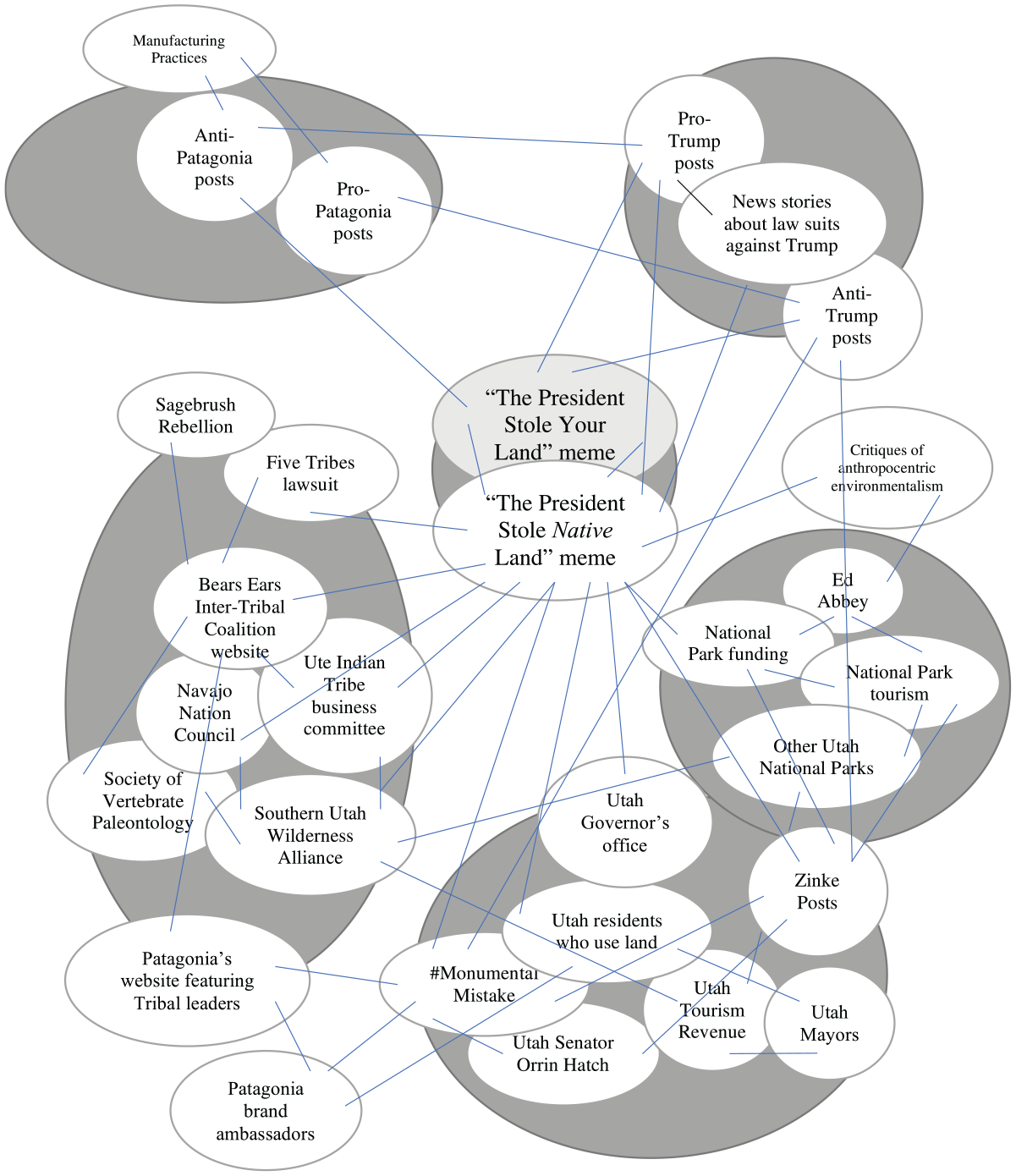
A map of posts addressing the land.
This example illustrates how conversations are redirected and how those links and tangents shape discourses. Of course, we could not trace every offshoot, but we worked to trace the more prominent discourses (see Figure 1 for an example of how posts addressing the land connect to other discourses).
Results
Social Media Blitz Generating Movement
Patagonia launched the “The President Stole Your Land” meme simultaneously on Twitter, Instagram, and Facebook on December 4, 2017. Patagonia started #MonumentalMistake to draw attention to the issue and create a distinctive hashtag dedicated to the cause, which was most widely circulated on Twitter. Visitors to Patagonia’s website who choose to click the “Take Action” button associated with the initiative are asked to tweet and “Tell the administration that they don’t have the authority to take these lands away from you.” A short sentence followed by #MonumentalMistake is automatically generated such as “You just made a monumental mistake,” “Wild places are the soul of this country,” and “The largest land heist in our history.” Users are then asked to tag President Trump (@realDonaldTrump) and/or their legislator.
The result of #MonumentalMistake is rather striking. Those searching #MonumentalMistake on Twitter are confronted with a seemingly unending stream of the same short video that begins with “The President Stole Your Land.” The repetition creates a powerful, rhythmic stream of opposition. If users pause long enough, the short video offers a visual showing the original size and then reduced size of both Bears Ears and Escalante. The video ends with the words “Defend the land you have left” and then “Text DEFEND to 52886.” Those that choose to text the number provided receive a text message response that reads “The President Stole Your Land. Defend the land you have left” along with a link that takes users to a page asking visitors to generate yet another #MonumentalMistake tweet.
The uniformity of the campaign as deployed across WPN is impressive in its simplicity. The color choice of black and white rather than, for example, the green typically associated with environmental efforts or picturesque images of the national monuments suggests the issue is a black and white one. Patagonia is taking a polarizing position on the issue and calling out President Trump.
On Instagram, the black and white image of “The President Stole Your Land” appears above the words of current Patagonia CEO Rose Marcario: “We’ve fought to protect these places since we were founded and now we’ll continue that fight in the courts.” This post explicitly demonstrates the brand’s integrity, a requirement for a successful CSR effort, because the initiative is endorsed and explained by the highest-ranking executive. Yet, it generates a multivocal response of thousands of heated opinions that hardly reflect approval alone.
Patagonia used a different posting strategy on Facebook than it did on both Twitter and Instagram in that it followed up the original post from December 4 with two additional posts related to the initiative on December 5 and 6. The two follow-up posts provided context for the original and came from company spokespeople (the senior communications director and the CEO), thus providing legitimacy. We review these statements and the generated comments in the next section. The original “The President Stole Your Land” post on Facebook was introduced by another Marcario statement, a longer version of the one on Instagram: Americans have overwhelmingly spoken out against the Trump Administration’s unprecedented attempt to shut down our national monuments. The Administration’s unlawful actions betray our shared responsibility to protect iconic places for future generations and represent the largest elimination of protected land in American history. We’ve fought to protect these places since we were founded and now we’ll continue that fight in the courts.
The call to shared responsibility, which is indicative of a CSR effort, hardly creates any change in the sentiment of comments. Patagonia’s simple black and white statement provoked a flurry of user responses that fall into four categories: those that support/oppose Patagonia’s initiative, those that focus on the land itself rather than politics, those that use the feed for partisan commentary, and those that admonish the corporation for entering a political realm. Inspired by WPN, we use these categories to emphasize the connections the comments make rather than focusing on individual meaning or intent. The emerging discourses described below roughly function at three interconnected levels, which we call user, organizational, and mass media levels of discourse.
User-Level Discourses: An Exploded Stakeholder Pool
Posts in support/opposition
The posts supporting or opposing Patagonia are the most numerous, comprising about 35% of all comments made. 1 The posts supporting Patagonia are rather straightforward, thanking the company for its efforts and pledging to buy its products, thereby engaging Patagonia’s base of supporters. Those that oppose the company claim they will never buy the product again, leverage insults, and question the company’s ethics by interrogating its manufacturing practices, bringing the paradox of environmentalism and corporations into the foreground. These posts then forge new connections with dispersed user groups by linking to previously published mass media articles in The Atlantic, Bloomberg, and The New York Times about manufacturing practices and the social media conversations that accompany these stories. Ryan Zinke, secretary of the interior at the time, fueled the fire during an appearance on Fox and Friends. Users linked to the clip, saying, “It’s interesting you know, these companies that make their products other places, on foreign shores,” thereby helping the topic to trend as it crossed discursive topics, boosting its appearance in search results (Abramson, 2017, para. 3).
Posts addressing the land
The second group of posts, comprising about 20% of all comments, address the land in three distinct ways, demonstrated in the map under Figure 1.
We constructed this map by centering the meme that most directly dealt with the issue of land rights and then drew connections to other clusters of discourses by dividing the tweets into subcategories (i.e., Bears Ears Inter-Tribal Coalition, Navajo Nation Council, etc.). The lines drawn between categories and subcategories represent topics to which users linked, thereby creating a portrait of the rhizomatic movement of discourse. We also drew connections to other major categories (pro-/anti-Patagonia and pro-/anti-Trump posts) to illustrate the overlap between our larger categories.
Our subcategories are telling. One set of posts addresses the Native Tribes associated with Bear Ears and Escalante, scoffing at the initiative by revising Patagonia’s meme. Users replaced “your” with “Native” so the black and white image reads, “The President Stole Native Land.” Others applauded Patagonia for standing with the five tribes that also filed lawsuits: Obviously local stakeholders should have influence in how lands in their state are managed. Which they did, when they went through the process of designating this a national monument. Native tribes in particular lobbied state legislature to protect the land, and then lobbied the federal government when they didn’t get anywhere. Those are the same groups that are now suing the government, alongside Patagonia and a number of other organizations. (@sleezenhouse)
These posts link the current issue to the oft-forgotten tribes that lived on these lands and engage stakeholders who likely do not purchase Patagonia products but do support their initiatives and clout as a large corporation. These posts also engage the Bears Ears Inter-Tribal Coalition, the Ute Indian Tribe business committee, the Southern Utah Wilderness Alliance, the Navajo Nation Council, the Society of Vertebrate Paleontology, law professors, as well as environmental organizations and individual advocates for Native tribes, which moves the initiative into more dispersed social media user groups.
The second set of posts often blends pro-Trump sentiments with an assertion that the president’s decision is legal and gives the land back to the people of Utah, such as “Trump just restored the land to Utah just as it was before Obama confiscated it. Why is Patagonia becoming political?” (@Deanna773). This taps into more highly charged networks of contemporary partisan politics. In 2018, 21 Utah mayors and council members signed onto briefs in support of the lawsuits filed against Trump. The controversy over the legality of Trump’s executive order remains a topic of debate and the focus of the lawsuit Patagonia and other outdoor retailers are filing against him. Furthermore, it links into discourses surrounding state versus federal land ownership and management. These discourses have historically incited intense reactions, including the contemporary Sagebrush Rebellion that seeks to allow states to manage their public lands. The resulting discourses continue to extend wildly outward, linking contemporary politics with historical tensions.
The third group erases Trump from the discussion and, instead, contemplates the consequences of Bears Ears and Escalante becoming/remaining national monuments à la Edward Abbey (1990), who critiqued national parks for opening up fragile ecosystems to hordes of careless tourists that today cause irreparable damage in their quest to take selfies and adventure beyond park boundaries. One Twitter user writes, “You do understand that when something becomes a ‘protected’ monument or national park, it suddenly doubles the traffic of tourists in and out. As someone that is as concerned about utahs [sic] conservation as you Are [sic], trust me when I say that less is more. If that makes sense” (@iisaacfrazier). The discourse in this group links to and overlaps with recent news coverage of national parks, the damage they are experiencing as a result of increased tourism, and the lack of national park funding (Turkewitz, 2017).
This set of responses directs users to distinctly environmentalist discourses and debates and further engages local populations in Utah, a state that is home to five national parks and where state and national parks have experienced double-digit growth in visitation rates between 2013 to 2017, contributing US$8.17 billion to the local economy in 2015 alone, and where 72% of residents participate in recreational activities (Utah Governor’s Office of Economic Development, 2017). The engagement of local users is evident in the use of #MonumentalMistake in Twitter posts that repeatedly tag Senator Hatch of Utah. Inciting locals links Patagonia’s initiative to networks more likely to participate in generating responses both within social media and outside of them.
Posts espousing political views
The third group comprises more than a quarter of the posts in the feeds: those that use social media to express their political views. This set of posts is composed of explicitly anti-Trump, anti-Obama, pro-Trump, and pro-Obama posts that position partisan politics at the heart of the matter, such as, “We are with you Patagonia. When this Occupying Force is relinquished from the White House by Muller [sic], American start to heal and maybe no other Republican will ever occupy the white house evere [sic] again for a billion years” (BMP17A), “Jeff’s alt-right history lesson: In 1906, Hillary sent an illegal email instructing the gays and James Comey to steal land from hard working coal miners in Utah. Oh man, I hope you’re just getting started here. This is priceless” (@z34L0T), and “Obama took our land away from our people, farmers and ranchers. Finally it’s ours again. Thank you @POTUS” (@AlexisSAcevedo). These tweets engage a wide variety of issues that are not connected to this initiative but were highly inflammatory at the time, including Mueller’s Russia investigation, Clinton’s e-mails, coal miners, Comey’s firing, rural America, and Obama. This illustrates the campaign’s ability to link itself to discourses so hypercharged that they are able to generate rapid rhizomatic movement, moving the conversation well beyond a traditional stakeholder base.
Users who link to the affectively charged political realm, and more specifically President Trump, extend the debate into a large pulsating network of users who have increasingly turned to Twitter for political news, updates, and arguments. As of 2016, before he even became president, Trump had more than 42 million followers (Tsur, Ognyanova, & Lazer, 2016). Tagging Trump in a tweet helps it reach more users. Trump encourages engagement on Twitter by making important political announcements from the status of transgender people in the military to the firing of former secretary of state, Rex Tillerson, on the platform. Since Trump became president in 2017, Twitter has witnessed a 15 percentage point increase in users who are going to the site for news since 2016 (Shearer & Gottfried, 2017). By specifically referencing “The President” in its Twitter post, Patagonia utilizes the energy and attention generated by a person many have dubbed “Commander in Tweet.” Against the advice of CSR experts, Patagonia dove headfirst into a highly controversial political environment and, in doing so, entered into the flows, intensities, and erratic movement of WPN to reach more people and illustrate that environmentalism and politics are unable to be separated. The reverberations helped the campaign connect to people Patagonia would otherwise never be able to reach.
Posts condemning political activism
The fourth group of posts, comprising approximately 20% of posts, explicitly criticizes Patagonia for entering the discursive realm of politics. Entering the political arena, regardless of political leaning, caused some commentators to call for boycott and withdraw support for the brand’s products: I used to support Patagonia. And what they stood for. But now it’s more political bullshit from them. Lost a customer forever. I’m all for access and standing for what you believe in, but this is simply finding what we can be upset about. (@Bryce Larsen)
And, “I love Patagonia clothes but also love President Trump. Guess who’s gonna win that, Patagonia? Stay in yo lane” (@Chandler Durden). Among the comments are many asking the company to stop using its values to “alienate.” Anger spread rapidly as people condemned Patagonia for its activism.
These comments suggest a previous public unawareness that buying choice has always been political. In linking itself explicitly to politics, Patagonia forfeits customers but further energizes the WPN on which the initiative is taking place and moves its message to those who have never and will never buy Patagonia. What these posts, in particular, suggest is that corporations taking a social stance in the form of what we term CSR-based wild public provocations develop out of specific political, social, environmental, and economic conditions.
Organizational-Level Discourses: Strategic Linkages
Patagonia chose to publish two messages from its executives on Facebook. The first post from December 5, 2017 links to The Cleanest Line, the corporation’s blog, which for years has functioned as a sounding board for company executives, employees, athletes, and customers. The senior communications director’s post engages highly charged and fast-moving discourses by comparing President Trump’s statements about the “revoked” national monuments to “the truth.” This type of fact-checking discourse links to the recently popularized parlance used during the 2016 presidential election about what is “real” and what is “fake news.” A Google search in March 2018 for “fake news” provides 40.4 million results. Thus, the blog post is tapping into a flood of discourses regarding confrontational truth-telling and, thus, discursively enters politics. In this move, once again, Patagonia explicitly fails to follow the CSR expert advice of remaining outside political debate to launch wild public provocations (see Rodriguez-Villa & Bharadwaj, 2017). Instead, Patagonia privileges connections with people outside its typical stakeholder group, those on the fringes, as well as users tangentially connected to the issue, helping to further publicize its campaign rather than utilizing traditional CSR strategies.
In response to this post, we find comments falling in the categories outlined in our user-level discourse observation: support/opposition for the initiative, focus on land, partisan commentary, and politics versus corporation, in addition to aforementioned discourses surrounding “fake news.” This blog post was made popular via the same social media channels as the original initiative and generated the same polarized feedback. A typical comment encompassing a few of the individual themes identified previously is below: Patagonia - if you truly cared about the United States, you would make your clothing here and your labels would read “Made in the USA.” By the way, Bears Ears National Monument was established less than a year ago. It’s not like it’s been a national monument for decades and decades. Obama created it just a month before he left office. Your clothing is pretty pricey and most of the people I know who wear it are wealthy, well-off conservatives, so keep that in mind if you decide to go too deep into politics. You just might alienate the people actually buying your products. (@Julie Timms)
This user’s comment does important work for Patagonia’s initiative by linking it to partisan politics, manufacturing practices, land designations, and business practices—all highly charged issues that help the initiative to continue to pulsate out across the networks to reach an ever-growing audience. The more anger it ignites, the further it spreads.
On December 6, 2017, Time published an article by Patagonia’s CEO (Marcario, 2017) that was also posted on Facebook. Beyond moving the issue into mass media, the article continues to further link the initiative to existing discourses. The article focuses on the following principles: “to enforce the law,” “to carry out our purpose as benefit corporation,” “to stand with our grassroots partners,” and “to defend our business.” Unlike the blog post, this article does not directly argue with President Trump’s statements. It primarily positions Patagonia as a good corporate citizen by establishing it as a company that enforces “the law.” This, again, links to discourses surrounding legal challenges about the 2016 elections, which were reinvigorated at the time by news about the Mueller investigation. Patagonia’s response, then, tapped into highly charged networks about the investigation by using jargon associated with the controversy. For example, Patagonia’s rhetoric establishes it as a law-abiding company that was also willing to sue the president. Trump, himself, has regularly boasted about the number of lawsuits in which he and his businesses have engaged (more than 3,500 legal actions in both federal and state courts in the three decades prior to running for office; Penzenstadler & Page, 2016). In addition to aligning with these discourses, Patagonia’s statement encapsulates what CSR scholars call integration of business, values, and social responsibility (Bullis & Ie, 2007; Rodriguez-Villa & Bharadwaj, 2017).
The post generated the very same heated responses as those outlined above. Not one of the responses comments on the specifics of the article itself, demonstrating clearly that by December 6, two days after the president’s announcement and Patagonia’s original initiative post, the force of the resulting conversations was in their movement rather than their meaning. With this post, Patagonia connects to fiery discourses and provokes movement across WPN well beyond the impact under an organizational spokesperson’s control. Environmental activism, at its core, engages a complicated set of discourses, and Patagonia benefits from engaging them via wild public provocations that link to other hypercharged political and social discourses.
Mass Media-Level Discourse: Rhizomatic Extensions
Thus far, we have reviewed user and organizational levels of discourse as represented by social media comments and corporate spokespersons. We now move to the discourse of political entities and figures, mass media, and larger social commentaries. Patagonia’s initiative to sue the president of the United States over Bears Ears and Escalante immediately generated a response from government figures. @NatResources, the Twitter handle of the U.S. House Committee on Natural Resources, then chaired by Congressman Bishop of Utah, a supporter of state’s rights in land ownership, almost immediately released a problematic tweet that mimicked Patagonia’s black and white meme reading, “Patagonia is Lying to You.” Following the Twitter interactions with @NatResources, Patagonia is only mentioned as an actor in passing and the issue of Bears Ears and Escalante as public land is nonexistent in responses. Instead, the focus of the interactions remains entirely political, taking attention away from the CSR effort and the issue at hand, the land: “You are LIARS and have no credibility. My family is done with your company for good. #VetsforTrump #USMC” (@Tamara McPherson). Paradoxically, having a governmental agency issue threats against a corporate citizen was seen by Twitter followers as un-American as Patagonia’s manufacturing practices and locations addressed previously. This reaction only further engaged users connected to @NatResources, Patagonia, and governmental ethics, which invariably helps the initiative reverberate even further across WPN.
Importantly, this political reaction also links the issue to another hot-button topic—responsible manufacturing practices. As part of its CSR effort, Patagonia issues a yearly social responsibility report called The Footprint Chronicles where it addresses its sustainability practices and specifically its supply chain. As noted earlier, one major theme of social media commentary was the public’s concern with the corporation’s production practices and, namely, the fact that its clothing is not produced in the United States. This concern entered the mass media-level discourse through a statement issued by the secretary of the interior, Ryan Zinke, 1 day after the initiative went live on Fox News. In this statement, he suggests (a) that Patagonia’s interests in the lawsuit represented “special interest groups,” and (b) that the company makes its products in “other places, on foreign shores” (Abramson, 2017). Trump ran on a platform to bring jobs back to the United States, and Zinke references this promise and the excitement it generated. WPN respond immediately, appropriating Zinke’s comments to promote the hashtags #MAGA and #boycottpatagonia, the first of which generates a veritable onslaught of posts.
To illustrate how a mention of this kind can travel, we turn to Fortune, which picked up Zinke’s commentary and went back to a 2012 blog post Patagonia published on its supply chain (Abramson, 2017). In the post, the company reported that it receives weekly inquiries on supply chain matters from customers and provides a lengthy explanation as to why its garments are made elsewhere, as well as what it is doing to make sure that fair trade and work conditions exist in the factories it uses. These efforts respond directly to critiques over Patagonia’s use of non-U.S. laborers. In 2018, the company devoted an entire webpage to its sustainability efforts. This effort is a commendable CSR practice because it directly relates to the company’s reason for existence, as a clothing manufacturer, and provides legitimacy. CSR’s objective is, after all, to gain public acceptance of the corporation’s right to exist (Llewellyn, 2007). Yet, it does not address the related issue that many unemployed workers in the United States view outsourcing as the reason they are unemployed. By tapping into this base of angered citizens, Zinke’s comments are carried far across networks, outside of company control.
“The President Stole Your Land” prompted additional conversations on the mass media level by engaging the paradox companies face in CSR efforts. In response to the company’s CSR effort, Fast Company wrote “how Patagonia grows every time it amplifies its social mission” (Beer, 2018). Citing specifically the #MonumentalMistake initiative, GQ looked at Patagonia’s skyrocketing profits over the holiday season, which followed the company’s early December announcement (Wolf, 2017). GQ’s article explicated a sentiment shared by many in the CSR literature and the public alike when it comes to the reason for corporate existence: The takeaway: In Trump’s America, it pays to be part of the #resistance. That’s not to impugn the brand’s motives, actions, or statements—it’s just to note that, in this case, they exist hand-in-hand with a display of masterful marketing. And with Patagonia, those two things are never mutually exclusive. (para. 3)
This quote helps to draw attention to what appears to be part of Patagonia’s CSR strategy over WPN—to engage in the issues that generate heat, movement, and responses. Politically charged posts on Patagonia’s feed garner the most activity (thousands of reposts and reactions vs. dozens or sometimes hundreds its other posts typically receive) primarily through affect and rhizomatic linkages.
The unprecedented angst against and celebration of Patagonia exhibited by the user, organizational, and media levels of discourse put the company in a paradoxical situation. Yet, this paradox launches the initiative into trending Twitter topics, Google search results, and Facebook feeds. This movement is necessary for Patagonia’s efforts to be successful and, ideally, directs some of the conversation from social media platforms into town hall debates, voting booths, and living rooms.
Discussion
We emphasize the unique elements of analyzing CSR discourses through WPN to provide suggestions for theory and practice. First, we contribute to CSR theory by integrating social media theory (Benkler, 2006; Benkler et al., 2018; Castells, 2012) and affect theory (Deleuze & Guattari, 1987; Gregg & Seigworth, 2010) via the concept of WPN. This allows us to chart how CSR is unfolding in radically different media environments, characterized by the movement of discourses. The #MonumentalMistake initiative is predicated on the understanding that discreet groups of stakeholders no longer exist and, as a result, CSR efforts cannot assume authorial control, manage interactions, and even legitimize a certain organizational image, making wild public provocations an apt CSR tactic.
The CSR paradox corporations like Patagonia exist within is not easily reconciled, but Patagonia’s initiative shows that this irreconcilability can incite movement, especially when connected to highly charged issues. Today, such interactions and connections are essential in the deployment of CSR strategy. Unlike luxury brands that used their own websites to navigate the CSR paradox through various discursive strategies as discussed by Wong and Dhanesh (2017), Patagonia deploys the power of an exploded stakeholder pool along with wild public provocations to politicize an issue. The company then steps back, thereby avoiding engaging directly in the multiplying conversations as they cascade across social media. We are witnessing other companies such as Nike following suit by tapping into the movement, chaos, anger, and excitement surrounding quarterback Colin Kaepernick (and his choice to kneel during the national anthem) by featuring him as the spokesperson in their new ads, sometimes alongside LeBron James (another figure Trump has attacked). Airbnb offered refugees affected by Trump’s travel ban free housing. Cofounder and CEO Brian Chesky announced this offer in a tweet after stating that “Not allowing countries or refugees into America is not right, and we must stand with those who are affected” (@bchesky, January 28, 2017). Publisher Melville House publicly took a stand against Trump’s nominee for Central Intelligence Agency (CIA) director, Gina Haspel, by offering its e-book The Senate Intelligence Committee Report on Torture for free so readers could learn about her record on torture. While such tactics may not be right for every business, their increased adoption speaks to the effectiveness in reaching audiences and generating engagement.
Winning on WPN is not about leveraging the best argument, as Habermas’s public sphere would suggest, but about generating rhizomatic movement and linkages to garner attention. In such an environment, CSR efforts may not be best served by avoiding controversial issues (Rodriguez-Villa & Bharadwaj, 2017) or thoughtfully responding to negative comments (Rim & Song, 2016), but instead by immersion in the conflict and embracing the paradox. WPN encourage organizations to create affective movement by, for example, taking overtly political and potentially divisive stances to demonstrate CSR. It is this type of animated, forceful movement that we observe in Patagonia’s CSR campaign and the connections it created. Our insistence on movement and connections over meaning and rationality in this case reflects a larger movement toward seeing organizations and work beyond sensemaking. Our observations and analysis confirm what Kuhn et al. (2017) speculate about regarding the impact of applying affect to communication. While affect does not completely negate the mattering of discursive activity, it redirects our attention away from coherent meaning and toward sensing, toward the “energetic intensities” that move us and the world (pp. 90-91).
These theoretical contributions translate into practical advice for organizations seeking to engage in CSR efforts. For example, Patagonia did not respond or otherwise engage with posts. This action (or lack thereof) is precisely the opposite of what authors examining CSR and social media interaction suggest a company should do to build credibility (see Rim & Song, 2016). We suggest that instead of aiming to control the message by attempting to conceptualize a target audience and responding, organizations may be better off focusing their efforts on strategically provoking activity and generating affective movement that floods various networks, thereby drawing attention to the corporation and its cause. Politics is ascribed to corporate entities by the multitude of stakeholders as they engage argumentative fragments, regardless of company intent, so wild public provocations become an important strategy in an arsenal of CSR tools.
The mediascape has changed and continues to change, demanding the new discursive tactics we call wild public provocations—initiatives designed to incite political and affective responses that engage diverse and dispersed audiences, draw mass media attention, and embrace paradox through strategic silence rather than seeking to resolve it. They serve three important functions: (a) to launch an issue into trending topics on social media, (b) to link the issue to places where productive debate is occurring, and (c) to disrupt the social media bubbles in which users reside.
Patagonia launched its campaign into a public space marked not by productive conversation, but by movement, collision, distractions, affectively charged pleas, and multi-vocality. We illustrate this complexity at three levels of discourse: user, organizational, and mass media. Apart from demonstrating the complexity of conducting CSR campaigns in an age of WPN, the three distinct but interconnected levels of discourse become a useful mapping tool for practitioners as they conceptualize initiative launch. It must be noted that Patagonia continues the conversation about this initiative on its website, where it features stories from Native Tribes and outdoor adventurers who each make an argument to save these sacred spaces. It continues the conversation in courts as it files a lawsuit. It continues the conversation in protests and marches. These are spaces where organizations can continue a CSR effort to enact lasting change.
Conclusion
The notion of CSR has always spurred social and academic debate, with some calling it a spin and others a corporate obligation. However, when taken to meaningful lengths, as Patagonia has done with its “The President Stole Your Land” initiative, CSR efforts create productive paradoxes. As Putnam et al. (2016) demonstrated across disciplines, organizations successfully exist along with the paradoxical relationships in which they find themselves. Through our examination of Patagonia’s initiative as launched across WPN, we suggest that the contradictions and tensions emblematic in the posts, comments, and statements’ part of the initiative may underscore these greater paradoxes, but do not weaken the corporation or its CSR efforts. In fact, they seem to energize it while at the same time exciting public dialogue around the issues it champions.
By linking the initiative to hotly trending topics, including President Trump, partisan politics, and fake news, Patagonia was able to garner mass media attention and activate disparate viewpoints throughout WPN. Thus, we suggest that CSR in the age of WPN must engage new discursive strategies that focus on generating affective movement rather than coherent meaning. Affective movement in this case study manifests as reactions on social media, new connections forged between users, and the explosion of dialogue brought about by nonrational pleas. This understanding stands in contrast to coherent meaning, which suggests reasoned discourse designed to convey a specific message. Networks privilege nodes and relationships over content and meaning. Patagonia’s initiative took advantage of these forces, demonstrating that embracing the emblematic and contentious CSR paradox can be a functional tool in the social media context.
Footnotes
Acknowledgements
A version of this paper received a top paper award by the Organizational Communication Division of the National Communication Association in Salt Lake City, Utah. The authors would like to thank the convention reviewers for recognizing the potential of this research and providing valuable feedback early on. The authors would also like to thank the three anonymous reviewers and the Management Communication Quarterly editors for their dedication to improving this manuscript.
Declaration of Conflicting Interests
The author(s) declared no potential conflicts of interest with respect to the research, authorship, and/or publication of this article.
Funding
The author(s) received no financial support for the research, authorship, and/or publication of this article.
