







Abstract
This study examines discourses of gender equality, inclusion, and empowerment in the mineral mining industry, focusing on the Women in Mining Association of Namibia (WiMAN). Qualitative content analysis revealed four themes: women as activists, women as hard workers, women as negotiators, and women as aligned with men. Building on African feminisms, the study emphasizes co-constructed, conciliatory, and collaborative symbolic action between men and women. These insights dislocate and denaturalize taken-for-granted assumptions espoused by some forms of Western feminisms which assume that feminist symbolic action requires antagonism and competition between women and men. In doing so, this study answers Broadfoot and Munshi’s (2007) call to diversify and enrich communication theory by including concepts, methods, and perspectives from around the globe.
Gender parity and empowerment are global issues at the forefront of feminist discourse. They are the main theme of the United Nations Sustainable Development Goal 5—SDG5, an agenda for gender equality by 2030 (United Nations, n.d.). Women derive courage and motivation from SDG5 as they pursue gender equality and empowerment within their own communities and countries. Namibia is no different. A report by the International Institute of Sustainable Development (2018) stated that Namibia is ranked 108 out of 159 countries on the UN’s 2015 Gender Inequality Index. The state of Namibia’s gender inequality is reflected in key indicators such as the lifespan of Namibian women compared to men (67.5 years versus 62.5 years) and the fact that women’s educational advantage has not translated into higher earnings. This gender inequality has implications for Namibian women in the social, economic, and political spheres. Hence, gender equality and inclusion are issues that have reached the organizational agenda within many industries in Namibia. Presently, in the mineral mining industry, women have formed an organizing body, Women in Mining Association of Namibia-WiMAN, to address issues of gender equality, inclusion, and empowerment.
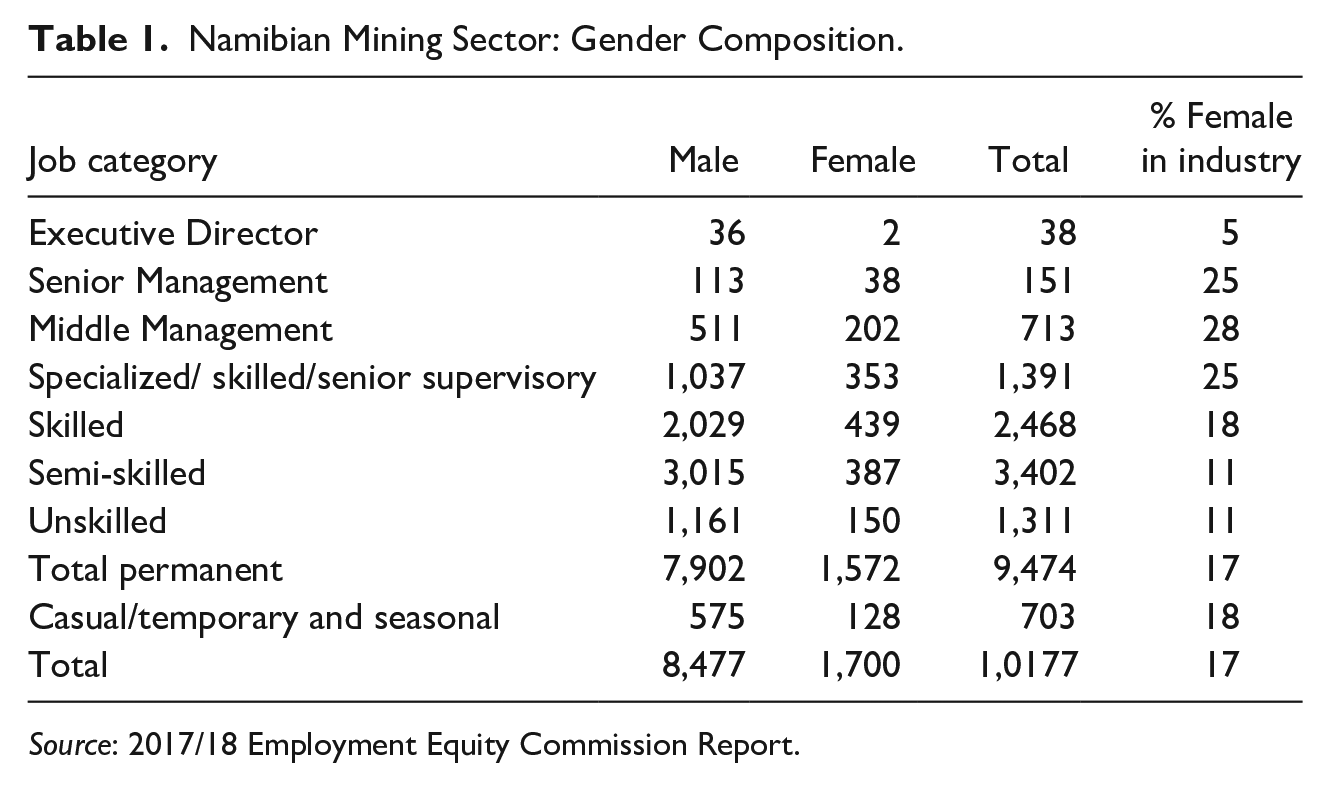
Mining is a male-dominated industry; women represent only a small fraction of those employed in the industry. From a 2018 Labor Force Survey, women make up 51.4% of the Namibian population and 65% of Namibia’s labor force (Namibia Statistics Agency, n.d.). However, women are 17% of Namibia’s mining-oriented labor force (See Table 1) (Employment Equity Commission, n.d.). This percentage is on par with trends from around the world. In the United States, for instance, women make up 15.7% of the mining industry (Doku, 2019), in South Africa 12% (Minerals Council of South Africa, n.d.), and in the United Kingdom 16% (Devine & Foley, 2020).
Namibian Mining Sector: Gender Composition.
Source: 2017/18 Employment Equity Commission Report.
Despite these numbers, experts say that more and more women are entering the mining industry (Botha, 2016; Le Roux & Naudé, 2009; Letlape, 2014). In Namibia, the number of women in mining has increased by 8% since 2015 (Namibia Statistics Agency, n.d.). The masculine nature of the job and the historically male-dominated structure of the industry, however, prove challenging—both in terms of hierarchy and structure—to women on mining sites. Women report issues pertaining to gender inequality and exclusion regarding upward mobility into executive positions, decision making pertaining to gender policy and workplace procedures, and availability of resources such as mentorship, on-site sanitary facilities, and protective gear. Frustrations stemming from these issues have sparked organizing and discourse toward affecting change in the Namibian mining industry. The gender discourses surrounding these issues are the impetus for this paper.
I build on African feminisms and the principles of holism, collectivity, situationality (Cruz, 2015a) and nego-feminism (Nnaemeka, 2004) to examine the women’s discourses. African feminisms are theories that express African women’s localized, indigenous, and post-colonial standpoints. Women enact agency and resistance to forms of patriarchy and oppression by deploying nego-feminism—feminism of negotiation—strategies rooted in accommodation, collaboration, and compromise (Nnaemeka, 2004). They understand that all aspects of their lives are connected and inform their knowledge production, interactions, and behavior (Cruz, 2015a). African feminists emphasize the importance of the group and their interconnectivity. Thus, their foremost concern is for human life. This concern is also an acknowledgment that “each gender constitutes the critical half that makes the human whole—neither sex is totally complete in itself” (Nnaemeka, p. 380)—men are not the other. This concern is reflected in the notions of complementarity, alliance, and true partnership with men (Nnaemeka, 2004). These notions are tied to the importance of shifting context that influence negotiations, discussions, and message framing (Cruz, 2015a).
African feminisms are not monolithic. Instead, they are fluid in their nature, rooted in activism, complex, and constantly shifting. Thus, African feminist theory focuses on African women’s “specific cultural and historical location and their responses to shifting conditions” (Cruz, 2015b, p. 421). Women organize themselves to fight for previously denied economic empowerment, formal education, training, and political representation (Mekgwe, 2010). Their voices span across wide domains and interpretations of what it means to be an African feminist. I build on the theories by showing how Namibian women’s gender discourses instantiate African feminisms in their localized experiences and illuminate the merits of African feminisms where the principles of holism, collectivity, situationality, and negotiation are pertinent in attaining goals and achieving favorable outcomes.
The purpose of this study is threefold. First, it answers the call for diverse feminist scholarship within organizational communication (Buzzanell, 1994). Scholars have expressed a need for a variety of voices, perspectives, and scholarship that can enrich the subfield. Broadfoot and Munshi (2007) invited organizational communication scholars to diversify by considering works of scholars from across the globe to enrich the scholarly community with concepts, methods, and perspectives. A consideration of African feminisms answers this call. African feminist scholars (Arndt, 2002; Cruz, 2015a; Martin, 2016; Nnaemeka, 2004) advocate for the theories’ use in varying western contexts. I endorse their view and offer my insights on African feminisms as a theoretical framework. African feminisms dislocate and denaturalize feminism in organizational communication scholarship by revealing those places where Western feminist scholarship takes for granted that feminist ends must be achieved through antagonistic and competitive means against men. Instead, the case of the WiMAN feminist discourses reveals that feminism can unfold in cooperative and conciliatory ways that promote holism, collectivity, and situationality, especially where negotiation and collaboration is needed to bring awareness to gender equality, inclusion, and empowerment to advance women’s causes.
Second, studies investigating issues and experiences of people beyond the Western world are needed for developing new models that can be applied cross-culturally or globally (Nnaemeka, 2004). Third, gender equality, inclusion, and empowerment are issues tackled by various feminist groups across the globe. Illuminating the lived experiences of women in mining in various countries may provide a blueprint for how other male-dominated industries can ease the process of integrating of women. The case of Namibia and the women in mining is interesting because the country’s colonial past and patriarchal culture affects its societal, economic, and political structures. WiMAN’s movement has raised consciousness and foregrounded issues of gender equality, inclusion, and empowerment within the industry and nation. I present a literature review on Namibian Women in Mining and African feminisms followed by findings and a discussion.
Review of Literature
Namibian Women in Mining
Mineral mining remains a masculine industry, reflecting a history of women forbidden from being miners due to historical, legal, and societal norms. For example, U.S. laws forbade women working in the mining industry as recently as 1973 (Lucas & Steimel, 2009). For years, mining was deemed a highly dangerous endeavor (Letlape, 2014). The idea that miners had to be physically strong led to the exclusion of women and allowed the negative attitude toward women in mining to persist (Letlape, 2014; Lucas & Steimel, 2009). Mining work was seen as unsuitable for women, who were perceived to be weak and not leadership material (Botha, 2016; Letlape, 2014; Lucas & Steimel, 2009).
Despite this historical exclusion, the number of women entering the mining industry across the world is on the rise. For instance, after Namibia’s independence from colonial rule, legislation such as The National Gender Plan of Action and the Chamber of Mines Mining Charter were enacted to grant women entre into the industry and increase the number of women miners (Mwetulundila & Indongo, 2018). In South Africa, the Employment Equity Act No. 55 of 1998 was enacted to ensure the integration of women in the industry (Letlape, 2014). This trend brings new challenges that seem to strain top management (Botha, 2016; Le Roux & Naudé, 2009; Letlape, 2014). Amongst these challenges are the recruitment and retention of women, career advancement and development, lack of sanitary facilities, cases of sexual harassment, and lack of acknowledgement of women as equal stakeholders in the mining industry (Botha, 2016; Letlape, 2014).
Mining job openings for women are rare (Letlape, 2014). When women are recruited, it is usually for administrative and human resources positions. Those who get hired rarely fill skilled, managerial, or executive positions (Botha, 2016; Letlape, 2014). Women are also rarely offered career advancement opportunities, including employee development and mentorship programs, resulting in high turnover among women miners (Le Roux & Naudé, 2009; Letlape, 2014). Additionally, women experience a lack of sanitary facilities (e.g., changing rooms) on mining sites (Letlape, 2014). They also lack uniforms and safety gear tailor-made for women (Letlape, 2014), and wearing ill-fitting safety gear may not serve its purpose when it matters most. Machismo culture and negative attitudes among male miners translate into women being exposed to sexual harassment that often goes unchecked (Botha, 2016). As a result, women suppress their femininity, hoping to remain inconspicuous or be taken seriously (Botha, 2016; Letlape, 2014; Lucas & Steimel, 2009). They adopt masculine attributes and balance masculine and feminine traits to avoid negative labels and drawing attention to themselves (Letlape, 2014).
Finally, women’s voices are silenced in the male-dominated culture. Top management does not usually consider the implications a male-dominated culture may have on a female workforce. Women battle with male executives who struggle to incorporate and understand their needs (Le Roux & Naudé, 2009). Such insensitivity fails to acknowledge that women are equal stakeholders in the mining industry, worthy of all the advantages and privileges enjoyed by their male counterparts.
It is important to note that these issues are not reflective of the experiences of all women in mining; however, a significant number of women undergo such experiences. For example, Lucas and Steimel’s (2009) examination of gendered discourses of a mining community in the U.S. revealed that the community saw women as physically weak, as an easy prey in the mines, and as having no place in the industry. In another instance, Letlape (2014) found that women in middle and senior management positions in the mining industry in South Africa experienced sex discrimination, suppression of femininity in the workplace, and the glass-ceiling phenomenon. Similarly, Botha (2016) investigated sexual harassment and abuse in South African mines and found that women were still exploited and harassed daily. The women reported name calling, vulgar or derogatory language, catcalling, sexual innuendoes, sexual assault, and quid pro quo offers for advancement.
These concerns have led to the development of many organizations advocating for women in mining (WIM). In the U.S., women started a WIM organization in 1981; WIM-Canada was established in 2009; and WIM-South Africa was found in 2010. More recently, countries such as Botswana and Ghana have mobilized to start WIM organizations in their countries. In Namibia, WiMAN was found in 2017.
Namibia’s gender disparities in mining are tied to the country’s colonial past. Namibia, a small country situated along coastal southwest Africa, is often referred to as the continent’s last colony. The country was acquired by Germany at the Congress of Berlin in 1884 (Pfouts, 1982). Hubbard (2000) explains how Germany lost control of Namibia to Great Britain after its defeat in World War I. Great Britain, however, turned Namibia over to South Africa as a “mandate and trust territory” that should be developed and brought to self-governance. South Africa, instead, extended and intensified the oppression of the Namibian people through its apartheid regime. Namibia gained its independence in 1990. Today, the country is scarcely populated, with only 2.5 million people within an 825, 234 km2 territory (Legal Assistance Center, n.d.).
Mining accounts for more than half of Namibian primary industry and contributes significantly to the infrastructure and community development in the country (Simonis Storm Securities, 2006). Namibia is rich in minerals, including diamonds, lead, zinc, copper, gold, and uranium. During its reign over Namibia, South Africa engaged in agreements with and received capital from international stakeholders such as Britain, Germany, France, and Japan to mine Namibian minerals (Pfouts, 1982). Consequently, contemporary Namibian mining is monopolized by South African, British, and American companies such as De Beers Marine and Rio Tinto Zinc. Although Namibia is no longer under South African rule, the country’s economy is strongly tied to South Africa (Freeman, 1992).
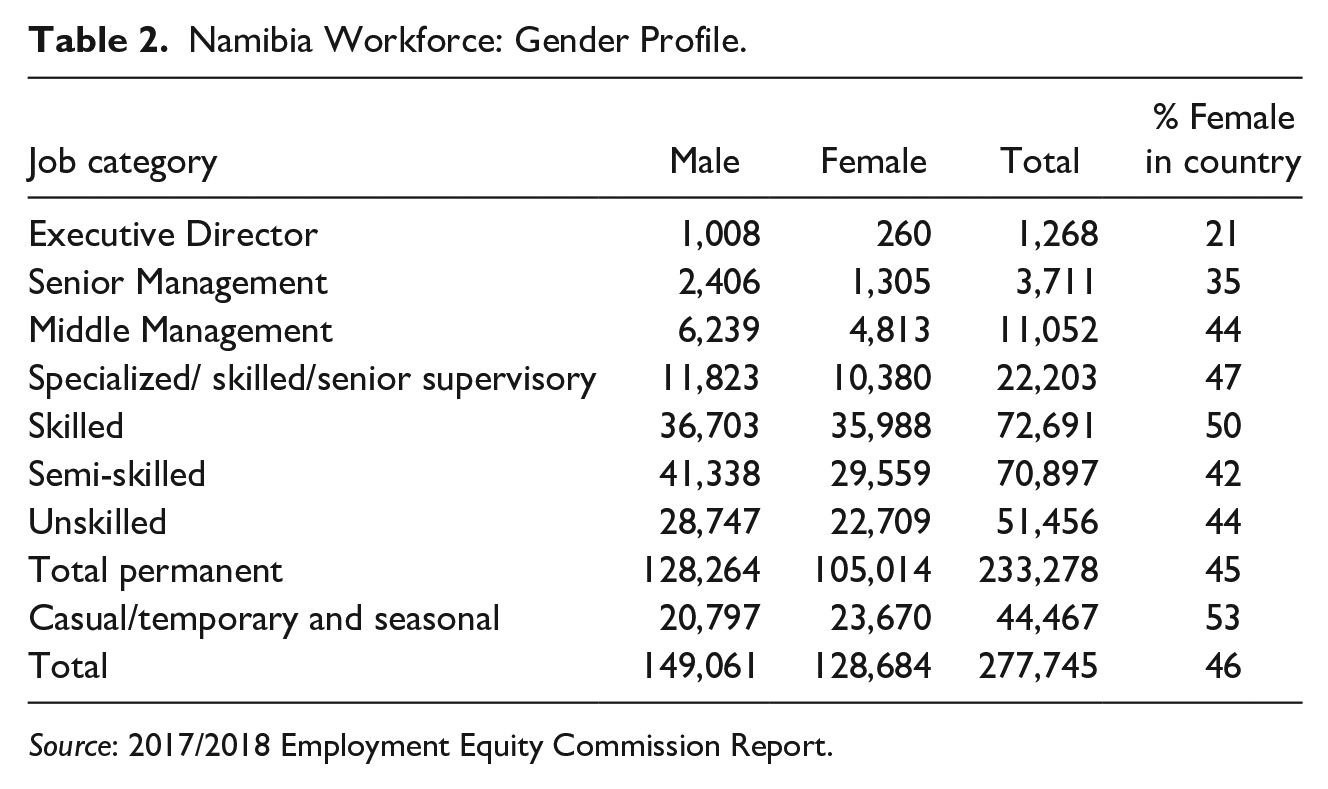
Historically, Namibia’s patriarchal culture has fostered gender imbalances embedded in political, economic, and social structures. Power relations pre- and post-colonialism between men and women reinforce the systemic disadvantage and oppression for women (Mwetulundila & Indongo, 2018). Common law privileges enjoyed by men during colonialization, (i.e., property rights and the designation of power from division of labor) created an inferior social and economic standing for women in society, and that status has lingered. Furthermore, because women were relegated to home and reproductive labor, their access to education, training, and resources were limited (Mwetulundila & Indongo, 2018). As a result, Namibian women have been mostly employed in occupations labeled as feminine such as nurses, teachers, or social workers (Mufune, 2013), and very few women are found in executive or managerial positions (see Table 2). This trend is apparent in the mining industry.
Namibia Workforce: Gender Profile.
Source: 2017/2018 Employment Equity Commission Report.
Recently, more women have entered the mining industry in Namibia in varying positions, such as artisan, metallurgist, machine operator, geologist, or engineer. Women fill entry level, administrative level, and middle management positions but rarely occupy senior management ranks (see Table 1). Women range from young to old, with work experience ranging from 3 months to over 13 years. They possess varying levels of education, ranging from high school education to graduate degrees, and earn on average only 87% of men’s wages. This increase of women in the industry—combined with the importance of gender equality, inclusion, and empowerment—led to the establishment of WiMAN.
WiMAN was established in April 2017 as a call to reimagine mining beyond a masculine-only industry. While telling the organization’s inception story, the president of WiMAN shared in a 2017 Radio 99FM interview: In all my years, we’ve never thought of let us get together as girls in the industry. Up until 10 years ago it was unheard of to see a female geologist never mind a female truck driver on any mine. We’ve been there, but only in support roles, mainly HR and Finance. So, I got a little bit tired, that you’re working with men, we’re sort of sidelined. In 2016, the entire mining industry [had] only one female executive director.
The realization of these inequities and other comparable experiences led women to unite. At a women in mining conference spearheaded by the Deputy Minister of Mines and Energy, Kornelia Shilunga, the women in attendance were confronted with frustration of many women regarding industry treatment. This frustration illuminated the need for an advocacy group that could champion the causes of gender equality, inclusion, and empowerment. According to the president of WiMAN: [We realized that] guys there’s actually a problem, speaker after speaker sang the same message. We noticed the number of graduates coming into the industry is becoming less and less over the years. There is nobody to promote the profession and saying it’s okay for women to enter the industry . . . Policies have been written in the years when it was just a man’s world. And although some of the policies have been adapted, it hasn’t really been in line with what’s really happening out there (Sipunga, 2017).
The organization’s key aim and slogan is “forging equal opportunities for women in the mining industry” (WiMAN [Facebook page], n.d.). Their vision is outlined as a quest for gender equality, inclusion, and empowerment with a focus on recruitment, retention, mentorship, advocacy, and organizational transformation. WiMAN represent women in all three sectors of the Namibian mining industry—large scale, small scale, and business/entrepreneurial—as well as students pursuing careers in the industry (WiMAN [Facebook page], n.d.). Their aim is to empower women in both rural and urban mining spaces and provide a roadmap for young girls wishing to enter the industry. WiMAN’s establishment illuminated gender equality, inclusion, and empowerment issues and foregrounded women’s experiences within the mineral mining industry. To analyze the women’s discourses, I turn to African feminisms theory as a theoretical framework.
African Feminisms
African feminisms call for examination of a multilayered reality of African women’s experiences. African feminisms are used in lieu of African feminism to underscore heterogeneity, diversity, and dynamism of historical, cultural, and localized realities central to African women’s activism, thinking, and engagement with issues affecting women, children, and community (Nnaemeka, 2004). The theories acknowledge that African women operate from a place of intersectionality where, race, class, gender, and age are interrelated (Cruz, 2015a). Thus, African feminisms are different from Western and Black feminisms. African feminist approaches advocate for the political, economic, and social freedoms of African women while recognizing the diversity of experiences, struggles, and resistance to different forms of patriarchal oppression and domination in formally colonized and historically marginalized societies (Chilisa & Ntseane, 2010).
African feminisms are informed by African women’s stance, their need to challenge patriarchal oppression, their desire for equality in the form of complementarity rather than conflict between men and women, and their understanding of the connectedness of men and women within the African culture, without the rejection of African culture (Ntseane, 2011). African women’s insights into the complexity and struggle of gender equality, and the thought and negotiation needed to broach the topic of male and female inequality, are rooted in conciliation and compromise (Ntseane, 2011).
Here, I choose to ground this study in two African feminist perspectives: nego-feminism (Nnaemeka, 2004) and African feminist organizing principles (Cruz, 2015a). Nnaemeka’s (2004) nego-feminism acknowledges that negotiation is imperative in achieving desired goals and outcomes. According to Nnaemeka (2004), nego-feminism stands for “no ego” feminism and represents feminism of negotiation. This practice is rooted in the principles of negotiation, give and take, compromise, and balance. For Nnaemeka (2004), negotiation has a dual meaning: “give and take/exchange” and “cope with successfully/go around” (p. 378). An understanding of such duality allows nego-feminism to challenge patriarchy through negotiation and compromise because it knows where, when, and how to detonate and go around landmines. Nego-feminism acknowledges the shifting contexts and evolving terrain for negotiation and the resultant need to negotiate with and around patriarchy in different contexts.
Cruz (2015a) offers holism, collectivity, and situationality as three principles of African feminisms that can help frame the African feminist perspective. Holism references the connecting and overlapping societal domains within varying context that influence knowledge, interactions, and behavior and includes race, class, nation, and age. It also acknowledges the role of family, which is central to the identity of African women. The idea of collectivity is entrenched in the notion that the group is more important than the individual, and that all groups are interconnected. Collectivity is tied to connectivity because it acknowledges interdependent relationships within a society, community, or household. Situationality emphasizes the importance of being attuned to and sensitive of relational and situational contexts such as time, place, space, and actors present in interactions as these contexts can influence the meaning making process through topics discussed, information disclosed, message framing, and more.
I use African feminisms as an analytical framework for the Namibian women in mining’s gender discourses. I use four concepts—holism, collectivity, situationality from Cruz (2015a) and nego-feminism from Nnaemeka (2004)—to analyze women’s gender discourses. These African feminist perspectives complement each other in principle and application. To examine the women’s discourses, I pose the following research questions:
RQ1: What are the discourses of gender equality, inclusion, and empowerment of the Namibian women in mining?
RQ2: In what ways do the women’s gender discourses instantiate African feminisms?
RQ3: In what ways do these discourses reveal taken-for-granted assumptions within Western feminism that are valued in African feminisms?
Method
Data
Data collection unfolded in three stages. First, I searched the following keywords and phrases on Google: WiMAN, women in mining association of Namibia, Namibian women in mining, women in mining Namibia, mining and women in Namibia, and Zenzi Awases. 1 My search resulted in over 10,000 results. Second, I filtered and narrowed the results down to a manageable set, retaining only text applicable to the research questions. The retained set included a Facebook page, a LinkedIn page, three interviews with the president on YouTube, a profile piece of the president with the International Women in Mining (IWiM) organization (International Women in Mining, 2018), and three newspaper articles about WiMAN and women in mining. Third, I used two selection criteria to narrow down data: (1) texts representative of the collective’s voice and stance as it concerns WiMAN’s organizing and (2) discourses regarding gender equality, inclusion, and empowerment to refine the data set. The final corpus of data selected for analysis included three interviews with the organization’s president (One Africa TV, Radio 99FM, and Sibo Tshabalala), a profile piece on the president with IWiM, excerpts of the president’s speeches shared in three reports on the organization’s Facebook page (Highlights 2017-2018, WiMAN Feedback on the 2019 Mining Indaba, and How far are we from an enabled world?), and 113 Facebook posts from November 2017 to March 2020 on the WiMAN’s Facebook page. I focused on topics such as the establishment of the organization, membership recruiting, awareness campaigns, relationship and partnership building efforts, gender discourses, and women’s careers.
Analysis
I used qualitative content analysis (QCA) to analyze the data. QCA is a “method for describing the meaning of qualitative material in a systematic way” by assigning labels to categories within a coding frame (Schrier, 2012, p. 1). Berg (2009) explains that QCA can be fruitfully used to examine any type of communication. QCA involves organizing data, interpreting data by developing categories and emerging patterns, and assigning meaning to what is documented. This process allows the researcher to learn how participants view their social world and how it relates to what is known about the phenomena.
To start the analysis, I engaged in a close review of the corpus of data while attempting to answer the research questions. I attended to the ways in which the women’s discourse instantiated the use of African feminisms. For example, framing devices, such as metaphors, were noted and explored (e.g., when referencing conversations with men the metaphor “tackle the elephant in the room” and “come on board and take on this journey with us” were isolated, compared, and thematized). The process continued iteratively until all data were accounted for by the inductively derived themes. At the conclusion of this back-and-forth process, each text was identified as (a) not relevant to the research questions, or (b) representative of one or more major category of discourses of gender equality, inclusion, and empowerment. The process allowed me to explore the corpus systematically (Lindlof & Taylor, 2011) and identify patterns and themes emerging from within the data. The patterns and themes were then reviewed to examine how they related to the literature and the research questions. The analysis revealed four themes of gender discourse, detailed next.
Findings
The organizing of women in WiMAN built awareness and foregrounded gender equality, inclusion, and empowerment in the Namibian mining industry. QCA findings revealed four themes: women as activists, women as hard workers, women as negotiators, and women as aligned with men. The themes are reflective of the key principles of African feminisms: holism, collectivity, situationality, and negotiation, which are discussed in response to the study’s research questions.
Women as Activists
The first theme relates to women as activists. The women do not see themselves as victims of their circumstance but rather as pioneers of transformation toward a more gender-inclusive mining industry. Cruz (2015a) posits that African women are agents of social, cultural, and political change, and this is true for Namibian women. Activism is part of their legacy. Namibian women were active participants inside and outside the country in the protracted and violent struggle for independence (Bauer, 2004). During colonization, women led the charge in resisting South African colonial policies that would deprive them of primary income-generating opportunities (Bauer, 2004). They were part of the resistance movement, where they supported men in the political struggle as members of a community under threat (Bauer, 2004). As early as the 1950s, women and men were exiled. They fled to neighboring countries and some to Europe. While in exile, women trained, returned, took up arms, and fought alongside men in the liberation struggle (Bauer, 2004). After independence, women vehemently fought for gender equality and active participation in the political sphere. Through political party women’s movements and the Namibian Women’s Manifesto Network (NWMN), the women enacted their most notable sign of activism, the 50/50 Bill campaign, calling for 50/50 representation of men and women in politics. This activism is today reflected in the 29% representation of women in the National Assembly of Namibia, the principal legislative authority with power to make and repeal laws (Bauer, 2004).
Thus, activism is embedded in the very being of Namibian women and can be seen in the actions of the women in mining. Activism is depicted in their descriptions of self, the industry, and their sociocultural reality. Their stories are reflective of political undertones of social change amidst uncertain and challenging contexts (Cruz, 2015a). As the president of WiMAN noted in a 2017 radio 99FM interview: “I realized that somebody has to pave the way. Us being a part of this industry, it’s a national issue. It’s not about one company to the other. So, this is a pioneering thing that I am proud to be a part of.” Her words represent the movement and echo a sentiment shared by those who support WiMAN. The importance of her conviction in championing the cause, not only for the mining industry, but for the nation, recognizes that the WiMAN are pioneers of the cause.
Women show a hunger for agency and empowerment in their expressions of what the industry and their chosen careers mean to them. A series of Facebook posts aimed at educating the public and women who want to enter the industry evidenced these women’s agency, zeal, and aspirations. As a complex manager stated: As part of my development and growth, I have learned that one should embrace the challenges that present itself as so much opportunities are locked up within these challenges. Rather than waiting for something to happen; I concisely choose to be the catalyst for change.
Another mining engineer exclaimed: “I want to be part of the solution by encouraging perseverance in others within the mining industry and drive to change company policies one mine at a time by applying best practices from other operations.” These expressions of agency are reflective of equality, belonging, and empowerment despite the startling reality of a masculine industry where women are marginalized. Humm (1992) wrote “the word feminism can stand for a belief in sexual equality combined with a commitment to transform society” (p.1). Women see themselves as activists of change within the mining industry.
Women as Hard Workers
The second theme revealed women as hard workers. The assertion that mining is hard work with a high degree of danger is expounded in literature on mining (e.g., Lucas & Steimel, 2009). Nevertheless, women in mining were not disillusioned by the nature of the industry they had entered. The president of WiMAN shared her thoughts on entering the industry: Initially you don’t think about it. I didn’t even think I was entering a male industry. Men initially, I feel they think we’re not capable of being in ‘their industry’. . . It’s still a men’s world—but not for long. Men initially feel a bit threatened. [But] . . . we bring a different perspective into anything, even at your home. We are different biologically and physically. But there are specific small little things that we do differently. We think about stuff that men don’t think about. And it has been proven that we actually do improve their bottom line. We’re good for their financial performance as well (Radio 99FM, 2017).
Hard work is a central theme to the women’s discourse as they insist on the value of hard work, and the benefits they may gain by being committed to the job. Sentiments of hard work are shared by a senior geologist, the first woman in her company of 70 men, in her interview with a local television station: There were a lot of doubts. A lot of people were like, will she really cope with the environment, will she really cope [with] the fact that she’s the only lady on the vessel. For that, I needed to work extra hard to prove that, apart from my gender, I can contribute to the company’s ambitions in any environment (Sipunga, 2017).
Women’s discourses are narratives vying for transformation of the status quo. They view themselves and want to be viewed as equal stakeholders in the industry who are not afraid to work hard and produce profits for the company. Hard work is emphasized by the women in mining because work has always been part and parcel of the fabric of Namibian society. As children, boys and girls are expected to be contributors to the household (Ipinge & Lebeau, 2005). At an early age (6–18 years), they become part of the workforce by taking up chores at home, working on family and commercial farms, selling goods as street vendors, or working in their parents’ shops (Ipinge & Lebeau, 2005). Aside from mineral mining, Namibia has an agrarian economy. Thus, 67% of Namibians depend on subsistence agriculture, a labor-intensive enterprise (Ipinge & Lebeau, 2005). Females are responsible for 90% of subsistence farming including cropping and land preparation (Ipinge & Lebeau, 2005). These are arduous processes and requires hard work in order to reap profits. Hence, Namibian women have long been taught that they need to work hard and be contributors to the group. It is no surprise that the women in mining stress hard work and see themselves as contributors and equal stakeholders in the industry.
African feminists understand that “the political, socio-economic, cultural, spiritual, and religious realms of their society are intrinsically connected” (Cruz, 2015a, p. 29), and this connectivity of realms is exemplified by the principles of holism and collectivity. The interconnection is a catalyst where the response to one realm can affect the others. Such connectivity is evidenced in a story shared on WiMAN’s Facebook page about a geologist, one of 11 cousins her grandmother raised. This woman realized that her success translated to improvement of her grandmother’s household and education for her cousins. She understood her success may cause a trickle-down effect to the rest of her cousins, and improve the socio-economic status of the community, society, and country. Her story is also reflective of the principle of situationality as it relates to fluidity of gender within African societies, where women became breadwinners when men went to war; or in single-parent households, where women are the head of the house in a patriarchal society. Her story transforms the cultural norm of patriarchy—men as the breadwinner—to a new norm in which whoever has the opportunity, skill, and ability to provide, should do so. The principles of holism, collectivity, and situationality are illustrated in her statement: They say when you empower a woman, you empower a nation. This is my empowerment story . . .. One of the first things I did with my salary was to construct a decent house for Kuku and my cousins as the house was in a dilapidated state. I ensured that they had clean, running water and installed solar panels for the household. One of my greatest achievements so far was to be able to witness two of my cousins successfully completing their tertiary studies. I assisted them financially . . .. Given our background, the three of us made a pact: to be each other’s greatest link. Together we will ensure that all of Kuku’s grandchildren will receive a good education and ultimately for us all to be valuable contributors to this nation. We vowed to inspire our younger cousins to follow suit.
This woman’s story is part of the transformation story. Changing the way her cousins view her as a woman influences their perception of the status quo—a patriarchal society in which the man is the breadwinner. This, in turn, advances an alternate narrative toward societal transformation of culture, politics, and socioeconomics, as it pertains to gender ideologies.
Women as Negotiators
The third theme describes women as negotiators. African feminists believe that African men are equally responsible for improving African women’s lives. Nevertheless, as Nnaemeka (2004) notes, there are patriarchal land mines that should be approached with compromise and negotiation. Cruz (2015b) alerts women to be conscious of different and shifting contexts and to leverage those contexts toward fruitful negotiation. An interview with the organization’s president conducted at the 2019 Mines Expo exemplifies this idea: How do you tackle the elephant in the room? You can’t do it all at once. You got to do it one thing at a time. . .. We’ve opened our membership to men understanding that the movement cannot be achieved without the men. We cannot achieve this alone. We need to partner with our brothers in the industry.
Allowing men to share their perspectives and standpoints develops trust, investment, and commitment to the cause. Here, the notions of collectivity and connectivity are evidenced in the conciliatory and collaborative expressions that men are key to the conversation of gender equality and inclusion. As noted in an excerpt from WiMAN’s Facebook page: We need to understand that this is not just for women, we need the men to come on board and take on this journey with us, however; the women’s narrative should no longer be defined through the male perspective. In order to fast track the progress, associations such as ours (WiMAN) should be consulted when bringing about e.g. policy changes.
Understanding that the movement cannot gain enough traction without the entire community involved in the enterprise acknowledges the harmony, interdependence, and interconnectivity amongst society members (Cruz, 2015a; Ntseane, 2011). Such insight affirms the importance of women’s voice in the desired change. Specifically, this echoes sentiments of Nnaemeka’s (2004) nego-feminism. Men are not described as enemies, but as essential and potential partners. These African feminists position themselves as in the process of negotiating the terms of their partnership with men, not against them, highlighting the practice of negotiation and compromise as central to African communities and cultures. They are willing and ready to negotiate with and around men (Nnaemeka, 2004), to advance their goal and intended outcome.
A similar strategy of negotiation was seen after the liberation struggle and Namibia’s independence in the political sphere, where women engaged in private conversations with men (who were allies in their political parties) to keep women and their interests at the forefront of negotiations and decisions whilst drawing up the Namibian constitution (Bauer, 2004). The South West African People’s Organization (SWAPO) political party’s women’s wing, SWAPO Women’s Council (SWC), strategically pressed their male counterparts to include progressive gender provisions in the Namibian constitution (Bauer, 2004). Gender equality was a priority for SWC within the liberation struggle. Today, women’s negotiation prowess is reflected in the Namibian constitution which, according to Bauer (2004), is the most liberal and democratic constitution in the world and is progressive on gender issues.
Based on history and their astuteness to that cultural imperatives and shifting contexts pertinent to successful negotiations and favorable outcomes, women in mining understand that the ability of their movement to affect notable change is dependent on multiple actors, partners, and collaborators and their cooperation. It is a collective responsibility (Martin, 2016). In their mission to establish themselves as equal stakeholders in the industry, they embrace a transformational feminist perspective (Gill, 2006), attempting to reconstruct societal norms that glorify gender stereotypes (Buzzanell, 1994). They are calling for equal opportunity across all levels and sectors of the mining industry, where women are seen as equal and capable contributors to the industry. Women are challenging gender ideologies (Buzzanell, 1994) that perpetuate beliefs about social meanings of masculinity and femininity within industry and society as a whole.
According to Broadfoot and Munshi (2013), there needs to be a disruption and reimagining of spaces where some actors were previously barred access. As female presence increases in mining, structural change representative of access, upward mobility, and inclusion is needed. The acknowledgement of a broken system can change the narrative and, in doing so, offer an opportunity for a paradigm shift toward an inclusive mining sector. The Namibian constitution makes provision for women’s advancement and equal opportunity. Laws of Affirmative Action are put into place to safeguard such a constitutional commitment. Consequently, for such a change to be realized, women have to be strategic negotiators who can navigate landmines, such as quota systems, that do not address the issue and instead mute the conversation on gender equality, inclusion, and empowerment.
Women as Aligned with Men
The fourth theme referenced women as aligned with men. As much as negotiation is imperative, it is moot without men being aligned to women’s perspectives, thinking, and causes. Language is a key part of alignment. Women acknowledge the power of language, meaning making, and message framing (Cruz, 2015a). There is power and ownership in naming (Cruz, 2015a), and naming is important to the women’s cause. In a profile piece with IWiM, the president made a representative statement: “There’s a lot to celebrate but some of the companies are uncertain of what we actually stand for. Some view us a group of feminists who want to disrupt the industry—which is completely unfounded.” In their discourses, women present their description of the industry as male-populated instead of dominated, calling themselves geologists instead of female geologists, and thinking of themselves as pioneers instead of feminists. As the president of the organization noted in an interview with Tshabalala (2020): “I’m not here to take over your job, I don’t want to kick out the male geologists to become the female geologist. I want to be seen as a geologist.” For women, these issues are important, because naming determines the engagement with the issue they can expect from the industry and the general public. Naming is imperative because it guides the trajectory of their movement toward gender inclusion. Stating male-populated in lieu of male-dominated diverts the power equated with dominance away from men toward a neutrality outside of men or women that can be shared rather than claimed by one or the other. Being known as a female geologist instead of a geologist detracts from the notion that gender determines degree of knowledge, ability, skill as well as uniqueness and the exception-tokenism such a label brings.
In an interview with Susan Arndt (2000), Chikwenye Ogunyemi talked extensively about gender-sensitization and its effect on message framing as it pertains to men and the feminist agenda. African feminisms recognize the effect feminism has on the male audience. As such, Ogunyemi noted sensitizing men to women’s ideas by avoiding alienating them with language representative of Western feminist rhetoric. Doing so allows men to recognize the problem with the system and become allies, offering them an opportunity to become part of the change that women envisage. A similar sentiment is representative of the SWC’s efforts to impart pressure on their counterparts after the liberation struggle. Bauer (2004) writes of influence the women had in the drafting of the Namibian supreme law to convince them of their claim through capitalizing on their relationships with men, reminding them of the women’s role in the struggle, and emphasizing the commitment made during such a time.
Discussion
This paper examined the discourses of gender equality, inclusion, and empowerment of Namibian women in mining. Findings revealed the women’s discourses were centered around four themes—women as activists, as hard workers, as negotiators, and as aligned with men. The women’s discourses instantiated African feminisms through the exemplification of holism, collectivity, situationality, and negotiation. I summarize each of these in relation to the findings.
Holism is instantiated in discourse in the agreed understanding of the value of hard work, complementarity of men in negotiations, and alignment of men with women’s cause. Hard work in African societies pre-dates colonialism (Cruz, 2015a). Namibian societies engaged in division of labor where men hunted and women cultivated crops (Ipinge & Lebeau, 2005; Mwetulundila & Indongo, 2018). Thus, hard work is viewed as an individual effort for the benefit and welfare of the group. Hard work is described as contribution, belongingness, differing perspective, capability, and thinking. These notions are reflected in the women’s discourses, such as “valuable contributors of a nation” and “contribute to company’s ambitions.”
Holism is exemplified in the belief of complementarity of men and women in the discourses regarding negotiation. First, women acknowledge men as needed partners and collaborators to gain traction with the movement. They also understand results will not be immediate and issues need to be “tackled one by one” through compromise. Women recognize time, space, place, and parties involved (Cruz, 2015a) as crucial to advancing their cause, emphasizing the relevance of shifting contexts. Connectivity in negotiation is evident in the language women use. Their discourses are laced with metaphors, such as “elephant in the room,” “come on board,” and “take on journey,” which suggest a co-constructed future with men and women in partnership. This language is also used to ensure that men are aligned with women in envisioning their goal. Language is important to how women persuade men that they are equally responsible for improving African women’s lives. Here, negotiation occurs within a context. Nnaemeka (2004) calls identifying landmines and negotiating accordingly, finesse.
Collectivity is instantiated through women’s expressions of activism, such as “someone has to pave the way,” “it’s a national issue,” and “catalyst for change.” These expressions are reflective of the African feminist perspective that the individual does not exist outside the community/group and has the backing of the group; the individual is connected to the group because of interdependent relationships within a society, community, or household (Cruz, 2015a). Finally, situationality is exemplified in the consideration of context and appropriateness of the message to be effective. Women understand the importance of relationship management in negotiations.
The themes of women as activists, as hard workers, as negotiators, and as aligned with men tell the story of trailblazers who are on a journey toward transformation. Their movement cannot be viewed outside of their race, culture, nation, and its history, because their experiences are lodged amidst the complexities of their location. The movement goes beyond gender inclusion within the industry toward a broader social change within society. These discourses are also a notification that the social landscape of the industry and country is changing, and such a change requires re-evaluating reality and relative truth. Inclusion is more than a quota-system; it is gender inclusive policies and procedures in which women’s voices are represented; it is a change in language to make room for gender inclusive terminology (e.g., foreman to team leader); it is level of education being commensurate with job position and remuneration; and it is checking unconscious bias rooted in cultural and social norms of patriarchy. Once there is active engagement to rectify instances where these factors are present, women can enact their agency.
The four themes derived from the women’s discourses share a common thread of agency and intersectionality of social identities. Activism, hard work, negotiation, and compromise are all powered by enactment of agency. African feminists are steadfast in their identity as women as agentic because it fuels their commitment to the struggle. Similarly, women’s identity and agency are lodged among the complexity of their experiences within the industry. They cry for equity and inclusion, and this culminates in empowerment. “Empower a woman, you empower a nation” were sentiments of a member of WiMAN previously quoted. This statement speaks to the assumed multiplier effect or the fruitfulness of womanhood and motherhood. In explaining motherism, Alemayehu (2020) discusses an ethos of solidarity, prosperity, and partnership that a mother has with God, nature, and men. This hallmark of motherism supports notions of women’s empowerment and unique abilities.
In a cover story by The Namibian, the Deputy Minister of Mines and Energy adamantly stated that women wear multiple hats, allowing them to have multiple perspectives, ways of thinking, and ways of being (Kahunga, 2019). The prime minister’s statement affirms the identity of a woman as connected to her agency. Her conviction is a retelling representative of a rationale that resonates with African feminists. Her words are the essence of the leverage women carry and the reason why men should partner with women to affect change. Her statement is also the reason why women should not dislocate their womanhood in exchange for a label (e.g., geologist) that speaks to equality instead of equity. Women cannot divorce their self from being women because their identities, bodies, and experiences follow them into the places and spaces they occupy.
The findings of this study reveal points of convergence and divergence. Points of convergence include the themes of activism and hard work, which resonate with Western feminism assumptions. Activism has been part of the Western feminist agenda since its inception and is evidenced in recent rallies for women’s voice in movements such as the #MeToo movement. However, activism for African feminists mean more than voice or equality. For women of Africa, activism means access to water, education, and freedom from patriarchal oppression (Cruz, 2015a; Ntseane, 2011). Similarly, hard work is present in the Western feminist lexicon in phrases such as work ethic, reap what you sow, hard work pays off, and girl power. These themes speak to the neoliberal capitalism agenda as women are pushed to overcome structural and institutional obstacles through hard work. In African feminisms, hard work is valued because its benefactor is not the individual but the group. Hard work is a collective endeavor, as seen in the Namibian context, where children, women, and men all work as contributors to the household. Hard work for these women means they can improve the livelihood of those in their family, community, and nation. Hence, the sentiment of empower a woman, empower a nation implies a powerful multiplier effect.
The points of divergence revealed by the study are the themes of negotiation and alignment with men. These themes reveal the taken-for-granted assumptions within some Western feminism. First, women’s discourses present an alternative perspective of how feminist goals can be met. Their discourses reveal that feminist ends do not have to be achieved through antagonistic and competitive means against men and affirm that there is no need to elevate women by undermining men. Scholars (Arndt, 2002; Nnaemeka, 2004) have contended that Western feminist scholarship tends to equate all women’s oppression and frame women’s causes as oppositional to men—an implicitly or explicitly anti-men stance. African feminisms account for an alternative narrative. African feminists see men as essential and potential allies and partners in enacting change, not as villains or enemies obstructing causes. Women’s discourses share this sentiment, revealing that feminist goals can be achieved in cooperative and conciliatory ways.
Recommendations and Future Directions
In this section, I make two recommendations addressed towards WIMAN and feminist work at large. Women’s discourses are clear. Women want to be equal stakeholders with a voice in decision making regarding gender policies and procedures and want to enjoy the same privileges and advantages as men in the industry. However, the question of whether men in the industry are willing to become allies of the cause remains unsettled. African feminisms speak of the notion of complementarity and negotiation as ways in which African women approach issues connected to patriarchy. However, the real question is whether men are ready and willing to relinquish such power. A member of WiMAN stated, “The challenges have less to do with policy and more with what is not said aloud and the negative connotations that those assumptions carry” (WiMAN [Facebook page], n.d.). This statement can be interpreted as tied to the patriarchal culture-societal norms and roles. As Hubbard (2007) offers, Namibian men are defensive about change, especially where law reform or policy is concerned. They use religious and customary law justification arguments to cling to the status quo—the preservation of male power.
Complementarity and negotiation assume buy-in from men because of the collective struggle African women and men have endured. Naturally, there are allies and diversity advocates among men. This was seen in the SWC’s alliance with members of their political party in pursuing women’s interest after the liberation struggle (Bauer, 2004). Nevertheless, the implication of partnering with women who wish to have an influential voice in the decision making of organizations, industries, and society is tied to relinquishing some degree of power, influence, domination, privilege, advantage, and wealth. The advantages patriarchy bring are not easy to surrender, as evidenced by the lack of follow through on the commitment of gender equality enshrined in the Namibian constitution and the governmental efforts to equal the playing field for women through the National Gender Plan of Action and the Chamber of Mines Mining Charter. Theoretically, African feminisms do not address or make room for the possibility of African men not relinquishing their claim to power, privilege, and wealth afforded through patriarchy. African feminisms assume that complementarity and negotiation will be better received, which may not always be the case. Nevertheless, women’s recognition, cognizance, and sensitivity to this reality are key in maneuvering these patriarchal landmines.
Second, Gill (2006) makes a case for solidarity and coalition building by transcending borders. This sentiment is relevant to Yenna Wu’s proposal that feminists should learn from each other by drawing on one another’s work and, in doing so, offset weaknesses (Gill, 2006). This notion of boundary transcendence can help feminists achieve their goals. Learning and borrowing from each other are part of solidarity and coalition building. Anchored in these considerations, this section addresses the transcendence of African feminisms toward praxis in various feminist organizational communication contexts. As highlighted by African feminisms, negotiation is a skill that African women develop as they navigate patriarchal landmines (Nnaemeka, 2004). Such a skill requires language use that may lead to persuasion. Fairhurst (2011) writes about the power of framing and its value to leaders. She discusses how context and culture influence the use of framing. I argue that African women use framing to negotiate their positions and advance their causes. Framing is present in their use of metaphors, idioms, and proverbs as well as language informed by culture. They use these communication tools to construct an envisioned future for men and society. This skillful use of negotiation tactics is critical for understanding women in leadership.
According to a 2015 Pew Research study (Pew Research Center, 2015), in the United States, women in leadership positions are on the rise. The study revealed that 19% of Congress, 5% of CEOs of Fortune 500 companies, and 17% of directors of Fortune 500 companies are women. The increase of women in leadership positions has implications for how we study women as leaders in spaces dominated by men. Nego-feminism can be applied to female leaders’ communication. Nego-feminism is employed in African feminist theorizing to explain the importance of “give and take/exchange” and “cope with successfully/go around” (Nnaemeka, 2004, p. 378). The principles of compromise, collaboration, and negotiation provide a way to study women’s communication practices in such spaces. These principles can offer an important lesson for when, where, and how to broach issues pertaining to gender relations and gendered communication.
The above outlines the merit and application of nego-feminism and the three key principles of African feminisms as a way to cross boundaries in feminist scholarship. Nnaemeka (2004) advises that, in this journey that is feminist engagement, “women need to walk like the chameleon—goal-oriented, cautious, accommodating, adaptable, and open to diverse views” (p. 382). As times change, so must the way feminists engage with issues of gender equality, inclusion, and empowerment. A one-shoe-fits-all feminist perspective has long since been denounced (Arndt, 2000, 2002; Buzzanell, 1994; Nnaemeka, 2004). Thus, a toolbox with many options to address varying issues across cultures, countries, and continents can be beneficial. African feminisms, as a boundary transcendent perspective, can be added to this toolbox.
Footnotes
Acknowledgements
The author would like to extend her appreciation to Ioana A. Cionea and Ryan S. Bisel for the valuable feedback and suggestions that shaped the development of this article; and to the editors, in particular, Joëlle Cruz, and the anonymous reviewers for their helpful comments on earlier versions of this manuscript.
Declaration of Conflicting Interests
The author declared no potential conflicts of interest with respect to the research, authorship, and/or publication of this article.
Funding
The author received no financial support for the research, authorship, and/or publication of this article.
