







Abstract
Extensive commentary cautions about the consequences of poor email etiquette, including emotional miscommunication and conflict escalation at work. This research considers the role of the receiver in negative email exchanges. Participants identified examples of negatively perceived emails received from coworkers, provided the text of these emails, and reported their perceptions and accounts of the messages. Results document a negative intensification bias in receiver perceptions of emails. Receivers perceived the emails more negatively than did observers, and receiver ratings had only weak relationships to characteristics of messages, including negative language and flaming. Negative intensification bias occurred more in poor communication climates and among individuals in subordinate positions. Qualitative results highlight the potential for ambiguous emails to be perceived in multiple ways leading to unanticipated consequences.
Typical knowledge workers spend as much as 28% of work time reading, writing, and responding to email (Chui et al., 2012). The preponderance of time spent on this activity highlights an issue that has received more commentary than research, namely, negatively perceived emails that contribute to strained relationships at work. The vast majority of information workers receive such emails at least occasionally; in one study, 91% reported receiving emails from supervisors that violated norms of workplace respect (Lim & Teo, 2009). Negatively perceived email exchanges include direct cyber incivility (e.g., derogatory remarks) along with subtler problems (e.g., not replying to email as requested), all of which can affect worker morale (Lim & Teo, 2009). Email incivility contributes to stress and withdrawal from work for both employees and their partners (Park & Haun, 2018). Given the volume of workplace email, the occasional negative exchange seems inevitable. However, some authors argue that characteristics of the medium exacerbate relational consequences of negative email, including emotional miscommunication (Byron, 2008) and escalation of conflict (Friedman & Currall, 2003). The potential for problematic email is not lost on the working public. A simple internet search reveals numerous articles about email etiquette. For example, readers are advised to minimize “reply all,” curt responses, and all negativity (e.g., Bradbury, 2015).
Although not inherent to technology nor routine, it should be apparent that conflict and incivility occur over email at least occasionally, with possibly troubling consequences for workplace relationships. What accounts for instances in which email takes a negative turn? One potential answer is suggested by email etiquette, referring loosely to professional norms for polite and appropriate behavior over email. The emphasis on appropriate email use in applied circles suggests a view of technology that highlights the sender’s responsibility for email exchanges gone bad. By following rules for email use, one strives to ensure positive outcomes (Markus, 1994). Yet Markus (1994) found that negative social effects can occur despite email users’ deliberate efforts to follow best practices.
Much of the commentary about email etiquette provides sensible advice. Collectively, however, it yields an unbalanced view of communication highlighting the sender’s role in constructing tactful messages nearly to the exclusion of the role played by the receiver. In contrast, the current study considers how people receiving presumed rude emails interpret these messages. We assume that negative social effects of email are only partly attributable to poor email etiquette because the recipient exercises considerable judgment when interpreting emotive and relational meaning in email. Workplace email is potentially ambiguous due to the lack of nonverbal cues and limited interactivity (e.g., Byron, 2008; Kruger et al., 2005), as well as the complexity of workplace relationships. The use of email to advise, request, and accomplish other relational functions has symbolic meaning for individuals and varies depending on roles, relationships, perceived norms, and other factors.
In the current study, we analyze negatively perceived emails at work and consider what makes these messages negative to the people receiving them. Negatively perceived emails are messages receivers regard as insulting or otherwise inappropriate; such perceptions, may be based on negative message features or on the receiver’s sensitivities and background knowledge. Participants identified negatively perceived emails from co-workers, provided the actual text of these emails, and completed ratings and questions to clarify their interpretations of the messages. With some exceptions (Belkin & Kurtzberg, 2013; Erhardt et al., 2016), other studies have examined only self-reports about email, not the emails themselves, or examined email and other electronic messages in experimental simulations, mainly involving students. Although experiments are best able to compare effects of different media, they greatly simplify features of workplace life that contribute to message interpretation.
To explore receiver contributions to conflict over email, we first test for the existence of a negative intensification bias by receivers in which messages are perceived more negatively than they appear on the surface. Second, we consider how negative intensification bias relates to two aspects of organizational context, authority and communication climate. Third, we analyze the emails for negative language and obvious incivility to see if the messages are offensive to receivers in transparent or subtle ways. Finally, we explore receiver accounts to identify contextual patterns contributing to hypernegative interpretation of email. Before turning to the research, we discuss characteristics of negatively perceived emails and consider how sense-making processes might contribute to hypernegative interpretation.
Characteristics of Negatively Perceived Emails
Emails might be perceived as negative for obvious or subtle reasons. The clearest examples are direct flames, referring to hostile and aggressive interaction (O’Sullivan & Flanagin, 2003). While there is no definitive list of features that constitute flaming, studies commonly reference profanity, insults, sarcasm, excessive punctuation, and other features conveying hostility, aggression, intimidation, and negative tone (Turnage, 2008). Some authors suggest that the lack of physical co-presence between communicators and reduced social cues in computer-mediated communication (CMC) has a disinhibiting effect that encourages flaming (e.g., Friedman & Currall, 2003; Sproull & Kiesler, 1986). Others maintain that the channel by itself is not decisive, as flaming is subject to local and relational norms in a given context (O’Sullivan & Flanagin, 2003). In an early study, people reported seeing flaming 33 times per month in workplace email versus four times per month in face-to-face communication (Sproull & Kiesler, 1986). However, other studies find workplace flaming to be less commonplace (Belkin & Kurtzberg, 2013; Lim & Teo, 2009; Markus, 1994). Workplace email occurs within ongoing relationships, is often subject to insitutional protocol and sanctions, and leaves an electronic paper trail. Thus, workplace email is far more constrained than informal online interactions.
Politeness theory highlights more subtle and typical ways that workplace emails cause offense. Politeness theory recognizes two universal needs underlying face-threatening acts: positive face, desire for approval, and negative face, the desire to avoid imposition (Brown & Levinson, 1987). To mitigate positive face threat, for example, one might express understanding and common ground when conveying disagreement or criticism (Vinagre, 2008). To mitigate negative face threat when making requests, one might show reluctance and appreciation (Duthler, 2006). A message might be deemed rude, even in the absence of direct face attacks, if it fails to mitigate face threat inherent in such speech acts (e.g., the bald on-record request; Brown & Levinson, 1987). Similarly, an email might be offensive to the receiver if it lacks pleasantries or other social conventions that serve as verbal markers of the sender’s social presence (i.e., awareness of other people during interactions; Short et al., 1976).
Again, some authors suggest that attenuated cues in CMC lead to reduced politeness, such as conveying bad news in honest but blunt terms (Sussman & Sproull, 1999). Others argue that, depending on user goals, email affordances can be used to either enhance politeness or violate politeness norms (Markus, 1994; Walther, 1996). For example, the ability to review and edit email can help one construct carefully worded messages that preserve the other’s face (Duthler, 2006; Walther, 1996). Email can also serve competitive goals; for example, managers rated email as the best medium to use in situations characterized by dislike, intimidation, anger, or anticipated objections (Markus, 1994).
In sum, negatively perceived emails might reflect direct verbal aggression (flaming), violation of positive or negative politeness, and/or impersonality. Next, we consider sense-making processes that could affect how emails are read as negative.
Making Sense of Emails
Although email etiquette anticipates typical ways emails cause offense, in practice these features are quite variable and subjectively construed. Ultimately, rudeness is not a property of the message alone; rather, face attacks are acts viewed as purposefully offensive (Dynel, 2015; Tracy & Tracy, 1998). O’Sullivan and Flanagin (2003) characterize flaming as the (real or perceived) intentional violation of normative expectations. Intentionality is often seen differently by sender, receiver, and observer (Dynel, 2015). In the least ambiguous cases (true flames) judgments of intentionality coincide. In other cases, a seemingly innocuous message could convey insult based on relational knowledge, or an individual might take offense where none was intended or objectively warranted (O’Sullivan & Flanagin, 2003). These variable reactions can stem from ambiguity in the message as well as the meaning context of the receiver.
Ambiguity in email interpretation
While all communication contains ambiguity (Sillars & Vangelisti, 2018), email has added potential for ambiguity due to limited interactivity and restricted access to nonverbal cues (Byron, 2008). The interactivity of face-to-face communication facilitates monitoring and repair of listener interpretations in real time (Robinson, 2006). By contrast, the asynchronous nature of email provides no immediate feedback and sometimes no response at all. From the receiver’s standpoint, asynchronicity allows time to carefully consider sender intent, which can either moderate immediate emotional reactions or evoke rumination that sharpens these reactions (Friedman & Currall, 2003). Additionally, email restricts access to nonverbal behaviors that are primary cues used to judge emotion in face-to-face interactions (e.g., Byron, 2008).
To avoid miscommunication, some caution against using email to express negative emotion (e.g., Bradbury, 2015). Yet people judge emotion from email whether intended or not (Byron, 2008). Ambiguity and miscommunication are not inherent to the medium. Indeed, CMC users might compensate for the lack of nonverbal cues by using words and text conventions to express the same meaning (Walther et al., 2015). Research shows that while people sometimes accurately judge emotive and relational meaning from textual cues in CMC, results are mixed. Some studies find that people accurately judge emotions (Hancock et al., 2007, 2008) and affinity (Walther et al., 2005) during CMC by attending to textual cues. However, people judged sarcasm and emotion more accurately from spoken messages versus email (Kruger et al., 2005). Some research finds considerable regularity in the use of textual cues (e.g., praise, statements of affection) to judge emotion and relational meaning. However, Riordan and Trichtinger (2017) found little overall relationship between emotive accuracy in email and text conventions or verbal cues. People also were overconfident in their ability to communicate and interpret emotion in email (Kruger et al., 2005; Riordan & Trichtinger, 2017), and they overestimated accuracy more in email that in voice or face-to-face communication (Kruger et al., 2005).
Hypernegative Interpretation of Email
Although impressions of others formed online can be accurate, they are often exaggerated. Lacking physical and other cues present in face-to-face communication, receivers do not suspend judgment but instead fill in the blanks using whatever information is available (Walther et al., 2015). This tendency contributes to perception intensification effects, in which receivers form more extreme judgments of senders online than they do face-to-face (Hancock & Dunham, 2001; Jiang et al., 2013). To date, most research documents a tendency to form exaggerated, positive impressions of others online (e.g., Jiang et al., 2013; Walther et al., 2016). Walther (1996) describes hyperpersonal positive relationships that evolve through the interplay of sender, receiver, and channel effects. Senders exploit the absence of visual cues and the ability to plan and edit messages in CMC to create a favorable self-presentation. Receivers fill in incomplete information by forming idealized impressions of others when initial cues are positive. Feedback between these processes then contributes to self-reinforcing cycles. However, studies also suggest that CMC can intensify negative perceptions; for example, when others disclose personal problems (Rains et al., 2019) or respond to disclosures with low quality support (High & Solomon, 2014).
The hyperpersonal model describes relationships that occur exclusively online and does not apply directly to the online/offline interactions of many workplace relationships. However, we propose that similar processes contribute to the hypernegative interpretation of workplace emails when emails are indirectly face-threatening. We highlight the following observations. First, the thought processes of others are always somewhat uncertain, even with a history of face-to-face interaction, and limited cues in email potentially add to this uncertainty. As uncertainty about others increases, so does the perceived severity of face threats (Knobloch et al., 2010). Second, just as receivers form idealized positive impressions of others under some circumstances, it seems likely that they over-attribute negativity when limited cues are negative. In fact, receivers appear to react disproportionately to negative over positive elements of emails (Walther & D’Addario, 2001). Third, affordances in email construction also have implications for email interpretation. That is, receivers likely recognize the sender’s agency in planning and editing email and thus might expect a high degree of politeness (Duthler, 2006; Jessmer & Anderson, 2001). Further, receivers understand the use of email for certain purposes (e.g., to evaluate performance or make demands) as a strategic decision and can read this as potential misuse of email (Kurtzberg et al., 2006). Thus, receiver knowledge of email’s affordances should reinforce the perceived intentionality of face threats. Finally, feedback effects are not limited to positive CMC interactions, as self-reinforcing patterns also characterize conflict over email (Friedman & Currall, 2003). As part of this process, individuals acquire negative interpretive frames for ongoing conflicts that bias interpretation of subsequent communication (Sillars, 2011).
In sum, we propose that the use of email often contributes to a negative intensification bias in face-threatening situations, making negative messages appear more offensive to the receiver than they seem on the surface. Byron (2008) proposed a similar idea, suggesting that the relative sparseness of emotive cues increases the impact of negative information in email. That is, limited cues in email exacerbates negativity bias—the pervasive tendency to use negative information more than positive in social judgments (Baumeister et al., 2001). Illustrating negativity bias in email interpretation, Walther and D’Addario (2001) found that any negative element in email evoked a negative interpretation of the sender’s emotion and attitude, even when accompanied by positive elements (e.g., a smile emoticon).
One indicator of negative intensification is the discrepancy between negativity assigned by the receiver (i.e., received negativity) versus that assigned by uninvolved observers judging the message’s manifest content. Thus, we pose the first hypothesis:
H1: Received negativity of negatively perceived emails exceeds observer-rated negativity.
Workplace Influences on Hypernegative Interpretation of Email
While perception intensification and negativity bias could affect CMC in any context, additional considerations apply to workplace relationships. Workplace emails differ from those studied in a typical CMC experiment because the sender and receiver are often well-acquainted, have formal role relationships, and possess other sources of relational knowledge. Two organizational variables seem likely to affect the degree of negative intensification bias. First, in negative communication climates, characterized by poor morale, limited sharing of information (Glaser et al., 1987), and a pattern of negative email use, existing insecurities and dissatisfactions may encourage attribution of strong meaning to subtle cues. In negative communication climates, individuals have greater motivation to reduce uncertainty, so they might monitor emails more closely for relational meaning. Greater vigilance could lead individuals to read subtle forms of negativity as intentional face attacks. Moreover, individuals with low morale likely have well-established interpretive frames for workplace conflict that supply additional context for ongoing communication (Brummans et al., 2008). Thus, in negative communication climates, emails are framed within recurring, negative patterns that increase their significance.
H2: Greater negative intensification of emails occurs in poor communication climates.
Second, individuals with low power or authority are motivated to reduce uncertainty and seek approval from those with greater power, so they monitor messages closely and are especially sensitized to negative information (Byron, 2008). Conversely, powerful individuals depend less on others to accomplish goals and their attention is often overloaded, so they attend less closely to subordinates (Fiske & Dépret, 1996). Greater vigilance by those with low power increases accuracy of social judgments in some contexts, but low power heightens angry reactions in negative situations (Fiske & Dépret, 1996). In the case of negatively perceived emails, heightened vigilance likely creates reactivity to perceived face threat. Further, authority relations affect the symbolic meaning of email. Whereas supervisors use email for efficiency (Markus, 1994), subordinates perceive email to be lower quality communication and desire greater face-to-face contact (Braun et al., 2019). Each of these factors should increase negative intensification bias for those with lesser authority.
H3: Greater negative intensification occurs among individuals with lesser authority relative to the sender.
The Role of Message Features in Email Interpretation
A central premise of communication scholarship is that meaning depends on context (e.g., Sillars & Vangelisti, 2018), and this clearly applies to judgments about the negativity of messages (Dynel, 2015). Meaningful aspects of context are far more complex in workplace email than in typical CMC experiments, encompassing authority relations and communication climate as well as organizational norms (Markus, 1994) and personal relationship histories (Elfenbein, 2007). A key question, then, is the degree to which overt features of messages versus contextual factors influence interpretation of emails.
In extending politeness theory, Tracy and Tracy (1998) distinguish between rude messages that are context-spanning (recognized as face attacks regardless of situation) versus context-tied (resting on contextual factors, such as power differences or relationship history). Whereas obvious flames best exemplify context-spanning face attacks, context-tied features of email could reflect such things as delayed response or message length, combined with receiver framing of the message. As a final goal of this research, we evaluate whether the emails in an actual workplace environment are perceived as negative by the receiver in ways that are context-spanning or context-tied. As previously noted, workplace norms constrain obvious negativity over email, suggesting that face threat in email is often context-tied. To consider the alternative, that perceived negativity mainly reflects outward negativity, we examine emails for: (1) emotive language, and (2) overt flames (e.g., use of insults, profanity). To the extent that these features account for received negativity, face threat results from the message itself and not from context-tied sense-making by the receiver. Thus, we raise the following questions:
RQ1: To what extent are negatively perceived emails characterized by emotive language?
RQ2: To what extent are negatively perceived emails characterized by overt flaming?
RQ3: To what extent does emotive language predict negativity perceived by the receiver (received negativity)?
RQ4: To what extent does overt flaming predict received negativity?
For comparison purposes, we also consider whether overt features of emails predict negativity perceived by uninvolved observers. Outsider perceptions provide a decontextualized understanding of the message. Thus, to the extent that received negativity is context-tied, observer-rated negativity should relate more strongly to language and overt flaming.
RQ5: Does emotive language predict observer-rated negativity more than received negativity?
RQ6: Does overt flaming predict observer-rated negativity more than received negativity?
Finally, we examine receiver accounts of negative emails, together with the text of actual messages, to reveal additional influences on email interpretation. This qualitative analysis considers how receivers use context to determine meaning when messages are perceived more negatively than they appear on the surface.
RQ7: When emails lack overt markers of negativity, what contextual features in receiver accounts explain received negativity?
Methods
Participants and Data Collection
Participants were members of Research Now, a firm that maintains standing panels for marketing and academic research. Adult panelists in Australia and New Zealand received an invitation to participate in exchange for reward points. Eligible participants were required to: (1) use email regularly in their work, (2) work in an organization with five or more employees, (3) recall a negative, emotive email from a co-worker, and (4) copy/paste the email into the survey. Other screening questions ensured that the sample included males and females at different levels of comparative authority (higher, lower, or equal to the sender). The survey closed after 10 days, when nearly all new responses were screened out. 1 Subsequent screening disqualified responses if they did not copy/paste an actual email from a co-worker, if answers to open-ended questions gave insufficient information, if surveys were completed quickly (under 5 minutes), or if ratings showed extreme response sets (SD = 0 across items in multiple scales with dissimilar meaning). 2
Of the final sample (N = 276), 58% were from Australia and 42% from New Zealand, with an average age of 40.5 (SD = 10.8). Slightly more than half (53%) had been with their employer over 5 years. Participants were mostly well-educated: 13% reported a high school/secondary certificate, 24% had a technical/vocational diploma or certificate, and 62% had a bachelor degree or higher. Seventy percent identified their ethnicity as European, 15% were Asian, 3% were members of indigenous groups (Māori, Aboriginal, or Torres Strait Islander), and the rest identified with other ethnic groups. Position titles were diverse (e.g., prison officer, kindergarten teacher, curator, air traffic controller) and covered a broad spectrum of fields, the most common being office administration (n = 31), education (n = 22), technical support (n = 18), business (n = 17), research (n = 16), health and social services (n = 15), and finance (n = 14). Thirty-seven percent included the word “manager” or another term implying supervision in their position title.
Twenty-six percent of participants had higher overall authority than the person sending the email (29 males, 42 females), 40% had lower authority (52 males, 58 females), and 34% had equal authority (44 males, 51 females). Overall authority did not always reflect direct line authority, as 13% reported direct authority over the sender, 30% were under the sender’s authority, and 57% reported neither person had direct authority.
The survey included open-ended and fixed response items about the negative email. We asked participants to provide the actual text of the email after removing identifying information. Participants described what they saw as negative or emotional in the email and rated message qualities. To provide additional context, we asked participants to describe their responses (how they responded, what they said or did) and explain reasons for choosing how to respond.
Measures
Received negativity of email
Participants rated the email on four message qualities referenced in the literature review. Three seven-point semantic differential items from the Message Invectives Scale (Turnage, 2008) measured flaming (hostile-nonhostile, aggressive-nonaggressive, intimidating-nonintimidating). A three-item scale adapted from Short et al. (1976) measured negative social presence (impersonal-personal, cold-warm, uncaring-caring). Three items each measured violations of positive politeness (insulting-not insulting, tactless-tactful, disrespectful-respectful) and negative politeness (demanding-undemanding, pushy-not pushy, imposing-not imposing). To assess whether the four subscales represented distinct factors, we performed a principal axis analysis with oblique rotation, specifying a four-factor solution. One item, “impersonal,” had a low commonality (0.16), did not load on any factor, and was removed. The re-specified factor analysis did not support a four-factor solution and instead, showed a dominant first factor (λ = 5.00, 46% of variance) and marginal second factor (λ = 1.29, 12% of variance). Supplemental tests including scree line test, ratio of first to second eigenvalue, MAP test (Velicer, 1976), and parallel analysis (O’Conner, 2000), did not support extraction of a second factor, suggesting the items formed a single dimension. 3 Thus, we computed overall received negativity from the average of all items, excluding “impersonal” (M = 5.09, SD = 0.97, Cronbach’s α = 0.88).
Observer-rated negativity
One author and two research assistants, who were blind regarding goals of the research, rated emails on the same scales used by participants. Instructions stressed that coders should rate messages based on outward features without second-guessing sender motivations. All coders saw only the email when completing ratings, not participant explanations or other questionnaire responses. This coding adopted a cultural informant approach (Gottman & Levenson, 1986), assuming that coders can interpret conventional meaning (e.g., what constitutes a command or insult) with minimal training through their own cultural knowledge. Coders practiced briefly on emails from a separate study and then independently rated emails over a two-week period. Inter-rater reliability was assessed by intraclass correlations, with agreement defined as absolute agreement to reflect both mean level agreement and relative consistency among coders. Coders achieved fair to good agreement on all ratings (ICC hostile = 0.77, aggressive = 0.76, intimidating = 0.66, disrespectful = 0.79, insulting = 0.83, tactless = 0.77, cold = 0.71, uncaring = 0.70, demanding = 0.75, pushy = 0.64, imposing = 0.71) and overall negativity (ICC = 0.84). Ratings were averaged across coders and items to measure overall observer-rated negativity (M = 4.5, SD = 0.89). As with received negativity, the 11 items (averaged across coders) formed an internally consistent index (Cronbach’s α = 0.95).
Communication climate
Four items each from the organizational culture survey (Glaser et al., 1987) measured morale (e.g., “This organization respects its workers,” M = 3.3, SD = 1.0, Cronbach’s α = 0.94) and information flow (e.g., “I get enough information to understand the big picture here,” M = 3.4, SD = 0.9, α = 0.84). Two items from Markus (1994) assessed the frequency of negative emails (e.g., “I receive too many hostile or angry emails at work,” M = 2.3, SD = 1.0, α = 0.88). All items were assessed on 5-point Likert scales (strongly agree to strongly disagree).
Emotive language
Emails were analyzed for emotive words using the Linguistic Inquiry and Word Count (LIWC2015) program (Pennebaker et al., 2015). The LIWC2015 uses a dictionary of words, word stems, and emoticons to classify words and form aggregate measures. LIWC measures that directly assess emotive language include the percent of positive emotions words, percent of negative emotion words, percent of specific negative emotions (anger, anxiety, sadness), and emotional tone, which reflects the overall percentage of words with positive versus negative connotations (e.g., happy, success vs. angry, hurt). We analyzed emails after editing to correct misspellings, replace abbreviations, remove automated language, and convert UK to US English.
Flaming attributes
To document overt flames, we identified features of context-spanning face attacks suggested by relevant literature (Tracy & Tracy, 1998; Turnage, 2008) and our own reading of negatively perceived emails. Each email was coded for eight features: profanity (directed at email recipient), direct insults (language demeaning the email recipient), accusations (blaming recipient for action or failure to act), threats (stating the intention to punish the recipient), text conventions (capital letters, exclamation points, etc., expressing anger/irritation), sarcasm (ironic language mocking the recipient), pointed questions (questions criticizing or blaming the recipient), and curt commands (pointed imperatives that suggest past noncompliance or wrongdoing). One author coded all emails for the presence versus absence of each flaming attribute and trained a second coder to check reliability. Coders worked independently, aside from a preliminary reliability check on the initial 50 cases, and saw only the email when coding for flaming attributes. Kappa reliability for the eight attributes ranged from 0.71 to 0.89. We summed the total flaming attributes identified by each coder and averaged total flaming attributes of the two coders for use in subsequent analyses. Total flaming attributes (i.e., the sum of flaming codes) showed good reliability (ICCabsolute agreement = 0.94).
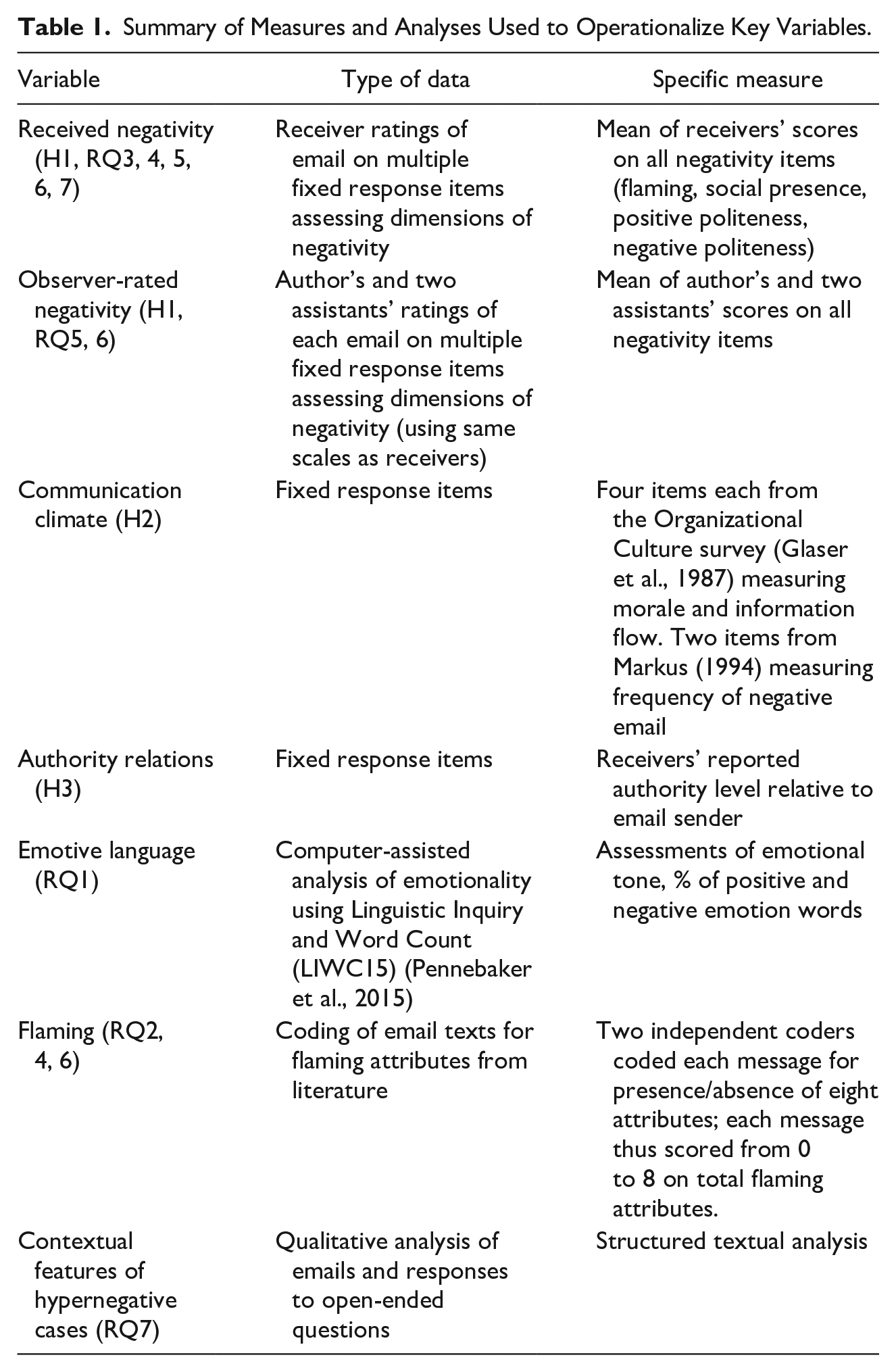
In summary, each survey respondent provided an example of an actual email they had received and perceived as negative, and then responded to a number of open-ended and fixed-response item questions about their interpretation and reactions to the email. Table 1 summarizes the specific measures and analyses used to operationalize the variables identified in the hypotheses and research questions.
Summary of Measures and Analyses Used to Operationalize Key Variables.
Results
Negative Intensification Bias (H1)
Results confirmed H1 in that received negativity of emails (M = 5.09) exceeded observer-rated negativity (M = 4.50), t(275) = 9.34, p < .001. Received and observer-rated negativity correlated moderately (r = 0.37, p < .001), suggesting that received negativity had some objective basis while also being context-tied to a considerable extent.
Workplace Influences on Hypernegative Interpretation of Email (H2 and H3)
H2 predicts greater negative intensification of negatively perceived emails in poor communication climates. H3 predicts greater negative intensification by individuals with lower authority than the sender. To perform a direct test of both hypotheses, we computed difference scores (received negativity minus observer-rated negativity) to index negative intensification bias. As expected from H2, negative intensification bias correlated positively with frequency of negative emails (r = 0.13, p < .05) and negatively with morale (r = −0.19, p < .01) and information flow (r = −0.17, p < .01). As expected from H3, overall authority in the organization had a significant effect on difference scores, F(2, 273) = 5.19, p < .01, ηp2 = 0.04. A planned comparison revealed greater negative intensification bias among individuals with lower overall authority than the sender (M = 0.82) versus individuals with greater authority (M = 0.41), t(180) = 2.58, p < .01, one-tailed. Although not predicted, results also showed greater negative intensification bias among individuals with lower overall authority versus individuals with equal authority (M = 0.42), t(208) = 2.72, p < .05, two-tailed with Bonferroni correction. Direct authority did not affect negative intensification, F(2, 273) = 1.79, ns, ηp2 = 0.01, although means trended in a similar direction as those for overall authority (M = 0.77, 0.52, 0.59 for lower, higher and equal authority).
Also supporting the logic of H3, received negativity had a weak association with observer-rated negativity among individuals with lower authority (r = 0.28 for those with lower overall authority, 0.23 for lower direct authority). The same correlations were moderate to strong for individuals with greater authority (r = 0.48 for those with greater overall authority, 0.52 for direct authority), and for equal authority relations (r = 0.44, 0.42). Thus, received negativity was more loosely associated with observable features of email for individuals in lower authority positions.
A hierarchical regression tested the unique and combined effects of authority and climate on received negativity, controlling for observed negativity. Independent variables in the model included lower overall and direct authority (each coded 1, 0), morale, information flow, and frequency of negative emails. Observer-rated negativity, emotional tone, negative emotion words, and total flaming attributes were included to control for observed negativity. Sex of the receiver (coded 1 = female, 2 = male) was included as a further control variable. A preliminary analysis screened for two-way interactions but failed to reveal significant interaction effects. The final model included control variables entered as a block on the first step, followed by independent variables. Independent variables contributed a significant combined effect beyond control variables (Table 2). With all variables entered, significant predictors of received negativity included observer-rated negativity, negative emotion words, morale, frequency of negative emails, and lower overall authority. Results mostly supported H2 and H3, indicating that communication climate and authority relations independently predicted received negativity after controlling for observed negativity. Individuals with lower workplace morale, who received frequent negative emails, and who had lower overall authority relative to the sender were especially prone to hypernegative interpretation of email.
Predictors of Email Negativity Perceived by the Receiver.
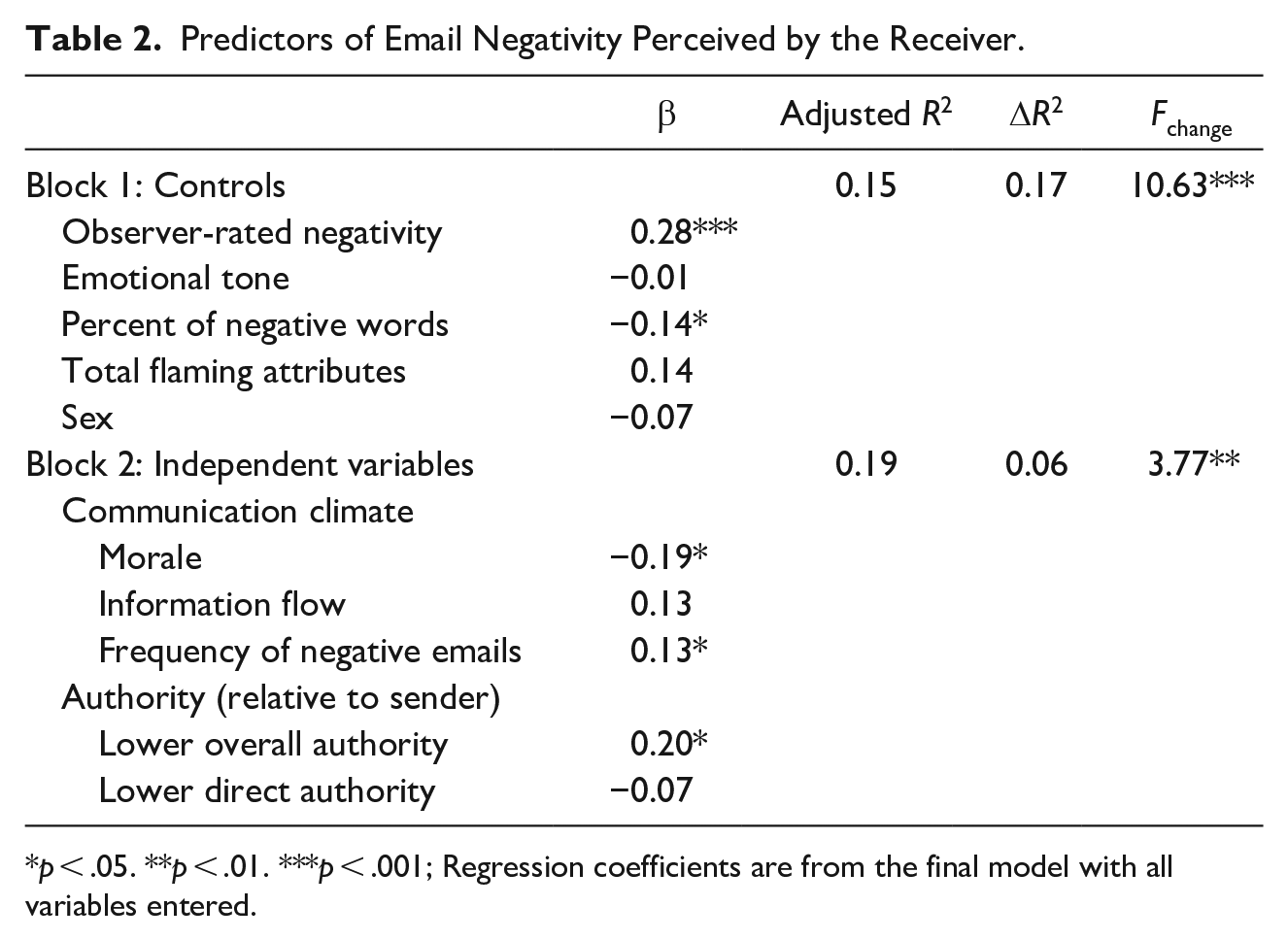
p < .05. **p < .01. ***p < .001; Regression coefficients are from the final model with all variables entered.
Characteristics of Negatively Perceived Emails (RQ1-6)
Based on LIWC analyses, emotive language in negatively perceived emails was not especially negative overall (RQ1). On average, the emotional tone of emails (M = 46.3, SD = 34.2) was close to the theoretical midpoint of the scale (0 = very negative, 100 = very positive), t(275) = 1.79 ns. Emotional tone was less positive than norms (M = 54.2, SD = 23.3; Pennebaker et al., 2015), but not dramatically so. Norms reflect over 80,000 language samples from diverse sources (e.g., Twitter, New York Times). Emails had a lower percent of positive emotion words than norms (M = 2.8, SD = 3.2 vs. M = 3.7, SD = 1.6) but the same percent of negative emotion words (M = 1.8, SD = 4.4 vs. M = 1.8, SD = 1.1). One sample t-tests compared sample means against hypothesized population means based on reported norms. These tests showed significant differences between negatively perceived emails and norms in emotional tone, t(275) = −3.83, p < .001, and positive emotion words, t(275) = −4.67, p < .001, but no difference in negative emotion words, t(275) = 0.08 ns. Overall, emotive language in our sample of negatively perceived emails was somewhat less positive but otherwise similar to that seen in diverse settings. However, emotive language in emails was more variable than norms, as suggested by the high standard deviations reported above. The high standard deviations confirm our informal observation that some of the negatively perceived emails were overtly negative but many others were emotionally neutral or even distinctly positive.
Coding of emails for flaming attributes (RQ2) revealed some that were offensive by any standard and others that posed no obvious face threat. Three percent of emails used profanity (“Fuck you and your performance assessments”), 8% contained direct insults (“You are egotistical, smug, and self satisfied”), 35% made accusations (“You have continually undermined my decisions”), 5% issued threats (“I’m going to make your life very difficult”), 11% used text conventions to show irritation (“TRYING FOR TWO CONSECUTIVE DAYS TO GET THROUGH TO YOU!!!!!!!!!!”); 6% were sarcastic (“It would be nice if you actually replied to me this time”), 11% raised pointed questions (“Are you capable of making useful comments in a meeting?”), and 15% issued curt commands (“This needs to be done by yesterday”). Fifty-one percent of emails contained at least one of these attributes and 21% contained two or more (Mtotal flaming attributes = 0.89, SD = 1.05). However, many emails were outwardly civil and some were notably polite (e.g., “We acknowledge that our request was a very short timeline and certainly appreciate that you are very busy”).
RQ3 and RQ4 inquire about the relationship of received negativity to emotive language and overt flaming. RQ5 and RQ6 ask whether these overt features of email predict observer-rated negativity more than received negativity. Total flaming attributes in emails correlated moderately with received negativity (r = 0.33, p < .001). However, flaming attributes correlated far more strongly with observer-rated negativity (r = 0.71, p < .001).
With respect to emotive language, received negativity did not correlate with emotional tone, positive emotion words, negative emotion words, or words indicating specific emotions (anger, anxiety, sadness). By contrast, observer-rated negativity correlated positively with anger words (e.g., “hate,” “annoyed,” r = 0.13, p < .05), and negatively with emotional tone (r = −0.21, p < .001) and positive emotion words (e.g., “love,” “nice,” r = −0.15, p < .05). 4
In sum, observer-rated negativity related to emotive language and overt flaming far more consistently and strongly than did participant-rated negativity (RQ5, RQ6). Negativity attributed to workplace email by those receiving the messages seemed to reflect the individual’s subjective meaning context as much or more than overt negativity of messages accessible to observers.
Contextual Features of Negativity in Hypernegative Cases (RQ7)
To enrich our understanding of hypernegative interpretation of email, we examined qualitative data in cases that showed a clear discrepancy between received and observer-rated negativity (RQ7). We based the qualitative analysis on iterative readings of messages and participant accounts guided by structured questions (Tracy, 2013). At the start, we were interested in how participants used context to fill in meaning of emails that were not, based on outward features, as negative as suggested by receiver ratings. To organize relevant data, we selected cases in which received negativity exceeded observer-rated negativity by 1.5 on the 5-point scale. There were 45 such cases. Although somewhat arbitrary, this numerical cutoff effectively distinguished clear examples of emails that did not outwardly appear especially negative but were depicted as such in additional comments and explanations by participants.
We initially arranged the text of offending emails in a spreadsheet, together with participant answers to open-ended questions about the email (what was negative, how they responded and why). Two researchers independently looked for patterns in messages and contextual information provided by respondents and recorded analytic memos (Tracy, 2013). After discussing initial observations, we focused the analysis on the following structured questions: (1) Does the context provided in accounts make the receiver’s reaction fully understandable and predictable? (2) Are particular types of messages most characteristic of hypernegative cases? (3) What role does (perceived) violation of email etiquette play in receiver reactions? (4) What other patterns explain the source of hypernegative interpretation? Through independent, close reading of these cases followed by discussion, we agreed on the following observations.
First, hypernegative cases included examples that were easily clarified by objective events and circumstances known to the receiver, but most involved a selective framing of the message. In a small subset, the context was obvious such that, with a fuller understanding, most observers would likely interpret the message as similarly offensive. One message was “After discussion within the department, all staff will be required to work a minimum of two Sundays per month.” The respondent’s explanation that her boss knew she is “very spiritual person” and goes to church regularly on Sundays clarifies why the negativity of the directive was exacerbated for her. In other cases, even with the context explained, an observer would have difficulty understanding the respondent’s strong reaction. For example, an email stated, “There are two hosts at your location, X and Y, that need hardware support. Do you want to . . . have them ship you the replacement parts? Please advise.” The recipient was offended because the message was “sent to the wrong person, and basically asked me do his job for him,” and he was concerned enough to refer the situation to the union.
Second, hypernegative interpretations often reflected the fact that demanding or impersonal messages were also seen as hostile, even absent overt markers of hostility. That is, participants seemed to conflate subtler forms of impoliteness with flaming. Using the original subscales for received and observer-rated flaming, the 45 hypernegative cases were often received as flames (received flaming M = 5.8) but not seen as such by observers (observer-rated flaming M = 3.2). It is important to note that most of these cases involved recipients with low power (27 of 45 had lower overall authority relative to the sender, five had greater authority, 13 had the same authority). Further, negative politeness violation overshadowed positive politeness violation in these cases. Using Searle’s (1969) speech act classifications, 28 of the 45 messages were directives (15 commands, 10 requests and three implied directives) and 16 were representatives or assertives, with 12 of these providing explanations and only four asserting criticism. Thus, many cases of hypernegative interpretation were reactions to people of authority issuing commands or requesting information or action. In some cases, the message was very direct, even abrupt, lacking personal acknowledgement or attention to negative politeness (e.g., “Bill, Send this to the group. Alan” [names are pseudonyms]). However, other messages included social niceties or politeness cues (“Thank you for your email. I hope you are feeling ok”), expressions of empathy (“I know you feel injustice”), or agreement (“I know - and I’m not overly thrilled about the situation either”). In such cases, explicit efforts to convey politeness were overridden by implicit features of context that signified hostile intent for the receiver.
Third, hypernegative interpretation often involved messages that could be read in multiple ways (e.g., as a simple directive, informational question, or indirect criticism), with recipients embracing the most negative reading. For example, “Just wondering why no update has been received . . . No news is good news hopefully!” was taken as an “insinuation” blaming the recipient for an unavoidable delay in providing requested information. In another, the phrase “You have been approved to attend . . .” within an apparent form letter was offensive because “approval” had never been required before and attendance was actually obligatory. In such cases, recipient accounts did not acknowledge ambiguity but instead revealed a tone of certainty through conspicuous absence of hedges or qualifiers (i.e., no accompanying phrases such as “maybe,” “somewhat,” “might be”). A factor that informed judgment in 14 cases was a tendency to frame messages within a larger pattern of behavior by individuals (e.g., others find him “impossible to work with”) or groups (e.g., “the Dutch can be very demanding”). One email referred to an existing conflict affecting the sender’s “progression in the organization” and asked the recipient to “join in a peace treaty.” This was seen as further evidence of the sender blaming “everyone working around him” for his own limitations and reported as such to management.
Fourth, receiver accounts frequently highlighted the sender’s inappropriate use of email as justification for hypernegative interpretation. In 18 cases, participants commented on something about the use of email, highlighting such things as cc’ing, short or long emails, misdirected emails, lack of pleasantries, spelling errors, lack of care in construction, bold or uppercase letters, issuing emails without consultation, and using email in place of face-to-face communication. These comments showed recipient mindfulness about email etiquette and the symbolic meaning of email use (Kurtzberg et al., 2006; Timmerman & Harrison, 2005). For example, the use of email to issue directives was understood by some as an intentional strategy to circumvent consultation. In one case, a manager directed employees to review and comment on policies in the company manual. Although couched in polite language (e.g., “Thanks team!”), the directive was received as “patronizing” and “do as I say,” due to lack of “engagement face to face before sending out the email.” Another email with ambiguous intent (“Please find attached order that was placed by [name] and note the inconsistencies in the part numbers”) evoked a strong response due to a lack of prior consultation and cc’ing (“Please in future contact either myself, or [name] before you cc all and sundry into an email . . . this is not how we handle errors made by members of our team”). Thus, mindfulness about appropriate and strategic uses of email served to augment and justify negative attributions about sender intent.
Discussion
The present study contributes to the literature by using multiple methods to examine receiver sense-making in conflict and incivility over email. This contribution is important in the context of workplace communication. In particular, there is a proliferation of advice on email etiquette focusing almost entirely on “dos and don’ts” for message construction; that is, advice for the sender of emails. However, as our research demonstrates, the receiver plays an active role in the process of message interpretation, drawing on context as much as the message to derive meaning. Three general observations support this conclusion. First, results demonstrate a negative intensification bias in negatively perceived emails. Electronic messages that receivers find to be insulting or otherwise inappropriate often do not appear particularly negative when judged by their manifest style and content. Second, the degree of negative intensification bias relates to receivers’ own sensitivities arising from poor communication climate, a low position of authority, or other factors. Third, contextual influences on receiver interpretation are quite variable and reflect little consensus about what makes an email offensive. Thus, email interpretation in hypernegative cases involves unpredictability that is not necessarily mitigated by polite and careful message construction.
Results support the idea that receivers intensify the meaning of negatively perceived emails beyond that suggested by surface features. As expected, negativity attributed by receivers exceeded negativity identified by observers. Further, received negativity had only weak to moderate associations with ostensible markers of negativity, including emotive language and flaming. To be sure, many of the emails were offensive for obvious reasons. Some were strikingly abusive. Yet, many others were outwardly civil and even notably polite. About half of negatively perceived emails were context-spanning face attacks, in the sense that messages included at least one overt marker of flaming (e.g., profanity, insults). However, only one-fifth had two or more such markers and these included nearly all examples that we intuitively read as clear flames. Received meaning was more context-tied in the remaining examples.
The negative intensification bias observed in this research parallels perception intensifying effects of CMC in other contexts. However, most effects demonstrated to date are hyperpositive tendencies to form inflated, positive impressions of others online. The hypernegative interpretations documented here do not characterize email as a rule; however, results suggest that negative intensification bias plays an important role when email takes a problematic turn.
Results also revealed ways receiver sensitivities contributed to hypernegative interpretation. As hypothesized, negative intensification bias occurred at higher levels among those with low power and in poor communication climates. Qualitative results showed that hypernegative interpretation often occurred in response to people in authority issuing commands or making requests. A main source of hypernegativity was a tendency to regard these somewhat impersonal or demanding messages as flames, even absent obvious signs of hostility. Thus, participants seemed to conflate minimal social presence or negative face threat with direct face attack and hostile intent. Research on family conflict suggests that existing tensions and insecurities contribute to heightened vigilance toward relational meaning, such that one individual might attribute poignant meaning to messages that appear neutral to another (Sillars, 2011). A parallel phenomenon seems to occur in workplace relationships. That is, impersonal, task-oriented messages are sometimes construed as flames, particularly by individuals with low authority and morale.
Qualitative analysis of hypernegative cases revealed variable contextual features that informed meaning for participants. In some cases, received negativity was based on background knowledge that was easily understandable once explained. In other cases, however, an observer might have difficulty understanding the receiver’s reaction even after knowing the context. Thus, insider knowledge of background events, by itself, was insufficient to account for strong negative reactions of the receiver. Instead, participant narratives highlighted the multiple origins of received meaning. Receivers took offense to emails based on wide ranging aspects of context, including indirect message cues, background events, and framing of the relational and organizational context. The varied and layered nature of context accentuates the potential for multiple meanings within negative emails exchanges.
One source of hypernegative interpretation in qualitative accounts was the tendency to frame ambiguous messages within ongoing patterns of negative behavior (e.g., “He has little man syndrome”). This tendency to fit communication into pre-existing narratives often underlies intractable conflict according to literature on conflict frames (Brummans et al., 2008). People’s sense of what is appropriate for email use also featured prominently in hypernegative interpretation, with accounts highlighting a number of message cues deemed inappropriate (e.g., misspellings, abrupt or long messages). Thus, hypernegative interpretation reflects implicit theories about appropriate/inappropriate uses of email at work. Markus (1994) found that managers show considerable mindfulness about strategic purposes and liabilities of email. Our results also illustrate that people receiving email are also mindful about its strategic purposes and use this knowledge to interpret sender intent, albeit in ways that sometimes reveal considerable bias. For example, the fact that a directive is conveyed by email versus face-to-face can be read as a power move intended to close off consultation. Further, receivers understand that email provides the opportunity to plan messages; thus, receivers might expect a high degree of politeness. A hastily constructed or abbreviated message might therefore be read as an intentional slight. While receiver accounts showed considerable mindfulness about strategic and appropriate uses of email, there was no obvious consensus on basic rules of email use. Ironically, this suggests that sensitivity to email etiquette might increase the fallout of negative email by invoking personal norms that are not widely shared.
Hypernegative interpretation of workplace email seems most likely to come into play with messages that pose ambiguous face threats, such as the requests and directives highlighted in qualitative results. Ambiguity provides greater latitude to fill in meaning based on the subjective context of the receiver. Thus, uses of email by managers and co-workers as an efficient medium to accomplish goals can be read as intentional face attacks if messages violate receiver norms for email, or if the receiver is sensitized to potential face threat by weak morale, low power, and other factors. Moreover, narrative accounts show little acknowledgement of ambiguity. People did not hesitate in the face of ambiguity, as revealed by the tone of certainty about emails that could be read in multiple ways.
Our study has important implications for workplace practice. Most practical advice in the popular press has focused on email construction. The most obvious implications from the present study are to remind communicators of the inherent limitations of message construction advice and the potential value of shifting email-related training, advice, and other interventions from focusing solely on message construction to a greater emphasis on email reception. Four specific points stand out. First, the significant and complex role of context suggests it is likely impractical for a sender to anticipate all potential offenses. People can read ill intent into even a carefully constructed and well-intended message. Thus, guidance regarding email construction should emphasize the unpredictable nature of message interpretation as well as the tendency for receivers to read into messages and intensify negative meaning. Second, differences in the interpretations of receivers compared to neutral observers highlight limitations of the common advice to ask a colleague to read an email before sending it. In our findings, observers’ negative evaluations were much more tied to emotive language and overt flaming than were the actual receivers of those messages. At the very least, communicators should give the neutral reader a rich sense of the context and relationship to inform their reading. Third, communicators should be especially cautious about messages sent to receivers situated within negative communication climates and in lower power positions. Fourth, training and advice should heighten awareness of the multiple opportunities for misinterpretation in email and the tendency of receivers to embellish face threat. Such training could help message recipients be more cautious and less prone to harsh evaluations of messages as well as increase the likelihood of their seeking clarification or other constructive engagement with senders.
Certain limitations of the research affect the interpretation of results. Participants provided their own examples of negative emotive emails and likely selected the most negative example they could easily locate. Thus, results do not show that negative intensification bias applies to email in general, only that it characterizes negative examples salient to the receiver. Although the sample was diverse in terms of occupations and authority levels, it was not a random sample. Moreover, we screened out individuals who could not recall or reproduce a negative workplace email, so we cannot say whether the experiences of our participants were typical. Although the results mostly supported hypotheses, effect sizes were small. There are likely many factors that influence message interpretation beyond those we directly measured. Among other things, hypernegative interpretation of emails could reflect personality characteristics of receivers, such as dispositional negativity (Shackman et al., 2016) or trait perspective-taking (Edwards et al., 2017), as well as familiarity and relationship quality with respect to the sender. Although our results document a negative intensification bias, we do not dismiss the possibility that individuals with high morale and strong relationships might exaggerate positivity and understate negativity reflected in the observable message. This possibility is supported by evidence that people project their own affective states when interpreting the emotional communication of others (Clark et al., 2017). Because we asked respondents to self-select negative emails, our research was not positioned to examine the possibility of positivity bias. Future research might consider the potential role of morale, relationships, and traits in fostering both positive and negative perception intensification effects.
We did not compare email with communication face-to-face or via other media. Thus, the results do not show that negative intensification bias occurs more over email than face-to-face. In fact, we assume that hypernegativity can occur during any form of interaction. Further, not all emails are ambiguous; for example, the obvious flames reported by some participants could hardly be read as anything other than direct face attacks. However, workplace emails seem distinctive because they often represent task-oriented messages without obvious cues to the sender’s emotional state or beliefs about the recipient. Our research indicates that co-workers nonetheless, frequently read these messages as clear face attacks.
Conclusion
Extensive commentary suggests that negative email exchanges at work are commonplace, owing to insensitivity regarding rules of politeness regarding the medium. Our research explores a different side to negative email exchanges, illustrating the importance of receiver sense-making and the potential for hypernegative interpretation of emails under certain conditions. Ultimately, politeness is not contained in messages but in the interface of messages and context-dependent standards for appropriate communication. Because the receiver has considerable latitude when identifying relevant context, the troublesome side of email can originate in sender insensitivity, receiver over-sensitivity, or both.
Footnotes
Declaration of Conflicting Interests
The author(s) declared no potential conflicts of interest with respect to the research, authorship, and/or publication of this article.
Funding
The author(s) disclosed receipt of the following financial support for the research, authorship, and/or publication of this article: This research was supported by a grant from the Massey Business School. The authors wish to thank Bridget Herlihy, Anjali Saroop, and Mackensie Minniear for their valuable assistance with data analysis.
