






Abstract
This paper investigates how organizational members author strategy in digital contexts. Situated within the strategizing literature, we focus on messaging on online collaboration platforms as a less-discussed mode of communication in strategizing and on team collaboration platforms as a neglected context for strategy making. Drawing on the case of a fintech startup in its early days that proposes, discusses, and performs strategic options on Slack, we show that organizational members author strategy by projecting actionability onto a proposed course of action, invoking sustained progress over time, and accumulating efficacy of evidence until the course of action appears inevitable. They do so through practices of referencing, reasoning, and revealing, by blending affordances with messages as the mode of communication. Our findings explain how strategy is authored through displayed actions and outcomes rather than through shared meanings alone and highlight the interplay between communication mode and digital context in shaping strategizing practices and their outcomes.
Research on strategizing has increasingly paid attention to authoring as a perspective for examining how strategy emerges and settles (Bencherki et al., 2021; Li & Jarzabkowski, 2025; Nathues et al., 2023; Spee & Jarzabkowski, 2011; Vaara & Langley, 2021). Strategy authoring concerns the processes of establishing a specific course of action directed towards some strategic accomplishment (Jarzabkowski & Seidl, 2008). Current research has identified various practices in the strategy authoring process, such as substantiating an issue and appropriating one’s voice to shape a strategy (e.g., Bencherki et al., 2020; Holm & Fairhurst, 2018). However, these practices are associated with and shaped by communication modes of strategy talk and text produced in or through social interactions, such as in-person meetings and strategy documents (Huisman, 2001; Skov et al., 2023; Spee & Jarzabkowski, 2011). The focus on talk-in-interaction and discourse, within which strategy texts need to align, suggests that authoring is grounded in a common and shared, albeit potentially ambiguous, meaning. An authored strategy is thus a consensus, a joint account, or an authoritative narrative, even when it includes multivocality (Bencherki et al., 2021; Nathues et al., 2023; Spee & Jarzabkowski, 2017). Despite the widespread use of team collaboration platforms such as Slack and Teams in contemporary organizations, the strategizing literature has rarely examined strategy authoring through messages in digital contexts. The few studies concerning practices on such platforms have not given full attention to messages on online collaboration platforms (messages or messaging hereafter) as language-in-use (e.g., Bunce et al., 2018; Pietinalho & Martela, 2024) and affordances that “frame […] the possibilities for agentic action in relation to an object.” (Hutchby, 2001, p. 444). Theoretical consideration of how organizational members strategize through messages and how the platform context shapes authoring remains an important but overlooked topic in strategizing research.
In this paper, we examine strategy authoring on a team collaboration platform. Specifically, we ask: What practices do actors enact to author a strategy on a team collaboration platform, and how does the strategy authoring process unfold through these practices? Our study sits at the nexus of strategy-as-practice research that defines strategizing as actions, interactions, and negotiations of organizational members to establish a course of action for their organization going forward (Jarzabkowski et al., 2007), and research that considers how actors mobilize technology affordances to support strategic accomplishments (Faraj et al., 2011; Rice et al., 2017). We draw on the salient case of DigitCo, a technology startup that communicated, interacted, and strategized on the Slack platform in its early days to develop a series of functional strategies, including recruitment, data acquisition, and marketing, in preparation for its formal launch. Based on the communication logs from the first two years of DigitCo’s history, we find that organizational members author strategies by projecting actionability onto a proposed course of action, invoking sustained progress over time, and accumulating efficacy of evidence that a particular course of action starts to seem unavoidable. This actionability, progress, and accomplishment are demonstrated through performing practices of referencing, reasoning, and revealing in a platform-based context, where initiating actors construct messages and mobilize platforms’ affordances in their strategy authoring. While the platform affordances do not determine how these actors perform their authoring practices, they do enable this unfolding of the authoring process. Our study thus shows that strategy authoring in a platform context requires a persistent display of actionability and accomplishments.
Our study makes several novel contributions to the understanding of strategizing practices and the process of strategy authoring in a digital, platform-based context. First, we contribute a distinctive understanding of strategy authoring in this context as a trajectory of actionability, progress, and efficacy of a course of action. Such authoring does not require the meaning alignment or shared understanding assumed in the existing literature that focuses on how talk-in-interaction and associated texts generate some form (or not) of shared understanding, consensus, or common attribution of meanings as the basis for strategic accomplishment (e.g., Samra-Fredericks, 2003; Sillince et al., 2012; Spee & Jarzabkowski, 2017). Specifically, we explain that actionability in this context is manifested as a persistent display and, sometimes, staging, of what has been done through messages, with their versatility in communicating formally and informally, and affordances that enhance these narratives with a ‘material’ quality. In doing so, we draw attention to the interplay of the communication mode and the digital context in shaping strategizing. Second, we add to the literature by highlighting organizational members’ skillful mobilization of affordances in performing otherwise generic discursive practices that give rise to effective strategy authorship, further demonstrating how practices and technologies are co-constituted (Orlikowski, 2000) in strategizing. We highlight the preservation of human agency and suggest that, in platform-based strategizing, actors can also display and stage progress and accomplishment through manipulating temporality, which is enabled by messages and affordances, often in conjunction. Consequently, the strategy authoring process in a platform context appears to be episodic and cumulative, occurring in communicative ‘bursts’ rather than a continuous, monotonic process suggested by the literature, with the traditional focus on in-the-moment strategizing through talk-in-interaction (Kuhn, 2008; Vaara & Langley, 2021). Finally, we contribute to authoring research (e.g., Jäger & Kreutzer, 2011; Vásquez et al., 2018) by highlighting the distinctive sources of authority and contesting nature of the authoring process in a platform context. In summary, our study emphasizes the mode and context of communication in understanding the strategizing process and its outcome, such as strategy authoring and authorship, and suggests a research agenda that embeds communication at the center of strategizing.
Literature Review
Authoring, Communication Modes, and Strategizing Context
In strategizing research, something is strategic when it demands “particular courses of action” (Bencherki et al., 2020, p. 10). Strategy authoring thus refers to constructing a course of action deemed consequential or strategic for an organization to accomplish, which could be written as a document (Huisman, 2001; Spee & Jarzabkowski, 2011). As such, research has often treated an authored strategy as a consensus, a commitment, or a joint account (Jarzabkowski & Seidl, 2008; Spee & Jarzabkowski, 2017), even when this account is also multivocal, ambiguous, and requires translation and recontextualization (Aggerholm et al., 2012; Sillince et al., 2012). This emphasis on meaning, account, and voice, however, is partly a consequence of research’s tendency to focus primarily on strategy talk and texts. Indeed, our current understanding of strategy authoring processes and practices is grounded in studies of non-digital contexts, such as in-person meetings, where the main modes of communication are talk-in-interaction and texts of specific genres, such as strategic planning documents.
Three bodies of research address authoring in the strategizing literature. The first body of research focuses on strategy talk-in-interaction (Samra-Fredericks, 2003). Organizational members author strategies through voice leveraging, such as speaking on behalf of others, invoking a collective voice, or aligning with an authoritative figure or entity (Holm & Fairhurst, 2018). These practices are afforded, that is, actions made possible (McLuhan, 1964/2001), by talk as the mode of communication that allows the invocation of absent voices or expropriation of individual, organizational, or other voices to coauthor or resist the team’s strategy (Nathues et al., 2023). As such, this body of research has largely focused on voices in authoring (Bencherki et al., 2021) and highlighted how shared meanings and collective accounts are constructed in authoring strategies.
The second body of research on strategy authoring focuses on the interplay of strategy talk and texts in shaping a collective understanding of a strategy as a meaning system. Organizational members author strategies by formulating, communicating, and interpreting a strategy document, which is further revised, refined, and shaped through talk and discussion in meetings. The focus on the interplay of differing communication modes has shaped the understanding of strategy authoring as meaning proposition, expansion, and reframing (Spee & Jarzabkowski, 2017). However, Holm and Fairhurst (2018) observed that “When tracked over time, most of the topics and ideas raised in the discussion (even those heavily discussed and supported) were seemingly forgot [ten].” As such, this process makes any emerging course of action ambiguous despite the collective understanding reached (Aggerholm et al., 2012; Spee & Jarzabkowski, 2011). Indeed, this ambiguity may even serve as the basis for progressing a course of strategic action constructed through the multivocal interplay of talk and text (Sillince et al., 2012).
The third body of research examines formal meetings as a context for strategizing, which are “routinely planned in advance, with structured agendas and goals as well as clearly delineated participation structure.” (Halvorsen & Sarangi, 2015, p. 3). In this context, organizational members author strategies through practices such as controlling the agenda, delegating responsibility within their hierarchical positions (Sorsa et al., 2014; Tavella, 2021), prioritizing goals, updating information, and providing specialist information through individual members’ expert status (Jarzabkowski & Seidl, 2008). While actors can assume various roles to present, respond, assess, elicit, and regulate these meetings in their attempt to author a strategy (Halvorsen & Sarangi, 2015; Hendry & Seidl, 2003; Tavella, 2021), attention has been given to the collective “recognition that possession of the resource grants the holder a legitimate capacity to make decisions on behalf of a collective.” (e.g., Porter et al., 2018, p. 892). As such, this body of research highlights that organizational members mobilize organizational resources in their attempt to author a strategy.
The above insights largely resulted from studying strategizing through the traditional modes of communication, such as talk-in-interaction and documentation. In contrast, strategizing research has rarely investigated strategy authoring when messages become the predominant mode of communication, often without recourse to in-person strategy talk. Moreover, messages as a distinctive mode of communication are often digital and embedded in a technological infrastructure that could introduce differing dynamics. Despite acknowledging that “elements of wide group communications […] are likely somewhat unique to the online environment” (e.g., Pietinalho & Martela, 2024), research has not paid sufficient attention to messages in a platform context and their implications for strategy authoring. To understand how organizational members author strategies through messages on a team collaboration platform, which is distinctive from talk and texts in a non-digital context of strategizing, we turn to communication research for inspiration.
Platforms, Strategizing, and Affordances as Resources
A Selective List of Technology Affordances of Social Media
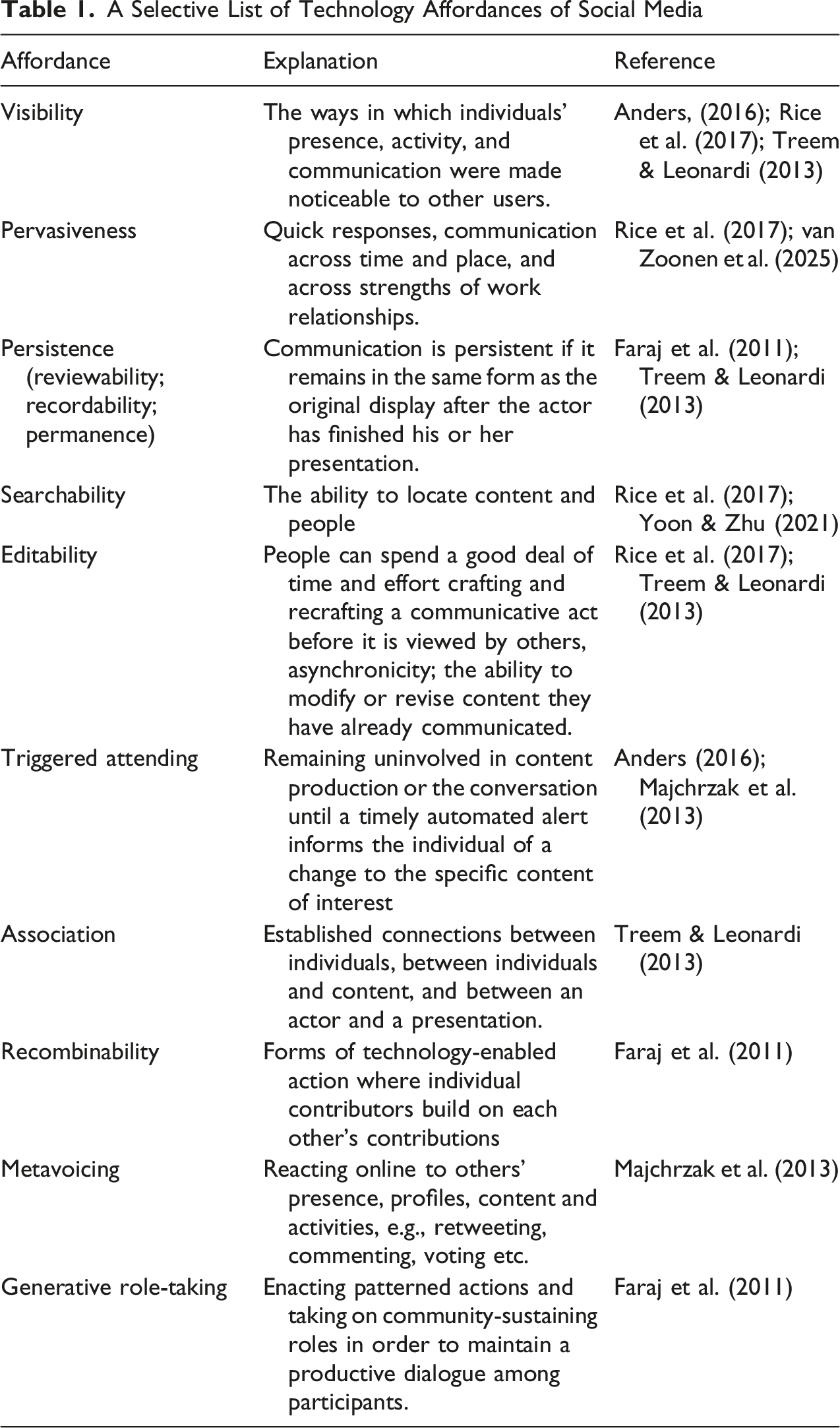
Research on the “affordances for organizing” has cautioned against objectivist views of affordances (Zammuto et al., 2007). Scholars suggest that a technology affordance is “a multi-faceted relational structure, not just a single attribute or property or functionality of the technology artifact or the actor” (Faraj & Azad, 2012). Affordances, therefore, need to be understood in relation to “the domain of action,” that is, what actors attempt to accomplish in the digital, platform-based context (Majchrzak et al., 2013). Moreover, different platforms, such as Slack (Anders, 2016) or Twitter (Albu & Etter, 2015), may also foreground certain affordances over others. As such, actors engage with affordances selectively and sometimes idiosyncratically in accomplishing their tasks and goals (Majchrzak et al., 2013). Drawing on the above theoretical understanding, our study asks: What practices do actors enact to author strategies through messages on a team collaboration platform? And how does the strategy authoring process unfold in this context?
Methods
Research Context and Case
We address our research question using DigitCo as a case. DigitCo was a digital insurance startup founded by Ian and Tim (all names are pseudonyms), who wanted to create a flexible insurance product and sell it through digital distribution channels, such as an app or a website. Initially, DigitCo faced challenges with several functional issues associated with its business model. For instance, DigitCo was registered as an insurance broker, which required the startup to have an insurance and reinsurance partner, a license for selling financial products from the regulatory body, and a claims management function. The (re)insurance partner required a pricing model that the startup needed to construct. The focus on digital also meant that the startup needed an app or a website to distribute its products. Hence, it needed engineers capable of building a platform from scratch. As such, DigitCo had to develop several functional strategies to enable its formal launch.
We gained access to DigitCo in 2018. The startup offered flexible working arrangements, with some hires fully remote. It used several digital platforms in its operation, including Jira for agile development, Trello for project tracking, and Slack for communication and collaboration. Upon entering the field, we were authorized to access Slack, which has maintained communication logs since the founding of the firm in 2016. Members had set up channels or chatrooms for specific topics, where they discussed strategic issues, including #marketing, #claims, and #recruitment, as well as non-strategic discussions, such as #blah and #zipwire. Reviewing the messages from 2016 and 2018 revealed competing courses of action; that is, divergent strategies proposed to resolve issues and move the startup forward. Meanwhile, our field-entry interviews with founding members in 2018 confirmed the strategies DigitCo employed at that time. We realized that it was an unusually rare opportunity to understand strategy authoring—that is, how actors promote courses of action and get them accepted as strategies for the organization moving forward. Our access to the Slack archives between 2016 and 2018 allowed us to track the strategy authoring process, and our 2018 interviews confirmed that the outcomes were strategies that had been accomplished.
Empirical Materials
This study relied on the communication logs in the first two years of DigitCo’s life. The primary source consisted of 15 channels created over these two years, with the communication logs totaling 423 pages. Each channel was dedicated to one topic. However, each topic could contain multiple issues. For instance, members could discuss both product design and product distribution in the primary product channel. Across channels, members discussed various, sometimes overlapping, issues, including, but not limited to, engineer recruitment, market position, data acquisition for building the pricing model, and the type of pricing model.
Our understanding, based on the primary source, was further confirmed and contextualized through our field entry interviews and fieldwork. Specifically, we used interviews with key members and our observations in the field to determine the accepted courses of action; that is, the authored strategies being accomplished in 2018 that were developed through the authoring process that unfolded on Slack from DigitCo’s founding in 2016 to our field entry in 2018. For instance, we can confirm that DigitCo recruited engineers in 2018 based on their compatibility with DigitCo’s team (i.e., cultural fit) because job interviews were structured as a 30-min “cultural interview” plus a 30-min “engineering and process focus [ed]” part. Not all interactions took place on Slack, and we did not have access prior to our field entry in early 2018. However, our entry interviews and fieldwork were sufficient to triangulate the discovery from the communication logs regarding the actions of and dynamics between initiating members and the authored strategies.
Analysis
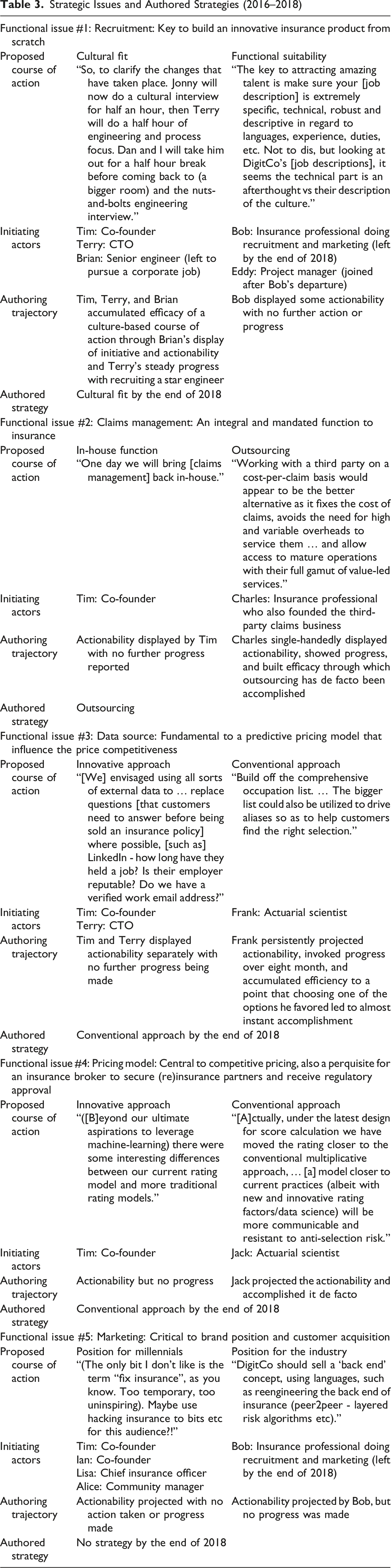
We analyzed our data over four phases. Phase one was to understand the context, scope, and dynamics in which strategies needed to be authored for the formal launch. Specifically, we read message exchanges in each channel and tabulated the start date, topic/issue, and participating actors in a spreadsheet (Miles et al., 2013). Second, based on the spreadsheet, we identified seven channels in which key strategy issues were discussed. We wrote memos to describe issues, proposed courses of action, key episodes (i.e., blocks of intense message exchange), and interaction dynamics in these episodes, resulting in a total of 44 pages of single-spaced memos. Third, based on our extensive memos, we identified five issues with divergent courses of action that differing actors proposed and attempted to establish: recruitment, claims management, data acquisition, pricing model, and marketing. We then tagged the relevant blocks of message exchange with these five issues for further investigation. Fourth, we examined our field entry interviews with key members to determine the adopted courses of action in 2018. We were able to confirm strategies for four issues, but the marketing strategy remained unclear.
Phase two zoomed in on messages to examine discursive practices in and through these messages to propose and promote a course of action for a strategy issue. Specifically, guided by the question of what actors did in these messages, we open-coded the tagged blocks of messages for each issue and found three generic practices. First, we observed that on many occasions, actors presented their ideas while referencing their sources, which could be long quotations from personal correspondence and narratives about lessons learned from experience. We labeled this practice referencing. Second, some messages listed pros and cons of a particular option and elaborated on them with written observations and reflections. We labeled this as a reasoning practice that actors enact in message writing. Finally, we labeled revealing when actors reported what they were doing and what they had achieved through messages, or displayed their actions through Slack functions or features, such as starting a poll or uploading a document. Importantly, we noticed that the ways actors performed these practices involved both constructing messages and using Slack to display their actions, progress, and accomplishments, sometimes in a material form, such as a poll, an attachment, or a web link.
Discursive Practices Performed Through Messages on a Platform
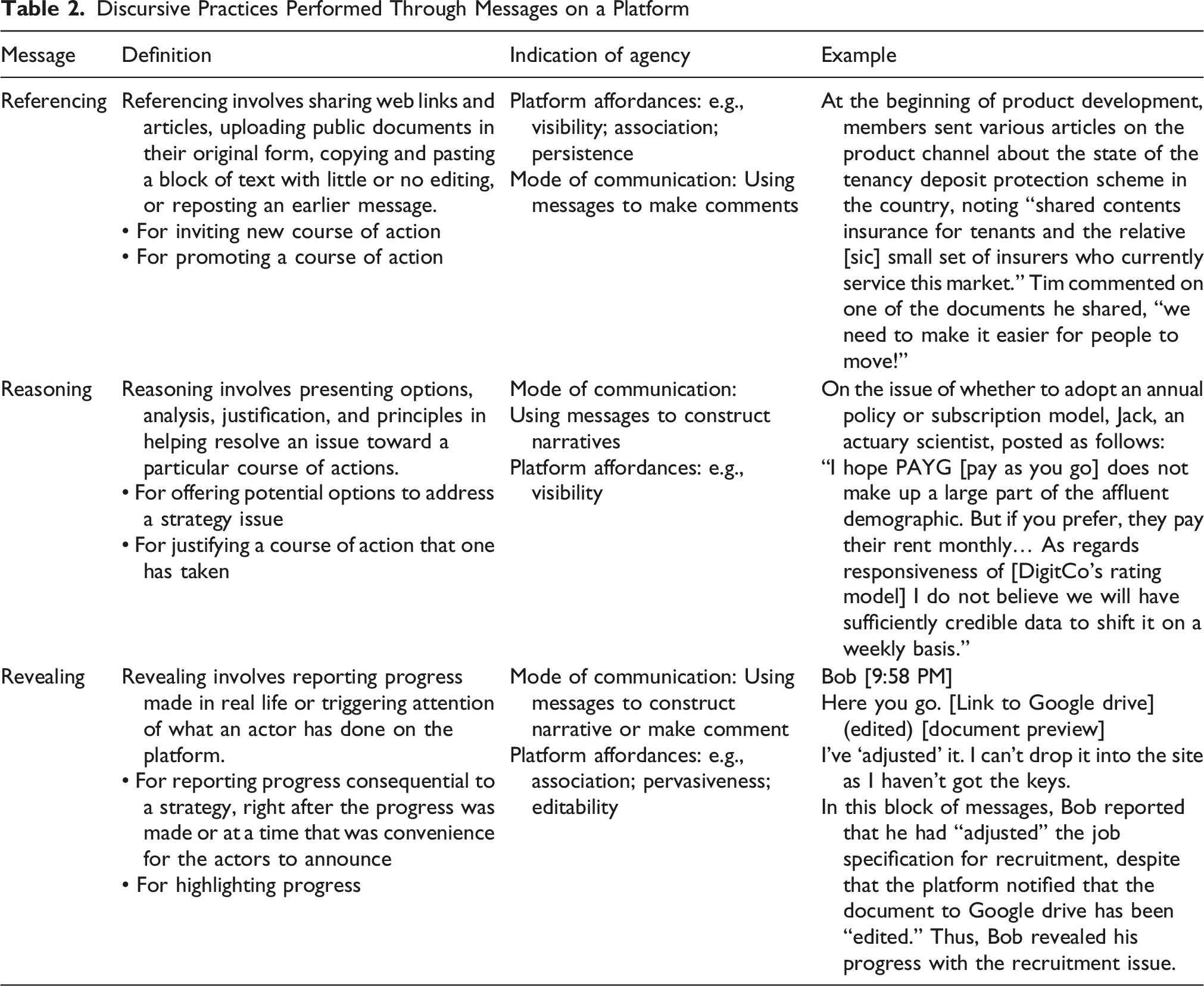
Phase three zoomed out to track the trajectories of competing courses of action that differing members attempted to establish as the strategy. Specifically, we identified initiating actors for each identified course of action, examined their practices in promoting their proposed course of action, and investigated their effects on whether and how their proposal was settled as the strategy. For example, based on our investigation in phase one, two competing courses of action were identified: culture- or function-based recruitment. We then read through all the relevant blocks of message exchange. We found that Tim, Brian, and Terry were major actors promoting a cultural strategy, while Bob promoted a functional strategy. Third, we examined how these two groups of actors messaged on Slack. We found that actors behind the cultural strategy regularly reported actions they had taken using both messages and Slack functions to demonstrate outputs, such as uploading a document to Google Docs and ‘verbally’ reminding others of what they did in a message, suggesting that their course of action was doable. We labeled this ‘projecting actionability’ in which actors enacted practices, such as revealing and referencing while using the repost function but ignoring the automatic notification function. We also found that their messages constituted a narrative about how they got in touch with one contact, how the recruitment fell through, how they followed up regularly, and how the contact came back for discussion. We realized that actors invoked sustained progress by crafting a narrative through message writing to indicate that the culture-based orientation was not only actionable but also progressing steadily. Finally, we saw strong evidence that three actors reinforced the perception that their course of action was producing results, building up evidence that their actions were effective, until a particular course of action started to seem so compelling that it appeared unavoidable. For example, Tim pointed out an interview appointment with a highly qualified individual, followed by Brian’s report of three additional candidates in the interview pipeline. We labeled this building up of evidence ‘accumulating efficacy,’ highlighting their various efforts to demonstrate that the course of action was accomplishable, if not already producing accomplishments. We noted that, from an affordance perspective, ‘accumulating efficacy’ concerns affordances, such as recombinability, suggesting that platform affordances shaped the overall authoring process.
Strategic Issues and Authored Strategies (2016–2018)
Findings
We found that strategy authoring on a team collaboration platform unfolded through a process of projecting actionability, invoking sustained progress, and accumulating efficacy, i.e., building up evidence that their actions are effective. Actors projected, invoked, and accumulated actions, progress, and accomplishment through revealing, referencing, and reasoning practices, performed through messages and afforded by Slack. The effectiveness of these practices in strategy authoring depended on how actors used messages as a specific mode of communication and engaged with the platform affordances to demonstrate actionability and accomplishability. Through this strategy authoring process, within a platform context, actors in our case established, persisted, and escalated actions, progress, and accomplishments of a course of action, enabling it to be established as the authored strategy.
Projecting Actionability
To author a strategy, actors revealed, referenced, and reasoned in their messages to project the actionability of their proposed course of action. Actionability indicates what has been tried or could be done, thereby suggesting the effectiveness of the proposed course of action. Actors projected actionability by displaying actions and constructing them as actionable. We found that these projections were most effective when actors used messages and platform affordances in conjunction, rather than alone.
First, actors revealed what had been done in trials, demonstrating that the proposed course of action was feasible. For example, DigitCo’s human resources (HR) specialist wrote on Slack that, as part of the recruitment process, the startup should have an Equal Opportunities Policy in place before posting job advertisements. While Tim asked whether there was “a preferred template for an Equal Opportunities Policy,” Brian, a founding engineer, searched for a template online, tweaked it, and posted it in the channel. He wrote, “Alternatively, is this acceptable? [an internal link] (feel free to say no, it’s not public, I just wanted to kick things off).” The file was automatically uploaded, and a link was visible to everyone. With the comment, Brian drew others’ attention to what he had done. In another discussion on whether and how to include the occupation list in the pricing model, dissatisfied with the current list, Tim wrote that he “found and cleaned the occupation list from MoneySavingExpert - not perfect - but a good start [an internal link to a document].”
In both examples, actors revealed their actions through messages and platform affordances such as visibility (by posting), association (by sharing a link), attention-triggering (notification of a file upload), and a generative role-taking (“just wanted to kick things off”). Specifically, actors skillfully combined messages (e.g., commenting on a status ‘verbally’) with platform affordances, such as attention-triggering or association (e.g., notification of a shared link), to create a powerful perception that what has been said has been done. Revealing, by enhancing the effect of messages with displayed actions, sometimes through a material form, such as a link to a newly made document, was effective in projecting the actionability of a proposed course of action, showing the initiating actors’ action and their willingness to act further to solve problems at hand. The actionability they projected through these messages made it more likely for other actors to approve by showing it as accomplishable.
Second, actors referenced strategies in other organizations similar to their proposed course of action, presenting action plans with various degrees of detail, and showing that this proposed course of action was actionable because it had been done elsewhere. For instance, in his attempt to author a recruitment strategy that prioritized functional suitability, Bob frequently posted lengthy excerpts from his personal correspondence with his contacts to promote it. The most striking message was a 400-word copy-and-paste of one of his emails, starting with a note, “Here’s some feedback from my founders’ community.” He continued to write, quoting directly from the email, We are facing similar challenges [in] finding good people without going via recruiters. […] I checked DigitCo out and noticed that whilst they have an Angel List profile, they’re not advertising there yet. I find it an effective platform for talent, albeit you have to sort out the wheat from the chaff, but don’t you everywhere? […] Furthermore, a great way to get into the communities of each language is to look for meet-ups for, say, “Java devs [developers]” or “iOS devs [developers]” and contact the organizers and ask to speak for a couple of minutes after their meeting […]
In this remark (condensed due to space limitations), Bob directly referenced three actions that could be taken—advertising on AngelList, using jargon that resonated with engineers, and making recruitment announcements at engineering community events to solicit applications—thus making them actionable.
In this example, the actor referenced others’ actions through such platform affordances as visibility (by posting), metavoicing (by copying-and-pasting an email that involved an action plan), and association (by displaying his connection with “from founders [sic] community” despite that he was an insurance professional), without writing or displaying any action, as little else was written or displayed other than the extensive copy-and-paste. Relying solely on platform affordances to enact a practice was not always effective for establishing a course of action. In this case, for example, it did not indicate any substantive actions of the initiating actor beyond providing high-level guidance on what others could do. Other members did not always recognize such actionability, as the initiating actor did not act upon what he was proposing, despite associating with the “founders [sic] community” through the lengthy post. In replacing well-reasoned articulation and displayed action with a solution based on copying and pasting from elsewhere—which is afforded by the platform—the actionability of the action plan that the actor referenced and projected failed to appear promising.
Third, actors reasoned about what should be done by crafting a logical argument that laid out the actionability of their proposed course of action. For example, Tim proposed an innovative data strategy, which required collecting on-demand data to feed into the rating model. He explained why an innovative approach should be adopted in this message: Essentially, if [the] DigitCo rating only uses rating factors from prior art [already known/ released inventions] but with the disadvantage of not having historic data - we will always be playing catch-up with the incumbent industry… (hardly “Insurtech”! So, at any point in time, I would like DigitCo to be running up to 3 experiments on potentially novel rating factors (very transparently and asking for customers’ participation in exchange for token discounts). With this kind of approach, we will always be making up ground on the rest of the industry by continuously improving our rating models - over time, [we] will leave them behind.
In this comment, Tim argued that DigitCo would only be able to catch up with incumbents if it became innovative with data sources. Then he provided a structure for actions, that is, “running up to 3 experiments on potential novel rating factors (very transparently and asking for customers’ participation in exchange for token discounts).” He followed up with a conclusion that DigitCo would be “making up ground … by continuously improving our rating models.”
In this example, to project the actionability of his innovative data strategy, Tim used reasoning through writing without exploiting the platform affordances, beyond the affordance of visibility always involved in messaging on a platform. Writing well-reasoned messages without drawing on the platform affordances was not effective in projecting actionability, as members did not always enact their potential affordances of role-taking or recombining in the absence of concrete and, in some cases, material indication that something has been done, preventing the consolidation of the proposal as accomplishable.
In summary, projecting actionability is crucial for strategy authoring. Effective strategizing requires organizational members to write well-reasoned messages and engage with affordances in their practices to display what has been done. It is less effective to rely solely on messages or affordances to indicate what could be done and expect others to act on that advice based on their experience or the success of an action elsewhere. The initiating actors need to display actions and actionability through messages and affordances, hence projecting their proposed course of action as accomplishable.
Invoking Sustained Progress
Actors invoked sustained progress by showing what was done under their proposed course of action and by referencing and reasoning about its projected actionability. Progress is a persistent display of what has already been done toward achieving their proposed course of action—thereby positioning it as the way to proceed. Effective invocation of sustained progress requires actors to construct messages with a temporal narrative and to engage with affordances for displaying evidence, sometimes in material form, including earlier messages.
Actors in our study invoked sustained progress in two ways. First, actors displayed multiple pieces that had developed over time into a single message. For instance, in authoring a culture-based recruitment strategy, Terry wrote (emphasis added): Terry [5:31 PM] Some good news on the Java Developer front. Just back from lunch with an ex-colleague of mine, [Jonny P]. We spoke to him already I worked with [Jonny] Some highlights from [Jonny]’s CV: [Copied-and-pasted the following] Two years’ experience in [a renowned technology consulting company] Developed software for [two household names in the UK] Graduated from [one of the top universities in the UK] with an MSc in Computing in 2012 Top skills: Java, Java Script, Linux, SQL, C#, Agile Software Development
This message followed the one Bob had written, shown above, which referenced the “founders’ community” as the basis for authoring a function-based recruiting strategy.
In this example, the actor constructed a temporal narrative that revealed his progress in recruiting top talent in a cumulative and compelling way. Specifically, he revealed the details of his progress over time (e.g., had lunch with Jonny “back in August” and had a coffee meeting “last week”) in his message, whilst referencing the quality of this candidate by copying and pasting Jonny’s CV, which was afforded by the digital platform. These practices were effective because, through revealing and referencing, he made his recruitment efforts and progress visible, highlighted the skills and experiences of the top talent they were looking for (in contrast to those of Bob’s ideal candidates), and built associations with their recruitment needs. In the end, he also created a sense of urgency to act now while the candidate was available and “thinking about DigitCo.” Displaying actions and progress through a temporal narrative and substantiating the stakes in the proposed course of action through engaging with affordances constructed a sense of confidence among other members that this course of action was accomplishable.
Second, actors blended prior material, such as archive posts, with their messages to construct a scenario narrative, displaying their progress with the proposed course of action and signaling its imminent accomplishment. For example, Frank, the actuarial scientist, wrote the message below based on his earlier (archived) messages, which were created eight months earlier, reasoning about strategic options for data acquisition. 12 December Frank [11:59 AM] A few points about flood data: 1) The environment agency does provide surface water risk maps. However, we can’t use them without (but see below) [software name] license and [software name] license (combined cost about 22k per year, or 10k plus about 5-7p per lookup) [note though, that with these licenses, we might be able to do other things as well - match to other databases - e.g., energy performance certificates, subsidence risk maps (would have to license), etc. - so might be worth it at some stage] 2) [The data company A’s] pricing could be per quote: [web link to Team Slack Archive] 3) I’m also asking [data company B] about prices, [we] will see what they say. 4) left-field approach - we could try to build a custom solution from [using] the environment agency data using mobile phone location data. [It] would require: a) user[s] to enable location data, b) user[s] to be at home when quoting/some slightly convoluted customer journey to finish quote at home, c) a bit of development - and I’m not certain what accuracy location data we can determine? [It] would have to be ∼ 10m of preferably slightly better [data], I would think. [Message Preview from the web link to Team Slack Archive]. Frank [12:07 PM]. Had a meeting with [data company A] on Monday - they do the flood risk assessment for most of the UK property insurance industry. Their data looks good, and probably better than the (free) Environment Agency data we are using currently. It’s updated regularly and (they claim) uses a more consistent methodology. It includes a number of different sources of flood water, rivers/sea/surface water are all included. They have two pricing options: 1) We go direct to them, we get the entire database, and pay based on *converted quotes* - 22p per converted quote but with a minimum yearly charge of £9800 or so. We also need to get [address] data for this - either from OS (About £16000 per annum for a single terminal license for all of GB) or from PCA predict API, but this raises our price per *quote* to about 10p per lookup, plus then the 22p for a converted quote, above. 2) We can go via one of their partners who provide API’s and charge per lookup - which is a charge in the range of 16-18p per *quote* (plus PCA charge of ∼3-5p). If we go via a partner, [data company A] will still provide full support. Posted in #datadatadata Apr 12th, 2017 View message.
In this example, the actor reasoned about the potential course of action, referenced his earlier messages about actionability, and revealed the progress he had made in pursuing an accomplishable course of action in data acquisition. Specifically, the actor constructed a scenario narrative of all the options DigitCo might have with its flood data, including using free data from the “environment agency” (point 1), purchasing data from Company A (point 2), purchasing data from Company B (point 3), or building its own dataset (point 2). For the options he did not prefer, the actor reasoned the pros and cons, while subtly undermining them by suggesting it was a “left-field approach” (point 4). However, for the options he preferred (i.e., purchasing ready-to-use data either from Company A or B), the actor combined his scenario narrative with platform affordances, such as revealing his actions and progress by referencing an archived message written eight months ago as prior material. In doing so, he blended his newly written message with affordances such as persistence and attention-triggering, which both displayed what he had acted and made progress upon and signaled that a decision could be made imminently.
In summary, invoking sustained progress is critical for strategy authoring. The progress can be substantiated by actors’ skillful mobilization of platform affordances to enhance the narratives in their messages. The key is to demonstrate the actions and progress made by the initiating actors over time, made possible by blending affordances, such as reposting an archive post (i.e., persistence and triggered attention), with messages that reiterate and extend their proposed course of action. Invoking sustained progress persuades others that the accomplishment of the proposed course of action is imminent, arising from the persistent actions of the author.
Accumulating Efficacy Toward a Course of Action as Compelling and Unavoidable
Actors further drew upon their messages based on the sustained progress they had displayed, blending affordances into their messages over time to assert the compelling nature of their proposed course of action by accumulating efficacy of evidence across actors or, in a rare case, as an expert with deep social capital. Specifically, in our study, actors accumulated evidence that their actions were effective, therefore right and almost inevitable, in two ways.
First, multiple actors could draw upon platform affordances such as pervasiveness, association, and recombinability to rally behind an established course of action and reinforce the actions and progress made so far, to assert, through responsive writing, that it was close to accomplishment. For instance, the block of message exchanges below occurred four and a half hours after Terry’s messages about recruiting Jonny, prompting Tim to respond immediately later that night and Brian to follow up the next day. 10 January *Bob [9:48 PM] [Referencing to somebody called Harry, i.e., “Echoing Harry,” with a piece of advice: “Ask for fluff and you’ll get fluff.”] Another creative way, if I may: If you have a lady in your team, she could also become a member of Ada’s List (we have about 2K members now and many are programmers), or groups on Facebook or Meetup for DevelopHer, WomenWhoCode, PythonLadies, GeekGirlsCarrots, RubyGirls and many many more (depending on the skills you are looking for) and post your jobs for free ;) (edited) (Go Tim, get it out mate…) (edited) Tim [10:01 PM] Who is Harry? Tim [10:30 PM] Oh and we are meeting [Jonny] on Thurs… so the fluffy job spec looks like it is attracting engineers after all. One bit of feedback I have had is that “hacking” has a negative context with engineers who strive to create quality code - so “hacking insurance to bits” might not be a good way to showcase our tech values. 11January Brian [10:18 AM] Yes, and I have had 5 approaches thus far.
The exchange continued with Terry revealing his progress with Jonny. Bob followed up, late at night, with references to his contacts. Tim responded immediately, further revealing the progress in recruiting Jonny through the culture-based recruitment strategy. Specifically, he briefly responded to the negative connotation of Bob’s wording, offering a counterpoint to Bob’s criticism of the culture-oriented language in DigitCo’s job description (e.g., “fluff”). The next day, Brian messaged to report his progress, noting that he had received five applications for the job Bob had criticized. The consecutive, responsive revealing of progress from various actors advocating for the same course of action cumulatively generated a strong perception that the culture-based recruitment strategy was producing outcomes. No further exchange was subsequently identified.
In the example above, actors cross-referenced their actions and revealed their progress in turn, cumulatively sustaining and substantiating the trajectory of their proposed course of action. Accumulating efficacy across multiple actors involved mobilizing such platform affordances as pervasiveness (e.g., allowing actors to respond quickly out of office at 10pm), association (e.g., laying bare competing courses of action and their backers), and recombinability (e.g., building on each other’s contributions), until a particular course of action starts to seem so compelling that it appears unavoidable. Accumulating efficacy of evidence across actors was effective for strategy authoring, with platform affordances enabling them to show, not just tell, evidence of actionability and progress. The cumulative effort, visible across actors on a platform, lent extra weight to a course of action, offering some assurance of accomplishment. This is because even if one actor did not achieve sufficient progress (e.g., recruiting Jonny failed), other actors would continue the course of action (e.g., the startup still had at least five candidates to consider).
Second, by selectively combining messages and platform affordances, individual actors could also accumulate efficacy over time by referencing, reasoning, and revealing, thereby building anticipation that their course of action would move the organization forward. In the following example, Charles, the advisor, almost single-handedly authored DigitCo’s claims management strategy, which was to outsource claims management to a third-party company he had founded but was no longer involved with. In an earlier message he had posted on the outsourcing strategy: [B]uilding claims infrastructure within DigitCo from the outset would likely be cost-prohibitive and require a lot of effort to deliver acceptable service offerings. […] Working with a third party on a cost-per-claim basis would appear to be the better alternative as it fixes the cost of claims, avoids the need for high and variable overheads to service them … and allows access to mature operations with their full gamut of value-led services.
Then, Charles began his weekly report on his progress in outsourcing claims management, in which he used multiple platform affordances, including triggered attending, persistence, and association, to complement the medium of writing. For instance, on 24 October, he tagged Terry and revealed his meeting with Tim and Ian, who were also tagged, and notified everybody that I am going to set up a meeting with the guys [who] now run the claims management business I founded. The idea [is] to see what innovation they’re looking to deliver in their business to improve UX, the tech they’re using, and how that might benefit us in delivering our DigitCo solution.
He followed up with an update about “the claims meeting” on 3 November. He continued his regular progress updates with the “workshop” with the claims company and the meeting with the relevant parties. Steadily and surely, outsourcing became the established claims management strategy for DigitCo, even though comments such as “one day we will bring it back in-house” remained in Slack messages.
In the example above, Charles accumulated efficacy of evidence for the outsourcing strategy by first reasoning with a narrative of cost effectiveness, highlighting “cost,” citing “cost-prohibitive” and “overheads” for in-house service in the message he wrote, and then developing a clear course of action and trajectory of progress toward accomplishment. He mobilized the affordance of visibility and drew attention to his actions and the progress he had made, beyond a purely narrative account of reason. Specifically, he regularly triggered attention by tagging members who would be instrumental in delivering his strategy, such as Terry, who would design a technical solution to integrate the third-party’s system, and revealed his progress in every step, visible on Slack. He would make references to senior decision-makers from the relevant parties, such as insurance partners, associating himself with these decision-makers, thus constructing a sense of assurance with his course of action.
Single-handedly accumulating efficacy of evidence over time could be effective when indicators of progress are consistently made visible, helping signal which strategic way forward would be most effective. In our case, the initiating actor’s expertise and social capital in establishing this course of action were substantiated and made more visible by the affordances he drew upon to enhance his proposed course of action as accomplishable, if not already delivered. In summary, accumulating efficacy, that is, gathering evidence to show their actions are successful, so that a certain achievement begins to appear unavoidable, is critical for strategy authoring, and may be performed cumulatively across multiple actors, or, more exceptionally, by an individual actor, to carry other members on the trajectory of the course of action, ultimately settling it as an accomplishable strategy.
Discussion
This study aims to extend knowledge of strategy authoring by examining how the process unfolds on team collaboration platforms, a neglected communication context for strategizing. Drawing on a unique dataset from a startup at the beginning of its life, we show that strategy authoring in such contexts relies on the authors’ ability to demonstrate a trajectory that is accomplishable by projecting actionability, invoking sustained progress, and accumulating evidence of the efficacy of a course of action. Specifically, we illustrate how organizational members use messages, the primary mode of communication, and the team collaboration platform’s affordances to reveal, reference, and reason about the actionability, progress, and efficacy of a course of action, which is then expected to be accomplishable and settled as a strategy. Our findings offer three key insights into platform-based strategy authoring.
First, we demonstrate that strategy can be authored by establishing a course of action as compelling and accomplishable. Our finding contrasts with the traditional view in the literature, which regards authoring as the construction of a joint account or the careful attribution of meaning to ambiguous texts that accommodate differing courses of action (e.g., Bencherki et al., 2021; Nathues et al., 2023; Sillince et al., 2012; Spee & Jarzabkowski, 2017). In our case, organization members who proposed a course of action needed to act on their proposal, demonstrate progress, and signal a trajectory toward accomplishment, rather than engaging in rhetoric (Sillince et al., 2012), discourses (Balogun et al., 2014), talk-in-interaction (Samra-Frederick, 2003), or iterations of talk and text (Spee & Jarzabkowski, 2011) to generate sufficiently shared attributions of meaning to act. The actionability, progress, and accomplishments that the initiating actors deliver through strategizing on a platform create an expectation among organizational members that the proposal is accomplishable, if not partially accomplished. The process is made possible by the affordance of visibility, which allows actors to be associated with their course of action and for their progress to be displayed on the platform (Anders, 2016; Rice et al., 2017; Treem & Leonardi, 2013). Visibility works alongside other affordances, including pervasiveness, attention-triggering, association, and recombinability (Anders, 2016; Faraj et al., 2011; Majchrzak et al., 2013; Treem & Leonardi, 2013). With concrete progress accomplished by these initiating actors, a collective sense of anticipation is formed that some course of action has produced results – is accomplishable – and hence is becoming settled as the strategy. Therefore, platform-based strategy authoring extends existing literature by showing that strategizing is not only about creating a shared understanding of a specific strategy but can also be pursued by solidifying a particular course of action as accomplishable, based on past progress and anticipated effectiveness.
Second, our study offers a renewed understanding of actionability by highlighting persistent display as a core mechanism for strategizing in a platform environment. This mechanism is invariably associated with messages on online collaboration platforms as a mode of communication and affordances that actors mobilize to perform practices of referencing, reasoning, and revealing on the platform (Treem & Leonardi, 2013). Rather than assuming actionability through discourse and narratives, our study grounds it in persistently displaying and, in some cases, skillfully staging progress and accomplishments with words and through affordances, giving it a ‘material’ quality. Actionability is not solely due to affordances; it is also influenced by the textual nature of messages and their versatile use for communicating formally and informally. However, the effectiveness of such communication is further enhanced by affordances, such as persistence and recombinability (Faraj et al., 2011; Treem & Leonardi, 2013), which substantiate claims or present further evidence for a course of action, sometimes in a material form, such as an attachment, a live poll, or a link to a document. As such, actors strategizing on a platform could display chains and networks of evidential traces using both words and ‘material’ artifacts to make their cases for a course of action. As such, our study offers a nuanced understanding of actionability in a platform environment and its implications for effective strategy authoring.
Third, although affordances do not determine actors’ strategizing practices of revealing, referencing, and reasoning, they do shape the overall authoring process in a distinctive way. In addition to the ‘material’ quality of actionability, which proves crucial to strategy authoring, communication on a platform affords a distortion of the temporal process, allowing actors to manipulate temporality and display, or even stage, actionability, progress, and efficacy that establish and escalate the course of action in our case. For example, the (accepted) lag between turns on a platform allows people to work in the background, take action without open consultation and agreement, and present a “fait accompli” to others moving the discussion forward. While there is often a lag between initiatives and their progress over time, the asynchronous nature of revealing discursively and constructing a narrative with the help of platform affordances (Anders, 2016; Rice et al., 2017; Treem & Leonardi, 2013) creates a sense that this strategy can be, and has already been, partially accomplished. Persistently displaying actions and progress with tangible outputs, enabled by a team collaboration platform, is crucial and often decisive in authoring a strategy because it demonstrates the feasibility of the proposed approach. In doing so, it puts competing options in a difficult position: to change course, they would need to undo what has already been done and pursue a different (still hypothetical) course. If the decision is time-sensitive, organizational members might simply accept it and move on to the next strategic challenge. The insights above become the basis for our contributions.
Contributions to Strategizing Practices
Our study contributes to research on strategizing practices in two ways. First, we extend understanding of strategizing practices by drawing attention to the modes of communication and their influence on how these practices are performed. Specifically, our study demonstrates that messages are a versatile mode of communication that allows actors not only to construct temporal or scenario narratives that support their course of action but also to make brief comments, sometimes informally, to substantiate material evidence produced by affordances. Using messages formally to construct a narrative appears similar to formulating strategic documents. However, compared to strategy documentation (e.g., Huisman, 2001; Spee & Jarzabkowski, 2011), message-based narrative construction of a course of action does not follow a specific template or genre of this text that we call ‘strategy,’ nor does it involve a structured process (e.g., Spee & Jarzabkowski, 2017; Vaara et al., 2010). Rather, such construction blends messages, in their formal and informal uses, with platform affordances that may be both responsive and pervasive. Indeed, it is an emerging process in which actors establish, sustain, and construct the actionability of a course of action that ultimately settles into a strategy. As such, our study extends research on strategizing by elucidating how the becoming of strategy is afforded and shaped by platform-based messages, drawing attention to the selective blend of affordances and their distinctive effects on strategizing practices. Future research could investigate messages as a primary mode of communication more broadly and their implications for strategizing across contexts.
Second, we contribute to strategizing research by drawing attention to the team collaboration platform as the digital context in which actors strategize, suggesting that temporality can be distorted or manipulated and that action and progress can be produced ‘materially,’ thereby influencing the interactional patterns in this context. Specifically, digital platforms afford forms of strategizing that unfold episodically yet cumulatively, through communicative “bursts” rather than as a continuous or monotonic process. This contrasts with accounts that foreground in-the-moment strategizing through talk-in-interaction, often centered on planned events or discrete episodes of interaction (Kuhn, 2008; Vaara & Langley, 2021). Actors can follow up on one another to build momentum for a particular course of action or to contest competing courses of action almost synchronously, regardless of the time of day or their physical locations (Anders, 2016). These efforts, enabled by the affordance of pervasiveness (Rice et al., 2017; van Zoonen et al., 2025), give rise to concentrated blocks of message exchange that appear as ‘bursts’ in an unfolding process. The affordance of persistence enables the process to unfold over a longer, asynchronous period and allows the interplay between situational exchanges and persisting traces (Faraj et al., 2011; Treem & Leonardi, 2013), such as the ‘atemporal’ thread of messages. It also allows actors to escalate actionability and accumulate evidence of progress toward making the course of action as compelling and almost inevitable. In addition, we suggest that in a platform context, initiating actors blend affordances (Rice et al., 2017) with messages (McLuhan, 1964/2001) to construct a narrative of their course of action as being accomplished, which involves both ‘telling’ (through writing) and ‘showing’ (through displaying material on the team collaboration platform). Although our study alluded to the material aspects of messages, such as the length, the attachments, and the use of symbols like emojis, future research could examine how the ‘material’ evidence shapes the authoring process.
While the team collaboration platform affords a different way of strategizing and shapes the unfolding of the overall authoring process, it does not determine individual actors’ engagement with these affordances. Actors have wide agency to selectively mobilize not only affordances but also to use messages differently, writing formally or commenting informally, to establish a specific course of action. The platform environment offers opportunities and constraints but does not determine actions or their directions. The implications for the authoring process pose intriguing questions for future research, such as how time is represented in platform-mediated communication, how this representation affects strategizing, and how messages on a platform can accelerate, slow down, or ‘bend time’ in the authoring process (Hernes & Feuls, 2024). It is also promising for future research to explore the material representation of messages and how actors skillfully mobilize these affordances as resources in strategizing on a platform.
Contribution to Strategy Authoring Processes
Our study contributes to understanding of the strategy authoring process. First, we demonstrate that the persistent display of progress and accomplishments serves as a source of authority in platform-based strategy authoring, developed through actors’ skillful blending of messages and affordances to make a case and provide preliminary evidence for their proposed course of action. Our findings of authority as accumulatively built through actions and progress in a platform environment contrast with the dominant understanding that authority is drawn from largely hierarchical or other sources of power and presented verbally to legitimize a proposal (e.g., Holm & Fairhurst, 2018; Mantere & Vaara, 2008; Porter et al., 2018). While our study does not rule out other sources of power, such as expertise, the patterns we have uncovered suggest that a mere verbal presentation is not sufficient to maintain actors’ authority, even when they could command some form of power at the outset. Our findings also distinguish from the body of research, drawing on the communicative constitution of organization perspective, that focuses on strategy as an authoritative text (Kuhn, 2008) emerging through legitimization efforts (e.g., Jäger & Kreutzer, 2011; Vásquez et al., 2018). These differences stem from our theoretical approach and our attention to messaging on online collaboration platforms. This study thus extends understanding of authoring and authorship and sheds light on why, how, and when practices differ in strategizing and strategy authoring. Future research could investigate how messages are used to convey authority and enable authoring in strategizing.
Second, we show that platform-based authoring could be seen as a contest, and that the outcome depends on the persistent display of action, progress, and accomplishment. Regardless of their idiosyncratic or selective mobilization of affordances, the interactions of initiating actors are visible on a platform (Ter Hoeven et al., 2021; Gibbs et al., 2013). Divergences in courses of action and tensions between actors associated with competing courses of action become increasingly apparent. In contrast to existing research that suggests a mediating process for reaching an inclusive, albeit ambiguous, understanding (e.g., Pietinalho & Martela, 2024), our study suggests that the relative clarity of competing courses of action as they emerge may make convergence challenging. At the same time, such clarity and visibility enable the display of actionability and concrete progress on a specific course of action, making them a driving force in effective strategy authoring, potentially reducing the convergence of strategies while supporting the dominance of the one most effectively advanced through the available affordances. The findings complement existing literature on authoring as a process of constructing a consensus, joint account, or authoritative narrative that, even where it includes multivocality, settles on some common or shared, albeit ambiguous meanings (Bencherki et al., 2021; Nathues et al., 2023; Spee & Jarzabkowski, 2017).
Conclusion
Our paper draws attention to strategy authoring on a team collaboration platform, highlighting the persistent display of actionability, progress, and accomplishment as a core mechanism in platform-based strategizing, in which actors skillfully blend messages as the primary mode of communication with affordances. We acknowledge that our findings may be influenced by DigitCo’s status as a start-up, which may prompt greater urgency in addressing issues and producing outcomes, thereby affecting the authoring process. Also, Slack may offer affordances different from those of other team collaboration platforms, such as Discourse or Discord, which can shape how actors strategize. In addition, our study does not uncover the strategizing process beyond message exchange on the platform. These limitations suggest other strategizing contexts, multiple modes of communication, and their interplay in shaping the strategy authoring process, which are promising areas for future research.
Footnotes
Acknowledgements
We would like to thank Nicolas Bencherki, Matthew Koschmann, and three anonymous reviewers for their thoughtful comments and constructive feedback during the review process. We are also grateful to DigitCo for supporting research.

Funding
The authors received no financial support for the research, authorship, and/or publication of this article.
Declaration of Conflicting Interests
The authors declared no potential conflicts of interest with respect to the research, authorship, and/or publication of this article.