






Abstract
Middle managers occupy a critical but structurally paradoxical position, often serving as the primary communicative conduit between strategic leadership and operational teams. Drawing on organizational paradox as a metatheory, this qualitative study utilizes in-depth interviews with 66 middle managers and an abductive thematic analysis to investigate how this liminal role functions as a nexus for competing communicative demands. The findings demonstrate that the role is structurally configured as a communicative tensional knot, where vertical pressures result in the convergence and interpenetration of three core paradoxes: Authority (enable/constrain), Information (ambiguity/transparency), and Performance (task accomplishment/relationship management). This research theoretically extends the concept of the tensional knot by grounding it in the structural liminality of the middle manager role, illustrating how these paradoxes are not merely encountered but are constitutive of the position itself. Practical implications shift the focus from pursuing role clarity to embracing a paradox mindset and utilizing strategic communicative responses (reframing, spatial/temporal separation, and synergy) to manage the irreducible friction inherent in the role.
Keywords
Middle managers are among the most influential employees within organizations largely because of the relational communication roles that they enact and the significant role they play in organizational functioning (Adkins, 2015; Rouleau & Balogun, 2011). Situated in the “messy middle” of organizational hierarchies, middle managers serve as bridges between levels, communicating and enforcing senior leadership’s directives downward, while advocating for follower needs upward (Jaser, 2021; Van Rensburg et al., 2014). This unique status defines the middle manager’s structural position as inherently liminal—a complex double act where they are titled leaders and followers simultaneously. It is this structural liminality that embeds paradox into the middle manager role from the outset, making it both communicatively complex and pragmatically challenging as they navigate being both empowered and constrained by their place in the hierarchy.
Despite the critical role middle managers play in shaping organizational culture and team engagement, leadership research has historically overlooked the managerial middle in favor of C-suite executives (Balogun & Johnson, 2004; Van Rensburg et al., 2014). Existing studies often focus on discrete tensions, yet they fail to capture the communicative negotiation of the enduring structural paradoxes that govern middle managers’ daily work. While we know these managers are the “engine of the business, the cogs that make things work [and] the glue that keeps companies together” (Jaser, 2021, para. 2), there remains a significant gap in understanding how they manage the intersection of vertical (leader/follower) and horizontal (task/relationship) contradictions. This lack of a nuanced, communication-centered understanding leaves a critical void in how we theorize the lived experience of these pivotal employees.
This research addresses this gap by employing an organizational paradox lens to examine the middle manager role as a site of tensional knots (Sheep et al., 2017). Moving beyond the surface identification of dualities, we use a tension-centered, constitutive approach (Fairhurst & Putnam, 2024) to explore how persistent, contradictory demands are intertwined and communicatively merged. Through a qualitative study of 66 middle managers across various industries, we demonstrate how the structural position of the middle manager functions as a dense site where organizational paradoxes are concentrated. In doing so, we contribute to the literature on organizational paradox by illustrating how middle managers do not just face individual tensions, but navigate complex knots of intertwined contradictions through communicative practice.
Literature Review
The Demands of Today’s Middle Manager
The role of the middle manager has evolved dramatically over recent decades, becoming increasingly complex and essential for organizational success. Today’s middle managers must navigate a multifaceted landscape, tailoring their communication to address the diverse needs of employees and upper management alike (Omilion-Hodges et al., 2016). This shift comes with heightened expectations, as research indicates that middle managers who foster team engagement through honest and transparent communication achieve significantly better organizational outcomes, including higher employee motivation, enhanced creativity, and open dialogue (Ford & Harding, 2011; Menguc et al., 2013). Middle managers, in other words, succeed by skillfully balancing multiple, often contradictory, communication demands.
However, the immense demands placed upon middle managers—often compounded by dwindling resources—can undermine their effectiveness. Bill Schaninger, a leader and talent expert at McKinsey & Company, has noted that middle management has been under sustained attack for decades as organizations flatten hierarchies and cut costs (Hancock & Schaninger, 2021). The emergence of AI and machine-learning systems further complicates matters, putting mid-level roles at risk and expanding the scope of responsibilities remaining managers must shoulder. Beyond continuous scrutiny from the C-suite, middle managers are tasked with managing day-to-day projects and achieving organizational targets, all while maintaining positive relationships with their team members and effectively stewarding resources (Omilion-Hodges & Baker, 2013). This confluence of pressures situates middle managers in a web of potential contradictions, where meeting one set of expectations (e.g., pushing for performance) may impede another (e.g., supporting employee well-being).
Despite their crucial role in shaping both organizational success and team member well-being, middle managers frequently find themselves overwhelmed and inadequately prepared for these demands (Jaser, 2021). A significant factor contributing to this challenge is the lack of proper training in essential soft skills, particularly communication (Cable & Judge, 2003). Research from Deloitte (Radin et al., 2020) highlights this crucial gap: while nearly 80% of executives believe that middle managers should receive training in soft skills, less than 20% report that such training is provided. While leaders widely consider communication skills critical (LinkedIn, 2019; Wilkie, 2019), formal training opportunities for middle managers remain scarce (Radin et al., 2020; Worrall et al., 2016). This lack of preparation leaves managers ill-equipped to navigate the complex relational dynamics inherent in their roles. Consequently, many middle managers encounter constraints that hinder their ability to lead authentically due to restrictions imposed by their supervisors or the organization itself. Johansson et al. (2014) found that leaders’ communicative behaviors are both supported and constrained by organizational dynamics and their relationship with top management. Due to their distinctive liminal role, managers regularly partake in communication that flows both up and down the organizational hierarchy, as well as across their peers, interpreting and relaying messages in ways that resonate with their individual experiences and motivations (Vuckovic, 2025). This positional complexity means middle managers are perpetually caught between the interest of top leadership (pushing mandates downward) and the needs of their teams (pushing concerns upward). This structural tension establishes the perfect conditions for organizational paradox, where conflicting, interdependent demands are a permanent feature of the job.
Organizational Paradox and the Communicative Construction of Tensional Knots
Organizations are intrinsically rife with contradiction. Organizational communication scholars have long conceptualized organizations not as harmonious or stable systems, but as contested and dynamic arenas characterized by competing demands (Putnam et al., 2016; Trethewey & Ashcraft, 2004). An organizational paradox lens foregrounds these contradictions, emphasizing that paradoxes—defined as persistent, contradictory, and interdependent demands—are endemic to organizing and must be continuously negotiated (Fairhurst & Putnam, 2024; Smith & Lewis, 2011). Unlike a problem to be solved, a paradox is a both-and duality that serves as a generative force to help organizations adapt, innovate, and evolve through continuous interaction (Putnam et al., 2016). Paradoxes reflect foundational organizational dualities, such as structure versus agency, control versus flexibility, and routine/stability versus change that must be continuously negotiated through interaction (Fairhurst & Putnam, 2024).
Communicative responses to tensions can take various forms, categorized into either-or responses such as separation (alternating between competing demands), both-and responses such as synergy, and more-than responses such as reframing/transcendence, and such responses shape both organizational practices and identities (Putnam et al., 2016). Indeed, this perspective has been crucial for analyzing communication surrounding organizational change, identity formation, and strategy implementation (e.g., Ashcraft, 2001; Trethewey & Ashcraft, 2004).
This tension-centered approach provides the metatheory for our study. We contend that the middle manager’s structural position makes them especially susceptible to these macro-level organizational paradoxes due to their liminal position between senior leaders and front-line employees (Adkins, 2015). In fact, research has identified the managerial middle as a site where organizational paradoxes—like global versus local demands or efficiency versus flexibility—are most acutely felt and managed because they must absorb the contradictory pressure from the strategic level above and the operational reality below (Balogun & Johnson, 2004; Putnam et al., 2016; Smith & Lewis, 2011). This inherent structural paradox requires them to be constantly engaged in balancing conflicting yet interdependent demands.
From Simple Paradox to Tensional Knots
While earlier research often examined paradoxes in isolation, recent scholarship has moved toward a constitutive approach, which views tensions as co-constructed through communication (Putnam et al., 2016). Central to this evolution is the concept of tensional knots (Sheep et al., 2017). Tensional knots occur when multiple, seemingly distinct paradoxes become intertwined, creating a “dense site” of contradiction (Fairhurst & Putnam, 2024). For example, a middle manager does not experience a control vs. autonomy tension in a vacuum; rather, it is often knotted with tensions of performance vs. well-being and upward vs. downward advocacy.
We contend that the middle manager’s liminal structural position—straddling the strategic level above and the operational level below—makes them the primary site where these organizational knots are tied. Because middle managers must absorb contradictory pressures from both senior leadership and front-line employees (Balogun & Johnson, 2004), they do not merely observe paradoxes; they embody them. This positional complexity requires constant communicative negotiation to manage the “structural squeeze” (Jaser, 2021).
In a constitutive framework, communication is far more than a tool for describing pre-existing tensions; it is the primary mechanism through which tensional knots are tied, untied, and continuously renegotiated (Fairhurst & Putnam, 2024). From this perspective, the “structural squeeze” experienced by middle managers is not a static state, but a communicative process. As managers interact with senior leadership and front-line employees, they are actively constructing the very contradictions they must then manage. Because these paradoxes are interdependent and “knotted,” a change in one area—such as a shift in how a manager communicates authority—inevitably pulls on other strands of the knot, such as information flow or performance expectations (Sheep et al., 2017). Thus, the knot is not just a burden they carry, but a communicative product of their unique position.
To navigate this complexity, managers employ various communicative responses that allow opposing goals to coexist. These responses are generally categorized into three strategies: separation, synergy, and reframing/transcendence (Putnam et al., 2016). Separation involves a temporal or spatial oscillation, where a manager might prioritize the leader pole during a strategic meeting with executives, only to pivot to the follower/advocate pole during a one-on-one with a direct report. Synergy seeks a both-and combination, such as using a team meeting to simultaneously enforce a high-pressure deadline (task) while providing the emotional support necessary to maintain morale (relationship). Finally, reframing/transcendence represents a higher-order reframing, where the manager no longer sees the contradictions as competing interests, but as mutually reinforcing forces where, for example, the constraints of the hierarchy are seen as the very structures that enable creative problem-solving.
By focusing on the communicative management of tensional knots, this study moves beyond the surface-level identification of individual paradoxes. Instead, we explore how middle managers navigate the intertwined-ness and density of their dual roles. We examine how the strategic choice of one communicative response over another serves to untangle or, in some cases, further tighten the structural knots of middle management. Ultimately, this focus reveals how communicative practice does not just manage the role; it fundamentally shapes the manager’s professional identity and their ability to drive organizational outcomes within the messy middle.
To that end, we pose the following research question:
Methods
We adopted a qualitative, multi-phase research design to explore middle managers’ experiences. Data collection occurred in two iterative stages, totaling in 66 in-depth interviews. This phased approach allowed for a grounded exploration of the middle manager role, ensuring that our subsequent data collection was deeply rooted in middle managers’ real-world experiences and language.
Participants and Procedure
The study consisted of 66 qualitative interviews with middle managers across a wide range of sectors, including landscaping services, education, healthcare, retail, insurance, service, technology, nonprofit, and business. This variation allowed us to identify differences and similarities in how midlevel leaders perceive and enact their roles across organizational contexts. Participants in this study included 27 women, 31 men, 2 non-binary individuals, and 6 who did not disclose gender. Participants averaged 40 years of age (SD = 9.41). Of those who disclosed ethnicity (n = 56), reported backgrounds including: Caucasian (n = 42), African American (n = 10), Bi/Multiracial (n = 2), Hispanic (n = 1), and Native American (n = 1). On average, participants have been in their current organization for approximately 6 years (SD = 1.43).
Interviews ranged from between 40 to 75 minutes in length, with an average of 52 minutes, yielding 552 single-spaced pages of transcripts. We used a semi-structured interview guide to ensure consistency while allowing participants to elaborate on issues unique to their professional context. Interviews commenced with rapport-building questions and then posed questions related to the study’s theoretical framework.
Analysis
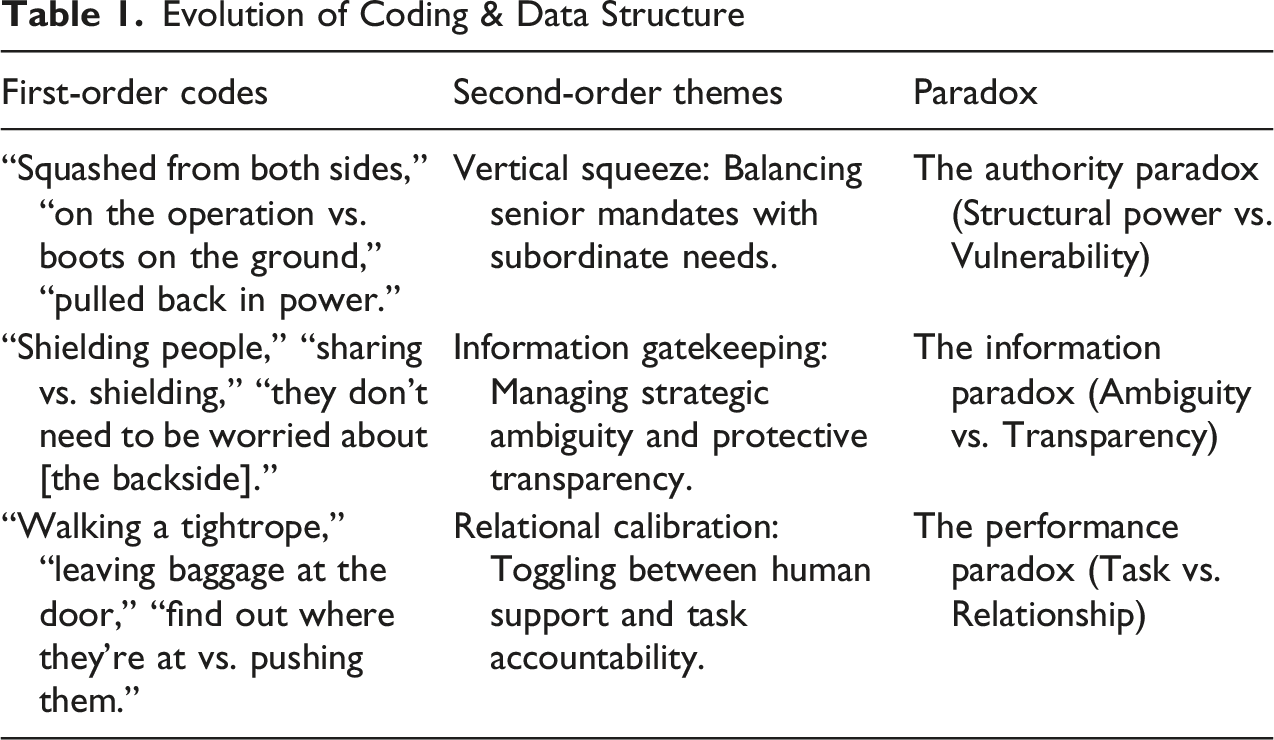
Evolution of Coding & Data Structure
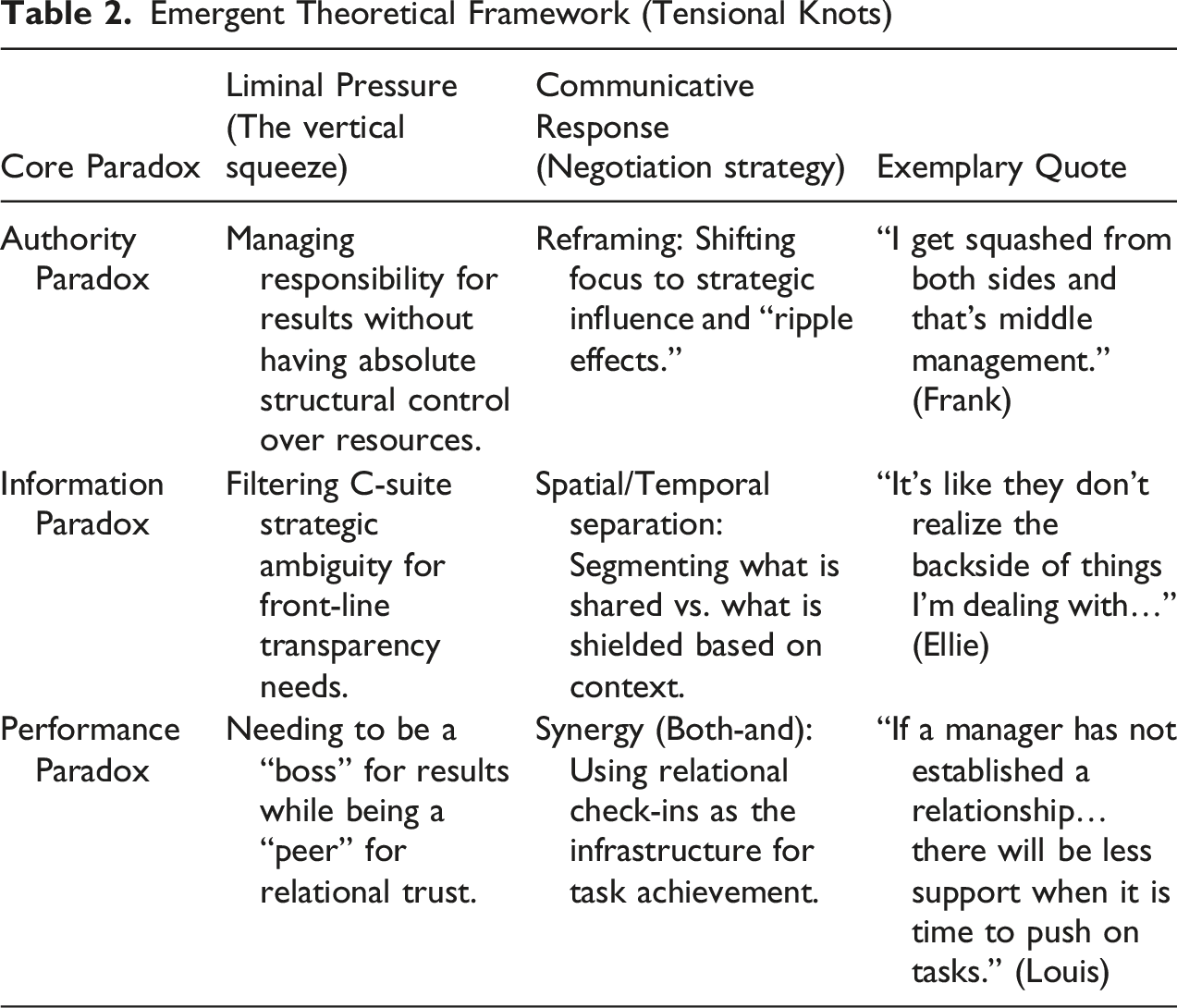
Emergent Theoretical Framework (Tensional Knots)
Findings and Interpretation
Data analysis revealed three overarching themes related to the communicative tensions middle managers experience. These themes include enable and constrain (The Authority Paradox), ambiguity and transparency (The Information Paradox), and task accomplishment and relationship management (The Performance Paradox). While general leadership literature often identifies broad paradoxes, our findings specify how these tensions are uniquely pressurized by the middle manager’s liminal position—a structural reality that imposes a vertical squeeze on communication.
Specifically, middle managers are not just balancing abstract concepts, but are communicatively negotiating the competing interests of senior leadership (the top-down drive for efficiency, strategy, and control) and subordinate teams (the bottom-up need for support, transparency, and humanity). The three themes illustrate this vertical squeeze, highlighting the specific negotiation strategies—such as reframing, spatial/temporal separation, and synergy—middle managers use to navigate these structural knots (Putnam et al., 2016).
Theme 1: Enable and Constrain – The Authority Paradox
Participants commonly made sense of their role as middle managers as being both enabled and constrained—possessing formal authority over their teams while lacking the structural power to fully resource or protect them. This paradox manifests as a structural tension between power and vulnerability, rooted in the manager’s dependency on senior leaders for the very resources they are expected to manage.
Frank, a landscape supervisor, described this tension: “I get squashed from both sides and that’s middle management,” he said, explaining that he saw things from both the manager’s and employee’s perspective, yet felt “pulled back in power in both directions.” He characterized his position as being both “on the operation” and “the boots on the ground” and handling both sides. This feeling of being pulled back highlights the constraint. Furthermore, while his position allowed him to “have a voice into things,” Frank often found himself juggling so many responsibilities that there was no one to pass information to or get information from. In other words, he had a platform, but not always an audience.
Similarly, Michael, a 53-year-old facility manager, likened his role to trying to contain a glass of spilled milk. Michael said, “You have your manager, but you’re in charge of your own performance on top of the performance of a number of different individuals.” He elaborated on this feeling of responsibility without control, articulating a core challenge of the middle manager role: You’re trying to keep all that milk on the table before you get the paper towel there. And so you’re reaching in different areas and trying to keep control of different areas before the literal milk spills off the table and makes a mess.
This metaphor captures the reality of juggling multiple high-stakes responsibilities with incomplete authority, illustrating how the Authority Paradox is built into the hierarchy itself.
Retail district manager Louis echoed this sentiment, saying the role made him feel “like a chicken with your head cut off.” Louis’s account illustrates how feeling responsible for everything (enabled with broad responsibility) is coupled with being overburdened and under-supported (constrained by human limits and corporate demands). He elaborated on this constraint: “They want 25 hours of work shoved into those 24 hours which is physically impossible and humanly impossible. Every single thing you do has some sort of ripple effect.”
Participants also described feeling enabled and constrained in their middle manager role in interacting with employees. Carl, a 63-year-old business executive, acknowledged that having formal authority enabled him to guide employees’ decisions, but it also required a significant investment of time—an investment some managers feel constrained by. Carl emphasized that even though a manager can tell subordinates what to do, a good manager enables employees to make their own decisions by engaging with them. Similarly, Keisha, a business manager, felt torn between being enabled in her role to be her “authentic self” and feeling pressure to use a more formal, “professional voice” at work, highlighting how organizational norms constrain her self-expression.
To navigate this, managers often used reframing to transform their lack of absolute control into a form of strategic influence. Louis, for example, reframed his focus toward high-level strategy, recognizing the “ripple effect.” By shifting their definition of success, these managers navigated the paradox of being held responsible for results they could not fully control. These accounts illustrate that embodying the reality of being both powerful and vulnerable in their position, rather than denying one side of the tension, can lead to more effective leadership (Foldy, 2006; Mantere, 2008).
Middle managers in our study described using specific communication tactics, such as adjusting their interaction style or advocating for resources, to cope with feeling pulled in two directions. Acknowledging the idea of “I can’t control everything, but I can control how I communicate with my team” can be key to balancing this tension. In sum, communication serves as the tool through which middle managers make sense of and navigate the paradox of having authority yet not absolute power. The pressures inherent in the authority paradox, where managers strategically recalibrate their limited power, naturally feed into the second major tension: The communicative flow of information.
Theme 2: Ambiguity and Transparency – The Information Paradox
Another major theme that emerged is the constant push and pull between ambiguity and transparency in middle managers’ communication. Situated between the C-Suite and the front line, middle managers are the primary communication conduit, constantly negotiating the Information Paradox. They face another vertical dilemma: Upper management often requires strategic ambiguity (confidentiality, delayed announcements), while subordinates demand transparency and clarity, creating a permanent structural tension rather than a temporary interpersonal conflict.
Marissa, a 47-year-old director of sales, explained: There’s so much going on behind the scenes… I think sometimes they [employees] don’t fully appreciate what it takes to keep the business running and some of the decisions you need to make and that’s the fine line between over communicating and having them worried about things that they don’t need to be worried about but also having them understand some of the complexities and just the why behind what we’re doing.
Marissa’s comment illustrates the recurring Information Paradox: she wanted to be transparent so that employees grasp the reasoning behind decisions, yet she also felt the need to shield them from unnecessary concern. Sharing too much could cause anxiety about issues beyond their control, but sharing too little could leave them in the dark and uninvested.
Several participants echoed Marissa’s dilemma. Reagan, a student leadership coordinator, wished subordinates understood “the complicated relationship the center has with the institution” when certain requests were denied, yet Reagan’s role as an organizational leader barred them from explaining those nuances to the team. Michael, a facilities manager, similarly noted having to draw a line, stating there are “certain decisions that I need to make myself and certain decisions that I will offer my team to make.” In other words, Michael sometimes kept information ambiguous or private to fulfill his managerial responsibilities, even though he valued openness. These examples show middle managers negotiating their dual role in real time—they oscillate between being forthcoming and strategically withholding information.
To manage this Information Paradox, participants frequently employed spatial/temporal separation—a strategy of isolating separate moments or organizational spheres for different communicative approaches. For example, Marissa’s choice to shield employees from behind-the-scenes complexities is a form of spatial separation, where sensitive information is contained within the managerial tier to maintain an operational focus and emotional stability at the team level.
This management choice is often enacted through strategic ambiguity, the purposeful use of general or vague language to achieve functional ends (Eisenberg, 1984; Erhardt & Gibbs, 2014). Rather than a communication failure, managers leverage ambiguity as a tactical tool for three primary reasons. First, it facilitates unified divergence, where broad goals are relayed in a way that allows subordinate teams to interpret and commit to the vision based on their local needs, aligning diverse activities under a single, flexible mission. Second, it serves as a protective shield during organizational change, reducing anxiety by maintaining necessary and preventing unnecessary panic about issues beyond their control—a move that directly addresses the Authority Paradox. Finally, strategic ambiguity actively preserves autonomy by maintaining the manager’s own flexibility in execution. This allows them to adapt high-level directives to ground-level realities without explicit permission for every adjustment, thus defending their role autonomy against excessive senior control.
Jeri, an area leader with a financial institution, described this protective impulse in terms of “shielding” their employees: “If I’m hearing something from leadership, I also have to consider if I share that information versus shielding my people …” when “something is going on.” Jeri’s reflective idea of “do I share or do I shield” is a microcosm of this ambiguity-transparency paradox. This tension requires middle managers to interpret and frame senior leaders’ potentially troubling news or complex changes for their teams.
The implications of this tension are significant. Ambiguity allows for flexibility and strategic decision-making while avoiding prematurely alarming employees, but transparency fosters trust and mutual understanding (Gibbs, 2009). Ellie, a retail manager, noted that her staff sometimes became frustrated because certain tasks, like completing schedules, were delayed. From the staff’s view, Ellie’s actions were ambiguous—they did not see why she was not doing tasks on their expected timeline. Ellie lamented the personal cost of this constraint: I am pretty much more married to my job than my husband. I’m here 12-hour days and only get paid for 40 hours. So, I wish they would understand that when I’m here I’m not always here to be out on the floor doing things. There’s times that I need to be behind the scenes taking care of other things and they don’t always realize that.
Ellie realized that these “behind the scenes” aspects of her work were not always transparent to her employees even though she was working to make the workplace better for them.
To navigate this personal element, more seasoned managers use high-level contingency selection based on the individual. Natasha, another middle manager, provided a nuanced example of knowing her employee, Kate, very well and could gauge how to approach problems with her. Natasha described thinking, “she’s delicate, do I go there?” when deciding whether to fully disclose an issue. This reflects the paradox strategy of temporal separation, where managers calibrate transparency based on the specific relational context and the immediate needs of the employee (Smith & Lewis, 2011). Her example also underscores the value of strong leader-member relationships—knowing her employee well provides a framework for how much transparency or ambiguity to communicate (Omilion-Hodges & Ptacek, 2021).
Ultimately, the ambiguity-transparency paradox requires constant negotiation. Middle managers in our study conveyed that they want to be seen as honest and communicative, yet they also feel responsible for filtering information to protect their team or to maintain strategic control. They continually ask themselves, “Where is the line between being open with my team and keeping certain information confidential or simplified?” This balancing act is not static; it must be recalibrated as situations evolve.
For instance, participants illustrated this ebb and flow by describing managing organizational change: a middle manager might initially keep discussions with upper management under wraps (ambiguity), then shift to full transparency when announcing the change to the team and finally revert to some ambiguity when handling employees’ anxieties (emphasizing what is known and understanding uncertainties). Several managers summarized the idea of reading the room and deciding, in each moment, how much information is helpful and how much will cause panic.
Middle managers thus act as communication gatekeepers, using ambiguity and transparency tactically. This tension is not one they can resolve once and for all, but rather, they manage it day-to-day and decision-to-decision. Consistent with a paradox lens, the goal is not to choose between openness or secrecy, but to maintain a dynamic balance that allows both to function as necessary organizational resources (Fairhurst & Putnam, 2024). In practice, that means middle managers strive to be honest but judicious, sharing enough to foster trust and understanding while withholding or framing information in ways that keep their teams focused and secure. Finally, the most acute tension felt in the middle manager’s daily practice is the conflict between organizational expectations for productivity and their team’s need for humanity and support.
Theme 3: Task Accomplishment and Relationship Management – The Performance Paradox
A third emerging contradiction that governs how middle managers negotiate their role is the Performance Paradox, the tension between task accomplishment and relationship management. By nature of their “in-between” position, middle managers are charged with achieving formal organizational goals (upward pressure for results) while simultaneously nurturing a positive work environment and supporting their team’s development (downward pressure for support). Participants consistently reported a complex interplay between being task-oriented and being people-oriented, which constitutes a structural paradox that is persistent and challenging to navigate.
One way tension manifests is through the investment of time. While task accomplishment and relationship building are interdependent, they often appear at odds in daily practice. Attending to both sets of needs requires significantly more time, sensitivity, and insight than a single-focused role. Given the finite hours in a workday, balancing these competing priorities can feel insurmountable. Time spent coaching an employee or addressing personal issues is time not spent hitting a deadline, and vice versa. This time scarcity makes the performance-relationship trade-off salient, leaving managers feeling caught in a dichotomy.
For many participants, this Performance Paradox plays out in everyday interactions. Michael, the facilities manager, described his approach as walking a tightrope between being involved in his employees’ personal lives and providing clear guidance on work tasks. He enjoyed “…getting to know them [his employees] as people…” showing that he values being more than just a boss. However, he admitted that this relational investment makes communicating direct task requirements more challenging; giving tough feedback or pushing for performance can strain the very relationships he has cultivated. Leon, an operations manager, similarly emphasized building genuine connections with his team: “[not] just telling them what to do…actually taking the time to really get to know them on a personal level.” Yet he too faced the crunch of ensuring accountability for results. Both Michael and Leon highlighted the emotional tug-of-war between being a supportive, understanding leader and being an efficient, results-driven manager. Doing both is necessary, but toggling between these modes can be jarring and stressful for the manager and confusing for employees.
While some managers struggled with the dichotomy, the most effective managers moved beyond temporal separation—simply toggling between being a “boss” and a “peer” and instead employed synergy (both – and balancing) where the opposing poles are treated as mutually reinforcing (Smith & Lewis, 2011). Natasha offered a key example of this: I always ask [my employees] “How’s it going? How are you doing?” because maybe their car broke down…So while they do leave their baggage at the door, you still have to put some humanity in it…I just try and find out where they’re at on that day and how can I push them to where they need to be on that day.
Natasha’s approach acknowledges that tasks are managed through the relational context. She did not choose between humanity and performance, rather she used the relational check-in to calibrate how to push for task achievement. Similarly, Carmen, a sales support manager, reframed this tension as a non-zero-sum, arguing that building healthy communication acts as necessary infrastructure for meeting performance goals: You have to wear a lot of hats…So if I keep a healthy relationship with them they at least know where to find me if they do need anything…like I said, keep the door open and keep that healthy stream of communication.
Carmen recognized that relationship-building was not a distraction from the task, but the very mechanism that mitigates the friction of high-pressure demands.
Consistent with Paradox Theory, our findings reinforce that these competing demands are interdependent—middle managers cannot address one side of the tension in isolation without affecting the other. Rather than seeking a final resolution, adept managers practiced active acceptance, openly acknowledging the tension and involving their teams in the balancing act. By modeling that both tasks and relationships are essential, they demonstrated that navigating the Performance Paradox is an ongoing process of communicative recalibration rather than a problem to be solved.
In the context of the Performance Paradox, “managing, not resolving” represents active acceptance (Smith & Lewis, 2011) acknowledging that there is no equilibrium, but rather a requirement for continuous, communicative adjustment. Middle managers who appeared most adept at navigating this tensional knot were those who openly acknowledged the contradiction and involved their teams in the balancing act. By specifically stating, “We have a busy week ahead, so I might not check in as much as usual, but let’s reconnect after,” managers modeled a both-and approach. In doing so, they demonstrate to their teams that both task performance and relational care are essential, and that temporal oscillation between these poles is a functional necessity of organizational life.
Discussion: The Middle Manager as a Communicative Tensional Knot
This study investigated the structural paradoxes associated with the middle manager position, revealing that the role itself is structurally configured as a communicative nexus where organizational contradictions converge. Framed by an organizational paradox lens, our analysis demonstrates that the middle manager operates within a unique “sandwiched” context where contradictions are not merely separate challenges, but are inherently interwoven. The primary theoretical takeaway of this research is that the middle manager role functions as a communicative tensional knot (Sheep et al., 2017)—a dense site where the organization’s vertical (authority/information) and horizontal (performance) contradictions are structurally concentrated and communicatively negotiated.
Our findings extend the literature in two important ways. First, we argue that the common tensions experienced by middle managers are constitutive of the role; they stem from the structural requirement to simultaneously perform as a leader and a follower. This forces the employee to navigate the Authority Paradox (power vs. vulnerability), the Informational Paradox (transparency vs. ambiguity), and the Performance Paradox (tasks vs. relationships). Second, by shifting the analytic focus from interpersonal dynamics to the structural liminality of the role itself, we provide empirical evidence for how these employees manage compound contradictions through specific paradoxical negotiation strategies: Reframing, spatial/temporal separation, and synergy.
Pragmatic Implications
The findings from this study provide valuable insight for targeted organizational interventions. Recognizing that the middle manager role is structurally configured as a tensional knot requires moving training philosophies away from traditional, clarity-seeking management techniques. Instead, organizations must focus on cultivating a paradox mindset, which explicitly addresses the managerial reality that promoting absolute clarity often comes at the expense of necessary tension and adaptive capacity.
Shifting Development From Technique to Mindset
Developing middle managers must begin by preparing them to accept tension as normal and generative (Smith & Lewis, 2011). Training should involve surfacing and reflecting on all three inherent role paradoxes—Authority, Information, and Performance—using them not as problems to be eliminated, but as prompts for sophisticated sensemaking. Including modules on paradoxical thinking can legitimize these contradictions and provide managers with practical tools to practice constructive tension management.
Training for Strategic Oscillation
Since the tensional knot cannot be resolved, effective management requires strategic oscillation or the ability to temporarily focus on one pole of a contradiction before shifting attention to the other. Training should teach managers to use temporal separation as a tool. For example, instead of attempting to achieve task efficiency and relational maintenance simultaneously (synergy), managers can learn to segment their day when possible to dedicate the mornings to intense task focus and the afternoon to team development and check-ins. This approach helps mitigate that feeling of being “pulled back in power” by providing dedicated focus for different managerial demands.
Structural Interventions for Senior Leadership
Senior leadership must recognize their role in managing the knot. Organizations should enable shared ownership of ambiguity by training and empowering managers to communicate the reality of the knot upward to senior leadership. This involves articulating the structural friction (e.g., “Implementing this strategy will require sacrificing one of our three core priorities”) rather than simply absorbing it, thereby reducing the likelihood of silencing the middle manager through overwhelming workload. Senior leaders should also intentionally leave certain tensions unresolved at the top level, communicating the paradox (e.g., “We need both radical innovation and rigorous standardization”) instead of demanding absolute, premature clarity. Second, performance metrics should reward paradoxical management. Evaluation criteria must be modified to explicitly reward managers who demonstrate effective ambivalence and acceptance of contradiction (Smith & Lewis, 2011), rather than penalizing them for failure to achieve perfect results on opposing goals. This systemic support reinforces the theoretical implication that accepting paradox is both more beneficial and realistic than attempting to eliminate it.
Theoretical Implications
Communication scholarship has profoundly enriched the understanding of leadership as a communicative practice, moving beyond simple influence models to emphasize the complexity of role enactment, agility, and sensemaking (Barge, 2019; Fairhurst & Connaughton, 2014; Johansson et al., 2014). Building on this foundation, our study argues that the enduring challenge of the middle manager stems from the structural configuration of the role itself as a nexus where organizational contradictions are highly concentrated. We demonstrate that the simultaneous expectation to manage the Authority, Information, and Performance Paradoxes forces the middle manager to negotiate the communicative tensional knot (Sheep et al., 2017). This approach extends existing research by offering empirical evidence for how the density of these interwoven contradictions necessitates specific paradoxical management strategies rather than simple resolution.
The Middle Manager Role as a Tensional Knot: Density and Interpenetration
By applying an organizational paradox lens (Putnam et al., 2016; Smith & Lewis, 2011), our study offers a grounded extension of paradox theory into a structurally liminal context. The middle manager—who must perform leadership and followership simultaneously—faces constitutive paradoxes where opposing demands do not just coexist but define one another, and must communicatively navigate these tensions as a function of their dual role. As we detail below, this structural positioning ensures that paradoxes do not operate in isolation but converge and compound in ways that make the middle manager role uniquely dense with contradiction.
Our data show that the experience is characterized by the simultaneous interpretation of the Authority, Information, and Performance Paradoxes. Crucially, the organization’s structural design configures the middle manager as the ultimate filter and implementer of strategy. This structural positioning ensures they are not a source of transparent communication, but rather the essential—and overburdened—conduit where organizational friction converges. Middle managers described communicative experiences where multiple contradictions compounded, requiring them to navigate tensions not as discrete oppositions, but as layered and overlapping forces. This density indicates that middle managers do not simply toggle between isolated tensions, but often must inhabit several paradoxes at once, illustrating the structural configuration of the role as managing a tensional knot. The feeling of being “at a loss for how to balance these competing priorities” provides empirical support for this structural concentration of contradictions. The necessity of managing these compounded contradictions illuminates why middle managers employ paradoxical negotiation strategies.
Communicative Management of Paradoxical Knots
Our findings detail how middle managers utilize paradoxical negotiation strategies—reframing, separation, and synergy—to manage the tensional knot. In managing the Information Paradox, middle managers utilize strategic ambiguity (Eisenberg, 1984) as a functional tool. This is often enacted through spatial separation, where managers intentionally “shield” teams from sensitive C-suite information to maintain stability and prevent unnecessary anxiety.
Furthermore, the strategy of synergy (both-and balancing) addresses the Performance Paradox by treating task efficiency and relational maintenance as mutually reinforcing rather than mutually exclusive. We found evidence of this when managers infused high-pressure task discussions with intentional relational check-ins, recognizing that the “humanity” of the team is what fuels the performance.
Similarly, reframing allows middle managers to transform ambiguous senior leadership directives—often experienced as constraints—into empowering mandates for their teams. This effectively transforms a core component of the Authority Paradox from a limitation into a resource for action. Ultimately, success in managing the knot aligns with the organizational paradox literature indicating that active acceptance and ambivalence can be more beneficial than seeking premature closure (Smith & Lewis, 2011). Successful managers embraced the both-and nature of their position, learning to accept the constant pull and focus on keeping the tension constructive. This active, strategic engagement with contradiction positions the paradoxical role tension itself as the impetus for managerial sensemaking, which we explore next.
Sensemaking as a Paradoxical Response
We integrate our findings with sensemaking theory (Weick, 1995), proposing that structural paradoxes are the primary driving force in middle managers’ sensemaking. The role’s inherent contradictions—the Authority, Information, and Performance paradoxes—structurally supply the state of equivocality that sparks Weick’s sensemaking cycle. Our study provides evidence that for middle managers, this equivocality is structurally fueled by the role’s inherent contradictions (e.g., “I’m responsible, but not fully in control”). The middle manager’s need to navigate these competing demands—a paradoxical impulse—initiates the sensemaking cycle. This moves the literature toward viewing leadership communication as an iterative communicative practice of paradoxical navigation and interpretation sparked by the tensional knot of the role, enriching theory in leadership communication beyond simple framing or influence (Fairhurst, 2001).
Limitations and Future Research
While this work contributes to our knowledge of the contemporary middle manager, it is not without limitations. First, our primary focus was on uncovering the tensional knots; we did not explicitly ask managers how they managed or coped with these contradictions. Though some coping strategies emerged spontaneously in participant responses (as discussed in our findings), a more direct investigation of tension-management techniques was outside the scope of the current study. This presents a fruitful avenue for future research: studies could specifically examine the strategies middle managers use to negotiate structural paradoxes, perhaps focusing on the organizational paradox strategies of acceptance, separation, and response (Smith & Lewis, 2011). Intervention research or comparative case studies could explore how training in a both/and mindset—the core of the paradox acceptance—impacts managerial outcomes.
Additionally, our data relied on participants’ retrospective self-reports. Future research could address this limitation by using observational methods (e.g., shadowing) to capture how paradoxes manifest and how middle managers adjust their communication in the moment. Finally, while our findings were consistent across sectors, future research could compare middle manager paradoxes in different organizational cultures—such as startups versus bureaucracies—to see how context influences the salience of the Information or Authority Paradoxes.
Conclusion
This study highlights the unique and complex tensions faced by middle managers as they juggle their double role. By emphasizing the importance of understanding these structural paradoxes—such as being enabled yet constrained—this research offers insights into why middle managers often feel “stuck in the middle.” Notably, this research contributes to the existing literature by shifting the focus from relational dynamics alone to the structural liminality of the role itself. This condition of being perpetually “betwixt and between” is what configures the role in a tensional knot.
By integrating sensemaking theory into our discussion and in conversation with the findings, we demonstrate how acknowledging and addressing these role paradoxes can facilitate more effective managerial practices. The findings suggest that organizations must prioritize targeted strategies that equip middle managers to manage, rather than eliminate, the inherent friction of the tensional knot. This requires a fundamental shift toward developing a paradox mindset and training in communicative strategies such as strategic oscillation, instead of pursuing premature closure or seeking absolute clarity on contradictory demands. Ultimately, addressing the inherent tensions in the middle manager turns the middle manager from a beleaguered messenger into a proactive sensemaker and a cornerstone of organizational leadership.
Footnotes
Acknowledgements
An earlier version of this paper was accepted for presentation at the at the 72nd International Communication Association Conference in Paris, France. The authors also wish to thank the anonymous reviewers for their invaluable feedback.

Funding
The authors received no financial support for the research, authorship, and/or publication of this article.
Declaration of conflicting interests
The authors declared no potential conflicts of interest with respect to the research, authorship, and/or publication of this article.