






Abstract
Research at the nexus of strategy as practice and the communicative constitution of organizing indicates strategizing is a formalized process occurring alongside materialities supporting discourse in conventional organizations. Yet, strategizing is also accomplished informally in fluid organizational settings alongside diverse materialities that have little to do with discourse. Drawing upon a relationality analytical lens, we investigate how diverse other-than-discursive materialities are implicated in the strategizing process of a fluid social collective. After analyzing interview, observation, and encrypted online discourse data from a fluid social movement aimed at preventing the construction of a police training center, we find that materially enmeshed, aggregated, and reappropriated direct actions come to ‘speak’ for strategic directions of the collective. The study augments theory by moving past explicitly articulated discursively formulated strategies—often reliant upon conventional settings and human-designed materialities—to provide sharper theorizing on agentic contributions of diverse, other-than-discursive materialities in strategizing.
A growing body of research combines the communication constitutes organizing (CCO; Basque et al., 2022; Cooren, 2010) and strategy-as-practice (SaP; Jarzabkowski & Spee, 2009) perspectives to view strategizing as a fundamentally communicative process. This line of scholarship has progressed through linguistic turns, focused on the discourse of strategy, and material turns, which recognize the “stuff” (Jarzabkowski et al., 2013) of strategy. Whereas CCO and SaP research have made valuable contributions to understanding the communicative nature of strategy, there remains an empirical puzzle to be solved regarding the role of materiality in strategizing.
Three commonalities of existing research illustrate this puzzle; (1) focus on a narrow range of materialities supporting discourse of strategizing, (2) favoring of “explicitly articulated” (Jarzabkowski et al., 2021, p. 5) strategy, and (3) emphasis on conventional organizations. First, prior strategy research notes the role of “particular types of spatial arrangements” (Balogun et al., 2014, p. 186), such as tables and boardrooms, as well as materiality supporting discourse, including statistical software, flipcharts, notecards, institutionalized ways of strategizing (e.g., SWOT analysis, scenario planning; Jarzabkowski et al., 2013) and other visual aids (van den Broek & Gander, 2024). Most regard designed forms of materiality (i.e., tools, architecture) supporting the discourse of strategy. Recognizing this limit, scholars have called for more work on the “sociomaterial entanglement” (Balogun et al., 2014, p. 194) of strategy work and encourage greater focus on diverse materialities that are not designed or inherently semiotic (Myllykoski & Rantakari, 2023; Vaara & Whittington, 2012). Second, existing research privileges “explicitly articulated” (Jarzabkowski et al., 2021, p. 5) formalized strategizing, often in public or visible organizations, with less attention centered on day-to-day practices comprising informal strategizing. Third, strategy research emphasizes conventional organizational settings replete with hierarchies, contracts, roles, membership, defined locations, stable boundaries, and other material and structural elements. Recent communicative investigations of strategy also focus on conventional organizations such as non-profits (Vásquez et al., 2018), insurance companies and churches (Pälli, 2018), breweries, hospitals, and civil service or large governmental agencies. Those conventional settings facilitate leadership conversations (Pälli, 2018), strategic meetings (Archambault-Janvier et al., 2024), and upper management groups (Asmuß & Oshima, 2018; Liu & Maitlis, 2014) for discursively negotiating strategy.
Collectively, prior research seemingly indicates strategizing is a formalized, explicitly articulated process occurring alongside materialities supporting discourse in conventional organizational settings replete with defined members, roles, and leaders. Thus, existing literature highlights a gap in our knowledge: we know little of how diverse materialities, beyond designed materialities supporting discourse, play a role in fluid and informal strategizing. This deficit is noteworthy considering many collectives organize via increasingly fluid (Dobusch & Schoeneborn, 2015) or hybrid (Ganesh, 2015) arrangements. In fluid organizing, membership is often unclear, roles are ambiguous, boundaries obscure, and leadership hard to identify. Although lacking conventional structure, fluid organizations are still able to strategize and achieve collective outcomes.
In this article, we examine strategizing of Stop Cop City (SCC), also known as Defend Atlanta Forest (DAF), a fluid social movement aimed at preventing the razing of a public forest to build a police training facility. Activists have engaged in both legal (e.g., public protests, letter writing) and illegal actions (e. g., civil disobedience, sabotage, vandalism) leading to heavy repression of the movement, criminal charges, and a need for secrecy in organizing. By eschewing structure (Soule, 2013), opting for decentralization and leaderlessness (Fotaki & Foroughi, 2022), and adopting anonymous and concealed forms of organizing, the fluid SM studied in this article diverges from organizational arrangements typically supporting strategizing. Considering shortcomings of existing knowledge and prior calls for scholarship, we pursue the overarching question of how are other-than-discursive materialities implicated in the informal strategizing of a fluid social movement?
Overall, the main theoretical contributions of this paper are twofold. First, drawing upon a relationality lens (Kuhn et al., 2017) that considers all the agentic contributions making a difference in strategizing, findings add a more theoretically precise conceptualization of diverse other-than-discursive materialities as enmeshed, aggregated, and reappropriated in strategic actions. Second, findings shed light on how strategizing occurs amid fluidity and decentralization. Confirming prior research conceptualizing strategy as “multimodal” (Asmuß & Oshima, 2018) and “not just talk [emphasis original]” (Balogun et al., 2014) findings extend knowledge of strategy by showing how actions of social movement contributors set strategy in motion across the movement. In what follows, we review SaP literature regarding materiality while pointing out theoretical voids. We then illustrate how emerging overlaps between SaP and CCO theory offer a way to address those voids. After detailing methods of a 2 and a half yearlong ethnographic and interview-based study of the SCC/DAF fluid social movement, we present our findings and conclude by discussing contributions to materiality in SaP and CCO literatures.
Literature Review
Materiality in Strategy as Practice
The interdisciplinary field of strategy research spans many years and cannot be exhaustively reviewed here. Instead, we focus on a subfield that has paid considerable attention to materiality in strategy—SaP. Stated simply, SaP research concerns the day-to-day “doing of strategy” (Jarzabkowski & Spee, 2009, p. 69). Early SaP-aligned research centered on narrative (Fenton & Langley, 2011), metaphors (Heracleous & Jacobs, 2008), and other forms of discourse in strategizing. However, responding to the swell of discourse studies, some claimed researchers “marginalized materiality” (Whittington, 2015, p. S13) and scholarship “needs to go beyond discourse” (Vaara & Whittington, 2012, p. 316). Thus, a material turn prompted investigations of software and technologies, spreadsheets, graphs, and maps (Jarzabkowski et al., 2013), sensegiving through visuals (van den Broek & Gander, 2024), company products (Myllykoski & Rantakari, 2023), or frameworks as tools (e.g., SWOT analysis; Jarzabkowski & Kaplan, 2015). One stream of research examined “direct use of material objects” (Myllykoski & Rantakari, 2023, p. 2) wherein materialities passively support strategizing when used according to their “implicit practices” (Vaara & Whittington, 2012, p. 288). Another sociomaterial-leaning stream viewed discourse as bound up with artifacts that shape strategy-making (Leonardi, 2015). Whereas extant research addresses earlier calls for a material focus (Vaara & Whittington, 2012; Whittington, 2015), examining SaP literature with a material focus reveals two limitations: A) outsized focus on material artifacts supporting discourse of strategy in a priori strategic settings, B) favoring of “explicitly articulated” (Jarzabkowski et al., 2021, p. 5) strategizing in conventional settings.
For limitation A, scholars have decried the outsized focus on “mass produced” (Whittington, 2015, p. S14) and “obvious artefacts” (Balogun et al., 2014, p. 194) of research on technology, furniture, software, and supplies. These mass-produced (i.e., laptop, chairs) and designed (i.e., architecture) materials support strategic conversations and conveying of meaning about strategic issues. Relatedly, organizational settings, such as “weekly top management meetings” (Liu & Maitlis, 2014, p. 203), are highly conventional. Studies of embodied practices (Heracleous & Jacobs, 2008) and the human body are commendable for recognizing the multimodal nature of strategy (Asmuß & Oshima, 2018) and moving beyond designed ‘stuff,’ yet many focus on gestures, gaze, eye contact (Jarzabkowski et al., 2015; Pälli, 2018), displayed emotions (Liu & Maitlis, 2014) and other ways the body may emphasize the discourse of strategy. In other words, although the body is not designed or built, the focus remains on how the body accentuates communicating and enhancing meaning, often in a priori strategic settings. Although strategizing occurs alongside artefacts, objects, and generic ‘stuff’, we know less about these other-than-discursive materialities in strategizing.
For limitation B, much research examines conventional organizations with structural elements (e.g., leaders, members, roles, clear authority) that support strategic conversations (e.g., strategy workshops, meetings). As Jarzabkowski et al. (2021) critique, considerable attention focuses on “those strategies that have been explicitly articulated [emphasis original], usually by top managers” (p. 5) to the neglect of day-to-day doings. In other words, a focus on “particular types” (Balogun et al., 2014, p. 186) of spatial arrangements (e.g., tables, boardrooms), participants (e.g., executives), and “material aids” (p. 186) means current theorizing overlooks the informal not explicitly articulated forms of strategizing in fluid organizing. We turn to examine a developing field of research capable of addressing these shortcomings.
The Nexus of SaP and CCO
Emerging research seeks to integrate CCO and strategy, mostly drawing upon Montreal School CCO (Aggerholm et al., 2012; Archambault-Janvier et al., 2024; Bencherki et al., 2021; Cooren et al., 2015; Nathues et al., 2023; Spee & Jarzabkowski, 2011; Vásquez et al., 2018). Spee (2022) notes that CCO (for overview see Basque et al., 2022) and SaP form a “powerful alliance” and have “complementarity in terms of onto-epistemological considerations” (p. 343) by rejecting entitative views of both organization and strategy and ascribing to relational ontology assumptions (Kuhn et al., 2017). Whether speaking of strategy or organization, both “essentially consist [emphasis original] of processes of communication” (Cooren et al., 2015, p. 366).
Cooren et al. (2015) specify that viewing strategy through a CCO lens means starting from communication (i.e. not merely the transmission of individual perceptions of strategy), broadly defining communication to account for sociomateriality, and acknowledging the multimodal nature of communicating beyond writing and speaking to include nonhumans. From a CCO/SaP lens, strategy-making is defined as “communication episodes in which specific matters of concerns lend their weights to various courses of action” (p. 376). For instance, empirical work using the “metaconversation” concept (Robichaud et al., 2004) starts from communication in showing how people in dispersed conversations speak from hierarchical positions, job functions (e.g. sales, design), or geographic divisions (Mantere & Vaara, 2008) to collectively constitute and orient to a shared strategic trajectory. Spee and Jarzabkowski (2011) reveal how, through a series of strategic planning meetings, recursive cycles of talk generated a shared understanding (or text in CCO parlance) that gradually took on authority as a strategic plan. Vásquez et al. (2018) and Bencherki et al. (2021) show how “matters of concern” are expressed through talk and begin to materialize into strategy. As concerns are negotiated, transported through texts, and recognized as legitimate, they become “matters of authority” (Vásquez et al., 2018) and specific discursive moves may “crystallize a course of action” (Bencherki et al., 2021, p. 627) thus materializing some issues as strategic. While prior research shows the communicative emergence of strategy, it primarily examines explicit discussions of strategy and centers on discursively oriented materialities (e.g., grant proposal, documents). Consequently, the role of other-than-discursive materialities in informal strategizing remains under-theorized.
The relational view of materiality touted by CCO scholars (Kuhn et al., 2017) offers a theoretical way to address the omission of other-than-discursive materialities in informal strategizing because it moves beyond mere use of meaning-centric materialities. In relationality viewpoints (Kuhn et al., 2017) agency is distributed, hybrid, and shared among a variety of entities. The bifurcation of a social and material world is rejected along with subject-centered explanations of organizing. Neither humans nor materials are the absolute origins of action. What is material is what matters, or “makes a difference” (Cooren et al., 2015, p. 369) in a situation, which can include physical made of atoms materialities (e.g., objects, nature) or more fleeting feelings, emotions, and desires. Cooren (2010, 2015) offers the metaphor of ventriloquism to explain how we make others, whether people (i.e., a coworker), “textual agents” (Cooren, 2004; i.e., contracts, bylaws, press releases) or other materialities (i.e., objects, values, principles) say or do things but those things also animate us. For example, a manager could invoke a corporate policy, budget constraints, or principles of fairness, to deny a request for additional compensation. The manager gives voice to the corporation, policy, budget, and principles, but at the same time those things also ventriloquize the manager by “dictat[ing] how people should proceed in a given situation” (Cooren, 2015, p. 479). Aligning with relationality, ventriloquism decenters humans from analysis and considers agency as having no absolute origin by instead encouraging exploration on all the things and beings making a difference in constituting situations, organizations, and realities. Some recent work has applied ventriloquism to strategy. For instance, Nathues et al. (2023) draw upon a ventriloqual lens to show how many different voices of people, teams, and organizations, are woven together or excluded in strategy-making processes, ultimately conceptualizing strategy as a relational assemblage.
Although CCO viewpoints recognize agentic contributions of the other-than-human and “more-than-material” (Kuhn, 2024, p. 32), Cooren et al.’s (2015) encouragement for a broad definition of communication and emphasis on non-human communication have not received as much attention in the emerging SaP/CCO literature. Prior ventriloqual work is a move toward relationality but still focuses on “strategy debates’ interactional dynamics” (Nathues et al., 2023, p. 705), that is, strategic discourse. Consequently, many studies are vulnerable to Cooren et al.’s (2015) caution to not “overemphasize the role of practitioners” or reductively define communication as a “linguistic resource for strategy making” (p. 367) restricted to humans. Relatedly, Spee (2022) notes a bias toward formalized strategizing “may portray a rather lopsided view” (p. 347) and claims there is “ample scope to extend the adoption of CCO beyond the realm of formalized strategy-making” (p. 347)—a call we aim to fulfill in this work. Kuhn (2024) puts a fine point on the need to relationally consider a wide variety of strategic influences stating, “forces well beyond the control of the strategic manager participate in the very constitution [emphasis original] of the firm” (p. 5).
To put simply the theoretical innovation on offer, a relational view of materiality can expand theorizing to capture everything that “makes a difference” (Cooren et al., 2015) in strategizing. Rather than focusing solely on how people talk about strategy or how they use tools to convince others of strategic directions, relationality affords theorizing agentic contributions of a diverse array of other-than-human and other-than-discursive materialities. In short, the full potential of relationally considering diverse materialities in strategizing has yet to be realized in SaP research. Collectively, research is needed on how other-than-discursive materialities express agency and “make a difference” (Cooren et al., 2015) in the informal, not explicitly articulated, strategizing of fluid social arrangements. Therefore, we pursue the following question: RQ: How are diverse other-than-discursive materialities implicated in the informal strategizing of fluid social collectives?
Method
Research Context
Because social movements (SM) are “profoundly hybrid” (Ganesh, 2015, p. 484) and often “deliberately eschew formal organizations” (Soule, 2013, p. 108) they are a fitting setting to investigate other-than-discursive materialities in informal strategizing. For example, scholarship on alternative (Ferrell, 2014; Shanahan, 2023) and radical organizing reveals non-hierarchical decision making, leaderlessness (Fotaki & Foroughi, 2022), and “anti-leadership” (Sutherland et al., 2014) are common in SMs. Activists carry out ‘actions’ and ‘mobilizations’ including anything from legal protest (e.g., a march, picketing) or nonviolent civil disobedience (e.g., sit-ins) to destructive actions (e.g., vandalism). Destructive protest actions can lead to repression via direct policing, surveillance, infiltration, propaganda, harassing arrests, creation of extraordinary laws (e.g., curfew, banning of clothing), and stigmatization (Boykoff, 2007). Ganesh (2015) considers movements hybrid because they organize across space and time through chat applications, digital networks, and various social media. However, digital coordination is susceptible to repression and infiltration, prompting studies on visibility management through encryption, obfuscating or concealing activities (Albu, 2023), and the digital tools for contending with decentralization (Poon, 2024) or promoting democratic decision making (Shanahan, 2023). As Albu (2023) reveals, communicative efforts to resist data monitoring and repression can “both empower and undermine” (p. 662) activists’ efforts. Thus, fluidity, ambiguity, and precarity often accompany SM organizing, calling into question whether movements can be considered organizations. For example, Dobusch and Schoeneborn’s (2015) study of the highly fluid “anonymous” hacker collective advances the idea that, rather than organization versus non-organization, fluid collectives can be understood as achieving degrees of “organizationality” based on attaining shared decision making, identity, and actorhood through carefully prepared speech acts.
Field Site
In 2021 the DAF/SCC SM emerged to resist construction of a 90-million-dollar police training facility on one of Atlanta, Georgia, USA’s few remaining forests. The Atlanta Public Safety Training Center, or Cop City, would sit on 85 acres of land in a forest surrounded by majority Black and lower-income neighborhoods. Activists viewed the project as environmentally damaging, furthering police militarization, wasting taxpayer funds, initiated without transparency or legitimate community input, and tone-deaf considering Atlanta’s importance in protests calling for police reform. Movement tactics included legal actions (e.g., call-in campaigns, street marches, posting flyers), but also “direct action” (Graeber, 2009). Drawing upon a history of labor movements, anarchist thought, and civil rights movements, Graeber (2009) defines direct action as attempting to create change through direct collective intervention rather than through voting, lobbying, or other appeals to existing governments or authorities. Direct action tactics of DAF/SCC included occupying ‘tree sits’ and camps within the forest, blockades, graffiti, and sabotage of police and construction equipment.
DAF/SCC represents a fitting case for this investigation as the movement is both highly fluid and has experienced stifling repression limiting official organizing. For example, after several skirmishes between police and forest occupiers, a multi-agency task force raided the forest in December of 2022, arresting five activists and charging them with domestic terrorism—a tactic repeated several more times. Despite repression, activists launched a referendum campaign to put Cop City on Atlanta’s election ballot, provided 17 hours of oppositional comment at city hall, and held many rallies, music festivals, food distributions, art events, lawsuits, injunctions, and picketing. Local and federal law enforcement increasingly investigated the movement, using Racketeer Influenced and Corrupt Organizations (commonly called RICO) statutes to raid homes of activists suspected of affiliation with destructive protest. Activists have received simple ‘pedestrian in roadway’ or more severe ‘criminal trespassing,’ ‘racketeering,’ ‘money laundering,’ and at least 61 ‘domestic terrorism’ charges. Many interviewees and online communiques emphasize the movement’s fluidity, autonomy, and disavowal of organization. Image 1 from the DAF Instagram describes the movement as “an autonomous movement, not an organization” whereas Ana, an interviewee of this study, characterizes the movement as: The definition of this movement is that we are disorganized. So, in that, people are throwing rocks at protests, in that people are carrying signs that say fuck the police. They are doing those things, not because one person or even a group of people agreed that that was the correct strategy, but because every single person that’s here is brought here by whatever is their personal agenda and what is in their heart. Defend Atlanta Forest Instagram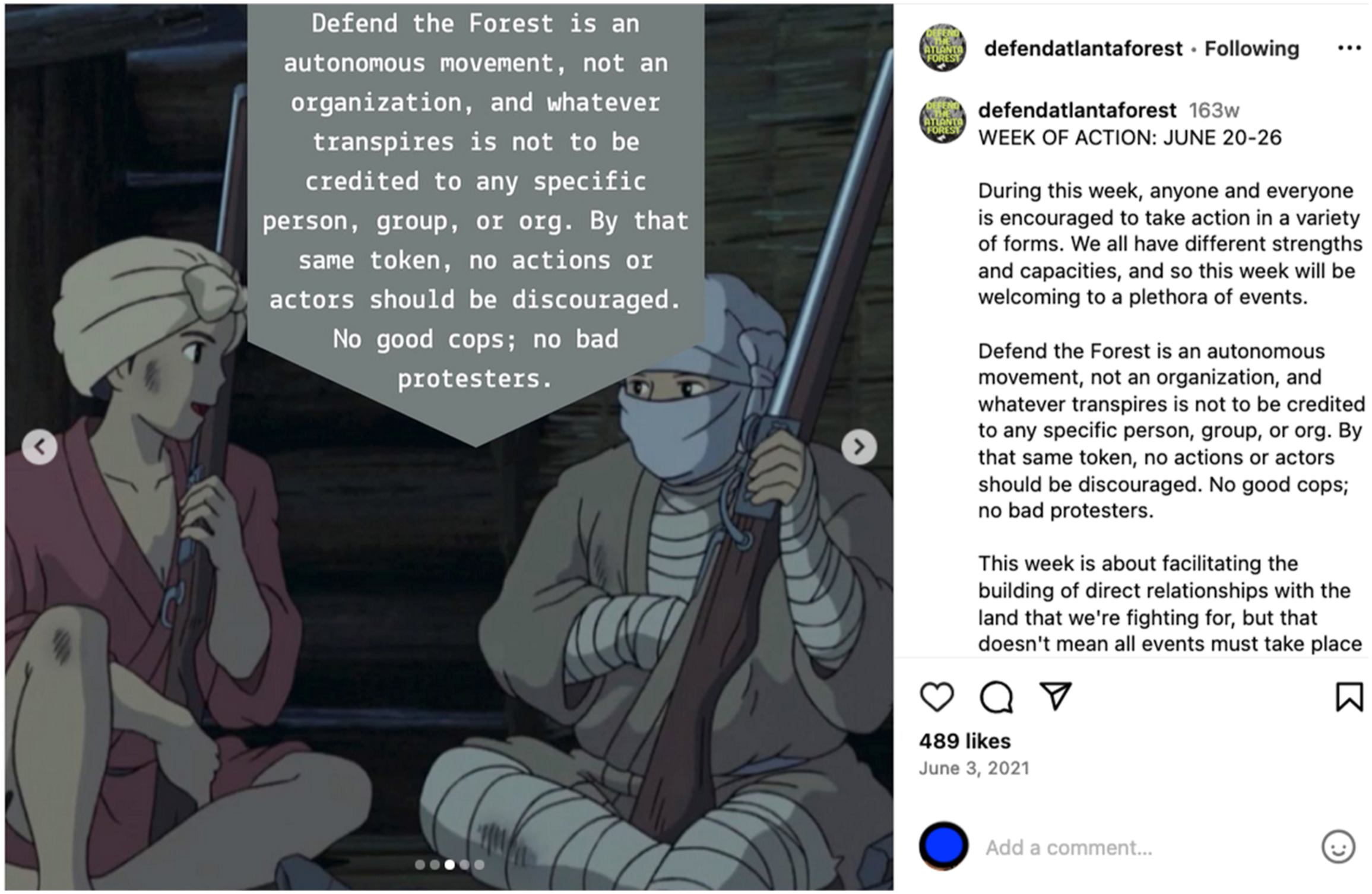
Ana emphasized that no strategy was centrally agreed upon and individuals have autonomy to participate as they see fit. Thus, DAF/SCC is fitting for this study given the fluidity and repression characterizing the movement.
Data Collection
Intrigued by news stories about “forest defenders,” the first author began following the movement in October 2022 by attending a speaking tour presented by an activist. Shortly thereafter, the first author began following prominent social media accounts associated with the movement. Institutional Review Board (IRB) approval was obtained after conversing with university legal and the human subjects research office for guidance on collecting data while protecting privacy of participants who may be involved in illegal actions
1
. Thereafter, the second author joined by participating in legal and public movement events, recording fieldnotes, and establishing contacts for later interviews. Eventually, movement participants added us to Signal threads, an encrypted messenger application containing almost 400 anonymous users meant to share information about upcoming movement events. To complement in-person observation, we used a “netnographic” (Kozinets, 2010) approach to monitor blogs, alternative news outlets, and the Signal thread to stay abreast of developments. Netnography moves beyond ‘scraping’ of ‘big data,’ or simple content analysis, by immersing the researcher in an online community to understand its cultures and customs. In further support of the theory-case fit of DAF/SCC, through monitoring the Signal thread we observed several conversations present, what prior empirical work may have termed “matters of concern” (Archambault-Janvier et al., 2024; Bencherki et al., 2021; Vásquez et al., 2018) be shut down. For instance, Image 2 shows an anonymous poster voicing concern about a prior action be admonished by others, ultimately deleting the post—an action we repeatedly observed. Shutting down discourse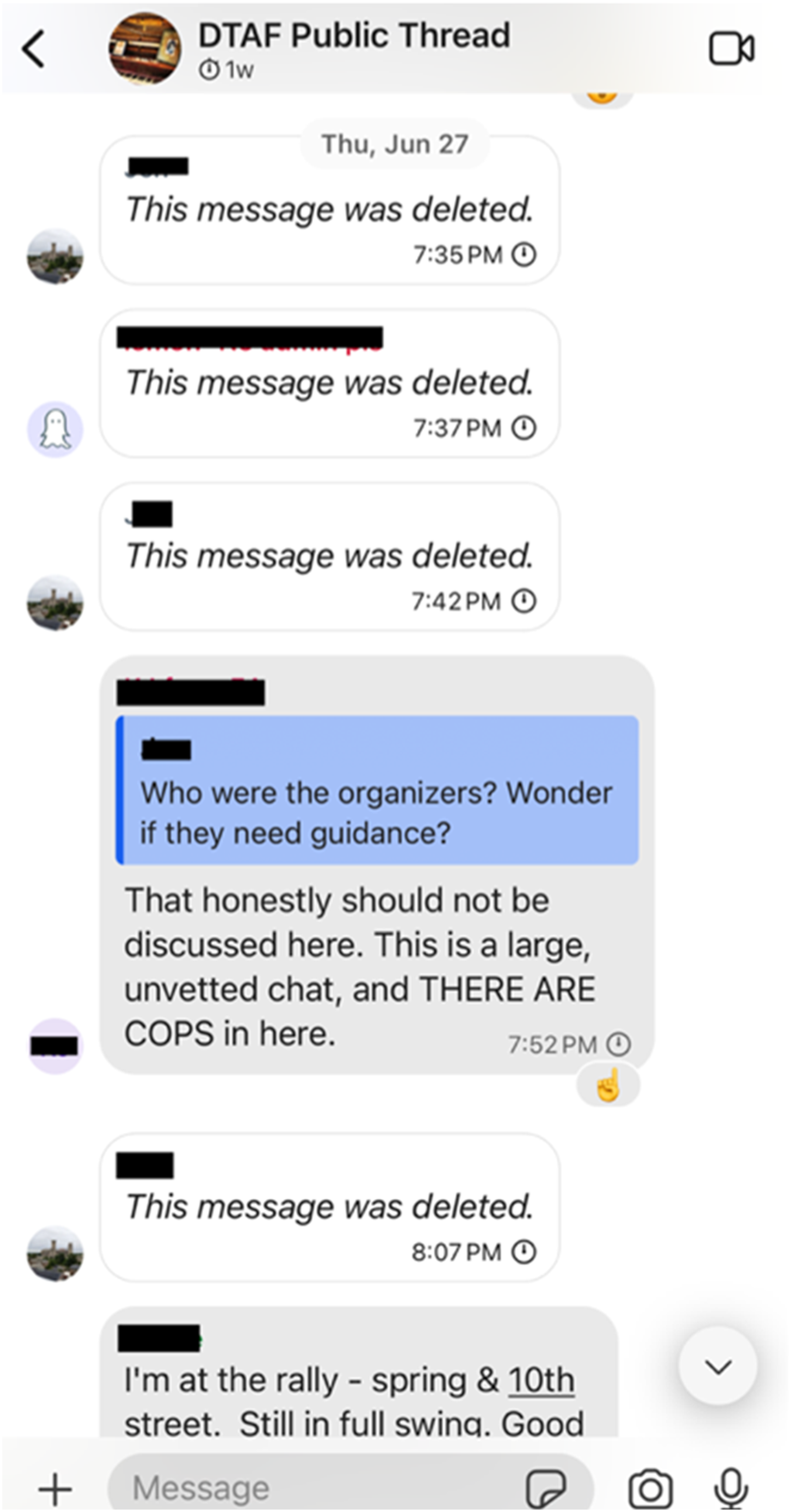
In both in-person and netnographic aspects of the study our role as researchers was akin to “play participant” (Tracy, 2013, p. 109) in that, while sympathizing with some movement goals, we maintained distance from full engagement to allow more reflexivity in the research process and avoid any legal troubles. We also collected printed materials, leaflets, and zines distributed at protests or events associated with the movement (see Table 1).
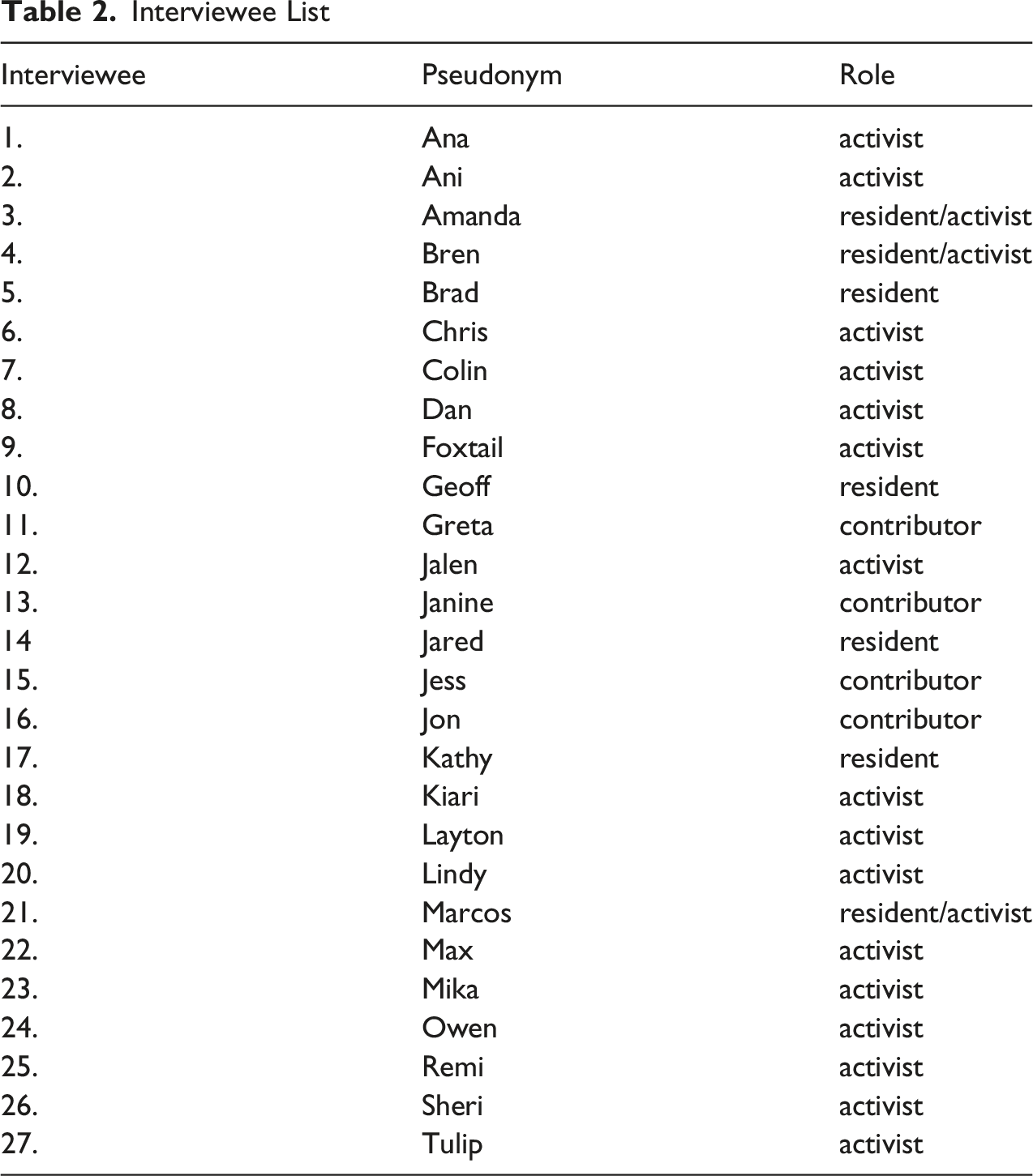
The first author initially recruited participants near the forest encampments. However, in January 2023 while conducting an interview in a neighborhood adjoining the forest, another surprise raid occurred wherein an officer was shot and activist Manuel “Tortuguita” Terán killed. The shooting propelled the movement into the national spotlight, yet it was deemed too legally and physically risky to continue recruiting near the forest, so we began recruiting interviewees at events and through social media outlets. In-person recruitment helped in contacting activists who preferred to remain anonymous or to locate people living near the proposed training site. Publicly involved activists were invited through social media to complete in-person interviews. In this article, ‘activist’ denotes anyone participating in movement events, ‘resident’ refers to neighbors who oppose the site but do not engage in protests, and, adopting Bencherki and Snack’s (2016) “contributorship” notion, ‘contributor’ denotes people aligned with an organization involved in the movement (e.g., an environmental nonprofit; see Table 2) but not official members of the movement.
Audio recorded interviews were conducted in a private or semi-private location of the interviewees’ choosing. We followed a semi-structured interview guide but remained flexible allowing the conversation to venture to aspects of the movement the interviewees desired to talk about. In total, we conducted 34 hours of on-the-ground observation at events and collected more than 20 hours of audio-recorded interviews with 27 study participants.
Data Analysis
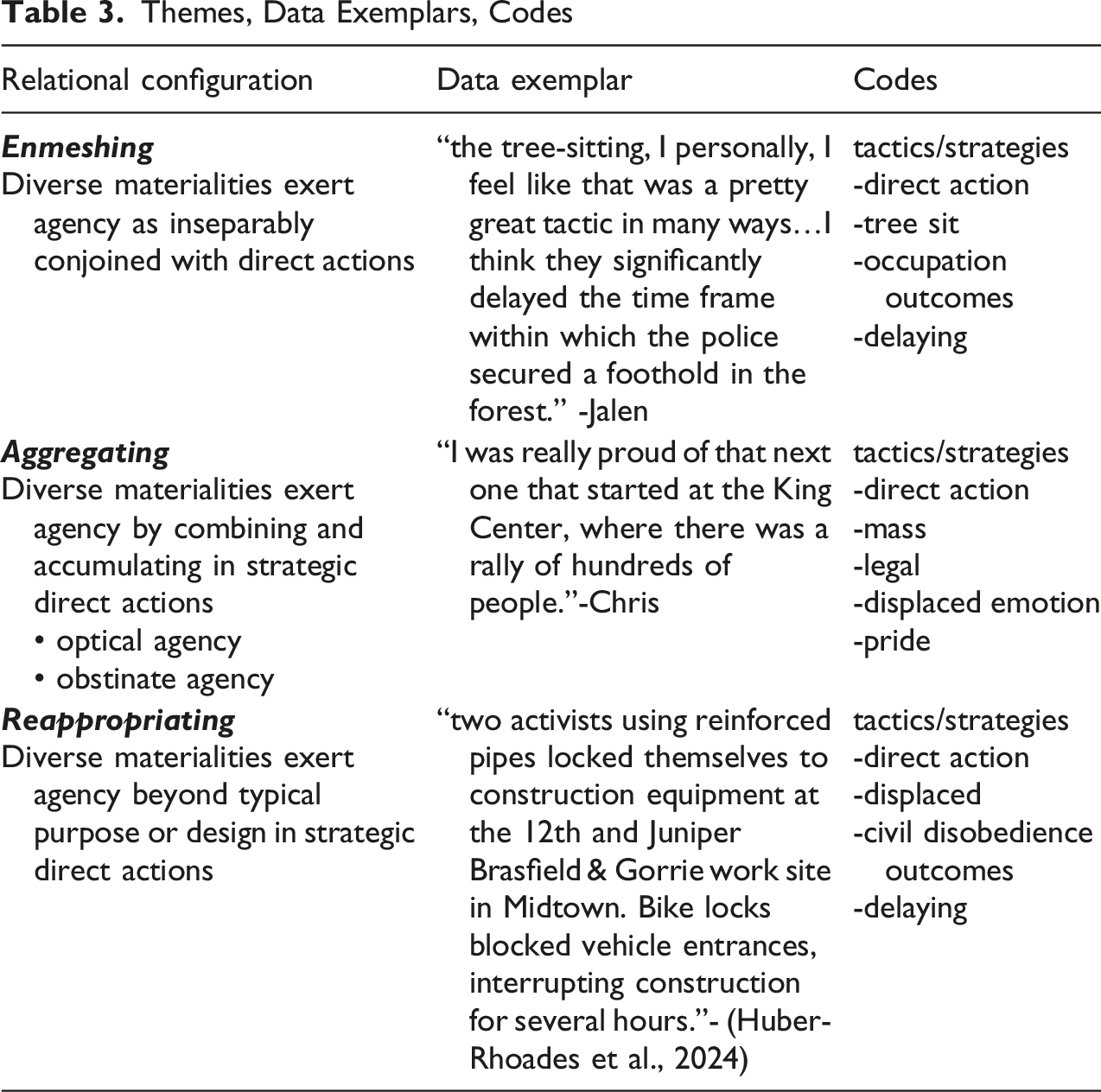
Data analysis was iterative and ongoing rather than separate stages. For instance, the first author collected five interviews in their first trip to Atlanta. The second author joined the project after the initial research trip. After transcription, we conducted broad open coding labeling topics within the data. The analysis followed an abductive logic (Mantere & Ketokivi, 2013) “driven by an interplay of doubt and belief, which, in turn, fuels the imaginative act of creating new knowledge” (p. 81). Whereas our initial interest was broadly on how the SM organizes, embracing “preunderstanding” (Alvesson & Sandberg, 2022; Mantere & Ketokivi, 2013) means we were not complete blank slates devoid of existing theory knowledge. Thus, as we reviewed fieldnotes, online discourse, and interviews, we kept tentative “analytic reflections” (Tracy, 2013) about possible theoretical connections. We open coded newly collected data between trips, and then independently open-coded all transcripts again, revisiting previously coded interviews and refining earlier broad codes. For example, an early broad code of tactics/strategies was further specified with a granular code of symbolic (referring to primarily symbolic actions), whereas, through abductively consulting prior literature on social movements, other excerpts were differentiated with the direct action code. We then discussed aspects of theoretical interest emerging from independent coding sessions and compared codes with one another looking for overlapping ideas.
Abduction entails remaining open to being “surprised” (Mantere & Ketokivi, 2013) by the data, particularly when it does not fit existing explanations. During joint coding and data collection, we were intrigued to find a lack of explicitly agreed upon strategy among the collective and consulted literature on fluid organizing and strategy. As Alvesson and Sandberg (2022) detail, “bringing our pre-understanding into a dialogical conversation with data and theory [emphasis original]” can lead to “development of more original, complete or rethought knowledge of the phenomenon” (p. 401). As we reviewed the intersections of data, pre-understanding, and theory, we noticed collective accomplishments were intimately tied with actions, doings, and materiality, yet much of the materiality involved in strategizing was not discourse-centric. Consulting the literature on relationality, CCO, and SaP, with particular attention given to materiality, we returned to the data selectively coding for how materiality “makes a difference” (Cooren et al., 2015) in organizing. In tune with SaP’s focus on actions, and the relational view of materiality as de-centering the human from analysis, we coded for what people did with and among various materialities in pursuing strategy. Abductively cycling between reading extant relationality scholarship and coding, we examined ways to group those action codes into thematic categories of the agentic effects of those actions. This process resulted in our main findings on the relational configurations of enmeshing, aggregating, and reappropriating materialities in strategizing. See Table 3 for data exemplars and example codes. We selected quotes for the findings section based on two criteria. First, excerpts needed enough length to be analytically interesting yet also concise enough to fit space constraints of the article. Second, quotes demonstrating the widest range of materialities and clearest examples of enmeshing, aggregating, and reappropriating were selected.
Findings
Findings reveal how, in a setting where discursive strategic negotiations are limited, activists are enmeshing, aggregating, and reappropriating diverse materialities in strategic direct actions. We begin by explaining direct actions and then unpack the enmeshing, aggregating, and reappropriating relational configurations. Consistent with relational ontology viewpoints, relational configurations illustrate the ways a “multiplicity of hybrid forces” (Kuhn et al., 2017, p. 36) including both humans, nonhumans, and other-than-discursive materialities come together in strategizing processes. Agential effects emerging from these configurations are not sole properties of materialities or humans, but are joint effects created through constellations of multiple elements.
Direct Material Actions as Strategy
At the beginning of the SCC/DAF speaking tour, an activist described efforts to stop Cop City as decentralized and welcoming of individual autonomous efforts claiming, “anyone is encouraged to take any action at any time.” Foxtail also highlighted decentralization and autonomy stating, “what has given the movement a lot of strength and flexibility is folks feeling empowered to kind of create their own initiatives and move forward with that without having to go through some kind of formalized approval process.” Jess clarified, “we’re not beholden to shared principles and strategies” and went on to stress that accepting a wide variety of tactics, as opposed to a singular unified strategy, is the strategy of the movement. The common “action,” “initiative,” and tactic these interviewees allude to is direct action, a method common to prior SMs (Graeber, 2009), where activists exercise agency through civil disobedience, sit ins, strikes and in some cases arson, sabotage, and property destruction. As Marcos recalled, “there was a vehicle that somehow caught on fire in the parking lot … I have no information about that either. I just know that things happen” whereas Layton claimed, “people are just kind of self-directed, doing whatever they feel like is right” further emphasizing the embrace of direct autonomous action among the movement.
In reviewing the various types of data for this study, it became apparent that those direct actions and practices contributing to strategy of the collective are inextricably linked with materialities. More specifically, we theorize that diverse materialities, beyond just technological tools, visual aids, or materialities supporting strategic discourse, are enmeshed, aggregated, and reappropriated all underneath a direct-action strategic focus. Although presented as separate sections, the relational approach to materiality adopted in this study means no example of materiality is purely one of these themes, nor do we intend to bifurcate humans and other-than-humans into strictly separate categories. Enmeshing, aggregating, and reappropriating each defined with examples in Table 3, and at the beginning of their respective sections, should be considered more as overlapping relational configurations of human and other-than-human agencies rather than standalone concepts. A direct action may be enmeshed with reappropriated and aggregated materialities. Further, each term embraces a diverse view of other-than-discursive materialities ranging from naturally occurring (e.g., trees, water) to human-designed (e.g., rope, tire).
Enmeshing Materialities
We define enmeshing as undertaking strategic direct actions that are inseparably conjoined with the hybrid agencies of diverse materialities. Enmeshing draws attention to two aspects; acknowledging all strategic actions have a material component, and some material aspects are fundamental to the viability of certain actions. For example, early in the movement, a key strategy involved occupying the forest through camping, living in tree-sits, and hosting events. The forest provided spaces, such as the ‘living room’ and ‘kitchen,’ where activists could meet and strategize. The importance of a meeting area for strategic negotiations is perhaps unsurprising; however, our findings emphasize that space is not just a meeting location, it is inseparably enmeshed with the occupation tactic. Marcos described how the forest provided a location for organizing, claiming, “The only way to be really involved I would say and to like have – and to be in that organizing – is to live there in the forest and be there all the time.” However, other participants noted flowing in and out of the forest instead of committing to 24/7 occupation. An anonymously-authored blog described the forest as “a zone where defenders have attempted to flow freely between various modes of protest, occupation, and liberation…the forest has served as a semi-stable nexus for clandestine organizing” (I.C.L.A., 2024). Materiality of the forest, such as the thick underbrush, dense canopy, multiple entry points, tall trees capable of supporting tree sits, and vast acreage helped conceal actions within and support occupation. For instance, a news report about a May 2022 raid quotes an unnamed activist stating: It was really intense. There was a helicopter circling for a long time trying to track our movement across open areas because they can’t see us under the trees. We did what we could to make it as hard as possible for them to destroy these woods. (Fatica, 2022, para. 6)
Although a police helicopter aided surveillance, materiality of the forest concealed movements of occupiers. To clarify, enmeshing comprises both naturally occurring materialities (i.e., trees) and human designed materialities, as forest defender Max claimed, “we need paracord and ropes to do these tree sits.” At that time, the forest was both a space of organizing and facilitated the direct-action occupation strategy itself. Thus occupation, as both a strategy and facilitator of organizing, was enmeshed with materiality of the forest, human-designed materialities, and physicality of human bodies within. Put simply, an occupation strategy would have little chance of success without the materiality of the forest.
As repression intensified and frequent raids made forest occupation risky, many interviewees viewed the loss of the forest spaces like the ‘kitchen’ and ‘living room’ as setbacks. Greta claimed, “closing the park was massive – is a massive setback because people don’t have one place to go to anymore” similarly Jess noted how decentralization was harder to contend with after the park closed stating, “it’s such a decentralized movement, we’re not – there’s no space where everyone is coming together to do political education, to align on our work thinking about strategy or how our ideology is turning into our practice.” An anonymous contributor to a direct action resulting in the burning of construction equipment claimed in a news article, “I am not sure of the viability of permanent mass encampments after Tortuguita’s death” however they speculated that “direct negation of the deforestation process” through direct action “could form a serious and coherent strategy” (Unicorn Riot, 2023, para. 6). Despite risks, some committed activists continued stealthily occupying the forest until the land was clearcut. Clearcutting ended occupation as Lindy stated, “I actually knew that we were kind of dead in the water once I realized that they had really clearcut. That happened so quickly. And they showed the pictures. It was like holy mackerel!” The materiality of the forest was altered in ways that no longer supported occupation, thus direct-action strategies shifted to aggregating and reappropriating materialities at related sites.
Aggregating Materialities
We define aggregating as combining and accumulating diverse materialities to exert an obstinate or optical hybrid agency in strategic direct actions. In this configuration, humans gather together disparate materialities to achieve an agentic effect that differs from a singular materiality’s effect. The hybrid agency achieved is more than, and different from, the sum of individual materials. Aggregating draws attention to how materialities “lend their weights” (Cooren et al., 2015, p. 377) to strategic courses of action capitalizing on obstinance or optics. Emphasizing the overlapping relational configuration of enmeshing and aggregating, Layton touted the collective obstinate agency of activists when forest occupation was still a viable tactic: They’ve even been heard [police] on scanners at times when there were hundreds of people in the forest frothing at the mouth, like, ‘Oh, let us go in there and get them!’ And people saying, ‘No. We don’t have enough. We can’t.’ They [police] seriously can’t. We have the numbers and we [activists] have the will to fight that the cops are rapidly losing.
Layton’s quote illustrates how aggregating together many activists in the forest created an obstinate agentic effect, one the police were hesitant to encounter. Post-occupation strategies also relied upon mass direct actions aggregating many activists. For instance, the Block Cop City action of November 2023 staked on many individuals marching toward the construction site and pushing through a riot police line to disrupt construction. The strategy is only viable if enough people show up putting their bodies on the line to form a human wedge. Lindy, an activist arrested at other civil disobedience protests, claimed there was no way to access the land and stop construction but had hoped “this big march would then sit down in the street and block the street. Now, [construction] trucks can’t get in. So, for the period of time before you get arrested for sitting in the street you’re blocking.” When police encircled a music festival held in a field near the forest, activists relied on linking arms together, aggregating into one stubborn obstacle, to prevent individuals from being picked off from the group and arrested. Thus, aggregating different individuals into a more obstinate obstacle affords the strategy.
In another strategy, activists used a ‘sleeping dragon’—a steel or reinforced plastic pipe—to handcuff or attach themselves to each other, equipment, and in one case the top of a 250 ft crane, at construction sites of the lead contractor building Cop City (Huber-Rhoades et al., 2024). Activists also chained themselves to the entry gates of Cop City (Dean, 2024) and the neighborhood gate of a Nationwide Insurance executive’s home—a primary insurer of Cop City. In each case, because materiality of these alternate protest spaces did not support occupation in the way the forest did, the obstinance of other materialities (plastic, concrete, height of crane, metals, bodies) was aggregated and reappropriated to new strategic ends.
Materialities can also exert an optical agency when aggregated. To clarify, the optical agency suggested by aggregation differs from symbolic optical agency. For instance, one could interpret a high turnout of people at a protest to be symbolic of the issue’s importance to community members. Conversely, while we acknowledge there is also a symbolic optical effect to aggregation, we are theorizing a different type of agential effect is expressed when materialities are combined. For example, in many actions activists wear ‘black bloc’ clothing—covering head-to-toe in black—or wear white painter coveralls to make identifying single individuals more challenging for law enforcement. Black bloc only works as a tactic if many people aggregate together in like clothing. One person dressed head-to-toe in black would be easily identifiable. Thus, rather than a mere symbolic optical agency created through greater numbers of activists, a different concealing optical agency is created through the ‘black bloc’ aggregation.
Reappropriating Materialities
We define reappropriating as altering or repurposing diverse materialities to exert hybrid agency beyond typical purpose or design in strategic direct actions. The agential effects of reappropriation emerge when physical things are reconfigured for new uses. Physical things are often combined (i.e., aggregated) and reappropriated in strategic actions. For example, a real-estate developer came to own the public park adjoining the forest through a controversial land swap arrangement with the city. The developer bulldozed a gazebo and concrete bike path in the park. Activists quickly reappropriated the debris into a makeshift blockade to prevent police raids, and painted rubble with protest slogans (see Image 3). Main Image: Activists reappropriate truck into barricade and illustrate tree-sits. From anonymous “Camp Deadnettle” posted on https://scenes.noblogs.org/post/2022/03/09/defend-the-barricades-calling-feral-anarchists-to-atlanta-forest/ [website no longer active]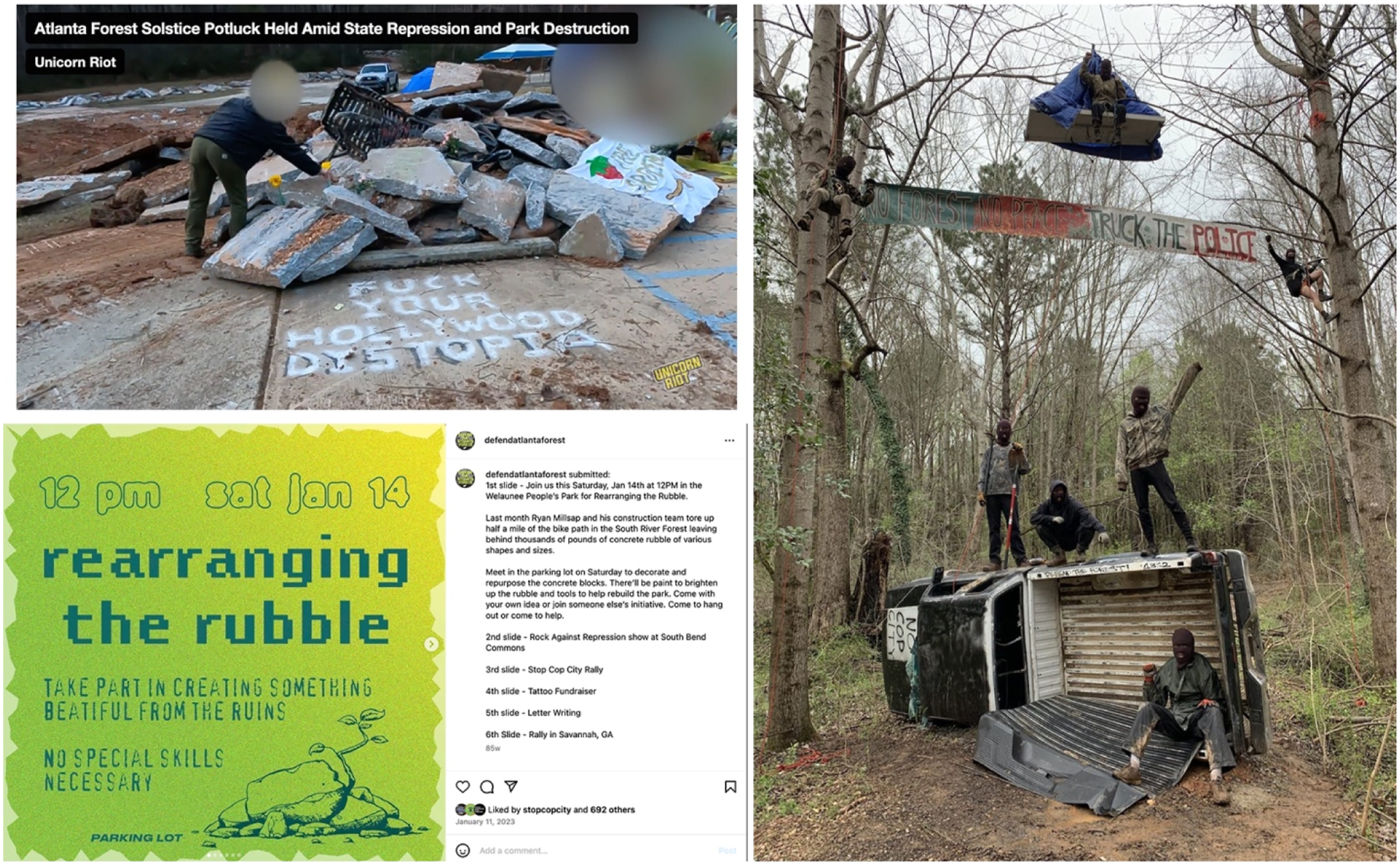
The anonymous activist quoted earlier in a news report about the movement worked to “make it as hard as possible” for police and construction vehicles to enter the forest, in this case by lighting a truck on fire creating a barricade. Similarly, Marcos noted, “There’s no violent resistance here. There may be a little bit of a blockade to make it a little harder, but that’s not violent.” Jon, a contributor to a forest preservation nonprofit and frequenter of the park recalled encountering a forest defender who was “burning a few tires to scare the cops away.” Thus, materialities initially designed by humans for one purpose (i.e., a walking surface, gazebo, tires, trash) are torn down, moved, or reconfigured (i.e., reappropriated) and often collected together with other materialities (i.e., aggregated) to new strategic ends. The above examples of a blockade crafted from a variety of materialities help demonstrate how the hybrid agentic effects of aggregating (i.e., combining the rubble with other materialities), and reappropriating are overlapping relational configurations. The tactic is viable through both the reappropriation and aggregation of diverse other-than-discursive materialities.
In sum, decentralization, fluidity, and repression can make formalized communicative refinement of strategizing difficult. Thus, informal direct actions carried out autonomously by activists come to vie for strategic direction. All these direct-action strategies are about doing, and that doing is enmeshed with diverse aggregated and reappropriated materialities rather than mere use of meaning-centric materialities.
Discussion and Conclusion
In this article, we examined how other-than-discursive materialities are implicated in fluid social movement strategizing. Our findings make important contributions to the emerging SaP/CCO literature. Our main contribution lies in offering the relational configurations of enmeshing, aggregating, and reappropriating to theorize the complex role of diverse other-than-discursive materialities in strategic pursuits. Secondarily, we extend existing research on fluid organizing by revealing how strategizing occurs amid fluidity and decentralization. When traditional organizing is prohibited, made cumbersome by a need for secrecy, and difficult to achieve in fluid decentralized contexts, we reveal how material direct actions become consequential for enacting strategic focus. Collectively, findings fulfill prior calls for research on diverse materialities (Myllykoski & Rantakari, 2023; Vaara & Whittington, 2012) and move past “explicitly articulated” (Jarzabkowski et al., 2021) and discursively negotiated strategies reliant upon conventional organizational elements.
Our first contribution, drawing upon relationality (Kuhn et al., 2017), adds a more theoretically precise conceptualization of diverse, other-than-discursive, materialities in strategizing. Across both fluid organizing and strategy scholarship, researchers have expanded past purely discursive investigations of organizing to bring in materiality (Jarzabkowski et al., 2013). However, extant research has concerned mass produced human-designed (Whittington, 2015) technologies, “obvious artefacts” (Balogun et al., 2014), visuals (van den Broek & Gander, 2024) or other “semiotic resources” (Jarzabkowski et al., 2015) conveying meaning around strategy, prompting calls for additional research on diverse materialities (Myllykoski & Rantakari, 2023; Vaara & Whittington, 2012) that are not inherently communicative. Specific to research on fluid organizing and SM contexts, materiality is often equated with digital communication technologies (Poon, 2024; Shanahan, 2023) or social media (Dawson & Bencherki, 2022; Dobusch & Schoeneborn, 2015) sometimes taking an affordances approach. This is not a dismissal of prior studies; indeed, we also present findings based partly on social media data. However, we augment the conversation on materiality by bringing in a relational view to illuminate how diverse materialities, far beyond “obvious artefacts” (Balogun et al., 2014) and “textual agents” (e.g., policies, protocols; Cooren, 2004), express strategic agency through enmeshing, aggregating, and reappropriating relational configurations.
To make this specific theorization, we draw upon relationality (Kuhn et al., 2017) and Cooren et al.’s (2015) guidelines for CCO-based strategy work in revealing how communication is extended “beyond individual agents …encompassing as agents anyone or anything that makes a difference in a given situation, lending its weight to a given course of action over another” (p. 377). Enmeshing, aggregating, and reappropriating encourages a view that materialities are not just tools, things, devices or passive conduits of strategic intent or discourse. Rather, the terms conceptualize how three relational configurations of materialities exert agency, or “make a difference” in strategizing.
In SaP literature, materiality is often viewed as having “certain implicit practices whose constraints and affordances must be constantly negotiated” (Vaara & Whittington, 2012, p. 288). Conversely, we add to the literature in showing how a relational mix of materialities, as diverse as trees, bodies, concrete rubble, tires, colors, clothing, and construction equipment are the enmeshed, aggregated, and reappropriated agents “making a difference” (Cooren et al., 2015, p. 369) in how strategy unfolds across the movement. In this case “crystallizing” a course of action (Bencherki et al., 2021, p. 627) is not as reliant upon discursive moves or using human-designed materialities according to their “implicit practices” (Vaara & Whittington, 2012, p. 288).
Along similar lines, prior research has shown how spaces of strategizing matter (Jarzabkowski et al., 2015), yet this article conceptually shifts materiality of space, not solely as a place of strategizing discourse, but as fundamentally enmeshed to the strategy itself. It is not merely use of material tools and visual aids (e.g., post it note, flip chart, PowerPoint, SWOT; Jarzabkowski & Kaplan, 2015; Jarzabkowski et al., 2013) or even bodily gestures (Jarzabkowski et al., 2015; Pälli, 2018) in a meeting room allowing for convincing others of a strategic direction (i.e., encouraging certain discourses), the forest itself supported a strategy of bodily occupation. The materiality of the trees provided a strong anchor for tree-sits, the forest’s complexity allowed easy sleuthing, canopy foliage visually obscured aerial surveillance, and reappropriated and aggregated concrete rubble afforded a durable barricade. As a space, the forest was not only akin to a boardroom or meeting arena, it was fundamentally enmeshed to strategies of occupation and carrying out covert direct actions (e.g., burning equipment). Similarly, mass actions required aggregating multiple bodies to be a viable strategic direct action. When the materiality of the forest was compromised through clear-cutting, strategies had to shift to other tactics, such as reappropriating the height of a crane or the durability of a steel gate to affix oneself to. In this case, materiality is not just another aid to discursive strategizing—its ability to be aggregated and reappropriated largely dictated what could and could not be done strategically.
Returning to Cooren et al.’s (2015) definition of strategy-making as “communication episodes in which specific matters of concerns lend their weights to various courses of action” (p. 376), enmeshing, aggregating, and reappropriating provides a more precise theoretical vocabulary explaining how not only “matters of concern,” but diverse materialities help “lend their weights” to courses of action. Occupation was a viable “course of action” when the forest’s materiality lent its weight to tree sits, camping, and hiding occupiers. Without reducing agency only to humans or materialities, blockades were a viable course of action when rubble, tires, and other debris—along with the human agents working to reappropriate and aggregate them—lent their weight to that strategy. These findings build upon a ventriloqual (Cooren, 2010, 2015) view by showing how activists are acting, but also being “acted upon” (Cooren, 2010, p. 476). The activists could not dictate the occupation strategy to the forest so much as the forest acted back in allowing occupation to be a strategy. As the forest’s materiality changed, strategic direct actions shifted to other locations.
The relational configurations presented here offer scholars a toolkit to investigate agentic effects of diverse materialities—beyond humans, architecture, technologies or other “obvious artefacts” (Balogun et al., 2014). In future research, enmeshing encourages researchers to ask which strategies are (im)possible or reliant upon materialities, whereas reappropriating directs attention to how agencies of materialities are reconfigured. Aggregating encourages analysts to view how accumulations of diverse materialities achieve an optical and(or) obstinate agentic effect on strategizing.
Second, findings shed light on how strategizing occurs amid fluidity and decentralization. Reflecting prior research, the movement adopts leaderlessness (Fotaki & Foroughi, 2022; Sutherland et al., 2014), disavows organization, and enacts anonymous and secretive organizing across the “hybrid” (Ganesh, 2015) online/offline interactions of the movement. Drawing upon the organizationality perspective (Dobusch & Schoeneborn, 2015), we can theorize the movement as achieving “degrees” of collective identity and actorhood but not full-fledged organization. Decentralization and fluidity constitute the organizationality of the movement in a way that encourages personal initiative for a variety of protest actions.
However, in keeping with prior research finding visibility management both empowers and undermines (Albu, 2023), fluidity also restricts avenues for strategizing detailed in existing literature. Strategic conversations pose risk. Intense repression of the movement means “polyphonic moments” (Archambault-Janvier et al., 2024) of interacting, dialoguing, verbalizing, “writing the strategy text” (Aggerholm et al., 2012, p. 425) or authoring a strategic plan, as common in prior empirical work (Spee & Jarzabkowski, 2011), carries legal risks. Although the movement deploys technological tools supporting mass inclusion commonly investigated in preceding literature (Poon, 2024; Shanahan, 2023), activists must hide strategizing processes to avoid conspiracy or RICO criminal charges.
Therefore, rather than a discursively negotiated strategic plan, vision, or document, this study suggests strategy is in the fluid communicative constitution (Basque et al., 2022) of the movement as encouraging activists to engage in any protest actions they desire. Rather than meetings (Archambault-Janvier et al., 2024), leader/manager conversations (Liu & Maitlis, 2014; Pälli, 2018), crafting of narratives (Fenton & Langley, 2011), or a leader wily employing metaphors, findings show how physical doings set strategy in motion across the movement. In plain terms, it is risky to talk about strategy or author a strategic viewpoint. Thus, aligning with the SaP agenda’s focus on the day-to-day doing of strategy, direct material actions are done to advance a strategy when strategic conversations are prohibited.
Bencherki et al.’s (2021) prior claim that, “strategy is not only a rational cognitive problem, as if it occurred in people’s mind and was then shared with others or imposed on them through persuasion” (p. 629) is validated through this research by showing how, when outlets for discursively persuading are limited, direct doings materialize courses of action as strategic and further lend form to the collective. Direct actions are intimately tied to both constituting organizationality and strategy of the collective. For instance, prior theorizing on materially establishing organizational property through “possessive relations” (Bencherki & Bourgoin, 2019), appropriation/attribution (Bencherki & Cooren, 2011), and recursive ventriloquizing (Cooren, 2010, 2015) reveals that “organizations exist as the (partial) possessors of people, things, and actions” (Bencherki & Bourgoin, 2019, p. 505). An interesting facet of this case is that direct material actions contribute to the organizationality of the collective without “carefully prepared and staged identity claims” (Dobusch & Schoeneborn, 2015, p. 1005). In this SM, direct actions, whether as simple as occupying a tree in the forest or as shocking as a flaming bulldozer, are both possessed by the movement (thus contributing to organizationality) and non-discursively ventriloquize (Cooren, 2010), that is, “speak”, for strategic directions.
Limitations and Future Directions
Care should be taken in generalizing results of this study to all instances of fluid organizing. The various intersecting ideologies, diversity of legal/illicit tactics, and mixed composition of this movement may limit generalizability to other fluid collectives. This work primarily theorizes physical made-of-atoms materialities as opposed to thoughts, emotions, or more fleeting materialities. Future work could investigate how more ephemeral materialities (i.e., passions, attitudes, affect) comprise these three relational configurations. Findings also present a fraction of movement efforts and tactics and should not be normatively interpreted as the correct strategy. Countless trainings, marches, reading groups, summits, care clinics, mutual aid efforts, food distributions, community art making, festivals, and letter-writing campaigns have fallen under the SCC/DAF banner as the movement progressed. Our findings are not meant to minimize these efforts, but to highlight strategy across the movement.
Consistent with previous research on hidden organizing (Albu, 2023), we were not always successful convincing activists involved in or sympathetic to radical direct actions to speak with us. Nevertheless, combined data from 27 interviews, observations, and online Signal discourse helped us form a rich picture of movement organizing. Future studies employing ethnographic and embedded forms of participant observation may gather richer data of the on-the-ground strategizing processes among SM activists.
In sum, this article highlights how strategy is “multimodal” (Asmuß & Oshima, 2018; Jarzabkowski et al., 2015), not just in the sense of occurring through discourse, pens, papers, whiteboard, gestures etc., but materially enmeshed, aggregated, and reappropriated, actions are at the heart of what makes certain strategies viable. Consequently, findings support Balogun et al.’s (2014) assertion that “while strategy work involves talk in all its form, it is not just [emphasis original] talk” (p. 176) by showing how intermeshed sociomaterial elements constitute strategy of the collective. Collectively, findings help address calls to move beyond “explicitly articulated” (Jarzabkowski et al., 2021) and “formalized strategy-making” (Spee, 2022, p. 347) by focusing on the consequentiality of the relational mix of a wide range of human and other-than-human actors. In essence, we argue the ‘multi’ in ‘multimodal’ strategizing should be inclusive of a wider variety of materialities than previously theorized.
Footnotes

Consent for Publication
The Human Research Protection Program at the University of Tennessee, Knoxville approved our data collection [UTK-IRB-22-07273-XP]. Participants provided verbal informed consent.
Funding
The authors disclosed receipt of the following financial support for the research, authorship, and/or publication of this article: This work was supported by the Waterhouse Family Institute for the Study of Communication and Society [grant number: R012926197]
Declaration of Conflicting Interests
The authors declared no potential conflicts of interest with respect to the research, authorship, and/or publication of this article.
Data Availability Statement
Due to IRB regulations and sensitive nature of interview data, no data sharing is available for this work.
Note
Author Biographies
Appendix
Zines, Flyers, and Reports Analyzed Interviewee List Themes, Data Exemplars, Codes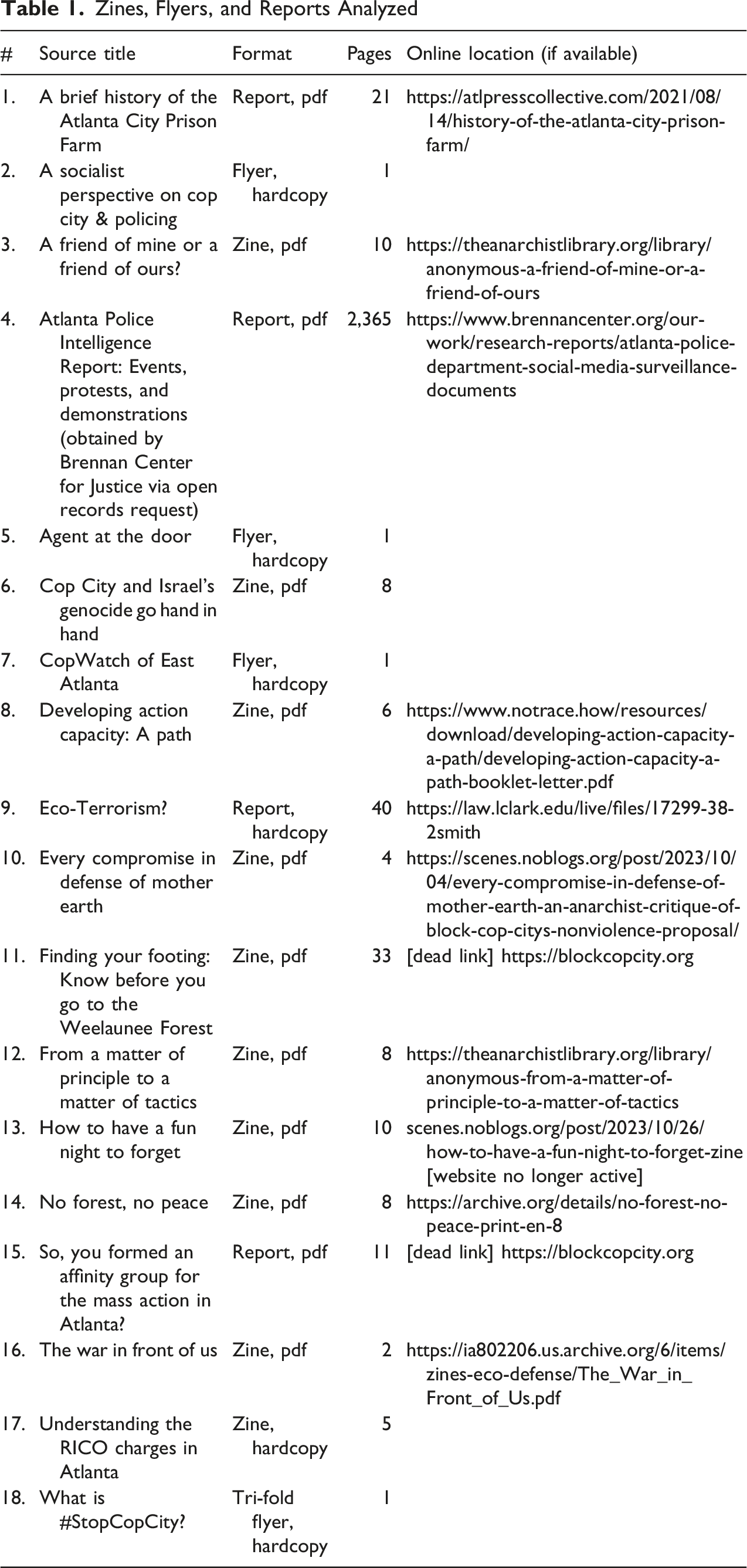
#
Source title
Format
Pages
Online location (if available)
1.
A brief history of the Atlanta City Prison Farm
Report, pdf
21
https://atlpresscollective.com/2021/08/14/history-of-the-atlanta-city-prison-farm/
2.
A socialist perspective on cop city & policing
Flyer, hardcopy
1
3.
A friend of mine or a friend of ours?
Zine, pdf
10
https://theanarchistlibrary.org/library/anonymous-a-friend-of-mine-or-a-friend-of-ours
4.
Atlanta Police Intelligence Report: Events, protests, and demonstrations (obtained by Brennan Center for Justice via open records request)
Report, pdf
2,365
https://www.brennancenter.org/our-work/research-reports/atlanta-police-department-social-media-surveillance-documents
5.
Agent at the door
Flyer, hardcopy
1
6.
Cop City and Israel’s genocide go hand in hand
Zine, pdf
8
7.
CopWatch of East Atlanta
Flyer, hardcopy
1
8.
Developing action capacity: A path
Zine, pdf
6
https://www.notrace.how/resources/download/developing-action-capacity-a-path/developing-action-capacity-a-path-booklet-letter.pdf
9.
Eco-Terrorism?
Report, hardcopy
40
https://law.lclark.edu/live/files/17299-38-2smith
10.
Every compromise in defense of mother earth
Zine, pdf
4
https://scenes.noblogs.org/post/2023/10/04/every-compromise-in-defense-of-mother-earth-an-anarchist-critique-of-block-cop-citys-nonviolence-proposal/
11.
Finding your footing: Know before you go to the Weelaunee Forest
Zine, pdf
33
[dead link] https://blockcopcity.org
12.
From a matter of principle to a matter of tactics
Zine, pdf
8
https://theanarchistlibrary.org/library/anonymous-from-a-matter-of-principle-to-a-matter-of-tactics
13.
How to have a fun night to forget
Zine, pdf
10
scenes.noblogs.org/post/2023/10/26/how-to-have-a-fun-night-to-forget-zine [website no longer active]
14.
No forest, no peace
Zine, pdf
8
https://archive.org/details/no-forest-no-peace-print-en-8
15.
So, you formed an affinity group for the mass action in Atlanta?
Report, pdf
11
[dead link] https://blockcopcity.org
16.
The war in front of us
Zine, pdf
2
https://ia802206.us.archive.org/6/items/zines-eco-defense/The_War_in_Front_of_Us.pdf
17.
Understanding the RICO charges in Atlanta
Zine, hardcopy
5
18.
What is #StopCopCity?
Tri-fold flyer, hardcopy
1
Interviewee
Pseudonym
Role
1.
Ana
activist
2.
Ani
activist
3.
Amanda
resident/activist
4.
Bren
resident/activist
5.
Brad
resident
6.
Chris
activist
7.
Colin
activist
8.
Dan
activist
9.
Foxtail
activist
10.
Geoff
resident
11.
Greta
contributor
12.
Jalen
activist
13.
Janine
contributor
14
Jared
resident
15.
Jess
contributor
16.
Jon
contributor
17.
Kathy
resident
18.
Kiari
activist
19.
Layton
activist
20.
Lindy
activist
21.
Marcos
resident/activist
22.
Max
activist
23.
Mika
activist
24.
Owen
activist
25.
Remi
activist
26.
Sheri
activist
27.
Tulip
activist
Relational configuration
Data exemplar
Codes
Diverse materialities exert agency as inseparably conjoined with direct actions“the tree-sitting, I personally, I feel like that was a pretty great tactic in many ways…I think they significantly delayed the time frame within which the police secured a foothold in the forest.” -Jalen
tactics/strategies
-direct action
-tree sit
-occupation outcomes
-delaying
Diverse materialities exert agency by combining and accumulating in strategic direct actions
• optical agency
• obstinate agency“I was really proud of that next one that started at the King Center, where there was a rally of hundreds of people.”-Chris
tactics/strategies
-direct action
-mass
-legal
-displaced emotion
-pride
Diverse materialities exert agency beyond typical purpose or design in strategic direct actions“two activists using reinforced pipes locked themselves to construction equipment at the 12th and Juniper Brasfield & Gorrie work site in Midtown. Bike locks blocked vehicle entrances, interrupting construction for several hours.”- (Huber-Rhoades et al., 2024)
tactics/strategies
-direct action
-displaced
-civil disobedience outcomes
-delaying