







Abstract
For more than 30 years, research utilization has been described in the literature, which predated the heightened interest and demand for using best research evidence in nursing practice. Fernandez, Tran, Ramjan, Ho, and Gill identified evidence-based practice (EBP) as a methodical approach for using the best research evidence when making clinical judgments, together with patient preference and clinical experience. Furthermore, EBP was defined as the use of evidence-based knowledge in the clinical situations, and its usage should be one of the most important educational objectives in nursing education as well as one of the important skills for registered nurses worldwide. In nursing education, students must be taught to appreciate the importance of utilizing best evidence in their nursing practice, especially during their clinical time in the healthcare setting. It is hoped that if they appreciate EBP that when they become nurses, they will play an important role in the decision-making related to patient care, along with other medical and allied health professionals.
Surprisingly in the United States of America, studies indicate that a large number of nurses are unaware of the latest research findings available to optimize nursing practice (Brady & Lewin, 2007) and that traditional research skills are not directly transferable to EBP knowledge (Stichler, Fields, Kim, & Brown, 2011). Of interest, Australia’s Tertiary Education Quality and Standards Agency (TEQSA) requires institutions of higher education to meet their responsibilities to students by prompting lecturers to address and support evidence-based nursing (EBN). It is believed that teaching about EBN will strengthen clinicians’ knowledge, skills, and capacity for implementing EBP in the clinical setting. The call by the TEQSA is similar to a unit that is taught in Hong Kong (Fernandez, Tran, Ramjan, Ho, & Gill, 2014). In Hong Kong, the Chinese undergraduate nursing students are equipped with basic knowledge and skills through self-directed learning and workshop strategies that nurture positive attitudes toward EBP during clinical practice (Zhang, Zeng, Chen, & Li, 2012). Also, a competency-based education (CBE) has been used in all European countries, specifically in Spain, and one of the academic competencies in its new nursing degree is related to EBP in clinical decision-making (Ruzafa-Martinez, Lopez-Iborra, Moreno-Casbas, & Madrigal-Torres, 2013).
In the last 5 years in Saudi Arabia, many studies have been dedicated to evidence-based research for nursing practice in addition to those created for the dental and medical disciplines. Interestingly, in two separate studies, a gap was found between EBP knowledge and actual practice among physicians. Furthermore, it has been reported that the junior healthcare physicians’ knowledge and attitudes were below the required competency standards (Bahammam & Linjawi, 2014). In another study, lack of knowledge and practice strategies among nurses raised concern about applying EBP in hospitals even for renewal of licenses or accreditation (Ez alarab, El Salam, Behalik, & Eltayeb, 2012). Results showed that implementation of EBP was very poor among bridge-nursing students (Cruz et al., 2016). These outcomes indicate that healthcare professionals including nurses rely on tradition, intuition, or the authority of policies and procedures instead of trusting best research evidence. Therefore, it is vital for faculty as well as nurses not only to focus on education about EBP but also to support nursing students as they implement EBP in the holistic process of patient care (Ashktorab, Pashaeypoor, Rassouli, & Alvi-Majd, 2015).
When considering the standard practice of patient care, some practice traditions in the clinical setting continue although they are unsupported by research evidence. Moreover, EBP is a critical step to successfully transform and ensure student mastery and appreciation of EBP. Therefore, this study aimed to assess the competence of nursing students about EBP and its related influencing factors.
Research Questions
This study aimed to answer the following specific questions:
What is the level of knowledge, skills, and attitudes of nursing students about EBP?
Is there a significant relationship between demographic variables and the level of knowledge, skills, and attitudes of nursing students about EBP?
Is there a significant difference related to the level of knowledge, skills, and attitudes of nursing students about EBP when grouped according to age, gender, academic level, and track of study?
What are the factors that influence the knowledge, skills, and attitudes of nursing students about EBP?
Method
Research Design
This study employed a descriptive-cross-sectional design.
Study Setting and Sample
The present study was undertaken at a university in Saudi Arabia where nursing students were in a baccalaureate program between February and April of 2017. A total of 212 undergraduate nursing students participated in this study. Purposive sampling was used to obtain a more diverse group of Saudi nursing students as defined by the inclusion and exclusion criteria. Included in the study were those who were officially registered in the nursing program during academic year 2016-2017; bonafide students from the college of nursing of the university in Riyadh, Saudi Arabia; participating in the nursing program; available at the time data were collected; and willing to participate. Excluded from the study were those enrolled in an internship program, who were non-Saudi, and those not willing to participate at the time data were collected.
Research Instrument
A two-part instrument was used in this study. The first part consisted of questions about the demographic characteristics of the participants. It included their age, gender, academic level, grade point average (GPA), and training and familiarity with research methods and EBP. The second part of the instrument was the Evidence-Based Practice Competency Questionnaire (EBP-COQ). It was designed to assess nursing students’ knowledge, skills, and attitudes about EBP. The EBP-COQ has 25 items and consists of three dimensions: one concerning attitudes toward EBP (13 questions), a second related to skills related to EBP (6 questions), and a third about knowledge about EBP (6 questions). All items have a 5-point Likert-type scale ranging from 1 (strongly disagree) to 5 (strongly agree). The three categories that describe competence relating to EBP—attitudes, knowledge, and skills—were grouped accordingly after a factorial analysis was performed by Ruzafa-Martinez and colleagues (2013). Further, Cronbach’s alpha was 0.89 for the entire questionnaire, and the factor solution explained 55.55% of the variance. Internal reliability of the questionnaire was also confirmed: attitudes toward EBP (α = .94), knowledge in EBP (α = .76), and skills in EBP (α = .80).
Ethical and Procedural Considerations
The present study received approval from the Institutional Review Board (IRB) of the office of the Ethics Committee at the university in Riyadh Region, Saudi Arabia. Permission from the university administrators as well as from the college where nursing students were registered was obtained before collecting the data. The researchers recruited the potential participants who were on their break time on several occasions. They were approached as groups who were available in classrooms in the college. The objectives were explained and consent forms were provided to those participants who volunteered to be in the study. Anonymity was assured by not including participants’ names on the questionnaire. Confidentiality of the participants was also assured by only using the coded responses while analyzing the results of the survey. The participants were informed that they had the right to withdraw from the study at any time without any consequence on their academic standing and future opportunities at the university. Questionnaires were distributed to those who willingly and voluntarily consented to participate in the study. The 212 participants answered the questionnaires, which took an average of 10 minutes to complete. The questionnaires were retrieved after the students finished answering the questions.
Data Analyses
Statistical analysis was done using IBM SPSS® Version 21. Descriptive statistics (frequency, percentage, mean, and standard deviation) were calculated. Independent sample t tests were used to compare the mean scores of bridging and regular nursing students’ knowledge, skills, and attitudes about EBP in terms of their age, gender, academic level, and track of study. Pearson correlation coefficients were used to examine the association between nursing students’ age and GPA with their scores of knowledge, skills, and attitude on EBP. A multiple regression analysis was done to determine the impact of demographic variables influencing students’ knowledge, skills, and attitude on EBP. For all statistical tests, a p value of < 0.05 was considered statistically significant.
Results
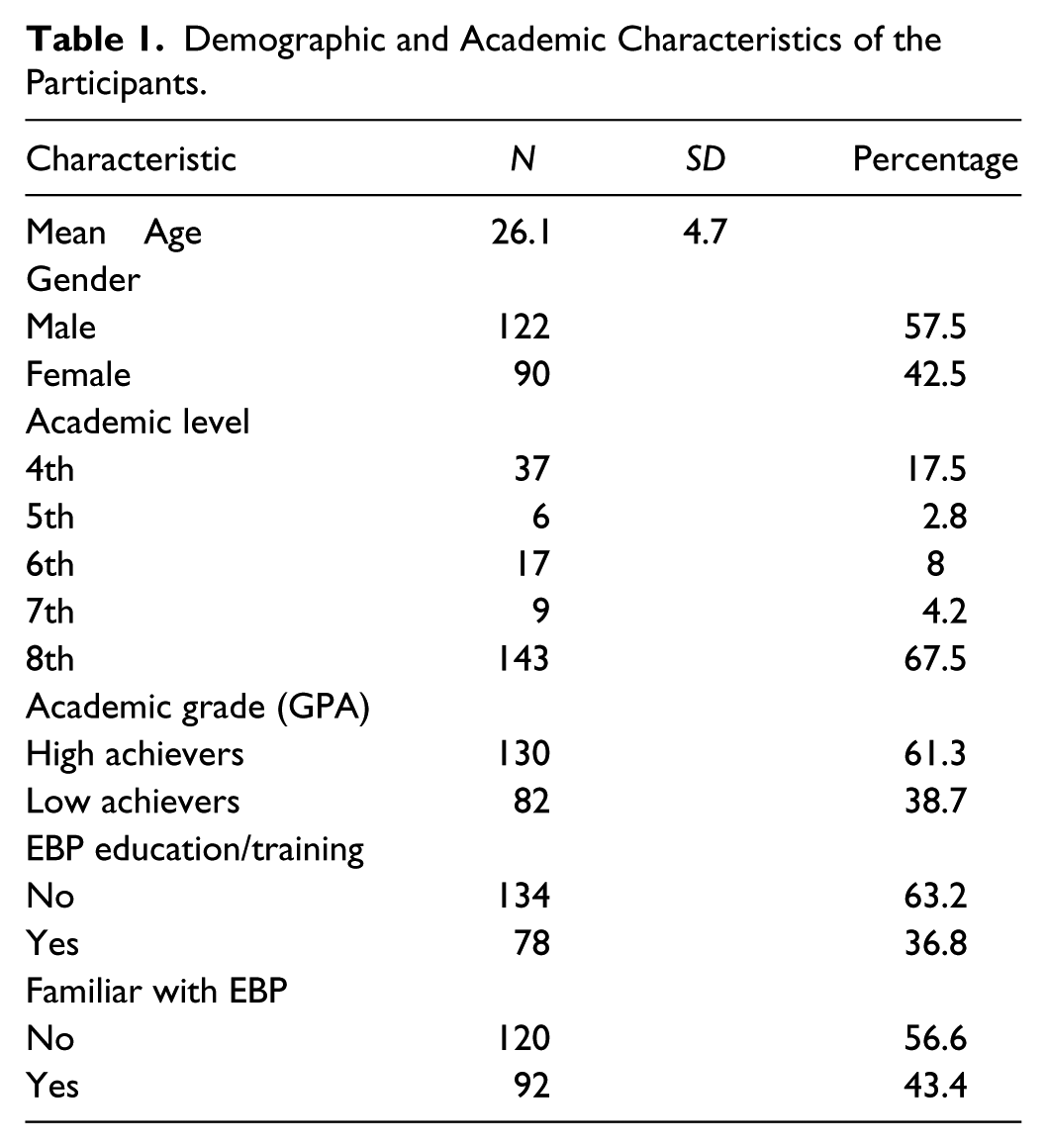
The participants’ demographic characteristics are presented in Table 1. A total of 212 undergraduate nursing students at a university in Saudi Arabia completed the survey (response rate 70.7%). The participation of the male nursing students was higher than female students (122/90). The majority of the participants were in eighth academic level (67.5%), and 61.3% were high achievers, meaning that their GPA ranged between 4 and 5 on a 5-point scale. Although the majority of the nursing students reported a positive attitude towards EBP, 56.6% were not familiar with the process and 63.2% had not received formal education about EBP. When considering the attitudes of nursing students toward EBP, they overwhelmingly agreed (92%) that it helped in clinical decision-making and they looked forward to using it in practice (76.9%). They also agreed that the process of EBP improved healthcare outcomes (82.5%). Personally, the students felt that EBP would help in defining the role of nurses (81.7%) and increase their autonomy (81.2%). Furthermore, a majority felt confident that they could critique a scientific article (76.4%), and they wanted nursing contracts to include time to evaluate such research (79.7%). On the other hand, 68.8% thought that patients would only experience minor improvements from EBP changes, and 56.1% reported that they considered the EBP process to be only theoretical and that it would not influence practice.
Demographic and Academic Characteristics of the Participants.
When considering the data about skills and knowledge of nursing students related to EBP, 79.7% were confident in their ability to create a PICO (population, intervention, comparison, outcome) question, and 59% felt that they could adequately search major databases for information. As far as interpreting statistical data such as the principle measures of association and impact, 59% of the students agreed that they felt comfortable with this activity and that 67.9% could judge the practical utility of the information. However, a full 39.6% did not feel confident in searching the principle databases for scientific knowledge, and 45.3% were not confident in their ability to analyze the results of a scientific study.
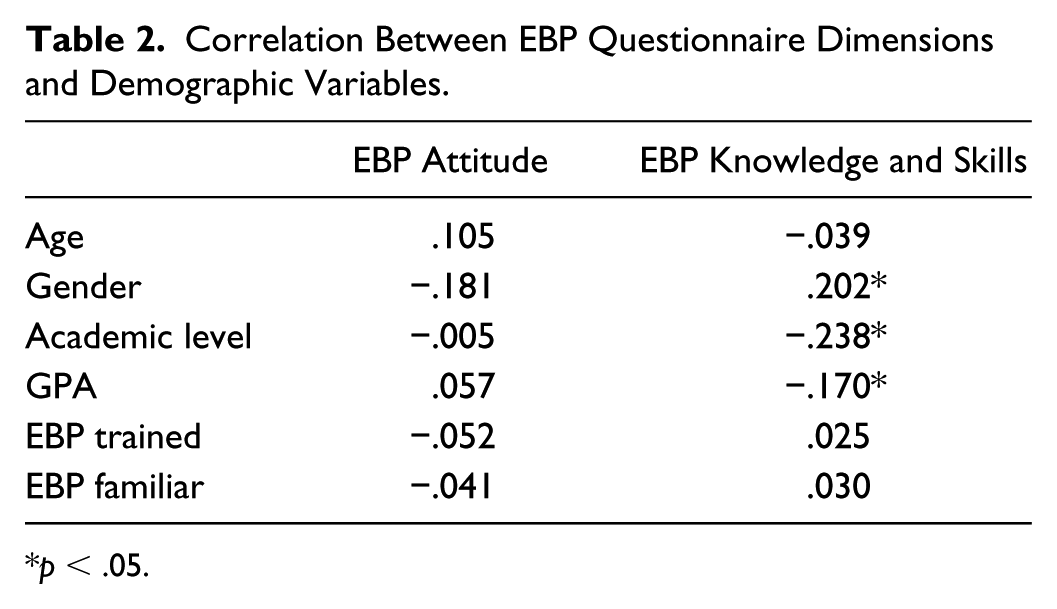
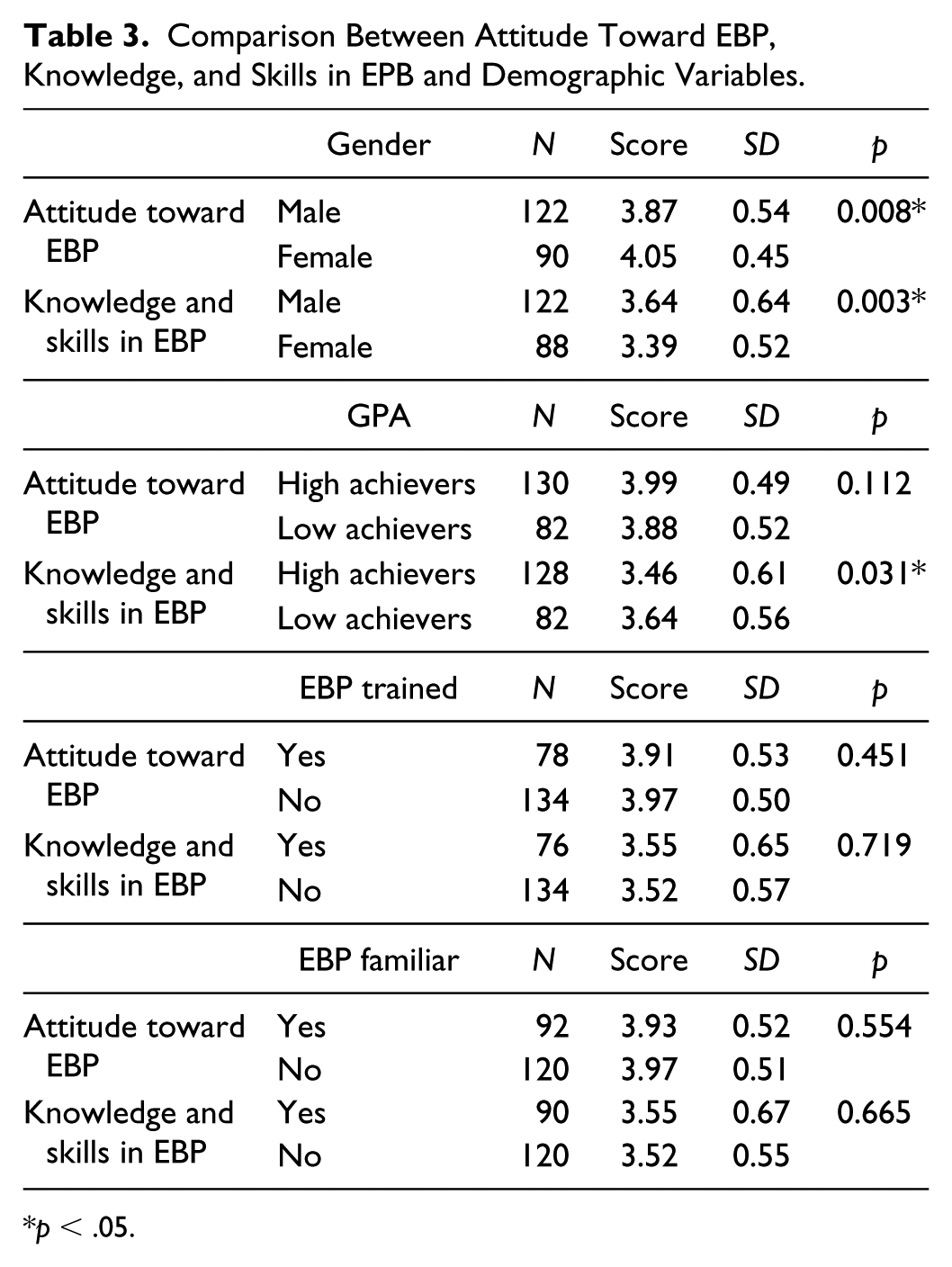
The correlation between EBP questionnaire dimensions and demographic variables is presented in Table 2. There was no correlation between demographic variables and attitudes toward EBP. Only gender, academic level, and GPA score were correlated with knowledge and skills about EBP. However, in regression analysis, it was revealed that the EBP attitudes of the participants were influenced by gender (ß = -0.26, p = 0.001), academic level (ß = -0.25, p = 0.008), and age (ß = -0.22, p = 0.010). In addition, EBP knowledge and skills of the participants were influenced by academic level (ß = -0.28, p = 0.002) and age (ß = 0.18, p = 0.041). The comparison between attitudes, knowledge, and skills about EBP and demographic variables is presented in Table 3. Female participants showed more positive attitudes toward EBP than did male participants. However, male participants showed better knowledge and skills about EBP than did female participants. Surprisingly, participants with a low GPA score showed better knowledge and skills on EBP than the participants who had high GPA scores.
Correlation Between EBP Questionnaire Dimensions and Demographic Variables.
p < .05.
Comparison Between Attitude Toward EBP, Knowledge, and Skills in EPB and Demographic Variables.
p < .05.
Discussion
The purpose of the current study was to assess nursing students’ knowledge, skills, and attitudes about EBP. In addition, it aimed to determine the impact of demographic variables on influencing students’ knowledge, skills, and attitudes about EBP. Furthermore, it examined the association between nursing students’ age and GPA with their scores of knowledge, skills, and attitudes about EBP. Finally, it compared students’ knowledge, skills, and attitudes about EBP in terms of their age, gender, academic level, and track of study.
The results showed that nursing students were very positive toward EBP, as a majority of them responded agree or strongly agree for most of the items related to this dimension. The positive attitudes were seen in interest, usefulness, decision-making, benefits, and relevance of EBP in the nursing profession. This indicates that nursing students believe EBP to be very important for nursing practice. Similarly, Al Furaikh, Al Omairi, and Ganapathy (2017) reported a positive attitude toward EBP on these factors among nursing students in Saudi Arabia. This idea has also been supported with previous studies that reported positive attitudes toward EBP among nursing students (Cruz et al., 2016; Stokke, Olsen, Espehaug, & Nortvedt, 2014). In the current study, more than 80% of the participants responded agree or strongly agree about the use of EBP in their clinical practice. Similarly, a previous study reported a moderate level of intention to use EBP among nursing students to use EBP in practice (Forsman, Wallin, Gustavsson, & Rudman, 2012). Likewise, the current study indicated that only a few participants responded disagree or strongly disagree about the use of EBP in their clinical practice. Contrary to previous studies, a majority of the participants in the current study responded agree or strongly agree to the application of EBP that will improve patients’ healthcare outcomes. Of interest, participants in previous studies could not identify the importance of integrating research and academic knowledge with patient care in clinical situations (Forsman et al., 2012).
Although majority of the participants in the current study reported positive attitudes toward EBP, most of them were not familiar and had not received formal education about research and EBP during their undergraduate programs. Similarly, a previous study reported minimal teaching about the clinical application of research and EBP in undergraduate nursing curriculums (Hung, Huang, Tsai, & Chang, 2015). The potential reason for this finding could be due to the complexity of implementing best evidence, patient perspectives, and expert opinions, as well as the difficulty of integrating research evidence into clinical situations (Melnyk, Fineout-Overholt, Stillwell, & Williamson, 2010). Although EBP education can improve students’ attitudes, knowledge, and skills, the learning process would be meaningless and fruitless if EBP education is focused only on confirming clinical questions, searching databases, and evaluating the literature rather than implementing evidence into clinical practice (Yousefi-Nooraie, Rashidian, Keating, & Schonstein., 2007). Therefore, multiple teaching strategies, including journal club meetings and clinical conferences, could be incorporated in EBP education to improve students’ competence in the use of EBP in clinical practice (Winters & Echeverri, 2012).
In the current study, female participants, higher academic level, and being older showed increased EBP attitudes, knowledge, and skills. A previous study reported an increase in attitudes, knowledge, and use of EBP among undergraduate nursing students with higher academic standing (Brown, Kim, Stichler, & Fields, 2010). Additionally, other studies reported that older students showed more positive attitudes toward EBP than younger students (Cruz et al., 2016). This could be explained by the fact that older participants in the current study had more clinical experiences and had more training about EBP, which could have positively influenced their attitudes toward EBP.
Limitations
There were some potential limitations related to this study. Since this was a cross-sectional study, the relationship between the dependent variables and the predictor variables should not be considered a cause-and-effect relationship. Additionally, study participants were drawn from only one university, and the samples were not randomly selected. Hence, these findings may not be generalized to all nursing students. Furthermore, the response from the surveys might have overestimated the participants’ true level of attitudes, knowledge, and skills of EBP. In the future, interventional studies implementing the EBP into the clinical situations that use both objective and subjective and assessments might be useful in improving EBP education among nursing students. Finally, studies assessing effectiveness of an EBP course on attitudes, knowledge, skills, and implementation of EBP in clinical practice are warranted.
Conclusions
Although there is a positive attitude toward EBP, a significant gap in knowledge and skills in terms of understanding and application of EBP concepts was reported among nursing students in Saudi Arabia. Since a majority of students had no formal training on EBP, there is a need to incorporate EBP concepts into the nursing curricula. In addition, nursing students should be provided and encouraged to gain competence related to EBP during their baccalaureate nursing studies.
Footnotes
Declaration of Conflicting Interests
The author(s) declared no potential conflicts of interest with respect to the research, authorship, and/or publication of this article.
Funding
The author(s) received no financial support for the research, authorship and/or publication of this article.
