







Abstract
Feeling listened to as a universal humanuniverse living experience was investigated with the Parsesciencing mode of inquiry. Historians were 10 English-speaking adults between 18 and 65 years old who had been hospitalized, willing to share their experiences of feeling listened to. The inquiry stance was “What is the discerning extant moment of the universal humanuniverse living experience of feeling listened to?” The major discovery of this investigation revealed the discerning extant moment as: Feeling listened to is uplifting recognition amid disconcerting rebuff, as treasured affiliations surfaces with joyful gratification.
Listening is the phenomenon of interest, and feeling listened to is the universal humanuniverse living experience. Feeling listened to is a universal phenomenon that all persons can describe. People in all areas of life experience being listened to and being disregarded and not listened to. In her professional career, the scholar witnessed persons’ dissatisfaction about not feeling listened to. As a nurse leader, the scholar also received complaints describing nurses who were always in a hurry, doing “important things” but could not spare enough time to listen and who were appearing to listen, while continually controlling their handheld communicating devices. The scholar also witnessed nurses and other health professionals who were occupied with gathering data on checklists to promote economic transparency and administrative efficiency. It is the opposite of nursing theory-guided practice, which is human health service to society based on the discipline-specific knowledge articulated in the nursing frameworks and theories. The discipline-specific knowledge reflects the philosophical perspectives embedded in the ontological, epistemological, and methodological processes that frame nursing’s ethical approach to the humanuniverse-health process (Parse et al., 2000, p. 177). The significance of this inquiry is that it shed light on how people are living with feeling listened to and not listened to. In addition, Pilkington (2008) affirmed Kagan’s (2008) study conclusions that there is a dearth of knowledge about feeling listened to and that additional theory-based research is needed to enhance discipline-specific nursing knowledge about feeling listened to. The purpose of this inquiry was to discover the discerning extant moment of the universal humanuniverse living experience of feeling listened to in light of humanbecoming paradigm (Parse, 2014).
Horizon of Inquiry
The theoretical perspective of the humanbecoming paradigm (Parse, 2014) is the horizon of inquiry for investigating the universal humanuniverse living experience of feeling listened to. The three themes of humanbecoming—meaning, rhythmicity, and transcendence—permeate the principles of humanbecoming. These three principles are “structuring meaning is the imaging and valuing of languaging, configuring rhythmical patterns is the revealing-concealing and enabling-limiting of connecting-separating, and transcending with possibles is the powering and originating of transforming” (Parse, 2014, p. 35). These three principles of humanbecoming are illuminated with four postulates: illimitability, paradox, freedom, and mystery. The postulates of humanbecoming are foreground to the central foundation, the seamless symphony of becoming and the principles. Illimitability is the “indivisible unbounded extended to infinity, the all-at-once remembering and prospecting with the moment. The word illimitability expresses indivisible, unpredictable, everchanging” (Parse, 2014, p. 30). Paradox is an “intricate rhythm expressed as a pattern preference. Paradoxes are not opposites to be reconciled or dilemmas to be overcome but, rather, are liv[ing] rhythms” (Parse, 2014, p. 32). Freedom is “contextually construed liberation” (Parse, 2014, p. 32). Mystery “is the unexplainable, that which cannot be known unequivocally. It is a puzzlement, an impenetrable” (Parse, 2014, p. 33). The literature is replete with testimonies of persons describing their experiences of feeling listened to (McCarthy, 2014) and feeling not listened to (Lundell, Eulau, Bjarneby, & Westerbotn, 2018). In this investigation about feeling listened to, historians share their experiences of feeling listened to while all at once bitterly remembering memories when they were not listened to. Some of the historians in feeling listened to talked of losing their liberty when as children they were forbidden to voice their opinions and were not listened to. Moreover, in feeling listened to, mystery is inherent in all dialoguing-listening, in that what is said and what is explicitly intended may not be heard or interpreted as such (Parse, 2014, p. 33).
The Humanbecoming Concept Inventing Model
The humanbecoming concept inventing model (Parse, 2018) (see Figure 1) “is preliminary to initiating a humanbecoming investigation with the two humanbecoming modes of inquiry—Parsesciencing and Humanbecoming Hermeneutic Sciencing” (p. 157). It invites the scholars “to plumb the depths of their knowings to create unique descriptions of concepts, known as ingenuous proclamations” (Parse, 2018, p. 157). Parse (2018) posited, “Ingenuous proclamations are declared in the language of humanbecoming science and with relevant artforms” (p. 157).
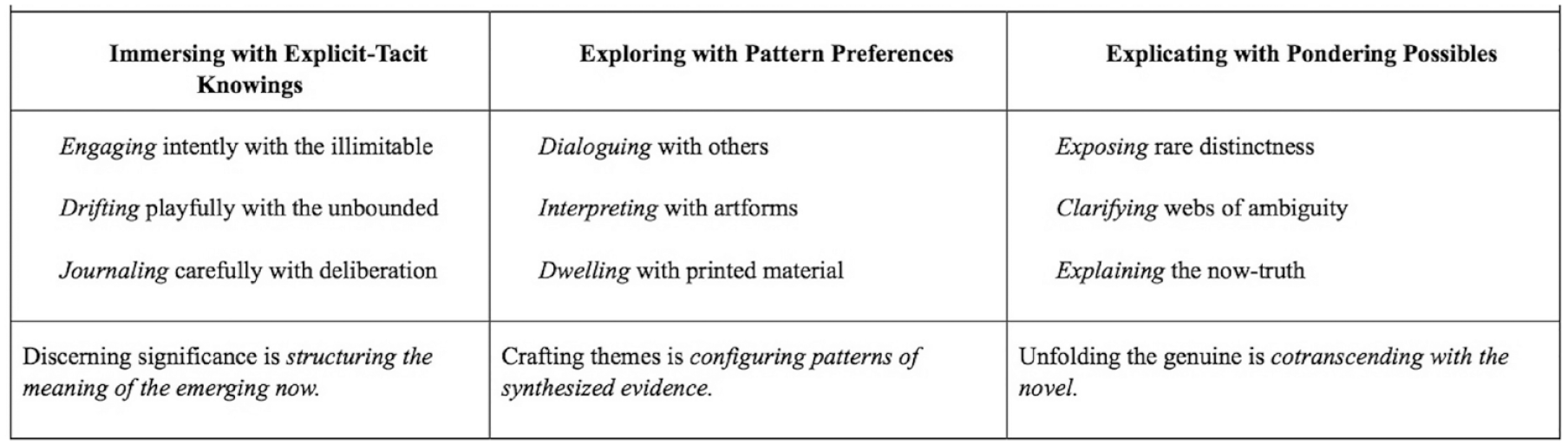
The Humanbecoming Concept Inventing Model. Reprinted with permission from Parse (2018, pp. 157-159).
“With attentive illuminations from immersing with explicit-tacit knowings, exploring with pattern preferences, and explicating with pondering possibles” (Parse, 2018, pp. 157-158), the scholar pondered her experience, listened to what others said about feeling listened to, reflected on artforms, interpreted a film to enhance understanding of the phenomenon of feeling listened to, dwelled with printed materials, clarified and exposed the distinctness of the concept, and arrived at the now-truth of feeling listened to. For the scholar, the now-truth of feeling listened unfolded as: Feeling listened to is uplifting recognition with attentive dialoguing arising with contentment. Uplifting recognition is feeling good about being acknowledged by others in everyday living. It is respecting and accepting others’ decisions while living the risk of being rejected and disregarded. With feeling listened to, individuals may experience attentive dialoguing by being close and away from others who treasure a relationship, and this is shown with trust and understanding. Feeling listened to arises with contentment. With the idea of contentment connected with feeling listened to, individuals may experience a comforting feeling when they know that others are listening to them. The ingenuous proclamation was declared at the highest level of sciencing as feeling listened to is powering the languaging connecting-separating of imaging, and the artform is Renoir’s (1878) painting “Conversation.” The now-truth and the ingenuous proclamation of feeling listened to was discussed with the principles of the humanbecoming paradigm (Parse, 2014) (see Duarte-Quilao, 2019). The artform (Figure 2) shows two women engaging in a peaceful conversation and capturing the meaning of the universal humanuniverse living experience of feeling listened to. This painting shows a culmination of a face-to-face encounter wherein one woman is hugging the other as if listening to her concerns. The face of the other woman seems to be showing contentment, as she is recognized and acknowledged in her grief with a nonjudgmental and unconditional love. This woman seems to be mourning a loss as she is acknowledged by the other with attentive dialoguing. The embracing arm of the other seems to offer comfort, while the folded arm of the mourning woman shows acceptance. Feeling listened to surfaces with the inspiring acknowledgment of others while engaging in thoughtful illimitable affirmations.
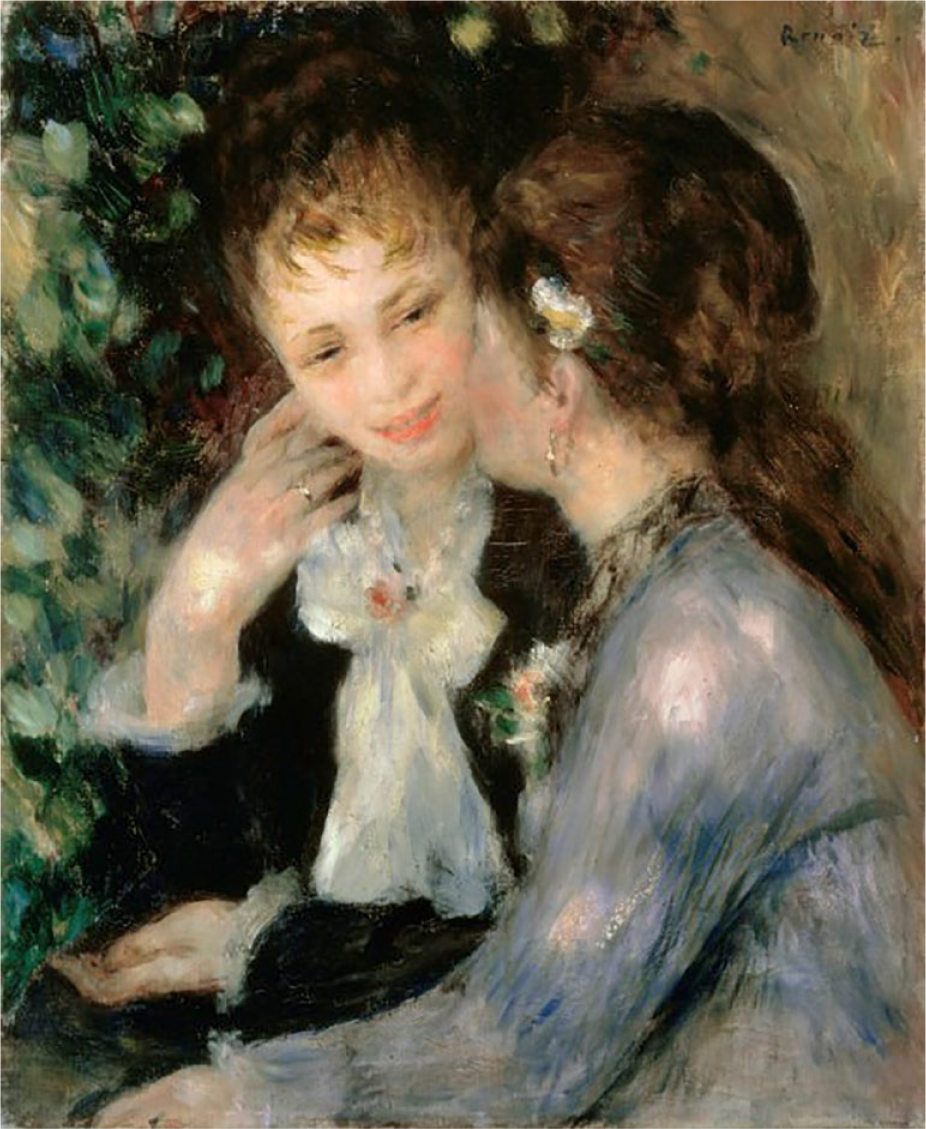
Conversation (Renoir, 1878). Wikimedia Commons.
Foreknowings
The scholar explored a multitude of literature from diverse disciplines and posited conceptual foreknowings in terms of integrated themes about the universal humanuniverse living experience of feeling listened to and the humanbecoming paradigm (Parse, 2014) as the theoretical foreknowings. While exploring with pattern preferences, three themes arose crafted by the scholar. The three themes are as follows: (a) Feeling listened to arises with endearing deference, (b) feeling listened to emerges with fortifying alliances, and (c) feeling listened to surfaces with struggling for recognition amid not feeling listened to.
Feeling Listened to Arises With Endearing Deference
In a study describing Black women’s comfort level in discussing HIV and their likelihood of returning for their HIV results, Williams, Pichon, Latkin, and Davey-Rothwell (2014) reported that feeling listened to was found to be one of the three characteristics important for them. The study was conducted to understand the relationship between congregational support and HIV prevention behaviors among a sample of high-risk, HIV-negative Black women. Participants were 434 Black women who were at high risk for contracting HIV and who were recruited through face-to-face interviews and Audio Computer-Assisted Self-Interviews. Feeling listened to was connected to feeling loved by their congregation that helped people with their problems. All these characteristics seem to have the greatest influence on the prevention behaviors of these Black women and reduced HIV stigma for women seeking comfort from Black churches.
Similarly in another qualitative study, McCarthy (2014) found that healthcare providers including nurses showed respect and support by giving adequate time to patients and family members to listen and answer their questions before, during, or after undergoing chemotherapy treatment. Patients appreciate being treated with compassion, kindness, and understanding. Also, patients specified the selective use of humor of healthcare providers when talking and treating them as normal individuals and not as “cancer individuals” (McCarthy, 2014). Clementi (2006) in a grounded method study about patients’ expectations during healthcare encounters found that cardiac patients felt respected when nurses spent adequate time, while acknowledging that healthcare providers are busy. Participants in this study felt that concerns were taken seriously when the nurse made specific time to listen. Scholars from the allied health profession affirmed that valuing and acknowledging others without judgment but with unconditional love supported the first theme: feeling listened to arises with endearing deference.
Feeling Listened to Emerges With Fortifying Alliances
Cummings (2011), a nurse scholar, narrated the experience of feeling listened to, as a partnership when listener and storyteller shared a traumatic event. The listener and the storyteller collaborated to piece the story together and accept what they knew in the present moment to be the story, while being open to the possibility of change in the future. Forming a unique dyad happens when the listener manifests an interest in the story being told by the storyteller. If the listener loses interest, then the storyteller would quit talking, remain silent, and keep feelings to self. This is concomitant to the testimony of one historian in this investigation of feeling listened to, who alleged that she is not going to further the conversation if she knows by body language and eye contact that somebody is not listening to her. Moreover, using a grounded theory method, Clementi (2006) found that participants had developed a relationship with the healthcare provider who asked and answered their questions and gave them information that they could understand. Participants described feeling assured that they were receiving competent care and that led to their fears being calmed. Involvement in healthcare decision-making has been reported as patients’ perception of dignity. Patients wanted to be treated as partners and share decision-making about their daily life in the hospital including nursing care (Kvåle & Bondevik, 2008). With the above-mentioned discoveries from diverse literature, the scholar illustrated fortified alliances experienced by participants who felt listened to.
Feeling Listened to Surfaces With Struggling for Recognition Amid Not Feeling Listened To
Feelings of being listened to and safety were considered important aspects in a positive encounter with health professionals. However, feeling lack of time or interest often led to negative experiences, such as frustrations with and distrust of the healthcare system.
In a study of patients’ expectations of the maintenance of their dignity, a patient said, “Nurses just tend to storm in—just start doing things without explaining.” “Patients are not talked to and feel they don’t exist and are ignored by the nurse” (Matiti & Trorey, 2008, p. 2713). Likewise, Clementi (2006) with her grounded method study of cardiac patients’ expectations during healthcare encounters also described participants who perceived they were not being treated with respect. They did not feel listened to and that healthcare providers did not make time to listen nor did participants believe their concerns were taken seriously. Finally, in one qualitative study by Eriksson and Svedlund (2007) using narrative interviews, participants were asked to describe experiences of dissatisfaction with hospital care. Findings showed that the participants’ struggled for confirmation, the feeling of distrust in the healthcare system. Patients reported feelings of being disbelieved, being troublesome, not listened to and were also met with negligence, ignorance, and arrogance (Eriksson & Svedlund, 2007). At the same time, positive encounters were described as well as situations of confirmation from caregivers. The results also showed hope and a will to get on with life. This may be connected to struggling for recognition amid not feeling listened to as participants experienced validation when confirmed and listened to by caregivers yet experienced a feeling of distrust in healthcare when not recognized. The third theme was shown with individuals’ struggling to be recognized and listened to without being denigrated when others refuse to acknowledge them.
Inquiry Stance
What is the discerning extant moment of the universal humanuniverse living experience of feeling listened to?
Historians
For this investigation, historians were 10 adults between 18 and over 65 years old, English-speaking, who have been hospitalized and willing to describe their stories of feeling listened to in a dialogue. Approval from the Institutional Review Board (IRB) was obtained from the university for the protection of historians. Each historian signed a consent form disclosing the purpose, the process of dialoging-engaging, and the intent of the investigation. The scholar answered all the questions to the historian’s satisfaction. To ensure confidentiality, the consent form stated that audiotapes and transcriptions were kept under lock and the scholar guarded the key. The consent forms guaranteed anonymity in that a code was kept separately from the audiotapes, the transcripts of the dialogue, and the consent forms. The code names identified historians in all presentations and publications.
Mode of Inquiry
Parsesciencing (Parse, 2016), consistent with the humanbecoming paradigm (Parse, 2014), was the mode of inquiry for investigating the universal humanuniverse living experience of feeling listened to. Parsesciencing as a mode of inquiry to discover the discerning extant moment of the living experience consists of three phases: (a) dialoging-engaging, (b) distilling-fusing, and (c) heuristic interpreting (Parse, 2016).
Dialoging-Engaging
In dialoging-engaging, the scholar is in true presence dialoguing with the historian about the living experience. “True presence is not an interview but rather an up close and personal presence wherein the scholar invites the historian to share a description of the experience in a dialogue without being interrupted by the scholar” (Parse, 2016, p. 272). The scholar starts the dialogue by saying, “Can you please describe your experience of . . . ?” Then the scholar may request the historian to say more or go on about the experience. Historians’ audiotaped descriptions of the humanuniverse living experience is later transcribed to typed format for the distilling-fusing (Parse, 2016, p. 272).
Distilling-Fusing
“Distilling-fusing is dwelling with and inventing” (Parse, 2016, p. 272). As the scholar dwells with each transcribed historian’s description and audiotaped dialogue, the scholar then distilled from the transcription “a story by capturing the central ideas” (Parse, 2016, p. 272). In the language of the historian, the essences are stated, after which these essences are stated in the scholar’s language at a higher level of abstraction. “These essences are creatively fused and stated as the language-art for each historian” (Parse, 2016, p. 272). Parse (2014) explicated, “in deep contemplation, with the transcribed descriptions, the audiotaped dialogue, and the language-art for all historians, the scholar identifies core ideas” (Parse, 2016, p. 272), which are the essences arising from the historian’s stories regarding the universal humanuniverse living experience being investigated. The fusion of the historians’ and the scholar’s core ideas creates the discerning extant moment of the universal humanuniverse living experience (Parse, 2016, p. 272).
Heuristic Interpreting
In heuristic interpreting, “the discerning extant moment, the truth for the moment of the universal humanuniverse living experience, and the major discovery of Parsesciencing is moved to a higher level of abstraction” (Parse, 2016, p. 273). “Heuristic interpreting includes transmogrifying, transubstantiating, metaphorical emergings, and artistic expressions” (Parse, 2016, p. 273). Transmogrifying is the conspicuous shifting of language, locating words and phrases to a higher level of abstraction” (Parse, 2016, p. 273). “Transubstantiating is moving the abstract transmogrified language to the core level of humanbecoming” (Parse, 2016, p. 274). Parse (2016) supported the definition by explaining “trans comes from the Greek word meaning beyond and substantiating refers to substance, a core essence of something” (p. 274). As clarified by Parse (2016), the terms transmogrifying and transubstantiating are not static, thus referring to everchanging, incarnating the intent of humanbecoming paradigm (p. 274). Also included in heuristic interpreting are metaphorical emergings and artistic expressions. “Metaphorical emergings are statements describing in symbolic language the historians’ living experience” (Parse, 2016, p. 274). “The artistic expression is the scholar’s personal choice of expressing the historians’ universal humanuniverse living experience of feeling listened to with the Parsesciencing inquiry” (Parse, 2016, p. 274).
Historians’ Truths
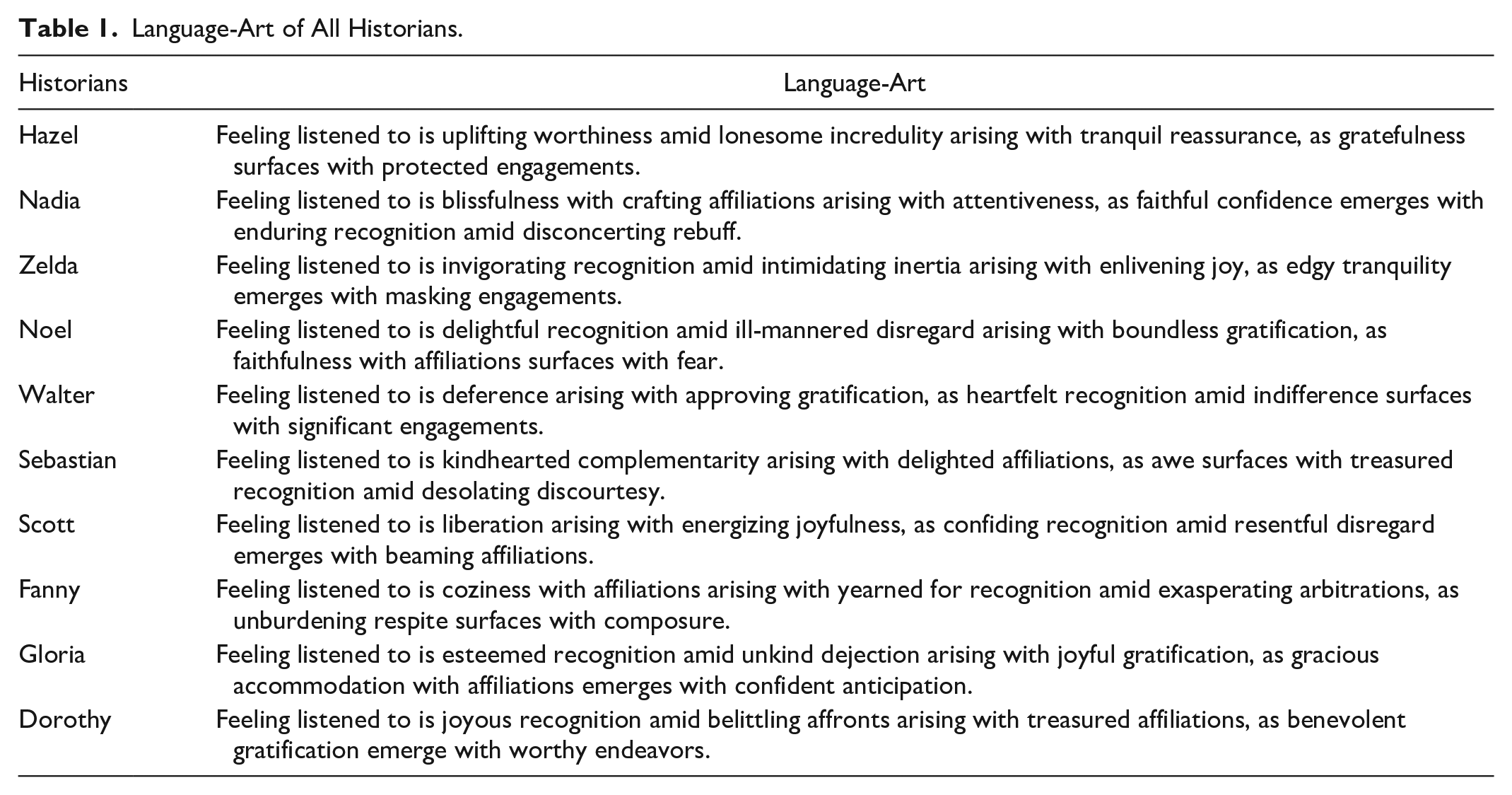
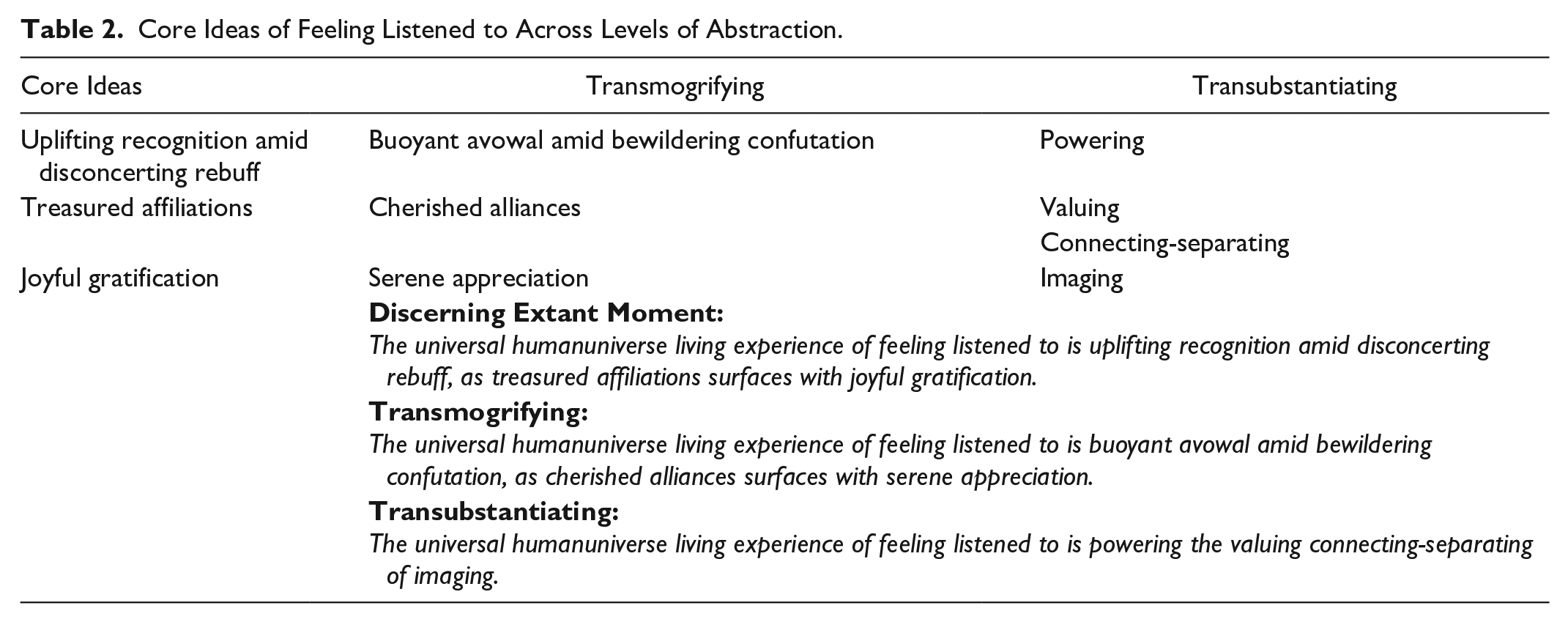
What surfaces from a Parsesciencing inquiry is the historian’s now-truth. Presented next are the stories of 3 of the 10 historians’ stories, the essences in the historians’ and the scholar’s language, the language-art for each historian, including the core ideas at different levels of abstraction. The language-art of all 10 historians is portrayed in Table 1 and the core ideas of feeling listened to across levels of abstraction in Table 2.
Language-Art of All Historians.
Core Ideas of Feeling Listened to Across Levels of Abstraction.
Noel’s Story
Noel said feeling listened to “is to talk and trust each other and give good feedback. It is to feel wonderful. It validates one as human being and that’s very important.” He said, “it makes me feel great when somebody like my cousin and friend listen. I got the feeling that they really understand and I feel a connection.” Noel said, “I am scared to open myself up to trust and to have somebody listen to me. I got connected with women and all of a sudden they disappear in my life, and to me it’s like a death.” Feeling listened to is to feel good spending time talking to a coworker every day and becoming close. Noel felt good when he had somebody he could talk to. Noel went on, “people don’t usually listen, I wanted connection but in our family we didn’t share anything, we don’t talk, so we don’t share and we don’t listen to one another.” He continued, “When my sister died, as a kid I think I asked questions to my parents but I never received an answer. I should have listened to my parents more, and I didn’t, it was rather difficult, and they died.” Noel recalled, “I was hospitalized for kidney stones. I was under morphine injection for pain and a guy wheeled me into the hallway for an X Ray and left me. I was waiting for a long time and I decided to take a walk. The doctor was angry when I came back.” Noel explicated, “the guy should have waited and stayed with me but he left me and there’s something wrong with that.” Noel concluded, “I really wanted to speak to the head nurse, and I didn’t, I could have sued, but I didn’t, and that’s what it is, but nobody listened to me.”
Essences: Noel’s Language
Feeling listened to is getting feedback and being validated. It is feeling good, and wonderful, yet not being listened to on occasions.
Feeling listened to is trusting and being connected and understood, but being scared to open up to others.
Essences: Scholars’ Language
Delightful recognition arises with boundless satisfaction amid ill-mannered disregard.
Faithfulness with alliances surfaces with fear.
Noel’s Language-Art
Feeling listened to is delightful recognition amid ill-mannered disregard arising with boundless gratification, as faithfulness with alliances surfaces with fear.
Walter’s Story
Walter said, “Feeling listened to is being acknowledged that I have a voice. It helps me grow.” Feeling listened to gives you the comfort and allows you to feel like this is somebody willing to talk to you. He said feeling listened to means people are giving validity to what you have to say. It is internalizing what you are saying and giving feedback. Feeling listened to means you are accepted, people are interested on who you are as an individual, and people are giving you respect. Walter added, “Feeling listened to validates you as an individual and allows you to meet your needs.” Feeling listened to is not just you only listening; it is an interaction between the two. Walter commented, “There are times when I am not listened to; when others really don’t care and don’t have time for you.” Walter declared, “Being able to sit here and talk to you is a way of me validating in my head and seeing that the reality of being listened to is more important and I realize the importance of being able to speak and being able to be with people.”
Essences: Walter’s Language
Feeling listened to is being acknowledged and respected. It is comforting and validating.
Feeling listened to is being able to talk to and be with people, yet considering not being listened to.
Essences: Scholar’s Language
Deference arises with approving gratification.
Heartfelt recognition surfaces with significant engagements amid indifference.
Walter’s Language-Art
Feeling listened to is deference arising with approving gratification, as heartfelt recognition amid indifference surfaces with significant engagements.
Dorothy’s Story
Dorothy said, “When I feel listened to I feel that I am an important part of the conversation or relationship, my opinion is valued. I am collaborating with other persons, my input is valuable, and the feedback is mutual.” Feeling listened to is to feel happy and respected. She added, “I am more productive when I feel listened to.” Dorothy said, “If people are not listening to me and you are not meeting me in a certain level I am not gonna waste my time forging a relationship with that person.” Dorothy remembered as a kid: “Adults don’t listen to you, as you are a child, and you don’t have experience,” and she thought, “That’s true but they were very dogmatic.” She also learned in nursing school that the more you know the more people respect you, the more people will listen to you. Dorothy related, “I noticed that doctors would listen to you if you could have a discussion with them in a proficient level.” She concluded, “To feel not listened to was anxiety-provoking and I got very upset about that.”
Essences: Dorothy’s Language
Feeling listened to is being happy and respected. It is collaborating with others validating opinions.
Feeling listened to is comforting with more productivity. It is being embarrassed when not listened to.
Essences: Scholar’s language
Joyous recognition arises with treasuring affiliations.
Benevolent gratification emerges with worthy endeavors amid belittling affronts.
Dorothy’s Language-Art
Feeling listened to is joyous recognition amid belittling affronts arising with treasured affiliations, as benevolent gratification emerges with worthy endeavors.
Ensuing Discoveries
The major discovery of this investigation is the discerning extant moment of feeling listened to: Feeling listened to is uplifting recognition amid disconcerting rebuff, as treasured affiliations surfaces with joyful gratification. “Ensuing discoveries include connecting each core idea of the discerning extant moment to the horizon of inquiry, the foreknowings, and beyond to expand understanding of the universal humanuniverse living experience and humanbecoming” (Parse, 2016, p. 274). The scholar approaching the culmination of the investigation illuminates the core ideas supported by the historians’ (10 persons who had been hospitalized) descriptions, the foreknowings, and the humanbecoming paradigm (Parse, 2014). The core ideas are uplifting recognition amid disconcerting rebuff, treasured affiliations, and joyful gratification.
Uplifting Recognition Amid Disconcerting Rebuff
All historians when asked about their experience of feeling listened to talked of uplifting recognition. Historians said that they felt recognized and loved when listened to, and yet they also related feelings of being rejected, disregarded, and not respected when not listened to. Uplifting recognition amid disconcerting rebuff is a core idea of the discerning extant moment of the universal humanuniverse living experience of feeling listened to. The transmogrifying is buoyant avowal amid bewildering confutation. The transubstantiating is powering. “Powering is the pushing-resisting of affirming-not affirming being in light of nonbeing” (Parse, 2014, p. 48). Powering is a concept from the third principle of humanbecoming: “cotranscending with possibles is the powering and originating of transforming” (Parse, 2014, p. 46).
Uplifting recognition surfaced as historians talked of their testimonies of feeling listened to. Some examples of historians’ descriptions included: “I feel acknowledged that I have a voice”; “I feel appreciated and valued”; “I feel that I am an important part of the conversation, my opinion is valued, my input is valuable”; “I am thankful they didn’t send me home, they knew that was not an ordinary fall and I was observed, they cared”; “I feel respected and that someone understands”; “I was heard and validated”; “I was understood”; “I matter”; and “I feel comforted and respected.” Concomitantly, the scholar also received testimonies from historians recalling their disappointments and heartaches from their experiences when not listened to. For example, “I had to complain of headaches and vomiting before the nurse came in and sat with me”; “I asked questions but I never received an answer”; “You feel lonely, neglected, and disrespected”; “I was rushed, miscommunicated with and left in pain”; “I was irritated and angry”; “I got very upset”; and “I had to scream in pain to receive medication.”
With uplifting recognition amid disconcerting rebuff connected to feeling listened to, historians offered descriptions on how they struggled by affirming-not affirming their desires to be recognized, creating possibilities for options, and making valued decisions, which were associated with risk in terms of conflicts and misunderstandings with others. One of the historians talked about his expectations when he was a kid. His sister died and was expecting answers, but he never received an answer. Likewise, being hospitalized may be stressful to anybody especially when confronted with aggravating situations wherein you have to implore for attention to pain. One historian said, “I had to compromise with the nurse, and I got angry, but they are not listening to my cry of pain.” While yearning for recognition, she opted to compromise in order to be considered and have her supplications heard.
Although most of the historians stressed the importance of communicating and dialoguing when feeling listened to, they simultaneously commented on others’ nonwelcoming reactions not affirming their expectations. One historian said, “I can tell when people don’t listen to me, they are giving me short answers and feedback, and they have no eye contact and distracting body language.” Another historian said, “The experience with the therapist has been horrible. I felt not listened to, I had to say wake up, I am talking about myself to you.” Feeling listened to with uplifting recognition amid disconcerting rebuff was clearly portrayed by one of the historian’s experience when he talked of the way he was brought up. He said, “I had a father at home, he didn’t listen to me but I have a community of men who listened to me growing up, who looked at how I turned out and I was heard.” The father not affirming his expectations did not hear his son’s expectation. The son felt listened to by others.
The core idea of uplifting recognition amid disconcerting rebuff is similar to findings of other scholars’ studies about feeling listened to. The studies described here are the most pertinent to the discoveries in this investigation. Kagan (2008) described a core concept, unreserved affirmation amid potential irreverence, which was transposed as unrestrained assertion and was consistent with powering in an investigation with 10 adults who shared their experience of feeling listened to using the Parse research method, while Jonas-Simpson (2003), also using the Parse method to study being listened to with 10 older women in rehabilitation, identified another related core concept, acknowledging engagement, which was transposed as abiding communion and was linked with the theoretical concepts connecting-separating and powering. “Being listened to then is an acknowledging engagement experienced as an affirming communion with another where humans are connected with and apart from others all at once” (Jonas-Simpson, 2003, p. 236). Participants in her study felt acknowledged being listened to.
In a feeling respected study (Parse, 2006), core concept of fortifying assuredness amid potential disregard was identified that is consistent with uplifting recognition amid disconcerting rebuff and was transposed as vivifying unwavering amid imaginable irreverence and conceptualized as powering. In this Parse method study, “participants felt respected when there was an acknowledgement or some affirmation reflecting their worth, but this was always accompanied by the possibility of disregard, the imaginable irreverence that can happen in the not knowing explicitly what is about to be” (Parse, 2006, p. 55). This is similar to what historians said in the feeling listened to study investigation when they said they felt disregarded when not being listened to.
From the overall literature, one descriptive qualitative study by Lundell et al. (2018) related to listening sought to describe how seven women in Mexico who have suffered from gender-based violence experienced their encounters with healthcare professionals. Findings showed that women emphasized the importance of healthcare professionals taking time to listen to them. When the healthcare professionals treated the women with respect and genuine interest, the women felt secure. On the other hand, these women felt frustrated when they were not treated with respect. Women considered feelings of being listened to and feeling secure as important aspects in a positive encounter but emphasized feeling that a lack of time spent with them often led to negative experiences such as frustration with and distrust of the healthcare system. The findings of this study are consistent with the core idea of uplifting recognition amid disconcerting rebuff, as participants and historians wanted to be considered and recognized by being listened to.
Historians in this study of feeling listened to talked of respect and being loved. They wanted to be acknowledged, understood, and accepted without being judged and disregarded. Discoveries with the foreknowings that arose with other humanbecoming investigations and findings from general literature clarified the core idea of uplifting recognition amid disconcerting rebuff and enhanced the scholar’s comprehension of the universal humanuniverse living experience of feeling listened to. As shown by the historians, feeling respected and not respected shifts relationships with others.
Treasured Affiliations
Treasured affiliations is the second core idea of the universal humanuniverse living experience of feeling listened to. Similar to uplifting recognition, historians affirmed unanimously the importance of others when describing their experiences of feeling listened to. The core idea treasured affiliations is transmogrified as cherished alliances and transubstantiated to valuing connecting-separating. Valuing is a concept of the first principle of humanbecoming: “Structuring meaning is the imaging and valuing of languaging. Valuing is explained as “all-at-once confirming-not confirming cherished beliefs in light of personal worldview” (Parse, 2014, p. 39). “The paradoxical rhythm of confirming-not confirming is freely choosing pattern preferences from illimitable imaged options and owning the choices” (Parse, 2014, p. 39). Connecting-separating is a concept of the second principle of humanbecoming, “configuring rhythmical patterns is the revealing-concealing and enabling-limiting of connecting-separating.” These concepts “are paradoxical living rhythms recognized as humanuniverse pattern preferences” (Parse, 2014, p. 44). “They are paradoxical in that they appear to be opposites, but are really rhythms expressing embracing contradictions” (Parse, 2014, p. 44). With connecting-separating, individuals experience “attending-distancing” (Parse, 2014, p. 45). Connecting-separating “is living being with and apart from others, ideas, objects, and situations all-at-once” (Parse, 2014, p. 45) and “is the communion and aloneness source of humanuniverse emergence” (Parse, 2014, p. 46).
Treasured affiliations is a construct meaning valuing the presence of others, ideas, objects, and situations. Individuals freely choose from illimitable possibilities that arise with valued choices and decisions, as “cherished choosings are incarnated with a value framework, which consists of principles and ideas that guide an individual’s living” (Parse, 2014, p. 39). Individuals therefore choose freely from options, prize, and cherish the option with affirmation, and act upon it (Parse, 2014). “In choosing valued images as pattern preferences amid contextually construed situations while incarnating the illimitable, individuals structure meaning as a feature of humanbecoming” (Parse, 2014, p. 40). Historians shared with the scholar their testimonies about treasured affiliations. For example, feeling listened to is: “I was able to move on with what’s next in my chapter in life”; “Feeling listened to is me disclosing a part of me, like opening my heart to you, it is opening the door to friendship; it is opening the door to a bond that can develop into something greater; it is opening up your heart and soul to someone”; “Feeling listened to brings bigger bond between groups of people or people together”; “It is to feel more connected”; “It is the feeling of getting closer to the person that I should be or that I want to be”; “Feeling listened to is to talk and trust each other and give good feedback”; “Feeling listened to is talking to a co-worker every day and becoming close”; “It is not just you only listening”; “It is an interaction between the two”; “It is a feeling of give and take”; “Feeling listened to is communication”; and “I am collaborating with other persons.”
With the core idea of treasured affiliations, one historian talked of opening the door to friendship, which is a way to attend to valued others while all-at-once deciding to leave the trivial and meaningless behind offering new possibilities. The historian was expressing her intention to initiate a durable relationship with somebody precious to her with shared expectations and aspirations in the near future. Historians shared their desires and yearnings to be listened to and their experiences of being treated well when hospitalized, yet they at times experienced being humiliated and disregarded. Historians should have been invited to discuss what is important for them at the moment allowing the meaning of the situation to emerge, as the professionals listened to them as they shared their desires related to what is the becoming visible-invisible becoming of their emerging now. Parse (2014) illuminated this with true presence.
The scholar also found similarities with core concepts from Parse method studies related to the core idea of treasured affiliations. Kagan (2008) discovered benevolent affiliations in a study about feeling listened to from the dialogues with participants who declared that when persons feel listened to they were choosing prized cocreations with others. Benevolent affiliations captured notions of treasured involvements with others. This concept was transposed as cherished involvements, and conceptualized in humanbecoming as valuing connecting-separating.
Similar to treasured affiliations of feeling listened to, the core concept revering alliances was discovered in a Parse method study about feeling unsure (Maillard-Strüby, 2012). “Revering alliances surfaced with fulfilling activities with esteemed others, while cherishing the preciousness of everyday situations with affiliations” (Maillard-Strüby, 2012, p. 78) was transposed to prizing involvements and linked to humanbecoming as valuing connecting-separating. This may be connected to a description of one historian in feeling listened to who said, “Feeling listened to means you are accepted, people are interested in who you are as an individual and allow you to meet your needs.”
In another Parse method study on trusting another, the core concept of cherishing alliances was discovered (Doucet, 2009). Cherishing alliances was structurally transposed as treasuring involvements and conceptualized as valuing connecting-separating. However, with the Parsesciencing inquiry on feeling listened to, cherished alliances is the transmogrified language of treasured affiliations. In the trusting another study, “ten participants while cherishing a promise, strength, or goal with others, simultaneously they experienced trusting another as aloneness with the fear of being let down and feeling of vulnerability” (Doucet, 2009, p. 264). A historian in feeling listened to said, “Feeling listened to is to talk and trust each other and give good feedback.” The core idea treasured affiliations with the core concept of cherishing alliances fortify the scholar’s comprehension of the universal humanuniverse living experience of feeling listened to.
The scholar searched the general literature and found knowledgeable conceptions related to the core idea treasured affiliations of the universal humanuniverse living experience of feeling listened to. The core idea treasured affiliations may also be connected to individuals who valued others who were able to tell their stories, testify, and describe the most positive and most difficult aspects of their experience of testifying. In a study with 147 witnesses who completed their testimonies at a war-crimes tribunal in Sierra Leone, Stepakoff, Reynolds, Charters, and Henry (2015) reported that “the most frequently mentioned positive aspect was being given the chance to tell their story, being able to talk about difficult/painful experiences, breaking silence.” The second most frequently mentioned positive aspect was “being listened to, feeling believed/understood.” Some witnesses specified that the judges listening was the best part, and one witness specified that it was the lead attorney’s understanding that was the best part in testifying in the Special Court For Sierra Leone (SCSL). Similar to the participants of this study, historians of feeling listened to valued treasured affiliations who listened to them and acknowledged their demands.
The scholar with the learned discoveries from the humanbecoming’s investigations and foreknowings illuminated the core idea of treasured affiliations and intensified the scholar’s understanding of the universal humanuniverse living experience of feeling listened to. With treasured affiliations, historians felt listened to when being connected with valued others; they also felt gratified and happy.
Joyful Gratification
All historians in this investigation expressed feelings of gratefulness, security, satisfaction, calmness, relief, comfort, happiness, and contentment, as they felt respected, acknowledged, and validated being listened to. Joyful gratification is the third core idea of the universal humanuniverse living experience of feeling listened to. The transmogrifying is serene appreciation, and the transubstantiating is imaging. Imaging is a concept of the first principle of humanbecoming, “structuring meaning is the imaging and valuing of languaging.” Historians as individuals have freedom to choose from illimitable options “in the context of what is known explicitly-tacitly and confirmed-not confirmed with speaking-being silent and moving being still” (Parse, 2014, p. 37). In imaging, explicit-tacit knowing arises when individuals choose innumerable possibilities to be acknowledged, accepted, and understood by others, while looking for satisfaction over discontentedness signifying the reality of the meaning of the valued priorities chosen at that moment. Joyful gratification is felt when persons are listened to. Historians shared testimonies of their experience of joyful gratification when they felt listened to. Examples are: “Feeling listened to is security, comfort, relief the feeling of ease with yourself; it is a feeling of contentment”; “When somebody hears me, that gives me comfort”; “When I am truly listened to, it makes me happy”; “Feeling listened to is a weight lifting off my shoulders”; “I feel it just a feeling of clarity, of feeling of freedom”; “To feel listened to is to have more energy when I wake up and I don’t have guilt”; “To feel listened to is to feel calm, happy, contented, loved, cared for, nurtured, and at peace”; “Feeling listened to is to feel good”; “I feel like a feather when I am listened to”; “Feeling listened to is healthy and vital”; “To feel listened to is like I am satisfied getting what I want; I am relieved, I have the comfort; I have satisfaction; and I am happy”; “I feel very happy to know that people care about me”; “To feel listened to is to feel okay”; and “It is to feel happy.”
The core idea joyful gratification is similar to other scholars’ investigations about feeling listened to. Kagan (2008) identified liberating contentment as core concept in feeling listened to. Participants described it as happiness that arises with the freedom to be oneself and express oneself in an unrestricted manner. Liberating contentment captures the idea of the participants’ joy and illuminates understanding of choosing meaning in the opportunities and restrictions of feeling listened to (Kagan, 2008, p. 64). The core concept liberating contentment was transposed as unbridled delight and linked to humanbecoming as enabling-limiting imaging. One historian in this current investigation described feeling listened to as a “weightlifting off my shoulders” and “Just a feeling of freedom,” similar to liberating contentment. In 2003, Jonas-Simpson identified the core concept gratifying contentment in a Parse method study on being listened to with music and with 10 older women in rehabilitation. Gratifying contentment is related to the core idea of joyful gratification, as it reflects the participants’ descriptions of appreciation for those who truly listen and for the good feelings and happiness that are experienced when someone listens (Jonas-Simpson, 2003, p. 236). In the same way, historians described happiness and contentment when others listened to them.
The core idea joyful gratification is also similar to the core concept of uplifting delight in a Parse method study on feeling loved (Baumann, 2000). Participants were 13 mothers who were recently released from prison and in a shelter-based parolee program in a major Northeastern urban area in the United States, who described feeling loved, as a beautiful feeling, energizing and motivating. This is related to feeling listened to, as one of the historians in feeling listened to said, “To feel listened to is have more energy when I wake up. Uplifting delight was structurally transposed as unburdening joy and conceptualized in humanbecoming as transforming.”
From the extant literature, joyful gratification may also be connected to the experience of participants in a comparative study about patient satisfaction with nurse-delivery primary healthcare services in Free State and Gauteng provinces, South Africa. Out of 1,096 respondents, over 90% of them were satisfied with primary healthcare services in both provinces and reported satisfaction when being listened to by nurses, when privacy was respected, and when given information on their condition and being treated politely. A good patient interaction with staff members improves the understanding of treatment plans and heightens patients’ morale, thus facilitating better health outcomes (Nunu & Munyewende, 2017). The scholar illuminated the core idea of joyful gratification with the historians’ descriptions of feeling listened to, the foreknowings and major discoveries from humanbecoming investigations.
Scholar’s Now-Truth and the Discerning Extant Moment
The now-truth arising from the scholar’s theoretical and conceptual foreknowings of feeling listened to in concept inventing is different from what was discovered as the discerning extant moment of the universal humanuniverse living experience of feeling listened to. The scholars conceptualized now-truth as: Feeling listened to is uplifting recognition with attentive dialoguing arising with contentment. The scholar’s “ingenuous proclamation was written at a scientific level of discourse and with a chosen artform” (Parse, 2018, p. 158). The ingenuous proclamation is explicated as: Feeling listened to is powering the languaging connecting-separating of imaging. While the scholar’s now-truth did contain uplifting recognition, the ideas of attentive dialoguing and contentment were not identified in the universal humanuniverse living experience of feeling listened to. The scholar discovered the discerning extant moment of the universal humanuniverse living experience of feeling listened to, which is Feeling listened to is the uplifting recognition amid disconcerting rebuff, as treasured affiliations surfaces with joyful gratification. The transubstantiating of the discerning extant moment is: Feeling listened to is powering the valuing connecting-separating of imaging. The discerning extant moment also identified rebuff, treasured affiliations, and joyful gratification, which did not in the scholar’s conceptual and theoretical foreknowings. Finally, the scholar illuminated the discerning extant moment of the universal humanuniverse living experience of feeling listened to with the artistic expression Music and Dance (Martinez, 2010).
The ensuing discoveries of this Parsesciencing inquiry (Parse, 2016) contribute newknowings and understanding to the universal humanuniverse living experience of feeling listened to and enhance understanding of the humanbecoming paradigm (Parse, 2014). The ensuing discoveries expand the humanbecoming paradigm (Parse, 2014) and enhance the disciplinary knowledge of Parsesciencing (Parse, 2016) and disciplinary knowledge in general.
Metaphorical Emergings
“Metaphorical emergings are those statements made by historians that describe in symbolic language the living experience” (Parse, 2016, p. 274). There were no clearly described metaphors in the descriptions by historians during the dialoging-engaging with 10 historians in this Parsesciencing investigation of the universal humanuniverse living experience of feeling listened to.
Artistic Expression
“The artistic expression is the scholars’ personal choice of an artform to express their experience with the Parsesciencing at hand” (Parse, 2016, p. 274). The scholar chose Music and Dance (Martinez, 2010) (Figure 3) as the artistic expression to illuminate the discerning extant moment of the universal humanuniverse living experience of feeling listened to and her experience with Parsesciencing inquiry (Parse, 2016).
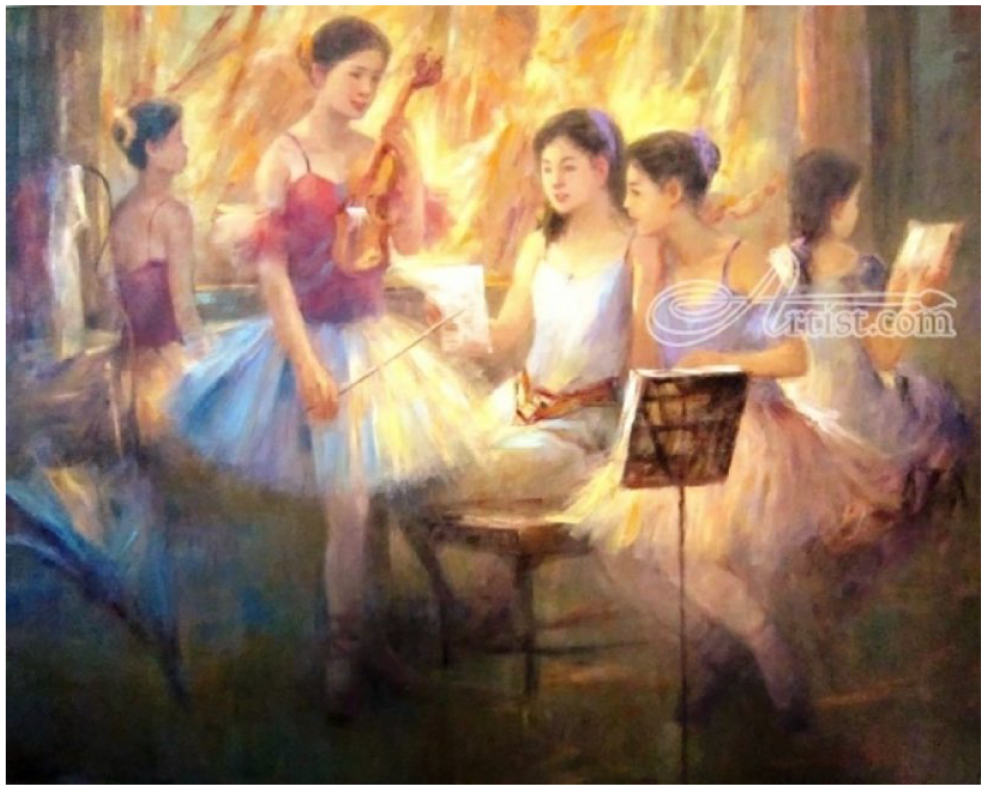
Music and Dance (Martinez, 2010). Reprinted with permission.
The artform named Music and Dance (Figure 3) portrays a group of youthful ballet dancers rehearsing for a spectacle. The young lady standing with a violin, unsure of the reaction of the group, seems to be timidly discussing with the two ladies her performance before and asking their commentaries. The two ladies sitting in front of her seem to be acknowledging her quest, as they are looking intently at the music script making them appear to be completely engaged in the conversation. The young lady with a violin seems to appreciate the presence of the two ladies and their interest to her performance. She seems to have connected to them, trusted their opinion and she created a bond with them. The young lady with the violin seems to be smiling and feeling grateful, as the other ladies seem to be offering her reassurance and giving her feedback and encouragement. However, behind the young lady standing is another young lady sitting alone who seems to be looking nowhere in particular and indifferent to what’s happening, particularly with the group. She is sitting upright not participating in the conversation, as if to signify her lack of interest. Likewise, another girl is busy with her own piece of music and shows no concern with the others’ presence, paying no attention to what the three young ladies are sharing and accomplishing. As shown in the painting, feeling listened to arises with approving acknowledgment of others amid indifference, as contentment emerges with trusting benevolent affiliations.
Uplifting recognition amid disconcerting rebuff is the first core idea discovered as discerning extant moment of the universal humanuniverse of feeling listened to. All of the historians mentioned in their stories the experience of being recognized, understood, accepted, and relieved when they felt listened to, yet they also narrated disappointing situations of not feeling listened to. This may be connected to powering, which is the third concept of the third principle of humanbecoming “cotranscending with possibles is the powering and originating of transforming” (Parse, 2014, p. 47). “Powering is the pushing-resisting of affirming-not affirming being in light of nonbeing” (Parse, 2014, p. 48). The painting depicts a young lady with sureness-unsureness, seeking other’s opinions. In pushing-resisting, the young lady’s friends may be affirming-not affirming their agreement acknowledging her presence. With the universal humanuniverse living experience of feeling listened to, there is always the possibilities of being recognized and being disregarded. As shown in the painting, the young lady although in doubt tried to engage with others in a conversation and “continue to create new possibles that surface from contextually construed situations as opportunities from which alternatives are chosen” (Parse, 2014, p. 47). While struggling to feel listened to, with sureness-unsureness, the young lady freed herself from doubt and affirmed a choice to open to others. As shown in the painting, with uplifting recognition amid disconcerting rebuff, the young lady experienced feeling listened to and accepted by others who responded to her request by giving feedback and sharing moments of complicity, yet she may feel not listened to as others ignored her and manifested lack of interest.
Treasured affiliations is the second core idea discovered as discerning extant moment of the universal humanuniverse living experience of feeling listened to. The transubstantiating of treasured affiliations is valuing connecting-separating. Valuing is a concept from the first principle of humanbecoming, “structuring meaning is the imaging and valuing of languaging” (Parse, 2014, p. 37). Treasured affiliations as “cherished choosings are incarnated with a value framework, which consists of principles and ideas that guide an individual’s living” (Parse, 2014, p. 39). As portrayed by the painting, the young lady with the violin chose among alternatives with doubts and fears to possibly be snubbed, and yet she approached courageously her friends and requested their honest feedback on her performance. She valued her friends’ friendships with openness and trust. She affirmed her intention to listen for their advice and encouragement showing the importance of her friends’ opinions. This refers to connecting-separating, which is a concept of the second principle of humanbecoming, “configuring rhythmical pattern is the revealing-concealing and enabling-limiting of connecting-separating” (Parse, 2014, p. 43). “Connecting-separating is attending-distancing; it is living being with and apart from others, ideas, objects, and situations all-at-once” (Parse, 2014, p. 45). As shown in the painting, the two ladies may chose to ignore the young lady’s request to the other ladies behind them, but they chose to value their friendships with the young lady with the violin and chose to respond pleasingly to her request by intently reflecting on her performance. Valuing connecting-separating is a paradoxical rhythm of cocreation with the universe, illuminating the choosing among prized potentials the ways to be with and away from others. It is to be close and distant all-at-once with treasured intimacies. With treasured affiliations, the young lady with the violin experienced feeling listened to when the two others welcomed her request to be accepted with openness and comradeship without judgment. She felt grateful and happy.
Joyful gratification is the third core idea discovered. All of the historians in this investigation experienced gratification when they felt listened to. Longing for the core idea of joyful gratification refers to imaging, which is “reflective-prereflective coming to know the explicit-tacit all-at-once” (Parse, 2014, p. 38). Imaging is a concept of the first principle of humanbecoming, “structuring meaning is the imaging and valuing of languaging” (Parse, 2014, p. 37). In imaging, individuals may choose various possibilities, as to be accepted, recognized, and understood by others when they seek gratification over dissatisfaction, connoting the reality of the meaning of prized priorities chosen at the moment. When individuals felt listened to, they experienced a feeling of satisfaction, relief, calmness, and happiness, as someone is being recognized, esteemed, and respected. Joyful gratification as connected to feeling listened to refers to feeling of relief and happiness, as others chose to listen and respect the other’s request. The painting showed joyful gratification, as the young lady with the violin seemed to be smiling and in deep conversation with her friends, accepting feedback and encouragement. She felt listened to, as she was relieved, contented, and happy, and she felt recognized as a member of a group.
Newknowings
The new discoveries that were uncovered from this investigation include the following:
The discerning extant moment of the universal humanuniverse of the living experience of feeling listened to is uplifting recognition amid disconcerting rebuff, as treasured affiliations surface with joyful gratification.
Uplifting recognition amid disconcerting rebuff, as the affirming-not affirming of the pushing-resisting being in light of nonbeing emerges as vital to feeling listened to.
Treasured alliances as the prized choosings all-at-once confirming-not confirming being with and away from other, ideas, and objects while cherishing valuable meaning of the chosen beliefs is significant to feeling listened to.
Joyful gratification as the reflective-prereflective coming to know the explicit-tacit all-at-once is the meaning of the prized priorities chosen at that moment that emerges when individuals are listened to.
A profound comprehension of the phenomenon of feeling listened to is a commitment for the living quality of healthcare professionals with persons and the community. Listening is vital to reverence among humanbeings. The purpose of this investigation was to discover the discerning extant moment of the universal humanuniverse living experience of feeling listened to for individuals who had been hospitalized and were willing to share their experiences. The historians in this investigation shared their experiences of feeling listened to. It is the scholar’s quest to stir awareness and initiate a movement of change in nursing to nurture a crucial awareness about the significance of honoring others; this could be done by acknowledging people, by treating them with respect, and honoring their dignity. As Wheatly (2002) said, “I believe we can change the world if we start listening to one another again.”
Beyond The Horizon
Further investigations on the universal humanuniverse living experience of feeling listened to-not feeling listened to is recommended, as all historians shared this paradox with their descriptions of feeling listened to. The scholar proposed investigation on feeling enlightened, feeling unburdened, and feeling worthy, which may be connected to the core idea of uplifting recognition amid disconcerting rebuff, feeling welcomed for the core idea treasured affiliations, and feeling serene and feeling lucky for the core idea of joyful gratification.
