







Abstract
This retrospective study investigates the effectiveness of a nursing intervention based on Orem’s self-care model of nursing with elderly patients with femoral head necrosis who underwent total hip arthroplasty. Postoperative outcomes in the intervention and control groups were assessed by the visual analog scale (VAS), Barthel index, and Harris Hip Score (HHS). Participants in the intervention group had significantly better outcomes in terms of VAS, Barthel index, and HHS. The occurrence of pneumonia was significantly different between the groups. Those who underwent Orem’s self-care model of nursing intervention were highly satisfied with their status postoperatively compared with the control group.
Femoral head necrosis is a crippling and persistent condition that develops as a result of the loss of blood supply to the femoral head and subsequent cell death, fracture, and articular surface collapse (Alexiou et al., 2018; Gullberg et al., 1997; Marques et al., 2015). Femoral head necrosis has a very high risk of disability among elderly patients. Dyskinesia brought on by the condition has a profound negative impact on the health-related quality of life of the patients (Wiklund et al., 2016) and is associated with a significant burden on the healthcare system (Hallberg et al., 2004).
Core decompression, vascularized bone transplantation, and hip traction are just a few surgical options for treating femoral head necrosis, but complete hip replacement is associated with the best early pain relief and a fair functional prognosis for the patients (McLaughlin et al., 2006; Peterson et al., 2002; Varacallo et al., 2022). One of the most effective orthopedic procedures is total hip arthroplasty (Fierens & Broos, 2006). However, as a general procedure, total hip replacement is associated with side effects such as hip dislocation, abductor dysfunction, fracture, and nerve damage (Hashemi et al., 2014). Therefore, specific nursing interventions should take into account the patient’s unique needs and preferences, the progression of the disease, and response to and tolerance of the treatment (Khatiban et al., 2018). Orem’s self-care model of nursing care is one of the most complete self-care approaches that offers a suitable therapeutic roadmap for organizing and putting self-care concepts into practice (Mohammad Hassani et al., 2010).
According to the model, nurses can help in patient care–related empowerment by using techniques such as acting, teaching, and supporting to enhance patients’ balance and motor function (Hasanpour-Dehkordi, 2016). Studies show that this approach is efficient in promoting normal functioning; maintaining normal growth, development, and maturity; preventing, controlling, and treating disease processes and injuries; preventing or compensating for disabilities; and promoting an overall positive attitude in patients (Hosseinzadeh et al., 2019). However, to date, very few studies have looked at the impact of Orem’s self-care model of nursing care on the motor and balance functions in elderly patients. This study investigates the effectiveness of a nursing intervention based on Orem’s self-care model in elderly patients with femoral head necrosis after total hip arthroplasty.
Theoretical Framework
Orem’s self-care deficit nursing theory has been widely used in the nursing discipline to guide patient care. Orem’s model includes seven major concepts, including basic conditioning factors, which are relevant to this study. The three most pertinent concepts for this research are self-care, therapeutic self-care demand, and self-care agency (Hartweg, 1991). Self-care refers to the activities that persons perform to maintain their health, well-being, and life. Therapeutic self-care demand shows the self-care activities required to achieve the self-care state, including developmental, health self-care needs, and universal needs. Finally, self-care agency refers to persons’ ability to engage in self-care, which is influenced by their life experiences, age, sociocultural orientations, developmental state, health, and available resources. If the second and third concepts are not in balance, this can disrupt the first concept. Therefore, nurses play a critical role in supporting patients and performing necessary self-care activities (Hartweg, 1991).
Methods
Study Design and Participants
This is a comparative retrospective study, for which the data were obtained after the appropriate approval was gained from the institutional ethics committee (approval number MRCTA, ECFAH of FMU [2022]427, 2022-08-25). A total of 250 elderly patients (aged >60 years) underwent total hip arthroplasty for femoral head necrosis between July 2019 and July 2022 at the Department of Bone and Joint Surgery in the First Affiliated Hospital of Fujian Medical University. The nursing program based on Orem’s self-care model was started in our institute in the year 2021. Hence, all the cases who underwent this nursing care program were taken as the intervention group, and the cases receiving routine care before this implementation were taken as the control group for our study. Patients were stratified into either of the following two groups:
Group A (intervention): a nursing program based on Orem’s self-care model of the nursing care
Group B (control): standard care (no special intervention)
Inclusion Criteria
The study included participants older than 60 years with femoral head necrosis who were hemodynamically stable without any diagnosis of deep venous thrombosis, wound problem, bedsore, pneumonia, and urinary infection who underwent total hip arthroplasty.
Exclusion Criteria
The study excluded those with failure to complete or respond to the consent form, inability to participate in the educational sessions with differing degrees of disturbance of consciousness, and any mental changes.
Sample Size Calculation
The sample size was calculated by OpenEpi (version 3.01, updated in 2013), based on a previous study that reported a reduction in visual analog scale (VAS) score following nursing intervention based on Orem’s self-care model of the nursing care in patients with hip fracture (Xu et al., 2020). Per study results, the mean (standard deviation) of the VAS score in the intervention and the control groups was 1.9 (0.9) and 2.4 (1.5), respectively, with 95% confidence interval, 80% power, and alpha error of 5%. The minimal sample size was estimated as 194 patients (97 in each group).
Procedures
The investigators obtained written informed consent before using a structured questionnaire to gather sociodemographic data and baseline characteristics.
Participants in group B (control group) received standard, routine orthopedic nursing care. Participants in group A (Orem’s self-care model of the nursing care group) received nursing intervention based on Orem’s self-care model of nursing care for 6 weeks after the surgery (through routine postoperative visits every week).
Intervention Details
Step 1: First, a personalized health education message for educational sessions and printed brochures were created using various nursing plans such as fully compensatory nursing (nurse performs all the activities necessary to meet the patient’s self-care needs), partially compensatory nursing (nurse and the patient share responsibility for meeting the patient’s self-care needs), and supportive education. The brochure was created to improve the knowledge of the condition, decrease pain levels, reduce anxiety by listening and offering emotional support, and improve the awareness of persons’ capacity to manage their discomfort.
Step 2: Educational sessions were carried out by the nurses daily while the patient remained in the hospital. These educational sessions included oral interpretation (the process of explaining information using verbal communication in simple language, diagrams, or pictures) and action modeling (nurse performs the activity in front of the patient, explaining each step as they go along; the participant is encouraged to ask questions and practice the activity themselves to ensure they understand the process), along with the distribution of teaching materials to the participants.
Step 3: After discharge, patients continued to receive telephone guidance and were asked to visit the facility every week until 6 weeks after surgery.
All these interventions were created based on the three major concepts of Orem’s self-care model of nursing care (self-care, therapeutic self-care demand, and self-care agency) (Hartweg, 1991).
Demographic characteristics of the participants in both groups were collected. Orem’s model-based self-care questionnaires were completed by all study participants 1 week, 1 month, and 3 months after surgery. Data on complications, such as bedsores, deep vein thrombosis, urinary infections, and wound issues, were also gathered and compared. Data were collected by the nurses in the department for documentation purposes. These data were extracted for analysis for this study.
Data Collection Tools
Visual Analog Scale
The VAS is a straightforward and popular technique for evaluating changes in pain intensity. The purpose of the VAS is to give the respondent a rating scale with the fewest restrictions possible. Respondents highlight the spot on the 10-cm line that corresponds to the level of discomfort they feel. Additionally, the VAS allows each respondent the greatest chance to express their response preferences (Langley & Sheppeard, 1985). The validity and reliability of the tool are moderate to good, as per previous evidence (Boonstra et al., 2008).
Barthel Index
The Barthel index is a scale that assesses a patient’s ability to carry out 10 daily living activities: eating, bathing, dressing, grooming, controlling bowels and bladder, using the toilet, transferring, moving around, and climbing stairs. The Barthel index is graded in 5-point increments from 0 to 100. Anyone who receives a score below 100 is regarded as having a disability (Collin et al., 1988). Cronbach’s alpha for the index was 0.94 (Dos Santos Barros et al., 2022).
Harris Hip Score
The Harris Hip Score (HHS) was created to examine hip surgery outcomes and is used to assess different hip impairments and treatment options in the adult population (Harris, 1969). The HHS is an outcome measure that is carried out by a licensed healthcare provider, such as a doctor or physical therapist.
The HSS is comprised of 10 questions covering four domains. The domains include range of motion (ROM), discomfort, function, and lack of deformity (Nilsdotter & Bremander, 2011). The pain domain assesses the degree of pain, its impact on daily activities, and the requirement for painkillers. Function domains include gait and daily activities. The ROM domain evaluates hip ROM, whereas the deformity domains look at hip flexion, adduction, internal rotation, and extremity length discrepancy.
The HHS is a measure of dysfunction; therefore, higher scores correlate with a better result for the patient: 100 is the highest possible score; less than 70 indicates a poor performance; 70 to 80 is acceptable; 81 to 90 is good; and 91 to 100 is superb (Harris, 1969). Results can be calculated and documented online.
Participant satisfaction was measured using a Likert scale of four levels: very satisfied, satisfied, neutral, and not satisfied.
Data Analysis
Data were entered into the Microsoft Excel program, and SPSS Version 20 was used for the analysis. Based on the distribution’s normality, assessed by the Shapiro-Wilk test, continuous variables were reported as mean and standard deviation or median and interquartile range. The statistical significance of the difference between the two therapies’ postintervention mean values was examined using the Mann Whitney test (as all the outcomes were scores). Postoperative complications, a categorical outcome variable, were reported as a proportion with a 95% confidence interval in both the intervention and the control groups. The chi-square test was used to determine the statistical significance of differences in postintervention categorical values. A p value of .05 or less was regarded as statistically significant.
Results
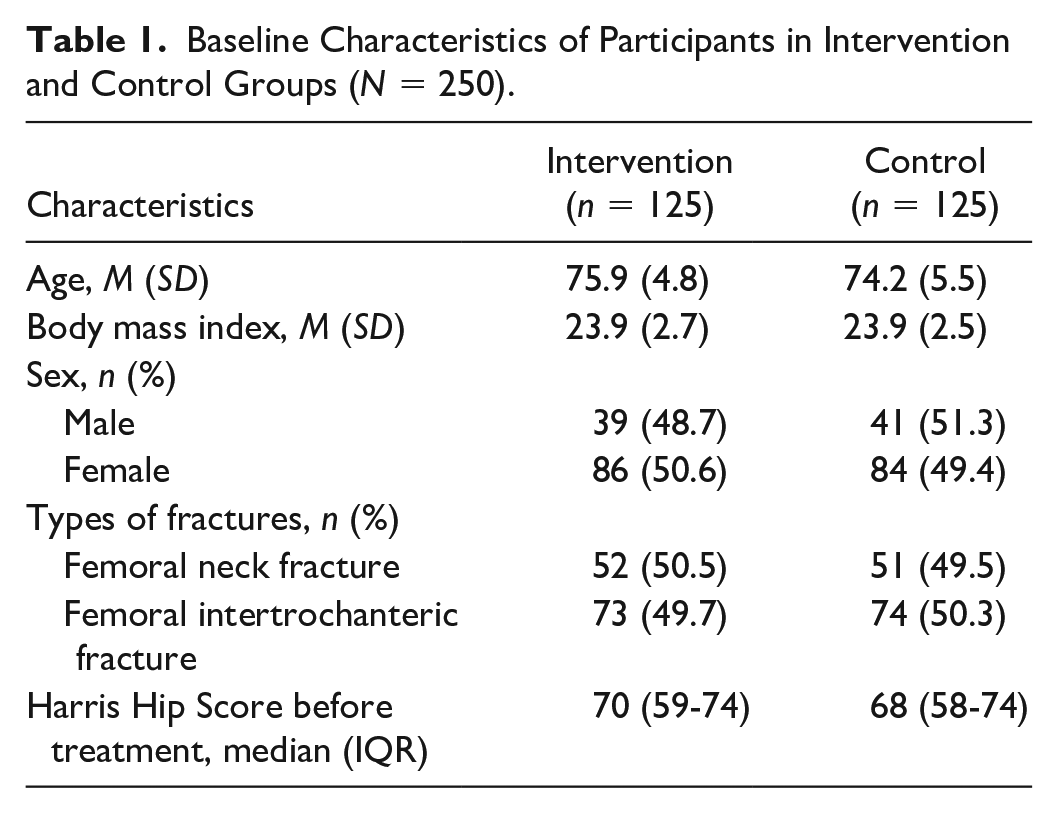
During the study, 308 people in total were screened for eligibility. A total of 250 participants who met the study’s eligibility requirements were chosen, with 125 stratified to the intervention group and 125 to the control group. During the follow-up, all 250 participants in the intervention and control groups were evaluated for all the required parameters without any loss to follow-up (response rate 100%). There was little difference between the intervention and control groups for all of the baseline characteristics of the participants (see Table 1).
Baseline Characteristics of Participants in Intervention and Control Groups (N = 250).
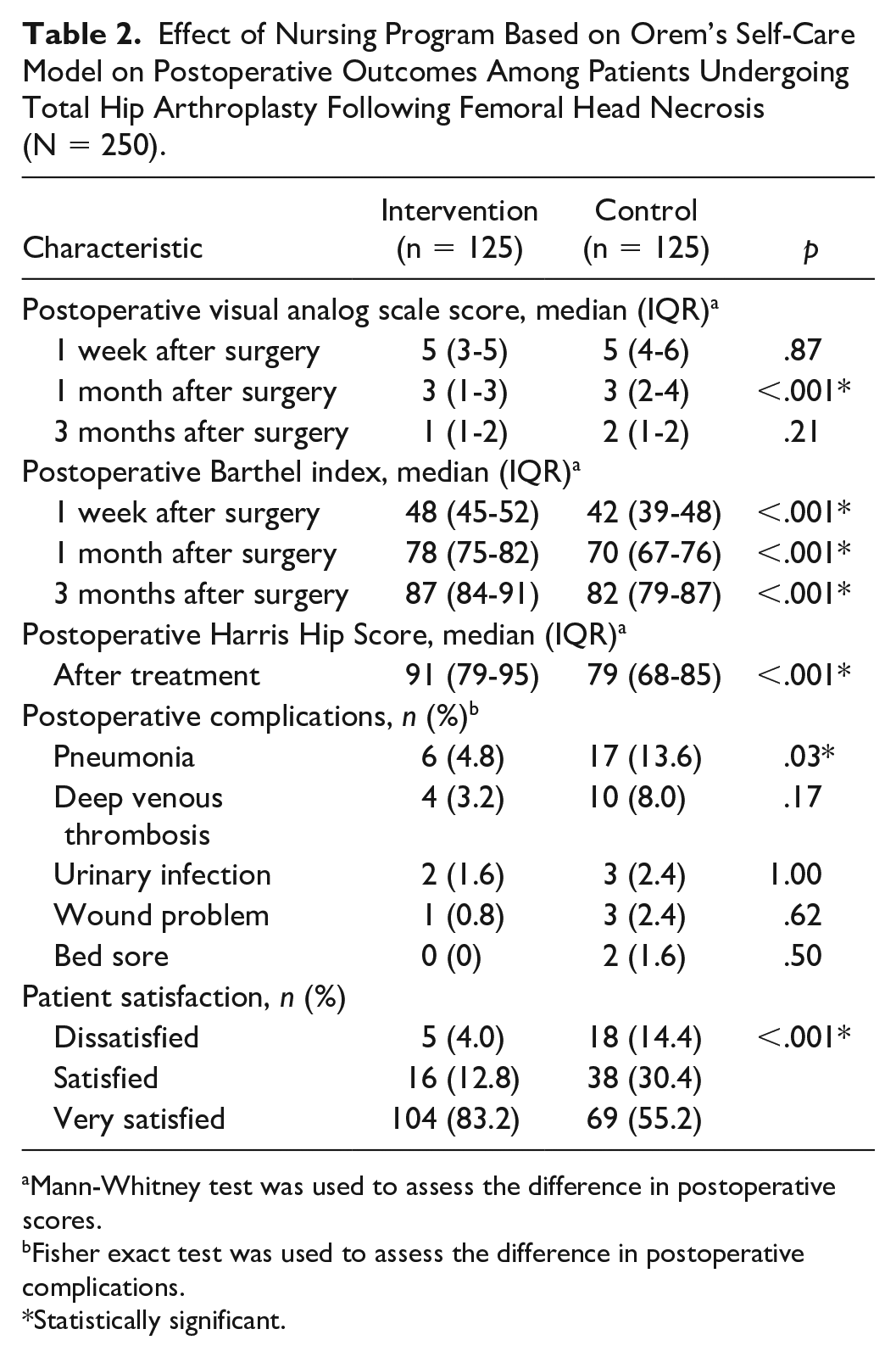
In terms of postoperative outcomes, the participants had significantly lower postoperative VAS scores 1 month after surgery, whereas there was no statistically significant difference at 1 week and 3 months after the surgery (see Table 2). The postoperative Barthel index was significantly different between intervention and control groups across all time points (1 week, 1 month, and 3 months after surgery) (see Table 2). The HHS after treatment was significantly higher in the intervention group (median = 91; IQR = 79-95) compared with the control group (median = 79; IQR = 68-85) (p < .001).
Effect of Nursing Program Based on Orem’s Self-Care Model on Postoperative Outcomes Among Patients Undergoing Total Hip Arthroplasty Following Femoral Head Necrosis (N = 250).
Mann-Whitney test was used to assess the difference in postoperative scores.
Fisher exact test was used to assess the difference in postoperative complications.
Statistically significant.
No significant difference was found in terms of the postoperative complication rate except for pneumonia (4.8% in the intervention group vs 13.6% in the control group), and this difference was statistically significant (p = .03) (see Table 2). Significantly more patients in the intervention group were very satisfied and satisfied compared with the control group (p < .001).
Discussion
Elderly patients with femoral head necrosis have higher mortality and morbidity rates, necessitating expensive hospital stays and lengthy rehabilitation treatments. These patients have trouble fully recovering their function and going back to their prefracture living (Lavernia & Villa, 2015). Given the poor survival quality of these patients, improving their survival quality must be a top priority. Studies have shown that self-care in general and Orem’s self-care theory, in particular, can assist healthcare professionals in identifying and meeting patients’ self-care requirements (Xu et al., 2020). The goal of the current study was to explore the benefits of educational interventions using Orem’s self-care model of nursing care for elderly patients with femoral head necrosis undergoing total hip arthroplasty.
The VAS score, Barthel index, and HHS were significantly different postoperatively between the intervention and control groups. This finding was in line with previous studies using this intervention model for other orthopedic and neurological conditions (Afrasiabifar et al., 2020; Hashemi et al., 2014; Xu et al., 2020). All the patients in the intervention group received counseling services and started to take part in the nursing program as soon as they were admitted. The therapeutic self-care demand was explained as well as the developmental, universal, and health self-care activities, along with self-care agency, to increase the ability of participants to engage in self-care activities; this played a crucial role in the intervention impact.
Interventions increased the overall enthusiasm of participants and increased their potential and capacity for self-care, which in turn encouraged patients and their family members to engage in nursing activities together. Interventions helped the participants to acquire a better understanding of their illness and necessary self-care skills, which, in turn, decreased the likelihood of problems and improved hip function after the surgery.
Findings demonstrated that a training program based on Orem’s theory can be successful in meeting needs and enhancing patient satisfaction. The intervention was specifically designed to prevent common postoperative complications such as pneumonia, deep vein thrombosis, urinary tract infection, and others. Although postoperative pneumonia was the only complication showing a significant difference between the intervention and control groups, there was a decrease in all other postoperative complications in the intervention group compared with the control group. However, these changes were not statistically significant due to limitations in the number of outcomes.
Postoperative complications in elderly patients with femoral head necrosis are potentially modifiable. Results confirm previous studies which showed that high-quality nursing intervention can significantly lower the postoperative rate of pneumonia and various other complications (Berry et al., 2009). Although our study did not explore survival outcomes, a previous study reported that reducing these postoperative complications ultimately enhances the survival of the susceptible population (Roche et al., 2005). Finally, we demonstrated that the participants in the intervention group were highly satisfied postoperatively compared with participants in the control group, and this difference was statistically significant (p < .001).
This study has certain strengths. A wide range of outcomes were assessed postoperatively. There was no loss to follow-up during the study. The standard VAS, Barthel index, and HHS tools were used to assess the outcomes postoperatively. However, the study has limitations. It was conducted as a retrospective study, which might limit the causal interpretation of the effectiveness of the intervention. The mental and emotional aspects of quality of life were not assessed, since the study focused on only the physical aspects. The sample size was limited, and stringent inclusion criteria might further limit the generalizability of the application of intervention to the target population. Finally, even though a thorough literature analysis was used to guide the selection of variables and data-collecting methods, other potentially crucial variables or methods were not considered.
In conclusion, the study has some clinical implications. It is generally believed that postsurgical nursing interventions would benefit the recovery and preservation of physical function in elderly patients with femoral head necrosis. Orem’s self-care model of nursing care has a significant effect in terms of pain, function, complications, and satisfaction in elderly patients with femoral head necrosis after surgery. A future large-scale trial with a longer follow-up period is needed to clearly establish the effectiveness of the intervention and its applicability in routine practice across healthcare setting.
Footnotes
Declaration of Conflicting Interests
The authors declared no potential conflicts of interest with respect to the authorship and/or publication of this review.
Funding
The authors disclosed receipt of the following financial support for the research, authorship, and/or publication of this article: This study is supported by Fujian Provincial Health Technology Project(No.2023GGA031, No. 2022TG013) ;Joint Funds for the Innovation of Science and Technology, Fujian Province (No.2021Y9098).
