







Abstract
This essay is based on an invited virtual presentation for the Nursing Theory Forum sponsored by the American Academy of Nursing, Nursing Theory–Guided Practice Expert Panel, May 26, 2023, and a podium presentation at the Virtual Nursing Theory Week Conference, March 22, 2024
Keywords
The purpose of this essay, which is an extension of content presented in a previous essay about conceptual models and health policy (Fawcett, 2023), is to discuss how nursing conceptual models can be used to guide health policy nursing research. This essay focuses on the health policy example of the effects of parental leave policies on parents’ experiences following childbirth or adoption or fostering of a child, within the context of seven different nursing conceptual models.
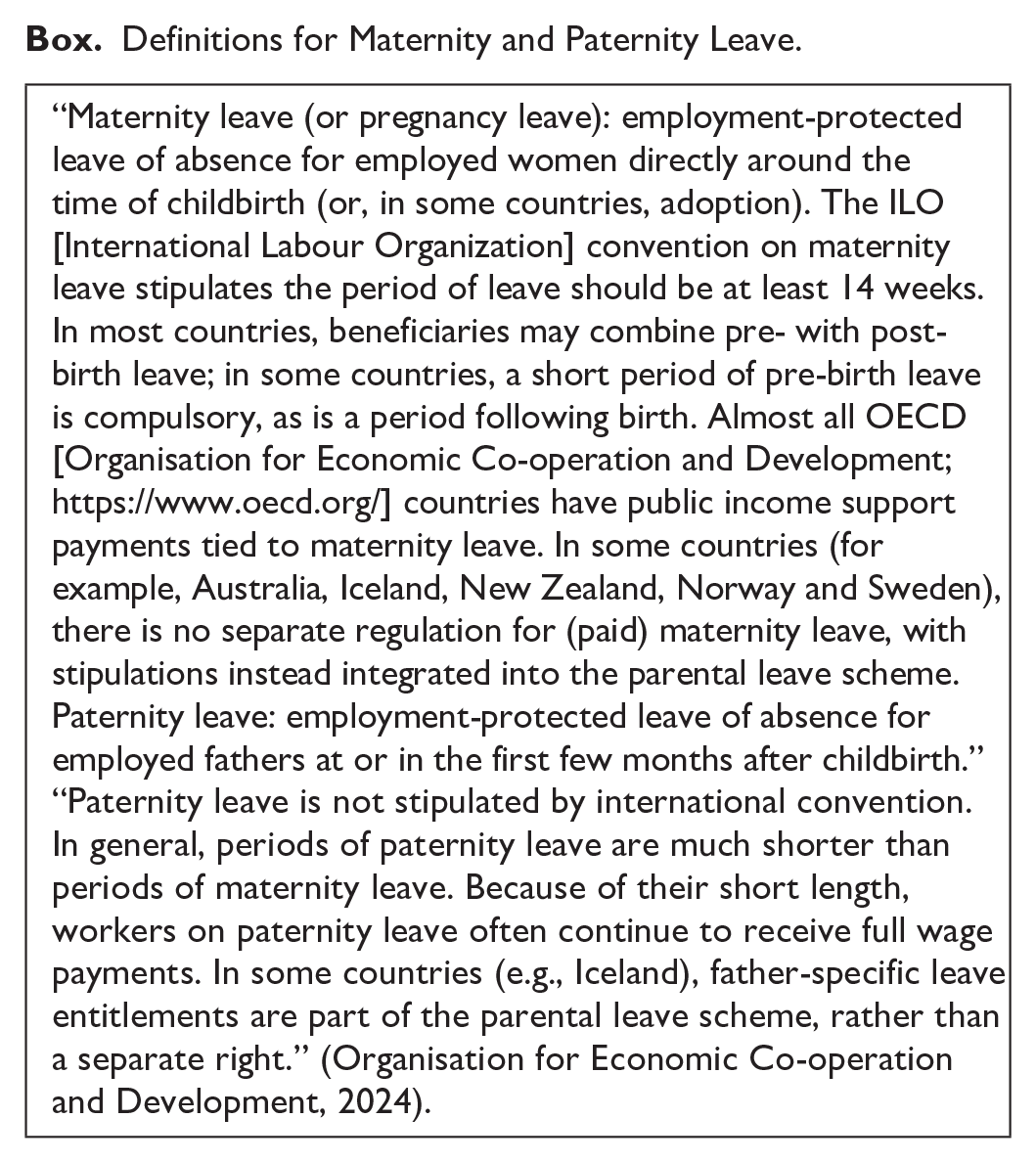
Parental leave policies usually are developed as maternity leave and paternity leave, which, depending on interpretation, may be biased against same-gender parents. The definitions for maternity leave and paternity leave are given in the Box. Maternity and paternity leave policies typically specify whether the leave is paid or unpaid, as well as the length of the leave.
Definitions for Maternity and Paternity Leave.
Of considerable concern is that with the exception of leave for federal employees, “The US remains the only advanced economy without federal paid leave, despite overwhelming [public] support for this benefit” (Lee & Ono, 2022). In the United States, the Federal Employee Paid Leave Act allows up to 12 weeks of paid parental leave only for federal employees (U.S. Department of Labor, n.d.).
Absent a federal policy in the United States, state governments and private employers may provide parental leave policies, such as paid leave for mothers and fathers. For example, Massachusetts Paid Family Medical Leave (Mass.gov, n.d.) allows up to 26 weeks of paid leave for Massachusetts state employees. An example of an employer parental leave policy is that of NBC Universal, which provides paid parental leave of “16 weeks off for a primary caregiver and 4 weeks off for a non–primary caregiver” (NBC Universal Careers, 2024).
Conceptual Model-Guided Parental Leave Policy
Examples of how seven nursing conceptual models could change health policy regarding parental leave are seen below. As can be seen in the examples, which are conceptual-theoretical-empirical structures for imaginary studies, a concept from each conceptual model is linked with parental leave policy and another concept from each conceptual model is linked with a theory concept that could be an effect of the parental leave policy. The theory concepts are then linked with fictitious empirical indicators. The linkage of the concept from each conceptual model that could be represented by a health policy was discussed in a previous essay (Fawcett, 2023). Descriptions of these conceptual models are found on nursology.net in the models and theories gallery section of the website.
• Johnson’s behavioral system model (Figure 1)
• King’s conceptual system (Figure 2)
• Levine’s conservation model (Figure 3)
• Neuman’s systems model (Figure 4)
• Orem’s self-care framework (Figure 5)
• Rogers’ science of unitary human beings (Figure 6)
• Roy’s adaptation model (Figure 7)
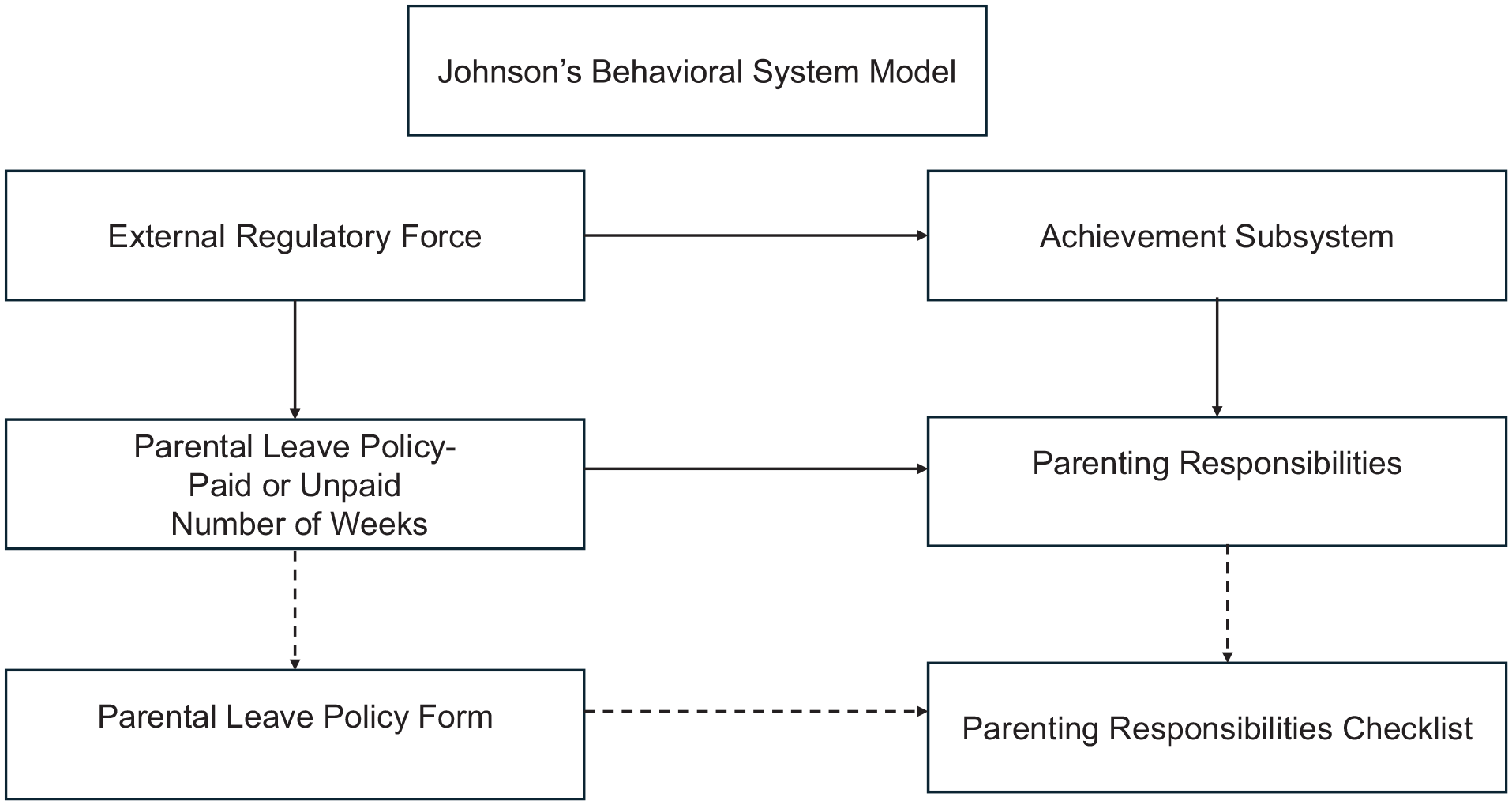
Conceptual-theoretical-empirical structure for the effect of a parental leave policy on parenting responsibilities using Johnson’s behavioral system model.
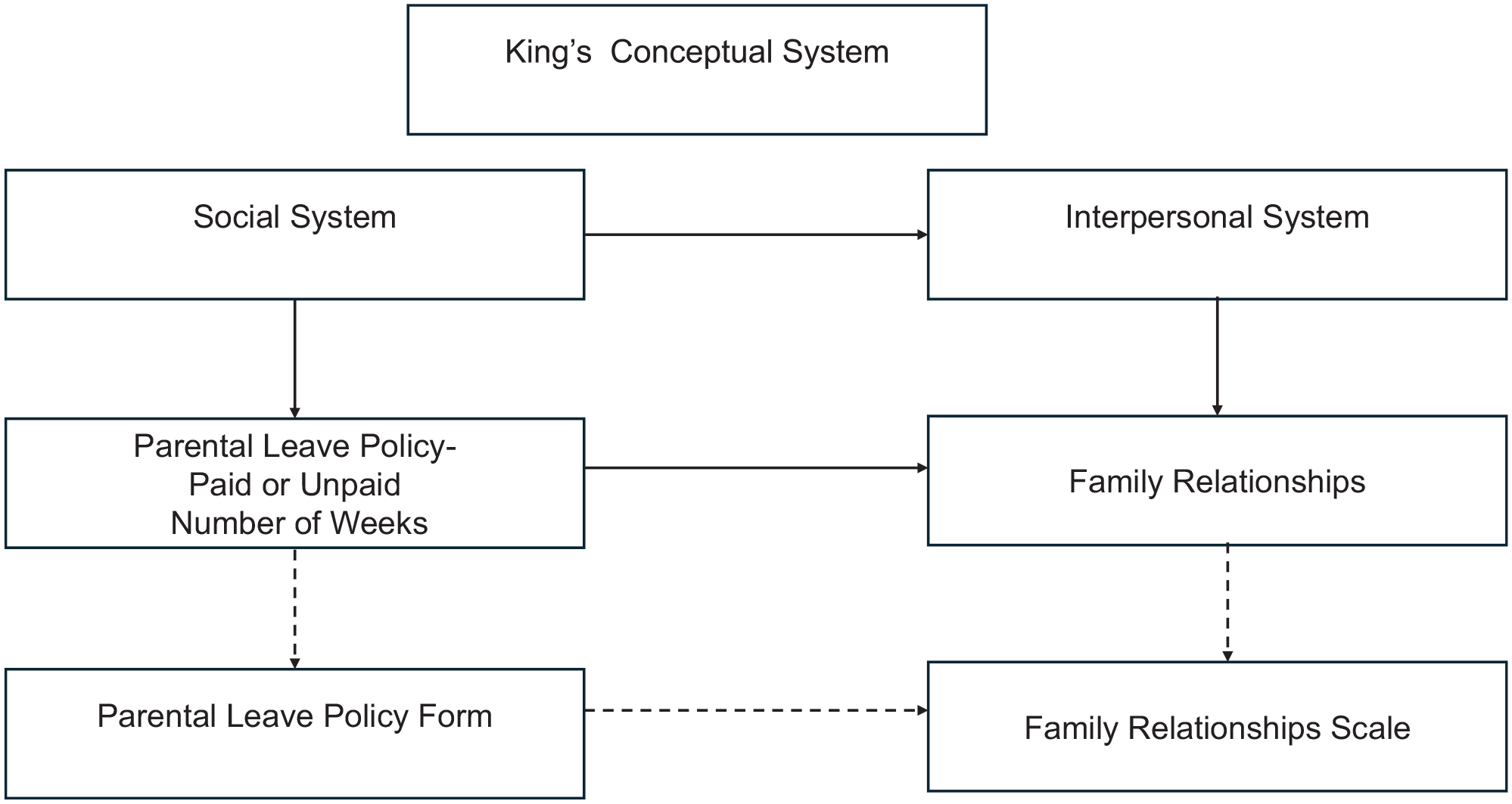
Conceptual-theoretical-empirical structure for the effect of a parental leave policy on family relationships using King’s conceptual system.
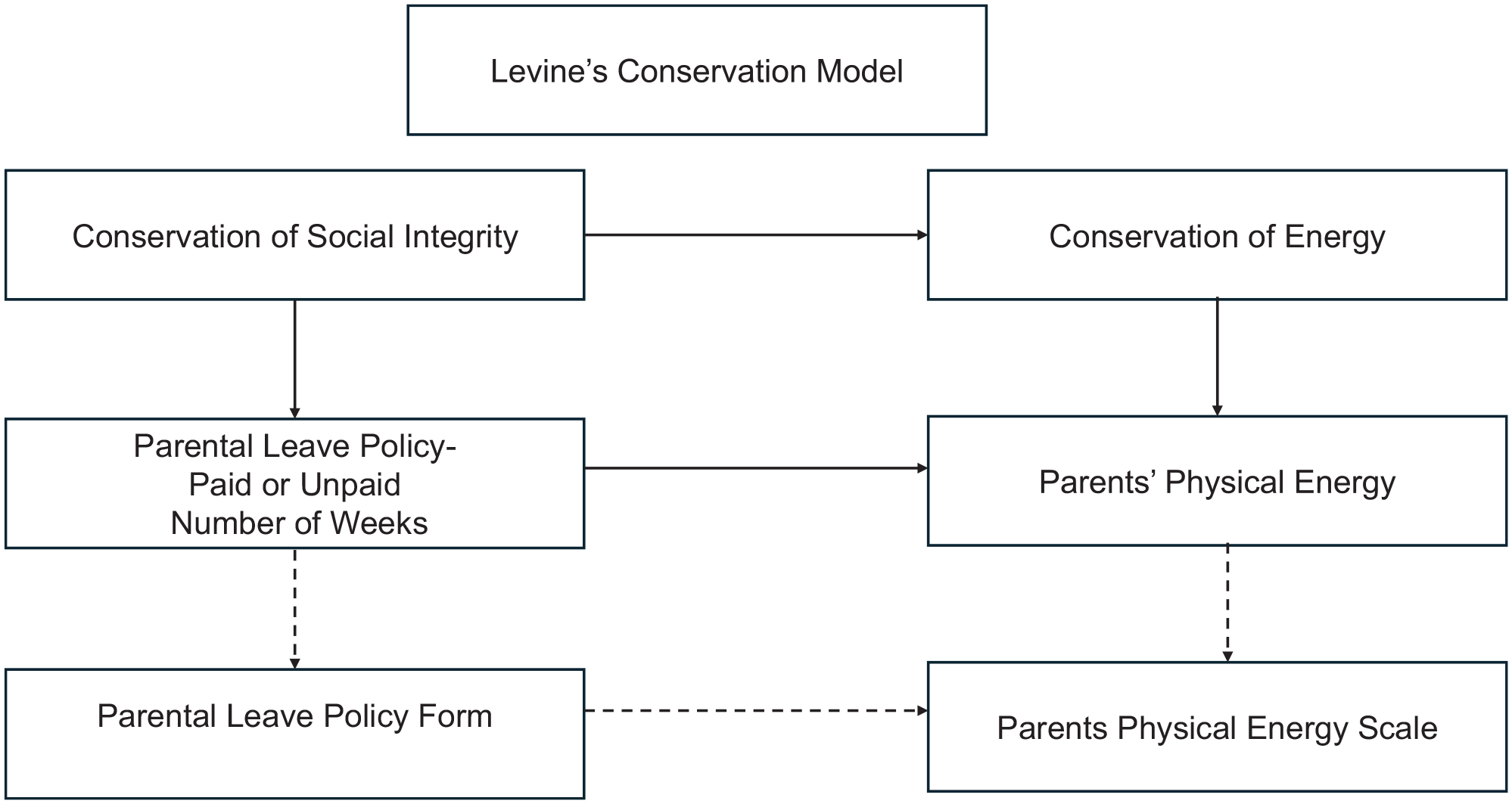
Conceptual-theoretical-empirical structure for the effect of a parental leave policy on parents’ physical energy using Levine’s conservation model.
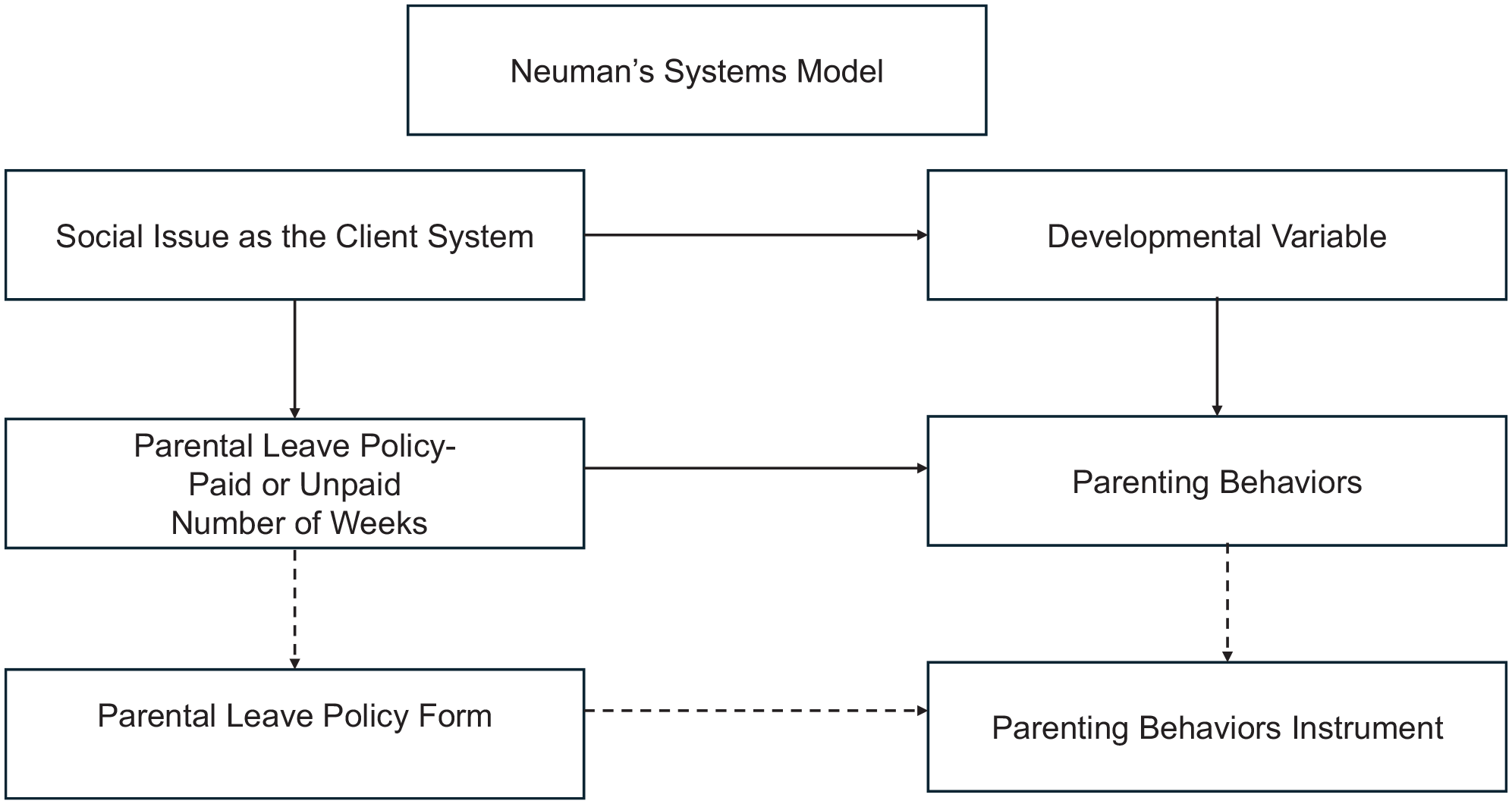
Conceptual-theoretical-empirical structure for the effect of a parental leave policy on parenting behaviors using Neuman’s systems model.
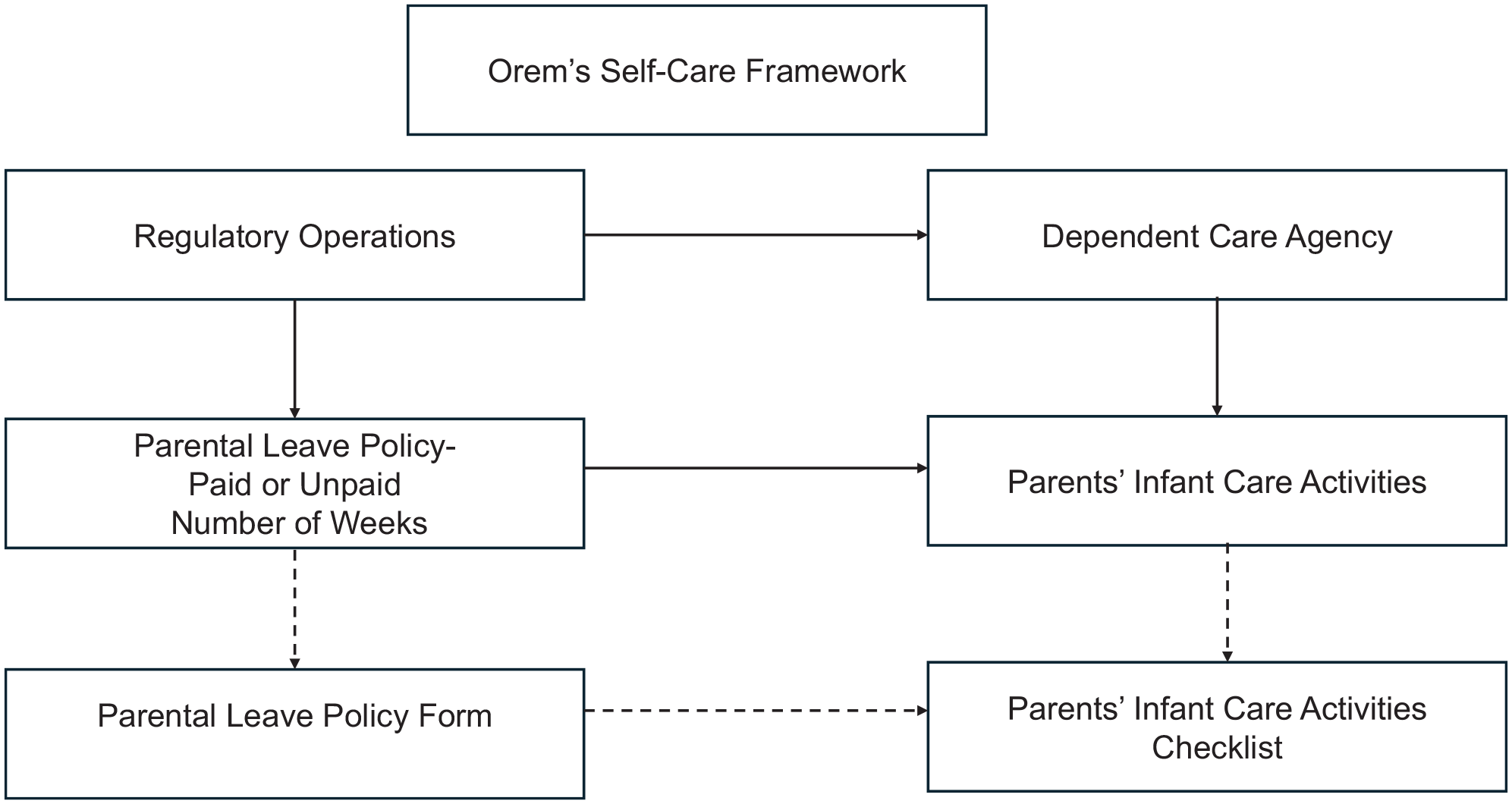
Conceptual-theoretical-empirical structure for the effect of a parental leave policy on parents’ infant care activities using Orem’s self-care framework.
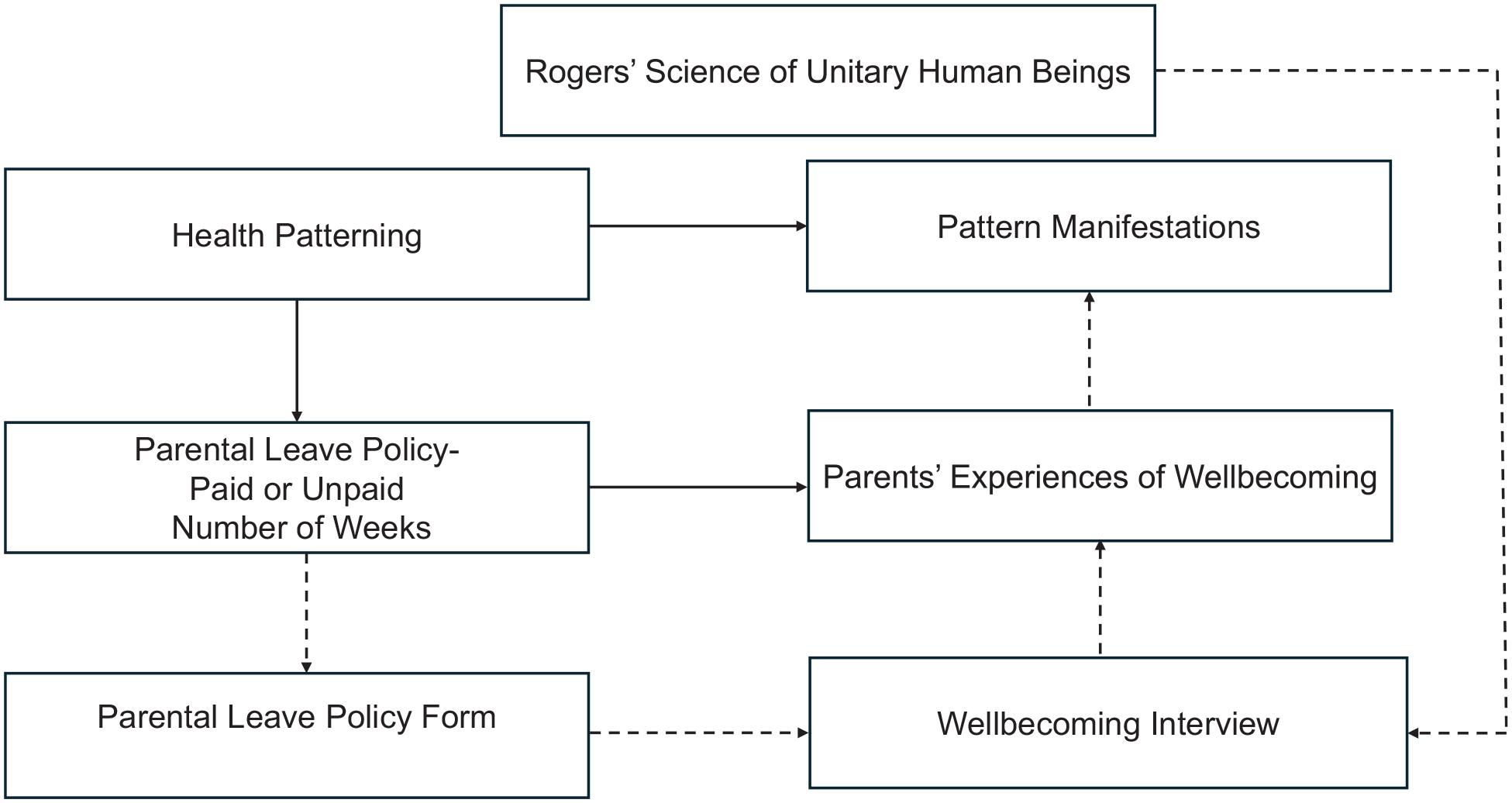
Conceptual-theoretical-empirical structure for the association between a parental leave policy on parental functional status using Rogers’ science of unitary human beings.
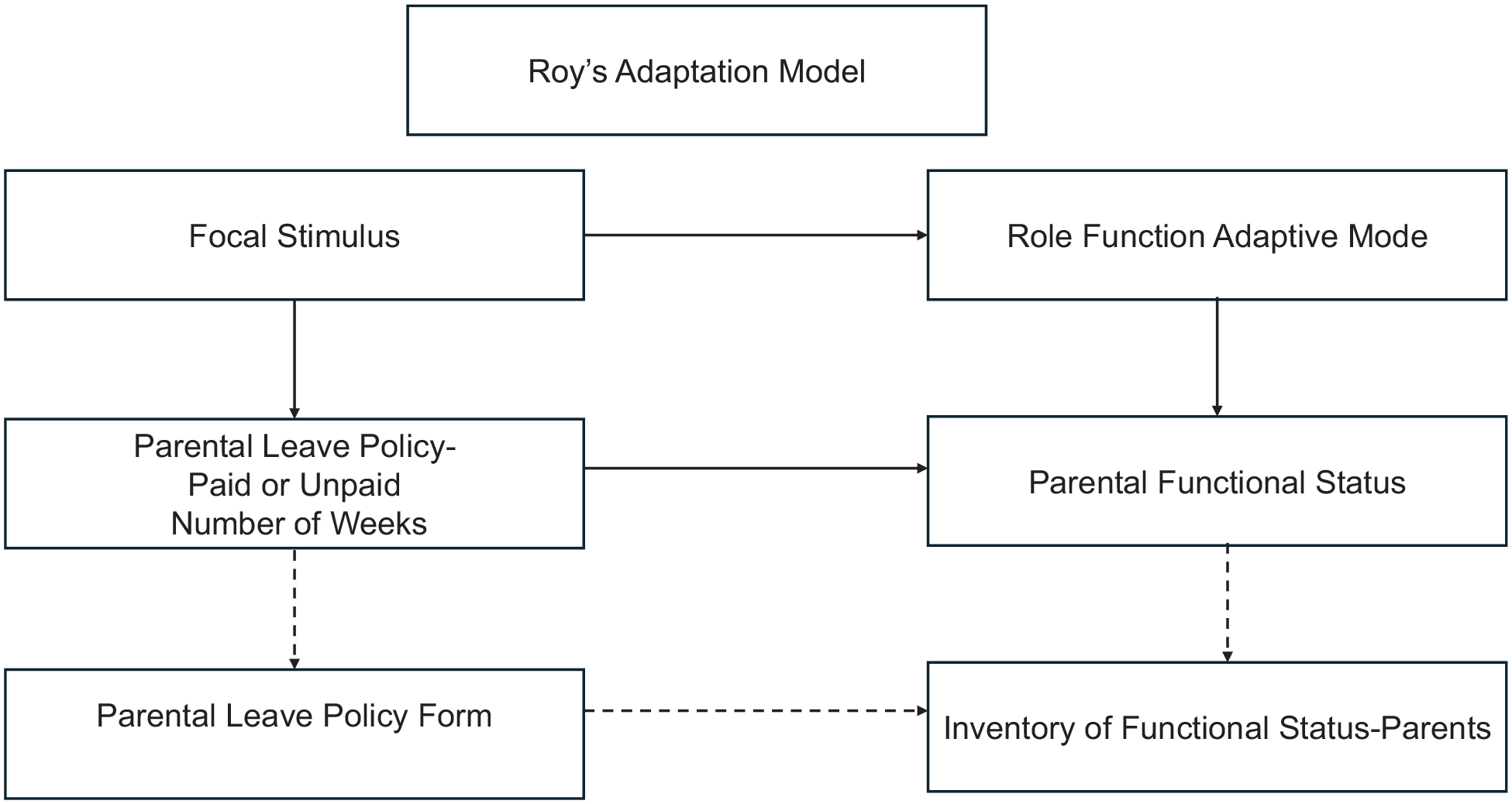
Conceptual-theoretical-empirical structure for the effect of a parental leave policy on parental functional status using Roy’s adaptation model (See Fawcett, 2023, for a more comprehensive conceptual-theorical structure for a study of the effects of parental leave policy).
Recommendations for Future Parental Leave Policy Nursing Research
Nursing research is needed regarding actual parental leave policy. Studies could include determining the type and amount of available parental leave for all parents, the types of facilitators of and barriers to adequate parental leave, and parents’ desired length of leave. This research should be conducted internationally so that the many voices of parents and those who offer parental leave are included. Study designs should be longitudinal to determine parental perspectives over time.
The importance of listening to parents’ voices about their experiences during the postpartum period is underscored by the voices of women who participated in one study, which indicated that “more than one-half (52%)” said that the first 6 months postpartum were harder than they had expected (Tulman & Fawcett, 2003, p. 137). One of the women who participated in the study commented,
I thought I would be back to [part-time] work, and I haven’t. Back to work to me was only part-time. . . . Even that amount of time is difficult because of the childcare problem and my husband working and traveling. (Tulman & Fawcett, 2003, p. 137)
Nurses are ethically obligated to advocate on behalf of patients worldwide (International Council of Nurses, 2021). In the case of parental leave policy, nurses are obligated to advocate for development of federal-level policy regarding paid parental leave for all biological, same-gender, foster, and adoptive parents in the United States and other countries that do not yet have a federal paid parental leave policy, as well as having limited or no state or employer policies. Nurses may consider going beyond advocacy to become an ally (Weitzel et al., 2020) or an accomplice (Chinn, 2023) with parents for parental leave policies that meet their economic needs as well as their needs for optimal quality of life as childrearing persons.
Conclusion
In the interest of decolonizing nursing knowledge, readers are invited to share the voices of all those involved in developing all health policies worldwide (parents, legislators, employers) and to determine what nursing conceptual models have been developed in countries other than the United States that could be used to guide parental leave and other health policy nursing research.
