







Abstract
Hiding is a universal humanuniverse living experience and is significant in living quality. This is the first humanbecoming inquiry into the living experience of hiding. Parsesciencing, a phenomenological-hermeneutic mode of inquiry within the humanbecoming paradigm, was used for this investigation. The investigation included 10 historians between the ages of 34 and 76 years who were willing to share their experiences of hiding. The inquiry stance was as follows: What is the discerning extant moment of the universal humanuniverse living experience of hiding? The major discovery of this inquiry was the discerning extant moment: Hiding is fortifying vigilance emerging with a welcoming shelter of ingenious maneuvers of not-letting-know–letting-know while distancing from involvements.
Hiding is a universal humanuniverse living experience. Hiding can be described in various ways. For example, the scene is a neighborhood backyard. Several children are scurrying about, crawling under bushes, slipping behind fences, while one little girl shouts out, “Ready or not, here I come!” The traditional childhood game of hide and seek begins. In another scene, a young woman and her 2-year-old daughter flee their home and enter a shelter for women, hoping that the person they are running from does not find them. Then, there is the daughter who tells her mother a secret, saying “Please don’t tell dad.” Another graphic account of the experience of hiding is in the book The Diary of a Young Girl, written by Anne Frank (1947/1993). The discovered diary described the 2 years that Anne and seven other Jewish people hid out from the Nazis during the occupation of Holland in World War II. They were living in constant fear for their lives. Anne wrote in this diary, which she named Kitty, “If God lets me live, I shall attain more than Mummy ever has done, I shall not remain insignificant. I shall work in the world and for mankind” (p. 208). In another entry in her diary, Anne wrote concerning the paradox involved with hiding, “Again I ask myself, would it not have been better for us all if we had not gone into hiding, and if we were dead now and not going through all this misery. . . . But we all recoil from these thoughts too, for we still love life” (p. 242). Anne Frank and the others in hiding with her were discovered by the Nazis and taken prisoner, and Anne died in a German concentration camp before the end of the war. The experience of hiding is further described in the book The Hidden Children: The Secret Survivors of the Holocaust, by Jane Marks (1993). Marks detailed the stories of Jewish children taken from their families and hidden for their safety. Marks wrote, “They had to behave as adults, fabricating new identities at a young age, sacrificing their childhoods to save their lives” (book flap). In the book, a woman named Rosa Sirota described her experience of hiding: “Another part of me that goes back to my hiding is that I need to feel in control at all times. I need to have order around me, and to know that everything is taken care of” (p. 23). From a humanbecoming perspective, hiding is a way of exploring new ways of being with and apart from others in not-sharing–sharing one’s thoughts and feelings while mysteriously moving on in challenging situations. The purpose of this Parsesciencing inquiry was to discover the discerning extant moment of hiding for persons living in a Midwestern metropolitan city.
Horizon of Inquiry
The horizon of inquiry for this sciencing investigation is the humanbecoming paradigm, which has as its central thought “cocreating reality as a seamless symphony of becoming” (Parse, 2014, p. 26). The paradigm has four postulates that permeate the three principles of humanbecoming (Table 1). These principles describe how individuals structure meaning in their lives, live rhythmical patterns, and move on day-to-day. Constructs that further depict the paradigm are the following: humanuniverse is indivisible, unpredictable, everchanging; living quality is the becoming visible–invisible becoming of the emerging now; the ethos of humanbecoming is dignity with the four tenets of reverence, awe, betrayal, and shame (Parse, 2021).
Four Postulates of Humanbecoming and Three Principles of Humanbecoming.
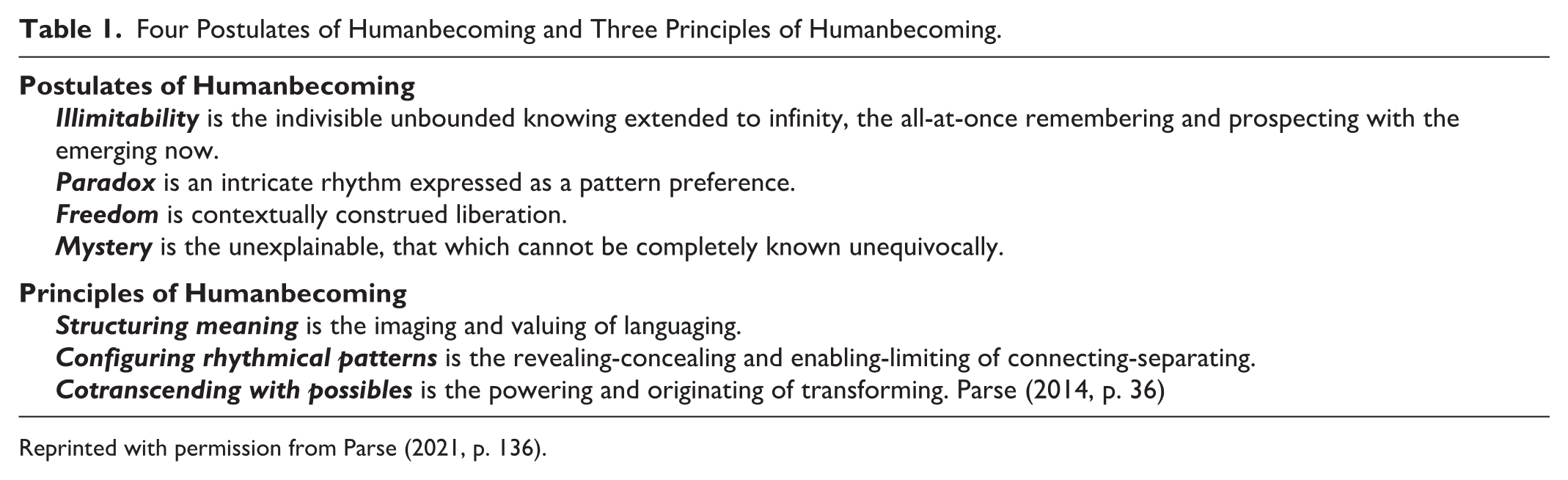
Reprinted with permission from Parse (2021, p. 136).
The four postulates of humanbecoming further expand understanding of the indivisible, unpredictable everchanging nature of the experience of hiding. “Illimitability is the indivisible, unpredictable, everchanging unbounded knowing extended to infinity” (Parse, 2021, p. 35). In hiding, one is aware of the boundless numbers of ways that are available to a person to conceal the self from others. Paradox, the second postulate, “is an intricate rhythm expressed as a pattern preference. . . . Paradox is the living moments surfacing with insightfulness that can only unfold with the contradictory” (p. 35). Hiding involves rhythmical patterns of not wanting to share–wanting to share while distancing from involvements in the moment-to-moment changes in living quality. “Freedom is contextually construed liberation. . . . Freedom is a humanuniverse coconstitution inherent in personal choosings that gives birth to meaning” (p. 36). When hiding, an individual has the liberty to choose how and when one conceals-reveals self to others. The individual also has the choice to keep secrets as a way of hiding. These choices surface meanings of what it is like being with and away from others. Mystery, the fourth postulate, “is the unexplainable, that which cannot be completely known unequivocally. It is a puzzlement, an impenetrable” (p. 36). When hiding, a person chooses puzzling ways of not-sharing–sharing aspects of the self while not knowing what will occur with the emerging now.
Dignity, as the ethos of the humanbecoming paradigm, provides further in-depth understanding of the importance of hiding in living quality. Reverence is the honoring of uniqueness of another and is an appreciation of differences (Parse, 2021). When hiding, one respects others while still choosing to distance from such involvements. Awe can be felt as a welcoming tranquil surprise or as a disquieting unrest. When hiding, one can feel a sense of ease or a disquieting unrest withdrawing from others. Betrayal involves the loss of trust in another and involves the breaking of promises. Hiding can occur when there is a loss of trust, and the familiar becomes unfamiliar surfacing with the desire to remove oneself from such situations. Shame “is lived as embarrassment and manifests in escape from the situation as persistent avoidance with guilt mounts over time” (p. 29). Hiding is often lived with keeping secrets. Such secrets shield a person from being embarrassed for not meeting the expectations of self and others. Hiding is an important component of living quality, which is what one is living now—and requires further investigation from a humanbecoming perspective.
Foreknowings
Foreknowings are “what is known and believed about the universal humanuniverse living experience from the literature and other sources chosen by the scholar” (Parse, 2016, p. 272). The humanbecoming paradigm was the ground for the authors’ theoretical foreknowings of hiding. The Great Plains Parse Scholars Group (Bunkers et al., 2018) developed a group concept inventing of hiding. The humanbecoming concept inventing process involves “all-at-once immersing with explicit-tacit knowings, exploring with pattern preferences and explicating with pondering possibles” (Parse, 2018, p. 156). The unique descriptions of concepts invented by this method are “known as ingenuous proclamations” (p. 157). From this process of concept inventing, citing sources from movies and the arts, literature on hiding including theological writings, sociological studies, cultural writings, and personal experiences, the following five themes concerning hiding were developed: “(a) hiding shifts patterns of divulging–not divulging, (b) hiding involves being seen-unseen, (c) hiding fosters mysterious secrecy, (d) hiding surfaces risking with tenacity, and (e) hiding explores new ways of being” (Bunkers et al., 2018, p. 9). The following “now truth” (Parse, 2018, p. 158), which is truth for the moment, for the concept of hiding was crafted: “Hiding is shapeshifting disclosing–not disclosing in persevering with peril in cocreating the new” (Bunkers et al., 2018, p. 9). In shapeshifting disclosing–not disclosing, individuals create unique changes in how they are known and not known as they are living quality. In persevering with peril, an individual courageously moves on with difficult situations while altering choices for speaking–being-silent and moving–being-still. In cocreating anew, an individual invents distinctive patterns of moving with the not-yet while continuing to reveal-conceal. The art form chosen for this concept inventing of hiding was the picture Hiding in Plain Sight (Great Plains Parse Scholars Group, in Bunkers et al., 2018, p. 8). This picture of the human eye, which is a graphic example of hiding, can be described in the following way: In the art form, at a distance the picture of the eye discloses the colors and consistency of the photos that make it up but at the same time does not disclose the individual images present in the photos. However, when viewing the art form up close, the individual images in the photos are seen that make up the eye. (pp. 9-10)
The ingenuous proclamation of hiding was written at the level of the humanbecoming theory: “Hiding is transforming revealing-concealing in the powering of imaging originating” (Bunkers, et al., 2018, p. 9). “Transforming is shifting the view of the familiar-unfamiliar, the changing of change in coconstituing anew in a deliberate way with the unexplainable mystery of humanuniverse” (Parse, 2021, p. 55) and is connected to the third principle of humanbecoming (Table 1). When hiding, an individual mysteriously moves with unique patterns of being seen-unseen; some of these patterns are familiar to the individual while others are newly developed and unfamiliar, thus giving rise to struggling with change. Revealing-concealing “is disclosing–not disclosing; it is living telling–not telling all at once” (p. 48) and is connected to the second principle of humanbecoming. In hiding, there is a mysterious secrecy of not sharing certain aspects of the self while time sharing other aspects of the self. Powering “is the pushing-resisting of affirming–not affirming being in light of nonbeing. . . . Pushing-resisting pattern preferences emerge with humanuniverse and are present in every engagement, creating tension and sometimes conflict” (pp. 52-53), and powering is connected to the third principle of humanbecoming. When hiding, an individual is often taking risks and feeling the tension of the threat of being versus non-being, and this may manifest itself as a threat to one’s perception of self or to one’s life itself. Imaging originating is connected to the first and third principles of humanbecoming. Imaging “is reflective-prereflective coming to know the explicit-tacit all-at-once. . . . Beings are questioning beings however, and all that is imaged explicitly-tacitly is an answer to a question, and the questioning is a searching for certainty in knowing” (p. 42). When an individual is hiding, questions of certainty and security are vital questions, and how to move with the struggles of hiding is a constant challenge. Originating “is inventing new ways of conforming–not conforming with the certainty-uncertainty of living” (p. 54). In hiding, the way that one invents unique ways of living day-today being seen-unseen and telling–not telling is a priority in living with the ambiguity of secrecy. This novel conceptualization of hiding with group concept inventing paves the way for advancing nursing knowledge concerning the universal humanuniverse living experience of hiding.
Inquiry Stance
What is the discerning extant moment of the universal humanuniverse living experience of hiding?
Historians
The historians in this Parsesciencing inquiry on hiding were 10 individuals: 6 women and 4 men (ages, 34-76 years) living in a metropolitan Midwestern city. These 10 historians were able to understand, read, and speak English. They were recruited by posting of leaflets and by word of mouth. The inquiry was approved by the Augustana University institutional review board. Each historian signed a consent form to participate in the inquiry and were told that one’s identity would remain confidential and that a code name would be used in reporting the discussion. All agreed to the audiotaping of their descriptions of hiding, and the scholar and historians met in a convenient private setting of the historian’s choice for the discussion on hiding.
Mode of Inquiry
The humanbecoming inquiry mode of Parsesciencing (Parse, 2021) was chosen for this inquiry. The purpose of Parsesciencing is to discover the discerning extant moment of universal humanuniverse living experiences with “dialoging-engaging, distilling-fusing, and heuristic interpreting” (p. 69).
Dialoging-Engaging
In dialoging-engaging, the scholar invited the historians to share a description of their experiences of hiding. “The scholar trusts that the historian knows the way in choosing words and phrases that illuminate the meaning of the phenomenon under investigation as it is appearing in the emerging now” (Parse, 2021, p. 69). The scholar, in true presence, explored the experience of hiding from each historian’s perspective. The scholar began by making the statement “Please tell me about your experience of hiding.” No other questions were asked, but at times the scholar said, “Go on” or “Can you tell me more about that?” The discussions lasted from 30 to 60 minutes depending on what the historians shared. All discussions were audiotaped and later transcribed to typed format for the distilling-fusing process.
Distilling-Fusing
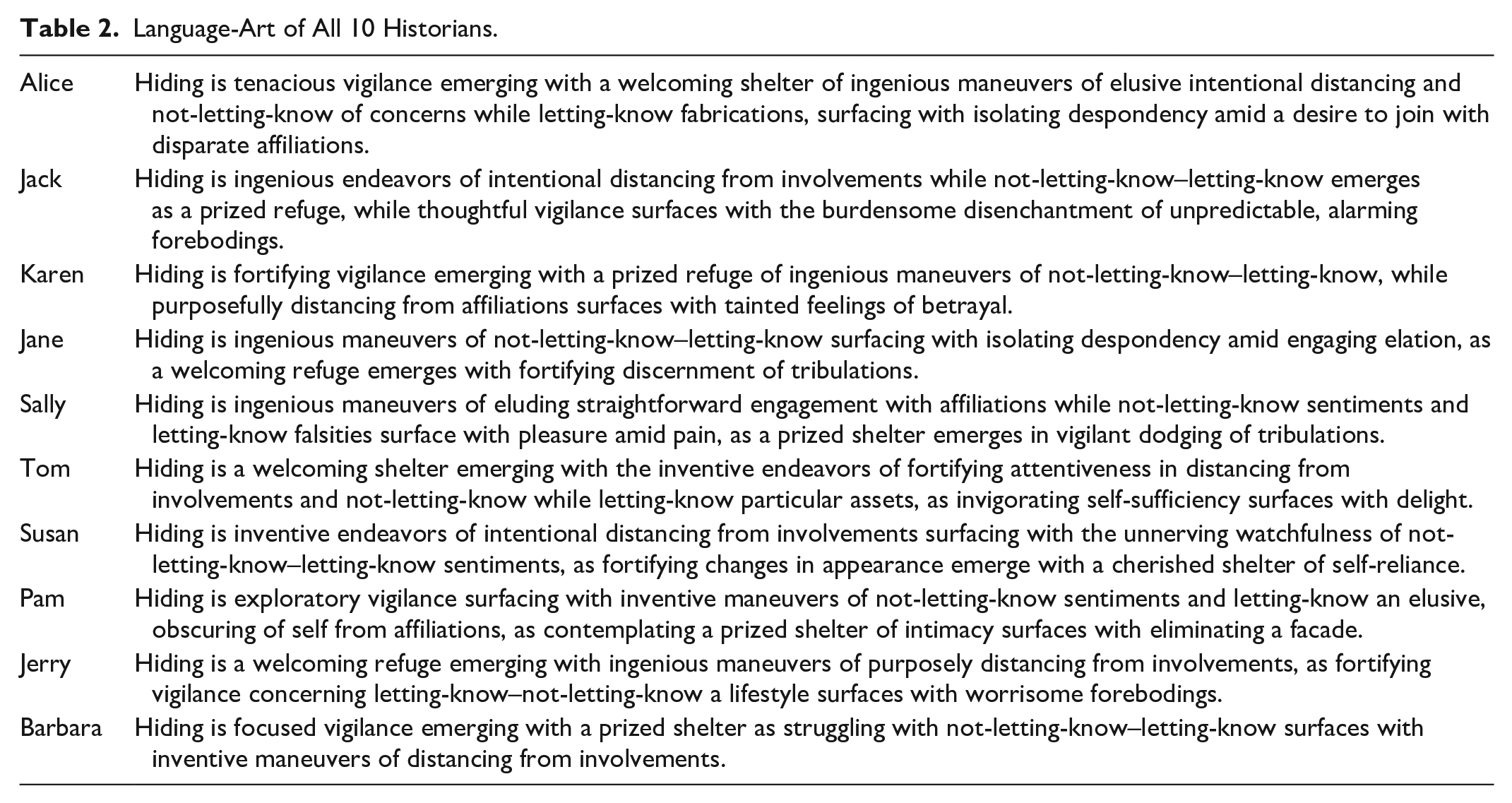
In distilling-fusing, the scholar dwelled with the transcribed historian’s description of hiding, capturing the central ideas in a story about the living experience. “Distilling-fusing is dwelling with and inventing with logic and semantic consistency” (Parse, 2021, p. 70). From this dwelling with and inventing, “central ideas are succinctly stated as essences in the language of the historian, and then at a higher level of abstraction the essences are expressed in the scholar’s language” (p. 70). These central ideas from each historian become the language-art for each historian. From the language-art of all 10 historians and with the fusion of horizons of the historians and the scholar, from the transcribed descriptions and audiotaped dialogues, the scholar identified core ideas regarding the living experience of hiding, and the discerning extant moment of the universal humanuniverse living experience of hiding was created. “The discerning extant moment explicates the inquiry stance and the newknowings of the investigation” (p. 70).
Heuristic Interpreting
The final phase of Parsesciencing is heuristic interpreting, which includes the discerning extant moment, transmogrifying, transsubstantiating, metaphorical emergings and artistic expression (Parse, 2021). The discerning extant moment is the newknowings of the inquiry, “the truth for the moment” (p. 70). Transmogrifying shifts the level of the historians’ language to a higher level of abstraction in the scholars’ language. Transsubstantiating is “moving the abstract language of transmogrifying to the core language of humanbecoming” (p. 71). Metaphorical emergings describe in abstract language the universal living experience of the historian. “Metaphors express in contradictory terms an idea that does not fit the usual context of the words or phrases being used” (p. 71). The artistic expression is a description that the scholar chooses to describe the experience of transformation in living Parsesciencing.
An additional step in this inquiry process for this particular investigation on hiding was for the first author to review each phase of Parsesciencing with three other scholars who were assisting in the inquiry process. These three scholars offered feedback and suggestions to the first author that refined the newknowings.
Historians’ Truths
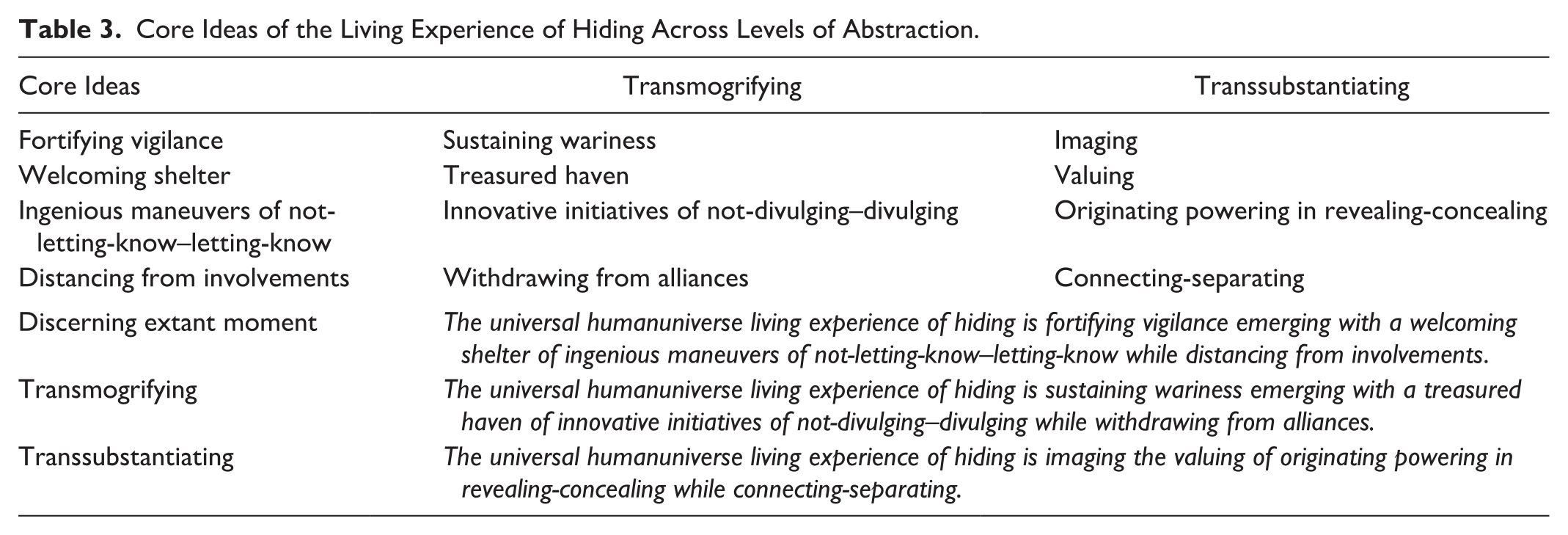
Presented here are four historians’ stories with essences in the language of the historian and the scholar and the language-art of each historian. In addition, the language-art of all 10 historians (Table 2) and the core ideas, the discerning extant moment, and the heuristic interpreting (Table 3) are detailed.
Language-Art of All 10 Historians.
Core Ideas of the Living Experience of Hiding Across Levels of Abstraction.
Karen’s Story
Karen, a 68-year-old woman, stated, “I think I have been hiding ever since I was a child. I was always discreet about what I would reveal or share. Hiding is a discernment of what to share when or where.” Karen talked about her husband.
Through him I learned to be discreet. He felt he could share certain things with me, and I felt honored that he felt safe to share with me. Hiding is a tool for survival. Now, on a personal level I wrestle with hiding things from my husband. I feel like I am carrying on an affair behind his back in that there are certain things I don’t share. He had a major stroke and is in a long-term nursing home. I can’t go in and tell him certain things that are going on at home. It would hurt him; it would frustrate him, and he would feel more helpless than he is. So that is where I am most guarded. It is not easy. I wasn’t brought up to be a two-faced person, it is a dirty feeling to me. It is less than honest. My kids also probably know there is more going on than mom shares. When they ask, I tell them. I struggle to keep my own integrity.
Karen talked about her experience with the nursing home staff. “I work very hard to be careful at what I say to staff. We do not honor our senior citizens and we treat them in a very shabby way. There are many people in the nursing home you can’t talk to. I hide from people that I wouldn’t put past them to retaliate against my husband. I am careful about what I say, what I listen to. I am just careful.” Karen discussed her life as a minister’s wife. “I chose to stay in the background. I never chose to put myself out front and my husband never expected me to.” Karen concluded by talking about an experience as a teenager. “My sister and I were walking to town to see our grandma. Guys on motorcycles started circling us. We fled into a cornfield and hovered way down. They couldn’t find us. We stayed cowered down for a real long time and were scared to death. I guess there are all kinds of hiding that goes on. It is an ongoing thing.”
Essences: Karen’s Language
Hiding is guarded discernment; it is honored discreetness and a tool for survival.
Hiding is staying in the background; being careful about what to share, when to share, and what to listen to; and fleeing from guys on motorcycles. It is a feeling like carrying on an affair.
Essences: Scholar’s Language
Fortifying vigilance emerges with a prized refuge.
Ingenious maneuvers of not-letting-know–letting-know while purposefully distancing from affiliations surface with tainted feelings of betrayal.
Karen’s Language-Art
Hiding is fortifying vigilance emerging with a prized refuge of ingenious maneuvers of not-letting-know–letting-know while purposefully distancing from affiliations surfaces with tainted feelings of betrayal.
Jerry’s Story
Jerry, a 71-year-old man, talked about hiding as a gay man. “My serious gay happenings or intimacies started in high school. I was unbelievably careful with fear that somebody would find out. You just had to be very cautious and guarded. Sometimes there would be queer jokes to be told. I would try to fake that I was laughing at the joke, too.” Jerry stated he divorced his wife: When I gravitated away from her, I started having these gay feelings again. But I was living in this conservative town, and I would have everything to lose. I was invited by friends to come to a big, sophisticated city to celebrate being gay. There was a lot of back and forth driving and weekends in the big city. I was very comfortable meeting all good men in a big city. I didn’t have to hide there, but I still do here. I have shared myself with some friends in my Bible study. They said, “J. we all knew, and we love you and there is nothing wrong with you.” So, I wondered, who else is suspecting me? And that scared me. I have never shared with my mother or father.
Jerry concluded saying, “Hiding is to protect yourself, protect your career, protect your family . . . it’s real. I know what it is like not to hide in a sophisticated city . . . it felt so good, it felt so normal. It’s not that I haven’t met men around here, but they have to be careful as I am. Fortunately I have a nice private place out here. No neighbor 20 feet from me is wondering.”
Essences: Jerry’s Language
Hiding is protective in feeling comfortable and normal in a sophisticated city; it is faking laughing, driving back and forth to a big city from a conservative town, and having a private place with no neighbor.
Hiding is being careful, cautious, and guarded and feeling scared about sharing–not sharing being gay; it is the possibility of losing everything.
Essences: Scholar’s Language
A welcoming refuge emerges with ingenious maneuvers of purposely distancing from involvements
Fortifying vigilance concerning letting-know–not-letting-know a lifestyle surfaces with worrisome forebodings.
Jerry’s Language-Art
Hiding is a welcoming refuge emerging with ingenious maneuvers of purposely distancing from involvements, as fortifying vigilance concerning letting-know–not-letting-know a lifestyle surfaces with worrisome forebodings.
Barbara’s Story
Barbara, a 34-year-old woman, stated, I have been hiding most of my life, starting at 6 years old. My mom died and after her funeral a lot of people came to my house, and I was hiding in my room to stay away from people—from being scared. I use it as a coping mechanism, I like to self-isolate and be by myself and stay in my room. Even with living with my grandma, I like to stay in my room as much as possible and keep to myself because I think sometimes that is the only time, I feel safe.
Barbara talked about her childhood. “My dad had lots of friends that started coming around. It was scary and terrifying when you’ve lost your mom. At age 6 I was trying to get away from everybody.” Barbara continued, “Hiding is really a safety net. You can hide from all the bad things that are happening in the world or from people that can harm you. Now there is so much going on with shootings you feel like you are just not safe anywhere. I just want to stay alone and just not do anything.” Barbara continued, “I feel like you have more time to think when you are hidden and kind of process things when you are going through a lot and when you’re not around other people. It feels more secure to be by yourself.” Barbara concluded, “Emotionally you can hide if you are not around people and not talking to them, like hiding your feelings or your grief. Keeping to yourself. If you don’t talk with people, you hide your emotions. I think a lot of people are scared to express themselves or talk to people. It is hard to get out of that.”
Essences: Barbara’s Language
Hiding is having time to think and process things when going through a lot; it is a safety net for feeling secure from the bad things that can harm.
Hiding is being scared to express emotions, hiding feelings and grief, not talking with people; it is keeping to self, staying in room, self-isolating.
Essences: Scholar’s Language
Focused vigilance emerges with a prized shelter.
Struggling with not-letting-know–letting-know surfaces with inventive maneuvers of distancing from involvements.
Barbara’s Language-Art
Hiding is focused vigilance emerging with a prized shelter as struggling with not-letting-know–letting-know surfaces with inventive maneuvers of distancing from involvements.
Tom’s Story
Tom, a 72-year-old man, discussed hiding by identifying himself as an introvert.
The idea of hiding for me has to do with me being an introvert, which I am. Can you hide in plain sight? I imagine so. In a big group I will always be on the periphery. Even in a group where I feel I have been established, I will be on the outside of them. That is what makes me extremely comfortable. That would be my most visible means of hiding.
Tom continued, “I am totally content being alone for stretches of time, certainly for hours, and I will go late into the night being alone. I feel like I am alone and on my own. It is what gets me energized.” Tom talked about his past profession where he was obligated to attend many meetings. “I would go to those receptions somewhat reluctantly and I would be way on the periphery. So, if I could hide out, I would have, but it was an obligation to go to that kind of stuff.” Tom, in talking about hiding, stated that he was pretty open with his wife and children: “Last fall we had a meeting with our two kids. We gave them a copy of all our finances now that we are getting older. They had not known that before, so we told them.” Then, Tom discussed when he kept a journal.
I had a daily journal that I kept in college. It had thoughts about being 20 years old, about school, work, the future and about family. I hid that. I kept them over 30 years in our cabin, and when we sold the cabin, I burned them. I had a red one, a green one, and a blue one. I had my own little slice of the world I was keeping track of. I am glad I never shared it and now it is gone. Nobody needed to see them, it was very personal.
Tom concluded talking about hiding: “If my wife was gone, I could see myself pulling away from people much more. I could see removing myself from society.”
Essences: Tom’s Language
Hiding is being comfortable on the periphery, outside of a group, pulling away from people, removing self from society; it is burning personal daily journals never shared while sharing finances with children.
Hiding is being alone and being energized; it involves glad feelings.
Essences: Scholar’s Language
A welcoming shelter emerges with the inventive endeavors of fortifying attentiveness in distancing from involvements and not-letting-know while letting-know particular assets.
Invigorating self-sufficiency surfaces with delight.
Tom’s Language-Art
Hiding is a welcoming shelter emerging with the inventive endeavors of fortifying attentiveness in distancing from involvements and not-letting-know while letting-know particular assets, as invigorating self-sufficiency surfaces with delight.
Ensuing Discoveries
The discovery of this Parsesciencing inquiry is the discerning extant moment: Hiding is fortifying vigilance emerging with a welcoming shelter of ingenious maneuvers of not-letting-know–letting-know while distancing from involvements. The transmogrifying is as follows: Hiding is sustaining wariness emerging with a treasured haven of innovative initiatives of not-divulging–divulging while withdrawing from alliances. The transubstantiating is the following: Hiding is imaging the valuing of originating powering in revealing-concealing while connecting-separating. The core ideas are discussed individually to gain further understanding of the discerning extant moment of the living experience of hiding in humanbecoming (Table 3).
Fortifying Vigilance
Fortifying vigilance involves a cautious, guarded watchfulness when wondering what might be happening. This sustaining wariness serves one in coming to know what is important for feeling safe in the moment-to-moment of living and is imaging in the first principle of humanbecoming. Imaging “is reflective-prereflective coming to know the explicit-tacit all-at-once. Reality is seamlessly constructed with the reflective-prereflective that is shaping personal knowing explicitly-tacitly” (Parse, 2021, p. 42). The personal knowing of fortifying vigilance was expressed by the historians in the following ways. One historian stated, “Can you hide in plain sight? I imagine so. In a big group I will always be on the periphery. Even in a group where I feel I have been established, I will be on the outside of them.” Another said, “My serious gay intimacies started in high school. I was unbelievably careful with fear that somebody would find out. You just had to be very cautious and guarded.” One historian stated, “I was hiding in my room . . . I was scared. I use it as a coping mechanism. You can hide from all the bad things that are happening in the world or from people that can harm you. It feels more secure to be by yourself.” One historian talked about her vigilance in staying out of a situation where she was hiding. “I keep repeating the story over and over in my head. I want to know when it started, how it started. I go over and over it in my mind and keep trying to figure it out, so it won’t happen again.” Another stated, “Hiding something, whether it is a tragedy or a joy, is not healthy and I suppose we all have to learn and decide the balance in privacy or secrecy. I think a lot of it depends on trust, trusting of ourselves and trusting the other person.” One historian talked about her experience with fortifying vigilance in a nursing home:
I work very hard to be careful at what I say to staff. We do not honor our senior citizens and we treat them in a very shabby way. There are many people in the nursing home you can’t talk to. I hide from people that I wouldn’t put past them to retaliate against my husband. I am careful about what I say, what I listen to. I am just careful.
Concepts similar to fortifying vigilance were found in related humanbecoming inquiries. Baumann (2009) in an inquiry on feeling fear identified the concept of “haunting possibilities with cautious perseverance” (p. 350). This concept was described as “attentive presence with envisioning the certainty-uncertainty the participants described when considering fearful events” (p. 350). Haunting possibilities with cautious perseverance was integrated with the theory of humanbecoming as “imaging originating” (p. 348) and is similar to fortifying vigilance, which involves the anticipation of and watching for threatening possibilities. Bournes and Mitchell (2002), in an inquiry on waiting for persons in a critical care waiting room, identified the concept of “vigilant attentiveness” (p. 62). Such vigilant attentiveness was described “as a focused, persistent, and diligent watchfulness” (p. 62) and was integrated with the theory of humanbecoming as imaging. Such persistent watchfulness is similar to fortifying vigilance discussed by the historians in this study. At a theoretical level, vigilance was described by Van Schie and colleagues (2021) as “the capability to be aware of relevant, unpredictable changes in one’s environment, irrespective of whether or not such changes occur” (p. 178). Such a description of being aware aligns with the historians’ accounts of the importance of such sustaining wariness in hiding emerging with a welcoming shelter.
Welcoming Shelter
A welcoming shelter is a feeling of being safe and secure and protected from vulnerability. It is an appreciation of self-perseveration and gratefulness for survival. It is a treasured haven of comfort and security and is connected with valuing in the first principle of humanbecoming. Valuing “is all-at-once confirming–not confirming cherished beliefs in light of a personal worldview. The paradoxical rhythm of confirming–not confirming is freely choosing pattern preferences from illimitable imaged options and owning the choices” (Parse, 2021, p. 43). The historians described their chosen patterns of creating a welcoming shelter in the following ways. One historian stated, “I know there are areas you have to hide for self-preservation.” She said, “I remember running under a tree and sitting there feeling like I had no friends in the world. God gave me little birds to be my friends and keep me safe and protected from the girl bullies on the playground. I always had to hide.” Another stated, “I think I have been hiding ever since I was a child. Hiding is a tool for survival.” One historian said, “As an extrovert I am tired because everywhere I go people want to talk about their health because of my profession. I get tired of caring so much, and when I hide, I don’t have to care so much. Hiding takes me away a bit.” Another stated, “Hiding is to protect yourself, protect your career, protect your family. It is real.” One other historian stated, “It feels more secure to be by yourself. Hiding is a safety net.” Another stated, “Even in a group where I feel I have been established, I will be on the outside of them. That is what makes me extremely comfortable.”
A concept comparable to a welcoming shelter of feeling secure and protected is the concept of “trusting in potentiality” that Cody and Filler (1999) identified in a humanbecoming inquiry on hope for women residing in a shelter. The authors described this trusting in potentiality as a belief in a better and safer tomorrow, and the concept “was transposed to the discourse of the theory as confirming possibilities” (p. 223) and was integrated with the theory of humanbecoming as valuing. The optimism for the welcoming shelter as a safe and secure today and tomorrow, as expressed by the 10 historians in this hiding study, is similar to the hope expressed in confirming possibilities by the women in the shelter. Doucet (2012), in an inquiry on feeling strong, identified the concept of “treasured alliances” (p. 69). This concept pertained “to protecting affiliations. It is having a precious regard of worth with involvements” (p. 68). One participant in the feeling-strong inquiry stated, “I grew up in a sheltered sort of existence” (p. 68). Treasured alliances were integrated with the theory of humanbecoming as valuing connecting-separating. This description of treasured alliances as sheltering is similar to a welcoming shelter as a treasured haven of feeling safe and secure for the 10 historians in this hiding study. In the experience of hiding, valuing is lived as an appreciation for feeling safe and protected at times of uncertainty and threat while moving with and away from others. Gendler (1988) in The Book of Qualities wrote about the human capacity for embracing shelter and protection: Protection is sensible and artistic. . . . Protection has lived in many kinds of houses. . . . She has studied ancient architecture and the habits of butterflies and spiders. When the caterpillar is dying and the new butterfly is yet to be born, it constructs a chrysalis. We also have this need. However, many of us are too proud or have forgotten how to go inside. Protection has learned from the butterflies how to make a chrysalis for the changing human heart. (p. 77)
This moving with uncertainty and change with a desire for security and safety surfaces ingenious maneuvers of not-letting-know–letting-know.
Ingenious Maneuvers of Not-Letting-Know–Letting-Know
Ingenious maneuvers of not-letting-know–letting-know are unique ways of keeping secrets and not sharing certain information while choosing to share other aspects of the self. It is taking creative, innovative initiatives in not-divulging–divulging material concerning the self and one’s experiences and is originating powering in revealing-concealing in the third and second principles of humanbecoming. “Originating is inventing new ways of conforming-not-conforming with the certainty-uncertainty of living” (Parse, 2021, p. 55). Powering involves “the pushing-resisting of affirming–not-affirming being in light of nonbeing” (p. 52). Revealing-concealing, as described by Parse, is “disclosing–not-disclosing, it is living telling–not-telling all-at-once” (p. 48). The innovative ways of pushing-resisting in living telling–not-telling is expressed by historians in the following ways: One historian in describing her experience with a difficult situation stated, Hiding started so slow. Slowly there were pieces and parts of me that I couldn’t share, either my emotions or reactions were too big, or I shouldn’t know that information. He would make comments and then I would dumb myself down. I would come home and get small. I can’t share any of this with my friends because they know him. I want my group to know and be there for me, but there are only a few that can be.
This historian also shared, “I believe that all the lying I did as a child had to be hiding. It was protecting me from the feeling of not being good enough. Not fitting in. If I made the story a little bigger and more interesting, maybe I would be good enough, be friends with everybody.” Another stated, Hiding is something I have been doing pretty much my whole life. Not coming forward or hitting things head on or backing away. I don’t like conflict, so I try to avoid conflict. I suppose the hiding part is not talking to anyone about it and acting like everything is fine. Maybe it is this idea that if you let people know what is really going on, it will change the relationship.
One historian said, “The thorn of sadness that I carried was the secret of having epilepsy. I hid that. I also hid the miracle of joy about being healed from epilepsy. We were driving down the highway and I shared my secrets with my roommate. My body was shaking, my voice was shaking, and I felt like a volcano ready to erupt.” Another said, “hiding is avoiding. Hiding is everywhere, not sharing feelings, not being honest is hiding, but it is a protection, too.” One historian in talking about being gay stated, “I have shared myself with some friends in my Bible study, but I have never shared with my mother or father.” Another historian said, “Emotionally you can hide if you are not around people and not talking with them, like hiding your feelings or your grief. I think a lot of people are scared to express themselves or talk to people. It is hard to get out of that.” One historian said, “I had a daily journal that I kept in college. It had thoughts about being 20 years old, about school, work, the future and about family. I hid that. I kept them hidden in our cabin over 30 years and when we sold the cabin, I burned them. I am glad I never shared it and now it is gone. Nobody needed to see them, it was very personal.”
The core concept of ingenious maneuvers of not-letting-know–letting-know as originating powering in revealing-concealing is not explicitly cited in any other humanbecoming literature; however, both originating powering and revealing-concealing are noted in humanbecoming inquiries. Bunkers (1999), in an inquiry on the experience of hope, described the concept of “inventive endeavoring” (p. 248), describing “a process of constructive inventiveness in the pushing-resisting encounters of human existence” (p. 248) and at the level of humanbecoming theory as “powering originating” (p. 249). This concept of inventive endeavoring is similar to ingenious maneuvers being the unique ways that individuals move on while hiding. Baumann (2015), in an inquiry on difficulty telling the truth, identified the core concept of “contemplating intentional withholding arising in calm acquiescence” (p. 54). Participants “talked about some situations in which they not only did not tell the truth or the whole truth, but . . . found a way out of the situation” (p. 54). This concept of contemplating intentional withholding arising in calm acquiescence was integrated with the theory of humanbecoming as “transforming revealing-concealing” (p. 52). In this hiding study, originating powering in revealing-concealing illuminates the inventive ways that individuals kept secrets and withheld information while distancing from involvements.
Distancing From Involvements
Distancing from involvements is moving away from persons, places, and events; it involves evading certain circumstances and affiliations while moving toward other situations. It is wittingly withdrawing from select others and involves connecting-separating from the second principle of humanbecoming. “Connecting-separating is attending-distancing; it is living being with and apart from others, ideas, objects, and situations all-at-once” (Parse, 2021, p. 50). Historians discussed this attending-distancing in their withdrawing from others in the following statements: “I remember one time running and locking a door to protect myself from what he was saying. Another time I got out of the car and ran and was hiding in the bushes and he was trying to find me. I was outside in the rain cowering in a corner and there was a frog jumping. That is a horrible way to have to live.” Another stated, “I was the smallest kid in the class and the locker room was a place where I was afraid a lot of the time. I tried to make myself invisible.” This historian went on to say, “They had a school reunion and some of the teachers wrote me and asked me to come. I said I am not going back. When that opportunity came, I didn’t do it. I believe there is an amount of safety in that. Protects you from the vulnerability.” One historian added, When I think of hiding, I go back to my early years in school. I think of hiding behind the person in front of me so I might not get called on by the teacher. I remember incidents on Easter when everybody wore fancy dresses on Easter and new shoes. I would get in the back of Sunday school class because I didn’t have the fancy clothes that everybody wore. I was poor. I hid because of embarrassment.
Another added, “My mom died when I was 6 years old. After her funeral a lot of people came to my house, and I was hiding in my room to stay away from people.” Another historian added, “My life is so saturated with work and children. I will go into the bathroom with my phone and lock the door for five minutes just to have a little break.” She continued, “As a pastor there is an element of performance in the pulpit, so I hide behind a persona where I speak differently in the pulpit than when I am just in conversation with someone.” One historian described driving to another city to hide being gay. “I was living in this conservative town, and I would have everything to lose. I was invited by friends to come to a big, sophisticated city to celebrate being gay. There was a lot of back and forth driving and week-ends in the big city. I didn’t have to hide there, but I still do here.” Another historian talked about living in a small town. “If you don’t want to talk with someone you go around a corner.” In talking about hiding, another historian stated, “I am totally content being alone for stretches of time. I feel like I am alone and on my own. It is what gets me energized.”
Humanbecoming nursing literature surfaced similar concepts to distancing from involvements including the core concept of “distancing affiliations” described by Hawkins (2017, p. 157) in an inquiry on feeling disrespected. “Distancing affiliations surface when the participants felt with and apart from others as one withdraws from trusted relationships” (p. 157). The participant stated, “I had my guard up.” “I always got along with all the groups but never was in the group. I was very isolated” (p. 157). Such difficulty in relationships was identified by Condon (2010) in her inquiry on feeling misunderstood in the concept of “discordant affiliations” (p. 144). Condon suggested, “discordant affiliations surface as dissonance in relating with others” (p. 144). Historians in speaking about their hiding described such dissonance in their relationships with others. Theoretical literature capturing the paradox of connecting-separating in distancing from involvements is highlighted by the writing of David Whyte (2016) titled RUN AWAY: RUN AWAY is what most human beings would like to do a great deal of the time. It is the flight part of the fight or flight deeply in our bodies and our past, it is our protection. . . . We know intuitively that most of the time, we should not run, we should stay and look for a different way forward, despite the evolutionary necessity. Rarely is it good to run, but we are wiser, more present, more mature, more understanding when we realize we can never flee from the need to run away. (pp. 195-197)
Scholars’ Conceptualization and the Discerning Extant Moment: A Comparison
There are several differences between the group concept inventing and the discoveries of the Parsesciencing inquiry on hiding. As mentioned earlier in this article, a group concept inventing process created the following now truth for the living experience of hiding: “Hiding is shapeshifting disclosing–not disclosing in persevering with peril in cocreating the new” (Bunkers et al., 2018, p. 9). The ingenuous proclamation of hiding at the level of the humanbecoming theory was “Hiding is transforming revealing-concealing in the powering of imaging originating” (p. 9). The artistic expression was an artwork of a picture of the eye entitled Hiding in Plain Sight (Great Plains Parse Scholars Group, in Bunkers et al., 2018, p. 9).
This inquiry of the universal humanuniverse living experience of hiding uncovered the discerning extant moment of hiding as follows: Hiding is fortifying vigilance emerging with a welcoming shelter of ingenious maneuvers of not-letting-know–letting-know while distancing from involvements. At the level of theory, hiding is imaging the valuing of originating powering in revealing-concealing while connecting-separating. The discerning extant moment of hiding gives a clearer description of the actual universal humanuniverse living experience of hiding; it includes valuing as a welcoming shelter of feeling safe and secure and connecting-separating as distancing from involvements. A welcoming shelter more clearly illuminates the importance of feeling safe and secure while moving away from others and events when hiding. Imaging is described as fortifying vigilance and more obviously portrays the watchfulness and cautiousness present in the experience of hiding. Transforming is not in the discerning extant moment of hiding, but originating powering in revealing-concealing is and distinctly describes the inventive and unique behaviors that the historians manifested of not-divulging–divulging when hiding in their day-to-day living quality. The artistic expression included in this inquiry was a writing entitled Hiding by international author and poet David Whyte (2016).
Metaphorical Emergings
Metaphorical emergings help to clarify the meanings of humanuniverse universal living experiences. The metaphor “hiding is a safety net” illuminated one historian’s experience of feeling safe and secure as a welcoming shelter. Barbara stated that she had been hiding most of her life and that it was important to her to keep to herself because “sometimes that is the only time that I feel safe. It feels more secure to be by yourself. . . . Hiding is really a safety net.” Hiding is a safety net clearly depicts the security and protective feeling of a welcoming shelter.
Artistic Expression
The following writing by internationally acclaimed poet and author David Whyte (2016), in a book entitled Consolations, illuminated the core ideas of the living experience of hiding and reflects the scholars’ transforming learnings from this experience of conducting the Parsesciencing inquiry of hiding: Hiding is a way of staying alive. Hiding is a way of holding ourselves until we are ready to come into the light. Hiding is one of the brilliant and virtuoso practices of almost every part of the natural world: the protective quiet of an icy northern landscape, the held bud of a future summer rose, the snowbound internal pulse of the hibernating bear. Hiding is underestimated. . . . Hiding is a bid for independence, from others, from mistaken ideas we have about ourselves, from an oppressive and mistaken wish to keep us completely safe, completely ministered to, and therefore completely managed. Hiding is creative, necessary, and beautifully subversive of outside interference and control. Hiding leaves life to itself, to become more of itself. Hiding is the radical independence necessary for our emergence into the light of a proper human future. (pp. 113-115)
Fortifying vigilance as imaging is described with “hiding is a bid for independence, from others, from mistaken ideas we have about ourselves, from an oppressive and mistaken wish to keep us completely safe” (Whyte, 2016, pp. 114-115). A welcoming shelter as valuing is “hiding is a way of staying alive. Hiding is a way of holding ourselves until we are ready to come into the light” (p. 113). Ingenious maneuvers of not-letting-know–letting-know as originating powering in revealing-concealing is “hiding is one of the brilliant and virtuoso practices of almost every part of the natural world: the protective quiet of an icy northern landscape, the held bud of a future summer rose, the snowbound internal pulse of the hibernating bear. . . . Hiding is creative, necessary and beautifully subversive of outside interference and control” (pp. 113, 115). Distancing from involvements as connecting-separating is “hiding leaves life to itself, to become more of itself. Hiding is the radical independence necessary for our emergence into the light of a proper human future” (p. 115).
Newknowings
• Hiding is fortifying vigilance emerging with a welcoming shelter of ingenious maneuvers of not-letting-know–letting-know while distancing from involvements.
• Fortifying vigilance is a sustaining wariness and guarded cautiousness when knowing–not knowing imaginable possibilities.
• A welcoming shelter is a treasured haven of feelings of safety, security, and appreciation for survival and is a chosen way of living with the emerging now.
• Ingenious maneuvers of not-letting-know–letting-know are innovative initiatives of not-divulging–divulging certain aspects of the self while hiding.
• Distancing from involvements is wittingly withdrawing from select others, including persons, places, and events, while seeking safekeeping when hiding.
• This Parsesciencing inquiry on hiding provides new insights and understanding on the universal humanuniverse living experience of hiding and its importance in living quality.
Beyond the Horizon
This was the first humanbecoming inquiry on the universal humanuniverse living experience of hiding. The authors encourage further inquiries to be conducted on this very important living experience. The findings of this investigation uncovered the significance in the historians’ lives of establishing ways of feeling safe while they lived their truth for the moment. Further inquiries to enhance understanding of hiding and similar experiences could include keeping a secret, being very careful, feeling threatened, feeling safe, feeling alone, feeling fearful, and feeling isolated. Parsesciencing inquiries, such as this investigation, expand understanding of many universal humanuniverse living experiences and contribute to expanding nursing knowledge and the humanbecoming paradigm.
Footnotes
Declaration of Conflicting Interests
The authors declared no potential conflicts of interest with respect to the authorship and/or publication of this review.
Funding
The authors received no financial support for the authorship and/or publication of this review.
