







Abstract
This study adopted the humanbecoming concept inventing model to explore the phenomenon of feeling afraid. Through simultaneously immersing with explicit-tacit knowings, exploring with pattern preferences, and explicating with pondering possibles, the author unveiled the now-truth of feeling afraid as paralyzing hesitation arising with daunting uncertainties of dissociating affiliations. This now-truth was shapeshifted into an ingenuous proclamation, articulated within the language of the humanbecoming paradigm. The final declaration portrayed feeling afraid as languaging the originating of connecting-separating, with Edvard Munch’s The Scream (1893) as the chosen artform. This inventive inquiry enriches nursing knowledge by deepening understanding of feeling afraid as a universal humanuniverse living experience.
Concepts are essential elements as they serve as the foundation upon which an entire study is built. According to Walker and Avant (2019), concepts serve as the building blocks of theories, helping to define, describe, and predict outcomes in nursing practice. Rodgers and Knafl (2000) emphasized that concepts are fundamental to knowledge development in nursing because they provide the basis for theory formation, research, and practice. With the humanbecoming paradigm, concept inventing is used to explore universal humanuniverse living experiences (Parse, 2018). Concept inventing, introduced by Rosemarie Rizzo Parse, is a creative and transformative process that goes beyond traditional concept analyses by generating new meanings and perspectives “to advance disciplinary knowledge from the humanbecoming paradigm and beyond” (Parse, 2021, p. 141). The humanbecoming concept inventing model (Figure 1) by Parse (2018, 2021) provides scholars with a unique way to enhance nursing knowledge of universal humanuniverse living experiences. Unlike the predominant methods of concept analysis (Rodgers & Knafl, 2000; Walker & Avant, 2019), the concept inventing model in the humanbecoming paradigm is unique in its nonlinear nature, occurring “as an all-at-once nonlinear rational-intuitive moment-to-moment birthing of novel conceptualizations” (Parse, 2021, p. 135). Furthermore, the concept inventing model does not focus on the particulate as it focuses on creating novel ideas (Parse, 2018). This uniqueness invites scholars to explore new ways of thinking and understanding a concept. The concept inventing model is “preliminary to initiating a humanbecoming modes of inquiry—Parsesciencing and Humanbecoming Hermeneutic Sciencing” (Parse, 2021, p. 135).
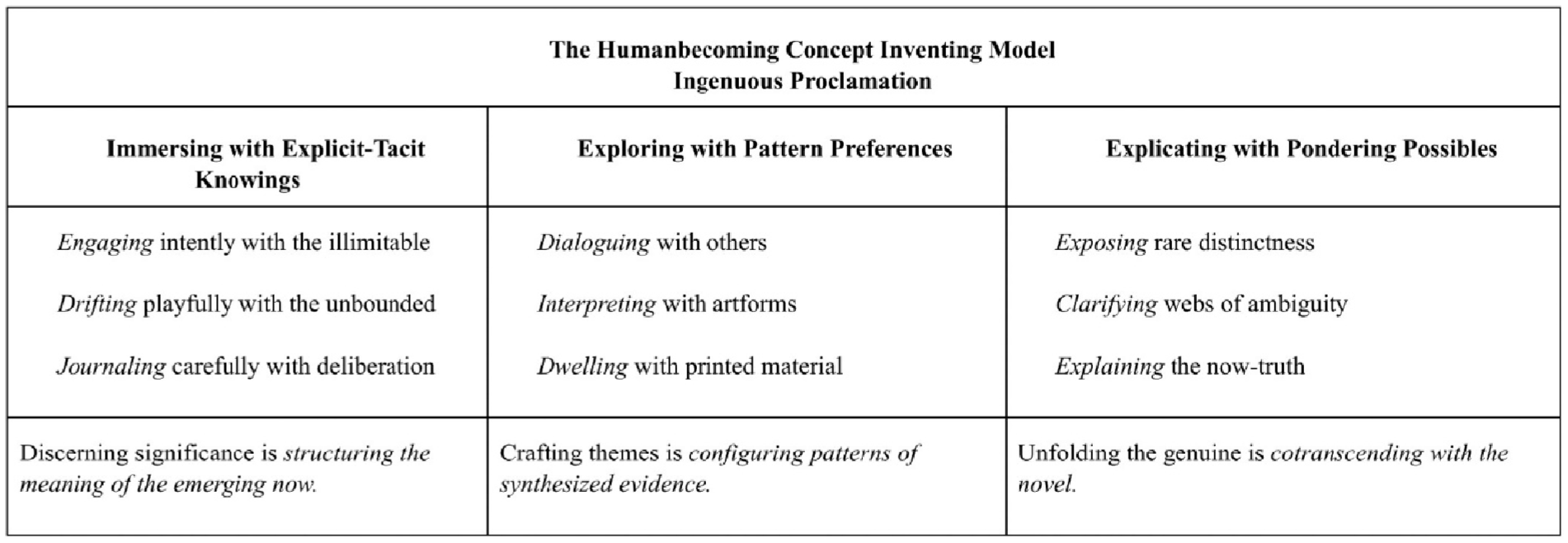
The Humanbecoming Concept Inventing Model. From “The Humanbecoming Concept Inventing Model: A Reprise,” by R. R. Parse, 2018, Nursing Science Quarterly, 31, p. 158. Copyright 2018 by Rosemarie Rizzo Parse. Reprinted with permission.
As the scholar commences his initial inquiry into the humanuniverse experience of feeling afraid, the concept inventing model presents an invitation to create a genuine, open, and penetrable declaration or clear expression of the meaning of feeling afraid. Concept inventing calls for scholars to “plumb the depths of their knowings to create unique descriptions of concepts, known as ingenuous proclamations” (Parse, 2018, p. 157). An ingenuous proclamation is an “assertion that incarnates the meaning of the concept for the scholar” (Parse, 2018, p. 157). The scholar unveils the now-truth by cocreating the meaning of feeling afraid, shaped by personal interpretation and unfolding realities, and then the now-truth is “declared in the language of humanbecoming science and with relevant artforms” (Parse, 2018, p. 157). Exploring this concept through the concept inventing model within the humanbecoming paradigm will contribute to the expansion of nursing knowledge and reveal the richness and depth of the universal humanuniverse living experience of feeling afraid.
Unfolding the Concept
The concept unfolds with the “all-at-once immersing with explicit-tacit knowings, exploring with pattern preferences, and explicating with pondering possibles”(Parse, 2018, p. 157). The scholar uses the humanbecoming concept inventing model to unfold the unique, now-truth meaning of the phenomenon of feeling afraid as a universal humanuniverse living experience.
Immersing With Explicit-Tacit Knowings
Engaging deeply with explicit-tacit knowings involves meticulous exploration and comprehensive inquiry to uncover the unique meaning of a phenomenon (Kabigting, 2019). The scholar will immerse in explicit-tacit knowings through “engaging intently with the illimitable, drifting playfully with the unbounded, and journaling carefully with deliberation” (Parse, 2018, p. 157). Engaging intently with the illimitable prompts the scholar to become like a river, flowing seamlessly through the depths of his knowledge and carving new pathways to discern the personal meaning of feeling afraid. Through individual reflection during journeying about the universal humanuniverse living experience, the currents of insight deepen, shaping the scholar’s course like a river—eroding stones, smoothing rough edges, and carrying the essence of discovery toward the personal meaning of feeling afraid. The scholar’s feeling afraid arises like turbulent waves in a river flow, paralyzing amid the certainty-uncertainty of failure. Through his personal experience, the scholar fears failure, loss, not being enough, and being alone. He fears climbing his ladder of success because he might lose friends. He worries that the weight of responsibility will crush him, leaving him isolated in his pursuit of achievement. He often finds himself paralyzed by the thought of what he might have to sacrifice, questioning whether the rewards are worth the potential loneliness that success could bring. While the scholar was immersed with explicit-tacit knowings, he also drifted playfully with the unbounded to uncover the essence of feeling afraid.
As the scholar drifted playfully with the unbounded, he discerned that being afraid is paralyzing and heavy. It is not merely hesitation but the weight of infinite possibility. In that vastness, the inability to decide was not a flaw but a momentary surrender to the immensity of choice. It is the reflection of continuing journaling carefully with deliberation, where thoughts, once elusive, took form. From a careful entry of valued knowings of feeling afraid, each word is penned, “preserving the meaning moments of the emerging now with the unfolding concept” (Parse, 2018, p. 157). Through this intentional act of reflection, the scholar does not merely transcribe the experience of feeling afraid but engages in constantly structuring the meaning with the “reflective-prereflective that is shaping personal knowing explicitly-tacitly” (Parse, 2021, p. 42). The meaning of feeling afraid can be seen in Matthew 14:22-33 (The Holy Bible, New International Version, 2011). The story of Peter walking on water illustrates the experience of fear and hesitation in the face of certainty-uncertainty. As Peter stepped out of the boat toward Jesus, Peter initially walked on water, but when he saw the wind and waves, he became afraid and began to sink. His fear paralyzed him, causing him to doubt despite the infinite possibility before him. Yet, in Peter’s moment of crisis, Jesus immediately reached out and caught him, saying, “You of little faith, why did you doubt?” (Matthew 14:31). This story beautifully illustrates the paralyzing nature of being afraid. Peter, in that moment, was caught between trust and hesitation, between the infinite possibility of walking on water and the weight of his own doubt.
Through immersing with explicit-tacit knowings, the scholar’s unique personal meaning of feeling afraid emerged. As the exploration continued, the scholar sought in “discerning the significance is structuring the meaning of the emerging now” (Parse, 2018, p. 157). Now, the scholar remains engaged in exploring with pattern preferences.
Exploring With Pattern Preferences
Exploring with pattern preferences is “traversing with the known with precisely scrutinizing the concept in dialoguing with others, interpreting with artforms, and dwelling with printed material” (Parse, 2018, p. 157). According to Parse (2018), “Traversing the known is a way of spanning all possibles to discover what is said and not said and what is shown and not shown about the concept” (p. 157). Pattern preferences are the scholar’s moment-to-moment choices among myriad ideas in diverse media (Parse, 2018) that provide a deeper philosophical understanding of the meaning and experience of feeling afraid. To further unravel the meaning of feeling afraid, the scholar was dialoguing with others, interpreting with artforms, and dwelling with printed material to distill and infuse the limitless meaning of feeling afraid.
Dialoguing with others necessitates attentive engagement, allowing scholars to uncover the various possibilities of what the concept truly means (Parse, 2018). In doing so, scholars engage in “sifting and sorting” (Parse, 2018, p. 157) through diverse perspectives, gradually distilling a distinct meaning from the dialogue. This process not only deepens the scholar’s understanding but also reveals the fluid and evolving nature of concepts (Gadamer, 1975/2004), shaped by the multiple interpretations of universal humanuniverse living experiences. Through this continual exchange, meaning is not merely received but actively constructed (Vygotsky, 1978), allowing for a more nuanced and enriched understanding. The scholar engaged in dialoguing with internationally educated nurses to explore the experience of feeling afraid. Some of the declarations included: (a) “not having control in certain situations, especially in terms of my health journey. Fear of what will be the prognosis and treatment” (anonymous, personal communication, February 16, 2025); (b) “emerges as personal priorities shift, where the child’s welfare becomes the central concern, and any potential loss of capacity to nurture or witness her growth is both alarming and heart-wrenching” (anonymous, personal communication, February 18, 2025); (c) “is a combination of self-doubt, insecurity, and anxiety about the future. I may not meet personal or professional expectations, and a hesitation to take a risk as this is a new environment and the uncertainty of failure” (anonymous, personal communication, February 19, 2025). These multiple dialogues provide affirmation that feeling afraid is a universal humanuniverse living experience, revealing that it is a complex and multifaceted experience. While dialoguing with others, the scholar further explored the experience of feeling afraid and engaged in interpreting with various artforms.
According to Parse (2018), interpreting with artforms is “engaging with the various paintings, films, theatrical performances, movements, musical compositions, and other media that reflect the meaning of the concept for the scholar” (p. 158). The scholar chose several artforms through the years of his life that exhibit the meaning of feeling afraid for him. The Black Swan (Aronofsky, 2010) portrays fear as a paralyzing force that both drives and immobilizes the protagonist, Nina. As she grapples with the intense pressures of perfection and the looming threat of failure, her inner world becomes a battleground of conflicting identities, the innocent white swan versus the seductive black swan. This duality mirrors the internal struggle with hidden fears and vulnerabilities. Black Swan vividly encapsulates how fear can overwhelm and distort reality, leaving one immobilized by the very forces meant to propel growth. Stravinsky’s (1913) The Rite of Spring also encapsulates the experience of being afraid with its raw, primal energy and revolutionary use of dissonance and rhythm. The music’s jarring, irregular beats and sudden, intense shifts in dynamics create a sense of unease and unpredictability, mirroring the disorienting experience of fear. The feeling of impending doom and uncertainty is conveyed with its rhythmic complexity and almost chaotic orchestration, propelling listeners into tension and volatility. In addition, the scholar reflectively remembers the dance he did during childhood that portrays the experience of feeling afraid. Pangalay ha Pattong (Pineda, n.d.) is a traditional dance from the Sulu Archipelago Republic of the Philippines that involves dancers balancing atop swaying bamboo poles, simulating a ride on a vinta boat, the region’s iconic boat. The dance portrays the experience of being afraid as a spectator and a performer through its precarious balance, symbolic representation of danger, and the tension embedded in its movements. This collection of artforms—Black Swan, The Rite of Spring, and Pangalay ha Pattong—demonstrates how feeling afraid manifests across different media, shaping the scholar’s experience with movement, sound, and storytelling.
To gain deeper insight into the essence of feeling afraid, the scholar dwelled with printed material “to uncover the relevant written evidence that is known and published about the emerging concept” (Parse, 2018, p.158). By examining literature across multiple disciplines—including nursing, education, psychology, sociology, anthropology, medicine, and international policy—using keywords such as feeling afraid, being afraid, afraid, and feeling scared, additional meanings of feeling afraid were uncovered. The scholar used Google Scholar, PubMed, Cumulative Index to Nursing and Allied Health Literature (CINAHL), and other academic databases to gather a comprehensive range of studies and articles that delve into the multifaceted nature of being afraid. The scholar synthesized relevant evidence from the literature and crafted it into three themes that present the scholar’s conceptual foreknowings, “which are phrases stated at an abstract level of discourse, reflecting the meanings of the concept from many printed sources and others” (Parse, 2018, p. 158). According to Parse (2018), “Crafting themes is configuring patterns of synthesized evidence” (p. 158). From exploring pattern preferences using printed materials, the following themes were crafted: (a) feeling afraid surfaces with the known-unknown, (b) feeling afraid emerges with sureness-unsureness, and (c) feeling afraid arises with trust-mistrust. Exploring with pattern preferences, the scholar ventured further by explicating with pondering possibles.
Explicating With Pondering Possibles
Explicating with pondering possibles exposes the concept’s rare distinctness as it is evolving by immersing with explicit-tacit knowings while simultaneously exploring with pattern preferences (Parse, 2018). According to Parse (2018), “With explicating, the scholar is clarifying the webs of ambiguity that were present before the concept was born as a novel conceptualization” (p. 158). The scholar clarified the webs of ambiguity and revealed the novel conceptualization of feeling afraid. Parse (2018) added, “Unfolding the genuine is cotranscending with the novel” (p. 158). Unfolding the concept of feeling afraid evolved into “explaining the now-truth” (Parse, 2018, p. 158). The scholar’s articulated now-truth of feeling afraid serves as a response to the personal inquiry, “What does feeling afraid mean to me?” The now-truth of feeling afraid for this scholar that ascended with immersing with explicit-tacit knowings while simultaneously exploring with pattern preferences and explicating with pondering possibles is that feeling afraid is paralyzing hesitation arising with the daunting uncertainties of dissociating affiliations.
Paralyzing hesitation is the scholar’s distilled meaning of being afraid, where the hesitation halts movement, creating uneasiness with the urge to act and the immobilizing heaviness of being afraid. Paralyzing hesitation arises in an overwhelming wavering, making it difficult to move on with new experiences. Paralyzing hesitation arises when being afraid is shaped with silence and movement in the becoming-visible–invisible-becoming of the emerging now in the unfolding present moment. It is lived in moments where one longs to speak yet swallows words, fearing their consequence more than their silence. It surfaces in the tension of yearning for transformation while clinging to what is familiar and known. In attempting to escape pain, one inadvertently postpones joy; in reaching for safety, one resists the expansion of freedom. Thus, paralyzing hesitation is not merely the absence of action—it is a profound manifestation of being afraid, where the pull toward becoming is dimmed by the imagined heaviness of what change might unveil.
Daunting uncertainties give rise to a deep-seated experience of the unknown and the unpredictable, cocreating an inner sense of unsettledness. Feeling afraid emerges when there is no guarantee of safety, success, or stability—when frightening unsureness arises, halting the path onward. This fear intensifies as individuals realize they cannot fully discern what is real or imagined in the yet-to-come. When clarity dissolves, vulnerability takes root; individuals may feel hesitant, exposed, or caged in spirals of self-doubt. In these moments, feeling afraid becomes an existential stirring, thinning the fragile thresholds between knowing and not knowing, control and surrender, anchoring and unmooring. It is the silent pause shaped by the weight of daunting uncertainties, where feeling afraid takes form within the known-unknown—where meaning unfolds between what is grasped and what remains elusive.
Dissociating affiliations emerge throughout life, where the longing to belong, to build relationships, and to create social bonds coexists with the experience of rejection and abandonment. Feeling afraid arises with dissociating affiliations—where individuals dwell in the tension of seeking connection while fearing separation, where the pull to belong dances with the possibility of estrangement. Individuals may feel uncertain when dwelling amid relationships that no longer resonate with their evolving sense of self while all-at-once holding close to others who nurture their becoming. When feeling afraid, individuals may contemplate stepping away from long-held affiliations while remaining tethered to familiar rhythms of togetherness. In dissociating affiliations, an individual may live the paradoxical pattern of distancing while desiring closeness, honoring value priorities while fearing the dissolution of shared meaning in connection.
Ingenuous Proclamation
In immersing with explicit-tacit knowings, exploring with pattern preferences, and explicating with pondering possibles, the scholar transformed the now-truth of feeling afraid into the ingenuous proclamation, articulated with a theoretical statement at a scientific level of discourse and integrated with an artform (Parse, 2018). The scholar articulately crafted an ingenuous proclamation expressed within the language of the humanbecoming paradigm: Feeling afraid is languaging the originating of connecting-separating. The scholar used the painting by Edvard Munch (1893), originally done in oil, tempera, and pastel on cardboard, titled The Scream (Figure 2), illuminating the meaning of the universal human universe experience of feeling afraid.
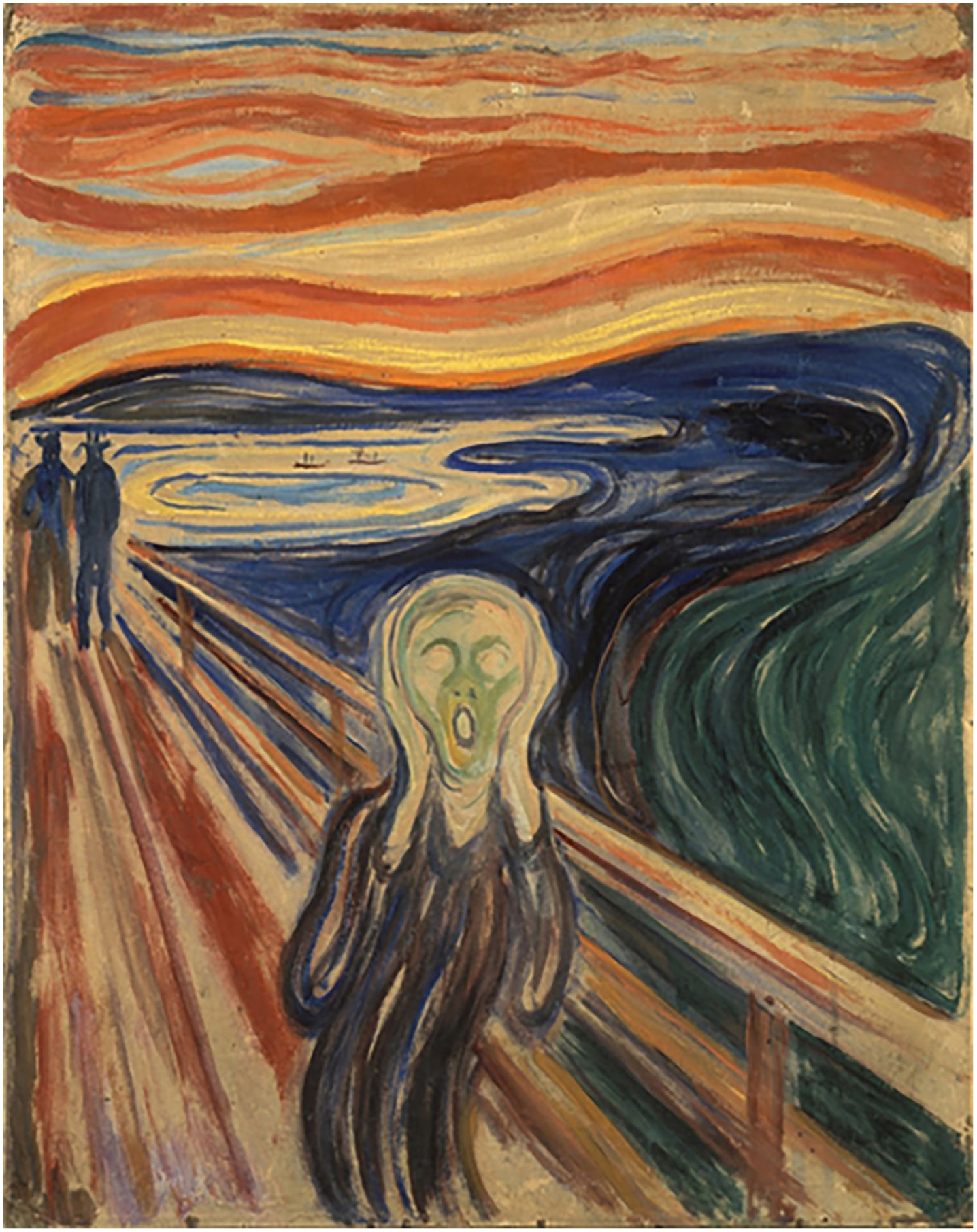
The Scream, by Edvard Munch (1893). Licensed under public domain. Image courtesy of Wikimedia Commons.
Languaging
Languaging is the third concept of the first principle of humanbecoming. The first principle of humanbecoming is that “structuring meaning is the imaging and valuing of languaging” (Parse, 2021, p. 41). Languaging is “signifying valued images with speaking–being silent and moving–being still” (Parse, 2021, p. 45). In the experience of feeling afraid, individuals signify their structured meanings through expression and concealment. For some, feeling afraid may surface as trembling hands or hurried speech, whereas for others, it may manifest as frozen stillness or withdrawn silence. With languaging, individuals express their experience of being afraid through spoken and unspoken language. Languaging happens in the humanuniverse—it is a mutual, cocreated process of structuring meaning. As individuals language their experience of feeling afraid, they engage in a shared unfolding of meaning that reflects, responds to, and reshapes their lived reality in the emerging now.
The artform of Munch in Figure 2 embodies the paradoxes of languaging. In speaking–being-silent, the figure’s mouth is wide open, seemingly screaming, but the figure may be engaged in a silent scream. The silence of the painting suggests that the scream is unheard, lost in the vast surroundings, where being afraid is both expressed and suppressed, vocalized yet unheard, shared yet isolated. In moving–being-still, the figure is frozen in place, unable to escape, while the swirling background moves chaotically, symbolizing the intolerable experience of being afraid. Individuals may feel the urge to move and yet are immobilized by hesitation and unable to break free from the cage of being afraid.
Originating
The third principle of humanbecoming is that “cotranscending with possibles is the powering and originating of transforming” (Parse, 2021, p. 51). Originating is inventing new ways of “distinguishing personal uniqueness by living the paradoxical rhythm of conformity-nonconformity and uncertainty-uncertainty all-at-once” (Parse, 2021, p. 54). Individuals struggle with the tension of seeking to be like others yet asserting uniqueness. Individuals are uncertain whether conformity will bring acceptance or nonconforming will lead to rejection. Individuals live with “the ambiguity of the consequences that are not yet known explicitly, the sure-unsure exist all-at-once” (Parse, 2021, p. 54).
In the artform, the physical separation symbolizes the struggle of nonconformity—fear that may lead to alienation and rejection. Conversely, the distant figures represent the path of conformity, walking forward in a coordinated, expected approach, symbolizing social norms. The swirling sky and fluid backdrop symbolize uncertainty, where the external world looks unstable and unpredictable. The solid bridge could represent certainty, yet the figure remains frozen, unable to cross or take refuge, caught between being afraid of the unknown and the safety of known. The central figure’s scream with silent terror embodies the uncertainty of being afraid of losing control, of being consumed by chaos, or of making a choice that cannot be undone.
Connecting-Separating
Dissociating affiliations may be connected to connecting-separating, one of the concepts in the second principle of humanbecoming: “Configuring rhythmical patterns is the revealing-concealing and enabling-limiting of connecting-separating” (Parse, 2021, p. 47). According to Parse (2021), connecting-separating “is attending-distancing; it is living being and apart from others, ideas, objects, and situations all-at-once” (p. 50). Parse (2021) added that connecting-separating “is the communion-aloneness source of humanuniverse emergence” (p. 50). When feeling afraid, individuals reach for connection while all-at-once retreating with separation. Individuals continue to live and are present in an everyday living experience of connecting-separating, a core concept in the humanbecoming paradigm, which emphasizes the rhythmical pattern of being with and apart from others, ideas, objects, and situations—all-at-once (Parse, 2021). Feeling afraid emerges as individuals navigate the certainty-uncertainty of acceptance. Connecting-separating arises with desires of closeness yet fear of exposure. Connecting-separating emerges in moving with and away from others, ideas, objects, and situations. This constant movement with engaging and withdrawing cocreates ambiguity, often with apprehension fueling the experience of feeling afraid.
In Figure 2, the figure stands alone on the bridge and is physically separated from the two distant figures with their backs turned away from the scream. The proximity of others who remain perceptually unavailable may amplify the ache of separateness amid shared space. The bridge upon which the three figures stand serves as a symbol, caught between moving onward with connecting-separating. The bridge’s railing may also symbolize a barrier—something to hold onto or something that confines—inviting reflection on the boundaries individuals create or cling to in the tension of reaching out and pulling back. The swirling lines and distorted colors in the background evoke a turbulent atmosphere, as though the environment itself is part of the figure’s internal fragmentation. The figure’s open-mouthed expression suggests that the scream may be a silent and unheard plea for connection, yet the posture reflects withdrawal, mirroring the paradox of connecting-separating.
Beyond the Horizon
The scholar used the humanbecoming concept inventing model (Parse, 2018, 2021) to conceptualize the universal human experience of feeling afraid. As the concept of feeling afraid was explored, the scholar’s now-truth or understanding of this experience at the moment emerged as paralyzing hesitation arising with daunting uncertainties of dissociating affiliations. The ingenuous proclamation of feeling afraid articulated as a theoretical statement at the scientific level of discourse was languaging the originating of connecting-separating. The chosen artform was the expressionist painting by Edvard Munch (1893) titled The Scream. As the scholar engages with the Parsesciencing inquiry on feeling afraid, the conceptual and theoretical foreknowings emerging from this concept inventing deepen understanding of feeling afraid, enrich the humanbecoming paradigm, and advance nursing knowledge of a universal humanuniverse living experience.

