






Abstract
This scholarly dialogue with Dr. Steven L. Baumann elucidates the meaning of nursing sciencing through the sharing of his experiences, knowledge, and insights as an outstanding nurse, nurse educator, and nurse scholar. Dr. Baumann’s scholarly endeavors through nursing sciencing address human experiences and what is important to being human.
There are various ways of understanding nursing science. Parse (2001) explained sciencing, contrasted from science, as “the ongoing process of inquiry that specifies knowing as the continuous incarnating of the unfamiliar with the familiar” (p. 1) to advance knowledge guided by the theories of the discipline. Thus, sciencing does not pursue the absolute truth but focuses on “coming to know” (p. 1), which is useful to know the truth for the moment from human experiences. A leading nursing scholar and educator, Dr. Baumann is invited to this scholarly dialogue to discover the identity of nursing as a fundamental discipline through his unique pursuit of nursing sciencing with his shared scholarly experiences.
Dr. Baumann is a Professor in Hunter College, New York. He earned his PhD in nursing from Adelphi University and has been teaching nursing for over 40 years. Serving as a contributing editor for Nursing Science Quarterly, he has been casting light on global health issues and sharing the distinctive outlook of fundamental topics in nursing. He has authored more than 180 articles in the discipline of nursing and dedicated to the prosperity of nursing sciencing and discipline. He was the recipient of the President Hunter College’s Excellence in Teaching Award in 2017 and the Nursing Science Quarterly Best Paper Award in 2022.
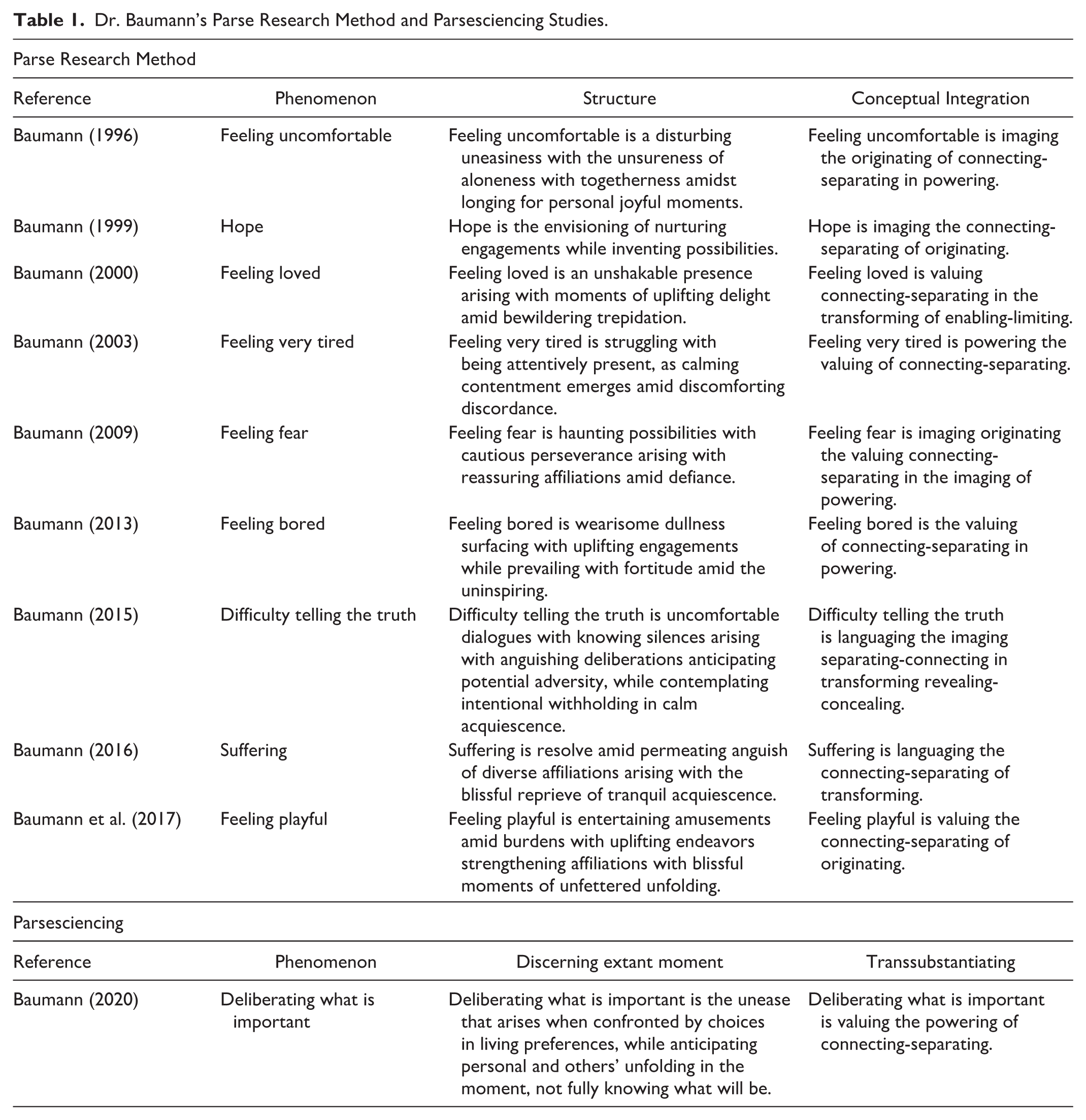
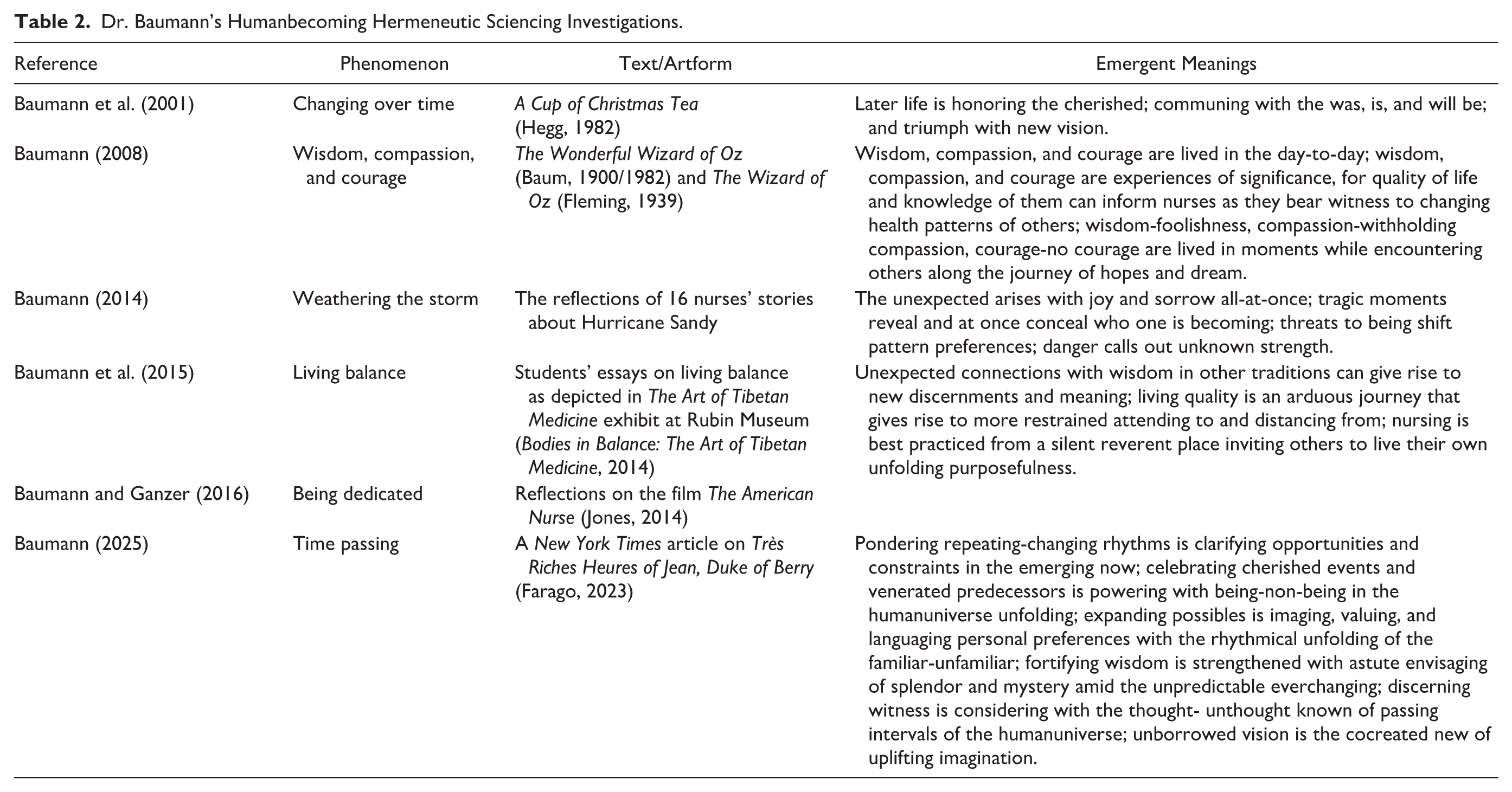
He has been developing and advancing nursing knowledge on universal humanuniverse living experiences using the Parsesciencing and the humanbecoming hermeneutic sciencing modes of inquiry. His scholarly work has made significant influences on nursing sciencing and unfolded the unlimited possibilities for the nursing discipline. He has discovered new nursing knowledges on human experiences and conducted more than 10 phenomenological-hermeneutic studies using the Parse research method and the Parsesciencing mode of inquiry (see Table 1). Furthermore, newknowings with the emergent meanings of universal humanuniverse living experiences were explored through his humanbecoming hermeneutic sciencing inquiries (see Table 2) with descriptions of texts and artforms. Dr. Baumann’s scholarly endeavors to advance nursing sciencing through rigorous scientific inquiries provide nurse scholars with a precious opportunity to reflect on the meaning of nursing sciencing and guide them in pursuing nursing sciencing along the right path.
Dr. Baumann’s Parse Research Method and Parsesciencing Studies.
Dr. Baumann’s Humanbecoming Hermeneutic Sciencing Investigations.
Dr. Baumann, thank you for participating in the scholarly dialogue and sharing your thoughts, ideas, and experiences on nursing and nursing sciencing.
Thank you for asking.
It is very impressive that you have uniquely contributed to nursing discipline through your scholarly endeavors of consistently pursing nursing sciencing. As the first question for the scholarly dialogue, I would like to ask what led you to the discipline of nursing and inspired you to continuously pursue the scholarly activities in the field.
As I did well in my high school science classes and wanted to work with people, I decided to become a healthcare professional. My initial plan was to become an optometrist, but after a year as a chemistry major, I realized becoming an optometrist was going to take longer than I thought and there was no guarantee that I was going to get into the optometry school, a SUNY school in New York City, that I wanted. It was a little bit of crisis at that time, but my sister was a nursing student at that time at a Catholic college, and I saw the books she was reading, which included books on philosophy, religion, psychology, as well as sciences, all of which interested me. In other words, the nursing curriculum was broader, more aligned with myself, and more interesting to me and still is. So, I realized I did not need to be a medical doctor and decided to switch to nursing. I think I had been pushed to think about being a doctor by others, but it wasn’t essential for me to have a medical doctor title, and this would be a better plan to do nursing. So, that’s how it happened.
Many people don’t know that nursing has its own philosophy and theories and easily assume nursing only as a practice. However, nursing is a discipline grounded with philosophical and historical foundations, and nurses would be responsible for informing people of this.
Yes. Right. It brought me to the next level of education. I decided to go back to graduate school. In my first semester of my graduate nursing program in psychiatric nursing at The Catholic University of America, I do recall that we had a theory class. We were asked to pick two nursing theories and compare them. It was very stimulating, so I picked Martha Rogers’ science of unitary human beings (Rogers, 1986) and Paterson and Zderad’s humanistic nursing (Paterson & Zderad, 1976). I compared the two theories. I thought I had an interest in both, to some degree. The reason I probably did was that in the summer before I went to the graduate school, I had read Abraham Maslow’s The Farther Reaches of Human Nature (Maslow, 1971), Carl Rogers’ On Becoming a Person: A Therapist’s View of Psychotherapy (Rogers, 1961/1995), and Teilhard de Chardin’s The Divine Milieu (Teilhard de Chardin, 1960/1965). This combination of humanistic psychology and the spiritual focus in science influenced me greatly and helped me clarify my ontological assumptions about the world and people.
When I was in my doctoral program, I got to hear Dr. Parse, who gave a presentation at Adelphi University one evening. I was very interested in her theory. I wanted to use it for my dissertation, but my committee talked me out of it, and I used Giorgi’s method of doing a phenomenology instead (Giorgi, 1985). Dr. Parse’s theory also added to my interest in teaching at Hunter College, where she was teaching at the time, and the Research Associate Dean and I were able to work with her.
Thank you for sharing your experiences. I think the nurse scholar’s perception on nursing theoretical frameworks and conceptual systems will determine the choice of the phenomenon of interest and the methodology of the inquiry. Can you elaborate on your insights into the unique identity of nursing?
I have, since high school, been interested in ideas and questions at the intersection of the natural sciences, religion, philosophy, and psychology. My view of nursing is that it is based on all these fields of knowledge and was a service profession working with people in need. Nursing is dedicated to people who are in need.
Your scholarly journey has been highlighting the uniqueness of the nursing discipline by expanding nursing knowledge based on the philosophical and theoretical perspectives of the humanbecoming paradigm. Can you explain more about your journey with the humanbecoming paradigm?
As I said, for my dissertation, with some direction from my advisor and faculty, I decided to do a phenomenological study on the experience of home and homelessness using Giorgi’s (1985) phenomenology method. In the dissertation I did a critique of Sister Callista Roy’s (1984) adaptation model as being too reductionistic for my phenomenological study. I was more interested in the science, which could honor the complexity, freedom, and dignity of human beings found in Dr. Parse’s work. I wanted a theory and method that would do justice to questions and studies of what it means to be human.
I was able to get a job offer from Hunter College, right after doctoral work. The chair of the search committee at Hunter when I came in for an interview was Dr. Elizabeth Barret, who I did not know at the time was a Rogerian scholar. She and the rest of the interview committee suggested I would work well together with Dr. Parse and asked me to wait in the lobby. After a short wait, they came and offered me the job.
At Hunter, I got to work with Dr. Parse as well as Elizabeth Barret and Violate Malinski. In addition to attending the very first International Consortium of Parse Scholars (ICPS), I also attended Rogerian Dialogues at New York University. At the dialogues I met John Phillips, Richard Cowling, Howard Butcher, and Margaret Newman. At Hunter I also met a graduate student named Bill Cody. I was very fortunate because the Dean at Hunter College in those years was Evelynn Clark Gioiella who had helped Dr. Parse start Nursing Science Quarterly and was supportive of me using her theory and method.
The humanbecoming paradigm has been the paradigm that was the basis of my practice and my philosophy of being a nurse. I have described it as an antidote to reductionistic science and medicine. In other words, the humanbecoming paradigm (Parse, 2021) provides an alternative view of persons and health and helps nurses avoid negative social stigma and labeling people. The humanbecoming paradigm was, again, a good fit. It is a paradigm that honors all people.
As a senior Parse scholar, you have conducted many nursing investigations from the humanbecoming paradigm. Your studies have contributed to enhancing the understanding of universal humanuniverse living experiences, using all two modes of inquiry unique to sciencing humanbecoming: Parsesciencing and humanbecoming hermeneutic sciencing (Parse, 2021). I believe those two modes of inquiry are distinctive. Could you help the reader better understand those two modes of inquiry?
Yes, I am happy to do so. Both methods explore universal humanuniverse living experiences. That is something they share. The difference is that Parsesciencing relies on what arises from dialoguing-engaging on a phenomenon with the humanbecoming scholar. These dialogues generate narrative data, but they are to some degree limited to what verbal language can communicate. On the other hand, the humanbecoming hermeneutic sciencing also studies universal humanuniverse living experiences, but it does that by intensive study of artforms. I don’t know if it can be done with artforms created by computers, probably not, but it is a good question for future thought.
I have learned the value of art as a way to access human experience from studies involving children. While children lack sophisticated language, they freely express themselves in art. The meaning of their artworks still needs the child’s voice, but the visual expression provides a vehicle of their expression and a window to their view of their world. I also appreciate children’s willingness to “have a go at it,” less inhibited by social expectation and censorship than most adults for the most part.
Sir Ken Robinson in his popular TED Talk (Robinson, 2006) tells the story of a child doing a drawing in class; when her teacher asks, “What are you drawing?” she says, “God,” to which the teacher says, “No one knows what God looks like,” and the child says, “They will soon.” Good artwork by adults does the same thing. Both approaches explore meaning, which is both the essence of what we communicate and about our purpose for living. Art, like nursing, is for me a loving service to those in need, not only helping them deal with health and human challenges but co-create a life worth living.
It seems that as formal modes of inquiry, Parsesciencing and humanbecoming hermeneutic sciencing are unique and distinct from other commonly used quantitative or qualitative methodologies. Why is it important to choose a proper mode of inquiry congruent with the theoretical framework of the inquiry?
Dr. Parse has always argued the importance of having a mode of inquiry (methodology) that is congruent with the theoretical framework and the nature of existence (ontology). If people are not staying consistent with their ontology and methodology, the interpretation of the data, sometimes obtained from narratives from interviews, will not lead to clarity but just add confusion, which is widespread out there. People, including researchers, use the same words but with far different meaning. Incongruence can lead the interviews to generate data that is a mess. It is not uncommon for researchers who are trying to do qualitative research to use the language and assumptions more aligned with the quantitative inquiry, so they don’t even know the difference in their language because they got so much exposure to quantitative. They just bring it over, but it just leads to confusion.
Drawing from your sustained experiences of scholarly activities, in what ways do you anticipate the investigations guided by the humanbecoming paradigm will contribute to advancing nursing sciencing?
The humanbecoming paradigm guides research, asking different kinds of questions from other paradigms. Once Dr. Ortiz, the Dean at the University of Indiana, South Bend, at that time, invited me to be a respondent to a national nurse leader, Dr. Bernadette Melnyk, who was the guru of the evidence-based practice and quantitative research, and still is. I could not help noticing that her presentation was highly effective because she told stories, including about the individual person’s experience, with considerable skills and passion. Even though she was a quantitative researcher, she appreciated communicating about individuals’ experiences. I did not point it out at the time, but I suggested in my remarks that the type of research she was promoting was good at comparing two approaches in nursing to see which would be more effective to address specific health issues. However, it did not address some very important questions about what it means to be human and how you should be with others. Particularly, it did not appreciate human freedom or search for meaning, which I thought was critical, as well as wholeness and authenticity, which are I think related to tenets of existentialism and more aligned with the humanbecoming paradigm. I suggest humanbecoming-guided research was better able to address human experiences and what is important to being human. I don’t say her work was better or worse; it just addressed different kinds of questions.
In your article, “A Humanbecoming Program of Research” (Baumann, 2012), you explained “the clearest ripple effect of studies done by this author” (p. 18), illustrating a series of studies, continued from “The Meaning of Being Homeless” (Baumann, 1993), “No Place of Their Own: An Exploratory Study” (Baumann, 1994), and “The Lived Experience of Feeling Loved”(Baumann, 2000). I found it interesting that doing a series of phenomenological studies linked with the humanbecoming paradigm has provided you with life-changing endeavors. I am confident that newknowings flowed out of the historians’ descriptions through a Parsesciencing study give new insights into a new study. Likewise, I fully anticipate that the newknowings arisen from your Parsesciencing investigations will expand the understanding of human experiences not only for your benefit but for other scholars who inquire about living experiences as well. Can you please share your valuable experiences of conducting a collection of Parsesciencing investigations with your dedication and coherence in pursuit of living as a Parse scholar?
I may have mentioned it earlier that I appreciate research as a cyclical process in that you endeavor to uncover meaning and new understanding, and you have findings that are useful and interesting, but you also end up with new questions after you finish a study. Perhaps, those new questions are better than the questions you started, ideally, or at least they contribute to the process. Also, as your question suggests and this is true of all studies of universal humanuniverse living experiences, the scholar has been changed by the research process; he or she is a different person from someone who was before the study began, interested in a different aspect of the same or similar phenomenon. Also, the cumulating findings add to the discussion and understanding. In addition, the humanbecoming sciencing has been advanced and encouraging other researchers like the Hope book (Parse, 1999). There were 17 different researchers on the same phenomenon of hope with the same mode of inquiry, but the findings were significantly different. We combined them and made a book trying to pull them together. When we perform advanced sciencing, the meaning of words becomes clearer, such as the word “sibling” or “fathering” that I explored, in a way that I had never perceived before. To be honest, I did those two studies in large part for myself, because I needed to do them to make sense of what I was going through. It was a deep dive into my own experiences, which helped me resonate and be in true presence with the historians. It was a self-exploration as well as contribution to nursing sciencing. I also must admit with my recent humanbecoming hermeneutic sciencing of time passing (Baumann, 2025) that I feel I have only achieved a very partial understanding of the phenomenon. Therefore, questions remain unanswered for me and the need to know more remains.
You just said you felt that you could achieve only a partial understanding of time passing and there are more unanswered questions. I believe that the article, “The Art of Time Passing: A Humanbecoming Hermeneutic Study of Très Riches Heures,” published in 2025, plays an important role in diversifying nursing sciencing and broadening our understanding of the nursing investigation. I also trust the hermeneutic nursing scientific investigations on the meaning of human experiences through the investigator’s perspective with texts and artforms will expand the horizon of nursing sciencing. It was very impressive to find the meaning of time passing from your interpretation of an artform and then relate the created meaning to the living quality of the humanuniverse. Could you elaborate on your perspective on the value of art in nursing sciencing?
As I already alluded, I believe that art provides a unique and valuable window into human experiences. Hearing a piece of music, for example, can access human emotions and memories, which in turn facilitates new understanding of experience that may have occurred decades ago, but remain somewhat not understood, disturbing and confusing. Art can engage and provoke human reflection and contemplation of matters that are essences to being human. It also stimulates conversation and communication with others, which can elevate the science. It helps to find words for things that we find hard to talk about as efforts to put into words what without it would remain ineffable.
Yes, I agree. With everchanging understanding of living experiences, as you mentioned, the interpretation of an artform does not stay the same but changes with the reflection and contemplation. On behalf of junior scholars who are pursuing nursing sciencing, would you offer some advice and share your wisdom?
I have appreciated the value of balancing among active clinical practice, teaching, and scholarship, even if the scholarship has been somewhat limited by not giving more focus or attention to the research. I think it is valuable to do research. So, I have tried to remain humble and content to be a follower and an active learner, and whenever possible do what my bosses and employers ask of me to do. Most importantly, I try to be compassionate and service-oriented to my patients, students, and historians.
As a nurse educator you have shared your visions on nursing education in the article of “Transforming Nursing Education and the Formation of Students: Using the Humanbecoming Paradigm” (Donohue-Porter et al., 2017). The environment of nursing education has been rapidly evolving, calling for transformation in nursing education. I would be interested in hearing your insights on contemporary nursing education. How should nursing education be steered moving forward, and what fundamental changes are essential to achieve this?
I am not sure I can answer it exactly as you asked, but I suggest continual learning is essential. Being an open-minded learner is critical, learning first and foremost from patients, if you have contact with patients and from research participants, students, and colleagues as well. In the past few years, I have enjoyed being involved in an interprofessional education program funded by the Mother Cabrini Foundation that has brought social work and graduate nursing students together to learn together. I think there are advantages in healthcare for all professions to do interprofessional collaboration. I am also impressed with the value of using live models and simulations, which are not new, but it is impressive particularly when nurses are observed by others of the same and different disciplinary background. I am also interested in self-reflective practice, looking at not only what worked but also what did not work and learning from errors and mistakes, which always facilitates ongoing professional improvement as a nurse, nurse education, and researcher. I think it is a key thing.
Would you like to add anything more for the nurse readers of Nursing Science Quarterly?
To be a nurse, nurse educator, and nurse researcher takes a fair amount of courage. When I conducted the humanbecoming hermeneutic sciencing of study of The Wizard of Oz (Baumann, 2008), the importance of courage cannot be understated in nursing and living a life worth living. I have highly valued nurses and it has been the best decision in my life to become a nurse.
Thank you so much for your time and this great opportunity to know more about your scholarly endeavors, knowledge, and intuition in nursing. I believe they will resonate with many nurses, nurse educators, and nurse scholars.
