







Abstract
Common ground is vital for developing deliberative democracy. The current study employs text mining techniques to measure common ground in online political discussions and examines how the structure of political discussions coevolves with common ground over time. The present study collected 175,960 messages over a period of 13 months, from a popular discussion forum on 2012 U.S. presidential election. Common ground is measured by a semantic similarity network and an interpretive framework network. The former emphasizes shared political knowledge, while the latter emphasizes shared interpretations. In addition, this study explores the coevolutionary process of political discussion and common ground. Results were obtained by employing longitudinal network analysis. They suggest that political discussions could facilitate the achievement of common ground that might further serve as a facilitator of political discussion among the participants.
Introduction
One feature of a successful deliberative democracy is to discuss ways to finding common ground, if not reach a consensus (Levine, Fung, & Gastil, 2005). As argued by Gastil (2008), a deliberative community should cultivate a minimum level of shared language and symbols to ensure mutual understanding. Kim and Kim (2008) argue that before formal deliberation, people need to know each other in order to explore the common context and circumstances by virtue of informal discussions. Different from the classic deliberative theorists (e.g., Cohen, 1989; Habermas, 1962) who emphasize the role of common good in formal deliberation, more recent theorists suggest that a strong focus on the common good suppresses the consideration of conflicting interests. Instead, common ground is a place where people can find broad agreement (Mansbridge, Hartz-Karp, Amengual, & Gastil, 2006). For instance, when debating on Obama, some users are more supportive of Obama’s economic policy whereas others are against it. Regardless of supporting or opposing Obama, they are more likely to discuss it under the framework of “Obama-economic policy” rather than “Obama-war.”
Much past research in political communication has focused on political opinions (see Neuman, Just, & Crigler, 1992). Common ground, however, refers more broadly to what people think and how they structure their ideas, feelings, and beliefs about political issues. It is not merely the common knowledge that is shared by the public but also the shared interpretations of the common knowledge. Although many normative theorists conceptualized common ground as an essential component of healthy deliberation (e.g., Mansbridge et al., 2006), few empirical studies have systematically examined whether and how common ground evolves in political deliberation.
In the traditional media environment, shared knowledge is highly influenced by mass media and social economic elites (e.g., Neuman et al., 1992). The emergence of online discussion platforms has significantly changed the discursive landscape and provided new opportunities for ordinary citizens. Internet is being celebrated as an excellent tool for realizing horizontal communications among ordinary citizens. This possibly led to the revival of citizen deliberation and participation in public matters (e.g., Budge, 1996; Dahl, 1989; Rheingold, 1993). Online spaces allow for noncentralized communication of many to many (Janssen & Kies, 2005). Web features have the potential to increase citizens’ knowledge, political engagement, and participation (Kavanaugh et al., 2005; Papacharissi, 2002; Polat, 2005). Consequently, it is possible that online discussion spaces can enhance the visibility of minor political actors. However, in research, little attention was given to the question whether and how online political discussions among ordinary citizens have facilitated the achievement of common ground.
Given the importance of common ground in deliberative democracy and the lack of empirical research in the context of online situation, the current study employs natural language processing (NLP) techniques to measure common ground in a web discussion forum and examines how the structure of political discussion coevolves with common ground over time. In particular, this study focuses on the emergence of shared knowledge and interpretations of 2012 U.S. presidential election in a web discussion forum.
Theoretical Framework
Measuring Political Common Ground
Common ground is closely related to two aspects of political knowledge: content and structure. The content of knowledge refers to facts whereas the structure of knowledge refers to relationships between facts (Fiske, Kinder, & Larter, 1983; McGraw & Pinney, 1990). Similarly, Neuman (1981) dichotomizes “political thinking” by distinguishing between differentiation and integration. Differentiation is a measure of the number of pieces of political information held by an individual. Integration is the way that these bits of information are organized. This is also consistent with Graber’s (2001) concepts of denotative and connotative political information. The integration of various components of information is essential for creating a meaningful mental system in an individual’s memory (e.g., Collins & Loftus, 1975). Under this framework, Eveland, Marton, and Seo (2004) built a precise empirical definition of the structural component called knowledge structure density (KSD). KSD is defined as the extent to which individuals see connections among various concepts within the political domain analysis. The term density, borrowed from social network analysis, reflects this concept of interconnected nodes (i.e., concepts) within the cognitive network.
Although researchers in the past have generally accepted well-connected knowledge structure as an indicator of political expertise in political deliberation (e.g., Eveland & Hively, 2009), knowledge structure also reflects how the facts could be interpreted by individuals. For instance, many people possess reasonably well-developed Barack Obama, election, democratic, and economy schema. It implies people think about Barack Obama in detail. According to schema theory, once the stimulus is perceived, the relevant schema will be activated, which then guides individuals’ interpretations of social reality (Kuklinski, Luskin, & Bolland, 1991).
However, the measurements of political knowledge, per se, could not capture the essential aspect of common ground that emphasizes the shared reality and interpretation across individuals. Previous studies conducted surveys to find out the aggregate percentage of people holding a similar political reality. The problem with the surveys was that, including the facts and the relationships between the facts are predefined by the researchers. This top-down approach is hard to trace how the salient facts and interpretations emerge from individual interactions. Online discussion platforms, which archive massive messages of political discussions, provide new opportunities for a bottom-up approach. This would enable observation of the evolution of common ground in long-term discussions. It is then possible to infer what the users know and how they think about the facts. This can be done by observing what they say on the Internet.
This study proposes that common ground is the shared facts and interpretations that are embodied in political discussions. Unlike previous studies that measured knowledge at an individual level, investigating how common ground is produced through political discussions calls for measuring common ground at the dyadic and network level. According to the definition, the measure of common ground includes two aspects: the shared knowledge and the shared knowledge structure across individuals. First, the semantic similarity between discussion partners represents to what extent participants are using similar language and are talking about the same things. Second, the relationship between concepts (i.e., co-occurrences) represents the structure of knowledge: how individuals interpret the facts. Accordingly, two cognitive networks could be constructed. Following the terminology of social network analysis, a semantic similarity network (SS) consists of discussion participants (nodes) and semantic similarity relationships (edges), while an interpretive network (IN) consists of core concepts (nodes) and co-occurrence relationships (edges). The cohesiveness of SS and IN indicates the degree of common ground achieved across the participants, in terms of shared knowledge and shared interpretations, respectively.
Political Discussion and Making of Common Ground
Deliberative theorists argue that informal political discussion could facilitate the achievement of common ground that will prepare participants for subsequent deliberation (Levine et al., 2005). Ideal deliberation generally aims to help different subgroups learn about each other through mutual reflection. Once each subgroup understands how the other thinks, it is easier for them to avoid conceptual confusions, symbolic battles, and epistemological thickets that could potentially derail a deliberative process. The informal discussion does not resolve moral disputes or advance policy goals; rather, it prepares group members for the necessary but challenging process of making common decisions together, despite deep underlying differences.
Asynchronous discussion forum has long been seen as a tool for political deliberation that provides an ideal space for large-scale political discussion (e.g., Coleman & Gotze, 2001; Goodin, 2003), evokes exciting reactions in the context of democracy and civil society (Corrado & Firestone, 1996; Himelboim, 2011), and allows citizens to participate within their daily schedules (Hauben & Hauben, 1997). It allows citizens to be exposed to and participate in discussions on diverse public issues. Discussions in web forums are organized in the form of conversation threads. A thread is a collection of a seed post and its corresponding replies usually displayed in chronological order. People can freely initiate a conversation by posting a seed post and can join a conversation by replying to others’ discussions. When using web forums, users make their own decisions whether to read or reply to a post. The major difference between a web forum and a Usenet newsgroup is that the newsgroup automatically delivers every new message to its subscribers. A forum, on the other hand, requires users to visit the website and check for updates. In this sense, users of web forums are more selective than newsgroup users. Forums also differ from chat rooms and instant messaging services in their asynchronous communication. Participants of a discussion thread do not have to be online at the same time to receive or send messages. Thus, forum users have more time to respond deliberatively to others.
Compared with social media platforms like Facebook and Twitter, the major difference is that web forum discussions are organized on the basis of political issues rather than social relationships. Network relationships on Social Networking Sites (SNSs) refer to important social cues that might cause social-influence bias in receiving and processing information as well as discussion patterns. To some extent, political discussions on web forums are the least restrictive forms of online communication till now. Despite this difference, web-based forum is a classic form of user-generated content platform. It contains the core characteristics of online communication that are inherited by more recent social media platforms.
However, whether online discussion could serve for healthy deliberation or not is still largely controversial. Optimists hope that it will increase mutual understanding, whereas the pessimists argue that it could also increase polarization (see Wojcieszak, 2010). Internet users are unlikely to foster sincere, respectful, and understandable debates. Instead, online discussion spaces could drive users apart rather than together (Sunstein, 2001). According to this view, if one has the choice to discuss with a person, she or he will avoid getting in contact with opposing-view users, and this leads to attitude polarization. Although the general public are less polarized than the elites (Fiorina, Abrams, & Pope, 2005), access to the Internet is not distributed equally across groups of different demographic characters but depends on factors such as income, education, and gender (DiMaggio, Hargittai, Neuman, & Robinson, 2001). Voices of privileged segments of a society are often overrepresented in online political discussions. Those who are politically active produce most of the messages in web forums (e.g., Himelboim, 2011). The elite dominance in online discussions might increase the possibility of online polarization. However, more recent works (e.g., Mossberger & Tolberts, 2010) suggest that there is a generational change: Demographic gaps are closing.
Given this controversy, the first purpose of this study is to examine whether the SS network and IN network would become more cohesive over time. The cohesiveness of cognitive networks could be measured in terms of social network analysis, by calculating the density, clustering coefficient, and modularity of the cognitive networks. Therefore,
In order to examine the network-level characteristics of common grounds over time, this study further questions whether discussion partners would become more in sync or think alike when it comes to either posting messages in web forums or responding to intensive political discussions. Even if there is a cohesive common ground that emerges in web discussion forums at the aggregate level, it is hard to establish the causal relationship between political discussions and the emergence of common ground at the individual level. It is possible that common ground makes them discuss as a group as well as makes them start to think alike as a result of these discussions.
Shared reality theory (Hardin & Higgins, 1996) was developed in social psychology and was successfully applied to political studies (Jost, Ledgerwood, & Hardin, 2008) to explain how social verification converts opinions from subjective to objective. It upholds the fact that people are motivated to achieve mutual understanding or “shared reality” with specific others in order to (1) establish, maintain, and regulate interpersonal relationships and (2) reduce uncertainty and achieve a valid and reliable understanding of the world. This theory implies a coevolutionary process between political discussion and common ground.
First, peer influence could operate in this process to produce mutual understanding through political discussions. In order to maintain the conversation in a discussion thread, users are expected to tailor their expressions to suit the audience as long as they are aware of how others think about the issues. Therefore,
Furthermore, cross-cutting debate (i.e., the frequency of discussions between participants supporting different political ideologies) may moderate the relationship between discussion and common ground. In addition to tuning messages toward similar ones, people could “antitune” messages from politically dissimilar others (Hardin & Higgins, 1996). Jost, Ledgerwood, and Hardin (2008) combined self-identity and social-categorization theories to argue that people are more inclined to align with the ones who come from the same ideological group.
Second, in order to reduce uncertainty and achieve validation from others to protect common understanding, people prefer to select discussion partners who share similar knowledge and interpretations as theirs. Therefore,
Method
Data Collection
In order to collect a complete discussion network, the data set of this study included all threads and messages posted in the section “2012 US Presidential Election” on debatepolitic.com (http://www.debatepolitics.com/us-elections/). There were 175,960 messages in 2,372 discussion threads in the final record. The total number of authors involved in the discussions was 1,178. The following information was extracted for each post or reply: text of the message, time of the message posted, author’s name, author’s name that is mentioned in the message, political lean of the author, and URL of the thread.
Political leans are explicitly provided by debatepolitics.com. The platform forces users to select their political leans from a list of 18 items. The items are organized under three categories: left (recoded from liberal, libertarian, libertarian left, libertarian right, progressive, slightly liberal, socialist, very liberal, and communist), right (conservative, slightly conservative, and very conservative), and neutral (centrist, moderate, independent, and other). Of the 1,178 participants in the election sample, 32% (376) are left wing, 21% (243) are right wing, and 47% (559) are the centralists. Compared with the population of registered voters in 2012 presidential election (American National Election Studies [ANES], 2008), the liberals in this forum are overrepresented.
The average number of messages generated by the 1,178 users is 149, over a period of 13 months (October 5, 2011 to November 8, 2012). The overall distribution of user participation is highly skewed. In all, 206 (17.5%) participants posted only one message. The maximum value of postings is 9,411. There are 13 authors who didn’t receive any reply and 239 authors who received only one reply. The maximum value is 9,452.
Quantifying Common Ground
NLP techniques were employed to measure SS and IN framework. Following standard NLP procedure, stop words (e.g., a, an, the), punctuation marks, and white spaces were removed from the raw texts.
To measure the SS between discussion partners, bag-of-words model was employed. After a given time interval

SS ranges from 0 (completely dissimilar) to 1 (actually the same). Accordingly, SS network was constructed by using users as nodes and SS as the weighted edges.
IN network was measured by a word co-occurrence matrix. Word co-occurrence frequency
Cohesiveness of cognitive networks was measured by density, clustering coefficient, and modularity. The density of a network is the ratio of the number of edges and the number of possible edges. Clustering coefficient measures the probability where the adjacent nodes of a node are connected. The modularity of a graph is concerned with how separated the different node types from each other are (Newman, 2006).
Modeling the Coevolutionary Process
Actor-based approach that models the coevolution of several social networks (Ellwardt, Steglich, & Wittek, 2012) is specifically useful in the current study to examine the relationship between political discussion and common ground at the individual level. To date, researchers have used the program Simulation Investigation for Empirical Network Analysis (SIENA) to carry out the statistical estimation of models for repeated measures of social networks. The basics of the model are detailed in Snijders, van de Bunt, and Steglich (2010). In short, actor-driven model assumes that change in network ties occurs due to individual decisions. There are two submodels to estimate when an actor can make a decision (rate function) and what decision the actor makes (objective function). Following Ellwardt, Steglich, and Wittek (2012), a variant of the SIENA model that allows the study of multiplex networks was used. Both multiplex networks, that is, discussion network and SS network, serve as explanatory and outcome variables in this study. More specifically, the model estimates whether a change in one codependent network causes a change in another codependent network.
Modeling the coevolution relationship between discussion network and IN framework is based on Snijders, Lomi, and Torlo (2012) dynamic model of two-mode and one-mode networks. Discussion network is a one-mode network, while description of the similarities and differences between individuals’ IN networks is a two-mode network. Instead of measuring IN network as a word co-occurrence network, the present study calculates word co-occurrence matrix for each individual. Therefore, there is a bipartite network in which nodes are discussion participants (Mode 1) and word co-occurrence relationships (Mode 2), while edges are the associations between participants and word co-occurrence relationships. Figure 1 illustrates these relationships. Circles represent participants (i, j) and squares represent the word co-occurrence relationships
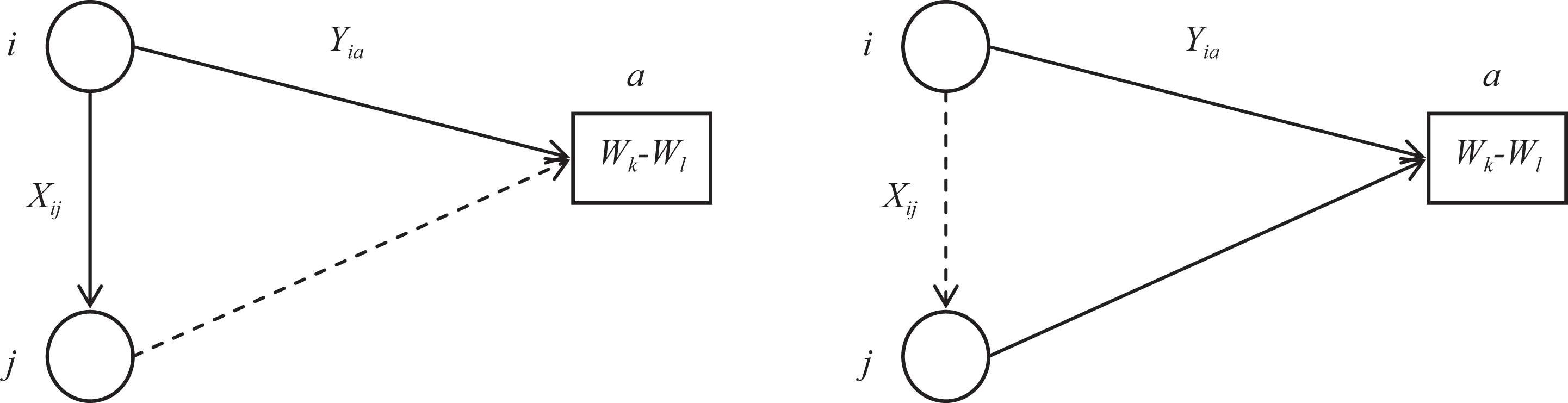
The coevolution of discussion and interpretive network.
The coevolution between discussion network and the bipartite network reflects how individuals alter IN networks based on previous discussions and how the commonalities can structure user discussions in web forums. The most mentioned 50 edges (words associations) in the IN networks are selected to construct a bipartite network. The reason to choose 50 edges is because 50 edges are sufficient to represent a meaningful network at the aggregate level (see Figure 2). Since the stochastic actor-based model strategy requires discrete time points, the event stream of forum discussions had to be divided into several episodes. Sliding window approach is a commonly accepted method to achieve this. Due to computation complexity, the messages were segmented into four episodes (therefore, nearly 3.5 months per segment). In order to make the densities of discussion networks similar across time periods, the networks were segmented into 43,990 (175,960/4) messages each. Segmentation according to the quantity of messages excels the method merely based on time interval, because the selection of interval length could affect the measured properties, for example, cohesiveness as described above.
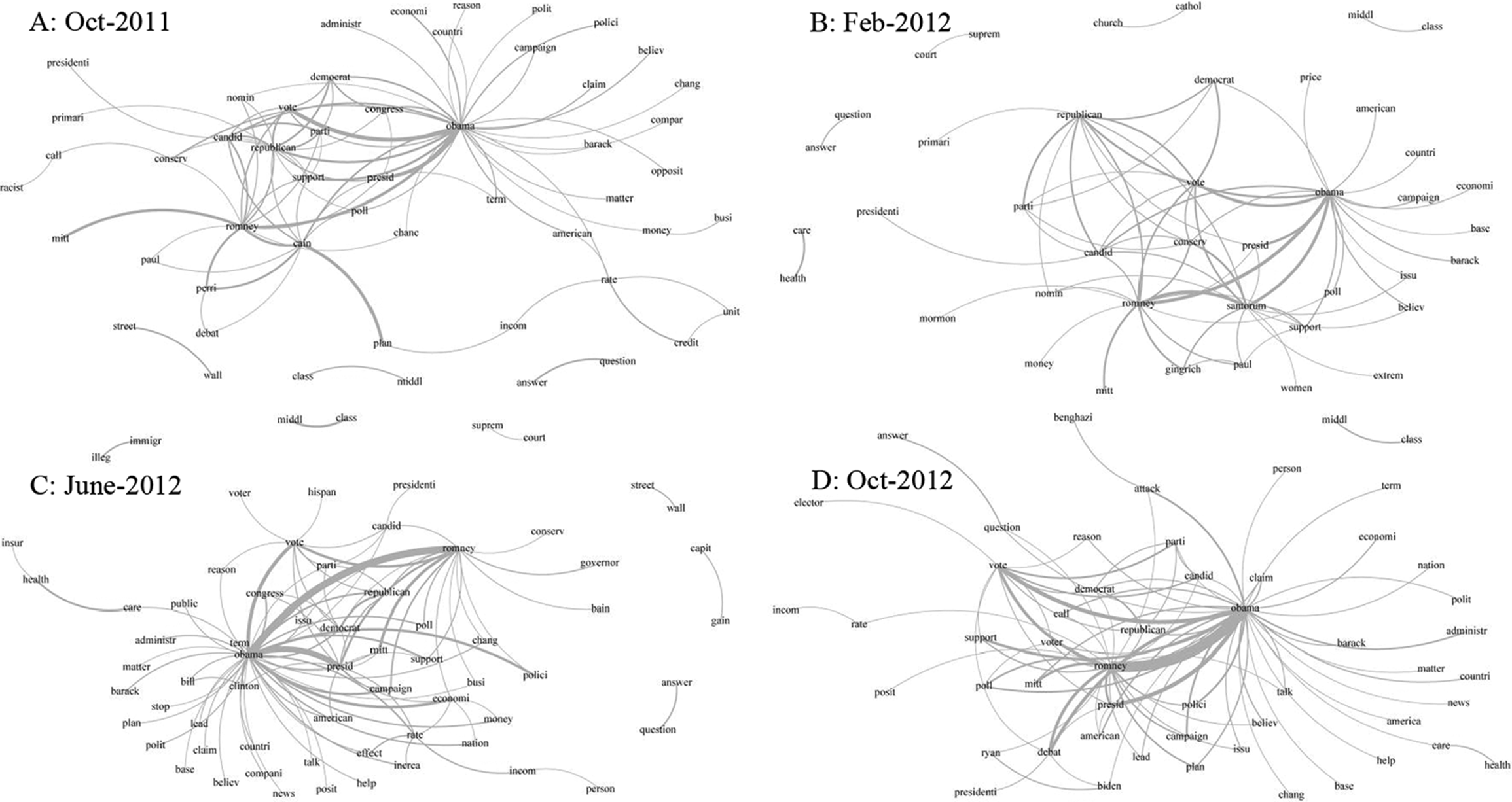
The interpretive networks over time. October 2011 (modularity is 0.09), February 2012 (modularity is 0.07), June 2012 (modularity is 0.04), and October 2012 (modularity is 0.00).
Besides the segmentation of forum messages, dichotomization of network edges is another problem for stochastic actor-based modeling. To make them fit the model estimation, the cutoff point of SS network was set at 0.34, which means 34% of overlap between user discourses is considered as existence of an edge, where the IN network’s cutoff point was 1 and was 9 for discussion network. All edge weights above these values are recoded as 1 and those edges below these values are recoded as 0. The choices of cutoff points and sliding windows, though are arbitrary in nature, perform better with model estimation. According to previous experience (Snijders, van de Bunt, & Steglich, 2010), a good estimation using SIENA requires the Jaccard index above 0.30. That means, 30% of the ties do not change over consecutive waves. In the current study, the choices of cutoff points and sliding windows are based on maximizing the Jaccard index. Different combinations of the choices were made to test robustness. The results suggest that the choice of cutoff points does influence the overall fit but shows no qualitative differences in terms of parameter direction and statistical significance.
Findings
Common Ground Over Time
Since there were many early leavers and newcomers every month, the evolution process was examined on a monthly basis rather than on a cumulative basis. From October 5, 2011 to November 8, 2012, there have been 13 complete months in the election sample. Over the 13 months, user activity in presidential discussion had increased rapidly, beginning in June 2012. In October 2012, there were 520 participants and 12,701 messages, while there were 255 participants and 2,521 messages in October 2011 when the subforum opened. In general, there was an increasing number of users and messages posted over time.
The structural characteristics of the discussion networks over time are presented in Figure 3A. As shown, clustering coefficient increased monotonically between June 2012 and October 2012. However, the density has been relatively stable over the year. It implies that the number of edges in discussion network is proportional to the number of participants during that time. In addition, modularity, which measures the degree of clustering, decreased rapidly since April 2012. In summary, the density of discussion networks does not change much over time, but the configurations of the networks change. That means the discussion probability between any pair of participants is constant, but the probability of who would be selected as a discussion partner changes over time. First, participants are more likely to reply to the ones who are in the local triangle clusters. Second, participants are less likely to discuss politics within subclusters. In structural terms, users are not becoming more active but are becoming more cohesive over time.
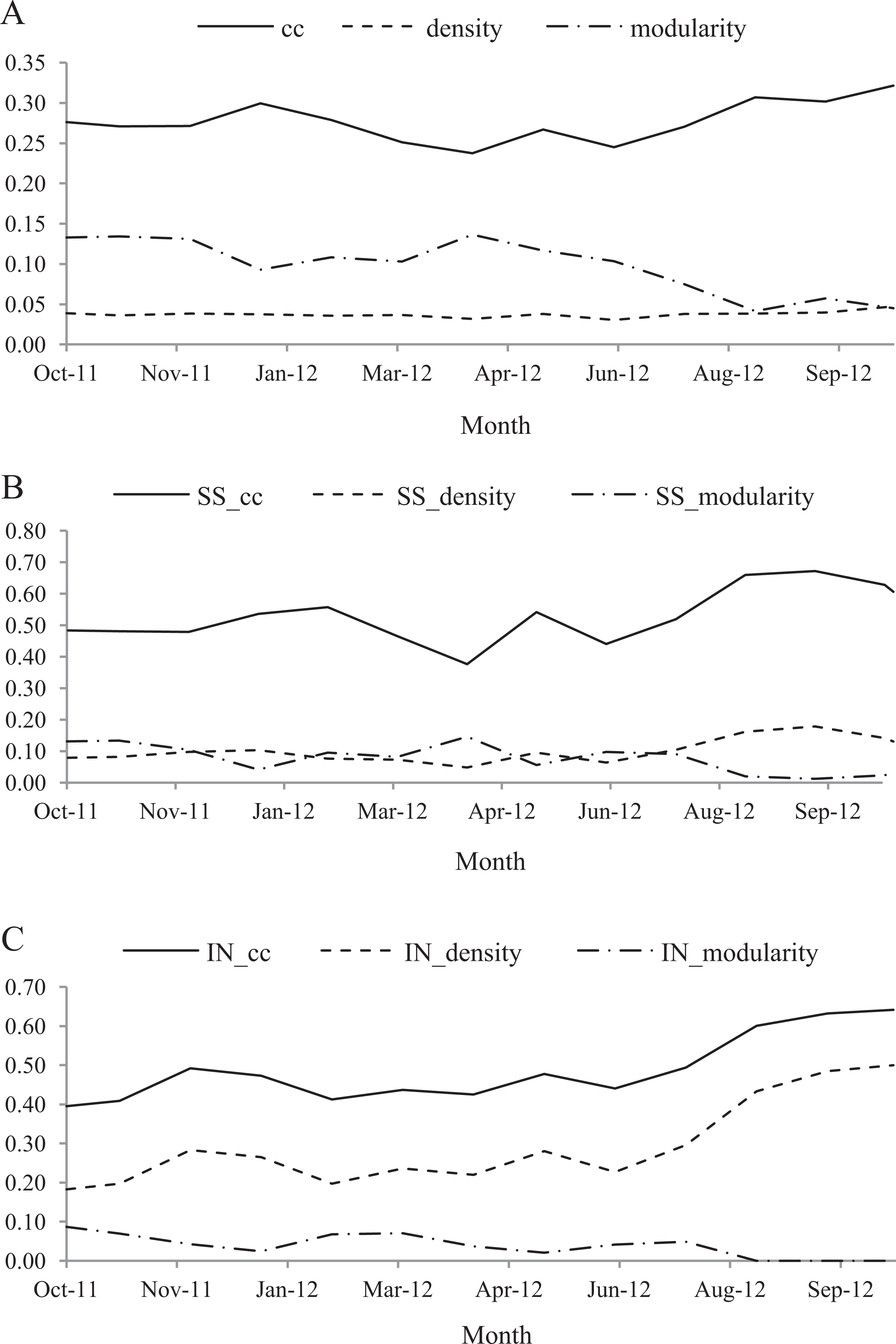
The evolution of discussion and cognitive networks over 13 months. A, The evolution of discussion network. B, The evolution of semantic network. C, The evolution of interpretive network.
With regard to SS network, nodes are the participants in forum discussions, while edges are the normalized SS scores between any pair of participants. The original value of SS is continuous, ranging from 0 to 1. To characterize the structural aspects of the network, the value is dichotomized at 0.15. To answer Research Question 1, note that in Figure 3B, the evolution process follows a similar pattern as the discussion network. From the period June 2012, all indicators have shown clear trends: the clustering coefficient and the density increased, whereas modularity declined. Overall, the discourse of presidential election has become similar and cohesive within the last 5 months before the election. Further, participants used increasingly similar concepts in forum discussions.
For IN network, are the concepts used in discussions well organized in clusters to represent political meanings? How do the organizations and meanings evolve over time? To construct IN network, 500 most discriminant and frequent words are extracted from all words used in the 13 months and were compared with leisure discussions. The relationship is defined by the frequency of co-occurrence in a sentence over time. Values above 1 are coded as 1. Figure 3C can answer Research Question 2. The cohesiveness of IN network increases over time. This indicates that the key concepts are bundled up together. This pattern could be interpreted in two ways. First, if people are talking about different topics during a certain period, the modularity should be high and density and clustering coefficient should be low. The increase in cohesiveness in this sense means that semantic consensus has been developing over time. Second, semantic association between concepts implies a framework for interpreting the core concepts. The increasing semantic cohesiveness indicates that peoples’ interpretations of the issues are becoming more similar.
Figure 2 visualizes four IN networks—October 2011 (modularity is 0.09), February 2012 (modularity is 0.07), June 2012 (modularity is 0.04), and October 2012 (modularity is 0.00). Edge values above 0.0015 are displayed to get readable maps (i.e., 15 times of co-occurrences over 10,000 sentences). In all time segments, the core concepts are well connected around the candidates (e.g., Obama and Romney), election procedures (e.g., nomination, campaign, vote), and hot debates (e.g., economy, plan). That is why modularity scores were consistently small over time.
There are differences between the four networks both with the salience of concepts and with association patterns. First, the core concepts changed over time. In October 2011, Cain (John McCain), Romney, and Republican were connected as a competing semantic cluster against Obama. In February 2012, McCain disappeared while Santorum (Rick Santorum) replaced his position. The connection gap between Republicans and Democrats became salient. Networks in June 2012 and October 2012 are quite similar in terms of core concepts, however, they differ in modularity. In October 2012, connections between Romney and Obama as well as other concepts were denser and more cohesive. Visually, it was harder to separate Romney cluster from Obama cluster in October 2012 compared to June, 2012.
RSiena
Tables 1 and 2 report the results from RSiena models. The rate parameter estimates the rate of network change over two consecutive waves. The models control several purely structured effects (i.e., endogenous factors) in order to estimate the mutual influences of political discussion and common ground more precisely. The density parameter estimates the overall density of the network. It reflects the tendency of the user to create ties in a certain network. Reciprocity estimates the probability of user B replies to A, given A has replied to B. Transitivity estimates the probability of user A replies to C, if A has replied to B and B has replied to C. Popularity estimates the tendency of replying to the authors who have already received many replies. The activity alter and ego parameters are included to control the impact of user activity on network formation.
Multiplex Networks Model
Table 1 shows a unilateral relationship between political discussion and SS over the four waves. The estimated parameters of the evolution of SS network are highly inconsistent across the periods. It implies that the evolution process is unstable and the measure of common ground using SS might be problematic. On the other hand, the evolution of discussion network appears quite consistent and stable.
Hypotheses 1 and 2 are related to how discussions produce common ground. The discussion parameter at Period 1 is significant (B = 1.06, standard error [SE] = 0.53). This indicates that political discussion could facilitate the agreement of language use in political discourse. However, the significant relationship between discussion and SS does not exist at the second and third periods (i.e., T2 = > T3, T3 = > T4). It indicates that users are more likely to adapt their use of key concepts, according to their discussion partners at the early stage. There is no clear evidence of polarization effect. This shows that discussion will lead to semantic dissimilarity at the end, given all parameters of discussion effects are positive.
The interaction effect of the same ideology and discussion on SS is not significant during the first two periods. However, it is significant at the third period (B = 3.53, SE = 1.07). This means discussions between politically similar partners are more likely to produce SS than crosscutting debates. A measurement of the common ground based on SS does not therefore present a clear evidence to support Hypotheses 1 and 2. Yet, the result suggests that participants are more likely to be influenced by political discussions at the very beginning. It, thus, suggests a need for the establishment of common language at this stage. However, in the later stage of discussion, participants are more inclined to seeking consensus within political leans.
Hypothesis 3 is concerned with whether SS can serve as common ground for selecting discussion partners. It shows that all parameters of SS on discussion network are not significant. This suggests that SS might not serve as a common ground in political discussions.
Coevolution of Discussion–Semantic Networks.
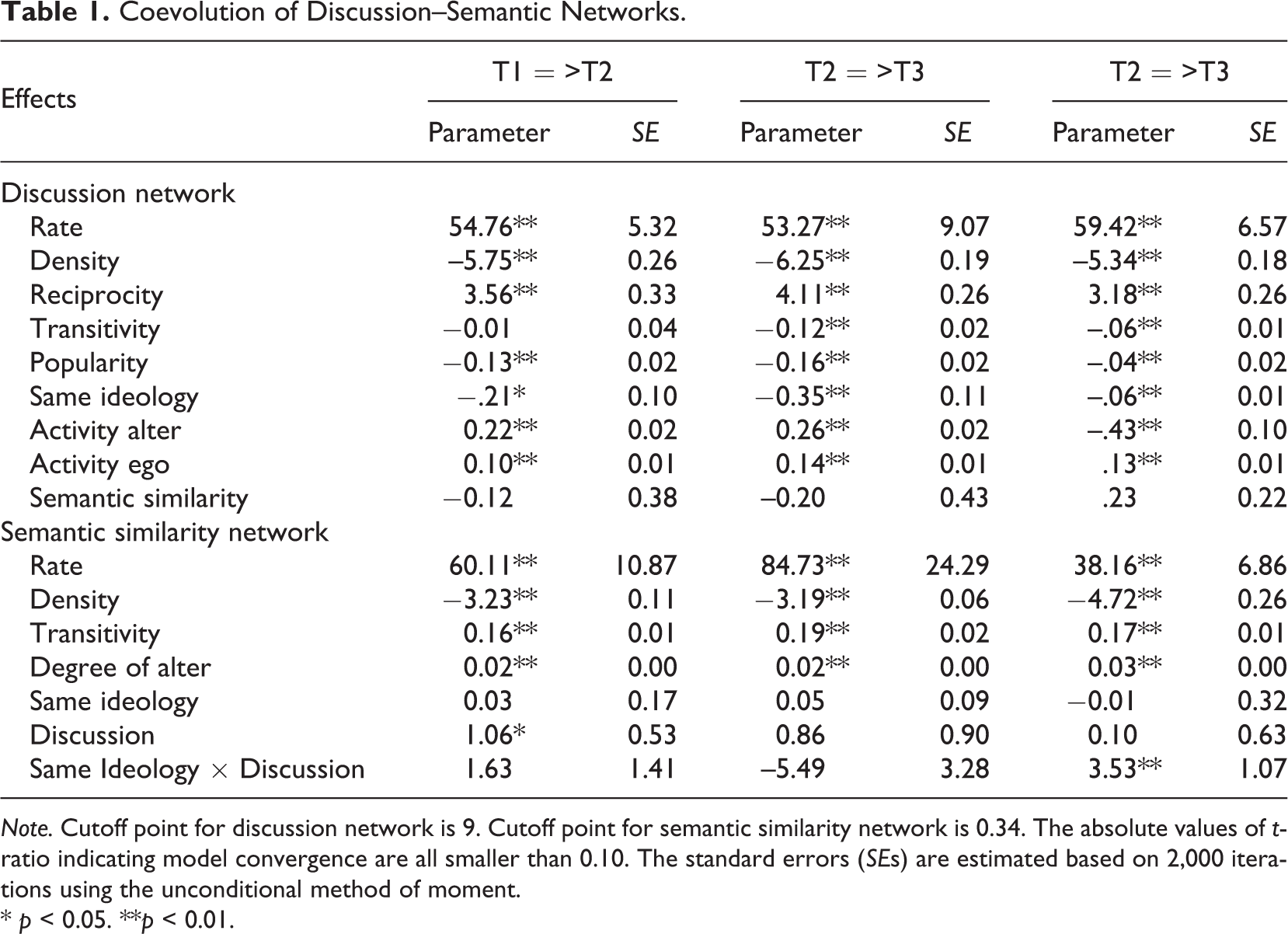
Note. Cutoff point for discussion network is 9. Cutoff point for semantic similarity network is 0.34. The absolute values of t-ratio indicating model convergence are all smaller than 0.10. The standard errors (SEs) are estimated based on 2,000 iterations using the unconditional method of moment.
* p < 0.05. **p < 0.01.
Bipartite Network Model
Table 2 presents the results of coevolution of discussion network and IN network. There are no substantial changes with the parameters over time, indicating that the evolution process is relatively stable. Nevertheless, there are quantitative variations. The rate parameter of IN network from T1 to T2 is larger than others. It could be interpreted as, on an average, the number of changes that the discussion participants make to their existing IN frameworks is larger at the very beginning of the discussion.
Coevolution of Discussion–Interpretive Network.
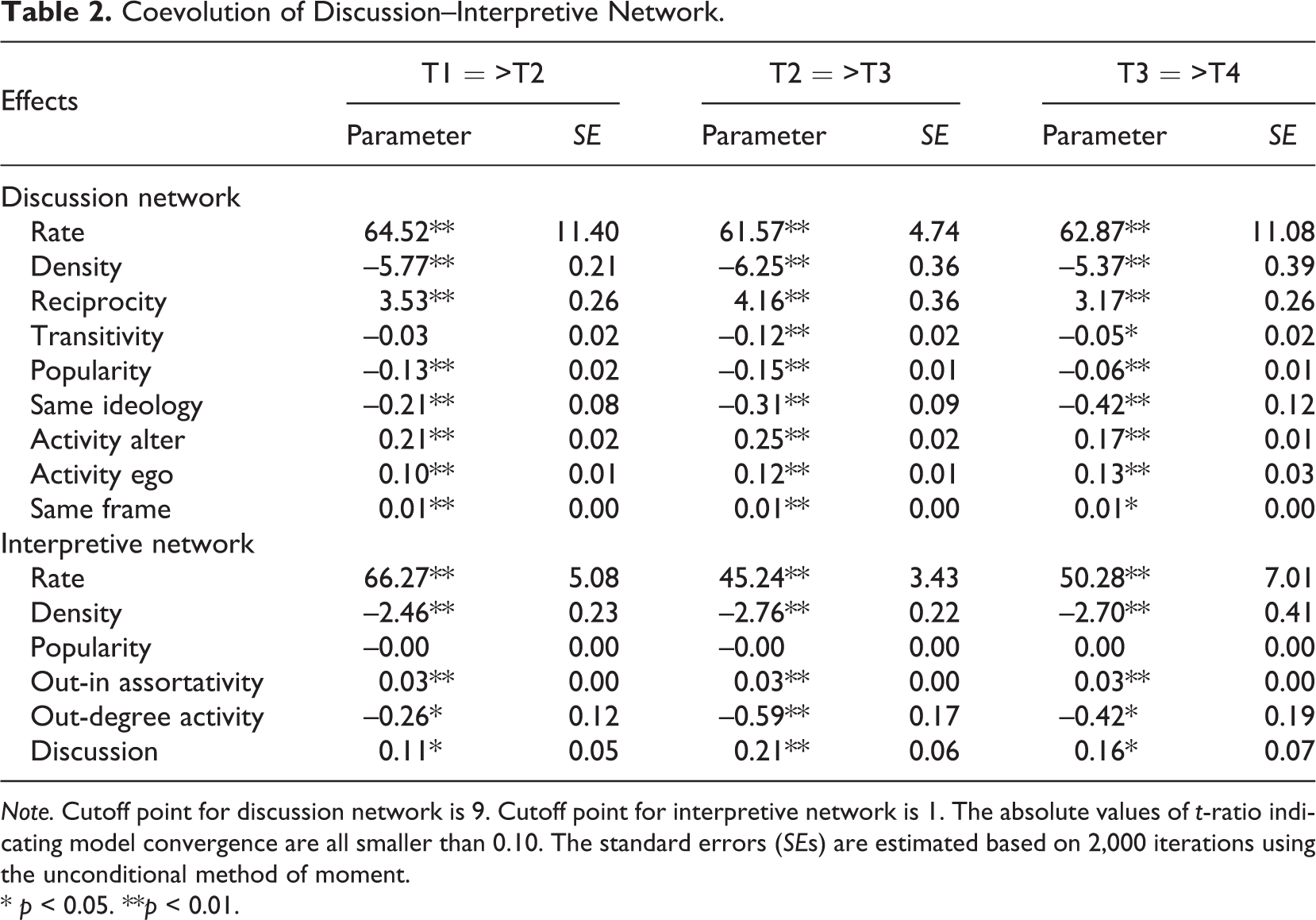
Note. Cutoff point for discussion network is 9. Cutoff point for interpretive network is 1. The absolute values of t-ratio indicating model convergence are all smaller than 0.10. The standard errors (SEs) are estimated based on 2,000 iterations using the unconditional method of moment.
* p < 0.05. **p < 0.01.
According to Hypothesis 1, common IN framework could be achieved through political discussions. The positive effect of the discussion on IN network indicates that participants are more likely to use a similar IN framework when they had previous discussions. The parameters in the three transitions are 0.11 (SE = 0.05), 0.21 (SE = 0.06), and 0.16 (SE = 0.07), respectively. This individual-level analysis is consistent with the aggregate results presented in the previous section. Political communication among individuals could facilitate an immediate cohesive IN framework. However, it turns out that the effect size of discussion on IN network is relatively small (t-statistics: 2.10, 3.38, and 2.34) when compared with other endogenous variables.
Regarding Hypothesis 3, a positive effect of the same frame on discussion network indicates that people are more likely to discuss with those who share a similar IN framework. The parameters in the three transitions are quite stable: 0.01 (SE = 0.00), 0.01 (SE = 0.00), and 0.01 (SE = 0.00), respectively.
In addition, the formation of IN network is not dependent on the popularity effect (popularity effect parameters are all not significant). However, the positive effect of out-in assortativity suggests that the active participants are more likely to use a framework that is different from the framework used by the less active ones. Therefore, the IN network exhibits a kind of hierarchical structure. The out-degree activity indicates that the out-degree in discussion network is negatively associated with the out-degree in IN network.
Conclusion and Discussion
In summary, the contribution of this study is twofold. First, this study proposes using text mining techniques to quantify political common ground in online political discussions. In the current study, common ground is operationalized as the similarity of language use at a surface level and the common interpretation of the key concepts at a deeper level. The SS network is to measure the shared knowledge, while IN network measures the shared interpretations across participants. Generally, the results suggest that cognitive networks become more cohesive along with discussions over a long period of time. More specifically, the degree of shared knowledge in the discussion network is more stable than shared interpretation over time. In the RSiena models, the results are also consistent with this global pattern: people are more susceptible to change in their interpretation than language use.
The result implies that IN network might be a more effective measure of common ground than SS network. SS has nonsignificant and inconsistent effect on the choice of discussion partners. It suggests that SS that quantifies the knowledge aspect of common ground is not necessary in producing common ground. Thus, future studies should pay more attention to users’ interpretations in political discussions.
Second, this study also sheds light on the potential for online political discussion in achieving deliberative democracy. The data support both Hypothesis 1 and Hypothesis 3 that political discussion could produce common ground that would further facilitate political communications. In the current design, it is hard to find any attitude or ideology change that is caused by user discussions over time. However, the purpose of a deliberative system of informal discussion is not to produce consensus. As Kim and Kim (2008) pointed out, informal political discussion provides the basic common ground for further formal deliberation. Before starting deliberation, people need to get to know each other and explore the common context to form a basis. There is a clear trend that SS between participants increases and the association of core concepts becomes more cohesive over time. Through discussions in web forum, a common ground had emerged around the topic of presidential election (see Figure 2). It implies that people are talking the same thing and try to interpret the facts in a similar way even when they do not agree with each other. In terms of Fishbein’s (1980) attitude formula, political discussion exerts influence on the weight of aspects (interpretation framework) rather than the evaluation of these aspects.
Footnotes
Declaration of Conflicting Interests
The author declared no potential conflicts of interest with respect to the research, authorship, and/or publication of this article.
Funding
The author received no financial support for the research, authorship, and/or publication of this article.