







Abstract
In the 2016 U.S. presidential campaign, both the traditional media and social media platforms, like Twitter, were critical in attempts to influence voters. Prior to the 2016 presidential election, the assumption was that campaign messages sent through the traditional media are perceived as more effectual by the public than those sent via Twitter. But after the election of Donald Trump, there is now a sense that things may have changed. In this new era of American politics and campaign discourse, do campaign messages sent via Twitter resonate equally with messages sent through the traditional media? This study attempts to address this question by utilizing a survey experiment to test whether campaign messages sent using USA Today headlines were perceived as more believable and persuasive by potential voters than messages sent via Twitter. The results suggest that campaign messages about candidates sent via Twitter—regardless of the candidate of focus—resonate just as strongly with potential voters as those sent via the traditional media. This provides a potential partial explanation for the shocking rise of Donald Trump’s political fortunes.
Keywords
The 2016 U.S. presidential campaign cycle was a national spectacle with unprecedented levels of media coverage and citizen interest. At one point, Pew Research referred to the race between Donald Trump and Hillary Clinton as “a news event that’s hard to miss” (Gottfried, Barthel, Shearer, & Mitchell, 2016, p. 1), while Showtime and Bloomberg Politics collaborated on a documentary series simply titled The Circus depicting the events surrounding the presidential contest. Americans were paying close attention, too, with 9 of 10 Americans learning about the election in a given week from a variety of media platforms (Gottfried et al., 2016).
Both the traditional media (which consists of online and print newspapers, television ads, and news and radio programs) and social media platforms like Twitter were critical in the campaigns' attempts to connect with voters. Prior to the 2016 presidential election, the assumption was that campaign messages sent through the traditional media are perceived as more influential, believable, and motivating by the public (Johnson & Kaye, 2014; Stromer-Galley, 2014). However, after the election of Donald Trump, a man dubbed “The Master of Twitter” (Barbaro, 2015), there is now a palpable feeling that things have changed. In this new era of American politics and campaign discourse, do campaign messages sent through the traditional media and those sent through Twitter resonate equally with potential voters? Or does the traditional media still hold dominion over campaign message effectiveness?
This study attempts to address these questions. Utilizing a survey experiment administered through Mechanical Turk (MTurk), I test whether potential voters perceived campaign messages sent through USA Today headlines by the Clinton campaign and the Trump campaign to be more effectual than tweets sent by the two campaigns. The results of the experiment suggest that campaign messages about candidates sent via Twitter, regardless of the candidate of focus, resonate just as strongly with potential voters as those sent via the traditional media. This provides a potential partial explanation for the shocking rise of Donald Trump’s political fortunes, and adds insight into the role that Twitter and other nontraditional media platforms may play in future presidential campaign cycles.
The Trump and Clinton Campaigns’ Use of Twitter in the 2016 Presidential Election
The 2016 presidential campaign was highly emotional and contentious, with near-ubiquitous media coverage of the event. An essential tool in disseminating and gathering campaign information in this environment was Twitter. On the day of the election, Hillary Clinton had 10.4 million followers on Twitter and had sent nearly 10,000 tweets up to that point. However, she was bested by Donald Trump who had 13.2 million followers on the day of the election and had sent over 30,000 tweets (Twitter Counter, 2016).
In fact, it was Trump and his campaign that were renowned for truly embracing this form of campaign communication in an attempt to sway voters and dictate the national conversation. The New York Times went so far as to say that Trump had mastered Twitter in a way no other candidate ever had (Barbaro, 2015), and Trump himself referred to his Twitter account as comparable to owning his own newspaper (Savransky, 2016).
This suggests that the two candidates for president and their campaign teams differed in their use of and approach to Twitter and the traditional media in their attempts to connect with voters. The Trump campaign placed more focus on Twitter, while the Clinton campaign was more conventional and placed more focus on traditional media exposure. Accordingly, Hypothesis 1 predicts that potential voters will evaluate a campaign message sent advocating for Trump as similarly effectual to a USA Today headline advocating for him. Hypothesis 2 predicts that potential voters will evaluate a campaign message sent via tweet advocating for Clinton as less effectual than a USA Today headline advocating for her.
Two Different Media Models for Understanding the 2016 U.S. Presidential Campaign
Internet use is near ubiquity in the United States, as almost 90% of adults use the Internet, and social media sites are used by the vast majority of Americans—including 16% who use Twitter (Gottfried & Shearer, 2016; Greenwood, Perrin, & Duggan, 2016). The Internet and social media platforms like Twitter are also widely used to send and gather campaign news and political information. For instance, nearly 60% of Twitter users report getting news via Twitter (Gottfried & Shearer, 2016) and nearly 10% of Twitter users reported using the microblogging service to get information about the 2016 U.S. presidential campaign within any given week.
Nevertheless, most Americans still view traditional media outlets (e.g., television ads and news, online and print newspapers, radio) as the most useful and effective conduits to get information on presidential races (Gottfried et al., 2016). All this indicates that the traditional media is still essential when it comes to the public learning about politics and presidential campaigns, but digital platforms such as Twitter have become fundamental in the process as well. It is important to consider, then, whether candidate messages spread via the traditional media are viewed by the public as more agreeable, believable, and persuasive than candidate messages communicated via Twitter, or whether messages sent through Twitter are now just as effective. Two competing theoretical models frame this issue: the Traditional Media Model and the Hybrid Media Model.
The Traditional Media Model
The traditional media, which is made up of news organizations that produce online and print newspapers, television ads and news, and radio programs, has been assumed to be central to political campaign success for decades (Burton, Miller, & Shea, 2015; Enli & Moe, 2013; Graber, 2001; Stromer-Galley, 2014; West, 2014). Effective use of the traditional media allows candidates and their campaign team to get out their message, attack their opponent, convince potential voters to support them, and motivate those who already support them to advocate for them. The traditional media also establishes legitimacy for a candidate by publishing news stories and discussing the candidate’s ideas, policies, and actions (Stromer-Galley, 2014).
Because of the traditional media’s established record of presenting information reliably over many decades and due to the perception that journalistic norms regulate the actions of its members, the traditional media has been viewed as more credible than social media platforms in their presentation of political information (Flanagin & Metzger, 2007; Johnson & Kaye, 2014; Schmierbach & Oeldorf-Hirsch, 2012). Social media outlets are new entrants into the world of political campaigning (Stromer-Galley, 2014) and are often helmed by people who are not professional journalists or political strategists. Messages delivered from and through Twitter and other social media platforms can come from anyone and anywhere, the platforms were not designed with news dissemination in mind, and they are largely used for social and entertainment purposes. Consequently, information gathered from traditional media sources has been seen as more serious, reliable, and believable than information gathered from newer digital sources like Twitter (Johnson and Kaye, 2014). Indeed, research has suggested that use of social media does not increase interest and participation in politics (Baumgartner & Morris, 2010). Other studies examining young adults found that increased attention to traditional media sources was associated with increased interest in and awareness of the political landscape while increased attention to social media was not (Kushin & Yamamoto, 2010).
From a traditional media model, messages about a political candidate delivered through the traditional media will resonate more with the public. This should hold even if just a headline is presented since research has shown that most consumers of news read only the headlines and not the news stories themselves (Dor, 2003). Consequently, Hypothesis 3 predicts that information gathered about a candidate from a USA Today headline will be viewed by voters as more agreeable, believable, and persuasive than a message received via Twitter.
The Hybrid Media Model
Chadwick (2013) criticizes the traditional media model perspective, which clearly delineates the older and more established media from new media. He believes that such a dichotomy between “old” and “new” is inaccurate and misleading. Rather, he argues that the dissemination of information through media outlets is better characterized as a continual crossbreeding between media platforms that have been used in the past and those that are newly developed. For Chadwick, many of the strategies and practices of the established media are adopted by newly developed media platforms, and the established media adopts many of the strategies and practices of the newer media platforms. The result is a fusion of older and newer media into a hybrid media system in which clearly defined boundaries between the two are unclear and impossible to define.
From this perspective, clear boundaries between Twitter and traditional media outlets are not necessarily evident. So in the eyes of the public, campaign messages gathered from social media differ little from campaign messages gathered from the traditional media. Consequently, issues of credibility and persuasiveness regarding campaign messages from online platforms like Twitter are not as relevant as some might assume since digital platforms are now heavily integrated in political campaigns (Enli & Moe, 2013).
Indeed, political campaigns are regularly and effectively deploying Twitter and other social media tools in unison with traditional media outlets in order to interact with voters and influence news cycles and campaign narratives (Kreiss, 2014; Parmelee & Bichard, 2012). This can occur even if voters are not purposefully seeking political information when using social media due to accidental exposure to news and campaign information placed by friends and contacts on platforms like Twitter (Morris & Morris, 2017). Gainous and Wagner (2014) go so far as to say that use of social media platforms in politics has effectively placed itself alongside the traditional media and has fundamentally shifted how voters make their decisions regarding who will govern.
From the hybrid media model perspective, interpretations of candidate information gathered by the public from Twitter would be no less compelling than information gathered from traditional media sources. Consequently, Hypothesis 4 predicts that a campaign message received from a USA Today headline will be viewed by the public as no more agreeable, believable, and persuasive than a message received via Twitter.
Methodology
Data were collected as part of the Tweets and Headlines in the 2016 U.S. Presidential Election Survey Experiment (hereafter Tweets and Headlines Survey), conducted between November 2 and November 6, 2016, several days prior to the U.S. presidential election. The survey was designed in Qualtrics and administered via Amazon’s MTurk. Each respondent who completed the survey was compensated US$.50 for his or her participation. Only people living in the United States and those 18 years or older were able to participate.
MTurk is an Internet marketplace that provides access to a pool of respondents who can respond to social science surveys and experiments of their choosing, among other tasks, and it has become a widely used resource for social science data collection (Berinsky, Huber, & Lenz, 2012). As one might expect, because all respondents must be Internet users to access MTurk, samples drawn using the service are more likely to be White, younger, liberal, and college educated than population-based random samples (Berinsky et al., 2012).
Nevertheless, research has shown that MTurk samples are often more representative of the U.S. population than convenience samples (Berinsky et al., 2012; Buhrmester, Kwang, & Gosling, 2011), and are an excellent source for inexpensive high-quality data (Buhrmester et al., 2011; Mason & Suri, 2013). Additionally, research comparing the social and political ideologies of liberals and conservatives in an MTurk sample to those of two nationally representative samples found little difference between the three samples, indicating that political perspectives of MTurk respondents mirror those in representative samples (Clifford, Jewell, & Waggoner, 2015). Because of the advantages offered by online labor markets like MTurk, the use of such platforms has resulted in a slew of high-quality studies in leading academic journals (see Billingham & Hunt, 2016; Kuziemko, Norton, Saez, & Stantcheva, 2015; Mérola & Hitt, 2016).
The Tweets and Headlines Survey was started by 1,011 respondents in MTurk, but 10 respondents failed to complete the vast majority of the survey so these respondents were excluded from the analysis. Of the remaining 1,001 respondents, 3 did not have information for all three dependent variables so these respondents were dropped from the analysis leaving the final sample size at 998.
The Tweets and Headlines Survey used experimental manipulation to investigate how people respond to political campaign messages advocating for a candidate. Candidate information was presented in the form of a tweet or USA Today digital headline and focused on either Hillary Clinton or Donald Trump, allowing for comparison of media source effect based on the candidate of focus. Twitter was chosen as the social media communication platform due to Trump and his campaign’s heavy reliance on it to communicate with potential voters, while USA Today was chosen because it has the widest U.S. circulation of all daily newspapers and its readership tends to be ideologically similar to the average American (Cision, 2016; Mitchell & Weisel, 2014).
As part of the experiment, each respondent was first presented with the following hypothetical scenario: The economy is consistently one of the most important issues in determining who is elected President of the United States and this year looks to be no different. Imagine that tomorrow evening while you are online… …you come across the following USA Today headline about Hillary Clinton written by a nationally-known Clinton political supporter: “Hillary Clinton has clear vision to boost America’s economy, restore jobs, and increase wages, has know-how to get it done. …you come across the following tweet about Hillary Clinton from a nationally-known Clinton political supporter: @HillaryClinton has clear vision to boost America’s economy, restore jobs, and increase wages, has know-how to get it done #I’mWithHer. …you come across the following USA Today headline about Donald Trump written by a nationally-known Trump political supporter: Donald Trump has clear vision to boost America’s economy, restore jobs, and increase wages, has know-how to get it done. …you come across the following tweet about Donald Trump from a nationally-known Trump political supporter: @realDonaldTrump has clear vision to boost America’s economy, restore jobs, and increase wages, has know-how to get it done #MakeAmericaGreat.
Dependent Variables
Following the experimental treatment, respondents were asked three questions (with candidate name and media source altered based on the treatment), which serve as the three dependent variables under analysis in this study. The first dependent variable (agreement) asked respondents, “How likely are you to agree with the above USA Today headline/tweet about Hillary Clinton/Donald Trump?” (1) extremely unlikely, (2) moderately unlikely, (3) somewhat unlikely, (4) neither likely or unlikely, (5) somewhat likely, (6) moderately likely, and (7) extremely likely.
The second dependent variable (believability) asked respondents, “On a scale of 1 to 10 (with 1 being ‘not at all believable’ and 10 being ‘very believable’), how believable is the above USA Today headline/tweet about Hillary Clinton/Donald Trump?”
The third dependent variable (increased support) asked respondents, “From your point of view, does the above USA Today headline/tweet make you more or less likely to support Hillary Clinton/Donald Trump?” (1) more or somewhat more likely and (0) equally, somewhat, or less likely.
Independent Variables
The four treatment effects (Clinton headline, Clinton tweet, Trump headline, and Trump tweet) are the four key independent variables in the analysis. A set of control variables is also included in the analyses. Regular social media user measures how often the person uses websites like Twitter, Facebook, or Instagram (1) regularly and (0) not regularly. The variable Favorable opinion of Trump and the variable favorable opinion of Clinton measure how respondents view each candidate (1) favorable and (0) unfavorable. Political party identification was dummied into three variables: Democrat (which serves as the referent category), Republican, and Independent. Liberal politically is a 5-point scale measuring political ideology (1) very conservative, (2) conservative, (3) moderate, (4) liberal, and (5) very liberal. Age is a continuous measure of respondent age, female is a dummy variable indicating gender, college degree is a dummy variable indicating if the respondent has earned a 4-year college degree, and racial/ethnic minority is a dummy variable indicating whether a person is (1) racial/ethnic minority or (0) White. Income (in thousands) is a quasi-continuous variable where categories of income ranges from the survey item (e.g., US$10,000 to under US$20,000, US$20,000 to under US$30,000, US$30,000 to under US$40,000) were recoded to the midpoint of each income category and put in units of thousands ranging from US$0 to US$200k.
Missing Data
If not addressed, the analyses would see a nearly 10% reduction in sample size through listwise deletion due to missing values on the independent variables. To address this, multiple imputation (MI) in Stata 14 was used to multiply impute missing values on independent variables that included missing information. MI generates more precise coefficients and standard errors than what is provided from single imputation or by relying on listwise deletion (Royston, 2005). Based on recommendations from prior studies, 20 imputations and corresponding datasets were completed (Enders, 2010; White, Royston, & Wood, 2011). The results were then averaged across the 20 data sets. This allowed for the retention of all cases except three, which had missing values on the dependent variables.
Approach to the Analysis
After briefly discussing summary statistics for variables used in the study, the analysis compares the effect of reading a Clinton headline to the effect of reading a Clinton tweet, Trump headline, and Trump tweet. Next, the analysis compares the effect of a Trump tweet to a Trump headline, Clinton headline, and Clinton tweet. After comparing the four treatments, the analysis combines Clinton tweet and Trump tweet treatments to directly compare the effect of reading a tweet compared to a headline, holding constant the candidate of focus. Lastly, the analysis ends by examining how regular social media use moderates the effect of reading a tweet compared to a headline. Ordinary least squares regression is used to analyze the dependent variables measuring agreement and believability. Logistic regression is used to analyze the dependent variable measuring increased support.
Results
Table 1 presents summary statistics for the sample and all variables used in the analysis. As noted earlier, all sample members randomly received one of the four treatment effects, leading to an equal proportion of respondents within each treatment group. Exclusion criteria discussed previously resulted in some treatments being experienced by slightly more respondents than others. Looking at the dependent variables, the average respondent is in the midrange for agreement and believability of statements about the candidates, while approximately 20% of respondents reported that the statements increased their support for the candidate. Also, the standard deviations indicate a large amount of variability within each outcome variable. Typical of MTurk samples (Berinksy et al., 2012), the current study’s sample is whiter, more educated, more liberal, and more financially well-off than the overall U.S. population, although the sample means do not differ dramatically from those found in the population.
Summary Statistics for Variables in the Analysis.
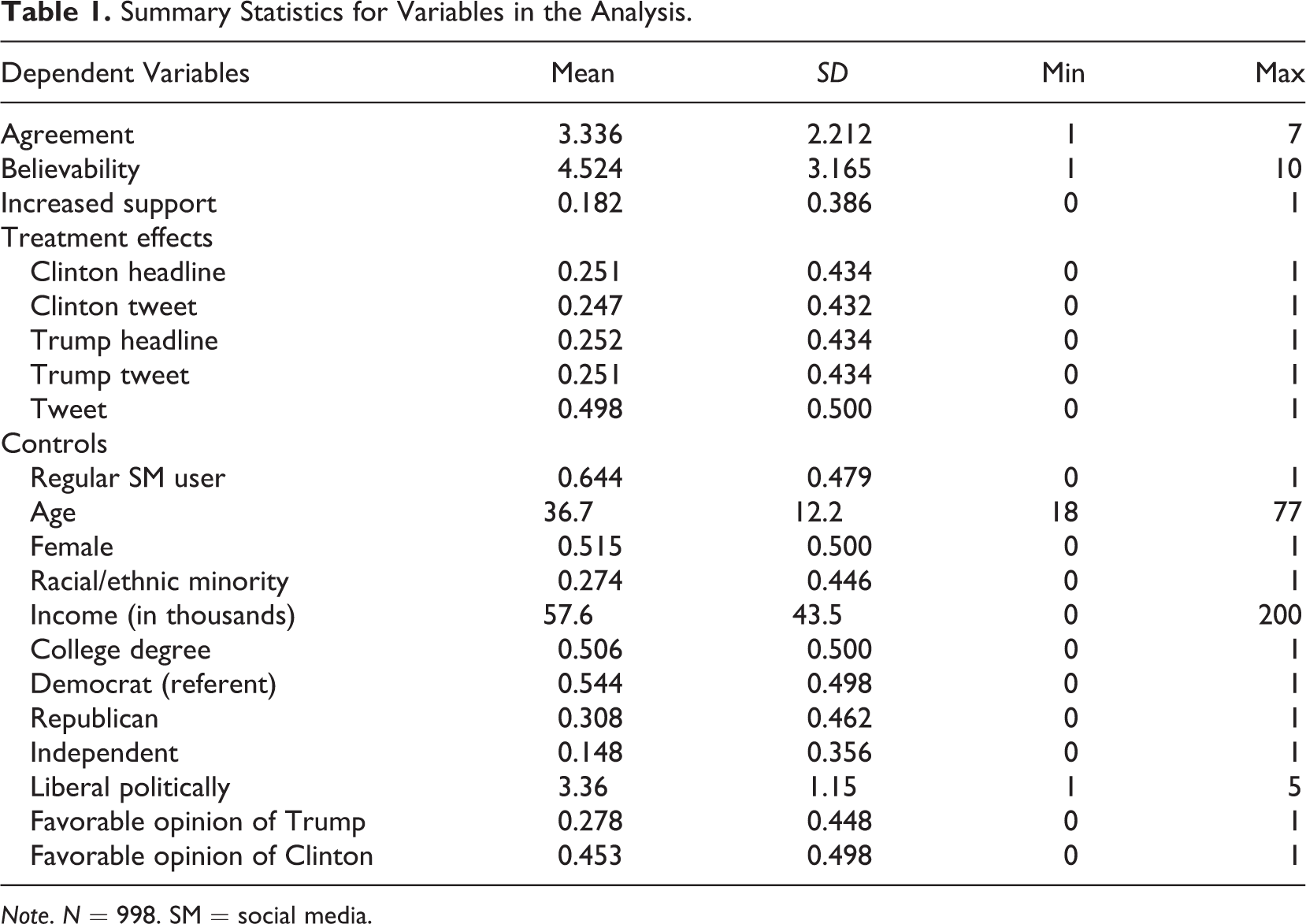
Note. N = 998. SM = social media.
Tables 2 and 3 turn the analysis toward analyzing how the four treatment effects differ in terms of public perception of agreement, believability, and persuasion. Table 2 presents the results comparing the Clinton tweet treatment effect to the Clinton headline, Trump tweet, and Trump headline treatment effects. Two findings stand out. First, respondents found information about Trump to be less convincing overall than a headline promoting Clinton, regardless of whether the information about Trump came via the traditional media or Twitter. Second, respondents perceived a traditional media headline about Clinton to be no more convincing than a tweet about Clinton since the coefficient for the Clinton headline treatment effect was not statistically significant.
Regressions Comparing Clinton Headline, Trump Headline, and Trump Tweet Treatments to Clinton Tweet Treatment With Controls.
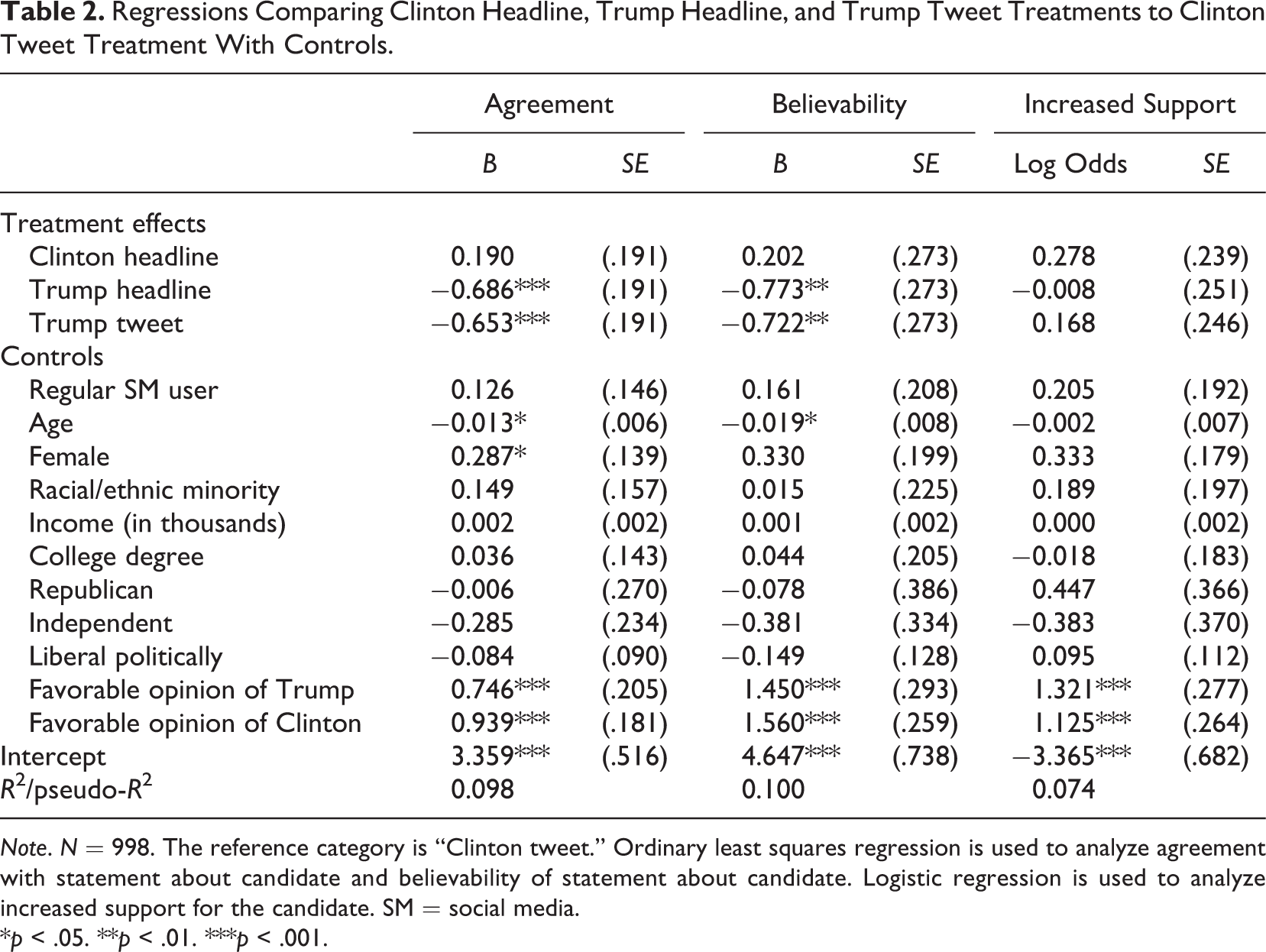
Note. N = 998. The reference category is “Clinton tweet.” Ordinary least squares regression is used to analyze agreement with statement about candidate and believability of statement about candidate. Logistic regression is used to analyze increased support for the candidate. SM = social media.
*p < .05. **p < .01. ***p < .001.
Regressions Comparing Clinton Headline, Clinton Tweet, and Trump Headline Treatments to Trump Tweet Treatments With Controls.
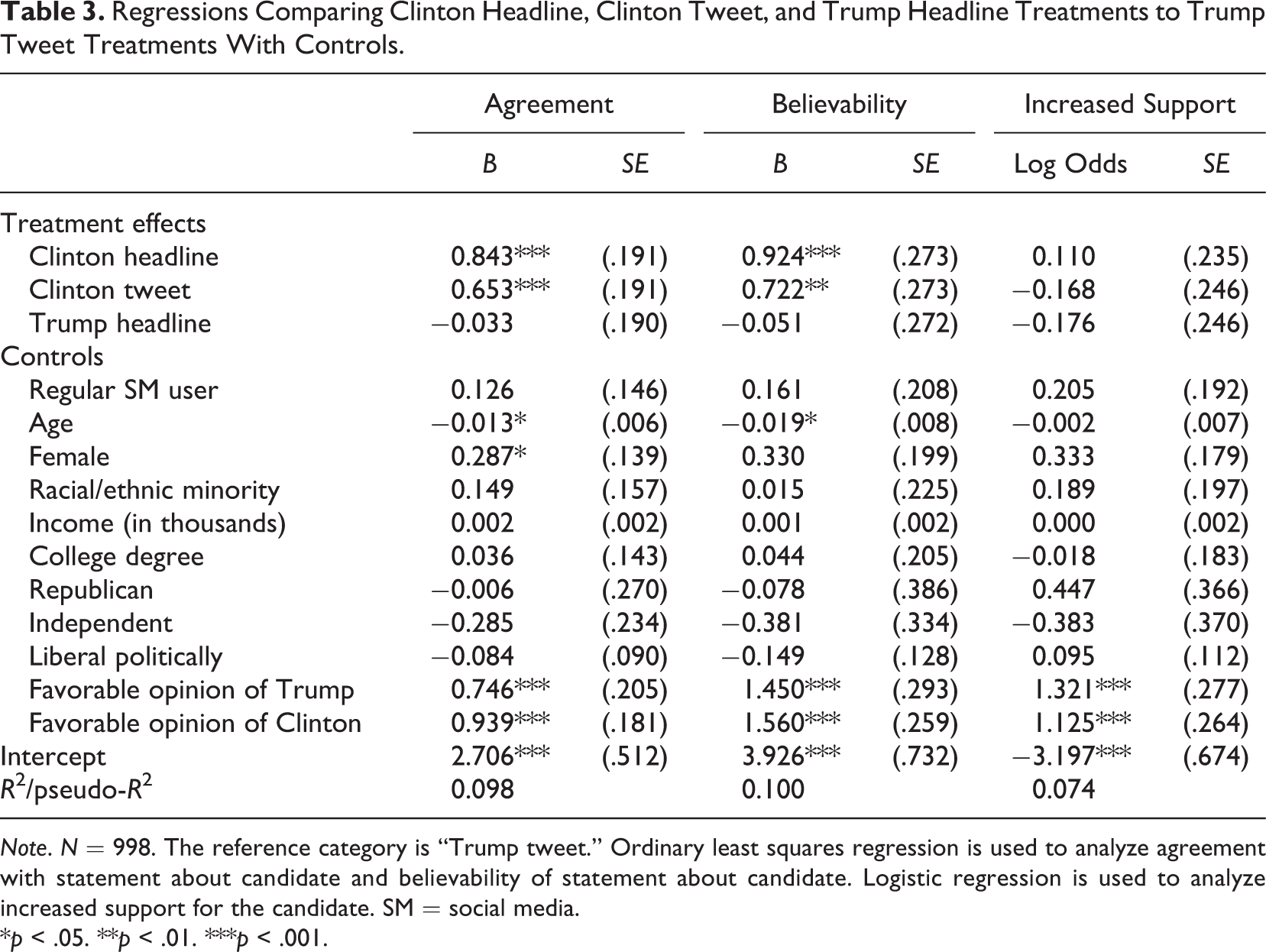
Note. N = 998. The reference category is “Trump tweet.” Ordinary least squares regression is used to analyze agreement with statement about candidate and believability of statement about candidate. Logistic regression is used to analyze increased support for the candidate. SM = social media.
*p < .05. **p < .01. ***p < .001.
Table 3 presents a similarly styled analysis, except the results compare the Trump tweet treatment effect to the Trump headline, Clinton headline, and Clinton tweet treatment effects. Again, information advocating for Clinton was seen as more convincing than tweets advocating for Trump, regardless of media platform. It is worth noting that the coefficients for Clinton headline are slightly larger than those for Clinton tweet, suggesting that Clinton headlines were slightly more effectual than Clinton tweets when compared to Trump tweets. However, when comparing the Trump headline effect to the Trump tweet effect, there is no statistical difference, indicating that respondents perceived a traditional media headline promoting Trump to be no more or less convincing than a tweet promoting Trump.
These results indicate an overall preference for Clinton, which comes as no surprise since the sample overall had a noticeably higher favorability rating of Clinton (see Table 1). But of key importance is the finding that respondents did not view campaign information promoting Trump sent via Twitter any differently than campaign information promoting Trump sent through the traditional media. This effect largely holds true for campaign information promoting Hillary Clinton.
The next portion of the analysis combines the Trump and Clinton tweet treatment effects, so that the analysis can compare how people respond to campaign information from Twitter and the traditional media regardless of candidate of focus. Table 4 presents these results. The results are clear and follow a pattern predicted by the hybrid media model. People did not perceive candidate information received via the traditional media to be any more agreeable, believable, or persuasive than candidate information received via Twitter. This may help to explain how a Master of Twitter in Donald Trump was able to best an established political candidate in Hillary Clinton who out-financed, out-spent, and out-organized him by a wide margin in the U.S. election for president (Allison, Rojanasakul, Harris, & Sam, 2016).
Regressions Comparing Tweet Treatment Effect to Headline Treatment Effect.
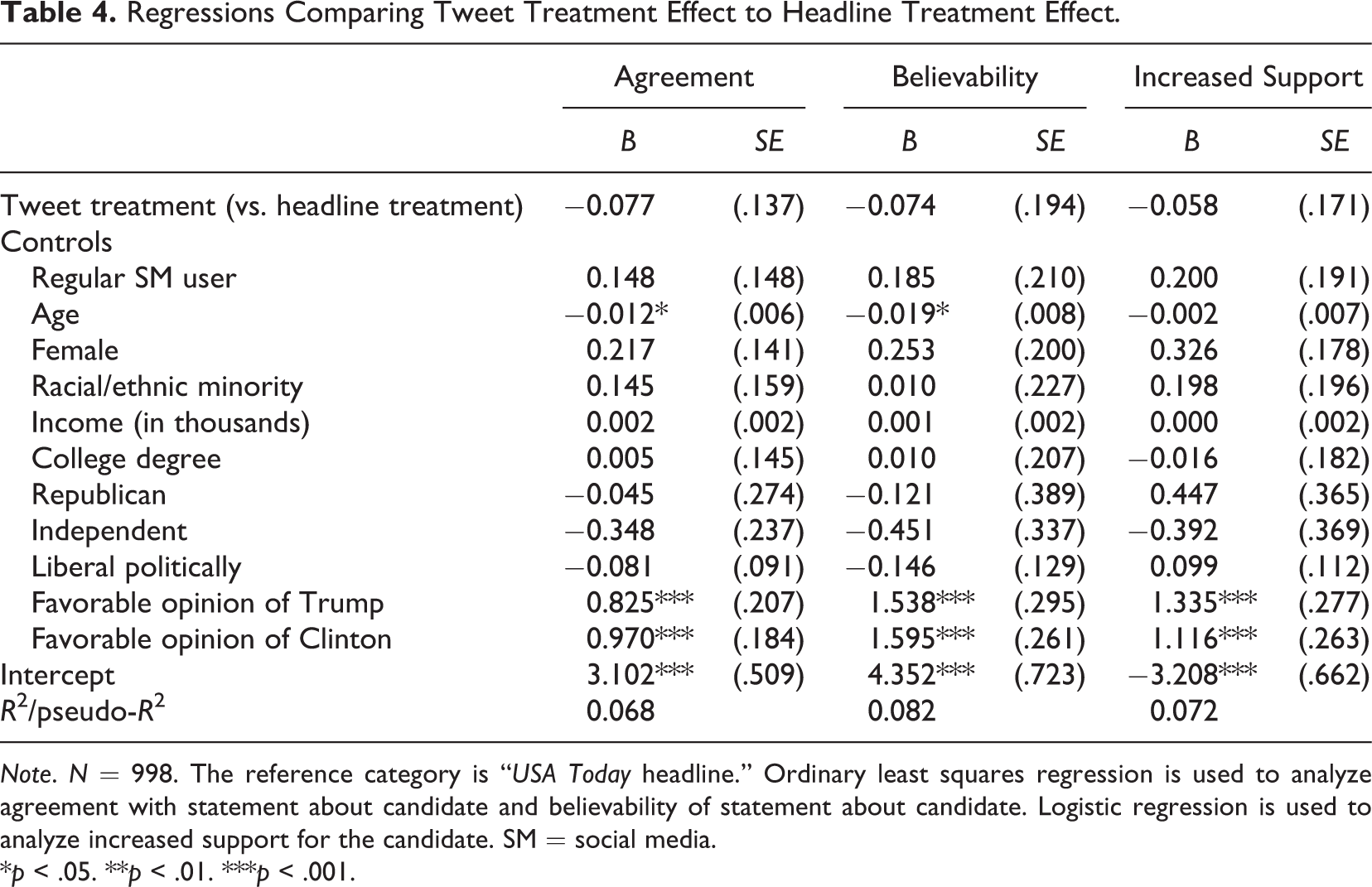
Note. N = 998. The reference category is “USA Today headline.” Ordinary least squares regression is used to analyze agreement with statement about candidate and believability of statement about candidate. Logistic regression is used to analyze increased support for the candidate. SM = social media.
*p < .05. **p < .01. ***p < .001.
In addition to examining main effects models comparing the tweet treatment effect to the headline treatment effect, additional models were run investigating potential interactions between treatment effect and key demographic variables, including age, party identification, political ideology, educational attainment, income, and social media use. The only factor that showed an ability to moderate the relationship between treatment effect and the dependent variables was social media use.
Table 5 presents the results of these models interacting social media use with treatment effect. The interaction is statistically significant in the model measuring believability. Those who regularly use social media report that they find campaign messages sent via Twitter to be slightly more believable than messages sent via USA Today headlines. This suggests that as more people use social media, political campaigns may rely less on the traditional media and more on social media platforms like Twitter to connect with voters and influence public perceptions of the candidate.
Interactions Between Tweet Treatment Effect and Regular Social Media Use.
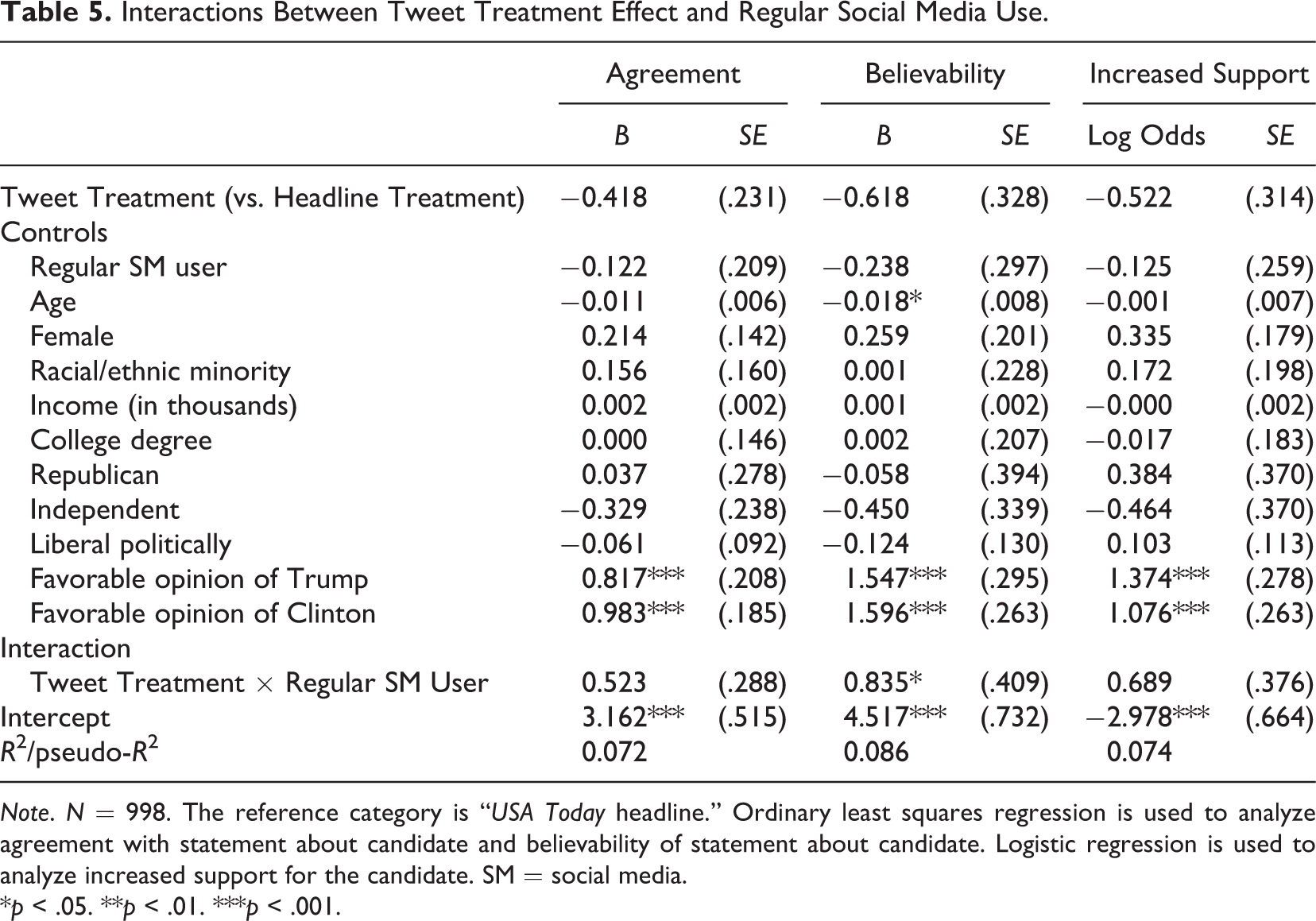
Note. N = 998. The reference category is “USA Today headline.” Ordinary least squares regression is used to analyze agreement with statement about candidate and believability of statement about candidate. Logistic regression is used to analyze increased support for the candidate. SM = social media.
*p < .05. **p < .01. ***p < .001.
Discussion
On the heels of the election of Donald Trump to the U.S. presidency—a stunning turn of events in the eyes of many Americans and most social scientists who study politics—it is important to examine the myriad of factors that may have led to his victory. The changing role of the traditional media and social media platforms like Twitter in the campaign process is one such potential factor. I used a survey experiment administered through MTurk to compare how people perceived campaign messages received via USA Today headlines to campaign messages received via Twitter. I also examined whether the candidate of focus in those campaign messages, whether it be Donald Trump or Hillary Clinton, affected the perceptions of the campaign messages.
The results of the experiment suggest that campaign messages about candidates sent via Twitter, regardless of which candidate the message promoted, resonate just as strongly with potential voters as those sent via the traditional media. This comes as little surprise when viewed from a hybrid media model perspective. The findings are especially relevant in the 2016 U.S. presidential election in which a man called the master of Twitter ultimately prevailed. This provides a small explanatory piece to the puzzle that is Donald Trump’s unexpected political success, and may be a harbinger for the ascendency of Twitter and other nontraditional media platforms in future presidential campaigns.
Although the results of this survey experiment are compelling and provide new insights, the study has several limitations and alternative interpretations. First, the finding that campaign Tweets are deemed just as agreeable, believable, and persuasive as traditional media headlines may be unique to the 2016 presidential election. The race was highly emotional, contentious, and closely watched, and it included a participant who was formerly a reality TV star and who relished media attention well before his presidential run (Trump & Schwartz, 1987). This may have skewed the manner in which people responded to all media in the election and may not be an indicator of things to come. Nevertheless, since Donald Trump won the election, it is likely that the media environment and the emotions surrounding the 2016 presidential election will be replicated in the 2020 presidential election cycle.
Additionally, in the experimental portion of the survey that provided a hypothetical message promoting Trump or Clinton, the tweets did not originate from the candidates themselves. Rather, they were sent by a campaign surrogate. This was done to standardize the treatment effects. However, in a scenario where the tweet emanates directly from the candidate, which so many of Trump’s tweets did, the results might have differed. This would be an ideal area for future study.
Also, the use of a survey experimental design creates not only benefits but also detractions. Although survey experiments are a powerful tool for causal inference (Auspurg & Hinz, 2014), they often must simulate scenarios to create treatment effects. In this case, respondents did not actually come across a USA Today headline or a tweet about Clinton or Trump. Rather, they received a hypothetical scenario to which they had to respond. This may have standardized how people responded to both forms of campaign messages. Still, survey experiments have a long and established history of using hypothetical circumstances to carry out high-quality and meaningful research (Auspurg & Hinz, 2014; Billingham & Hunt, 2016; Mérola & Hitt, 2016).
Despite these limitations, this study provides novel insight into how Americans are responding to candidate information in what would appear to be a hybrid media model environment. Campaign messages sent through social media platforms like Twitter appear to have more resonance than previously thought and do not necessarily differ from those sent through the traditional media. This may help to partly explain Donald Trump’s stunning political success in the 2016 U.S. presidential election.
Footnotes
Declaration of Conflicting Interests
The author declared no potential conflicts of interest with respect to the research, authorship, and/or publication of this article.
Funding
The author received no financial support for the research, authorship, and/or publication of this article.