







Abstract
The more racial or ethnic diversity a person lives around in America, the less likely they are to take part in civic life, or to profess feelings of trust for the average person. Differences have instead become reasons to pull back, prompting a mass erosion of social capital, by undermining social contact. The present study moves the conversation online, to the Facebook group setting in particular, as a means of highlighting shared interests while downplaying other differences at first. Results of a national web survey (N = 1,005) indicate the use of Facebook groups for meeting new people relates to civic participation, along with added weak-tie discussions, which spill over to participation again indirectly. Sociability use of Facebook groups is also a source of bridging social capital, or having more active weak ties upon which to draw, and this contributes to trusting in people. Localized diversity becomes a reason to trust as well, but only for sociable Facebook group users. Less sociable users still mistrust at the sight of difference, but online social efforts appear to swing the direction of influence, for converting neighborhood-level racial and ethnic diversity into trust.
The United States now finds itself diversifying rapidly (U.S. Census Bureau, 2017; Van Hook & Lee, 2017), home to one-fifth of the world’s immigrant population, some 48 million people (Pew Research, 2018). 1 Fifteen percent of Americans are foreign-born (Huth, 2018; United Nations, 2017), with immigrants and their children together comprising 27% of the populace (Zong, Batalova, & Hallock, 2018). And over the next 50 years, new immigrants and their offspring are expected to account for 88% of U.S. population growth (Passel & Cohn, 2017; Pew Research, 2017). Whites become a minority around 2045 (Frey, 2018; U.S. Census Bureau, 2018).
In the face of these changing demographics, America’s reputation as a melting pot appears little more than mythology (Tocqueville, 1969). Once racial or ethnic diversity moves into a given neighborhood, residents withdraw (Costa & Kahn, 2003; Hewstone, 2015; Neal, 2017). They “hunker down” (Putnam, 2007, p. 137), pulling out of civic life and mistrusting more generally (Cortright, 2015; Dinesen & Sønderskov, 2018; Kesler & Bloemraad, 2010). Differences instead evoke threat, or feelings of being in direct competition with new and diverse others for life chances (Oliver & Wong, 2003), which are driven by Whites fearful of living among minority groups (Abascal & Baldassarri, 2015). This is ironic, given their own pending minority status, and the fact that diverse social contact is actually a key source of social capital. It adds to personal connections, who contribute to beneficial outcomes like engagement and trust (Burt, 1992; Coleman, 1988; Granovetter, 1973). Except that perceived differences, and the feelings of threat these elicit, mostly prevent the requisite contact from occurring, and social capital from forming (Abascal & Baldassari, 2015; Dinesen & Sønderskov, 2018).
As a foothold for sociality in a country long devoid of it, social networking sites show potential for addressing the American decline in social capital. On Facebook, for example, the world’s most popular social networking site (Richter, 2018), “People You May Know” are suggested, while groups on the site allow users to rally around common interests or concerns (Donath & boyd, 2004). This can encourage the formation of “affiliative” ties—new social connections who share an affinity, but still differ in a range of other ways (e.g., race and ethnicity; Flanagin, Stohl, & Bimber, 2006, p. 35). By softening these differences at first, through the use of small, optional profile pictures, contrasts feel less salient on the site (Donath & boyd, 2004; Ellison & boyd, 2013). This streamlines the process of weak-tie activation (Ellison, Vitak, Gray, & Lampe, 2014), with group topics as easy icebreakers.
So despite fears that digital settings would usher in new ways of hunkering down (Putnam, 1995), assuming Facebook groups act as a haven for weaker, more affiliative ties to connect, efforts of sociability they host should relate to increased civic engagement and generalized trust (Gil de Zúñiga & Valenzuela, 2011; Glanville, Andersson, & Paxton, 2013; Putnam, 2000). I further ask whether this use of Facebook groups for meeting new people might alter user perceptions of difference more generally, as the start of social learning (Greenhow & Robelia, 2009), for conveying the “strength of weak ties” first in the absence of threat online (Granovetter, 1973; Spitzberg, 2012). Even as interactions move offline, and differences come to light, these should matter less, given past benefits, as the rewards of trusting in a wider range of people gradually overcome perceived risks (Bouchillon & Gotlieb, 2017; Glanville et al., 2013). Results suggest that digital groups are indeed well positioned to address the threat dynamic in this way, for improving the way users think about diversity, even in their neighborhoods, and whether they trust in the face of it.
The Self-Undermining Virtuous Circle
To accumulate social capital, a measure of personal network and resource diversity, requires an “unceasing effort of sociability,” one that take times and energy (Bourdieu, 1986, p. 52). Americans historically had been up to the task, as citizens said to be “forever forming associations” (Tocqueville, 1969, p. 513), both engaged civically and trusting socially. But empirically, this hasn’t been true for the better part of a century, where national levels of trust and civic engagement first began to slip in the 1960s, with losses in one reinforcing declines in the other (Paxton, 2007; Putnam, 2000). In the absence of trust, citizens feel less motivated to work together, so engagement suffers (Uslaner & Brown, 2005); and by neglecting to engage, they interact less, so feelings of trust struggle to develop (Putnam, 2007; Stolle, 1998).
As to what kicked off the downward spiral, Putnam (1995) famously blamed television, suggesting the medium displaced time spent engaging in the community. He spoke of changing social norms as well, with the dutiful civic generation dying off, replaced by younger Americans who engage less, or do so in nontraditional ways (Putnam, 2000). But his most durable explanation for the decline of social capital has been the steady influx of diversity stateside, where residents of diverse neighborhoods trust less in the average person and in people like themselves (Putnam, 2007). Mistrust becomes standard operating procedure, both limiting interactions and shuttering engagements, as whole communities hunker down (Alesina & La Ferrara, 2002; Cortright, 2015; Costa & Kahn, 2003; Putnam, 2007).
A New Media Solution
If diverse social contact is vital for social capital, perceived differences are what give us pause (Dinesen & Sønderskov, 2018). It follows that by downplaying these differences at first, digital settings might here offer an advantage. Facebook shows a utility for the activation of weak ties in particular (De Meo, Ferrara, Fiumara, & Provetti, 2014; Kwon, D’Angelo, & McLeod, 2013; Steinfeld, Ellison, & Lampe, 2008), who can differ in a range of ways, often in terms of race or ethnicity, but also in regards to lifestyle, religion, or politics (Burt, 1992; Granovetter, 1983). The Facebook setting allows them to focus more on the substance of the interaction, and less on demographics (Donath & boyd, 2004; Ellison & boyd, 2013), while giving users control over who can access their profile (Bartsch & Dienlin, 2016). This makes them feel more comfortable expressing their views (Valkenburg & Peter, 2011), for interacting with “known as well as unknown others” (Bouchillon & Gotlieb, 2017, p. 302), as efforts that pay social capital dividends, like new chances to engage locally (Gil de Zúñiga & Valenzuela, 2011).
Sociability tops the list of reasons why users get involved with groups on Facebook (Park, Kee, & Valenzuela, 2009), where “for every cause there is a community online” (Thorson, Gotlieb, & Bouchillon, 2014, p. 6). Overlapping interests ease the formation of weak-tie connections therein (Flanagin et al., 2006), helping to facilitate recruitment into civic life (Boulianne, 2015; Conroy, Feezell, & Guerrero, 2012; Kahne, Lee, & Feezell, 2012). Teens and twenty--somethings are especially likely to adapt these participatory ideals (Kahne & Middaugh, 2012), joining civic groups locally after first doing so online. But motivations for using sites like Facebook can vary wildly from one user to the next, which serves to “morph” the experience, and “influence the type of social capital generated by Facebook use” (Papacharissi & Mendelson, 2011, p. 18). The present study thus elects to focus on sociability use of Facebook groups for meeting new people, as efforts thought to contribute to localized civic participation, through exposure to new information and opportunities (Bourdieu, 1986).
2
The Strength of Weak Ties for Civic Life
“The greater variety of social interactions a communicator encounters or observes, the more likely he or she is to develop an action plan that is appropriate to accomplish his or her goal or goals in each” (Canary, Cody, & Manusov, 2008, p. 505). Reaching desirable outcomes by way of social contact is thus partially a function of the work one puts in, the wealth of experience they accumulate, and practice makes perfect in this regard. Repeated interactions improve the knowledge and skill with which one interacts, along with their motivation for doing so (Canary et al., 2008; Spitzberg, 2012), efforts that over time cultivate more adaptable, efficacious communicators, those driven to interact (Spitzberg, 2000; Spitzberg & Cupach, 1984).
In past study, sociable Facebook users were in more frequent, meaningful contact with weak ties everywhere (Bouchillon & Gotlieb, 2017), converting interactions with them into higher levels of civic engagement, compared to less social users (Bouchillon & Gotlieb, 2017; Yu, Tian, Vogel, & Kwok, 2010). This speaks to an increase in competence, namely the motivation to interact with weak ties specifically, along with effectiveness at doing so. Because before committing to a given interaction, people think about what they stand to gain (Bandura, 1997), and the more an interaction type has led into positive reinforcements in the past, the stronger one’s expectancy becomes that it will do so again in the future (Rotter, 1966). So as a way of communicating the benefits of weak-tie connections, while subtly improving one’s ability to tap into them, I expect efforts of sociability in Facebook groups to incentivize weak-tie contact everywhere (Bouchillon & Gotlieb, 2017). Any increase in weak-tie discussion from social use of these groups should indirectly contribute to civic participation.
Generalizable Feelings of Trust
Weak-tie interactions provide new opportunities to participate in local life (Gil de Zúñiga & Valenzuela, 2011), but resulting social connections matter more for learning how to trust in people (Glanville et al., 2013; Stolle & Harell, 2013). Because prejudice dissolves and trust emerges when different kinds of people connect (Pettigrew & Tropp, 2008; Stolle, Soroka, & Johnston, 2008), and there exist optimum conditions under which the formative contact should occur.
3
These include equal status, common goals, cooperation, and support (Pettigrew & Tropp, 2000), criteria that Facebook groups would appear to meet, at least in part. The shared interests that underlie these groups naturally come with some common goals (Flanagin et al., 2006), and although cooperation isn’t a given, through efforts of sociability it might be. Users can work together toward any number of ends, and the site itself provides structural support, allowing group members to flag posts and even ban other members if necessary (Baborska-Narozny, Stirling, & Stevenson, 2017). These affordances set the stage for gains in trust to occur (Allport, 1954; Bouchillon & Gotlieb, 2017), by closely approximating the “optimum” conditions for social contact. As such, I expect efforts of sociability in Facebook groups to contribute to faith in people more generally, by helping them to connect under idealized conditions.
Bridging for Trust
New media cater to the construction of weak ties in a number of ways: by hosting interactions, easing perceptions of difference, and “by laying an infrastructure of latent ties (ones that exist technically but have not yet been activated)” (Haythornthwaite, 2002, p. 1). With the rise of social networking sites, access to latent ties has increased exponentially (Flanagin et al., 2006), where shared interests can now be used to trigger interactions with otherwise complete strangers (Ellison, Steinfeld, & Lampe, 2011), for adding them to personal networks. Doing so contributes to bridging social capital (Steinfeld et al., 2008), a measure of active weak ties, along with the resources accessible through them (Williams, 2006), and bridging is a source of generalized trust in past study (Bouchillon & Gotlieb, 2017). The inclusion of newer, weaker ties into a personal network contributes to feeling more optimistic about the average person’s trustworthiness (Glanville et al., 2013). 4
As a site for the formation of these bridging social connections, meeting people on Facebook could offer at least one more way of replenishing social capital. In groups especially, members develop expectations of other members, that when met, contribute to perceived growth in a personal network (Ellison et al., 2011; Lee & Lee, 2010). Feelings of trust in the average person should expand as a result (Warren, Sulaiman, & Jaafar, 2015), through the perception of being connected to a wider range of people (Glanville et al., 2013; Kwon et al., 2013; Uslaner, 2002a), as Internet connections “tend to develop closeness and intimacy more quickly than do real-life relationships” (McKenna, Green, & Gleason, 2002, p. 20). Because of this, I expect efforts of sociability in Facebook groups to contribute to generalized trust indirectly, through an increase in bridging social capital, weak-tie gains that reflect kindly on the average person.
Trusting and Perceptions of Difference
For improving the way people think about diversity, Spitzberg (2006) suggested that digital interactions could supplement interpersonal contact. Telecommunication between diverse individuals feels real enough to lead into perspective-taking (Yu et al., 2010); and the wider range of technologies they use, the greater returns to intercultural competency they enjoy (O’Dowd, 2007, p. 146). Chatting on Facebook tells a similar story, a usage that relates to showing greater empathetic concern (Alloway, Runac, Quershi, & Kemp, 2014), while providing users with new ways of demonstrating it—liking, messaging, video chatting, even using emojis (Carrier, Spradlin, Bunce, & Rosen, 2015). These efforts quickly become contagious as well, where empathizing online relates to showing empathy off-line (Carrier et al., 2015). Facebook users are more considerate of the thoughts and feelings of others everywhere (Vossen & Valkenburg, 2016).
But the drawbacks of social media use are by now painfully clear as well, with social networking in general linked to depression (Lin et al., 2016), and Facebook use in particular eroding life satisfaction and cognitive well-being over time (Ginsberg & Burke, 2017; Kross et al., 2013; Tromholt, 2016). Liking posts and pictures on the site works to undermine self-perception, making one’s own life seem worse by comparison (Wright, White, & Obst, 2018). It can also limit exposure to diverse opinions (Bakshy, Messing, & Adamic, 2015), which is true of the group setting as well, where bigots and racists can meet on the basis of “shared interests” (Bouchillon, 2014; Kaakinen, Oksanen, & Rasanen, 2018).
Drawbacks aside, recall that outcomes of Facebook use are again highly contingent on how users engage with the site (Papacharissi & Mendelson, 2011), and the use of social networking sites (SNS) to meet new people still contributes to beneficial measures like empathy and tolerance (Angelova & Zhao, 2014; Ciftci, 2016; Mollov, 2006). So as the most likely place to find these efforts on the world’s most popular SNS, Facebook groups might offer a solution to the original problem, one of diversity’s negative impact on trust locally (Park et al., 2009; Richter, 2018).
I thus ask whether sociability use of Facebook groups for meeting new people could mitigate the tendency for diversity to undermine trust at the neighborhood level—whether sociable members of these groups learn to trust at the sight of racial and ethnic differences, in light of positive experiences they accumulate online, and intercultural competencies these help them acquire. If so, the digital-group setting could play a role in changing the way users look at diversity, for beginning the process of reconnecting the populace, even locally.
Method
Sample
To address the aforementioned hypotheses and research question, data from a national web survey of U.S. adults collected through Survey Sampling International (SSI) in January 2014 were used. SSI recruits respondents from multiple places, including survey panels, social media, and various websites, and those who respond to recruitment are asked to complete a short set of demographic questions. This allows SSI to approximate a representative sample of the target population across a range of variables. Compensation varies according to the length and focus of the survey but can include incentives like cash, prizes, and charitable donations see European Society for Opinion and Market Research, 2012 (ESOMAR 2012).
This process was used to generate a sample of U.S. adults matched to U.S. population estimates for age, sex, race, ethnicity, and region (U.S. Census Bureau, 2010a, 2010b, 2012). Those invited to take the survey were linked to an online questionnaire, hosted in Qualtrics, where just over 1,000 (N = 1,005) usable responses were recorded (Table 1).
Comparison of Sample and U.S. Population Characteristics.
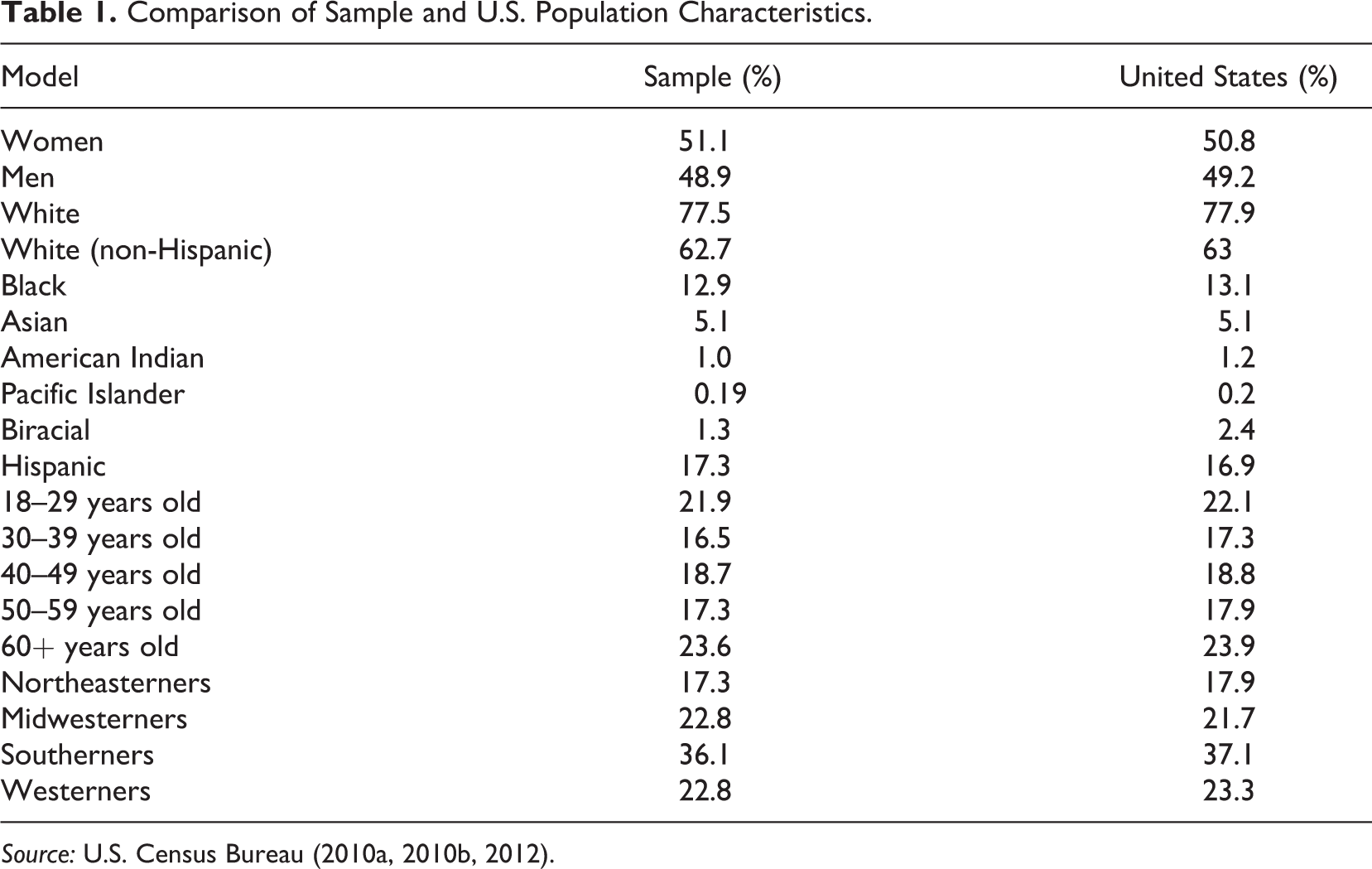
Source: U.S. Census Bureau (2010a, 2010b, 2012).
Dependent Variables
Civic participation
Fifteen items were drawn from Son and Lin (2008) and the General Social Survey (Smith, Marsden, Hout, & Kim, 2008) to construct an index of active memberships in a wide range of civic groups. Membership in each group was reported on a 3-point scale (0 = no involvement, 1 = I participated when I could, or 2 = I was actively involved). Responses were summed to form the additive index (Cronbach’s α = .83, M = 3.19, SD = 4.00).
Generalized trust
Three items were used from previous study (Valenzuela, Park, & Kee, 2009) to assess individual levels of trust in the average person (Cronbach’s α = .82, M = 3.45, SD = 0.69). They asked, “Generally speaking: (a) Would you say that people can be trusted (Rosenberg, 1957), (b) People try to be fair, and (c) People try to be helpful?” (Valenzuela et al., 2009). Responses were drawn on a 5-point scale (1 = strongly disagree; 5 = strongly agree).
Mediating Variables
Weak-tie discussion
Six items were used to measure frequency of interpersonal discussion with coworkers and acquaintances (Cronbach’s α = .91, M = 2.42, SD = 1.39; Gil de Zúñiga & Valenzuela, 2011). Responses fell on a 7-point scale (1 = never talked, 7 = talked multiple times a day).
Perceived access to bridging social capital
Five items from Williams (2006) were used to measure perceived access to bridging social capital (Cronbach’s α = .85, M = 3.64, SD = 0.72). Responses fell on a 5-point scale (1 = strongly disagree, 5 = strongly agree).
Independent Variable
Facebook group sociability
Three items were drawn from previous study (Park et al., 2009) and three more were developed to capture motivated use of Facebook groups for connecting with new and different people. Respondents were asked to agree or disagree with the following along the same 5-point scale: “I join and interact with specific groups on Facebook: (a) to get peer support from others, (b) to feel like part of a community, (c) to keep in touch with people I know (Park et al., 2009), (d) to meet new and different people, (e) to talk about things with different people, and (f) to meet people like me who share my interests.” Item (c) was dropped to improve reliability, and the other items were combined to create the index for Facebook group sociability (Cronbach’s α = .91, M = 3.12, SD = 1.008).
Control Variables
Demographics
Demographic variables used to build this survey included age (M = 45.56, SD = 16.26), sex (51.1% female), race (77.5% White), ethnicity (17.3% Hispanic), and region of residence (36.1% Southern). Other potentially confounding influences were also controlled for, as detailed below.
Annual household income
This item was drawn from the General Social Survey (Smith et al., 2008), with responses ranging from less than $15,000 to $200,000 or more (M = $61,970.83; Mdn = $44,999; SD = 46,704.44).
Educational attainment
Respondents were asked about the highest level of education they had completed thus far, and responses fell on a 9-point scale (M = 7.0, Mdn = some college, SD = 1.67). About 13.5% were high school graduates, 25.4% had bachelor’s degrees, and another 14.5% held postgraduate or professional degrees.
Neighborhood diversity
This item came from the U.S. Citizenship, Involvement, and Democracy Survey (Howard, Gibson, & Stolle, 2006), asking respondents, “Of the people who live in your neighborhood, how many are a different race or ethnicity than you?” Responses fell on a 9-point scale: none (0%), almost none (5%), a few (10%), some (25%), about half (50%), many (75%), most (90%), almost all (95%), and all (100%; M = 2.87, SD = 2.01).
Party ID
Respondents were asked about their political party affiliation (Weisberg, 1999), with the sample comprising 234 Republicans (23.3%), 297 Independents (29.6%), 378 Democrats (37.6%), and 95 reporting “Other” as their party of choice (9.5%).
Perceived access to bonding social capital
Five items were used to account for perceived access to bonding social capital (Williams, 2006), as an index of active strong ties (Cronbach’s α = .87, M = 3.76, SD = 0.85). Responses fell on a 5-point scale (1 = strongly disagree, 5 = strongly agree).
Particularized trust
Five items were used to gauge trust in similar, proven others. Responses fell on the same 5-point scale (Cronbach’s α = .77, M = 3.94, SD = 0.61).
Intensity of Facebook use
Six items were used to measure a respondent’s number of Facebook friends, how much time they spent on the site, and its importance in their daily life (Ellison, Steinfeld, & Lampe, 2007). These were standardized and combined to create the index for intensity of Facebook use (Cronbach’s α = .88, SD = 0.79).
Time spent using Facebook groups
One final item was included to account for time spent in Facebook groups, asking respondents, “On a typical day, how much time do you spend reading and posting to various groups on Facebook?” Responses fell on a 7-point scale from no time at all to more than 3 hours (M = 2.04, SD = 1.63).
Statistical Techniques
Two multiple regressions were used in SPSS 24 to predict civic participation and generalized trust, both controlling for demographics (age, sex, race, ethnicity, region, education, income, and party ID) along with neighborhood diversity and relevant measures of social capital (weak-tie discussion, bonding/bridging, and generalized/particularized trust). The PROCESS macro (Hayes, 2013) was used to test for mediating and moderating associations, while the MODPROBE macro (Hayes & Matthes, 2009) was used to plot the Research Question 1 interaction. The full set of control variables was utilized throughout.
Multicollinearity between predictor variables was not an issue, as no tolerance values fell below 0.4 and no Variance Inflation Factor (VIF) values rose above 2 (Hair, Anderson, Tatham, & Black, 1995). Kolmogorov–Smirnov tests of normality were admittedly significant though (p < .001), and this can indicate that data are from a nonnormally distributed population. But these tests are highly susceptible to issues of sample size, and nonnormal distributions cease to be a problem in samples this large anyway, due to the central limit theorem (Ghasemi & Zahediasl, 2012). Looking at Q–Q plots indicated linear relationships between the predicted outcomes and sets of regressors, while scatterplots of the standardized residuals with standardized predicted values appeared to be homoscedastic as well.
Results
Hypothesis 1 predicted that efforts of sociability in Facebook groups would have a positive association with civic participation. The model accounted for 22.2% of the variance in civic participation, R 2 = .222, F(18, 620) = 9.81, p < .001, with results indicating that Facebook group sociability was related to taking more active roles in a wider range of civic organizations (β = .162, p < .01). The simple act of spending time in Facebook groups was also a source of civic participation (β = .107, p < .05), while Facebook use was, in general, negatively associated with the same measure (β = −.100, p < .05). Facebook group sociability thus contributes to civic participation above and beyond the influence of spending time in groups, and beyond that of using Facebook in general, which is apparently a negative influence. Hypothesis 1 finds support. Sociability use of Facebook groups relates to more active involvement in civic life (Table 2).
Multiple Regression Predicting Civic Participation.

Hypothesis 2 predicted that Facebook group sociability would relate to civic participation indirectly as well, through an increase in weak-tie discussion. Results of a mediation analysis show that Facebook group sociability had a significant total effect on civic participation (β = .201, p < .001). Results further indicate that Facebook group sociability had a significant indirect effect on civic participation as well, through an increase in weak-tie discussion. That is, the use of Facebook groups for meeting new people relates to having more frequent conversations with coworkers and acquaintances (B = .187, β = .133, p < .01), as gains that additionally contribute to civic involvement (B = .899, β = .291, p < .001). Bootstrapped confidence intervals (CIs) confirm the significance of the indirect association (point estimate = .168, 95% CI [.06, .337]) or that the reduction in the size of the total effect is significant once the mediating variable is included in the model (see Preacher & Hayes, 2004). In percentage terms, the size of the relationship between Facebook group sociability and civic participation drops by 19.4% after the inclusion of the weak-tie discussion mediator, but remains significant (β = .162, p < .01). This indicates partial mediation (see Baron & Kenny, 1986), as Hypothesis 2 finds support. The link between Facebook group sociability and civic participation depends in part on the weak-tie discussions it contributes to.
Hypothesis 3 predicted that efforts of sociability in Facebook groups would be positively associated with generalized trust. The model accounted for 30.3% of the variance in trust, R 2 = .303, F(18, 620) = 16.39, p < .001, however results show that Facebook group sociability was not directly related to trusting in the average person (β = .056, p = .224). Neither was spending time in Facebook groups (β = −.008, p = .857) nor using Facebook in general (β = .012, p = .804). Hypothesis 3 is not supported, and Table 3 presents the full model. Sociability use of Facebook groups is not directly related to estimations of the average person’s trustworthiness.
Multiple Regression Predicting Generalized Trust.
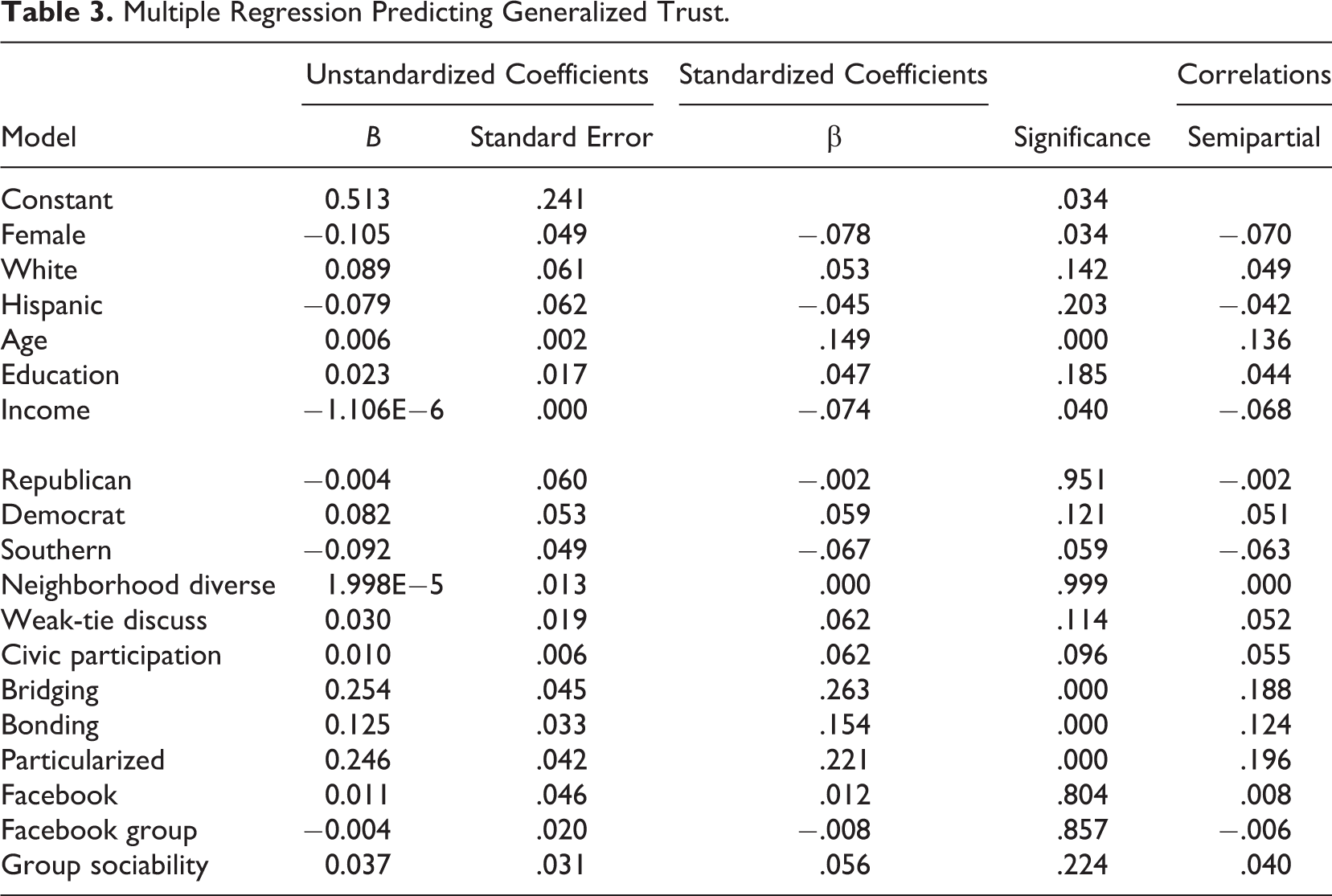
Hypothesis 4 predicted that Facebook group sociability would indirectly relate to generalized trust, through an increase in bridging social capital. Results of a mediation analysis indicate that Facebook group sociability had a significant total effect on generalized trust, such that users who actively socialize in these groups are more likely to trust in the average person, when bridging social capital is kept out of the model (β = .165, p < .001; Hayes, 2013). Results also show that Facebook group sociability had a significant indirect effect on trust, through bridging social capital. Divere social efforts in groups on the site help users amass larger stores of active weak ties upon which to draw (B = .289, β = .416, p < .001), and these gains spill over to trusting in people (B = .254, β = .263, p < .001). Bootstrapped CIs confirm the significance of the indirect association (point estimate = .074, 95% CI [.044, .111]) or that the drop in the size of the relationship between Facebook group sociability and generalized trust is significant once bridging social capital is included in the model. In fact, the direct association between the two measures actually drops to nonsignificance after bridging’s inclusion (β = .056, p = .224), which suggests full mediation. Any relationship between Facebook group sociability and generalized trust here completely depends on the bridging social capital users manage to accrue (see Baron & Kenny, 1986). 5 But Hypothesis 4 finds support, as efforts of sociability in Facebook groups carry over to trusting in a wider range of people, because of the bridging social connections they permit one to activate.
Research Question 1 asked whether Facebook group sociability would moderate any association between neighborhood diversity and generalized trust. Results of a moderated multiple regression including the same set of control variables showed a significant interaction between neighborhood diversity and Facebook group sociability (B = .042, β = .125, p < .001). Neighborhood diversity was negatively associated with generalized trust between the values of 1 and 2.43 on the scale for Facebook group sociability. But between the values of 3.79 and 5, neighborhood-level diversity was a positive source of generalized trust (Figure 1). This indicates a crossover interaction (Szklo & Nieto, 2014) and explains the lack of any direct association between neighborhood diversity and trust in the full regression (see Table 3). Because the size and even direction of this association here depends on levels of sociability Facebook group users exhibit. As neighborhoods diversify, users who are less likely to interact in Facebook groups see their feelings of trust in the average person falter. But for those who employ Facebook groups in wide-ranging efforts of sociability, the influx of neighborhood diversity becomes a reason to trust in the average person. Research Question 1 thus finds support, as diverse social efforts in Facebook groups appear to bolster real-world perceptions of difference.
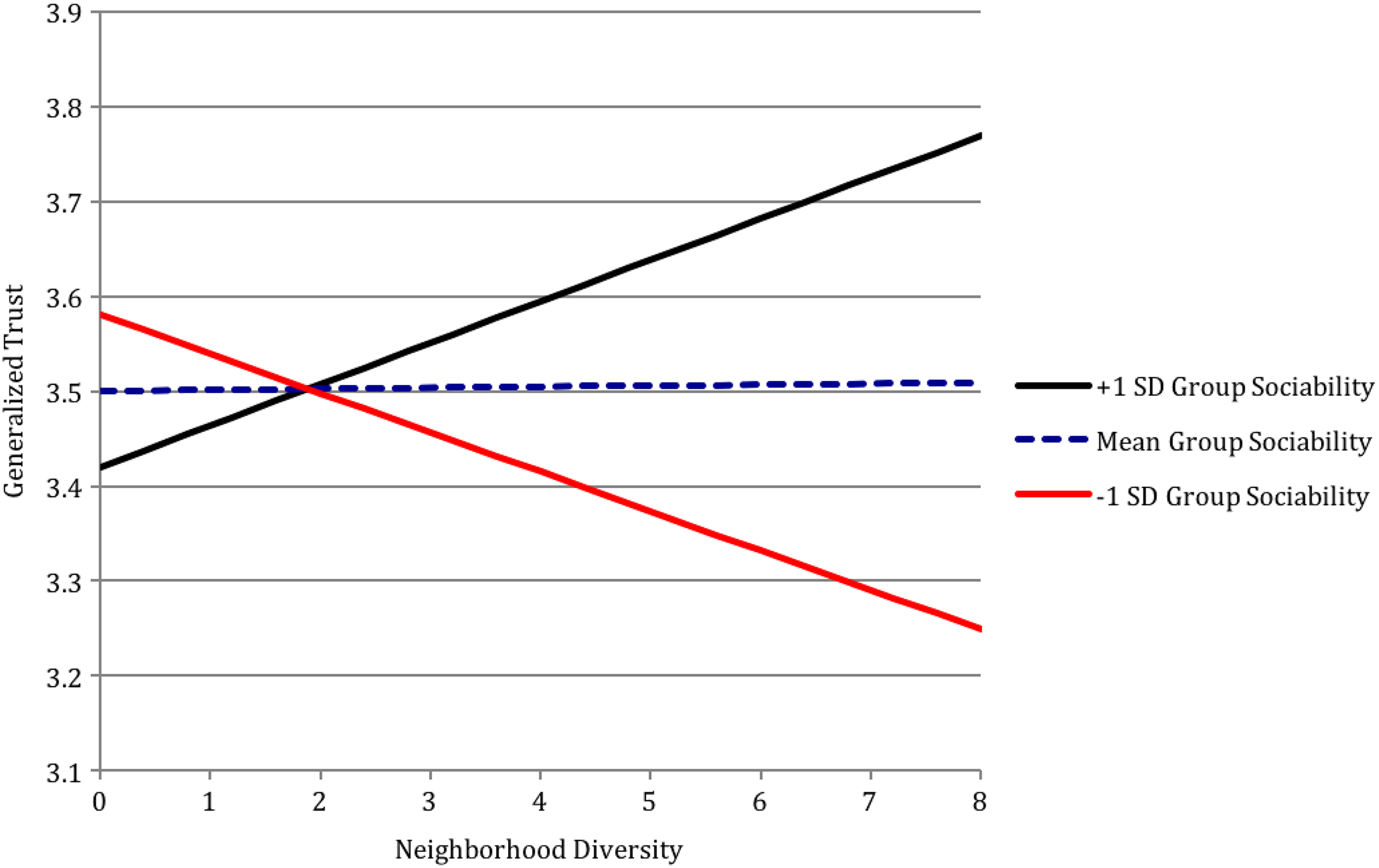
The effect of neighborhood diversity on generalized trust at levels of Facebook group sociability.
Discussion
The problem of waning social capital in America can be viewed as a failure to grasp the strength of weak ties, all the benefits of diversifying personal connections, something efforts of sociability in digital groups might clear up. Because benefits arise when we learn to “put faith in strangers” (Uslaner, 2002b, p. 14), but the threat dynamic mostly prevents us from doing so (Dinesen & Sønderskov, 2018; Putnam, 2007). Digital-group settings can ease this process of connecting, for sourcing newer, weaker ties on the basis of shared interests (Flanagin et al., 2006). As a test of potential benefits, I weighed the use of Facebook groups for meeting new people alongside measures of social capital like civic participation and generalized trust (Putnam, 2000). The question of whether group sociability would alter the way users perceive of racial and ethnic diversity in their neighborhoods was also asked.
Sociability use of Facebook groups was a source of civic participation, contributing to users joining a wider range of civic efforts, and assuming more active roles therein. Group sociability was also an indirect source of participation, by adding to weak-tie discussions both online and off-line. Grasping the social-capital benefits of weak ties in the digital-group setting apparently nudges users to interact with them everywhere, and the added social contact spills over to new engagements in the end. Facebook use was in general negatively associated with the same measure of engagement. Yet meeting new people in Facebook groups becomes a direct and indirect source of localized participation.
As it relates to the other half of the virtuous circle, no direct association was found between Facebook group sociability and feelings of trust in the average person. Digital group interactions are not yet to the point of resembling face-to-face contact that they can be said to pay the exact same dividends. Nevertheless, indirect effects can exist even in the absence of direct or total effects (Hayes, 2013), and Facebook group sociability here contributed to generalized trust indirectly, through an increase in bridging social capital. Social efforts in these groups translate into faith in the average person by adding to weak-tie connections and resources. Indeed, bridging wholly accounts for Facebook group sociability’s contribution to trust in the present study.
When asked whether the average person could be trusted, sociable Facebook group users were here more likely to say yes, even in the face of increasing neighborhood diversity. They trusted because of the racial and ethnic differences they lived around, while less sociable users still mistrusted at the sight. An increase in intercultural competency is theorized as the reason why, where beyond measures like motivation or skill, diverse interactions promote feelings of tolerance and empathy (Mollov, 2006; Preece & Ghozati, 2001; Zhao, Abrahamson, Anderson, Ha, & Widdows, 2013). The use of Facebook groups for activating these connections may even alter the way users perceive of racial and ethnic diversity locally, thus mitigating the tendency for differences to get viewed as a threat. Making this switch ironically depends on the social effort one exerts online, in groups especially, as contact that sets the stage for a complete reversal, “the development of a positive attitude toward other cultures” (Ciftci, 2016, p. 317).
Limitations and Future Directions
This survey used a nonprobability mode of sampling, by fielding respondents from an Internet panel, which limits how widely the results generalize. I address this in part by matching respondents to U.S. Census parameters for age, sex, race, ethnicity, and region, so at the very least, this looks like a cross section of the American populace. But cross-sectional surveys cannot speak to causation in general, and the most that can be shown here is covariance. It could be that engaging civically and trusting socially prompts more social uses of Facebook groups, but not vice versa. Or, these associations could be spurious. Either way, a longitudinal survey is necessary to show time order, and an experiment to demonstrate causation, with covariance nonetheless as a step.
With the rise of social networking sites, and even newer technologies like virtual reality, digital modes of interacting can be said to more closely resemble interpersonal forms of social contact (Shuter, 2012). As this mimicry improves, so too might SNS’s potential to facilitate competencies traditionally acquired face to face (Bouchillon & Gotlieb, 2017). This would have a range of applications, from the travel industry to office-sensitivity training, but foremost among them remains the reintegration of local residents into back into neighborhood life (Julien, 2015), something efforts of sociability in Facebook groups here show potential for.
But the public’s good faith in Facebook has also warn thin, evidenced by the Cambridge Analytica breach, in which the private data of 87 million users was leaked by the site (Kang & Frenkel, 2018). So although digital mediums could aid in the regeneration of social capital, this notion becomes hard to reconcile with the often haphazard way in which these sites are managed. The task becomes one of providing for online interactions that resemble their real-world counterparts, while still protecting that which users would like to keep private.
Conclusions
If the “central challenge for modern, diversifying societies is to create a newer, broader sense of ‘we’” (Putnam, 2007, p. 139), new media can help, with SNS groups as something of a rare commodity, a place where diverse interactions still occur regularly (Lee & Lee, 2010) and still pay dividends for social capital (Bouchillon & Gotlieb, 2017). Here, these include weak-tie discussions, bridging social connections, civic participation, and generalized trust; and as an added bonus, diversity itself becomes a reason to trust, after recasting difference as a source of reciprocity. I thus provide evidence of not only the digitization of American social life, but the added value of digital groups for diverse social efforts, where interactions could ease the process of living near, and connecting with, different kinds of people.
Footnotes
Appendix
Author’s Note
This data set is available from the author upon request (
Declaration of Conflicting Interests
The author declared no potential conflicts of interest with respect to the research, authorship, and/or publication of this article.
Funding
The author received no financial support for the research, authorship, and/or publication of this article.