






Abstract
Twitter gained new levels of political prominence with Donald J. Trump’s use of the platform. Although previous work has been done studying the content of Trump’s tweets, there remains a dearth of research exploring who opinion leaders were in the early days of his presidency and what they were tweeting about. Therefore, this study retroactively investigates opinion leaders on Twitter during Trump’s 1st month in office and explores what those influencers tweeted about. We uniquely used a historical data set of 3 million tweets that contained the word “trump” and used Latent Dirichlet Allocation, a probabilistic algorithmic model, to extract topics from both general Twitter users and opinion leaders. Opinion leaders were identified by measuring eigenvector centrality and removing users with fewer than 10,000 followers. The top 1% users with the highest score in eigencentrality (N = 303) were sampled, and their attributes were manually coded. We found that most Twitter-based opinion leaders are either media outlets/journalists with a left-center bias or social bots. Immigration was found to be a key topic during our study period. Our empirical evidence underscores the influence of bots on social media even after the 2016 U.S. presidential election, providing further context to ongoing revelations and disclosures about influence operations during that election. Furthermore, our results provide evidence of the continued relevance of established, “traditional” media sources on Twitter as opinion leaders.
Social media has become ubiquitous. In 2005, only 5% of American adults used social media; currently, about seven of 10 Americans use at least one social media site (Pew Research Center, 2019). With 186 million daily users (Twitter Inc., 2020) producing 500 million messages per day and over 15 billion Application Programming Interface (API) calls per day (Pandya et al., 2020), Twitter remains a key part of the social media landscape and the media diet of many Americans. Twitter gained new prominence when the former President of the United States, Donald J. Trump, adopted Twitter as his preferred platform to make official statements directly to the public (Landers, 2017). The 45th U.S. president tweeted from his personal account—@realDonaldTrump—more than 26,200 times throughout his term, an average of 18 tweets per day (Trump Twitter Archive, 2016). Indeed, Twitter remained his method of communicating with the public. Trump directly attacked the company for placing warning labels on his tweets as well as suspending him for 12 hr on January 7, 2021, when he was accused of inciting violence which led to a mob attack on the U.S. Capitol building. On January 8, 2021, shortly before the end of his presidency, Trump was permanently banned from Twitter (Twitter Inc., 2021).
A whole new body of research analyzing Trump’s tweets has emerged. Scholars have found in his tweets evidence of an authoritarian personality (Fuchs, 2018) and disdain for democracy (Ouyang & Waterman, 2020) and the rule of law. Others found that Trump’s tweets included content that fuels racial hatred (McGranahan, 2019) and promotes mistrust of the mainstream news media (Ott & Dickinson, 2019). These rhetorical styles can also be found in other actors who have gained prominence in recent years: bots. Studies show that bots have influenced political discussion on Twitter in a range of countries (Ferrara, 2017; Howard & Kollanyi, 2016; Nobre et al., 2019). Political bots are software processes that power automated accounts tasked with interacting with other users and trying to manipulate public opinion during political events. Cyborgs refer to hybrid human–bot accounts that execute automated actions with human supervision (Ferrara et al., 2016; Grimme et al., 2017).
The Special Counsel investigation, conducted by special prosecutor Robert Mueller from 2017 to 2019, concluded that Russia attempted to influence U.S. public opinion during the 2016 presidential election. As a result of this investigation, the Justice Department indicted 13 Russian citizens and three Russian entities, including the Internet Research Agency (IRA; Mueller, 2019). Since mid-2018, Twitter’s Transparency Center (https://transparency.twitter.com/) has released several data sets with “tweets and media (e.g., images and videos) from accounts we [Twitter] believe are connected to state-backed information operations” (Twitter Inc., 2019), including over 9 million tweets from 3,613 accounts affiliated with the IRA. There are studies that show that bots were decisive tools to influence conversations, demobilize opposition, and create a false appearance of support for Trump during the 2016 U.S. election (Badawy et al., 2018; Howard et al., 2018; Kriel & Pavliuc, 2019; Ruck et al., 2019).
However, after the election, there remains a lack of consensus of whether bots were among the top opinion leaders on Twitter, influencing content around Trump. Therefore, it is important for scholars to identify Twitter opinion leaders during the first days of Trump’s presidency and analyze how these opinion leaders contributed to Twitter political discussions. We use social network analysis (SNA) to identify opinion leaders and topic modeling to discern the main themes on Twitter during Trump’s 1st month in office. This study’s aims are to provide a snapshot of who the opinion leaders were, what they were tweeting about when they posted about Trump, and what prominence bots had as influencers.
Literature Review
Opinion Leaders: Two-Step Flow of Information
A seminal study of the 1940 U.S. presidential election revealed that most people are influenced not by mass media, but by opinion leaders: “ideas often flow from radio and print to the opinion leaders and from them to the less active sections of the population” (Lazarsfeld et al., 1969, p. 151). This concept, known as the “two-step flow” of communications, has had a profound influence in marketing, political science, and diffusion of innovations (Rogers, 2003; Shah & Scheufele, 2006; Van den Bulte & Joshi, 2007). According to the two-step flow of communication hypothesis, there are opinion leaders throughout every class and occupation. Through word of mouth, they have more influence on friends, coworkers, and relatives in decision-making processes and behavior than the mass media (Katz, 1957). Katz and Lazarsfeld (1955) suggested four major traits of opinion leaders: having a large following, being considered as an expert, being knowledgeable, and holding a central position within their networks to influence social pressure and support.
In the two-step flow of information, influential members of the public (known as opinion leaders) have played a prominent role in transferring information from news media to the public. The two-step flow of information emphasizes the role of interpersonal communication in overcoming some limitations of mass media’s direct reach toward audiences. Erbing et al. (1980) suggested that interpersonal communication was necessary to help audiences understand news media issues, arguing that opinion leaders could reinforce or reduce the effects of media messages on personal agendas.
Opinion Leaders on the Internet and Social Media
The emergence of the Internet and digital media technology has raised questions about the continued utility of the two-step flow of information hypothesis. The Internet provides an unlimited amount of information at a low cost, and users can personalize their news feeds. The Internet is also perceived by many as an egalitarian forum that can facilitate many-to-many (multiplex) interactions and reduce inequality by increasing opportunities for individual participation in online discussions. Others have not only argued that online opinion leaders exist but also that the two-step model remains important conceptually (Wu et al., 2011). While traditional opinion leaders had greater access to information than their followers, digital media changed the dynamics of information flow. Specifically, online opinion leaders can now produce information and transfer it to mass audiences. Also, online opinion leaders can be identified by the quality of arguments they make (Lu et al., 2013) and the degree of activity they exhibit in online discussions (Kwak et al., 2010).
Social media redefined the traditional concept of opinion leaders and gave birth to a new category: social media influencers. McCorquodale (2020) defined an influencer as “an individual who has built a digital audience through sharing editorialized content about their life” (p. 11). McCorquodale suggested the term influencer can be interchangeable with a content creator, blogger, Instagrammer, and YouTuber; such figures are known as independent, industrious, and famous in digital environments. McCorquodale (2020) suggested that influencers do share information from traditional media, but their information-sharing activities reflect their own views and perspectives. Influencers are seen as having more direct engagement with their audiences than traditional opinion leaders. Furthermore, influencers’ social media activities can also lead their audiences to gravitate away from traditional media toward social platforms.
Twitter Opinion Leaders: Unique Characteristics and Their Association With Polarization
Twitter influencers have unique characteristics. McCorquodale (2020) suggested that Twitter users who have significant followings are motivated to propel their ideas into mainstream media. Twitter influencers have been known to have controversial and extreme voices that tend to encourage other users to react to them. Moreover, the “value” of opinion leaders’ tweets has been evaluated based on their reach and diffusion (Bruns, 2012).
Journalism is also affected by these tweets. For example, by tweeting controversial posts, opinion leaders on Twitter can get an editor’s attention and coverage, for even a retweet can expose opinion leaders to mainstream media audiences (McCorquodale, 2020). In a process originally known as the reversed two-step flow (Brosius & Weimann, 1996), the public’s interests can be transferred to the mainstream media through opinion leaders who first spotlight issues. Also, some journalists are encouraged to be commentators on Twitter by discovering stories not covered in mainstream media, commenting on existing stories, or eliciting additional reports from their audiences (McCorquodale, 2020). Lastly, the boundary between news and comments has been blurred on Twitter to generate further audience growth and engagement. Thus, Twitter has the ability to redefine news agendas and issues by adding multiple personal opinions through retweets.
On Twitter, opinion leaders can be celebrities, political actors, journalists, and other influencers. For example, the Twitter activities of celebrities can and do receive attention from news media and the public (Lang, 2017). Tufekci (2013) argued that celebrities, as spokespeople or supporters of a social movement, could perform as event headliners, and their activities could be highlighted in traditional and social media. Walter and Brüggemann (2020) argued that political actors could spark Twitter discussions and initiate interactions by posting a high volume of tweets and/or by being mentioned by other Twitter users. Walter and Brüggemann found that political actors could impact Twitter debates about climate change, as their tweets were retweeted by activists, scientists, and journalists. Journalists can utilize Twitter to brand themselves and their organizations (Molyneux et al., 2018). Journalists have also been able to build more personal relationships with their audiences by retweeting humorous tweets, for example (Molyneux, 2015). Such Twitter usage could deviate from traditional journalistic practices that require neutrality. Some news organizations like Reuters set strict social media guidelines controlling Twitter usage by journalists to safeguard objectivity and impartiality (Jukes, 2019). However, scholars identified many journalists who can and do use Twitter liberally and have successfully built audiences on the platform through methods of self-promotion (Lasorsa et al., 2012; Molyneux, 2015).
Habel (2012) defined the opinion sections of The New York Times and The Wall Street Journal as spaces for opinion leadership, as these sections served as a venue for media elites to persuade others. Similarly, the Twitter accounts of news organizations can be considered as individual entities, engaging in direct communication with their audiences and, ultimately, fostering opinion leadership. Fourth, van Haperen et al. (2018) examined the #not1more campaign (a Twitter social movement against immigrant deportations) and found that this movement was supported by activists who actively tweeted with other users to organize online protests.
Empirical research on social networks sheds new light on the two-step communication model and provides evidence of opinion leaders’ importance, particularly on Twitter (Cha et al., 2010; Park & Kaye, 2017; Wu et al., 2011). There has been a diversity of measures to identify the influence of a user on Twitter: followers, retweets, mentions, favorites/likes, Page Rank, and Klout, for example. Moreover, rankings of influencers are highly variable, as there are many differences among the measures used (Cha et al., 2010; Riquelme & González-Cantergiani, 2016; Winter et al., 2020).
Twitter opinion leaders can also facilitate the creation of echo chambers, a situation where information is shared to reinforce a group’s preexisting beliefs (Sunstein, 2009). Echo chambers can be shaped both intentionally and unintentionally. The former is particularly seen in cases where bots are involved. At a theoretical level, the concept of reinforcement is useful and overlaps with the definitions of opinion leadership and selective exposure. Lazarsfeld et al. (1969) argued that opinion leaders were self-assured enough to assert why they were right, and they were reminded that other people agreed with them. Echo chambers were found on Twitter during the impeachment process of ex-Brazilian president, Dilma Rousseff. Specifically, opinion leaders with higher followings facilitated echo chambers by producing a high volume of retweets (Soares et al., 2018). Examples such as these highlight how Twitter networks can reinforce partisan political perspectives through active information sharing within clusters of networks. In some cases such as this, like-minded followers produce and consume media within a partisan bubble. However, in many other cases, filter bubbles were not found to exist on Twitter (Eady et al., 2019).
Scholars have examined Twitter networks and studied various communication patterns, including polarization (Bastos et al., 2018; Pew Research Center, 2014). “Polarized crowds” represent two big and dense groups in a network that were rarely connected. In the U.S. context, polarized crowds often refer to liberal and conservative groups with limited interconnections. Within each densely connected polarized crowd, Himelboim et al. (2013) found evidence of “hub” users who occupied the center of each cluster and acted as a sort of clearinghouse of information.
In this study, we sought to identify who opinion leaders were in the Twitter mention network of former President Trump. In order to understand which topics were most prominent during Trump’s first 30 days in office, we used the computational method of topic modeling. Lastly, we evaluated whether echo chambers emerged in the Twitter network we studied, and we explored whether topics were discussed differently between the two dominant U.S. political parties—Republicans and Democrats. Thus, we considered the following research questions in this study:
Method
Data, Opinion Leaders, and SNA
We examined Twitter data to identify the opinion leaders and the topics related to Trump during his 1st month in office. We collected 2,862,987 unique tweets from January 20 to February 18, 2017, that contained the word “trump.” These tweets were posted by 1,260,752 unique users from all over the world and include non-English-language tweets. Within these data, we further identified a subset of tweets associated with user accounts with 10,000 or more followers and studied the user profiles most mentioned by these accounts. The 10,000-follower cutoff was used as it would not be possible to manually study a data set with over a million unique users. Of course, opinion leadership of a user is not necessarily linked to their number of followers, and accounts with few followers may be opinion leaders. However, for a profile to be influential, it is essential that it be mentioned by users with many followers (through retweets, replies, etc.; Park & Kaye, 2017; Shao et al., 2018).
In our sample, 133,640 tweets (around 5% of the initial sample of 2,862,987 tweets) were from users with 10,000 or more followers. These tweets were posted by 36,540 unique users. We used SNA to systematically identify connections among actors and investigate evidence of polarized clusters in our sample. SNA can be used to study individual nodes (actors including persons or organizations), ties (an edge or connection among nodes), and subnetworks (parts of a larger network; Ward et al., 2011; Wasserman & Faust, 1994). In this study, the unit of analysis is an individual Twitter account, which we treat as a single node/actor in the entire network.
Measurements of centrality evaluate how highly concentrated links are around a small number of central nodes. In SNA, various types of centrality are used to quantitatively measure the role and relative importance of individual nodes within a network (Hanneman & Riddle, 2005). Valente (2010) found that node centrality can be used successfully to identify opinion leaders in social networks. There are multiple ways of calculating centrality scores, such as betweenness, degree (in and out), closeness, and eigenvector centralities (Everett & Borgatti, 2005; Freeman, 1978). Eigenvector centrality—a measure used to describe the relative importance of nodes—can be used to identify the most central actors who have the smallest degree of farness from others in the overall structure of the network. This measure assigns higher weights to links that connect a node to other central nodes.
We used Gephi version 0.9.2, an open-source SNA software package, to measure the eigenvector centrality of the nodes in the network. We created a mention network to observe how specific users were mentioned by extracting targets (nodes being mentioned) and sources (nodes who mentioned other accounts). A total of 49,182 Twitter accounts were found in the mention network, based on 133,640 tweets posted by 36,540 unique users. We then enumerated a list of eigenvector centrality scores in descending order (from highest to lowest) to rank order opinion leaders in the mention network.
Among the 49,182 unique users, 38% (N = 18,862) of the users mentioned had zero eigencentrality. From the 30,320 users that scored above zero, the top 1% (N = 303) tweeted 5,856 times from January 20, 2017, to February 18, 2017. The subsample of 303 users was manually coded to identify types of opinion leaders based on each user’s Twitter profile and their tweet content. We classified opinion leaders into 12 categories: news media, nonmedia organization, journalist, political analyst, Republican politician, Democrat politician, right-wing activist, left-wing activist, celebrity, a politician from another country, bot, and suspended user. The categories are grounded in data and were created after analyzing user accounts. We opted for a broad and mutually exclusive categorization to facilitate the analysis.
News media (newspaper, news agency, etc.), nonmedia organizations (foundation, nonprofit organization, etc.), journalists (reporter, producer, etc.), political analysts (contributor, columnist, etc.), celebrities (musician, actor, etc.), Republican politicians, Democrat politicians, and politicians from other countries generally identify themselves as such in their Twitter bio and often have verified accounts. To classify activists, we studied the posts of each user and found they were generally monothematic and explicit in terms of their beliefs and views.
In order to identify bots in our data set, we queried Botometer (https://botometer.osome.iu.edu/) for all user accounts. We labeled as bots the users that scored above 4.8 out of 5 since only 9% of users with this score are human. Botometer is a tool that uses a machine-learning model trained to classify an account as a bot or human; it has been successful in detecting social bots (Davis et al., 2016; Ferrara et al., 2016). We defined “suspended” users as those with accounts deleted or suspended by Twitter (e.g., for violating the terms of service). Although many additional accounts have been suspended since we began our research, we kept these accounts in the initial categories since they were active at the time of our data collection. In the “Results” and “Discussion” sections, we mention accounts that were suspended after we collected the data.
Bessi and Ferrara (2016) found that during the 2016 presidential election campaign, bots were responsible for one fifth of political discussions on Twitter. Among tweets posted by bots, 30% of Twitter accounts were suspended for violating the terms of service. Bessi and Ferrara (2016) argued that such a prominent number of tweets posted by bots could influence political discussions and public opinion. Thus, we added bots and suspended users to the categorization of opinion leaders.
Topic Modeling
We used the software package MALLET version 2.0.8 (McCallum, 2002) to conduct topic modeling. This system uses probabilistic algorithms to computationally identify topics from large text corpora. Topic models have been successfully applied to multiple text mining tasks to discover groups of related words in collections of tweets (Murthy, 2015). These baskets of words are called “topics.” Latent Dirichlet Allocation (LDA; Blei et al., 2003) is one of the most popular topic models and has been successfully applied to study a diverse range of topical domains on Twitter (Weng et al., 2010; Zhao et al., 2011).
We chose LDA topic modeling because it is one of the few methods available for deciphering topics from large tweet corpora and because it has been used to successfully study tweets within the context of political communication (Karami et al., 2018; Sharma et al., 2017; Zheng & Shahin, 2018). Our topic modeling analyses were iterated. Specifically, we iteratively extracted sets of 50, 25, 15, 10, and five topics, with and without any optimization, from the 5,856 tweets from the top 1% of opinion leaders. We did this until recognizable clusters of topics emerged. We also used MALLET with the same settings with the entire sample. Although tweets were collected in several languages, we found that the main topics in these were either proper nouns or words in English.
Lastly, we measured the degree of polarization of tweets mentioning Donald Trump. We calculated modularity scores in the network and modularity classes for each user through Gephi. Modularity is a measure to determine the extent to which calculated clusters are bounded (Himelboim et al., 2013) and can be used to identify communities or clusters in networks. We used a computational algorithm created by Blondel et al. (2008) to calculate modularity scores and enumerate clusters produced by similarities of members in each cluster. Modularity scores range from −1 to 1 (Li & Schuurmans, 2011). Scores closer to 1 have dense connections between nodes within clusters but sparse connections between nodes in different clusters (Li & Schuurmans, 2011). Most modularity scores range from 0.3 to 0.7 (Newman & Girvan, 2004). In the context of polarization, low modularity scores ranging from −1 to 0.3 have been found to imply that no polarization exists in the network, while high modularity scores ranging from 0.3 to <1 have been found to indicate the existence of polarization (Garcia et al., 2015). Himelboim et al. (2013) indicate 0.6 as a threshold for detecting high divisions and 0.4 as a sufficient threshold for a medium level of divisions among clusters. After calculating modularity scores, we interpreted opinion leaders’ tweets in each group and evaluated whether detected clusters were polarized or not.
Results
Who Are the Opinion Leaders Tweeting About Trump?
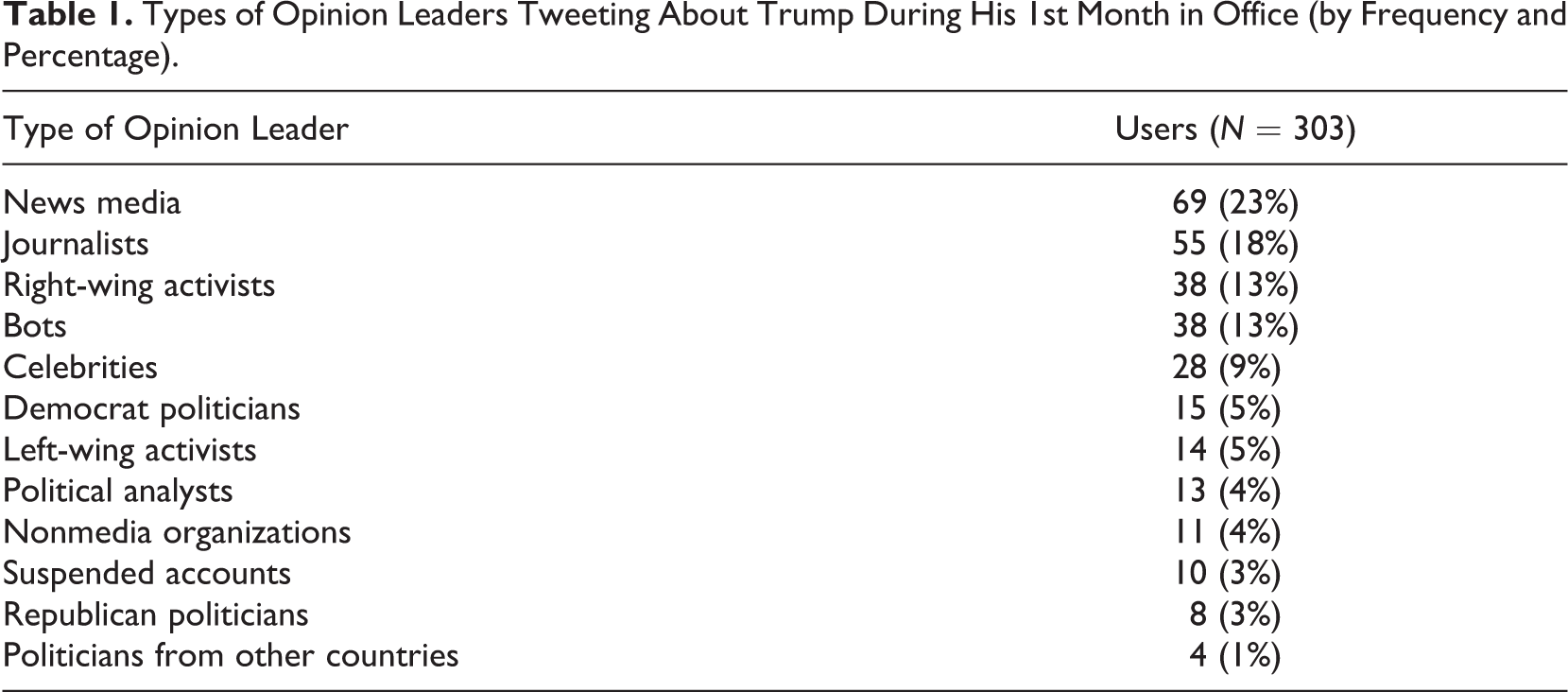
About a quarter of opinion leaders are media outlets or self-described as news sites. It should be noted that some of these accounts (e.g., @BreitbartNews and @zerohedge) have been flagged as consistently spreading misinformation or fabricated news by fact-checking organizations. The next less frequent category are journalists at 18% of our sample. Next were right-wing activists and Botometer-flagged accounts (both made up 13% of our sample). Table 1 provides a breakdown of all opinion leader categories by frequency and percentage. Figure 1 illustrates the mention network between these accounts.
Types of Opinion Leaders Tweeting About Trump During His 1st Month in Office (by Frequency and Percentage).
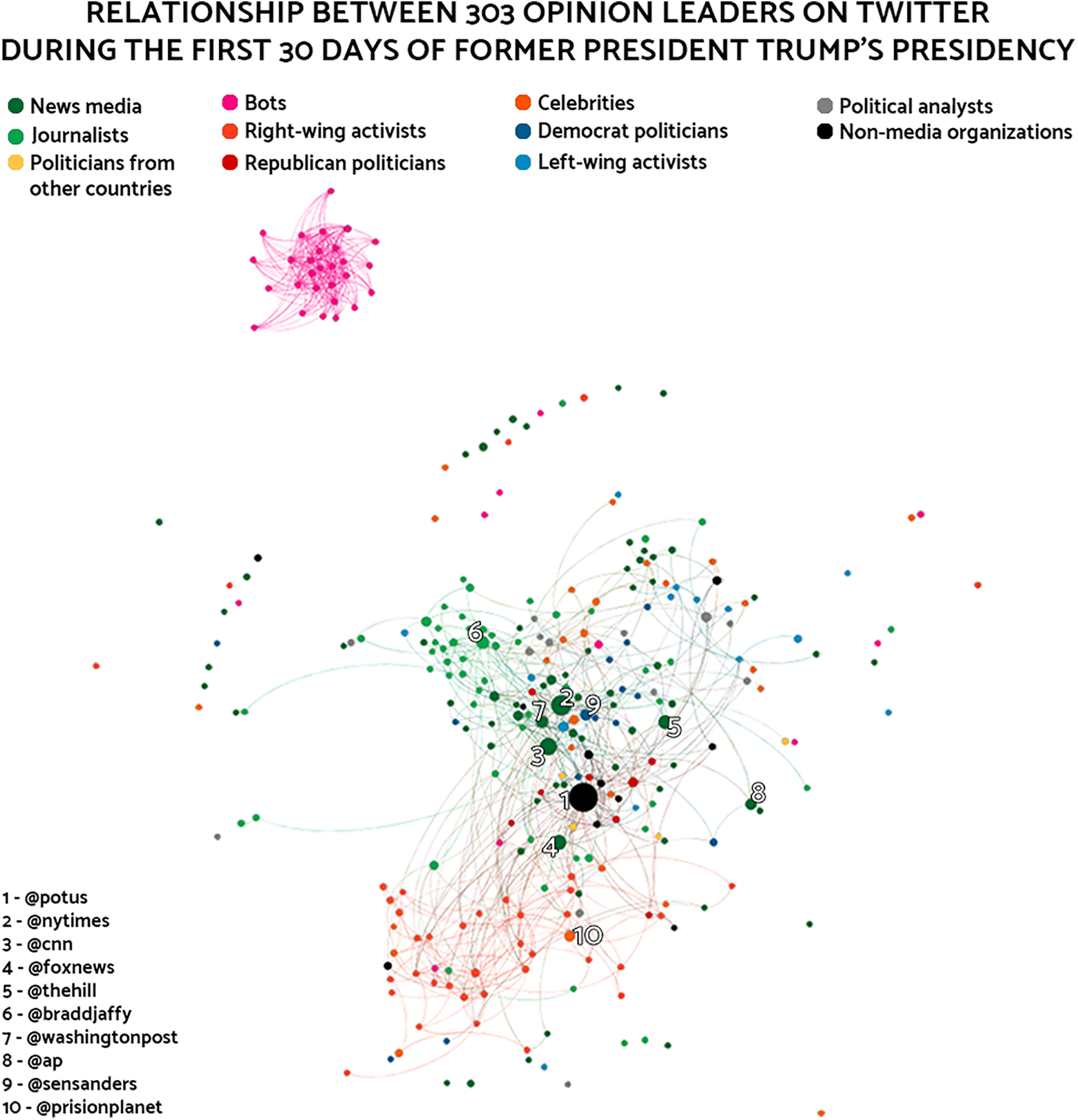
Influencers’ mention networks. Note. Accounts with highest eigencentrality are rank ordered.
News Media
News outlets were distributed in the following categories: extremely biased left-wing, left, left-center, right, right-center, extremely biased right-wing. Following Bovet and Makse (2019), we used the websites www.allsides.com and www.mediabiasfactcheck.com to perform our classification. We also used the latter to measure the factual reporting of the news organizations: from very high to very low.
Around 90% of media users are “verified” accounts, which means they are accounts verified by Twitter as being in the public interest or considered to belong without doubt to verified humans (Ferrara, 2017). As Table 2 indicates, most media outlets are left-wing (e.g., @CNN, @RawStory) and left-center (e.g., @nytimes, @washingtonpost). The organizations classified as center (e.g., @AP, @TheEconomist) were the best performers in following traditional, fact-based journalism in that 92% of them scored high/very high for factual reporting. The right-wing media (e.g., @FoxNews, @DailyCaller) and the right-center (e.g., @FoxBusiness, @FortuneMagazine) scored 6% and 4%, respectively, and none of these media scored high/very high for factual reporting.
Media Outlets Tweeting About Trump During His First Month in Office (by Frequency and Percentage).
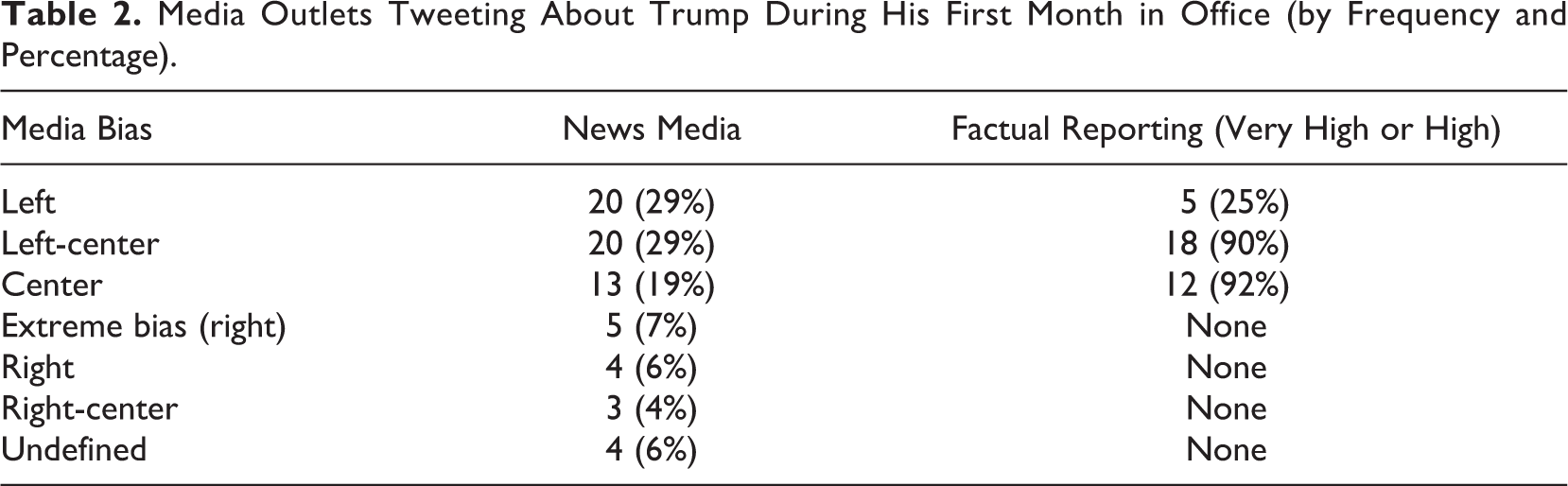
Among the most influential media users’ accounts, there are none from the extreme left-wing, but there are five extreme right-wing accounts that also score low/very low for factual reporting: @Breaking911, @BreitbartNews, @gatewaypudint, @infowars, and @zerohedge. All these websites have been flagged as consistently spreading misinformation or fabricated news. @infowars and @gatewaypudint were permanently suspended from Twitter for violating the platform’s rules (Conger & Nicas, 2018; Dellinger, 2021).
Journalists and Political Analysts
With 55 accounts, journalists represent a little less than a fifth of the opinion leaders during our study period. About 96% have an account verified by Twitter and work or collaborate with news organizations. About 70% are linked to left-wing or left-center media outlets, while 14% are associated with media classified as center and 11% with right-wing or right-center publications. Finally, 5% work for extreme right-wing websites, which promote conspiracies and fake news (e.g., @BreitbartNews, @gatewaypudint). Journalists are associated with 28 media outlets, but 62% are associated with CNN, and The New York Times. All the right-wing opinion leaders are associated with Fox News.
Political analysts have different backgrounds, but they can be grouped into two categories: those linked to media outlets and those that are independent. Around 70% fit the first case. Six opinion leaders are linked to left-wing or left-center news organizations (e.g., @arimelber), and three are linked to right-wing or right-center media (e.g., @jasoninthehouse). Among the opinion leaders who do not have a clear association with any media outlet are @tribelaw and @igorvolsky.
Right- and Left-Wing Activists
Together, the activists represent 17% of opinion leaders, with 52 users. Those labeled as activists users were users who tweeted about politics, generally in a partisan matter. Among the right-wing activists, only one user (@ScottPresler) has an account verified by Twitter. Of the 38 right-activist opinion leaders, 18 had their accounts suspended for violating Twitter’s rules, and another eight deleted all their tweets and changed their profile picture. In other words, 68% of the right-wing activists who tweeted in favor of Trump during our study period no longer exist. Some of these accounts, such as @SandraTXAS, @ChristiChat, @asamjulian, @nia4_trump, @JrcheneyJohn, @MissLizzyNJ, @ThePatriot143, and @jko417, also played a prominent role on Twitter during and after the 2016 presidential election, often spreading disinformation and fake news (Al-Rawi et al., 2019; Bovet & Makse, 2019; Cornfield, 2017; Zheng & Shahin, 2018). We also found that our sample of leaders included the suspended account @TEN_GOP, an account affiliated with the Russian IRA, which engaged in information operations campaigns on Twitter and other social media platforms.
The left-wing activists consist of 14 users (5% of opinion leaders), with one verified by Twitter: @LibyaLiberty. Since 2017, one account has been suspended for violating Twitter’s Terms of Service, and another three deleted all their tweets and changed their profile pictures; these three represent 28% of the left-wing opinion leaders in our study. As with the now-suspended right-wing opinion leaders’ user accounts, left-wing suspended/deleted accounts played a prominent role on Twitter during and after the 2016 U.S. election. Users such as @ezlusztig and @IMPL0RABLE were among the few that appeared among the influencers on Twitter in 2016, which was generally dominated by right-wing activists (Jaech et al., 2018; Nguyen et al., 2017).
Bots and Suspended User Accounts
We labeled as bots the accounts that scored above 4.8 out of 5 as scored by Botometer, given that only 9% of users with this score are human. These 38 users were responsible for 11% of the total tweets during the analyzed period. Twenty-nine of the 38 bots had common attributes: They were created between February and September 2016, they always tweeted from TweetDeck, and they retweeted the remaining 28 accounts several times. By publishing in a coordinated way, this group managed to influence the top-performing topics during the analyzed period with tweets such as “Nude Photos of Melania Trump Published in the New York Post https://t.co/9rhmogSzHl and “J.K. Rowling Burns Donald Trump in 3 Magical Tweets https://t.co/WR0HRwYDxY.” All accounts are now suspended by Twitter, except: @just_lovforever, @RitikaSarma1, @govindkumarbab1, and @mahimarani21. The last tweet from these four accounts was posted on January 25, 2018.
There is not much to comment on regarding the 10 accounts that were suspended right after our data collection since we did not inspect these users. That being said, 3% of opinion leaders in our sample were suspended by Twitter for violation of their terms of service in 2017. At the time of writing in March 2021, that number reaches almost 30%. Together, bots and users that are suspended (again, as of the time of writing) accounted for a quarter of all tweets posted during our study, which corroborates levels of bots and suspended accounts found by others (e.g., Bessi & Ferrara, 2016).
Democrat and Republican Politicians
Among the opinion leaders we identified on Twitter, 15 users are linked to the Democrats and eight to the Republicans. Most opinion leaders among Democrats are senators—a third of the total (e.g., @SenSanders and @SenSchumer). But there are also congressional representatives, institutional accounts, and a former president. Among Republicans, the majority of opinion leaders during our study period were White House employees (e.g., @KellyannePolls and @DanScavino), followed by senators, congressional representatives, and institutional accounts. All these accounts are verified by Twitter.
Other Opinion Leaders
Four non-U.S. politicians are among the opinion leaders we studied: the Prime Minister of Israel, Benjamin Netanyahu (@netanyahu); Nigel Farage (@Nigel_Farage), the then Member of the European Parliament; Theresa May (@theresa_may), the then Prime Minister of the United Kingdom; and Vicente Fox Quesada (@VicenteFoxQue), the then President of Mexico. The first two are well-known Trump allies. Trump had meetings with all but Fox Quesada (who had mocked the border wall) during our data collection period. All tweeted about Trump in English.
Among the 11 nonmedia organizations (i.e., organizations other than news media), there are accounts considered neutral (e.g., @YouTube, @Nordstrom), and there are institutional accounts (e.g., @WhiteHouse, @SecretService). Finally, among celebrities’ accounts, there are television shows that regularly parodied Donald Trump, such as Saturday Night Live (@nbcsnl) and The Daily Show (@TheDailyShow), as well as celebrities tweeting for and against Trump (e.g., actor @RealJamesWoods and the writer @StephenKing).
Main Topics Addressed in Tweets by Opinion Leaders
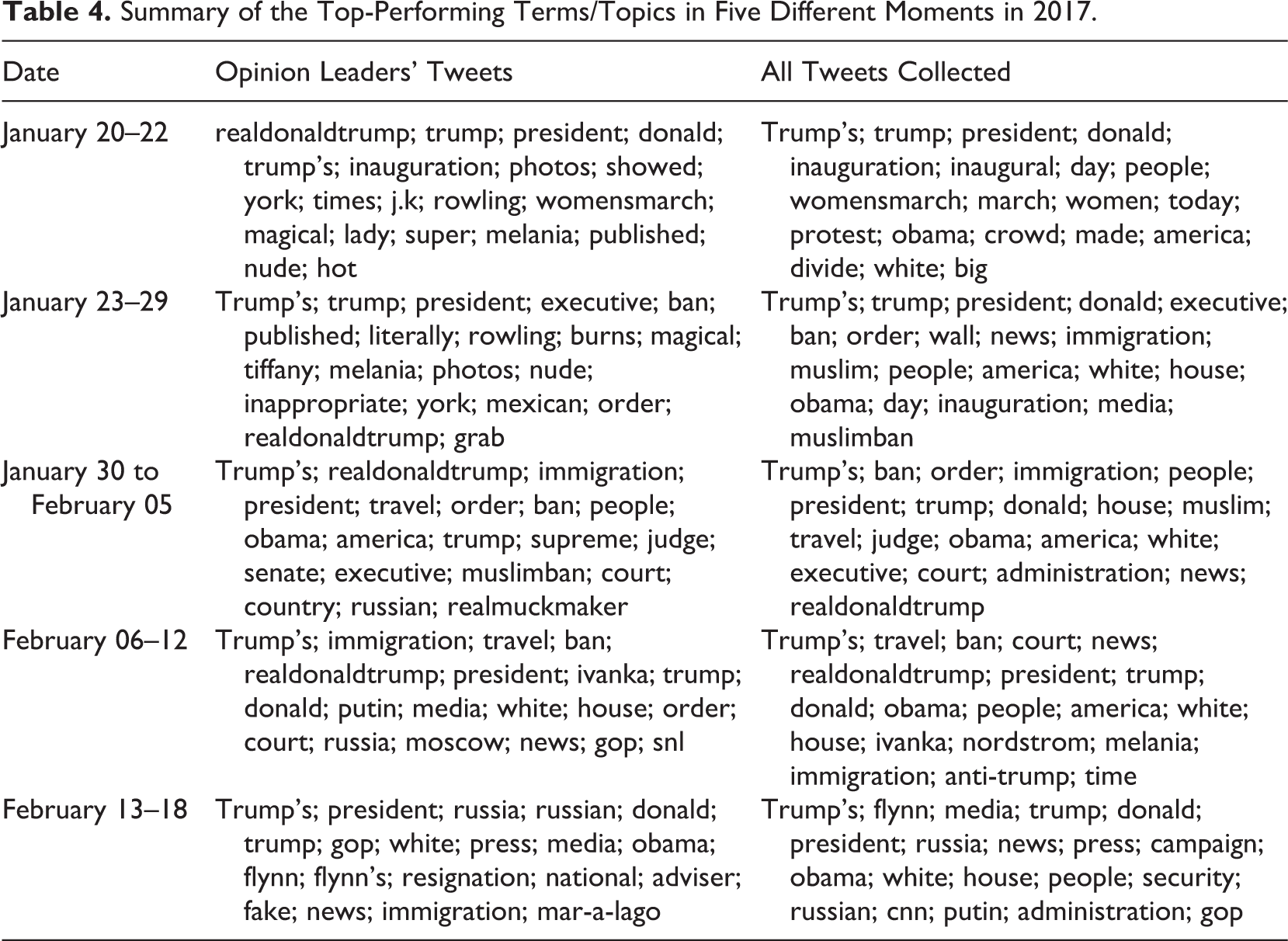
Two groups were created to conduct LDA analyses: one with 2,862,987 tweets that contained the word “trump” and the other with 5,856 tweets from our subsample of influencer tweets. Table 3 indicates that the President’s executive order on immigration at the end of January (Stack, 2017) was the main subject discussed in our study period. Figure 2 provides a timeline that illustrates the frequency of tweets among the influencers that contain the word “trump” per day from January 20 through February 18, 2017.
General Summary of the Top-Performing Topics.

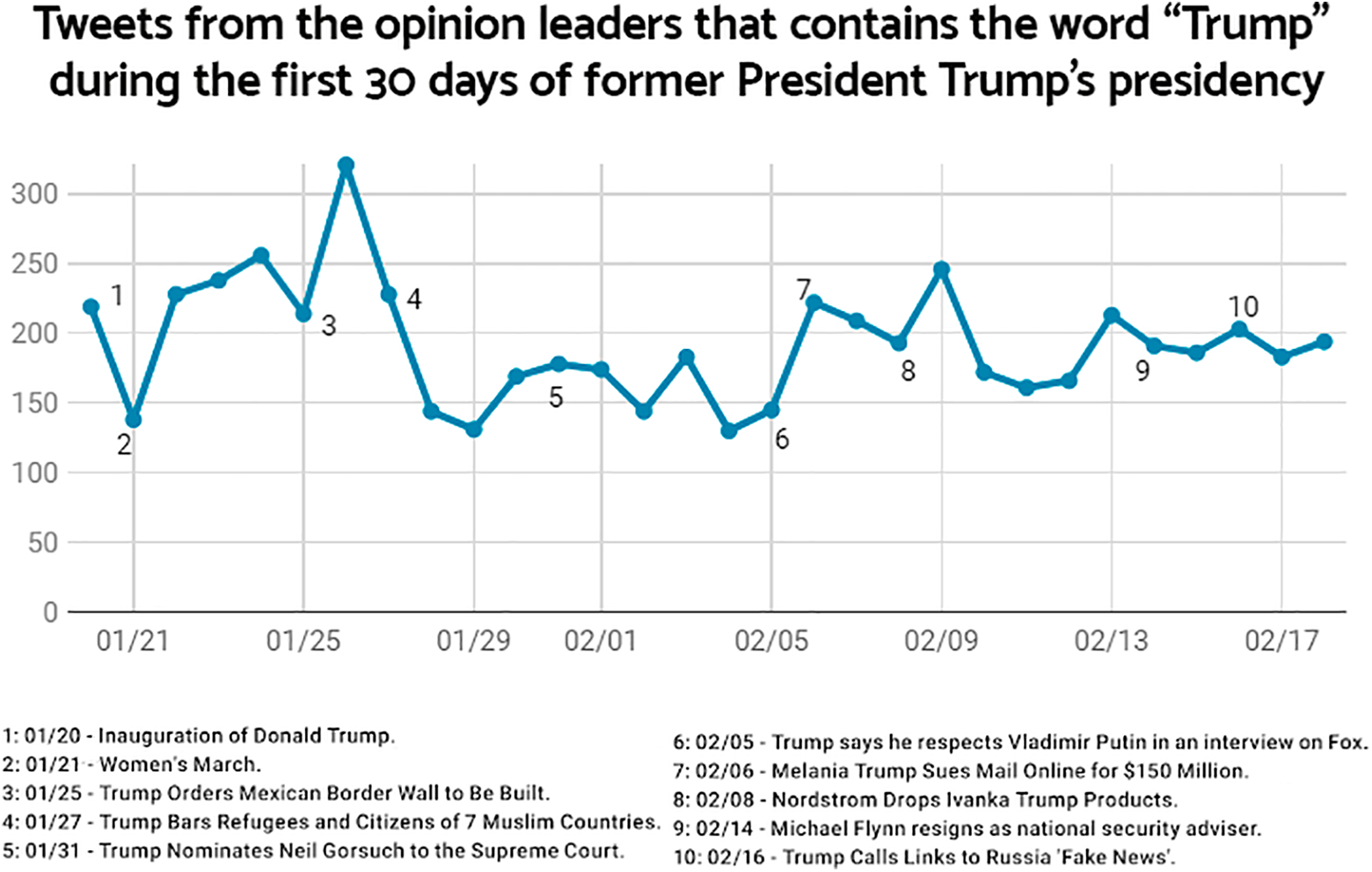
Timeline of Tweets from influencers by frequency, from January 20 to February 18, 2017.
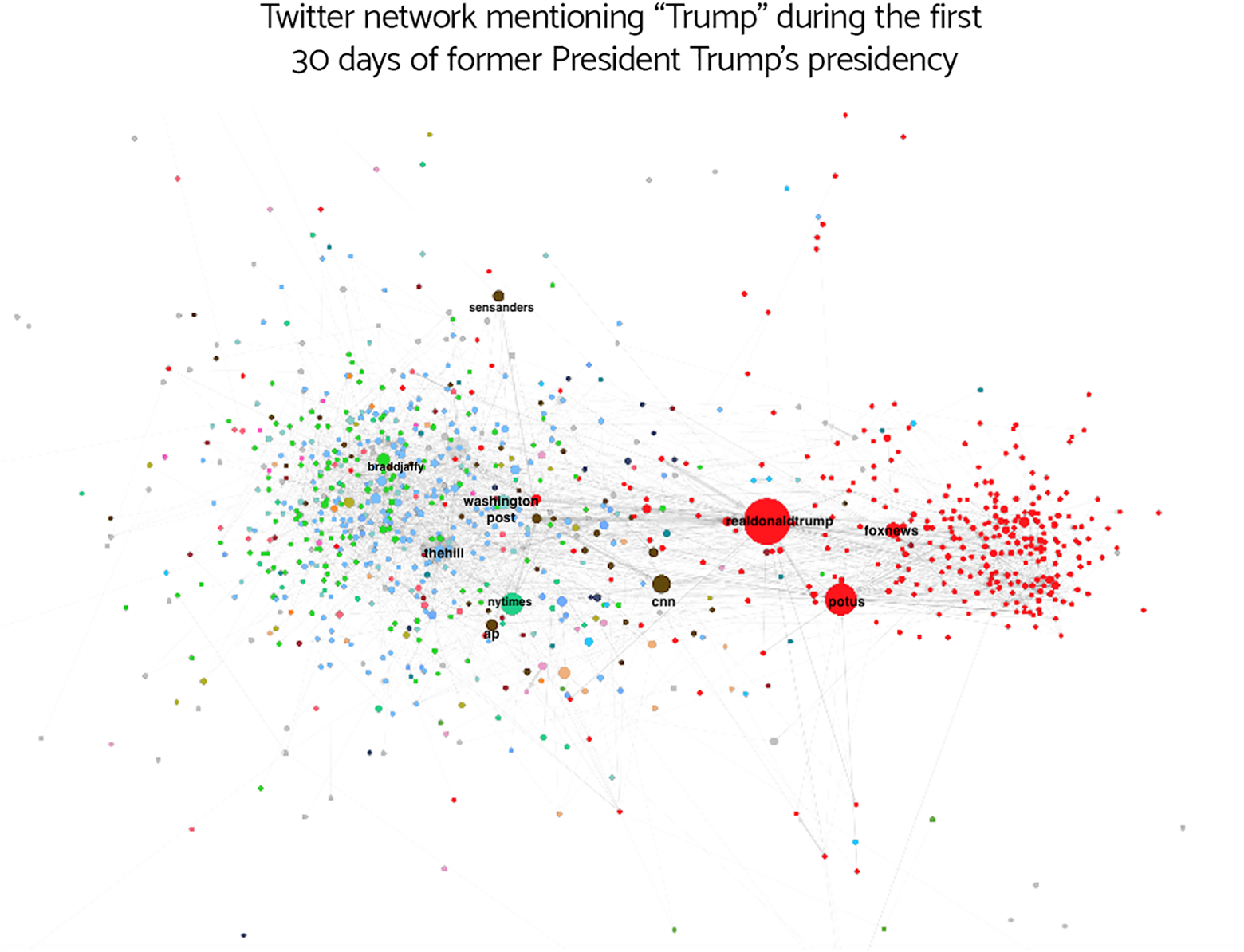
Twitter network mentioning “Trump” during the first 30 days of former President Trump’s presidency. Note. For visualization purposes, the nodes of networks are Twitter accounts with eigenvector centrality scores of 50 or more. The size of the nodes is equal to their eigenvector centrality.
To get a more accurate analysis of the main topics of the first 30 days of Trump as U.S. President, we repeated the LDA analyses on the two groups in five different periods: January 20–22, January 23–29, January 30 to February 5, February 6–12, and February 13–18. Table 4 illustrates the terms/“topics” discerned by LDA as most relevant (typos and hyperlinks, such as “https://t.co,” “amp,” and “https” have been removed).
Summary of the Top-Performing Terms/Topics in Five Different Moments in 2017.
How Are Twitter Networks Related to Former President Trump Divided?
To evaluate how Twitter communities talking about former President Trump are divided, we calculated modularity scores using Gephi. We also interpreted tweets posted by Republican and Democratic influencers to investigate how tweets could contribute to the polarization of Twitter communities. Based on a total of 49,182 users in the mention network, we observed a total of 4,926 communities. The modularity score was .684. Based on Garcia et al.’s (2015) criterion (modularity scores range from 0.3 to <1: the existence of polarization), and Himelboim et al.’s (2013) criterion (0.6 as a threshold for detecting high divisions among communities), communities in the mention network are highly divided.
Next, we compared both Republican and Democrat opinion leaders’ tweets by week to compare how opinion leaders in both communities tweeted about Trump differently. Our observations identified that though Twitter opinion leaders discussed some of the same topics, they did so very differently based on their political orientation.
From January 20–22, the main topics discussed on Twitter were “inauguration” and “women’s march.” Some Trump supporters posted tweets celebrating Trump’s presidential inauguration, while others who opposed Trump’s election posted about their participation in the “women’s march” in Washington, DC. For example, @SandraTXAS tweeted on January 19, 2017, “THIS is my president! Donald Trump lays wreath at Arlington Cemetery #Inauguration #MAGA#TrumpInauguration,” and @funder tweeted on January 21, 2017, “SOME may not be his-but the burden of proof is on #Trump, not me #trumpleaks #theresistance #womensmarch #inauguration #thankso.”
Twitter opinion leaders on the left retweeted posts by bots, including satirical posts by J.K. Rowling, a British author, who had a feud with Donald Trump on Twitter. One tweet, “J.K. Rowling Burns Donald Trump in 3 Magical Tweets,” was posted by bots on January 21, 2017 and was then retweeted extensively. During the week of January 23–29, the main topics discussed on Twitter were related to Trump’s travel ban on people from a list of predominantly Muslim countries. In terms of tweets mentioning this executive order, we found evidence of polarized discussions based on this issue within tweets mentioning former President Trump. For example, @SpeakerRyan tweeted on January 23, 2017, “My statement applauding President Trump’s first executive actions,” and @KamalaHarris tweeted on January 25, 2017, “Trump’s executive orders on immigration today will tear apart families at the direct expense of public safety and national security.”
These two tweets provide an example of polarized opinions about the executive order posted by two prominent political figures, Paul Ryan and Kamala Harris. Other tweets posted during this week included topics such as “photos of Melania Trump” and “grab” that reflected attacks on Trump’s family and criticisms of former president Trump’s audio-recorded remarks about sexually assaulting women. These tweets were generally posted by bots and tended to focus on more sensational issues.
During the week of January 30 to February 5, Trump’s 2nd week in office, the travel ban was the dominant topic among both sets of general users. Opinion leaders posted tweets on this issue that were indicative of their political orientation and again reflected polarized positions. For example, @SenWarren tweeted on February 1, 2017, “Muslim countries PERMANENT on ban Israeli Jews. Yet they say we are intolerant?? #ImmigrationOrder #maga #Trump,” and @SandraTXAS tweeted on February 5, 2017, “No, @realDonaldTrump, your illegal, unconstitutional, immoral Muslim ban is not about keeping us safe at all.”
During the week of February 6–12, along with the legal fight over Trump’s travel ban, the main topic was “Russia,” referring to the investigation of potential political connections between Donald Trump and Russian leader Vladimir Putin. Media organizations and workers did present contrasting opinions about this issue. The topic of potential Russian interference in the 2016 U.S. presidential election is reflected in the following tweets. For example, @thehill tweeted on February 10, 2017, “Trump says he doesn’t know about reports Flynn talked about sanctions with Russia,” and @DavidCornDC, an MSNBC analyst and the author of Russian Roulette, tweeted on February 9, 2017, “I think it can now be said: Trump and Flynn have sold out US democracy to Putin and Russia.” Among the influencers, “SNL” relates to Saturday Night Live, a television comedy show that regularly parodied Trump and his administration. For example, @businessinsider tweeted on February 10, 2017: “Alec Baldwin: Why it’s ‘not a lot of fun’ to play Trump on ‘SNL.’” This tweet mentions a skit on the SNL television show where Trump, parodied by the American actor Alec Baldwin, expresses that playing Trump is not actually a “fun” endeavor, despite SNL being a very popular comedy show.
During the week of February 13–18, the Affordable Care Act (also known as “Obamacare”) and former president Obama were dominant topics. As in previous weeks, evidence of polarized discussions shaped by political opinion leaders was found. For example, @steph93065 tweeted on February 18, 2017: “For Obamas entire term the media lied to us about O’Care, the economy and Iran deal; they are now lying to us about Trump.” In addition, @SenWarren tweeted on February 15, 2017: “@realDonaldTrump & the @GOP should stop these reckless actions to hurt the ACA before they hurt even more people who need health coverage.”
During this week, Russia also remained a dominant topic. “Russia,” “putin,” “national,” “security,” “adviser,” and “flynn” were found in tweets and were related to Michael Flynn’s resignation as national security adviser because of his contacts with the Russians (Borger, 2017). For example, @BostonGlobe tweeted on February 14, 2017: “Trump was told weeks ago that Michael Flynn had not told the truth about his interactions with Russia’s ambassador.”
Discussion
Our results indicate that media outlets and journalists represent 41%, the largest percentage in our sample of Twitter opinion leaders tweeting about Trump. Of these accounts, 93% are verified. Two were permanently suspended from Twitter for violating the platform’s rules: @infowars and @gatewaypudint. According to www.allsides.com and www.mediabiasfactcheck.com, the websites associated with these accounts have been flagged as consistently spreading misinformation or fabricated news. The majority of these opinion leaders, 62%, work for or are left/left-center news companies. Eleven percentage are classified as right/right-center. Six percentage are extreme-right and associated with spreading conspiracies and fake news. Most political analysts are also affiliated with left/left-center media outlets. These findings are in line with studies that show that those with an established reputation/social capital offline are still influential on Twitter (Guo et al., 2020). Moreover, this influence potentially seems to be a more longitudinal, nonpolitical trend. During the 2010 Pakistan floods (Murthy & Longwell, 2013) and the 2013 Typhoon Haiyan in the Philippines (Takahashi et al., 2015), journalists and media outlets were found to have played a key role.
Previous work has highlighted the prominent role that bots played during the U.S. 2016 election (Badawy et al., 2018; Howard et al., 2018; Kriel & Pavliuc, 2019; Ruck et al., 2019). Our findings provide evidence that bots remained very influential even after the elections. By tweeting in a coordinated way, bots managed to be extensively retweeted and shaped the top-performing topics during our study period. “Nude Photos of Melania Trump Published in the New York Post https://t.co/9rhmogSzHl” and “J.K. Rowling Burns Donald Trump in 3 Magical Tweets https://t.co/WR0HRwYDxY” were first published by bots during the analyzed period and retweeted hundreds of times, making terms like “nude,” “rowling,” and “magical” (that did not appear in many other tweets) enter the list of main topics.
Our results indicate that during the first 30 days of Trump’s presidency, there were almost three times more right-wing activists among influencers than left-wing ones. The former were responsible for 16% of all tweets from opinion leaders, while the latter accounted for 7%. This is not a new trend. Rather, others have found similar levels of activity among right-wing activists, particularly in regard to the spread of fake news during the 2016 U.S. election (Bovet & Makse, 2019).
At the time of this writing in March 2021, 68% of the right-wing activists and 28% of the left-wing activists have been suspended by Twitter. Ninety of the 303 opinion leaders examined in this study have now been suspended and/or revealed as bots. These accounts were responsible for a quarter of all tweets posted during the period analyzed. Some accounts were suspended for spreading misinformation (e.g., @infowars and @gatewaypudint; Conger & Nicas, 2018; Dellinger, 2021). Others, such as @TEN_GOP, are suspected of trying to influence the 2016 U.S. presidential election. This was an account affiliated with the Russia-backed IRA. Others have specifically studied Russian-controlled bots and found in some cases that they have had a large presence (Kriel & Pavliuc, 2019).
Among politicians, there were almost twice as many Democrats as Republicans. Our findings indicate that Republican and Democratic opinion leaders contributed to forming highly polarized communities that can potentially lead to echo chambers. While studying polarized Twitter groups in discussing political propaganda, Caldarelli et al. (2020) discovered that hubs in each polarized cluster played a significant role in distributing polarized messages. Hub users in a cluster had the highest chance to be exposed to other users in the same cluster (Himelboim et al., 2013). Thus, some offensive and critical tweets about Donald Trump posted by opinion leaders could gain prominence among politically opinionated audiences who further retweet them within their insular clusters.
Although tweets tend to be quite brief, personal or political biases can be detected in tweets (Kulshrestha et al., 2017). Twitter users who followed specific political parties might follow tweets that support their preexisting beliefs, a phenomenon known as confirmation bias (Stroud, 2010). Thus, tweets with political ideas can elicit retweeting and other forms of engagement from followers, potentially dividing Twitter communities by amplifying like-minded ideas.
One of the limitations of the study is that we consider only users with 10,000 or more followers who have the top 1% of eigenvector centrality scores to determine Twitter opinion leadership. Therefore, there could have been more discrepancies between influencers if we had taken the entire sample (roughly 3 million tweets) into account. Nevertheless, our findings remain consistent with other work on opinion leaders in political communication and social media.
Our findings indicate that, despite Donald Trump’s constant attacks on the press, which were not restricted to the first month of his presidency (Meeks, 2020), nonconservative media outlets and journalists were highly visible opinion leaders during our study period. This suggests that despite the rise of digital influencers (McCorquodale, 2020), news media and journalists remain relevant communication actors, contributing to the debate in the public sphere by sharing political information with their followers.
Immigration was the main topic discussed by opinion leaders on Twitter during Trump’s 1st month as president. During the 2016 U.S. presidential election, immigration was one of the main issues on Twitter (Agrawal & Hamling, 2017). The Trump campaign’s relations with the Russians were also widely discussed by opinion leaders. This content reinforced former President Trump’s criticisms of the media, again fueling extreme content and disinformation in polarized networks.
Opinion leaders may be a trusted source for information and thus have the potential to protect their followers from disinformation, but they could also amplify disinformation, misinformation, and fake news in echo chambers (Dubois et al., 2020). Disinformation may pose a variety of potential harms to democracy and might contribute to systemic harms such as “techno-affective polarization,” epistemic cynicism, and pervasive inauthenticity (McKay & Tenove, 2020).
Conclusion
With Trump’s election, Twitter gained new and perhaps unprecedented importance as a platform for direct communication from a U.S. president to the public. Twitter was Trump’s “main political communication tool” (Fuchs, 2018, p. 198) throughout his presidency, and his use of the platform has been termed the “Twitter Presidency” (Ott & Dickinson, 2019). In this study, we identified the top 1% of opinion leaders on Twitter during the first 30 days of Trump’s administration. We also uncovered the main topics influencers discussed during that period, enabling other researchers to compare Trump’s Twitter content during this time with content posted at other moments of his term.
This study uses a sample of tweets and profiles associated with opinion leaders who posted on Twitter in the 1st month of Donald Trump’s U.S. presidency. Our findings are important as they examine an important time in Trump’s presidency, as the platform became central for Trump’s communication not just to the public but even to international leaders. Our findings provide evidence that bots and accounts suspended for violating Twitter’s terms of service were opinion leaders during this time. This is important particularly within the context of recent work which has found that bots and other accounts have been part of information operations, including state-backed campaigns.
Our approach is important as we retrospectively examined the landscape among influencers on Twitter during the first 30 days of Trump’s presidency. At the time of our data collection, there were many opinion leaders in the various categories by which we labeled users. However, at the time of writing in 2021, only two groups stand out: media/journalists and suspended/bots (representing 71% of the accounts). More than half of the media outlets scored high/very high for factual reporting. On the other hand, many accounts have been suspended by Twitter in the past 4 years for sharing misinformation. This indicates that Twitter has taken a proactive stance toward accounts violating its platform policies. Nevertheless, bots and accounts with malicious behavior remain present on Twitter. For this reason, studies like ours are critical for contextualizing and understanding the evolution of these accounts.
Footnotes
Declaration of Conflicting Interests
The authors declared no potential conflicts of interest with respect to the research, authorship, and/or publication of this article.
Funding
The authors received no financial support for the research, authorship, and/or publication of this article.