







Abstract
The democratization of technology to re-create content and make that content publicly available has spurred a wave of user-generated content (UGC), which has produced remarkable social and economic benefits. However, under current copyright law, UGC creators face the dilemma of being deterred from creating UGC because of the risk of copyright infringement, copyright owners can rarely obtain remuneration from UGC, and UGC platforms profit from UGC without being held liable for copyright infringement. Recent proposals to extend fair use and compulsory licenses to UGC creators and impose direct liability on UGC platforms cannot solve the UGC dilemma due to the inadequate or unreasonable regulation of UGC platforms. This study aims to solve the UGC dilemma by proposing a non-exploitative UGC levy on UGC platforms. We demonstrate the necessity of the non-exploitative UGC levy by conducting a comparative study of existing proposals and illustrate the feasibility of the non-exploitative UGC levy through an institutional analysis of its framework and enforcement mechanisms. Justification of the proposed levy and responses to possible criticism are also provided. The levy scheme also provides inspiration for how copyright law can address burgeoning artificial intelligence-generated content (AIGC).
Keywords
Introduction
The widespread availability of digital tools that allow ordinary users to engage in cultural creation, coupled with the hyperconnectivity of the internet, has given rise to an unparalleled surge in user-generated content (UGC). UGC not only has profound social impacts, such as increasing user autonomy and participation (Aufderheide et al., 2013; Gotlieb & Sarge, 2021) and democratizing access to media (Inguanzo et al., 2021; Shirky, 2010), but also possesses economic significance. For example, TikTok, a popular UGC platform, generated US$9.4 billion in annual revenue in 2022, with a year-on-year 100% increase (Iqbal, 2023). However, UGC has sparked serious legal disputes, particularly in the realm of copyright law (Frosio, 2020). There are two categories of UGC. One is user-authored content, which is independently created by its creator rather than being based on other people’s works. The other type, user-derived content, involves the transformation or combination of preexisting copyrighted works, as in samplings and remixes (Gervais, 2008). As user-authored content does not involve the use of preexisting works, no copyright infringement disputes arise; thus, there is no need to propose a new regulatory framework for this type of UGC. Conversely, user-derived content is based on preexisting works and thus raises the issue of copyright infringement. However, current copyright law can hardly regulate disputes over user-derived content (Quintais et al., 2023). Due to the great influence and lack of proper regulation of user-derived content, the UGC discussed in this paper refers to user-derived content.
Normally, copyright law regulates users via an exclusive-right approach. If you wish to use a work created by others, you must obtain permission from the copyright owner. The exclusive-right approach intends to prevent free riding to provide economic incentives for creating copyrighted works (Menell et al., 2020). To prevent the exclusive-right approach from impeding users’ freedom to use copyrighted works, copyright law also regulates users through the “fair use” and “compulsory license” rules. When a user meets the conditions of fair use or compulsory licenses, he or she can directly use a work without ex ante permission. Since most UGC creators create UGC for fun rather than for profit, they do not bother to seek permission from copyright owners and thereby violate the exclusive right (Hartmann, 2020). Whether UGC creation can be accommodated by fair use or compulsory licenses has been debated extensively in the literature (Senftleben, 2020; Zhou, 2022). The judgment of fair use is full of uncertainties and thus cannot provide stable expectations for UGC creators (Salar, 2023). Furthermore, the fair use rule allows free use and undermines incentives for copyright owners. While a single unauthorized use has a negligible impact on the copyright owner, large-scale unauthorized use inevitably prejudices the interests of the copyright owner. Compared to the fair use rule, compulsory licensing schemes better protect copyright owners by requiring users to pay. However, this approach is unfair and impractical in the context of UGC because most UGC creators have not profited from UGC creation.
By analyzing the target fair use and compulsory licensing regulate, we found that current discussions of extending fair use and compulsory licensing to UGC creators have missed the point. UGC creation involves three parties: the copyright owner, the UGC creator, and the UGC platform. The dilemma is that copyright owners can rarely gain remuneration for their works that are used in UGC, while UGC creators face the risk of copyright infringement even though most of them do not profit from UGC. On the other hand, UGC platforms profit from UGC without bearing liability for infringement. However, the literature has paid attention mainly to how to regulate UGC creators. Although the European Union has formulated direct liability for UGC platforms, placing an excessive burden on UGC platforms is not conducive to the growth of the UGC industry (Marique & Marique, 2020). The inadequacy of current copyright rules and proposals to solve the UGC dilemma will inevitably hinder users from creating UGC and prejudice copyright owners’ interests (Quintais et al., 2023). Given the profound social and economic impacts of UGC, we considered it necessary and imperative to put forward a reasonable scheme to regulate UGC platforms, thereby encouraging UGC creation and tailoring copyright law to the UGC wave.
By tracing the history of copyright law, we observe that copyright law has a long-established intermediary-oriented approach to protecting end users by regulating intermediaries. Drawing on existing intermediary-oriented rules and comparing UGC platforms and traditional intermediaries, we propose a nonexploitative UGC levy scheme on UGC platforms. Through an institutional analysis, we provide a detailed explanation of the framework and implementation of the proposed scheme, including the conditions for UGC creators to be exempted by the scheme, the scope of copyright owners covered by the scheme, the entity responsible for collecting and distributing levies, and the criteria for calculating and distributing levies. Following the illustration of the feasibility of the proposed levy scheme, we proceed to explore the justification of the levy scheme from legal and institutional, economic and social, and technological and cultural perspectives. Responses to possible criticism of the proposed levy scheme are also provided.
The User-Generated Content Dilemma due to the Lack of Reasonable Regulation of Intermediaries
UGC has begun to attract the attention of copyright owners due to its great influence. 1 However, since most UGC creators do not profit from UGC, copyright owners can rarely obtain compensation from UGC creators. How to solve the dilemma of UGC creators facing the risk of being sued while copyright owners cannot gain remuneration for their works has attracted vigorous debate (Daly, 2013; Kornelius, 2023; Zhou, 2022), but no reasonable solution has yet been proposed.
The Missing Point of Fair Use and compulsory Licenses
Some scholars have proposed resolving this dilemma by considering UGC creation to be fair use (Wong, 2008). However, this path does not seem feasible. In terms of legislation, only the Canadian copyright law regards the general category of UGC creation as fair use, with the condition that the exempted UGC creation is “solely for non-commercial purposes” (Section 29.21(1) (a)). Although most UGC does not actually make a profit, UGC creation cannot be considered solely for non-commercial purposes because the content is placed on the UGC platform and may become popular overnight (Daly, 2013). Other jurisdictions, such as the US, Australia, and China, determine whether UGC creation constitutes fair use on a case-by-case basis. In terms of judicial practice, the fair use test is known for its vague standards and uncertainty (Salar, 2023); therefore, the fair use rule cannot provide predictable guidelines for UGC creation (anonymous). In terms of legal consequences, the fair use rule results in the nonpayment of copyright owners and undermines the incentives for copyright owners to create copyrighted works that are the basis and source of UGC (Zhou, 2022).
Some studies have suggested implementing a compulsory license for UGC creation, arguing that this would allow artists to “receive more money over the last ten years than they have” (Lessig, 2008, p. 110) and secure cultural freedom for the mashup generation (Menell, 2015). Some believe that, compared to fair use, compulsory licensing is more efficient and profitable since it alleviates users’ risk of being sued and encourages more UGC creation, thereby generating greater income (Lu, 2022). Nevertheless, as most UGC creators do not profit from UGC, requiring them to pay a licensing fee, regardless of how small, would substantially hinder UGC creation. For this reason, compulsory licenses have generally been designed for professional users, as illustrated in Section “Compulsory licenses governing user-distributors as professional users”, but not for amateur users.
Regardless of the feasibility of applying fair use or compulsory licenses to UGC creation, these rules focus on regulating UGC creators rather than regulating UGC platforms, which are another crucial party in UGC creation. UGC creators, copyright owners, and UGC platforms form the triangular relationship of UGC creation. It is not UGC creators but rather UGC platforms that gain enormous profits from UGC. However, UGC platforms can be protected by the safe harbor rule, 2 which exempts them from copyright infringement provided that they take down the UGC upon receiving a notice alleging that the UGC constitutes infringement (Sag, 2017). The statutory protection for UGC platforms, in turn, forces copyright owners to take enforcement actions against individual users (Tylec et al., 2022). Nevertheless, copyright owners can rarely gain remuneration from individual users. First, end users are numerous and geographically dispersed, which means that the costs of bringing a lawsuit against them are high. Second, the damage caused by each user is actually minimal; thus, the costs of litigation significantly outweigh any potential benefits. Third, even if a copyright owner is willing to bear the costs of litigation, imposing liability on non-commercial users can hardly gain sympathy from the courts, making it difficult to win such a suit. 3 The difficulty of obtaining ex post remuneration from either UGC platforms or UGC creators drives copyright owners to adopt ex ante measures, such as blocking access to copyrighted material and taking advantage of extralegal privileges, such as removing UGC through takedown notices (Kornelius, 2023). In this way, users are denied access to cultural products, and copyright owners are denied remuneration. Thus, the only winner is UGC platforms. The proposals to apply fair use and compulsory licensing to UGC creators are regulating the wrong target.
The Undesirable Effect of Direct Liability on User-Generated Content Platforms
In recent years, the lack of regulation of UGC platforms has attracted attention. In 2019, the European Parliament and Council adopted Directive 2019/790 on copyright and related rights in the Digital Single Market (DSM) directive. Article 17 of the DSM directive requires UGC platforms to not only seek a license for preexisting copyrighted works on which UGC is based but also take effective and appropriate measures to prevent unauthorized use of copyrighted works “with high industry standards of professional diligence.” Compared with the safe harbor rule, which completely exempts UGC platforms from liability, the DSM directive goes to another extreme (Moreno, 2020). It regards UGC platforms as direct users of copyrighted works and thus requires them to obtain authorization from copyright owners and do their best to delete the infringing content. Nevertheless, considering the large number of preexisting copyrighted works, ex ante licensing seems to be an excessive burden for UGC platforms (Sanchez, 2020). This is the reason why Article 17 of the DSM directive is hotly contested and highly controversial (Li, 2020). Some scholars have even attributed the underdevelopment of the UGC industry in the EU to the direct liability imposed on UGC platforms (Bridy, 2019; Senftleben, 2020).
Copyright law has been deemed the child of technology (Goldstein, 2003). Nevertheless, the preceding discussion shows that the current safe harbor rule leads to the UGC dilemma in which users are threatened so that they give up creating UGC, while copyright owners lose the incentive to create the source works on which UGC is based. Given the significant social and economic impact of UGC, there is a crucial need to establish an effective regulatory framework to resolve this predicament. Since current proposals have failed owing to insufficient or unreasonable regulation of UGC platforms, copyright law should be reframed to regulate UGC platforms in a reasonable way that promotes UGC creation, remunerates copyright owners and fosters the sustainable development of the UGC industry. Only in this way can the child of technology be prevented from turning against its parent.
Method to Solve the User-Generated Content Dilemma
First, we undertook a comparative study on the solutions to the UGC dilemma proposed by legislators and academics, which established the need to impose a levy scheme on UGC platforms. In addition to the drawbacks of uncertainty and unfairness, the proposals for extending fair use and compulsory licensing to UGC creators focus on regulating UGC creators. However, the root cause of the UGC dilemma is the inadequate regulation of UGC platforms. While the DSM directive does regulate UGC platforms, it unreasonably burdens them with direct infringement liability, hindering the development of the UGC industry. Through our comparative study of these proposals, we recognized the necessity of establishing a new regulatory regime for UGC platforms. By delving into copyright law history, we uncovered a long-established intermediary-oriented approach that safeguards end users’ freedom to use copyrighted works by regulating intermediaries. This provides valuable insights into the current UGC dilemma. By comparing different intermediary-oriented rules and by comparing UGC platforms with intermediaries regulated by intermediary-oriented rules, we concluded that a levy scheme would be appropriate for regulating UGC platforms. Given the profound social and economic impact of UGC, it is imperative to adopt the levy scheme, through which copyright owners can maintain the incentive to create copyrighted works that serve as the source for UGC, numerous end users are encouraged to create UGC without fear of infringing on copyright, and the UGC industry can grow sustainably.
Second, we conducted an institutional analysis to thoroughly examine the function and enforcement of the proposed levy scheme, thereby confirming its feasibility. We delineated the involved parties and their respective eligibility criteria for inclusion in the scheme. Specifically, we devised a two-stage test to determine whether a UGC creator would be covered by the levy scheme and established conditions for a UGC platform to be regulated by the levy scheme. Subsequently, we scrutinized the enforcement mechanism of the scheme, particularly introducing collective management organizations (CMOs) to collect and distribute levies as well as formulating the criteria for calculating and distributing levies.
The Intermediary-Oriented Approach
We found that copyright law has historically been underpinned by an intermediary-oriented approach. We identified two categories of important intermediaries: producers and distributors. Producers make massive numbers of copies of works and can obtain copyright from individual creators. Distributors provide devices and services to allow copyrighted works to be distributed in a new channel or medium. Every time a new technology appears, producers wish to extend copyright law to the new distribution channel, while distributors prefer that new technology be exempted from the old rule (Spar, 2001). By regulating producers and distributors and balancing their rights, copyright law has empowered end users to freely use works through new technologies. This section elucidates the necessity of drawing insight from the intermediary-oriented tradition and implementing a levy scheme for UGC platforms.
Compulsory Licenses Governing User-Distributors as Professional Users
Distributors are the providers of devices and services through which users can consume copyrighted works in a new channel or medium. Until the first half of the 20th century, distributors used copyrighted works directly. 4 Such distributors are referred to as user-distributors; an example is manufacturers of phonograph records, who not only provided phonograph records through which users could consume music in the form of sound recording but also mechanically reproduced musical compositions in phonograph records themselves. Copyright wars between producers and user-distributors over whether a new distribution channel was controlled by the producer usually ended with user-distributors being regulated by compulsory licenses (Brotman, 2020). Because of the compulsory licenses, distributors could release works at a relatively low cost since the licensing fees were determined by a third party rather than by the producers, thereby allowing end users to enjoy works through the latest technology at a low cost. The essence of compulsory licenses is to impose licensing fees on distributors, who are also professional users, and to exempt end users from regulation.
Levies Imposed on Facilitator-Distributors to Exempt End Users
With technological advances in areas such as photocopying and digital recording, the ability to reproduce works was transferred from professional distributors to numerous individual users. In this scenario, distributors, such as the manufacturers of photocopiers and digital audio recorders, do not directly use copyrighted works but rather provide devices to facilitate the use of works. We refer to the providers of these devices as facilitator-distributors. While each user may have only a minor impact on the market for copyrighted works, a colossal number of users greatly influences the copyright owners’ interests. Therefore, large-scale private use is regulated by copyright law. Rather than regulating the actual users, copyright law regulates facilitator-distributors. First, facilitator-distributors facilitate and profit from end users’ use of works in the new distribution channel, while end users themselves do not make money from using works. Second, end users far outnumber facilitator-distributors; thus, it is more efficient to impose liability on facilitator-distributors.
Copyright law regulates facilitator-distributors by levy schemes under which facilitator-distributors pay levies to copyright owners/producers, thereby exempting non-commercial end users from copyright infringement liability. The most popular levy scheme is the private copying levy, under which the providers of photocopying devices pay levies to copyright owners and individual users can make private photocopies free of charge (Lunney, 2001).
Comparing Compulsory Licenses and Levy Schemes
Both compulsory licenses and levy schemes exemplify the intermediary-oriented approach, which enables end users to freely use works via the latest technology. Jonathan Barnett (2013) explained this phenomenon as follows: “The intermediary’s private interest in influencing the state to expand copyright to cover a novel production or distribution technology and the public’s interest in producing and distributing content through that technology at the lowest cost possible would go hand in hand” (406–407).
Nonetheless, compulsory licenses and levy schemes have two differences. First, they apply to different subjects. Compulsory licenses are imposed on user-distributors, namely, professional users who are capable of paying and willing to pay the licensing fee. Levies are collected from facilitator-distributors, namely, intermediaries that facilitate end users’ use of copyrighted works, to ensure the freedom of end users to enjoy works through the latest technology. The second difference is the way in which licensing fees are calculated. Under compulsory licensing, licensing fees are determined based on the specific number of times and the ways in which users use the work. Levies are calculated based on the profits made by facilitator-distributors from end users’ use of works, regardless of how the end users use the works. These differences suggest that compulsory licenses and levy schemes are designed for different stages of technological development. Compulsory licenses apply to situations where the ability to use works is controlled by a few professionals. Levy schemes apply to situations where technology has democratized end users’ ability to use works and exempted end users on a large scale by regulating intermediaries.
Necessity for a Levy Scheme on User-Generated Content Platforms
However, early in the internet age, the safe harbor rule was introduced into copyright law, interrupting the long-established intermediary-oriented approach. The primary reason to establish the safe harbor rule was to provide breathing space for online platforms to nurture the growth of the internet economy. The safe harbor rule also gained justification from the passive role played by online platforms as mere conduits for transmitting content in the early internet age (Senftleben, 2020). As online platforms have changed from passive conduits that merely deliver content to powerful gatekeepers that promote and profit from the distribution of content, the safe harbor rule has become obsolete (Elkin-Koren et al., 2020).
Laws need to adapt to the development of technology. Compulsory licenses have been applied when the ability to use copyrighted works is concentrated in the hands of a small number of professional users. When technology decentralizes the ability to use works, levy schemes emerged. When the internet industry was in its infancy and online platforms acted only as passive channels through which content was transmitted, the safe harbor rule was introduced to protect the emerging internet industry. Following the same logic, when online platforms have developed into powerful gatekeepers and reintermediation has taken place (Macchiavello, 2022), moving toward the intermediary-oriented approach is not only reasonable but also necessary to preserve the freedom of end users. Of the two intermediary-oriented rules, the levy scheme is considered appropriate for the context of UGC creation due to the democratization of the ability to re-create works and make works publicly available to large numbers of end users. UGC platforms act as facilitator-distributors by providing a service to facilitate the use and distribution of the copyrighted works contained in UGC without using the works themselves. Through the levy scheme that imposes levies to UGC platforms, copyright owners can gain the levies from the platforms, and numerous end users are encouraged to create UGC without fear of infringing on copyright. Only in this way can the social and economic significance of UGC be realized.
Imposing a Non-exploitative User-Generated Content Levy on User-Generated Content Platforms
Since “the devil is in the details” for any policy proposal, this section outlines the proposed levy to demonstrate its feasibility.
The Framework of the Proposed Levy
There are four parties under the proposed levy scheme: UGC creators, copyright owners, UGC platforms, and collective management organizations (CMOs). UGC creators make certain use of copyrighted works to create UGC and upload it to UGC platforms. UGC platforms profit from UGC and pay levies to CMOs. Copyright owners receive levies from CMOs, and UGC creators can be exempted from copyright infringement liability (see Figure 1). Framework of the proposed levy scheme.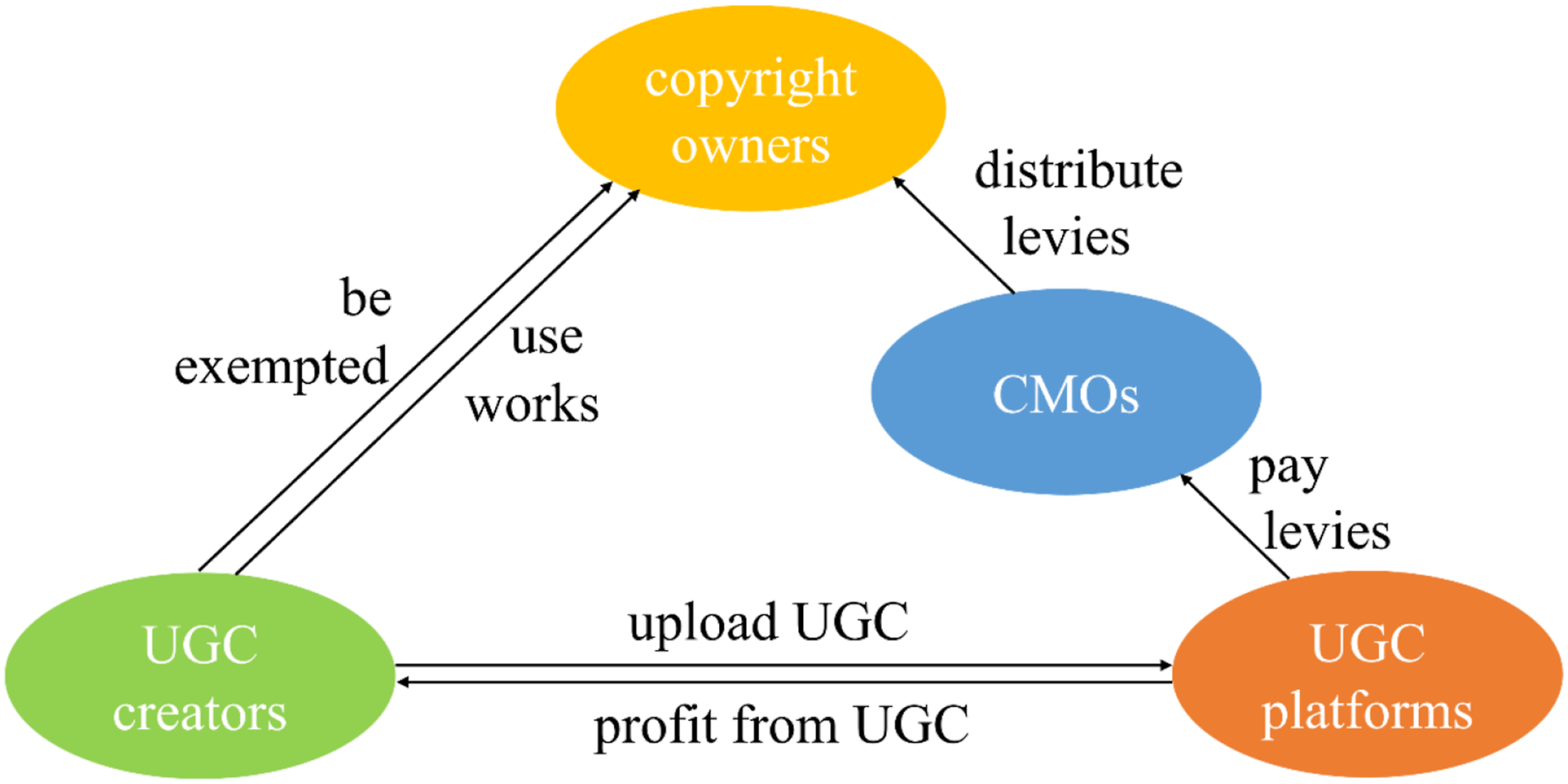
The above figure introduces CMOs into the triangle relationship of UGC creation. Some academics have argued that levies should be distributed directly from levied devices (De Beer, 2006), namely, UGC platforms. Direct distribution could save the significant administrative costs incurred by CMOs (Netanel, 2003). However, a piece of UGC is sometimes posted to different UGC platforms, and the users of different platforms overlap significantly. If UGC platforms pay copyright owners directly, the amount of money that copyright owners receive would depend on how many UGC platforms host the UGC containing their works. Copyright owners may want users to upload the UGC to multiple platforms as a condition of using their copyrighted works or may collaborate with UGC platforms to allow automatic reuploading to multiple platforms when a work is identified on one UGC platform. Multiple uploads contribute nothing new to society but increase server workloads.
We suggest that levies be distributed by CMOs that have been deployed to collect and distribute remuneration to copyright owners under existing levy schemes. Accordingly, levies can be distributed to copyright owners only once rather than being distributed separately many times by different UGC platforms. CMOs also have comparative advantages in collecting data on the popularity of works from diverse information sources. For example, CMOs can obtain statistics on the use of works from each platform and learn about the use of popular works across different platforms by consulting multiple-channel networks (MCNs). In this way, CMOs can estimate the popularity of copyrighted works and allocate levies to the corresponding copyright owners proportionately.
Identifying the Four Parties under the Proposed Levy
Two-Stage Test for User-Generated Content Creators
UGC creators are users of copyrighted works. The condition for users to be exempted by the proposed levy scheme is rooted in the Berne Convention. Article 9(2) of the Berne Convention establishes two requirements for permitted use: (i) such use should not intervene in the normal exploitation of the work and (ii) such use should not unreasonably prejudice the legitimate interests of the copyright owner. 5 The “unreasonable prejudice” test requires remuneration to copyright owners, and levy schemes fulfill the remuneration requirement (Gervais, 2008). The “normal exploitation” requirement means that permitted use should not acquire, nor should it be possible to acquire, “considerable economic or practical importance” (WIPO, 1971, p. 41). To comply with the “normal exploitation” requirement, we name the leviable use non-exploitative use.
In the pre-Internet age, “considerable economic or practical importance” under the Berne Convention meant “significant or tangible commercial gains” (WTO, 2000, p. 47, ¶ 6.183). In the context of UGC, micropayments should be accounted for when determining whether the commercial gains are significant. In addition to money, audiences also pay attention to online content creators. In fact, significantly more audiences pay attention than pay money (Bostoen, 2019). This business model is called the attention economy (Davenport & Beck, 2001). If a piece of UGC receives considerable attention, even if it does not generate economic benefits, it competes with the work on which it is based and is likely to intervene in the normal exploitation of the work. Receiving either economic revenue or attention constitutes acquiring “economic or practical importance” under the “normal exploitation” requirement. The threshold of “considerable economic or practical importance” needs to be determined by an authoritative third party according to empirical data such as market conditions.
According to the Berne Convention, if the use of a work has a considerable impact on that work and affects normal exploitation of it, that use should not be permitted. The reason is that the term use under Article 9(2) of the Berne Convention refers to reproduction, and the influence obtained by the use comes entirely from the original work. However, in the context of UGC, use refers to re-creation rather than mere reproduction. UGC creators not only use copyrighted works but also input their own creation. If a piece of UGC generates considerable revenue or attention, the use is not necessarily illegal. It is illegal only when the revenue or attention comes from preexisting works rather than from the user’s own creation. The source of the influence of UGC can generally be found according to the similarity between the UGC and the preexisting work. For text-based UGC, there are already many tools, such as Turnitin, that can check whether similarities constitute plagiarism. For video-based and audio-based UGC, such similarities can be checked by extracting and comparing the digital fingerprints of UGC and preexisting works. Some UGC platforms, such as YouTube, have already used this technology, known as the content ID system, to cope with pirated content (Rojszczak, 2022).
Therefore, we suggest a two-stage test to determine whether a UGC creator falls into the proposed levy scheme (see Figure 2). First, we need to judge whether the UGC has acquired significant importance, that is, economic revenue or attention. There are four possible scenarios: (i) acquiring significant revenue with significant attention; (ii) acquiring significant revenue with insignificant attention; (iii) acquiring significant attention with insignificant revenue; and (iv) acquiring neither significant revenue nor significant attention. The threshold of significance is predetermined and disclosed as ex ante information to all UGC creators. Under the fourth scenario, UGC creators can be directly exempted by the proposed levy scheme. In the first three cases, UGC creators need to go to the next step to judge whether the revenue or attention comes from preexisting works, that is, to examine the similarity between UGC and preexisting works. If the similarity is under the threshold predetermined by an authoritative third party, the UGC creator can be exempted by the proposed levy scheme. Text-based, audio-based, and video-based UGC may correspond to different similarity thresholds. Two-stage test for UGC creators.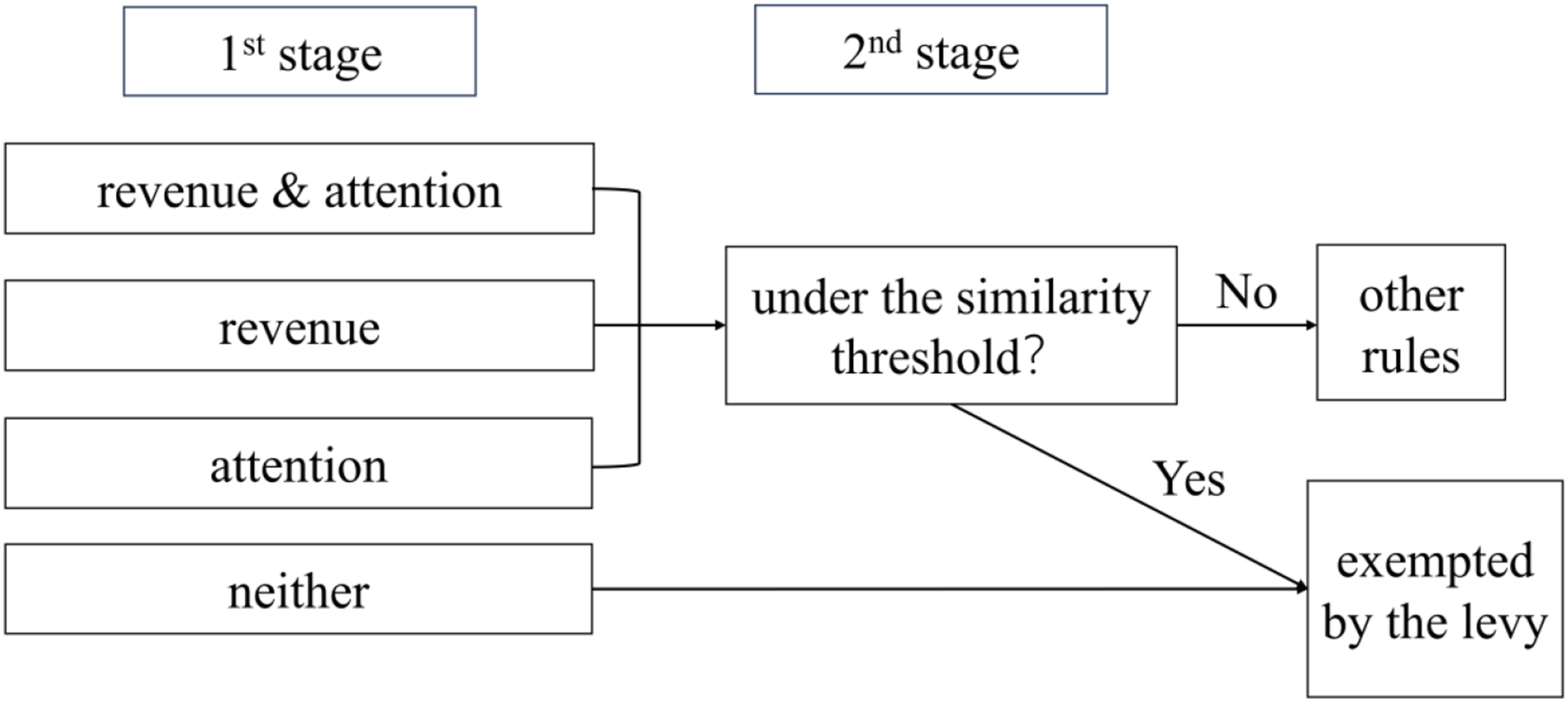
An Opt-In Choice for Copyright Owners
To join the proposed levy scheme, copyright owners need to authorize UGC platforms to extract the fingerprints of their works. In this regard, copyright owners have the right to choose whether to join the proposed levy scheme. Since the two-stage test excludes exploitative UGC from the levy system, joining the levy system enables copyright owners to obtain a stable income from levies on non-exploitative UGC and does not affect their ability to enforce copyright on exploitative UGC. Due to the great cost of finding and pursuing non-exploitative UGC, most copyright owners are willing to join the levy system.
Only those copyright owners who consider the reputation of copyright guardians and the chilling effects on potential users more important than remuneration from levies, especially copyright conglomerates such as Disney and Warner, would prefer to stay outside the proposed levy scheme (Feller & Ventimiglia, 2020). However, even if copyright guardians do not care about income, they are concerned about maintaining their public image of protecting freedom of creation; thus, they would not completely shut out the proposed levy scheme. Moreover, due to the democratization of content creation, their productions can increasingly be replaced. For example, many songs created by independent musicians can go viral overnight on TikTok or YouTube. To ensure that their works are constantly being used and attracting attention, copyright conglomerates are likely to include some works in the levy system. Therefore, the opt-in mechanism would not result in a significant reduction in the source material on which UGC can be based.
Criteria for Levied User-Generated Content Platforms
Under the traditional private copying levy, a device whose value has been substantially enhanced by private copying 6 is subject to the levy system (Netanel, 2003). In the same way, UGC platforms that enter the levy system also need to meet the condition that their value is substantially increased by UGC. The Court of Justice of the European Union (CJEU) holds a rather open attitude toward levied devices/services. For example, in Copydan Bandkopi v. Nokia (2015), the court held that multifunctional media is regulated by the proposed levy scheme as long as its value has been substantially enhanced by leviable use, even though it is not used mainly to facilitate leviable use. In the online world dominated by the attention economy, judging whether a UGC platform should be included in the levy system depends not only on whether it has significant value enhancement from UGC but also on whether it obtains significant attention from UGC. A UGC platform that has received enough attention, even if that attention has not yet been reflected in an increase in value, should also be levied. In summary, as long as a platform has gained significant enhancement of value or attention from facilitating the distribution of copyrighted works contained in UGC, it should be subject to the proposed levy scheme.
On the other hand, if a platform is used mainly to host UGC but has not gained substantial value or attention enhancement from such UGC, it can apply for an exemption. Otherwise, the administrative costs incurred will outweigh the levies collected. For example, social media platforms such as Twitter and Facebook could be exempted because a great amount of the UGC they hold is user-authored content that does not use preexisting works.
Additionally, some video and music sharing platforms have incorporated both UGC and content generated by professional producers, known as professional-generated content (PGC). 7 This makes it difficult to examine whether the value or attention enhancement comes from PGC or UGC (Gilardi & Lam, 2022). Since the platform has information about the attention received by each content item and attention is usually the source of value, a platform that contains both PGC and UGC should be subject to the levy system by default unless it can prove that the attention it receives is focused mainly on PGC.
One CMO in One Category
We argue that there should be only one CMO managing copyrights in one category of copyrighted works. Some countries, especially civil law countries, allow only one CMO to represent copyright owners in one specific category (Schroff & Street, 2018). Other countries, especially common-law countries, allow competition between CMOs in the same field (Towse, 2020). The former path is more conducive to the collection and distribution of levies. Consider the following example: a user re-creates a video, uses a new song as background music, and uploads it to YouTube. Given that only one CMO governs one category of copyrights, YouTube will pay levies to the CMOs in the fields of video and music, after which the CMOs will distribute the levies to the copyright owners. However, if there is more than one CMO in the same field, the UGC platform must separate the total amount of levies and then allocate them to the various competitive CMOs. However, copyright owners may join different CMOs in the same field; thus, separating levies for competitive CMOs is difficult, if not impossible.
Despite the advantages of collective management, the concept of having one CMO per category has been criticized for discouraging competition among CMOs, thus harming the interests of CMO members, namely, copyright owners. This inefficiency can be addressed by a supervisory authority to prevent CMOs from abusing their monopoly positions. The experience of many continental European countries has proven the effectiveness of establishing a supervisory authority or arbitration body to oversee the activities of CMOs, such as calculating revenue and disclosing financial reports (Moreno, 2020). A special supervisory entity consisting of experienced professionals with expertise in managing copyright in various fields can help build a fair, efficient and transparent system for collecting and distributing levies and reduce rent seeking, thus improving CMO efficiency and credibility (Gervais, 2016).
Implementing the Proposed Levy
Criteria for Calculating Levies
Under current levy schemes, the bases on which levies are calculated include (i) the memory capacity of the device (such as €0.6 per 4.7 GB for an MP3 player), (ii) the number of devices manufactured, and (iii) the manufacturing/import/sale price of the device (Kretschmer, 2012).
The first method does not make sense for UGC platforms, as they usually store UGC on cloud servers provided by a third party. Thus, discussing the memory capacity of UGC platforms is meaningless. The second method is unfeasible. UGC platforms provide services rather than devices, and such services are not manufactured. It is also difficult to count the number of times UGC platforms provide such services. Although the number of user uploads can be counted, UGC platforms provide services that aim to not only store UGC but also promote its distribution; thus, the number of times UGC services are provided cannot be defined according to the number of uploads.
The third method focuses on the price of the device, which is directly associated with the revenue the device gains from facilitating leviable use. This method is fair in that the greater the revenue earned by a device from users’ use of copyrighted work, the higher the price of the device is and the more levies the device provider needs to pay. Since UGC platforms provide services, it is reasonable to calculate levies based on a certain percentage of a platform’s annual revenue.
Criteria for Distributing Levies
The popularity of a copyrighted work is the proper criterion for distributing levies. Digital tracking and metering tools can provide objective statistics on how much of a copyrighted work is reused by a UGC and how often (Elkin-Koren, 2020). The problem is that although large platforms such as YouTube have developed the content ID system to compare UGC with preexisting works, many platforms cannot adopt such content identification technology (Gorwa et al., 2020). A feasible solution is for every levied platform to crowdfund CMOs to develop the latest content recognition technology. Crowdfunding can be in the form of the payment of money or the provision of technical support. In return, each levied platform can be updated with content identification technology. In addition to content identification technology, a database of works that have opted into the proposed levy scheme could also be established. Copyright owners could register the works that they wish to be included in the proposed levy scheme with CMOs, and CMOs could establish a database of registered works through the aforementioned means of crowdfunding by each qualified platform. Access to the database could then be licensed to each platform, allowing them to not only count the frequency of the registered works being used by UGC but also to calculate the levies accordingly.
Objective data on how frequently a work has been used and how much of it has been used cannot always determine the substantial role of a preexisting work in UGC (Gervais, 2008). Some songs might be played repeatedly in UGC but just as background music. Some video excerpts could be used for several seconds but could substantially help the UGC gain attention. Some copyright owners might even cheat the algorithmic systems by deploying “ballot stuffing” computer programs to make their works play repeatedly in certain UGC to increase their calculation (Netanel, 2003). In addition to continuously upgrading algorithms, subjective surveys can be referred to when copyright owners dispute the amount of levies. CMOs could conduct sample surveys with UGC creators who use the works of the copyright owner disputing the amount and ask the UGC creators to write down or check off copyrighted works according to their contribution level to the UGC. To prevent copyright owners from abusing the subjective investigative procedure, the copyright owner filing the dispute may be required to bear the cost of the procedure.
Justifying the Non-exploitative User-Generated Content Levy
Legal and Institutional Justification
As previously noted, Article 9(2) of the Berne Convention proposes “unreasonable prejudice” and “normal exploitation” requirements for permitted use. This two-stage test ensures that a leviable UGC creation meets the “normal exploitation” requirement. By remunerating copyright owners, the proposed levy scheme also complies with the “unreasonable prejudice” requirement.
The proposed levy scheme also meets other institutional requirements. Unlike compulsory licenses, which require payment from direct users, levy schemes collect fees from third parties, thereby alleviating the privacy concern that copyright owners can obtain detailed information on a specific use. In the 1964 landmark case of Personalausweise, the German Supreme Court argued that although the audio recording manufacturers had contributorily prejudiced the interests of copyright owners, requiring the disclosure of individual users’ proprietary information would encroach on their privacy. A levy scheme was thus introduced as a way to reward copyright owners and respect end users’ fundamental right to privacy (Senftleben, 2019).
Economic and Social Justification
The economic reason for adopting the proposed levy scheme is to change copyright protection from a property rule to a liability rule. Under the “property rule/liability rule” formulation (Calabresi & Melamed, 1972), a property rule requires the user to obtain ex ante permission and thus grants the pricing power to the copyright owner. Conversely, a liability rule allows a user to use a work by paying damages determined by a third party. Property rules are more efficient when transaction costs are low because property rules allow only voluntary negotiations, which bring about desirable outcomes but take place only when transaction costs are low. When transaction costs are high, liability rules are preferable. Through third-party pricing, entitlement can be transferred without relying on negotiations. In a normal case, copyright protection takes the form of property rules that promise copyright owners’ exclusive exploitation of their works. When transaction costs are too high to deter negotiation, liability rules, such as compulsory licenses and levies, are needed (Victor, 2020). Non-exploitative UGC creation may involve many prior works, the use of each work may not be extensive, and the work may not gain significant importance; thus, it is difficult to agree on licensing fees. (Merges, 2020). The proposed levy scheme allows users to directly acquire the right to create non-exploitative UGC without having to negotiate licensing fees.
The proposed levy scheme can also achieve long-term effects of increasing social welfare, especially compared to the fair use rule. The fair use rule has been inclined toward polarization. Like an on/off switch, it has either provided copyright owners with overwhelming control over the use of their works or entitled users to use the works without remunerating the copyright owner. The proposed levy scheme not only remunerates copyright owners but also prevents them, especially copyright conglomerates, from lobbying to oppose revolutionary technology democratization, which in turn increases long-term social welfare.
Technological and Cultural Justification
By extending the scope of leviable use from private copying to non-exploitative UGC creation, the proposed levy scheme adapts to the technological democratization of the capacity to re-create and publicly communicate content. Section “Levies imposed on facilitator-distributors to exempt end users” shows that levy schemes were introduced to address technological democratization. Before the technology to reproduce was decentralized to end users, a few professional distributors controlled the use of work, and such use was governed by compulsory licenses. After the democratization of reproduction technology, distributors were transformed from user-distributors to facilitator-distributors. Although facilitator-distributors do not use the works themselves, they are regulated by levy schemes because enforcing copyright against a massive number of end users and calculating the damages of each user is inefficient. It is more reasonable to collect fees from professional distributors who profit from facilitating the use of works than to collect them from dispersed individual users (Cohen et al., 2019).
The development of analog technologies such as photocopying and recording contributed to decentralizing the ability to reproduce works; thus, pre-Internet facilitator-distributors, such as the manufacturers of photocopiers and recorders, were subject to private copying levies. The UGC age has led to not only the democratization of reproduction but also the re-creation of copyrighted works. Compared to the act of reproduction covered by traditional levy schemes, the act of re-creation is even better suited to exemption from infringement liability because, among other factors, re-creation adds something new to preexisting works rather than merely consuming them (Salar, 2023). By combining UGC creators’ own creation with preexisting works, such UGC creation brings more social value than mere reproduction; thus, it has more legitimate grounds for exemption from copyright enforcement. In addition to the ability to re-create works, the ability to make works contained in UGC available to the public has been democratized due to the peer-to-peer online distribution mode. Therefore, in the UGC context, the proposed levy scheme should be extended to both re-creating works and making them publicly available.
The advantage of promoting cultural diversity also plays a crucial role in the formulation of the proposed levy scheme. Most EU countries require a certain percentage of levy funds to be set aside for specified social and cultural purposes. For instance, France allocates 25% of its levy revenues to public institutions for cultural purposes, such as performances and festivals (Katzenbach & Ulbricht, 2019, p. 12). Moreover, such levy schemes can promote cultural diversity by cross-subsidizing. Some countries have allocated additional shares of their levies to nonpopular works. (Lunney, 2001). Cross-subsidization also narrows the gap between the wealthiest and least wealthy copyright owners. Since the frequency of a work being used to create non-exploitative UGC increases with the work’s popularity, copyright owners of popular works suffer more loss under the non-proprietary levy scheme than under the traditional proprietary regime. In this way, copyright owners have more incentives to create nonpopular, marginal works that enhance the diversity of culture.
Possible Criticism: Cross-Subsidization
A major criticism of the levy system is that it leads to cross-subsidization, that is, users who do not use works extensively to create UGC but need to subsidize users who do so (Guibault, 2016). The logic is based on the assumption that a levied device/service will absorb the levies into the price, and since it is too costly to set different prices according to the intensity of leviable use, the levies will be imposed on every user equally (Yu, 2005). This means that users who seldom engage in UGC creation would absorb the cost for users who frequently engage in UGC creation.
However, this criticism has not been supported by empirical research. A report commissioned by the UK Intellectual Property Office pointed out that the retail price of a levied device is not influenced by levy schemes as long as the device is in a competitive market (Kretschmer, 2012). For instance, audio recorders sold in France and Germany (high-levy countries) are not substantially more expensive than those sold in the UK (non-levy country). This difference shows that a levy scheme does not substantially influence the price of levied devices/services and thus would not place a large burden on users. Even if device/service providers separated the levies charged to users, the problem of subsidizing low-intensity users has been somewhat overstated, as explained by Netanel (2003). Many low-intensity users are willing to pay a premium for the opportunity to engage in lawful UGC creation, just as we are happy to spend a thousand US dollars to buy a smartphone or laptop with far more storage and processing capacity than we actually use. The cost of the proposed levy scheme borne by low-intensity users, if any, would be modest. First, existing levy schemes have not imposed substantial costs on users (Kretschmer, 2012). Second, although there is currently no levy scheme for online platforms, these platforms have already introduced subscription fees to charge customers for additional services. Such subscription fees have proven to be affordable and acceptable in business practice (Kübler et al., 2021).
Conclusion
Copyright law has a tradition of levying facilitator-distributors to allow end users to use their work. The essence of these levy schemes is requiring intermediaries to pay copyright owners and thus exempting end users. By emphasizing the role of UGC platforms in facilitating the distribution of copyrighted works on which UGC is based, we consider UGC platforms to be a type of facilitator-distributor and import a non-exploitative UGC levy scheme to solve the current UGC dilemma. Under the non-exploitative UGC levy, users can create non-exploitative UGC for free, and copyright owners can gain the necessary incentive for creation. However, due to spatial constraints, we discuss how to solve the UGC dilemma only from the perspective of copyright law without delving into other aspects, such as competition law.
Hopefully, the proposed non-exploitative UGC levy scheme will provide some inspiration for how copyright law can respond to the recent boom in artificial-intelligence-generated content (AIGC). Groundbreaking generative AI providers have empowered amateur users to create highly creative content. Although whether AIGC can be protected by copyright is still controversial, legal proceedings have been initiated on whether the use of works for AIGC constitutes copyright infringement. For example, in January 2023, Getty Images sued Stability AI, the developer of the popular AI tool Stable Diffusion, for copyright violation (Strowel, 2023). A month later, three artists brought a class-action lawsuit against Stability AI, asserting that it had copied their images without their permission. Although copyright owners are currently suing generative AI tool providers rather than AI tool users, when the law makes it clear that these deep-pocketed AI tool providers can be exempted from regulation (Henderson et al., 2023), copyright owners will inevitably turn to targeting AI tool users. According to the famous case of Sony v. Universal (1984), as long as a device has a substantial non-infringing use, its manufacturer is not liable for potential copyright infringement by its users. Since generative AI tools have substantial non-infringing uses, such as using material that has fallen into the public domain and is no longer protected by copyright to create AIGC, providers of generative AI tools may indeed not be liable for copyright infringement (Murray, 2023). Therefore, there is an urgent need to find a way to strike a balance between promoting the development of AI and preserving the interests of copyright owners. Applying a levy scheme to non-exploitative AIGC creation is one way to unleash creativity in the AIGC age without compromising the incentives of copyright owners.
Nevertheless, generative AI providers differ from UGC platforms in the way in which they utilize works. UGC platforms are facilitator-distributors that promote the distribution of copyrighted works contained in UGC. Generative AI providers, however, are not merely facilitator-distributors because they not only provide a platform for users to upload AIGC but also generate AIGC themselves. Users only initiate the generating process by entering prompts. On the other hand, generative AI providers are not user-distributors because AI’s use of works is not similar to a human user’s use of works. The overall logic of creating AIGC is to mark relevant works with necessary parameters and carry out statistics and analyses of a mathematical nature through such parameter marking; however, the relevant works do not actually become part of the model (Samuelson, 2023). Whether and how AI’s utilization of works will affect the application of the levy system to generative AI providers is a topic for future research.
Footnotes
Declaration of Conflicting Interests
The author(s) declared no potential conflicts of interest with respect to the research, authorship, and/or publication of this article.
Funding
The author(s) disclosed receipt of the following financial support for the research, authorship, and/or publication of this article: This work was supported by the Department of Education of Guangdong Province in China (Grant No. 2023GXJK463) and The National Social Science Fund of China (22BFX193).
