






Abstract
This study investigates how English-language Twitter discourse surrounding the #MahsaAmini protests (October 2022–February 2023) organized into distinct yet interconnected thematic communities within civil society networks. Combining Louvain community detection, sentiment profiling (via VADER), and semantic validation (Jensen–Shannon Divergence, MANOVA, cosine similarity), we map five protest “streams” reflecting modular issue alignments, from Documentation of events involving violence and On-the-Ground Mobilization to Monarchist Advocacy & Diaspora Political Engagement and Anti-IRGC Campaigns. While these communities differ in topical focus, their shared affective tone and overlapping lexicons point to modular polyvocality, a discourse structure characterized by thematic differentiation within broader rhetorical and affective coherence. This pattern represents polyvocal consensus rather than fragmentation. We interpret these findings through the lens of connective action, networked publics, and digital diaspora activism, arguing that the discourse reflects a transnational, modular, and affectively aligned subset of protest-oriented civil society mobilization within constrained information environments. This work contributes to debates on hybrid dissent, algorithmic visibility, and the structure of protest discourse in controlled digital contexts.
Keywords
Introduction
Twitter has become a key platform for political communication in contexts with centralized media structures (Kermani, 2023; Michaelsen, 2018). Its accessibility and time-space independence make it a major tool for producing, distributing, and monitoring information, and an arena where public opinion is actively constructed during socio-political transformations. Computational studies of political Twitter discourse demonstrate the value of combining text mining and network analysis to reveal how distinct discursive communities emerge around contested events. Demirel et al. (2024) show that the Hagia Sophia conversion produced differentiated sentiment clusters with distinct emotional registers, structurally similar to the thematic streams in #MahsaAmini discourse while Demirel and Gündüz (2022) demonstrate that COVID-19 Twitter discourse formed identifiable communicative streams with distinct informational functions, illustrating how crises generate predictable structural patterns in networked publics and how social media becomes essential for countering misinformation. In Iran, Twitter enables information sharing, political expression, coalition building, and agenda setting (Kermani, 2023), supporting rapid narrative diffusion across linguistic and national boundaries (Ahmed & Jaidka, 2013). We conceptualize English-language discourse as civil society communication: coordinated expression by non-state actors, including activists, diaspora communities, and advocacy groups operating outside state-controlled media.
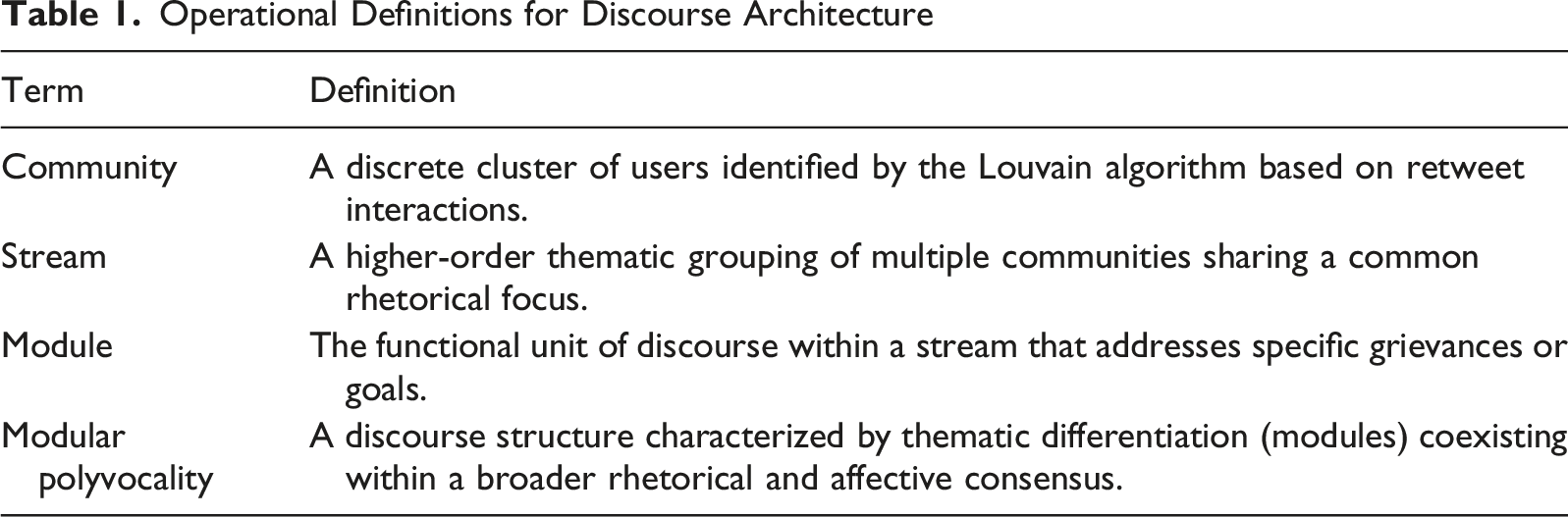
The death of Mahsa Amini in September 2022 triggered mobilization that challenged assumptions of digital slacktivism (Kermani, 2023). Expanding from hijab-related debate to broader claims under “Woman, Life, Freedom,” the #MahsaAmini protest gained global visibility through transnational activist and diaspora networks (Khorramrouz et al., 2023). Over 500 million Persian tweets reflect large-scale mobilization (Kermani, 2025), forming what Tufekci (2017) calls a “contested commons” where mourning, memory, and civic action converge. Alongside domestic mobilization (Khatam, 2023), the English-language layer is crucial, produced by activists, diaspora users, and human rights actors, and it reflects strategic reframing for global audiences rather than translation of Persian slogans (Atefinia & Mirnezami, 2025; Michaelsen, 2018). While Farsi tweets focused on domestic issues (Akbari, 2022), English posts targeted international audiences through universal rights discourse and platform visibility logics (Michaelsen, 2018). This globally oriented discourse has a distinct structure not fully captured by existing frameworks. To explain coherence amid thematic diversity, we introduce modular polyvocality.
Conceptualizing Modular Polyvocality
Operational Definitions for Discourse Architecture
Literature Review
Transnational Activism and the Strategic Use of English
Transnational activism literature shows how local struggles are embedded in global networks (Piper & Uhlin, 2004), often through the “boomerang effect,” where external pressure compensates for constrained domestic channels (Keck & Sikkink, 1998). English functions as a strategic bridge, enabled by digital platforms and “serial transnational activists” who translate local testimony into globally legible frames, a practice extending beyond diaspora actors to domestic activists seeking international visibility (Mercea & Bastos, 2016).
The Iranian Twittersphere as a Contested Transnational Arena
Since the 2009 Green protests, the Iranian Twittersphere has been a contested space for political communication (Kermani, 2023). The #MahsaAmini protest reframed it as strategic action beyond “slacktivism” critiques (Tufekci, 2017). Activism operates under information control and filtering (Sohrabi-Haghighat, 2011) as well as “informational saturation” driven by bots and noise (Kermani, 2025), within which emotional expression shifts into citizen documentation (Rosenbaum & Bouvier, 2020), combining expressive and strategic communication (Kermani, 2023) and reinforcing digital resilience and transnational solidarity (Khorramrouz et al., 2023).
Theoretical Framework: Networked Publics, Gatekeeping, and Framing
This study integrates three theoretical domains. First, connective action explains how loosely coordinated discourse “streams” emerge through personalized digital networks rather than hierarchical organization (Bennett & Segerberg, 2012). Second, these streams function as networked publics where narratives develop outside state-affiliated media (Boyd, 2010; Papacharissi and de Fatima Oliveira, 2012); traditional gatekeeping is replaced by “networked gatekeeping” as hashtags, retweets, and platform algorithms shape visibility (Meraz & Papacharissi, 2013; Papacharissi, 2015), capable of both unifying and fragmenting movements (Meraz, 2017) while remaining vulnerable to bots and misinformation (Golkar, 2015; Kermani, 2025). Third, we draw on digital diaspora activism (Ghorashi & Boersma, 2009; Sohrabi-Haghighat, 2011): English-language tweets function as strategic public diplomacy rather than direct translation, as diasporic and allied actors reframe narratives for global audiences, producing a “contested commons of visibility” (Tufekci, 2017).
From Fragmentation to Modular Polyvocality: Theorizing Discourse Structure
Across scholarship on digitally mediated protest, collective coherence under semantic diversity is explained through a limited set of mechanisms. A first group, networked framing, affective publics, connective action, and hybrid movement solidarity, locates coherence in emotional alignment, where shared affect binds participants despite divergent narratives (Meraz & Papacharissi, 2013; Papacharissi, 2016; Pavan & Rapini, 2022; Rosenbaum & Bouvier, 2020; Stewart & Schultze, 2019). A second group explains coherence through organizational coordination under controlled socio-political atmosphere, treating semantic diversity as destabilizing or as a product of controlling strategies (Kermani, 2025; Khatam, 2023). A third strand, aspect-based sentiment analysis, emotion lexicons, and structural approaches such as random matrix theory, maps emotional or structural variation without theorizing how coherence persists under fragmentation (Haralabopoulos & Simperl, 2017; Mohammadi et al., 2022).
Taken together, these literature studies explain persistent coherence either through affective alignment, organizational coordination, or not at all. Affect’s role as an autonomous mechanism synchronizing heterogeneous communities remains under-specified (Papacharissi, 2016; Rosenbaum & Bouvier, 2020). This limitation surfaces in recurring empirical tensions: online–offline disjunctions (Pavan & Rapini, 2022), doubts about the effectiveness of connective movements (Michelen & Glasius, 2018; Rosenbaum & Bouvier, 2020), participant anonymity and fragmentation (Etemadifard & Khazaei, 2021; Rosenbaum & Bouvier, 2020; Stewart & Schultze, 2019), and difficulties sustaining coherence in polarized networks (Kermani, 2025). What remains under-theorized is not polyvocality or affective engagement, but the relational condition in which they coexist without collapsing into fragmentation, how affective alignment operates across modular structures (Papacharissi, 2016), how semantic divergence is contained, and how coherence persists without shared frames or centralized coordination.
Our Contribution
Existing theories either attribute unity to affective alignment, locate it in organizational capacity, or merely describe fragmentation, none theorizes the condition under which heterogeneous discourse remains collectively synchronized across modular communicative structures. This study addresses that explanatory gap by conceptualizing modular polyvocality as the condition in which multiple, internally coherent discursive modules coexist, remain affectively attuned, and contribute to collective persistence without requiring discursive convergence or hierarchical integration.
Our analysis integrates computational network methods with qualitative interpretation to answer three interrelated research questions.
Cross-Cutting Analyses
Bot detection (section 2.3), sentiment analysis (Section 2.9), and topic divergence (Section 2.6.2) (Figure 1). Visualization of the analytical pipeline, showing how raw tweets flow through successive stages, creating a multi-layered validation structure where findings must be consistent across computational and interpretive methods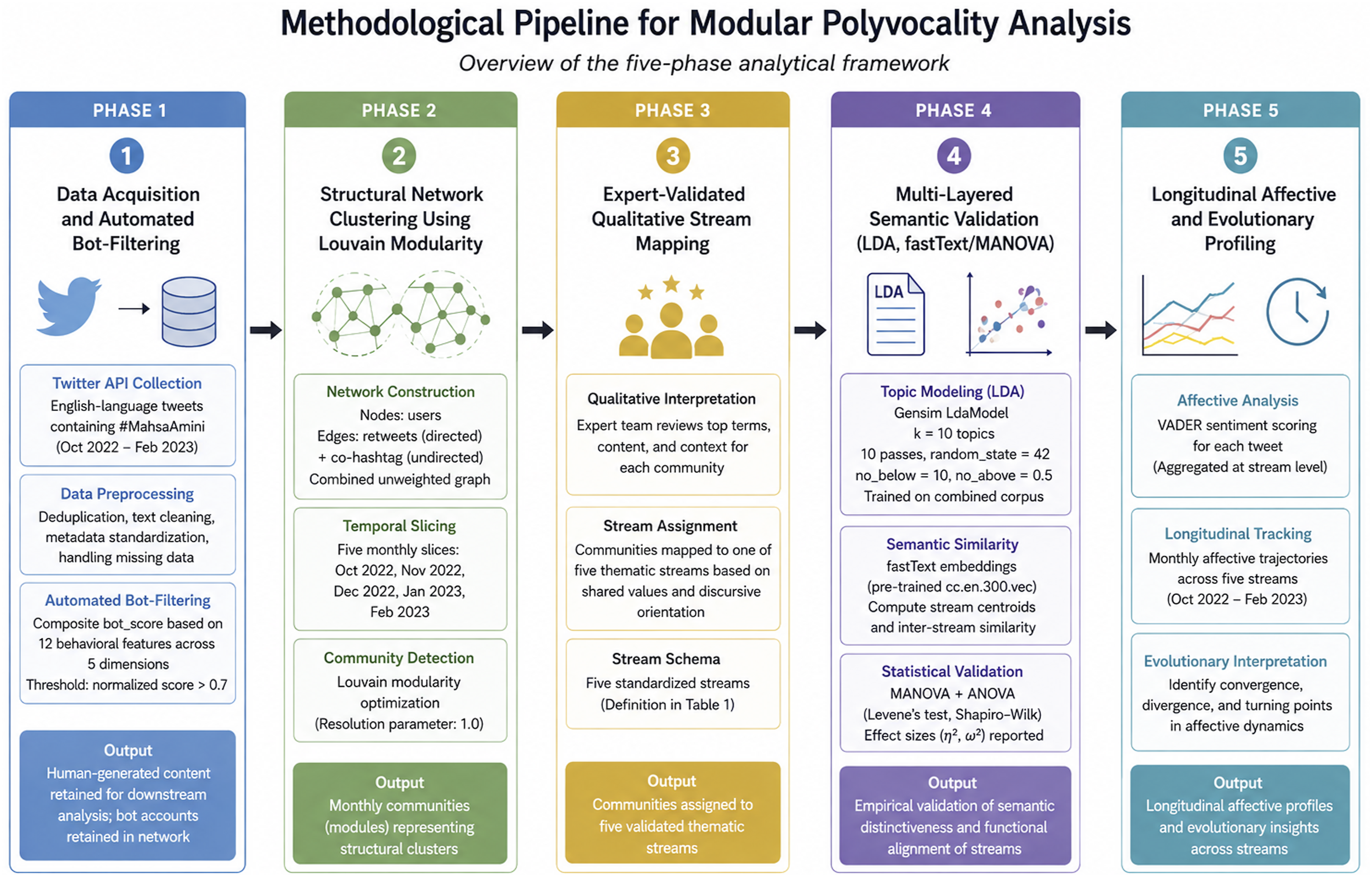
Materials and Methods
Data Collection and Preprocessing
English-language tweets containing #MahsaAmini and related hashtags were collected via the Twitter API over 6 months (October 2022–February 2023), covering the movement’s peak transnational visibility (Kermani, 2025). The focus on English tweets reflects their role as a channel for global advocacy rather than user geography.
Preprocessing followed a multi-stage pipeline. Regex removed hyperlinks, mentions, and non-textual symbols while preserving core contextual information (Haralabopoulos & Simperl, 2017). Non-ASCII characters and emojis were encoded and filtered to retain English-language semantic structure. Stopwords were removed using NLTK (Bird et al., 2009) to optimize the corpus for clustering, embeddings, and keyword extraction. Mixed-language tweets containing both English and Persian script were retained but treated as English-language documents; Persian-script tokens were removed alongside other non-ASCII characters during filtering, meaning only the English-language portion contributed to downstream lexical and semantic analysis. This approach preserves the strategic English-language layer of the discourse while acknowledging that meaning carried exclusively in Persian script is not captured, a limitation discussed in Section 4.7.
A Temporal Text-Matching algorithm was applied to detect and group duplicate content, ensuring accurate inference of retweet relationships and network robustness even when API metadata was incomplete (Figure 2). Top ten most prevalent hashtags during the studied period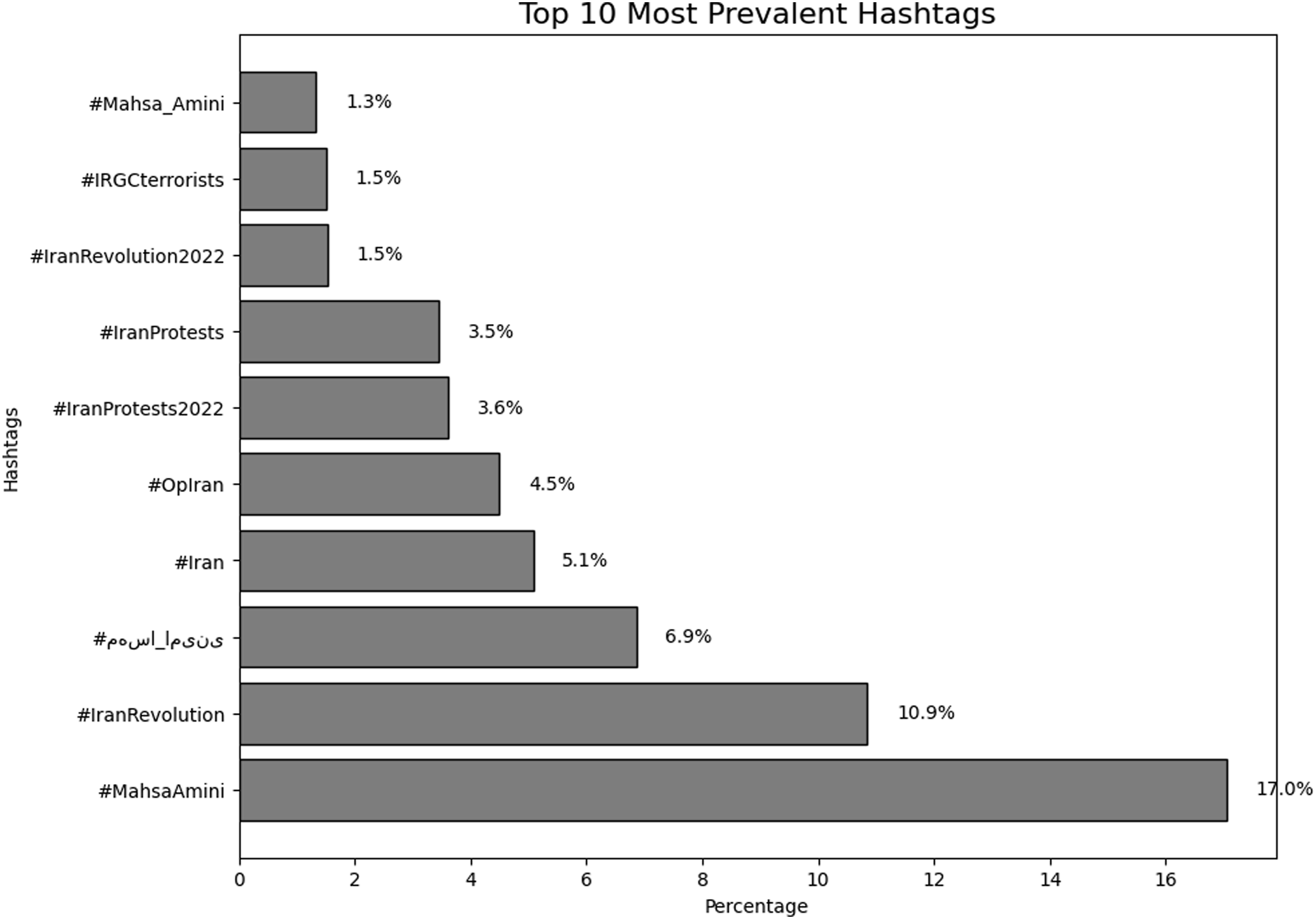
Community Detection Algorithm
Monthly retweet networks were constructed with users as nodes and retweet relations as directed edges, capturing information flow and alignment (Castillo, 2016). To incorporate both behavioral alignment (retweet relations) and topical alignment (hashtag co-occurrence), retweet and co-hashtag edges were merged into a unified graph prior to community detection, producing more robust community structures reflecting multiple dimensions of discursive alignment (Castillo, 2016; Mohammadi et al., 2022). All edges were treated as unweighted binary ties; while weighted networks capture interaction intensity, unweighted representations are more appropriate in protest settings where connectivity itself indicates alignment (Farzam et al., 2023). Mention networks were excluded due to susceptibility to manipulation in politically contested contexts (Kermani, 2025; Tufekci, 2017). Where API metadata was incomplete due to deletions or suspensions, the Temporal Text-Matching algorithm reconstructed missing retweet relations by grouping duplicate content (Olteanu et al., 2019).
Community detection used the Louvain modularity optimization algorithm (Farzam et al., 2023; Mohammadi et al., 2022), selected for scalability in large networks. Each monthly network was run with 10 random initializations, retaining the highest-modularity partition to reduce sensitivity to local optima, with a resolution parameter of 1.0 to balance granularity and over-fragmentation (Mohammadi et al., 2022). The resulting clusters formed the basis for downstream semantic and lexical analyses (Campbell et al., 2013).
Bot Flagging
To preserve analytical validity in an environment with coordinated inauthentic activity, we constructed a composite bot_score integrating five validated dimensions: temporal activity (Al-azawi & Safaa, 2022), account metadata (Varol et al., 2017), network behavior (Castillo et al., 2011), content style (Kosmajac & Keselj, 2019), and coordinated surges indicating botnet activity (Davis et al., 2016). Features were weighted by prior reliability (Varol et al., 2017), producing a normalized score (0–1). A conservative threshold of 0.7 was applied to reduce false positives in politically sensitive contexts (Keller & Klinger, 2019), where misclassification of activists could distort findings (Pacheco et al., 2021; Rauchfleisch & Kaiser, 2020).
Bot detection followed a two-stage design. In stage one, tweets from flagged accounts were removed from all content-level analyses (G2 profiling, Jensen–Shannon divergence, semantic validation, and VADER sentiment analysis). In stage two, flagged accounts were retained in the network graph to preserve structural integrity, as removal would distort community topology (Pacheco et al., 2021; Rauchfleisch & Kaiser, 2020), a trade-off discussed in Section 4.7. This separation follows established computational social science practice (Castillo et al., 2011; Varol et al., 2017).
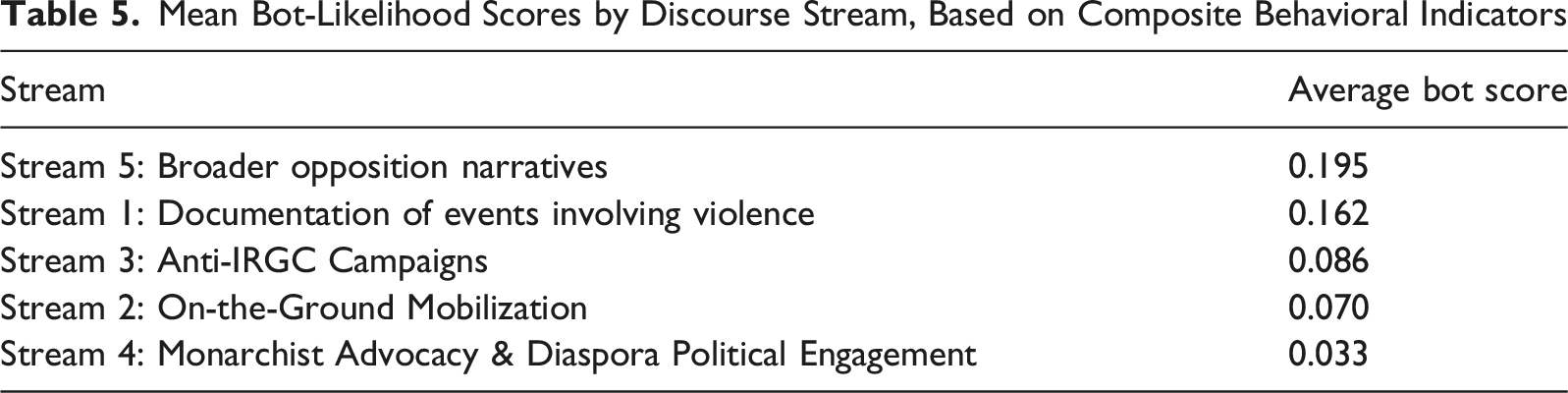
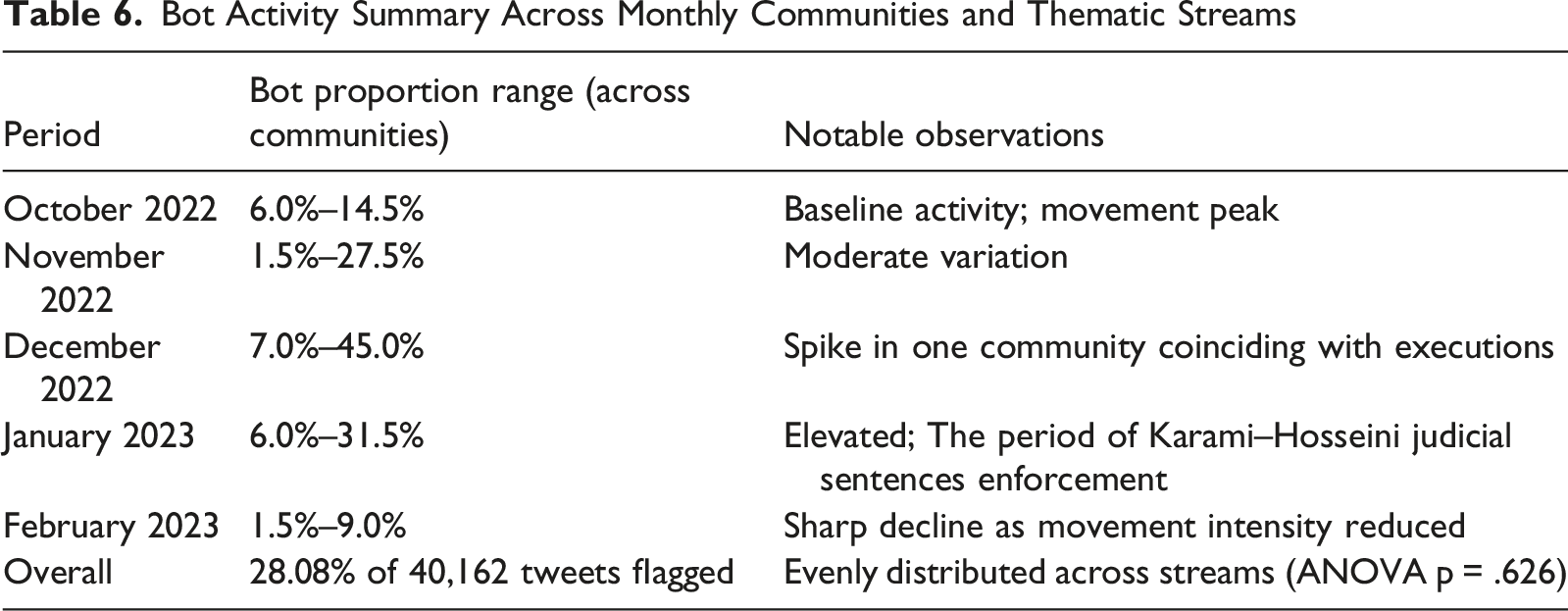
Of 40,162 tweets, 11,276 (28.08%) were classified as bot-generated and excluded from content analysis. Bot activity varied across months (1.5%–14.5% in October 2022; 1.5%–9% in February 2023), with a sharp spike in December 2022 where one community reached ∼45%, coinciding with the Final judicial sentences carried out by the state against Karami and Hosseini, consistent with Kermani (2025) concept of reactive “informational saturation.” Across the five thematic streams, mean bot scores were uniformly low (0.033–0.195). Stream five exhibited the highest average bot score (0.195), while Stream four showed the lowest (0.033). A one-way ANOVA revealed no statistically significant differences in bot activity across streams (F (4, 21) = 0.68, p = .626), indicating that automated activity was distributed broadly rather than concentrated in any specific discourse stream. This supports the interpretation that the observed modular structure reflects organic human discourse rather than an artifact of coordinated automated amplification.
Stream Mapping and Reliability Assessment
Community detection alone does not reveal thematic meaning (Braun & Clarke, 2006). We applied an interpretive stream mapping framework linking structural communities to thematic categories through qualitative coding (Farzam et al., 2023; Kermani, 2025), treating streams as analytical constructs rather than fixed discourse boundaries (O'Connor et al., 2010).
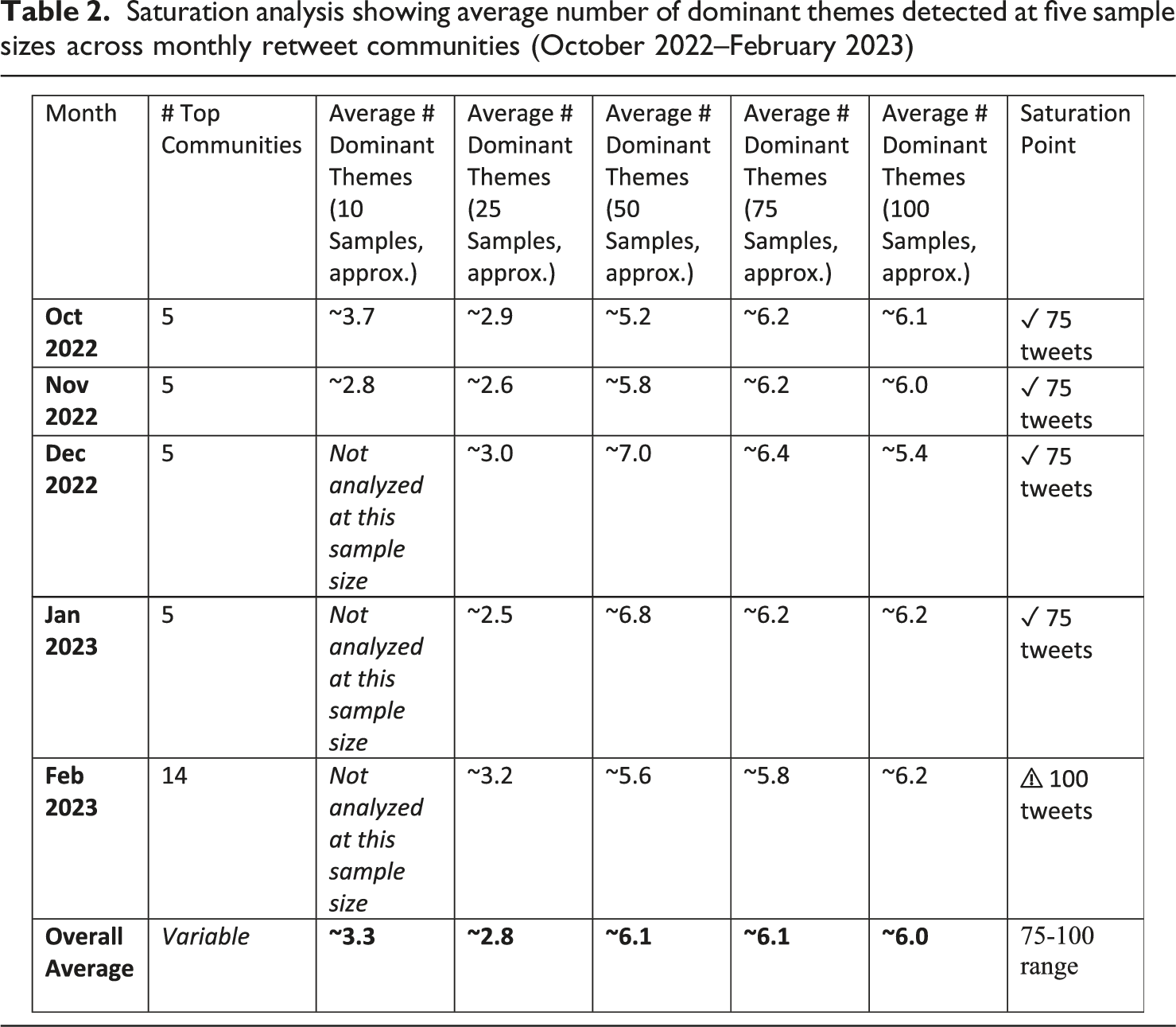
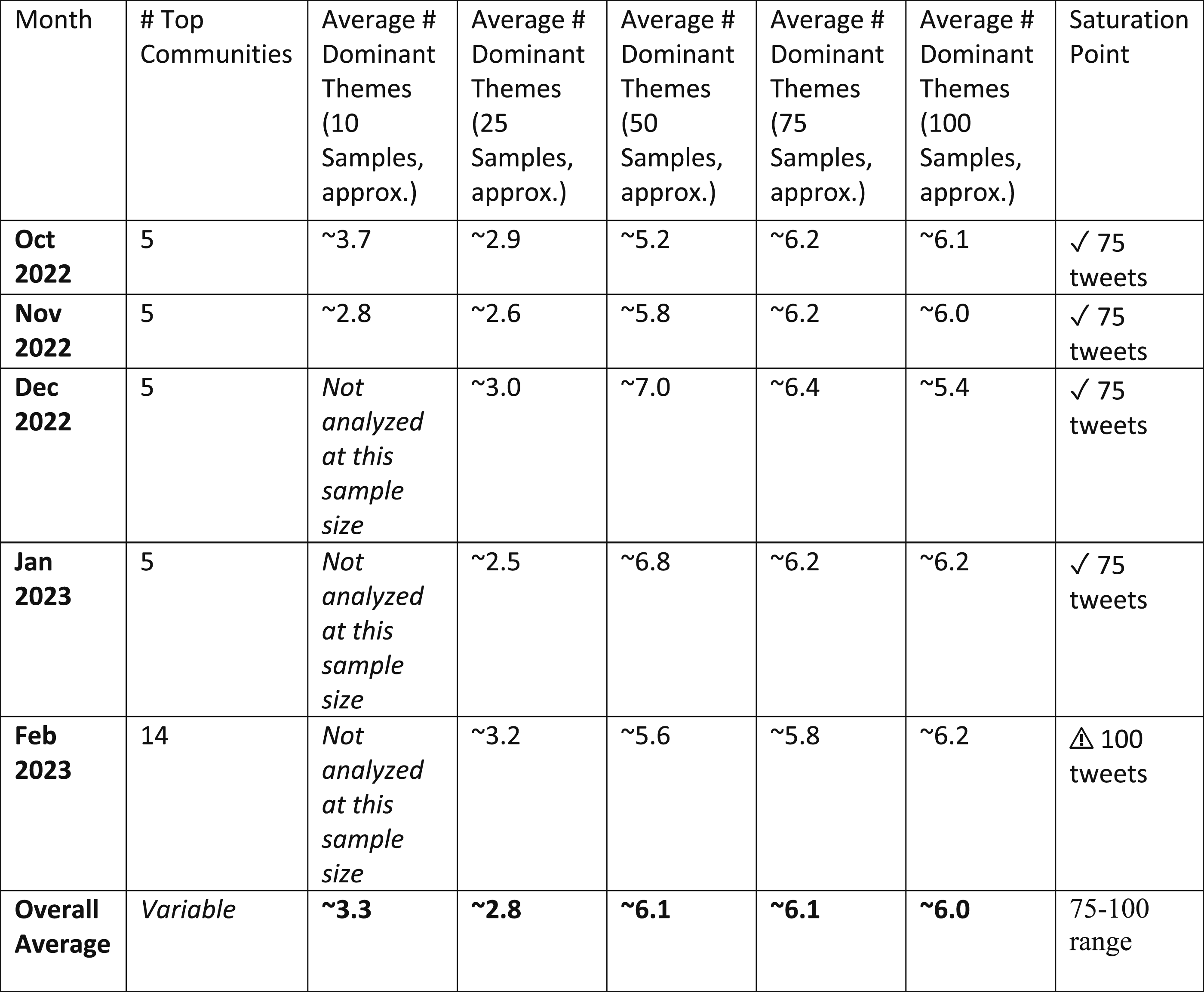
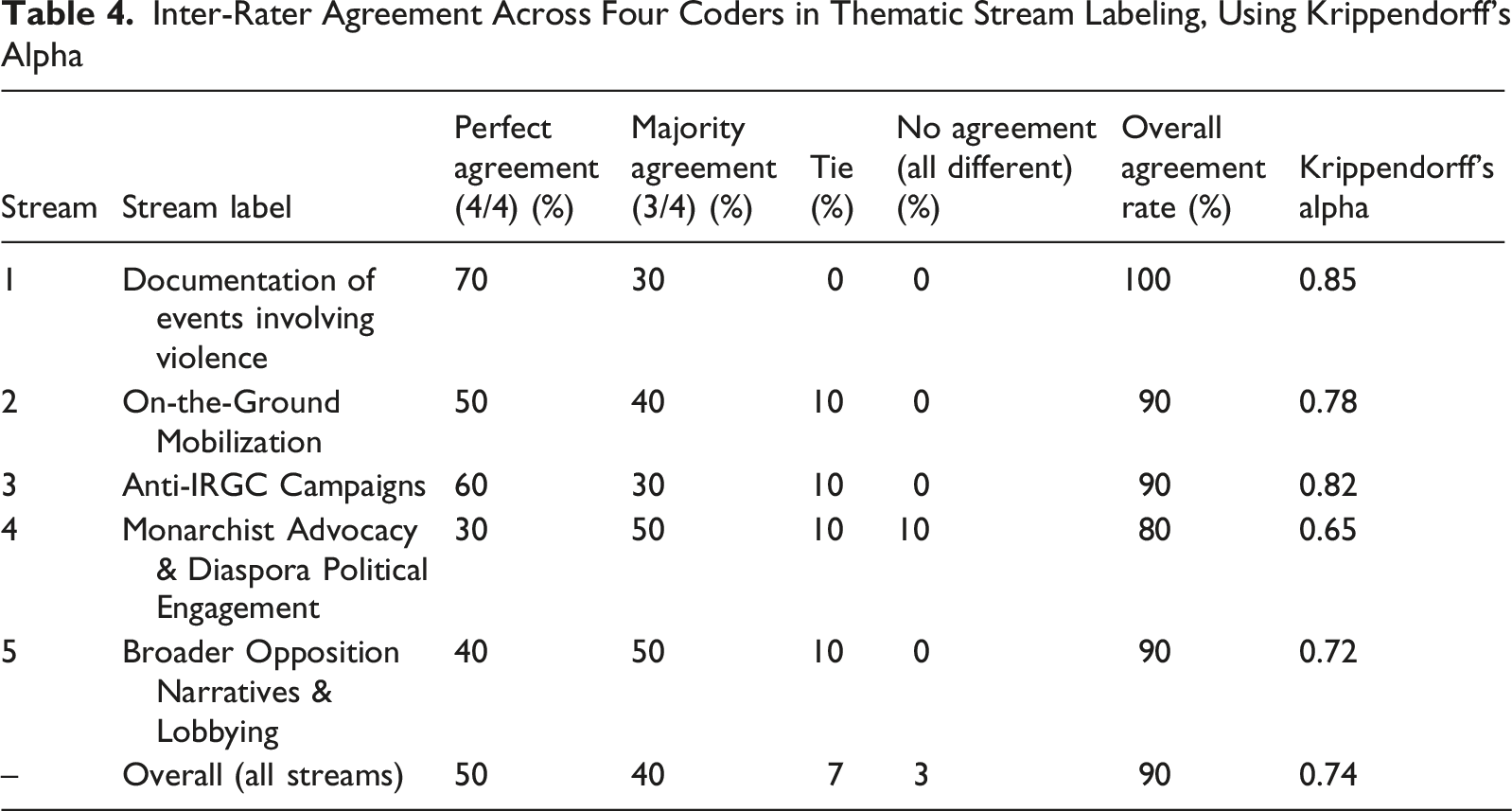
The largest communities per monthly network were selected based on size and modularity score (Mohammadi et al., 2022). Saturation testing at five sampling levels (10, 25, 50, 75, and 100 tweets per community) showed thematic stabilization between 50 and 75 tweets (6.1 dominant themes at both levels; 6.0 at 100), consistent with established saturation logic (Guest et al., 2006). Our 75-tweet threshold, applied across 34 communities (2,550 tweets), achieved Krippendorff’s α = 0.74, supporting stable and replicable community-level representations. Adequacy of this strategy is further confirmed by convergence between 75- and 100-tweet samples alongside validation from G2 profiling, Jensen–Shannon divergence, MANOVA, and sentiment analysis.
Manual coding followed three steps. First, key users were identified by retweet volume for network description only, not sampling (Castillo et al., 2011). Second, 75 tweets per community were randomly sampled to avoid visibility bias from algorithmic amplification (Kermani, 2025; Olteanu et al., 2019), using a fixed seed (random_state = 42) for reproducibility. Third, sampled tweets were coded using an iterative thematic framework and codebook (Appendix A), following established computational qualitative methods (Braun & Clarke, 2006; Freelon & Wells, 2020).
Reliability Assessment
Saturation analysis showing average number of dominant themes detected at five sample sizes across monthly retweet communities (October 2022–February 2023)
Lexical Characterization and Topic Divergence
Lexical Characterization (G2 Keyword Profiling)
To identify stream-specific vocabulary, we applied the log-likelihood ratio test (G2), a standard corpus linguistics method for detecting overrepresented terms (Dunning, 1993). For each stream, a 2 × 2 contingency table compared word frequencies within the stream against all others; terms with G2 ≥ 6.63 (p < 0.01) and minimum frequency thresholds were retained. The top 30 terms per stream served as lexical fingerprints capturing distinct rhetorical and thematic emphases (Ahmed & Jaidka, 2013; Haralabopoulos & Simperl, 2017).
Topic Divergence (Jensen–Shannon Divergence)
To assess thematic separation, we combined probabilistic topic modeling with information-theoretic divergence. LDA was applied via Gensim’s LdaModel (Řehůřek & Sojka, 2010) to identify latent thematic structure, representing documents as topic mixtures and topics as word distributions. The model was trained jointly on all five streams to ensure a shared topic space, with k = 10 topics, 10 passes for convergence, a fixed seed (random_state = 42), and vocabulary filtered by frequency thresholds (no_below = 10, no_above = 0.5). Document-level topic distributions were averaged per stream into a single representative vector (“topical DNA”) using Gensim’s sparse2full function. Pairwise Jensen–Shannon Divergence (JSD) was then computed between stream-level vectors. JSD is a symmetric, bounded measure (0–1) of distributional divergence (Tan & D’Souza, 2025) that avoids the asymmetry and zero-probability issues of KL divergence, making it suitable for partially overlapping vocabularies. Together, LDA-based JSD and G2 profiling provide complementary measures capturing both deep topic distributions and surface lexical differentiation.
Semantic Validation
Word Embedding Approach
We used pre-trained fastText English embeddings (cc.en.300.vec), representing words as high-dimensional vectors based on contextual similarity (Khorramrouz et al., 2023). The top 30 G2-identified keywords from each stream were converted into vectors using gensim.KeyedVectors.
Semantic Coherence Tests
Three procedures validated stream vocabulary coherence: (a) Centroid Construction, embedding vectors of each stream’s top keywords were averaged to create a representative “semantic center of gravity”; (b) Seed Alignment, stream keywords were compared to predefined thematic seed centroids using cosine similarity; (c) Label Alignment, each stream centroid’s proximity to a manually constructed reference label was measured. This confirmed alignment between stream content and label, especially in narrower streams like Incident Documentation (cosine = 0.75), while broader streams showed lower scores due to lexical diversity.
Semantic Space Mapping via Multidimensional Scaling (MDS)
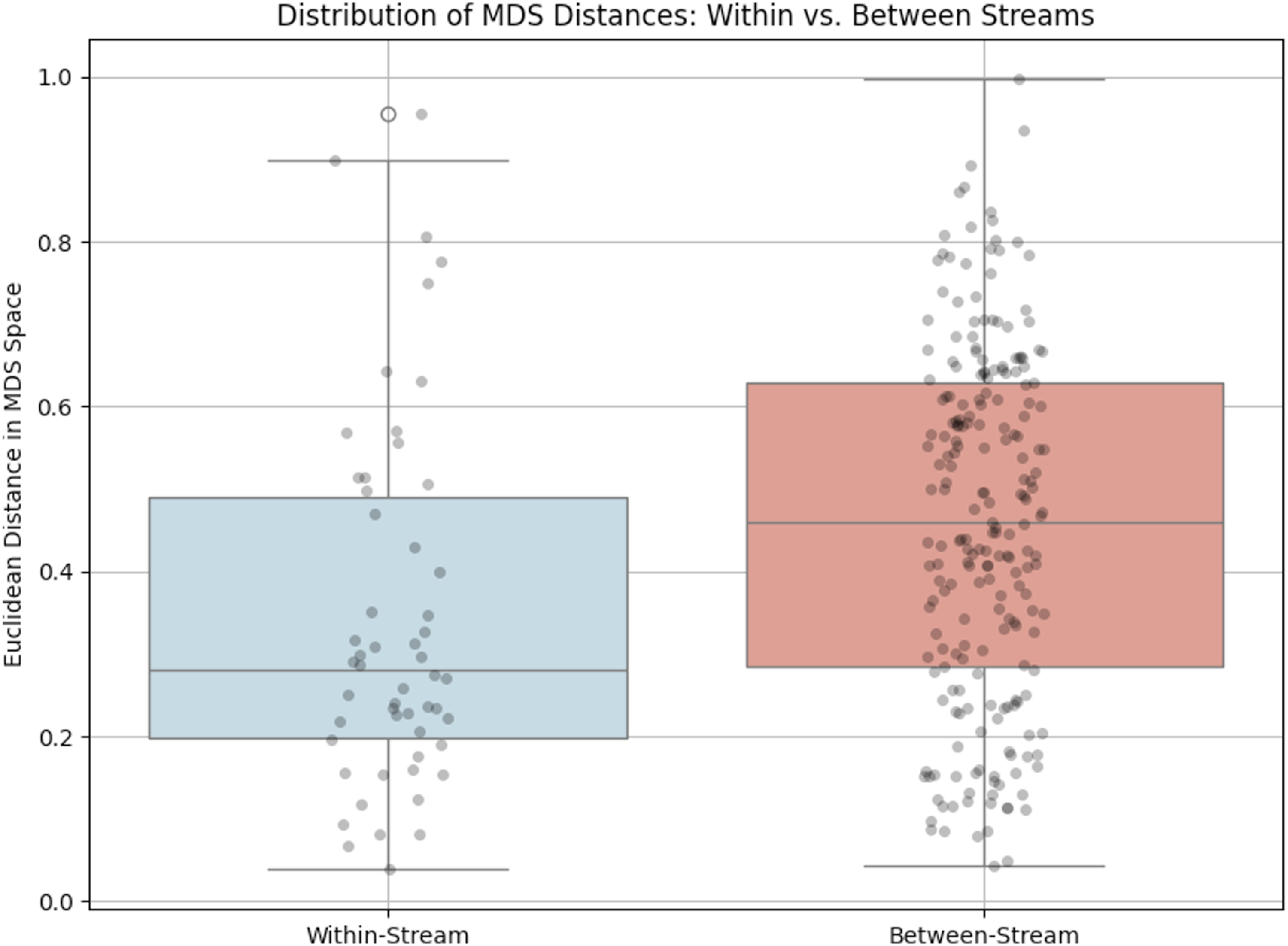
MDS was applied to cosine similarity matrices derived from top keyword embeddings, projecting high-dimensional word-vector relationships into 2D space to enable visual inspection of community clustering. A two-sample t-test on Euclidean distances in MDS-reduced space evaluated intra-vs. inter-stream coherence.
Statistical Validation (MANOVA Tests)
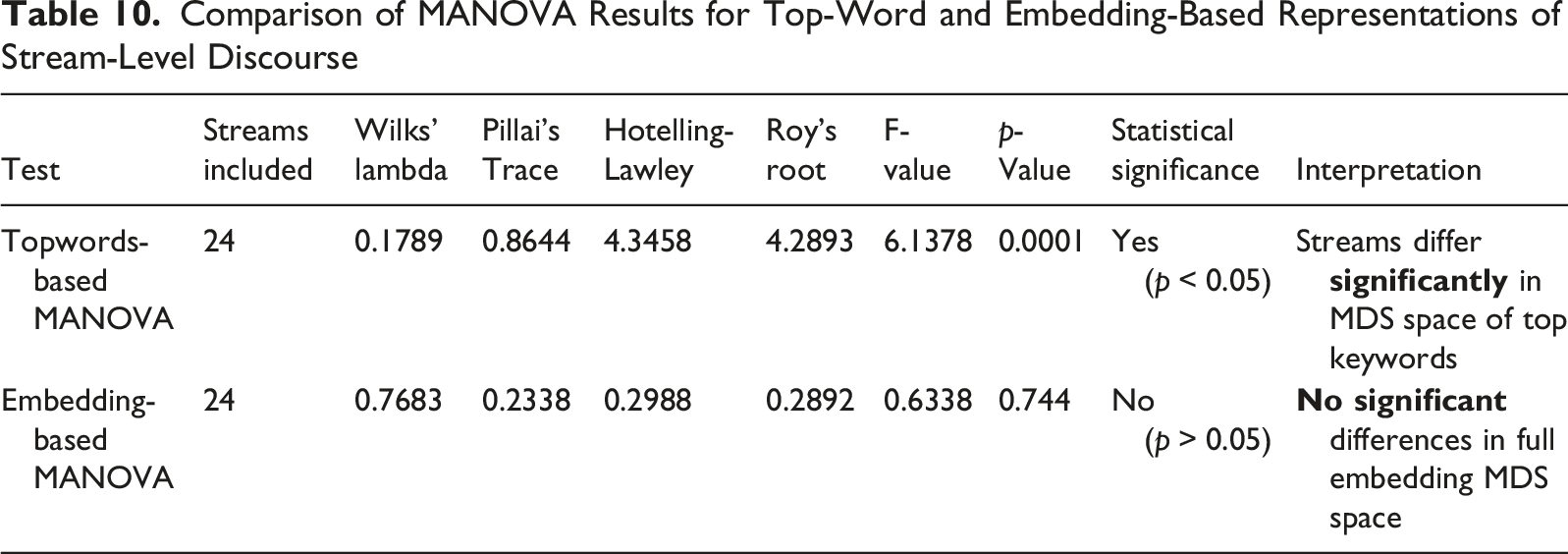
Two MANOVA tests using MDS coordinates were conducted: the full embedding space yielded no significant group separation (p = 0.744), likely due to overlapping vocabulary; the topword embedding space showed significant differences (Wilks’ λ = 0.1789, p < 0.001), affirming stream separation when lexical scaffolding is used. All labeling was completed prior to validation to avoid circularity.
Temporal and Hierarchical Analyses
Hierarchical Clustering: Meta-Streams
Agglomerative hierarchical clustering on top-word frequency vectors identified higher-order “meta-streams,” revealing thematic alignments (e.g., early mobilization vs. geopolitical advocacy) beyond initial community detection (Braun & Clarke, 2006).
Semantic Drift: Month-to-Month Lexical Change
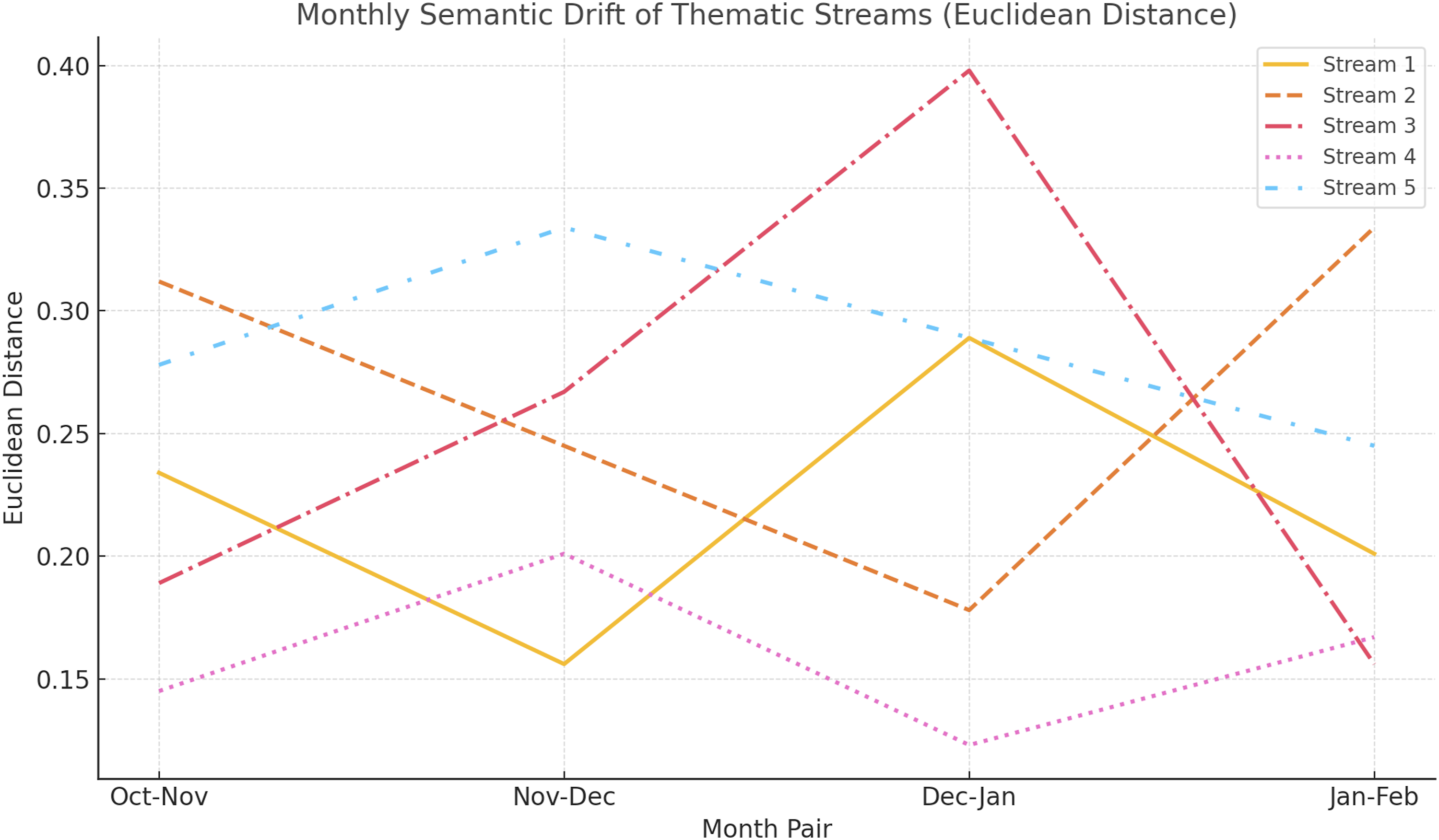
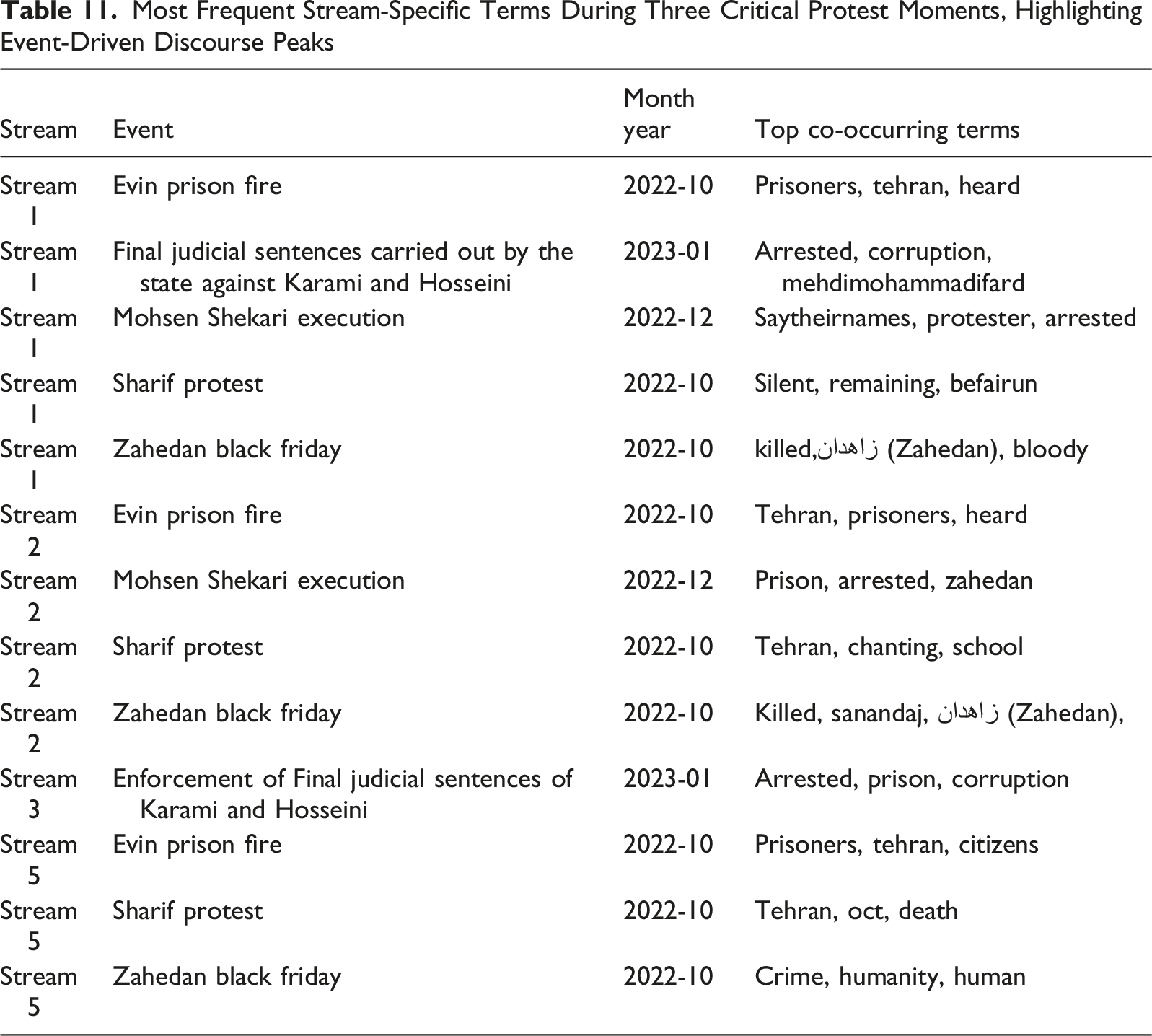
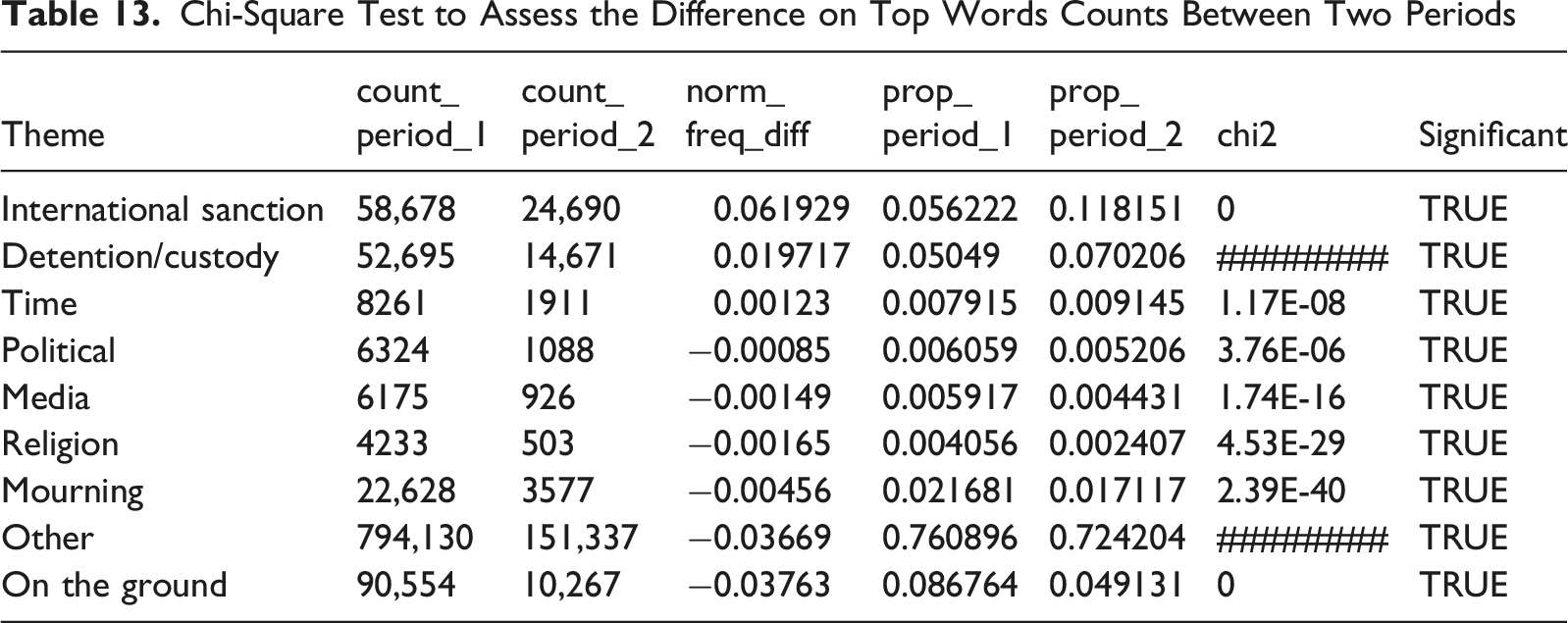
Semantic drift was measured by calculating Euclidean distances between monthly lexical centroids, classifying streams as persistent (stable vocabulary), emergent (appearing later), or sporadic (rapidly changing) (Castillo, 2016), capturing narrative adaptation to protest dynamics or algorithmic shifts (Pavan & Rapini, 2022). A chi-squared test on normalized token frequencies between two periods (Oct–Dec 2022 vs. Jan–Feb 2023) confirmed a significant shift from grassroots terms to international advocacy frames, coinciding with the Final judicial sentences carried out by the state against Karami and Hosseini. A co-occurrence matrix aligning top terms with protest events (e.g., “Zahedan Black Friday”) further revealed how streams semantically reoriented around symbolic flashpoints (Castillo, 2016).
Sentiment Analysis Using VADER
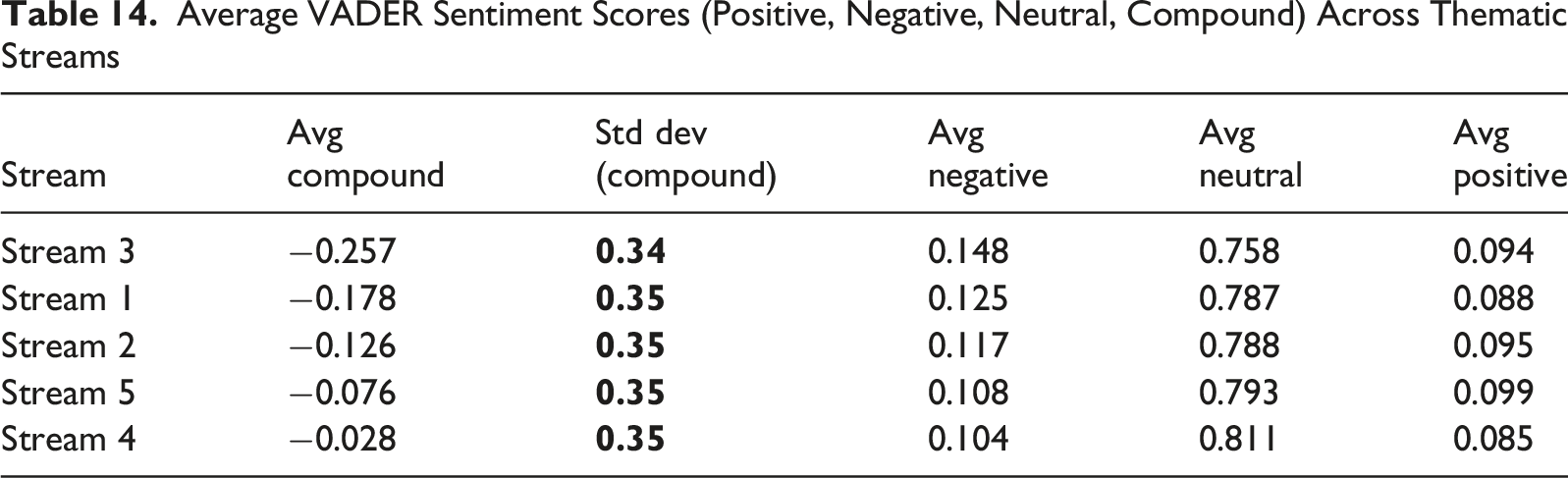
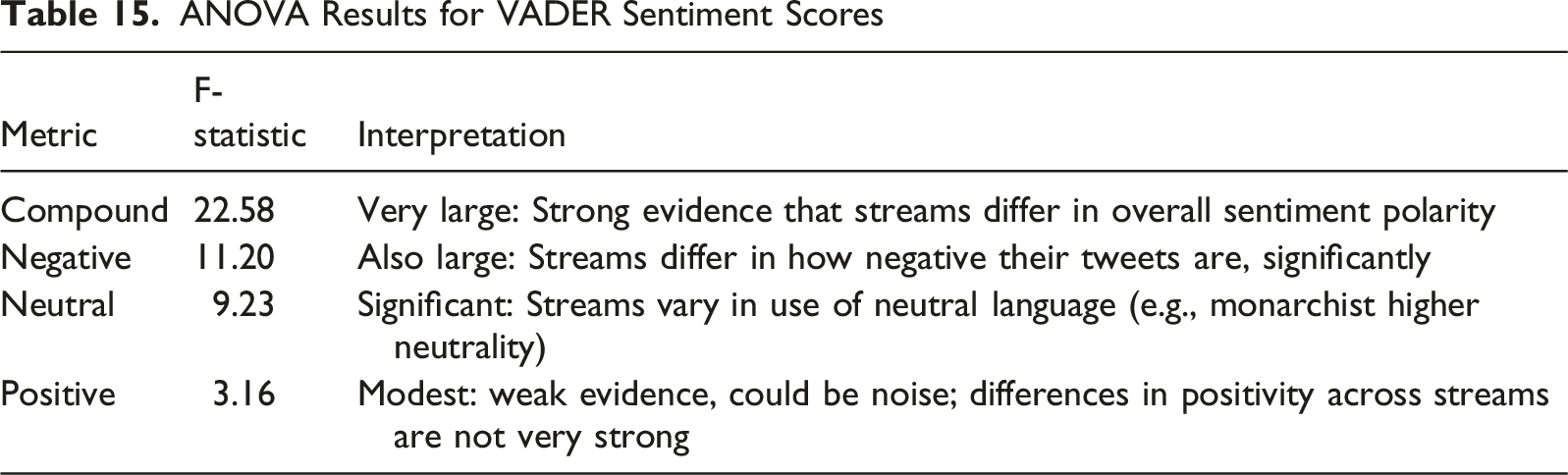
Affective variation was assessed using VADER (Valence Aware Dictionary and sentiment Reasoner), a lexicon- and rule-based model validated for social media text (Hutto & Gilbert, 2014). For each stream, VADER derived averaged positive, negative, neutral, and compound scores; the compound score served as the primary metric. While all streams exhibited negative affective valence, intensity varied, from most negative (Stream 3, Anti-IRGC Campaigns: −0.257) to most neutral (Stream 4, Monarchist Advocacy & Diaspora Political Engagement: −0.028). One-way ANOVA confirmed significant variation across mean compound scores, supporting the hypothesis of emotionally distinct discourse formations reflecting underlying strategic differences.
Results
Network Modularity and Community Structure
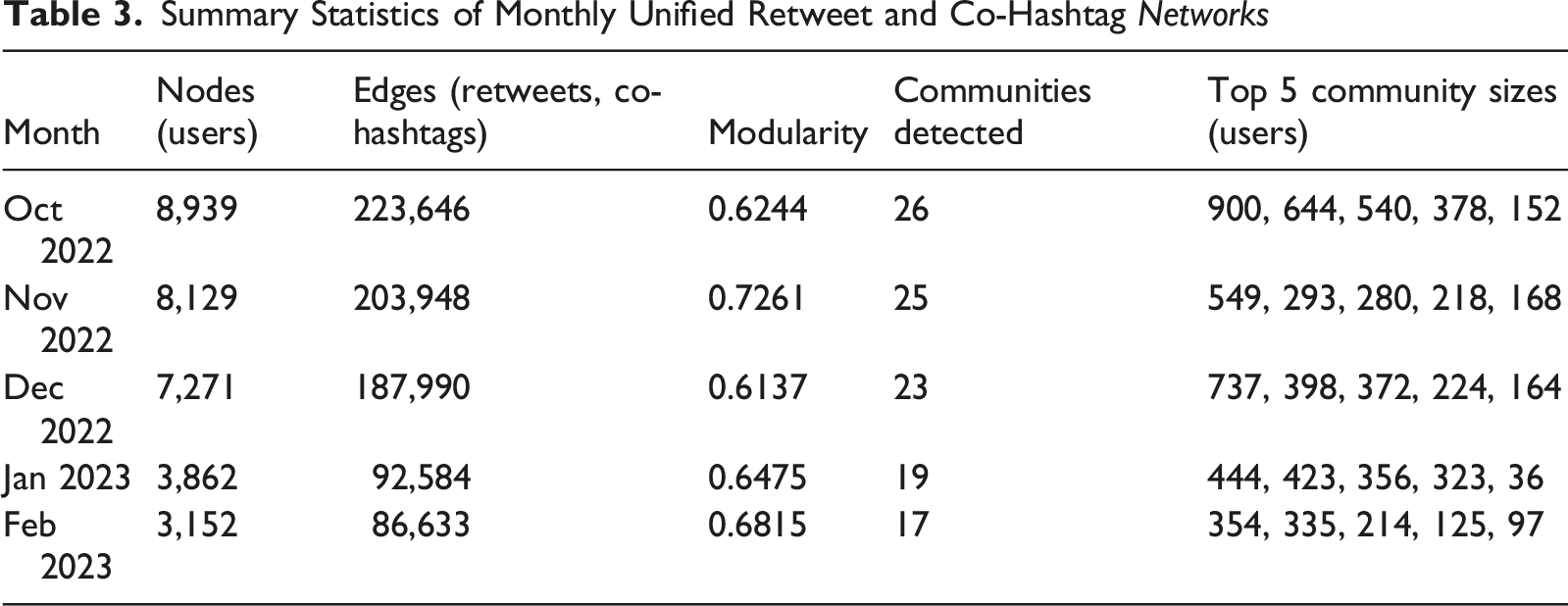
Monthly retweet networks (October 2022–February 2023) were analyzed using the Louvain algorithm (resolution = 1.0). Despite network size declining from ∼9,000 users in October to ∼3,100 in February, modularity remained stable and high (0.6137–0.7261; avg. 0.6586), with 17–26 communities detected per month, indicating a strongly clustered, non-random network structure.
Thematic Stream Reliability Validation
Structural communities were interpreted through qualitative stream labeling, yielding five discourse formations: (1) Documentation of events involving violence, (2) On-the-Ground Mobilization, (3) Anti-IRGC Campaigns, (4) Monarchist Advocacy & Diaspora Political Engagement, and (5) Broader Opposition Narratives & International Lobbying, inductively defined via close reading of 75 tweets per community. Inter-coder reliability across 10 stratified communities reached Krippendorff’s α = 0.74, supporting the stability of the typology (Freelon & Wells, 2020; Rauchfleisch & Kaiser, 2020) (Figure 3; Tables 3 and 4).
3D visualization of the retweet and co-hashtag network in January, illustrating modular community structure and inter-stream clustering Summary Statistics of Monthly Unified Retweet and Co-Hashtag Networks Inter-Rater Agreement Across Four Coders in Thematic Stream Labeling, Using Krippendorff’s Alpha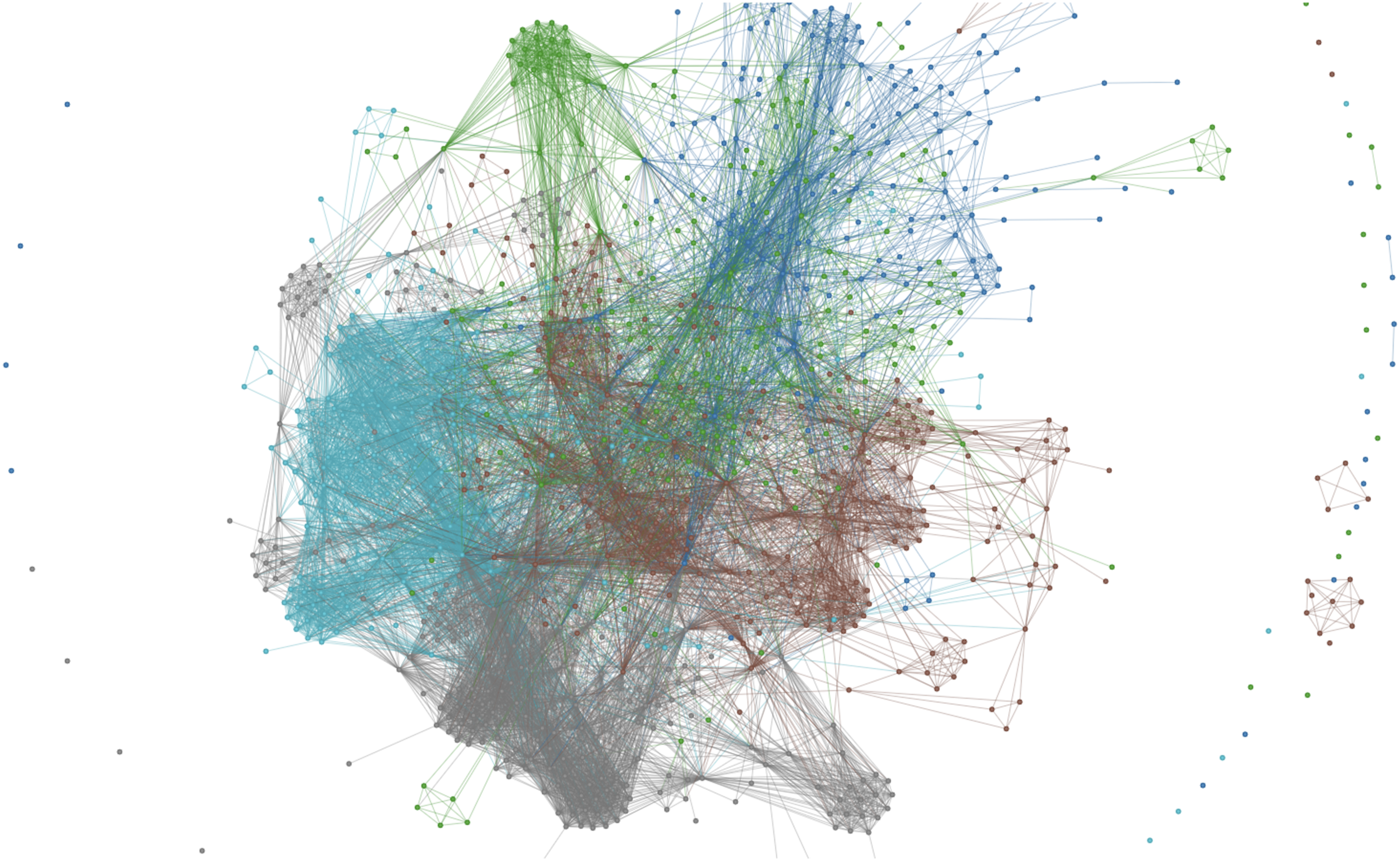
The Contested Information Environment: Bot-Like Activity Across Streams
Mean Bot-Likelihood Scores by Discourse Stream, Based on Composite Behavioral Indicators
Bot Activity Summary Across Monthly Communities and Thematic Streams
Mean bot scores per stream ranged from 0.061 (Stream 4) to 0.225 (Stream 1). Given the limited number of community observations per stream (n = 1–4), a formal inferential test is underpowered; the descriptive pattern nonetheless indicates no concentration of bot activity in any single discourse stream, consistent with the manuscript’s argument for organic modular structure.
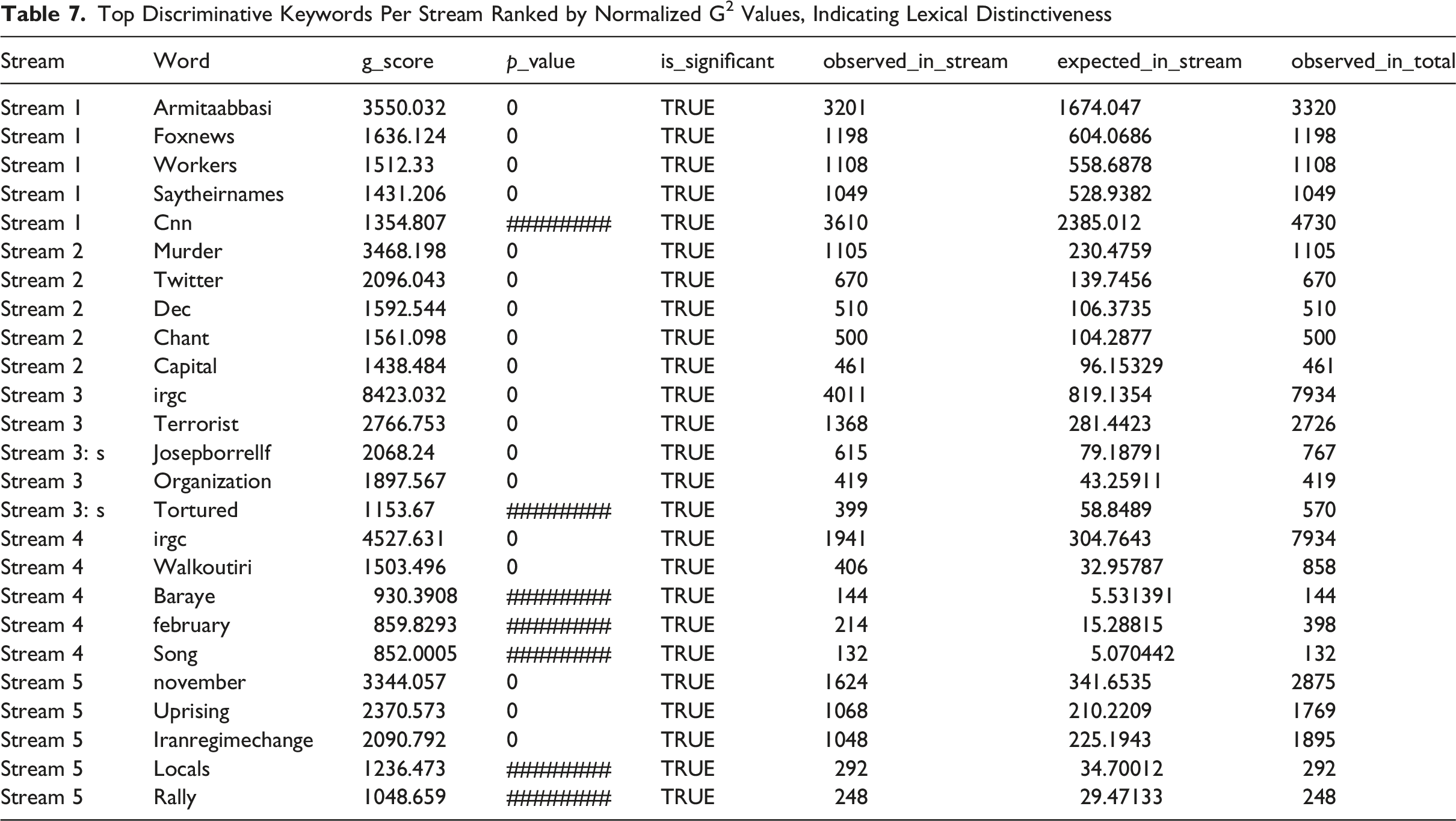
Lexical Distinctions Across Streams
Top Discriminative Keywords Per Stream Ranked by Normalized G2 Values, Indicating Lexical Distinctiveness
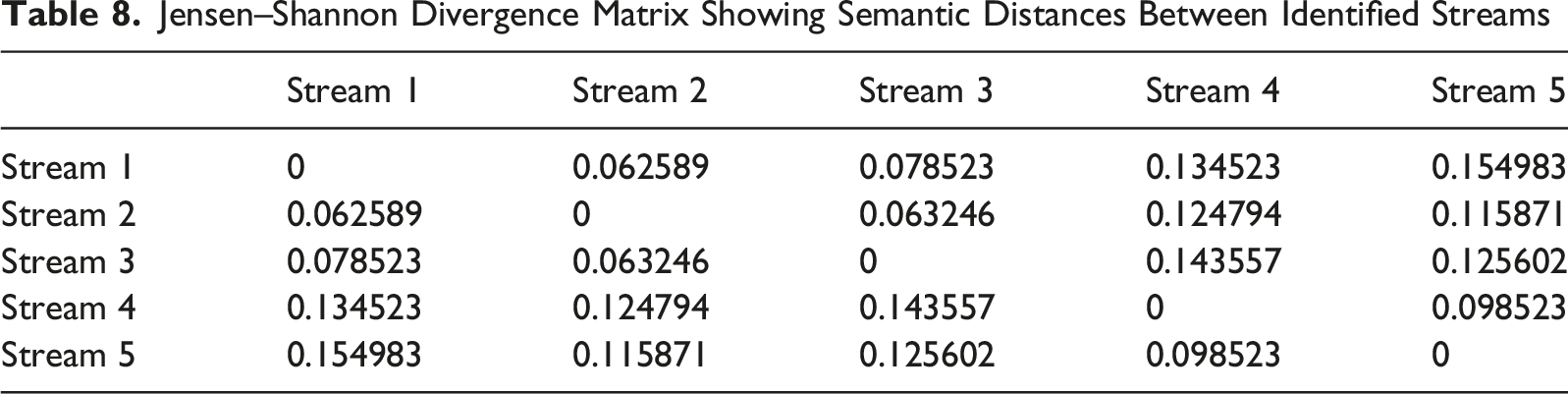
Topic Divergence (JSD Matrix)
Jensen–Shannon Divergence Matrix Showing Semantic Distances Between Identified Streams
Cosine Similarity Between Manual Stream Assignments and Computationally Identified Dominant Themes
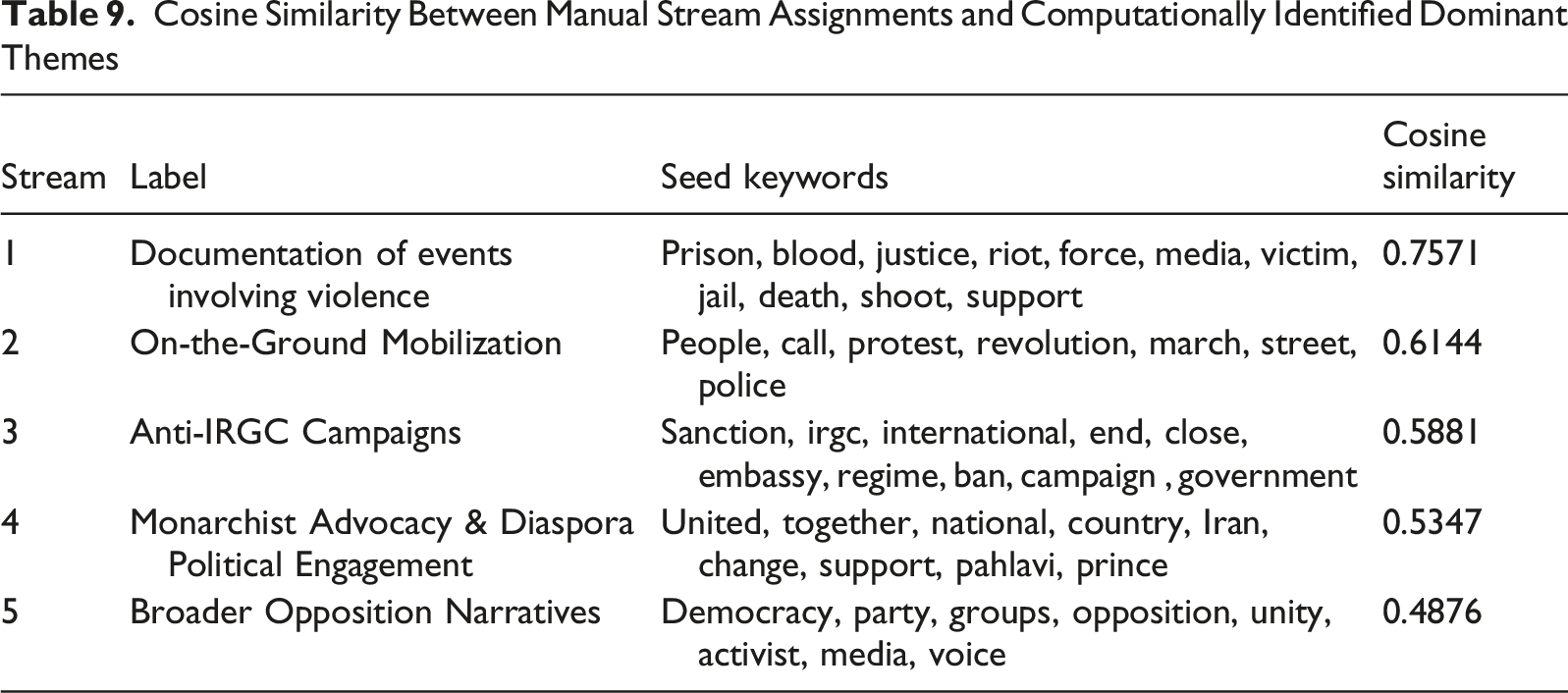
Stream Validation—Theme–Centroid Alignments
Pre-trained fastText embeddings assessed semantic coherence of each stream’s top 30 keywords. MDS plots revealed communities clustering spatially by designated stream, with particularly tight groupings for Streams 1 and 3. A two-sample t-test on Euclidean distances confirmed that communities within the same stream were significantly closer than those from different streams (t (274) = −3.48, p = 0.0008), supporting thematic differentiation despite lexical overlap.
Intra-stream distances were significantly smaller than inter-stream distances (M = 0.3430 vs. M = 0.4582), confirming tighter semantic coherence within streams than across them (Figures 4 and 5). Two-dimensional MDS plot of community-level linguistic similarity based on cosine distances between top-term vectors Distribution of MDS distances within versus between labeled streams, suggesting intra-stream coherence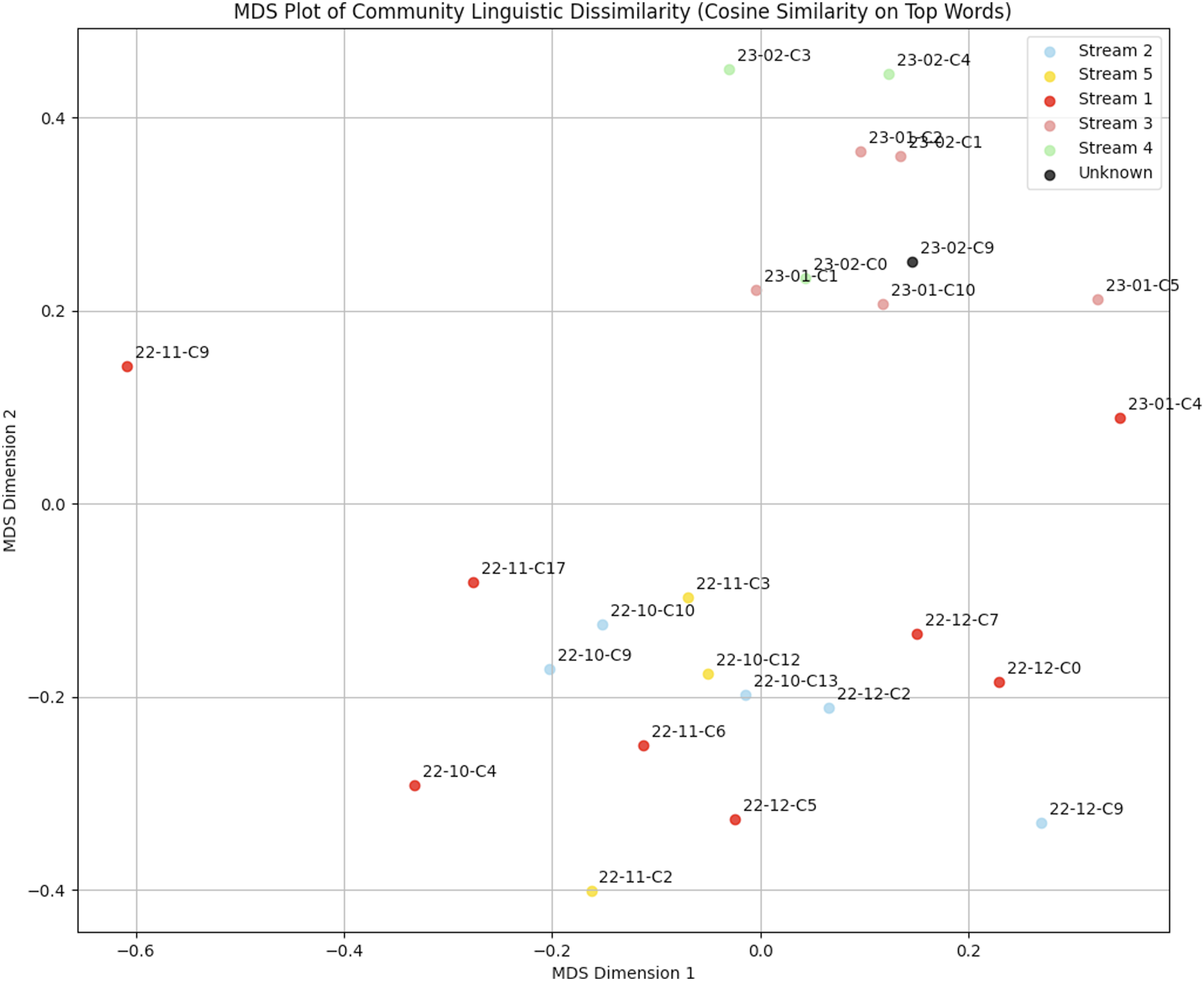
Meta-Streams and Temporal Drift
Agglomerative hierarchical clustering of thematic centroids produced higher-order “meta-streams”: a two-cluster solution grouped Streams 1 and 2 against Streams 3, 4, and 5. Semantic drift analysis classified streams as Persistent (Streams 1 and 4 stable vocabularies) or Variable (Streams 2, 3, and 5 higher monthly lexical change), measured by Euclidean distances between monthly lexical centroids based on averaged fastText embedding vectors (Figures 6 and 7). Hierarchical clustering dendrogram of retweet communities based on cosine similarity of top tokens, illustrating higher-order groupings Temporal semantic drift for each stream measured by Euclidean distance across months, indicating thematic evolution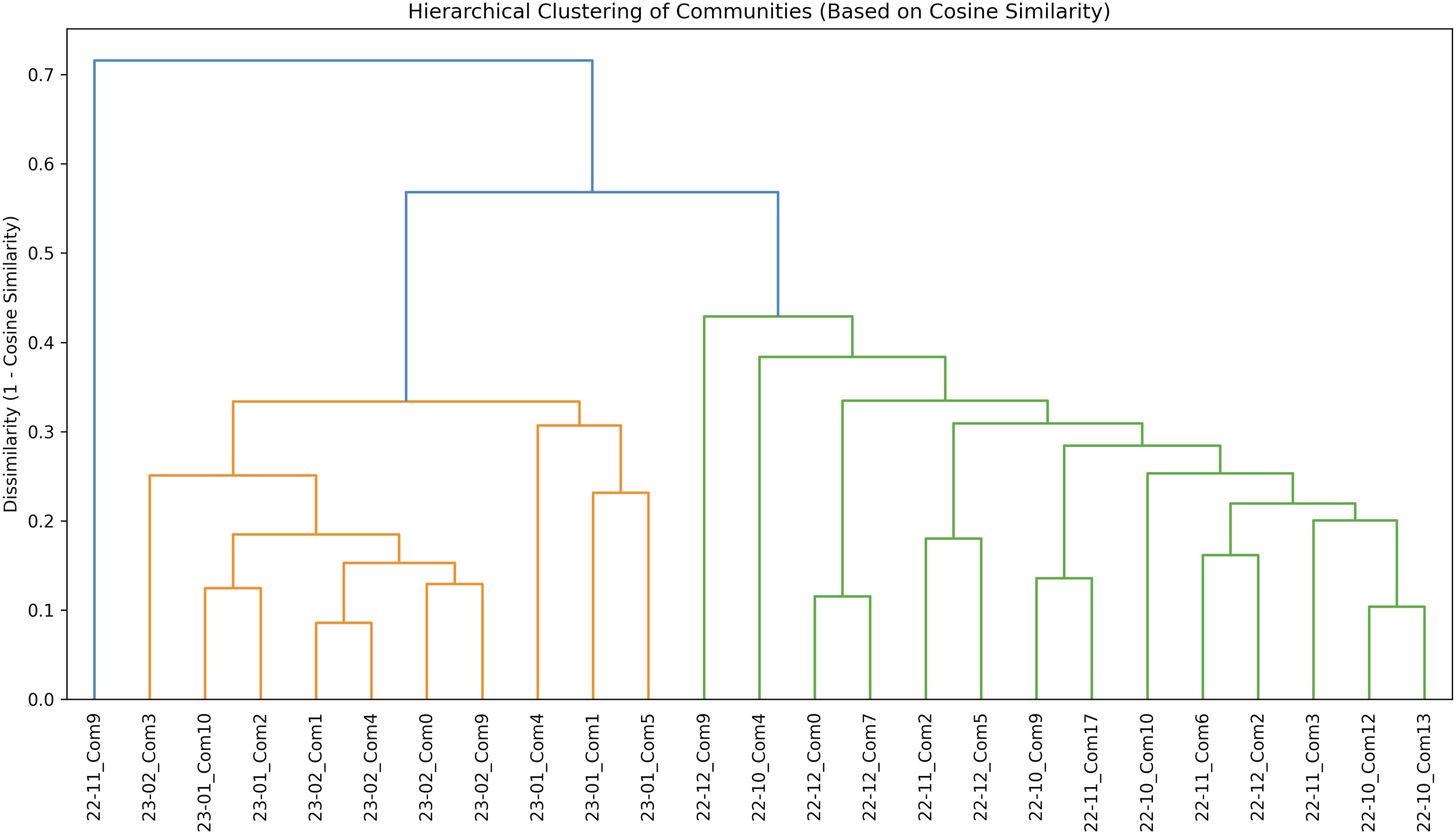
MANOVA Findings: Statistical Differentiation of Streams
MANOVA on MDS coordinates was conducted following assumption checks: homogeneity of covariance was supported via Levene’s test (W = 0.72–2.09, p = .12–.59), with Shapiro–Wilk tests indicating mostly normal distributions with minor violations in very small groups (n = 3–4). Given these constraints, Pillai’s Trace (V = 0.864, p < .001) is reported alongside Wilks’ λ for robustness (Tabachnick & Fidell, 2013).
Comparison of MANOVA Results for Top-Word and Embedding-Based Representations of Stream-Level Discourse
Stream Evolution Over Time
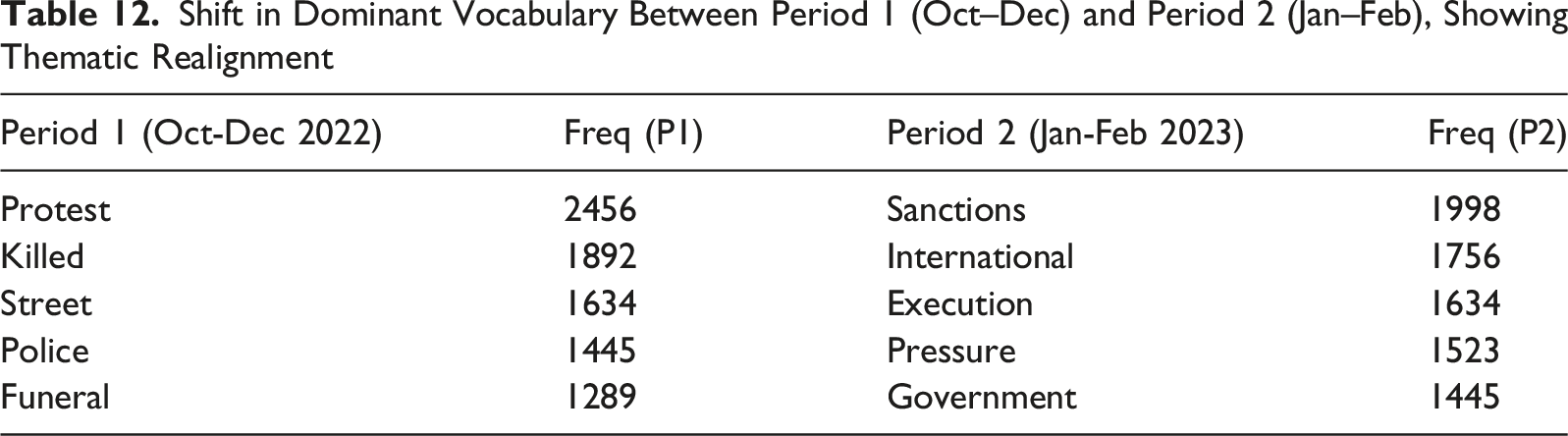
Monthly keyword analysis reveals lexical evolution aligned with key protest events. Stream 1 shifted from “killed” and “massacre” during the Zahedan Black Friday events (October) to “martyr” and “funeral” during 40-day memorials (November), while Stream 3 peaked in “execution” and “hanged” following the Final judicial sentences carried out by the state against Karami and Hosseini (January). A chi-square test confirms a significant thematic shift between Period 1 (Oct–Dec 2022) and Period 2 (Jan–Feb 2023) (p < 0.001): Period 1 was dominated by on-the-ground reporting (8.7%) and mourning terms, whereas Period 2 shows a rise in sanctions and lobbying terms from 5.6% to 11.8%, marking a transition from localized resistance discourse to transnational advocacy and forming two temporally distinct meta-streams (Figure 8; Tables 11, 12 and 13). Top 15 discriminative tokens across Period 1 and Period 2, normalized by token frequency, indicating evolving protest narratives Most Frequent Stream-Specific Terms During Three Critical Protest Moments, Highlighting Event-Driven Discourse Peaks Shift in Dominant Vocabulary Between Period 1 (Oct–Dec) and Period 2 (Jan–Feb), Showing Thematic Realignment Chi-Square Test to Assess the Difference on Top Words Counts Between Two Periods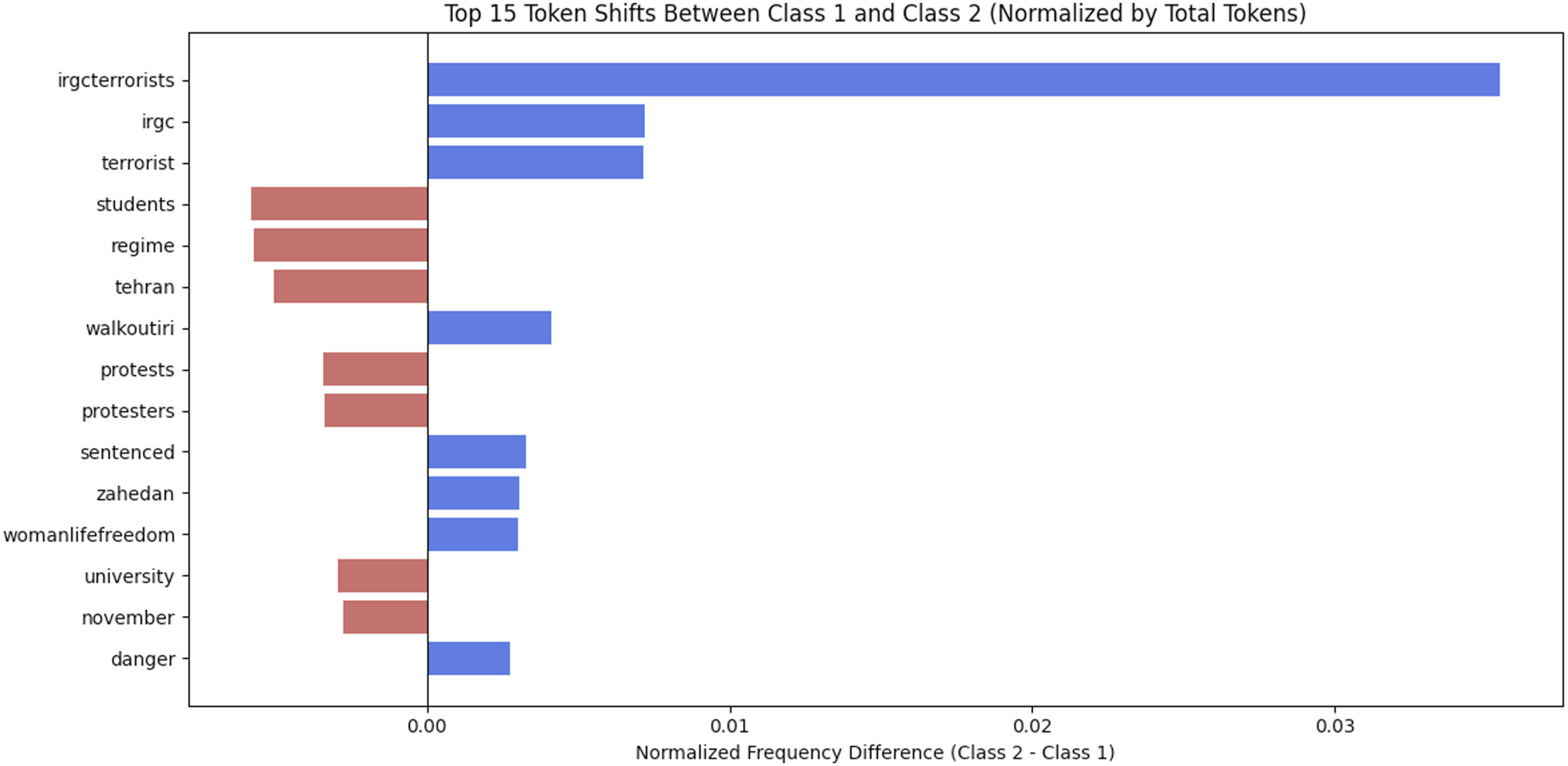
Affective Signatures: Sentiment Analysis of Discourse Streams
Average VADER Sentiment Scores (Positive, Negative, Neutral, Compound) Across Thematic Streams
ANOVA Results for VADER Sentiment Scores
Discussion: Modular Polyvocality in Transnational Digital Activism
This study’s central contribution is the empirical identification of modular polyvocality as a distinct organizational pattern in transnational protest discourse. The English-language #MahsaAmini discourse exhibits high structural modularity (0.61–0.73), clear lexical differentiation (G2 stream-specific vocabularies), and measurable thematic boundaries (MANOVA separation in topword space, t (274) = −3.48, p < 0.001), while maintaining affective coherence and semantic proximity (Jensen–Shannon Divergence: 0.06–0.15), defining features of modular polyvocality: distinct thematic clusters coexisting with rhetorical and emotional cohesion. This structure is neither fragmentation nor homogeneity, but strategic complementarity, where streams perform specialized functions, documentation, mobilization, sanctions advocacy, diaspora engagement, and Broader Opposition Narratives & Lobbying while reinforcing a shared cause through distributed rhetorical labor. Its persistence over 5 months suggests strategic adaptation rather than algorithmic artifact.
Using a hybrid computational–interpretive approach, we identify five stable streams with lexically clear but semantically porous boundaries. This challenges the fragmentation–unity binary in early social media theory (Barberá et al., 2015; Sunstein, 2018) and aligns with differentiated information flows (Jackson et al., 2020), specifying modular polyvocality as the enabling mechanism. The structure reflects connective action logic, mobilization through circulating symbolic content rather than centralized coordination (Bennett & Segerberg, 2012)—and exemplifies networked publics, where platform affordances enable divergent actors to co-produce collective narratives (Meraz & Papacharissi, 2013). The discourse’s orientation toward international institutions further highlights its transnational character: sanctions- and IRGC-focused streams show how diasporic actors reframe domestic grievances for global legitimacy, consistent with digital diaspora activism and transnational advocacy network theories (Keck & Sikkink, 2014; Sohrabi-Haghighat, 2011).
Semantic Coherence in a Transnational Discourse
Despite clear lexical separation across five streams, low Jensen–Shannon Divergence scores (0.06–0.15) and mixed MANOVA results indicate semantic proximity beyond simple fragmentation. Coherent clusters (modularity 0.61–0.73) form around expressive affinities rather than fixed ideologies (Bennett & Segerberg, 2012), producing a “polyvocal consensus” that contrasts with electoral polarization (Barberá et al., 2015) and supports differentiated information flows in digital movements (Jackson et al., 2020). Persistence of networked publics despite declining participation reflects sustained collective meaning-making rather than algorithmic artifact (Boyd, 2010; Olteanu et al., 2019). Transnational in orientation, the discourse enacts a “boomerang effect” through strategic public diplomacy (Keck & Sikkink, 1998), with sanctions and legal advocacy streams exemplifying “serial transnational activism” (Mercea & Bastos, 2016; Michaelsen, 2018). Methodologically, contrasting MANOVA results, thematic differentiation more visible in curated lexical space than raw embeddings—underscore the value of hybrid computational–interpretive approaches (Freelon & Wells, 2020; O’Connor et al., 2010).
Thematic Differentiation and Discourse Diversity
G2 analysis reveals distinct stream vocabularies reflecting differentiated rhetorical strategies: Stream 1 (Documentation; e.g., “killed,” “bloody”) aligns with digital witnessing (Wulf et al., 2022), while Stream 4 (Monarchist Advocacy & Diaspora Political Engagement; e.g., “Reza,” “Pahlavi”) reflects diasporic memory work (Ghorashi & Boersma, 2009)—a “choreographed” diversity (Gerbaudo, 2012) within a single platform. Yet streams share a common semantic field: low JSD scores (0.06–0.15) indicate coherence consistent with “affective publics” (Papacharissi, 2015), and a t-test confirms intra-stream distances are significantly lower than inter-stream distances (M = 0.3430 vs. M = 0.4582, p = 0.0008). This “subjectivity in networks” (Milan, 2015) enables ideologically distinct streams to coexist. Rather than fragmentation, the pattern reflects strategic complementarity, streams fulfilling distinct functions from moral urgency to constituency mobilization, consistent with tactical repertoire diversification (Bennett & Segerberg, 2012; Keck & Sikkink, 1998). Statistical detection (topword MANOVA, p < 0.001) confirms structured organization, while boundary persistence supports “networked framing” (Meraz & Papacharissi, 2013).
These findings, however, likely reflect digitally empowered actors, educated English-speaking diaspora users, NGO professionals, and internationally connected activists rendering working-class Iranians, ethnic minorities (e.g., Kurds and Baluchis), and non-English speakers less visible. Stream 4’s near-neutral tone may reflect diasporic positional privilege relative to on-the-ground actors whose negativity is rooted in lived trauma. Overall, thematic diversity enhances movement effectiveness by broadening rhetorical reach while reducing vulnerability to information control (Michaelsen, 2018; Tufekci, 2017).
Affective Dimensions of Strategic Communication
VADER sentiment analysis reveals that each identified protest stream exhibits a distinct affective profile tightly aligned with its underlying communicative function, confirming that emotion operates as a strategically calibrated resource within transnational digital advocacy. Stream 3 (Campaigning against the IRGC and for International Sanctions) registers as the most intensely negative cluster (M = −0.257), a feature structurally consistent with denunciatory political discourse and the systematic production of moral outrage to capture international institutional attention (Papacharissi & de Fatima Oliveira, 2012). In sharp contrast, Stream 4 (Monarchist Advocacy and Diaspora Political Engagement) exhibits a near-neutral compound score (M = −0.028), reflecting a rhetorical pivot away from immediate trauma and toward institutional, forward-looking alternative governance models (Ghorashi & Boersma, 2009).
This systematic variation provides empirical support for the existence of strategically calibrated “affective publics” (Papacharissi, 2015), where emotional registers are intentionally tailored to match the expectations of different target audiences, such as state policymakers, foreign diplomats, or domestic activists. Crucially, this affective differentiation coexists with a shared baseline of negativity across the broader network, indicating a common grounding in collective grief, indignation, and urgency that functions as the foundational connective tissue for transnational mobilization (Bennett & Segerberg, 2012). These patterns point to the deployment of “strategic affect” rather than unmediated, spontaneous emotional outbursts (Gerbaudo, 2012; Milan, 2015). The temporal stability of these affective signatures across the 5-month sampling window suggests established rhetorical repertoires, demonstrating that emotional diversity can enhance collective action by distributing specialized emotional labor across semi-autonomous modules.
These findings align with prior computational literature investigating affectively structured political discourse on social media. For instance, Gündüz et al. (2024) demonstrate that targeted emotional registers enable structural cohesion within specialized, niche online communities. Similarly, Demirel and Gündüz (2022) establish that highly salient socio-political transformations generate structurally distinct sentiment communities characterized by polarized or highly differentiated emotional baselines (e.g., structural backlash vs. institutional affirmation). Within the #MahsaAmini English-language layer, Stream 3’s denunciatory outrage and Stream 4’s measured affective restraint operate not as polarizing cross-currents but as highly complementary rhetorical registers nesting within a unified civil society framework.
The concentration of neutral sentiment for Stream 4 (Monarchist Advocacy and Diaspora Political Engagement), which exhibits a near-neutral compound score ($M = −0.028$), this signature represents more than an absence of emotion; it indexes three analytically distinct conditions: strategic institutionalism, positional ambivalence, and reform fatigue.
First, neutrality functions as an active rhetorical tool for strategic de-escalation and institutional legitimacy. Transnational networks targeting institutional gatekeepers, such as foreign ministries and international NGOs, must deliberately suppress high-arousal emotional registers to match the technocratic, formal, and legalistic expectations of international diplomacy. For Stream 4, maintaining a neutral affective signature serves to foster passive trust among international observers, projecting legal stability and governance preparedness. Second, neutral sentiment reflects a structural positional and diasporic ambivalence. As the monarchist stream balances factional ideology against the broader #MahsaAmini umbrella, its communicative output relies on descriptive, factual assertions that create a “neutrality of friction.” Third, the prevalence of neutral sentiment serves as a linguistic proxy for reform fatigue and emotional exhaustion. This neutral baseline represents a strategic pivot toward long-term organizational endurance, marking an adaptation where emotional expressions are rationalized into structural documentation and policy reporting.
Within the overarching modular polyvocality framework, these diverse expressions of neutrality are not analytical contradictions but vital functional complements. While Streams 1 and 3 supply the network’s core moral urgency and disruptive outrage, Stream 4’s affective restraint broadens the protests overall rhetorical and strategic range. This distributed affective labor enables the network to simultaneously energize emotionally mobilized activists on the ground while addressing formal, institutional audiences abroad—a structural synergy that reinforces collective persistence across informationally constrained environments without requiring uniform emotional expression.
English as Platform Strategy
English functioned as a strategic communicative layer with its own rhetorical logic. The discourse enacts a “boomerang effect” through international political vocabulary generating external pressure and strategic public diplomacy (Keck & Sikkink, 1998), aligning with “serial transnational activism” that reframes local struggles for global policymakers (Mercea & Bastos, 2016; Michaelsen, 2018). English also enabled platform optimization by leveraging “networked gatekeeping” for algorithmic visibility and global reach (Meraz & Papacharissi, 2013; Shoemaker & Vos, 2009), while serving as a coordination tool for diaspora groups and NGOs (Zajak, 2014). Language choice thus operates as strategic resource allocation enhancing movement effectiveness through differentiated communicative targeting.
Temporal Evolution and Strategic Adaptation
A chi-square test between Period 1 (Oct–Dec 2022) and Period 2 (Jan–Feb 2023) confirms a significant discursive shift (p < 0.001): from local mobilization and victim testimony toward international advocacy and sanctions framing, with legal and geopolitical terms increasing as mourning vocabulary declined. This reflects strategic adaptation to intensified state repression, shifting discourse from testimonial narration to external pressure strategies. Hierarchical clustering reveals two meta-streams corresponding to these temporal phases, indicating that time actively structures discourse formation. Thematic boundaries function as evolving repertoires shaped by political urgency and audience targeting, consistent with connective action theory’s account of digital publics recalibrating narratives under shifting constraints (Bennett & Segerberg, 2012).
Networked Gatekeeping and Transnational Framing
Visibility in the #MahsaAmini discourse was shaped by networked rather than centralized gatekeeping, operating through engagement patterns, hashtags, and algorithmic amplification (Meraz & Papacharissi, 2013; Shoemaker & Vos, 2009). Each stream functioned as a semi-independent gatekeeping node: monarchist content leveraged influencers and nationalist hashtags; documentation streams circulated witness imagery; sanction-related streams targeted policymakers and journalists. Despite lexical overlap, framing logics diverged from mourning to diplomatic urgency, reflecting a decentralized editorial process in which distributed actors collectively structure global visibility through multiple semi-autonomous framing nodes.
Limitations and Future Research
Several limitations warrant acknowledgment. First, the English-language focus excludes Persian-language discourse, biasing findings toward globally engaged actors and likely underrepresenting local resistance; without granular user data, diaspora and domestic participation cannot be distinguished. Future work should extend to cross-linguistic and cross-platform comparisons (e.g., Instagram and Telegram). Second, qualitative coding analyzed 75 tweets per community, risking underrepresentation of rare themes (<10%), within-community heterogeneity, and elite voice overrepresentation. These concerns are mitigated by triangulation across G2 analysis, Jensen–Shannon Divergence, MANOVA, and sentiment analysis, whose convergence with qualitative results suggests robust patterns; future work could apply large-scale topic modeling to capture sub-stream structures. Third, stream labeling retains interpretive subjectivity despite longitudinal definitional consistency. Fourth, bot detection remains heuristic rather than ensemble-based (e.g., Botometer), warranting more advanced frameworks. Fifth, network analysis captures retweet and co-hashtag alignment but not dialogic interaction (replies, mentions), and temporal dynamics could benefit from automated frame detection. Finally, future research should link discourse structures to offline outcomes, protest activity, and policy impact through multi-lingual, multi-modal, and multi-scalar designs.
While our analysis identifies modular thematic coherence, we acknowledge that this may be influenced by structural factors beyond organic user intent. Future research should disentangle the role of algorithmic amplification where platform recommendation systems push ideologically consistent content and coordinated campaigning where organized actors may be artificially inflating the perceived unity of these streams. Furthermore, our findings are constrained by an English-language sampling bias, which may overlook critical vernacular nuances present in non-English protest discourse.
Conclusion
By introducing and empirically validating modular polyvocality, this study demonstrates that transnational protest movements can maintain multiple thematic streams while preserving a shared affective and rhetorical core. Our integration of Louvain community detection, G2 keyword profiling, semantic divergence measures, and intercoder-verified qualitative coding offers a methodological template for analyzing hybrid cohesion in large-scale online discourse. Applied to the English-language #MahsaAmini mobilization, this framework reveals how activists strategically recalibrated their discourse from local testimony to international advocacy by maintaining the convergence of the movement.
The Modular Polyvocality Framework: A Synthesis
The concept of modular polyvocality offers a middle-range theory for understanding how contemporary movements sustain convergence and cohesion across diversity. It synthesizes insights from three literatures: (1) network science, which provides structural foundation (modularity as community clustering), (2) discourse analysis, which contributes rhetorical dimension (polyvocality as voice multiplicity), and (3) social movement studies, which supplies functional logic (strategic complementarity as distributed labor). Where existing frameworks emphasize either coordination mechanisms (connective action) or affective dynamics (affective publics), modular polyvocality specifies the structural outcome: discourse architecture characterized by thematic specialization within affective alignment. This pattern appears particularly adaptive for transnational movements operating under three conditions: (a) normative framing permitting tactical flexibility, (b) multiple target audiences requiring differentiated messaging, and (c) information environments where redundancy and diversification enhance resilience. Future research should test whether modular polyvocality generalizes beyond the Iranian case to other movements with similar socio-political roots, from Hong Kong’s pro-democracy protests to climate activism’s international coordination.
Key Empirical Contributions
We found the discourse exhibited modular polyvocality: thematic differentiation within broader rhetorical coherence. The identification of five persistent and complementary streams with distinct lexical and affective signatures indicates systematic organization: 1. Documentation of events involving violence. 2. On-the-Ground Mobilization. 3. Anti-IRGC Advocacy and Sanctions Campaigns. 4. Monarchist Advocacy & Diaspora Political Engagement. 5. Broader Opposition Narratives & International Lobbying. Our temporal analysis revealed strategic adaptation from on-the-ground event terms to international advocacy language, showing how social mobilizations recalibrate in response to changing political conditions.
Theoretical Implications
These findings contribute to three scholarly conversations. They support connective action theories by showing how mobilizations maintain coherence without centralized coordination, enabling coalition politics based on strategic complementarity (Bennett & Segerberg, 2012). They extend networked publics concepts by demonstrating how strategic communication choices interact with platform affordances to create sustained thematic organization (Boyd, 2010; Papacharissi, 2015). Finally, they advance transnational activism literature by revealing how English serves strategic functions beyond simple translation, helping mobilizations develop specialized competencies for global engagement.
Methodological Insights
Our multi-method approach demonstrates computational discourse analysis potential and constraints. The contrasting MANOVA results (no separation in full embedding space vs. significant separation in top-word space) highlight the conditional nature of thematic detectability, underscoring the value of our integrated framework, which maintains analytical rigor while balancing computational scale with qualitative depth.
Final Reflections
We propose the modular polyvocality framework has utility beyond the #MahsaAmini case. Protest operating in restrictive political contexts, multilingual publics, and transnational advocacy demands may rely on similar patterns of thematic differentiation within affective coherence. Recognizing and measuring this structure can help scholars and practitioners understand how cohesion is sustained without homogeneity and how digital publics adapt rhetorical repertoires over time. By foregrounding this framework, we invite further comparative and cross-linguistic applications that can refine our understanding of cohesion, diversity, and strategic adaptation in the evolving grammar of political resistance.
Supplemental Material
Supplemental material - Modular Polyvocality: Community Detection and Semantic Analysis of Civil Society Discourse in English-Language #MahsaAmini Twitter Networks
Supplemental material for Modular Polyvocality: Community Detection and Semantic Analysis of Civil Society Discourse in English-Language #MahsaAmini Twitter Networks by Hossein Masoudnia, Alireza Samiee Esfahani, Mohsen Forghani, Mohamamd Moghimi, and Hossein Samiei Esfahany in Social Science Computer Review
Footnotes
Ethical Considerations
This study analyzes publicly available Twitter data on #MahsaAmini (October 2022–February 2023). We recognize the heightened ethical risks in politically sensitive contexts under extreme surveillance, where user identification could expose individuals to harm (Kermani, 2025; Wulf et al., 2022). Accordingly, the ethical framework prioritizes user protection. First, only publicly available tweets accessed via Twitter’s public API were used; no private or direct-message data was collected. Second, all results are reported at aggregate levels, with no individual tweets, usernames, or behavioral traces disclosed in any form that could enable identification. Third, all user identifiers and metadata were removed prior to analysis, and communities are reported using analytical labels only. Network visualizations exclude readable node identifiers. The dataset used (Banachewicz, 2023; CC0 license, Kaggle) was accessed in compliance with platform policies at the time of collection. All Supplemental Material used for validation was fully anonymized. Following established guidelines for computational social media research (Franzke et al., 2020; Townsend & Wallace, 2017), the study did not require formal IRB approval due to its aggregate-only design and anonymization procedures. Nevertheless, we acknowledge ongoing ethical responsibilities in sensitive political contexts and applied precautionary safeguards accordingly. This study analyzed publicly available Twitter data related to the #MahsaAmini protests (October 2022–February 2023). No private or direct-message content was accessed, and no attempts were made to contact individual users. Usernames and identifying details were removed or anonymized in all datasets, tables, and visualizations. Data collection complied with Twitter’s Developer Policy and relevant terms of service at the time of access. In line with established ethical guidelines for research using public social media data (Franzke et al., 2020; Townsend & Wallace, 2017), this study did not require institutional review board (IRB) approval.
Consent to Participate
Not applicable, as no human participants as research subjects in this article.
Funding
The authors received no financial support for the research, authorship, and/or publication of this article.
Declaration of Conflicting Interests
The authors declared no potential conflicts of interest with respect to the research, authorship, and/or publication of this article.
Data Availability Statement
The raw Twitter data analyzed in this study was obtained from the IranProtest Tweets dataset by Konrad Banachewicz, available on Kaggle under a CC0: Public Domain license (https://www.kaggle.com/datasets/konradb/iranprotest-tweets). The original dataset contains tweets from September 23, 2022, to June 11, 2023, and is publicly accessible for research purposes. Supplementary materials are available on Figshare ( ), with an additional anonymized CSV of sample tweets for labeling validation provided via the journal’s submission system. Supplementary materials are available on Figshare with an additional anonymized CSV of sample tweets for labeling validation provided via the journal’s submission system. The computational code used for data processing and analysis is available upon reasonable request from the corresponding author. All analytical procedures are fully documented in the methodology section to ensure reproducibility.
Supplemental Material
Supplemental material for this article is available online.
Author Biographies
Appendix
Thematic Coding Framework for Community-Level Discourse Analysis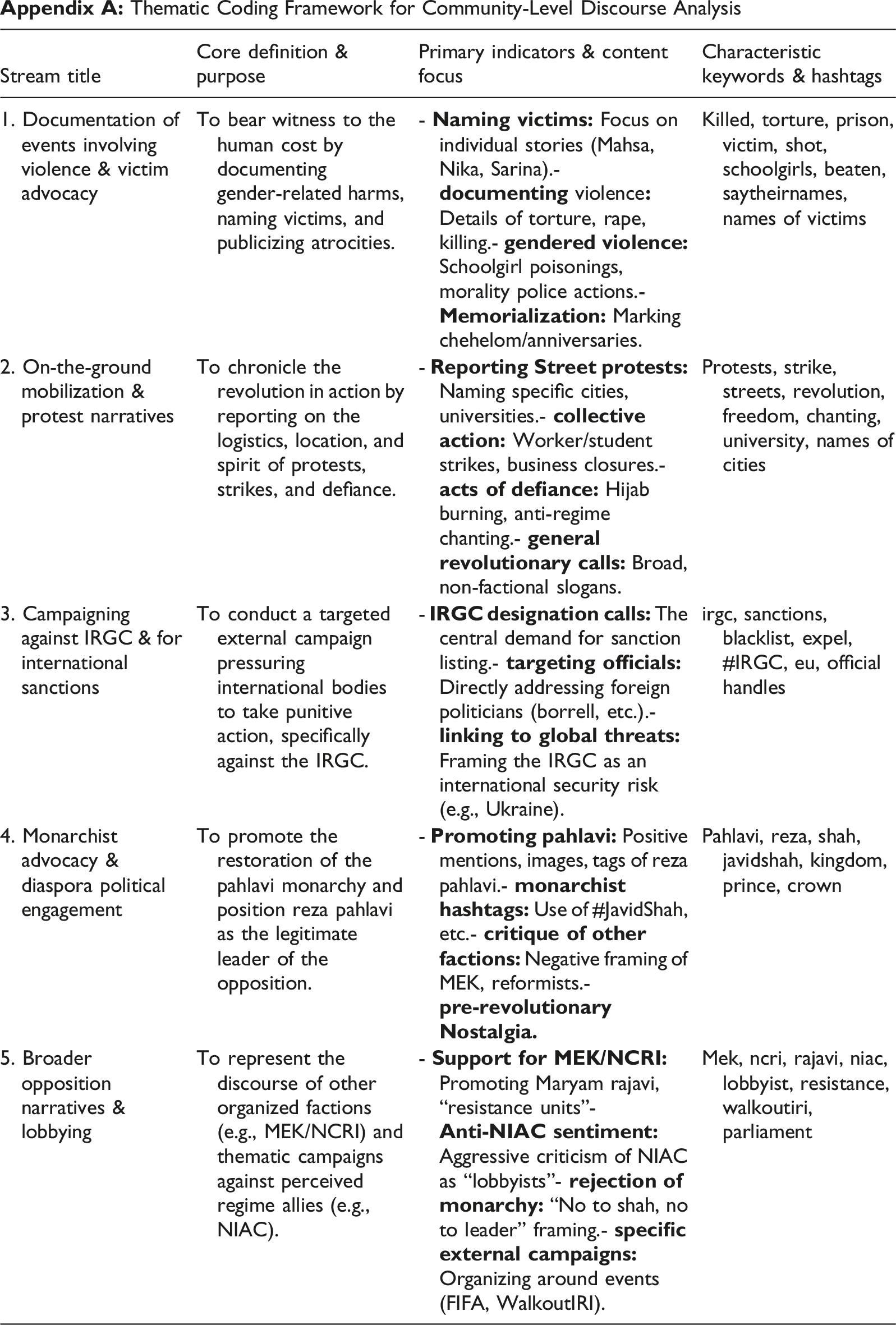
Stream title
Core definition & purpose
Primary indicators & content focus
Characteristic keywords & hashtags
1. Documentation of events involving violence & victim advocacy
To bear witness to the human cost by documenting gender-related harms, naming victims, and publicizing atrocities.
-
Killed, torture, prison, victim, shot, schoolgirls, beaten, saytheirnames, names of victims
2. On-the-ground mobilization & protest narratives
To chronicle the revolution in action by reporting on the logistics, location, and spirit of protests, strikes, and defiance.
-
Protests, strike, streets, revolution, freedom, chanting, university, names of cities
3. Campaigning against IRGC & for international sanctions
To conduct a targeted external campaign pressuring international bodies to take punitive action, specifically against the IRGC.
-
irgc, sanctions, blacklist, expel, #IRGC, eu, official handles
4. Monarchist advocacy & diaspora political engagement
To promote the restoration of the pahlavi monarchy and position reza pahlavi as the legitimate leader of the opposition.
-
Pahlavi, reza, shah, javidshah, kingdom, prince, crown
5. Broader opposition narratives & lobbying
To represent the discourse of other organized factions (e.g., MEK/NCRI) and thematic campaigns against perceived regime allies (e.g., NIAC).
-
Mek, ncri, rajavi, niac, lobbyist, resistance, walkoutiri, parliament
References
Supplementary Material
Please find the following supplemental material available below.
For Open Access articles published under a Creative Commons License, all supplemental material carries the same license as the article it is associated with.
For non-Open Access articles published, all supplemental material carries a non-exclusive license, and permission requests for re-use of supplemental material or any part of supplemental material shall be sent directly to the copyright owner as specified in the copyright notice associated with the article.
