






Abstract
This article examines how citizens’ perceptions of public employees in the education system change as these employees adopt artificial intelligence (AI) in their work. It argues that the use of AI matters for citizens’ perceptions of decision-making not only due to AI system characteristics, but also because AI adoption alters the perceived relationship between citizens and public organizations. Rooted in assumptions of social cognition theory, the analysis tests how information about AI use by public employees alters the perceived warmth of these employees and thereby affects the acceptability of decision-making. The analysis is based on a pre-registered vignette experiment and a sample of 4,569 participants from Norway. It finds that AI use decreases both the perceived warmth and competence of public employees, that these evaluations negatively bear on the overall acceptability of decision-making, and that the effect of AI use is stronger for public employees more directly interacting with others.
Introduction
Governments worldwide are adopting applications of artificial intelligence (AI) for many different tasks, such as internal document processing, detecting welfare fraud, or optimally allocating state resources (Sousa et al., 2019; Van Noordt & Misuraca, 2022; Wirtz et al., 2019). Overall, there is a lot of enthusiasm among governments about the technology, and the recent wave of AI implementation appears to lead to a broader transformation in government with major consequences for internal structures, processes, and the work of public employees (Dunleavy & Margetts, 2023; Mergel et al., 2023). Consequently, not only do citizens increasingly come into contact with government AI systems, such as chatbots (Chen et al., 2024; Hemesath & Tepe, 2024), but they are also likely to become aware of an increasingly algorithmic government in which AI systems support public employees in their work. Such growing AI use thus alters the face of government, with possible downstream consequences for the citizen-state relationship. This can ultimately affect the legitimacy of government institutions (Harrison & Luna-Reyes, 2022; Schiff et al., 2023, p. 3). Against the backdrop of this development, the present article focuses on a social-relational aspect of AI use in government. It addresses the question of how AI adoption bears on people’s perceptions of government organizations and their employees, thereby altering the citizen-state relationship.
Previous research has shown that citizens’ acceptance of AI in government depends on the stage and kind of decision-making (Arnesen et al., 2025; Haesevoets et al., 2024; König, 2023; Starke & Lünich, 2020) and that citizens value various features of AI applications, such as performance, costs, transparency, and the presence of a human in the loop (Decuypere & Van de Vijver, 2025; Haesevoets et al., 2024; Hemesath & Tepe, 2024; Hillo et al., 2025; Horvath et al., 2023; Ioku et al., 2024; Johnson, 2025; König et al., 2024; Liu & Han, 2026; Schiff et al., 2022; Waldman & Martin, 2022). Related work has also compared citizens’ perceptions of AI-led and human-led or bureaucrat-led decisions in public services, showing that citizens distinguish between algorithmic and human decision-makers in terms of trustworthiness, representation, and service preferences (Gaoozhao et al., 2024; Ingrams et al., 2021). However, this research has focused on how people perceive concrete AI applications, decision arrangements, or AI-versus human decision-makers. We add to this research by shifting the perspective and studying how citizens perceive the actors using the AI systems, and how these perceptions change with their use of AI. Indeed, previous research also suggests that citizens rely on contextual factors which operate as cues and heuristics when they evaluate AI uses in government rather than on technical evaluative criteria (Hemesath & Tepe, 2025; Schiff et al., 2023; Wenzelburger et al., 2024).
We build on this research testing the argument that the use of AI in public organizations has consequences for how citizens perceive public employees. We draw on theoretical foundations that focus on social-relational perceptions, leveraging assumptions from social psychology research about people using cues to infer characteristics of others. Based on the stereotype content model (Fiske, 2018) and attribution theory (Malle, 2022), we argue that AI use is a cue that alters citizens’ perceptions of public employees in terms of their warmth and competence. Warmth refers to perceptions of good intentions and friendliness, whereas competence refers to perceptions of people’s abilities and skills (Fiske, 2018, p. 68).
Social cognition research has shown that people perceive all kinds of agents along these two universal dimensions (Fiske et al., 2007). Warmth is presumed to have primary importance among the two as it has an affective component and is about evaluating sources of harm or threat (Fiske et al., 2007, pp. 77–78). We argue and expect that public employees using AI systems is a social cue that makes these employees less relatable for citizens, which expresses itself in a lower perceived warmth. In the analysis below, we thus test whether public employees using AI in their work influences their warmth in the eyes of citizens and how these perceptions, in turn, influence the overall perceived acceptability of decision-making. We also investigate whether these effects are stronger in a setting in which a public employee is in more direct contact with other people.
With this perspective, the analysis below offers a novel application of social cognition theory to AI in public organizations. In doing so, our analysis speaks to human-AI interaction research, which has shown that people perceive AI systems as a social presence (Hong, 2024; Longoni et al., 2023) and along the dimensions of warmth and competence (McKee et al., 2023, 2024). However, unlike this research, we are interested not in how people perceive the AI systems themselves, but how citizens’ perceptions of other people change when these use AI.
The analysis is based on a pre-registered vignette experiment fielded among more than 4,500 panel participants selected through a probability sample from the Norwegian population. The vignettes differ between two settings of decision-making by public employees in the education sector that involve at least a moderate amount of discretion (Young et al., 2019, p. 304), teachers assessing students versus civil servants allocating funds among public schools. Our study thus focuses on a specific part of the work of these public employees in which they take decisions that affect people directly or indirectly and where AI use is possible. Within both settings, the main contrast of the presented vignettes is between the public employee using versus not using AI to support their work. AI use refers to AI assisting decision-making while the human remains in control, that is, augmentation through AI, not automated decision-making. The analysis yields strong evidence that AI use decreases both the perceived warmth and competence of public employees, that these evaluations negatively bear on the acceptability of decision-making in the examined scenarios, and that this effect is stronger in settings in which public employees have more direct contact with other people.
The findings have important implications for both theory and practice. They extend the theoretical bases for understanding how increasing AI use influences citizens’ perceptions of the state and matters for the affective underpinnings of government legitimacy. The support for and legitimacy of the political systems is not merely cognitive in nature but also has a social and affective component that is rooted in how close people feel to their polity (Almond & Verba, 1963; Easton, 1975). Based on the results we report below, the rapid roll-out of AI systems may well reduce people’s felt closeness to public organizations. The study thus also has practical relevance for policymakers and public managers trying to maintain the legitimacy of public organizations while modernizing them with digital technologies—an increasingly central task in digital-era public administration (Ritz & Weißmüller, 2025). The article is structured as follows. Section two presents the theoretical argument and the hypotheses. The third section describes the research design, followed by the empirical findings in section four. Section five provides a discussion of the findings and points to limitations of the study and future research before section six concludes with a summary of the findings and their implications.
Theory and Hypotheses
Theoretical Assumptions
Information technologies can be an important source of change in government and its relation to citizens (Gascó, 2003; Lindgren et al., 2019). AI is a technology that stands out in its potential to change how citizens experience their relationship to the state. It differs from other information technologies in the extent to which it can have agent-like qualities (Parker & Grote, 2022). Research on human-AI interactions has shown that people perceive AI systems to have a social presence (Jin & Youn, 2023; Van Doorn et al., 2017) and are perceived along the lines of ingroup and outgroup categorizations (Longoni et al., 2023). AI may therefore intervene into social relations in ways that other technologies do not.
We start from the assumption that AI not only has consequences for how people perceive AI systems themselves, but also for how they perceive their users and their relationship to these users. The use of AI, we presume, can be a social cue from which citizens make inferences about public employees. We develop this argument drawing on the assumptions from two major social-psychological theories about people’s perceptions of other actors, the stereotype content model and attribution theory. The stereotype content model assumes that people form general social judgments about others based on cues arising from their characteristics and behaviors, specifically their status and their cooperative stance (Fiske, 2018). Attribution theory, in turn, posits that when interpreting behaviors, people show an attribution bias in terms of favoring dispositional explanations rather than situational ones (Malle, 2022). Certain choices and behaviors can thus serve as a cue that people use to infer certain qualities of an actor.
Regarding the inferred qualities and dispositions of actors, different characteristics could be examined. Based on the assumptions above, the mere use of AI may alter social relations between people and how they perceive them on a fundamental level. When choosing concepts for characterizing actors, we thus refrain from studying concrete characteristics such as perceived personality traits (Herringer & Haws, 1991), role perceptions—like being entrepreneurial or managerial (Van Der Meer et al., 2024)—and stereotypes—like being helpful, dedicated, or professional (Willems, 2020)—that public administration research has investigated. Rather we draw on a specific strand of social cognition which describes interpersonal relations and social perceptions in terms of warmth and competence. These are two fundamental and universal standards of social evaluation (for an overview, see Fiske et al., 2007). 1 Not only are they basic characteristics for describing social relations, but they also figure as “fundamental meta-dimensions” (Kanwal & Van Hoye, 2024, p. 69) that capture important aspects of the reputation of organizations and their workforce (Casciaro & Lobo, 2008; Pepermans & Peiffer, 2024). 2
The main reason for choosing these concepts is thus theoretical. Social cognition theory, in which these concepts are rooted, explicitly focuses on social perceptions and is concerned with how people try to make sense of other actors (Fiske, 1993; Frith & Frith, 2012; Higgins & Bargh, 1987). Furthermore, social cognition commonly occurs automatically, without people being aware of it (Frith & Frith, 2012, p. 289), and with warmth furthermore having an affective dimension (Fiske et al., 2007). Social cognition research highlights general social evaluative standards that are clearly distinct from evaluations of functional and instrumental criteria and more conscious and deliberate evaluations. Warmth and competence thus ideally fit with our assumption of AI use as a social cue.
The relevance of warmth and competence as the key concepts for describing social perceptions is further underscored by its growing use in research on public organizations. Public administration research has increasingly relied on the concepts of warmth and competence in recent years, showing that characteristics of bureaucrats shape how people perceive them and that warmth and competence cues influence the legitimacy of and compliance with decisions (De Boer, 2020; Hansen, 2022; Mazepus & Rimkutė, 2026; Neo et al., 2024). However, this perspective focusing on warmth and competence perceptions has not been studied with respect to public employees using AI as a social cue. Research on human-AI interactions, in turn, has extensively drawn on the concepts of warmth and competence (e.g., Bai et al., 2024; Gilad et al., 2021; Harris-Watson et al., 2023; McKee et al., 2023), but to study perceptions of AI systems not of those who use them and how AI as a cue can alter social perceptions. Our study below advances the literature by integrating these different strands of research.
Given that social cognition research has identified warmth as the primary dimension for evaluating how people relate to each other, warmth perceptions are of particular interest in our study. If public employees’ AI use has consequences for their perceived warmth as an evaluation that is rooted in affect and is about friend-or-foe distinctions (Fiske et al., 2007), this arguably amounts to an important impact on the citizen-state relationship. Although competence perceptions may not be as fundamentally important as warmth, we include it as a second important dimension of social evaluations. We follow social cognition research in conceptualizing warmth as a horizontal dimension of social relations, capturing to what extent others are seen as friend or foe (Fiske, 2018, p. 68). It is commonly measured as good intentions, friendliness, likability, trustworthiness, and honesty and serves to distinguish others based on liking. Competence, in turn, describes a vertical dimension of social relations and serves to distinguish others based on respect. It is usually measured with perceptions of being competent, intelligent, skilled, or efficient (Fiske, 2018, p. 68), and thus refers to rather general abilities or skills rather than highly task-specific expertise and professional judgment. Such warmth and competence perceptions vary with group relations and with stereotypes tied to social and occupational roles. For instance, while children are perceived as high in warmth and low in competence, the opposite is true for people in technical professions (Fiske, 2018).
Hypotheses
Based on the theoretical assumptions described in the previous section, we expect that the use of AI operates as a cue of social qualities. Specifically, we expect that people’s inferences of public employees’ warmth and competence are based on these employees’ use of AI in their work. We note that if AI is to operate as a cue, this requires that citizens know or become aware about the use of AI among public employees. Often citizens may not be aware of AI uses in public organizations. However, given the rapid proliferation of the technology, heavily increased media reporting on AI adoption in society (Korneeva et al., 2023), and evidence about knowledge of widespread AI use in society (Poushter et al., 2025), it is likely that many citizens know or learn about AI use in public organizations. Still, the theoretical expectations about AI use among public employees we develop in the following necessarily presume that people are or become aware of this use.
Based on the stereotype content model, we would expect that the use of AI by public employees decreases the perceived warmth of these employees among citizens. As AI use is likely to make public employees appear more like technical experts and problem-solvers, and as findings based on the stereotype content model have shown, technical experts are perceived as lower in warmth (Fiske, 2018, p. 68). Warmth evaluations are also a response to perceiving people as cooperative or harmless as opposed to competitive or exploitative toward the ingroup (Lee & Fiske, 2006). The use of AI may thus evoke evaluations of lower warmth based on AI users being perceived more different from an ingroup categorization. Existing evidence from human-computer interaction research in line with this argument suggests that where machines and humans merge to perform tasks, humans are perceived less as humans and more similar to machines (Li et al., 2023; see also Siedl & Mara, 2024). Hence, AI use may operate as a cue that makes public employees less relatable to citizens, leading to lower warmth perceptions.
A decrease in perceived warmth is equally to be expected based on the premises of attribution theory. According to this theory, the fact that humans use AI may be taken as a sign that they are not committed to working in the best interest of those for whom they are supposed to provide a service (Reif et al., 2025). This would mean that AI use is a cue for perceptions that a person is not as likable and friendly as the person would be without using AI and is thus perceived as being lower in warmth. In sum, we expect that governmental AI adoption to assist decision-making reduces the perceived warmth of public employees who use these systems.
If a public employee uses AI in decisions that affect citizens (versus no use of AI), citizens rate them lower in warmth.
There is thus a rather clear expectation that AI use affects warmth negatively. In contrast, the way in which AI use bears on competence perceptions is less straightforward. Based on previous work, two alternative arguments can be made. On the one hand, in line with the stereotype content model, AI use is likely to make public employees appear more like technical experts and problem-solvers. These are perceived not only as comparatively low in warmth, but also as high in competence (Fiske, 2018, p. 68). It requires special skills and AI literacy to use AI systems for work tasks (Ng et al., 2021), and available evidence indicates that people largely find AI use to lead to improved task performance (Figueroa-Armijos et al., 2023). Public employees using an AI system may thus improve how citizens rate their competence, even while their perceived warmth decreases. On the other hand, it is also conceivable that AI use by public employees makes them appear less competent in the eyes of citizens. According to attribution theory, AI use may be a cue from which people infer dispositions that give rise to AI use, specifically in the form of a presumed lack of competence (Reif et al., 2025). 3 We will thus test the following two competing hypotheses regarding the effect of AI use on the perceived competence of public employees, specifically in the education system.
If a public employee uses AI in decisions that affect citizens (versus no use of AI), citizens rate them higher in competence.
If a public employee uses AI in decisions that affect citizens (versus no use of AI), citizens rate them lower in competence.
Perceived warmth and competence of public employees are the central dependent variables in our study. Yet, we expect that they, in turn, also influence the acceptance of decision-making. Warmth and competence are generally desirable properties, and we thus expect positive relationships with decision-making acceptance. This expectation is also in line with findings that higher perceived warmth and competence lead to greater perceived legitimacy of (Hawks et al., 2024; Pei, 2025) and trust in (Hansen, 2022) actors.
The general effect of AI use on decision-making acceptance, however, is likely to be negative. People may well have an overall favorable view of AI and rate AI positively in various domains, such as with consumer applications (Ada Lovelace Institute & The Alan Turing Institute, 2023; Scantamburlo et al., 2024; Selwyn & Gallo Cordoba, 2022). Citizens also support the use of AI for enhancing administrative processes (Gesk & Leyer, 2022) and may be swayed to accept AI systems in certain areas of public administration decision-making under the condition that these systems, for example, show a high performance and level of transparency (e.g., Hemesath & Tepe, 2024; Horvath et al., 2023; König et al., 2024), and at least as long as AI only takes a supporting role (Haesevoets et al., 2024). Yet, citizens generally do not like AI use in domains which involve social intelligence (Glikson & Woolley, 2020, p. 632), and previous research indicates that citizens are moderately to very skeptical toward the use of AI in government where decisions about social affairs involving a certain degree of discretion and entail dealing with value questions (Haesevoets et al., 2024; König, 2023; Starke & Lünich, 2020). Presuming a generally negative impact of AI use on the acceptance of decision-making, we expect that warmth and competence perceptions at least partly mediate this impact of AI use. We will therefore test the following hypotheses.
If a public employee uses AI in decisions that affect citizens (versus no use of AI), citizens perceive decision-making by that employee as less acceptable.
The higher citizens rate the warmth and the competence of a public employee the more acceptable they find decision-making by the employee.
The effect of AI use on the acceptance of the decision-making is mediated through warmth perceptions.
The effect of AI use on the acceptance of the decision-making is mediated through competence perceptions.
The extent to which AI use matters for perceptions of the public employees is likely to depend on the concrete constellation of decision-making. This follows directly from the insight that people find AI less acceptable for tasks that involve social intelligence as compared to technical tasks (Glikson & Woolley, 2020). Relatedly, it makes a difference for individuals whether decisions concern and affect them directly or indirectly (Gesk & Leyer, 2022). If decisions are made about people and affect them directly, they are more vulnerable in this situation and more directly exposed to power asymmetries, making them perceive a “human touch” as more appropriate. Using an AI system in decision-making that very directly affects people may thus be particularly grave for the perceived warmth of a public employee, as expressed in hypothesis H6. The expected associations are shown in Figure 1. The next section describes how the main predictor (AI use) and the moderator (setting) in Figure 1 are operationalized through a vignette experiment. Theoretical model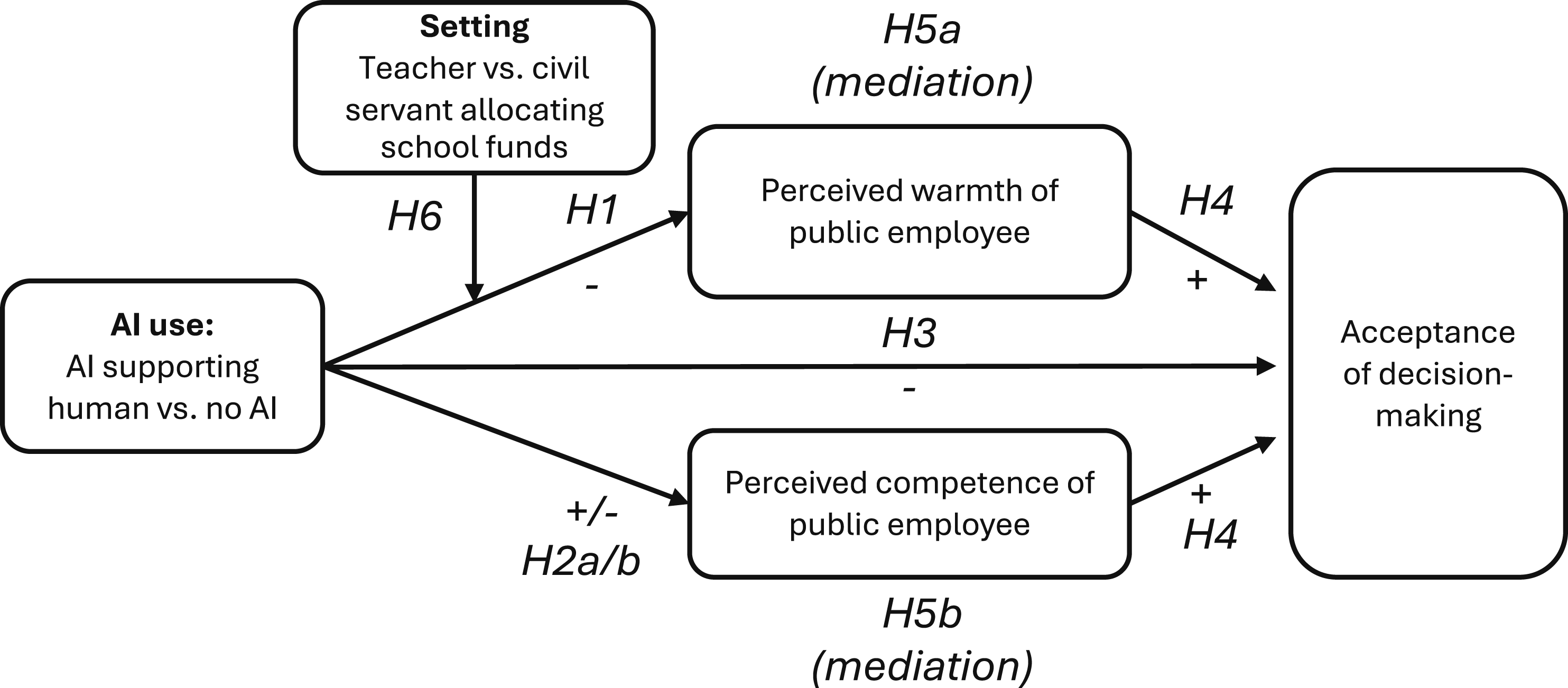
The effect of AI use on the perceived warmth of a public employee is stronger in a setting in which decisions are made directly about citizens as opposed to decisions that affect them indirectly.
Research Design
Vignette Experiment
The study uses a survey-embedded full factorial vignette experiment with texts that describe public employees making decisions in the education system. Such experiments combine the controlled manipulation of experimental designs with the realism of context-rich scenarios, allowing researchers to draw causal inferences while approximating real-world decision-making (Auspurg & Hinz, 2015). By simultaneously varying multiple attributes within each vignette, this approach enables efficient testing of several factors. Presenting hypothetical situations rather than direct questions helps reduce social desirability bias. The orthogonal design of vignettes minimizes collinearity, ensuring precise estimation of effects with greater statistical efficiency than many observational approaches.
Education is a policy domain in which AI use can have substantial impacts on society. A further reason why we choose the education system is that it is a setting in which different AI uses are realistic and where these uses can entail differences in the degree to which public employees are in direct contact with other people in their daily work. Our experiment assumes a scenario in which public employees are the users of the AI systems. At the same time, it is citizens who are ultimately affected by these uses while not being direct users. The vignette texts contain a contrast in this regard through showing one of two possible settings to respondents. This contrast serves to test H6 about the conditioning role of the closeness of the relationship between citizens and public employees. The first setting is that of a teacher assessing and grading pupils. The second scenario is a civil servant allocating resources among schools. This second setting is similar to a setting used in previous studies (Haesevoets et al., 2024; Miller & Keiser, 2021).
These scenarios thus present two public employees acting as decision-makers in different settings and roles. We include the teacher setting and contrast it with the civil servant allocating funds to have an alternative which also falls into the domain of education but involves, as part of their role, closer contact between public employees and other people and making decisions about individuals. Hence, while our respondents do not themselves generally interact with these public employees, we can presume that they are generally aware of the fact that it is part of a teacher’s role that they interact with others (students)—including because they were once students themselves. The civil servant setting thus reflects a traditional public administration role, whereas the teacher setting involves a public employee that operates in a more relational and socially embedded context, characterized by frequent and direct interaction with citizens.
For each of the two settings we vary the scenarios regarding the main contrast of whether the public employees use AI in their work or not. The vignette texts describe the AI uses as supporting the decision-making, with the human remaining in control. For the teacher, the AI condition entails using an AI system to support the work of assessing and grading pupils. For the civil servant allocating school funds, the AI condition entails an AI system to support the task of allocating resources across public schools in the school district. This focus on AI-supported rather than fully automated decision-making is consistent with a growing literature on human-AI interaction in public sector decision-making, which examines how public officials interpret, rely on, or selectively adhere to algorithmic advice (Alon-Barkat & Busuioc, 2023; Janssen et al., 2022). Yet, whereas this literature examines how public employees use algorithmic support, our study examines how citizens evaluate public employees once they learn that such support is being used.
The vignette texts furthermore vary in three other features that are intended to make the description more realistic and palpable for respondents. These are the stated goal of the decision-making, varying between optimizing overall learning outcomes and realizing equity, as well as the gender (female or male) and age (20, 40, and 60 years old) of the public employee. It should be noted that we do not vary characteristics of the context in which public employees use AI. The conclusions that the experiment enables us to draw are thus about changes in evaluations resulting from respondents being presented information about the mere use of AI as opposed to no information about AI use. We will thus be able to interpret the results as follows: What if people were to learn about the use of AI, without any further specification about the conditions under which it is being used.
Figure 2 presents an overview of the features in the vignette texts. Our main feature of interest, AI use, is highlighted in bold. The complete vignette texts (English translation of the Norwegian texts) can be found in Online Appendix I. An example of a vignette for the teacher setting and the AI use condition reads as follows (English translation): “Imagine a middle school teacher whose goal is to optimize students’ learning outcomes. Imagine a regular classroom situation where the teacher, in this case a man of 40 years, uses artificial intelligence to help set grades and provide verbal feedback to each student on what they should work on next to achieve this goal.” Experimental design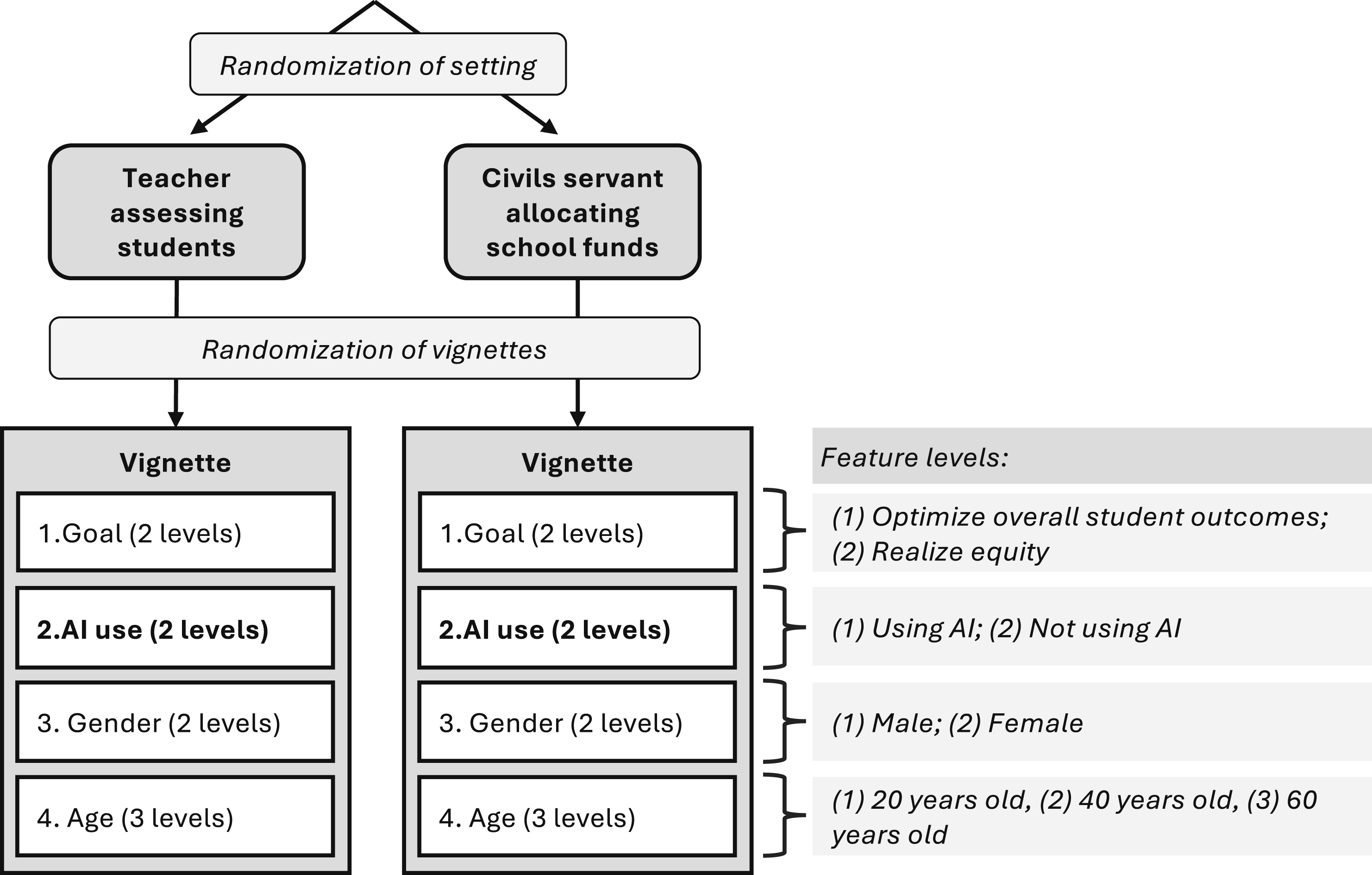
Each respondent is randomly selected for one of the two settings and is asked to evaluate one random combination of the vignette text blocks based on the features shown in Figure 2 (pure between-subject design). Respondents see the dependent variables described in the next section on the same survey page as the vignette text. To introduce respondents to the subject, they first saw the following introductory text about AI before the vignettes: “In some cases, public administration uses machine learning. Machine learning can be used to fully automate certain tasks and to provide decision-makers with information or suggestions.”
Dependent Variables
To measure the perceived warmth and competence of the public employees, we use two items for each construct. We ask respondents the question “How well do you think the following description fits the teacher/school administration employee?” They then rate the characteristics “is friendly,” “has good intentions,” “is competent,” “is intelligent” on a scale from 1 = “Does not fit at all” to 5 = “Fits very well.” These and similar items have been used in many other studies (e.g., Aaker et al., 2010; Frank & Otterbring, 2023) and can be seen as valid indicators of perceived warmth and competence. By combining two items for each construct into a variable, we reduce measurement error, which should lead to more accurate estimates in the analysis. Cronbach’s alpha for the composite warmth variable is .97 and .98 in the civil servant allocating school funds and the teacher setting, respectively. For competence, the score is .99 in both settings. We use these combined measures of warmth and competence for the main analysis (Online Appendix XII and XII present analyses with individual items as dependent variables).
The third dependent variable is the overall evaluation of the way in which the public employees perform their task. As the variable needs to be applicable both to the AI and the non-AI condition, we use a wording that refers to the mode of decision-making applied by the public employee in the respective description of a vignette. The post-treatment question item in the survey reads “How acceptable do you think is the teacher’s/school administration employee’s approach?,” with responses ranging from 1 = “Not acceptable at all” to 5 = “Very acceptable.”
Descriptive statistics for the variables used in the analysis (by setting)
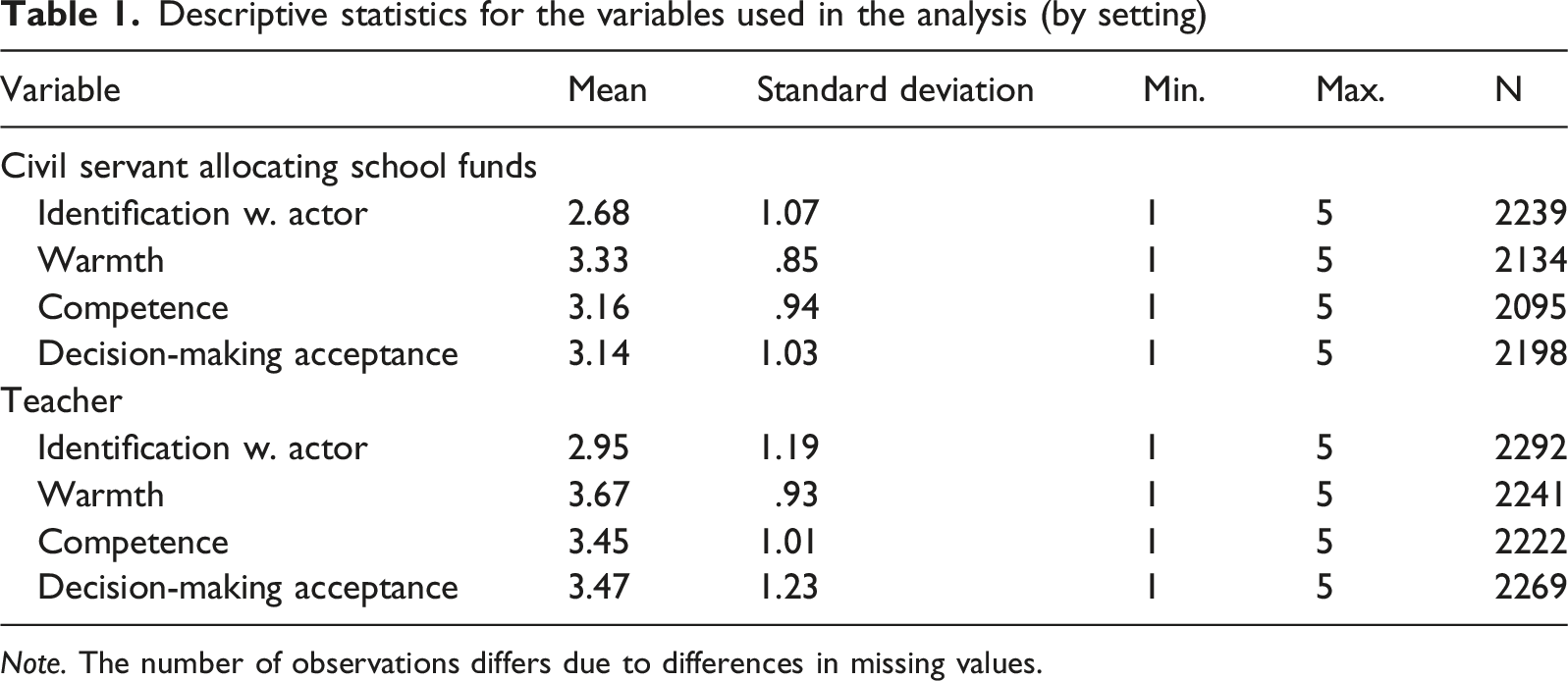
Note. The number of observations differs due to differences in missing values.
Sample
The questionnaire was fielded as part of Round 31 of the Norwegian Citizen Panel – NCP (Ivarsflaten et al., 2026). 4 The NCP is a web-based survey of Norwegians’ opinions toward important societal matters and comprises over 10,000 active participants. 5 It is based on a probability sample of the general Norwegian population above the age of 18 drawn from the Norwegian National Registry. Panel members complete an online questionnaire three times a year of 15 minutes each. The fielding of the round that is the basis for our study took place in November 2024. Due to common changes of the panel over time through panel attrition, the representativity of the sample has decreased over time. To address the deviation from the known population quotas, the dataset contains weights for adjusting the strata by gender, region, age, and education (see Online Appendix II for a description of the unweighted and weighted sample). We use the unweighted sample for the analysis below and report the analysis with weighted data in Online Appendix VII to Appendix X (the results are close to identical).
Before the fielding of the survey, at the time of the pre-registration, it was certain that the number of the respondents seeing the vignette experiment would be at least 1,200. 6 As described in the pre-analysis plan, the anticipated power for 600 cases per setting and the experimental design (2x2x2x3-factorial) is β = .99 for a small effect of .3 and β = .59 for a trivial effect of .1 (with an α of .05). With the final size of 2,267 for setting of a civil servant allocating school funds and 2,302 for the teacher setting, the sample size far surpassed the envisaged minimum.
Results
The analysis estimates marginal means for the vignette feature levels based on a linear regression model. Effect sizes can be directly read from the differences in marginal means between a given feature level and a reference category. Using identification with the public employee, which we included as a manipulation check for identification with the described public employees, we find that respondents’ identification with the two public employees—teachers and civil servants allocating funds among schools—is, indeed, significantly and substantially lower in the AI condition (b = −1.19 and b = −.51, respectively, both p < .01; see Online Appendix III). 7 In the following, we focus on the effects of the vignette treatment of AI use versus no AI use by public employees—the main predictor of interests—on our dependent variables.
Figure 3 shows this treatment effect together with the effect of the other vignette features on all three dependent variables in both settings. The figure indicates that reliance on an AI system markedly reduces the perceived warmth of both the teacher (b = −.90, p < .01) and the civil servant allocating school funds (b = −.42, p < .01). This result offers strong support for H1 and suggests that the use of an AI system makes citizens feel less close to the users, that is, the public employees relying on AI systems in their work. Effects of the vignette treatments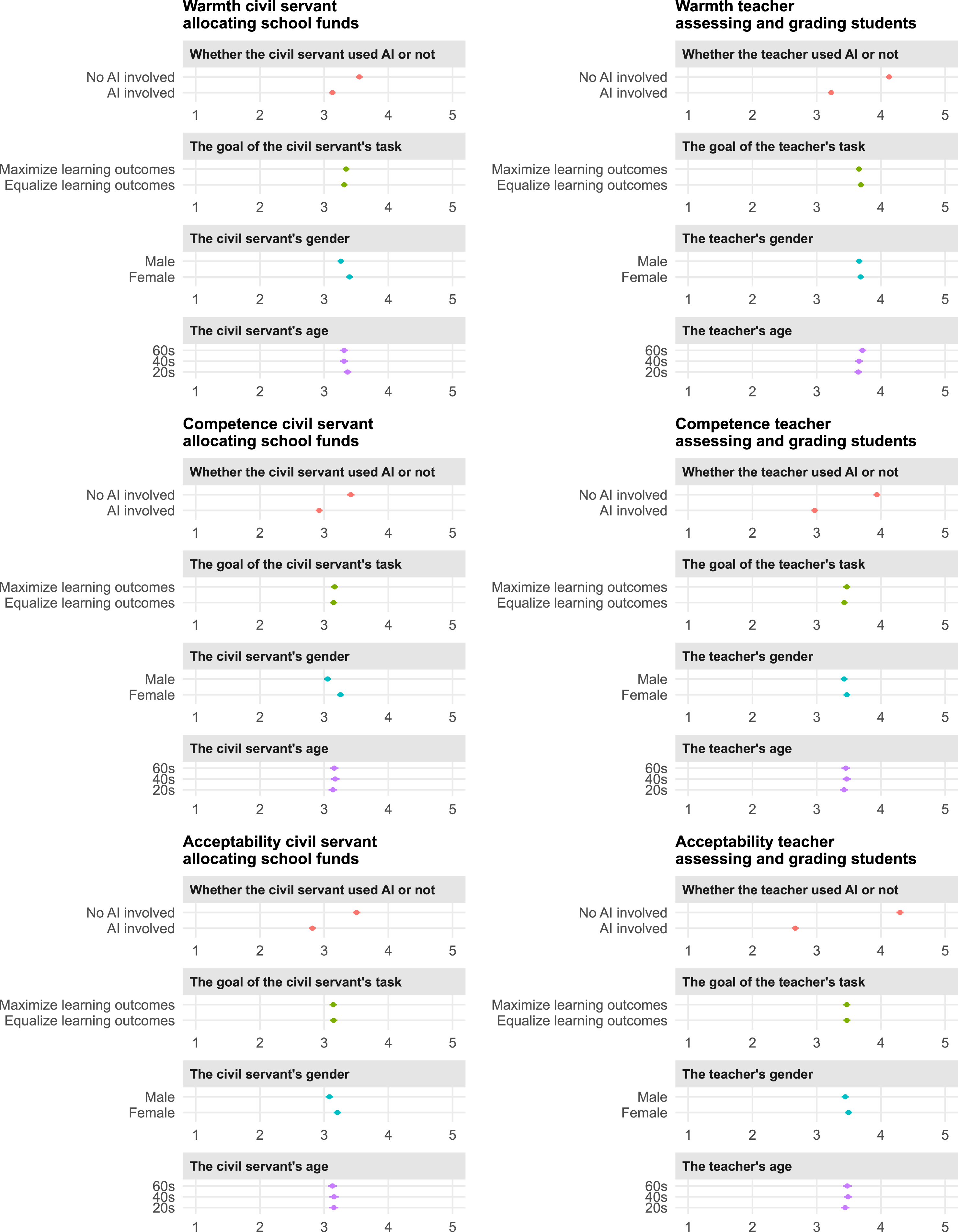
The effect of AI use on perceived competence is also negative, as Figure 3 shows (b = −.50 and b = −.97 for the civil servant allocating schools funds and the teacher, respectively, both p < .01). H2a must be rejected in view of this result, whereas H2b is supported. 8 Figure 3 also shows a clear negative effect of AI use on the decision-making acceptance for both settings, in line with H3 (b = −.69 and b = −1.63 for the civil servant allocating school funds and the teacher, respectively, both p < .01). Furthermore, when regressing decision-making acceptance on competence and warmth in an additional analysis, we obtain significant positive effects for both these predictors (b = .57 and b = .18, respectively, for the civil servant allocating funds, b = .58 and b = .14, respectively, for the teacher, all p < .01). This finding is in line with H4 and already indicates that these two variables mediate the overall effect of AI use.
We conduct a formal mediation analysis to examine the mediating role of perceived warmth and competence, relying on regression-based mediation analysis with 1,000 bootstrapped samples to generate confidence intervals for direct and indirect effects. 9 In this analysis, perceived warmth and perceived competence both emerge as significant mediating factors for the teacher and the civil servant deciding about school funds (see Online Appendix V for details). In line with H5a, warmth mediates a significant portion of the effect of AI use on acceptance (21% and 12% of the total effect of AI use for the school fund allocating setting and for the teacher feedback and assessment setting, respectively, both p < .01). When taking competence as the mediator, the share of this indirect effect is also significant (H5b) and surpasses that of warmth (48% and 38% for the civil servant allocating school funds and the teacher, respectively, both p < .01).
Looking more closely at the substantive effect sizes, the use of AI has moderate to large effects on the various examined dependent variables. Notably, there are no other vignette features that have effect sizes comparable to those of AI system use versus no use. Neither the age nor the gender of the public employee in the description makes a palpable difference for the perceived warmth and competence, although women are generally perceived as being slightly higher in warmth and competence. The stated goal of the decision-making makes no difference. 10
Moreover, the effect of AI use is consistently larger for the teacher than for the civil servant allocating funds among schools. For perceived acceptability of the mode of decision-making as the dependent variable in the teacher setting, this effect is a sizable 1.5 units on a scale from 1 to 5, more than twice the effect in the school fund allocation setting. The effect of AI use on warmth is about 1 unit on the same scale, and about twice as big as for the civil servant allocating school funds. As citizens learn about teachers using AI in their daily work, this can apparently have a strong impact on the affinity that people feel toward the teachers, with consequences for the acceptability of how they do their work. A formal test through an interaction term underscores that the negative effect of AI use is significantly larger (p < .01) for the teacher as compared to the civil servant deciding about school funds for all dependent variables—perceived warmth, perceived competence, and perceived acceptability (see Online Appendix VI for details). The findings thus support H6 about the role of the public employee and how directly they interact with other people (students in the teaching scenario). The more directly public servants interact with others, the stronger is the negative effect of AI use on the perceived warmth of these public employees.
Discussion
General Discussion
The findings above suggest the use of AI changes how citizens perceive public employees, specifically in terms of their warmth and competence. These findings concerning two kinds of public employees in the area of education are in line with evidence on private sector applications indicating that the implementation of AI systems in an organization changes people’s perception of the organization (Pizzi et al., 2023) and that the personal use of AI signals certain properties of the user (Reif et al., 2025). The negative effect of AI use on competence perceptions conforms to attribution theory and the idea that citizens infer from someone relying on an AI system that this user lacks competence (Reif et al., 2025). Further questions arise, however, with this possible explanation. Available evidence from customer service interactions shows that people perceive human employees as more competent—and warmer—than an AI agent (Lou et al., 2022). Further, for the same advice presented to people, they deem AI as the source of the advice as less competent than humans (Böhm et al., 2023). 11 Hence, if people perceive AI alone to be less competent than humans, it is not entirely clear why they would infer from AI use that the user lacks competence. The user might also be skilled at applying AI in hybrid decision-making effectively and in ways that compensate for the weaknesses of the technology.
Attribution theory would also lead us to expect that a negative attribution occurs mainly for agents with which people identify less. However, we found that the negative competence—and warmth—attributions are stronger for the public employee with which people identify more (teachers). In any case, when public employees do rely on AI, they are ultimately perceived more like the AI, that is, lower in warmth and in competence. Further research is needed to shed light on the mechanism that lies behind the effect of AI use on perceived competence.
Overall, the results underscore the importance of looking at evaluations of AI systems that are based on mental shortcuts. While previous research of public sector AI uses has shown that the institutional context and specifically trust in organizations provide important cues that shape the evaluation of AI systems (Schiff et al., 2023; Wenzelburger et al., 2024), the analysis above indicates that public employee use of AI systems in decision-making is a cue for certain social perceptions of these employees. Social perceptions of warmth and competence, as shown above, are furthermore important antecedents of perceived decision-making acceptance.
The registered overall negative effect of AI use on decision-making acceptance in the area of education is similar to what has been found for other public sector AI uses in which AI supports human decision-making and where decisions involve a certain degree of discretion (Haesevoets et al., 2024; König, 2023; Starke & Lünich, 2020). At the same time, we cannot presume that our findings are also generalizable to tasks and forms of decision-making that are of a more technical nature. For these uses, the social-relational dimension of AI use is likely to be less relevant as people may be narrowly concerned with instrumental considerations regarding the AI use. The effects of AI use on warmth and competence and on decision-making acceptance may be clearly weaker, then.
Our findings altogether underscore that besides any functional relevance of AI systems adopted in public organizations citizens also respond to changes in the relationship between citizens and these bodies due to AI adoption—with potentially important consequences for the perceived legitimacy of the organizations. People who grow up with AI today as something completely normal may well come to take it for granted. The use of AI in government may not influence their perceptions of public employees in the way described further above. However, this does not seem to be the case yet, and we would expect that increasing AI use that is visible to the public weakens the affective ties to and the perceived legitimacy of the state.
Limitations
We acknowledge several limitations of our study. First, we have examined how AI use affects the perception of public employees, but not how it affects the perceptions of the organizations. The effect on the perception of organizations may well be weaker than for their employees who directly use AI in their work. Second, our findings concern the perception of public employees in one government domain, that is, education. There exist many other domains and the results may not generalize to all of them. While the results are likely to generalize to similar settings in which public employees act in the service of citizens and exercise a moderate amount of discretion, these conditions do not similarly exist in many other government areas. Some areas, such as the military, may also yield different patterns, for example, because they are more controversial or involve higher stakes.
Third, our findings come from a case, Norway, in which the teacher setting in our experiment may differ from other countries. It could be that in countries in which teaching is more performance-oriented and where performance comparisons play a more important role already at a younger age, the use of AI systems does not similarly lead to negative perceptions as registered in our experiment. In the Norwegian education system, citizens may care more about the relational aspect of teaching and thus about the quality of the relationship between teachers and their students. Fourth, there could also exist mitigating factors, such as government communication about AI use, which could reduce any negative effects of using AI. Emphasizing human involvement in AI system design seems to ease concerns about AI use (Jago, 2019). Future research could thus investigate how adding different justifications to the description of AI use might weaken negative impacts on citizens’ perceptions of public employees.
Fifth, survey experiments face some limitations compared to other designs (Mutz et al., 2011). They often lack the deep engagement and environmental control of lab experiments, making it harder to ensure participants attend closely to treatments. And unlike field experiments, they take place outside real-world contexts, which can limit ecological validity and capture only short-term effects. Compared to observational studies, they simplify complex phenomena and may be ill-suited for broad, exploratory questions. However, these limitations are offset by notable strengths. Survey experiments use random assignment, enabling strong causal inference while drawing on representative samples for high external validity. They allow researchers to present realistic, policy-relevant stimuli to geographically dispersed populations at relatively low cost. Unlike observational studies, they eliminate confounding, and compared to lab or field settings, they combine experimental rigor with population-level generalizability. This balance makes them valuable for testing causal hypotheses in political and social contexts where both control and representativeness matter, as they do in our study.
Regarding external validity, we note that it is inherent to our experimental design that half of the respondents were made aware of public employees’ AI use when stating their evaluations. We thus created a situation in which citizens learn about such AI use. Strictly speaking, our results can only tell us how evaluations differ as people are aware of the AI use as compared to not being aware of it. For many citizens it is realistic to assume that this occurs as they may learn about AI use in public organizations through media consumption or personal conversations. However, for some citizens this may not be the case. For them, the effects we registered above are irrelevant.
Finally, as the primary purpose of the study was to test how AI bears on the social relation between citizens and public employees with an experimental design to probe causal effects, we limited ourselves to a few explanatory factors. Future research could, for example, explore the effect of different kinds of AI systems or other mediating factors besides warmth and competence. It could also examine more closely the concrete conditions under which public employees use AI. Our experimental design only presented information about AI use without any further information about the concrete way in which it is used. Yet, certain contextual factors could alleviate concerns about the use of AI that citizens may have. The described limitations notwithstanding, the study points to the importance of studying how citizens may perceive AI use as inappropriate for reasons that are separate from functional qualities of AI systems.
Conclusion
To understand how citizens respond to the increasing use of AI systems in government, it is important to look beyond how citizens evaluate the AI applications themselves. As has been argued above, awareness about the use of AI may also shape how citizens perceive public employees using the AI systems in their work—specifically how relatable they are for citizens. Studying the scenarios of a teacher and a civil servant allocating school funds, we find that their AI use decreases citizens’ warmth perceptions of these public employees. This, in turn, decreases the overall perceived acceptability of decision-making. The effect of AI use on perceived warmth is also stronger for actors who more directly interact with other people. For teachers, the use of AI leads to a reduction in perceived warmth that corresponds to one quarter of the range of the variable for perceived warmth. This effect is about twice as large as for the civil servant allocating school funds, whose role is more remote in relation to citizens. Similar negative effects of AI use also emerged for the perceived competence of both public employees.
Overall, the analysis provides strong evidence that the use of AI in government organizations makes employees using AI systems less relatable for citizens, leading to a lower acceptance of the decision-making. It adds to previous findings on attitudes toward AI in government through pointing to the importance of social evaluative standards. Based on our findings, it seems that AI use in public employees’ work is a cue about fundamental social characteristics of these employees—and an unambiguous one that reduces both their warmth and competence in the eyes of citizens.
The findings have important implications for efforts to maintain the legitimacy of government organizations while harnessing the potentials of AI systems. While the adoption of AI systems in government has been increasing rapidly, the mere use of AI seems to lead to reduced affective ties between citizens and government organizations. To the extent that citizens are aware of actors in government using AI, the increasing adoption of the technology can gradually erode the legitimacy of government organizations. Besides a range of practical challenges and obstacles to implementing AI in public organizations (Medaglia et al., 2023; Van Noordt & Misuraca, 2022), AI adoption may also be problematic due to the perceptions and sentiments it evokes in the public—and in ways that are not tied to functional aspects of these AI systems. To avoid such impacts, public managers and policymakers need to be aware of how AI use can lead to citizen disaffection, especially in frontline service provision.
Simply concealing the increasing adoption of AI is hardly an option to avoid the negative effects reported above, as citizens are likely to learn about the spreading AI uses. It also runs counter to government transparency. Rather, practitioners should assure the public that AI use is not a sign of lacking competence. Further, to avoid perceptions of a dehumanized state, practitioners may need to create an image of AI use that preserves the “human touch.” Taking the example of teaching, schools may want to openly communicate to parents how teachers employ AI in their work while presenting teaching as a still thoroughly interpersonal activity. They may also want to communicate the adoption of AI in ways such that they alleviate fears about an outgroup AI agent becoming a part of public organizations. Relational signaling theory (Six & Sorge, 2008), with its focus on how to deliberately foster trust through signals of good intentions and competence, could provide a suitable basis for devising corresponding communication strategies. If government authorities instead leave it to citizens to form an opinion about AI in government, citizens may resort to heuristics and to their imagination to fill the gaps of what they do not know about those AI uses.
Supplemental Material
Supplemental Material From Fragmented Narratives to Systemic Critiques: Transformations in Korean Twitter Discourse on Sexual Violence
Supplemental Material for Artificial Intelligence in Government Weakens Citizens’ Affective Ties With Public Employees: Results From a Vignette Experiment by Pascal D. Koenig, and Sveinung Arnesen in Social Science Computer Review
Footnotes
Acknowledgements
We thank the anonymous reviewers for their valuable comments. They have been very helpful in improving several parts of the manuscript.

Funding
This study has in part been funded by the Research Council of Norway through the project “Public Fairness Perceptions of Algorithmic Governance,” project no. 314411.
Declaration of Conflicting Interests
The authors declared no potential conflicts of interest with respect to the research, authorship, and/or publication of this article.
Supplemental Material
Supplemental material for this article is available online.
Notes
Author Biographies
References
Supplementary Material
Please find the following supplemental material available below.
For Open Access articles published under a Creative Commons License, all supplemental material carries the same license as the article it is associated with.
For non-Open Access articles published, all supplemental material carries a non-exclusive license, and permission requests for re-use of supplemental material or any part of supplemental material shall be sent directly to the copyright owner as specified in the copyright notice associated with the article.
