







Abstract
This study investigates the determinants of career choice intentions of adolescents with family business background from both adolescents’ and parents’ views. Comparing three groups of adolescents (“intentional successors,” “intentional founders,” and “intentional employees”) from 106 German family firms through multinomial regression analyses, the authors found personality traits (i.e., Openness and Agreeableness), gender, adolescent identification with the family business, perceived parental job rewards, and parental succession preference and preparation to significantly differentiate adolescents’ career choice intentions. Findings add to previous succession research by empirically demonstrating the impact of individual and socialization influences on offspring’s succession intentions as early as in adolescence.
Introduction
For adolescents growing up in a family business, career planning almost inevitably includes the question of whether or not to join the family business. By investigating the factors that drive family business offspring to follow in their parents’ footsteps compared with becoming an independent founder or employee, this study, offers practical and theoretical contributions to family business and entrepreneurship research. As described by Stavrou and Swiercz (1998), family business succession can be conceptualized as a developmental process that includes socialization influences starting as early as adolescence. According to their three-level intergenerational transition model, potential successors in the pre-entry stage are associated with the family business through activities such as family discussions and part-time employment. The second level is when the potential successor enters the firm as full-time employee. The third level entails the appointment of the offspring to the leadership position and responsibilities within the family firm. In line with Stavrou and Swiercz’s model (1998), general life-span approaches to vocational development emphasize that the roots of an individual’s vocational development are determined as early as in childhood (Hartung, Porfeli, & Vondracek, 2005). Moreover, prospective longitudinal studies following individuals from childhood to adulthood have demonstrated the predictive value of individuals’ characteristics in childhood and adolescence for developmental outcomes, for example, career success, in adulthood, in quite an impressive way (Caspi, Elder, & Bem, 1988; Kokko & Pulkkinen, 2000).
Against the backdrop of the immense impact of the next generation’s career decisions on future planning, investment, and continued survival of the family business, it is surprising that few studies so far have addressed career choice intentions of adolescents with family business background (Eckrich & Loughead, 1996). By combining insights from adolescents’ career development, determinants of entrepreneurial career choice, and family business succession research, the present study investigated the antecedents of career choice intentions of adolescents with a family business background. Specifically, we aimed to analyze the determinants of career choice intentions of three different groups of adolescents: (a) those who intend to succeed in the family business; (b) those interested in an entrepreneurial career, but who intend to found their own business; and (c) those who intend to find regular employment outside the family firm. Given that all three groups can draw on a parental model of self-employment, with the opportunity of own entrepreneurship right at hand, preference for one of the three career groups is likely to relate to factors such as personality traits, sex of the respective child, family structure in terms of birth order, number and sex of siblings, or to characteristics of the interaction of the respective family and opportunities for adolescent participation related to the company. Discovering how intentional successors differ from intentional founders and intentional employees in terms of individual and contextual prerequisites has important implications for family business owners and offers new insights for family business and entrepreneurship research.
In the following, we provide the theoretical foundations of our study by first looking at the complexity of career choice for adolescents with a family business background. We then consider determinants of career choice as potential predictors of family business offspring’s intention to succeed into the family firm (successor) compared with intentions to found a new business (founder) or to be employed by someone else (employee).
Theoretical Foundations
Adolescents’ Career Choice Intentions
In entrepreneurship research, entrepreneurial intentions have been widely investigated with a large body of studies drawing on Ajzen’s (1991) theory of planned behavior (TPB; Carr & Sequeira, 2007; Kolvereid, 1996). TPB postulates that intentions will be greatest when an individual holds a favorable attitude toward the intended behavior, experiences strong subjective norms regarding that behavior, and expects to perform the behavior successfully. Moreover, empirical studies based on TPB demonstrate that intentions are the single best predictor of any planned behavior, including entrepreneurship (Krueger & Carsrud, 1993).
From a career development perspective, children’s career choice intentions and aspirations change from a fantasy stage to more realistic options with increasing age (Hartung et al., 2005). By adolescence, therefore, a major developmental task is to explore various career options and develop career choice intentions consistent with one’s own abilities, values, and interests (Kracke, 2002). Due to kinship linkages, the career options of adolescents involved in family businesses not only include regular employment (outside the family firm) or founding a new firm but also and most notably, the possibility of taking a leadership position as successor in the family business. Depending on the adolescent’s abilities, interests, and connectedness to the family, this potential succession option may be perceived as an opportunity or a burden. For example, succeeding as head of a family firm requires the ability to take responsibility, interest in the branch of the business, and the willingness to work closely together with other family members. In comparison, while founding a new firm also requires entrepreneurial abilities, it also allows the individual to choose his or her own area of interest and to work independently from family bonds. Similarly, regular employment outside the family business involves free choice of an area of interest, independence from the family, and less responsibility for the family and their business. However, both founding and regular employment career options may also be accompanied by parental disappointment and the problem that parents have to find an alternative solution for securing the survival of the family business. These examples demonstrate the intricacies of adolescent’s career planning in the family business context and show that offspring career choice intentions are likely to reflect evaluations regarding individual abilities, interests, and pros and cons of each career option.
Studies analyzing the stability of adolescents’ career interests offer support for continuity (Low, Yoon, Roberts, & Rounds, 2005). For example, Falck, Heblich, and Luedemann (2010) demonstrated the stability of career aspirations from adolescence to adulthood. In their study, students who stated entrepreneurial intentions at age 16 were shown to have a significantly higher probability of being an entrepreneur at age 33 than students who had not indicated any entrepreneurial intentions. Moreover, Schmitt-Rodermund (2007) showed a relationship between entrepreneurial interests at the age of 13 years and business start-ups and other entrepreneurial activities some 20 years later. Given the empirical support for the predictive value of intentions with regard to later behavior and the stability of career aspirations, we assume that succession intentions expressed as early as adolescence relate to self-employment in adulthood and thus have a substantive impact on the long-term succession planning and continued survival of a family business.
Following a contextual life-span approach on human development (Lerner, 1982), which states that developmental outcomes (e.g., career success) result from the interplay between individual resources (e.g., personality traits, gender, birth order) and contextual factors (e.g., parental support, self-employed role model), in the following subsection, we present findings on individual and contextual determinants of adolescents’ career choice intentions.
Determinants of Career Choice Intentions
Personality
Recent meta-analytic findings (Rauch & Frese, 2007; Zhao & Seibert, 2006) indicate that the five-factor model of personality (i.e., Conscientiousness, Extraversion, Agreeableness, Openness to Experience, and Neuroticism) is relevant for entrepreneurship. Specifically, Zhao and Seibert’s (2006) meta-analysis reveals significant differences between entrepreneurs and managers on four dimensions of the Big Five traits, such that entrepreneurs score higher on Conscientiousness and Openness to Experience, and lower on Neuroticism and Agreeableness than managers. No difference was found for Extraversion. Other research concerning the early precursors of entrepreneurship, often as early as in adolescence, has also shown the predictive value of entrepreneurial personality characteristics for later self-employment. For example, boys of the famous prospective longitudinal Terman Life-Cycle Study who were rated high in Conscientiousness, Extraversion, Openness and low in Neuroticism and Agreeableness by their parents at age 13, were twice as likely to have started a business or worked as major business executives later in their lives as compared with boys with low levels of these characteristics (Schmitt-Rodermund, 2004).
In contrast to the extensive body of research comparing the personal characteristics of entrepreneurs with those of managers or employees (e.g., Engle, Mah, & Sadri, 1997; Utsch, Rauch, Rothfuß, & Frese, 1999), only a handful of findings are available concerning differences between personality traits of founders and successors. One of the few is that of Brandstätter (1997), who studied an adult sample of small business owners with predominantly up to 10 employees and found that owners who had personally set up their business (founders) were emotionally more stable and more independent than owners who had taken over their business from parents, relatives, or by marriage. Another study is that of Zellweger, Sieger, and Halter (2011) who investigated a student sample (average age of 24 years) with a family business background. Their findings revealed that students who intended to become employees outside the family firm shared a lower independence motive, for example, the importance of being your own boss, than students who assumed a leadership role in the parental firm. Intentional founders, that is, those who, rather than succeeding in the family business, wanted to start their own firm, demonstrated a higher independence motive than successors. Moreover, intentional founders shared a stronger innovation motive (e.g., their need to create something new) than successors and future employees. Taking Brandstätter’s (1997) and Zellweger et al.’s (2011) results together, it seems that striving for independence and the desire to take innovative approaches are important factors differentiating intentional founders and successors.
Drawing on these findings regarding entrepreneurial personality factors, one could assume a hierarchy of career choice intentions depending on an individual’s level of personality characteristics. Zellweger et al. (2011) propose a “pecking order of career preferences” depending on personality factors such as student’s independence and innovation motive. Other, closely related personality traits such as the Big Five can be assumed to vary accordingly. Thus, one could speculate that succession is preferred at medium levels of entrepreneurial personality characteristics, whereas high levels of such characteristics are more likely to classify potential founders and low levels can be expected as typical for potential employees. For example, high levels of Openness are expected to spur the founding intention, medium levels the succession intention, and low levels the intention for employment outside the family business. In contrast, high levels of Neuroticism are assumed to stimulate employment outside the family firm, medium levels the succession intention, and low levels the intention to create a new firm.
Hypothesis 1a: Openness will be positively related to choosing to create a new business.
Hypothesis 1b: Conscientiousness will be positively related to choosing to create a new business.
Hypothesis 1c: Extraversion will be positively related to choosing to create a new business.
Hypothesis 1d: Agreeableness will be positively related to choosing employment outside the family firm.
Hypothesis 1e: Neuroticism will be positively related to choosing employment outside the family firm.
Gender
Research indicates that females, although not explicitly excluded from the list of succession candidates, are disadvantaged with regard to being accepted as successors (Eckrich & Loughead, 1996; Stavrou, 1999). For example, Innarelli (1992) described that females are considered as potential successors primarily only when all the founders’ descendants are female. Dumas (1992) in her exploratory study, revealed that daughters are almost invisible as potential successors and only taken into account where a critical incident forces the family into considering doing so. Brandstätter’s (1997) and Zellweger et al.’s (2011) results concerning the determinants of choosing a career as employee, successor, or founder also support the importance of gender for differential career choice intentions. Zellweger et al. found that females displayed a higher likelihood to opt for employment than to succeed into the family business. Brandstätter (1997) reported a higher share of women among heirs than among founders of a private business. Taken together, these considerations suggest that gender relates to career choice intentions. Specifically, we assume that girls are more likely to opt for employment compared with succeeding in the family business. At the same time girls are expected to be more likely to follow in the family firm as compared with founding a new firm:
Hypothesis 2: Gender will be related to career choice intentions such that women will be more likely to choose to work outside the family firm.
Identification with the family business
Social identity theory (Tajfel & Turner, 1985) posits that a person’s sense of self is conceived by multiple social roles (e.g., daughter, stakeholder, potential successor, etc.). Moreover, identification has been defined as the process of integrating membership of a particular group or organization in one’s sense of self (Cole & Bruch, 2006). In this way, individuals who identify with an organization perceive a oneness or belongingness to the organization; they typically believe in the organization’s goals and desire to contribute toward the achievement of these goals (Ashforth & Mael, 1989). By drawing on social identity theory and organizational identification research (Ashforth & Mael, 1989), Sharma and Irving (2005) proposed that the alignment between an individual’s self-identity and the family firm is an important antecedent of affective commitment (mind-set of desire) to pursuing a career within the family business. Offspring in family businesses who feel that the family firm is an important part of their self are thought to develop a strong desire to contribute to the family firm’s success, followed by the decision to start a career within the family firm. Although in the present study we focus on adolescents and career phases prior to actual employment, we do not include a measure of actual commitment to the family business in our study. Instead, we assume that identification with the family business as an antecedent of affective commitment predicts adolescent’s succession intentions.
The assumption that identification with the family business predicts succession intentions is also supported by a number of studies, suggesting self-identity as a useful additional component in TPB (Conner & Armitage, 1998; Terry, Hogg, & White, 1999). These studies indicate that identification accounts for significant effects on behavioral intentions, over and beyond the traditional TPB variables (attitudes, subjective norms, perceived behavioral control). Taking the findings on organization identification and on the extended TPB together, it seems reasonable to assume that identification with the family business predicts adolescents’ career choice intentions:
Hypothesis 3: Adolescents who show high levels of identification with the family business will be more likely to intend to work in the family business instead of choosing to create their own business or work outside the family firm.
Perception of fathers’ work conditions
The influence of the family on children’s vocational development has long been stated (Schulenberg, Vondracek, & Crouter, 1984). For example, children’s work orientations are highly influenced by their family members’ own work experiences and emotions (Porfeli, Wang, & Hartung, 2008) as well as by parental work conditions. Kalil, Levine, and Ziol-Guest (2005) also found father’s (but not mother’s) job characteristics in terms of job autonomy and job complexity to be linked to teenage boys’ and girls’ expressed preference for a job like that of their parents. Moreover, Galambos and Sears (1998) revealed that adolescents have relatively accurate impressions of their parents’ work-related affect (job satisfaction and role strain) and that these impressions are significantly linked to adolescents’ respect for their parents’ jobs.
From a theoretical and empirical point of view, entrepreneurship and family business research propose parental role modeling as a key factor in the promotion of children’s propensity to enter self-employment (Aldrich & Kim, 2007; Scherer, Adams, Carley, & Wiebe, 1989). However, little is known about the mechanisms by which occupational role models are transmitted and turned into adolescents’ career choice intentions. Our intention is to add empirical evidence for parent’s role modeling and to shed light on transmission mechanisms by analyzing the impact of perceived parental job rewards on adolescent’s entrepreneurial career intentions. Moreover, we intend to do this by differentiating between adolescents’ intentions to found a new firm or to succeed in the family business:
Hypothesis 4: Adolescents who perceive their father’s work in the family business as positive and rewarding will be more likely to intend to work in the family business instead of choosing to create their own business or work outside the family firm.
Parental succession preference and preparation
Research on the parental role in youth career development demonstrates parents’ influence on adolescents’ career planning (Otto, 2000) and parents, especially mothers, have been found to be the most important advisors of their children in the process of making career plans (Dietrich & Kracke, 2009). In our study, parents often reported a dilemma (see also, von Schlippe & Groth, 2006) between wanting their life’s work to be continued through their children on one hand but not wanting to influence their offspring’s career and life planning on the other. Based on such reports, one aim of the present study was to examine whether parents’ views and behaviors regarding business succession transmit to adolescent’s career choice intentions. In addition to parent’s own intentions concerning the issue of succession, the degree of children’s preparation for succession by their parents may play an important role. Parents who systematically prepare their young family members through information and participation in the family business are likely to contribute to their offspring’s succession intention (Bryant, Zvonkovic, & Reynolds, 2006):
Hypothesis 5a: Parents’ preference about succession will increase the likelihood that an adolescent will express intentions to work in the family business rather than choosing to create an own business or work outside the family firm:
Hypothesis 5b: Parents’ preparation for succession will increase the likelihood that an adolescent will express intentions to work in the family business rather than choosing to create an own business or work outside the family firm.
Method
Participants
“One of the reasons that there is very little research that focuses on the children of owner-managers is that, to this researcher’s knowledge, there are no available lists of children of owner-managers” (Birley, 2002, p. 9). Following Birley’s (2002) statement, our analyses are based on a convenience sample of 106 families contacted statewide in Germany volunteering to participate. Recruitment of the majority of the families (73%) took place via an association of wives in family businesses, who were very interested in participation due to their involvement in their children’s career decisions and the issue of succession. Using a mixed procedure of standard questionnaires and open questions, we interviewed adolescents (average interview duration M = 85 minutes, SD = 18.45) and parents (average interview duration M = 45 minutes, SD = 20.30) separately at their homes.
The parent interviewed was the current owner and leader of the firm and had an average age of 46.69 years (Min = 37, Max = 59, SD = 4.02). All of the parents were born in Germany: 28% had graduated from secondary school after Grade 9, 49% graduated from secondary school after Grade 10, and 21% received a university-entrance diploma (after Grade 13). Altogether, 94% of the parents were married, and the families had 2.3 children on average (Min = 1, Max = 5, SD = 0.77). With regard to the decision about a succession in the family business, 71% of the parents expected it to come in the following 10 to 15 years.
The average age of adolescent respondents was 16.87 years (Min = 13, Max = 22, SD = 1.91) and the majority (71%) were firstborn children, with more boys (69%) than girls (31%) in the sample. Of the adolescent respondents, 29% were working as apprentices (of those, 7 boys and girls, 23%, in the family business) and 71% were school students of different secondary school tracks. Of these, 53% attended higher track schools leading to a university admission qualification, whereas the remaining 47% attended low track schools; see Schnabel, Alfeld, Eccles, Köller, and Baumert (2002) for a description of the German school system.
The industry types represented in the sample varied with a concentration on construction (60%). Most firms (58%) were smaller businesses with 1 to 10 employees, and about half of the businesses (52%) were owned and operated within the second generation or older, meaning that half of the parents had already experienced a business succession themselves.
Measures
Dependent variable
Adolescents were asked to imagine their 40th birthday and to say what they expected their career status to be at that time. They could choose one of four possible answer categories: (a) being employed outside the family business, (b) having founded an own firm, (c) having succeeded into the family business, and (d) being not in any form of employment. From the adolescents’ answers we derived our categorical dependent variable, with three different groups representing adolescents’ career choice intentions: “employment” (n = 35 [33%]; ngirls = 12, nboys = 23), “founding” (n = 17 [16%]; ngirls = 12, nboys = 5), and “succession” (n = 54 [51%]; ngirls = 9, nboys = 45). Interestingly, none of the adolescents chose the answering category “no employment.”
Independent variables
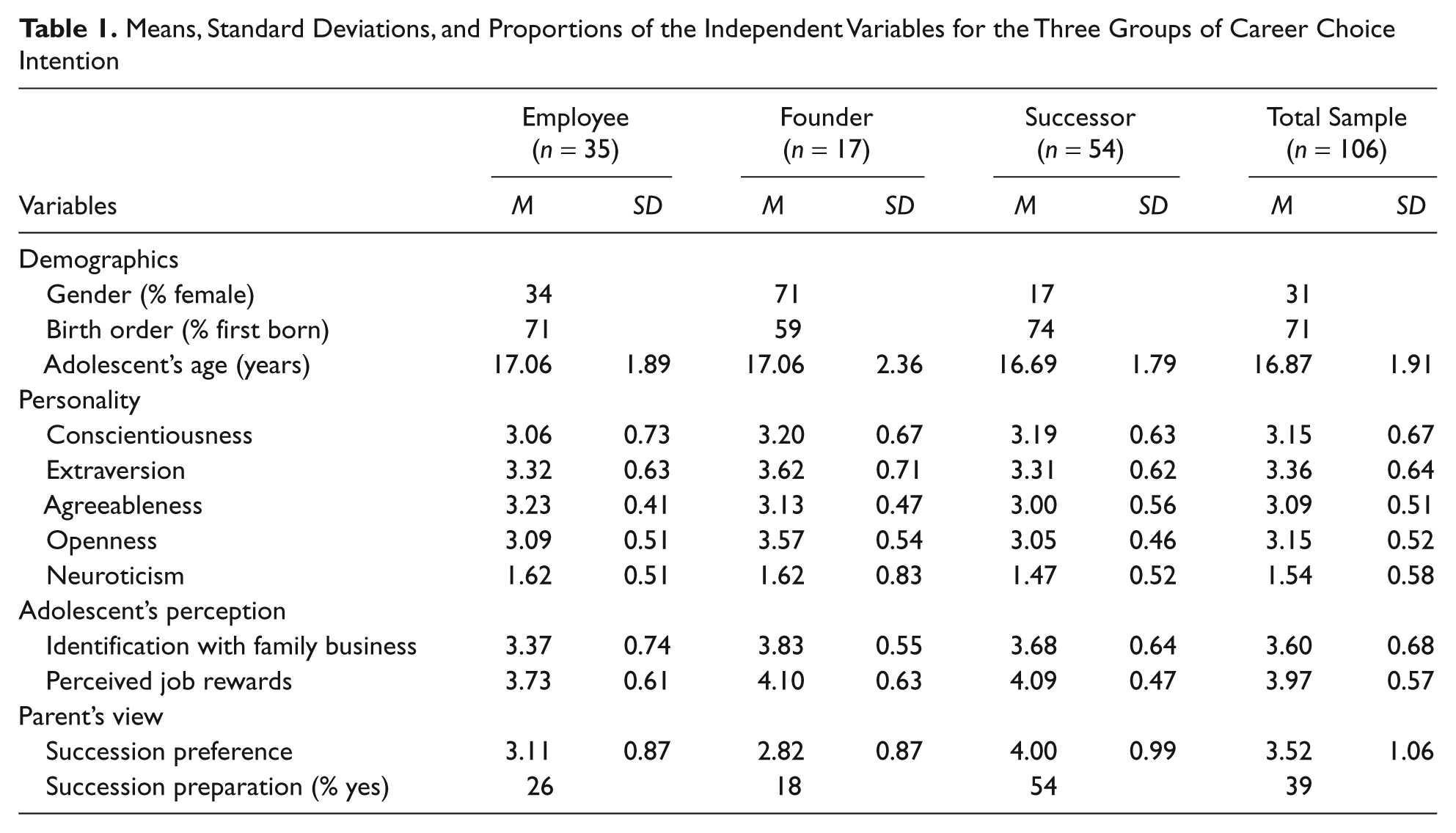
Means, standard deviations, and proportions of the variables for the total sample as well as for the three groups of adolescents’ career choice intentions separately (“employment,”, “founding,” and “succession”) are shown in Table 1.
Means, Standard Deviations, and Proportions of the Independent Variables for the Three Groups of Career Choice Intention
Personality was measured drawing from the five-factor model of personality and using a well-validated German 45-item questionnaire (Ostendorf, 1990). Participants rated nine bipolar items for each personality trait with answers ranging from 0 to 5 (Conscientiousness, e.g., “lazy vs. diligent,” α = .83; Extraversion, e.g., “uncommunicative vs. talkative,” α = .80; Agreeableness, e.g., “cranky vs. good-natured,” α = .67; Openness, e.g., “conventional vs. inventive,” α = .60; Neuroticism, e.g., “robust vs. vulnerable,” α = .78).
Adolescent’s gender was included as an independent variable, coding boys = 0, girls = 1.
Identification with the family business was assessed by adapting the Organizational Identification scale from Mael and Ashforth (1992) for the family business context. Six items were used to capture adolescent’s identification with the family business, for example, “When someone criticizes the family business, it feels like a personal insult” and “When I talk about the family business, I usually say we rather than they,” with possible responses ranging from 1 (not at all true) to 5 (very true); α = .70.
Adolescent’s perception of father’s “job rewards” was assessed relying on a measure “from Neblett and Cortina (2006)”, including intrinsic rewards (e.g., “My father’s job gives him a good feeling about himself”), and extrinsic rewards (e.g., “My father’s job provides him with an income that satisfies him”) with six items, α = .74, on a scale from 1 not at all true to 5 very true.
Parental succession preference and preparation were assessed with two items. First, to assess parent’s succession preference, we asked parents, “How much would you like your son/daughter to succeed you in the family business?” on a 5-point scale (1 = not at all, 5 = very much). We then asked parents, “Do you prepare your child to succeed you in the family business?” (0 = no, 1 = yes). For those who answered “yes” we asked how they prepared their child for succession. Example answers were “part-time employment in the family business, mostly as a vacation job,” “taking children to exhibitions/customers/suppliers,” “talking about the business,” “being a positive role model.”
Control variables
As prior studies have highlighted the importance of sociodemographic factors for career choice intentions (Stavrou, 1999), we included the adolescent’s position in the birth order (firstborn vs. other) and their age as control variables in the analyses. Although family business research has not empirically confirmed a direct association between birth order and succession, more general research on vocational development found differences in career interests across different birth order groups (Leong, Hartung, Goh, & Gaylor, 2001). Concerning adolescent’s age it is well documented that career interests crystallize and become more clearly with increasing age (Savickas & Spokane, 1999). Moreover, we used business factors, that is, generation of business (first generation = the interviewed parent had founded the business; second generation or older = the interviewed parent succeeded into the business), number of employees, and turnover in 2007, as control variables because research has shown a relationship between business factors such as family firm size and the willingness to succeed in parent’s business (Schröer & Freund, 1999).
Results
Pearson correlations of the variables examined are shown in Table 2. The maximum correlation is .41, thereby indicating only modest shared variance between the variables. Our test of multicollinearity further supported this assumption: The variance inflation factor, which expresses the degree to which each independent variable is explained by the set of all other independent variables ranged between 1.07 and 1.60. Values are below the critical cutoff of 10, thus indicating little redundancy between the independent variables (Hair, Black, Babin, & Anderson, 2010).
Pearson Correlations of the Variables Examined
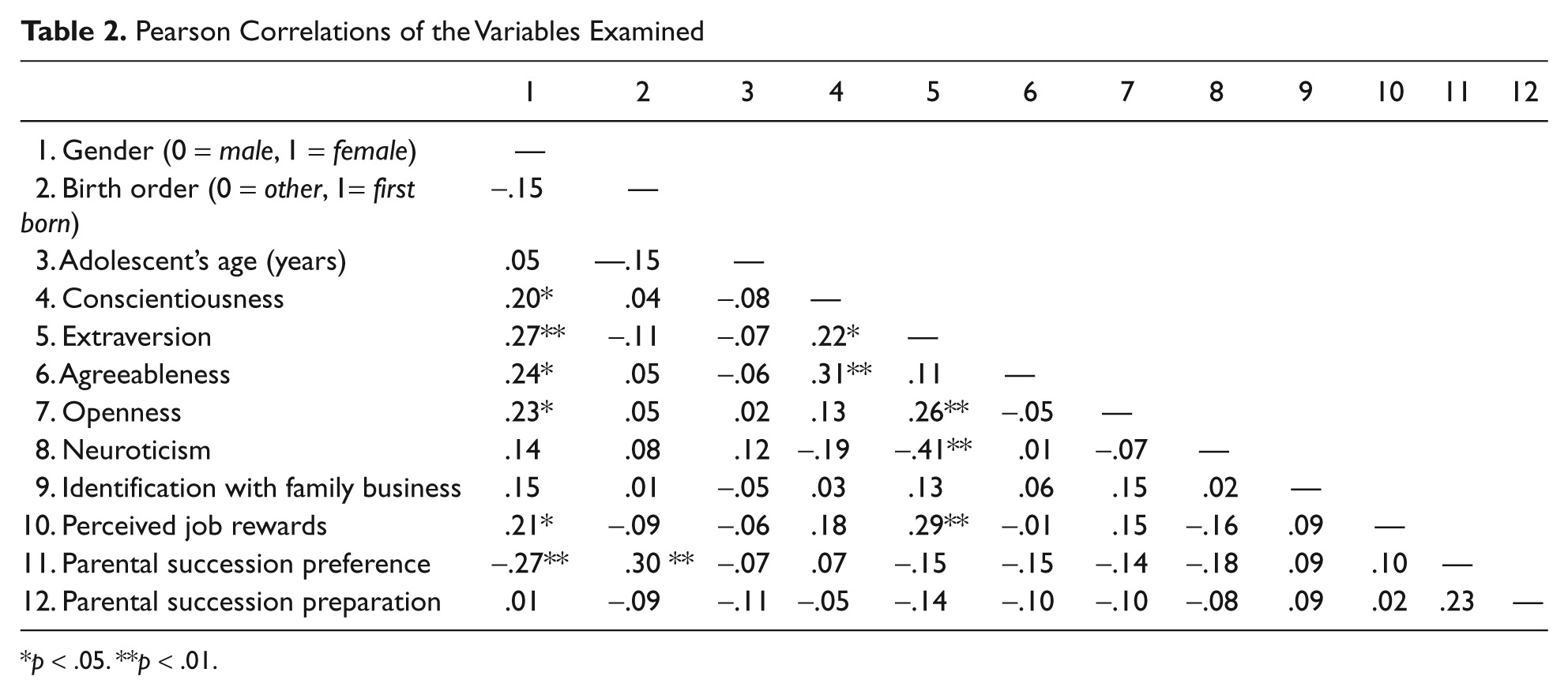
p < .05. **p < .01.
We conducted stepwise multinomial logistic regression models to test our hypotheses. Multinomial logistic regression models work like regular logistic regressions except that they predict membership of one of several categories relative to a base category (1 vs. 0, 2 vs. 0, 3 vs. 0) instead of dichotomous categories (1 vs. 0; Long, 1997). The coefficients reflect how unit increases in the independent variable are associated with increases in the likelihood of being placed in a particular group compared with being placed in the base category. To test our hypotheses, we calculated the likelihood of being placed in the employee group compared with the successor group as well as the likelihood of being placed in the founder group compared with the successor group. For example, for Hypothesis 1a to be supported, higher scores on Openness would increase the likelihood of becoming a founder compared with a successor, and the likelihood of becoming a successor compared with an employee. Similarly, for Hypothesis 2 to be supported, girls would be more likely to opt for employment compared with succeeding in the family business, and would be more likely to follow in the family firm compared with founding a new firm. The results of the multinomial logistic regressions are reported in Table 3.
Results of Multinomial Logistic Regression Analyses

Note. The reference group is “succession intention.”
p < .10. *p < .05. **p < .01. ***p < .001.
As can be seen in Table 3, Model 1 includes adolescents’ sociodemographic characteristics (i.e., gender, birth order, and age) 1 as well as adolescents’ personality traits. The independent variables referring to adolescents’ reports on identification with the family business and perceived parental job rewards are added in Model 2. In a final step, the independent variables referring to parents’ answers (succession preference and succession preparation) are entered (Model 3). We chose the commonly used Nagelkerke pseudo-R2 ranging from 0 to 1 (Nagelkerte, 1991) to indicate the amount of variance explained by the respective model. The pseudo-R2 approximates the R2 (Agresti, 1990). In the upper part of Table 3, coefficients can be interpreted as the extent to which increases in the independent variable are associated with increases in the likelihood of being placed in the category “employment intention” compared with the base category “succession intention.” In the lower part of Table 3, the likelihood of being placed in the category “founding intention” compared with the base category “succession intention” is reported.
Who Intends to Become an Employee Outside the Family Firm Instead of Succeeding in the Family Business?
Results from Model 1 revealed that higher Agreeableness related to endorsing the “employment intention” response category over the “succession intention” response category (see left-hand panel of upper Table 3). More specifically, for every one-unit increase in Agreeableness, participants were 3.28 times more likely to prefer employment outside the family business instead of succeeding in the family firm. No significant predictive effects were found for adolescents’ sociodemographics (i.e., gender, age, and birth order) and the other personality traits. Results from Model 2 indicate that, beyond Agreeableness, adolescent’s identification with the family business, and adolescents’ perceived parental job rewards, significantly related to adolescents’ career choice intentions (see middle panel of upper Table 3). In detail, the more adolescents identified with the family business, the less likely they were to choose employment compared with family business succession as a career option, Exp(B) = 0.39, p = .02. Similarly, the more adolescents perceived their father’s self-employment as highly rewarding, the less likely they were to aspire for regular employment compared with family business succession, Exp(B) = 0.21, p < .01. In the final model, Model 3 (see right-hand panel of upper Table 3), parent’s succession preference and succession preparation are added and emerge as significant predictors for adolescents’ career choice intentions. The more parents preferred their offspring to succeed in the family business, the less likely adolescents were to intend to become an employee instead of becoming a successor, Exp(B) = 0.49, p = .02. In addition, parental succession preparation significantly reduced adolescent’s preference for employment compared with succession, Exp(B) = 0.30, p = .05. In other words, parental succession preparation was associated with a 233% (i.e., [(1/0.30) − 1] × 100) increase of the odds of succeeding in the family business. As can be seen from the right-hand panel of upper Table 3, the predictive effects of Agreeableness and identification with the family business from Model 2 were somewhat attenuated in the final model and did not reach significance with all other predictors included. The influence of gender, however, did reach significance, with girls reporting a 4.15 times higher likelihood of becoming an employee than succeeding into the family business. In sum, high Agreeableness, low identification with the family business, few perceived parental job rewards, low parental succession preference, low parental succession preparation, and female gender were associated with the intention to seek employment rather than succeed their parents in the family firm.
Who Intends to Found a New Firm Instead of Succeeding in the Family Business?
As can be seen from the left-hand panel in the lower part of Table 3, Openness to new experiences and female gender significantly related to adolescents’ preference of founding one’s own firm instead of succeeding into the family business. More specifically, each one-unit increase in Openness was associated with a 6.86 times increased odds of founding a new firm. Similarly, girls reported a 6.45 higher likelihood to start a new firm instead of succeeding into the family business. The predictive effects of Openness and gender remained significant after adding the independent variables in Models 2 and 3. None of the other variables, that is, adolescents’ age, birth order, and personality traits other than Openness, had significant effects. Concerning adolescents’ identification with the family business and perceived parental job rewards, which were entered as predictors in Model 2, no significant differences between intentional founders and intentional successors were found (see middle panel of lower Table 3). In the final model, Model 3, we tested the effects of parents’ succession preference and succession preparation on adolescents’ likelihood to found a new firm instead of succeeding into the family business (see right-hand panel of lower Table 3). Both hypotheses find full support. The more parents preferred their offspring to succeed in the family business, the less likely the adolescents intended to found their own firm, Exp(B) = 0.27, p < .01. Similarly, parental succession preparation significantly reduced adolescent’s preference for starting a new firm instead of becoming a successor, Exp(B) = 0.07, p = .02. In sum, high Openness for new experience, female gender, low parental succession preference, and preparation significantly increased adolescent’s founder intention compared with a succession intention.
The fit of all models was significant (see model fit statistics in Table 3), and the total amount of variance accounted for by all predictors examined was 59% (Nagelkerke pseudo-R2 = .59). Based on the final model, in 75% of all cases, group membership was predicted correctly (correct classification per group: 83% “successor” group, 69% “employee” group, 59% “founder group”). In contrast to this, the proportional classification by chance, which also takes into account the number of cases per group (Rohrlack, 2007), was 39% for the total sample. Altogether, our expectations were not fully confirmed but were to some extent: Among the Big Five personality dimensions, Agreeableness and Openness significantly differentiated between the career intention groups (Agreeableness employees > successors; Openness founders > successors). Gender turned out to be an important predictor for adolescents’ career intentions, however, against our hypothesis, girls were more likely to found a new firm compared with succeeding into the family business (founder > successor). Assumptions regarding adolescents’ identification with the family firm and perceived parental job rewards were confirmed for intentional successors and employees (successors > employees) but not for intentional founders and successors (successors = founders). Our hypothesis concerning parents’ behavior finds full support, with intentional successors being more preferred and more prepared for succession by their parents than intentional founders and employees (successor > founder, successor > employee).
Discussion
Quantitative studies based on a psychological approach so far have been rare in family business research. To our knowledge, we are among the first to investigate empirically the impact of individual and contextual influences on the career choice intentions of adolescent offspring with a family business background seen from the parents’ and adolescents’ perspectives. Given that all young people interviewed grew up with a model of self-employment and the opportunity of own entrepreneurship right at hand, this study offers insights not only into factors promoting adolescents’ succession intentions but also into those increasing the likelihood of turning away from succession into the family business. In the following section, individual and contextual influences on adolescents’ career choice intentions will be discussed.
Personality
Our results regarding the predictive value of personality traits on adolescents’ career choice intentions parallel in part those of Zhao and Seibert (2006), whose meta-analysis suggests that Openness, Agreeableness, Conscientiousness, and Neuroticism differentiate between managers and entrepreneurs. Whereas Openness to new experiences in our study significantly distinguished intentional founders and successors, Agreeableness contributed significantly to explain adolescent’s intentions to become an employee rather than to succeed into the family business. As Zhao and Seibert (2006) described, individuals high on Openness can be characterized as creative, innovative, imaginative, and untraditional. Moreover, Openness to new experiences is positively related to aspects of intelligence, such as divergent thinking (McCrae, 1987). Whereas starting a new business requires entrepreneurs to come up with a creative idea and to take an innovative approach to products and strategies, succeeding into the family business, at least in the offspring’s perspective, is likely to mean continuing with products and methods established by parents or ancestors. Introducing own ideas and innovations in the family business might be perceived as particularly challenging and, in turn, may foster adolescents’ founder intentions rather than successor intentions. Our results find further support by the findings of Brandstätter (1997) and Zellweger et al. (2011) who revealed in their respective student and adult samples that both independence motives and innovation motives differentiate between intentional founders and successors.
Individuals high on Agreeableness can be characterized as caring, altruistic, and trusting, whereas persons at the lower end of this dimension are deemed to be manipulative, self-centered, and suspicious (Costa & McCrae, 1992). Entrepreneurs have been found to score lower on Agreeableness than employees which is not surprising, given that low Agreeableness may facilitate entrepreneurial behavior, such as driving a hard bargain and influencing others to reach business goals. Our findings support this view. Adolescents high on Agreeableness opt to become an employee rather than to run the family business as a successor. Contrary to our expectation, however, Agreeableness was not significant in distinguishing between intentional successors and founders. Originally, we assumed that Agreeableness would be related to circumstances associated with succeeding in the family business (e.g., dense social relationships, affiliation with family members, supporting the family), thereby promoting adolescent’s likelihood to follow in their parents’ footsteps, rather than starting their own business. However, it seems that Agreeableness rather differentiates between organizational employment and self-employment instead.
Female Gender
In line with previous studies (Stavrou, 1999; Zellweger et al., 2011) we found that girls displayed a higher likelihood to opt for employment than to succeed into the family business, and indeed, to date, only 1 in 10 family business successors in Germany is a female (Federal Government, 2007). However, in contrast to other research, which reported a higher share of women among heirs than among founders of a private business (Brandstätter, 1997), in our study girls also showed a higher inclination to start a new company than to be a successor in the family business. Keeping in mind that 60% of our interviewed family businesses represented construction firms, we interpret our results as follows: Growing up in a family business may well foster girls interest in entrepreneurial activities in general, however, as their parents’ businesses represent more male-dominated types of industry (e.g., carpenter, electrician) these girls may seek fulfillment of their entrepreneurial career intentions by starting their own business in less male-dominated trades. Interestingly, girls perceived their father’s occupation to be even more rewarding than the boys, whereas at the same time parents expressed a definite preference for boys to succeed in the family business (as is indicated by the significant bivariate correlations in Table 2). For parents our results may implicate to discuss with daughters interested in self-employment (Dumas, 1992) entrepreneurial career options related but not identical to the family business, for example, by supporting the foundation of a subfirm (for instance, interior design related to construction).
Personality and Gender
Given that both personality and succession intention seemed to relate to gender (the correlation matrix in Table 2 revealed significant relations between gender and most of the personality traits), we were somewhat suspicious to see some confounds. Indeed, whereas multinomial logistic regression analyses for boys only revealed that the effect of Agreeableness had disappeared, for female adolescents, we saw a significant difference between the career intention groups concerning Agreeableness. Agreeable girls opted for employment, whereas the more persistent, tougher females preferred succession in their parents’ business and entrepreneurship as such. Openness worked the same way as in the boys: The greater the level of Openness, the higher the likelihood to opt for an independent business as compared with succession, with no difference between succession and regular employment, that is, both were equally low in Openness. Taken to extremes, one could speculate that, whereas for boys it seems Openness (e.g., in terms of creativity) is necessary for founding a new business and no particular traits to become a successor in the family business, for girls it is different: Girls consider entering their families’ companies only if they bring along the ability to stick to their aims even against the odds.
Future research will have to find larger groups of girls with family business backgrounds, preferably from companies with typically male, as well as neutral or female, profiles (due to the technical or building focus of most of the companies in our study, our girls may be somewhat special). From such a sample, it needs to be seen whether or not low Agreeableness plays a role in female entrepreneurial activities in general, or whether higher levels of Agreeableness support closure for girls with regard to entrepreneurial careers, be it in typical male-dominated occupational areas or in all areas of possible entrepreneurial action. Maybe here is one of the keys why many more companies are founded by males than by females.
Identification With the Family Business and Perceived Parental Job Rewards
Data in past entrepreneurship research on the role of parents in stimulating their offspring’s career intentions were captured primarily with a dichotomous answering format eliciting whether or not individuals came from a self-employed family background. Hence, information on parental role models was only collected through indirect indicators (Carr & Sequeira, 2007). A major goal of our study was to shed light on the mechanisms within self-employed families that direct young people toward or away from following their parents’ footsteps. Consistent with career development research (Kalil et al., 2005), our findings suggest that adolescents’ perception on parental job rewards and identification with the family firm relate to their career choice intentions. The results fit nicely with TPB (Ajzen, 1991), which postulates that individual’s favorable outcome evaluations regarding the intended behavior (i.e., in our study, perceived satisfying income, security, and self-esteem) stimulate intentions to engage in the actual behavior. For parents in family businesses, our results suggest that they should be aware of both direct and indirect sources (e.g., wealth, positive or negative communication about the family business) that may shape adolescent’s perception about his or her parents’ jobs, and hence, offspring’s career choice intentions.
Parental Succession Preference and Preparation
A major strength of this study is that the information assessed relies not only on adolescents’ self-reports but also includes parents’ perspective on succession planning. Parental views play a crucial role in the succession process as, in the end, they have a major say in whether or not their offspring can actually join the family business. Our findings reveal that parental succession preference and preparation is significantly related to adolescents’ career choice intentions. The stronger parents’ succession preference and preparation, the more likely adolescents report a succession intention as compared with founding one’s own company or dependent employment. Judging from these results, it seems that the transmission of parents’ and offspring’s succession preferences is visible at an early pre-entry stage in the succession process. From a developmental perspective, researchers assume that the effective transmission of values, attitudes, and orientations between parents and children goes through various stages during a life time. Younger children are subject to intense transmission efforts by their socializers. With growing autonomy, children adopt views of the transmitters more selectively, up to the point that some studies even suggest open rebellion against parental transmission of views that they had previously adopted and acceptance later on (Schönpflug & Bilz, 2009). This rebellion phenomenon, however, is not supported by the findings of our adolescent sample. The intergenerational transmission literature further proposes that, for successful transmission, the content of transmission (e.g., the family business succession) must be salient to the family members, evoking discussion about these contents and associated behaviors (Pinquart & Silbereisen, 2004). Further analyses of our data set provide empirical support that, indeed, the intensity of intrafamilial communication about succession promotes congruence between parents’ and children’s succession preferences (Reiter, 2010).
Limitations
Our study has several limitations that need to be considered. First, we assessed adolescents’ career choice intentions, which do not yet tell us offspring’s actual career decisions or later career success. However, relying on the ample empirical support stemming from TPB and on the results of longitudinal studies (Falck et al., 2010; Krueger & Carsrud, 1993), reported intentions are deemed to be strong predictors for actual behavior. Zellweger et al.’s (2011) results on a student sample together with Brandstätter’s (1997) findings on an adult sample partly point in the same direction as our results on adolescents. However, only a prospective longitudinal design following the career paths of adolescents with family business background over the life course will provide knowledge about the long-term predictive value of early antecedents on the successful succession in family businesses.
Second, although the current study seems to offer some intriguing insights into the career intentions of adolescent offspring in family businesses, findings should be interpreted cautiously given the relatively small sample size in each of the career intention groups. Moreover, our analyses are based on a convenience sample with no entitlement to representative results. Replication with further groups would be helpful in this regard, although we agree with Birley (2002) that large scale sampling of children in family businesses is very challenging.
Third, our findings regarding adolescents’ perceived parental job rewards referred to father’s self-employment only and revealed that daughters perceived father’s occupation more positively than boys. For family businesses run by mothers, we would expect interesting gender effects (e.g., stronger encouragement or discouragement of girls compared with boys) which deserves closer scrutiny in future research. Concerning specific family structures (e.g., birth order, number, and sex of siblings), our small sample size only gave us a first hint about the impact of birth order on adolescent’s career choice intentions, which in this study did not reveal significant effects. However, it is possible that other sibling constellations do relate to adolescents’ career choice intentions. For example, growing up as a single child in a family business may, on one hand, put even more pressure on the offspring to follow in their parents’ footsteps than on children raised with siblings, if for no other reason than that the single offspring is the only available intrafamiliar successor (Eckrich & Loughead, 1996). On the other hand, growing up as a single child also prevents sibling conflicts, which may have a negative impact on the succession process.
Fourth, in our study we exclusively considered the biological sex (i.e., girls vs. boys) of the adolescents with family background in relation to their personality traits according to the “Big Five” and in relation to their career choice intentions. However, drawing on research about the social construction of gender (e.g., Caldwell, Kleppe, & Henry, 2007) a closer look at gender role personality traits across different domains of life is needed. It is likely that girls and boys exhibit different gender traits when moving across different identities or roles in their lives, for example, girls might exhibit stronger masculine traits while behaving as successor or founder and more feminine traits in their role as daughter or girl friend. Therefore, we suggest that gender-role personality traits beyond biological sex be included in future research on family business succession.
Finally, our results allow no statements regarding the direction of effects. It is possible that, for example, parents started to prepare their offspring for succession by involving them with customers, suppliers, and others, only after adolescents had expressed their succession intention.
Nevertheless, in spite of these limitations, we feel the present study to be a useful contribution to entrepreneurship and succession research by supporting empirically the impact of individual and contextual influences on the career choice intentions of offspring with a family business background as early as in adolescence.
Implications for Practitioners
Our findings demonstrate that succession is a process that is set on course very early on. This implies that family business owners should be aware of their role model function concerning rewards and costs of running a family firm. For example, talking positively about the family business at home may spur offspring’s interest toward the family firm. As positive human development results from the interplay between contextual and individual factors, parents should offer a stimulating context that allows their offspring to discover and crystallize their abilities and interests. Practically speaking, our findings suggest that parents should involve their offspring actively in the family business from early on. We recommend parents to delegate age-appropriate responsibility for projects (e.g., web design, computer support, foreign language assistance) that allow offspring to feel competent, proud, and contributing to the family business. Moreover, family business owners should be conscious that children draw conclusions from parents’ behavior regarding parental succession preferences. Instead of children’s vague assumptions concerning their parents’ succession plans, it is likely to be helpful if parents openly express their wish for continuation of the family firm, even though this might seem counterintuitive to the generally subscribed parenting principle of granting offspring free career choice. Finally, we would like to point to the potential of female successors in securing the survival of the family firm. We advise family business owners to consider and foster their daughters as competent successors from early on instead of taking them into account only after a critical incident forces the family to do so.
Footnotes
The author(s) declared no potential conflicts of interest with respect to the research, authorship, and/or publication of this article.
The author(s) disclosed receipt of the following financial support for the research, authorship, and/or publication of this article: This research was supported by a grant from the Federal Ministry of Economics and Technology in Germany; Grant number: 03EXTH001A.