







Abstract
The focus of much career choice research is framed around a unidimensional conceptualization of motivation in which the tendency to approach a career assumes a proportionately equal and opposite willingness to avoid it. Drawing upon regulatory focus theory, we advance a dual-channel model of career choice, which allows us to capture the competing goal orientations leading individuals to approach and avoid any given career choice decision. Our results support our main hypothesis that both promotion and prevention career goal orientations mediate the relationship between individual differences, situational characteristics, and career choices in either paid employment or entrepreneurship.
Why do some individuals choose career paths in paid employment, while others choose to be self-employed as entrepreneurs? This question is relevant in an environment where career indecision is high (Praskova, Creed, & Hood, 2014), where individual careers are increasingly boundaryless (Arthur & Rousseau, 1996; Grzeda, 1999), and where societies can ill afford to forego the substantial benefits that come with new entrepreneurial activity (Moriano, Gorgievski, Laguna, Stephan, & Zarafshani, 2012).
Research exploring the frontiers of career paths and entrepreneurship has compared the employed and self-employed, highlighting the role of individual differences like cognitive ability (Eren & Sula, 2012) and personality (Shane, Nicolaou, Cherkas, & Spector, 2010) as well as situational factors like education and family business background (Eren & Sula, 2012). The same research concludes that individual attributes and situational characteristics are too distally related to career choices to predict them with any certainty (Baum & Locke, 2004; Mitchell et al., 2007).
This criticism appears particularly relevant to complex, dynamic careers like entrepreneurship (Shane et al., 2010). To enhance our understanding of what influences entrepreneurial career choice, numerous researchers have therefore called for theory and research that situates more proximal motivational mechanisms as a linkage in the relationship between individual differences, situation characteristics, and the major steps of becoming an entrepreneur (Barrick, Mount, & Li, 2013; Hirschi, Lee, Porfeli, & Vondracek, 2013).
While important contributions have been accomplished by research using social cognitive theory (SCT; Bandura, 1986) and the theory of planned behavior (TPB; Ajzen, 1991), their central constructs (self-efficacy within SCT and perceived behavioral control and attitude toward the act within the TPB) are unidimensional in the sense that the presence of approach motivation for one choice implies avoidance of all others. The potential for a problem here is highlighted by the phenomena that individuals consider potential gains motivating approach, and the potential losses motivating avoidance separately (Kahneman & Tversky, 1984) much like an individual might weigh the pros and cons of choosing one path over another.
Since the potential differences in gains and losses are large in employed versus entrepreneurial careers, decisions regarding these two career choices are a natural context to study how career goal orientations regarding gains and losses motivate approach and avoidance toward particular career choices separately. We draw on regulatory focus theory (RFT) to introduce the role of the career goal orientations individuals pursue in their decision-making choices. RFT suggests that all individuals have two distinct, independent, and unique goal striving orientations: a promotion and prevention focus (Higgins, 1997, 2005). Although individuals may have a disposition favoring one goal striving orientation over another, these orientations have been shown to be malleable both over time through socialization experiences and in the more near term through situational cues that prompt one focus over another (Gorman et al., 2012).
The promotion focus goal orientation is concerned with striving for gains, ideals, and accomplishments. Individuals with high promotion goal orientations are driven by a need for growth and development. In contrast, individuals with a high prevention focus goal orientation are concerned with security, stability, and obligation. They are driven by a need to safeguard themselves from harm, threats, and failure. Whereas a promotion focus is made salient by dispositions favoring and situations emphasizing opportunity recognition and attention to gains, a prevention focus is prompted more by concerns for security and attention to losses (Brockner, Higgins, & Low, 2004; Higgins, 2005).
In this article, we argue that individuals will make sense of their career choices through the lens of both a promotion and prevention career goal orientation. In choosing their path to be employed or an entrepreneur, we argue that individuals’ promotion and prevention career goal orientations will be influenced by personal attributes of which we examine the Big Five personality traits as well as by the socializing effects of growing up with self-employed parents and exposure to vocational training in entrepreneurship—two situational contexts that have been previously identified as relevant to entrepreneurial career choice (Kuratko, 2005; Schmitt-Rodermund, 2004). Our theory and empirical results suggest that more elevated promotion career goal orientations tend to motivate an entrepreneurial career choice, but we also show that prevention career goal orientations are at least as relevant in doing the opposite, highlighting the need to account for both of these career goal orientations to better understand the motivation to become employed or an entrepreneur.
Theoretical Context
RFT
RFT delineates how people engage in self-regulation, the process of bringing oneself into alignment with one’s standards and goals (Brockner et al., 2004; Higgins, 1997, 1998). The theory proposes that individuals have two goal orientations that differ in terms of the underlying needs and desires individuals are trying to satisfy, the nature of the goals/standards sought, the types of outcomes that are salient, and the strategies used to pursue goals. Although individuals may have a disposition to favor one goal orientation over another, particular situations can evoke the promotion focus goal orientation, the prevention focus goal orientation, or both (Higgins, 1997).
Individuals with high promotion goal orientations are driven by a need for growth and development and strive for goals that enable them to fulfill their idealized conception of themselves (e.g., I dream of one day starting my own business). As primarily driven to pursue gains, such individuals strive not to miss any potential opportunities while paying less attention to the fact that some of these opportunities might fail (Higgins, 1998).
Individuals with high prevention goal orientations tend toward a concern for security, stability, and obligation. They are driven by a need to safeguard themselves from harm, threats, and failure and are characterized by a tendency to avoid losses and focus on safer outcomes that align with their conception of what they think they ought to do (e.g., I am afraid of what I might lose were I to try and start my own business). Such individuals are therefore more skeptical and vigilant. As primarily driven to avoid losses, they tend to avoid “unjustified”—albeit possibly fruitful—opportunities to ensure that potential outcomes are in line with their safety needs.
The promotion and prevention goal orientations serve as a source of motivation through the idea of regulatory fit. Regulatory fit occurs when an individual’s needs, desires, or strategy for pursuing a goal orientation is consistent with or otherwise sustains their interest in an activity (Higgins, 2005). When individuals experience regulatory fit, they “feel good” about what they are doing and this positive self-evaluation enhances their motivation to engage in particular activities. By contrast, a lack of fit is associated with a state of anxiety that motivates one to avoid activities connected to those feelings. In much the same way as an individual sizing up the pros and cons of a decision to be made, we expect individuals to be most motivated to pursue career choices based on their overall sense of fit between their career goal orientations and the demands of that particular career in a way not unlike when individuals experience higher satisfaction and motivation when their work values are congruent with those of a particular vocational group (Super, 1953). Since regulatory fit enhances commitment, task performance (Förster, Higgins, & Idson, 1998), and the likelihood that individuals move from intentions to actions (Spiegel, Grant-Pillow, & Higgins, 2004), the enhanced motivation and energy that result from regulatory fit provide promise for a better understanding of individual career intentions and choice. In this context, we theorize that individual differences and situational characteristics are related to promotion and prevention career goal orientations, which in turn motivate individuals to approach and avoid potential careers in paid employment or as entrepreneurs.
Dispositional Individual Differences and Regulatory Career Goal Orientations
The Big Five are important individual differences that have been related to vocational choice directly as well as through more proximal mediating mechanisms like work values, career goals (Berings, De Fruyt, & Bouwen, 2004; Furnham, Petrides, Tsaousis, Pappas, & Garrod, 2005; Spurk & Abele, 2011) and as we argue in this article career goal orientations. Our focus on developing new career goal orientation measures is rooted in a number of reasons for which it will be helpful to clarify some definitions. While work values have been defined in a variety of ways (Berings et al., 2004), they can generally be understood to be relatively stable and enduring tendencies to prefer certain job characteristics over others (Furnham, Forde, & Ferrari, 1999). Conceptually similar, career goals may be defined as the object or aim of one’s occupational life or work domain (Pinder, 1998; Spurk & Abele, 2011). Like career goal orientations which describe the approach or mind-set of the individual toward a vocational goal, work values and career goals are similar in nature to characteristic adaptations which McCrae and Costa (1996) argue are relatively malleable attitudes, motivational states, or self-regulatory tendencies resulting from the interaction of the individual and their environment to influence decisions like career choice.
Yet while there is considerable disagreement in the dimensionalization of work values and career goals (Furnham et al., 2005; Spurk & Abele, 2011), our measure of career goal orientations is informed by RFT and its focus on a promotion and prevention focus. These two foci not only have the power to explain approach and avoidance in vocational choice outside of employment settings but inform important differences between entrepreneurial and employed careers in such areas as risk preferences, goal salience, and strategy in ways the work values and career goals literature appear less able to do. In this sense, RFT is better equipped to bridge the divide between individual differences and career choices because it allows one to decompose the approach and avoidance motivations leading to those choices. We expect individuals with high and low levels of personality traits like the Big Five to experience more or less regulatory fit with particular career choices depending on how well the career goal orientations associated with those traits map onto the requirements or conditions associated with particular careers.
The Big Five refers to the personality traits of openness to experience, extroversion, conscientiousness, agreeableness, and neuroticism. Our reasoning for each follows. Individuals open to experience tend to be imaginative, intellectual, creative, and curious while being less concerned with conformity and security (Costa & McCrae, 1992). They also have stronger preferences for novelty, variety, risk, and complexity whereas those low on openness prefer familiarity, routine, security, and simplicity (McCrae, 1996; McCrae & John, 1992). Meanwhile, extroverted individuals tend to be more sociable, ambitious, active, and leader like (McCrae & John, 1992). They are also more likely to set up, pursue, and achieve more challenging goals (Barrick, Stewart, & Piotrowski, 2002; Judge & Ilies, 2002). In contrast, less extroverted individuals are more focused on the status quo and less likely to be proactive (Fuller & Marler, 2009). Thus:
Conscientiousness indicates a tendency associated with organization, carefulness, competence, dutifulness, and persistence in the pursuit of goals (McCrae & John, 1992). Conscientiousness has two broad facets (e.g., Zhao & Seibert, 2006). The first facet, achievement motivation, reflects being competent, efficient, and goal-focused and thus relates positively to the tendency to get more things done (Barrick et al., 2002). The second facet, dependability, reflects being meticulous, thorough, dutiful, cautious, and giving attention to details. Consistent with prior research (Wallace & Chen, 2006), we argue that the achievement striving aspects of conscientiousness fit with careers oriented toward promotion goals, while the dependability aspects (e.g., being careful of obstacles interfering with goal pursuits) fit careers oriented toward prevention goals. Thus:
Agreeableness is associated with the tendency of being trusting, forgiving, caring, altruistic, and even gullible. The high end of agreeableness represents cooperative values and strong preferences for harmonious interpersonal relationships (Barrick et al., 2002). Such individuals avoid potential interpersonal conflicts and can be seen as less assertive. Because they value communion more than status, more agreeable people also set less ambitious goals (Judge & Ilies, 2002). Neuroticism, a reverse-coded measure of emotional stability, includes properties such as anxiety, nervousness, stress proneness, lack of self-confidence, and fearfulness (Costa & McCrae, 1992). Evidence indicates that neurotic individuals are less likely to perceive themselves as confident and so they may pursue less challenging goals (Judge & Ilies, 2002). Further, neurotic individuals, by seeing the world through a rather negative lens, tend to experience and engender more often negative emotions including hostility, depression, self-consciousness, and impulsiveness (Costa & McCrae, 1992). Neurotic individuals also avoid stressful, uncertain, and emotionally charging situations although these situations have the potential to lead to greater success. All told, these characteristics suggest the following:
Situational Learning Differences and Regulatory Career Goal Orientations
In addition to dispositional differences (i.e., the Big Five), the strength of a learning situation can shape individual regulatory career goal orientations and make individuals feel right about engaging in or refraining from certain career choices (Bird, 1988; Kyndt, Raes, Dochy, & Janssens, 2012). In a manner consistent with the development of work values (Berings et al., 2004) and in line with RFT, the socializing effects of learning situations can change individuals’ underlying values, preferences, the nature of and strategies connected with goal orientations, and the types of outcomes that are salient (Higgins, 1997, 1998). As such, learning situations are important mechanisms for influencing the orientation one adopts toward their career goals. We study the learning situations of growing up with self-employed parents (Schmitt-Rodermund, 2004) and enrollment in postsecondary entrepreneurship courses (Kuratko, 2005) because they are well established in entrepreneurship research and apply to individuals who are at university (unlike other variables that apply more broadly outside of a postsecondary learning environment). Unlike previous research, however, we argue, based on RFT, that these learning situations affect the career choice to be employed or become an entrepreneur indirectly via the individual’s regulatory career goal orientations.
Early childhood and adolescent experiences can have a profound effect on one’s regulatory foci (e.g., Higgins & Silberman, 1998). Growing up with self-employed parents permits individuals to learn about entrepreneurship both vicariously by observing and receiving instruction from family members in general and experientially by participating in the family’s business itself (Carr & Sequeira, 2007). Individuals can consequently develop more ambitious career goal orientations and be more open to strategies relevant to achieve entrepreneurial goals. By offering important resources, financial and emotional, self-employed parents may further induce offspring to develop more challenging career goal orientations while attenuating orientations that emphasize security concerns (Aldrich, Renzuli, & Langton, 1998). Thus:
The potential for both theoretical and applied learning on the job is also given in entrepreneurship courses. Commonly, these courses expose students to successful entrepreneurs who are regular guests at lectures to share their success stories. The celebration of successful entrepreneurs may appeal to students’ sense of aspiration, encourage them to be more proactive and optimistic, and increase the likelihood that they identify and exploit opportunities (Walter, Parboteeah, & Walter, 2013). Moreover, entrepreneurial courses regularly include business plan competitions that focus on real ventures reducing individuals’ uncertainty regarding entrepreneurial ideas by providing students with feedback on business ideas, reducing students’ uncertainty and fear of potential failure, and encouraging students to adopt an entrepreneurial attitude.
1
In line with the RFT, we thus expect:
The Role of Career Goal Orientations in Employed Versus Entrepreneurial Careers
After outlining how individual differences and learning situations influence career goal orientations, we now turn to how career goal orientations fit the particular demands of some careers relatively better than others, thereby playing an important mediating role between individual differences and learning situations on one hand and the motivation to become employed or become an entrepreneur on the other hand.
Promotion career goal orientations
It is crucial to recognize opportunities and generate ideas before a venture is even established (e.g., Brockner et al., 2004) if one wants to be an entrepreneur. Individuals with high promotion career goal orientations will feel good when looking for opportunities to start a venture because they will be motivated to strive for potential gains and aspirations. Such individuals are therefore more likely to pursue an “eagerness strategy” to improve their status quo by imagining new concepts and exploring novel ideas which will be on average more common among individuals with entrepreneurial than with employment intentions (Lam & Chiu, 2002; Liberman, Idson, Camacho, & Higgins, 1999):
Promotion career goal orientations should be more relevant to individuals with entrepreneurial intentions than to those with entrepreneurial status because the aspirations to start something new, risky, and creative require individual flexibility and imagination that are fueled by optimism, growth potential, and ideal outcomes. This state, however, is less salient for individuals who already have entrepreneurial status because the latter need to commit time and energy to exploit (rather than explore) concrete goals (Brockner et al., 2004). Thus:
Prevention career goal orientations
A prevention focus orientation does not help define what needs to be done to be successful but rather what needs to be avoided to avoid failure. Individuals with high prevention career goal orientations tend to see their career as a way to fulfill their safety and security needs, leading them to a focus on minimizing the “risk” of a risk-return opportunity (Wu, McMullen, Neubert, & Yi, 2008). Whereas these individuals value accuracy, safety, and continuity, those with the potential to become entrepreneurs actually have to be relatively more willing to challenge existing structures and accept the possibility to fail (Baum & Locke, 2004; Brockner et al., 2004). Hence, individuals with high prevention career goal orientations may on average experience a better fit in potential employment than entrepreneurship because the potential for losses and failure is relatively lower in the former relative to the latter (Fitzsimmons & Douglas, 2011). Thus:
Shifting from the intention to actual status as an entrepreneur involves moving from potential to real risks of failure that would only appear to intensify rather than subside. Since individuals with higher prevention career goal orientations are more attuned to emotions and strategies geared to the minimization of potential loss and failure, they will be less likely to attain status as an entrepreneur than those with weaker prevention career goal orientations (Fitzsimmons & Douglas, 2011). Thus:
Method
Sample and Procedure
The sample used in this study stems from the 2006 GUESSS/ISCE project (e.g., Zellweger, Sieger, & Halter, 2011). For the data collection we used an online survey, which was distributed to 26, 23, and 9 universities in Switzerland, Austria, and Germany, respectively. Each university sent out an e-mail to all of its enrolled students. The e-mail included a link to the online questionnaire. After about 3 weeks a reminder was sent to all students. We focused on students enrolled in business degree programs because we were interested in how entrepreneurship courses (which are part of business programs) influence entrepreneurial career choices among countries that share a similar (Germanic) culture. To minimize response and common method bias tendencies, we ensured participants that their data would be treated confidentially and the questionnaire also included different scales and mixed questions (Podsakoff, MacKenzie, Lee, & Podsakoff, 2003). We yielded a response rate of 11.70 percent, which is a typical response rate in other cross-nation studies (e.g., Newby, Watson, & Woodliff, 2003). Demographic information obtained from the sample was very similar to corresponding national demographic statistics, suggesting that nonresponse bias was not a major concern. For instance, in the German sample the students are on average 25.49 years old, while the Federal German Statistical Office data show a mean student age of 24.60 years. The representativeness of our sample is also supported in Austrian and Swiss data. Our sample in analysis comprises 4,352 students.
Measures
Dependent variable
Individuals completing the questionnaire were asked “What kind of profession do you intend to pursue 5 years after your graduation?” The wording and time frame used in the questionnaire are common in the entrepreneurship career literature (Zellweger et al., 2011; Zhao, Seibert, & Hills, 2005). Respondents had to choose one option among a number of mutually exclusive options. Based on available options, we developed a three-category measure that uses dummy variables to distinguish entrepreneurial status, entrepreneurial intentions, and employment intentions (e.g., Gupta, Turban, & Bhawe, 2008; Zhao et al., 2005). Respondents have entrepreneurial status when they already started a venture which generates sales; those with entrepreneurial intentions plan to start a venture within the next 5 years, while those with employment intentions plan to become employees within the next 5 years (see for a similar approach, e.g., Zhao et al., 2005). To be consistent with our hypotheses, we used the entrepreneurial intentions category as a common reference category in our analyses.
The Big Five
The Big Five was measured using the internationally validated inventory developed by Schallberger and Venetz (1999). The inventory is based on the German version of the NEO-Five-Factor Inventory (Costa & McCrae, 1992). The entire questionnaire contains 25 pairs of adjectives with each Big Five individual difference measured with five pairs of adjectives on a 6-point Likert-type scale. Sample items include openness (inventive/curious vs. consistent/cautious), extroversion (outgoing/energetic vs. solitary/reserved), conscientiousness (efficient/organized vs. easygoing/careless), agreeableness (friendly/compassionate vs. cold/unkind), and neuroticism (sensitive/nervous vs. secure/confident). Coefficient α reliability for the five measures were .75, .84, .73, .71, and .78, respectively.
Promotion and prevention career goal orientations
Given the lack of a measure that fits our specific sample (i.e., college students) and the particular focus of this study (i.e., the role of career goal orientations in career choice), we decided to develop a domain-specific measure by referring to RFT (Higgins, 1997) and other general measures of regulatory focus (e.g., Lockwood, Jordan, & Kunda, 2002; Neubert, Kacmar, Carlson, Chonko, & Roberts, 2008). Drawing on RFT (Higgins, 1997), we identified a number of indicators, which each author was asked to separately categorize as reflecting either a promotion or prevention career goal orientation, given the following defining characteristics. Career goal orientations reflecting a promotion focus had to reflect growth or achievement, attainment of an ideal, or attention to gains, whereas career goal orientations reflecting a prevention focus had to reflect a concern with safety or security, fulfilling a duty or responsibility, or attention to losses (Higgins, 1997). Further, items had to be neutral between paid work and working for oneself. We achieved consensus on five prevention and 4 promotion items that uniquely reflected the agreed definitions of prevention and promotion career goal orientations. 2 An example of a promotion item is to have a “challenging career” implying advancement beyond the status quo and therefore an attitude that focuses on growth, aspirations, and gain. An example of a prevention item is to have “stability,” this term implying a preference toward fulfilling the status quo and not risking losing it. Cronbach’s α coefficient for our 4-item promotion and 5-item prevention career goal orientation measures was acceptable at .73 and .77, respectively. Using confirmatory factor analyses (CFAs), we found that the hypothesized two-factor model fit the data reasonably well (e.g., comparative fit index [CFI] = .88; normed fit index = .89; standardized root mean square residual = .11; root mean square error of approximation = .14) and significantly better than a single-factor model (Δχ 2 = 5,371.60, Δdf = 1, p < .001). To further bolster construct validity evidence, we decided to cross validate our newly constructed measures in two steps: (a) assessing the convergent and discriminant validity of the new measures and (b) reassessing the model fit on another sample via CFA. 3 To do so, we sent a questionnaire that included the items of our new measures as well as the items of a well-established, general RFT measure (an 18-item measure developed by Lockwood et al., 2002) to all business students of a major German university, of which 204 students completed the questionnaire. First of all, we found that the two measures had satisfactory convergent and discriminant validity. Specifically, our promotion “career goal orientation” measure is correlated .26 (corrected r = .37) with the Lockwood et al.’s “general” promotion focus orientation measure but unrelated (r = .01; corrected r = .01) with the Lockwood et al.’s general prevention focus orientation measure. In addition, our prevention focus career goal orientation measure is correlated .23 (corrected r = .29) with the Lockwood et al.’s general prevention focus orientation measure but weakly (r = −.07; corrected r = −.09) with the Lockwood et al.’s general promotion focus orientation measure. In summary, these tests provide support for the construct validity of our new RFT-based career goal orientation measures. Second, as done in the first sample, we retested the two alternative models on the new data set using CFA. The two-factor model was found to fit the data reasonably well (CFI = .84; NFI = .80; SRMR = .09; RMSEA = .13) and significantly better than the single-factor model (Δχ 2 = 103.32, Δdf = 1, p < .01); the results on the new sample were also slightly better than the CFA results of the initial data sample (i.e., RMSEA and SRMR). Furthermore, all factor loadings were positive and there was no improper solution (e.g., negative error variance). In summary, our tests indicate a consistently moderate model fit of our RFT-based career goal orientation measures. This model fit is sufficient for our particular research context because students are still in the process of forming their career orientations, goals, and intentions and thus they are yet to clearly define their career orientation (Wilson, Kickul, & Marlino, 2007).
Learning situations
Two dummy coded learning situation variables were constructed based on respondent reports if they grew up with at least one self-employed parent or if they had completed at least one postsecondary course in entrepreneurship.
Control variables
We control for potential age and gender effects on regulatory career goal orientations and choices (Gupta et al., 2008). We also included dummy variables for Austria and Switzerland relative to Germany to control for cross-national differences (Hofstede, 2001).
Analytic Strategy
Because we were interested in explaining group membership in employed versus entrepreneurial intentions and in entrepreneurial status versus intentions, we used a multinomial logistic regression procedure. This analytic method uses the total sample size across all three group membership categories and has an advantage in terms of statistical power compared to running a series of binomial regressions. The logistic regression coefficients (B) can be converted to odds ratios (ORs) using the formula OR = Exp(B). For example, an OR value of 2.55 means that an additional unit increase in the predictor increases the odds of the dichotomous outcome by 155%, whereas an OR value of .65 means the predictor reduces the probability of the outcome by 35%. In relating individual differences to our two measures of regulatory career goal orientations, ordinary least squares regression was used.
Results
Descriptive statistics and intercorrelations among all study variables are presented in Table 1. All variables have sufficient reliabilities and ranges, and no two independent variables are intercorrelated at unreasonable levels.
Descriptive Statistics and Intercorrelations Among Study Variables.
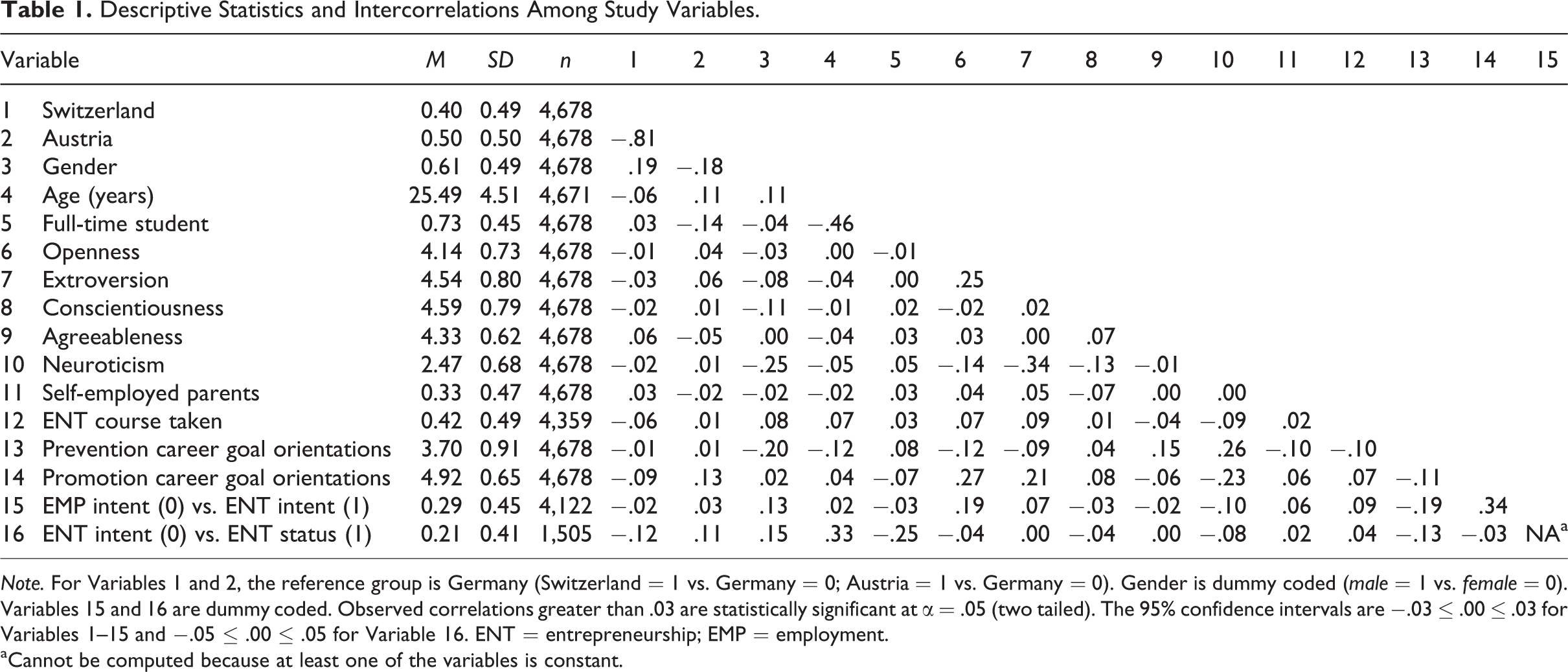
Note. For Variables 1 and 2, the reference group is Germany (Switzerland = 1 vs. Germany = 0; Austria = 1 vs. Germany = 0). Gender is dummy coded (male = 1 vs. female = 0). Variables 15 and 16 are dummy coded. Observed correlations greater than .03 are statistically significant at α = .05 (two tailed). The 95% confidence intervals are −.03 ≤ .00 ≤ .03 for Variables 1–15 and −.05 ≤ .00 ≤ .05 for Variable 16. ENT = entrepreneurship; EMP = employment.
aCannot be computed because at least one of the variables is constant.
Table 2 shows the results of hierarchical regression analyses for the hypothesized relationships between individual differences and each regulatory career goal orientation. We find that openness (β = .19, p < .01), extroversion (β = .08, p < .01), and conscientiousness (β = .05, p < .05) show statistically significant, positive relationships with promotion career goal orientations consistent with Hypotheses 1a, 2a, and 3a, while agreeableness (β = −.06, p < .01) and neuroticism (β = −.14, p < .01) have significant negative relationships with the same criterion, consistent with Hypotheses 4a and 5a, respectively. Further, conscientiousness (β = .04, p < .05), agreeableness (β = .21, p < .01), and neuroticism (β = .27, p < .01) show statistically significant, positive relationships with prevention career goal orientations, supporting Hypotheses 3b, 4b, and 5b, while openness (β = −.10, p < .01) has a negative relation with this same criterion consistent with Hypothesis 1b. Among learning situation variables, self-employed parents (β = .09, p < .01) and entrepreneurship courses (β = .04, p < .05) have a strong, positive relationship with promotion career goal orientations and a negative relationship (β = −.22, p < .01; β = −.10, p < .01) with prevention career goal orientations consistent with Hypotheses 6a, 6b, 7a, and 7b.
The Relationship Between Individual Differences and Regulatory Career Goal Orientations.
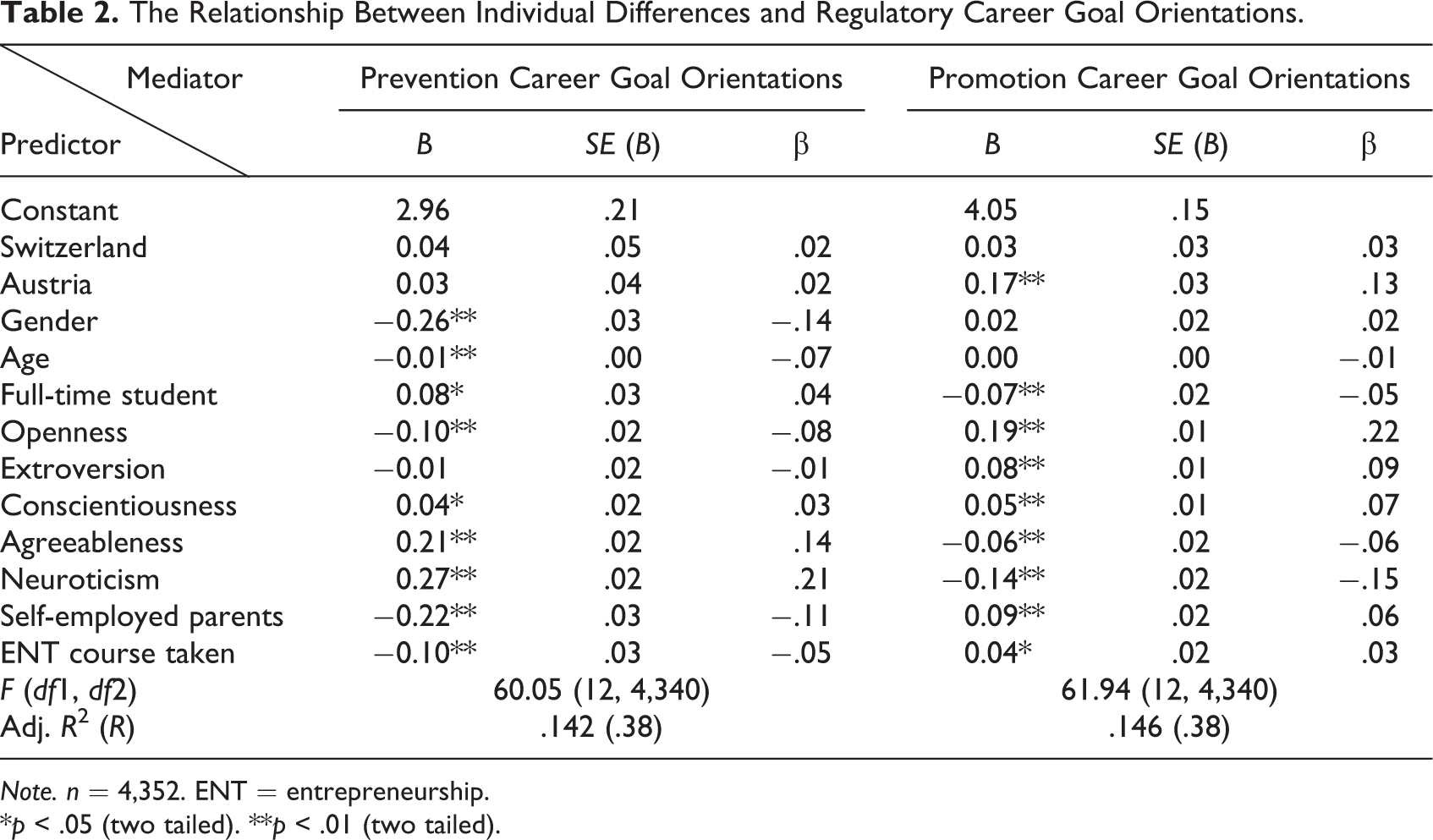
Note. n = 4,352. ENT = entrepreneurship.
*p < .05 (two tailed). **p < .01 (two tailed).
Next, we examine the results for the hypothesized relationships between regulatory career goal orientations and employment versus entrepreneurial intentions (Table 3) and entrepreneurial status versus intentions (Table 3). For each specification (Steps 1–4), results were estimated using multinomial logistic hierarchical regression having the advantage of estimating the effects of each variable across our three category dependent variables at the same time. Given the low correlation (r = −.11) between prevention and promotion career goal orientations, estimates for these two variables are very similar whether estimated independently in Steps 2 and 3 or simultaneously in Step 4 (Table 3). Thus, for the Hypotheses 8a, 8b, 9a, and 9b, we refer to Step 4 which shows the final specification of our model. Consistent with Hypotheses 8a and 8b, respectively, a one unit increase in promotion career goal orientations significantly decreases the odds of wanting to be an employee relative to entrepreneur by 73% (B = −1.30, OR = 0.27, p < .01; see Step 4 in Table 3), while the same unit change reduces the odds of entrepreneurial status relative to intention by 19% (B = −.22, OR = 0.81, p < .1; see Step 4 in Table 3). Consistent with Hypotheses 9a and 9b, respectively, a one unit increase in prevention career goal orientations increases the odds of intending to be an employee relative to entrepreneur by 42% (B = .35, OR = 1.42, p < .01; see Step 4 in Table 3) as well as reduces the odds of entrepreneurial status relative to intention by 18% (B = −.20, OR = 0.82, p < .05; see Step 4 in Table 3).
Multinomial Logistic Regression Results for Employment Intentions Versus Entrepreneurial Intentions.
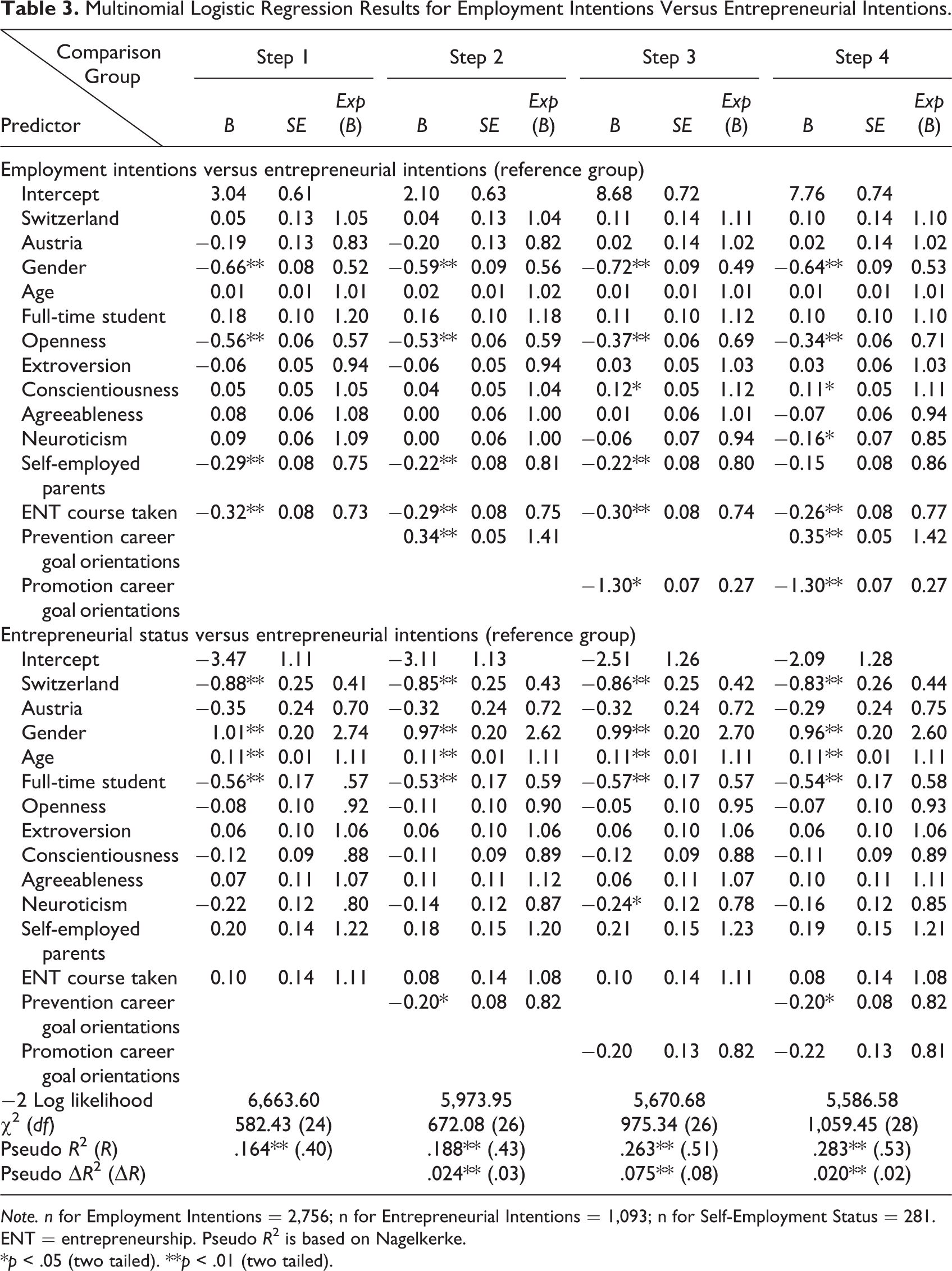
Note. n for Employment Intentions = 2,756; n for Entrepreneurial Intentions = 1,093; n for Self-Employment Status = 281. ENT = entrepreneurship. Pseudo R2 is based on Nagelkerke.
*p < .05 (two tailed). **p < .01 (two tailed).
Although Baron and Kenny (1986) is the often quoted standard for establishing mediation, we draw on recent work that attenuates the necessity of meeting all four of their conditions to draw such a conclusion (Kenny, Kashy, & Bolger, 1998). This is particularly appropriate where, as in our situation, we have a case of inconsistent mediation (MacKinnon, Fairchild, & Fritz, 2007) in which the direct effects of individual differences on our career outcomes are cancelled out by two oppositely signed indirect paths through our regulatory career goal orientation measures. In this situation, it may be argued that mediation is implied by establishing, as we have, that our individual difference measures are associated with our mediating career goal orientations (Requirement 1) and that our career goal orientations, controlling for individual differences, are associated with our career outcomes measures (Requirement 2). Our results in Table 2 show that 9 of 10 effects of individual differences and all 4 effects of situational learning variables on our two regulatory career goal measures have been established, meeting the first requirement of the inconsistent mediation test. Meanwhile, Step 4 in Table 3 establishes the second requirement as all four of our hypothesized relationships between our regulatory career goal orientations and entrepreneurial status and intentions are given. Knowing that each of the individual difference and situational learning variables’ effects on our career outcome measures are reduced to varying extents yet nonzero after controlling for career goal orientations (moving from Steps 1 to 4), we conclude that we have some evidence of partial mediation for entrepreneurial status versus intentions, and stronger evidence of partial mediation for employment versus entrepreneurial intentions.
Our findings support prior research, showing that individual differences are too distal to predict entrepreneurial career outcomes consistently. For instance, most of the Big Five show no significant direct relationship with employment (vs. entrepreneurial) intentions or entrepreneurial status (vs. intentions). Modeling the career goal orientations as mediators between individual differences and our career choice measures, however, shows a different picture. The majority of our hypothesized relationships support the conclusion that individual differences like the Big Five impact employment (vs. entrepreneurial) intentions and entrepreneurial status (vs. intentions) partly through dual-channeled career goal orientations that motivate the individual to approach or avoid particular career choices. The impact of our career goal orientation measures is evidenced by the fact that our final model explains substantially more variance in outcomes than our baseline model (i.e., R2 increases from .164 in Step 1 to .283 in Step 4 of Table 3). The low correlation between the two career goal orientations provides further support for the relevance of dual-channeled career goal orientations as important sources of motivation between individual differences and situational variables on one hand and career choices on the other.
Discussion
Findings
Using a large-scale cross-sectional sample of postsecondary business students in three countries, we show that accounting for promotion and prevention career goal orientations contributes to a better understanding of the links between individual differences on the one hand and intentions to pursue a career in employment or entrepreneurship or among those with entrepreneurial status itself. Our hypotheses on the antecedents of the two career goal orientations were widely supported across all our measures of individual (Big Five) and situational differences, explaining approximately 38% of the variance in both promotion and prevention career goal orientations. In support of partial mediation, both career goal orientations were also strong predictors of entrepreneurial intentions and status. Considering insights from RFT (Higgins, 1997, 1998), our findings highlight that it is important to jointly consider career goal orientations that motivate approach and avoidance to particular career choices, whether those choices lead to employment or entrepreneurship. We find that higher promotion career goal orientations fit the desire to becoming an entrepreneur more than becoming an employee. This differential remains positive but less strong when we compare potential and actual entrepreneurs. Moreover, we find that prevention career goal orientations demotivate potential entrepreneurship and that actual entrepreneurs have the weakest prevention career goal orientations.
Conceptual Contributions
Our research contributes in three ways to the career choice literature. First, our RFT framework enabled us to decompose the muted effects of career goal orientations that motivate individuals to approach and avoid careers in paid employment and entrepreneurship. The large increase in explanatory power after the inclusion of the two regulatory career goal orientations supports our theory that career goal orientations motivate individuals to approach and to avoid potential gains and losses that are more or less inherent to different career choices. Our approach also offers a framework driven by RFT for linking individual differences to vocational choice outside of the more employment-centric realm of work values or career goals where there is less consensus on the dimensionality of the constructs and measures in use.
Second, by developing and employing two measures of regulatory career goal orientations, we responded to calls for using more proximal variables in mediation models (Baum & Locke, 2004) that overcome the modest explanatory power of prior studies at the nexus of persons and opportunities (Shane, 2012; Zhao, Seibert, & Lumpkin, 2009). We theoretically and empirically established the links between dispositional (Big Five) and situational (self-employed parents, entrepreneurship courses) differences with regulatory career goal orientations at levels of explanatory power well beyond prior studies (Gorman et al., 2012). Our article shows that dual-channeled career goal orientations help fill the gap between individual and situational differences on the one hand and entrepreneurial relative to employed career choices on the other (Baum & Locke, 2004; Baum, Locke, & Smith, 2001; Brockner et al., 2004; Mitchell et al., 2007).
Third, the interdisciplinary approach taken in our research offers a more nuanced framework for studying career choice (Ajzen, 1991; Bandura, 1986; Douglas & Shepherd, 2002; Eren & Sula, 2012). Specifically, our approach reveals that approach and avoidance motivations have uneven effects as individuals gravitate toward entrepreneurial careers that would be lost in a more unidimensional approach to motivation as found in prior research on entrepreneurial careers. For instance, our results suggest that higher promotion career goal orientations distinguish those with the intent to become entrepreneurs rather than paid employees but are of lesser relevance to entrepreneurial status itself. The exploitation of ideas in a new venture may thus be achieved through a lowered focus on new ideas; ideas that may otherwise distract attention away from executing in areas where resources have already been committed. Conversely, prevention career goal orientations might impede the realization of entrepreneurial intentions (and hence moving to entrepreneurial status): the high demands on actual entrepreneurs with respect to flexibility, workload, and uncertainty seem to be opposed to prevention career goal orientations. These findings add nuance to the conceptual model of Brockner, Higgins, and Low (2004), which suggested that some level of prevention goal orientation is important for the success of entrepreneurs because it helps them sort out and avoid acting on poor ideas. In contrast, our results suggest that too strong prevention career goal orientations might actually lead to avoidance of entrepreneurial careers altogether. Individuals with career goal orientations that are high on promotion and moderate in prevention might thus be brimming with creative ideas like an entrepreneur but reluctant to risk their own capital and start their own firms, highlighting a motivational profile that appears unique to employees best suited to a career path in corporate entrepreneurship (Schmelter, Mauer, Börsch, & Brettel, 2010).
Practical Contributions
Our study supports that promotion and prevention career goal orientations are higher and lower, respectively, among those with self-employed parents, while those who have taken entrepreneurial courses evidence lower prevention career goal orientations. These two learning situations are thus conducive to entrepreneurial careers. Interestingly, even when we add regulatory career goal orientations as mediators to the analysis, entrepreneurial courses maintain a direct effect on the intention to pursue entrepreneurship over employment careers, suggesting the formal aspect of entrepreneurial education may help inspire a career choice among business students through mechanisms other than our regulatory career goal measures. For instance, entrepreneurship courses may help students develop efficacy-enhancing skills, and/or networks relevant to pursue entrepreneurial intentions.
Our study also offers at least two practical contributions for career counseling. First, many students intend to start a venture, and some of them already do so while at university. However, about two thirds of all ventures fail relatively quickly, and failure rates are higher among younger entrepreneurs. Accordingly, career counselors at university not only need to be prepared to support potential but also actual as well as failed student entrepreneurs; some of the latter might end up (reluctantly) in employment careers. Second, because universities are becoming hubs for launching ventures, many founders might neglect nonentrepreneurially relevant components of their studies. Rather than starting their careers after they complete their studies, career counselors will therefore have to deal with students who abandoned their studies to pursue an entrepreneurial career or pursue their entrepreneurial career while studying.
Future Research and Conclusion
Our study has some limitations that offer opportunities for future research. First, although our data do offer the advantages of focusing on entrepreneurial intentions and status across three nations, it has the limitation of being confined to self-reported data at single points in time. This necessarily limits the strength of the conclusions we are able to draw about our model, though the large, international, and representative scope of our study as well as a confirmatory analysis on an independent student sample attenuate these limitations. Second, we demonstrated the applicability of RFT to the specific context of careers through new measures of promotion and prevention career goal orientations. The newness of our measures is partly mitigated by the face validity of the items we used to construct them, and by the results of a CFA on a second, independent sample of students supporting each of our multi-item scales to be independent constructs.
Future research should build on our results and focus on the transition of individuals from entrepreneurial intention to status. We showed that prevention career goal orientations reduce the motivation to engage in explorative, innovative, and creative tasks that are commonly associated with entrepreneurial careers. Interestingly, this differential widens between students with entrepreneurial intentions and status, presumably because the potential for losses grows with the commitment of personal capital when starting a firm. Moreover, future research would benefit from distinguishing students’ type of employment intentions. Although we did not distinguish potential employment careers, levels of promotion and prevention career goal orientations are likely to differ among students with different types of employment intentions. For instance, students interested in managerial positions where organizational strategy is developed are more likely to show higher promotion and lower prevention career goal orientations than those students intending to work as a regular employee in a firm (Jaskiewicz & Luchak, 2013).
Footnotes
Acknowledgments
We appreciate the helpful comments and suggestions that we received on an earlier version of this article from Barbara Bird, Michael Frese, Frank Rauch, Philip Sieger, Thomas Zellweger, Hao Zhao, and the participants of the 2012 IFERA Conference.
Declaration of Conflicting Interests
The author(s) declared no potential conflicts of interest with respect to the research, authorship, and/or publication of this article.
Funding
The author(s) disclosed receipt of the following financial support for the research, authorship, and/or publication of this article: The authors gratefully acknowledge funding for this project from the Social Sciences and Humanities Research Council of Canada, the John Molson School of Business, Concordia University, and the Alberta School of Business, University of Alberta.