







Abstract
A transition from elementary to high school represents a very profound change and a potential source of stress, as it often requires young adolescents to make significant professional decisions. This topic was the focus of the present study in which 303 Croatian students attending their final year of elementary school completed measures of career decision self-efficacy, emotional stability, emotional competence, and concerns regarding the upcoming transition. The results indicated emotional competence as a statistically significant predictor of career decision self-efficacy, whereas emotional stability was revealed as a significant predictor of career concerns. Furthermore, a moderating effect of gender and a mediating role of career decision self-efficacy were revealed in this context. These findings provide novel evidence regarding the complex relationship between individuals’ vocational self-beliefs and emotional processing and may be informative for vocational guidance interventions targeted at young adolescents undergoing similar educational transitions.
Keywords
Introduction
A transition from elementary to high school represents a very profound change that often requires a substantial degree of cognitive and behavioral engagement of young adolescents. In addition to making a significant vocational decision, at this time students typically transition to a new physical and social environment (Akos & Galassi, 2004; Blyth, Simmons, & Carlton-Ford, 1983; Wigfield, Eccles, Mac Iver, Reuman, & Midgley, 1991). However, it is assumed that individuals are prepared for such a challenge, as they have already accomplished numerous developmental tasks related to the career domain (Hartung, Porfeli, & Vondracek, 2005). Nevertheless, during this period, students often experience numerous negative thoughts and emotions that limit their ability to deal with the encountered transition demands (Blyth et al., 1983; Turner & Lapan, 2004).
In this context, it is important to highlight that the magnitude of the transition and the complexity of young adolescents’ decisions during this time differ across educational systems. In Croatia, students in their final, eighth grade of elementary school actively choose preferred high schools among a rather large selection of potential choices (Ministarstvo znanosti, obrazovanja i sporta [MZOS], 2014). These include gymnasiums or grammar schools that provide general education with minimal specialization and a number of more specialized schools that train students for particular professions. These schools differ with respect to their organization and quality, and enrolling into them may provide adolescents with unequal opportunities for pursuing higher education. For example, students who enroll into gymnasiums have limited opportunities for entering the job market directly after graduating, although these schools typically provide the best preparation for college applications. Somewhat more specialized 4-year high schools that enroll higher achieving children provide students with chances for applying either to colleges or jobs, whereas lower achieving students attending 3-year high schools typically enter the job market directly after graduating. The choice of schools attainable to students is influenced by their elementary school achievements and other factors, for example, exceptional academic or sport accomplishments as well as several medically and socially relevant criteria (MZOS, 2014).
Given the relevance of the transition to high school during which students make one of their first long-reaching vocational decisions, the present study addressed the way young adolescents experience this period. This focus was chosen because emotional states triggered by school events strongly influence students’ cognitions and behaviors inside and outside school (Boler, 1999; Humphrey, Curran, Morris, Farrell, & Woods, 2007). In the present study, we explored the concerns young adolescents experience prior to transitioning to high school and investigated how these are influenced by their emotional characteristics and self-beliefs. We first assessed emotional stability that reflects individuals’ typical emotional responses to different events (McCrae & Costa, 2003). Specifically, emotional stability is considered one of the stabile personality characteristics that determine the ways we adapt to the environment (Caspi & Roberts, 1990) such that individuals with lower emotional stability scores tend to be more hot-tempered, worried, and unable to deal with stress (McCrae & Costa, 1999). As it has previously been indicated that higher emotional stability may increase individuals’ adaptability and facilitate more efficient coping in vocational settings (Lent & Brown, 2013), in the present study, we hypothesized that students characterized by higher emotional stability would experience fewer concerns regarding the upcoming transition to high school.
In addition to being prone to more negative affect, individuals with lower emotional stability often have lower emotional competence, namely, the ability to successfully perceive, understand, express, and regulate emotional states (Mayer & Salovey, 1997; Mayer, Salovey, & Caruso, 2004). Thus, whereas emotional stability describes individuals’ tendency to experience a larger or smaller degree of negative affect, emotional competence and regulation reflects their ability to control own emotional experiences (Davies, Stankov, & Roberts, 1998; Newsome, Day, & Catano, 2000; Van Rooy, Viswesvaran, & Pluta, 2005). Although it has been acknowledged that emotional competence may influence behaviors in academic and vocational settings (Brown, George-Curran, & Smith, 2003; Di Fabio & Kenny, 2011; Emmerling & Cherniss, 2003; Schutz & Davis, 2000), it is still not clear whether this influence is equivalent to the effects of emotional stability whose relation to vocationally specific measures has previously been described as modest (Lent & Brown, 2006). Therefore, the present study explored the relevance of this factor for students’ career concerns. Based on earlier studies indicating strong associations between emotional competence and efficient coping (Brackett, Mayer, & Warner, 2004; Folkman & Lazarus, 1988; Goleman, 2006), we hypothesized that higher emotional competence would be associated with experiencing fewer career concerns.
Moreover, we expected that the influence of emotional characteristics on career concerns would depend on students’ beliefs regarding own characteristics and confidence in the ability to manage vocational challenges. The general relevance of self-beliefs for successful goal accomplishment has been recognized within the social cognitive framework (Bandura, 1977, 1986, 2006), whereas a domain-specific social cognitive career theory acknowledged the role of vocational self-beliefs, that is, career decision self-efficacy, in vocational behaviors and outcomes (Betz, 2007; Betz & Hackett, 1986; Lent, Brown, & Hackett, 1994, 2002). In the present study, we expected that this factor would influence the way students approach the explored transition, such that individuals with more positive vocational self-beliefs would experience fewer career concerns. We also hypothesized that the influences of students’ emotional processing and self-efficacy would not be mutually independent, as previous studies have identified strong associations between the experienced emotions, emotional competence, behavioral self-regulation, and self-efficacy (Bandura, 1977; Schutz & Davis, 2000; Zimmerman, 1995). Therefore, we expected that career decision self-efficacy would mediate the impact of emotional competence and stability on career concerns, in accordance with studies indicating the mediating role of self-efficacy in various contexts (Bandura, 2006; Bandura, Adams, & Beyer, 1977; Bandura, Barbaranelli, Caprara, & Pastorelli, 2001; Zimmerman, 1995).
Finally, while investigating the relationships among the described constructs, the present study took into consideration three additional variables that were expected to be of relevance in this context. First, within all analyses, we included students’ grade point average (GPA) as a measure of academic achievement that influences options attainable to students after finishing elementary school. Furthermore, we addressed the potential moderating effect of gender because it has previously been indicated that girls and boys differ in their career decision-making process (Gati, Landman, Davidovitch, Asulin-Peretz, & Gadassi, 2010; Mau, 2000; Sanz de Acedo Lizarraga, Sanz de Acedo Baquedano, Soria Oliver, & Closas, 2009). Finally, we also addressed the moderating effect of decision status that reflects whether the students had already chosen their preferred high schools because previous findings have indicated the role of indecisiveness in emotional processing and career behaviors (Chartrand, Rose, Elliott, Marmarosh, & Caldwell, 1993; Jin, Watkins, & Yuen, 2009).
Overall, the present study addressed the relevance of elementary school students’ emotional characteristics and self-beliefs for the way they experience the expected transition into high school. In doing so, it was hypothesized that higher emotional competence and emotional stability would be associated with experiencing fewer concerns regarding the upcoming transition and that these effects would be mediated by career decision self-efficacy. Furthermore, it was expected that higher achieving students and those who had chosen their future high schools would experience less stress at the end of elementary school. The suggested interrelations between the explored variables were captured within a holistic structural model that specified the mediating influence of career decision self-efficacy and moderating effects of gender and decision status and was tested using the structural equation modeling (SEM) approach.
Method
Sample and Procedure
A total of 303 elementary school students from five schools in Croatia’s region of Dalmatia enrolled into their final (eighth) grade participated in the present study. Participants were approached at school at the beginning of the second semester of their eighth grade, where they completed the prepared questionnaires. Students also reported their gender, GPA, and whether they already knew which high school they wanted to attend. One hundred sixty-three (53.8%) participants within the sample were male and 140 (46.2%) female. One hundred ninety-five (64.4%) students knew what high school they wanted to attend, whereas 108 (35.6%) were still undecided.
Instruments
Emotional stability represents a subscale of the International Personality Item Pool (IPIP 50; Goldberg et al., 2006; Mlačić & Goldberg, 2007), a questionnaire based on the Big Five model of personality (Goldberg, 1992). The full questionnaire comprises 50 items designed for measuring five personality factors: extroversion/introversion, agreeableness, conscientiousness, emotional stability/neuroticism, and intellect/imagination and has previously shown satisfactory psychometric properties among Croatian student samples (Milas, Mlačić, & Kratohvil, 2007; Mlačić & Goldberg, 2007). In this study, only the Emotional stability/Neuroticism subscale was used which contains 10 items (e.g., I get upset easily) that the participants rated on a 5-point Likert-type scale (1 = disagree, 5 = agree). Previous studies have indicated that emotional stability reflects a disposition to experience less anxiety, stress, and hostility and to be calm and resilient (Costa & McCrae, 1995; McCrae & Costa, 1999). Thus, this trait is negatively associated with negative affect and positively associated with positive affect and life satisfaction (Donnellan, Oswald, Baird, & Lucas, 2006). During data analysis, participants’ scores were recoded so that a higher score reflects a higher degree of emotional stability. The reliability of the scale measured using Cronbach’s α coefficient was .80.
Emotional Skills and Competence scale (Upitnik emocionalnih vještina i kompetentnosti, UEK-15; Takšić, 2002) is a scale used for the general assessment of individual differences in emotional competence (Mayer & Salovey, 1997). This is a short version of the more elaborated 136 and 45-item Emotional Skills and Competence scales that have been validated across several student samples in Croatia, showing satisfactory convergent, discriminant, and prognostic validity and indicating that this construct is independent from cognitive abilities but positively correlated with social abilities, self-evaluations, empathy, and life satisfaction (Takšić, 2002; Takšić & Mohorić, 2006; Takšić, Mohorić, & Duran, 2009). Within the questionnaire used in the present study, the participants’ task was to rate how well each of the 15 items (e.g., I can express my feelings easily) comprising this scale describes themselves using a 5-point scale (1 = not at all characteristic for me, 5 = very characteristic for me). The reliability of the scale measured using Cronbach’s α coefficient was .77.
Career Decision Self-Efficacy scale (CDSES–short form; Mind Garden; Betz, Klein, & Taylor, 1996; Taylor & Betz, 1983) is an instrument designed for measuring individuals’ beliefs that they can successfully complete various tasks necessary for accomplishing the desired career outcomes. This scale has been extensively validated internationally, demonstrating its satisfactory criterion-related and construct validity, as it significantly correlates with lower levels of career indecision, higher vocational identity, career commitment, career adjustment, and other relevant vocational criteria (Betz & Taylor, 2001; Chung, 2002). In Croatia, its rare use has indicated satisfactory reliability as well as associations with career optimism and perceived academic control (Bubić, in press). Given that this instrument is best suited for high school and university students, some of its items are not appropriate for elementary school students (e.g., How much confidence do you have that you could find out about the average yearly earnings of people in an occupation?; Fouad, Smith, & Enochs, 1997). Therefore, two researchers independently rated the appropriateness of each item and chose 10 items that were administered in the present study (e.g., How much confidence do you have that you could choose a major or career that will fit your interests?). This selection was made so as to retain the conceptual meaning of the scale and in the same time be understandable to elementary school students who rated their confidence in own ability to accomplish each described career task using a 5-point scale (1 = no confidence at all, 5 = complete confidence). The reliability of the scale measured using Cronbach’s α coefficient was .77.
Concerns/fears regarding career future is a subscale of the Childhood Career Decision-Making Questionnaire (Sidiropoulou-Dimakakou, Mylonas, Argyropoulou, & Drosos, 2013), a questionnaire designed for investigating the process of career decision making in children that was originally developed and validated on a sample of elementary school students in Greece. The original questionnaire consists of 27 items that represent three subscales, namely, the Investment on decision-making process scale, knowledge of the world of work scale, and concerns/fears regarding career future scale that was of interest in the present context. This subscale was translated using the standard back-translation procedure to ensure it is comparable to the original measure (Hui & Triandis, 1985; Van de Vijver & Hambleton, 1996). As the factor analysis conducted on the original scale indicated that 2 of the 8 items had factor loadings under .40 (Sidiropoulou-Dimakakou et al., 2013), these were not retained in the questionnaire administered in the present study. Instead, we added 3 novel items that described individuals experiencing difficulties, fears, and stress regarding the types of obligations they expect to encounter in future high schools and professions. These were constructed after conducting a content analysis of the original scale in which these experiences were insufficiently represented. Two researches independently devised a set of 15 candidate items among which 3 were chosen after a discussion and a consultation with a third, independent researcher. Overall, within the modified instrument that comprised 9 items, participants’ task was to rate how well each item (e.g., When I think of my future job, I feel concerned) describes themselves using a 5-point scale (1 = not at all characteristic for me, 5 = very characteristic for me). The reliability of the scale measured using Cronbach’s α coefficient was .85.
Results
Differences in emotional competence, emotional stability, career decision self-efficacy, and career concerns of decided and undecided students were analyzed using independent sample t-tests with Bonferroni correction for multiple comparisons. The results indicated that decided students had higher career decision self-efficacy, t(301) = 4.35, p < .01, d = .52, and fewer career concerns, t(301) = 3.34, p < .01, d = .41, while the other differences were not significant (p > .05). An equivalent analysis of gender differences revealed that girls reported more career concerns, t(301) = 4.41, p < .01, d = .51, and had lower emotional stability scores, t(301) = 2.85, p = .04, d = .33, but did not differ from boys with respect to career decision self-efficacy or emotional competence (p > .05). Furthermore, girls and boys did not differ with regard to their decision status, as indicated by the results of the χ2 test (p > .05).
Next, a correlation analysis was conducted as the first step in exploring the relations among the variables of interest. The results revealed that emotional stability correlated positively with young adolescents’ emotional competence and career decision self-efficacy, whereas it was negatively correlated with career concerns. Similarly, emotional competence was negatively associated with young adolescents’ career concerns and positively correlated with career decision self-efficacy. The remaining correlations may be found in Table 1.
Correlation Matrix for the Tested Variables.
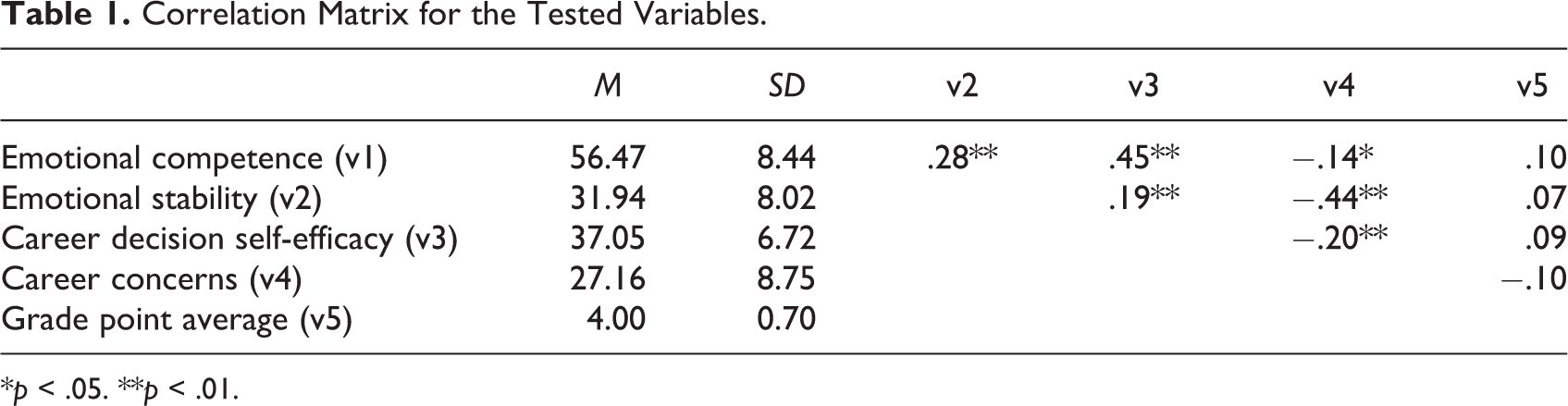
*p < .05. **p < .01.
Furthermore, SEM was conducted using AMOS 18 in order to explore the potential mediating effect of career decision self-efficacy with regard to the influences of academic achievement, emotional competence, and emotional stability on career concerns as well as the moderating effects of gender and decision status in this context. With that aim, a mediation model was suggested that includes (a) direct influences of academic achievement, emotional competence, and emotional stability on career decision self-efficacy; (b) direct influences of academic achievement, emotional competence, emotional stability, and career decision self-efficacy on career concerns; (c) indirect influences of academic achievement, emotional competence, and emotional stability on career concerns that are mediated by career decision self-efficacy (Figure 1). This proposed model was contrasted with one alternative simpler model that suggested only direct influences of academic achievement, emotional competence, emotional stability, and career decision self-efficacy on career concerns.

Results of the structural equation modeling analysis for the mediation model. *p < .05. **p < .01.
For testing the proposed models, we used a full-information maximum likelihood estimation that produced regression coefficients for each tested path. Within this analysis, bootstrapping was performed using 2,000 samples. For evaluating the models, several goodness-of-fit indices were calculated that included the χ2 test, comparative fit index (CFI), root mean square error of approximation (RMSEA), and the standardized root mean square residual (SRMR; Byrne, 2001; Schreiber, Nora, Stage, Barlow, & King, 2006). When evaluating these, we considered a combination of CFI cutoff values greater than .95 and SRMR values smaller than .09 to indicate good model fit (Hu & Bentler, 1999).
Overall, the evaluation of the simpler alternative model indicated a poor fit to the data, χ2(5) = 74.12, p < .01; CFI = .57; RMSEA = .21; SRMR = .13. In contrast, the mediation model showed satisfactory fit, χ2(2) = 3.83, p = .15; CFI = .99; RMSEA = .06; SRMR = .04, thus supporting the hypothesis regarding the mediating role of career decision self-efficacy within this model. The obtained standardized regression weights (Figure 1) indicated that emotional competence served as a statistically significant predictor of career decision self-efficacy that was, together with emotional stability, revealed as a significant predictor of career concerns.
Mediating Effects of Career Decision Self-Efficacy
In order to explore the mediating role of career decision self-efficacy in more detail, we examined the indirect effects of the mediation model (Holmbeck, 1997; Rucker, Preacher, Tormala, & Petty, 2011). The results revealed a significant indirect effect of the relationship between emotional competence and career concerns (β = −.06, p = .04), indicating a mediating role of career decision self-efficacy in this context. In contrast, career decision self-efficacy did not mediate the relationships between emotional stability and career concerns or academic achievement and career concerns, as indicated by insignificant indirect effects (p > .05).
Moderating Effects of Gender and Decision Status
In order to explore the moderating effects of gender, we used multigroup SEM in two steps. First, the above-specified model was estimated so that the regression (structural) paths were allowed to vary across boys and girls, which provided a χ2 estimate of the overall model fit across the two groups. Next, the model was constrained so that its statistical parameters were set to be equal across the two groups. The overall fit of the constrained model measured using the χ2 estimate was then compared with the fit of the unconstrained model using the χ2 difference test. The results indicated statistically significant differences between the two χ2 estimates, Δχ2(7) = 21.84, p < .01, suggesting a significant moderating effect of gender. The specific nature of the differences between boys and girls was identified using critical ratios that distribute as z-scores and allow the specification of structural paths that differ across the two groups of participants. With regard to the obtained regression weights, the results indicated that gender significantly moderated the association between career decision self-efficacy and career concerns (z = 3.54, p < .01), indicating a direct influence of career decision self-efficacy on career concerns only among girls. Furthermore, a mediating role of career decision self-efficacy with respect to the relationship between emotional competence and career concerns was identified among girls (β = −.12, p < .01) but not among boys (β = .02, p > .05). The identified structural paths for male and female participants are presented in Figure 2.
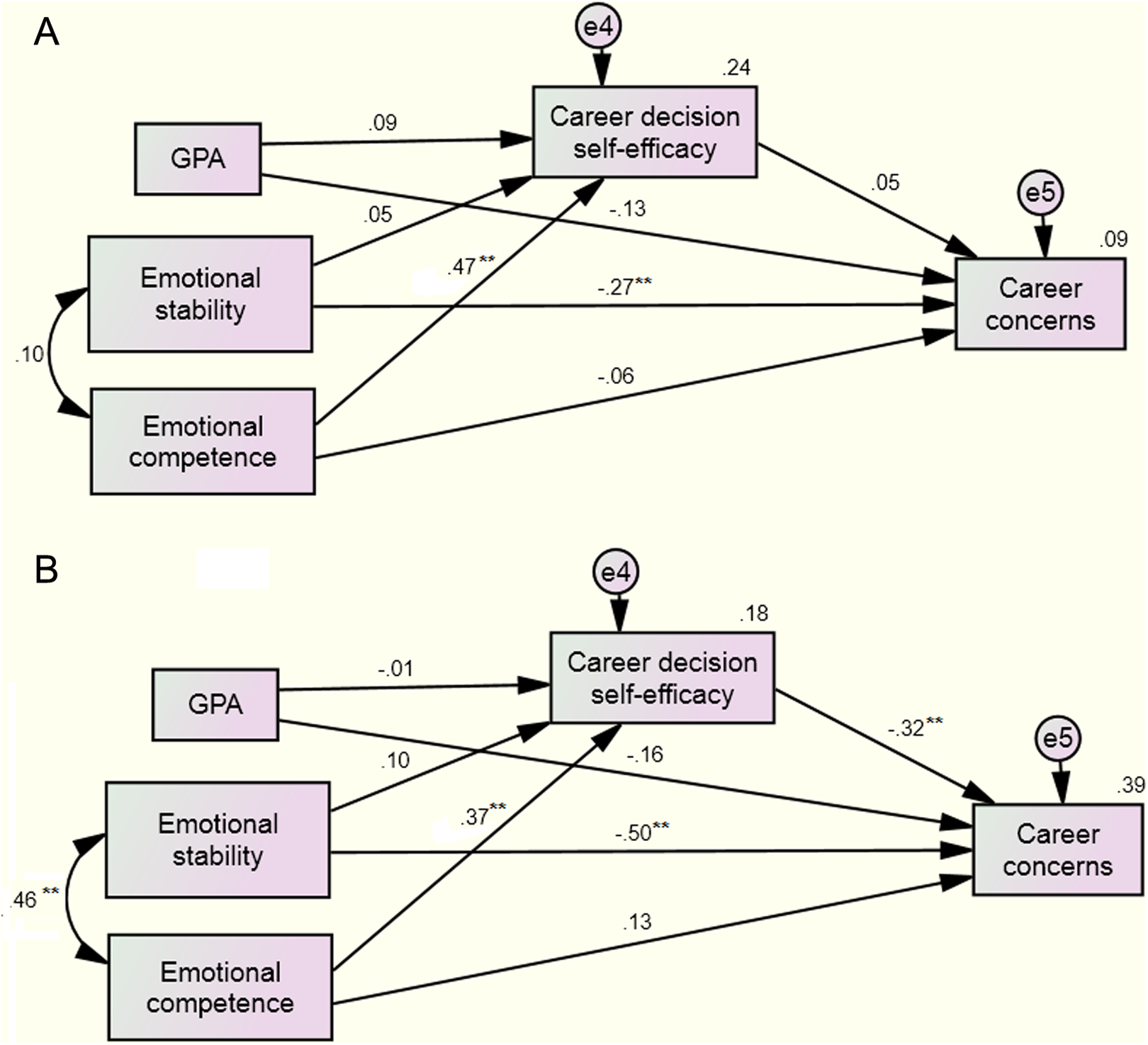
Results of the structural equation modeling analysis for the mediation model for boys (A) and girls (B). *p < .05. **p < .01.
Similar to the effects of gender, the moderating effect of decision status was tested by comparing the overall fit of the constrained and unconstrained models across the groups of undecided and decided participants. The results did not indicate a statistically significant difference between the two χ2 estimates, Δχ2(7) = 7.44, p = .39, suggesting no significant moderating effect of the decision status within this model.
Discussion
The present study explored the relevance of emotional competence and emotional stability for students’ career decision self-efficacy and concerns experienced at the end of elementary school. This question was chosen because of the importance of students’ transition to high school that may often be characterized by significant concerns regarding the anticipated future. The results indicated emotional competence as a statistically significant predictor of career decision self-efficacy, whereas emotional stability was revealed as a significant predictor of career concerns. Furthermore, a moderating role of gender and a mediating effect of career decision self-efficacy were identified in this context. A lack of significant contributions from GPA within the tested model may reflect the fact that this was a simplistic measure of students’ academic achievement that should be assessed in more detail in future studies.
The Role of Emotional Stability and Emotional Competence in Students’ Career Concerns
While exploring the associations between students’ emotional and vocational processing, we first considered the general relevance of individuals’ stabile tendency to experience certain emotional states, namely, their emotional stability. Although this personality trait did not directly impact career decision self-efficacy, it influenced the degree of career concerns experienced during the final grade of elementary school. This finding was expected, because emotional stability represents a heterogeneous personality trait that reflects one’s predisposition to experience psychological distress (Claridge & Davis, 2001; McCrae & Costa, 1999) and is related to emotional functioning and regulation (Kokkonen & Pulkkinen, 2001; Luminet, Bagby, Wagner, Taylor, & Parker, 1999). In a more specific career decision-making setting, previous studies have indicated an association between emotional stability and career decision-making difficulties (Hirschi & Herrmann, 2013; Meyer & Winer, 1993). This is in accordance with present findings that reveal emotional stability as a predictor of the experienced career concerns. As both of these variables assess individuals’ susceptibility to psychological distress, albeit of different scope and durability, it may be suggested that distress experienced at the end of elementary school represents one specific context in which individuals’ stabile traits such as emotional stability are expressed. This is in accordance with the social cognitive career theory suggesting that personality traits may promote or demote adaptation in vocational settings by engaging individuals’ typical emotional coping tendencies (Lent & Brown, 2013).
Although it was initially hypothesized that emotional competence and emotional stability would affect career decision self-efficacy and career concerns in a similar manner, the results demonstrated distinct effects of these factors. Whereas emotional stability was revealed as a significant predictor of career concerns, but not career decision self-efficacy, emotional competence was identified as a significant predictor of career decision self-efficacy. Furthermore, among girls, its influence on career concerns was mediated by career decision self-efficacy. These discrepancies may be explained if we consider the fact that emotional stability and emotional competence should be viewed as distinct constructs. Specifically, whereas emotional stability reflects individuals’ tendency to constantly experience a larger or smaller degree of negative affect, emotional competence reflects the ability to control such experiences (Mayer et al., 2004; McCrae & Costa, 2003). Thus, a close relationship between emotional competence and career decision self-efficacy may indicate that a more pronounced ability to control one’s emotional experiences constitutes a prerequisite of having higher self-efficacy or viewing oneself as a competent individual able to successfully accomplish demanding vocational tasks. This resonates with the suggestion that individuals characterized by higher emotional competence tend to perceive their abilities in a more positive light (Goleman, 2006). Furthermore, findings suggest that higher emotional competence may indirectly reduce students’ susceptibility to psychological distress during the transition to high school through more positive vocational self-beliefs. This informs the social cognitive career theory with regard to the role of emotional processes in the career decision-making process (Lent et al., 2002).
The Relevance of Career Considerations and Gender for the Experienced Concerns
When interpreting the present results, it is important to note that the direct influence of career decision self-efficacy on career concerns was revealed only among girls, as indicated by the identified moderating influence of gender. Furthermore, a mediating role of career decision self-efficacy with regard to the relationship between emotional competence and career concerns was also identified among girls. This effect of gender was somewhat surprising, as career decision self-efficacy has been associated with the successful accomplishment of numerous vocational tasks, career exploration, stability, and maturity among both male and female samples (Betz, 2007; Betz & Hackett, 1986; Gianakos, 1999; Patton & Creed, 2001). However, this finding resonates with previous studies that have noted gender differences with respect to the relationships between mood and career decision making (Ganzel, 1999) as well as career decision self-efficacy and career indecision that is often coupled with career worries (Betz et al., 1996). The present study extends these findings, indicating a more prominent influence of career decision self-efficacy on the emotional experiences of girls when compared to boys.
Furthermore, girls reported experiencing more career concerns, despite the fact that they did not differ from boys with respect to career decision self-efficacy and career decisiveness. Although a part of this influence may be related to the fact that girls in the present study showed marginally lower emotional stability scores, it is important to note that they did not differ from boys with respect to emotional competence. Thus, the identified gender differences may be associated with learning experiences of girls and boys who are typically treated differently by parents and teachers with respect to the encouragements, expectations, and attributions related to their performance in academic and career domains (Eccles, 1994; Lent et al., 2002). These differences often result in girls facing greater challenges such as having differential access to careers, less clear career paths, or experiencing more pressure to consider the balance between personal and professional lives, even in an early age (Hackett & Betz, 1981; Lent et al., 2002).
In contrast to gender, decision status was not revealed as a significant moderator within the tested model. However, similar to previous findings in this area (Betz et al., 1996), the results indicated that undecided students had lower career decision self-efficacy scores and experienced more career concerns. In accordance with findings demonstrating a connection between indecisiveness and negative affect (Germeijs & De Boeck, 2002; Rassin & Muris, 2005), this suggests that emotional distress experienced prior to transitioning to high school is associated with career indecisiveness. However, it is important to note that being undecided about one’s future in this context should not be equated with general indecisiveness (Germeijs & De Boeck, 2002), which also resonates with the present finding indicating no differences in emotional stability and emotional competence scores between the decided and undecided students.
Limitations of the Present Study and Directions for Future Research
When interpreting the results from the present study, it is important to keep in mind several limitations that influence the generalizability of the obtained findings. First, the present investigation represents a correlational study that provides limited insights into the potential causal relationships between the explored variables. Furthermore, it is based on self-report data that were collected at one time point, which may be associated with a number of biases that include validity issues, common method variance, and other problems (Paulhus & Vazire, 2007). Therefore, in future studies, it will be important to utilize additional types of data sources and focus on the outcomes of vocational decisions made by adolescents using longitudinal research designs that will provide important complementary information necessary for making stronger conclusions regarding the explored issues. Furthermore, it will be important to explore the role of other factors, for example, positive/negative affectivity, stress tolerance, or coping styles that may also be of relevance within the present context. Finally, future studies should validate the cross-cultural stability of the described results and explore the potential differences across educational systems. In doing so, it will be possible to address many related questions regarding adolescents’ career decision-making process and its long-term consequences.
Implications for Practice
The results of the present study and future research addressing associated questions may be very relevant for informing vocational guidance programs and interventions. Although these often aim toward providing students with the relevant vocational information, various guidance programs have also been developed for promoting emotional capabilities (Di Fabio & Kenny, 2011) and career decision self-efficacy (Oreshnick, 1991; Turner & Lapan, 2005). The present study indicates that these interventions may be helpful to young students worrying about school transitions, especially if they are sensitive to individual characteristics relevant for the experienced career concerns such as personality traits. In addition, practitioners should be careful when targeting boys and girls for such interventions, as vocational programs promoting their emotional competence and self-beliefs may have differential effects. More importantly, counselors should take into account the fact that girls tend to experience more career worries than boys, even in cases when they display high vocational self-efficacy and may appear to be confident and decisive in their career plans. As some of these worries may be related to their learning experiences and environmental influences that differ from those encountered by boys, teachers and counselors should promote gender equality and work against all types of minority stereotypes in their daily practice. More generally, practitioners should be aware that a substantial level of stress experienced by all young adolescents transitioning to high school can be alleviated using very simple and straightforward procedures that include providing students of all ages with appropriate vocational experiences as well as reducing their indecisiveness during transition periods through timely preparation and facilitation of their decision-making process. Taking into consideration these recommendations may aid in designing vocational interventions that will allow young adolescents to develop resilient decision-making approaches, resulting in a less stressful and more successful transition to high school.
Footnotes
Declaration of Conflicting Interests
The author(s) declared no potential conflicts of interest with respect to the research, authorship, and/or publication of this article.
Funding
The author(s) received no financial support for the research, authorship, and/or publication of this article.