






Abstract
This study examined the career decision self-efficacy (CDSE) and career maturity of 268 first-generation baccalaureate and community college student participants. Three independent variables were analyzed, including generational status (first generation and nonfirst generation), college type (baccalaureate, community college), and socioeconomic status (SES; low, medium, and high). The analysis indicated a significant interaction effect for generation by college type, with both first-generation and nonfirst-generation baccalaureate students reporting lower mean scores than community college students. This analysis also revealed an interaction effect for generation by SES, with first-generation students from high-SES backgrounds reporting the lowest levels of CDSE. A separate analysis using career maturity as the dependent variable indicated a main effect for generation, with first-generation students reporting a lower level of career maturity than nonfirst-generation students. The analysis also revealed a robust main effect for college type, with community college students reporting higher levels of career maturity than baccalaureate students.
While a fair amount of research (e.g., Lopez & Ann-Yi, 2006; Luzzo, 1995; Luzzo & Ward, 1995; Quimby & O’Brien, 2004) has been conducted on university campuses to identify the correlates of career decision self-efficacy (CDSE) and career maturity, there has been little research regarding these concepts in relation to students attending community colleges (2-year higher educational public institutions). In addition, first-generation college students, or those who represent the first in their family to attend college, present unique needs that those with a family history of college attendance do not always encounter (Dennis, Phinney, & Chuateco, 2005; Jehangir, 2010; Owens, Lacey, Rawls, & Holbert-Quince, 2010). The literature available on these two groups is nearly identical in tone with regard to lack of academic preparation, lack of social support, and perceived barriers to success (Davies & Casey, 1999; Jehangir, 2010; Mehta, Newbold, & O’Rourke, 2011). While these two groups may experience similar career development and decision-making challenges, it is also possible that differences between them have yet to be measured. The available literature on these groups suggests that they share challenges related to career development such as perceived barriers to success (Owens et al., 2010) and lack of career information and skills (Luzzo, 1993). In addition, statistics on degree completion rates of both community college and first-generation students indicate that they are more likely to drop out of college (Goldrick-Rab, 2010; Mehta et al., 2011), suggesting academic challenges that may also interfere with career goals.
Although a limited number of studies on both CDSE (i.e., Peterson, 1993) and career maturity (i.e., Ware, 2009) have found a positive relationship with continued persistence in degree completion, additional research specifically focusing on both community college and first-generation students is needed. Furthermore, community college (Davies & Casey, 1999) and first-generation students (Mehta et al., 2011) have reported low overall levels of social support, which has been shown to have a positive relationship with both CDSE (Quimby & O’Brien, 2004; Thompson & Subich, 2006) and career maturity (Schmidt & Nilsson, 2006).
In addition to social support, socioeconomic status (SES) may have an impact on both CDSE (Thompson & Subich, 2006) and career maturity (Kim & Oh, 2013). While multiple studies have emphasized the influence of SES on career decisions in general (i.e., Blustein et al., 2002; Brown, 2000), fewer studies have specifically examined the relationship between SES and CDSE or career maturity. More research is needed in order to better understand the overall impact of SES on CDSE and career maturity, particularly in relation to socioeconomically diverse community college and first-generation students.
Therefore, the purpose of this study was to identify the potential differences between first-generation community college students, nonfirst-generation community college students, first-generation baccalaureate students, and nonfirst-generation baccalaureate students on two career variables: CDSE and career maturity. In addition, SES was explored in order to determine how these variables impact the aforementioned career constructs.
Community College Students
According to national survey statistics, community college students tended to be less prepared academically than those who attended baccalaureate institutions. The number of students taking remedial courses at some point during their college education was more than twice that of students who took similar courses at baccalaureate institutions (Bailey, Jenkins, & Leinbach, 2005). The National Center for Education Statistics (NCES) reported that, of the students who entered community college with the intent of transferring to a 4-year institution and graduating with a bachelor’s degree, only about 20–25% ever achieved this goal (Hoachlander, Sikora, Horn, & Carroll, 2003). Whether or not this is simply due to a change in career plans or to an inability to meet academic and career goals remains unclear. In addition, many community college students reported working full-time while attending classes part-time and indicated a lack of social support for balancing school and life responsibilities (Davies & Casey, 1999; Mutter, 1992).
While very little recent research has been conducted on the career goals and concerns of community college students, the few studies available shed light on the issues many of these students encounter. At least one study suggested that, regardless of age, community college students reported low levels of career maturity, career skills, and CDSE (Luzzo, 1993). This could, however, be due to the fact that community college students did not have the information necessary to make confident career decisions. In two additional studies, community college students have also reported a high need for career and workplace knowledge but did not feel as though they were receiving enough information from counselors (Olson & Matkin, 1992; Simon & Tovar, 2004).
None of the current studies on the career concerns of community college students have directly compared their needs to those of baccalaureate students. While the career-related differences between these two groups of students remain unclear, low completion rates of community college students in comparison to baccalaureate students suggest that their academic and career needs have not been met.
First-Generation College Students
First-generation college students share many overlapping concerns with community college students in the area of lack of preparation, lack of social support, and perceived barriers. According to Engle and Tinto (2008), about 24% of all postsecondary students enrolled in 2007 were first-generation college students. As with community college students, they were highly likely to be required to take remedial courses.
In a qualitative study, Jehangir (2010) found that going to college was generally viewed as a means of upward mobility for first-generation students and their families and generally represented a chance to enhance one’s social status and to achieve financial stability. Despite these aspirations, however, like community college students, many first-generation college students do not complete a bachelor’s degree. The NCES reported that 26% of first-generation students who began college discontinued prior to graduation, compared with 7% of students whose parent(s) attended college (Horn, Nevill, & Griffith, 2006). While several factors could contribute to this high dropout rate, many first-generation students have reported feeling a lack of connection with the classroom material and with their fellow students (Jehangir, 2010). According to Tinto (1993), this lack of integration into the campus environment has often been a primary cause of attrition for both first-generation and traditional college students.
In addition to problems with integration into the college environment, some first-generation college students may be apprehensive about attending college long before they start. A study of middle school students found that those whose parents had not attended college endorsed a lower level of self-efficacy regarding their ability to succeed, a higher level of negative outcome expectations regarding the pursuit of a higher education, and more perceived barriers to success than their peers with college-educated parents (Gibbons & Borders, 2010). Other studies have shown that perceived barriers to success such as a lack of academic preparation, or a lack of support from faculty or mentors, may interfere with career goals and academic success (Dennis et al., 2005; Owens et al., 2010). Owens, Lacey, Rawls, and Holbert-Quince suggested that first generation African American students generally saw the college environment as “unwelcoming” and had difficulty feeling connected, which in turn affected their level of focus on career goals and career identity. Dennis, Phinney, and Chuateco (2005) similarly suggested that peer and family support were strong predictors of commitment to completing college for ethnically diverse first-generation students.
Mehta, Newbold, and O’Rourke found that first-generation students were less likely to be involved in campus activities and were more likely to lack social and financial support than baccalaureate students. Lack of involvement in campus activities suggests first-generation students as a whole have had difficulty integrating into the campus environment, which might also have given them less opportunity than baccalaureate students to learn about and utilize career services. Additionally, lack of social support may have implications for career development. Students who discontinue their college education early in the process may not have had the opportunity to find academic and career role models. Lack of role models, in addition to lack of prior preparation, may be indicative of less exposure to a wide variety of careers. This may place many first-generation students in an earlier exploratory phase of the career development process than their baccalaureate counterparts.
Furthermore, many first-generation college students reportedly come from low-income backgrounds (Choy, 2001), and many community college students need to maintain a full-time workload while attending college (Davies & Casey, 1999). Therefore, SES may be an important variable to consider when assessing CDSE and career maturity for both groups. To date, very few studies have examined the relationship between CDSE or career maturity and SES. The few studies available indicate that SES may have a relationship with CDSE (Hsieh & Huang, 2014; Patel, Salahuddin, & O’Brien, 2008; Thompson & Subich, 2006) and career maturity (Kim & Oh, 2013). Although research on SES has produced mixed results, with some studies finding no relationship between SES and general self-efficacy (Tang, Fouad, & Smith, 1999) or career maturity (Flouri & Buchanan, 2002), this variable has received little research attention with regard to community college and first-generation students and requires further exploration.
CDSE
CDSE is defined as the extent to which individuals believe they are capable of making an appropriate career decision (Betz & Hackett, 1981). A few studies have examined the career-related self-efficacy of community college students, with at least one study specifically examining career decision-making. For example, Rotberg, Brown, and Ware (1987) found in their study of community college students that high levels of career self-efficacy predicted a wider range of perceived career options. Similarly, Luzzo (1993) found that the career maturity and CDSE of community college students were positively and significantly correlated. Additionally, in a study of Hispanic-identified women attending a community college, Rivera, Blumberg, Chen, Ponterotto, and Flores (2007) demonstrated a significant and positive relationship between acculturation and career self-efficacy in fields traditionally dominated by women.
Furthermore, some of the other factors discussed in the literature available on community college and first-generation students such as perceived barriers to success (i.e., Dennis et al., 2005) and lack of social support (i.e., Davies & Casey, 1999) have been shown to have a negative relationship with career-related self-efficacy in studies with baccalaureate student samples. For example, both Quimby and O’Brien (2004) and Lopez and Ann-Yi (2006) found lack of social support and high levels of perceived career barriers to be significant predictors of CDSE among female baccalaureate students. Although academic-related self-efficacy has received some research attention among first-generation students (i.e., Garriott, Flores, & Martens, 2013; Gibbons & Border, 2010), career-related self-efficacy has yet to be fully examined with this population.
In addition, studies utilizing primarily baccalaureate student samples have demonstrated that CDSE had a strong relationship with several other career-related variables. Career indecision has been shown to have a consistently negative relationship with CDSE (Betz & Voyten, 1997; Creed, Patton, & Bartrum, 2004). CDSE has also been shown to correlate positively and highly with self-esteem (Brown, Reedy, Fountain, Johnson, & Dichiser, 2000; Creed et al., 2004), social prestige (Thompson & Subich, 2006), and social support (Garcia, Restubog, Tolendano, Tolentino, & Rafferty, 2012; Lopez & Ann-Yi, 2006; Patel et al., 2008) and negatively with perceived barriers to accomplishing career goals (Creed & Patton, 2003). Combined, these studies provide compelling evidence for the importance of CDSE to overall baccalaureate student career development. This body of research also provides support for a possible relationship between CDSE and other career variables related to the community college student population.
Career Maturity
Like CDSE, career maturity may also be related to some of the variables described in the community college and first-generation literature, such as lack of social support (Schmidt & Nilsson, 2006) and perceived barriers to success (Hirschi, 2011). Career maturity refers to an individual’s ability and readiness to make career choices (Crites & Savickas, 1996). This includes possessing adequate knowledge of the world of work and a realistic understanding of the steps required to attain a given career goal (Creed & Patton, 2003). A few of the previously discussed studies on community college students demonstrated findings that may relate to these concepts such as a need for basic career information (Olson & Matkin, 1992; Simon & Tovar, 2004) and general feelings of indecisiveness (Simon & Tovar, 2004). In addition, social support, which has also often been found to be lacking for both community college and first-generation students (e.g., Davies & Casey, 1999; Mehta et al., 2011), has been shown to have a moderately strong positive relationship with career maturity (Schmidt & Nilsson, 2006; Stern, Norman, & Zevon, 1991).
Additionally, baccalaureate students who reported high CDSE also reported greater career maturity (Luzzo, 1993). Career maturity has also been found to relate positively to aspiration-occupation congruence (Luzzo, 1995), indicating that those who are working in part-time jobs that relate to their career goals are more likely to report high levels of career maturity than those whose jobs are unrelated to their career goals. Career maturity for both high school and middle school students has been found to be higher for those with work experience than for those with no work experience (Creed & Patton, 2003; Flouri & Buchanan, 2002). This connection between work experience and higher levels of career development may have implications for community college students who tend to have a greater wealth of work experience than baccalaureate students (Bailey et al., 2005).
Yet another study involving secondary school students showed that students with higher career readiness, which is a component of career maturity (Savickas & Porfeli, 2011), demonstrated higher occupational knowledge and fewer perceived barriers to success than those with lower readiness levels (Hirschi, 2011). Since research has shown that community college and first-generation students have reported low levels of occupational knowledge and high levels of perceived barriers to college completion, this may indicate that these students could have had lower levels of career maturity than baccalaureate students.
Hypotheses
Given the importance of both career maturity and CDSE as demonstrated by previous research, the purpose of the current study is to learn more about how community college students and first-generation college students differ from baccalaureate students on these variables. Since the aforementioned studies suggested that lack of social support is likely to be present in both community college and first-generation student populations, this variable was controlled for in order to better compare groups on CDSE and career maturity. The following hypotheses were tested: (a) first-generation community college students will report lower levels of CDSE and career maturity than first-generation baccalaureate students, (b) first-generation baccalaureate students will report lower levels of CDSE and career maturity than nonfirst-generation baccalaureate students when controlling for social support, and (c) regardless of student group, individuals reporting high levels of SES will differ from those reporting low levels of SES on CDSE and career maturity.
Method
Participants
Participants included 168 students attending a midsized Midwestern university and 100 participants from a neighboring community college, for a total of 268 participants. Self-reported racial/ethnic composition of the two samples was similar with 1% Asian American, 7% African American/Black, 85% Caucasian/White, 2% Hispanic, and 4% multiracial baccalaureate student participants and 1% American Indian, 10% African American/Black, 75% Caucasian/White, 4% Hispanic, and 9% multiracial community college participants. Inclusion criteria required students to be between the ages of 18 and 25. The mean age of baccalaureate students was 19.34 (SD = 0.79), while the mean age of community college students was 21.03 (SD = 1.89). Baccalaureate students were required to hold either freshman or sophomore status in order to participate. These criteria were selected to ensure that all students were at comparable levels of career development. Of the 268 total participants, 195 were women and 73 were men (baccalaureate: 37 men and 131 women; community college: 36 men and 64 women).
In addition, approximately 14% of baccalaureate students and 36% of community college students reported a household income of less than US$19,000/year, 54% of baccalaureate students and 48% of community college students reported US$20,000–60,000/year for household income, and 29% of baccalaureate students and 14% of community college students reported a household income of over US$60,000/year. Finally, about 1% of baccalaureate students reported working full-time compared to 19% of community college students who reported maintaining a full-time job while taking classes. Approximately 42% of baccalaureate students and 46% of community college students reported working part-time, while about 57% of baccalaureate students and 35% of community college students reported not working while taking classes.
Measures
A total of three instruments were used to test hypotheses. These include (a) CDSE Scale–Short Form (CDSE-SF), (b) Career Maturity Inventory–Revised (CMI-R), Attitude Scale, and (c) Multidimensional Scale of Perceived Social Support (MSPSS). Participants were also given a demographic questionnaire at the end of the survey.
CDSE-SF
The CDSE–SF was developed by Betz, Klein, and Taylor (1996) as an abbreviated version of the original CDSE Scale (Taylor & Betz, 1983). Items in this scale addressed five unique content areas including accurate self-appraisal, gathering occupational information, goal selection, making plans for the future, and problem-solving. The CDSE-SF contains a total of 25 items. All items are presented on a Likert-type scale ranging from 1 (no confidence at all) to 5 (complete confidence). Sample items include “accurately assess your abilities” and “determine what your ideal job would be.” A high total score indicates that the individual has a high level of CDSE. Reliability for the CDSE-SF is strong. Internal consistency (Cronbach’s α) for the original normative sample ranged from .73 (self-appraisal) to .83 (goal selection) on the subscales. The α for the total measure was .94 (Betz, Klein, & Taylor, 1996). Reliability based on the total score for the current study was α = .93. Betz et al. demonstrated construct validity through a negative relationship between responses on the CDSE-SF and responses on the career indecision subscale of the Career Decision Scale (−.63, indecision subscale) and a positive relationship between CDSE and career identity as measured by responses on the My Vocational Situation (.63, total scale).
CMI-R Attitude Scale
The CMI-R Attitude Scale (Crites & Savickas, 1996) measures the degree to which individuals are prepared to make appropriate and realistic career choices. The CMI-R Attitude Scale contains the following five subscales: decisiveness, involvement, independence, orientation, and compromise. The scale contains 25 statements, 5 for each of the subdomains, for which the respondent chooses agree or disagree. Sample items include, “I have little or no idea what working will be like” and “I know very little about the requirements of the job.” Higher scores indicate higher levels of career maturity. Reliability estimates for the CMI-R Attitude Scale are moderate. The original measure (before revisions) had an internal consistency coefficient of .64 for the total score, with subscale scores ranging from .50 to .72 for the original norming sample (Busacca & Taber, 2002). Crites and Savickas maintained that these estimates should also be applicable to the CMI-R Attitude Scale. Reliability for the current study was moderate at α = .85. Construct validity for the CMI-R was demonstrated by Busacca and Taber with a positive relationship between the Occupational Plans Questionnaire and the CMI-R, R = .35, p < .01.
MSPSS
The MSPSS (Zimet, Dahlem, Zimet, & Farley, 1988) contains 12 total items that address the extent to which individuals feel supported by (1) family, (2) friends, and (3) significant others. Item responses are recorded on a 7-point Likert-type scale ranging from very strongly disagree to very strongly agree. Higher scores indicate higher levels of social support. Sample items include “My family really tries to help me,” and “I have friends with whom I can share my joys and sorrows.” Internal consistency for the MSPSS is fairly strong with coefficient αs on the original sample of baccalaureate students with a total scale score reliability of .85 (Zimet et al., 1988). Internal consistency for the current study was strong at α = .93. Zimet et al. also demonstrated moderate to low construct validity between responses on the MSPSS and the Hopkins Symptom Checklist. Scores on the depression and anxiety subscales of the checklist correlated with responses on the MSPSS at −.24 and −.18 (total score), respectively. In addition, Zimet, Powell, Farley, Werkman, and Berkoff (1990) reported that responses on the family support subscale were higher for adolescents whose parents reported more contact with their children (F = 34.47, p < .001), indicating adequate construct validity.
Demographic questionnaire
In addition to the aforementioned instruments, participants were given a demographic questionnaire. The questionnaire contained items pertaining to age, gender, ethnicity, class standing, characteristics of family, generation in college, academic major, grade point average, current workload, and household income. Household income was divided into three categories using the local median household income of about US$40,000 per year as a midpoint (low—less than US$19,000/year, medium—US$20,000–$60,000/year, and high—over US$60,000/year) in order to determine SES. The purpose of obtaining most of the other information was to better describe the sample population. Information on generation and college was used to separate students into groups.
Procedure
Students were recruited via e-mail or in person. All baccalaureate student participants completed the electronic survey, but very few community college students responded to the online survey. Therefore, the majority of community college student participants were recruited in person on campus. The response rate was approximately 2% of approximately 13,400 baccalaureate students who were sent a recruitment e-mail via university listserv and 95% of approximately 106 community college students who were approached in person. As an incentive to participate, students were offered the option of registering for a gift card drawing via e-mail for the opportunity to win one of four US$50 gift card prizes. Participants recruited in person completed a paper survey identical to the electronic version. Responses to both electronic and paper versions of the survey were anonymous, containing no identifying information.
Results
In order to compare significant differences between groups on CDSE and career maturity, an analysis of variance (ANOVA) was selected to analyze the data. Since social support appeared to have a strong relationship to the dependent variables based on previous research (i.e., Garcia et al., 2012; Schmidt & Nilsson, 2006), this variable was entered as a covariate when analyzing CDSE. A correlational analysis revealed a nonsignificant relationship between career maturity and social support; therefore, social support was not included as a covariate in the analysis of career maturity. The relationship between each dependent variable and independent variables was assessed using a 2 (college: baccalaureate, community) × 2 (generational status: first generation and nonfirst generation) × 3 (SES: low, medium, and high) factorial analysis of covariance (ANCOVA) for CDSE and a 2 (college: baccalaureate, community) × 2 (generational status: first generation and nonfirst generation) × 3 (SES: low, medium, and high) factorial ANOVA for career maturity.
Preliminary analyses indicated that all variables were normally distributed and all assumptions were met including equal variance between groups and nonsignificant differences between groups on social support, indicating independence of the covariate (social support) from the dependent variable (CDSE). In addition, an interaction term between the covariate and each of the independent variables was nonsignificant, indicating homogeneity of regression slopes. The correlation matrix revealed no multicolinearity between dependent variables. Correlational values for the covariate and dependent variables were linearly related, and CDSE and social support were significantly correlated.
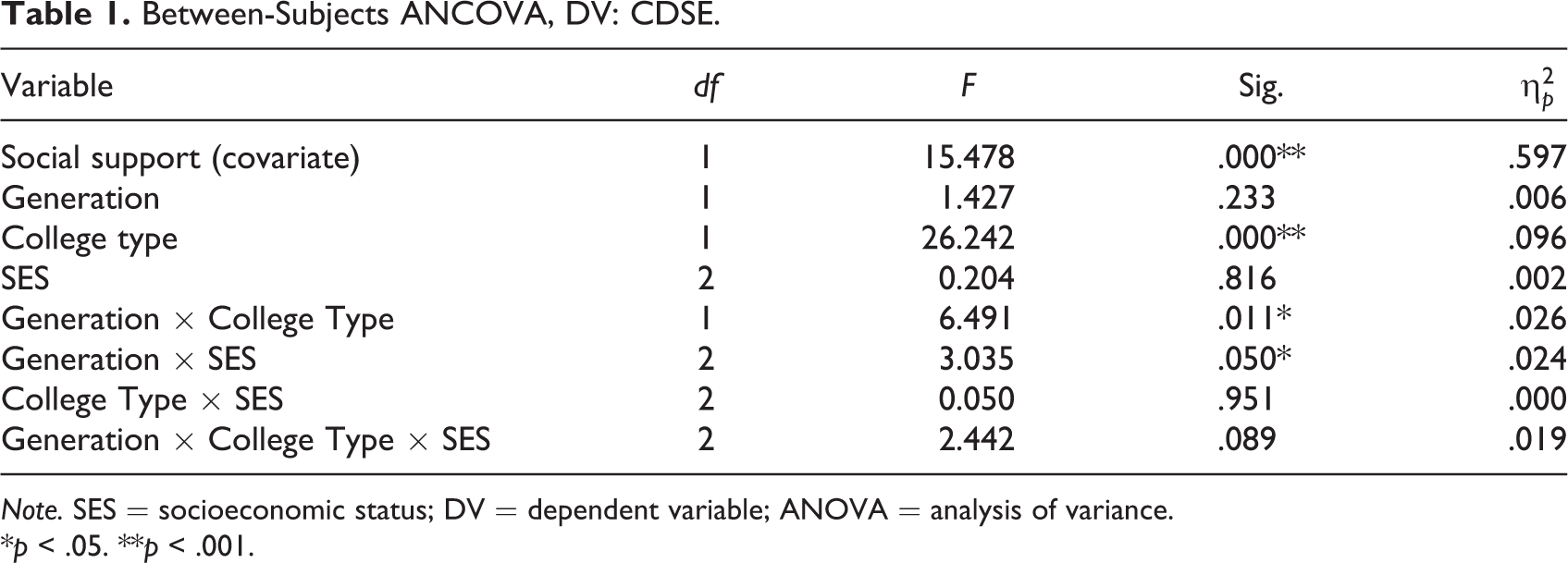
Results of the ANCOVA for CDSE revealed no effect for generation alone, but a significant interaction effect for generation by college, F(1, 261) = 6.49, p < .05 (see Table 1). Mean scores were lowest for nonfirst-generation baccalaureate (M = 86.53) students and highest for nonfirst-generation community college students (M = 100.91). Higher scores indicate higher levels of CDSE. The effect size for the interaction between generation and college was small at
Between-Subjects ANCOVA, DV: CDSE.
Note. SES = socioeconomic status; DV = dependent variable; ANOVA = analysis of variance.
*p < .05. **p < .001.
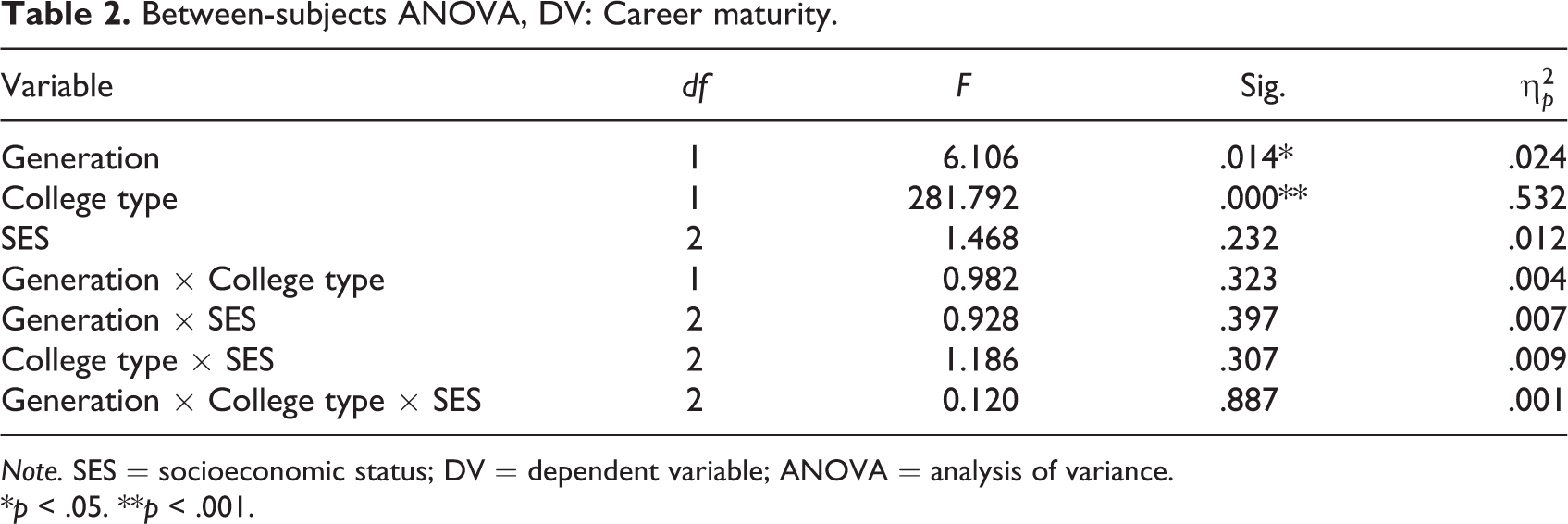
The ANOVA for career maturity revealed a significant main effect for generation, F(1, 261) = 6.10, p < .05 (see Table 2), with first-generation students (M = 36.39) reporting lower mean scores than nonfirst-generation students (M = 37.73). Higher scores indicate higher levels of career maturity. This effect was also small at
Between-subjects ANOVA, DV: Career maturity.
Note. SES = socioeconomic status; DV = dependent variable; ANOVA = analysis of variance.
*p < .05. **p < .001.
While there were no main effects for SES on either CDSE or career maturity, there was a significant interaction effect for generation by SES, F(2, 261) = 3.03, p < .05, on CDSE. First-generation students reporting high levels of SES (M = 88.34) indicated lower levels of CDSE than first-generation students reporting low (M = 94.31) or moderate (M = 91.81) levels of SES. Mean scores for first-generation students in the high SES category were also lower than those of nonfirst-generation students in all SES categories (low: M = 91.46, moderate: M = 91.93, and high: M = 97.79). This finding represented a small effect at
Discussion
Based on similarities between first-generation and community college students in the literature with regard to lack of academic preparation, lack of social support, and high perceived barriers to success (Davies & Casey, 1999; Jehangir, 2010; Mehta et al., 2011), these groups were expected to report similar levels of CDSE and career maturity. Community college and first-generation students were expected to have lower levels of CDSE and career maturity than baccalaureate students and nonfirst-generation students. While results showed that first-generation community college students and first-generation baccalaureate students reported similar levels of CDSE, first-generation community college students reported higher levels of CDSE than nonfirst-generation baccalaureate students. This finding is somewhat inconsistent with previous studies in which community college students indicated low levels of CDSE (Luzzo, 1993) and a lack of occupational information (Olson & Matkin, 1992; Simon & Tovar, 2004), which is a component of CDSE. While the reason for this difference is not apparent in the current study, one might speculate that nonfirst-generation baccalaureate students may enter college with less clearly defined career goals than community college students who are expected to complete their studies in half the time required for a bachelor’s degree. This may leave baccalaureate students in general feeling less efficacious in making career decisions. In addition, perhaps as suggested by Jehangir (2010), first-generation baccalaureate students experience greater levels of intrinsic and extrinsic motivation to be the first in their families to succeed in college than nonfirst-generation students, leading to greater motivation to establish career goals. It is worth noting that these scores are based on self-report and therefore reflect individually perceived rather than actual abilities, therefore the difference in scores between nonfirst-generation baccalaureate students and others groups could be the result of differing impressions of personal self-efficacy.
First-generation students in both settings reported lower levels of career maturity than nonfirst-generation students, with baccalaureate students reporting significantly lower levels. While there were statistically significant differences between groups, all groups indicated that they would be somewhat prepared to engage in college planning activities. While this finding generally appears consistent with the lower levels of integration and academic and career preparation reported by first-generation students in previous studies (Dennis et al., 2005; Jehangir, 2010; Owens et al., 2010), the reason for lower baccalaureate student scores is unclear. As with CDSE, baccalaureate students may feel less pressure to engage in career exploration at an early stage in their academic careers, which could lead to a lesser degree of career readiness or occupational knowledge. In addition, while the impact of work experience on CDSE and career maturity was beyond the scope of this study, 54% of community college students in the current sample reported working more than 20 hr per week while attending classes, in comparison to only 16% of baccalaureate students who reported working a similar number of hours. Since work experience has been associated with higher levels of career maturity in previous research (Creed & Patton, 2003; Flouri & Buchanan, 2002), this variable should be explored further in order to assess for a relationship with CDSE and other career-related constructs.
Contrary to Hypotheses A and B, when controlling for social support, nonfirst-generation baccalaureate students reported lower levels of CDSE than first-generation baccalaureate and community college students. While many factors could account for the differences found between community college and baccalaureate students, a difference in social support does not account for the variance in scores on CDSE. Perhaps perceived barriers to success, which were indicated in the literature as possible contributors to both CDSE and career maturity (i.e., Dennis et al., 2005; Gibbons & Borders, 2010), could be examined as a covariate in future research to better illustrate the differences between both first-generation and nonfirst-generation and baccalaureate and community college students. In addition, the lack of academic preparation and low completion rates found by Bailey, Jenkins, and Leinbach (2005) among community college students were expected to contribute to lower levels of CDSE, as they may interfere with completing academic and therefore career goals, yet community college students reported the highest levels of CDSE in this study. Lack of preparation and other variables related to academic self-efficacy should also be examined further within the community college population to determine whether they have a relationship with CDSE and career maturity.
Furthermore, additional aspects related to the differences between baccalaureate and community college students on CDSE and career maturity should be explored further. One possible factor that may affect both of these variables is career clarity. Since all of the students in this study were in the first 2 years of their education, the baccalaureate students may have spent less time considering their future career path than the community college students who would be graduating in the near future. Several major courses of study found in universities, such as psychology, which represented about a third of this baccalaureate sample, do not necessarily present students with a clear vocational path the way professional programs offered at community college such as nursing or culinary arts (which were represented about 35% of this community college sample) do. This might also leave students with less developed career goals that could impact career maturity and CDSE.
Finally, first-generation students coming from high-SES backgrounds reported the lowest levels of CDSE. It is difficult to speculate why this group would experience lower levels of CDSE than low or moderate SES groups. While career-related research findings on SES have been inconsistent, studies that have found a statistically significant relationship between career constructs and SES have generally found a positive relationship between these variables (i.e., Hsieh & Huang, 2014; Thompson & Subich, 2006), unlike the negative relationship found in the current study. There are several unmeasured factors that could influence first-generation students from high-SES backgrounds. These could perhaps include social pressure to attend college, whether interested or not, or perhaps hesitancy to use career services due to a lack of understanding of world of work, since baccalaureate students in this study reported working less than community college students. These factors may indicate both a lack of motivation in forming career goals and in acquiring occupational information, which are both components of CDSE. Perhaps a qualitative study that examined the concerns and career decision-making histories of first-generation students reporting high SES could shed light on career goals and motivation to attend college. In addition, these findings should be replicated to determine whether or not these results are idiosyncratic to the current sample, given particularly small cell sizes, or whether they are related to other characteristics of this unique group. Hsieh and Huang suggested that inconsistency in the way in which SES is measured may lead to mixed results in the study of this variable. Since “high” SES in this study was designated as a household income over US$60,000/year, the upper limit of this category is unknown, and the range between participants in this group could be potentially broad, representing important differences in supportive resources. Given these limitations, this result should be interpreted with caution. Further exploratory research is needed in order to determine how SES might affect the career decision-making process and whether or not SES may act as a moderator of other important career variables.
Another limitation of this study may be the way in which “first generation” was defined. In the current study, first-generation students were defined as those who indicated that their parents had never enrolled in college. Past studies on first-generation students have presented vague descriptions of this concept. Definitions in other studies have varied from having parents who never attended postsecondary education to having parents who may have attended but never graduated from college. This difference in the way that first-generation students are operationalized between studies makes comparing results difficult. In addition, community college students can vary broadly in academic background, goal, and purpose, making it difficult to generalize students in the current study to those with significantly different career histories and goals.
Finally, the decision to attend either a community college or university is dependent upon several factors. The current economy and job market can have a powerful impact on one’s career decision-making. Therefore, a study of community college students could produce varying results depending upon the current economic climate. At the time of this writing, the job market is particularly limited and the cost of a baccalaureate education increasingly expensive. These factors may have an impact on who is attending community college and could also impact how structured or focused a student is when exploring potential careers.
Conclusion
Although all groups in this study reported generally adequate levels of both CDSE and career maturity, first-generation students reported lower levels of career maturity than nonfirst-generation students, and nonfirst-generation baccalaureate students reported the lower levels of CDSE than other groups. This may indicate that these groups might benefit from additional career development programming, such as greater exposure to occupational information, guidance in goal setting, and increased self-exploration. Contrary to previous research (i.e., Luzzo, 1993), results demonstrated that community college students possess adequate to high levels of CDSE and career maturity compared with baccalaureate students. Whether this is due to variables/characteristics unique to community college students or to the nature of community college programs is unknown. Further exploration of community college students and the community college experience, in relation to career planning and development, would be helpful in providing guidance counselors and prospective college students with more information.
Footnotes
Declaration of Conflicting Interests
The author(s) declared no potential conflicts of interest with respect to the research, authorship, and/or publication of this article.
Funding
The author(s) received no financial support for the research, authorship, and/or publication of this article.