







Abstract
This longitudinal study addresses the role of support given by parents and peers during the transition from university to work life. A sample of 64 German university students in their last year at the university completed scales from the Network of Relationships Inventory regarding general support, namely, instrumental aid and intimacy with mothers, fathers, romantic partners, and friends. Four years later, they assessed domain-specific support when looking for work, namely, joint exploration and instrumental support. Participants perceived receiving both types of support from all significant others. However, joint exploration was more important than instrumental support. They felt especially supported by romantic partners. Women received more support than did men. Both types of domain-specific support were explained by general modes of support assessed 4 years earlier. Whether parents, friends, and partners were perceived as helpful during the transition was explained mainly by joint exploration. Again, support from a partner was seen as especially helpful in contrast to help from parents and friends. The special significance of joint exploration underlines the benefit of counseling at the transition from university to work life.
Background
The successful transition to work life is a major challenge during the period of early adulthood, particularly for a growing number of young adults spending a prolonged period pursuing higher education leading to qualified professions. The significance of the transition to work is evidenced by effects on young people’s well-being (Aseltine & Gore, 1993; Buhl, 2007; Haase, Heckhausen, & Silbereisen, 2012; Nurmi & Salmela-Aro, 2002; Shulman & Ben-Artzi, 2003). The increase in well-being due to the transition into work is seen as an indicator of the peculiar stress associated with the transition, namely, the pressure of career choice with uncertain success, which swiftly stops once young people have found a job (Kenny & Sirin, 2006). Obviously, stress should be particularly pronounced in times of high unemployment rates. At the time when the present study was conducted, the unemployment rate for young people under the age of 25 was 11.7% in Germany. This is a typical situation for young people in many industrial democracies. Unemployment rates for young adults in several European countries are even higher than in Germany, such as in the Czech Republic (20.4%), Finland (20.8%), and Italy (23.5%; Organisation for Economic Co-operation and Development, 2005). Following the cognitive–relational model of stress, among others, whether a stressor leads to psychological stress depends on the availability of resources (e.g., Lazarus & Folkman, 1984). Social resources are especially important for career development (Metheny & McWhirter, 2013; Shulman, Kalnitzki, & Shahar, 2009).
The topic of this article is the support of mothers, fathers, friends, and romantic partners given to emerging adults during the transition from university to work life. Most previous research addressing the transition from education to work has focused on adolescents. Several studies (e.g., Heckhausen & Tomasik, 2002; Kracke & Schmitt-Rodermund, 2001) have investigated youth as they left school and entered apprenticeships. They showed that there is substantial variation concerning the extent to which adolescents actively approach the transitional challenge in that they explore their own interests and competencies, try to gain a realistic idea of different areas of work as well as job prospects, and aim at balancing their individual profiles and the contextual conditions they meet. Still, occupational exploration is not a solitary activity. While young people attribute an important role in this process to themselves, they also point to people in their social context—and their parents in particular—as important sources of support (Hardgrove, McDowell, & Rootham, 2015). The few studies that addressed the role that parents play in the transition of adolescents to work life showed that, for instance, parents who adhere to authoritative child-rearing strategies and who care for parent–child relationships characterized by mutuality provide a fostering context for adolescent exploration (Grotevant & Cooper, 1987; Kracke, 1997, 2002). Thus, aspects of parent–child relations and family interactions that have been pointed to as being crucial for adolescents’ adaptation in a general sense also positively affect the school-to-work transition (Bryant, Zvonkovic, & Reynolds, 2006; Otto, 2000; Whiston & Keller, 2004). At the same time, domain-specific supportive activities, such as helping sons and daughters to write job applications or pointing out qualities of specific occupations, are also of high importance. In addressing parental support, it seems to be important to distinguish instrumental help in a narrow sense and to have discussions providing information and opportunities for self-reflection (Dietrich & Kracke, 2009). Both are highly correlated and are seen by adolescents as being about equally important sources of support.
It remains an open question whether the findings addressing adolescents’ transition to work can easily be extrapolated to young adults leaving the university. Young adults have more mutual relations with their parents and should be, at least to some extent, more independent in their approach to developmental challenges as is the case for adolescents (e.g., Arnett, 2004; Bucx & van Wel, 2008; Smollar & Youniss, 1989). However, parents still are known to give advice up to the fourth decade of their child’s life (Cooney & Uhlenberg, 1992; Nydegger & Mitteness, 1996). Regarding the college-to-career transition of young people between 22 and 25 years, they felt especially supported in decision-making by their mothers (Murphy, Blustein, Bohlig, & Platt, 2010).
Beside parents, peers might play a more important role in the occupational transition of young adults. Friends already play some role in adolescents’ occupational exploration (Kracke, 2002). However, their influence does not parallel parental impact. Given the particular life situation of young adults studying at the university, friends might be even more influential (cf. Felsman & Blustein, 1999). This is particularly true of romantic partners because steady relationships can be assumed to be far more prevalent in this age-group when compared to adolescents (Buhl, 2009; Lanz & Tagliabue, 2007).
For support in general, it can be expected that women receive more support than men (A. S. Rossi & P. H. Rossi, 1990). Indeed, in a U.S. sample of high school students, girls perceived more support than did boys (Paa & McWhirter, 2000). Also, among university students from the United States answering questions about career identity development, females reported higher degrees of parental support for their career than did males. However, there were no gender differences in the importance of parental support for career identity evaluation as well as career decision self-efficacy (Stringer & Kerpelman, 2010). Because our investigation was conducted in Germany as a comparable Western society, we also expect the widespread Western pattern of higher support for women than for men (cf. Laursen, Wilder, Noack, & Williams, 2000).
Research Questions and Hypotheses
It could be assumed that similar processes drive the adolescent and early adult transition to work life. However, this assumption is quite speculative, given the lack of studies addressing the mastery of the transition in early adulthood. Although longitudinal studies that could shed light on the transition in adolescence are rare, they are virtually nonexistent when it comes to early adulthood. The present research sets out to longitudinally explore young adults’ transition from university to work. Particular interest is paid to the role that parents play in this process compared to peers and romantic partners. With these potentially relevant others, general aspects of relationship quality as well as domain-specific support are considered.
Our first objective is mainly descriptive. We want to examine to what extent domain-specific support of the transition to work varies depending on the different relationship types considered, namely, relations with mothers, fathers, best friends, and romantic partners. We expect that:
Following the research on gender differences, it can be assumed that:
Moreover, variations in support depending on age are investigated. As the spatial distance between young adults and their parents determine the opportunity of instrumental support, we have controlled for it. We therefore hypothesize that:
The second objective of the study aims to better understand associations between generally supportive aspects of the relationships of concern on the one hand and aspect of help that are specific of the transitional situation on the other hand. Does a general tendency to provide instrumental aid or verbal intimacy translate into specific support given in the exploration process and the search for a job? We assume that:
The third objective is to explore to what degree general and domain-specific support predict young adults’ perception of others as having been helpful in their transition.
Method
Participants
A total of 102 young adults participated in a questionnaire assessment about 1 year before the completion of their studies at universities (T1) in two cities located in East and West Germany, respectively. In all, 60.8% of the participants were from East Germany and 39.2% were from West Germany. Both universities were located in large-sized cities and were comparable regarding student number and course offering.
The follow-up assessment (T2) was conducted 4 years later, involving 64 of the initial participants. The present study is based on this longitudinal sample. Four participants were still studying and 60 had meanwhile successfully graduated. Due to our interest in support during the transition into work life, only those participants who had reported being employed were included in the following analyses. Therefore, a further nine participants still unemployed or in retraining were excluded. Thus, the final sample comprised 51 participants. The 51 excluded participants and the 51 included participants did not differ in age, t(100) = 1.49, p = .14, gender, χ2(1, N = 102) = 0.04, p = .84, or personality (Big Five and social competence multivariate analysis of variance [MANOVA]), F(6, 95) = 0.67, p = .67. Of the final sample, 32 (62.7%) were women, and 66.7% were from East Germany. Age range at T1 was 22–30 years (M = 25.06, SD = 2.14) and at T2 26–34 years (M = 28.51, SD = 2.14).
Eight young adults lived in the same house as their parents (T2: four), four lived in the same city (T2: nine), and another 17 lived less than 1 hr away (T2: 14). Regarding their marital status, at T1, 3 participants were married, 36 were single but living with a partner, and 12 reported having no romantic relationship at the moment. At T2, 7 were married, 31 were single with a partner, 1 was divorced and living with a new partner, and 12 had no romantic relationship.
There is quite a high consensus between this sociodemographic information and the number of participants reporting relationship quality regarding a partner (n = 40). Of the participants, 49 reported having a supporting friend. Regarding longitudinal analyses, only those participants with a stable relationship (i.e., the same friend/partner at T1 and T2) were considered (friend n = 41, partner n = 26).
Measures
At T1, besides sociodemographic information, the questionnaires captured general aspects of support. At T2, domain-specific support was asked directly related to the transition to work.
At T1, general support from mother, father, partner, and best friend were assessed with subscales from the Network of Relationships Inventory (NRI; Furman & Buhrmester, 1992). The NRI was originally developed in English to assess social provision. It had already been used in a translated German version for earlier studies (e.g., Noack & Buhl, 2004, with Cronbach’s αs > .70). Formulations were adapted slightly for adult participants (Wittmann, Helm, Buhl, & Noack, 2000). The subscales consisted of 3 items each and were responded to using 5-point Likert-type scales (1 little or none to 5 extremely much). The scale intimacy (e.g., “How much do you share your secrets and private feelings with this person?”) addressed disclosure. The instrumental aid scale assessed the frequency of getting help in general (e.g., “How often does this person help you when you need to get something done?”). The internal consistencies of both scales were high (Cronbach’s αs > .80).
At T2, the participants were asked about the time between T1 and T2 when they were looking for work. This domain-specific support from significant others was assessed employing an instrument developed by Kracke (2002; with Cronbach’s αs > .80). Factor analyses starting with 12 items resulted in two scales for mother, father, partner, and friend, respectively: Instrumental support with the 3 items: “help looking for job offers”; “help looking for jobs or traineeships”; “practical aid, e.g., car ride to a job interview” (for all relationship types Cronbach’s αs > .75), and Joint exploration with the 3 items: “talks about pros and cons of a job”; “to reassure for further applications after abortive job application”; and “shared consideration of which position might be good for me” (for all relationship types, Cronbach’s αs > .75). Responses were given on 5-point Likert-type scales (1 = not at all helpful to 5 = very helpful). Correlations between the two scales were quite high. (For the different relationship types, r between .54 and .66.)
Finally, at T2, the participants evaluated the helpfulness of mother, father, partner, and friend in the transitional process using single-item measures (range 1 not at all helpful to 5 very helpful).
Procedure
The investigation was part of a more comprehensive investigation (cf. Buhl, 2007; Buhl, Wittmann, & Noack, 2003). At T1, the participants were recruited via local newspapers and announcements. Interested persons were asked to participate in a study regarding the relationship between adults and their parents. They were informed that it would take about 30 min to complete a questionnaire. Additionally, participants were informed that their participation was voluntary, that all the data collected would be confidential and anonymous, and that they were free to withdraw at any time without penalty. A code was used to relate the data of the first and the second measurement point.
The participants were interviewed on biographical transitions and received a questionnaire afterward. For the current analyses, only scales included in the questionnaire were used. The participants agreed with being contacted later in order to realize a second measurement point and gave us their contact data. At T2, again, all of the participants were contacted. However, we were not able to reach all participants, and some were not interested in additional participation.
Data Analysis
In order to test the group and within comparisons expressed in the first block of research questions (H1 and H2), MANOVAs of variance were conducted. The question of age and spatial distance effects (H3) were answered with correlations and are part of the following regression analysis. To answer the second and third research question about the prediction of domain-specific support (H4) and perceived helpfulness (H5), correlations and regression analyses were conducted. For all analyses, the level of significance was set at p < .05.
Results
Variations in Support During the Transition to Work
To test H1, the first set of analyses addressed domain-specific support on the part of parents, friends, and romantic partners in the transition from university to work life at T2. Table 1 shows means and SDs for instrumental support and joint exploration by the four relationship types addressed.
Means and Standard Deviations of Domain-Specific Support Concerning Entrance to Work Life Given by Mother, Father, Partner, and Friend Assessed at T2.
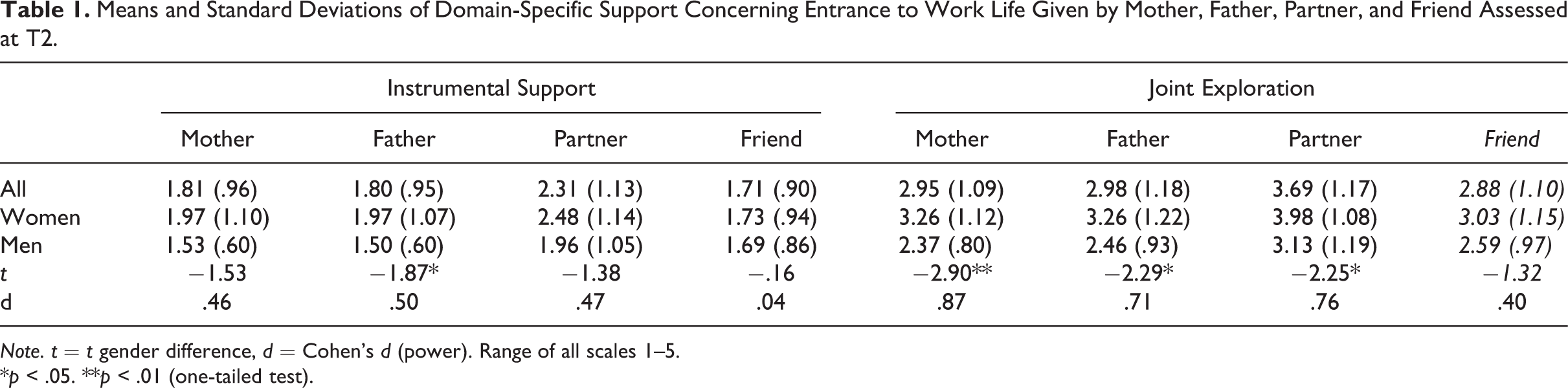
Note. t = t gender difference, d = Cohen’s d (power). Range of all scales 1–5.
*p < .05. **p < .01 (one-tailed test).
MANOVAs with support types (instrumental support, joint exploration) as dependent variables, gender as independent variable, and relationship type (mother, father, partner, and friend) as a within-subject factor revealed significant effects of relationship type and gender, p’s (F) < .05, relationship type η2p = .51, gender η2p = .21. There were no significant interactions (Relationship Type × Gender η2p = .09). In the follow-up analyses, this finding held for both dependent variables. A series of t tests for dependent samples showed that participants felt most supported (instrumental support as well as joint exploration) by their romantic partners, p’s (t) < .05. Mothers, fathers, and friends did not differ in the extent of support provided, p’s (t) > .15.
Following the gender effect formulated in Hypothesis 2, women reported more instrumental support by fathers than did men, and they reported having experienced more joint exploration with mothers, fathers, and partners than did men (cf. Table 1).
Regarding H3, findings concerning age-specific variations were mixed. Correlations of age and support were small (r < .20) and insignificant for partners and friends. However, as assumed, with increasing age, participants reported less joint exploration with their parents: mother r = −.27* and father r = −.31*.
Spatial distance to parents did not make any difference concerning joint exploration and instrumental support given by fathers but did regarding instrumental support from mothers, F(2, 32) = 4.94, p < .05, with higher values in nearer relationships (same house/same city M = 2.29, SD = .87, followed by less than 1 hr away M = 1.85, SD = .84, and more than 1 hr away M = 1.42, SD = .39).
Furthermore, an examination of means revealed differences between the two types of domain-specific support, MANOVA F(4, 36) = 24.98***, η2p = .76, with significant univariate differences for all relationship types (all η2p > .50). Deviating from findings in adolescent samples, the young adults reported higher rates of joint exploration than of instrumental support during the transition.
Relationship Quality as a Predictor of Support When Entering Into Work Life
Regarding Hypothesis 4, we then addressed the influence of general support while studying (T1) on domain-specific support during the transition from university to work life (assessed at T2). In a first step, bivariate correlations were calculated. Instrumental support as well as joint exploration during the transition to work life went along with general instrumental aid and intimacy reported at T1. Correlations between general and domain-specific support were higher in parent–child dyads than in friend and partner dyads. In child–mother and child–father dyads, all correlations were significant, with r > .30, with the exception of the correlation between T1 intimacy and T2 instrumental support in both dyads, and the correlation between T1 intimacy and T2 joint exploration in child–father dyads.
By contrast, in child–friend dyads, only the correlations between T1 instrumental aid and T2 instrumental support, as well as T1 intimacy and T2 joint exploration, were significant, with r > .30. Regarding the child–partner dyads, only T1 instrumental aid and T2 joint exploration correlated in a significant manner, with r = .49**.
For all four dyads, instrumental aid and intimacy were considered as predictors of both types of specific support during the transition in the following multiple regression analyses. Age and gender of the participants were included as control variables. Joint exploration could be better explained than instrumental support. There were significant models for joint exploration with mother, father, and friend. While age did not predict domain-specific support in any relationship, gender was a relevant predictor: As seen earlier, the degree of joint exploration with mother and father was higher for women than for men.
Instrumental aid as generally provided support (T1) predicted joint exploration even better than did domain-specific instrumental support by both parents. Verbal intimacy with the parents did not significantly add to the explanation of instrumental support or joint exploration.
Domain-specific support given by romantic partners and friends was not explained well by the T1 predictors. Again, instrumental aid was the best predictor for joined exploration with a partner. By contrast, intimacy predicted joint exploration in the friendship relationship. Regression coefficients and explained variances are shown in Table 2.
Multiple Regressions Predicting Domain-Specific Support at T2 by General Support at T1 (βs and Explained Variances).
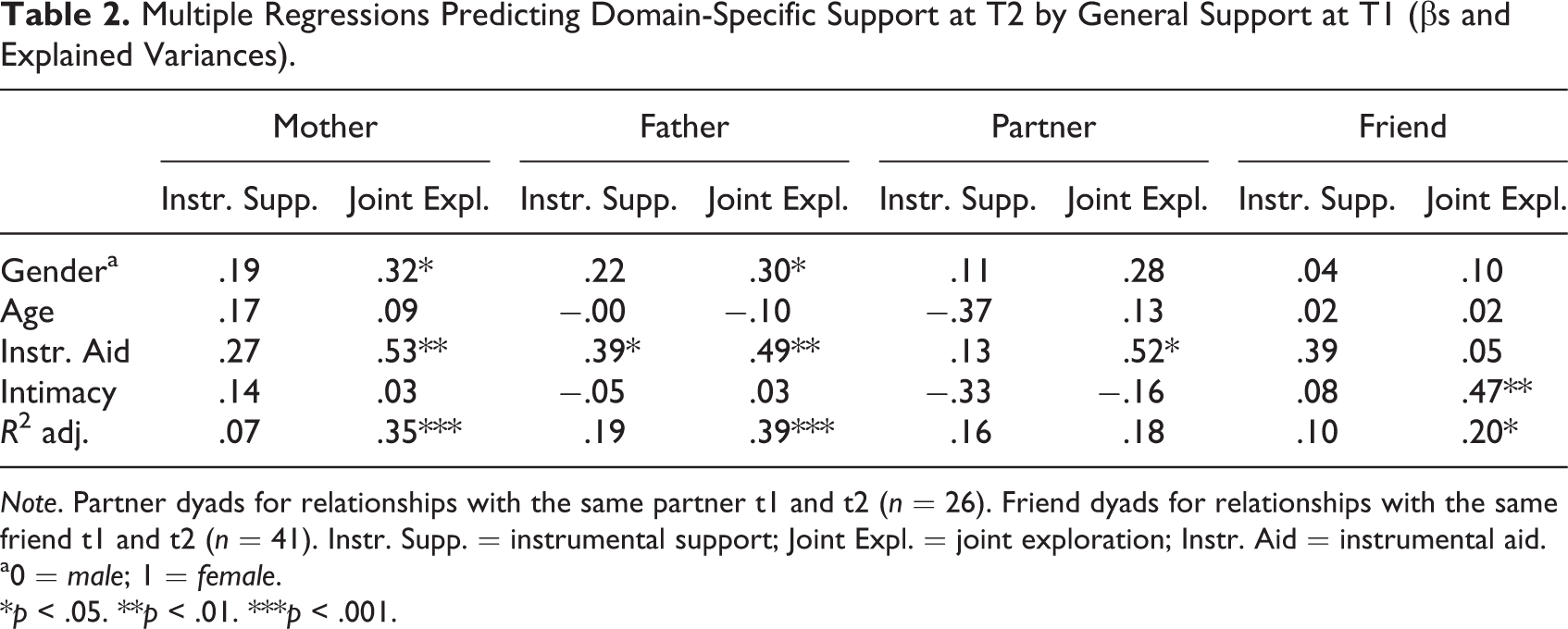
Note. Partner dyads for relationships with the same partner t1 and t2 (n = 26). Friend dyads for relationships with the same friend t1 and t2 (n = 41). Instr. Supp. = instrumental support; Joint Expl. = joint exploration; Instr. Aid = instrumental aid.
a0 = male; 1 = female.
*p < .05. **p < .01. ***p < .001.
Perceived Helpfulness
Finally, our study addressed how helpful young adults perceived significant others for finding a job. The examination of differences between significant others revealed an overall effect, F(3, 31) = 5.49**, η2p = .35. This is caused by the outstanding relevance of the romantic partners: The participants perceived their partners as being particularly helpful in the transition to work (M = 4.15, SD = 1.05). Mothers, fathers, and friends did not differ in this respect, Mother M = 2.92, SD = 1.13, Father M = 2.96, SD = 1.35, Friend M = 3.03, SD = 1.06, all p’s (t) > .6.
The perceived helpfulness went along with T2 instrumental support and T2 joint exploration in times of job search as well as T1 instrumental aid 4 years later, as shown by significant correlations (all r = .40–.81), with the exception of T1 instrumental aid from the friend, with r = .13. Regarding the father, intimacy at T1 was also correlated with his helpfulness (r = .34).
In order to test Hypothesis 5 regarding the assumed effects on perceived helpfulness, hierarchical multiple regressions were calculated with the T1 measure of instrumental aid and intimacy in the first step, followed by instrumental support and joint exploration assessed at T2. Table 3 shows the regression coefficients and explained variances of both models. With all relationship types (mother, father, partner, friend), analyses yielded significant increases in R2from Step 1 to Step 2. Instrumental aid did not emerge as a significant predictor above and beyond T2 measures. Its influence was fully mediated by the domain-specific support variables, particularly by joint exploration, which was a significant predictor in each of the analyses. Instrumental support did not significantly contribute to the prediction of perceived helpfulness.
Multiple Regressions Predicting Helpfulness by General Support at T1 and Domain-Specific Support at T2 (βs and Explained Variances).
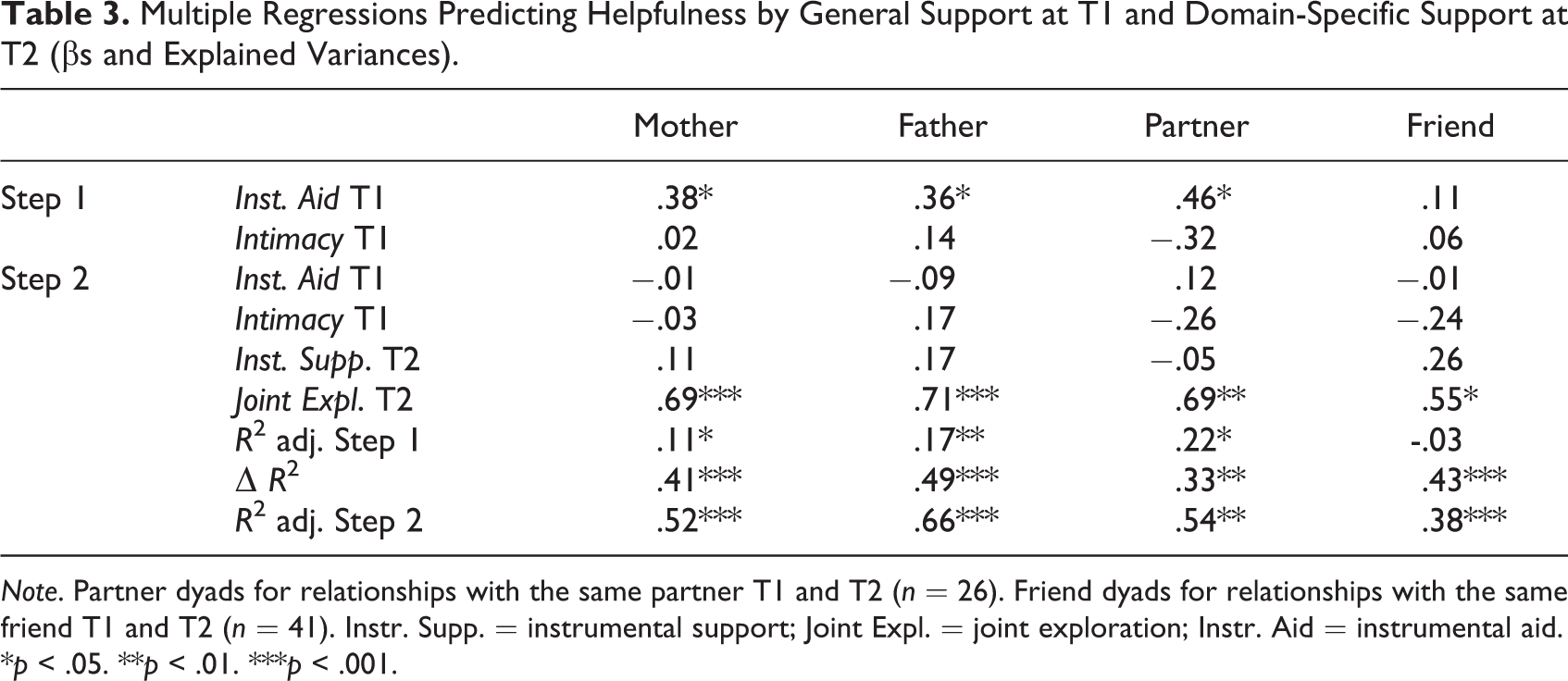
Note. Partner dyads for relationships with the same partner T1 and T2 (n = 26). Friend dyads for relationships with the same friend T1 and T2 (n = 41). Instr. Supp. = instrumental support; Joint Expl. = joint exploration; Instr. Aid = instrumental aid.
*p < .05. **p < .01. ***p < .001.
Discussion
The present study set out to examine the role that significant others play in the transition of university students to work. With an emphasis on career development, we can offer insights into the less investigated step from university to work life in emerging adulthood. The impact of important others can be substantiated from general to domain-specific support at an important transition from a relational psychological point of view.
The focus was on young adults’ parents who were shown to influence adolescents’ occupational development in earlier studies and on friends and romantic partners who were assumed to figure more prominently in adulthood transitions. In our analyses, we distinguished general modes of support on the one hand and joint exploration and instrumental support as instances of domain-specific support on the other hand. With the first hypothesis, we assumed that young adults see their peers as more important than their parents in the transition from university to work life. Our findings show that parents remain important sources of help throughout the mastery of the transition to work life in the third decade of life. However, peers seem to be equally important in this transition. Partially in line with the hypothesis, romantic partners exceeded the parents’ and friends’ rank in the eyes of young adults.
With all significant others, joint exploration was described as the more common type of support when compared to instrumental support. This finding suggests differences in the sources of influence during early adulthood when compared to adolescence. While in the second decade of life, both types of support are typically described as being equally important (Dietrich & Kracke, 2009), young adults seem to receive more support in terms of joint exploration than by way of instrumental support. It is plausible that they simply no longer need practical help, such as looking for job offers or a car ride to a job interview. This goes along with the different types of autonomy seen by Noom, Dekovic, and Meeus (2001; cf. Beyers, Goossens, Vansant, & Moors, 2003). While earlier studies only focus on the parents (e.g., Stringer & Kerpelman, 2010), our results show that the subjective prevalence of joint exploration exceeds the importance of instrumental support in friendship and romantic relationships as well. For the same reason, perceived helpfulness of significant others in the transition was clearly highest concerning romantic partners. It should be noted, however, that even in early adulthood, mothers and fathers are seen to helpfully contribute to the mastery of the transition to work.
Besides different types of relationship, there are also differences between young adults themselves. As a prominent differentiation, we considered the effect of gender. Following the line of support in relationships in general, and results concerning high school and college-age participants, with the second hypothesis, we assumed that women receive more support than men. This assumption was confirmed. However, this cannot be generalized to other countries and especially to other cultures. Regarding students from different ethnic groups living in more collectivistic or traditional cultures, or even regarding special academic fields (e.g., technology or engineering), the picture may differ (cf. Fouad et al., 2010; McWhirter, 1997; Otto, 2000; Shinnar, Giacomin, & Janssen, 2012).
With the third hypothesis, we assumed that parental support decreases with increasing age of the young adults and spatial distance between adult children and parents. Indeed, joint exploration with both parents, but not instrumental support, which is already weak during early adulthood, decreases with age. Regarding spatial distance, the only relation was with instrumental support from mothers. Modern possibilities of communication reduce the influence of spatial proximity.
As expected in the fourth hypotheses, analyses revealed a strong continuity between others’ general modes of support and domain-specific activities. This is not a trivial finding. It has to be kept in mind that general support was measured about 1 year before graduation (T1), whereas assessments of domain-specific involvement of others took place 4 years later (T2). Continuity was particularly strong for earlier instrumental aid. It is an interesting result that joint exploration with both parents and with a partner could be better predicted by generally given instrumental aid than by verbal intimacy. The assumed correlation between general instrumental aid at T1 and domain-specific instrumental support at T2, as well as between intimacy at T1 and domain-specific joint exploration at T2, was found for friendship relationships only. To understand these differences, it might be helpful to know more about mode and topic of joint exploration with parents, friends, and partners.
Finally, in line with the fifth hypothesis, there are domain-specific aspects of support, in particular, which account for the perceived helpfulness of significant others. Domain-specific support fully mediates associations between instrumental aid reported before graduation and helpfulness of others evaluated in retrospect. Interestingly, joint exploration, in particular, contributes to the explanation of helpfulness. This finding underscores, again, the crucial role that context-facilitating exploration plays in the transition from education to work. Earlier findings addressing the parental impact on the school-to-work transition during adolescence already suggested the beneficial effects of interactions fostering occupational exploration (Grotevant & Cooper, 1987; Kracke & Schmitt-Rodermund, 2001).
Several limitations of our study have to be acknowledged. Clearly, the small size of our sample, especially regarding partner and friendship relationships, places limits on the generalizability of the findings. Replications employing larger and more diverse samples are necessary. Simultaneously, we focused only on a small segment of resources. Following the social–cognitive theory of career development (Lent, Brown, & Hackett, 1994), more aspects of support, as well as social cognitions and personality, should be considered. For example, Rogers and Creed (2011) showed their impact on career planning and exploration.
Moreover, the longitudinal nature of the study allowed for the distinction of early general factors of support (T1) from domain-specific help in the process of transition, but it has to be kept in mind that the latter variables were only assessed by way of young adults’ retrospective reports. To a certain extent, this feature of the study could have contributed to the associations found. Likewise, we had to rely on only young adults’ self-reports in our analyses. Parental reports on domain-specific support correlated moderately with corresponding young adults’ reports, thus providing some evidence for the validity of young adults’ accounts. As parental reports on further aspects considered were missing and peers were not included in the study, we had to decide on drawing on one source of information only.
Future research should capture young adults’ exploratory behavior and decision-making because we have only elucidated the linkage between perceived support and judgments as to the helpfulness of others in the process. A study examining the mediating processes would clearly extend our understanding and also promise to clarify more objective consequences of support. At the same time, we know comparably little about the role played by peers and romantic partner, in particular in early adults’ transition to work. Despite the limitations of our study, our results are suggestive of important influences on the part of romantic partners. We think that their contribution to a successful transition calls for detailed exploration.
Given the limited evidence so far, we consider our study as an encouraging step toward an understanding of the role of significant others in adults’ transition from university to work. We could provide some evidence for the continued impact of parents after the end of adolescence. Moreover, our study is suggestive of the increasing importance of romantic partners in mastering major biographical challenges during this period of life. With an interest in social resources to help cope with transitional stress, the results underline the relevance of the difference between types of support. In contrast to adolescents who need instrumental help as well as joint exploration (Dietrich & Kracke, 2009), young adults perceived joint exploration as an outstanding part of social resources. A further implication of the results is a practical one. As the results indicate, the special importance of joint exploration underlines the importance of career counseling in the last year of university study and beyond. Unlike in compulsory school, where career counseling is widely offered, in (European) universities, this is a relatively new service offering. This should be of special importance for university students without friends and/or a partner. Additionally, professional counseling might offer deeper insight into job demands and personal fit. The special significance of joint exploration across all types of relationships points to the possibility of counseling to support the self-reflection of those seeking counsel (cf. Hixon & Swann, 1993). It seems to be even more important to offer opportunities to explore than to give information about work environments.
Footnotes
Acknowledgment
We are grateful to Simone Wittmann, Tabea Sporer, and Diana Rieger for their collaboration in this research.
Declaration of Conflicting Interests
The author(s) declared no potential conflicts of interest with respect to the research, authorship, and/or publication of this article.
Funding
The author(s) disclosed receipt of the following financial support for the research, authorship, and/or publication of this article: This research was supported by a grant of the German Research Foundation (DFG) for the project “Adults and their Parents” (BU 1145/2, principal investigators: H. M. Buhl and P. Noack).