






Abstract
Students of Korean cultural backgrounds seek to enter the U.S. workforce, yet they face various career development challenges. One challenge is building relationships and engaging in career networking, a crucial career development skill. Also, work values are often explored in practice, but little information exists about how work values influence networking behavior for students with Korean cultural background. This study examined the relation of intrinsic and extrinsic work values and career networking and how planned happenstance mediates these concepts. This study found that planned happenstance mediates intrinsic work and networking, but it does not mediate the relation between extrinsic work value and networking. This study suggests that applying planned happenstance theory to students of Korean cultural backgrounds may help students to expand their professional networks. Also, career intervention programs can be developed with planned happenstance theory and based on assessment of work values.
According to the 2016 Open Doors Report, the total number of international students in the U.S. higher education system has been increasing for the last 10 years. Today, international students represent over 5% of students enrolled in higher education in the United States (Institute of International Education, 2016). Asian nations are among the top five countries of origin for international students, with South Korea being the fourth most common country of origin for international students in the United States. These students bring with them various career development needs (Leong, 1995), such as the need for support in facing language barriers and differences in cultural values (Lin & Flores, 2013). One substantial difficulty the students face is building career networks in the United States, given the differences in cultural norms for building interpersonal relationships (Neuliep, 2017). Career networking is a necessity in students’ repertoire of career skills for effective job searching (Van Hoye, Van Hooft, & Lievens, 2009). Undaunted by this challenge, international students express a strong desire to work in the United States and to receive assistance in exploring and obtaining jobs (Spencer-Rodgers, 2000). More research on career networking for students of diverse cultural backgrounds is needed to better understand the predictors of success for workforce entry. This study represents one such effort to understand how to best facilitate the career development of students of diverse cultural backgrounds, taking college students of Korean cultural backgrounds as its focus.
In recent years, career networking has been highlighted as an essential skill for career success and identified as one of the six career competencies crucial for career development (Kuijpers & Scheerens, 2006). Networking is the process of building contacts and relationships relevant to one’s career (Kuijpers & Scheerens, 2006). Using factor analysis, Forret and Dougherty (2001) identified five types of networking behavior: (1) maintaining contacts, (2) socializing, (3) engaging in professional activities, (4) participating in community activities, and (5) increasing internal visibility. These factors establish networking as a proactive skill related to building and maintaining professional relationships.
Linehan and Scullion (2008) noted that networking provides substantial advantages such as visibility, information exchange, collaboration, alliance development, acquisition of tacit knowledge, and support. Moreover, it has been shown that college students of Korean cultural backgrounds can gain particular benefits from networking. Popadiuk and Arthur (2014) conducted a qualitative study of students in Canada, most of whom were originally from Asian countries, and found that students’ relationships with the host country were crucial in aiding the students’ transitions from university to work. Relationships that facilitate career networking provide students with essential information, such as an understanding of cultural nuances in the job search process (Popadiuk & Arthur, 2014). Unfortunately, international students unfamiliar with American cultural norms may abstain from networking due to cultural misunderstandings and difficulties in understanding cultural nuances (Reynolds & Constantine, 2007), a recognition that can be applied to students of Korean cultural backgrounds.
Value systems of individuals with diverse cultural backgrounds have been widely studied because of the considerable influence these systems exert on overall behavior. It has been suggested that value systems are related to work values and that differences in value systems for individuals of minority cultural backgrounds, when compared to those of majority cultural backgrounds, may affect career behavior (Leong & Hartung, 2003). For example, individuals from cultures with collectivistic value orientations, such as Korean culture, may have career decision-making processes that demonstrate greater attention to their families’ intentions and preferences, rather than on their own personal career intentions, which may result in different career development outcomes (Reynolds & Constantine, 2007). Work values may hold the key to understanding the career-related behaviors of students of Korean cultural backgrounds.
Work values have been found to be associated with job preparation behaviors, such as job search behavior (Maynard & Parfyonoya, 2013), labor market participation (Lobodzinska, 1996), job entitlement (Chow, Krahn, & Galambos, 2014), and career choice (Kalleberg & Stark, 1993; Zytowski, 1994). Multiple studies have classified work values into intrinsic and extrinsic values (e.g., Hirschi, 2010a; Lechner, Sortheiz, Gollner, & Salmela-Aro, 2017). Intrinsic work values are values related to fulfillment from the work itself, such as interest, independence, variety, responsibility, helping others, and leadership (Hirschi, 2010a). On the other hand, extrinsic work values are values related to external factors or outcomes of work, such as high income, leisure time, job security, fast and easy job entry, and prestige (Lofquist & Dawis, 1984).
Evidence suggests that there are career development benefits for individuals who prioritize intrinsic values over extrinsic values. For example, Lee (1997) found that intrinsic work values are positively correlated with career maturity, whereas extrinsic work values are negatively correlated with it. Additionally, intrinsic values have been found to be related to higher achievement and motivation to achieve goals (Roberts & Robins, 2000). However, research has found that extrinsic work values are associated with less satisfaction and dedication to work (Vansteenkiste et al., 2007). For students in particular, work values have substantial effects on career decision-making (Judge & Bretz, 1992) and subsequently on person–job fit (Sortheix, Chow, & Salmela-Aro, 2015). Although work values play a vital role in one’s career development, few studies have been conducted to show how work values influence the career preparation process (Masdonati, Fournier, Pinault, & Lahrizi, 2016), especially among students of Korean cultural backgrounds.
To better understand the relationship between work values and career development in college students of Korean cultural backgrounds, a review of the literature on Korean students is necessary. Choi and colleagues (2013) found that Korean college students’ work values influence their career decision self-efficacy and career decidedness, in that intrinsic values positively influence career decidedness through career decision self-efficacy, while extrinsic values negatively influence career decidedness. However, it has been noted that Korean students living in Korea and Korean students living in the United States may have different work values (Han & McPherson, 2009). During acculturation, an individual’s original value system is likely to be adjusted in light of the host country’s culture, resulting in a unique combination of the two cultural value systems (Berry, 2003). Therefore, it is important to conduct separate studies for the two populations in order to provide career counselors with useful information on working with students of Korean cultural backgrounds.
Happenstance Learning Theory
Happenstance learning theory (Krumboltz, 2009; Mitchell, Levin, & Krumboltz, 1999) suggests that certain psychological resources can help people to turn everyday experiences into “chance events” (Krumboltz, 2011). This theory helps career counselors and clients perceive unforeseen changes as desirable chances that can broaden one’s career potential (Kim, Jung, et al., 2014). The focus of the theory is on self-directed action, rather than reliance on luck or fate (Mitchell et al., 1999) as the theory’s name might suggest. Happenstance learning theory suggests five key components in creating planned happenstance events: curiosity, persistence, flexibility, optimism, and risk taking. These five constructs have been shown to be positively related to other career-related variables such as occupational engagement, career decision self-efficacy (Kim, Jang, et al., 2014), and career aspirations (Yang, Yaung, Noh, Jang, & Lee, 2017).
It is expected that multicultural students face more unpredictability in their career trajectories, since they are entering a new culture with a lack of resources. Happenstance learning theory can help these students build resources such as career networks. College students meet countless new people but rarely develop these encounters into meaningful relationships that might be leveraged for connecting to, or better understanding, the U.S. job market and culture. Happenstance learning theory can be applied to facilitate the creation of chance events from these unplanned encounters, which can increase students’ connection to beneficial resources.
Planned happenstance constructs provide psychological resources for networking. Planned happenstance helps individuals keep their minds open to new events by risking making cultural mistakes, which may lead to new networking opportunities. In other words, individuals take chances in approaching new people and building connections. Networking is one type of career exploration behavior (Van Hoye et al., 2009). Empirical evidence suggests that individuals who report high levels of planned happenstance also show high levels of exploratory behavior (e.g., Kim, Jang, et al., 2014; Yang et al., 2017) and acquire pertinent information for career development through experimental activities (Krieshok, Black, & McKay, 2009).
While a planned happenstance attitude may lead to networking behavior, it is important to note that particular work values may influence whether an individual possesses such a planned happenstance attitude. Since there are countless work values, there has been some effort to classify these work values according to various dimensions. Ros, Schwartz, and Surkiss (1999) suggested the openness—conservation dimension. Openness includes values such as self-direction, stimulation, and hedonism, which are similar to intrinsic values. Individuals with these values emphasize independence, autonomy, and preference for change in their surroundings (Ros, Schwartz, & Surkiss, 1999). On the other hand, conservation is closely related to external values such as security and conformity. Hirschi and Fischer (2013) found a negative relationship between entrepreneurial intentions and conservational values, showing that conservational values may discourage individuals from taking risks. According to Hirschi (2010a), intrinsic values are associated with planfulness and the exploration of career-related behaviors, while extrinsic values are not associated with these behaviors. This indicates that intrinsic values may lead to the positive career behavior of active but planned exploration, while extrinsic values may not. Ultimately, these studies suggest that intrinsic work values may facilitate a planned happenstance attitude, which may subsequently facilitate networking behavior. This relationship suggests the possible mediating role of planned happenstance.
Purpose of the Present Study
A general lack of information on work values and their influence on career development among students of Korean cultural backgrounds leads to challenges for career counselors tasked with assisting this population in effective and culturally sensitive ways. Since career networking has emerged as a core career development competency (Kuijpers & Scheerens, 2006), it is crucial that scholars examine this concept further to better support students of Korean cultural backgrounds in building career networks in the United States. To serve this purpose, this study investigated the influence of intrinsic and extrinsic work values on the networking intentions and behaviors of college students of Korean cultural backgrounds through the framework of happenstance learning theory. The mediating role of planned happenstance between work values and networking was also examined based on happenstance learning theory and related studies of work values and networking. Our hypotheses are:
Method
Procedure
A survey was distributed online from July 2015 to February 2016. The target sample was college students in the United States who identify as having Korean cultural backgrounds, whether these students be international students or 1.5-generation immigrants, the latter of whom immigrated to the United States before or during their adolescence. The link to the survey was provided to two Korean student associations that have chapters at both a large northeastern university and a southeastern university. The survey was also distributed to members of Korean churches located in the campus towns of the northeastern and southeastern universities. Finally, the survey was shared to the online social networks of Korean associations whose membership is limited to Korean or Korean–American students enrolled in U.S. colleges. Respondents participated voluntarily, and a US$10 coffee shop gift card was offered as a reward via lottery to 1 in 15 respondents. A consent form was presented prior to the survey, and only those who accepted the terms of the form proceeded to the survey questions.
Instruments
Work values
To measure work values, a questionnaire developed and validated by Hirschi (2010a) was used. The questionnaire contains a list of five intrinsic work values (helping people, interesting work, leadership and responsibility, independence at work, and variety at work) and a list of five extrinsic work values (prestigious work, job security, fast and easy job entry, leisure time outside work, and high income). Hirschi included these 10 work values in this questionnaire based on the work of Katz (2013) in order to ensure the construct validity of the scale. Hirschi also compared the scale to other similar work value scales to determine concurrent validity. Participants were asked to indicate the importance of each value on a 4-point Likert-type scale ranging from (1) not important to (4) very important. Hirschi (2010a) reported Cronbach’s α coefficients of .47 for intrinsic work values and .60 for extrinsic work values. Cronbach’s α does not need to be high for constructs such as work values because each item represents a different work value (Schmitt, 1996). The Cronbach’s α were acceptable in this sample, with .75 for intrinsic work values and .76 for extrinsic work values.
Networking
Networking was assessed via three scales that reflect the emotional, behavioral, and attitudinal aspects of networking. The Networking Comfort Scale and Networking Intensity Scale were developed and validated in Wanberg, Kanfer, and Banas (2000) using the researchers’ constructs. The Proactive Career Networking Scale was developed and validated in Strauss, Griffin, and Parker (2012) in the same way. Each scale was used as a measurement variable to estimate the latent variable, networking. The original English versions of the scales were presented in the survey with a Korean translation, validated via a translation–retranslation process by one native English speaker, one dual-language native speaker, and one native Korean speaker.
The Networking Comfort Scale measures how comfortable one feels building a network by disclosing his or her unemployment status and connecting with people (Wanberg, Kanfer, & Banas, 2000). This scale contains 8 items with 3 reverse-scored items, including statements such as “I don’t mind asking family members and relatives if they have any job leads for me.” Participants responded using a 5-point Likert-type scale ranging from (1) strongly disagree to (5) strongly agree. The Cronbach’s α reported by Wanberg et al. (2000) was .79, while it was .63 in this sample.
Networking intensity measures how frequently and to what extent respondents have made efforts to build professional networks in the last 2 weeks (Wanberg et al., 2000). This scale contains nine action statements and instructs respondents to consider how often they have done each action in the past 2 weeks. One such statement is: “Asked for a referral to someone who might have helpful information or advice about your career or industry.” The scale was measured with 5-point ordinal metrics ranging from (1) never or 0 times to (5) very often, at least 10 times or (1) I have not done this to (5) I have done a thorough job of this. Wanberg and colleagues reported the scale’s Cronbach’s α as .89. The Cronbach’s α was .93 in this sample.
Proactive career networking (Strauss, Griffin, & Parker, 2012) measures active engagement in networking. There are 3 items measured using a 5-point Likert-type scale ranging from (1) strongly disagree to (5) strongly agree. The internal consistency reliability was reported to be .89 in a previous study (Taber & Blankemeyer, 2015). One of the items is: “I am building a network of contacts to obtain information about how to get the job that I want.” The Cronbach’s α was .92 in this sample.
Planned happenstance
Planned happenstance was measured using the Planned Happenstance Career Inventory (Kim, Jung, et al., 2014). The construct, content, and criterion validity of the scale were found to be good (Kim, Jung, et al., 2014). This measure consists of 15 items that are scored on a Likert-type scale ranging from (1) strong disagree to (5) strong agree. This measure has five subscales containing 3 items each, which are reflective of the five skill domains and related constructs as defined by happenstance learning theory (Mitchell et al., 1999). The first subscale, Curiosity, measures to what degree respondents seek out new learning opportunities. The second subscale, Persistence, measures to what degree respondents expend effort despite obstacles. Third is the subscale, Flexibility, which gauges the degree to which respondents shift attitudes or strategies. Fourth is the subscale Optimism that measures the degree to which respondents see opportunities as able to be realized. Finally, the subscale Risk Taking measures the degree to which respondents take action in the face of uncertainty. Kim, Jung, and colleagues reported the Cronbach’s α of the overall scale to be .80, while the Cronbach’s α of the individual scales ranged from .78 (Risk Taking) to .89 (Optimism). The Cronbach’s α was .92 overall and ranged from .73 (Flexibility) to .83 (Perseverance) in this sample.
Participants
Two hundred and twenty-eight participants responded to the survey request. Twenty-six participants were not included in the study because they responded to <50% of the survey items. Among the remaining 201 participants, 63 (31.2%) were men and 133 (65.8%) were women. Six students did not disclose their gender. The age range was 18–33 (M = 23.20, SD = 2.88). The sample consisted of 32 (15.8%) first-year students, 42 (20.8%) sophomores, 41 (20.3%) juniors, 39 (19.3%) seniors, and 20 (9.9%) in their fifth year or later. Twenty-eight participants did not answer the question about their current year in school. Regarding nationality, 166 (82.2%) reported South Korean citizenship, 16 (7.9%) reported American citizenship, and 6 reported dual citizenship in both South Korea and the United States.
Data Analysis
SPSS 21.0 and AMOS 21.0 were used to calculate the internal consistencies, means, standard deviations, and correlations of the variables. For the missing value treatment, expectation maximization was utilized with SPSS 21.0. AMOS 21.0 was utilized to conduct structural equation modeling analyses for the measurement and structural models. Intrinsic and extrinsic work values were parceled into two measurement variables (Little, Cunningham, Shahar, & Widaman, 2002), as in Choi and colleagues’ (2013) study. Planned happenstance was parceled using the domain representative method. Three networking scales (Networking Comfort, Networking Intensity, and Proactive Career Networking) were used as measurement variables for the latent variable of networking. The model fit indices, the comparative fit index (CFI) ≥.90, the root mean square error of approximation (RMSEA) ≤.08, and the Tucker–Lewis index (TLI or non-normed fit index) ≥.90, were considered indicative of an adequate model fit, and we thus used these indices to evaluate the model fit with the data (Browne & Cudeck, 1993; Kline, 2005). The CFI and TLI ≥.95 and RMSEA ≤.06 were all considered a good fit (Hu & Bentler, 1998).
Results
Preliminary Analysis
Table 1 includes means, standard deviations, and correlations of the four latent variables. All the correlations were significant at p < .001 except the correlation between extrinsic work value and networking (r = .30, p < .01).
Means, Standard Deviations, and Correlations Among Study Variables.

Note. N = 201.
***p < .001. **p < .01.
Measurement Model
A measurement model with the four latent variables suggested a good model fit for the data: CFI = .95, RMSEA = .08, and TLI = .93. The null hypothesis of the χ2 test was rejected, meaning that the model was different from the saturated model, χ2(48) = 96.83, p < .001. However, the χ2 test is affected by a large sample size and large correlations among the variables (Kenny, 2015). As the studied variables had high correlations with one another and other model fit indices were good, the model was identified as having a good model fit. The standardized factor loadings from each measurement variable to its respective latent variable ranged from .69 to .83 for work values, from .56 to 95 for planned happenstance, and from .46 to .85 for networking. They were all significant (p < .001). A table with factor loadings is available from the authors upon request.
Structural Model
The model fit indices were identical to those of the measurement model. A strong correlation between intrinsic and extrinsic work values was observed (r = .80, p < .001), but the intrinsic and extrinsic values were not associated with planned happenstance and networking in the same way, as Figure 1 shows. The direct effect from intrinsic work values to planned happenstance was .55 (p < .01) and planned happenstance to networking was .42 (p < .01). There was no significant direct effect from intrinsic work values to networking (β = .15, p = .44), suggesting the full mediation of planned happenstance between intrinsic work values and networking. The total effect from intrinsic work values to networking was .39 (p < .05). However, no path regarding extrinsic work values was significant except for the correlation with intrinsic work values. The direct effects from extrinsic work values to planned happenstance and to networking were .11 (p = .51) and −.06 (p = .76), respectively. The total effect was, of course, not significant (β = −.06, p = .93).
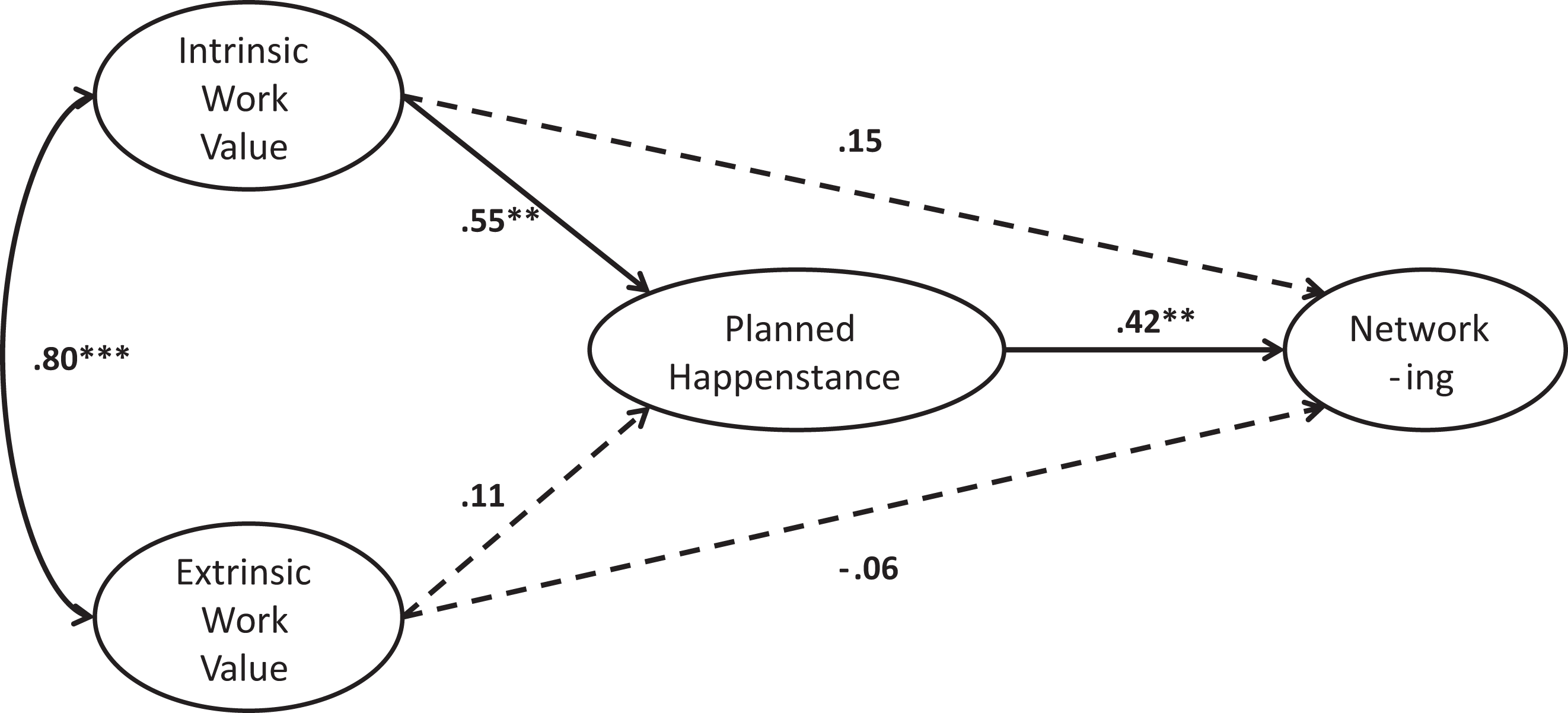
Structural model: Standardized solution. Solid paths are statistically significant at ***p < .001, **p < .01. Dashed path is not statistically significant.
Indirect effects were examined using the bootstrapping method. Ninety-five percent bias-corrected confidence intervals (CIs) were calculated to test the significance of the indirect effects (Mallinckrodt, Abraham, Wei, & Russell, 2006). A thousand samples were bootstrapped to check whether the CIs included zero. The indirect effect from intrinsic work values to networking was statistically significant at .23 (95% CI = [.04, .52], p < .05), suggesting that planned happenstance mediates the relationship between intrinsic work values and networking. However, the indirect effect from extrinsic work values to networking was not significant (β = .05, CI = [−.13, .27], p = .48).
Discussion
This study adds empirical evidence to the literature on planned happenstance theory, a key vocational theory that to date has commanded little research (e.g., Kim, Jang, et al., 2014), despite its importance for the current and rapidly changing world of work. The present study also suggests the usefulness of planned happenstance theory for individuals facing multicultural challenges by examining students of Korean cultural backgrounds. The results of this study elucidate the direct and indirect paths from work values to networking through planned happenstance. This sheds light on how work values influence career networking and the role of planned happenstance between them. The hypothesized model provided a reasonable fit to the data (Hypothesis 1), even though there were three paths that were not significant in the model. Among these paths, the paths from extrinsic work values to planned happenstance and to networking were hypothesized as not significant based on the literature review (Hirschi & Fischer, 2013; Ros et al., 1999).
Hypothesis 2a, which suggested that intrinsic work values are associated with planned happenstance, was supported by the results of the present study. Considering that intrinsic work values have been found to be related to higher achievement and motivation (Roberts & Robins, 2000) as well as the self-directed nature of planned happenstance (Mitchell et al., 1999), it is logical that intrinsic work values are associated with planned happenstance. This finding suggests that having strong values related to work itself, such as responsibility, independence, and variety (Hirschi, 2010a), is related to having strong planned happenstance skills, such as curiosity, persistence, flexibility, optimism, and risk taking (Mitchell et al., 1999).
Additionally, the results of this study support Hypothesis 2b, which suggested that planned happenstance is associated with networking. This finding is consistent with those of previous studies indicating that individuals with high levels of planned happenstance have high levels of exploratory behavior, such as the acquisition of pertinent information for career development (Krieshok et al., 2009), which likely relates to career networking. This finding suggests that strong planned happenstance skills are associated with proactivity and engagement in networking and vice versa. This also suggests that increasing an individual’s planned happenstance skills may improve his or her career networking ability and success.
Hypothesis 2c was supported by showing the significant indirect path from intrinsic work values to networking. This finding suggests that planned happenstance may help explain why intrinsic work values are associated with the career networking of students of Korean cultural backgrounds. For a student of a minority cultural background, having dominant intrinsic, rather than extrinsic, work values may mean that the student is more open to exploring occupations that meet his or her career values rather than choosing a career based on familial preferences (Popper-Giveon & Keshet, 2016). This may also mean that international students with higher intrinsic work values have more confidence in their labor-market prospects than those with dominant extrinsic values (Ng & Sears, 2010). Given this inner motivation and confidence, international students may be more active in building new professional networks that provide them with increased chances of, or information on, finding jobs that satisfy their intrinsic work values, thereby resulting in more networking. Planned happenstance may facilitate self-driven career exploration with confidence. Our present findings corroborate the claim that planned happenstance theory empowers people with fewer psychosocial resources (Mitchell et al., 1999) and explains how planned happenstance can help individuals’ career decision-making processes when work values impact one’s career-related behaviors (Choi et al., 2013).
Finally, the results of this study support Hypothesis 3, which suggested that extrinsic work values are not associated with planned happenstance or networking. This finding is consistent with those of the existing literature, given that extrinsic work values have been found to be associated with less dedication to work (Vansteenkiste et al., 2007) and negatively correlated with career maturity (Lee, 1997), whereas planned happenstance has been characterized by self-direction and following one’s own curiosity and is related to occupational engagement (Kim, Jang, et al., 2014). Furthermore, while networking has been found to be related to intrinsic and extrinsic success (Forret & Dougherty, 2004), it is initially a slow and self-motivated process that may require intrinsic motivation to maintain.
Implications for Research
Findings from this study suggest that planned happenstance mediates the relationship between intrinsic work values and networking for students of Korean cultural backgrounds in the United States and that extrinsic values are not associated with networking. Individuals of minority cultural backgrounds may face many challenges in building career networks in a society where the cultural values differ from their own. Most vocational counseling theories focus on individuals who simply need to make logical career decisions rather than considering those individuals who are surrounded by vast amounts of cultural information that they must learn while also participating in career exploration (Blustein, 2013). Planned happenstance theory may provide a clue as to how to best handle this situation by suggesting that individuals see the world as full of new learning materials and opportunities (Krumboltz, 2009). According to Krumboltz, planned happenstance is for everyone in this fast-changing society, but it can be especially useful for individuals from minority cultures faced with the additional challenge of acculturation.
This study shows the possible application of planned happenstance theory to multicultural populations and provides empirical evidence of how it can help individuals to expand their professional networks for career development. This study also suggests the applicability of planned happenstance theory to multicultural career counseling research. Our analysis identified a correlative relationship between planned happenstance and career-related variables frequently used by career counseling researchers and practitioners, such as work values and networking. As there are few empirical studies regarding this new theory, the present study provides a deeper understanding of how it relates to more traditional career-related variables.
The current study can also be used in development of career intervention programs for college students from minority or international cultures. Changing one’s value system is not desirable or culturally appropriate, but implementing planned happenstance interventions may help counselors to support students whose extrinsic, rather than intrinsic, values are dominant to achieve the networks needed to enter the workforce. Such an intervention could start with an assessment of students’ value systems and could be developed using the literature on planned happenstance theory (e.g., Krumboltz & Levin, 2010). Evaluations and empirical studies could follow these interventions to provide evidence of their effectiveness.
Implications for Practice
The results of this study have several implications for practice. First, it is important to avoid interpreting these results as suggesting that counselors need to discourage students’ extrinsic values and strengthen their intrinsic values. Rather, these results indicate that planned happenstance tools and interventions can be used by career counselors to improve client experiences with, and outcomes from, career networking. Planned happenstance interventions improve individuals’ open-mindedness toward opportunities, persistence in the face of challenges, and risk-taking, all of which are valuable when engaging in networking. Additionally, career counselors can provide students with opportunities to practice planned happenstance skills in the context of networking within counseling sessions using techniques such as role-playing. They can also encourage clients to practice planned happenstance skills during relevant social and professional events.
Additionally, findings from this study suggest that planned happenstance theory is a beneficial orientation for career counselors to learn and implement. Using planned happenstance theory and interventions may help counselors to improve client’s comfort and engagement with networking, a crucial career skill. Given the rapidly changing nature of the world of work, using a planned happenstance orientation may also help counselors to improve client persistence, flexibility, and optimism, to name a few attributes, making it invaluable for all aspects of the clients’ career development and job search processes.
It is important to note that counselors need to consider the cultural differences inherent in values. It is also crucial to remember that within-group differences can be just as wide-ranging as between-group differences. Therefore, it is valuable for career counselors to engage in conversations with students about their career values. Such conversations might address value formation, the influence of parental or familial values, the salience of different values, and the strengths and challenges tied to those values.
Finally, because many Asian cultures have similar values, the findings from this study are potentially applicable to international students from Asian countries other than Korea. It is likely that international students from different Asian countries share not only values but also experiences and challenges with career networking. Furthermore, it is possible that findings from this study may be useful in working with international students from any country of origin who are struggling with career networking. As mentioned earlier, the tools highlighted by planned happenstance theory are very valuable for improving career networking and may be useful for international and domestic students alike.
Limitations and Conclusion
Several limitations to the present study can be noted. First, networking was not assessed by observing the behaviors of the participants but by distributing a retrospective, self-reported questionnaire asking about networking comfort, intensity, and proactivity. The intensity items asked particularly about the frequency of behaviors during the last 2 weeks, but participants may not have had a clear idea of how many times they displayed the indicated behavior. A study measuring networking behavior through participant or observer logs would provide a more precise measurement for the study.
Second, the two groups of work values, intrinsic and extrinsic, had a considerably high correlation. Previous studies using the same work values instrument showed a similarly high correlation between intrinsic and extrinsic values among Korean college students (Choi et al., 2013). Significant correlations between intrinsic and extrinsic work values were also observed for Swiss and Italian populations, but these correlations were not as high as that of Koreans (Caricati et al., 2014; Hirschi, 2010b). This may be due to shared method variance. The 10 values were all assessed using a single stem question and the same method; moreover, because the respondents were not asked to rate the values, some students may have had a tendency to think that either all values were important to them or none of the values were important to them. Future studies may need to consider building a new questionnaire to avoid the high correlation between the two groups of values.
Third, the sample of this study was small, since the population of interest is scattered throughout the United States. It was challenging to collect data from various colleges. The sample was limited to college students, but there are many other multicultural individuals engaged in job searches. Planned happenstance may be more helpful for middle-aged immigrants seeking immediate employment for basic survival because cultural change may feel more overwhelming to them than to students who have experienced a “buffer period” in school that allowed them to learn cultural differences before seeking employment. Planned happenstance skills might help middle-aged immigrants to risk learning new cultural norms and engage with new cultural groups, rather than isolating themselves within their own cultural group.
Despite these limitations, the present study provides findings that can be used to facilitate the career networking of college students of Korean cultural backgrounds living in the United States, especially those whose career values are more extrinsic than intrinsic. Planned happenstance theory can be applied to any multicultural population facing challenges of scant networking resources.
Footnotes
Declaration of Conflicting Interests
The author(s) declared no potential conflicts of interest with respect to the research, authorship, and/or publication of this article.
Funding
The author(s) received no financial support for the research, authorship, and/or publication of this article.
