







Abstract
This study investigates the effect of practical skills-based career training intervention in electrical/electronic works on graduating students’ academic major satisfaction, career curiosity, and self-defeating job search behaviors (SDJSBs). We employed the quasi-experimental design, with a three-wave longitudinal survey. The participants were 101 electrical/electronic technology education undergraduates from two publicly owned universities in Nigeria. Our intervention procedures were guided by the tenets of social cognitive career theory and the theory of planned behavior. The findings revealed significant positive increase in the students’ satisfaction with their academic major, and career curiosity, as well as significant decrease in SDJSBs (viz., procrastination, impulsiveness, and failure to network). We also found mediating effects of learning self-efficacy and perseverance of effort on academic major satisfaction, career curiosity, and SDJSBs.
Keywords
The overall goal of an education program is to foster its recipients’ skills acquisition for smooth school-to-work transition. However, in vocational electrical/electronic technology in Nigeria, students tend to exhibit self-defeating job search behaviors (SDJSBs) because of poor acquisition of career-related practical skills, inadequate provision and availability of functional facilities for effective implementation of such career and academic-oriented program (Tavares, Carvalho, Sousa, & Santiago, 2015), low technology advancement in developing and underdeveloped countries (Sampath, 2014) such as Nigeria, and the unemployment syndrome engulfing the present day graduates (International Labour Office, 2014; Kahn, 2010; Shi, Imdorf, Samuel, & Sacchi, 2018) as a result of recessional economic crises. Vocational electrical/electronic technology students in Nigeria may also exhibit SDJSBs and have low satisfaction with their academic majors because most do not choose this major themselves; instead, they are offered admission into this major because they could not meet the requirements for their intended academic major (often engineering, which is viewed as more prestigious). Thus, we deemed it fit to conduct a study to help foster the technology students’ academic major satisfaction and career curiosity and to help reduce SDJSBs.
An individual’s level of academic major satisfaction largely determines his or her career-related outcomes. Academic major satisfaction is a predictor of students’ academic performance (Y. L. Kim & Lee, 2015; Milson & Coughlin, 2017; Nauta, 2007). This relationship culminates in an individual’s career decision-making ability, especially in relation to the individual’s major. Studies have suggested that academic major satisfaction has links with the career development of individuals (J. Allen & Robbins, 2008, 2010; Eun, Sohri, & Lee, 2013; Milson & Coughlin, 2017; Nauta, 2007). Similarly, Nauta (2007) linked academic major satisfaction with career interest and choice among college students and submitted that academic major satisfaction is a predictor of job search and job satisfaction.
Career curiosity is a “resource of career adaptability which has to do with exploring one’s opportunities and thinking about the fit between the self and different environments, vocational roles, and future scenarios” (Koen, Klehe, & Van Vianem, 2012, p. 397). It is a career adaptability resource that illustrates the “extent to which an individual explores circumstances and seeks information about opportunities” (Savickas & Porfeli, 2012, p. 664). We, therefore, expect that a training intervention will foster the students’ career curiosity so as to reduce SDJSBs upon graduation. Nevertheless, individuals who exhibit dissatisfaction in their academic major have the high tendency to exhibit a low level of career curiosity. The resultant effect may be SDJSBs.
SDJSBs are inhibiting conducts that job seekers exhibit (or intend to exhibit) toward job search, which deter their intentions or willingness to search for a desired job (Kanfer, Wanberg, & Kantrowitz, 2001; Wanberg, Glomb, Song, & Sorenson, 2005; Wanberg, Zhu, Kanfer, & Zhang, 2012), especially as a result of unguided career decision and dissatisfaction with academic major. These are behaviors that “are highly germane to college/university students’ unemployment and career success, are all self-regulated unemployment-related activities, occur at or around the same time during the job search process, and are expected to be linked to mentor career support” (Renn, Steinbauer, Taylor, & Detwiller, 2014, p. 423). It is on this justification that we investigated SDJSBs: (a) procrastinating on a job search, (b) impulsive job search, and (c) failure to network (Renn et al., 2014).
Existing literature on mentoring intervention (e.g., T. D. Allen, Lentz, & Day, 2006; Jyote & Sharma, 2015; Kossek, Roberts, Fisher, & Demaar, 1998; Renn et al., 2014; Scandura, 1992, 1997) has demonstrated that mentoring enhances career planning attitude, reduces career-related self-defeating behavior, and promotes work-related outcome. As far as we know, no such study was geared toward promoting career curiosity and academic major satisfaction among students via self-designed steps on practical skill training. However, in establishing a cause–effect relationship, there are usually models via which the effect can be explained (Preacher & Hayes, 2008). In this study, we chose effects of learning self-efficacy and perseverance as the possible models to explain the cause–effect relation between our predictor and outcome variables because our intervention uniquely involves a practical training. Therefore, the students’ judgment of their capability to undertake and learn the practical skills training tasks via mentors will help to explain the effect of our intervention on the students’ academic and career outcomes (cf. Sousa-Ribeiro, Sverke, Coimbra, & De Witte, 2018). Similarly, we propose that the students’ perseverance of effort to learn the practical skill will determine their academic and career outcomes. Consequently, the purpose of our study is to ascertain the effect of practical skills career training with experts/mentors support model on students’ academic major satisfaction and career outcomes via learning self-efficacy and perseverance of effort to learn.
Theoretical Framework and Hypotheses
Practical skills career training support and career outcomes
In this study, practical skills career training support is modeled toward career mentor support. Mentoring is a passionate relational exchange between a more experienced person (expert) and a less experienced person (student) in a particular situation such that the expert provides academic, career, and psychological supports for present and future development (Eby, Rhodes, & Allen, 2007; Scandura, 1992). The importance of mentor career support in career development has made it necessary that mentor career support is applied in fostering academic major satisfaction. It has been relatively established from previous studies that academic major satisfaction has a significant influence on academic performance and career decision-making (e.g., Eun et al., 2013; Milson & Coughlin, 2017; Nauta, 2007). Congruently, studies have demonstrated that there is a positive and significant link between mentor career support and career development (e.g., Crocitto, Sullivan, & Corraher, 2003; Jyote & Sharma, 2015; Ogbuanya & Chukwuedo, 2017; Renn et al., 2014). As far as we know, most of the studies were not conducted to investigate students’ mentoring via experts’ practical skills training support for academic satisfaction. All in all, we propose that an intervention that employs mentor career support, by applying practical skills models, will encourage positive academic and career behaviors among students. Thus, we hypothesize that:
Mediating roles of learning self-efficacy and perseverance on practical skill career training support, academic major satisfaction, and career outcomes relations
Learning self-efficacy is a domain of self-efficacy (an individual’s judgment of his or her abilities to organize and perform a task), which is a product of social cognitive theory (Bandura, 1986; Zulkosky, 2009). Learning self-efficacy is an individual’s belief toward his or her learning abilities in a given learning or training context (Sousa-Ribeiro et al., 2018). Since our mentoring intervention is focused on providing vicarious learning experiences (Bandura, 1986; Lent, Brown, & Hacket, 1994), self-confidence, and reducing self-doubt behaviors via mentor support, we expect an increase in the students’ learning self-efficacy.
Studies on self-efficacy have shown that it significantly predicts certain career behaviors such as career planning (e.g., Eun et al., 2013; Sousa-Ribeiro et al., 2018) and self-defeating behaviors (e.g., Renn et al., 2014; Wanberg et al., 2012). It has also been somewhat established that mentor career support directly enhances an individual’s learning capabilities (e.g., Thompson & Kelly-Vance, 2001). In the same vein, studies have shown that learning self-efficacy has a direct and significant relationship with career outcomes (e.g., Day & Allen, 2004; Renn et al., 2014). Since academic major satisfaction has a link with career decision-making, we infer that academic satisfaction can be predicted by learning self-efficacy. So, we theorize that learning self-efficacy will be a mediator in career training support relationships with academic and career behaviors. Therefore, we hypothesize that:
Another plausible mechanism for success in academic and career development is perseverance. In this study, perseverance in career learning has to do with an individual’s persistence and effort to learn the knowledge, attitudes, and skills required for successful entry into one’s career in relation to his or her academic major, despite difficulties and challenges. Perseverance of effort is the extent to which an individual expends appreciable effort to a given task that poses challenges (Christensen & Kneze, 2014; Datu, Valdez, & King, 2016; Duckworth, Peterson, Mathews, & Kelly, 2007). By this premise, we theorize that if an individual exhibits academic and career self-defeat behavior as a result of dissatisfaction in his or her present status, such individual may not persevere in relation to academic- and career-related development. As such, that individual can be helped to attain a higher level of perseverance of effort in academic and career development. Thus, perseverance is a function of social behavioral support and intentions (Ajzen, 1991; Bandura, 1986; Lent et al., 1994). Since our intervention is geared toward providing vicarious learning experiences (Bandura, 1986) as well as enhancing academic and career intentions (Ajzen, 1991) via mentor career support in a social context, we presume that our intervention will lead to increased perseverance of effort.
Consistently, studies have shown that perseverance of effort is a potential predictor of academic success (e.g., Datu et al., 2016; Duckworth, Kirby, Tsukayama, Berstein, & Ericsson, 2011) and workplace performance (e.g., Eskreis-Winkler, Shulman, Beal, & Duckworth, 2014). It can, therefore, be inferred that perseverance of effort is a predictor of academic and career behaviors. Similarly, literature has established that career support models advance career outcomes. These theories and analyses so far imply that career support can predict perseverance of effort, which in turn will predict academic major satisfaction as well as career outcomes. All in all, we propose that perseverance of effort is a plausible mediator in this cause–effect relationship. So, we hypothesize that:
Our hypothetical propositions so far are demonstrated in a conceptual model (see Figure 1), which represent a parallel meditation model (cf. Renn et al., 2014; Sousa-Ribeiro et al., 2018, who found a serial mediation model of learning self-efficacy on career and training intentions).
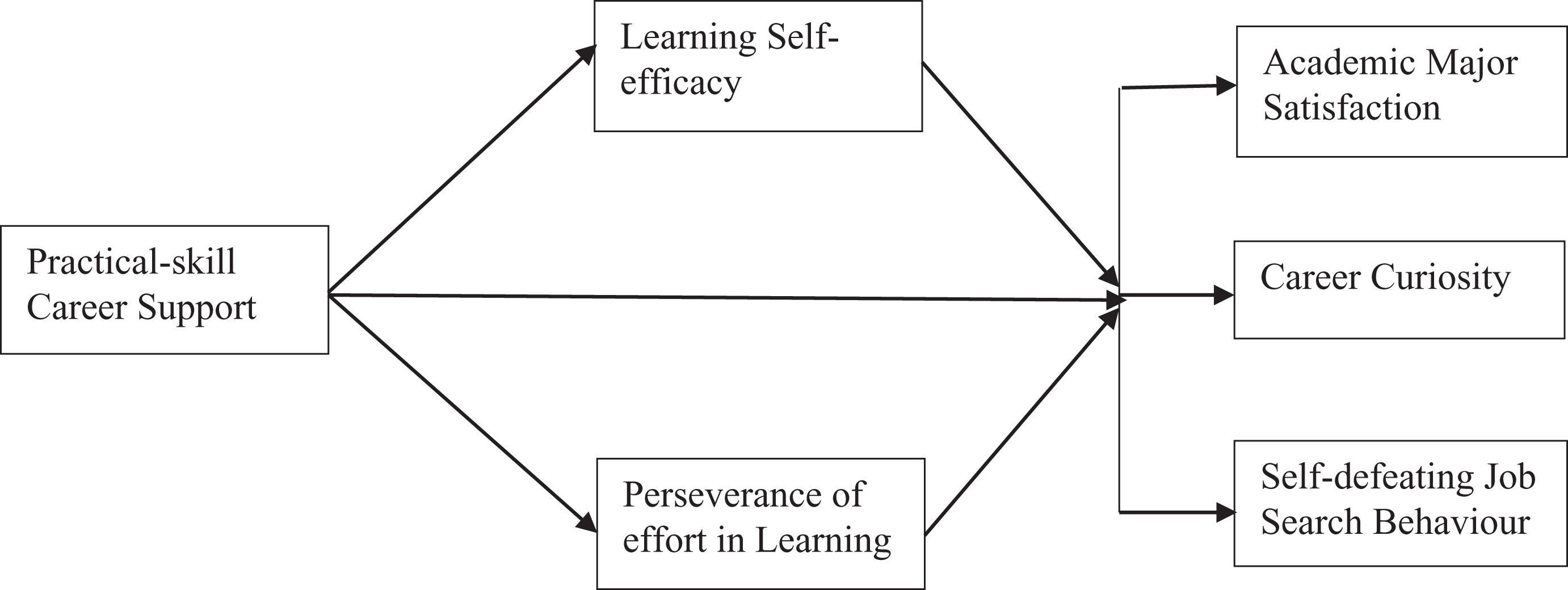
Conceptual model.
Method
Participants
The participants were 101 full-time (n = 60) and part-time (n = 41) students studying electrical/electronic technology in vocational and technical education from two universities in Nigeria. Students were encouraged by their course lecturers, advisers, and heads of the department to participate in this study, but participation was voluntary. Forty-eight of the students (33 males and 15 females) comprised the intervention group and were drawn from an intact class at one publicly owned university; the remaining 53 (39 males and 14 females) were selected from a similar intact class at a different publicly owned university. The students were in their penultimate academic year when we conducted the pretest but transited to their final academic year just before the intervention began. Sixty-three of the participants were aged 19–22 years, and 38 participants were over the age of 22 years.
Procedures
Research design
We employed the nonequivalent control group quasi-experimental design, where survey measures of the study variables were administered to both groups 1 week before the intervention (T1) and twice after the intervention (2 and 6 weeks for T2 and T3, respectively). Thus, the intervention group received the formal practical skill career–training support by varieties of experts from the noneducational sector. In this case, the trainers strictly followed the comprehensive stages designed in this study during the training process. The experts also served as the planned formal mentors to the students in the intervention group. They were made up of three entrepreneurs, three technical engineers, and two university lecturers in the intervention group. The technical engineers and entrepreneurs were experts in the field of electrical/electronic technology with not less than 10 years of job experience outside the context of the educational institutions. Conversely, the control group received the informal practical skills career training support involving their teachers. As such, the training was conducted haphazardly. Thus, the trainers in the control group did not follow any specific pattern during the training process. They were made up of two university lecturers and technologists each, who still maintained unplanned and informal mentoring with their students. In all, no student declined during and after the training.
Intervention process
The intervention of this study was guided by the tenets of social cognitive career theory (Lent et al., 1994) and the theory of planned behavior (Ajzen, 1991). Both theories placed emphases on career development and willingness to engage in a task within a social context. Thus, the intervention was summarized into an eight-stage model: (a) consent seeking; (b) pretreatment survey for data collection at T1; (c) introduction, where the experts and students were paired and exchanged means of communication; (d) career opportunities initiatives, where career opportunities in electrical/electronic fields were linked to some of the contents of electrical/electronic technology and explained to the students via career motivational talk. It also integrated entrepreneurship education. The motivational talk and entrepreneurship education were geared toward helping the students to develop confidence in their capabilities in performing related tasks as well as in expending efforts in undertaking the skills training in their academic major during and after the intervention. This stage was facilitated by the experts. As graduates from this major who have been gainfully employed, the experts use themselves and their experiences as illustrative examples; (e) related academic major skills training—involved practical skills training in electrical/electronic drafting, design, installation, and maintenance works. Here, the experts exposed the students to the rudiments of electronic circuits drafting and designs (with specific interest on modern electronic devices). The students were also exposed to the practical approaches of undertaking domestic electrical installation, where the skills in installation and maintenance of conduit wiring and circuit breakers were demonstrated. The students were also guided with the entrepreneurial skills expected in this major; (f) revision—there was a brief revision in practical skills training where trainers raised questions relating to what has been taught, while the students provide answers to such questions. This stage also gave rise to general interaction for exchange and solving of academic- and career-related challenges that students have faced or perceived overtime in their major; (g) posttreatment survey for data collection at T2; and (h) posttreatment survey for data collection, as a follow-up at T3. The entire research process lasted for 36 weeks (between August 2016 and October 2017). Stages (d) and (e) were the core training periods, which lasted for nonconsecutive 4 and 18 weeks, respectively.
Measures
Except mentioned otherwise, we utilized a set of standardized items to measure the main constructs of this study. All the items were rated on a 5-point Likert-type scale from strongly agree (5) to strongly disagree (1). In this study, the validity of each measure was estimated using confirmatory factor analysis (CFA) with T1 data.
Practical skills career training support was assessed with 15 items, consisting of 8 items of Vocational Mentoring subscale (Scandura, 1992; e.g., my mentor has taken a personal interest in my career) and a self-generated 7 items (e.g., my mentor demonstrates the tips on manipulative skills) which is herein referred to as practical skills support survey. We chose to also use self-generated items because of the paucity of literature with respect to students’ version of the mentoring scale as well as the nature of our study which employed experts (mentors) practical skills career training support. We ascertained the face validity of the self-generated items by including the suggestions and corrections of three experts (from vocational education, measurement and evaluation, and counseling psychology) to the final draft. The internal consistency measure for the Vocational subscale at T1, T2, and T3 showed α values of .85, .89, and .88, respectively, while the α values of the self-generated items at T1, T2, and T3 are .87, .94, and .91, respectively. We conducted CFA for the self-generated items (one-factor model), where the 7 items (observed variables) were loaded into a latent variable. The results showed relative good data fit (χ2 = 28.933; χ2/degrees of freedom [df] = 2.067; comparative fit index [CFI] = .926 ≥ .899; Tucker–Lewis index [TLI] = .90 ≥ .90; root mean square residual [RMR] = .038 ≤ .05; root mean square error of approximation [RMSEA] = .078 ≤ .08; p < .05; Arbuckle, cited in Otto, Roe, Sobiraj, Baluku, & Vasquez, 2017).
Learning self-efficacy was measured using the 7 items of self-efficacy in skills upgrading (Lim & Chan, 2003; e.g., I will have no problem learning new skills). The study of Sousa-Ribeiro, Sverke, Coimbra, and De Witte (2018) showed that learning self-efficacy was uniquely associated with attitude toward learning, which implies evidence of validity of the scale. In this study, a CFA on one-factor model relatively yielded good data fit (χ2 = 15.869; χ2/df = 1.221; CFI = .955; TLI = .927; RMR = .048; RMSEA = .047; p > .05). The α values at T1, T2, and T3 are .88, .94, and .95, respectively (cf. Lim & Chan, 2003; α = .85).
Perseverance of effort
This was assessed with Duckworth and Quinn (2009) 4 items of Perseverance of Effort subscale of the Short Grit Scale (e.g., I finish whatever I begin), to measure the students’ perseverance of effort in learning for one’s career. Evidence of the construct validity reported by Datu, Valdez, and King (2016) revealed that perseverance was correlated with behavioral engagement. We also established that one-factor model yielded adequate data fit (χ2 = 2.817; χ2/df = 1.408; CFI = .953; TLI = .900; RMR = .048; RMSEA = .064; p > .05). The respective α values at T1, T2, and T3 are .87, .86, and .89 (cf. Duckworth & Quinn, 2009; α = .65).
Academic major satisfaction was measured with the 6 items of the Academic Major Satisfaction Scale (AMSS; Nauta, 2007; e.g., I feel good about the major I’ve selected). Construct validity of academic major satisfaction has been supported in previous research, showing expected correlates with life satisfaction (Sovet, Park, & Jung, 2014) and career decision self-efficacy (Nauta, 2007; Sovet et al., 2014). In this study, a CFA on one-factor model yielded excellent data fit (χ2 = 12.042; χ2/df = 1.338; CFI = .981; TLI = .969; RMR = .045; RMSEA = .058; p > .05). The measure of the internal consistency of AMSS at T1, T2, and T3 are .93, .92, and .89, respectively (cf. Nauta, 2007; α = .94).
Career curiosity was assessed with the 6 items of Career Curiosity subscale (e.g., investigating options before making a choice). It is a subscale of the Career Adapt-Ability Scale international form 2.0 (Savickas & Porfeli, 2012). Evidence of convergent validity from previous research depicted that curiosity is uniquely associated with openness (Van Vianen, Klehe, Koen, & Dries, 2012). We also established that one-factor model relatively yielded good fit with the data (χ2 = 10.566; χ2/df = 1.321; CFI = .984; TLI = .969; RMR = .042; RMSEA = .057; p > .05). The respective α values at T1, T2, and T3 are .88, .90, and .89 (cf. Savickas & Porfeli, 2012; α = .79).
SDJSBs were measured with the 10 items of Renn, Steinbauer, Taylor, and Detwiller (2014) Self-Defeating Job Search Behavior Scale. It has three dimensions that measure procrastination with job search (4 items; e.g., I will probably end up working on my job search tasks at the last minute), job search impulsiveness (3 items; e.g., the only way to get the most worthwhile job after I graduate will be to wait for it), and failure to network (3 items; e.g., in all honesty, I probably will not network enough with other people in my job search). Evidence of discriminant validity from Renn et al. (2014) reported a three-factor model that yielded excellent fit with the data, χ2(95) = 45.47; df = 41; CFI = .98; RMSEA = .03. In the current study, we also confirmed the three-factor model and found satisfactory data fit (χ2 = 47.216; χ2/df = 1.475; CFI = .953; TLI = .933; RMR = .046; RMSEA = .069; p < .05). The internal consistency scores of each dimension was high procrastination (T1, α = .91; T2, α = .87; and T3, α = .88), impulsiveness (T1, α = .88; T2, α = .90; and T3, α = .89), and failure to network (T1, α = .88; T2 and T3, α = .90). The overall α values at T1, T2, and T3 are .90, .91, and .90, respectively (cf. Renn et al., 2014; α = .63 at T1 and α = .82 at T2).
Results
Descriptive
There was no missing data from the responses; hence, we did not employ any technique of analyzing missing data. Table 1 shows the mean, standard deviation, and intercorrelations of the variables at T1, T2, and T3.
Bivariate Correlations, Mean, and Standard Deviation of the Study Variables.
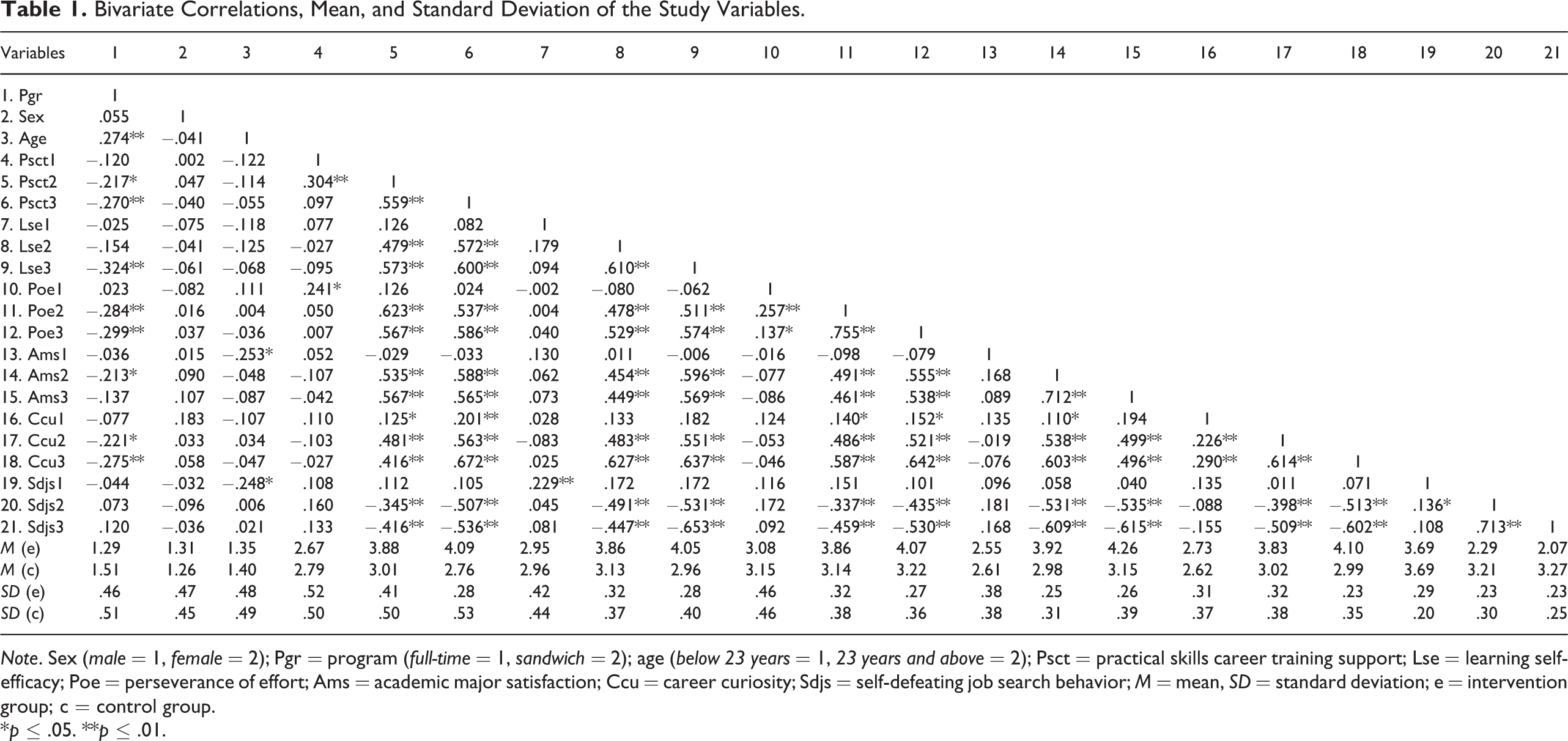
Note. Sex (male = 1, female = 2); Pgr = program (full-time = 1, sandwich = 2); age (below 23 years = 1, 23 years and above = 2); Psct = practical skills career training support; Lse = learning self-efficacy; Poe = perseverance of effort; Ams = academic major satisfaction; Ccu = career curiosity; Sdjs = self-defeating job search behavior; M = mean, SD = standard deviation; e = intervention group; c = control group. *p ≤ .05. **p ≤ .01.
Hypotheses Testing
We employed repeated measure multivariate analysis of variance using SPSS (Version 22.0) to test Hypothesis 1, with times (2 and 3) as within-subject factor and group (2) as between-subject factor. The results at all-time intervals (i.e., T1 vs. T2; T1 vs. T3; and T1 vs. T2 vs. T3) showed significant effect of the intervention and significant difference between the interaction groups, at the same df(1, 99). The multivariate tests of Wilks’s λ (Time × Group at T1 vs. T2) reveal significant effects on academic major satisfaction (F = 393.52, p < .001,
Hypotheses 2 and 3 were tested using the Hayes PROCESS macro (Model 4—Hayes, 2013), by applying bias-corrected 5,000 resample bootstraps to determine the direct and specific indirect effects (Hayes, 2013; Preacher & Hayes, 2008). We also employed Sobel’s test to determine the mediation effect since we applied Model 4 and 5,000 resample bootstrap method. Thus, Table 2 shows that the direct effects of practical skills career training support via learning self-efficacy on academic major satisfaction (β = .43, p < .001), career curiosity (β = .43, p < .001), procrastination for job search (β = −.38, p < .001), impulsiveness for job search (β = .35, p < .001), failure to network (β = .39, p < .001), and the overall SDJSB (β = .37, p < .001) are significant. Since the indirect effects are significant, it is inferred that there is significant mediation of learning self-efficacy on all the outcome variables. Similarly, the Sobel’s test shows significant effects on the outcome variables. Thus, Hypothesis 2 is upheld.
Mediation Analysis of Learning Self-Efficacy on Academic Major Satisfaction, Career Curiosity, and Self-Defeating Job Search Behaviors.
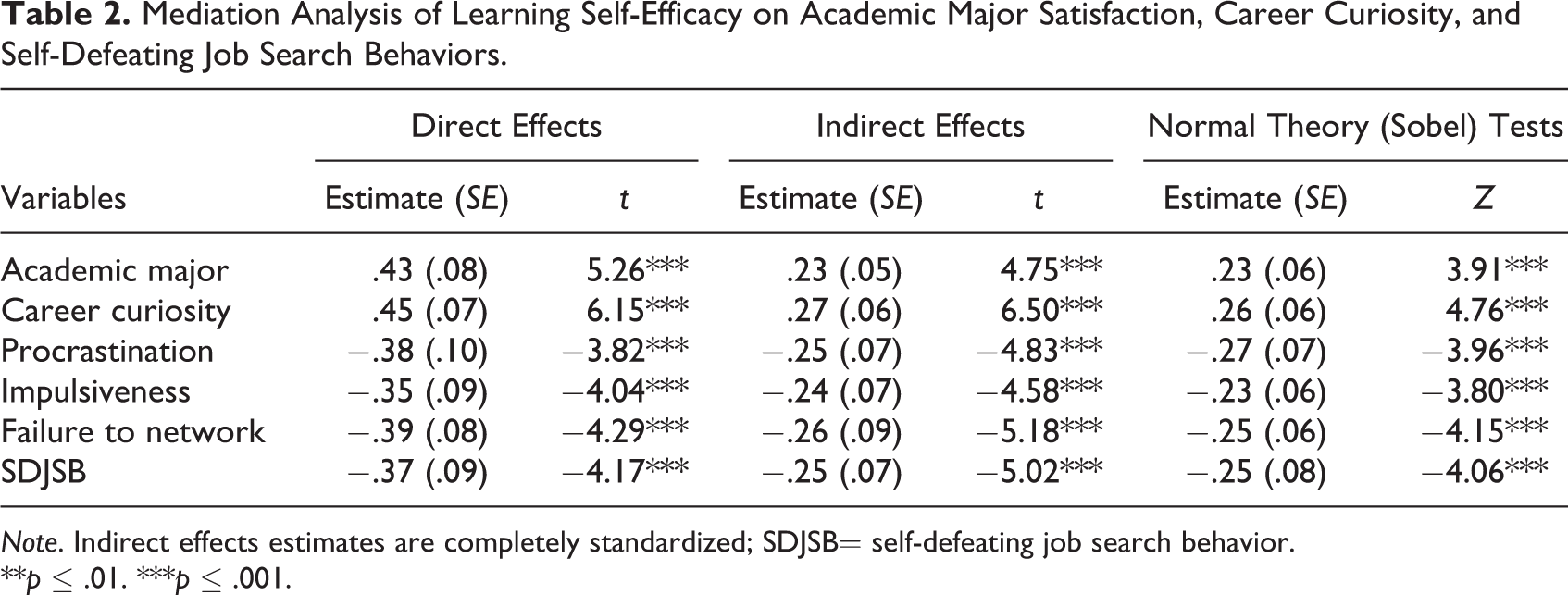
Note. Indirect effects estimates are completely standardized; SDJSB= self-defeating job search behavior.
**p ≤ .01. ***p ≤ .001.
Table 3 shows the significant direct effects of practical skills career training support on academic major satisfaction (β = .41, p < .001), career curiosity (β = .36, p < .001), procrastination for job search (β = −.36, p < .01), impulsiveness for job search (β = −.30, p < .01), failure to network (β = −.34, p < .001), and the overall SDJSB (β = −.33, p < .001) via perseverance of effort. The significant indirect effects imply that perseverance of effort is a mediator of all the outcome variables. Similarly, the Sobel’s test shows significant effects on the outcome variables. Hence, Hypothesis 3 is also supported.
Mediation Analysis of Perseverance of Effort on Academic Major Satisfaction, Career Curiosity, and Self-Defeating Job Search Behaviors.
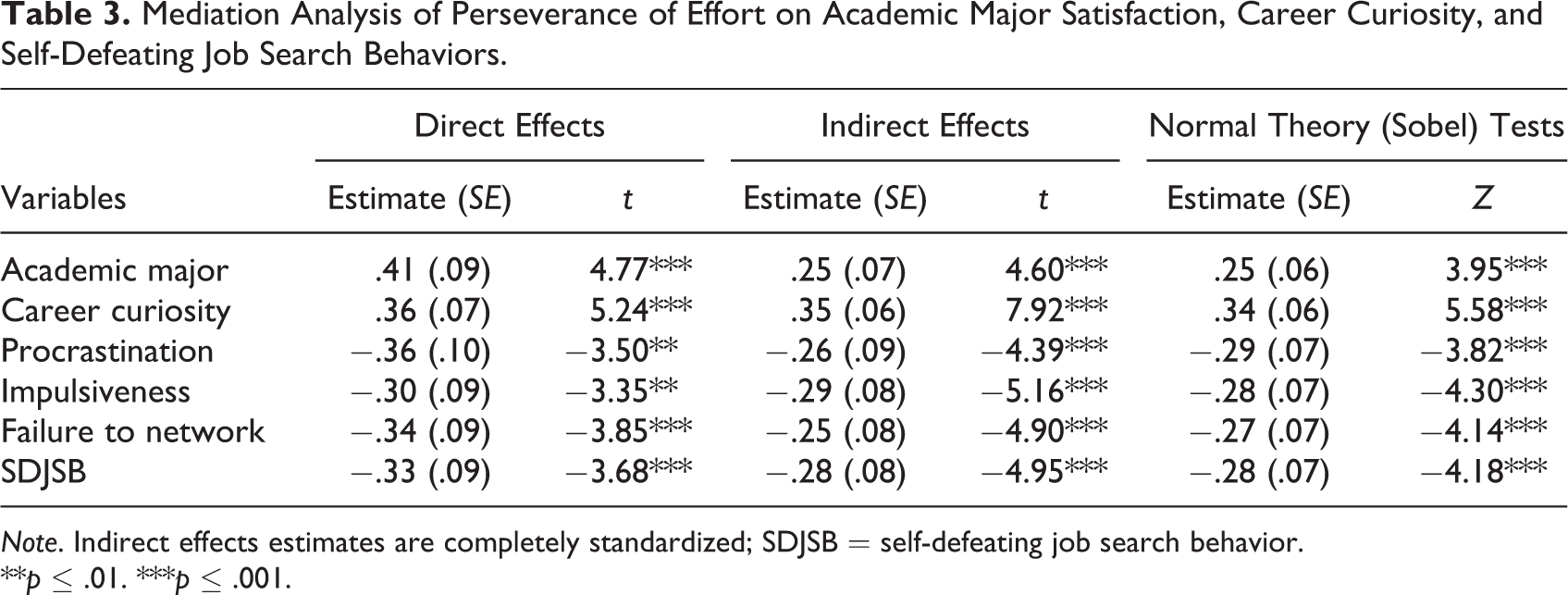
Note. Indirect effects estimates are completely standardized; SDJSB = self-defeating job search behavior.
**p ≤ .01. ***p ≤ .001.
Discussion and Implications
The focus of this study was to explore the impact of a practical skill career–training support by noneducational experts on graduating students’ academic major satisfaction, career curiosity, and SDJSBs in electrical/electronic works in Nigeria. The study also investigated the mediating effects of learning self-efficacy and perseverance of effort on the relationship between experts’ supports and the criterion variables of this study.
Based on the findings of Hypothesis 1, this study found that students in the intervention group significantly increased in their academic major satisfaction and career curiosity than the control group as a result of the practical skills career training support. There was also a significant decrease in SDJSBs among the intervention group than the control group. Our findings are closely supported by the findings of Koen, Klehe, and Van Vianem (2012) with respect to career curiosity, and Koivisto, Vinokur, and Vuori (2011), on components of career preparation, as well as that of Renn et al. (2014) with respect to SDJSB. As far as we know, our study is the first to apply practical skills support mechanism, with quasi-experimental design and a three-wave longitudinal survey to study students’ academic major satisfaction and career curiosity. This result indicates that a mentoring intervention with a practical skill guide can increase students’ satisfaction with their major as well as career curiosity for improved academic success, smooth school-to-work transition, and reduced self-defeat behaviors for related job search. From the evidence in previous studies that college students need help for effective career decision-making self-efficacy (e.g., Harlow & Bowman, 2016; B. Kim, Lee, Ha, Lee, & Lee, 2015; Vertsberger & Gati, 2016), our study has provided an empirical practical approach to helping students attain optimal academic- and career-related behaviors.
Our findings also revealed that learning self-efficacy and perseverance of effort are mediators of the cause–effect relationship of practical skills training support with academic major satisfaction, career curiosity, and SDJSBs. Thus, we found that learning self-efficacy and perseverance of effort independently showed partial mediation on academic major satisfaction, career curiosity, and SDJSBs. Although these findings are novel contributions of our study, these results complement previous studies (e.g., Bryne, Dik, & Chiaburu, 2008; Day & Allen, 2004) on self-efficacy as a possible mediator on career outcomes. To our knowledge, no study has previously investigated perseverance of effort as a mediator of academic major satisfaction and career outcomes or learning self-efficacy as a mediator of academic major satisfaction. However, our findings comparatively agree with Baroudi, Fleisher, Khapova, Jansen, and Richardson (2017) on the mediating role of taking charge on ambition at work and career satisfaction relation.
This study has both theoretical and practical implications. Our study has added to career development literature by identifying the career behaviors that can be modified via a practical skills support mechanism in Nigeria University, as well as other allied academic majors. The findings of this study have also extended the extant literature on academic major satisfaction (Nauta, 2007) in the Nigerian context and in electrical/electronic technology education. Our findings have empirically provided an evidence that students’ academic major satisfaction can be enhanced via the use of noneducation experts who provide career training with practical skills support to students in Nigeria, allied major and universities in general. Our mediation results showed that academic major satisfaction and career outcomes of students can be fostered by raising the students’ levels of learning self-efficacy and perseverance, which academic programs can achieve by conducting regular academic and career behavior modification assessment and consider implementing intervention with students who exhibit unsatisfactory learning self-efficacy, perseverance, academic, and career behaviors. From these implications, our findings can be generalized to other categories of students in allied fields of studies in the college or university.
Limitations and Future Research Directions
Although this study is a quasi-experimental study with a three-wave longitudinal survey, we cannot absolutely overrule any potential source of invalidity and common method variance. Hence, we recommend that future researchers should employ more rigors to control for extraneous variables during the research process and data collection. The use of scales not specifically and readily developed and validated among students (e.g., Vocational Support and perseverance of effort subscales) may be a limitation to the findings of this study. Despite our attempts to minimize this limitation, we recommend that students’ versions of such scales should be readily developed for future use. Another limitation of this study is the small size and homogeneity of the participants, which restricts generalization of findings. All in all, we suggest that other allied fields of studies should replicate our study to other groups of students.
Footnotes
Acknowledgment
We would like to thank Jennifer Agbaire for her support in English-language editing. Our thanks also go to Frank Uwagboe and his group for their assistance during the practical training sections of this study.
Declaration of Conflicting Interests
The author(s) declared no potential conflicts of interest with respect to the research, authorship, and/or publication of this article.
Funding
The author(s) received no financial support for the research, authorship, and/or publication of this article.