







Abstract
Few studies have explored the careers of Native Americans. Historically, this population has been, and continues to be, ignored within mainstream career and management studies. To address this research gap, the current study explores the challenges that Native Americans, living and working in various locations and states across the United States, face. Drawing on Syed and Özbilgin’s relational framework, a qualitative approach was used whereby 14 in-depth, semistructured interviews were conducted and analyzed using thematic analysis. The findings highlight the salience of some challenges including poor educational levels of completion, lack of transportation means, shortage of employment opportunities, difficulty in work–life balance, and cultural stereotyping and prejudice. The results of the study have important implications for career development practitioners, legislators, higher institutions of learning, and other stakeholders interested in advancing the lives of these disadvantaged people.
Despite the remarkable increase in research focusing on career advancement in the past decade (Tlaiss, 2014; Verbos, Kennedy, Gladstone, & Birmingham, 2015), minimal attention has been focused on the workforce dynamics and careers of Native Americans across the United States (Al-Asfour, 2014; Hoffmann, Jackson, & Smith, 2005). Notwithstanding the impressive increase in the number of employees from ethnic minorities (Fenwick, 2008) and the change in the racial and ethnic composition of the workforce as employers show more commitment to hire minorities (Feller & Whichard, 2005), unemployment rates among Native Americans remain high. To further explain, in an earlier study, Hoffmann, Jackson, and Smith (2005) stated that unemployment rates for Native Americans are higher than those of any other minority across the United States and that their standard of living is lower than the rest of the population. Nine years later, nothing has changed, as Al-Asfour (2014) reports that the poorest counties in the United States exist in Native American communities such as the Pine Ridge Reservation. For example, as of 2013, the unemployment rate for Native Americans living in North Dakota was 23.1%, and in South Dakota, it was 28.5%, while the statewide unemployment rate in North Dakota in the same year was 2.6% and 3.6% in South Dakota (Al-Asfour, 2014). The majority of Native American job positions in areas outside the reservation have been in low entry and mid entry jobs. These include working for hotels, schools, and various other privately owned organizations (Al-Asfour, 2014).
Accordingly, career scholars (e.g., Al-Asfour, 2018; Chartrand & Rose, 1996; Gambrell, 2016; Hoffmann et al., 2005; Turner & Lapan, 2003) have been calling for more studies which examine the careers and the concerns of economically and occupationally disadvantaged groups, especially Native Americans (Al-Asfour & Young, 2017). In response to these calls, this study draws on qualitative data from Native Americans and explores their overall career experiences while focusing primarily on the challenges that they face. In the context of this study, we lean on Syed and Özbilgin’s (2009) relational framework which is widely used in diversity studies. The central research question for this study is: What career challenges are experienced by Native Americans?
Theoretical Framework
Syed and Özbilgin’s (2009) relational approach is a framework that emphasizes the role of national structures and institutions such as laws, cultures, and race relations. It is the all-encompassing domain within which all other layers are embedded (Syed & Özbilgin, 2009). In this study, the focus was on two main aspects, namely, the culture of Native Americans and governmental efforts. Native Americans or American Indians are the Indigenous people of the United States (Verbos et al., 2015). According to the U.S. Department of the Interior, Bureau of Indian Affairs (2013), there are approximately 1.7 million American Indians enrolled in 566 tribes federally recognized as sovereign nations living in all 50 states. However, each tribe has its own unique historical narrative albeit having some commonalities with other tribes. For example, the majority of tribes put significant emphasis on family structural responsibility, the tribal worldview, and the belief that individuals live their lives for the good of all whereby the good of the community takes precedence over the good of the individual. Furthermore, the community has a paramount interest in the education of the individual with an expectation that the individual will, in turn, support their community (Stewart, Gladstone, Verbos, & Katragadda, 2014). However, learning occurs primarily in informal settings and is a type of learning that can easily be incorporated into the contemporary workplace. Also, “there is a heavy emphasis on spirituality, wisdom, dreams…that affect work and life-career decision making” (Stebleton, 2012, p. 53). Native American employees do not expect that employers, managers, and coworkers understand the components of their culture and spirituality, although they do expect that the same level of respect and consideration be given to them as is afforded to any other employee.
As for governmental efforts, prior to the 1950s, U.S. policy sought to either eradicate Native Americans or develop them into farmers (Pevar, 2012). However, in 1952, the Bureau of Indian Affairs created the Relocation Program to relocate Natives from reservations to seven major cities in the United States for the purpose of employment and assimilation (Laukaitis, 2005). As a result, many Native Americans made the move to urban cities. So, while the 1940 census showed that only 8% of Native Americans lived in urban settings, the census made in 2010 revealed that 64% of Native Americans lived in cities (Indian Country Diaries, 2016). Nevertheless, this move was not successful as it caused a majority of displaced Natives severe problems in adjusting to metropolitan life. They also continued to face unemployment, unskilled jobs, discrimination, and loss of language and culture (Laukaitis, 2005).
Although the numbers of Native Americans have increased steadily within the workforce, the job share for them has not made like progress proportionate to population increase. Population share for Native Americans is less than 2% in the U.S. Department of the Interior, Indian Affairs (2013). From 1966 to 2013, Native American workforce participation rose from 0.2% to only 0.6% and median income in 2013 was only US$36,252, as compared to the national median income at US$52,176 (U.S. Equal Employment Opportunity Commission, 2016). The high unemployment levels continue to persist despite the Workforce Investment Act, which was passed in 1998 to support employment and training activities for American Indian, Alaska Native and Native Hawaiian individuals in order help them develop more fully academic, occupational, and literacy skills, make them more competitive in the workforce, and to promote the economic and social development of their communities in accordance with the goals and values of such communities (Montgomery, 2016). Since the Act was passed, the Native American population on reservations has increased by 25% and 21% for nonreservation Native populations. Despite these substantial increases, funding for the Workforce Investment Act has decreased from US$55 to US$52.8 million and funding for personnel has been drastically cut while the unemployment rate for Natives is still more than twice the national average at 5.7% (Montgomery, 2016).
In order to resolve many of the employment challenges and provide Native Americans with the skills needed for employment on and off reservations, tribal governments created Tribal Colleges and Universities (TCUs). TCUs were conceived in the late 1960s to make higher education more accessible to Native communities (Al-Asfour & Abraham, 2016). In 1972, the Indian Education Act was enacted as landmark legislation to establish a comprehensive approach to the educational needs of Native Americans (U.S. Department of Education, 2016). It also established the Office of Indian Education as a suboffice of the Office of Education. Additionally, an Advisory Council consisting of 15 presidential appointees from throughout the United States was formed. The council aimed to provide Native Americans with educational needs from preschool to graduate-level education.
Today, there are 37 TCUs with more than 75 sites in the United States. Each of these TCUs is chartered by its own tribal government which tailors’ education to its unique tribal mission and the educational needs tribal members require for employment, on and off reservations (Al-Asfour & Young, 2017). These TCUs serve more than 30,000 students seeking degrees in many areas such as education, business, and vocational education (Al-Asfour & Bryant, 2011). Nevertheless, even with the strong presence of these educational entities, the employment of Native Americans has not improved.
Method
This study sought to identify the challenges faced by Native Americans working off reservations. Because this study was exploratory, an open-ended systematic inquiry was used to identify participants’ perceptions of the challenges when working off reservations and how these experiences will inform researchers, practitioners, and decision makers to create a better working atmosphere for Native Americans. Furthermore, the study attempted to draw from the experiences of Native Americans by digging deeper into the challenges that they were encountering with day-to-day activities by encouraging the participants to speak freely of their experiences. Hence, qualitative methods were most suited to this study. Qualitative research provides an in-depth understanding of people’s experiences in a specific environment. This method of inquiry allows stories to be told in context and compiles evidence drawn the participants (Patton, 2002).
Following our relational framework, we draw from the interpretive epistemological tradition. The interpretive approach arises from an ontology which holds that the investigation of the social world cannot uncover objective truth and that all observations are value- and theory-laden (Leitch, Hill, & Harrison, 2010). This approach allowed us to explore and understand the challenges and barriers that Native Americans face during their pursuit of actual careers. Like other exploratory studies in the interpretative tradition (Tlaiss & Kauser, 2018), it is important to stress that the primary objective of this study was to gain a deeper understanding of the challenges of Native Americans and to shed light on their struggles, not to generalize or make predictions based on the findings in this study. According to Max Weber (cited in Crotty, 1998, p. 67), an early theorist of this framework, interpretivism does not seek causality. Instead, interpretivism aims to understand how individuals make meanings from experiences. Crotty (1998) further explained interpretivism as an approach that “looks for culturally derived and historically situated interpretations of the social life-world” (p. 67).
In addition, interpretivism approach is the belief that we as individuals do not simply drift through life as passive objects. We engage in constructing our social world, hence, create our own personal reality (Crotty, 1998). This approach of research is aligned with constructivist theory of learning. Therefore, this further encouraged the researchers of this study to examine this research using interpretivism approach of qualitative research method to identify themes that represent the participants’ experiences.
Data Collection and Participants
To achieve our objectives, this particular study used a qualitative approach with an emphasis on exploring the meaning of social phenomena within the natural setting of the participants (Gay & Airasian, 2003). In-depth, semistructured interviews were conducted. The use of semistructured interviews allows for possible rich and detailed descriptive data to be generated from participants (Fontana & Fey, 2005). A purposive sample of Native Americans was selected to participate in this study. The purposive sampling technique is the deliberate choice of participants who were willing to share their personal experiences through narrative interviews (Patton, 1990). Each of the participant’s information is shown in Table 1.
Characteristics of Participants.
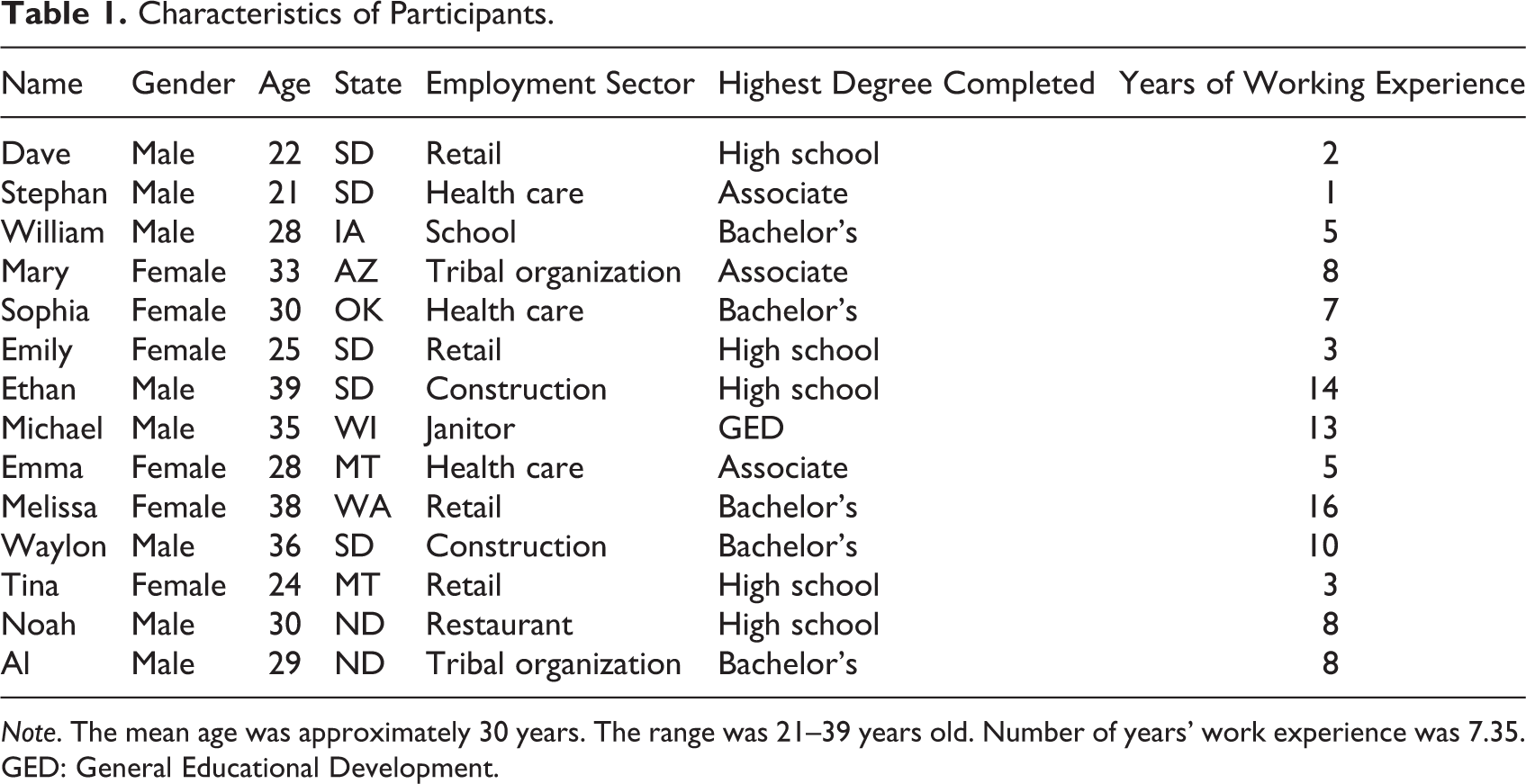
Note. The mean age was approximately 30 years. The range was 21–39 years old. Number of years’ work experience was 7.35.
GED: General Educational Development.
Creswell (2013) recommends that a sample between 3 and 15 participants is needed for these kinds of studies. Accordingly, and as suggested by Moyle (2002), interviews were conducted with 14 participants. After conducting the first 10 interviews and analyzing the data, recurring themes were identified, and additional data collection was less likely to reveal new themes. Nevertheless, to increase the reliability of the findings, four additional confirmatory interviews were conducted. As no new themes identified, the researchers judged that “theoretical saturation” had been reached (Glaser & Straus, 1967).
Each participant received a written invitation to participate along with a consent form. All participants who were contacted accepted becoming a part of this study. In order to protect the privacy and confidentiality of participants, as agreed between researchers and participants, the participants’ detailed information was not described or noted. However, some demographic characteristics of the respondents are compiled to ensure reliability and validity of this study. Pseudonyms were used for all participants.
Subsequent to reviewing the literature related to Native Americans and other minority groups, issues pertaining to individuals living in rural areas of the country in the field of career development, 10 questions were developed as interview questions. Conversations with community leaders also contributed to the development of interview questions. In addition to the main 10 interview questions, probing questions were developed to encourage the participants to elaborate further on their answers. The questions which pertained to the participants’ career experiences were asked (e.g., “Tell me about your experience in finding a job? What were some of the challenges in finding a job and keeping that job?”). Participants were asked to describe their methods of finding jobs and their perceptions of reasons contributing to high unemployment for Native Americans. The interviews lasted between 60 and 90 min and took place in various locations in the span of almost 2 years. The interviews were tape-recorded and transcribed. At the beginning of every interview, participants were assured of the confidentiality of their responses and reminded of the overall objectives of the study.
Data Analysis
As per the suggestions of Colaizzi (1978), and for each interview, researchers independently read and reread the transcripts to highlight areas discussed by the participants that were relevant to the study. Then, the data were coded by each researcher individually, highlighting important categories. Researchers reviewed categories and identified themes from data. Each theme and category was given a label of general (found in all participants), typical (found in half or more but all participants), or variant (found in less than half bure more than one or two participants), as shown in Table 2. Twelve of the participants confirmed that the data collected during the interview represented them accurately without further additions to the initial interviews. The other two participants added some clarifications to the data. Researchers made changes accordingly to more accurately represent the participants. The final stage of data analysis was that the researchers met with each participant to discuss the themes found and to ensure that the research findings were a credible representation of the participants’ perceptions and experiences. The participants all agreed with the themes and no disagreement from the participants was reported.
Themes, Categories, and Frequency.
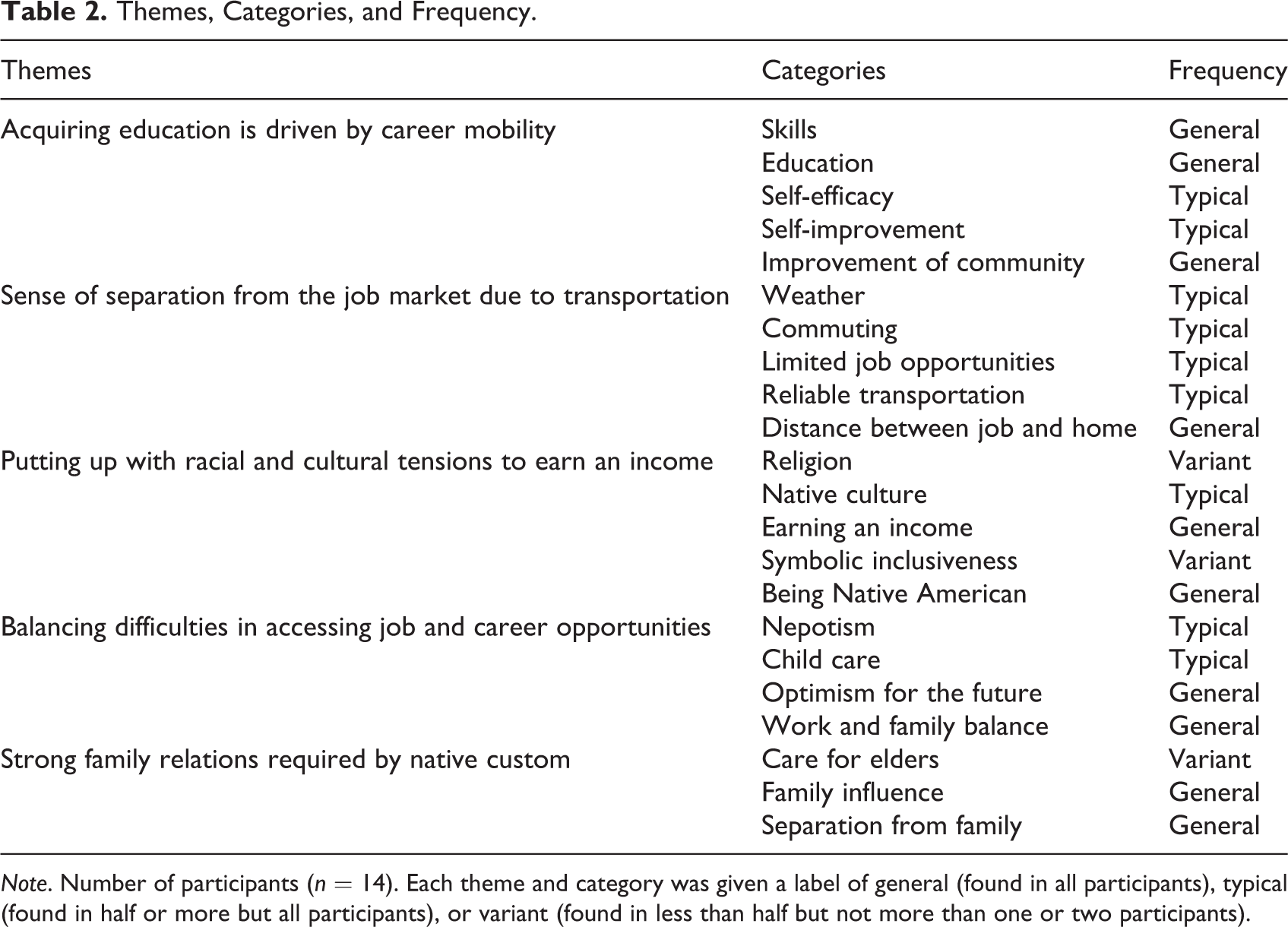
Note. Number of participants (n = 14). Each theme and category was given a label of general (found in all participants), typical (found in half or more but all participants), or variant (found in less than half but not more than one or two participants).
Findings
In the section below, the most important aspects of our study, as identified from our analysis of the interviews, are highlighted. The themes identified are Acquiring education is Driven by Career Mobility, Sense of Separation from the Job Market due to Transportation, Putting up with Racial and Cultural Tensions to Earn an Income, Balancing Difficulties in Accessing Job and Career Opportunities, and Strong Family Relations Required by Native Custom.
Acquiring education is driven by career mobility
All of our interviewees stressed the importance of education. Awareness of the importance of education and training and the impact that these have on finding an acceptable work opportunity was discussed by participants. The findings also highlight the importance of seeking continuous education in order to gain employment, start a career, or create career mobility. The participants discussed their commitment to improving their human capital through ongoing education. As for their actual level of education, some have been to college without finishing their degrees, while others are in the process of finishing bachelor’s degrees. One female participant indicated that she planned to start a master’s degree soon. The challenge that the participants mentioned was that they needed higher education in order to work in a white-collar type of job. Below are some of the responses: I graduated from high school several years ago. If I knew that I needed a degree to be a success in life, I would have went [gone] to college much earlier in my life. I plan to look for a college and maybe start a degree in business or education. Hopefully soon, I plan to attend a tribal college to receive an associate degree in business, then transfer to the University of Nebraska for a bachelor’s degree. I realized that having an associate degree is not going to be enough to get a good job. Attending a well-known university can be very helpful when applying for a job as I currently cannot find a good paying job with my current education background.
Sense of separation from the job market due to transportation
Traveling on a daily basis, from reservation to the work site (generally located in a city) or from home to work, was identified to be a challenge that some participants experienced, especially during winter months. The availability of a reliable vehicle was identified as a serious problem as per the below excerpts. I live in a somewhat middle size city and, while there is bus transportation, it is very difficult to have it take me right to my work. During winter time I have to walk for a few miles from where the bus drops me off, to work. In a subzero weather, this can be harsh so I do not even bother going to work when it is −10 degrees outside. I want to work, but I do not have a car to go to work. My car broke down a few months ago and I do not have money to fix it or buy another car as I lost my previous job due to lack of transportation. I know many Natives like me find the same issue.
Putting up with racial and cultural tensions to earn an income
The findings below demonstrate the influence of environmental factors and how social beliefs can provide a negative atmosphere to career seekers. The Native Americans in this study highlighted the discrimination that they face when working off reservations from, primarily, nonnatives. They spoke about cultural and racial tensions as explained in the excerpts below. I worked for a tourism business and I was subjected to racial tensions by many employees. I was the only one who was not white. At times, they insinuated that Native Americans get everything for free from the government and we do not need to work for living. Also, the employer did not understand when I requested a week off in July to go to a Sundance ceremony. He told me that I would get fired if I would leave to participate in ceremony. So, I quit my job. I was working for a small business and the owner asked me if I was a Christian. When I said I am not, his behavior changed. He started to read a verse every day in the morning to me and when I started to ignore him, then I quit. I know that what he did was illegal, but I just did not want any trouble. I then decide to apply for jobs in organizations that I know have a culture that support Native Americans. Many Native Americans are of “mixed blood” and may not visually be identified as Native. For these individuals the work place can be especially harsh because fellow worker comments are made regarding Natives that are not expected to be heard by a Native. When I revealed to my supervisor that I should be considered “Native” my supervisor replied by saying that she would never have hired me if she had known that I was Native. When I asked why, my supervisor commented that everyone knew that Natives were never on time to work. I had worked for the supervisor for 10 years when this exchange took place. The comment from her caused me to feel that work place policies were applied differently to Natives than non-Natives and that the supervisor and thus the company had irrational, untruthful perceptions of me and Native culture.
Ways of living, cultural and thus family customs, and spirituality are extremely important to Native Americans. These elements define Native Americans as unique among the societies which inhabit North America. The strength of the cultures’ influence on individuals and the depth of spirituality is misunderstood and underestimated within non-Native consideration.
Balancing difficulties in accessing job and career opportunities
Having a job and bringing home income for themselves and their families was understood and set as a goal by the interviewees. The frustrations, however, of solving the problems of transportation, facing cultural bias, and finding a job that pertained to something that they liked caused a sense of reserved expectations and extending a futile effort. I live in a small reservation and the job opportunities on the rez [reservation] are very limited. Most of the jobs here are either at the hospital, government entities, schools or small businesses. If I want to seek employment, most likely, I need to go to city such as Sioux City or Sioux Falls to find a job. In these cities, I can find a job, but I need to relocate, which sometimes is not possible as I want to be close to my family, relatives, and yes the child care can be costly. It is important for those of us who seek a career to attend a college. Many reservations have tribal colleges. I believe that for those of us who want a career we should attend a 4-year institution and receive a degree. Tribal colleges are much cheaper than state or for-profit institutions. Limited numbers of careers are available on the reservation, but others require moving to different places. I believe that any tribal member, who wants a career, should be willing to relocate. Otherwise that person should only accept a job. There are cases when tribal members can find a career such as in nursing, teaching or others. There is something that not many people are talking about and that is nepotism on the reservation. I know this is illegal but I believe it exists on many reservations.
Strong family relations required of native custom
As suggested elsewhere in the review of literature and as reported by previous studies, the interviewees in our study stressed the importance of their families in their lives and careers. As is the case with others belonging to collectivist societies (Hofstede, 1991), Native American communities throughout the United States have close family relationships and their communities still hold their collective traditional and cultural norms as paramount to their existence. Accordingly, and as previously mentioned, given the shortage of jobs on the reservations, Native Americans seek jobs outside of reservations which disrupt family and community lives. In other words, interviewees who ended up working outside the reservations experienced a disruption of their family life and could not meet their obligations and responsibilities to their families. These family obligations that are mandated via societal and cultural factors, indeed, are a barrier hindering career-oriented behavior. It also influenced personal goals and the ability to have a career rather than a job. These complexities are observed in the excerpts below: During winter, I moved to Rapid City to find a job. After living in Rapid for a few months and working, I decided to move back to the rez [reservation] to take care of my grandmother, as she was not feeling well. That meant that I had to quit my job that I worked at for only a few months. I have moved back and forth from the rez [reservation] to Rapid many times. I usually move to Rapid during the winter and then moved back to the reservation during summer time for Sundance [a religious ceremony practiced by the Lakota]. I participate in a Sundance once a year and I do not like to work during that time. I spend summer doing cultural activities. The reason I do not work during summer time is that many employers do not work with me. Sometimes, I can find some jobs to get me by during summer time on rez [reservation].
Discussion
This study explored some of the challenges Native Americans, working on and off reservations, face. The main themes identified from this study were interrelated and interdependent. At the macro-national level (Syed & Özbilgin, 2009), albeit the governmental efforts to enhance the educational level of Native Americans (Al-Asfour & Abraham, 2016), lack of access to education along with other issues pertaining to a good education is one of our prominent findings. The finding supports previous research and warrants the attention of various stakeholders and policy makers. Ting and Bryant (2001) indicated that fewer than 12% of Native Americans in the United States hold college degrees, with 0.67% of the undergraduate degrees being awarded to American Indians (Schmidtke, 2010). This percentage is extremely low when compared to the graduate rate of non-Natives by many mainstream colleges and universities. Freeman and Fox (2005) stated that Native Americans are the least formally educated among all other minority groups in the country. The correlation between the low educational levels of Native American degree holders and high unemployment rates is evident. The attitude of the participants in this study demonstrates that, of those in the workforce, there is an understanding of the importance of higher education within their lives and the intent to avail themselves to that education if possible.
Surprisingly, the lack of reliable transportation means was a challenge that is rarely identified by individuals in other minorities, and the consequence of this problem has been the inability to keep a job outside the reservation. For example, traveling the Pine Ridge Reservation from one side to the other means that residents must travel more than 100 miles. Most of the reservation is rural with hamlets here and there which generally boast a post office, school, and gas station/junk food store. A fully stocked grocery store is located in one corner of the reservation as is a casino. Travel to the grocery store or job site for these areas is lengthy and very often impassable in the winter time. Gas costs on the reservation are the highest in the state. Costs of having a car, as well as costs of fuel in addition to day care centers significantly affect the worth of even having a job. In other words, these accumulated costs leave Native Americans in this study with a small amount of disposable income, hence reducing motivation to achieve higher educational levels and eventually get a job. Owning a vehicle is a must for those who work outside the reservations given that public transportation is available on main arteries only and therefore may not deliver workers anywhere near their employment locations. Hence, transportation issues provide monumental challenges for Native Americans seeking sustainable employment and are a macro-level problem that spills over into their attempts to find and sustain a job. This fact coupled with the scarcity of jobs lends to findings which fully support and are relevant to Syed and Özbilgin’s (2009) relational network whereby the multiple social and environmental difficulties that the Native American are facing present real and everpresent obstructions to having successful careers.
An additional and critical theme identified from this study is the discrimination that Native Americans suffer. This finding highlights the relational framework (Syed & Özbilgin, 2009) and its ability to help us better understand the difficulties that Native Americans are facing. In other words, the discrimination that Natives face at a larger macro-national level spills over into organizational boundaries whereby the careers of Native Americans are significantly hindered by the discrimination that they face within organizational structures and cultures. Accordingly, if indeed any Native American was able to overcome the plethora of difficulties regarding getting a good education, a reliable vehicle, and a job outside the reservation, he or she still needs to understand and overcome discrimination within the meso-organizational (Syed & Özbilgin, 2009) boundaries.
The discrimination highlighted in the interviews stresses the cultural tensions between Natives and non-Natives as the Natives’ culture, values, and traditions continue to be undermined and underscored by non-Natives. Inappropriate treatment in organizational contexts because of cultural beliefs or appearance can be next to impossible to document and to corroborate yet the negative impact that it elicits causes devastating effects for all Native Americans, but especially for Native workers. Several holidays are anchored in Christianity, and Gregorian calendar are observed and accepted wholeheartedly by employers. Work calendars are built around their observance, but when Natives seek to exercise the same type of observance for their spiritual and cultural events, they are, many times, met with unyielding opposition, reinforcing the separations from family and community. The culture and traditions shape and identify Native Americans as unique within the ethnicity of the United States. However, non-Natives misunderstand the importance of the culture of Natives and are mostly concerned with artifacts rather than trying to understand the effects of culture and its meaning. To that effect, we argue that in today’s world, it is the responsibility of managers to be well informed about the diverse workforce within their employ. Employers who value their employees should seek innovative ways of respecting and honoring each employee, so they may practice their faith and celebrate essential events fairly as outlined by the Equal Employment Opportunity Act.
Furthermore, it is essential to understand the importance of family, community relations, and connections to Native Americans and their influence at the microindividual level (Syed & Özbilgin, 2009). It is also critical to understand that family, for our participants, is not the definition of family as understood by non-Natives. First-degree Native families include many more members that are included in non-Native’s understanding of their own families. This is a significant deviation from the individualistic nature of the American culture whereby the focus is on one’s small nucleus family with marginal responsibility for members other than the core members of the family. The results of the study demonstrate that these responsibilities impact Native Americans in the workforce with little understanding from employers. From the participants’ responses, it was evident that negative situations were created for families when pursuing employment meant moving from reservations to cities.
The physical separation, sense of loneliness, and inability to fulfill societal obligations took an emotional toll on the respondents and hindered their agency. It, therefore, is critical to recognize that the sense of belonging is imperative in Native American communities as both culture and tradition place primary responsibility upon young natives to provide and to care for elders and those less fortunate in the community. Like the family, extended communities are referred to as extended family in Native communities and are an integral part of identity. As one participant said, it is all about “we” not “I” and this is a core belief for individuals living in collectivistic societies (Hofstede, 1991). While the need of employers cannot be set aside for unilateral accommodation of all family issues, employers’ and managers’ understanding of the family structure and responsibility for Natives is needed in order to create job opportunity and to advance the careers of Native Americans. However, the absence of this understanding is significantly affecting Native Americans at the individual level. Despite highlighting the difficulty of finding jobs and pursuing careers, the majority of our interviewees expressed optimism in their future and expressed hope stemming from the tribal, state, and federal reform efforts that have been taking place to increase job opportunities for Native Americans. Accordingly, we argue that the macro-national and meso-organizational (Syed & Özbilgin, 2009) challenges that Native American have been facing did not eliminate their agency as they still believe that things will get better in the future and they continue to want to invest in themselves and their careers.
Implications
The responses of the interviewees in this study are a clear depiction of the challenges they encountered acquiring or holding a job. Historically, Indigenous people of the North American continent have endured many individual and collective atrocities. These atrocities have contributed to their short life expectancies as affected by disease due to financial inability to purchase and restricted physical access to well-balanced food sources, as well as lack of economic affluence affecting habitat environment such as economic inability to purchase housekeeping items or the ability to properly heat or cool the environment in extreme weather, cultural development, freedom of religious practice, and peace of mind. Today, there exists an opportunity for non-Native employers, governments, corporations, and career development specialists to work with Native American communities to resolve barriers and challenges in employment and career development.
This article helps to define areas of concern that might be considered and enhanced through an endeavor to establish parity with the main workforce group. The fruition of such parity, in all possibility, could produce a win–win situation for both Natives and the employers who work with them. Through their sheer survival, Natives have demonstrated that innovation is a part of their tradition, and their way of thinking and problem solving can contribute to the diverse thinking that many organizations seek in their employees. The findings discussed above, therefore, have several implications for theory and practice. First, they advance knowledge about a minority group that is underutilized in management and career studies. Second, this study validates the use of the relational approach framework in understanding the career challenges of Native Americans. The findings demonstrate the importance of exploring the careers of Native Americans within the local contexts in which they operate. The study findings also highlight the role of social systems in Native American communities. Third, the findings reported are elements in raising the awareness about the reality that this minority group experiences unique problem sets and allows the social services departments to better understand employment and career development challenges. This knowledge can be instrumental in programs development of effective interventions.
The findings also clearly support the argument that Native Americans have been subjected to multiple and ongoing struggles related to both educational opportunities and employment for several decades. The percentage of unemployment in Native communities is higher than for any other minority group in the United States (Al-Asfour, 2014). Despite their struggles, Native communities attempt to overcome challenges by using innovative programs to regain language and culture, by establishing Tribal Universities and Colleges, and by utilizing technology to bring educational opportunity to its members and to move on, with the limited help that they receive and without focusing on being victimized. Rather, Native communities focus on tribal sovereignty and empowerment for development of their reservations. This is very evident in the Mission Statements of many TCUs. For example, the mission statement of Oglala Lakota College (2016) is “Rebuilding The Lakota Nation Through Education” (p. 1). Education, training, and skill development of Native Americans are the paramount effort for many tribes across the United States. On the other hand, for Native Americans working off reservations, a cultural focus is widely used to cope with and adapt to adverse circumstances. This is often done with remarkable resilience, resulting in perseverance in their endeavors.
Educational challenges, cultural bias, and racial discriminations make it unlikely that most Native Americans will find their paths to career development. Eggerth, Delaney, Flynn, and Jacobson (2012) suggested that “socially marginalized individuals are typically far more concerned with meeting basic survival needs than with pursuit of self-actualization” (p. 25). Hence, career development specialists, who are inspired by vocational psychology’s history of social justice and advocacy, will need to take the initiative to build bridges to Native American communities based on trust and understanding of the challenges that they encounter in the workforce. Also, state and federal policies have historically sought to adopt Native Americans to the Caucasian way of life in all things, from the beginning of being on the reservations to the boarding schools’ era (Pevar, 2012). Al-Asfour (2014) recommended that policy makers at the state and federal level need to be further involved in helping Native communities overcome the challenges of unemployment and career development. Working with and through tribal entities is important in educating non-Natives on the realities of the challenges of this underserved population. Awareness of needs and expectations from both Natives and non-Natives within the business world, concerning core values, could help reduce unemployment rates and provide an opportunity for real career development for Natives. The interviewees also highlighted the lack of governmental support and the absence of regulatory norms to support employment for Native Americans on and off reservations. Accordingly, we highlight the need for more governmental support for work–life balance and quality of work–life practices in facilitating Native Americans’ employment.
Study Limitations and Suggestion for Future Research
Despite its contribution to an underrepresented population in management studies, this study has several limitations. First, although this study is exploratory in nature, our sample was small in size given the difficulty of data collection. The small size of the sample and the inherent nature of the qualitative approach used limit generalizability of the study. Second, due to the already stringent criteria for participant inclusion, we did not make a distinction between participants based on the state or region whereby they live, given that challenges in the workforce could differ. Hence, it would be interesting to see future studies compare their findings based on the demographics of their samples or the state they work/live in. It would also be interesting to see comparative studies drawing a distinction between career barriers and enablers of men versus women. Other qualitative approaches such as panel discussions and narratives and quantitative methods such as survey questionnaires could also be used.
Footnotes
Declaration of Conflicting Interests
The author(s) declared no potential conflicts of interest with respect to the research, authorship, and/or publication of this article.
Funding
The author(s) received no financial support for the research, authorship, and/or publication of this article.