







Abstract
This study examines whether job attribute preferences differ across three generational cohorts (i.e., cohorts of undergraduate students from 1995, 2004, and 2013). In 2013, we surveyed undergraduate students from several U.S. universities. We also obtained archival results from surveys administered to undergraduate students in 1995 and 2004. We found that salary/benefits, career advancement, and flexible work policies become more important across all three generational cohorts, whereas gender/racial equality increased in importance only from 2004 to 2013. Leadership showed no net gain from the 1995 to 2013 cohorts. Although most job attributes increased in importance, they largely have the same relative importance. Therefore, organizations should pause before making wholesale changes to workplace incentives and practices to cater to the new generation. To our knowledge, this is the first study to include U.S. millennial college students in the comparison of job attribute preferences across generations.
Keywords
The undergraduate classes graduating between 2003 and 2018 consist mostly of students who are often referred to as millennials, Generation Y, or Gen Y (Costanza, Badger, Fraser, Severt, & Gade, 2012; Shaw & Fairhurst, 2008). Millennials are considered by some to be drastically different in work and career expectations and workplace behavior from prior generations (Broadbridge, Maxwell, & Ogden, 2009; Kapoor & Solomon, 2011; Shaw & Fairhurst, 2008). 1 To recruit and retain these students, it is suggested that employers will have to adapt their human resource strategies to appeal to this generation (Broadbridge et al., 2009; Kultalahti & Viitala, 2015; Shaw & Fairhurst, 2008). However, some scholars question whether their employment expectations differ much from prior generations (Deal, Altman, & Rogelberg, 2010; Sullivan, Forret, Carraher, & Mainiero, 2009; Treuren & Anderson, 2010). This raises both practical and theoretical questions that we aim to address in this article.
It is imperative for employers to know whether values have changed across recent cohorts, so that they can continue to attract and retain the future workforce. Also, given that students are increasingly relying on career counselors for career information (Zondag & Brink, 2017), it is important for employment counselors to understand the values of college graduates, so that they can manage student expectations and facilitate a match between students and employers. The popular press frequently opines about generational differences, yet we are not aware of any prior empirical research that compares U.S. millennial college students’ job attribute preferences across generations. Most of the sparse empirical research that is available is limited by cross-sectional methods or sample constraints.
Construct Definitions
Defining generational cohort
Generational research suffers from definitional issues (Costanza et al., 2012; Dencker, Joshi, & Martocchio, 2007, 2008). A generation is a sociological concept defined by the social and historical context that is shared by its members (Lyons & Kuron, 2014; Parry & Urwin, 2011). It is, to a large extent, a cultural construct comprised of cohort, age, and period effects that are often inextricably intertwined (Brink, Zondag, & Crenshaw, 2015). The popular press and many scholars have adopted the notion of distinct generations (i.e., traditionalists, baby boomers, Gen X, millennials) and view generations as categorically different from one another. However, some scholars promote doing away with this conception of generations because it is replete with methodological limitations and perpetuates stereotypes (Costanza & Finkelstein, 2015; Joshi, Dencker, & Franz, 2011; Lyons & Kuron, 2014).
In her review of generational research, Twenge (2010) observed that all of the time-lag studies found linear trends across generations rather than categorical differences. Twenge noted that there are not sudden changes or shifts across generations at the commonly accepted birth years that define the generation categories and argues that the view of generations as categorically different should be reconsidered. Rather, “generations can be viewed as part of social change, which occurs gradually over a number of years” (p. 208). Therefore, we adopt the empirically supported viewpoint that generational change is more linear and gradual.
Joshi and colleagues (Joshi et al., 2011; Joshi, Dencker, Franz, & Martocchio, 2010) recommend defining generational cohorts as a group of individuals who enter the same institutional context within the same time interval; they advocate for this conceptualization of generational cohorts especially when studying the role of generation in the organizational context. As such, one way of defining “generational cohort” is those individuals who enter postsecondary education, exit postsecondary education, and enter the workforce together in the same approximate time intervals. This approach appropriately recognizes the similarities/sharedness within a generational cohort, and the distinctions between generational cohorts (cf. Brink et al., 2015), but does so without defining generational cohorts according to traditional (but empirically unsupported) categories. We adopt this approach in defining our generational cohorts. Our study includes three generational cohorts exiting postsecondary education and entering the workforce in or around 1995, 2004, and 2013.
We depart from the traditional approach of defining generations as categorically different (e.g., baby boomers, Gen X), discourage the perpetuation of categorical stereotypes, and caution against making such inferences. However, we also endorse Twenge’s (2010) view that generational labels are still useful as shorthand descriptors. In addition, the pervasive use of these traditional generation labels necessitates that we use them to place our research in the context of prior studies. Therefore, we sometimes refer to the 1995, 2004, and 2013 generational cohorts as Gen X, early millennial, and late millennial, respectively.
Job attribute preferences
Konrad, Ritchie, Lieb, and Corrigall (2000) define job attribute preferences as “the extent to which people desire a variety of specific qualities and outcomes from their paid work” (p. 593). Job attribute preferences are important because they influence the decisions, behaviors, and behavioral intentions of job seekers and employees. Person–environment fit is, perhaps, the most fundamental concept underlying organizational staffing. Job seekers appraise prospective employers based on the match between their values and the perceived attributes of the job/employer, and their perceptions of job attributes and fit influence their job choice decisions (Cable & Judge, 1996; Cable & Turban, 2001; Heneman, Judge, & Kammeyer-Mueller, 2015; Judge & Bretz, 1992; Turban, 2001). The assessment of fit continues posthire. An incongruence may result in a perceived breach of the psychological contract, which could negatively influence intentions to remain with the employer (Robinson & Morrison, 2000).
Theoretical Propositions and Hypotheses
The evolving career
Scholars have explicated the many changes to careers that have developed over the last few decades (e.g., see Baruch, 2006; Bidwell & Briscoe, 2010; Greenhaus, Callanan, & Godshalk, 2009; Sullivan, 1999). The psychological contract between the employer and employee has changed. Concerning organizations, downsizing has been a frequent occurrence, and the offering of job security and loyalty to employees has declined. The flatter and leaner organization results in fewer advancement opportunities for employees. Organizations are replacing long-term relationships, advancement, and security with transportable opportunities for growth and development.
Concerning employees, they are now responsible for managing their own careers. Traditional careers are being replaced by boundaryless and protean careers. According to Greenhaus, Callanan, and Godshalk’s (2009) model of career management, career paths now lie within the individual rather than the organization, and individuals must be proactive and ready to adapt to changing situations. Indeed, it is likely that the evolution of the career has resulted in greater job and organizational mobility (Lyons, Schweitzer, & Ng, 2015). Furthermore, careers are increasingly driven by personal values, more so than organizational values, and employees want more meaningful work (Allan, Owens, & Duffy, 2017), not just money and security.
There is also growing economic disparity. Despite some ups and downs, income inequality has increased steadily since tracking began in 1967 (U.S. Census Bureau, 2013). Americans have gotten richer on average statistically (DeNavas-Walt, Proctor, & Smith, 2009), but they may not feel richer perceptually as a result of the growing inequality. Indeed, perceptions of income, status, and wealth are largely subjective, relative, and depend on social comparison and contextual factors (Leana & Meuris, 2015).
Theoretical foundation
It is likely that the aforementioned career changes have resulted in shifting values across generational cohorts (Cennamo & Gardner, 2008; Kultalahti & Viitala, 2015). When viewing career evolution through the lens of Inglehart’s (1981) theory of generational value change, we believe there is a sound theoretical basis to expect that job attribute preferences will change across generational cohorts in predictable ways.
Inglehart’s (1981) theory is based on two hypotheses: scarcity and socialization. According to the scarcity hypothesis, an individual “places the greatest subjective value on those things that are in relatively short supply” (p. 881). The socialization hypothesis postulates that values form during the “formative” preadult years; values are malleable and are influenced by the conditions of the social and cultural settings experienced during youth. Values solidify by early adulthood and remain quite stable throughout adulthood. As such, period effects have the greatest impact on the more rapidly developing and malleable youth. However, period effects do not impact all members equally because of varying social and cultural settings. Furthermore, period effects may impact older generations but to a lesser extent since they are beyond their formative years. As a result, the values of individuals change gradually and the values of society change slowly and steadily through generational replacement. Inglehart has shown how these two hypotheses work in concert to impact generational values. Specifically, he utilized this theory to explain the steady intergenerational shift from materialist to postmaterialist ideologies (Abramson & Inglehart, 1992; Inglehart, 1981, 2008).
Drawing on social learning theory and social cognitive theory, scholars (e.g., Bosco & Bianco, 2005; Powers & Myers, 2017) have opined that career decisions are influenced by observation, modeling, and vicarious learning that occurs from early childhood through young adulthood. The tenets of Inglehart’s (1981) theory can extend this work and explain evolving job attribute preferences across generational cohorts. If the nature of careers and psychological contracts evolve during the formative years of a generational cohort, their values (or job attribute preferences) may differ from the generational cohort that preceded them. At the same time, if career-related resources become more scarce (e.g., lower wages, fewer jobs, or less advancement opportunities) during the formative years of a generational cohort, they may place greater value on these resources compared to the generational cohort that preceded them.
Hypotheses
Inglehart’s (1981) scarcity hypothesis postulates that things that are in short supply are valued the most. As organizations increasingly downsize, offer less security, and provide fewer advancement opportunities, and as economic disparities continue to grow, we would expect generational cohorts to increasingly value salary and benefits as well as career advancement and leadership opportunities, which ultimately result in greater salary and benefits. In support, in their review of generational research, Lyons and Kuron (2014) concluded that the importance of material rewards is increasing across generations.
Flexible work policies facilitate work–life balance as well as allow workers discretion to determine when and where they work (Bal & De Lange, 2015). The number of hours worked in America is rising simultaneously with the increasing desire for leisure (Deal et al., 2010; Twenge, 2010). Given that time is a scarce resource, this trend is consistent with Inglehart’s theory—as work hours increase and time becomes more scarce, the scarcity hypothesis would predict greater value being placed on flexibility, leisure, and work–life balance. Furthermore, as careers are increasingly driven by personal values, and employees want more meaningful work (Greenhaus et al., 2009), Inglehart’s socialization hypothesis would suggest that generational cohorts should increasingly prefer balance and flexibility that allows them to fulfill their personal values. These changes in desired job attributes are consistent with the steady intergenerational shift from materialist to postmaterialist ideologies (Abramson & Inglehart, 1992; Inglehart, 1981, 2008). In support, research has shown that younger workers and older workers respond differently to the availability of flexible work policies (Bal & De Lange, 2015) and that millennials want more flexibility and work–life balance (Broadbridge, Maxwell, & Ogden, 2007; Kultalahti & Viitala, 2015; Loughlin & Barling, 2001). Also, in her review of empirical research, Twenge (2010) observed that millennials have a weaker work ethic, place greater value on freedom and leisure, and are less work centric compared to previous generations. Furthermore, the importance of work–life balance and leisure is increasing across generations, and work ethic and the centrality of work to people’s lives are decreasing (Lyons & Kuron, 2014).
In a similar vein, as careers are increasingly driven by personal values, employees desire more meaningful work, and generations continue to shift to more postmaterialist ideologies, Inglehart’s socialization hypothesis would suggest that generational cohorts would increasingly prefer meaningful jobs that contribute to corporate social responsibility (CSR) values such as gender and race equality. Millennials have been branded as being more altruistic and socially conscious (e.g., De Hauw & De Vos, 2010; Hurst & Good, 2009; Ng, Schweitzer, & Lyons, 2010; Twenge, 2010). Given that scholars and the popular press widely label millennials as having stronger CSR and equality values, it is possible that their expressed values have strengthened as a result of Inglehart’s socialization hypotheses as well as a self-fulfilling prophesy of media-hype (cf. Hoffner, Levine, & Toohey, 2008; Riggio & Saggi, 2015; Vasterman, 2005). In summary, we hypothesize the following: Competitive salary/benefits, career advancement, leadership opportunities, flexible work policies, and equality will become increasingly important across generational cohorts.
Method
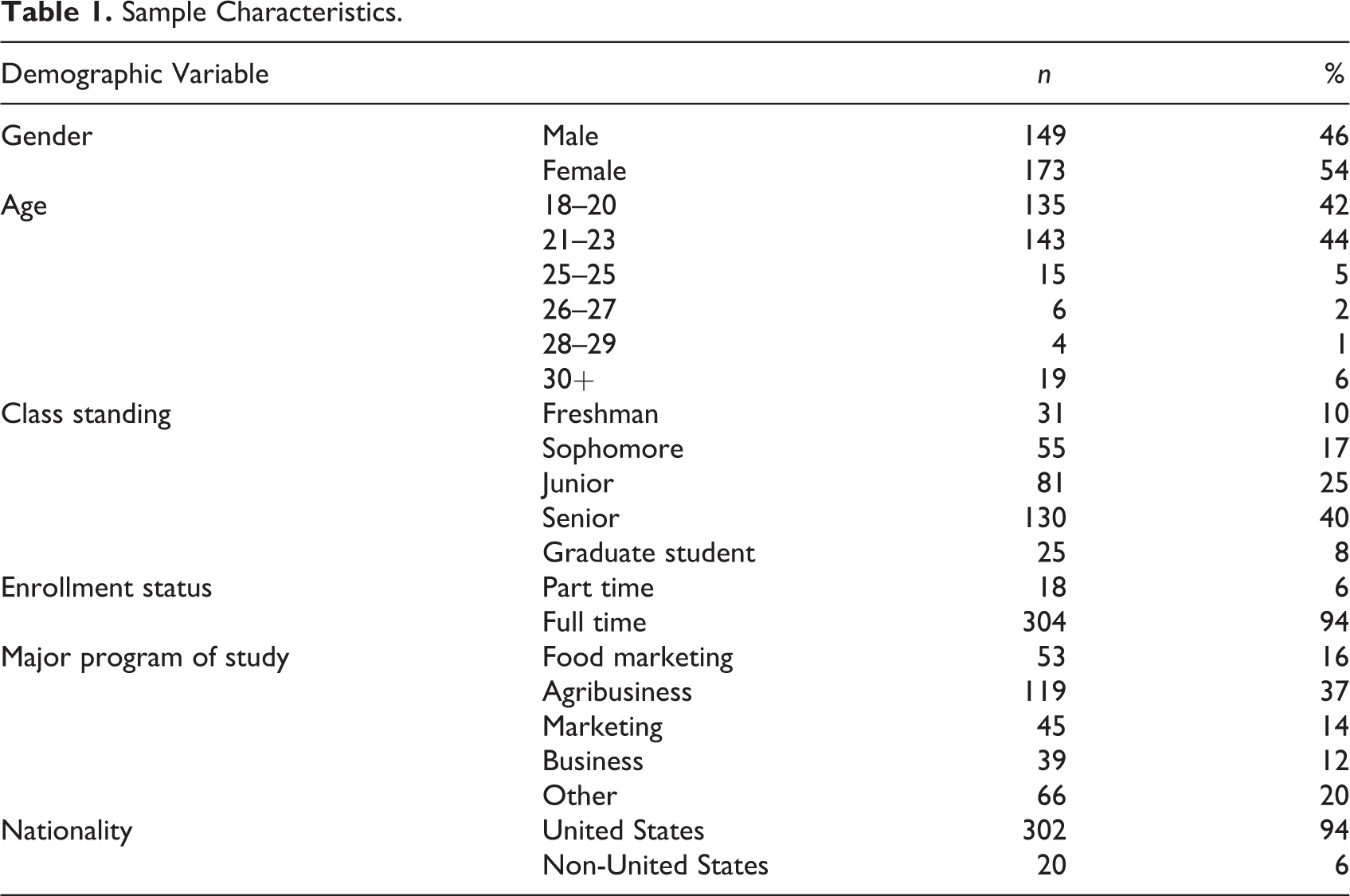
We developed an online survey to assess students’ perceptions of job attribute importance. Our survey was developed through the collaboration of academics and practitioners under the auspices of the Food Industry University Coalition (FIUC), a National Grocers Association (NGA)-affiliated group of food marketing programs at 13 U.S. universities, advancing a collaborative agenda of industry-focused academics and research. The survey was administered during the fourth quarter of 2013 to undergraduate students majoring in food marketing and related fields at FIUC universities. We received 322 usable surveys completed by students from 12 universities. Sample characteristics are shown in Table 1.
Sample Characteristics.
This was the third such survey in three decades. We obtained survey results from an unpublished 2004 study (Perosio, 2005), which was likewise supported by the NGA and FIUC. The 2004 study surveyed 533 students at seven FIUC member universities. The demographics of the 2004 study (i.e., 47% female, 53% male, and an average age of 21 years) were similar to the demographics of our 2013 sample. The 2004 survey was itself a follow-up to a 1995 study, supported by the Food Marketing Institute (FMI) that surveyed 300 students at seven FIUC universities. Demographics from the 1995 study were not available. Although no raw data were available from either of the prior surveys, the 2004 survey report (Perosio, 2005) included some of the key results of the 2004 and 1995 studies, allowing us the opportunity to compare results from three decades. Gen X (as defined by traditionally used generational categories) was surveyed in the 1995 questionnaire, whereas the 2004 and 2013 questionnaires surveyed millennials before and after the “great recession” of 2008.
Many scholars (e.g., Costanza et al., 2012; Costanza & Finkelstein, 2015; Lyons & Kuron, 2014; Parry & Urwin, 2011; Twenge, 2010; Twenge, Campbell, Hoffman, & Lance, 2010) have noted that most of the extant generational research is limited by the use of cross-sectional methods which confound age, cohort, and period effects. Time-lag designs gather cross-temporal data from different respondents from more than one cohort at different points in time when the cohorts are at the same stage of life (e.g., while in college). The strength of this design is that it is able to isolate or remove the effects of age (Campbell, Campbell, Siedor, & Twenge, 2015). In addition, our inclusion of more than two cohorts and measurement at equally spaced intervals allow for a robust assessment of change/trends over time. Therefore, our time-lag methodology makes a significant contribution to the literature.
Results
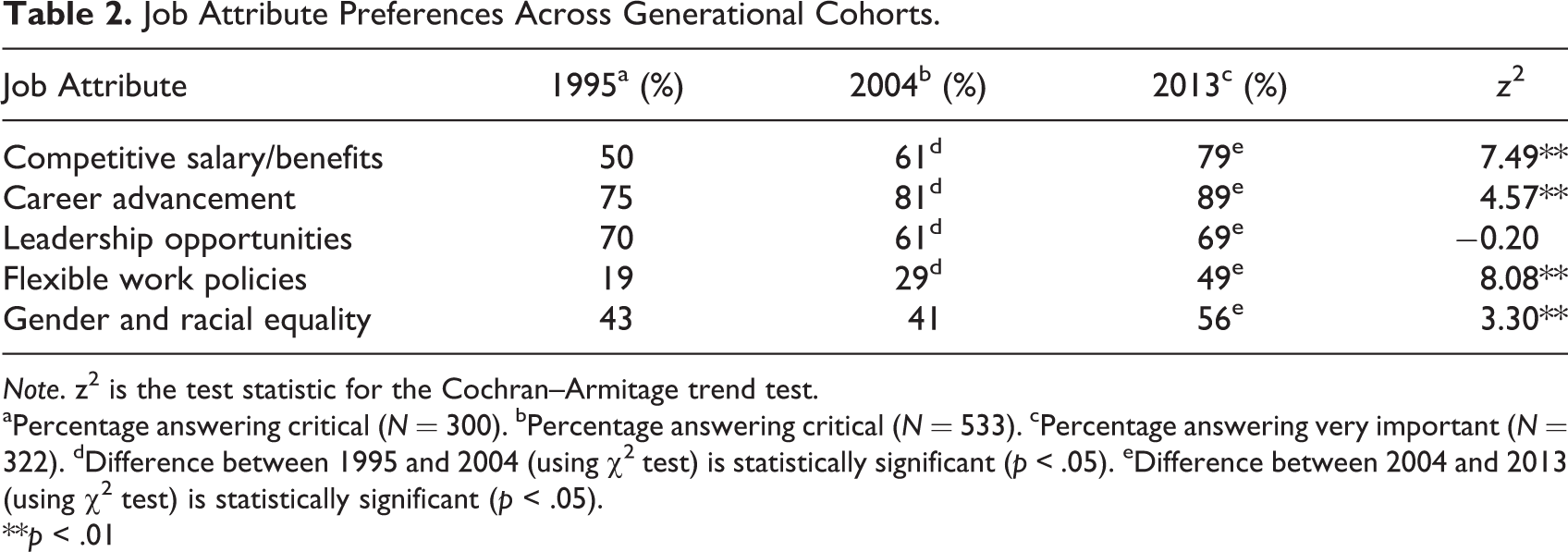
The report related to the 1995 and 2004 surveys (i.e., Perosio, 2005) only provided results with respect to the percentage of respondents endorsing the items as “critical” (i.e., the highest value on the rating scale). Therefore, we treated the items from all three surveys as if they were binary, ordinal-level items. The binary categories were critical versus not for the 1995 and 2004 surveys. The binary categories were very important (i.e., the highest value on the rating scale) versus not for the 2013 survey. Table 2 depicts the percentage of students who endorsed each job attribute dimension as critical or very important.
Job Attribute Preferences Across Generational Cohorts.
Note. z2 is the test statistic for the Cochran–Armitage trend test.
aPercentage answering critical (N = 300). bPercentage answering critical (N = 533). cPercentage answering very important (N = 322). dDifference between 1995 and 2004 (using χ2 test) is statistically significant (p < .05). eDifference between 2004 and 2013 (using χ2 test) is statistically significant (p < .05).
**p < .01
We analyzed change across all three generational cohorts using the Cochran–Armitage trend test, which is a powerful ordinal test for detecting linear trends when the response variable is binary (Agresti, 2002, 2007). Following this omnibus test, we analyzed change across two successive surveys (i.e., from 1995 to 2004 and 2004 to 2013) using the Pearson χ2 statistic. The linear trends are depicted in Figure 1, and the results are shown in Table 2.
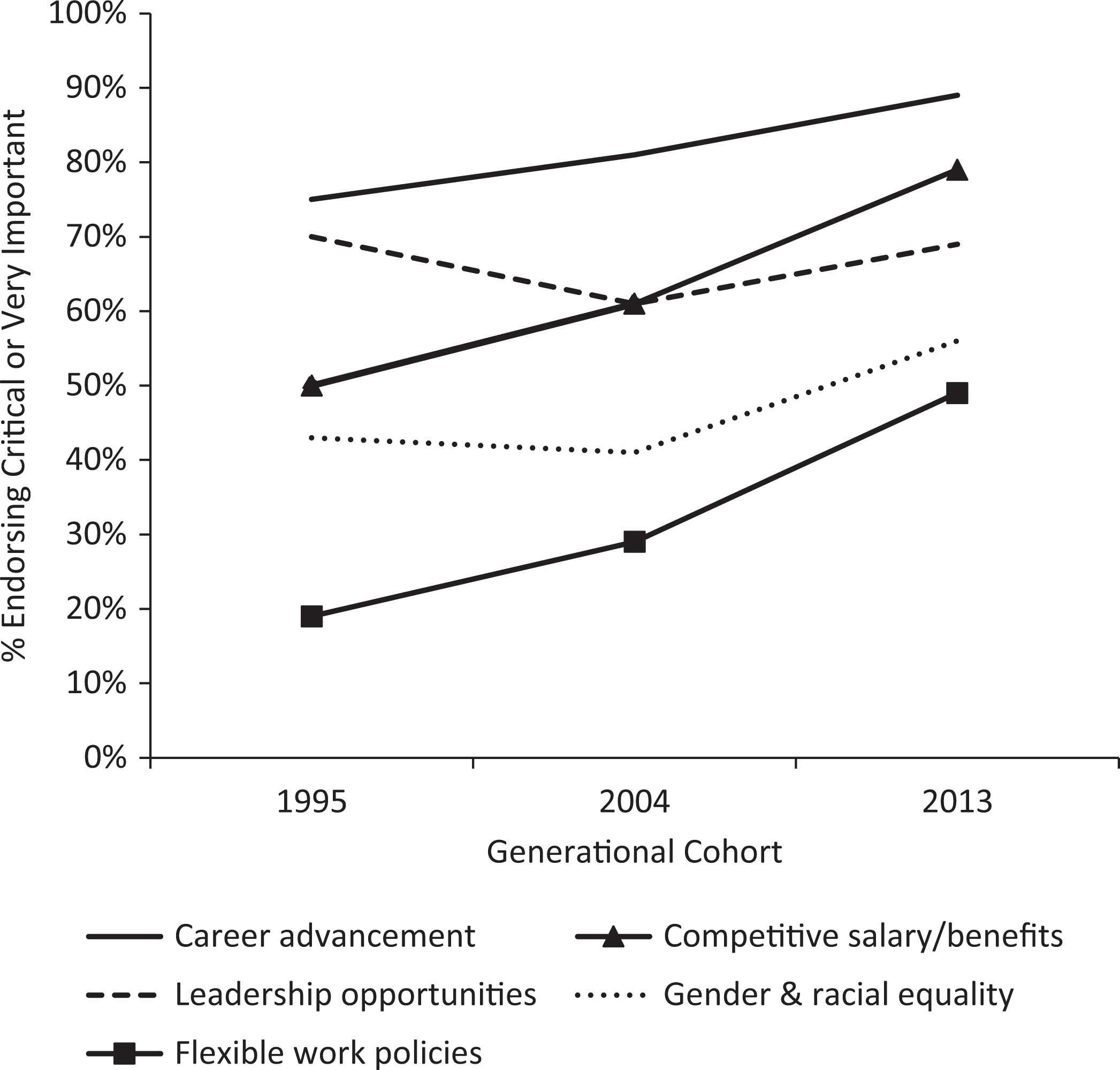
Job attribute preferences trends across generational cohorts.
The Cochran–Armitage trend tests for competitive salary/benefits, career advancement, and flexible work policies are statistically significant. These attributes are becoming more critical across the three generational cohorts. χ2 analyses show significant increases across both time periods (i.e., from 1995 to 2004 and 2004 to 2013) for all three variables. The Cochran–Armitage trend test for gender and racial equality is also statistically significant, indicating an upward trend over time. χ2 analyses showed that the upward trend is attributed to the significant increase from 2004 to 2013.The Cochran–Armitage trend test for leadership opportunities is not statistically significant. χ2 analyses show a significant decrease from 1995 to 2004, followed by a significant increase from 2004 to 2013.
Discussion
Our research surveyed students’ job attribute preferences with respect to careers in the food/CPG industry. According to previous research, millennials consider competitive salary and career advancement opportunities to be important employment conditions (e.g., Broadbridge et al., 2009; Deal et al., 2010; Lyons & Kuron, 2014; Wayne & Casper, 2012). We found support for that characterization in our survey results too. Career advancement was the most important job attribute across all three cohorts, and its importance increased across all three cohorts. The importance of salary/benefits increased substantially, making it among the most important job attributes for the most recent cohort. Given that salary/benefits and career advancement reflect short-term and long-term remuneration, respectively, the trend suggests that the newer generation may have less patience for compensation—they want it now and later.
Although more than two thirds of students regarded leadership opportunities as important, there was no net gain in importance across the generational cohorts, dropping from 1995 to 2004 and then rising to 1995 levels again in 2013. It is interesting that career advancement has increased in importance, whereas leadership opportunities (an important pathway to advancement) has remained flat, suggesting that the newer generation may want the economic rewards of advancement without the responsibility of leadership.
The importance of flexible work policies increased substantially across the three cohorts. This suggests that employers need to develop a balanced approach, prominently including these job attributes for talent recruitment, development, and retention as suggested in managerial and academic literature (e.g., Broadbridge et al., 2009; Donnelly, 2009). Work–family support policies (Butts, Casper, & Yang, 2013) and work schedule flexibility (Ng, Butts, Vandenberg, DeJoy, & Wilson, 2006) have been shown to be important determinants of organizational commitment and other work outcomes.
Gender/racial equality marginally increased in importance, with more than half of the 2013 respondents indicating that it is very important. Ng, Schweitzer, and Lyons (2010) found in a sample of Canadian students that diversity was among the least important job attributes for millennials. Likewise, in the retail sector, Broadbridge, Maxwell, and Ogden (2007) did not find evidence that millennials were concerned with equality or diversity. In contrast, our results suggest equality is moderately important compared to other job attributes and may be gaining traction.
Overall, our findings show that as the decades have progressed, students want more of everything but want it in the same relative proportion. Cennamo and Gardner (2008) found similar upward generational trends in New Zealand, even if the relative importance of job attributes differs from U.S. findings. The findings are consistent with the belief that millennials have higher expectations and a greater sense of entitlement (Alsop, 2008).
Implications
We found differences across generational cohorts, in the hypothesized direction, for most of the job attributes examined, supporting our theory-based propositions related to generational change. However, given that the rank order of job attributes remained virtually unchanged over three decades, the differences seem to be of little practical consequence to organizations. Nevertheless, the broader implications of our findings are substantial for several reasons.
First, examining job attribute preferences with cross-sectional or single-sample studies can result in erroneous conclusions and misleading advice. The popular press continues to propagate and organizations continue to believe in considerable differences across generations. The mounting empirical evidence suggests little, if any, difference. Unfortunately, sweeping changes are often suggested in the media, popular press, and some scholarly works (cf. Real, Mitnick, & Maloney, 2010; Treuren & Anderson, 2010). The results of our study fall within a growing body of empirical research that questions the popular belief about widespread differences in attitudes and workplace behavior of different generations (Costanza et al., 2012; Deal et al., 2010; Real et al., 2010; Staff & Schulenberg, 2010), and we caution against hyperbolic changes in recruitment, training, or retention strategies solely based on generational differences.
Second, theory must play a larger role in generational research. Costanza, Badger, Fraser, Severt, and Gade (2012) emphatically state that there is clearly a need for more research pertaining to generational differences, in particular with respect to work-related criteria and comparisons across cohorts. Unfortunately, most generational research in the context of the workplace is hindered by a lack of theoretical foundation (Costanza et al., 2012; Costanza & Finkelstein, 2015; Lyons & Kuron, 2014; Parry & Urwin, 2011). Although scholars have recently developed generation-based frameworks and proposition more strongly grounded in theory (e.g., Dencker et al., 2007, 2008; Joshi et al., 2011; Joshi et al., 2010; Parry & Urwin, 2011), nearly all existing research is still descriptive (Lyons & Kuron, 2014), and little empirical work has applied theoretical frameworks (Perry, Golom, & McCarthy, 2015). Therefore, our theory-based hypotheses related to generational differences in job attribute preferences contribute to several prominent holes in the literature.
To illustrate the importance of theory, millennials are often adversely characterized as materialistic, individualistic, overconfident, and narcissistic individuals with a sense of entitlement (Twenge, 2010; Twenge et al., 2010), who want it all and want it now (Ng et al., 2010). However, theory suggests a more empathetic, rather than adverse, interpretation. When viewed through Inglehart’s theory, a different explanation is that millennials are not needier, but, rather, they are becoming more frustrated with the less stable work environment, long workweek, and greater economic disparity. That is, millennials’ desires reflect a longing for what they do not (and may not) have, rather than a demand for what they feel they are entitled to. This interpretation is consistent with Inglehart’s (1981) scarcity hypothesis. Furthermore, the principle of diminishing marginal utility suggests that millennial college students, who have little in the way of material possessions, would naturally prefer material needs to nonmaterial needs.
Third, the concept of generations must be more carefully defined. Our findings add to the budding empirical evidence that generational change is more linear and gradual. The traditional approach to defining generations would suggest that there should be little, if any, change across our 2004 and 2013 cohorts because both are within the millennial generation. However, Figure 1 shows an upward gradation across the three equally spaced (in years) generational cohorts, rather than a step or cliff between the two traditionally defined generation categories (i.e., Gen X [1995] vs. millennial [2004 and 2013]). Our comparison of job attribute preferences from before (early millennials [2004]) and after (late millennials [2013]) the 2008 “great recession” may suggest that this period effect caused an intragenerational shift within the so-called millennial generation. This finding supports the tenets of generational theory but further debunks the persistent use of arbitrarily defined generation categories. The widely used but arbitrary generation labels (e.g., baby boomers, Gen X, millennials, Gen Z) are no doubt trendy and convenient, but generation theory and methodologically sound empirical evidence increasingly show that these labels are a farce, and they hinder progress with respect to research and practice.
Our findings also have implications for university faculty and staff that may be in formal or informal career counseling roles. First, if values and job attribute preferences are, in fact, a function of scarcity, it would be important to manage student expectations related to the most valued yet scarce job attributes. Second, as empirical research increasingly debunks the validity of traditionally defined generation categories, educators and career counselors should play an active role in correcting generational stereotypes that may be expressed and perpetuated by employers, recruiters, or students. Finally, if career advancement is the most important job attribute and is growing in importance, educators and career counselors may want to develop strategies to prepare students not only for that first entry-level job but for the next level as well. Strategies might include working with students to create long-term career plans and paths; providing graduate school advice and preparation; advising students to takes courses (or major/minor) in management, leadership, or administration; or connecting students with midlevel and upper level managers through mentoring programs.
Limitations
Although the time-lag methodology is a strength of our study, a challenge with this design is that we are restricted to data that have already been collected, and we cannot “travel back in time” to reword survey items or gather new data. Even though some subtle wording changes were made to the 2013 questionnaire for the sake of improvement, any change to a survey instrument could result in methodological confounds.
In addition, although we contacted the researchers involved with prior surveys, the raw data were no longer available, leaving us only partial reporting of frequency results. Therefore, we had to use categorical data analysis methods. Nevertheless, these methods are powerful for analyzing ordinal-level variables and are more than sufficient to allow academicians and practitioners to draw important conclusions. In addition, all three surveys included relatively large samples, enhancing the robustness of our findings.
We must also recognize generalizability constraints. Time-lag designs such as ours gather data from more than one cohort at different points in time, but when the cohorts are in the same life stage. Given our cohorts were in the college student life stage, our findings may not generalize to other life stages. In fact, the scarcity hypothesis would suggest that later in life, as more material resources are accumulated, economic rewards may become less valued, whereas nonmaterial resources might become more valued. Furthermore, our sample consisted of primarily food marketing and related majors. Relative job attribute importance could vary across majors, and it is possible that change in job attribute preferences could vary in direction and magnitude across generational cohorts from other majors. Although the homogeneity of our sample reduces the influence of extraneous variables, it does limit the generalizability of our findings.
In closing, we echo Costanza et al.’s (2012) call for more research related to generations in the workplace, particularly theory-based research comparing across generational cohorts. We suspect the lack of research is partially due to the definitional, theoretical, and methodological challenges that may discourage scholars from pursuing generational research and encourage gatekeepers to reject such research. Nevertheless, given that generational research in the context of the workplace is still maturing, even atheoretical, descriptive studies will continue to be useful (Lyons & Kuron, 2014). In fact, when researching cultural phenomenon such as generations, descriptive studies are entirely appropriate and add value to practitioners in particular (Brink et al., 2015; Lyons & Kuron, 2014). As evidence, the three surveys we analyzed were sanctioned by the FIUC, NGA, and FMI. We see generation articles appearing in the popular press nearly every week, suggesting that the topic is perceived as timely and important even if scholars are quick to dismiss it as myth- or stereotype-based hype. However, only empirical evidence can establish the relevance of generational change and support or debunk the popular press.
Footnotes
Declaration of Conflicting Interests
The author(s) declared no potential conflicts of interest with respect to the research, authorship, and/or publication of this article.
Funding
The author(s) received no financial support for the research, authorship, and/or publication of this article.
