







Abstract
Work values, career orientations, and career anchors are conceptually and empirically linked, and the aim of this article was to develop a new questionnaire that assesses their underlying common dimensions from a set of newly generated items. A first study, using a sample of Swiss French–speaking employees (N = 239) and exploratory factor analysis techniques, enabled the identification of eight career values: social, management, specialization, mobility, independence, salary, work–life balance, and variety. In a second study with another sample of Swiss French–speaking employees (N = 313), we confirmed this eight-factor structure and showed that these dimensions are reliable and stable over time. The measured career values were also meaningfully related to different work meanings and to job and career satisfaction. This newly created questionnaire enables an integrative assessment of career values and should be useful for researchers and practitioners to better understand and assist people in their career choices.
Work values, that is, the relative importance placed on various aspects of work including desirable work settings and outcomes (Jin & Rounds, 2012, p. 327); career orientations, that is, relatively stable career preferences regarding particular career opportunities, circumstances, and types (Gerber, Wittekind, Grote, & Staffelbach, 2009, p. 304); and career anchors, that is, a set of master career motives or inner career orientations that act as a cognitive compass that pulls individuals toward specific career choices and decisions (Coetzee & Schreuder, 2009, p. 99) all capture values that guide individual career choices and which can serve as criteria to define subjective success. However, despite several studies that examined relations among work values, career orientations, and career anchors (e.g., Abessolo, Hirschi, & Rossier, 2017; Abessolo, Rossier, & Hirschi, 2017; Wils, Bélanger, & Gosselin, 2016), how these different constructs can be integrated into a common framework remains unexplored. Such an integration would provide better insight into the values that are important for individuals’ career choices and perceived success and should be useful to advance research on career choice, career development, and career success, as well as career counseling practice.
To address this issue, the present study seeks to provide an integrative framework and measurement instrument to clarify the shared domains across work values, career orientations, and career anchors. More specifically, we create and validate a multidimensional Career Values Questionnaire, combining domains of work values, protean and boundaryless career orientations, and career anchors. As such, our study will make several contributions: (1) We present an integrative framework of work values, career orientations, and career anchors; (2) we provide a new measurement scale to assess career values in a comprehensive and integrative way; and (3) we provide new insights into the relation of different career values with work meanings as well as job and career satisfaction. A first study reports the development of this new questionnaire, and a second study evaluates the questionnaire’s construct stability and validity.
Work Values
Among the different classifications of work values, Super‘s (1980) work values theory and the theory of work adjustment (TWA) by Dawis and Lofquist (1984) are generally acknowledged as the most accepted models. Super (1970) conceptualized work values as “goals that one seeks to attain to satisfy a need” (p. 170) and provided probably the best-known inventory of work values (Dose, 1997), which includes 15 work values: achievement, aesthetics, altruism, associates, creativity, economic returns, intellectual stimulation, independence, management, prestige, security, supervisory relations, surroundings, variety, and way of life. Dawis and Lofquist’s (1984) TWA conceptualized work values as “second-order needs” (p. 83) and as important determinants of job satisfaction. Based on this conceptualization, Rounds, Henley, Dawis, Lofquist, and Weiss (1981) developed the Minnesota Importance Questionnaire (MIQ) to measure 20 vocational needs grouped into the six work values of achievement, comfort, status, altruism, safety, and autonomy. The MIQ has been further developed, resulting in the Work Importance Profiler (WIP), part of the Occupational Information Network, a free online database (McCloy et al., 1999).
Protean and Boundaryless Career Orientations
The protean (Hall, 2004) and boundaryless (DeFillippi & Arthur, 1996) career orientations capture the “new careers” that are characterized by frequent changes of employers and jobs (Sullivan, 1999), increased career self-management, mobility, flexibility, and striving for subjective career success (Hall, 2004). The protean career orientation and related scale (Briscoe, Hall, & DeMuth, 2006) consist of the two attitudinal dimensions of self-directed (e.g., being responsible for one’s success or failure in our career) and values-driven career management (e.g., navigating one’s career on the basis of personal values rather than on one’s employer’s values). The boundaryless career orientation taps two attitudinal dimensions (Briscoe et al., 2006): boundaryless mind-set (e.g., seeking job assignments that allow individuals to learn something new) and mobility preference (e.g., viewing one’s ideal career across organizations).
Career Anchors
Career anchors reflect the notion of the “internal career,” defined by Schein (1996) as a subjective definition of one’s career, as opposed to the “external career,” defined as objective career stages and roles defined by organizations. Schein (1996) identified eight career anchors: autonomy/independence, technical/functional competence, general managerial competence, entrepreneurial creativity, lifestyle, pure challenge, service/dedication to a cause, and security/stability. In collaboration with Schein, DeLong (1982) developed a reliable measure of the eight career anchors containing 41 items. The scale has been revised (Schein, 1990), resulting to 40 items with 5 items per career anchor. A new career anchor has been conceptualized (Suutari & Taka, 2004) to capture global and international mobility, named “the internationalism career anchor” (Lazarova, Cerdin, & Liao, 2014), which characterizes individual willingness to undertake international mobility.
Toward an Integrative Framework
An overview of these different constructs shows a clear overlap among work values, career orientations, and career anchors, as similar aspects appear across these constructs (e.g., security, independence, creativity, status, mobility, or lifestyle). They also show a strong conceptual overlap, as all of these constructs capture self-defined criteria that guide individuals toward specific career choices across the life span. As such, these constructs are difficult to clearly differentiate on a theoretical level. To capture their common elements, we herein use the term career values to indicate that we conceptualize these constructs as value-based orientations for career choice across the life span. However, to our knowledge, only a few studies (i.e., Abessolo, Hirschi, et al., 2017; Abessolo, Rossier, et al., 2017; Wils et al., 2016) empirically examined commonalities among these constructs. Abessolo, Hirschi, and Rossier (2017) findings suggested that different work values and protean and boundaryless career orientations can be organized into four broad domains of intrinsic, extrinsic, social/relational, and status work values. Other findings (Abessolo, Rossier, et al., 2017) suggested that protean and boundaryless career orientations and career anchors can be empirically represented according to Schwartz’s (Ros, Schwartz, & Surkiss, 1999) two bipolar dimensions of basic values: (1) openness to change versus conservation values and (2) self-enhancement versus self-transcendence values.
These findings support the general claim that a common set of values underlies these different constructs (Wils et al., 2016). Specifically, research suggests at least four dimensions that underlie work values, career orientations, and career anchors: (a) intrinsic (e.g., autonomy, independence, or variety), (b) extrinsic (e.g., security, salary, or working conditions), (c) social/relational (e.g., working with people, contribution to society, or altruism), and (d) status (prestige, influence, or management) values. Work values and career anchors cover all four dimensions (Abessolo, Hirschi, et al., 2017; Abessolo, Rossier, et al., 2017), while the protean and boundaryless career orientations are mostly represented in the intrinsic dimension (Abessolo, Hirschi, et al., 2017). However, from these findings, it remains unclear to what extent work values, protean and boundaryless career orientations, and career anchors share more specific common domains in terms of the values that they represent. Thus, in the present research, we aimed to develop and validate a new Career Values Questionnaire that integrates common dimensions and domains of these constructs. This enables a more precise understanding of their commonalities and can add empirical and practical value compared to existing measures.
Study 1: Development of a New Career Values Questionnaire
In the first study, we sought to develop a multidimensional Career Values Questionnaire following the most commonly recommended steps and procedures for scale development (e.g., DeVellis, 2016; Hinkin, 1998): (a) item generation, (b) item review, (c) questionnaire administration, (d) item evaluation and selection, (e) factor structure confirmation, and (f) establishing construct validity.
Item Development, Evaluation, and Selection
The generation of items involved rephrasing items from existing measures of work values, career orientations, and career anchors using a deductive approach and commonly used criteria for generating quality items (e.g., DeVellis, 2016; Hinkin, 1998) of clarity, readability, and adequacy. More concretely, the first author generated at least 3 items for each subscale of Super’s Work Values Inventory (SWVI; Super, 1970), the Work Importance Profiler (WIP; McCloy et al., 1999), the Protean and Boundaryless Career Attitudes Scales (PCAS and BCAS; Briscoe et al., 2006), and the Career Orientation Inventory (COI; Schein, 1990, including the internationalism anchor; Lazarova et al., 2014). The generated items mirrored the content of the original items, but they were (a) adapted to refer to the career setting instead of the job (e.g., an item from the WIP status: “It is important that the job would provide an opportunity for advancement” was rephrased: “In your career, how important is it for you to have opportunities for career advancement”), (b) shortened (e.g., an item from the PCAS self-directed: “Overall, I have a very independent, self-directed career” was rephrased: “In your career, how important is it for you to work independently”), and (c) rephrased to avoid double meanings and bidirectional items (e.g., an item from the COI security/stability: “Security and stability are more important to me than freedom and autonomy” was rephrased: “In your career, how important is it for you to have secure/stable working conditions”). A total of 96 items was generated and then carefully reviewed by the second and third authors for face and content validity, as well as for redundancy across the domains. Some items were rephrased, and 3 items were deleted at this step. Then, the item pool was submitted to a sample of 20 undergraduate students in psychology. They were asked to evaluate item wording clarity using a Response Scale ranging from 1 (not clear at all) to 5 (very clear) and could provide suggestions for revisions. Items that were evaluated with a score of 3 and below were rephrased or deleted, under the consideration of retaining adequate scope and construct representativeness of the remaining items. This process led to the deletion of an additional 30 items, and a final set of 63 items was retained for the next analyses.
Method
Procedure and Participants
Participants included a sample of employees recruited by undergraduate student assistants who sent e-mail invitations or posted them on social networking sites (e.g., Facebook). Participants who gave their consent were assured of their anonymity and confidentiality and were invited to complete a survey questionnaire for an average of 15 min. Due to the sampling strategy, no estimation of response rate is possible. Of the 333 person who started the survey, 72% provided complete answers to all measurement items, resulting in a final sample of 239 participants. They were aged 16–63 years (M age = 35.62, standard deviation [SD] = 13.27) and came from the French-speaking region of Switzerland. Half of them were women (n = 131, 55%), and the majority were Swiss (87%). In terms of education, 5% completed mandatory secondary school only, 37% vocational education, 9% high school, 5% tertiary professional education, 19% a bachelor, 21% a master, and 4% a PhD. In addition, 39% of participants were employed in the public sector, whereas 55% worked in the private sector. The remaining 6% were self-employed. Two thirds of the participants worked full time (73%).
Measures
The preliminary version of the Career Values Questionnaire included 63 items. The instructions for our participants were “In your career, how important is it for you to,” followed by the career value item, for example, “improve others’ well-being” or “have a very good salary.” The response format consisted of a 5-point Likert-type scale ranging from 1 (not important) to 5 (very important).
Results and Discussion
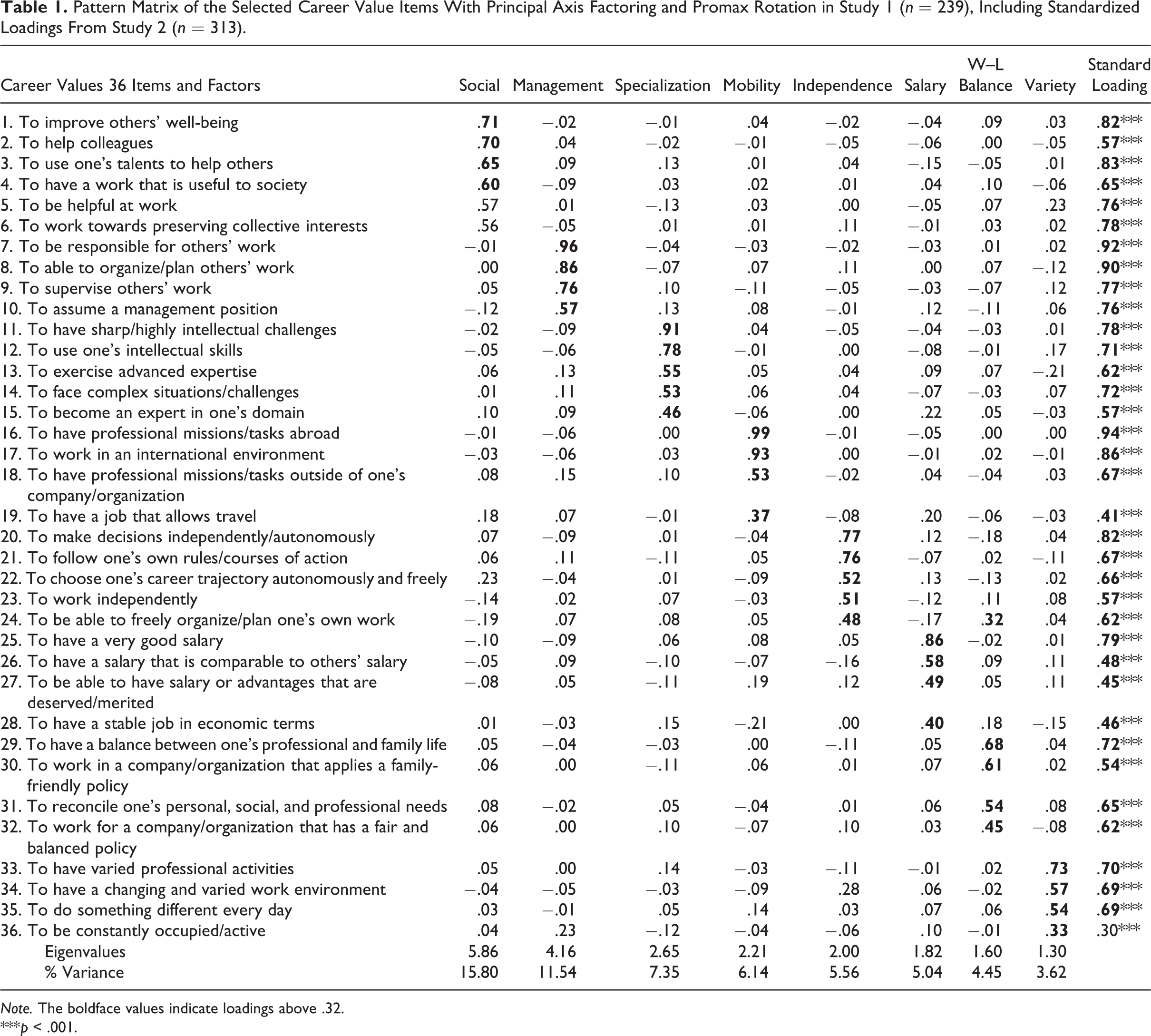
To identify the underlying factors of the career values items, we conducted a principal axis factoring (PAF) with promax rotation. The factor structure was determined using parallel analyses, the criterion of eigenvalues as larger than one, the scree plot, and the interpretability of the factor structure. These different criteria suggested retaining eight factors that best described the shared variance among the items. Thus, all eight factors showed eigenvalues above 1 and the scree plot indicated a clear angle at eight factors. Moreover, the eight-factor solution showed the best results in the parallel analysis and also exhibited high theoretical interpretability. Based on this first PAF (with a Kaiser–Meyer–Olkin value of .79, a significant Bartlett’s test of Sphericity), we selected the most representative items to further reduce the number of items to a manageable size by applying the following criteria of item deletion: (a) items that loaded below .32 and (b) item that cross-loaded above .40 on two or more factors. Using these criteria, a total of 27 items were deleted, resulting in 36 items that were retained. A second PAF, with the same sample and fixing the number of factors to eight, was applied to these 36 items. This eight-factor structure explained 59.66% of the total variance, close to the generally recommended value of 60% (Hair, Black, Babin, & Anderson, 2010). Table 1 shows the factor loadings of the retained items across the eight factors.
Pattern Matrix of the Selected Career Value Items With Principal Axis Factoring and Promax Rotation in Study 1 (n = 239), Including Standardized Loadings From Study 2 (n = 313).
Note. The boldface values indicate loadings above .32.
***p < .001.
Interpretation of the eight-factor structure revealed that it assessed the following dimensions: (1) social (6 items, including items that referred to the original domains of altruism [SWVI], associates [SWVI], and dedication to a cause [COI]), (2) management (4 items, including items from the original domains of management [SWVI, COI], status [WIP], and prestige [SWVI]), (3) specialization (5 items, including items from the original domains of technical functional [COI], pure challenge [COI], and stimulation [SWVI]); (4) mobility (4 items, including items from the original domains of mobility preference [BCAS] and internationalism [COI]), (5) independence (5 items, including items from the original domains of autonomy [WIP], independence [SWVI], and self-directed career [PCAS]), (6) salary (4 items, including items from the original domains of external comfort [WIP] and economic returns [SWVI]), (7) work–life balance (4 items, including items from the original domains of way of life [SWVI], life style [COI], and safety [WIP]), and (8) variety (4 items, including items from the original domain of variety [SWVI]).
In sum, based on a comprehensive item list that covered different work values, career orientations, and career anchors, we could derive an eight-dimensional career values structure that can be reliably assessed with 36 items. Our results also show that work values, career orientations, and career anchors share important communities and can be described by a coherent set of distinct career values.
Study 2: Confirming Factor Structure and Examining Stability and Construct and Criterion Validity
This second study aimed to confirm the dimensional structure of the developed career values measure and to examine the stability over time. We expected that we could confirm the obtained eight-factor structure with a new sample. In addition, because work values show relatively high interindividual stability (Jin & Rounds, 2012), we expected that our new measure would exhibit significant interindividual stability over time. Second, we wanted to provide evidence for construct- and criterion-related validity by demonstrating significant correlations between closely related constructs of work meaning and the related criteria of job and career satisfaction.
First, to establish convergent and discriminant validity of the new measure, we examined the relation of the career values to different work meanings. Willner, Lipshits-Braziler, and Gati (in press) adapted Wrzesniewski, McCauley, Rozin, and Schwartz’s (1997) conceptualization of work orientation in terms of job, career, and calling and suggested that five work meanings can be identified: calling, career, job, social embeddedness, and busyness. Work as a calling refers to individuals who consider their work as an end state of existence, a purpose, or a mission in their lives. Work as a career refers to work as a means for advancement and professional development and expectations to acquire further responsibilities, influence, and status. Work as a job defines work mainly for financial purposes or needs. The social embeddedness work meaning refers to individuals who consider their workplace a family or a significant social group. Finally, the busyness work meaning views work as a means to remain busy and active in some way. As these work meanings seem clearly related to the value that people attach to work, the present study seeks to investigate the correspondences between career values and work meanings.
Specifically, we expect to find that individuals who attach importance to helping others and contributing to society (i.e., social career value) are also more likely to see work as a way to feel part of a family or a social group (i.e., social embeddedness work meaning).
It is also likely that individuals who value management, mobility, and variety in their career would see their work as a means of career advancement to achieve higher and prestigious positions and to gain more privileges and titles inside or outside the organization.
We also might expect to find positive associations between the importance of expertise and technically challenging work and those who consider their work as an end state per se and something intrinsically rewarding. Conversely, these individuals are unlikely to pursue their work mainly for financial or instrumental reasons.
Another close correspondence can be expected between the importance of salary and work as a “job” to achieve or maintain financial security. Conversely, these people are unlikely to see their work as the purpose of their lives.
Finally, independence and work–life balance career values seem to capture something not represented in the five work meanings.
Second, we examined criterion-related validity in relation to job and career satisfaction on the basis of the intrinsic and extrinsic nature of some of the identified career values (Ros et al., 1999). Intrinsic work values refer to rewards derived from work contents or conditions that are inherently satisfying, such as intellectual stimulation, autonomy, or creativity. Extrinsic work values refer to rewards that are externally derived from work, such as security and salary (Ros et al., 1999). Research based on self-determination theory (e.g., Baard, Deci, & Ryan, 2004) has stressed the importance of intrinsic aspects of work for satisfaction and well-being. Conversely, extrinsic rewards, often pursued for instrumental reasons or under external pressure, have been frequently associated with lower satisfaction at work (e.g., Vansteenkiste et al., 2007). Therefore, we might expect that intrinsic career values, such as independence, specialization, and variety, would be positively associated with job and career satisfaction, whereas the extrinsic career value of salary is likely to be negatively associated with job and career satisfaction. Because the career values of social, management, mobility, and work–life balance do not clearly represent intrinsic or extrinsic values, we expect no significant correlation with job or career satisfaction.
Method
Procedure and participants
The procedure used to recruit participants was the same as used in Study 1. Only data from participants who completed the entire questionnaire were included in the analyses. As in Study 1, the response rate could not be estimated due to the sampling strategy used. Among the 436 participants who started the questionnaire, 72% completed the all measurement items, resulting in a final sample of 313 employees. They were aged 17–65 years (M age = 37.31, SD = 12.76) from the French-speaking region of Switzerland participated in this study. About half were women (n = 186, 59%), and the majority were Swiss (83%) and employed in the private sector (46%), while 44% worked in the public sector. The remaining (10%) were self-employed. Two thirds of the participants worked full time (63%). The participants had worked an average of 9.26 years (SD = 13.80) with an organizational tenure of 6.39 years (SD = 8.60). In terms of education, 4% completed mandatory secondary school only, 27% vocational education, 10% high school, 7% professional education, 18% bachelor, 26% master, and 7% a PhD. At the first measurement point, participants completed the Career Values Questionnaire, Work Orientation Questionnaire, and Job and Career Satisfaction Scales. Seven months later, we reinvited participants who accepted to be contacted again for a second survey (n = 213, 68%), which included the Career Values Questionnaire. We offered a CHF (Swiss franc) 10 (approx. US$10) voucher as an incentive for participation, resulting in an overall response rate of 40% with 111 (52%) participants completing the second survey. Two thirds of the participants who participated in both measurement waves were women (n = 84, 66%) and 60% worked full time. The results from t tests showed no differences in career values between participants who completed the measures at T1 and T2 and those who only participated at T1.
Measures
Career values
We used the preliminary 36 career values items developed in Study 1 with a 5-point Likert-type scale response format ranging from 1 (not important) to 5 (very important). Table 1 shows the career values items in their English translation. The original French items used in our studies are available upon request.
Work meaning
We used a validated French translation of the Work Orientation Questionnaire for working adults (Lipshits-Braziler, Abessolo, Santilli, & Di Maggio, 2017). It assesses five work meanings with 5 items each: calling (e.g., “I view my work as my life’s mission”), career (e.g., “I would like to advance in the professional hierarchy of my field and receive additional responsibilities”), job (e.g., “If I had enough money, I would not continue to work”), social embeddedness (e.g., “My work is an opportunity for me to be part of a significant group”), and busyness (e.g., “On days when I am not working, time seems to move very slowly”). The response format consisted of a 5-point Likert-type scale ranging from 1 (not at all) to 5 (very much). Lipshits-Braziler, Abessolo, Santilli, and Di Maggio (2015) reported, across three national samples of Israeli, Swiss, and Italian workers, Cronbach’s αs for calling (ranged between α = .80 and .84), career (ranged between α = .85 and .92), job (ranged between α = .79 and .87), social embeddedness (ranged between α = .70 and .82), and busyness (ranged between α = .75 and .80). They also provided support for the five-dimensional structure of the scale.
Job satisfaction
We used an existing French translation (Bravo-Bouyssy, 2005) of the Job Satisfaction Scale (Mottaz, 1985) with 3 items, for example, “Taking into consideration all things about my job, I am satisfied.” The response format consisted of a 5-point Likert-type scale ranging from 1 (strongly disagree) to 5 (strongly agree). Mottaz (1985) reported Cronbach’s α of .77 for the whole scale among a large sample of workers and provided support for the unidimensionality of the scale.
Career satisfaction
We used an existing French translation (Bravo-Bouyssy, 2005) of the CSS (Greenhaus, Parasuraman, & Wormley, 1990) with 5 items (e.g., “I am satisfied with the progress I have made toward meeting my overall career goals.”). The response format consisted of a 5-point Likert-type scale ranging from 1 (strongly disagree) to 5 (strongly agree). Greenhaus, Parasuraman, and Wormley (1990) reported Cronbach’s α of .88 for the whole scale among a large sample of managers and provided support for the unidimensionality of the scale.
Results and Discussion
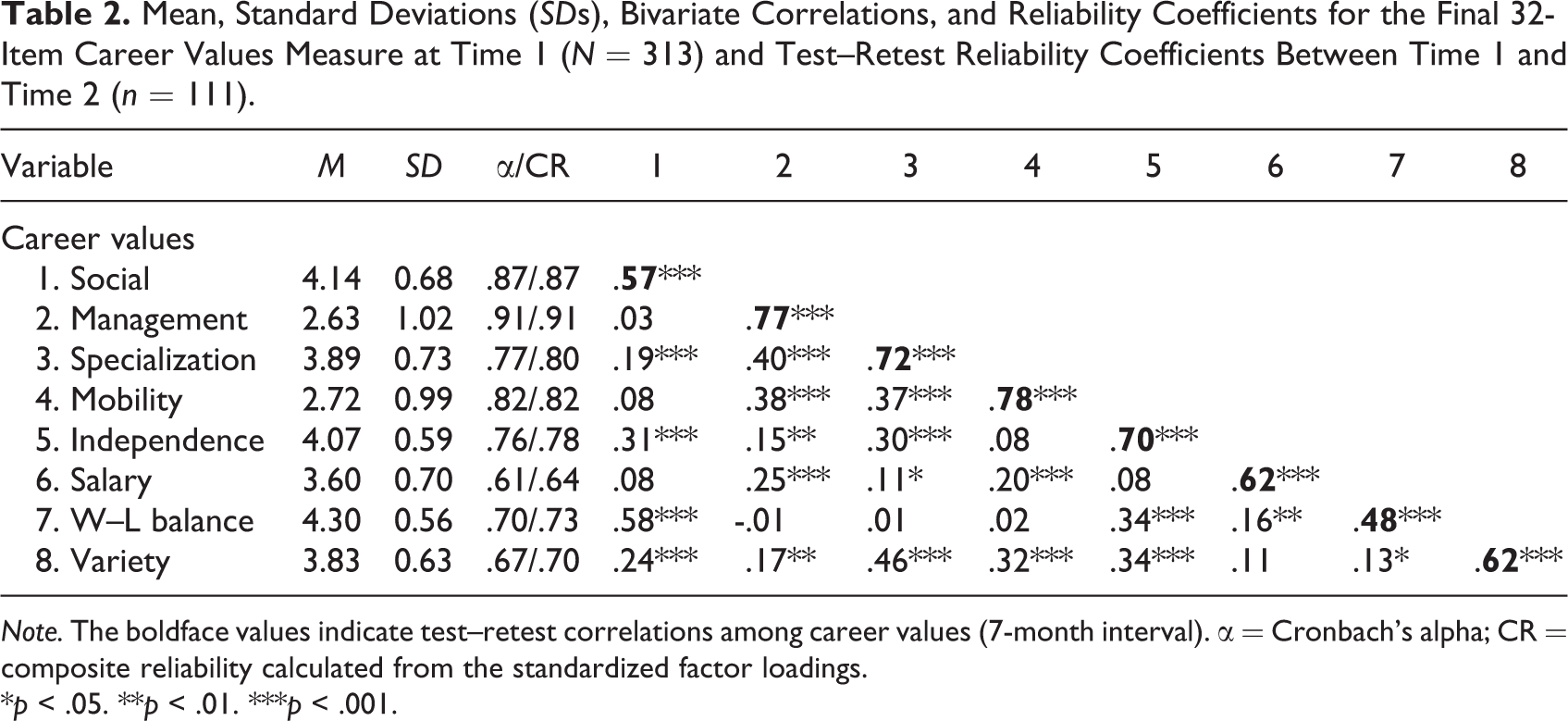
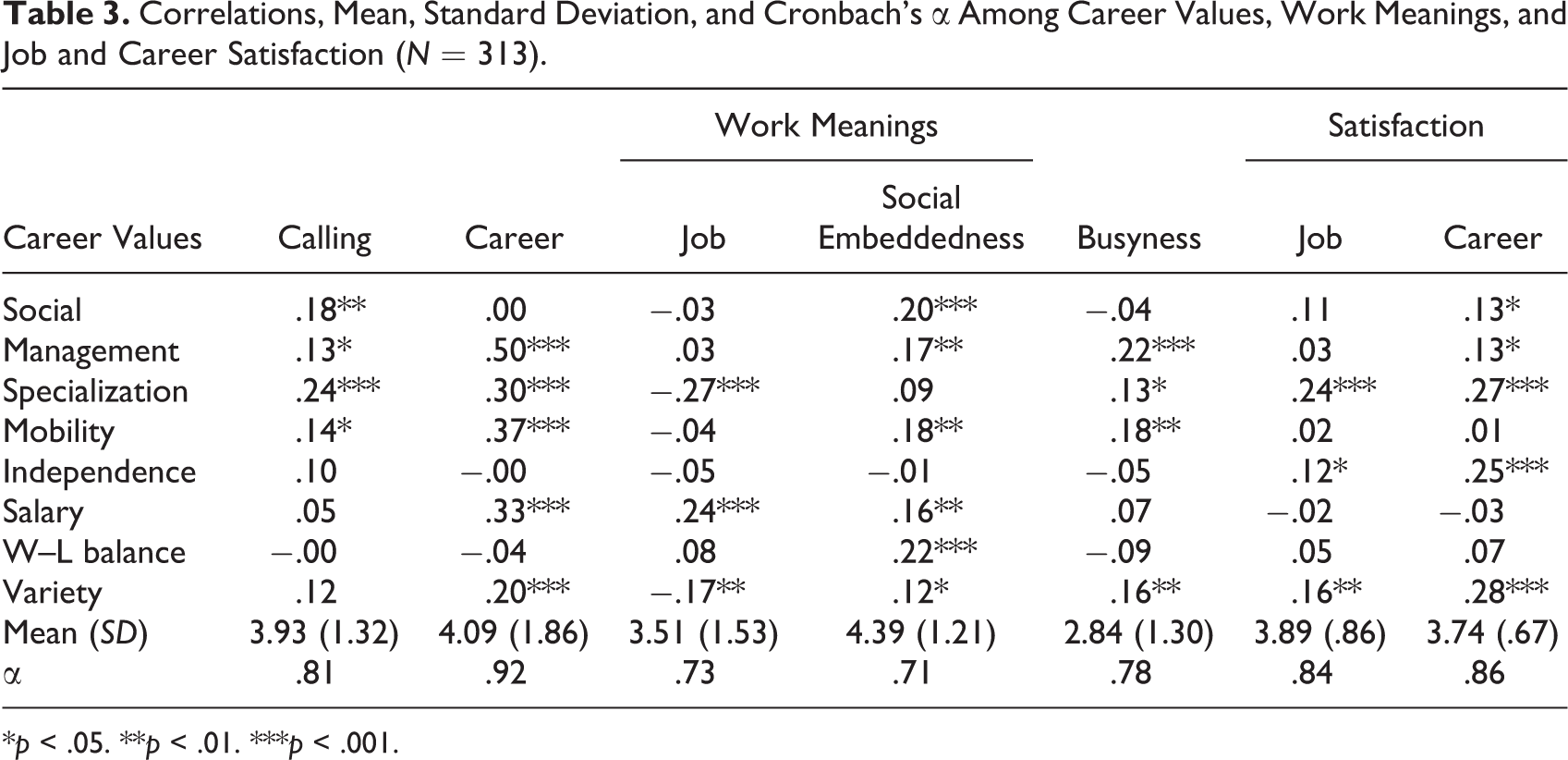
Means, SDs, and Cronbach’s αs of all measures are reported in Tables 2 and 3.
Mean, Standard Deviations (SDs), Bivariate Correlations, and Reliability Coefficients for the Final 32-Item Career Values Measure at Time 1 (N = 313) and Test–Retest Reliability Coefficients Between Time 1 and Time 2 (n = 111).
Note. The boldface values indicate test–retest correlations among career values (7-month interval). α = Cronbach’s alpha; CR = composite reliability calculated from the standardized factor loadings.
*p < .05. **p < .01. ***p < .001.
Correlations, Mean, Standard Deviation, and Cronbach’s α Among Career Values, Work Meanings, and Job and Career Satisfaction (N = 313).
*p < .05. **p < .01. ***p < .001.
Confirmation of the Dimensional Structure
To confirm the eight-factor structure of the Career Values Questionnaire, we conducted a confirmatory factor analysis (CFA) using Mplus Version 7 (Muthén & Muthén, 1998–2012) with the robust maximum likelihood method. We also added a common method factor to the CFA model, fixing all item loadings to 1 to control for the social desirability bias present when measuring values using Billiet and McClendon‘s (2000) procedure. Moreover, we examined the reliabilities using Cronbach’s α and the composite reliability (CR; calculated from the factor loadings) scores.
First, we examined CFA fit indices of the Satorra–Bentler-scaled χ2 (S-Bχ2), the root mean square error of approximation (RMSEA), the standardized root mean squared residual (SRMR), the comparative fit index (CFI), and the Tucker–Lewis index (TLI). It is recommended to consider RMSEA and SRMR below the value of .08, CFI and TLI above the value of .90, and χ2 per degrees of freedom less than or equal to the value of 3 as acceptable cutoffs (e.g., Hoyle, 1995; Hu & Bentler, 1999). Results suggested that the initial eight factors with 36 items, S-Bχ2(558, n = 313) = 1,373.21; p < .001; χ2/df = 2.54; CFI = .82; RMSEA = .068; 90% confidence interval (CI) = [.064, .073], SRMR = .086, did not fit the data well. Accordingly, we reexamined each career values item to achieve a more parsimonious and better fit of the model by eliminating items showing both low factor loadings (Hu & Bentler, 1999) and high redundancy in content. This process resulted in an iterative deletion of 2 items in social career values (i.e., “to help colleagues” and “to have work that is useful to society”) and 1 item each in specialization (i.e., “to become an expert in one’s domain”) and independence (i.e., “to work independently”). The final 32-item model with 4 items per factor showed significantly better fit to the data, S-Bχ2(428, n = 313) = 876.81; p < .001; χ2/df = 2.05; CFI = .88; RMSEA = .058; 90% CI [.052, .063], SRMR = .077, than the initial model (SB-corrected Δχ2 = 506, df = 130, p < .001) and validated the eight-dimensional structure of career values. However, the CFI index fell slightly under the acceptable threshold of .90. This index could be improved, according to modification indices, by covarying two error terms measuring the same career values both in social (Items 2 and 4) and management (Items 16 and 17); S-Bχ2(426, n = 313) = 786.26; p < .001; χ2/df = 1.84; CFI = .91; RMSEA = .052; 90% CI [.046, .058], SRMR = .078. Nonetheless, according to Kenny and McCoach (2003), “if the CFI is slightly lower than hoped, but the RMSEA seems slightly better, then there may be no real cause of concern” (p. 349). Table 2 shows career values reliability coefficients. These results provide support first for the measurement validity of the retained 32 items in terms of factor representativeness (all standardized loadings were significant and ranged between .30 and .94) and second for the construct internal consistencies, as shown by Cronbach’s α and the CR scores. However, the reliability scores of salary career value were relatively low, with .61 (for Cronbach’s α) and .64 (for CR).
Stability Over Time
We calculated correlations between the first and second assessment career values (7-month interval). The results (Table 2) show moderate to high interindividual stability over time, with an average correlation of r = .66 per career value.
Convergent and Discriminant Validity in Relation to Work Meanings
To evaluate the convergent and discriminant validity of the career values in relation to different work meanings, we calculated bivariate correlations. The results (Table 3) confirmed most of the hypotheses: The social career value (r = .20) was correlated significantly and positively with the social embeddedness meaning, confirming Hypothesis 1; the management (r = .50), mobility (r = .37), and variety (r = .19) career values were correlated significantly and positively with career meaning, confirming Hypothesis 2a–c; the specialization career value was correlaed significantly and positively (r = .24) with the calling meaning and negatively (r = -.24) with job meaning, confirming Hypothesis 3a and b; and the salary career value (r = .24) was correlated significantly and positively with job meaning, but was not correlated with the calling meaning, confirming Hypothesis 4a and leading to a rejection of Hypothesis 4b. With regard to discriminant validity, no significant correlations were found between independence and the work–life balance career values and the five work orientations, confirming Hypothesis 5a and b, with one exception between work–life balance and social embeddedness meaning (r = .22).
Criterion Validity in Relation to Job and Career Satisfaction
Bivariate correlations (Table 3) showed significant and positive correlations between the intrinsic career values of independence (rs = .12. and .25), specialization (rs = .24 and .27), and variety (rs = .16 and .28) and job and career satisfaction, confirming Hypothesis 6a–c. However, the extrinsic career value of salary did not significantly correlate with job or career satisfaction, refuting Hypothesis 7.
In sum, the present study refined the item selection and confirmed the factor structure of the new career values measure. We also provided evidence of interindividual stability over time, as well as construct and criterion validity in terms of significant relations with five work meanings and with job and career satisfaction.
General Discussion
In the present study, we sought to develop a new Career Values Questionnaire that assesses the underlying common dimensions of work values, career orientations, and career anchors. Using a sample of diverse employees, we found that eight career values best describe the shared underlying domains among these constructs. This factor structure of career values was confirmed using another heterogeneous sample of employees. We also found support for the stability of the assessed career values over time as well as for construct- and criterion-related validity. Overall, the present research contributes to the career literature by providing an integrative and comprehensive framework and instrument to assess career values in future research and practice. Specifically, this integrated understanding enables us to advance existing knowledge (e.g., Abessolo, Hirschi, et al., 2017; Hall, 2004) regarding which values are typically expressed by career actors to guide their career choices and to define subjective success.
Toward a New Understanding and Framework of Career Values
The herein developed measure of eight career values in terms of social, management, specialization, mobility, independence, salary, work–life balance, and variety offers a new framework for researchers and practitioners to understand and measure the goals that guide individuals in their career paths. Our proposed framework integrates many established work values across different existing assessment instruments, such as environment, competence, status, autonomy, organizational culture, and relationships (Leuty & Hansen, 2011). Moreover, the herein identified eight career values can also be meaningfully integrated into the four broader dimensions of work values (Jin & Rounds, 2012) of intrinsic (associated with specialization, independence, and variety career values), extrinsic (associated with salary career values), social/relational (associated with social and work–life balance career values), and status (associated with management and mobility career values). However, in comparison to existing work values frameworks and measures, our career values framework adds theoretical and practical value to research by simultaneously capturing common domains of work values, career orientations, and career anchors.
Evidence of Stability, Construct, and Criterion Validity of Career Values
Our results show moderate to high stability coefficients of the eight career values over time. These results are in line with those of the meta-analysis of longitudinal studies of Jin and Rounds (2012), who found relatively high test–retest correlations among work values across the life span. Thus, our findings give support to studies (e.g., Jin & Rounds, 2012; Johnson, 2001) that indicated stable individual differences in work values over time, comparable, to some extent, with vocational interest (e.g., Low, Yoon, Roberts, & Rounds, 2005) or personality traits (e.g., Roberts & DelVecchio, 2000). However, we tested the stability of career values over an interval of 7 months. Although this time period is an acceptable interval to assess stability of values (Jin & Rounds, 2012), future research might want to extend this interval and test career value differences with age to investigate more precisely the stability and change of career values over the life span.
We also provided evidence of the convergent and discriminant validity of career values in relation to work meaning. Our results first established close correspondences between the different values individuals pursue in their careers and the meaning they attach to their different work, confirming most of our expectations. These findings corroborate the general idea that values are important to construe personal meaning from work and career. As such, our measure could serve as a framework that helps to link different values to different meanings individuals attach to their work (Rosso, Dekas, & Wrzesniewski, 2010).
Finally, we could establish criterion validity of the assessed career values in relation to job and career satisfaction. As expected, the intrinsic career values of independence, specialization, and variety were significantly and positively associated with both job and career satisfaction. These findings support research (e.g., Baard et al., 2004) that suggests positive associations between intrinsic work needs and satisfaction. However, the extrinsic career value of salary did not show significant negative associations with job and career satisfaction as might have been expected. This could be explained based on research which shows that salary is generally positively related to career satisfaction (Ng, Eby, Sorensen, & Feldman, 2005) because a high salary is something that many people evaluate positively as a career attainment. Hence, valuing a high salary could have both positive and negative effects on job and career satisfaction, resulting in the herein found nonsignificant relation.
Limitations and Future Research
Some limitations to the present research need to be acknowledged. First, our research design was mostly cross-sectional. Therefore, the observed correlations should not be taken as causal relationships. Longitudinal research is needed to further investigate how career values, work meanings, and job and career satisfaction are related to each other over time in order to shed further light on the underlying mechanisms that link these constructs. Second, as we used self-reported measures, our results are not free from common method bias, even when controlled. Future research should use more objective measures or other reports of correlates and outcomes of career values, for example, supervisor-rated performance or career progression. Third, although we were able to largely support the convergent and discriminant validity of career values in relation to work meaning, future research may investigate correlations between career values and other related constructs, such as personality traits or vocational interest, to further address this issue. Finally, future research should try to replicate the herein presented career values measurement model with different populations and across countries.
Practical Implications
The newly developed career values framework and related questionnaire can be a meaningful model to better understand and address issues related to career choices and career self-management. It can therefore be a useful tool to assess individual’s career concerns in order to identify and implement satisfying and rewarding career paths. Career counselors could benefit from using the present questionnaire to obtain an integrative sense of a client’s work values, career orientations, and dominant career anchors. Thus, counselors can, for instance, use the questionnaire scores to depict the relative importance individuals place on specific career values to create an individual’s values hierarchy and to identify occupations and potential career paths that correspond to an individual’s values profile. In addition, human resource managers could use the questionnaire to gain a better picture of an employee’s career preferences in order to link individual career development needs with existing opportunities and career development support within the organization.
Conclusions
The present study adds to the existing body of research on work values, career orientations, and career anchors by providing an integrative career values framework and measurement. Hence, the questionnaire developed and validated in this study may help researchers assess the individual values underlying careers and support practitioners in tailoring interventions or managerial practices to help individuals experience more meaningful and satisfying careers.
Supplemental Material
Supplementary_File_(2) - Development and Validation of a Multidimensional Career Values Questionnaire: A Measure Integrating Work Values, Career Orientations, and Career Anchors
Supplementary_File_(2) for Development and Validation of a Multidimensional Career Values Questionnaire: A Measure Integrating Work Values, Career Orientations, and Career Anchors by Marc Abessolo, Andreas Hirschi and Jérôme Rossier in Journal of Career Development
Footnotes
Declaration of Conflicting Interests
The author(s) declared no potential conflicts of interest with respect to the research, authorship, and/or publication of this article.
Funding
The author(s) received no financial support for the research, authorship, and/or publication of this article.

Supplemental Material
Supplemental material for this article is available online.
References
Supplementary Material
Please find the following supplemental material available below.
For Open Access articles published under a Creative Commons License, all supplemental material carries the same license as the article it is associated with.
For non-Open Access articles published, all supplemental material carries a non-exclusive license, and permission requests for re-use of supplemental material or any part of supplemental material shall be sent directly to the copyright owner as specified in the copyright notice associated with the article.
