







Abstract
One-on-one career counseling has been established as the most effective type of career intervention. Prior research results have suggested that process quality determines counseling success. In this multilevel study, career counseling process quality is validated as a predictor of job seekers’ reemployment at three Swiss job centers. Supervisors’ evaluations of the process quality of mandatory counseling sessions predicted faster reemployment of the 444 counseled job seekers by 18.9 working days on average. This effect equals yearly savings of 418 million Swiss Francs CHF (US$ 422 million) in Swiss unemployment benefits. While in many countries, the counseling of the unemployed is predominantly an administrative process, the findings should encourage investments in process quality of career counseling to promote reemployment. Furthermore, the study calls for further research on the underlying factors of career counseling process quality and the respective career counselor behaviors.
Introduction: The Challenge of Unemployment and One-on-One Career Counseling
In 2014, a total of 201 million people were unemployed worldwide (Statista, 2019), of which 136,764 were unemployed in Switzerland. The economic and personal consequences of this unemployment have been tremendous. On the one hand, all Swiss job seekers received 22.2 million CHF in unemployment benefits per working day in 2014 (Staatssekretariat für Wirtschaft SECO, 2015; Winkler, 2015); moreover, unemployment means foregoing economic potential and the loss of gross domestic products and taxes. On the other hand, research has revealed hardships for the unemployed person: an increase of more than 200% in the risk of poverty (Liu, Huang, & Wang, 2014), a 110% increase in mental health problems (Paul & Moser, 2009), an increase of 40% in alcohol consumption (Deb, Gallo, Ayyagari, Fletcher, & Sindelar, 2011), and a 300% increase in crimes committed by youths (Farrington, Gallagher, Morley, St. Ledger, & West, 1986). Additionally, the risk of court conviction and suicide ideation for youths is increased (Fergusson, Horwood, & Woodward, 2001), as is the risk of death (Liu et al., 2014).
Many interventions are effective at tackling unemployment: they increase job seekers’ reemployment success (Meyer, 1995) and decrease the mental health decline due to unemployment (Liu et al., 2014; Paul & Moser, 2009). Meta-analyses have established one-on-one counseling as more effective and efficient (Whiston, Sexton, & Lasoff, 1998) than counselor-free computer interventions and purely text-based interventions (Whiston, 2002; Whiston, Brecheisen, & Stephens, 2003). Furthermore, one-on-one career counseling is more effective than financial interventions that offer reemployment bonuses (Meyer, 1995) or wage subsidies (Fay, 1996). It is also more effective than tighter monitoring of job seekers’ eligibility and compliance (Bloom, Hill, & Riccio, 2001; Dolton & O’Neill, 2002). The effect size of one-on-one career counseling is substantial (d = .75 in the meta-analysis of Whiston et al., 1998), and its effect persists for more than 5 years (Dolton & O’Neill, 2002). In almost all field experiments, investments in career counseling were repaid within the first year, and the total return can reach more than 600% of the investment (e.g., Dolton & O’Neill, 2002; Meyer, 1995). Therefore, career counseling “forms a key part of active labor market policies” in most of the countries (Hooley, 2014, p. 7). Meta-analyses conclude that counseling’s intensity (e.g., the number and duration of sessions) is unrelated to its outcome (Liu et al., 2014; Whiston et al., 1998). In contrast, preliminary research results have suggested that process quality determines counseling success (Meyer, 1995).
However, only a few studies have investigated career counseling’s process quality, and to our knowledge, none has tested the effect of varying levels of process quality on counseling success. To shed more light on process quality in career counseling, career counseling’s process quality is tested as a predictor of objective reemployment success. Validation of process quality as predictor of reemployment points governments and agencies to focus their policies on improving process quality of one-on-one career counseling to battle unemployment. Furthermore, the study explores a field-proof measurement of counseling process quality, which equips practitioners in career counseling agencies to direct their quality improvements.
Career Counseling Process Quality as a Predictor of Employment Success
In most Western countries, governmental job centers offer and prescribe career counseling to job seekers as long as the job seeker draws unemployment benefits. For example, Swiss job centers prescribe monthly counseling sessions. Whiston, Sexton, and Lasoff (1998) and Hooley (2014) define career counseling for job seekers as a process that enables unemployed job seekers “to identify their capacities, competences and interests, to make (…) occupational decisions and to manage their individual life paths in (…) work (…) settings in which those capacities and competences are learned and/or used (p. 7).” In other words, career counseling promotes job seekers’ reemployment via (1) enhanced understanding of their capacities, competences, and interests; (2) strengthened motivation to make and pursue occupational decisions; and (3) facilitated implementation of their job search competences (Behrendt, Matz, & Göritz, 2017). Many studies have confirmed that career counseling promotes understanding, motivation, and implementation (Bernaud, Gaudron, & Lemoine, 2006; Davidson, Nitzel, Duke, Baker, & Bovaird, 2012; Liu et al., 2014; Obi, 2015; Perdrix, Stauffer, Masdonati, Massoudi, & Rossier, 2012). However, only a few studies have investigated the actual process by which career counseling creates understanding, motivation, and implementation on the part of the job seeker. Meyer (1995) discovered that a more effective counseling intervention was one that focused on enhancing process quality instead of offering additional support. However, to date, no studies have systematically compared interventions that vary in their level of process quality and investigated the resulting effects on reemployment.
To define counseling process quality, most authors cite Donabedian’s (1966) clinical model of structure, process, and outcome quality. Donabedian (2005, p. 694) defines high process quality as when “what is known to be good (medical) care has been applied.” According to Donabedian (2005), assessing process records is inadequate because of veracity and completeness issues. As a basis for assessment, he suggests “direct observation of the (physician’s) activities by a well-qualified colleague” (Donabedian, 2005, p. 698), assessing the quality in categories from excellent to poor. In the field of counseling, direct supervisors of job counselors are the most qualified experts who regularly observe and evaluate a variety of counseling sessions. We posit:
Method
The predictive validity of counseling process quality for employment success is tested using evaluations by the counselor’s supervisor. The study investigates individual mandatory career counseling sessions for job seekers at three Swiss job centers in a time-lagged field study. Over a period of 5 years, beginning in 2010, the counselors’ supervisors evaluated the process quality of 444 counseling sessions. The effect of process quality on objective employment success was investigated using multilevel analysis.
Intervention and Procedure
The evaluated monthly career counseling sessions were mandatory for job seekers who drew unemployment benefits. In these 30-min sessions, the job seekers’ personal career counselors review the job seekers’ job search activities, discuss individual goals, progresses, challenges, and next steps, as well as potential support offers or penalties of the job centers. Process quality had to be rated 4 times a year for every counselor by their supervisor. Therefore, counselors were regularly requested to select any of their upcoming sessions for evaluation. The counselees did not receive any reward but had to consent prior to the evaluation. The acceptance rate was not captured in the archival data but it is estimated to be higher than 99%. The supervisors’ evaluations were entered by the supervisors themselves in a particular excel spreadsheet of the job centers. This data collection process was cleared by the job centers’ juridical consultancy. As a basis for supervisor feedback—and as required in Donabedian’s (1966) definition of process quality—the job centers’ quality model defined the expectations for good practice in the counseling process. The quality model based good practice on an internal research review and hence demanded a clear, supportive, and resource-activating counseling process in line with a solution-oriented approach and success-relevant counselor behaviors (Behrendt, Heuer, & Göritz, 2019; Grawe, 2004; Wampold, 2015). The quality model was implemented in 2010 before the study began.
Participants
At the three governmental Swiss job centers, all 10 supervisors evaluated 533 counseling sessions of all 68 counselors who worked in the three centers. The 533 counseling sessions were unique in that they took place with 533 different job seekers. To ensure sufficient data on all levels of a multilevel analysis, the 26 counselors who conducted fewer than five sessions and their respective job seekers were excluded from the multilevel analysis. Moreover, the 22 counseling sessions with missing process quality evaluations were excluded, leaving 444 counseling sessions nested within 42 counselors to be analyzed. The job center executive team provided the authors with the data in 2015. Using these archival data implied that the authors did not interact directly with any of the studied individuals, thus preventing experimenter and Hawthorne effects. Demographic data were not contained in the archival data. However, a subset of the counselors and supervisors who were still present in the organization in 2015 provided their demographic data post hoc, thus delivering an estimate of the overall demographics. On average, the 32 present counselors were 47.8 years old (SD = 9.5), their counseling experience averaged 10.9 years (SD = 6.7), and 78.1% of them were women. On average, the seven still present supervisors were 49.0 years old (SD = 6.5), their career counseling supervisor experience averaged 8.9 years (SD = 5.8), and 71.4% of them were women.
Research Instruments
Reemployment speed as an objective outcome
Employment success was objectively operationalized as the reemployment speed, given by the officially recorded number of working days the job seeker received unemployment benefits before reemployment. This measure of employment success directly reflects economic costs: Unemployment insurances pay 22.2 million CHF (US$ 22.4 million) in unemployment benefits per working day in 2014 to the Swiss job seekers (Staatssekretariat für Wirtschaft SECO, 2015; Winkler, 2015). The counseled job seekers received unemployment benefit for an average of 196.7 working days (SD = 126.3). The regional unemployment rate was used to control for macroeconomic influences. During the studied time frame, the regional unemployment rate was low and stable, varying between 2.1% and 3.5% (M = 2.5%, SD = 0.29%).
Supervisors’ evaluations of process quality
The supervisors evaluated the process quality of the counseling sessions on a scale of 1 (insufficient) to 4 (excellent) and entered the evaluation in the excel spreadsheet of the job center. To promote the evaluations’ objectivity, the job centers’ quality model defines the process that is expected. Evaluator calibration sessions have been held regularly since 2010 to compare the supervisors’ independent evaluations and align standards. The job centers promoted the evaluations based on video-taped sessions to ensure more objective and reliable observations. To warrant data privacy protection, counselors could alternatively opt for real-time observations by their supervisors. As a result, 80% of the evaluations were based on video-taped sessions, and 20% were based on real-time observations. The average supervisor evaluation was positive with an average of 3.23 (SD = .66).
Data Analysis
For testing process quality as a predictor of reemployment speed, a multilevel analysis was conducted using SPSS package 23. The multilevel analysis controls statistical dependencies in complex longitudinal data sets (Raudenbush & Bryk, 2002) and controls for differences among individual counselors who counsel job seekers from different professions with different employment prospects.
Results
In total, there were 444 counseling sessions nested within the 42 counselors. First, as a base model, we calculated the unconditional means model. The next model tested for the year (2010–2015) and for regional unemployment rate (in %) as linear predictors, whereby they revealed themselves to not be significant. Hence, the unconditional means model without covariates was kept as the reference model. Next, the supervisor evaluation of overall process quality was tested as a linear predictor of the speed of reemployment (Model 1 in Table 1): Process quality significantly predicted reemployment. When comparing the unconditional means model with Model 1, both the Akaike information criterion (AIC) and the likelihood ratio test (D = 8.15, df = 1, p = .004) attested a better fit to Model 1. A job seeker who received counseling one point higher in quality as judged by the supervisor on a 4-point scale found reemployment earlier and received unemployment benefits for a period that was 18.9 working days shorter. Thus, H1 is supported. Swiss unemployment insurances pay 22.2 million CHF of benefits per working day to all Swiss job seekers. In consequence, a one-point increase (which equals a 25% increase) in overall process quality would amount to savings of national unemployment benefit of 418.7 million CHF (US$ 422 million) per year.
Multilevel Analysis of Process Quality and Employment Success.
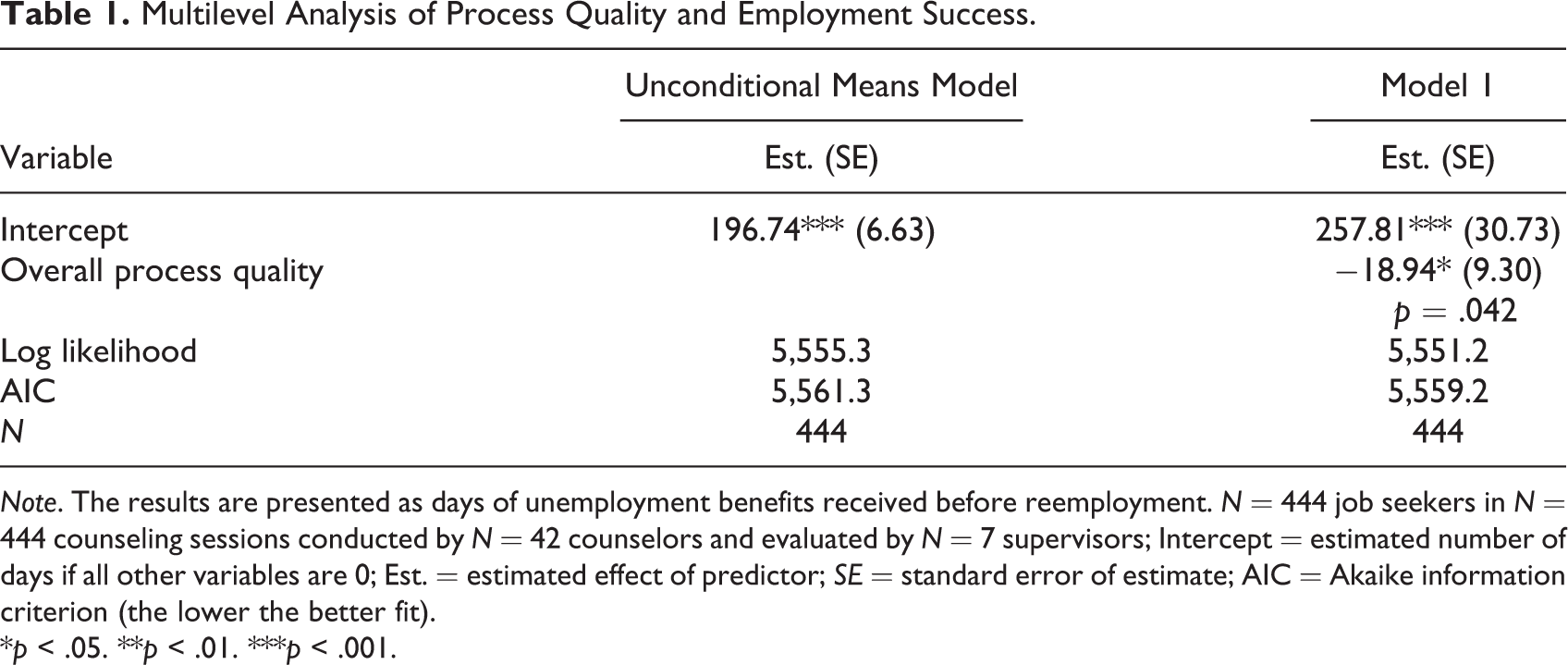
Note. The results are presented as days of unemployment benefits received before reemployment. N = 444 job seekers in N = 444 counseling sessions conducted by N = 42 counselors and evaluated by N = 7 supervisors; Intercept = estimated number of days if all other variables are 0; Est. = estimated effect of predictor; SE = standard error of estimate; AIC = Akaike information criterion (the lower the better fit).
*p < .05. **p < .01. ***p < .001.
Discussion
This study confirms Donabedian (1966) that the higher the process quality of one-on-one career counseling sessions, the faster the counseled job seekers find new work. In detail, job seekers’ reemployment accelerates by almost 4 weeks if the supervisors’ evaluation of overall process quality improves by 25% (i.e., one out of four scale points). The magnitude of this effect accords with Meyer (1995), who found that improvements in process quality of one-on-one counseling accelerate reemployment by four weeks.
Economically, the effect is highly relevant: By improving process quality by one quarter, more than 400 million CHF of unemployment benefits per year could be saved. The economic effects of improved one-on-one counseling are consistent with studies that demonstrate that counseling interventions pay back quickly and that their benefits are manifold (Dolton & O’Neill, 2002). We do not have figures on the cost of improving process quality by 25%. Counselors’ personnel development and evaluation processes conducted by supervisors, however, are part of everyday working life, at least in Swiss job centers. Thus, the marginal costs of improving process quality seem to be small when compared to the potential gains of faster reemployment.
As regard practical implications, the study reveals supervisor evaluations of process quality as a valid methodological approach to predict counseling success. Thus, on one hand, career counseling agencies such as job centers are encouraged to invest in the process quality of their counseling to speed up reemployment by way of supervisors. On the other hand, individual career counselors are encouraged to invest their efforts in improving the process quality of their counseling sessions. To this end, Fukkink, Trienekens and Kramer (2011) have shown that appropriate supervisor behavioral feedback improves subordinates’ skilled behavior and consequently may be a valuable means to promote counselor personnel development.
As regard strengths and weaknesses of our study, although there was a time delay between the predictor (i.e., counseling session and its evaluated process quality) and the outcome (i.e., days until job seeker’s reemployment), we are cautious of making claims about causality because the predictor was observed “as is” and not manipulated. This points to the need to sound out the robustness of the results in other samples in general as well as to conduct experiments in particular. The internal validity of the present findings is increased through using archival data of a large sample, state-of-the-art statistical methodology, an objective outcome, and the study’s multicenter structure (i.e., data stem from three different job centers). The findings’ external validity is promoted through the fact that this was a field study (i.e., we used data that were produced in the natural context); yet, the generalizability of our results to other job centers remains an open empirical question.
To our knowledge, this is the first study that has compared varying levels of evaluated process quality within the same counseling intervention with regard to employment success. In this manner, the study has demonstrated supervisors’ process quality evaluation as a valuable operationalization of the level of process quality and as a predictor for reemployment speed. While the current findings are promising, future studies should also investigate whether evaluated process quality predicts reemployment quality and sustainability as two additional facets of employment success. Furthermore, the theoretical and practical value of process quality as a predictor of counseling success so far is limited because of its generality. While having validated process quality only in general, the success-critical components of process quality remain largely unknown. Next, research needs to find out: What are the important behavioral components of process quality, and therefore, which counselor behaviors should quality models prescribe and supervisors focus on?
Conclusion
Globally, nearly 200 million people are exposed to the harmful effects of unemployment, more than 100,000 in Switzerland alone (Statista, 2019). One-on-one career counseling has been proven to speed-up job seekers’ reemployment. While in many countries, the counseling of the unemployed is predominantly an administrative process, this study stresses the importance of the counseling process’ quality for fast reemployment. To improve the life of the unemployed and to simultaneously realize economic savings, the findings should encourage investments in process quality to promote reemployment and stimulate further research on the underlying factors of career counseling process quality and the respective career counselor behaviors (for a first step into that direction please see Behrendt et al., 2019).
Footnotes
Author’s Note
The State Department of Economy and Labor in Solothurn provided access to the field data. In exchange for the funding, the department and counselors received feedback on the study results. The department was not involved in data analysis and interpretation, the decision to publish the results, or the publication process. Full publication rights were granted prior to the research.
Acknowledgments
We appreciate the extensive support of the State Department of Economy and Labor in Solothurn, Switzerland, that enabled the research and provided comprehensive field access. We also appreciate the feedback and suggestions by Miriam Rennung and Birgit Schyns on earlier versions of this manuscript.
Declaration of Conflicting Interests
The author(s) declared no potential conflicts of interest with respect to the research, authorship, and/or publication of this article.
Funding
The author(s) disclosed receipt of the following financial support for the research, authorship, and/or publication of this article: The execution of the study was supported by third-party funds of the State Department of Economy and Labor in Solothurn, Switzerland.
Author Biographies
 . Outside of work, she enjoys spending time with her family.