







Abstract
The present study examined the role of differentiation of self (DoS) in the career construction model of adaptation (CCMA) using a total sample of 243 married adults. Specifically, career construction theory (CCT) was extended by integrating Bowen family systems theory (BFST) and incorporating DoS as an adaptivity construct into the model. The data displayed a good fit to the model, and all hypothesized associations were supported. The direct paths from DoS to career adaptability, job, life, and marital satisfaction were positive and significant, as were the paths from career adaptability to job, life, and marital satisfaction. Furthermore, the mediation effect of career adaptability between DoS and job, life, and marital satisfaction was also significant. Based on these results, the implications and future research directions were discussed.
Keywords
Career construction model of adaptation (CCMA) comprises four interconnected components: adaptivity, adaptability resources, adapting responses, and adaptation results (Perera & McIlveen, 2017; Savickas, 2011, 2013). Adaptivity as a compound trait includes elements such as core self-evaluations, self-esteem, proactive personality, cognitive ability, optimism, and hope; adaptability resources include career adapt abilities; adapting responses include variables like career exploration and career self-efficacy; adaptation results include variables such as employability, work performance, job, school, and life satisfaction, (Rudolph et al., 2017).
Career construction theory (CCT) provides a useful framework, in which differentiation of self (DoS), the principal variable within the Bowen Family Systems Theory (BFST), could be conceptualized as a potential antecedent of career adaptability. According to CCT (Savickas, 2013), better outcomes (e.g., job satisfaction) are reached by people who feel ready (i.e., willing and flexible) and competent for taking steps in career-related problems such as work transitions and traumas. For the potential antecedents of career adaptability, past research documented antecedents such as core self-evaluations (Zacher, 2014), self-esteem (Cai et al., 2015), cognitive ability (Judge et al., 2007), and dispositional positivity (S. Santilli, Ginevra, et al., 2017; S. Santilli, Marcionetti, 2017).
Similarly, BFST views DoS from one’s family of origin as a prerequisite for independent choices and decisions (Kerr & Bowen, 1988). Moreover, within the BFST framework, differentiated people are described as more self-defined, independent, flexible, and adaptable (Bowen, 1978). Given that these attributes are important for better outcomes and can be seen as an adaptive readiness concept within the CCT framework, we proposed that DoS can be a significant antecedent of career adaptability. Self-differentiated individuals are individuals who have emotional and cognitive awareness, have gained their own autonomy in making decisions and choices, and can display a clear attitude toward events and situations, and their level of adaptation is high (Goldenberg & Goldenberg, 2008; Kesici et al., 2017). Individuals with self-differentiation can experience their own preferences. They are less affected by their environment emotionally (Mert & Kahraman, 2020). Thus, drawing on these two theories, this study attempts to extend CCT by depicting the potential association between DoS, career adaptability, and job, marital, and life satisfaction.
Bowen Family Systems Theory and Differentiation of Self
Bowen's Family Systems Approach (BFST) is accepted as the first of the systemic-based approaches in the field of family therapy and one of the first comprehensive theories on the functioning of family systems (Bowen, 1978; Kerr & Bowen, 1988; Gladding, 2012). Bowen (1978) tried to understand and explain the effects of behavior patterns transferred from past generations on family members. The balance that family members can establish between individuality and togetherness during their interactions within the system reflects the function of the family emotional process (Gladding, 2012).
The central concept underlying the BFST is the concept of DoS (Lampis et al., 2017). The concept of DoS is defined as the ability of individuals to balance both their internal and interpersonal dynamics, and to separate themselves from the family in which they grew up on an emotional and intellectual level (Hargrove, 2009). Bowen (1978) accepts separation from the nuclear family as one of the prerequisites for reaching a healthy adulthood and establishing satisfactory relationships. Bowen (1978) also suggests that DoS in general is more of a trait-like concept starting from emerging adulthood. In other words, it is a concept that does not change according to the instant situations but can decrease with long-term stress conditions or stressful life events or can be increased by psychotherapy throughout one’s lifespan (Bowen, 1978; Willis et al., 2021).
Bowen (1976, 1978) identified four factors that affect the level of DoS, and these factors also affect the emotional process of the nuclear family. The first of these factors is emotional reactivity. Emotional reactivity refers to an individuals’ disposition to respond to stress by emotional arousal. The second factor is emotional cutoff. Emotional cutoff is an emotional process when family members avoid each other physically and psychologically because of unresolved emotionality. The third factor is fusion with others which refers to dependent relationships with others. The fourth factor is being able to take the I-position. “I” position refers to individuals capability to stand up for themselves and autonomously and independently express their will (Biadsy-Ashkar & Peleg, 2013; Bowen, 1976; 1978; Kerr & Bowen, 1988).
DoS as an Adaptive Readiness
Adaptive readiness is “the psychological trait of willingness to meet the unfamiliar, complex, and ill-defined problems presented by vocational development tasks, occupational transitions, and work troubles with fitting responses” (Hirshi et al., 2015, p. 2). The present study used DoS to represent adaptive readiness. According to Bowen (1978), a low level of DoS is associated with a low level of adaptability, thereby, within the BFST, DoS level is seen as an antecedent of adaptivity. Parallelly, Kerr and Bowen (1988) stated that well-differentiated individuals can usually adapt successfully to stressful events that they encounter, including marriage, birth of a child, pregnancy, divorce, marital separation, a spouse’s parent or other relative moving in with the family, a child’s leaving home, retirement, serious illness or injury, financial instability, and job changes.
Within the literature, DoS is also seen as an antecedent of job, life, and marital satisfaction. According to Sagar and Wiseman (2007), DoS in the workplace is equivalent to the individual's ability to function fully within work systems. A differentiated individual works according to principles, is not manipulated by the anxiety or emotional reactivity surrounding the individual, and this individual does not participate in emotional systems. An undifferentiated individual may create anxiety within the organization and experience a lack of cooperation. In addition, undifferentiated individuals form coalitions or triangles to diffuse their anxiety, or they may project the anxiety onto another person (Sagar & Wiseman, 2007). Therefore, individuals with low levels of DoS can maintain anxiety within the system and lead to more dissatisfaction at work (Carbonel, 2007). Cavaiola et al. (2012) examined the relationship between DoS, job stress, and job satisfaction in the workplace among working individuals. As hypothesized, participants who scored higher in DoS reported higher overall job satisfaction and lower interpersonal stress (Cavaiola et al., 2012).
Similar results were obtained from the studies examining associations between DoS and life satisfaction. For example, Skowron et al. (2009) found that high DoS level was associated with high psychological well-being among 132 young adults attending a large mid-Atlantic university. Furthermore, Biadsy-Ashkar and Peleg (2013) examined the relationship between DoS and life satisfaction in 114 Jewish and 154 Arabian working and nonworking women living in Israel. Results of their study showed that working women who are highly differentiated demonstrated higher satisfaction with their life when compared with their poorly differentiated counterparts. Moreover, Chung and Gale (2006) examined the intercultural differences between DoS and self-esteem, depressed mood, and psychological well-being among 427 Korean and 375 American college students. According to the results of the study, the level of DoS was found to be higher in American individuals than in Koreans, and it was found to be associated with psychological well-being in both cultural groups. Another study by Işık et al. (2020) examined the relationship between DoS, marital, and life satisfaction among 113 Turkish heterosexual married couples. According to the results of the study, DoS was related with greater marital adjustment and life satisfaction, and marital adjustment fully mediated the relationship between DoS and life satisfaction.
Studies examining the relations between DoS and marital satisfaction also found significant associations between the two (e.g., Lal & Bartle-Haring, 2011; Lim & Jennings, 1996; Peleg, 2008; Richards, 1989; Skowron, 2000; Skowron & Friedlander, 1998). For instance, Kim and Jung (2015) found a significant correlation between DoS and life satisfaction among 759 university students in South Korea. They suggested that DoS and life satisfaction can be increased by improving the attitudes of individuals toward marriage with education programs (Kim & Jung, 2015). In another example, Lal and Bartle-Haring (2011) examined the relationship between DoS and relationship satisfaction among 52 couples and found that DoS of a partner predicts other partner’s relationship satisfaction. Moreover, another study found that individuals with high levels of DoS have high marital satisfaction while individuals with low levels of DoS have marital distress (Lim & Jennings, 1996). Based on these studies, the present study focused on the DoS as an antecedent of adaptive readiness.
Career Adaptability as an Adaptability Resource
Adaptability resources are “the psychosocial strengths that condition self-regulation in coping with the tasks, transitions, and traumas usually measured in terms of concern, control, curiosity, and confidence” (Hirshi et al., 2015, p. 2). Career adaptability is a central construct in CCT and is explained in four dimensions: concern, control, confidence, and curiosity (Savickas, 1997, 2013). Career adaptation refers to the resources of self-regulation to deal with unconventional and complex problems presented by current professional development tasks, professional transitions, and job problems that alter the individual's social integration (Savickas, 1997). It is not a single structure but an aggregate construct, that is, a composite of resources that serve development. Concern denotes a future orientation and inclination to anticipate and prepare for career moves. Control denotes taking responsibility for building a career. Curiosity denotes inquisitiveness about possible selves in various educational and vocational roles. Confidence denotes assuredness to make realistic career decisions and move toward educational and vocational goals. Individuals use these four transactional and psychosocial resources to form strategies for navigating successfully through unfamiliar and complex environments.
In the literature, there has been no research that directly examined the relationship between career adaptability and DoS. However, Keller (2006) argued that more differentiated individuals could gain an understanding of themselves and their environment and then make career decisions by logical thought and experience. On the other hand, if an individual needs acceptance and approval from others or coping with family anxiety (as a result of lower DoS), he or she may have developed less career adaptability resources. Based on these research findings and theoretical assumptions, it is hypothesized that DoS has a positive relationship with career adaptability.
Job, Life, and Marital Satisfaction as Adaptation Results
Adaptation results are “the outcomes of adapting behaviors, often measured in terms of career decidedness, career commitment, job satisfaction, and work success” (Hirshi et al., 2015, p. 2). Therefore, the present study focused on marital, job, and life satisfaction as adaptation results. Recent research has shown that there is a positive link between career adaptability and career outcomes (i.e., career and job satisfaction; Zacher, 2014; Zacher & Griffin, 2015). Job satisfaction can be a prime antecedent of work behaviors, and how individuals feel about their jobs and refers to individuals’ self-assessment on the extent to which if they dislike or like their jobs (Tazekand et al., 2013). Job satisfaction could be related to payment, nature of work, efficacy of employment, supervision, honor, colleagues, and communication (Tazekand et al., 2013). Recent studies have demonstrated that people with high adaptability resources show positive emotions to their jobs and indicate high job satisfaction levels. Similarly, highly adaptable people may cope with workplace obstacles confidently, may reduce the negative senses, and may experience lower work stress. Therefore, it can be said that career adaptability is correlated positively with job satisfaction (Ginevra et al., 2017).
Rudolph et al. (2017) conducted a meta-analysis on CCMA (Savickas & Porfeli, 2012), and found that career adaptability is both directly and indirectly related to the role of adapting responses and adapting results. Subjective well-being is one of these adapting results. S. Santilli, Marcionetti, et al. (2017) confirmed a relationship between life satisfaction and career adaptability. Moreover, Buyukgoze-Kavas et al. (2015) ascertained that four aspects of career adaptability, control, curiosity, concern, and confidence, are related to life satisfaction. It can be said that career adaptability is associated with the outcomes such as subjective well-being, satisfaction of life, and quality of life. Maggiori et al. (2013) stated that individuals with high levels of career adaptability also have high levels of optimism, hope, and life satisfaction. (Karatepe & Olugbade, 2017). Ginevra et al. (2017) examined the relationship between career adaptability and life satisfaction through the mediating role of resilience in 152 parents of mildly mentally retarded children. They found that career adaptability was associated with life satisfaction and resilience had a mediating role between the two. Santilli et al. (2014) also studied effects of career adaptability on hope and life satisfaction among 120 adults and they found that career adaptability had a positive effect on life satisfaction. Moreover, Hirshi (2009) studied the effect of career adaptability on life satisfaction among 330 Swiss eighth graders using different measures of career adaptability such as career choice readiness, confidence, planning, and exploration. According to the results of the research, with the increase in career adaptability, life satisfaction also increases (Hirshi, 2009).
Finally, marital satisfaction refers to individuals’ positive notions about their relationship. Certain factors seem to be related to marital satisfaction such as personality, level of education, educational homogamy, income level, religious homogamy, age of marriage, and age at marriage, and researchers have argued that experiences in the workplace and career-related aspects affect marital relationships (Ofovwe et al., 2013). Based on these studies, the present study assumes that there will be an association between career adaptability and marital satisfaction; however, there is no literature directly examining the two.
The present study
The present study investigated the CCMA by focusing on DoS as adaptive readiness, career adaptability as an adaptability resource, and job, life, and marital satisfaction as adaptation results. Based on the CCMA and previous research, we tested the following hypotheses:
DoS is positively related to career adaptability.
Career adaptability is positively related to job, life, and marital satisfaction.
DoS is related to job, life, and marital satisfaction through career adaptability.
Method
Participants and Procedures
The sample consisted of 243 married Turkish-speaking individuals from North Cyprus. Individuals ages were between 23 and 64 (mean age = 36.05; SD = 10.74). Of these, 65 were males (26.7%) and 178 were females (73.3%). Regarding age groups, 66.3% were young (between the ages of 20–39), 25.1% were middle-aged (between the ages of 40–52), and 8.6% were young-old (between the ages of 53–69). In terms of education level, most participants in the sample had bachelor’s degree of education (2% primary school; 4% secondary school; 7.4% high school; 6.6% associate degree; 44.9% bachelor’s degree; and 36.2% postgraduate degree).
Upon receiving institutional ethical approval, the survey packets including informed consent forms, demographic information forms, and the questionnaires in a closed envelope were sent to the participants by the first author herself through social connections and the contacts of these social connections. We targeted to reach working and married individuals as we focused on job and marital satisfaction variables in our model. We included working and married adults from all age groups given that we did not generate specific hypotheses for specific age groups. To control the potential differences across different age groups, we tested the differences between three age groups in all dependent and independent variables. The results of ANOVA demonstrated that the three age groups did not significantly differentiate in any of the study variables: DoS (F [2, 240] = 2.02, p > 0.05), career adaptability (F [2, 240] = 1.75, p > 0.05), life satisfaction (F [2, 240] = 0.86, p > 0.05), job satisfaction (F [2, 240] = 1.21, p > 0.05), and marital satisfaction (F [2, 240] = 1.19, p > 0.05). Participants were informed about the aims of the study along with confidentiality and anonymity. They were also informed that participating in the study is voluntarily and if they do not want to be included in the study they have right to withdraw. A total of 290 envelopes distributed; however, 47 of them were excluded because they were incomplete (valid response rate = 83.79%).
Instruments
DoS
Differentiation of self was measured with the Turkish version (DSI-T; Işık & Bulduk, 2015) of the Differentiation of Self Inventory-Revised (DSI-R; Skowron & Schmitt, 2003). The DSI-T assess DoS with 20 items using a 6-point Likert-type scale (1 = Not at all true of me, 6 = Very true of me). It has four subscales: Taking “I” position (IP), emotional reactivity (ER), emotional cutoff (EC), and fusion with others (FO). Sample items of DSI-R are as follows: “I often feel inhibited around my family,” “I’m fairly self-accepting,” “I tend to distance myself when people get too close to me,” and “If I have had an argument with my spouse or partner, I tend to think about it all day.” The DSI-T showed acceptable reliability and validity with Cronbach alphas ranging from .74 to .81 and expected negative correlations with trait anxiety (Işık & Bulduk, 2015). In the present study, Cronbach’s alpha coefficients for the total score were .85 and .75 for IP, .72 for ER, .78 for EC, and .79 for FO.
Career adaptability
Turkish version (Işık et al., 2018) of the Career Adapt-Abilities Scale–Short Form (CAAS-SF; Maggiori et al., 2017) was used to assess career adaptability. The Turkish CAAS-SF has 12 items and uses a 5-point Likert-type scale (1 = Not strong, 5 = Strongest). The scale has four subscales: concern, control, curiosity, and confidence. “Preparing for the future,” “Making decision by myself,” “Investigating options before making a choice,” and “Learning new skills” are sample items of CAAS–SF. Both the original version and the Turkish version showed strong internal reliability with respective values ranging from .94 to .92 and convergent validity with the longer 24-item form and other related constructs such as work stress, trait anxiety, and career decision self-efficacy (Işık et al., 2018; Maggiori et al., 2017). In the present study, Cronbach alpha coefficient for the total score was .91, for Concern .82, for Control .83, for Curiosity .83, and for Confidence .80.
Life satisfaction
Life satisfaction was measured using the Turkish version (Durak et al., 2010) of Satisfaction with Life Scale (SWLS; Diener et al., 1985). It has 5 items and uses a 5-point Likert-type scale (1 = Strongly disagree, 5 = Strongly agree). Sample items of the SWLF are the following: “I am satisfied with my life” and “The conditions of my life are excellent”. Diener et al. reported high reliability with a Cronbach’s alpha of .87. Similar results were found for the Turkish version of the SWLS with internal consistency reliabilities ranging from .81 to .89 and expected correlations with measures of depression, work stress, positive/negative affect, and self-esteem (Durak et al., 2010). Cronbach alpha coefficient was .90 in the current study.
Marital satisfaction
Turkish version (KMSS-T; Işık & Akun, 2021) of Kansas Marital Satisfaction Scale (KMSS; Schumm et al., 1983) was used to assess marital satisfaction. The KMSS-T has 3 items and uses a 7-point Likert-type scale (1 = Extremely dissatisfied, 7 = Extremely satisfied). Sample items are the following: “How satisfied are you with your marriage” and “How satisfied are you with your relationship with your husband/wife?” The Turkish version demonstrated a high reliability with Cronbach alpha coefficient of .99. Convergent validity was supported by positive correlations with Satisfaction with Family Life Scale (Johnson et al., 2006; Çelik, 2014). The Cronbach alpha internal consistency was .98 in the current study.
Job satisfaction
Job satisfaction has been measured with one item: How satisfied are you with your job? Participants responded marking a 7-point Likert-type scale (1 = I am not satisfied, 7 = I am very satisfied). Previous studies supported the use of single-item job satisfaction measures (e.g., Fisher et al., 2016).
Data Analysis
To analyze descriptive statistics, we used SPSS 22.0 and for testing our models, AMOS 22.0 was used. Following a two-step procedure (Anderson & Gerbing, 1988), we first tested a measurement model to examine if the antecedents were representative of five latent variables. In the second step, we analyzed a structural model (Figure 1) to test the hypotheses. For the evaluation of the model fit, the following indices were used: the chi-square (χ
2
), the comparative fit index (CFI), the root mean square error of approximation (RMSEA), and the standardized root mean square residual (SRMR). To evaluate an acceptable fit to the data, we used the following indices: ≥ 0.90 for the CFI, ≤ 0.06 for the RMSEA, and ≤0.08 for the SRMR (Browne & Cudeck, 1993; Hu & Bentler, 1999). The structural model. Note: standardized coefficients are displayed. All paths are significant at p < .001.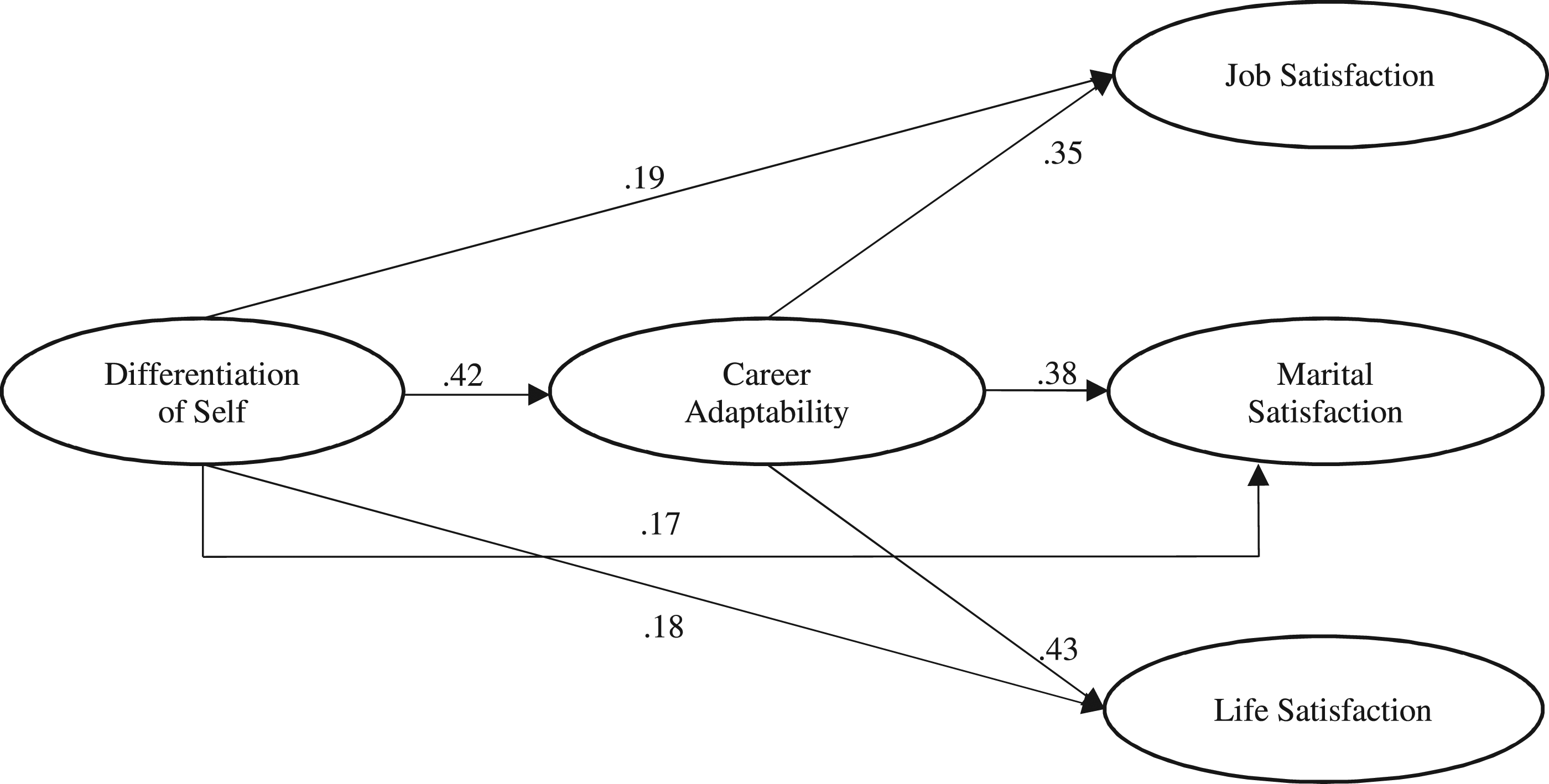
As the antecedents of latent variables, we used four subscales of DoS and career adaptability measures. For the latent marital satisfaction and life satisfaction constructs, we used three and five respective items of each measure and we included job satisfaction as a manifest variable.
Results
Preliminary Analysis
Means, standard deviations, and correlations among variables.
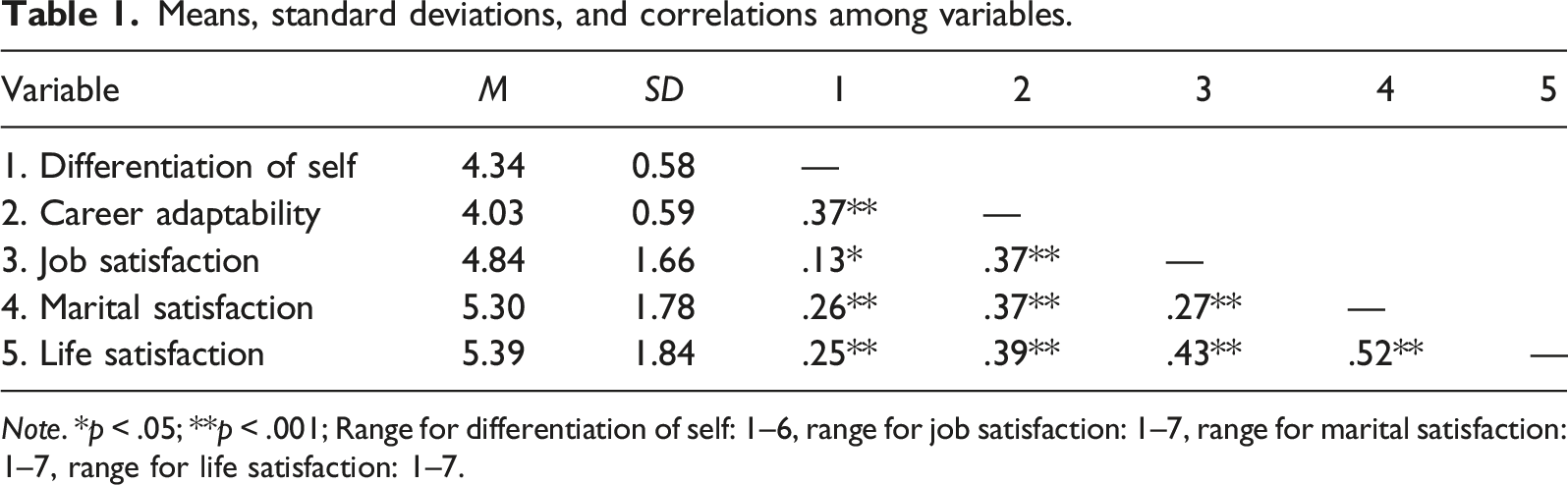
Note. *p < .05; **p < .001; Range for differentiation of self: 1–6, range for job satisfaction: 1–7, range for marital satisfaction: 1–7, range for life satisfaction: 1–7.
Measurement Model
To examine the distinctiveness of each measure of the study, we first constructed a Confirmatory Factor Analysis (CFA) and compared our hypothesized five-factor model with a single-factor model at which all five factors loaded on a single-factor. As expected, the single-factor model demonstrated poor fit to the data, χ 2 (118) = 499.4, CFI = .87, RMSEA = .12, 90% CI (.11–.13), and SRMR = .24. The five-factor model demonstrated a good fit to the data, χ 2 (108) = 281.3, CFI = .95, RMSEA = .08, 90% CI (.07–.09), and SRMR = .09. When compared, the five-factor model had a significantly better fit statistics than the single-factor model, χ2 (254) = 495.7, p < .001, supporting the discriminant validity of the measurement model. All antecedents loaded on their respective factors significantly (p < .001) with values ranging from 0.55 to 0.99, indicating that all four latent constructs could be well-represented by their observed items.
Structural Model
Next, we tested a structural model containing all hypothesized direct and indirect effects (Figure 1) using the maximum likelihood estimation method. This model had good fit to the data, χ 2 (111) = 283.1, CFI = .95, RMSEA = .08, 90% CI (.07–.09), and SRMR = .09. As seen in Figure 1, all hypothesized associations were significant. Specifically, DoS significantly positively predicted career adaptability (β = 0.42, p < .001), supporting Hypothesis 1. Career adaptability significantly positively predicted job satisfaction (β = 0.35, p < .001), marital satisfaction (β = 0.38, p < .001), and life satisfaction (β = 0.43, p < .001), supporting Hypothesis 2.
Related to Hypothesis 3, we examined the indirect effects of career adaptability between DoS and job satisfaction, marital satisfaction, and life satisfaction using bias-corrected bootstrapping method (Shrout & Bolger, 2002). Bootstrapped 95% confidence intervals (CIs) were generated from 1000 bootstrapping samples. Indirect effects were confirmed if CIs do not include zero (Hayes, 2013). The results showed that, through career adaptability, the indirect effect of DoS on job satisfaction (B = 0.15, Boot SE = 0.05, 95% (CI) = [0.08, 0.29]), marital satisfaction (B = 0.16, Boot SE = 0.06, 95% (CI) = [0.06, 0.27]), and life satisfaction (B = 0.18, Boot SE = 0.06, 95% (CI) = [0.09, 0.32]) were all significant, supporting Hypothesis 3.
Discussion
The present study examined the CCMA using a sample of married adults. Specifically, the relationship between adaptive readiness (DoS), adaptability resource (career adaptability), and adaptation results (job, life, and marital satisfaction) was tested. The results of the present study confirmed all hypotheses based on the career construction model of career adaptation.
DoS significantly positively predicted career adaptability, supporting Hypothesis 1. These results support Kerr and Bowen’s (1988) suggestion that there should be a relationship between DoS and adaptiveness and Keller’s (2006) argumentation that if an individual needs acceptance and approval from others or coping with family anxiety (as a result of lower DoS), they may have difficulties in career adaptability. According to Savickas (2005), career adaptability is the ability to make predictions about one's future career status, and to develop the skills to deal effectively with the obstacles they will encounter. Individuals with high adaptability develop problem-solving skills and increase self-confidence. They make future plans themselves and will not be impressed by others. Therefore, BFST framework states that undifferentiated people are emotionally affected very quickly and the reactions of those around them shape their lives; differentiated individuals can choose their behavior without being influenced by others. Thus, it was expected that differentiated individuals might be more adaptive which was supported by our study.
In the present study, career adaptability significantly positively predicted job, life, and marital satisfaction, supporting Hypothesis 2. In the literature, there are research studies which demonstrate that adaptive individuals show high job satisfaction in their lives. For instance, Wang et al. (2011) investigated the effect of adaptability on work-related outcomes and according to the results, a relationship was found between adaptability and job-related results (job performance, job satisfaction, and intention to leave). Similar with our hypothesis 2, Zacher and Griffin (2015) examined the potential associations between career adaptability and job satisfaction. It was found that younger workers and workers with high motivation to continue working have a higher positive relationship between career adaptability and job satisfaction. Research by Zacher (2014), Zacher and Griffin (2015), Tazekand et al. (2013), Ginevra et al. (2017), and Ofovwe et al. (2013) also shows that more adaptive individuals have high job satisfaction levels that are consistent with the present study. Positive associations between career adaptability and life satisfaction can also be seen in recent studies (Buyukgoze-Kavas et al., 2015; Karatepe & Olugbade, 2017; S.Santilli, Marcionetti, et al., 2017) which are parallel to the present study’s findings. Ginevra et al. (2017) studied the potential relationship between career adaptability and life satisfaction and found that career adaptability was positively related to life satisfaction through the mediating role of resilience. Santilli et al. (2014) studied effect of career adaptability on hope and life satisfaction and also it was found that career adaptability had an effect on life satisfaction. In line with the present study, Wilkins et al. (2014) found that career adaptability, hope, optimism, and life satisfaction were directly and positively related. Earlier research pointed similar link between career adaptability and marital satisfaction but no direct association between the two have been found in the literature.
The current results of the study showed that, through career adaptability, the indirect effect of DoS on job, life, and marital satisfaction was all significant, supporting Hypothesis 3. The results of the current study can be explained within the CCT model of adaptation by showing that adaptive readiness (DoS) predicted adaptability resource (career adaptability) and affected adaptability results (job, life, and marital satisfaction). Previous research has examined the direct relationship between DoS and job and life satisfaction (Ferreira et al., 2014; Kim & Jung, 2015). However, the results of the present study indicate that DoS also has an indirect effect on job, life, and marital satisfaction through career adaptability. Thus, in this sample of married individuals, career adaptability seems to have a mediating role between DoS and job, life, and marital satisfaction. In other words, individuals who can balance their feelings and thoughts are more adaptive and thereby satisfied generally in their lives. Moreover, having a high level of DoS seems related to greater professional, marital, and overall well-being by the mediating role of career adaptability. Career construction theory model suggests that good results (job, life, and marital satisfaction) could be reached by individuals who are flexible (e.g., high level DoS; Savickas, 2013) which was supported by the current findings. Differentiated individuals could adapt to a new environment and cope with difficulties much more easily than undifferentiated individuals which can result with satisfaction (Carbonel, 2007; Kim & Jung, 2015; Sagar & Wiseman, 2007).
In some ways, our data differ from previous studies due to the fact that the present study used DoS as adaptive readiness while expanding CCT model. It is also important to figure that this study will fill in the gap in the literature that it is directly investigating the relationship between DoS and career adaptability; career adaptability and marital satisfaciton which could not be seen in the literature.
Limitations and Future Research Directions
This research has investigated the CCMA (Savickas, 2013) and focused on adaptive readiness (DoS), adaptability resources (career adaptability), and adaptation results (marital, life, and job satisfaction). It was found that DoS affects career adaptability, career adaptability affects marital, job, and life satisfaction, and DoS affects marital, job, and life satisfaction through career adaptability. However, several limitations should be considered. Firstly, the findings of the present research are cross-sectional, so the mediation studies cannot be assessed longitudinally, and assumptions cannot be made about causality between variables. On the other hand, the present study did not examine the adapting responses of the model. Further research should examine the effects of adapting responses such as career planning, career decision making, or self-efficacy. Moreover, DoS was studied as adaptive readiness. Instead of DoS, risk-taking behavior or big five traits might be examined in future research studies. Also, the current research was conducted with a small number of married adults. Further research should be carried out to examine the model with a larger sample of participants.
Practical Implications
Findings of the present study contribute to career adaptability literature which supports the adaptation models’ theoretical process. Clearly, DoS serves as an important antecedent of adaptive readiness. This finding suggests a confluence between CCT and BFST. Also, the findings provide valuable practical implications to practitioners in career adaptability area. The present findings supporting the CCT model of adaptation suggest that focusing on career adaptability by career education programs might increase individuals’ job, life, and marital satisfaction. Practitioners could also study family therapy interventions and psychotherapy to increase DoS. It is suggested that if counselors work with DoS, carry out family therapy intervention programs for individuals to set the right togetherness-individuality balance they will contribute positively to marital relationship quality. Counselors might increase their married adult clients’ job, life, and marital satisfaction by working on and improving their level of DoS also by psychotherapy; training individuals to become aware of themselves, improving their ability to make their own choices, improving their self-confidence, and working on their strengths and weaknesses and faulty core beliefs.
To conclude, our study suggests that family intervention programs, psychotherapy for improving DoS and career education programs, can be seen useful in increasing career adapt abilities, which in turn would contribute to professional, marital, and overall well-being.
Footnotes
Author’s Note
This article is a part of the first author’s Ph.D. thesis supervised by the second author.
Declaration of Conflicting Interests
The author(s) declared no potential conflicts of interest with respect to the research, authorship, and/or publication of this article.
Funding
The author(s) received no financial support for the research, authorship, and/or publication of this article.
Ethics
This study was approved by the Ethics Review Committee of Cyprus International University (reference number, 100–624) and in compliance with the Declaration of Helsinki.
