







Abstract
This study examined two models of adolescents’ future perceptions and life satisfaction through a sense of career self-efficacy. Derived from the satisfaction model proposed by social cognitive career theory (SCCT), both examined models address work and family domains but differ in how career self-efficacy is appraised. The integrative model considers career self-efficacy a latent variable, incorporating three self-efficacy types as follows: occupational, spousal, and managing work and family roles. The alternative discrete model considers these three self-efficacy types separately. Israeli Jewish adolescents (N = 264) completed measures of the three self-efficacy domains, future perceptions, and life satisfaction. Findings for both models extended the SCCT’s satisfaction model’s applicability to adolescents. The broader, integrative definition of career self-efficacy proved superior to the alternative model, reckoning the self-esteem types discretely. Research and practice implications are discussed.
Broad approaches to career development
Many career approaches have considered vocational decisions and career development in a broad context. Super’s (1990) life-space theory laid the foundation for this approach by considering a spectrum of life roles beyond the worker role. Super suggested the inherent potential of addressing a rainbow of social roles in an individual’s life (e.g., parent, spouse, student, citizen) to better understand the person’s professional development. Scholars pursuing this notion have focused primarily on the social contexts of work. Some have highlighted the relationship dimension within the career field and proposed a broad conceptualization of work as an activity that ties the individual to the larger community (Blustein, 2011; Richardson, 2012; Flum, 2015). These studies posited that the nature of career decisions, transitions, and experiences lies in meaningful interactions with significant others. Richardson (2012), addressing the relationship dimension, offered four primary social contexts by which people may shape their lives: labor market, care, relationships, and work relations.
Expanding the discourse regarding the broad approach to career studies, Hansen (1997) developed the concept of integrative life planning (ILP). ILP “moves beyond the linear process of choosing a vocation to a more holistic view of the world, seeing work in relation to other life roles, or work within a life” (Hansen, 2001, p. 265).
Furthermore, the literature on work-family relations has reflected the importance of addressing several life roles and considering other life dimensions to better understand the individual’s career development and life satisfaction. The cumulative knowledge in this area shows how managing these two roles is tied to work performance, family performance, well-being, and life satisfaction among working adults (for a review, see Cinamon, 2006, 2010, 2012; Whiston & Cinamon, 2015). Furthermore, studies have shown that the interface of these two roles is also crucial in understanding adolescents' and young adults' career development and life satisfaction (e.g., Cinamon & Rich, 2014; Cinamon, 2010). Furthering this conceptualization, Cinamon delineated the potential advantage of addressing the interface of four main life domains––work, family, community, and leisure––to promote a meaningful life (Cinamon, 2012; 2017).
Following this line of research, Michael and her colleagues (e.g., Michael et al., 2011b; Michael et al., 2015) studied a broad career development model that included family aspects (spousal and parental) and aspects of managing work and family roles. Their research demonstrated the relevance of a broad approach to studying and understanding the career development processes also for people with disabilities. Aligning with this approach and derived from social cognitive career theory (SCCT), the current study acknowledges the benefits of a broad perspective in investigating career variables. This study examined the relative utility of two approaches for conceptualizing “career self-efficacy”––addressing several life domains integratively or discretely. To our knowledge, previous studies have not addressed this issue. Furthermore, we examined how these two alternative approaches to adolescents’ “career self-efficacy”––integrative and discrete––relate to adolescents’ future perceptions and life satisfaction.
Social cognitive career theory
Social cognitive career theory (SCCT; Lent et al., 1994; 2000; 2002) explains interest development, choice, and performance in occupational and educational domains. SCCT has been widely supported in diverse samples (for reviews, see Brown & Lent, 2017; Brown et al., 2011; Sheu & Bordon, 2017).
Lent and Brown’s (2006, 2008) expansion of SCCT to incorporate a life satisfaction model offered an integrative perspective of cognitive (e.g., self-efficacy), behavioral, social, and personality components that promote adaptive behavior and well-being at work. Research attention to date has primarily limited its scope to young adult samples (e.g., Lent et al., 2017; 2018; Sheu & Bordon, 2017), neglecting adolescent populations. Given the distinctly differing dynamics of young adults and adolescents, particularly concerning work and family roles (Cinamon, 2018), one may not presume their similarity. Understanding factors associated with life satisfaction during adolescence is crucial for enhancing their well-being. Deciphering the relationships between career variables and adolescents’ well-being can enhance their life satisfaction (e.g., Gelhaar et al., 2007), facilitate counseling interventions, and contribute to career interventions and career education in schools.
Bandura’s (1977) concept of self-efficacy is a core SCCT construct. In defining the concept, Bandura emphasized its domain-specific essence, referring to “beliefs in one’s capabilities to organize and execute the course of action required to produce given attainments” (p. 3). Self-efficacy studies have typically focused on young adult populations and STEM fields (for reviews, see Lent, Sheu, et al., 2018; Sheu et al., 2018) and on career decision-making self-efficacy (for reviews, see Choi et al., 2012; Martincin & Stead, 2015). This line of research has contributed substantially to our understanding of how internal and external variables promote STEM self-efficacy and career decision-making self-efficacy and how these two self-efficacy types promote performance and commitment in these areas.
As noted, some career development scholars have adopted a broad perspective of career, encompassing multiple life roles and their interaction to understand career behavior, career achievement, and various psychological health outcomes (e.g., Blustein, 2011; Cinamon, 2006; 2012; Flum, 2015; Richardson, 2012; Savickas, 2002; 2005; Schultheiss, 2007; Super, 1990). Following these broad relational perspectives, we suggest the utility of adopting a broad definition of adolescent career self-efficacy and incorporating multiple life domains integratively. Bandura (1986) acknowledged that self-efficacy beliefs might generalize beyond particular situations to situations and activities comparable to those in which self-efficacy beliefs had originally emerged. Aligning with this, several scholars recognized a general form of self-efficacy (e.g., Chen et al., 2001; Scherbaum et al., 2006), referring to an individual’s belief in their capacity to perform across a variety of situations. The approach in the current study expands these definitions: we refer to the concept ‘career self-efficacy’ while addressing several life roles simultaneously rather than focus on a specific domain or domains close to it. This approach may better support a real-life perspective where individuals are concurrently engaged in several life roles. This perspective is critical since this study addresses career self-efficacy as it relates to adolescents’ future perceptions and life satisfaction. Future perceptions typically concern multiple life domains, such as family, work, and community (e.g., Cinamon & Rich, 2014; Cinamon et al., 2012; Michael et al., 2015). Similarly, life satisfaction denotes a general evaluation of one’s quality of life, incorporating several life domains (for a review, see Busseri & Sadava, 2011). Implementing this conceptual approach, we focused on two key life domains when defining career self-efficacy––work and family––and their potential interface (Whiston & Cinamon, 2015) during adolescence (e.g., Cinamon & Rich, 2014).
We define career self-efficacy as one’s belief in successfully integrating multiple life domains (i.e., the work domain and the family domain) effectively and concurrently. For the current study, career self-efficacy comprises three components: occupational self-efficacy (work domain), spousal self-efficacy (family domain), and the self-efficacy to manage both work and family.
We chose to address adolescents' work domain in the current study, as 38.7% of the 15–24 age group in OECD counties blend work and student roles (OECD, 2021), and about 10% of high school students in Israel work after school (CBS, 2018). As for the family domain, among the many family roles (e.g., partner, parent, brother/sister), we chose to focus on the partner role due to the significance of romantic relationships in adolescents' development. Investigating romantic relationships up to adulthood empirically has been considered critical for promoting young people’s well-being (for a review, see Gómez-López et al., 2019). Thus, despite some adolescents not having sufficient experience in romantic relationships to have established self-efficacy in this area, we see their investigation of paramount importance. In addition, we view adolescence as the life stage where several life roles are consolidated and shaped, thus warranting applying an integrative approach. Indeed, a specific, single-role approach may prove more appropriate when considering more advanced life stages since life roles are more differentiated and mature in older life stages.
Similar considerations guided our focus on adolescents’ self-efficacy to manage work and family roles. Whereas most adolescents may not have had extensive experience managing work and family roles as parents and partners, they are likely to have managed work and family roles as family members along with other roles (such as study and family roles; Cinamon & Rich, 2014).
Thus, this study’s primary goal was to examine the utility of two suggested models of the broad definition of career self-efficacy and their relation to adolescents’ future perceptions and life satisfaction: The integrative model perceives career self-efficacy as a latent variable comprising three types of self-efficacy (i.e., occupational self-efficacy, partner self-efficacy, and self-efficacy in managing both work and family roles; see Figure 1). In contrast, the discrete alternative model considers these three types of self-efficacy discretely as three distinct variables (see Figure 2). Structural model – integrative model. Note. ⁎p < .05; ⁎⁎p < .01. Structural Model –Alternative discrete Model. Note. ⁎p < .05; ⁎⁎p < .01.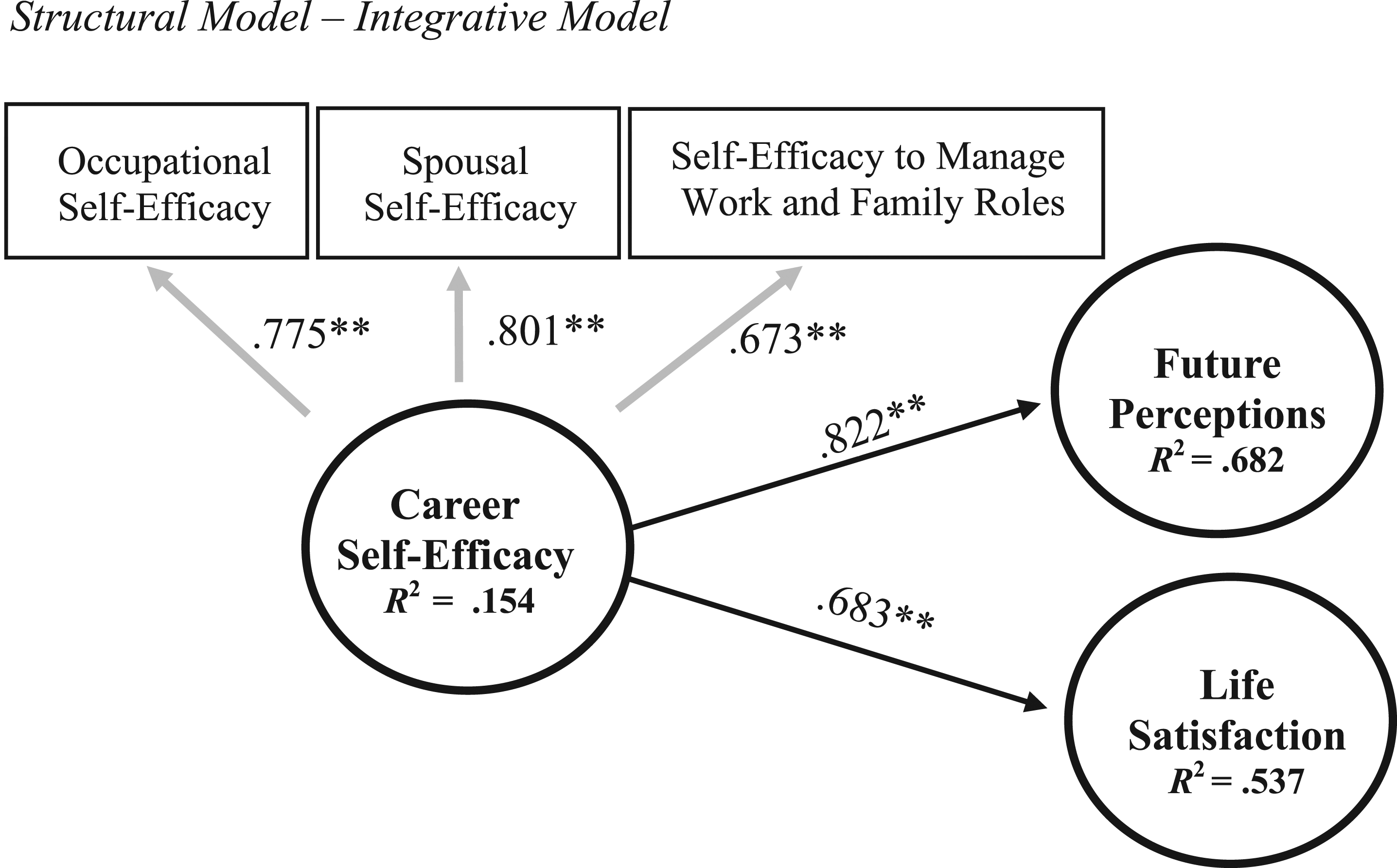
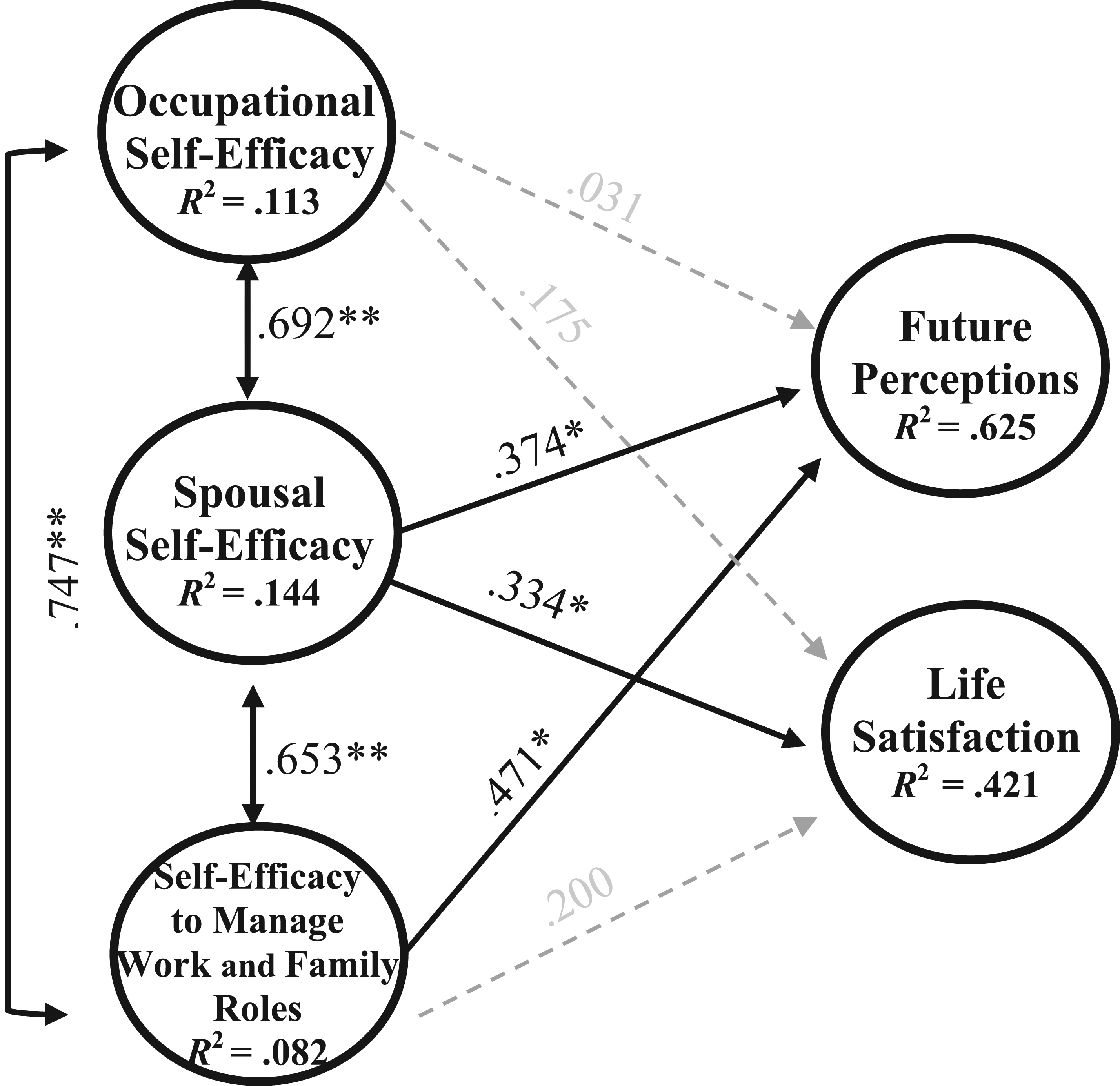
This study has two goals: a) to examine the applicability of SCCT’s satisfaction model for understanding adolescents’ future perceptions and life satisfaction; b) to compare the utility of two alternative models of measuring a broad definition of career self-efficacy––addressing several life domains integratively or discretely.
Career self-efficacy
Most studies grounded in SCCT have focused on self-efficacy regarding particular career-related behaviors, such as STEM study and decision-making, demonstrating the utility of the SCCT model in understanding career behavior. A meta-analytic study highlighted the critical role of STEM self-efficacy as a socio-cognitive mechanism (Lent, Sheu, et al., 2018). Another meta-analytic study demonstrated the association of career decision-making self-efficacy with vocational identity, peer support, vocational-outcome expectation, and career indecision (Choi et al., 2012).
Aligning with the reviewed broad career-related approaches, we defined career self-efficacy as a person’s belief in their ability to successfully manage and integrate multiple life domains (relevant to their developmental tasks and social contexts).
We derived this broad conceptualization of career self-efficacy regarding adolescents and their work and family domains from Michael (e.g., Michael et al., 2011b; Michael et al., 2015). In our view, career self-efficacy comprises three types: occupational self-efficacy, spousal self-efficacy, and managing both work and family roles.
To investigate the implied utility of our broad definition of career self-efficacy, we offer a conceptual model delineating the contribution of the concept to adolescents’ future perceptions and life satisfaction. We suggest two strategies to examine it. The first strategy assesses career self-efficacy as a single latent variable, integrating the three types of self-efficacy (for the integrative model, see Figure 1). The second strategy adopts the same broad definition but examines the distinct contributions of these three types of self-efficacy––as three variables––to future perceptions and life satisfaction (for the discrete alternative model, see Figure 2). We thus posit the following hypotheses:
The following sections describe each of the models’ variables.
Occupational self-efficacy
Hackett and Betz (1981) introduced the concept of occupational self-efficacy. Their definition included two aspects of self-efficacy: 1) educational requirements, that is, the belief in one’s ability to successfully complete the education or training requirements for working in the field; 2) job duties, that is, the belief in one’s ability to satisfy job demands. More recent career scholars (Schyns & von Collani, 2002; Rigotti et al., 2008) defined occupational self-efficacy as the belief in one’s ability to successfully fulfill the tasks involved in work in general, such as the ability to find several solutions to a work problem and the ability to achieve work goals.
The few studies on occupational self-efficacy and its role in career development processes investigated working-age populations. They emphasized the associations between occupational self-sufficiency, career variables, and quality-of-life measures. Occupational self-efficacy was found to be associated with organizational age stereotypes (Chiesa et al., 2016) and predicted job and life satisfaction among employed adults aged 50 and above (Paggi & Jopp, 2015). Moreover, occupational self-efficacy was shown to predict job satisfaction beyond generalized self-efficacy (Schyns & von Collani, 2002).
Several studies explored the mediating role of occupational self-efficacy between career variables and personal and well-being measures. Their findings demonstrated that occupational self-efficacy mediated the relationship between narcissism and salary and career satisfaction (Hirschi & Jaensch, 2015) and between job insecurity, work engagement, job satisfaction, and health of employees in the private and public sectors (Guarnaccia et al., 2018).
Spousal self-efficacy
Spousal (marital) self-efficacy is the belief in one’s ability to function as a mate and overcome challenges to maintain a satisfying relationship (Caprara et al., 2004). Spousal self-efficacy includes the belief in one’s ability to communicate openly and confidently; share feelings, aspirations, and concerns; provide each other emotional support; cope with marital challenges; resolve disagreements about raising children. The concept of spousal self-efficacy is grounded in the belief in one’s ability to conduct a relationship based on natural feelings of mutual trust and loyalty, mutual emotional support, avoidance of disagreements that may lead to hostility, positive communication, and the use of dynamic strategies to cope with daily challenges, such as child-raising and survival (Caprara et al., 2004). Few studies have explored spousal self-efficacy, especially concerning career development for people with disabilities (e.g., Adi-Bensaid et al., 2012). As part of family domain self-efficacy, spousal self-efficacy was found to enhance family functioning and satisfaction (e.g., Bandura et al., 2011).
Managing work and family roles self-efficacy
Cinamon defined managing work and family roles self-efficacy as the belief in one’s ability to deal with anticipated conflict between work and family roles. An additional task is to create an enriching relationship between these two domains, where positive skills and moods enhance both roles (Cinamon, 2012). Her studies portrayed the critical role played by perceptions regarding one’s confidence in managing work and family domains. Accordingly, these perceptions may circumvent future conflict, promote rich future perceptions, and serve as a source of emotional well-being among young adults (e.g., Cinamon, 2006; 2010; 2012; Whiston & Cinamon, 2015).
Future perceptions
Seginer’s (1988, 2003, 2009) concept of future perceptions incorporates the individual’s plans, aspirations, and fears about possible events in various life domains in one’s near and distant future. Seginer asserted that constructing perceptions about the future includes cognitive aspects of future clarity and beliefs regarding the future (expectations). These perceptions also include positive and negative emotions accompanying future-oriented thoughts. Cinamon and colleagues offered a broader definition of future perceptions. They considered the concept to be the individual’s process of preparing and constructing the future regarding several life domains, including work and family and their potential interface (Cinamon, 2017; Cinamon et al., 2012). Their studies have demonstrated the pertinence of this broad definition for young people with disabilities (e.g., Michael et al., 2015), women (e.g., Michael et al., 2017), and adolescents (e.g., Cinamon & Rich, 2014).
Studies focusing on future perceptions among adolescents and young adults have revealed these perceptions to converge on the domains of education, work, relationships/family life, leisure, property (Malmberg et al., 2005; Nurmi et al., 1995; Seginer, 2009), community, and general quality of life (Bellare et al., 2018).
Scholars have emphasized the critical role of future perceptions in individuals’ identity construction and career development (Bandura, 2001; Nurmi, 1991). Career construction theory (CCT; Savickas, 1997) explains the role of future perceptions in the individual’s career development through stories that refer to past, present, and future lives (Savickas, 2005).
Self-efficacy plays a critical and central role in individuals’ future planning. Bandura described the association between self-efficacy and expectation of outcomes, which can be perceived as an expression of future perceptions (Bandura, 1995). Several studies have demonstrated the relationship between self-efficacy and future perceptions (e.g., Michael et al., 2013; 2015; Michael et al., 2011a). Accordingly, Brown and Cinamon (2015, 2016) found that self-efficacy in choosing a high school major predicted the clarity of future academic plans. Aligning with the reviewed studies, this study examines the relationship between career self-efficacy and future perceptions within the SCCT’s satisfaction model.
For our study, future perceptions have a role in the broad approach to career, as they relate to work and family domains. Thus, future perceptions manifest the cognitive dimension––the ability to imagine carrying out anticipated work and family roles (e.g., imagining functioning in the role of parent; Michael et al., 2015). This focus is based on the assumption that being able to imagine a bright future may reflect a person’s efforts to explore their future, which, in turn, stems from career self-efficacy beliefs (whether broadly or specifically defined). Thus, this future orientation may derive from the individual’s confidence to successfully manage work and family roles and meet the challenge of integrating them. Thus, we posit the study’s third hypothesis:
H3a. Career self-efficacy will correlate positively with future perceptions (Figure 1).
H3b. Occupational self-efficacy will correlate positively with future perceptions (Figure 2).
H3c. Spousal self-efficacy will correlate positively with future perceptions (Figure 2).
H3d. Managing work and family roles self-efficacy will correlate positively with future perceptions (Figure 2).
Life satisfaction
Life satisfaction is derived from “quality of life,” a broad expression referring to various feelings, estimates, and positive expectations (Summers et al., 2012). As a cognitive term, it considers how the individual evaluates their quality of life in general and in several life domains (for a review, see Busseri & Sadava, 2011). Life satisfaction has been extensively studied and offers a rich database. Accordingly, life satisfaction measures are associated with a wide range of functions and life outcomes in the emotional, behavioral, social, environmental, and psychological domains (for a review, see Busseri & Sadava, 2011; Diener & Lucas, 2000; Diener & Seligman, 2004; Gilman & Huebner, 2000).
Life satisfaction features critically during the adolescent developmental stage in light of rapid physical changes, dramatic psychological changes, and transitions in social and cultural contexts (e.g., Gelhaar et al., 2007). Accordingly, extensive research has addressed the antecedents of life satisfaction (e.g., Prasoon & Chaturvedi, 2016; Ronen et al., 2016).
Most studies on adolescents' life satisfaction in OECD countries have reported satisfactory indicators. Using the Health Behavior in School-Aged Children (HBSC––a collaborative cross-sectional WHO study across 43 countries, mostly in North America and Europe, from 2002 to 2010), Cavallo et al. (2015) found that life satisfaction diminishes with age and is generally lower among girls than boys. This gender pattern was also revealed in the PISA-2015 findings (OECD, 2017), which examined students’ well-being across OECD countries. On a life satisfaction scale ranging from 0 to 10, 15-year-old students reported an average of 7.3, suggesting that the “average” OECD adolescent is satisfied with life.
As noted, the theoretical model presented in the current study suggests a mechanism through which adolescents’ life satisfaction is an outcome of career development processes, specifically career self-efficacy. Lent and Brown’s SCCT satisfaction model (Lent & Brown, 2006; 2008) assumed an indirect link between career self-efficacy and a sense of life satisfaction through perceptions of attaining occupational goals. However, the current study assumes that the belief in the ability to succeed in tasks in occupational and family contexts (career self-efficacy) may be translated directly into a sense of life satisfaction (with or without a productive employment function, for example, Michael et al., 2015). Thus, the following hypotheses are posited:
H4a. Career self-efficacy will correlate positively with life satisfaction (Figure 1). H4b. Occupational self-efficacy will correlate positively with life satisfaction (Figure 2). H4c. Spousal self-efficacy will correlate positively with life satisfaction (Figure 2). H4d. Managing work and family roles self-efficacy will correlate positively with life satisfaction (Figure 2).
Method
Participants
Participants were 264 Israeli Jewish high school students aged 15–19 (Mage = 17.01, SD = 0.86) from central urban and suburban Israel; 148 (56.1%) were female. All participants were enrolled in public high schools. Of the participants, 205 (77.7%) reported working in conjunction with their studies, of which 112 (42.4%) worked permanently and continuously, 61 (23.1%) worked only during summer vacation, and 32 (12.1%) worked only during school holidays. About half of the working participants worked about 18 hours a week.
Measures
Validated and highly reliable Hebrew versions of all the study scales were used. High values in all scales indicated higher levels of the targeted construct, with all scores comprising the measure’s mean. An exploratory study was conducted to examine the fit and relevance of the proposed study measures to the study’s participants. Participants in the exploratory study were 119 Israeli Jewish high school students aged 16–21 (Mage = 18.20, SD = 1.04(. 83 (69.7%) were female. All participants were enrolled in public high schools. Following the exploratory study, we performed CFAs for each of the study’s measures.
Occupational self-efficacy
Occupational self-efficacy was assessed by the 6-item short Hebrew version (Rigotti et al., 2008) of the Occupational Self-Efficacy Scale (Schyns & von Collani, 2002), which taps the degree of confidence in one’s ability to cope with general tasks at work (e.g., ‘…get along with co-workers’). Participants rated items on a 6-point Likert-type scale, ranging from 1 (strongly disagree) to 6 (strongly agree). The Hebrew version of the scale was formulated for the current study, employing a back-translation process conducted by the first author and a bi-lingual professional with a doctorate in education. The scale’s final version included minor modifications of the statements that simplified the language but did not change their meaning. We administered the translated scale to 119 adolescents (Mage = 19.20, SD = 1.036), yielding a Cronbach alpha of .84, supporting a single-factor structure. Confirmatory factor analysis of the items for the present sample supported the construct of a single factor with the relevant items: absolute fit measures: χ2 = 17.406; (p < .05); χ2/df = 2.176; GFI = 0.978; RMSEA = 0.067; incremental fit measures: IFI = 0.987; TLI = 0.975; CFI = 0.987; parsimonious fit measure PGFI = 0.373; PNFI = 0.520: PCFI = 0.526.
Spousal self-efficacy
Spousal self-efficacy was assessed with the Hebrew version (Michael et al., 2015) of the 12-item Perceived Marital Self-Efficacy Scale (Caprara et al., 2004), measuring the degree to which an individual is confident in their ability to maintain a relationship (i.e., communicating openly, mutual trust, sharing feelings, aspirations, and concerns, providing mutual emotional support, and sharing social activities, for example, “…find time to talk to your partner about things that bother him”). In light of the participants’ young age, we used only nine items, eliminating three items of the original scale that addressed aspects of parenthood. Participants rated their confidence in successfully managing these spousal tasks on a 7-point Likert-type scale, ranging from 1 (strongly disagree) to 7 (strongly agree). The exploratory study supported a single-factor structure, yielding a Cronbach alpha of .90. Confirmatory factor analysis of the items in the study sample supported a single-factor construct with the relevant items: absolute fit measures: χ2 = 61.003; (p = .001); χ2/df = 2.440; GFI = 0.948; RMSEA = 0.074; incremental fit measures: IFI = 0.961; TLI = 0.942; CFI = 0.960; parsimonious fit measure PGFI = 0.527; PNFI = 0.649: PCFI = 0.667.
Managing work and family roles self-efficacy
Managing work and family roles self-efficacy was assessed by Cinamon’s (2012) 16-item questionnaire, measuring one’s confidence in their ability to successfully manage the interface between work and family roles in two dimensions: conflict––the ability to deal successfully with the challenges related to this interface (eight items; e.g., “…able to satisfy my responsibilities at home despite difficulties at work”); enrichment––the ability to enjoy the enrichment components that stem from the interface between work and family (eight items; e.g., “… able to receive help from the family to deal with challenges at work”). We eliminated items that were poorly loaded (<.40) on the latent factor, using only four items (two items for each dimension) for data analysis. Items were presented on a 5-point Likert-type scale, ranging from 1 (strongly disagree) to 5 (strongly agree). Supporting Cinamon (2012), the exploratory study confirmed a single-factor structure, yielding a Cronbach alpha of .80. Confirmatory factor analysis of the items in the present sample supported a single-factor construct with the relevant items: absolute fit measures: χ2 = .007; (p < 1); χ2/df = .007; GFI = 1.000; RMSEA = 0.000; incremental fit measures: IFI = 1.007; TLI = 1.043; CFI = 1.000; parsimonious fit measure PGFI = 0.100; PNFI = 0.167: PCFI = 0.167.
Confirmatory factor analysis for the latent variable of career self-efficacy, comprising the three self-efficacy variables––occupational, spousal, and managing work and family roles––supported a single factor construct with the relevant items: absolute fit measures: χ2 = 267.075; (p = .001); χ2/df = 1.921; GFI = 0. 901; RMSEA = 0.059; incremental fit measures: IFI = 0.941; TLI = 0.926; CFI = 0.940; parsimonious fit measure PGFI = 0.659; PNFI = 0.718: PCFI = 0.764.
Future perceptions
Future perceptions were assessed by Michael et al.’s (2015) 22-item Future Perceptions Scale, which included four dimensions relating to perceptions about the future: future clarity––the extent to which the future is perceived vividly (seven items; e.g., “I can actually imagine myself a parent”); future intensity––The extent to which the individual thinks about their future (five items; e.g., “I am preoccupied with thoughts about my future”); stress––the stress involved in thinking about the future (four items; e.g., “I feel stressed when I think about my future work”); future planning––the extent to which the individual plans their future and the importance attributed to this planning (six items; e.g., “It is important for me to plan my future”).
Internal consistency values of the original scale were .86 for the full scale and between .72 and .82 for the subscales. We eliminated items that were poorly loaded (<.40) on the latent factor, using only five items for data analysis: future clarity (four items) and future planning (one item). Items were presented on a 6-point Likert-type scale, ranging from 1 (strongly disagree) to 6 (strongly agree). Confirmatory factor analysis for the present sample supported a single-factor construct with the relevant items: absolute fit measures: χ2 = 11.091; (p < .05); χ2/df = 2.773; GFI = 0.984; RMSEA = 0.082; incremental fit measures: IFI = 0.983; TLI = 0.956; CFI = 0.982; parsimonious fit measure PGFI = 0.262; PNFI = 0.389: PCFI = 0.393.
Life satisfaction
Life satisfaction was assessed by the Hebrew version (Anaby et al., 2010) of the 5-item Satisfaction with Life Scale (SWLS; Diener et al., 1985), measuring global life satisfaction (e.g., “In most ways, my life is close to my ideal”). Items were presented on a 7-point Likert-type scale, ranging from 1 (strongly disagree) to 7 (strongly agree). Internal consistency values were .87 for the original scale and .86 for its Hebrew version. The exploratory study supported a single-factor structure, yielding a Cronbach alpha of .86. Confirmatory factor analysis in the present sample supported a single-factor construct with the relevant items: absolute fit measures: χ2 = 9.538; (p < 1); χ2/df = 1.908; GFI = .986; RMSEA = 0.059; incremental fit measures: IFI = 0.993; TLI = 0.987; CFI = 0.993; parsimonious fit measure PGFI = 0.329; PNFI = 0.493: PCFI = 0.497.
Demographic questionnaire
A demographic questionnaire was administered, tapping gender, age, and education framework (general education, informal education, special education, or no educational affiliation).
Procedure
After approval from the university’s research authority and the Ministry of Education, data were collected within schools (further to parental consent and through educators) and online using Google Survey. Online invitations to a wide distribution of adolescents were disseminated via social networks, such as WhatsApp, with the research assistance of two adolescents who were hired for this purpose. The data collection took about 5 months.
The research questionnaire included a description of the research variables, its purpose, and its ethical components. All those responding to the invitation were assured of their anonymity, that their participation was entirely voluntary, and that they were free to discontinue their participation at any time. All study participants expressed their consent to participate by marking a relevant statement in the questionnaire. No time limits were imposed, and the participants received no financial or other incentives.
Strategy of data analysis
The two proposed theoretical models––the integrative model and the discrete alternative model (see Figures 1 and 2, respectively)––were tested through structural equation modeling (SEM), using AMOS 24 (Arbuckle, 2011), a preferred procedure for analyzing models with latent constructs (Baron & Kenny, 1986). SEM comprised two parts: the measurement model (specifies the posited relationship of the observed items to the underlying constructs) and the structural model (examines the potential causal relations between endogenous and exogenous variables). We used bootstrapping, a popular method for testing indirect effects (Shrout & Bolger, 2002), a resampling method estimating the parameters of a model strictly from the sample (Preacher & Hayes, 2008), and calculating accurate confidence intervals of indirect effects (Baron & Kenny, 1986).
To examine the data fit, we used the Comparative Fit Index (CFI), the Tucker-Lewis Index (TLI), and the root mean square error of approximation (RMSEA). CFI and TLI values of >0.90, and RMSEA value of <0.08 representing acceptable fit, whereas values of >0.95 and <0.06 represent a good fit (Hu & Bentler, 1999). Moreover, we calculated the parsimonious goodness-of-fit index (PGFI), the parsimonious normal fit index (PNFI), and the parsimonious comparative fit index (PCFI). Values of >0.50 for the parsimonious fit measures represent acceptable fit (Hair et al., 2006).
We performed a latent variable structural path analysis with maximum estimation (e.g., Jöreskog & Sörbom, 1995). To test the integrative model, we included three latent variables: 1) career self-efficacy (incorporating the three constructs of career self-efficacy), 2) future perceptions, and 3) life satisfaction. To test the discrete alternative model, we included five latent variables as follows: 1) occupational self-efficacy, 2) spousal self-efficacy, 3) managing work and family roles self-efficacy, 4) future perceptions, and 5) life satisfaction.
Results
Means, Standard Deviations, and Correlations.
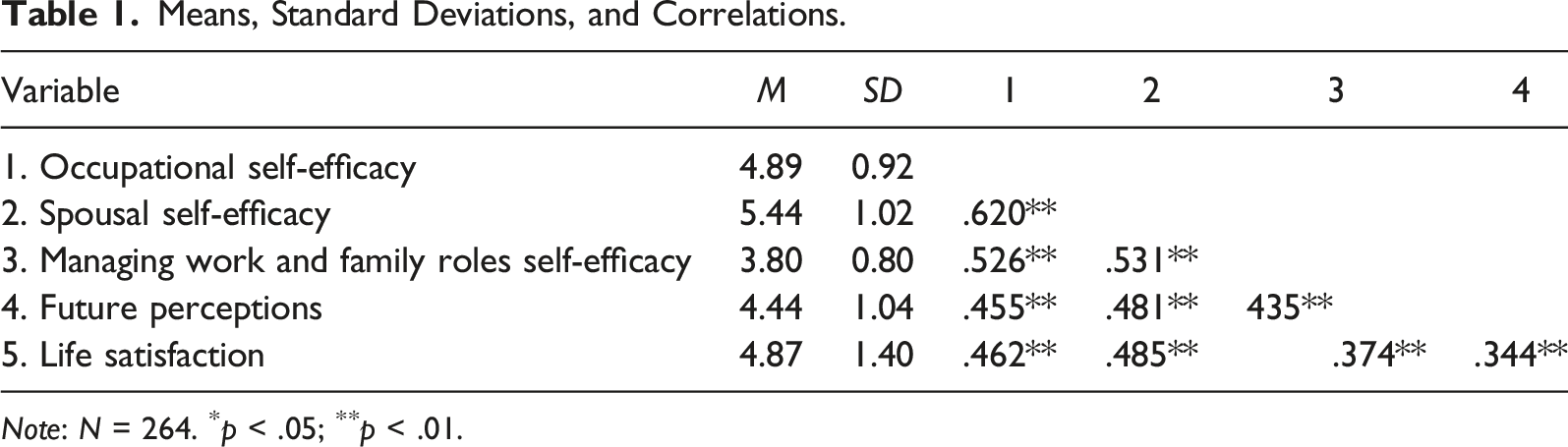
Note: N = 264. ⁎p < .05; ⁎⁎p < .01.
Testing the measurement models
The integrative model (Model 1)
The absolute fit, incremental fit, and parsimonious fit measures were utilized to assess the measurement model’s overall fit. The model fit indices were satisfied: absolute fit measures: χ2 = 1.468; (p = .832); χ2/df = 0.367; GFI = 0.998; RMSEA = 0.000; incremental fit measures: IFI = 1.006; TLI = 1.015; CFI = 1.000; parsimonious fit measure: PGFI = 0.266; PNFI = 0.399; PCFI = 0.400.
The discrete alternative model (Model 2)
The absolute fit, incremental fit, and parsimonious fit measures were utilized to assess the measurement model’s overall fit. The model fit indices were satisfied: absolute fit measures: χ2 = 372.785; (p = .001); χ2/df = 2.118; GFI = 0.877; RMSEA = 0.065; incremental fit measures: IFI = 0.916; TLI = 0.898; CFI = 0.915; parsimonious fit measure: PGFI = 0.668; PNFI = 0.714; PCFI = 0.766.
Testing the structural models
The integrative model
The absolute fit, incremental fit, and parsimonious fit measures were utilized to assess the proposed structural model fit. The model fit indices were satisfied: absolute fit measures: χ2 = 1.575; (p = .904); χ2/df = 0.315; GFI = 0.998; RMSEA = 0.000; incremental fit measures: IFI = 1.008; TLI = 1.017; CFI = 1.000; parsimonious fit measure: PGFI = 0.333; PNFI = 0.498; PCFI = 0.500. These results demonstrated a good fit of the proposed structural model. Thus, the results reflected satisfactory overall goodness-of-fit for the proposed integrative model.
The discrete alternative model
The absolute fit, incremental fit, and parsimonious fit measures were utilized to assess the alternative structural model fit. The model fit indices were satisfied: absolute fit measures: χ2 = 373.409; (p = .001); χ2/df = 2.110; GFI = 0.877; RMSEA = 0.065; incremental fit measures: IFI = 0.916; TLI = 0.899; CFI = 0.915; parsimonious fit measure: PGFI = 0.672; PNFI = 0.718; PCFI = 0.771. These results demonstrated a good fit of the alternative structural model. Thus, the results reflected satisfactory overall goodness-of-fit for the alternative model.
To compare the two models, we used the ECVI index, where lower index values indicate a model’s better fit (Schreiber et al., 2006). This index showed the structural integrative model advantageous over the alternative model (ECVI = .082 and ECVI = 1.830, respectively). Likewise, more variance was explained by the integrative model (career self-efficacy R2 =.154; future perceptions R2 =.682; life Satisfaction R2 =.537) than the discrete alternative model (occupational self-efficacy R2 = .154; spousal self-efficacy R2 = .154; managing work and family roles self-efficacy R2 = .154; future perceptions R2 = .682; life satisfaction R2 = .537). Thus, the study’s first two hypotheses were confirmed: Both the integrative model and the alternative model were found valid (H1), with an advantage to the integrative model (H2). This finding highlights the benefit attributed to the broad definition of “career self-efficacy” that considers multiple life domains integratively.
Testing path coefficients
To further determine the quality of the two proposed models’ fit indices, we examined the relationship between variables through the statistical significance of the path coefficients from one latent variable to another. Figure 1 presents the resulting path coefficients of the integrative model, and Figure 2 presents the resulting path coefficients of the discrete alternative model.
Career self-efficacy and outcomes
Consistent with the study’s hypotheses, career self-efficacy predicted future perceptions (β = 0.822; p < .01; H3a) and life satisfaction (β = 0.683; p < .01; H4a) in the integrative model (see Figure 1). As for the discrete alternative model, spousal self-efficacy and managing work and family roles self-efficacy predicted future perceptions (β = 0.374 and β = 0.471, respectively; p < .05; H3c and H3d, respectively). Spousal self-efficacy also predicted life satisfaction (β = 0.334; p < .05; H4d; see Figure 2).
Occupational, spousal, and managing work and family roles self-efficacy
Significant positive correlations were revealed between the following three types of career self-efficacy in the discrete alternative model: occupational and spousal self-efficacy (r = 0.692; p < .01); spousal and managing work and family roles self-efficacy (r = 0.653; p < .01); occupational and managing work and family roles self-efficacy (r = 0.747; p < .01; see Figure 2).
Discussion
Following SCCT’s satisfaction model (Lent & Brown, 2006; 2008) and the broad approaches to career, the current study examined the applicability of a theoretical model to the adolescent life stage and suggested two modes of measuring a broad definition of career self-efficacy concerning work and family domains: integratively (as a single latent variable) and discretely. The current findings demonstrated the SCCT’s applicability and validity and supported its expansion to incorporate a satisfaction model for an adolescent sample. As suggested by the proposed mechanism, career self-efficacy in work and family contexts promotes the construction of bright future perceptions and life satisfaction in the current adolescent sample.
The findings also highlight the potential of the broad definition of the career self-efficacy variable to enhance the socio-cognitive process and the research model’s outcomes. A closer examination of the findings revealed the integrative model as offering a better fit than the discrete alternative model. As noted, the integrative model included career self-efficacy as a single latent variable and considered the three types of self-efficacy integratively (occupational, spousal, and managing work and family roles; see Figure 1), whereas the discrete alternative model referred to each type of self-efficacy discretely (see Figure 2; ECVI = .082 and ECVI = 1.830, respectively).
Moreover, the findings indicated a more robust statistical significance of the path coefficients between the latent variable of career self-efficacy and research outcome––future perception (β = 0.822; p < .01) and life satisfaction (β = 0.683; p < .01; see Figure 1)––than with the three discrete types of self-efficacy. Thus, in the discrete model, only spousal self-efficacy and managing work and family roles self-efficacy were significantly related to the research outcomes (ranging between β = 0.374–0.471; p < .05; see Figure 2). These findings provide additional empirical evidence supporting the assumption regarding the advantage of considering career variables broadly, relating to multiple life domains integratively. This perspective is critical for research and practice regarding career development and well-being during adolescence.
The study’s findings contribute an additional layer supporting the broad career approach. The study’s central argument underscores the benefits of integrating multiple life domains in research and practice to fully understand adolescents’ future perceptions and life satisfaction. Super (1990) and other scholars (e.g., Blustein, 2011; Cinamon, 2006; 2012; Flum, 2015; Richardson, 2012; Savickas, 2002; 2005) have argued that occupational decisions and vocational behavior transpire in a social context, with individuals engaged concurrently in several social roles, especially those tied to family. Thus, these multiple roles should be considered in illuminating the dynamics of adolescents' occupational and vocational behavior.
This claim of integrated social domains is critical when investigating life satisfaction, as “life” is not confined to the working role. Life satisfaction may derive from other life domains, such as changing societal conditions (Tay et al., 2015), socioeconomic status (Chen et al., 2016), and trait resilience (Hu et al., 2015).
Our findings call into question the concept of self-efficacy as originally defined by Bandura, suggesting that when studying career development, a broad definition of the concept may be more effective than its domain-specific (Bandura, 1977) or general (Bandura, 1986) conceptualization, especially for adolescents. Accordingly, defining ‘career self-efficacy’ while referring to several life domains, especially those related to the family, may be more effective in career and quality-of-life variables than referring to a specific domain situation or situations close to it.
However, these understandings raise conceptual questions for research and practice. Two main questions arise regarding how best to investigate the suggested broad definition of career variables. The first question relates to the quantity of life domains incorporated into a broad definition of career variables. For example, regarding career self-efficacy, how many specific self-efficacy domains should be included in its broad definition?
The second question concerns the quality of the life domains to be included in the broad definition of career variables. In other words, which life domains should be included in the broad definition of career variables? In the current study, we defined ‘career self-efficacy’ as relating to three types of self-efficacy pertaining to occupational and family domains and their interface. This conceptualization was derived from previous studies concerning participants' adolescent developmental stage alongside cultural aspects of traditional Israeli society. However, the current findings may provide theoretical support for further conceptualizing a broad definition of career variables (concerning their quality and quantity) while acknowledging other questions. Among the questions posed are the following: What other career variables should be broadly defined beyond “career self-efficacy”?; What should be the criteria for selecting these variables?; Do other contexts need to be considered while defining the nature of the broad conceptualization of career variables beyond the contexts of age and culture?
These findings also have practical implications for career counselors, psychologists, and educators seeking to advance adolescents’ career development processes and encourage them to embrace a similarly broad approach in practice. Career professionals are urged to address a wide range of life domains integratively in their practice, subject to the adolescent’s role mosaic. Accordingly, we recommend guiding adolescents to explore how they function in their various life roles beyond school-related responsibilities, emphasizing how they balance these roles. This manner of exploration may promote career self-efficacy in a wide range of functions which may serve as a foundation for constructing brighter perceptions of the future from a more holistic perspective. Moreover, adolescents should be encouraged to expand the range of roles in which they are engaged, including leisure and community roles. Within this framework, it would also be beneficial to specifically address romantic relationships and ways to manage the interface between work and family roles. These balancing skills can be viewed as central in planning the future and achieving a sense of satisfaction with life.
A careful examination of the current findings reveals the centrality of the family in adolescents’ career development, perhaps even relegating peripheral importance to occupational aspects. Indeed, spousal efficacy and managing work and family self-efficacy—and not occupational self-efficacy––proved to be significant antecedents of the measured outcomes. Thus, while not all participants were working, all were engaged in their families and schools, compelling them to balance these domains. The findings also aligned with extant theoretical career models and approaches, highlighting the magnitude of the family context in adolescents’ career development (e.g., Blustein, 2011; Young et al., 2002).
Our findings may also be considered through a cultural lens. Israeli society has frequently been characterized as traditional and family-oriented (e.g., Fogiel-Bijaoui, 2002). Thus, the family occupies a central role in individuals’ lives, from their early years through adolescence. Therefore, incorporating multicultural samples in future studies would shed light on the generalizability of these findings.
In sum, this study’s findings stress the contribution of career variables to adolescents’ positive development, as manifested in bright future perceptions and life satisfaction through the mechanism proposed in the SCCT satisfaction model. The findings highlight the potential contribution of a broad definition of the career self-efficacy variable, addressing occupational and family roles integratively. They offer a theoretical framework for further study and practice to better understand and promote career processes and well-being during adolescence.
Limitations
The study’s limitations stem from its methodology and sample. The models’ variables required eliciting self-perceptions, including beliefs regarding future abilities (self-efficacy), perceptions about the future, and life satisfaction, thus entailing the need for self-report data. This methodology introduces concerns of common-method bias and precludes conclusions regarding causality. Collecting data from significant others in the adolescent’s environment, such as family members or educational figures, would likely have facilitated a broader, more accurate understanding of the mechanism proposed in the integrative model and incorporated an environmental perspective. Furthermore, the study’s data analysis strategy, using the structural equation modeling (SEM), whose purpose is to test the validity of a theoretical model and the correlations between all study variables, does not allow for directional assumptions. Thus, for comparing the two models proposed in the study, we adopted the ECVI index, with less attention given to model fit indices. Moreover, the parsimonious fit indicators in the CFAs for managing work and family roles self-efficacy, future perceptions, and life satisfaction attained limited construct validity, thus calling for caution in interpreting the data.
Furthermore, the study’s statistical analyses did not include participants’ SES demographic, work information (e.g., employment status, type of work, scope of work, reason for seeking employment), or data concerning other pertinent life domains (e.g., family, academic, social, and spousal status). We recommended that further studies examine the validity of the proposed mechanism relating to participants' status in these life domains.
Footnotes
Declaration of conflicting interests
The author(s) declared no potential conflicts of interest with respect to the research, authorship, and/or publication of this article.
Funding
The author(s) received no financial support for the research, authorship, and/or publication of this article.
