







Abstract
Postdoctoral scholars encounter challenges as they navigate the gap between graduate school and employment positions, one of which includes the challenge of work–family conflict and balance. We used structural equation modeling to test goal endorsement as a possible cultural moderator of the indirect relationship between work demand and work–family conflict. Results revealed that the indirect effect between work demand and work-family conflict was significant at low, but not high, levels of communal goal endorsement. In turn, work–family conflict was found to be a significant negative predictor of work–family balance satisfaction. Results suggest that minoritized postdoctoral scholars’ high value of communion serves as a protective factor in reducing the deleterious effects of challenging work environments on work–family conflict and satisfaction with work–family balance. Empirical and practical implications of the findings are presented.
Introduction
Postdoctoral scholars (hereafter referred to as “postdocs”) face a variety of challenges and hold many responsibilities as they transition from graduate school to academic careers (Rybarczyk et al., 2016), one of which includes the challenge of balancing work and family. Although work–family balance is not limited to individuals in romantic partnerships with children, postdocs are typically at an age in which romantic partnering, having children, and navigating household roles are developmentally typical (Moors et al., 2014). Work–family conflict continues to impact individuals who maintain roles in the workforce and at home, with more recent research indicating that approximately that 70% of adults report experiencing work-family conflict (Schieman et al., 2009). The science, technology, engineering, and mathematics (STEM) fields 1 represent one sector of the workforce where a closer examination of work–family conflict and balance is important due to the rise in prominence of these fields, with a particular focus on marginalized groups who face unique challenges in these fields.
Over the past 30 years, the number of postdocs has grown in all fields (National Academy of Sciences, 2014) for a variety of reasons such as the increasing competition for tenure-track and research-oriented academic positions and the need for specialized training (National Science Board, 2016). The National Science Foundation’s Survey of Graduate Students and Postdoctorates in Science and Engineering estimated that there were 45,295 postdocs in science and engineering fields specifically in 2015, of which only 1025 were Hispanic or Latinx, 56 were American Indian or Alaska Native, and 641 were Black or African American (National Center for Science and Engineering Statistics, 2017). Thus, despite the burgeoning growth in the number of postdocs, they have been understudied in the literature and data related to the postdoctoral experience is difficult to find (Davis, 2005; Gibbs et al., 2015; National Academy of Sciences, 2014).
Work Environment Factors, Work–Family Conflict, and Work–Family Balance Satisfaction
Achieving a satisfying balance between work and family is often considered a valuable career objective because it enhances family satisfaction (Ferguson et al., 2012) and functioning (e.g., equitable division of household labor; Carlson et al., 2009), while conferring individual benefits such as job satisfaction (Wayne et al., 2017). However, the literature tends to focus more exclusively on conflictual outcomes resulting from the interference of work demands in family functioning, with less attention paid to outcomes focusing on satisfaction with work–family balance (Valcour, 2007). Such conflicts are likely to have detrimental effects on individuals’ satisfaction with the degree to which their work and family lives are perceived to be in balance. Researchers have devoted substantial attention to the conflicts that can emerge when people attempt to balance work and family obligations. For example, Dabney and Tai (2013) identified themes such as the difficulty of balancing school with life, perceiving a lack of time outside of school, anticipating difficulty in balancing a career with life, and perceiving or anticipating a lack of time specifically for family when studying women who were doctoral students and professionals in the sciences. Fox et al. (2011) specifically studied work and family conflict among men and women scientists employed at research universities in the United States and found that academic scientists reported more work interferences with family than family interference with work. Interestingly, graduate students reported negative perceptions of work-life balance as one reason for their movement away from the path to academia (Fuhrmann et al., 2011). Given the added tension between the collectivistic, traditional, and family values of an ethnic minority group and the individualistic and personal goal achievement values of the Western workforce, minoritized postdocs may face challenges in terms of balancing work with family (Cinamon, 2006). For this reason we focused on the work experiences of racially and ethnically minoritized postdocs in the current study.
In the world of academia, expectations run high to prioritize work, understand that academic work does not end, limit outside interests and responsibilities, and remain productive (Bailyn, 2003; Fox et al., 2011; Ward & Wolf-Wendel, 2004). These expectations along with the pressure to produce cutting-edge science and technology can spill over to one’s family life, creating conflict and undermining the quality of the relationships therein. Indeed, a number of studies have shown that work-family conflict and similar constructs (e.g., work–life conflict) mediate effects of work demands on work–life balance satisfaction (e.g., Lott & Wöhrmann, 2022) and life satisfaction more generally (Gao & Jin, 2015). Work demands such as longer work hours and higher levels of work-related pressure have also been associated with higher levels of work–family spillover in a sample of White, Black, and Hispanic workers (Roehling et al., 2005).
Unfortunately, minoritized academics in particular tend to be disproportionately burdened with the demands of teaching and service in higher education institutions (Baez, 2000), leaving less time to focus on research, which is often a more salient factor in tenure and/or promotion decisions. Such work demands are exacerbated by the fact that faculty of color typically experience fewer positive interactions with colleagues (O’Meara et al., 2016) and, in fact, are often targets of bias in their respective STEM educational or occupational environments (e.g., Kameny et al., 2014; Strayhorn, 2010; Turner, 2002). O’Meara et al. (2020) have suggested that is not only the presence of microaggressions in the workplace that contribute to hostile working conditions, but the absence of microaffirmations that contributes to this dynamic as well. Given the time pressures placed on minoritized faculty, they often have fewer opportunities to be validated and supported by their colleagues. This suggests that high work demands may be an important precursor to the development of postdocs’ perceptions of a hostile work environment. In turn, hostile work environments are likely to have negative consequences for family functioning. For example, incivility experienced at work has been shown to predict increased withdrawal behavior among married couples (Lim et al., 2018).
Goal Congruity Theory
Goal congruity theory (Diekman & Eagly, 2008; Diekman et al., 2017), which derives from social role theory (Eagly, 1987), offers a potential lens through which the effects of these contextual factors on work–family relations can be understood. According to the goal congruity perspective, men and women tend to occupy different social roles within society that differ in their fostering of agency or communion, which leads them to typically seek and accomplish goals that are afforded by their specific roles (Diekman & Eagly, 2008; Eagly & Wood, 2012; Eagly et al., 2000; Wood & Eagly, 2002). An agentic orientation encompasses independence, assertiveness, dominance, and aggression, whereas a communal orientation encompasses friendliness, emotional expression, unselfishness, and a concern for others (Bakan, 1966; Eagly & Wood, 2012). One of the key components of this perspective is the importance placed on achieving goal congruity, which means that individuals’ behavior becomes aligned with the demands of their roles (Diekman & Eagly, 2008). Although gender roles have been largely studied in conjunction with the goal congruity perspective (Eagly et al., 2000), the benefits of experiencing goal congruity should motivate behavior across various types of roles (e.g., cultural roles; Diekman & Eagly, 2008). Benefits of making progress toward goals that are in alignment with social roles include improved well-being, increased likelihood of persevering toward goals, and receiving positive evaluation from others (Diekman & Eagly, 2008). In the current study we limit our focus to communal goal endorsement due to its compatibility with the cultural perspectives of individuals of racially and ethnically diverse backgrounds.
A few cultural values important to racially and ethnically minoritized individuals parallel the goal endorsement of communion. Collectivistic values encompass the placement of in-group or community needs above individual needs (Hofstede, 1980; Triandis, 1995) and such values are central to African Americans, Latinx individuals, and Native Americans (Carson, 2009; De Luca & Escoto, 2012; Gaines et al., 1997). Similar to collectivism, familismo is an organizing principle important to the Latinx population, which indicates that family ties are strong and typically reach beyond the nuclear family (Flores et al., 2010; Marín & Marín, 1991; Paniagua, 2005). Collectivism and familismo parallel notions of communal goals such as serving community, helping others, connection with others, and caring for others.
Recent research has also broadened goal congruity theory to cultural roles (e.g., Soto & Deemer, 2018), connecting communal goals with racially and ethnically minoritized groups. For example, Smith et al. (2014) found that Native American students in STEM endorsed communal goals more highly than agentic work goals, and also endorsed communal goals significantly more than White male students in STEM. Moreover, Boucher et al. (2017) argued that communal goal incongruity acts as a barrier for racially and ethnically minoritized groups in STEM. They noted that minoritized groups highly value collaborative and altruistic motivations, motives that align with a communal orientation, and called for the examination of the positive impact that communal goal congruity may have on these groups’ experiences in STEM. Research on the goal congruity perspective is becoming increasingly prominent in the career development literature as well. Diekman et al. (2010) found that participants perceived STEM careers as hindering of communal goals and that the endorsement of communal goals negatively predicted interest in STEM. Relatedly, Diekman et al. (2011) found that science careers framed as involving collaboration were viewed more positively, particularly among women and individuals who highly endorsed communal goals.
Present Study
The present study extended research on work-family conflict and balance by investigating the work-family balance satisfaction of racially and ethnically minoritized postdocs in the STEM fields. We examined whether the indirect relationship between perceived work demand and work–family conflict, operating through perceptions of a hostile work environment as a mediator, varied across levels of communal goal endorsement. We expected that communal goals would likely buffer the inimical effects of hostile work environments for postdocs because such goals orient them toward opportunities to seek connection with and social support from their colleagues as a way of coping with workplace hostility. Thus, we hypothesized that communal goals would moderate the indirect relationship between work demand and work-family conflict such that this relationship would be positive at low levels, and nonsignificant at high levels, of communal goal endorsement.
Method
Participants
The sample comprised racially and ethnically minoritized postdocs currently employed in the STEM fields comprised the sample for this study. Participants were required to be: (a) 18 years or older; (b) identify as belonging to a marginalized racial/ethnic group (African American, Latinx, and/or Native American); and (c) employed in a STEM postdoctoral position at a university. A total of 630 individuals participated in the study. A total of 339 cases were removed for failure to meet the inclusion criteria and nine cases were eliminated due to completely missing data, resulting in a final sample of 282 participants. One hundred sixty-two (57.4%) men, 119 (42.4%) women, and one participant who identified as transgender (0.4%) comprised the final sample. Participant age ranged from 26 to 47 (M = 31.90, SD = 3.80). The racial/ethnic identification of participants included: Black/African American (n = 92, 32.6%), Hispanic or Latinx (n = 173, 61.3%), Native American (n = 9, 3.2%), biracial (n = 3, 1.1%), and multiracial (n = 5, 1.8%). Participants included postdocs from fields of chemistry (n = 55, 19.50%), computer and information science and engineering (n = 32, 11.3%), engineering (n = 29, 10.3%), geosciences (n = 8, 2.8%), life sciences (n = 124, 44.0%), materials research (n = 10, 3.5%), mathematical sciences (n = 10, 3.5%), and physics and astronomy (n = 14, 5.0%).
Measures
Work Demand
The Perceived Work Demand Scale (Boyar et al., 2007) was used to measure perceived work demands among postdocs. Participants were asked to rate 5 items on a 5-point Likert-scale ranging from 1 (strongly disagree) to 5 (strongly agree). An example of a specific response item is “My job requires all of my attention.” In terms of validity, Boyar et al. (2007) found the perceived work demand scale to be predictive of both work interfering with family and family interfering with work, thus highlighting the scale’s predictive validity. Boyar et al. (2007) reported a Cronbach’s alpha coefficient of .83 with a sample of correction officers and .89 with a sample of university employees in the United States. A Cronbach’s alpha coefficient of .79 was obtained in the current study.
Goal Endorsement
Participants completed the 9-item communal goal subscale of the Diekman Goal Endorsement Measure (Diekman et al., 2010) as a means of assessing their preference for communal affordances. The total scale consists of 23 items and also includes a 14-item subscale measuring agentic goal endorsement. Participants are asked to rate the personal importance of each goal on a 7-point Likert-type scale ranging from 1 (not at all important) to 7 (extremely important). An example communal goal item includes “serving the community.” Diekman et al. (2010) found that the communal goal subscale possesses acceptable internal consistency reliability (α = .84), and provided evidence of the scale’s predictive validity by showing that communal goals differentially predicted vocational interest across a number of career types. The communal goal scale demonstrated sufficient reliability (α = .75) in the current study.
Hostile Work Environment
The Workplace and School Microaggressions subscale of the Racial and Ethnic Microaggressions Scale (Nadal, 2011) was used to measure perceptions of a hostile work environment. Participants were asked to respond to five statements by indicating the number of times that a microaggression occurred in the past 6 months with 0 = I did not experience this event in the past six months, 1 = I experienced this event 1 time in the past 6 months, 2 = I experienced this event 2 times in the past six months, 3 = I experienced this event 3 times in the past six months, 4 = I experienced this event 4 times in the past six months, and 5 = I experienced this event 5 or more times in the past 6 months. An example of a specific statement is “An employer or co-worker treated me differently than White co-workers.” Regarding reliability, Nadal (2011) reported a Cronbach’s alpha coefficient of .85 for the workplace and school microaggressions subscale, and demonstrated concurrent validity through a significant positive correlation with a measure of daily experiences of racial microaggressions. A Cronbach’s alpha coefficient of .96 was obtained in the current study.
Work–Family Conflict
Participants’ perceptions of work-family conflict were measured using the Work–Family Conflict Scale (WFCS), which is a 5-item scale developed by Netemeyer et al. (1996). Participants were asked to respond to five statements based on a 5-point Likert-type scale ranging from 1 (strongly disagree) to 5 (strongly agree). An example item includes “Due to work-related duties, I have to make changes to my plans for family activities.” Netemeyer et al. reported a Cronbach’s alpha coefficient ranging from .88 to .89 across three samples, and demonstrated evidence of concurrent validity via significant positive correlations with measures of role conflict and role ambiguity. The WFCS demonstrated good reliability (α = .93) in the current study.
Work–Family Balance Satisfaction
The 5-item Satisfaction with Work–Family Balance Scale created by Valcour (2007) was used to measure postdocs’ satisfaction with work-family balance. Participants were asked to respond to 5 items on a 5-point Likert-type scale ranging from 1 (very dissatisfied) to 5 (very satisfied). An example item includes, “The way you divide your time between work and personal or family life.” Valcour (2007) reported a Cronbach’s alpha coefficient of .93, and demonstrated evidence of concurrent validity through significant positive associations with measures of ideal work hours and control over work time. An alpha coefficient of .90 was obtained in the current study.
Procedure
The study was approved by the university Institutional Review Board before data collection began. All data were collected through an online survey using purposeful sampling and snowballing techniques. Participants were recruited via email through the National Postdoctoral Association (NPA), a prominent postdoctoral organization, and through postdoctoral-related social media pages. The recruitment email and condensed recruitment message contained a brief description as well as a link to the study. The first 200 participants who completed the questionnaire were compensated with a $10 gift card.
Research Design and Data Analysis Plan
Our hypothesis was tested using a three-step structural equation modeling procedure wherein the measurement model was tested first, followed by the unconditional mediation, and conditional (i.e., moderated) mediation models. The unconditional mediation tests involved exploratory analyses whereby (a) hostile work environment mediated the relationship between work demand and work–family conflict, (b) work–family conflict mediated the relationship between hostile work environment and work–family balance satisfaction, and (c) work–family conflict mediated the relationship between hostile work environment and work–family balance satisfaction. All models were tested in Mplus 7 (Muthén & Muthén, 1998-2016) using maximum likelihood estimation. Each model’s goodness of fit was evaluated using the following indices: (a) comparative fit index (CFI), (b) Tucker–Lewis index (TLI), (c) root mean square error of approximation (RMSEA), (d) standardized root mean square residual (SRMR), (e) model chi-square test, (f) Akaike information criterion (AIC), (g) Bayesian information criterion (BIC), and (h) the sample size-adjusted BIC. Hu and Bentler (1999) have suggested that CFI and TLI values of greater than .90 and SRMR values of less than .08 indicate acceptable model fit. RMSEA values of less than .08 indicate acceptable model fit (MacCallum et al., 1996). Lower values for the AIC, BIC, and sample size-adjusted BIC indicate better model fit (Burnham & Anderson, 2004). Given that the communal goal subscale had several items, we created parcels to serve as indicators of this latent construct. Parceling may be preferred in studies involving relatively small sample sizes because fewer parameters are required to define constructs, thus improving model parsimony (Little et al., 2002). We followed Little et al.’s (2002) item-to-construct balance approach by combining items with the strongest factor loadings with items reflecting the weakest factor loadings.
After testing the measurement models we evaluated the unconditional mediation models. These models were tested using a bootstrapping approach in which 1000 randomly generated samples from the original data set were used to build an empirical sampling distribution. We then calculated 95% confidence intervals to estimate the total and specific indirect effects. Next, the communal goal variable was added to the model to determine whether it moderated the indirect effect of work demands on work–family conflict. We computed the product of the latent perceived work environment and communal goal variables using numerical integration and estimated this interaction term as a predictor of work-family conflict.
Results
Correlations, Descriptive Statistics, and Reliability Coefficients for the Study Variables.
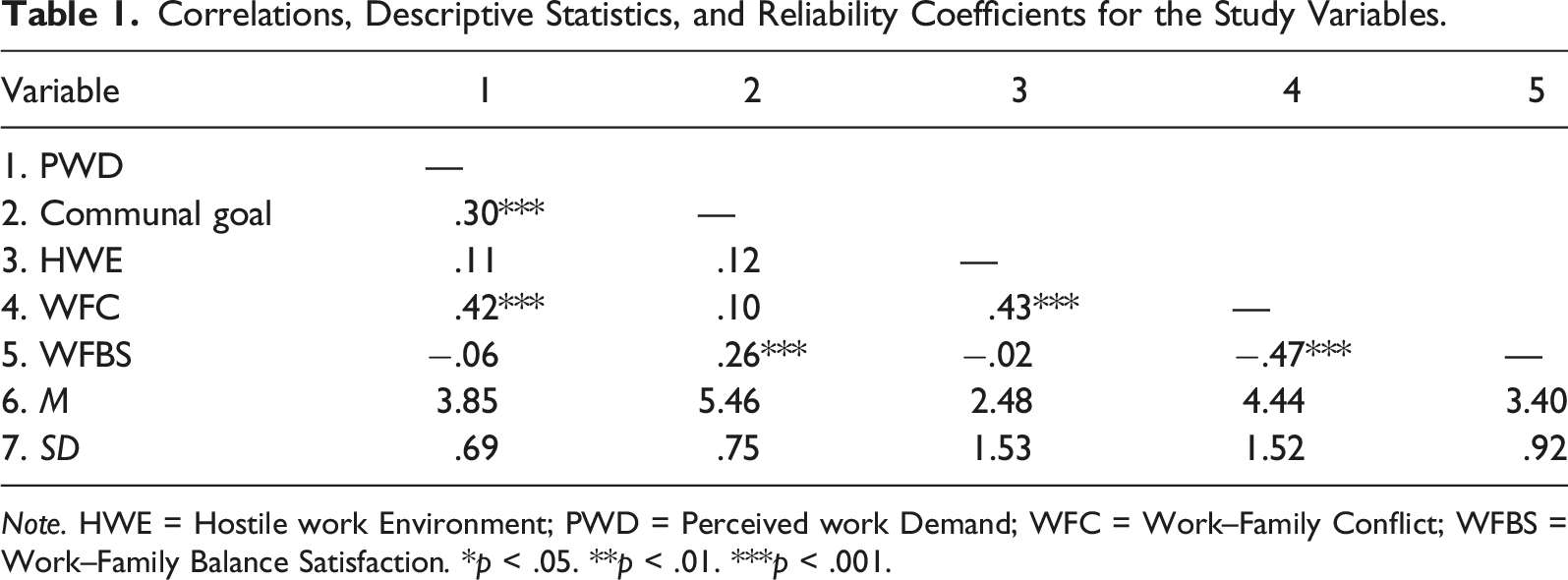
Note. HWE = Hostile work Environment; PWD = Perceived work Demand; WFC = Work–Family Conflict; WFBS = Work–Family Balance Satisfaction. *p < .05. **p < .01. ***p < .001.
Measurement Model
We first tested the measurement model to ensure that the instruments accurately measured the hypothesized constructs. The goodness-of-fit indices were: χ2 (242, N = 282) = 568.99, p < .001; CFI = .93; SRMR = .06; TLI = .92; RMSEA = .07 (90% CI: .062, .077); AIC = 19,741.16; BIC = 20,039.80; and sample-size adjusted BIC = 19,779.78. Thus, all fit indices indicated reasonable fit. Standardized factor loadings ranged from .77 to .82 for work–family balance satisfaction, .63 to .70 for perceived work demand, .56 to .69 for communal goal endorsement, .87 to .92 for workplace and school microaggressions, and .79 to .87 for work–family conflict.
Unconditional Mediation
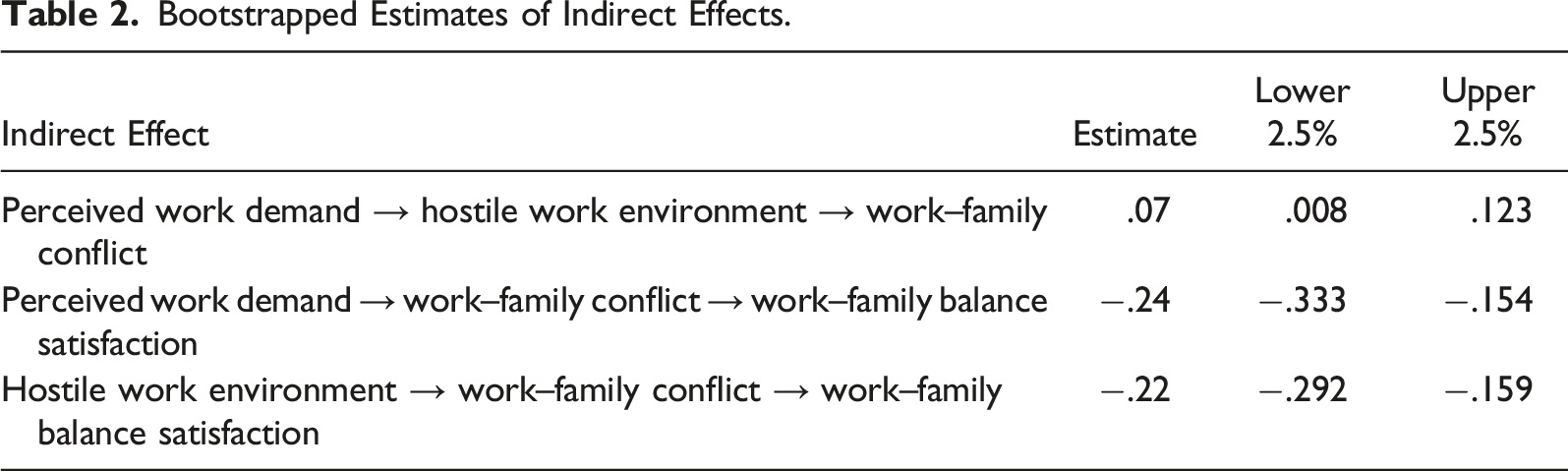
Next, we evaluated the unconditional mediated relationships with communal goals additionally examined as a main effect predictor of work–family conflict. The model was found to fit the data reasonably well, χ2 (245, N = 282) = 629.57, p < .001; CFI = .91; SRMR = .09; TLI = .90; RMSEA = .08 (90% CI: .067, .082); AIC = 19,795.75; BIC = 20,083.46; and sample-size adjusted BIC = 19,832.95. Standardized path coefficients are presented in Figure 1. Perceived work demand was a significant positive predictor of both workplace/school microaggressions (β = .16, p = .028) and work–family conflict (β = .47, p < .001). Workplace/school microaggressions was a significant predictor of work–family conflict (β = .44, p < .001), and work–family conflict was in turn a significant negative predictor of work–family balance satisfaction (β = −.51, p < .001). Communal goal endorsement was found to be a significant negative predictor of work–family conflict (β = −.18, p = .018). Results also revealed significant indirect effects (see Table 2) from perceived work demand to work–family conflict via workplace/school microaggressions (estimate = .07, 95% CI [.008, .123]), from perceived work demand to work–family balance satisfaction via work–family conflict (estimate = −.24, 95% CI [−.333, −.154]), and from workplace/school microaggressions to work–family balance satisfaction via work–family conflict (estimate = −.22, 95% CI [−.292, −.159]). Standardized direct path coefficients for the unconditional mediation model. Note. HWE = hostile work environment; PWD = perceived work demand; WFC = work–family conflict; WFBS = work-family balance satisfaction. Covariances among the constructs are not depicted for simplicity. *p < .05. ***p < .001. Bootstrapped Estimates of Indirect Effects.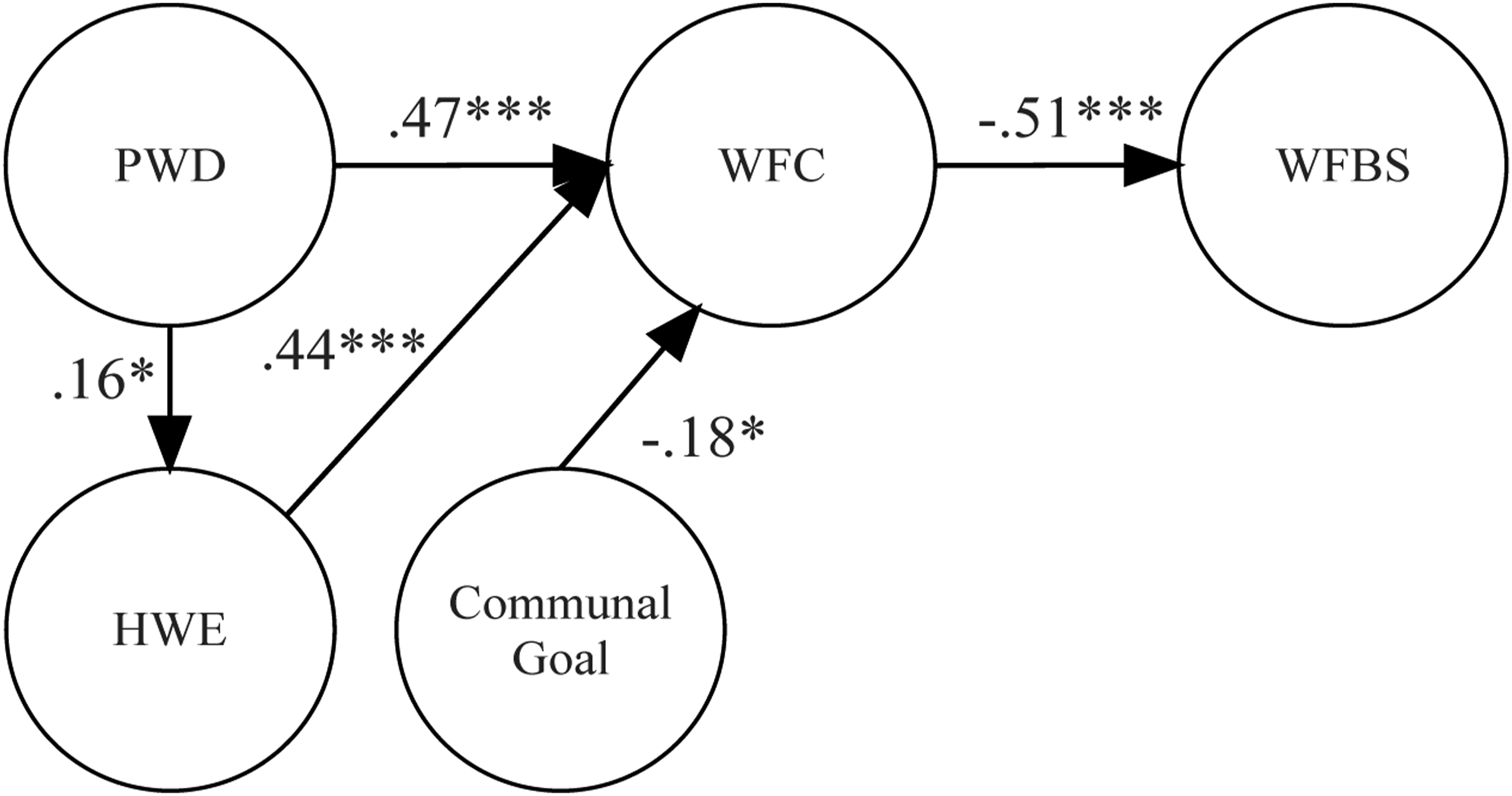
Moderated Mediation
To test the moderated mediation hypothesis we included the communal goal construct as a moderator of the indirect relationship between perceived work demand and work–family conflict and refitted the model to the data. Results yielded an AIC of 19,791.14, a BIC of 20,079.85, and a sample-size adjusted BIC of 19,829.34. The interaction between workplace/school microaggressions and communal goal endorsement in predicting work–family conflict was found to be significant (β = −.09, p = .03), thus supporting our hypothesis. We evaluated the levels at which the indirect effect was significant by estimating the model at 1 SD above and below the mean of the communal goal construct. Standard deviations were computed by deriving the square root of the variance of communal goal endorsement. Results indicated that the indirect effect was significant at low levels of a communal goal endorsement (estimate = .23, p = .03). The indirect effect of work demand on work-family conflict was also significant at high levels of communal goal endorsement, although it was somewhat weaker (estimate = .13, p = .04). Thus, the indirect effect was strongest at low levels of communal goal endorsement but became weaker and eventually the confidence interval subsumed zero as communal goal endorsement scores increased (see Figure 2). Plot of 95% confidence bands for the indirect effect of work demand on work–family conflict at varying levels of communal goal endorsement.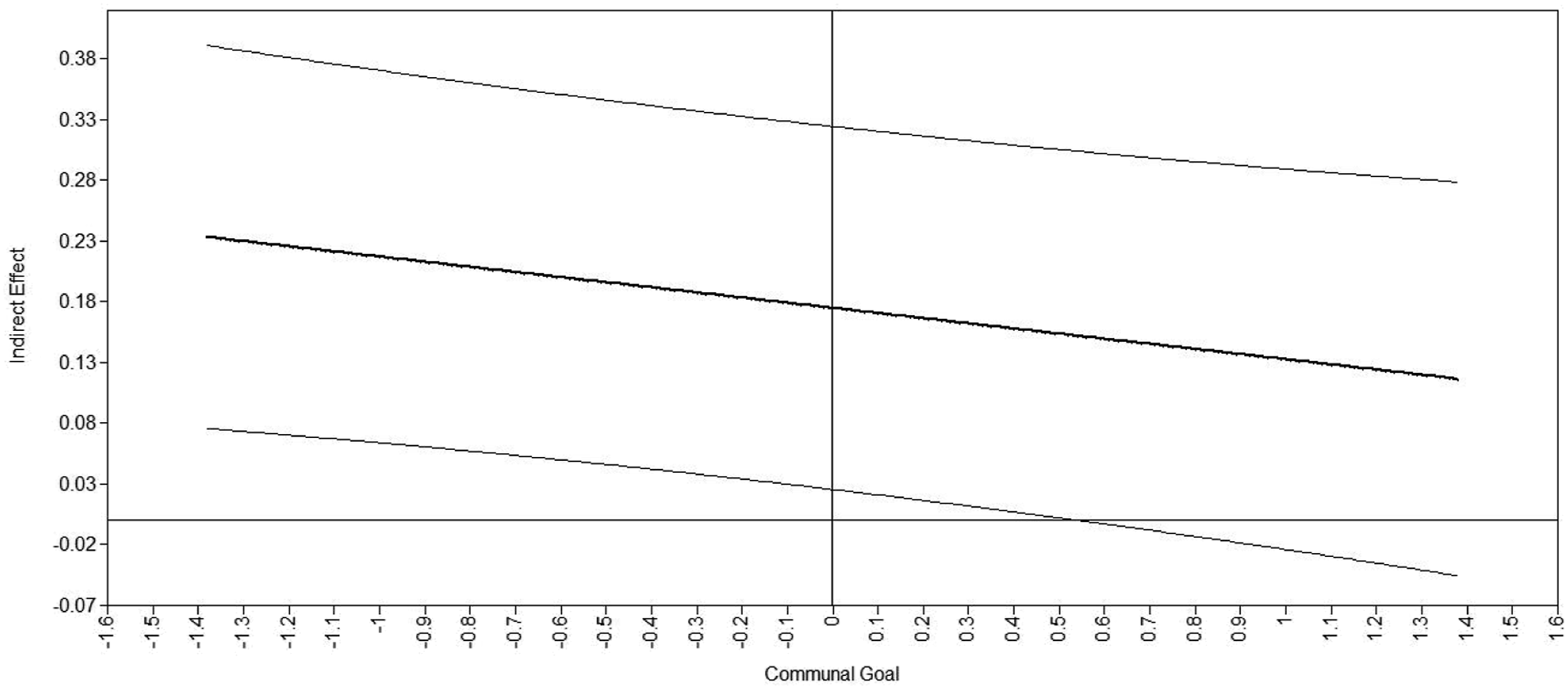
Discussion
Broadly, the goal of the present study was to examine the work-family balance satisfaction experience of racially and ethnically minoritized postdocs in the STEM fields. Specifically, we aimed to examine whether the indirect relationship between work demand and work-family conflict varied as a function of communal goal endorsement. Researchers have identified the importance of communal goals to academic and career development (e.g., Brown et al., 2015; Diekman et al., 2011) and the ways in which academic environments interact with communal goal endorsement (e.g., Soto & Deemer, 2018) among undergraduate students, but researchers have yet to examine the role of this goal type among non-undergraduates and in the context of the work–family interface. The current study also viewed communal goal endorsement as being related to cultural roles that can contribute to role congruity or incongruity, thus extends beyond the primary focus on gender roles in previous role congruity literature.
In support of our hypothesis, the indirect effect between work demand and work-family conflict was significant and strongest at low levels of a communal goal endorsement. This indirect effect gradually became weaker until it was nonsignificant as communal goal endorsement scores increased, thus suggesting that communal goals function as a buffer against deleterious environmental factors. Communal goals may buffer the positive relationship between microaggressions and work–family conflict because minoritized postdocs may find that their work affords them opportunities to make connections with colleagues at work, and the literature indicates that support from co-workers relates to reduced work–family conflict (e.g., Hammer et al., 2004). Furthermore, seeking support from colleagues is one coping mechanism that can be used to address the experience of microaggressions in academia (Constantine et al., 2008). Postdocs who value communion may still find affiliation and connection with colleagues in spite of also facing microaggressions. Their familiarity with the daily experience of microaggressions may mean they have learned to foster strong connections with others by finding ways to cope (e.g., avoidance and self-care) with the experience of stigmatization. In alignment with this explanation, individuals endorsing low communal goals likely place less emphasis on working with others or connecting with others at work, thus they may experience weaker relationships with others. Without strong relationships at work to turn to in the face of microaggressions, postdocs endorsing low communal goals may be more impacted by the experience of microaggressions at work, which exacerbates work–family conflict and reduces their satisfaction with work–family balance. This presents a significant problem for minoritized postdocs because this reduced satisfaction can have a negative spillover effect on overall family well-being (Davis et al., 2008) and cohesion (Stevens et al., 2006), as well as individual family members’ work–family balance satisfaction, health, and well-being (Bakker et al., 2009; Lott & Wöhrmann, 2022).
It is also possible that high communal endorsement buffers the positive relationship between microaggressions and work-family conflict because postdocs may find that their communal values are supported by fewer but more important colleagues at work such as mentors, supervisors, or other colleagues in their research labs. Although postdocs may face microaggressions at work, particular people in their workspace may offer critical support and connection as a means of coping with hostile work environments (Holder et al., 2015). These may be people who do not engage in microaggressions toward minoritized postdocs given that individuals can experience differing levels of racial/ethnic bullying from particular people in the workplace (Fox & Stallworth, 2005). Another possibility includes the chance that postdocs’ high communal goal pursuit is being met through connections outside of work, such as at home with family, through volunteer experiences, or with other social connections. The prompt for the goal endorsement scale in this study did not specifically direct participants to rate each of the goals in the context of their work environment or relationships with colleagues and, instead, was broad. Similarly, Constantine et al. (2008) identified seeking support from friends and family as a coping strategy used by Black faculty members when facing microaggressions. Postdocs who endorsed high communal goals may also find that their work (e.g., research and teaching), instead of the people at their place of work, affords them opportunities to have their high communal goals met. Brown et al. (2015) identified strengths such as positivity toward research and enhanced STEM motivation that emerged when participants endorsed a stronger communal orientation or perceived science as affording communal goals. This points to the idea that STEM and communal goals can co-exist in a beneficial way.
Work–family conflict emerged as a mediator of the relationship between work demand and satisfaction with work-family balance. Work–family conflict also emerged as a mediator of the relationship between workplace and school microaggressions and satisfaction with work–family balance. This finding indicates that increased microaggressions may lead to increased work-family conflict, subsequently resulting in decreased satisfaction with work–family balance, which coincides with literature tying racial bias in the workplace to work–family conflict (e.g., Cole & Secret, 2012). Microaggressions also emerged as a mediator of the relationship between work demand and work–family conflict. This finding indicates that increased work demand contributes to increased perceptions of microaggressions, subsequently resulting in increased work–family conflict. As postdocs face increased work demand, it is likely that colleagues also face increased work demand. Under the stress of increased work demand, colleagues may be more likely to commit microaggressions against minoritized postdocs, which then increases their experiences of work–family conflict. Minoritized postdocs may also interact more with colleagues as they face increased work demand; therefore, there are more opportunities for them to encounter colleagues committing microaggressions.
Implications for Research and Practice
Researchers may wish to further examine a communal goal orientation, paying particular attention to examining the protective nature of high communal values. Questions that researchers might consider include asking in what ways do minoritized postdocs see their work as affording them their communal values? Also, what aspects of the organizational cultures of these work environments engender social support or hostility, and are there particular people postdocs are connecting with at work that align with their communal goals? A mixed-methods approach in which a qualitative inquiry examines which aspects of one’s identity is most relevant within a hostile work environment would be particularly important. baeFuture research could also assess whether working specifically in a STEM career affords minoritized postdocs the opportunity to satisfy their communal goals. Incorporating a measure of goal congruity in addition to a measure of goal affordances would be important in determining whether they experience communal goal congruity in the context of their STEM work environments. Future research could also examine work-family balance satisfaction from a narrowed lens by studying a specific group or examining within group differences among various minoritized groups. Additionally, differences between the three broader racial and ethnic identity groups were not examined in this study, thus future studies could examine differences in work–family balance satisfaction among various minoritized groups. Similarly, future research could also examine gender-based microaggressions that diverse women who are postdocs may face in addition to microaggressions based on race/ethnicity. Such research would be important in examining whether diverse women’s intersecting marginalized identities and the various microaggressions they likely face because of these identities impact their work–family conflict and satisfaction with work–family balance in unique ways.
Results from this study generally highlight that postdocs face workplace struggles that reduce their satisfaction with work-family balance, which could be reasons for seeking counseling, particularly career counseling. Career counseling in particular would allow postdocs to address and explore their experience of work demand, social support, microaggressions, other unsupportive aspects of their work, and work–family conflict. Counselors may wish to capitalize on the malleability of goal affordances or ability to activate goal affordances (Diekman et al., 2011) by encouraging their clients to strengthen connections to colleagues, other postdocs, and other campus social supports such as cultural centers. In addition, counselors may encourage their clients to find ways to infuse their high communal goals into their postdoctoral work in order to continue fostering their high valuation of communion. Counselors working in university counseling centers may also provide psychoeducation and outreach programming centered on topics such as reducing microaggressions in the workplace, self-care, and balancing work and family to programs and departments who employ postdocs.
Limitations and Conclusion
Several limitations to this study should be noted. First, the heterogeneity of racial and ethnic minority participants must be considered given that there are a variety of subgroups within this specified group. African American, Latinx, and Native American individuals were considered as one group of minoritized postdocs, yet more specific racial and ethnic identities can be held (e.g., Mexican American, Puerto Rican, Jamaican, and Cherokee) within the three broader racial and ethnic categories. Second, the heterogeneity of postdoctoral disciplines warrants consideration. Postdocs recruited for this study worked in a wide variety of disciplines due to the National Science Foundation’s (2014) inclusive definition of STEM, which is broad.
In conclusion, findings from the current study demonstrated that minoritized postdocs endorsing high communal goals experienced a reduction in the harmful indirect effects of work demand on work–family conflict, which was in turn associated with greater satisfaction with work–family balance. In the face of microaggressions in the workplace, high valuation of communion serves as a protective factor in coping with workplace stressors such as excessive workloads and racial/ethnic bias. Creating specialized postdoctoral organizations could help minoritized postdocs create solutions to address and minimize the experience of microaggressions in their workplace.
Footnotes
Acknowledgment
We wish to thank Michael Lotz for his editorial assistance with this manuscript.
Authors’ Note
Materials and analysis code for this study are available by emailing the corresponding author. This study was not preregistered.
Declaration of Conflicting Interests
The author(s) declared no potential conflicts of interest with respect to the research, authorship, and/or publication of this article.
Funding
The author(s) received no financial support for the research, authorship, and/or publication of this article.
