






Abstract
Despite the well-known benefits of work–family balance self-efficacy (WFBSE), little is known about its predictors. This study addresses this gap by examining predictors of WFBSE (enacted and vicarious experiences in multiple role management), the relative strength of predictors, and a moderator (parent-child closeness) that facilitates vicarious learning. Dyadic survey data were collected in Singapore from 108 emerging adults (Mage = 21.8, SDage = 1.51 years) and their same-gender parents. Results from hierarchical regression analyses suggest that emerging adults’ work-school conflict (enacted failure) and parental work-to-family conflict (observed failure) were negatively associated with WFBSE. Dominance analysis supported the hypothesis that mastery experience is a stronger predictor of WFBSE than vicarious experience is. As expected, perceived parental work-to-family conflict had a stronger negative relationship with WFBSE among emerging adults who reported higher parent–child closeness. Implications for future research on emerging adults’ WFBSE and career development practice are discussed.
Keywords
Introduction
Work–family balance (WFB) continues to be frequently discussed in academia and in public arenas (e.g., Casper et al., 2018; Khazan, 2019), with a prevailing theme that many desire but few enjoy WFB (Vengapally, 2019). Given the challenges associated with obtaining WFB, it is critical to identify factors that facilitate it. In this regard, research has found that high self-efficacy in balancing work–family roles (i.e., work–family balance self-efficacy; WFBSE) is beneficial for successful work–family management (e.g., Cho et al., 2022; Lapierre et al., 2016). Thus, increasing WFBSE could be an effective way to help individuals achieve WFB.
Despite the importance and benefits of WFBSE, little is known about its predictors. As the first study exploring predictors of WFBSE, the current study addresses this critical gap in the literature. Based on the social cognitive career theory (SCCT; Lent et al., 1994) and the work–family literature, this study examines mastery experiences (work-school conflict/enrichment) and vicarious learning (parental work-to-family conflict/enrichment) concerning multiple role management as predictors of anticipated WFBSE among emerging adults. Further drawing on SCCT, this study also investigates the relative strength of the antecedents and a moderator that alters the impact of vicarious learning (parent–child closeness; Barry et al., 2008). With the focus on emerging adults (i.e., individuals aged 18 to 25; Arnett, 2000), this study responds to the calls for more research to inform an early intervention targeted to young adults whose work–family-related attitudes and plans are still malleable (Basuil & Casper, 2012; Cinamon, 2006). Emerging adulthood, the developmental stage that comes after adolescence and before adulthood, is a unique stage during which individuals explore various possibilities in career and intimate relationships (Arnett, 2000). A better understanding of factors predicting WFBSE during this stage is critical as WFBSE may influence career aspirations and family planning (Basuil & Casper, 2012; Cinamon, 2010). By delving into the relative strength of multiple predictors of WFBSE and identifying a moderator that amplifies vicarious learning, this research offers practical knowledge that could help create more effective and parsimonious interventions to support emerging adults in building their WFBSE and preparing for challenges ahead.
Benefits of Work–Family Balance Self-Efficacy
Self-efficacy is a major component of SCCT (Lent et al., 1994), which is a well-established theoretical framework for examining individual and contextual factors that shape career development (Lent & Brown, 2019). SCCT builds on social cognitive theory (SCT; Bandura, 1986, 1997), which emphasizes the importance of self-referent thought and human agency in overcoming obstacles and striving toward goals. Self-efficacy refers to our belief in our own ability to successfully perform a specific behavior (Bandura, 1997); by extension, WFBSE refers to our belief in our own ability to successfully balance work and family roles (Basuil & Casper, 2012). According to SCT and SCCT, self-efficacy is critical for goal pursuit because it influences our motivation, affects, and behaviors; when we believe we can execute behaviors that produce desired outcomes, we tend to have higher motivation, remain focused, and persist through difficulty (Bandura, 1997; Lent et al., 1994).
Previous empirical research has documented the benefits of WFBSE. For instance, working adults with higher WFBSE tended to report higher WFB (Chan et al., 2016). A longitudinal study found that blurred role boundaries due to involuntary telework arrangements did not increase work–family conflict for individuals with higher WFBSE (Lapierre et al., 2016). WFBSE was also beneficial in a crisis context, such that WFBSE predicted higher WFB during the lockdown imposed in Singapore during the COVID-19 pandemic among individuals who juggle paid work and eldercare (Cho et al., 2022). Among emerging adults, WFBSE was positively associated with the knowledge of and commitment to future work–family role planning (Basuil & Casper, 2012), while incrementally predicting career commitment beyond career-related self-efficacy (Myers & Major, 2017). Emerging adults with high self-efficacy for managing work–family conflict also tended to anticipate lower work–family conflict (Cinamon, 2006). In sum, the theory and empirical evidence highlight the benefits of WFBSE and point to the need to better understand the predictors of WFBSE.
Sources of Work–Family Balance Self-Efficacy
SCCT posit that self-efficacy is formed via exposure to direct (personal accomplishments) and vicarious (observed learning) experiences (Lent et al., 1994). Personal and observed successes raise self-efficacy, whereas personal and observed failures lower it. Also, one’s past performance or observation of a task may affect self-efficacy in similar tasks. Studies have supported the proposition that personal mastery and vicarious learning predict self-efficacy in the academic domain (e.g., science self-efficacy, Britner & Pajares, 2006; for reviews, see Byars-Winston et al., 2017; Sheu et al., 2018).
Building on SCCT (Lent et al., 1994), firsthand successes and failures in managing multiple roles are proposed as important sources of anticipated WFBSE among emerging adults. Substantial numbers of emerging adults simultaneously manage worker and student roles (e.g., The U.S. National Center for Education Statistics, 2017 2017), which working students often consider the most crucial life domains (McNall & Michel, 2011). More importantly, emerging adults’ experiences in managing work and school are akin to working adults’ experiences in managing work and family (Choo et al., 2019). On the one hand, emerging adults experience work-school conflict (WSC), which occurs when experiences in one role (work or school) hinder performance in the other role. For instance, emerging adults may realize that they are not studying enough because of work or that they cannot concentrate on job tasks due to fatigue from academic work. WSC represents a failure in managing multiple roles and resembles work–family conflict among working adults (i.e., experiences in work or family make it difficult to fulfill demands in the other role; Greenhaus & Beutell, 1985). Given that WSC signals that emerging adults are not effectively handling demands from multiple roles, emerging adults may think that they will be unable to balance work and family in the future. On the other hand, emerging adults experience work-school enrichment (WSE), which occurs when experiences in one role (work or school) facilitate performance in the other role. For example, emerging adults may experience that knowledge learned from school benefits their work performance or work experiences energize them to do better in school. WSE represents a success in managing multiple roles and resembles work–family enrichment among working adults (i.e., experiences in work or family improve performance in the other role; Greenhaus & Powell, 2006). As WSE indicates that emerging adults are excelling in their management of multiple roles, emerging adults may feel confident that they can effectively manage work and family roles in the future. In short, emerging adults’ WSC and WSE should predict their WFBSE.
Further drawing on SCCT (Lent et al., 1994), parents’ successes and failures in managing work and family roles, a source of vicarious learning, are posited to predict emerging adults’ WFBSE. As emerging adults are unlikely to observe how family influences parents’ work (Sallinen et al., 2004), the source of vicarious learning would be parental work–family experiences in the work-to-family direction. On the one hand, emerging adults who observe their parents experiencing work-to-family conflict are likely to think that they too may experience difficulties in managing work and family roles, and thus report lower anticipated WFBSE. On the other hand, emerging adults who observe their parents experiencing work-to-family enrichment may think that they too can successfully handle work and family roles, thus report higher anticipated WFBSE. As in previous research (e.g., Basuil & Casper, 2012), the current study examines same-gender parents—parents whose gender identity (internal understanding of their own gender) is the same as that of emerging adults children—as role models because vicarious learning is more likely to occur when a role model is similar to an observer.
Emerging adults’ WSC/WSE is negatively/positively associated with anticipated WFBSE.
Parents’ work-to-family conflict/enrichment is negatively/positively associated with emerging adults’ anticipated WFBSE.
Relative Strength of Sources of Work–Family Balance Self-Efficacy
SCCT emphasizes that individuals interpret and integrate multiple sources of information in ways that shape their self-efficacy and that sources of information differ in terms of their influence on self-efficacy (Lent et al., 1994). In particular, mastery experiences are considered the most salient source of self-efficacy because personally enacted experiences tend to intensely affect self-efficacy. Considered less informative than firsthand experience, vicarious learning can still be a critical source of self-efficacy for behaviors that are not readily practiced (Bandura & Walters, 1977). To date, a few studies concurrently investigated multiple predictors of self-efficacy (e.g., Britner & Pajares, 2006; Warner et al., 2014), and their findings suggest that mastery experiences indeed tend to be a stronger source of self-efficacy. Evidence from meta-analyses on the sources of academic self-efficacy also reiterates that mastery experiences are the most potent predictor (Byars-Winston et al., 2017; Sheu et al., 2018). Based on SCCT and available empirical evidence, emerging adults’ own success and failure experiences in multiple role management are proposed to be stronger predictors of WFBSE than perceived parental success and failure experiences in work–family management.
Compared with vicarious learning (parental work-to-family conflict/enrichment), mastery experiences (WSC/WSE) are a stronger predictor of anticipated WFBSE among emerging adults.
Moderator of the Link between Vicarious Learning and Work–Family Balance Self-Efficacy
Various factors may qualify the potency of vicarious learning to shape self-efficacy, such as the perceived similarity between the role model and the observer and the quality of the information obtained from observation (Bandura, 1997). In this study, parent–child closeness is proposed to moderate the relationship between perceived parental work–family experiences and emerging adults’ WFBSE. Parent–child closeness reflects warmth, attachment, and the regard a child has for the relationship with a parent (Barry et al., 2008; Peisah et al., 1999). Parent–child closeness is an important contextual variable that may affect emerging adults’ vicarious learning from their parents, as observers’ interpersonal attraction and emotional attachment to their role model are known to catalyze vicarious learning (Bandura, 1997; Pajares & Usher, 2008). Supporting this notion, several studies showed that emerging adults’ perceptions of parental work experiences and attitudes have a stronger relationship with their own experiences and attitudes among those who feel close to and identify with their parents (e.g., Barling et al., 1998, 1999; Kelloway et al., 1996). Previous research also found that parental impact on self-efficacy increases as the parent–child relationship becomes closer (e.g., Lombe et al., 2009).
Based on SCCT and empirical evidence, parent–child closeness is proposed to moderate the relationship between emerging adults’ perceptions of their same-gender parents’ work-to-family conflict/enrichment and their own anticipated WFBSE. Specifically, emerging adults who feel close to and strongly identify with their same-gender parents might be more strongly affected by their observation of parental work–family experiences, because they relate to their parents’ experiences and appraise vicarious experiences as more relevant to themselves. In contrast, the relationship between perceived parental work–family experiences and emerging adults’ WFBSE might be weaker when emerging adults feel distant from or do not identify with their same-gender parents, because they may not necessarily think their future experiences will be similar to their parents’ experiences.
Parent–child closeness moderates the relationship between perceived parents’ work-to-family conflict/enrichment and emerging adults’ anticipated WFBSE, such that the relationship is stronger for emerging adults who report more parent–child closeness than for those who report less parent–child closeness.
Methods
Participants and Procedure
The study protocol was approved by the Institutional Review Board of a university in Singapore (IRB-2018–06–014). Survey data were collected in Singapore from 108 dyads consisting of a college student (i.e., an emerging adult) and his/her same-gender working parent. A priori power analysis (conducted using the G*Power 3.1.9.6) suggested a minimum sample size of 87, with the desired power of .85 and a medium effect size. Data collection was completed between 2018 and 2019, prior to the global COVID-19 pandemic. College students who worked part-time during the academic semester and whose same-gender parent was currently working were recruited via research participant pool in the psychology department, online recruitment (e.g., Facebook, WhatsApp), and snowball sampling. After completing an online survey, student participants submitted their parent’s contact information, through which a link for an online survey was sent to the parent. Participating students were granted either one research credit or 5 SGD (approximately US$3.5). Participating parents received 5 SGD.
The majority of the sample were female (i.e., mother–daughter dyads, 73.1%) and of Chinese ethnicity (91.7%). On average, students were 21.8 years old (SD = 1.51) and worked 9.6 hours per week (SD = 7.08). About half of the students were living off-campus at home (54.6%). On average, parents were 53.4 years old (SD = 4.82), worked 40.8 hours per week (SD = 14.85), and had 1.73 children (SD = .88). About one-third of parents (29.9%) had a high school degree, followed by a bachelor’s degree (19.6%), a vocational diploma (19.6%), primary education only (15.9%), and a graduate degree (6.5%).
Measures
The surveys were in English. All items used a 5-point Likert scale (1 = strongly disagree to 5 = strongly agree). An average score for each variable was used for analyses.
Anticipated Work–Family Balance Self-Efficacy (Emerging Adult)
The WFBSE measure from Basuil and Casper (2012) was used. Basuil and Casper (2012) reported the scale to be reliable (α = .75). When responding, emerging adults were asked to think about the future when they have a full-time job and their own family. An example item is “I can be effective at balancing work and family roles.” The internal consistency in the present study was.76.
Work-School Conflict (Emerging Adult)
Work-school conflict was measured using the work–family conflict scale (Carlson et al., 2000). Carlson et al. (2012) reported a Cronbach’s α of .93 for the work-to-family direction and .95 for family-to-work direction. Items were modified by replacing “family” with “school” (e.g., “The amount of time my job takes up makes it difficult to fulfill school responsibilities.”). The Cronbach’s α in the present study was .93.
Work-School Enrichment (Emerging Adult)
The work–family enrichment scale (Carlson et al., 2006) was modified by replacing “family” and “family member” with “school” and “student"(e.g., “My involvement in my work makes me cheerful and this helps me be a better student.”). Carlson et al. (2006) reported a Cronbach’s α of .92 for this scale. The Cronbach’s α in the present study was .93.
Perceived Parental Work-to-Family Conflict (Emerging Adult)
Similar to previous research (Basuil & Casper, 2012), items from the work-to-family conflict scale (Netemeyer et al., 1996) were slightly modified to assess perceived parental experiences (e.g., “the demands of my parent’s work interfere with his/her home and family life.”). Cronbach’s α of this scale reported in Basuil and Casper (2012) was .95. The Cronbach’s α in the present study was .87.
Perceived Parental Work-to-Family Enrichment (Emerging Adult)
Items from the work-to-family enrichment scale (Wayne et al., 2006) were modified to assess perceived parental experiences (e.g., “Having a good day at work makes my parent a better family member when s/he gets home”). Cronbach’s α of this scale reported in Wayne et al. (2006) was .82. The Cronbach’s α in the present study was .64.
Parent–Child Closeness (Emerging adult)
The “regard” subscale from the parent–adult child relationship questionnaire was used, which assesses how close an adult child is to their parents (Peisah et al., 1999). When responding, participants were asked to think of their same-gender parent. A sample item is “I respect my mother’s/father’s opinion.” Cronbach’s α of this scale reported in Ayalon and Segel-Karpas (2022) was .92. The Cronbach’s α in the present study was .79.
Work-to-Family Conflict (Parent)
Parents completed the work-to-family conflict scale (Netemeyer et al., 1996). A sample item is “The amount of time my job takes up makes it difficult to fulfill family responsibilities.” Netemeyer et al. (1996) found the scale to be reliable across samples (Cronbach’s α ranging from .88 to .89). The Cronbach’s α in the present study was .88.
Work-to-Family Enrichment (Parent)
Parents responded to the work-to-family enrichment scale (Wayne et al., 2006). A sample item is “Having a successful day at work puts me in a good mood to better handle my family responsibilities.” Cronbach’s α of this scale reported in Wayne et al. (2006) was .82. The Cronbach’s α in the current study was .72.
Demographic Information
Gender, age in years, ethnicity, and work hours per week were measured from all participants. Students indicated their current living situation; parents indicated marital status, the highest education completed, and the number of children. Demographic variables that may correlate with study variables were considered as potential control variables (e.g., gender, Coyle et al., 2015).
Analytic Approach
Tests for normality suggested that data met normality assumptions, indicated by skewness and kurtosis values within the acceptable range (skewness less than |2| and kurtosis below |3|; Tabachnick & Fidell, 2012). Potential multicollinearity was addressed by using mean-centered predictor variables (Aiken & West, 1991). Hierarchical regression was conducted to test Hypotheses 1, 2, and 4. For moderation analysis, interaction terms were created, with parental work-to-family conflict/enrichment (emerging adults’ appraisal) as predictor variables and parent–child closeness as a moderator (Aiken & West, 1991). Simple slope analysis was conducted for significant interaction. Hypothesis 3 was tested using dominance analysis that demonstrates each predictor’s relative contribution to total R2 (Azen & Budescu, 2003; Budescu, 1993). In line with theories that emphasize individuals’ subjective interpretation of mastery and vicarious experiences (Bandura, 1997; Lent et al., 1994; Sheu et al., 2018), the dominance analysis included emerging adults’ perceptions of WSC and WSE as well as perceptions of parental work-to-family conflict and enrichment. All possible subsets using these four predictors were created for regression (e.g., a regression model with WSC, with WSC and WSE, with WSC, WSE, and perceived parental work-to-family conflict, etc.); a total of 15 regression models were estimated. R2 values from these analyses were used to estimate the general dominance of each predictor.
Results
Descriptive Statistics and Correlations among Study Variables.
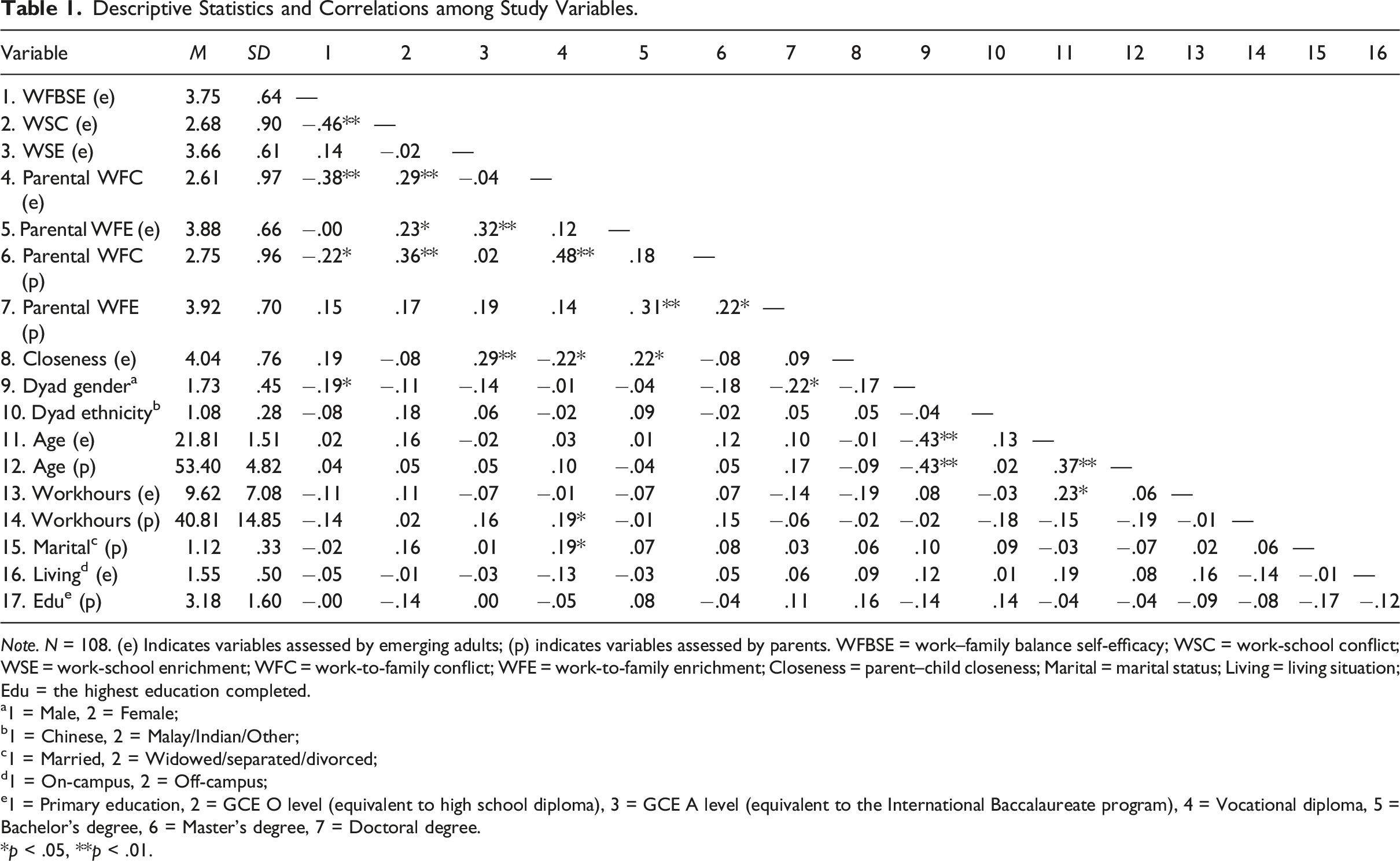
Note. N = 108. (e) Indicates variables assessed by emerging adults; (p) indicates variables assessed by parents. WFBSE = work–family balance self-efficacy; WSC = work-school conflict; WSE = work-school enrichment; WFC = work-to-family conflict; WFE = work-to-family enrichment; Closeness = parent–child closeness; Marital = marital status; Living = living situation; Edu = the highest education completed.
a1 = Male, 2 = Female;
b1 = Chinese, 2 = Malay/Indian/Other;
c1 = Married, 2 = Widowed/separated/divorced;
d1 = On-campus, 2 = Off-campus;
e1 = Primary education, 2 = GCE O level (equivalent to high school diploma), 3 = GCE A level (equivalent to the International Baccalaureate program), 4 = Vocational diploma, 5 = Bachelor’s degree, 6 = Master’s degree, 7 = Doctoral degree.
*p < .05, **p < .01.
Hypothesis 1 proposed emerging adults’ work-school experiences as a source of their anticipated WFBSE. Supporting Hypothesis 1a, emerging adults’ WSC was negatively associated with WFBSE (β = −.48, p < .001). Contrary to Hypothesis 1b, emerging adults’ WSE was not significantly associated with WFBSE (β = .10, p = .25).
Hypothesis 2 proposed parents’ work–family experiences as a source of WFBSE anticipated by emerging adults. Hypothesis 2a concerning parents’ work-to-family conflict was supported (β = −.29, p < .01), whereas Hypothesis 2b regarding parents’ work-to-family enrichment was not supported (β = .17, p = .08). Results are shown in Table 2 (Models 1 and 2).
Regression Results Examining Predictors (Mastery and Vicarious Learning) and a Moderator (Parent–Child Closeness) on Emerging Adults’ Work–Family Balance Self-Efficacy.
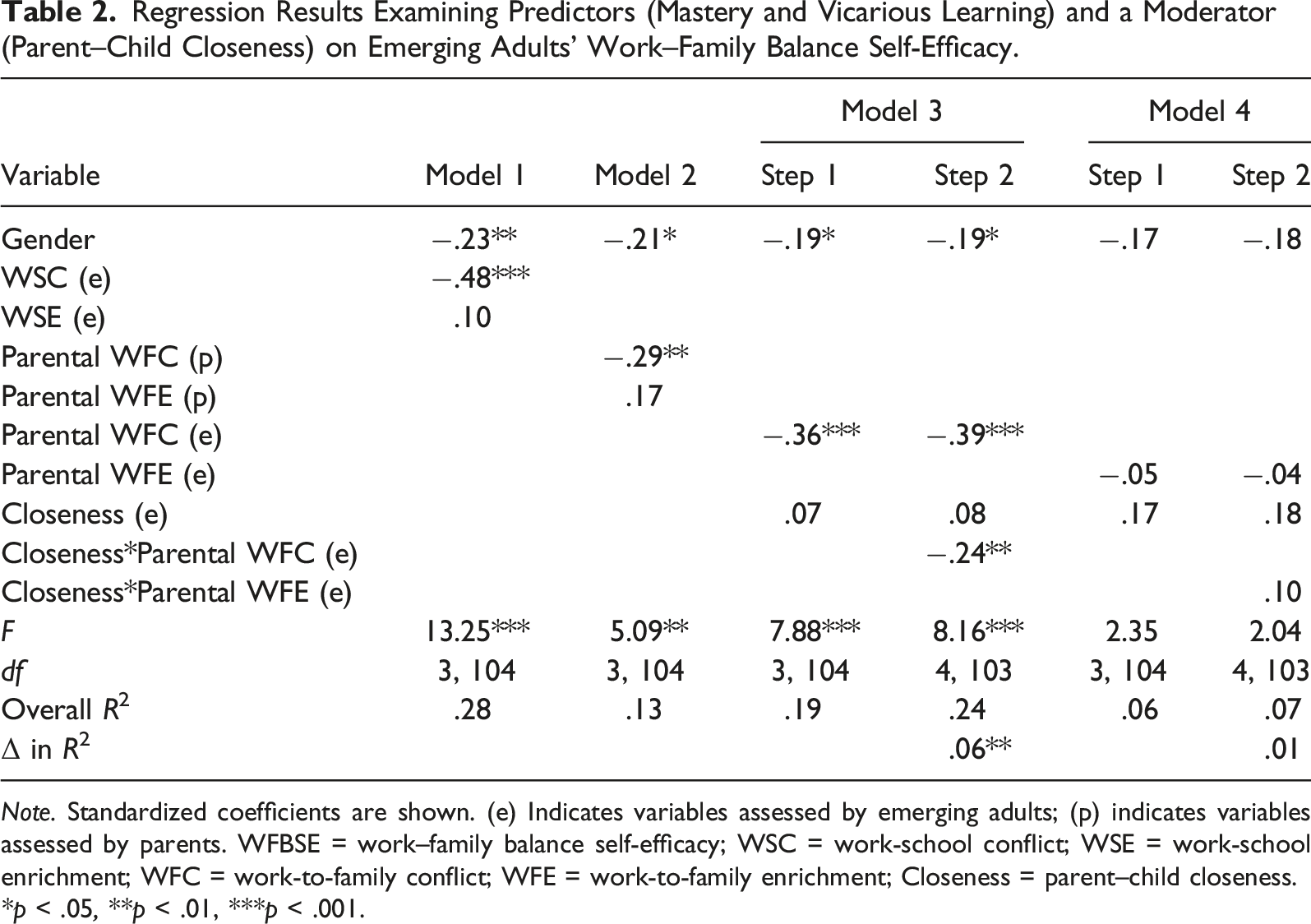
Note. Standardized coefficients are shown. (e) Indicates variables assessed by emerging adults; (p) indicates variables assessed by parents. WFBSE = work–family balance self-efficacy; WSC = work-school conflict; WSE = work-school enrichment; WFC = work-to-family conflict; WFE = work-to-family enrichment; Closeness = parent–child closeness.
*p < .05, **p < .01, ***p < .001.
Hypothesis 3 proposed that mastery experiences are a stronger predictor of anticipated WFBSE than vicarious learning. Results of the dominance analysis supported Hypothesis 3, as mastery experiences contributed to R2 more (63.71%) than vicarious learning did (36.29%). Results are shown in Table 3.
Results of Dominance Analysis Comparing Mastery Experiences and Vicarious Learning.
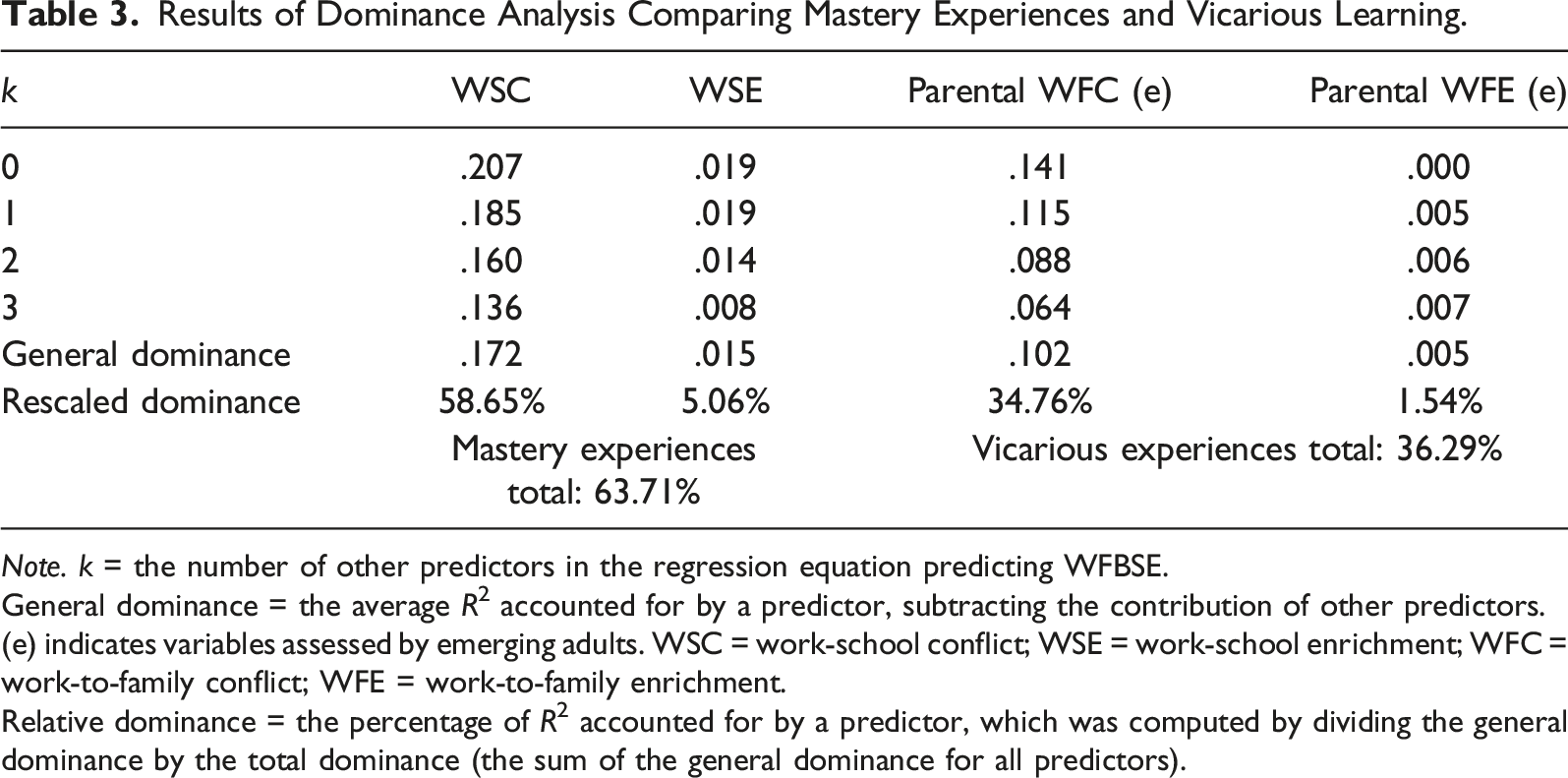
Note. k = the number of other predictors in the regression equation predicting WFBSE.
General dominance = the average R2 accounted for by a predictor, subtracting the contribution of other predictors.
(e) indicates variables assessed by emerging adults. WSC = work-school conflict; WSE = work-school enrichment; WFC = work-to-family conflict; WFE = work-to-family enrichment.
Relative dominance = the percentage of R2 accounted for by a predictor, which was computed by dividing the general dominance by the total dominance (the sum of the general dominance for all predictors).
Hypothesis 4 proposed that parent–child closeness moderates the relationship between parents’ work–family experiences (emerging adults’ appraisal) and emerging adults’ WFBSE. Supporting Hypothesis 4a, parent–child closeness interacted with emerging adults’ perception of parental work-to-family conflict in predicting WFBSE (β = −.24, p < .01). As Figure 1 shows, the negative relationship between perceived parental work-to-family conflict and WFBSE was significant among emerging adults who reported greater closeness with their same-gender parent (β = −.39, p < .001), whereas the relationship was not significant among emerging adults who reported less closeness with their parent (β = −.13, p = .10). Hypothesis 4b was not supported, as parent–child closeness did not interact with perceived parental work-to-family enrichment in predicting WFBSE (β = .10, p = .30). Results appear in Table 2 (Models 3 and 4).

Interaction of perceived parental work-to-family conflict on WFBSE as a function of parent
Discussion
Understanding the determinants of self-efficacy is important given its prominent role in SCCT (Lent & Brown, 2019). Although evidence on the benefits of WFBSE has accumulated, predictors of WFBSE have received scant research attention. The current study addressed this gap in the literature. Using SCCT as the guiding framework, this study investigated two major sources of WFBSE (emerging adults’ personal WSC/WSE, parental work-to-family conflict/enrichment), tested the relative contribution of the two sources of WFBSE, and examined a moderator (parent–child closeness) that may alter the potency of vicarious learning. All in all, this study makes important contributions to the literature by testing the core tenets of SCCT in the work–family context.
Consistent with hypotheses guided by SCCT (Lent et al., 1994), both enacted and vicarious experiences in multiple role management predicted WFBSE. Further confirming earlier research findings on other domain-specific self-efficacy perceptions (e.g., Britner & Pajares, 2006; Byars-Winston et al., 2017; Sheu et al., 2018), emerging adults’ mastery experiences in multiple role engagement were a stronger predictor of their anticipated WFBSE than vicarious learning through observing their parents’ work–family experiences. The findings suggest that mastery experience in a similar task (i.e., managing work and school) may still be a superior source of self-efficacy even when an observer has limited firsthand experiences with a target task (i.e., managing work and family). The reason may be that emerging adults appraise their current multiple role management involving work and school to be similar to their future balancing of work and family. In this sense, this research lends support to the notion that multiple role management during emerging adulthood involving work and school resembles work–family management during adulthood (Choo et al., 2019).
Interestingly, findings suggest that failure experiences in emerging adults and in their role models (inter-role conflict) were associated with lower WFBSE, whereas both enacted and observed success (inter-role enrichment) did not significantly relate to WFBSE. The null relationship between success in multiple role management and WFBSE contradicts the expectation. One explanation for the consistent pattern observed across the two sources might be negativity bias: that negative experiences tend to be more powerful in changing various outcomes than are positive experiences of the same type (for review, see Baumeister et al., 2001). Previous research found that individuals are more sensitive to negative performance feedback when updating their beliefs about their own abilities (e.g., Müller-Pinzler et al., 2019). Similarly, negative affective states (vs. positive affective states) had a stronger impact on self-efficacy for physical activity among older adults (Warner et al., 2014). In sum, the current study expands the growing literature on WFBSE by revealing that among multiple sources of WFBSE, enacted failures may be particularly detrimental to emerging adults’ WFBSE.
As hypothesized, parent–child closeness moderated the link between perceived parental work-to-family conflict and WFBSE, such that the negative association was significant only among emerging adults who felt close to their same-gender parents. Notably, parent–child closeness did not interact with perceived parental work-to-family enrichment to predict WFBSE, which might be due to the minimum variance explained by perceived parental work-to-family enrichment, the predictor itself. The observed significant interaction bolsters the notion that interpersonal attraction and emotional attachment between an observer and a role model facilitate vicarious learning (Bandura, 1997; Pajares & Usher, 2008). Building on this finding, further research is warranted to identify underlying mechanisms for such facilitation. For instance, emerging adults close to their same-gender parents may have more opportunities for modeling via frequent and open communications (i.e., different degrees of access to vicarious experiences). Also, the meaning and relevance of observations might be amplified among these emerging adults because they strongly identify with their role models and see their future in their role models (i.e., differential interpretation of vicarious experiences). Such knowledge may be useful in preventing reduced WFBSE among emerging adults who vicariously experience failures.
The present study extends the stream of research demonstrating the crucial role of parents in child development. A close parent–child relationship is essential to social learning (Padilla-Walker & Nelson, 2019), and parents continue to influence the development of offspring’s self-efficacy into emerging adulthood (Schunk & Meece, 2006). For example, parents’ job insecurity was related to career-specific parenting behaviors, which in turn predicted emerging adults’ career self-efficacy (Zhao et al., 2012). Working parents’ impact on offspring is also well-documented in the work–family literature; various aspects of parents’ work, such as employment history (Barnett et al., 2003) and negative work–family experience (Basuil & Casper, 2012), have been shown to explain emerging adults’ work–family outcomes (for review, see Cho & Ciancetta, 2016). The current study corroborates these findings and invites more research to examine parents’ work experiences as a key developmental context for emerging adults.
Implications for Career Development Practice
This research has valuable implications for career development practice. Previous findings on the association of WFBSE with career and family planning outcomes (Basuil & Casper, 2012; Cinamon, 2010) highlight that individuals’ malleable personal belief in their ability to achieve WFB should be an essential part of career guidance. The current study offers practical insights for career counselors to understand why some emerging adults may have lower WFBSE and how to support them to increase their WFBSE. Given that emerging adults’ WSC was the chief factor explaining their anticipated WFBSE, it is imperative to help minimize such conflict. Career counselors may start with assessing emerging adults’ anticipated WFBSE and inquire about the multiple roles they currently manage. For emerging adults who experience WSC, career counselors could assist them in identifying underlying reasons by asking about key known predictors of WSC, such as excessive role demands or lack of interpersonal support at work and school (Choo et al., 2019). Also, the significant relationship between parental work-to-family conflict and WFBSE emphasizes the importance of viewing emerging adults within the broader family context in which they are embedded. Career counselors might ask emerging adults about their perceived closeness to their parents and parental work-to-family conflict to better understand their WFBSE. As the findings show, perception and interpretation of the same-gender parent’s work–family conflict may be a particularly valuable topic for career counselors to delve into when interacting with clients who strongly identify with their parent.
Together, findings from the current study could be used to create an educational intervention for emerging adults to facilitate the development of WFBSE (cf. recovery self-efficacy training; Hahn et al., 2011). Such interventions may introduce the concept of WFBSE, invite emerging adults to reflect on past experiences in managing multiple roles and practice skills for managing multiple roles (e.g., time management, scheduling, stress management, etc.), and discuss their perception of parental work–family experiences and interact with peers to learn how others effectively balance demands from multiple roles.
Limitations and Future Research Directions
This study has several limitations. First, although the hypotheses were solidly grounded in SCCT, a causal conclusion cannot be drawn from the current study due to its cross-sectional design. The reliability of emerging adults’ perception of parental work-to-family enrichment was lower than the conventional cutoff of .70 (Nunnally, 1978). Gender was assessed as binary sex assigned at birth. Future research should adopt a more fine-grained measure of gender to examine whether and how gender characteristics (identity, expression, social and cultural expectations; National Academies of Sciences, Engineering, and Medicine, 2022) may shape the development of emerging adults’ WFBSE. This study used a convenience sample of emerging adults who were working during academic terms, thus, the findings may not be generalizable. Future research should use a more heterogeneous sample to explore whether and how the sources of WFBSE differ across emerging adults in different social and economic circumstances. Next, future longitudinal research may consider temporal dimensions when examining predictors of WFBSE. For instance, it would be worthwhile to examine the frequency of contact between the dyads (e.g., if more frequent contact amplifies vicarious learning) or the timing of certain experiences (e.g., if an initial failure has a stronger impact, Bandura, 1997) as moderators in the relation between the predictors and WFBSE. Last, data collection for this study was conducted prior to the COVID-19 pandemic. Given the drastic changes in employment, family, and careers due to the pandemic (Autin et al., 2020), future research is warranted to identify predictors of emerging adults’ sense of their future WFBSE in the post-pandemic era.
Conclusion
With a majority of young adults planning to have both a career and a family (Coyle et al., 2015), the importance and relevance of WFBSE are greater than ever before. The current study expands the literature on WFBSE by investigating two major sources of WFBSE, examining the relative strength of the two sources, and exploring a condition that facilitates vicarious learning. Results from dyadic data showed that both enacted and observed failure in multiple role engagement are significant predictors of WFBSE and that enacted failure was a stronger source of WFBSE. Emerging adults who feel closer to their same-gender parents were more strongly affected by perceived parental work-to-family conflict. Unexpectedly, both enacted and observed success in multiple role engagement did not predict WFBSE. The current research provides foundational knowledge regarding the origins of WFBSE and calls for more actions to support emerging adults.
Footnotes
Acknowledgement
An earlier version of this article was presented at the 2020 Crimson Conference on Work and Family, Tuscaloosa, AL, USA. I would like to thank Yuning Ng and Celine Ong for their help on data collection.
Declaration of Conflicting Interests
The author(s) declared no potential conflicts of interest with respect to the research, authorship, and/or publication of this article.
Funding
The author(s) received no financial support for the research, authorship, and/or publication of this article.
